268
COMPETENCES AND JOB OPPORTUNITIES OF ORGANIC MEDICINAL
AND AROMATIC PLANTS DOMAIN DEVELOPED BY
HERBAL.MEDNET PROJECT
TOADER MARIA1, ROMAN GH. V1., ALINA MARIA IONESCU1, MIHALACHE M1., BĂŞA A.GH1., LENUŢA IULIANA EPURE1
, ION V1., DRAKOS A2.
1University of Agronomic Sciences and Veterinary Medicine of Bucharest 2Agroknow Technology of Athens
Keywords:competences, job opportunities, organic medicinal and aromatic plants, e-learning.
ABSTRACT
Herbal.Mednet project aims to design an e-learning training program for advisors and trainers in the field of organic Medicinal and Aromatic Plants (MAPs) in order to equip them with knowledge, competences and skills necessary for providing a support and technical and managerial assistance to producers, processors and traders of organic medicinal and aromatic plants domain. The results showed that more than 65% of the participants are quite familiar with using competences to describe a job profile, hence the overall feedback is of high importance.Almost of all users respond that competences are very useful in the thematic area of organic MAPs.The most of survey participants (over 65%) already are familiar and use the competence to describe job opportunities, and believe that it is a useful tool. From the results, it can be seen that the competence list that is been identified and is being used by the Herbal.Mednet consortium, reflects the needs in the organic MAPs job profiles.
INTRODUCTION
Competence has been reported as the ability to reasonably and intentionally perform a specific job and task in an unknown situation with success: competences encompass a combination of knowledge, skills, and behaviour and are constituted by defined activities for the observation and measurement. Competences are built and are demonstrated by individuals (but also by teams and whole organisations).
Vocational education and training (VET) opportunities are seen more and more as important instruments which in the medium to longer term are indispensable to contribute significantly to the management of present global crisis. They generate human capital with relevant skills and improve competiveness and adaption to new demands. Vocational education and training has a crucial role to play in Europe’s efforts to raise the skills of its citizens.
The economic sectors involved in the search for a new balance in this era of globalization and labour market flexibility are crying out for human resources capable of performing job activities at required standards in a variety of contexts and conditions. Modern firms are therefore applying, or intend to apply, the competency approach to the management of their workers as a means of boosting their productivity and market competitiveness. In those countries whose competency certification and training systems are in an advanced stage of development, the training on offer already incorporates a competency-based approach, whereas for other countries this objective has yet to be achieved. The absence of a system of competency standards appears to be the brake that is holding back its adoption, although the need to modernize training has been clearly expressed in recent policies, legal instruments and educational reforms.
269
levels. With particular regard to training supply management, it implies making the services flexible enough to offer training that is timely, appropriate and relevant to the training needs to be met.
In this context, Herbal.Mednet project focus identify and analyse the targeted needs and competences in order to prepare a set of highly-qualified for agricultural advisors and extension officers, who can serve as trainers in adopting and applying organic cultivations and production / processing of organic medicinal and aromatic plants. This will particularly focus on the particularities of the Mediterranean countries of Spain, Italy and Greece that have a rich tradition in medicinal and aromatic plants.
Herbal.Mednet is meant to identify the needs in terms of knowledge, understandings,competences, abilities and skills for the selection and training of human resources in relation to the strategies and priorities of the agricultural sector. The newly designed training program is devoted to enhance personal development by eliminating the gap between the competences required by the organic MAPs sector and the actual background of human resources.
MATERIAL AND METHOD
In order to be able to identify the job opportunities in the area of organic MAPs and the related competences, a specific methodology was followed. First, the Herbal.Mednet consortium with the help from agricultural experts elaborated the list of competences in the area of organic MAPs. Second, for the identification of job opportunities and their relation with specific competences, a specific questionnaire was created.The questionnaire was translated in the languages of the target countries (Spain, Greece, Italy, and Romania) and was distributed through the Herbal.Mednet lists to the interested parties. The aim of the questionnaire is to provide information through specific use case scenarios regarding the job opportunities in organic MAPs and the related parties.Use cases are, nowadays, a commonly used system to describe stakeholder needs. In Herbal.Mednet, we use them as a mean to identify specific job opportunities in the area of organic MAPs and relate them with specific competences.
The feedback from the questionnaires provided a very interesting insight regarding the job opportunities and their relation to competences. It showed the significance of each competence in specific professions while at the same time it compared similar professions in different countries and present the similarities and dissimilarities that may exist.
The questionnaires were distributed to the consortium on September 2013, to around 100 people, and this task will ran for a period of one month.
RESULTS AND DISCUSSIONS
In the survey the list of competences for professions in organic MAPs is evaluated alongside with questions related to the usage of competence in the description of job opportunities. Job opportunities identification and related competences in targeted countries: questionnaires are used to describe real use case scenarios of professions in the thematic area of organic MAPs in the targeted countries. The descriptions included selection of competences. The outcome has been an enhanced list of competences and diversification of the list in the different countries and jobs.
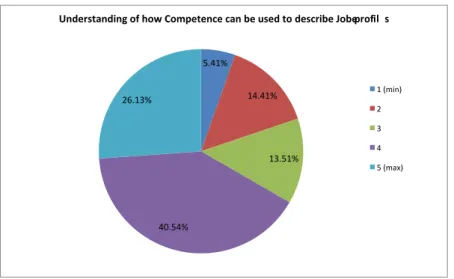
In the first questions users are asked to rate their familiarity and understanding in using competences to describe a job profile (1 to 5, with 1 being the minimum and 5 maximum value). More than 65% of the participants respond positively (4 or 5), an almost 14% neutrally and only 1 out of 5 rate their answers with 1 or 2. From the answers we can extract that users are quite familiar with using competences to describe a job profile, hence the overall feedback is of high importance.
270
users respond that competence are useful, 15% neutrally and only a roughly 10% negatively. These numbers are in accordance with the previous question and show the need of usage of competence in the thematic area of MAPs.
Fig.1. Understanding of how Competences can be used to describe job profiles
Fig. 2. Competences are useful in the area of MAPs
Fig. 3. Have you ever used competencesto describe a job profession
5.41%
14.41%
13.51%
40.54% 26.13%
Understanding of how Competence can be used to describe Job profile s
1 (min) 2 3 4 5 (max)
4.49%
5.62%
15.73%
42.70% 31.46%
To which degree do you feel that Competences would be useful in the area of MAPs?
271
In the question above, participants were asked if they have used competences in order to describe a job profession or specialization in their field. Again a 65% of the users respond positively and 35% negatively.
In all the above three questions, a specific pattern in the users responses can be seen. A roughly 65% of the users that already are familiar and use competence to describe job opportunities, believe that it is a useful tool while from the rest of the users almost half of them respond negatively and the rest neutral.
The above figure shows the evaluation of the competences that have been recognized by the Herbal.Mednet experts and used to describe job opportunities. As it can be seen by the figure above, all the competences that have been listed achieve an acceptance rate over 50% with an average of 73% of participants rating the competences with the 2 maximum rates (4 or 5). The least accepted competence is the “Delivering market performance” while the most accepted is the “Explain, understand and be able to apply the basic concepts of soil fertility in an organic system“. From the results, it can be seen that the competence list that is been identified and is being used by the Herbal.Mednet consortium, reflects the needs in the job profiles.
Fig.4. Competence importance in MAPs professionals
CONCLUSIONS
The competences of advisors correspond to the training needs of user organisations.
The profile of advisors includes knowledge in agriculture sciences and agriculture production and with practical skills and competences in organic MAPS sector.
272
These results showed that the Organic MAPSs sector provides great opportunities in the job market, which are destined to grow together with the increasing professionalism of the area.
Agricultural advisers will have to face more and more issues concerning the Organic MAPSs sector, and their competences need to grow and develop in an a broad dimensional asset.
The advising role in the organic herbal areas is definitely a challenging work; the organic herbal business has to deal with the standard problems of agricultural production and additionally with the particular organic methods and their different connotation in cultivation, processing, and particularly marketing.
In conclusions, the Job Profile plays a critical role in managing human resources, including better understanding and definition of the duties and responsibilities in a work place, recruitment, job evaluation, performance appraisal, training and development. Finally, certificate is the proved declaration of the successful fulfillment of the training.
BIBLIOGRAPHY
1. Koutoumanos, A., Protonotarios, V., Drakos, A., Toader, Maria, 2014 -Seeding
Courses on Moodle: the AgriMoodle Case, In AGRIS online Journal of Economics and
Informatics, Volume IV, Number 2, 2014.
2. Toader, Maria, Roman, Gh.,V., Protonotarios, V., 2012 -The Use of Metadata in the
Description of e-Learning Content for Organic Agriculture. In Metadata and Semantics Research Communications in Computer and Information Science, Springer, Vol. 343, p. 313-324. ISBN: 978-3-642-35233-1
3. Herbal.Mednet project, 2013 - D1.2 Report on Vocational Training Needs on Herbal plants topics (SERIFO, Italy).
4. Herbal.Mednet project, 2013 -D1.3 - Online survey for the Vocational Training
requirements (University of Thessaly, Greece), 2013.
5. Herbal.Mednet project, 2013 - D1.4 -Review of Job opportunities and required
competences in targeted countries (Agroknow, Greece).
6. Herbal.Mednet project, 2013 –D2.1 -Elaboration on competences of targeted job
profile (University of Agronomic Sciences and Veterinary Medicine Bucharest, Romania).