CHEMICAL ANALYSIS OF WATER USED FOR FISH FARMING IN
TUNDZHA RIVER, BULGARIA
SANDEVA GERGANA*, ZAPRYANOVA DIMITRINKA, ATANASOFF ALEXANDER, NIKOLOV GALIN, IVANOV VESELIN Trakia University, Stara Zagora, Bulgaria *[email protected]
Keywords: chemical parameters, water, carp
ABSTRACT
The aim of the study was to assess some chemical parameters in water from Tundzha River used for common carp (Cyprinus carpio L.) farming. Water samples were taken according to protocol in September 2014 from the fish farm located near the town Nikolaevo. Results showed compliance with regulations for most of the studied parameters. A slight increase of ammonia (NH3) was found in the control sample. In both
locations elevation of nitrates (NO3) and phosphates (PO4) was registered, suggesting
contamination of the water from agricultural use of organophosphate insecticides and nitrogen fertilizers. In conclusion, effective measures should be taken to protect water resources in Tundzha River used in fish farming from agricultural pollution.
INTRODUCTION
Aquaculture has become a significant agricultural sector in Bulgaria in recent years. Latest available data shows that total aquaculture production (fry, fish, and other aquatic organisms intended for consumption) for 2012 in Bulgaria amounted to 7557 t, and peak year being 2010 with 9830 t produced. Since the emergence of fishery activities in the country more than a century ago, the most important cultivated species remain those of family Cyprinidae, followed by family Salmonidae. Among Cyprinidae dominates the production of common carp (Cyprinus carpio) with more than 2000 t per year (NAFA, 2014).
Annual consumption of fish and other hydrobionts in Bulgaria per capita is around 5 kg. Common carp is the most commonly consumed fish with a share of 33%, followed by rainbow trout - 13%, zander - 11.5%, and silver carp - 11%. These types of fish amount to 68.6% of the total fish consumption in the country.
At present Bulgarian aquaculture uses four main production systems - free fish breeding in standing water bodies (lakes, reservoirs), fish farming in specially constructed concrete or earth ponds, fish breeding in cages, and recirculation systems.
Bulgaria possesses limited fresh water resources - about 2181 m3 per person (excluding the resources of the river Danube), which puts the country among the most vulnerable to water shortages in the European Union (Executive Environment Agency, 2015). According to data from the statistical information system of the National Agency for Fisheries and Aquaculture the total water area (including inland waters) used for aquaculture was 55 362 hectares in 2013.
conclusion from the latest EEA report on the state of the European environment was that rivers and transitional waters were on average in a worse condition than lakes and coastal waters. Furthermore, the chemical status of 40% of Europe's surface waters remains unknown, which presents a major issue for both stakeholders and consumers (European Environment Agency, 2015).
The main sources of water pollution in Bulgaria are industrial waste waters from the paper, yeast, chemical, mining, canning, and textile industries. Agriculture is another large source of pollution for lakes and rivers, causing nutrient enrichment from fertilizer run-off. Agricultural pesticides have been widely detected both in surface and groundwater. Hydromorphological changes also affect many surface water bodies.
Besides pollution by organic and inorganic chemical lately the so-called thermal pollution of water causes an ever increasing threat (Ficke et al., 2007). Thermal pollution is characterized by an increase in water temperatures above seasonal variances leading to distortions in the ecological balance and to negative changes in the flora and fauna of the water body.
In view of the current significant threats for fresh water resources, both in terms of quality and quantity, ensuring sustainable use of those resources is vital. Therefore in 2000, the EU Water Framework Directive established a framework for the management, protection and improvement of the quality of water resources across the EU. Its main objective was that all surface water and groundwater should hold good status by 2015 (unless grounds for exemption are present). Achieving good status means meeting certain standards for the ecology, chemistry, morphology and quantity of waters. Unfortunately, reaching good ecological status by 2015 is only likely to be met by 53% of surface water bodies, which is far from meeting current policy objectives (European Environment Agency, 2015).
European water bodies are now much cleaner than they were 25 years ago due to investment in sewage systems to reduce pollution from urban wastewater treatment. Nevertheless, more than 40% of rivers and coastal water bodies are affected by diffuse pollution from agriculture, while between 20% and 25% are subject to point source pollution, mostly from industrial facilities, sewage systems and wastewater treatment plants.
Limited freshwater resources combined with environmental pollution could have a devastating effect on the aquaculture sector in Bulgaria. Therefore, the purpose of the current study was to measure some chemical parameters in water from Tundzha River, Bulgaria, used for common carp (Cyprinus carpio L.) farming and to assess the risk caused by agricultural pollutants in the area.
MATERIALS AND METHODS
Water samples were collected in September 2014 from a fish farm situated along Tundzha River southeast of the town Nikolaevo, Stara Zagora Region, and about 2 km west of Zhrebchevo dam lake. The total water area of the farm is 2840 acres, currently producing around 540 t of carp, catfish, tench and pike, as well as fry. The farm comprises of series of pools that are constantly being emptied, filled or refilled with river water depending on the technological process and developmental stage of the fish.
occurring for two weeks prior to the sample collection. The water samples were put in a cooler and transported to the laboratory.
After arriving at the laboratory the visibly turbid samples were filtered, because large particles in the water could significantly alter the obtained results. Chemical pollutants in the collected water were analyzed using HACH DR/850 colorimeter and compatible reagents following the operating manual. Accuracy check was performed by standard solution method according to the operating manual’s instructions.
The obtained results for each parameter were compared with the norms available in Bulgarian national law (Ordinance No 4, Ordinance No H-4).
RESULTS AND DISCUSSIONS
Both studied samples had a near neutral pH of 6.9. Water hardness was 13.3°dH for the suspect sample and 7.84°dH for the control sample. Potassium permanganate oxidation (in ml O2/L) was 1.6 for the control sample and 2.8 for the suspect sample. Other measured chemical parameters are shown on Table 1.
Table 1 Chemical parameters of water from Tundzha River used for fish farming (in mg/L)
Indicator (mg/L) Suspect
Sample
Control Sample
Norm*
Fe 0.03 0.04
-Mn 0.0 0.0
-Zn 0.0 0.0 1 - 2
CN 0.004 0.007
-Cl 0.08 0.11 < 0.005
SO4 20.0 34.0
-PO4 6.86 5.43 0.4
NH4 0.0 0.29 < 0.2
NO2 0.014 0.038 < 0.03
NO3 40.28 19.48
-*Ordinance No 4 on the quality of water for fish and shellfish breeding (State Gazette No88/2000)
According to current national legislation on river water quality, the results for pH, heavy metals, ammonia (NH4) and nitrites (NO2) for the suspect sample indicated a good chemical status, but the results for nitrates and phosphates exceeded the norms more than ten times (Ordinance No H-4, 2012). It is notable that in the control sample NH4 and NO2 slightly exceeded the regulations, whereas the amount of nitrates (NO3) in the suspect sample was double the one in the control.
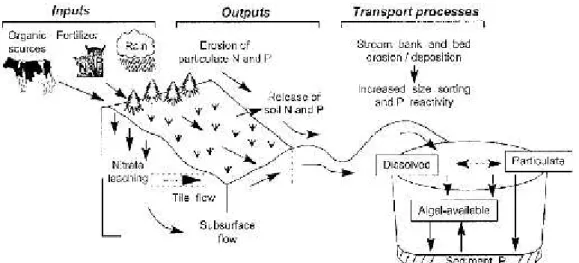
The obtained results for the group of nitric compounds (NH4, NO2 and NO3) suggested an ongoing process of nitrification in the river water. Additionally, the large amounts of nitrates present in both samples indicated another source of pollution beside the waste produced by the cultivated fish, most probably deployment of fertilizers in the neighboring agricultural lands used for grain production. The high levels of measured phosphates were also possibly due to excessive use of phosphate fertilizers and/or organophosphate pesticides around the fish farm (Figure 1).
Circulation of nitrogen and phosphorus compounds in the environment is presented on Figure 1. A major human influence on nitrogen and phosphorus in the environment is the use of fertilizers in agricultural and urban areas (Mueller et al., 1995). Commercial nitrogen fertilizers are applied either as ammonia or nitrate, but ammonia is rapidly converted to nitrate in the soil. Excess nitrate that is not taken up by plants can enter streams or leach into ground water. Animal manure is also used as a nitrogen fertilizer, especially in the increasingly popular organic farming. Organic nitrogen and urea in the manure are converted to ammonia, then nitrites, and finally to nitrates in the soil (Di and Cameron, 2002). Phosphorus fertilizer generally is applied as a compound of phosphate. Phosphates tend to remain attached to soil particles and rarely dissolve in water. However, soil erosion can carry a considerable amount of particulate phosphate to streams (Carpenter et al., 1998). Phosphate leaching in water is also influenced by water temperature and the amount of nitrates present (Jensen and Andersen, 1992).
Figure 1. Inputs, outputs and transport of nitrogen and phosphorus from agricultural land (Carpenter et al., 1998)
Excessive concentrations of nutrients, mainly nitrogen and phosphorus, in aquatic environments cause eutrophication, resulting in changes in species abundance and diversity, as well as algal blooms, deoxygenated dead zones, and leaching of nitrate to groundwater. All of these changes threaten the long-term quality of aquatic environments. This has implications for the provision of ecosystem services such as drinking water, fisheries, and recreation opportunities (EEA, 2015). The US Environment Protection Agency reported in 1992 that accelerated eutrophication was one of the leading problems facing local water reservoirs. On the other hand, extremely low levels of nutrients in water could also be detrimental for aquatic life. Therefore a nutrient balance needs to be achieved or else choices will have to be made between having aesthetically clear freshwaters but unproductive fisheries, or productive fisheries in greener lakes and streams (Stockner et al., 2000).
Agricultural nitrogen balances are declining but they are still high in some countries, particularly in lowland Western Europe. Measures to reduce agricultural pollution include improving the efficiency of nitrogen use in crop and animal production; conserving nitrogen in animal manure during storage and application; and full compliance with the EU Nitrates Directive. Linking financial support for farmers with compliance with European laws and tackling inadequate wastewater treatment and ammonia release from inefficient fertiliser management are particularly important for achieving further significant reductions in nutrient releases (EEA, 2015). Currently Bulgarian farmers are obliged to adhere to the requirements of the Nitrates Directive (adopted as Ordinance No 2 of 13.09.2007), but no specific measures are undertaken at national level concerning phosphorus inputs in water.
Air pollution can also contribute to eutrophication and acidification of water and soil, which could damage aquatic ecosystems’ health. Air pollution's most important effects result from emissions from transport, power generation and again agriculture. Ammonia (NH3) emitted from agricultural activities and nitrogen oxides (NOx) emitted from combustion processes are the predominant air pollutants causing water eutrophication. Further concerns arise from the discovery that anthropogenic emissions of NOx could be influencing atmospheric levels of carbon dioxide (a major greenhouse gas) via nitrogen stimulation of global primary production (Smith et al., 1999). Increased carbon dioxide in the atmosphere could further increase its temperature and could lead to increased water temperature and acidification – significant risk factors for all aquatic organisms, especially fish.
Although there has been a reduction in emissions of air pollutants over the last two decades, the complex links between emissions and air quality mean that this does not always result in a corresponding improvement in the exposure of ecosystems to these pollutants. For example, in Europe there have been significant improvements in reducing ecosystem exposure to excess levels of acidification, and the situation is predicted to improve further over the coming 20 years (EEA, 2015). However, there has not been the same degree of improvement regarding eutrophication, with exceedances of critical loads for eutrophication in most of continental Europe experiences It is estimated that around 63% of European ecosystem areas and 73% of the area covered by the Natura 2000 network of protected areas were exposed to air pollution levels that exceeded eutrophication limits in 2010. The divergence between levels of acidification and levels of eutrophication largely occurs because emissions of pollutants containing nitrogen (which can lead to eutrophication) have not fallen as much as emissions of sulphur and carbon dioxide (which cause water acidification). The projections for 2020 indicate exposure to eutrophication will still be widespread, due to the fact that eutrophic state is often persistent, and recovery of affected water bodies is slow (Carpenter et al., 1998).
Anthropogenic factors such as fishing, nutrient enrichment, introduction of exotic species, and chemical contaminants tend to act differentially at individual speciel level (Evans et al., 1987). Oftentimes causes for the poor chemical status of fishery water can be found on a much smaller scale. Stocking density of the pond could be one such deteriorating factor. Lukowicz et al. (1982) found that fish ponds with high stocking densities of common carp were characterized with a continuously increasing eutrophication effect which expressed itself in mass development of phytoplankton. This led to considerable diurnal fluctuations in oxygen concentration and total ammonia and large amounts of fresh water had to be introduced to the pond to dilute the algae and nutrients.
modifying nutrient and turbidity concentrations and phytoplankton abundance and diversity through benthic foraging, whereas zooplankton and benthic invertebrates could be affected by top-down processes through predation and reduced foraging efficiency (Weber and Brown, 2009). These findings suggest that both external pollution as well as internal processes in the pond itself (due to common carp’s biological activity) could lead to increased eutrophication and poor water status.
CONCLUSIONS
Chemical analysis of water from Tundzha River used in fish farming led to the following conclusions:
Increased phosphate concentration in the water could be linked to agricultural use of phosphorus fertilizer and/or organophosphate pesticides;
Significant nitrate levels suggest excessive use of nitrogen fertilizers in the area; High nutrient levels in the fishery water could lead to eutrophication and threaten
the well-being of cultivated fish;
Achieving healthy aquatic ecosystems overall and aquaculture ecosystems in particular requires taking a systemic view, as their state is connected to the management of land and water resources, and to pressures from sectors such as agriculture, energy and transport. Many opportunities are available in order to improve water management and achieve European Water Policy objectives. These include strict implementation of existing policies and integration of water policy objectives into other areas such as the Common Agricultural Policy, EU Cohesion and Structural Funds, and sectoral policies.
BIBLIOGRAPHY
1. Carpenter, S.R., Caraco, N.F., Correll, D.L., Howarth, R.W., Sharpley A.N., Smith, V.H., 1998 – Nonpoint pollution of surface waters with phosphorus and nitrogen, Ecological Applications, vol. 8(3), 559–568.
2. Conley, D.J., Paerl, H.W., Howarth, R.W., Boesch, D.F., Seitzinger, S.P., Havens, K.E., Lancelot, C., Likens, G.E., 2009 - Controlling Eutrophication: Nitrogen and Phosphorus, Science, vol. 323, 1014-1015.
3. Di, H.J., Cameron, K.C., 2002 - Nitrate leaching in temperate agroecosystems: sources, factors and mitigating strategies, Nutrient Cycling in Agroecosystems, vol.46, 237–256.
4. EEA, 2015 - The European environment — state and outlook 2015: synthesis report,
European Environment Agency, Copenhagen, Denmark.
5. Evans, D.O., Henderson, B.A., Bax, N.J., Marshall, T.R., Oglesby, R.T., Christie, W.J., 1987 - Concepts and Methods of Community Ecology Applied to Freshwater Fisheries Management, Canadian Journal of Fisheries and Aquatic Sciences, vol. 44(S2), 448-470.
6. Ficke, A.D., Myrick, C.A., Hansen, L.J., 2007 - Potential impacts of global climate change on freshwater fisheries, Rev Fish Biol Fisheries, vol. 17, 581–613.
7. Jackson, Z.J., Quist, M.C., Downing, J.A., Larscheid, J.G., 2010 - Common carp (Cyprinus carpio), sport fishes, and water quality: Ecological thresholds in agriculturally eutrophic lakes, Lake and Reservoir Management, vol. 26(1), 14-22.
8. Jensen, H.S., Andersen, F.O., 1992 - Importance of temperature, nitrate, and pH for phosphate release from aerobic sediments of four shallow, eutrophic lakes, Limnol. Oceanogr., vol. 37(3), 577-589.
10. Ministry of Agriculture and Food, National Agency for Fishery and Aquacultures, 2014 –National strategy on aquacultures in Bulgaria 2014-2020, Sofia, Bulgaria.
11. Ministry of Environment and Waters, Executive Environment Agency, 2015
-National report on the status and conservation of environment in Bulgaria in 2013, Sofia, Bulgaria.
12. Ministry of Environment and Waters, Ministry of Agriculture and Food, Ministry of Health, 2000 – Ordinance No 4 on the quality of water for fish and shellfish breeding, State Gazette No 88 of 27.10.2000.
13. Ministry of Environment and Waters, 2012 – Ordinance No H-4 on characterization of surface waters, State Gazette No 22 of 05.03.2013.
14. Mueller, D.K., Hamilton, P.A., Helsel, D.R., Hitt, K.J., Ruddy, B.C., 1995 - Nutrients in ground water and surface water of the United States - An analysis of data through 1992,
U.S. Geological Survey Water Resources Investigations (WRI) Report 95-4031, USA.
15. Smith, V.H., Tilman, G.D., Nekola, J.C., 1999 - Eutrophication: impacts of excess nutrient inputs on freshwater, marine, and terrestrial ecosystems, Environmental Pollution, vol. 100(1-3), 179–196.
16. Stockner, J.G., Rydin, E., Hyenstrand, P., 2000 -Cultural Oligotrophication: Causes and Consequences for Fisheries Resources, Fisheries, vol. 25(5), 7-14.