15
Application of point method in risk
evaluation for railway transport
Oľga Becherová
1University of Defence, FML, Kounicova 65/662 10, Brno, Czech Republic
Abstract
The paper is dealing with risk assessment affecting the hazardous substances shipping by rail; there are identified and assessed risks during the work process. The point method is applied to evaluate how serious risks are. In conclusion, there are suggested particular measures to reduce or eliminate the risks. The main priority of the system should consist in providing a safe workplace, or minimizing and eliminating undesirable factors.
Keywords: transport, accident, emergency, hazardous substance, railway, risks assessment
doi: 10.23755/rm.v29i1.19
1 Introduction
Safety belongs to basic prerequisites in the transport process; therefore, the emergence of rail accidents as well as emergencies cannot be passed over in the transport process particularly in cases of shipping hazardous substances. Every responsible person involved in transporting hazardous substances is obliged to comply with the relevant rules and regulations so that risks could be prevented as much as possible.
16
identified threatening sources of risks and factors, assessment and subsequent managing risk can follow.
2 Current situation
Occurrence and consequences of emergencies and accidents is a worldwide problem. An accident is such an activity of transport participants occurring in case of conflict with legal standards and regulations.
There is an incorrect movement of means of transport, interaction with one another or collision with other traffic participants with consequences resulting in damage, destruction or deterioration of means, vehicles, communications and further damage. This fact is accompanied by damage to health or fatalities caused to participants of accidents. [1]
Thorough cooperation of stakeholders as well as institutions can support significantly the smooth railway operation. Therefore, it becomes necessary to evaluate the situation and take measures while considering both the complex and partial situation solution processes.
The available statistical data characterized the situations as follows: in the Czech Republic, a total of 1,100 accidents with 1,083 fatalities happened on the railways within the period 2006-2014.
Table 1 Number of rail accidents in the Czech Republic and number of relevant casualties [2]
Year Number of accidents Number of casualties
2006 233 141
2007 115 126
2008 133 183
2009 113 118
2010 125 155
2011 99 103
2012 97 92
2013 91 76
17
Graph 1 Number of rail accidents in the Czech Republic [2]
Graf 2 Number of relevant casualties in the Czech Republic [2]
Although the shipment by rail seems comparatively safe, it is not entirely without risk. The accidents occurrence is affected by aspects such as human factor, technical condition of the train, technical condition of railway superstructure natural conditions as well as the transported goods. The risk and affects are much higher in case of shipping hazardous substances.
2.1 Risk assessment
Nowadays, there are high requirements for performance and work effort of employees; they dominate the threat resulting in working environment safety. Employers often do not realize that safe workplace can improve the quality of the entire work process.
Considering all the factors affecting the safe working environment is the basis for risks assessment in the work process.
Risk analysis is a method for identifying and assessing factors, which may threaten individual activities and objectives of the organization. We can use it for the risks identification, to which the enterprise is exposed to in terms of external and internal perspectives. It is based on identification of risks factors, developing scenarios, assessing the likelihood and consequences, and, finally,
0 100 200 300
Number of rail accidents Situation of rail accidents
2006 2007 2008 2009 2010 2011 2012 2013 2014
0 200
Number of casualties Situation of casualties
18
financial costs, in case that the emergency occurs. It is the basis for risk management and prevention of crisis situations in the enterprise. [2]
The point method, extended risk definition, was selected to assess risk in our case. The point method is classified as one of most frequently used methods for risks assessment. The level of risk is expressed by combining the value of the likelihood of risks, possible consequence and the effect of the occupational safety and health (OSH); having assessed, it is assigned to the relevant group of final risk. This method is focused on the protecting human life.
R (risk) = P (probability) x D (consequence) x V (effect of OSH level), [3]
P – probability establishes the option estimation that the undesirable event occurs. It is expressed by assigning specific numbers 1 - 5 (Table 2),
D – consequence expresses the seriousness of the consequence of the emergency occurrence; it is defined by five stages with assigned values from 1 to 5 (Table 3),
V – OSH level impact: this parameter comprises consideration of management level, the time of action period of threats, staff qualification, work ethic, the level of prevention, condition and age of technical equipment, maintenance level, the effect of work environment, workplace detachability, etc. (Table 4).
Point value Verbal expression
1 Improbable
2 Random
3 Probable
4 Highly probable
5 Permanent
Table 2 Probability estimation [4]
Table 3 Consequence estimation [4]
Point value Verbal expression
1 Negligible effect on probability and injury consequences
2 Little effect on probability and injury consequences
3 Considerable effect
4 Significant, big effect
19
Table 4 OSH impact estimation [4]
Risk – final indicator, which is the product of all three parameters of the risk value. The lowest value can reach 1 and the highest 125. According to point range, the risk is classified into five categories. (Table 4).
Table 5 Final risk range [4]
Point value Verbal expression
1 Damage to health and work activity
2 Injury followed by sick leave
3 More serious injury resulting in hospitalization 4 Severe occupational injury with permanent
consequences
5 Fatal occupational injury
Risk Risk category Point range Safety assessment
Safety measures requirement
Negligibl
e I 1-4 Acceptable safety
Taking measures not
required
Moderate II 5-10 Acceptable risk at
increased attention
System is classified as
safe; improvement can be achieved,
redress can be planned
Critical III 11-50
Risk cannot be accepted without taking protective
measures
Safety measures should be taken
Undesira
ble IV 51-100
Inadequate safety, high possibility of
injuries Immediate corrective measures or short-term measures have
to be taken
Unaccept
able V 100-125
Dangerous system, permanent threat of
20
2 Point method application while transporting
hazardous substances by rail
The carriage of hazardous substances by rail accounts for a significant share of total rail freight. Emergencies as well as accidents occur at shipping process resulting from hazardous substances characteristics. Number and scope of rail accidents is affected by many factors, which can be called causes resulting in consequences of various extents.
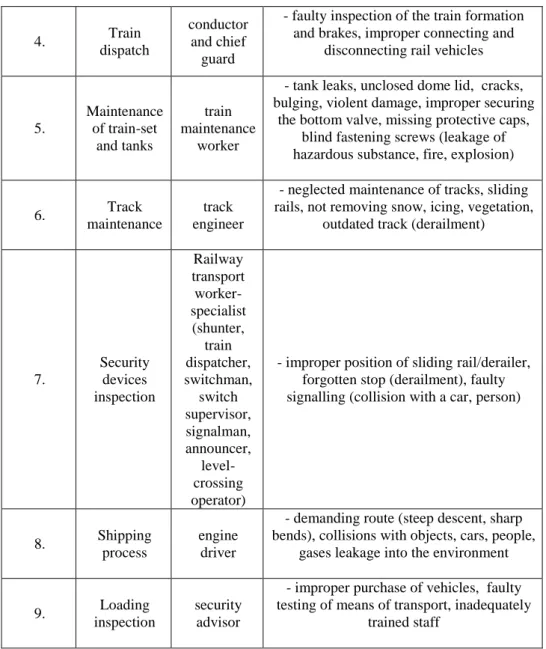
Each hazardous substance has its characteristics, according to which the material should be packed, loaded and stowed, shipped via adequate route and unloaded. The employees are frequently a significant element at giving rise to an accident: it is caused by activities, either intentional non-compliance with regulations and rules or by ignorance. These accidents affect the smooth flow of work process and shipping hazardous substances and threaten the very persons involved as well as people around. They may also affect significantly the property of residents within the accident as well as the environment (soil and water contamination, air toxic pollution). Therefore, all the time it is necessary to inspect and train the staff being focused on preventing accidents. The following table highlights the possible threats, which might arise during the rail-transport work process.
Number Responsible
action Profession
Possible threat due to non-compliance with regulations
1. Goods
loading loader
- goods loading, which may react together, omitting the tank failure (rupture), failure to
comply with test date, improper packaging (certified packageof I, II, III group) and
goods labelling, damage to goods, incorrectly completed waybill, inappropriate use of wagon for the
particular goods
2. Tank
labelling shipper
- assigning wrong UN code, excessive number of pieces, overload, assigning improper parameters to a particular category of hazardous substances, different
data in waybill in terms of labelling tanks/wagons or particular content
3. Tank
cleaning tank cleaner
- failure to comply with the rules on safety equipment, sparking at a soiled tank -
21
4. Train
dispatch
conductor and chief
guard
- faulty inspection of the train formation and brakes, improper connecting and
disconnecting rail vehicles
5. Maintenance of train-set and tanks train maintenance worker
- tank leaks, unclosed dome lid, cracks, bulging, violent damage, improper securing
the bottom valve, missing protective caps, blind fastening screws (leakage of hazardous substance, fire, explosion)
6. Track
maintenance
track engineer
- neglected maintenance of tracks, sliding rails, not removing snow, icing, vegetation,
outdated track (derailment)
7. Security devices inspection Railway transport worker-specialist (shunter, train dispatcher, switchman, switch supervisor, signalman, announcer, level-crossing operator)
- improper position of sliding rail/derailer, forgotten stop (derailment), faulty signalling (collision with a car, person)
8. Shipping process
engine driver
- demanding route (steep descent, sharp bends), collisions with objects, cars, people,
gases leakage into the environment
9. Loading
inspection
security advisor
- improper purchase of vehicles, faulty testing of means of transport, inadequately
trained staff
22
Table 7 Results of point method
4
Proposal of measures to reduce risks
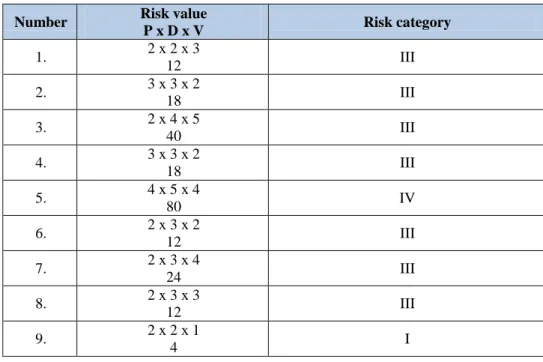
Risks presented in table 6, to a greater or lesser extent, affect the occurrence of accidents and emergencies. Knowledge of possible threats can result in taking measures, which might encourage risk reduction or elimination.
Rail transport brings risks of different levels. Some risks are determined by illegal action of a third party (terroristic attack, criminality); therefore, these threats cannot be controlled properly.
List of threats resulting from the assessment of risks in terms of transporting hazardous substances by rail:
- rigorous assessment of the particular goods characteristics and safe loading,
- modernization and inspection of used wagons and security devices,
- improvement and checking used packaging/containers,
- inspection of proper filling and pumping tanks,
- thorough inspection of labelling and marking wagons,
- data checking in a waybill and wagon labelling/marking,
- observing number of loaded units, not overloading wagons,
- applying adequate protective equipment and compliance with regulations at tank cleaning,
Number Risk value
P x D x V Risk category
1. 2 x 2 x 3
12 III
2. 3 x 3 x 2
18 III
3. 2 x 4 x 5
40 III
4. 3 x 3 x 2
18 III
5. 4 x 5 x 4
80 IV
6. 2 x 3 x 2
12 III
7. 2 x 3 x 4
24 III
8. 2 x 3 x 3
12 III
9. 2 x 2 x 1
23
- regular and complex inspection of the technical condition of the train, tanks and brakes,
- observing time-period checks,
- rigorous track inspection,
- tracks modernization,
- regular removing obstacles from the railway track (vegetation, snow, icing),
- weather forecasting and thorough evaluation of transport options,
- assessing and selecting route that is appropriate for shipping,
- goods inspection while transported,
- timely reporting in case of a terrorist attack or other unlawful entry of a third party,
- assessment and investigation of accidents and their causes so that recurrence of accidents due to same causes could be avoided,
- proper planning of work process,
- responsible performing work by employees,
- creating friendly work environment by superiors,
regular training: acquainting employees with risks, which might affect their work, work process knowledgeability, knowledge and compliance with relevant legislation, compliance with OSH, knowledge to provide first aid help.
5 Conclusions
24
Bibliography
[[1] Hečko, I. (1999) Teória a prax služby dopravnej polície, Akadémia Policajného zboru, Bratislava ISBN 80-8054-125-6.
[2] Štatistika Eurostat.
[3] Hollá, K. (2008) Vybrané metódy a techniky využívané v procese identifikácie a analýzy rizík. Risk-Management.cz, ISSN 1802-0496.
[4] Seňová, A., Antošová, M. (2007) Hodnotenie rizík možného ohrozenia bezpečnosti a zdravia zamestnancov ako súčasť kvality pracovného života v podniku. In: Manažment v teórii a praxi, roč. 3, č.1-2, ISSN1336-7137.
[5] Zákon č.124/2006 Z. z. v znení zákona 309/2007 Z. z. o bezpečnosti a ochrane zdravia pri práci.
![Table 1 Number of rail accidents in the Czech Republic and number of relevant casualties [2]](https://thumb-us.123doks.com/thumbv2/123dok_us/8083531.2141802/2.892.171.670.684.868/table-number-accidents-czech-republic-number-relevant-casualties.webp)
![Table 2 Probability estimation [4]](https://thumb-us.123doks.com/thumbv2/123dok_us/8083531.2141802/4.892.142.692.657.943/table-probability-estimation.webp)
![Table 4 OSH impact estimation [4]](https://thumb-us.123doks.com/thumbv2/123dok_us/8083531.2141802/5.892.194.756.209.356/table-osh-impact-estimation.webp)