9 *Corresponding Author. Mail. AlisheykhiGarousi@yahoo.com
Tell: +989126946153
Water resources management and optimization of flood design using
the moth-flame metaheuristics algorithm
Ali sheykhi Garousi1* Farinaz zamani2
1- master of civil Engieering, Islamic Azad University, Maragheh Branch, Maragheh ,Iran. 2- master of civil Engieering University of Samen, Razavi Khorasan ,Iran.
Received: 12, January, 2019 Accepted: 16, February, 2019 Online Published: 09, March, 2019
Abstract
Using linear, nonlinear, and dynamic planning methods for water resources management has been common since a long time ago, but owing to some deficiencies, today much attention is paid to heuristics methods. Among the optimization algorithms, the moth-fire algorithm can be considered. In this paper, the optimization of the flood management plan was carried out using the moth-moth-fire algorithm. In order to consider the flood damage in each month, the estimated damage values are determined according to the floods routing with different return periods in the downstream of the dam using MATLAB software. The sum of the expected damage of flood and lack of need supply in the objective function will be minimized using the moth-fire algorithm. The results of a case study carried out on the Aras dam indicate the efficiency of the proposed optimization model in supplying the needs and reducing the flood damage in the downstream
Keywords: Flood, Optimization, Dam, MATLAB Software, Moth-fire algorithm.
1. INTRODUCTION
Prevention and planning for the reduction of flood damage are the most important activities in flood management before the crisis. Due to the expensive costs of flood control plans, the heavy consequences of failure and the presence of different uncertainties, the optimal designing of flood control systems is considerably remarkable in prevention and reduction of the flood damage. Today, the water as a life-giving resource, and as well, as one of three environment’s survival factor and constituents (soil, air, and water) [1]. Therefore, the optimal use of water resources is very significant. In addition to the need for optimal utilization, and considering the complexity of water resources systems, in order to create some methods to assure beneficiaries and managers, nowadays, the use of models has developed remarkably, and various types of models are used in micro and macro decision-makings of water resources systems [2]. In addition to using the existing models, there are many opportunities and challenges for managers and planners; knowing and appropriate use of them, can be very effective in utilizing the modern knowledge and using it to supply the water as a basic human need [3]. By now, many studies have been done to optimize the volume of reservoirs of flood control systems [4, 5 and 6]. The process of erosion and sedimentation at riversides occurs naturally, and human factors can accelerate the rate of erosion there. The flood is one of the natural phenomena that has long been seen by human being. In Iran, due to the vast size, the numerous climates, and the temporal and spatial density of rainfall in most of the drainage basins, huge floods can be observed annually in some parts of the country [7]. In this paper, flood management will be investigated using moth-fire algorithms in the Aras dam's drainage basins. In this research, the evolutionary algorithm of moth-fire will be used to provide an optimal model of flood design. 2. FLOOD MANAGEMENET APPROACHES
energy and possible flood events. In order to control the probable floods, the objectives of the problem are to maximize the income of the sale of energy produced by power plants and to maximize the volume of flood control storage in the studied reservoirs in the flood-bearing months. In [8], different computational intelligence models are used to predict the hourly runoff to manage the flood risk. This study attempts to apply four different types of data-based methods, including artificial neural networks (ANN) as a traditional one, adaptive neuro-fuzzy inference system (ANFIS), wavelet neural networks (WNN), and ANFIS combination using wavelet (WNF). In this paper, a comparative study of four different types of data techniques is discussed. In [9-10], the optimal plan of unit hydrograph was performed using SA and moth-fire algorithms and their results were compared using Kameh drainage basin data. Kameh drainage basin is one of the source branches of Kal-salar River and is located in the north of Torbat-e-Heydarieh County. This basin is a sample of mountainous drainage basins in the middle parts of Khorasan Province. The Kal-sarar River is the main drainage of this basin and flows along the northwest to the southeast and sends out the surface runoffs from the basin. In the field of water resources management, one of the most important issues is the optimization of the dams’ performance after construction. The moth-fire algorithm is considered by the researchers in recent years[12-13]. The widespread use of the moth-fire algorithm has led the MATLAB software developers to add a new toolbox called the moth-fire algorithm in the 7th version. This toolbox has some capabilities such as changing each part of the moth-fire algorithm and drawing different diagrams, in relation to implementing the process of moth-fire algorithm, simultaneously. In this paper, the optimization of the flood management plan is investigated using the moth-fire algorithm.
3. CASE STUDY OF THIS RESEARCH
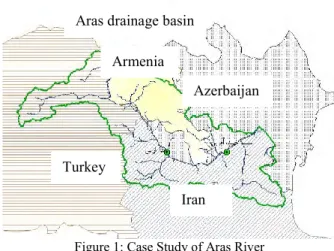
In this study, the Aras river is one of the most important Iranian rivers in the Caspian Sea drainage basin. The local name of this river in Armenian is called Arax and in Turkish is Araz. After about 450 km, this river separates from the Iranian border in Tazehkand village of Parsabad and enters the territory of the Republic of Azerbaijan; this river joins the Kura River in Azerbaijan and then enters the Caspian Sea. The total length of the Aras River is 1072 km, and more than 160 small and large branches connect to it along its route. Some rivers such as Nakhjavan, Magri, Akchichay, Makuchay, Hajilar, Qatourchay, and Doureh-rud are among the considerable branches of Aras river.
Figure 1: Case Study of Aras River Data selection
The investigation of rainfall data in the Aras Dam drainage basin will be based on the data archives of the NASA website(Fig 1).
Website URL: www.lake.nascom.nasa.gov The rainfall statistics of World Meteorological Network during the time period of 1950-1999, among 20599 rain-gage stations as 5.0 * 5.0 longitudinal and latitudinal degrees for the planet, were calculated and archived using interpolation method.
In Table 1, the statistics data of the Aras river is shown.
Time (hr)
Rainfall intensity (mm)
Flow rate (mm/hr)
0 0 0
0.5 2 0
1 1 0
1.5 1.4 0.118
2 2 0.222
2.5 1.6 0.315
3 1.6 0.365
3.5 4 0.415
4 2 0.568
4.5 2.8 0.653
5 3 0.764
5.5 0.4 0.836
6 0 0.803
6.5 2 0.714
7 1 0.629
7.5 1.4 0.530
8 2 0.468
8.5 1.3 0.365
9 1.6 0.328
9.5 4 0.298
10 2.2 0.256
10.5 2.8 0.185
11 3 0.068
11.5 0.8 0.032
12 0.2 0
Armenia Aras drainage basin
Azerbaijan
Turkey
The objective function of the moth-fire algorithm
In this model, theobjective function is to minimize the sum of difference squares between the observed and predicted surface runoff hydrographs in the drainage basin area unit. In this model, the constraints are as follows: the unity of the surface below the unit hydrograph curve and the positivity of unit hydrograph components. This model can be represented as (1) to (4) equations:
(1) ∑ to subject (1-∑
(2) ، ، ، ، ∑
In these equations, is the difference between the nth component of the observed and predicted surface runoff hydrograph, is the nth component of the observed surface runoff hydrograph, is the mth component of the additional rainfall, is
component of unit hydrograph and is the number of unit hydrograph components. The start of the moth-fire algorithm, by the equation (of equality) of constraints, is difficult. Therefore, the constraints equation is converted into an inequality by applying an allowable error of ε:
(3) ε 1-∑
In this model, the number of unknowns that have to be determined is equal to the number of unit hydrograph components ( ).
Thus, by introducing a penalty parameter, the problem of constrained optimization converts into an unconstrained issue. In the following, the unconstrained problem will be solved using the moth-fire algorithm.
Preparation of unit hydrograph
The most significant adverse point of the first model is that the number of unknowns is equal to the number of unit hydrograph components ( ). In this paper, a modified model is presented for converting the unit hydrograph into probability distribution functions. In this case, the number of unknowns is equal to the number of probability distribution parameters. In this model, the distributions of the normal log, Gamma log, and Gause reverse log are used. The unit hydrograph optimization model is defined and calculated using the gamma distribution function as (4) and (5) equations: With a fixed investment level, the amount of flood damage (with an optimal design) can be reduced to a certain amount. Further reduction requires an increase in the level of investment. In this study, the investment costs, and potential flood damage are considered as two separate objectives which are competed with each other in a multi-purpose optimization model. The general formulation of the objective functions is as follows:
∑
∑
∑ ∑ ∑ ،،
،
In these equations, m is the number of intervals, the is the cost of the combined option of X1 in the interval l and is the flood damage in interval l.
Proposed algorithm
The moth-fire algorithm is an optimization method that uses the natural selection theory. In this research, a method inspired by a moth-flame metaheuristics algorithm is proposed to find the active nodes in the social network. Moths experience two important stages in their lives: they are worms in the first stage and in the second one they are adult. The most considerable fact is their activity and movement at night. They fly at night using moonlight. They use cross-directional navigation to move at night. In this mechanism, the moths fly at a fixed angle to the moon. It is very suitable for direct movement on long pathways. One of the problems in this algorithm is that local updating of the moths with respect to different places of the search space can lessen the efficiency of the algorithm in solving the problem. To solve this problem, a mechanism for the number of flames is defined as follows [11].
(
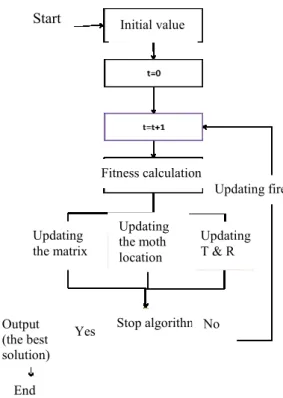
In this equation, l is the repeat number, N is the number of flames and T is the maximum number of repetitions of the algorithm. In the first stage of the repetition, there are N numbers for flames. However, moths update their position only with the best flame in the final stages of the repetition. The gradual reduction of a number of flames balances the exploration and utilization of the search space. Considering the above-mentioned notes, the algorithm flowchart will be as Fig. 2.
Figure 2: Flowchart of moth-fire algorithm Initial value
Start
Fitness calculation
Updating the matrix
Updating the moth location
Updating T & R
Output (the best solution)
Stop algorithm?
End
Yes No
4. SETTING THE CONTINUITY EQUATION
In all stages of optimizing the utilization of the dam, there must be a mass balance between the input and output values and the volume of the dam storage. (5)
S
t1
S
t
I
t
R
tSt+1: The volume of dam storage at time t+1 St: The volume of dam storage at time t It: The dam input at time t
Rt: The dam outlet at time t Volume of storage
In addition to the note that in all stages of the utilization of the dam, the volume of storage should be between the minimum and maximum values, another condition is set to keep the relative water level fixed in the dam; accordingly, the initial and final volumes should not differ more than 10% after the flood termination. This objective is mainly considered to prepare the dam for controlling the possible future floods.
Dam outlet
The optimized outlet quantity in each period must be between the minimum and maximum values.
The boundary conditions defined for the outlet are interpolated using rating-curve of the dam.
Results and discussion
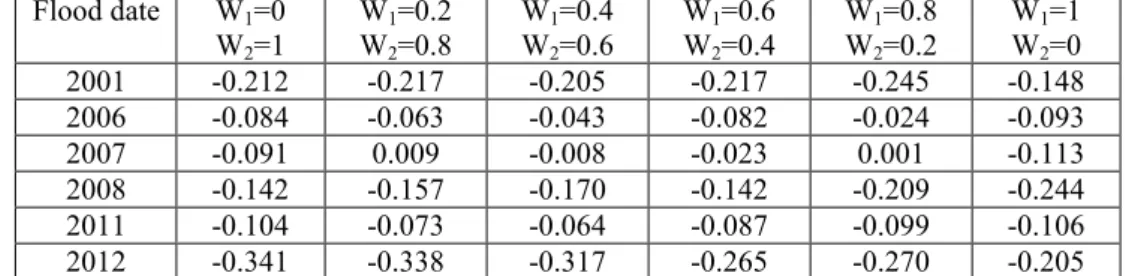
The performance of the optimization model of the moth-fire algorithm depends on the selection of the values of its parameters. To determine the optimum number of population, the sensitivity analysis was performed on different values of Creep type mutation probability (Pm) and uniform type coupling probability (Pc); their optimal values are calculated as 0.008 and 0.5, respectively. In addition to 27 hydrographs used in the optimization and calibration of the Nearest Neighbor model, 6 other hydrographs are applied to validate the model. Two input variables to the dam and the dam storage volume are considered as independent parameters of the function. Weighing the parameters was done by trial and error method and the relative errors were calculated for all situations; the results are presented in Tables (2) to (4).
Table 2: Relative error of output of the simulation model to the optimization model for different weights
Flood date W1=0 W2=1
W1=0.2 W2=0.8
W1=0.2 W2=0.8
W1=0.6 W2=0.4
W1=0.8 W2=0.2
W1=1 W2=0
2001 -0.161 -0.161 -0.164 -0.167 -0.194 0.193
2006 -0.061 -0.058 -0.057 -0.032 0.012 -0.016
2007 -0.080 -0.096 -0.101 -0.083 -0.077 0.022
2008 -0.215 -0.163 -0.159 -0.144 -0.133 -0.277 2011 -0.076 -0.069 -0.073 -0.053 -0.038 -0.137 2012 -0.304 -0.289 -0.283 -0.293 -0.267 -0.247
Table 3: Relative error of output of the simulation model to the optimization model for different weights
Flood date W1=0 W2=1
W1=0.2 W2=0.8
W1=0.4 W2=0.6
W1=0.6 W2=0.4
W1=0.8 W2=0.2
W1=1 W2=0 2001 -0.197 -0.194 -0.204 -0.192 -0.190 -0.182
2006 -0.058 -0.066 -0.071 -0.038 -0.041 -0.011
2007 -0.040 -0.020 0.004 -0.016 -0.01 -0.023
2008 -0.153 -0.151 -0.176 -0.208 -0.214 -0.266
2011 -0.064 -0.062 -0.049 -0.052 -0.064 -0.168
2012 -0.298 -0.233 -0.230 -0.226 -0.220 -0.206
Table 4: Relative error of output of the simulation model to the optimization model for different weights
Flood date W1=0 W2=1
W1=0.2 W2=0.8
W1=0.4 W2=0.6
W1=0.6 W2=0.4
W1=0.8 W2=0.2
W1=1 W2=0
2001 -0.212 -0.217 -0.205 -0.217 -0.245 -0.148
2006 -0.084 -0.063 -0.043 -0.082 -0.024 -0.093
2007 -0.091 0.009 -0.008 -0.023 0.001 -0.113
2008 -0.142 -0.157 -0.170 -0.142 -0.209 -0.244
2011 -0.104 -0.073 -0.064 -0.087 -0.099 -0.106
2012 -0.341 -0.338 -0.317 -0.265 -0.270 -0.205
5. CONSLUSION
The flood occurs when soils and plants are not able to absorb the rainfall and, as a result, the river's natural canal cannot have enough capacity to pass the runoff flow. The main methods to control the flood include the forests restoration, the construction of flood walls, dams, reservoirs and flood canals. Flood walls may be designed or be constructed without design. In the designed flood walls, special considerations on base soil condition, soil type used in the dyke, appropriate dyke compaction, and protection of the upstream of the flood walls against scouring and other factors are deemed. There is no reliable method for prediction of the next flood and how large its dimensions are. Engineers estimate the probability of floods with different dimensions using statistics. The flood occurrence probability in almost all areas depends on the existing conditions. For practical purposes, the acceptable risk depends on the specific case. Most of the optimization models of dam construction that have been developed by now, are suitable for utilizing on a monthly or seasonal scales, but they are not able to consider the significant changes of the inputs in short periods of flooding time. Utilization policies which are also developed in the form of these models (including static or dynamic), do not have satisfactory performance in flood management in the dam. In addition to the previous notes, the short-term and hourly nature of the management of the dam in flood conditions causes many problems in using classic optimization methods such as dynamic planning. The reason for this is the small changes of dam storage on an hourly scale, and the need for a considerable increase in the separation number of dam volume; due to them, some methods such as dynamic planning encounter dimensional problems. This paper presents a summary of the results of optimization and utilizing simulation of the Aras Dam at the flood time, using the above mentioned models; its main purpose is to minimize the flood losses connected with releases exceeding the safe carrying capacity of the downstream river and consequently minimize the flood damage in this area. In this paper, the utilizing optimization model of the concrete Aras dam is developed using the moth-fire algorithm. The objective function of this model was to minimize the flood losses related with releases exceeding the safe carrying capacity of the downstream river. The moth-fire algorithm is used to develop optimal policies. As shown in Tables (1) to (3), considering the weight of 0.8 for the gradient difference of the input hydrographs to the dam, and weight of 0.2 for the curves gradient of the variations of the dam storage volume, the least difference can be observed between the simulation results on the basis of optimal policies and utilizing optimization.
FUNDING/SUPPORT
Not mentioned any Funding/Support by authors.
ACKNOWLEDGMENT
Not mentioned.
AUTHORS CONTRIBUTION
This work was carried out in collaboration among all authors.
CONFLICT OF INTEREST
he author (s) declared no potential conflicts of interests with respect to the authorship and/or publication of this paper.
References
1. Waghwala, R. K., & Agnihotri, P. G. (2019). Flood risk assessment and resilience strategies for flood risk management: A case study of Surat City. International Journal of Disaster Risk
Reduction, 101155.[Scholar]
2. Morss, R. E., Wilhelmi, O. V., Downton, M. W., & Gruntfest, E. (2005). Flood risk,
uncertainty, and scientific information for decision making: lessons from an interdisciplinary
project. Bulletin of the American Meteorological
Society, 86(11), 1593-1602. [Scholar]
3. Alves, A., Gersonius, B., Kapelan, Z., Vojinovic, Z., & Sanchez, A. (2019). Assessing the Co-Benefits of green-blue-grey infrastructure for sustainable urban flood risk
management. Journal of environmental
management, 239, 244-254. [Scholar]
4. Roos, M. M., Hartmann, T. T., Spit, T. T., & Johann, G. G. (2017). Constructing risks– Internalisation of flood risks in the flood risk management plan. Environmental science &
policy, 74, 23-29. [Scholar]
5. Chang, F. J., Chen, L., & Chang, L. C. (2005). Optimizing the reservoir operating rule curves by genetic algorithms. Hydrological Processes: An
International Journal, 19(11), 2277-2289.
[Scholar]
6. East, V. (1994). Water resources system optimization using genetic algorithms.
In Hydroinformatics' 94, Proc., 1st Int. Conf. on
Hydroinformatics, Balkema, Rotterdam, the
Netherlands. [Scholar]
7. Hasebe, M., & Nagayama, Y. (2002). Reservoir operation using the neural network and fuzzy systems for dam control and operation
support. Advances in Engineering Software, 33(5), 245-260. [Scholar]
8. Karamouz, M., Araghinejad, S., & Haghnegahdar, A. (2004). Calibration and Validation of Long-Term Streamflow Forecasting Models. In Critical Transitions in Water and
Environmental Resources Management (pp. 1-9).
[Scholar]
nature (pp. 849-858). Springer, Berlin, Heidelberg. [Scholar]
10. Badrzadeh, H., Sarukkalige, R., & Jayawardena, A. W. (2015). Hourly runoff forecasting for flood risk management:
Application of various computational intelligence models. Journal of Hydrology, 529, 1633-1643. [Scholar]
11. Mirjalili, S. (2015). Moth-flame optimization algorithm: A novel nature-inspired heuristic paradigm. Knowledge-Based Systems, 89, 228-249. [Scholar]
12. Alimoradi, S., Faraj, R., & Torabian, A. (2018). Effects of residual aluminum on hybrid membrane bioreactor (Coagulation-MBR) performance, treating dairy wastewater. Chemical Engineering and Processing - Process
Intensification, 133, 320-324. [Scholar]
13. Alimoradi, S., Hable, R., Stagg-Williams, S., & Sturm, B. (2017a). Fate of phosphorous after thermochemical treatment of algal biomass. Proceedings of the Water Environment Federation, 2017(8), 3888-3891. [Scholar]