Abstract— This article is part of a scientific research ap-proach to identify a problematic related to an educational system [8], particularly in the primary school, in order to propose tangible and feasible solutions. It presents a varie-ty of teaching methods used to learn reading in order to identify the criteria for choosing the most appropriate one. The article focuses initially on the identification, catego-rization and prioritization of different criteria that come into play in learning to read. In a second step, it shows how to apply, on these criteria, the method AHP (Analytical Hierarchy Process) which is one of the methods MCDM / A (Multi-criteria decision-making and analysis) most used to facilitate the taking of multi-criteria and multi-objective decision.
At the end of this application, the article gives a classifi-cation of the various pedagogical methods studied (Syllabic Method, Global Method, Mixed Method and Montessori Method) and points out that, for a better efficiency, this study must be aggregated with another one which takes into account the profile of the learner.
Index Terms— AHP, Education, Global Method, ICT, MCDM/A, Mixed Method, Montessori Method, Pedagogy, Pri-mary school, Reading Methods, Syllabic Method.
I. INTRODUCTION
EARNING is a fundamental right and every individual must have the opportunity to access instruction that at least allows them to read, to understand a text, to write and to count. Unfortunately, we still find today that many people in underdeveloped and developing countries have not had the
chance for basic learning. Similarly, many of the elementary students complete their cycle without really mastering one or more of the above fundamentals.
Over the last decades, several studies have been carried out on a global scale and show a decline in relation to basic learn-ing.
In this context we would like to explore a scientific and pedagogical approach and make a contribution to promote the
development of learning skills in primary education of the educational system in Morocco (and even elsewhere). And for this we are interested in the study of multiple pedagogical methods of reading acquisition, through defining the most appropriate method in relation to certain learning. The article is structured around a section that presents the problem of primary education especially in reading instructions and re-calls the most used pedagogical methods to this aim [22]. It then puts in application the AHP (Analytical Hierarchy Pro-cess) decision making method, one of the MCDM / A (Multi-criteria decision -making and analysis) methods.
This implementation begins by a summary of the pedagogi-cal methods and the pedagogi-calculation of the global weights [Anon-ymous, 2017] and continues with the steps to be followed to arrive to an outcome that makes it possible to verify the con-sistency of the previous results with the actual ones.
II.
P
ROBLEMATICThe majority of pupils reach the end of primary school without achieving the most basic goals in reading, writing and arithmetic particularly in Africa apart from some countries [3]. The UNESCO report [25] shows that less than half of chil-dren, in 21 out of 85 countries from which they conducted their statistical survey, acquire basic skills in terms of learn-ing. 17 are sub-Saharan countries in Africa in addition to In-dia, Mauritania, Morocco and Pakistan. Which ranks Morocco among the 21 worst educational systems in the world [25], and shows that our country is experiencing a major crisis in its primary learning system. And more specifically the last PIRLS study [29] (Progress in International Reading Literacy Study) which points to the low level of Moroccan schoolchildren where Morocco occupies the 48th place out of 50 countries studied in terms of reading and comprehension. The fact is that Morocco is among the countries that have made the most progress between 2011 and 2016. But still, its ranking is far from the acceptable level set by PIRLS.
According to the Human Development Index (HDI) [14], Morocco is ranked in the bottom ranks [13]; 124th (out of 177) and the 11th among the 14 Arab countries.
The choice of the right pedagogical method for the
devel-opment of reading skills by the use of AHP decision
mak-ing method
Hasnââ CHAABI, [email protected], Abdellah AZMANI, [email protected],
Amina AZMANI [email protected]
FST, UAE, TANGIER
III.
M
ETHODS USED IN DEVELOPING READING SKILLS IN THE WORLDThis article focuses on the development of the reading skills that is part of the process research of authors' work to make their contribution to the improvement of learning es-pecially for the primary cycle. The investigations in the lit-erature [1], [2], [5], [7], [14], [20], [22], have revealed a non-exhaustive list of pedagogical methods used in the de-velopment of the reading skills: The Syllabic, the Global, the mixed, the Montessori, the phonics, the Boscher, the natural, the Ideo-Visual, the interactive, the Borel-Maisonny
phonetic and gestural, the phonomimic method, the Alphas method, the Jean-qui-rit method, the Bordesoules.
The work presented in this article focuses on four main methods: syllabic and global methods (first current), mixed and Montessori methods (second current). The aforemen-tioned methods constitute variants of the four.
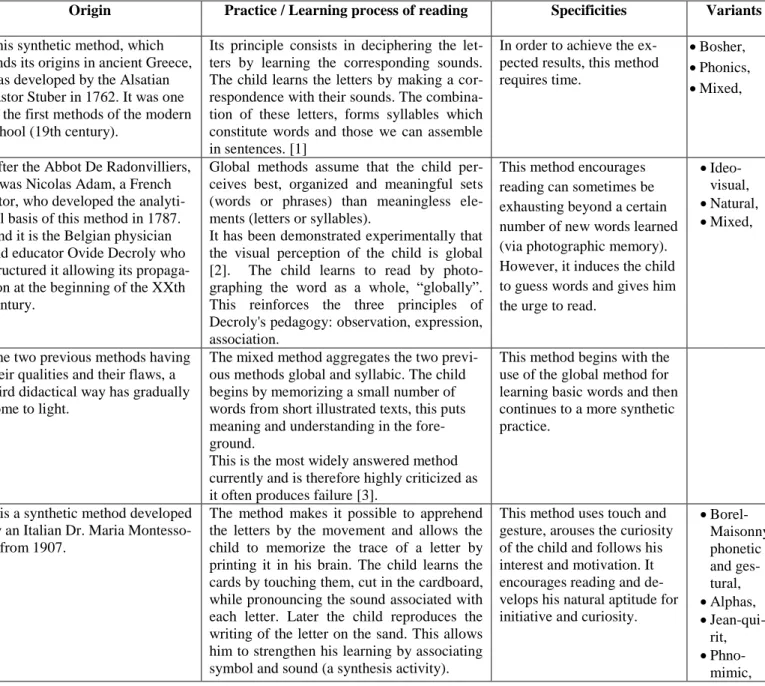
And here is an explanatory table of the characteristics of several methods on reading acquisition process.
Table I explanatory table of the characteristics of several methods on reading acquisition process
Meth-od
Origin Practice / Learning process of reading Specificities Variants
Sy
llab
ic
This synthetic method, which finds its origins in ancient Greece, was developed by the Alsatian pastor Stuber in 1762. It was one of the first methods of the modern school (19th century).
Its principle consists in deciphering the let-ters by learning the corresponding sounds. The child learns the letters by making a cor-respondence with their sounds. The combina-tion of these letters, forms syllables which constitute words and those we can assemble in sentences. [1]
In order to achieve the ex-pected results, this method requires time.
Bosher, Phonics, Mixed,
Glo
b
al
After the Abbot De Radonvilliers, it was Nicolas Adam, a French tutor, who developed the analyti-cal basis of this method in 1787. And it is the Belgian physician and educator Ovide Decroly who structured it allowing its propaga-tion at the beginning of the XXth century.
Global methods assume that the child per-ceives best, organized and meaningful sets (words or phrases) than meaningless ele-ments (letters or syllables).
It has been demonstrated experimentally that the visual perception of the child is global [2]. The child learns to read by photo-graphing the word as a whole, ―globally‖. This reinforces the three principles of Decroly's pedagogy: observation, expression, association.
This method encourages reading can sometimes be exhausting beyond a certain number of new words learned (via photographic memory). However, it induces the child to guess words and gives him the urge to read.
Ideo-visual, Natural, Mixed,
Mix
ed
The two previous methods having their qualities and their flaws, a third didactical wayhas gradually come to light.
The mixed method aggregates the two previ-ous methods global and syllabic. The child begins by memorizing a small number of words from short illustrated texts, this puts meaning and understanding in the fore-ground.
This is the most widely answered method currently and is therefore highly criticized as it often produces failure [3].
This method begins with the use of the global method for learning basic words and then continues to a more synthetic practice.
Mo
n
tess
o
ri
It is a synthetic method developed by an Italian Dr. Maria Montesso-ri from 1907.
The method makes it possible to apprehend the letters by the movement and allows the child to memorize the trace of a letter by printing it in his brain. The child learns the cards by touching them, cut in the cardboard, while pronouncing the sound associated with each letter. Later the child reproduces the writing of the letter on the sand. This allows him to strengthen his learning by associating symbol and sound (a synthesis activity).
This method uses touch and gesture, arouses the curiosity of the child and follows his interest and motivation. It encourages reading and de-velops his natural aptitude for initiative and curiosity.
Borel-Maisonny phonetic and ges-tural, Alphas,
Jean-qui-rit,
P h o n o m im ic [ 6 ], [2 0 ]
Augustin Grosselin is the founder of this method of learning to read. Originally, it was intended to teach his own children to read. The method was then used by Marie Pape-Carpentier, founder of the Asylum rooms.
It is a process that associates 33 onomatopoe-ic gestures to the speech.
To reinforce the assimilation of a word or an idea, this method proposes to use both the visual channel using gestures and the audito-ry sense via sound of the word.
GROSSELIN, dans le Moniteur du 30 mars 1867, p. 387, 2e col.
It has been proven by the author himself that this method is also used for the deaf-mute audience. Jean-Qui-Rit, Borel-Maisonny phonetic and ges-tural Jea n -qui -r it
Developed by Marie-Brigitte Lemaire, this method was in-spired by the phonomimic method and influenced by the phonetic and gestural method of Suzanne Borel-Maisonny.
Jean-qui-Rit enriched this method by adding contributions from great teachers such as Mrs. Ward, Ms. Lubienska of Lenval, Ms. Bugnet.
It teaches the pupils to read and write by gestures, rhythm and singing by arousing an interest that is always renewed by new ges-tures and new sounds.
It adds to a visual and auditory teaching, the development of motor intelligence by pro-posing action-gesture cards associating a gesture with a letter or a group of letters.
This method accentuating the total development of the child: physical and mental. It offers panoply of psycho-motor exercises and the ges-tures are learned from the stories. Alp h as [1 1 ]
It is a syllabic reading method created at the dawn of the year 2000 by Claude Huguenin and Olivier Dubois.
It was originally created for chil-dren with learning difficulties.
An alpha corresponds to a letter of the alpha-bet. The name of each alpha begins with the letter it represents.
To introduce them, the teacher tells a capti-vating story, whose heroes are the Alphas and have amazing characteristics: they have the form of the letters and a reason to emit their sound.
This helps to prevent children from confront-ing the abstract and arbitrary world of letters.
It speaks to the imagination of the young learner.
The learner builds an emo-tional relationship with the characters through a fantastic tale.
It takes a fun learning ap-proach. Id eo -Vis u al [4 ]
It was developed in France by Foucambert who considers the decoding as a concomitant act to the reading because it would constitute a handicap to the true reading.
For a child to learn to read, he must compre-hend globally the words and sentences. This method gives primacy to meaning and relies on visual recognition and discovery of words by intuition based on assumptions to reach the meaning.
This method is focused on meaning and not on decryp-tion.
Goigaux joins Foucambert in saying that the visual memory of words is very important to learn to read.
in
ter
ac
tiv
e
The method bases its approach on the interest that the learners might have in the content of the texts to be studied.
When the child reads, he first decodes the words and then questions the meaning to better understand the syntax and discover the meaning of the statements. Where reading is considered as a skill to acquire by learning the technique, then practicing it till it be-comes a learned skill.
The child performs two com-plementary operations in a combinatorial way: the deci-phering and the construction of meaning.
This method is usually based on reading albums (real books written by real au-thors) [32].
Mixed
IV. APPLICATION OF MCDM/A METHODS FOR THE CHOICE OF THE APPROPRIATE LEARNING METHOD
MCDM/A
The multi-criteria decision-making (MCDM) domain is divided into two sub-domains, Multi-Attribute Decision Making (MADM) and Multi-Objective Decision Making
(MODM) [9], [31], [28]. We are interested in the Analytic hierarchy process (AHP).
A.Summary: calculation of the overall weights of the criteria and sub-criteria
ried out and shown in our previous article.
Table II: the global and local weights of the criteria and sub-criteria according to the Syllabic Expert
Syllabic Expert
Criteria Sub-crieria Weight Local Global
Sensory organ C1[0.193]
Visual 0.267 0.052
Auditory 0.669 0.129
Kinesthetic 0.064 0.012
Acquisition mode C2[0.723]
Repetition 0.776 0.561
Intuition 0.068 0.049
Understanding 0.155 0.112
Energy C3[0.083]
Flow 0.5 0.042
Effort 0.5 0.042
Table III: the global and local weights of the criteria and sub-criteria according to the Mixed Expert
Mixed Expert
Criteria Sub-crieria Weight Local Global
Sensory organ C1[0.428]
Visual 0.58 0.248
Auditory 0.349 0.149
Kinesthetic 0.07 0.030
Acquisition mode C2[0.143]
Repetition 0.25 0.036
Intuition 0.25 0.036
Understanding 0.5 0.072
Energy C3[0.428]
Flow 0.334 0.143
Effort 0.666 0.285
Table IV: the global and local weights of the criteria and sub-criteria according to the Montessori Expert
Montessori Expert
Criteria Sub-crieria Weight Local Global
Sensory organ C1[0.458]
Visual 0.346 0.158
Auditory 0.11 0.050
Kinesthetic 0.544 0.249
Acquisition mode C2[0.416]
Repetition 0.4 0.166
Intuition 0.4 0.166
Understanding 0.2 0.083
Energy C3[0.126]
Flow 0.5 0.063
Effort 0.5 0.063
Table V: the global and local weights of the criteria and sub-criteria according to the Global Expert
Global Expert
Criteria Sub-crieria Weight Local Global
Sensory organ C1[0.143]
Visual 0.723 0.103
Auditory 0.193 0.028
Kinesthetic 0.083 0.012
Acquisition mode C2[0.428]
Repetition 0.091 0.039
Intuition 0.454 0.194
Understanding 0.454 0.194
Energy C3[0.428]
Flow 0.5 0.214
Effort 0.5 0.214
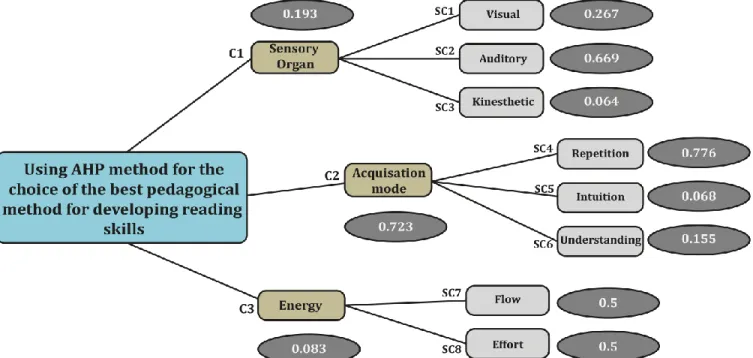
The next Fig. 1 presents the hierarchy of criteria and sub-criteria [19] used to evaluate the pedagogical methods using the AHP method.
The hierarchy of criteria reveals 3 major classes that de-scribe how the child perceives the information presented to him, the ways in which he can reinforce his learning and the energy he must put into it [10]:
The « sensory organ » used by the child to acquire learn-ing: vision (visual), hearing (auditory) and / or touch (Kines-thetic).
The « acquisition mode » that allows him to consolidate his learning: repetition, intuition and / or understanding.
The "energy" necessary to his learning: the flow (intensity or speed) and the effort (force) provided.
Sensory organ: this criterion has 3 sub-criteria:
Visual: photographic memorization of the forms of words
and / or sentences,
Auditory: phonic correspondence following a logical
progression of the letters‘ decryption,
Kinesthetic: gestural mechanics that allows the child to
Figure 1 : hierarchy of criteria and sub-criteria used to evaluate the pedagogical methods and their weights
Acquisition mode: this criterion includes 3 sub-criteria:
Repetition: a training session during which the child
re-peats the same letters or rere-peats the same gestures,
Understanding: the child has a mental representation
attached to the word he is about to read [12], [15],
Intuition: in the context where there is emission of
hy-pothesis or dependency of the context.
Energy: this criterion incorporates 2 sub-criteria:
Flow (speed or intensity) of learning,
Mental and physical effort provided by the child to
as-similate the presented text.
B.Steps of an AHP analysis 1)Introduction to the AHP
Using the AHP method [18], [17] enabled us to determine for each teaching method, the preferences and weights of the criteria and sub-criteria.
The following steps are used during the decision-making process:
Structuring the hierarchy of the problem; Construction of the judgment matrix;
Building a priority vector of weights of criteria; Analysis of the consistency of judgments; Comparative study of alternatives.
2)The fundamental scale of absolute value
These preferences expressed by linguistic expressions or qualitatively will be quantified numerically according to the grid shown in VI. It is the scale initially proposed by Profes-sor Saaty.
Table VI: the fundamental scale of absolute value
Digital scale Reciprocal Linguistic scale
1 1 equivalents
2 1/2 almost equivalents
3 1/3 slightly important
4 1/4 moderately important
5 1/5 generally more important
6 1/6 more important
7 1/7 much more important
8 1/8 extremely more important
9 1/9 infinitely more important
3)Table illustrating the comparisons of the criteria - Syllabic method
The experts are supposed to evaluate the comparison as equivalent, almost equivalent, slightly or moderately more important, more, much more, highly more, and infinitely more important.
Table VII: : table of pairwise comparisons between subcriteria with their digital and verbal evaluation of the Syllabic method
Pairwise com-parison of subcriteria
Criteria consi-dered most
important
Verbal as-sessment
Digital evaluation
Visual /
Audi-tory Auditory
slightly
impor-tant 3
Visual /
Kines-thetic Visual
generally more
important 5
Visual /
Repe-tition Repetition
generally more
important 5
Visual /
Intui-tion Visual
infinitely more
important 9
Visual /
Un-derstanding Visual
generally more
important 5
Visual / Flow Visual slightly
impor-tant 3
Visual / Effort Visual slightly
impor-tant 3
Auditory /
Kinesthetic Auditory
infinitely more
important 9
Auditory /
Repetition Repetition
slightly
impor-tant 3
Auditory /
Intuition Auditory
infinitely more
important 9
Auditory /
Understanding Auditory
generally more
important 5
Auditory /
Flow Auditory
generally more
important 5
Auditory /
Effort Auditory
moderately
important 4
Kinesthetic /
Repetition Repetition
generally more
important 5
Kinesthetic /
Intuition Kinesthetic
almost
equiva-lents 2
Kinesthetic / Understanding
Kinesthetic -
Understanding Equivalents 1
Kinesthetic /
Flow Flow
slightly
impor-tant 3
Kinesthetic /
Effort Effort
generally more
important 5
Repetition /
Intuition Repetition
infinitely more
important 9
Repetition /
Understanding Repetition
much more
important 7
Repetition /
Flow Repetition
generally more
important 5
Repetition /
Effort Repetition
slightly
impor-tant 3
Intuition /
Understanding Understanding
slightly
impor-tant 3
Intuition / Flow Flow slightly
impor-tant 3
Intuition /
Effort Effort
generally more
important 5
Understanding
/ Flow Flow
slightly
impor-tant 3
Understanding
/ Effort Effort
moderately
important 4
Flow / Effort Effort presque
équiva-lent 2
The same principle has been applied for the other meth-ods, which allows us to elaborate the judgment matrices.
4)Comparison judgment matrix
The transcription of the values of the evaluations of the criteria comparison table into judgment matrices is shown for each method in VIII, IX, X, and, XI.
And they are obtained by using the equations (1, 2, 3). The judgments are expressed according to the ratio wi / wj which indicates the importance of the attribute "i" with re-spect to "j".
(
⁄
⁄
⁄
⁄
⁄
⁄
⁄
)
(1)
Where ⁄ , we have :
(
)
( ) (2)
Knowing that: ⁄
The pair-wise comparisons are organized into a square matrix "A". The elements of the diagonal of the matrix are noted 1.
If the value of the element this means that the
crite-rion in row "i" is considered more important than the one on column "j". And the ratio
is then placed at the intersec-tion of column "i" and line "j".
For the syllabic teaching method:
(
)
This matrix ‗A‘ is represented by VIII.
Table VIII: judgment matrix of the syllabic method
Vi-sua l
Au- dito-ry
Kines-thetic
Repe-tition
Intui tui-tion
Unders-tanding
Fl ow
Ef-for t
Visual 1 1/3 5 1/5 9 5 3 3
Auditory 3 1 9 1/3 9 5 5 4
Kines-thetic 1/5 1/9 1 1/5 2 1 1/3 1/5
Repeti-tion 5 3 5 1 9 7 3 5
Intuition 1/9 1/9 1/2 1/9 1 1/3 1/3 1/5
Unders-tanding 1/5 1/5 1 1/7 3 1 1/3 1/4
Flow 1/3 1 /5 3 1/3 3 3 1 1/2
Effort 1/3 1 /4 5 1/5 5 4 2 1
The same approach has been applied to the three other teaching methods.
Table IX: judgment matrix of the global method
Vi-sua l
Au- dito-ry
Kines-thetic
Repe-tition
Intui tui-tion
Unders-tanding
Fl ow
Ef-for t
Visual 1 5 7 5 1 3 3 1
Auditory 1/5 1 3 3 1/3 1/5 1/3 1/3
Kines-thetic 1/7 1/3 1 3 1/5 1/5 1/3 1/3
Repeti-tion 1/5 1/3 1/3 1 1/5 1/5 1/5 1/3
Intuition 1 3 5 5 1 1 3 1
Unders-tanding 1/3 5 5 5 1 1 3 1
Flow 1/3 3 3 5 1/3 1/3 1 1
Effort 1 3 3 3 1 1 1 1
Table X: judgment matrix of the mixed method
Vi-sua l
Au- dito-ry
Kines-thetic
Repe-tition
Intui tui-tion
Unders-tanding
Fl ow
Ef-for t
Visual 1 2 7 2 2 1 1/2 1/2
Auditory 1/2 1 6 2 1/3 1/5 1/3 1/2
Kines-thetic 1/7 1/6 1 1/7 1/7 1/8 1/7 1/7
Repeti-tion 1/2 1/2 7 1 1 1/2 2 2
Intuition 1/2 3 7 1 1 1/2 1 1/2
Unders-tanding 1 5 8 2 2 1 1 1/2
Flow 2 3 7 1/2 1 1 1 1
Effort 2 2 7 1/2 2 2 1 1
Table XI: judgment matrix of the Montessori method
sual Vi-
Audi-tory
Kines-thetic Repe-tition
Intui-tion
Unders-tanding
Flo w
Ef-fort
Visual 1 1/3 1/3 3 1/3 1 1 3
Auditory 3 1 1 3 1/3 1/3 1 1
Kinesthe-tic 3 1 1 5 4 1 3 5
Repeti-tion 1/3 1/3 1/5 1 1/5 1/7 1 1
Intuition 3 3 1/4 5 1 1/3 3 4
Unders-tanding 1 3 1 7 3 1 3 3 Flow 1 1 1/3 1 1/3 1/3 1 1
Effort
1/3 1 1/5 1 1/4 1/3 1 1
5)Calculation of the priority vector
A normalized comparison matrix, such that the sum of the columns is equal to 1, is established in order to determine the relative weight of each criterion.
The weights of the attributes are measured with respect to each other according to the equation (3).
( n)
(3)
XIII summarizes the priority vectors of all pedagogical methods.
Table XII: priority vectors of all pedagogical methods
Criteria /
Methods Wsyllabic WGlobal WMixed WMontessori Visual 0.15407 0.24397 0.14148 0.09885
Auditory 0.24370 0.06049 0.08252 0.11393
Kinesthetic 0.03467 0.04233 0.01786 0.23484
Repetition 0.33406 0.03124 0.14271 0.03994
Intuition 0.02084 0.18667 0.11301 0.17168
Understanding 0.03746 0.17897 0.17544 0.22177
Flow 0.07428 0.10820 0.15077 0.06527
Effort 0.10093 0.14813 0.17622 0.05373
6)Study of the coherence
The verification of the consistency of our matrices is done because there might be a possibility of uncertainty from the experts or them making poor judgments concerning the com-parison of some elements.
Otherwise the answers of comparisons need to be reconsid-ered.
The calculation of the coherence ratio CR is done by the computation of the ratio CI (Consistency Index) on RI( Ran-dom Index).
We first determine the Random Index (RI).
In our case n = 8, the IR = 1.41, according to XII [30]:
Table XIII: the Random Index (RI) (SAATY, 2005)
Then, we calculate the consistency index using the following equation:
( ⁄ ) (4)
Where n is the number of criteria and λ𝒎ax the maximum eigenvalue of the judgment matrix.
In our study, and as shown in XIV, the CR is less than 10%, for the four teaching methods, for the criteria of the matrix, visual, auditory, kinesthetic, repetition, intuition, comprehension, speed and effort, which indicates that all matrices were compliant.
Table XIV: Calculated CR for all the pedagogical methods
Methods Calculated CR
Syllabic 0.0706
Global 0.0601
Mixed 0.0974
Montessori 0.0933
C.Presentation of the results and alternatives:
We create the solution matrices, corresponding to each one of the 4 experts, by inserting the solutions in the first column and the decision criteria in the first row.
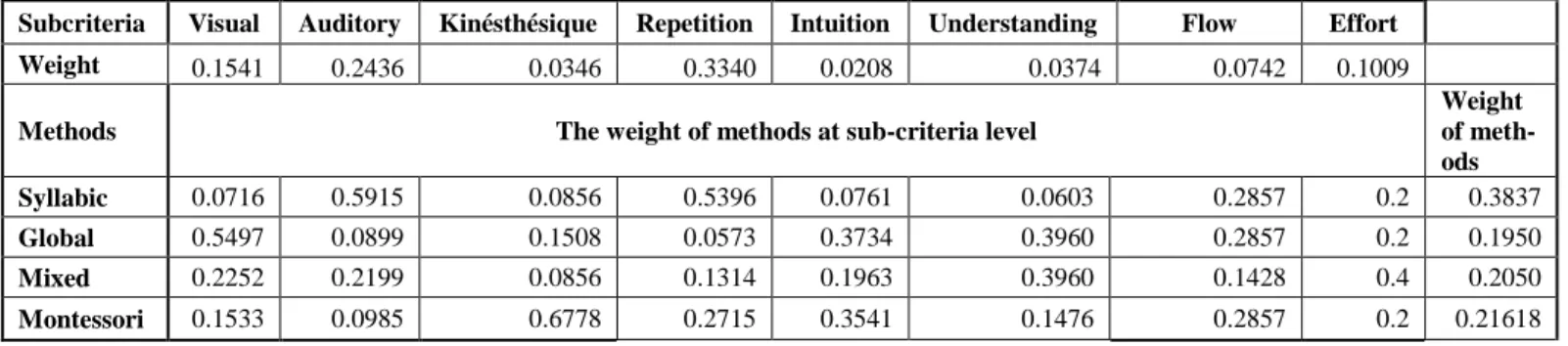
We give the example of the syllabic expert XV:
Table XV: solution matrix given by the syllabic expert
Subcriteria Visual Auditory Kinésthésique Repetition Intuition Understanding Flow Effort
Weight 0.1541 0.2436 0.0346 0.3340 0.0208 0.0374 0.0742 0.1009
Methods The weight of methods at sub-criteria level
Weight of meth-ods
Syllabic 0.0716 0.5915 0.0856 0.5396 0.0761 0.0603 0.2857 0.2 0.3837
Global 0.5497 0.0899 0.1508 0.0573 0.3734 0.3960 0.2857 0.2 0.1950
Mixed 0.2252 0.2199 0.0856 0.1314 0.1963 0.3960 0.1428 0.4 0.2050
Montessori 0.1533 0.0985 0.6778 0.2715 0.3541 0.1476 0.2857 0.2 0.21618
And having made the weighted average of the weight of the methods in relation to their matrices of solutions, we obtain the following table:
Table XVI: weighted average of the judgments of different experts
Syllabic Global Mixed Montessori
Expert Syllabic 0.3837 0.1950 0.2051 0.2169
Expert Mixed 0.2350 0.2861 0.2540 0.2249
Expert Global 0.1593 0.3489 0.2582 0.2336
Expert Montessori 0.1720 0.2836 0.2250 0.3193
XVII presents the ranking of pedagogical methods of de-veloping reading skills:
Table XVII: ranking of pedagogical methods of developing reading skills
Ranking Pedagogical methods
1 Global Method
2 Montessori Method
3 Syllabic Method
4 Mixed Method
N 1 2 3 4 5 6 7 8 9 10
V. CONCLUSION ET PERSPECTIVES
In this article we have considered several pedagogical methods (Syllabic, Global, Mixed, Montessori, Ideo-Visual, interactive, phonomimic, Alphas, Jean-qui-rit) of teaching and learning to read in order to evaluate them by applying a multi-criteria method which is the AHP method one of the MCDM methods. And which gave us a ranking of these pedagogical methods where the global method has distin-guished from other methods on the basis of the values men-tioned above.
This work is conducted in order to give primary learning its true value, which is currently experiencing some decline. Also to better identify the most appropriate learning method for a specific profile. Because, we noticed that from criteria related to the learning method, there are also criteria related to the learner which have an important impact.
We started to mix these two approaches [16], namely the method-oriented aspect and the profile-oriented aspect. And further research is underway by the authors to expand the work presented here by exploring other learnings types (cal-culation, comprehension, written and oral expression), in-cluding the integration of ICT (Information and communica-tions technology) and multimedia in a context of collabora-tive learning.
VI. REFERENCES
[1] J.-É. Gombert, P. Colé, S. Valdois, R. Goigoux, P. Mousty and M. Fayol, Enseigner la lecture au cycle 2: Nathan Université, 2000.
[2] P. Janet et G. Dumas, Journal de psychologie normale et pathologique / dir. Pierre Janet, Georges Dumas, Paris: Presse universitaires de France (Paris), 1926, p. 750.
[3] J.-P. Brighelli, «La Fabrique du crétin : la mort programmée de l'école,» Jean-Claude Gawsewitch, Paris, 2005.
[4] R. HAIDAR, "ÉLABORATION ET TEST D‘UN PROGRAMME DE REMÉDIATION AUX DIFFICULTÉS EN LECTURE AU COURS PRÉPARATOIRE," Université Haute Alsace, Haute Alsace, 2015.
[5] G. Bruno, «Les méthodes de lecture en cours préparatoire,» Bulletin des bibliothèques de France, p. 49, 2004.
[6] A. Grosselin, Manuel de la phonomimie, ou Méthode d'enseignement par la voix et par le geste (6e édition) / inventée par Augustin Grosselin, Paris: Belin frères, 1905.
[7] K. A. N‘Namdi, "Guide to teaching reading at the primary school level," UNESCO, Paris, 2005.
[8] H. Abadzi, "Instructional time loss and local-level governance," PROSPECTS, vol. 37, pp. 3 - 16, Mars 2007.
[9] F. Aissanou, "Décisions multicritères dans les réseaux de télécommunication autonomes," Thèse numéro : 2012TELE0019, Paris, 2012.
[10] M. Arnoux, P. Bressoux and L. Lima, "Pratiques d‘enseignement de la lecture au CP et acquisitions des élèves," Les Dossiers des Sciences de
l‘Education, no. 9, pp. 119-140, 2008. [11] A. Bentolila and B. Germain, Apprendre à lire,
labeur ou plaisir ?, Paris: Nathan, 2013, p. 96. [12] M.-F. Bishop, "LireÉcrireCP," in L‘enseignement
de la compréhension., Lyon, 2015.
[13] M. Bougroum, A. Ibourk and P. Löwenthal, "La politique d‘alphabétisation au Maroc : quel rôle pour le secteur associatif ?," Cairn.info, vol. 34, no. 9782804151362, pp. 63 - 65, 2006/2 (N°134). [14] F. L. Bowman, "The Influence of Montessori-Based
Literacy Instruction and Methods on Reading Achievement of Students in Grades 3, 4, 5, 6, and 7," Doctorat of Education, Seton Hall University, 2013.
[15] S. Cèbe, «LireEcrireCP,» chez L‘enseignement de la compréhension., Lyon, 2015.
[16] S. Dehaene, Apprendre à lire. Des sciences cognitives à la salle de classe., Paris: Odile Jacob, 2011.
[17] E. El Haji, A. Azmani and M. El Harzli, "Using AHP Method for Educational and Vocational Guidance," International Journal of Information Technology and Computer Science(IJITCS), vol. 9, no. 12, pp. 9-17, 2017.
[18] A. Diabagaté, A. Azmani and M. El Harzli, "The Choice of the Best Proposal in Tendering with AHP Method: Case of Procurement of IT Master Plan's Realization," International Journal of Information Technology and Computer Science(IJITCS), vol. 7, no. 12, pp. 1-11, 2015.
[19] N. Denzin and Y. Lincoln, The SAGE Handbook of Qualitative Research, 4ème ed., Los Angeles: SAGE, 2011.
[20] A. Grosselin, "De l'enseignement de la lecture par la méthode phonomimique," Revue pédagogique, vol. 2, no. 2, pp. 517-530, 1881.
[22] E. Jamet, «Comment lisons-nous?,» Sciences Humaines, n° %182 , pp. 20-25, Avril 1998. [23] UNESCO, «Rapport mondial de suivi sur
l'éducation. L'éducation pour les peuples et la planète : Créer des avenirs durables pour tous,» UNESCO, Paris, 2016.
[24] UNESCO, «Le rapport mondial de suivi sur l'EPT "Education pour tous 2000 - 2015 : Progrès et enjeux,» UNESCO, France, 2015.
[25] UNESCO, "Enseigner et apprendre : Atteindre la qualité pour tous," UNESCO, Paris, 2013/4. [26] T. Saaty, "Decision making with the analytic
hierarchy process," Services Sciences, vol. 1, no. 1, p. 83–98, 2008.
[27] R. W. Saaty, "The analytic hierarchy process—what it is and how it is used," Mathl Modelling, vol. 9, no. 3, p. 161–176, 1987.
[28] M. H. a. V. K. S. J. Sadjadi, "A Multi-Objective Decision Making Approach for Solving Quadratic Multiple Response Surface Problems," Math. Sciences, vol. 3, no. 32, pp. 1595-1606, 2008. [29] PIRLS, "pirls 2016 International Results in
Reading," TIMSS & PIRLS International Study Center, Lynch School of Education, Boston College and International Association for the Evaluation of Educational Achievement (IEA), United States. [30] W. Lai, L. Han-lun, L. Qi, C. Jing-yi and C. Yi-jiao,
"Study and implementation of fire sites planning based on GIS and AHP," Procedia Engineering 11, vol. 1, no. 1, pp. 486 - 495, 2011.
[31] C. L. A. A. Lahby Mohamed, "An intelligent network selection strategy based on MADM methods in heterogeneous networks," International Journal of Wireless & Mobile Networks, vol. 4, no. 1, pp. 83-96, February 2012.
[32] I. Bastide et C. Joigneaux, «Littératie précoce, album et lectures partagées à l‘école maternelle,» Spirale - Revue de Recherches en Education, n° %153, pp. 45-60, 2014.
Authors´ Biographies
Hasnââ CHAABI is an engineer and Ph.D student in the Laboratory of Informatic, System and Telecommunication (LIST) at Abdelmalek Essaadi University.
Her current research intrest associates mathematical models, artificial intelligence algorithms, tools and computer techniques around a Big Data-type digital ecosystem orientend to educa-tion models and e-learning. She is also a very active
associa-tion member in teaching and educaassocia-tion of young people in difficult situations.
Abdellah AZMANI received his Ph.D. in
Industrial Computing in Dynamic System Modelisation and Artificial Intelligent at the University of Science and Technology of Lille in 1991. He worked as a professor at the Ecole Centrale de Lille, France and at the Institute of Computer and Industrial Engineering from Lens, France. He is a professor at Faculty of Sciences and Technology of Tangier, Morocco. He is a member of the Laboratory of Informatic, System and Telecommunication (LIST). He has contributed for many theses, scientific research projects and he elaborates and produces many IT solutions for learning games, eLearning, Public Administration, business manage-ment, good governance and decision support.
Amina AZMANI obtained her PhD at the