REED HARVESTING EQUIPMENT IN THE COUNTRY AND WORLDWIDE
PhD.Eng. Ivan Gh. INMA Bucharest / Romania
ABSTRACT
Reed is a plant specific for channels and ponds in the Danube Delta, but it is very little exploited due to the lack of an ecological technology and of harvesting machines for its specific conditions. Due to the necessity to regenerate reed areas, around 200000 ha are incinerated annually, polluting a UNESCO heritage area. The paper presents machines and equipments existing worldwide at this moment for harvesting reed, respectively an innovative solution proposed by INMA Bucharest, complying with all the requirements specific to DDBR.
INTRODUCTION
In a study conducted in 2013 by Greenpeace and the European Renewable Energy Council it is presented that, in the last eight years, the necessary means to eliminate the causes responsible for greenhouse gas emissions were analyzed. It comes to radical measures that will allow abandoning technologies from all activities that have determined climate and environment changes, the cost of this “green revolution” being estimated at 14.7 billion dollars, only for the preparing stage until 2020. The cost is incredibly high, none of the countries or of the union of countries being able to handle such a financial effort, the only long term solution being to identify in each country the polluting factors from all human activities and to arrange the immediate halt of all polluting activities.
For Romania, one of the polluting activities is burning reed vegetation in the Danube Delta.
Due to the lack of an ecological technology for reed harvesting machinery, without a national strategy on identifying resources for producing renewable energy and due to the necessity to regenerate reed areas, large surfaces from these areas are incinerated every year. From the statistics of the Danube Delta Biosphere Reservation Administration (DDBRA) it results that around 200000 hectares are incinerated annually, despite the fact that in December 1990, Danube Delta has achieved maximum international recognition by being accepted on the UNESCO List of World Natural and Cultural Heritage as biosphere reservation [1].
Fig. 1 –Reed (Phragmites australis) [2]
water surface. Rhizomes are crawling, have vertical or horizontal position and form a large number of buds. From the buds of rhizomes are formed the straight, horizontal or oblique aerial stems. Rhizomes are destroyed by harvesting machines with tracks.
MATERIAL AND METHOD
Worldwide reed harvesting technology consists in harvesting reed, usually by using specialized machinery, but harvesting with motor mowers or even by hand is still practiced. Worldwide, reed has reduced spreading and for this reason, important machine building companies do not produce specialized equipment for its harvesting. Locally, especially in the Baltic countries, there are small companies producing a reduced number of specialized machines for reed harvesting, also being interested to export them to Eastern European countries.
Specialized machines produced by these firms are mainly self-propelled machines, on wheels or tracks, but there are also a reduced number of motor-mowers with two or three wheels, which are multifunctional or more concrete, they are used for various crops.
The majority of self-propelled machines are fitted with metallic or in the best case scenario, rubber tracks.
RESULTS
SEIGA4x4 and 6x6reed harvesting machine, Hungary
The machine is efficient for harvesting reed situated on dry land or in areas with water up to 1 meter in depth. The buoyancy of the machine does not also allow transporting the load in conditions of deep water, and harvesting in deep water is not possible. The machine is endowed with large width low pressure tires, having a large weight (3 tons), being hard to manoeuvre and very expensive.
This is a machine that can be used in the economic area of Danube Delta. SEIGA PELICAN reed harvesting machine
Fig. 3 - SEIGA PELICAN reed harvesting machine [4]
The machine is self-propelled, has three wheels with wide low pressure tires and an equipment that cuts and ties sheaves, leaving them on the ground, but does not comply with the specific conditions for DDBR.
REEDA REED HARVESTER reed harvesting machine- Finland / Poland
Fig. 4 - REEDA REED HARVESTER reed harvesting machine [5]
The machine is build on the basis of a German tractor equipped with Italian tracks. It operates perfectly on marshy terrain, in water up to 60 cm deep, when there is no ice. However, the machine is too heavy for its gauge (due to the tracks) and cannot operate in the conditions specific for DDBR.
REED HARVESTER- Estonia
The machine is similar to REEDA produced in Finland / Poland, except for the sheaves transporter situated between the mowing equipment and the platform.
REED HARVESTING SHAPWICK FEN– Great Britain
Fig. 6 -REED HARVESTING SHAPWICK FEN[7]
Softrak is a machine equipped with tracks, an equipment for mowing and tying sheaves, a sheaves transporter between the equipment and the folding transport bunker and a cabin for the driving post. The machine is operated by two people, but it cannot be used in water and is not recommended for the Danube Delta area.
ROOSMA RIETDEKKERS reed harvesting machine– Netherlands / Great Britain
Fig. 7 -ROOSMA RIETDEKKERSreed harvesting machine [8]
Roosma is a machine equipped with tracks, a mowing equipment, a transporter with device for tying sheaves between the equipment and the retractable bunker and a cabin for the driving post. The machine is operated by two people, but it cannot be used in water and is not recommended for the Danube Delta area
Towed reed harvesting machine
Fig. 8 – Tower reed harvesting machine [9]
machine cuts reed and leaves it on the ground and also doesn’t comply with the specific requirements of DDBR.
BCS 622 REAPER-BINDERmotor mower, for straw cereals, alfalfa and reed.
Fig. 9 - BCS 622 REAPER-BINDER motor mower [10]
BCS 622 motor mower is used both for harvesting straw cereals and alfalfa but also for harvesting cane and reed (is equipped with a device for tying sheaves). The following accessories can be added:
- Special cutting and tying device with forks, 140 cm cutting bar, arms, tying height 28 cm;
- Standard cutting and tying device with forks, 140 cm cutting bar, arms, tying height 28 cm;
- Working and transfer saddle with soft seat for mowing: BCS 622.
MRSreed harvesting machine
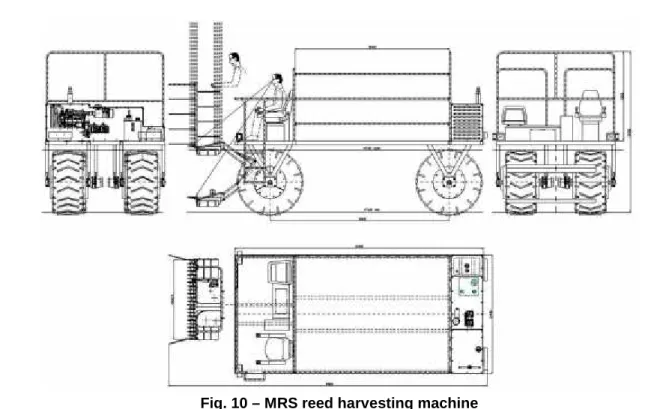
MRS reed harvesting machine is composed of an equipment for cutting and tying reed sheaves, a driving platform fitted with chairs, steering column and command console, platform for storing and transporting reed to storage places, a 45 kW internal combustion motor, mechanic-hydrostatic transmission for driving and actuating the equipment, two driving wheels and two steering wheels with wide low pressure tires, which do not affect the rhizomes of the harvested reed and ensure the machine’s buoyancy with/without load, hydraulic installation for positioning the equipment, electrical installation necessary for the machine to operate and to move on public roads, etc.
The MRS reed harvesting machine is presented schematically in figure 10.
The equipment for cutting and tying sheaves will be possible to be positioned depending on the ground or water depth and will be fitted with floater, placed beneath the cutting platform, to ensure the cutting position and the buoyancy of the machine with/without load, in deep water conditions.
The command platform will have a driving post, fitted with steering column, seat, multifunctional command lever, a folding seat for the operator who takes and loads the sheaves, an internal combustion motor positioned under the seats, mechanic-hydrostatic transmission, electromechanical system for command transmission, etc.
The mechanical hydrostatic transmission will simplify the construction and use of the machine compared to the transmission of existing machines in the field, will decrease weight and will increase the machine’s manoeuvrability.
Fig. 10 – MRS reed harvesting machine
Harvest monitoring can be performed by using a GPS system and by land verifications in the period when reed resources are harvested and stored. In these conditions, the incineration of reed vegetation would under no circumstances be justified, and the population would have opportunities to find jobs and generate income.
CONCLUSIONS
Reed harvesting machines represent a worldwide necessity, for our country the situation being urgent due to protection requirements specific for an UNESCO heritage area.
MRS reed harvesting machine will harvest reed situated in dry areas as well as the one situated on the banks of channels and ponds (floating reed islets), in the specific conditions of Danube Delta Biosphere Reservation.
ACKNOWLEDGEMENT
This paper was financed with the support of the National Authority for Scientific Research, NUCLEU Programme, PN 16 24 04 01 – Ecological technology and technical equipment for harvesting biomass specific to wet areas for using it as source for producing renewable energy.
REFERENCES [1] http://deltadunari.weebly.com/flora.html
[2] https://sites.google.com/site/nadarato/ [3] http://www.devriescornjum.nl/verkoop.php
[4] http://raedzaghloul.en.ec21.com/Reeda_Reed_Cane_Harvester--6005973_6005974.html [5] https://www.youtube.com/watch?v=ao8n7O5_aKw
[6] https://www.youtube.com/watch?v=-fb-TRFMwNA [7] https://www.youtube.com/watch?v=8WjTLgwpALA
[8] https://www.youtube.com/watch?v=dvG3BrC2YYY&feature=related
![Fig. 1 – Reed (Phragmites australis) [2]](https://thumb-us.123doks.com/thumbv2/123dok_us/8070238.2137716/1.892.157.739.815.1076/fig-reed-phragmites-australis.webp)
![Fig. 2 - SEIGA 4x4; 6x6 reed harvesting machine [3]](https://thumb-us.123doks.com/thumbv2/123dok_us/8070238.2137716/2.892.198.716.507.1137/fig-seiga-x-x-reed-harvesting-machine.webp)
![Fig. 4 - REEDA REED HARVESTER reed harvesting machine [5]](https://thumb-us.123doks.com/thumbv2/123dok_us/8070238.2137716/3.892.83.793.593.799/fig-reeda-reed-harvester-reed-harvesting-machine.webp)
![Fig. 6 - REED HARVESTING SHAPWICK FEN [7]](https://thumb-us.123doks.com/thumbv2/123dok_us/8070238.2137716/4.892.146.760.170.407/fig-reed-harvesting-shapwick-fen.webp)
![Fig. 9 - BCS 622 REAPER-BINDER motor mower [10]](https://thumb-us.123doks.com/thumbv2/123dok_us/8070238.2137716/5.892.306.609.181.403/fig-bcs-reaper-binder-motor-mower.webp)