
DRIVE SYSTEMS FOR GRAVITATIONAL SEPARATORS
BRĂCĂCESCU C., PĂUN A., SORICĂ C., MIRCEA C.
INMA Bucharest/ Romania [email protected]
Keywords: cleaning, seeds, specific mass, electric motovibrator
ABSTRACT
The cleaning of cereal seeds represent an essential operation of the conditioning chain. Taking into account all considerations, the experts׳ attention has been drawn by the study of phenomena which influence upon the impurities separation process, aiming at a maximum reduction impurities.
The paper presents the constructive and functional scheme of an gravitational separator driven by means of non balanced vibration generating systems known under the trade name of electrical motovibrators and also the constructive scheme of these, in view of theirs utilisation with best results for the drive of vibrating sieves.
At the end of the paper are presented the advantages of using these types of acting systems for gravitational separators.
INTRODUCTION
In order to use the main crop seeds at different purposes (storage and conservation, sowing matter and consumption, industrialization and commercialization products, etc), the whole and sain seeds should be separated out of the matter mixture and the obtained matter should meet the requirements of standards in force.
The continous progress related to improving the primary processing methods as conditioning operations and technical and material base periodically determines the enhancement of requirements in terms of foreign bodies removal and other quality aspects.Therefore, profoundly knowing the technology to be used, the operating method of technical equipment appropriate to relevant technology and technical-functional parameters adjusting represent an important preriquisite to obtain the maximum quality with reduced power and man labour consumption.
To reduce the number of technical equipment and implicitly of technological spaces, the modern cleaning technologies use complex installations carrying out the separation by combined principles, the most used following the specific mass difference being the ones and aerodynamic properties of various components of seed mixtures. [3, 7]
MATERIAL AND METHOD
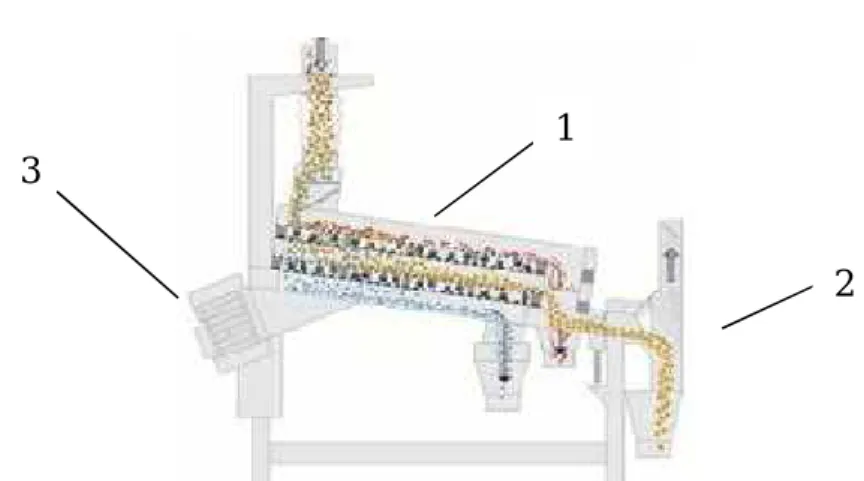
Gravitational separators are technical equipment which achieve the separation of impurities from the cereal mass based on the difference of specific weight, using inclined plane surfaces that have a vibrating movement (Geankoplis Chr., 2003).
Fig. 1. Functional diagram of a vibrating gravitational separator with aspiration channel 1-vibrating sieves; 2-aspiration channel; 3-electric motovibrator
Figure 2. Constructive scheme of gravitational separator SAI 800
1 – sieve frame; 2 – aspiration channel; 3 – flow box; 4 - framework; 5- upper sieve stage; 6 – low sieve stage; 7 – sight glass; 8 – electric motovibrator (2 pieces)
The experimental model of gravitational separator SAI 800 (figure 2) was realised at INMA Bucharest and is made up of a vibrating sieve frame, suspended from elastic supports, and an aspiration channel, the flexibility of which allows its adaptation to any operating conditions. The lighter parts are lifted by a current of air which surrounds the product along the entire width of the aspiration channel, and are carried upwards. The cleaned product falls into the lower outlet.
The gravitational separator with aspiration channel provides excellent classification efficiency and thus ensures improved quality of the end product – at a continuous and consistent quality level. Using intelligently conceived air distribution, the material being fed through is precisely separated into three fractions according to specific gravity: high-density (heavy), mixed, and low-high-density fractions.
The modern and representative gravitational separators produced by well known companies in the field (Bühler, Sangati, Ocrim, Golfetto, etc.) show a series of common constructive-functional particularities, such as:
- Waiving traditional systems for producing the oscillating movement and introducing electric motovibrators to ensure the amplitude of the vibrating movement;
- Eliminating mechanical transmissions;
- Increasing the loading index on the working surface; - Reducing specific energy consumption by 2÷5 times; - Easy maintenance and exploitation;
- Increased reliability.
2 1
RESULTS AND DISCUSSIONS
The electric motovibrators have monted on theirs axles two non-balanced eccentric masses m= m0/2, which are continously rotated, in opposite directions and which develop
the centrifugal forces F(t)/2. In figure 3 is shown the constructive scheme of electric motovibrator.
Fig. 3. Constructive characteristics of electric motovibrator [1]
1 -stator; 2 -rotor; 3 - non-balanced eccentric masses; 4 - special soles; 5 – guards
The method of adjusting the imbalance force acting on the shafts 3 of the driving electric motors of the vibrators unbalanced masses is given in figure 4 [1, 3].
Fig.4. Adjustment scheme of imbalance forces of the masses of centrifugal excitation control forces achieved by the electric motovibrators of the vibrating separator sieves [1]
1, 2 - control plates; 3 - drive shaft of the unbalanced masses
Adjustments are achieved by mounting of plates 1 and 2 in different relative positions, of semicircular shape, the size of centrifugal force developed for different coverage degrees of the plate’s surface being given in the graph at the bottom of figure.
The location of driving system (the two electric motovibrators) is chosen in equation with the disturbance force trajectory that should cross the mass centre (c.g) of the whole system, eliminating this way the additional oscillations of the worked surface which could determine the disturbance, of normal harmonical movement law.
Whithin the postresonating operating regime the rotation frequency of the two massesm0is far smaller than the own frequency of oscillating system.
in in
s
k
m
m
m
. (1)where: ms is equivalent mass of vibrating frame and other components connected to it; kîn
= 0.1…0.25 – reducing factor of loading mass for frame mass [6]; mîn – mass of loading
material on the vibrating frame.
For the connecting elastic elements with viscous damping, the damping hypothesis through viscous friction are generally used, the external resistance force F (c, μ) being given by the Eq. 2 [6]:
. )
,
(c cS c S
F . (2)
where: c is the elastic elements rigidity with viscous damping and μ – damping factor by internal friction (for rubber, μ = 0.001 s).
Studying the performance of gravitational separators above presented, operated by vibrations generators, compared to the same categories of machinery but operated kinematic, it results that:
- the gravitational separators equipped with inertial generators (electric motovibrators) cover a large range of working capacities at a power reduced almost at half for the maximum values reached be those with kinematic drive;
- for gravitational separators equipped with inertial generators, the working capacity is superior to the capacity of those with kinematic drive at powers of electric motovibrators that are approximately 5 times smaller.
-Table 1
Comparison between the technical characteristics of gravitational separators driven with the two types of vibration generators
No. Characteristic M.U. Kinematic
excitation
Inertial excitation
1
Working capacity : -pre-cleaning -cleaning t/h 15-40 5 2-67 6-12
2 Vibration amplitude mm 12-16 14
3 Installed power kw 1.1-3.92 1.1-1.5
4 Number of sieve levels buc. 2-4 2
5 Number of sieves/equipment buc. 2-8 2-4
6 Sizes : -length -width -height mm mm mm 2020-2350 1500-2750 1876-2500 1945-2310 1328-1900 1255-1600
7 Equipment weigh kg 820-2800 750-950
It is also observed the decrease of overall dimensions, due to simplification of driveline of the body with sieves, leading to material savings and increased reliability.
CONCLUSIONS
with specific consumption of reduced materials and energy, the utilization of these systems generating vibrations is fully justified.
ACKNOWLEDGEMENT
This paper was financed with the support of National Agency for Scientifical Research and Innovation, Programme NUCLEU, no. 8N/09.03.2016, Act. Ad. nr.1/2016, Project PN 16 24 03 01 - ,,Tehnologie inovativa si instalatie pentru valorificarea superioara a semintelor de soia in hrana animalelor”.
BIBLIOGRAPHY
[1] Brăcăcescu C., Sorică C., Manea D., Yao Guanxin, Constantin G.A., 2014
-Theoretical contributions to the drive of cereal cleaning technical equipment endowed with non-balanced vibration generating systems, INMATEH – Agricultural Engineering, Vol. 42; [2] Brîndeu L., 2001 - Vibration and vibropercussion. Basic of vibration and vibropercussion mechanics, Publishing Politehnica, Timişoara;
[3] Costin I., 1999 -Miller’s Book, Technical Publishing House, Bucharest, Romania; [4] Didyh V.F., 2002 - Improving the efficiency of drying agricultural plant materials, monograph, Lutsk;
[5] Falko O., 2014 - Bulk products separation on a stepped screen surface, Journal of EcoAgriTourism, vol.10, no.1, Braşov;
[6] Geankoplis Chr., 2003 - Transport processes and separation process principles, Prentice Hall PTR,Fourth Edition;
![Fig. 3. Constructive characteristics of electric motovibrator [1]](https://thumb-us.123doks.com/thumbv2/123dok_us/8069995.2137640/3.892.262.676.282.520/fig-constructive-characteristics-of-electric-motovibrator.webp)
