1 R E V I E W A R T I C L E
Homeopathy in dentistry: A review
Mahmoud Hoseinishad1, Azam Nosratipour2, Samineh Mozzaff ar Moghaddam3, Amin Khajavi4
1Department of Oral and Maxillofacial Pathology, Faculty of Dentistry, Mashhad University of Medical Sciences, Mashhad, Iran, 2Department of Oral and
Maxillofacial Disease Center, Mashhad University of Medical Sciences, Mashhad, Iran, 3Department of Oral and Maxillofacial Surgery, Faculty of Dentistry,
Mashhad University of Medical Sciences, Mashhad, Iran, 4Department of Oral and Maxillofacial Disease Center, School of Dentistry, Mashhad University of
Medical Sciences, Mashhad, Iran
Abstract
Homeopathy is an alternative therapy that has been used over 200 years. Homeopathic remedies are used in dentistry to improve psychological or emotional condition of the patients. Although the proposed homeopathic remedies are not supported by systematic reviews, but many clinical trials and case-control studies have been published about the eff ectiveness of homeopathic remedies for oral and maxillofacial problems. This article reviews some of this homeopathic application in dentistry.
Keywords: Alternative therapy, dentistry, homeopathy Correspondence
Dr. Samineh Mozzaff ar Moghaddam, Department of Oral and Maxillofacial Surgery, Faculty of Dentistry, Mashhad University of Medical Sciences, Mashhad, Iran. Tel/Fax: +985138414499. E-mail: [email protected]
Received 07 August 2015; Accepted 09 September 2015
doi: 10.15713/ins.ijcdmr.87
How to cite the article:
Mahmoud Hoseinishad, Azam Nosratipour, Samineh Mozzaff ar Moghaddam, “Homeopathy in dentistry: A review”, Int J Contemp Dent Med Rev, vol. 2015, Article ID: 030815, 2015. doi: 10.15713/ins.ijcdmr.87
Introduction
Homeopathy is the alternative therapy that has been used over 200 years. It was presented for the fi rst time by Samuel Hanemen (1755-1843), but its basic tents go back to Paracelsus and Hippocrates.[1] Hanemen worked on the treatment of malaria and
found that when a healthy person used the cinchona “a plant from which quinine was derived” symptoms of malaria appear. This was the advent of treatment which is in accordance with the energetic principles of healing.[2] In modern medicine the symptom are the
direct result of the disease and tries to suppress them but due to homeopathic concept the symptoms are the signs of bodies’ eff ort to conquest disease and tries to reinforce and not to inhibit them. Homeopathy has a holistic view to health and believes that every disease has basic causes that the homeopathic remedies focus on them.[1] The fi rst Hanemen book “organon” was published on 1810.
He introduced three laws as the basic principles of homeopathy including law of similarity, minimum dose and individuality.
Law of Similarity
One of the main principals in homeopathy is the rule of “like cure likes.” Due to this law a substance like coff ee which can cause insomnia can be used for the treatment of patients who suff ered
from this problem. Homeopathy accentuate to symptoms more than the external causes of the disease. A remedy for a disease is a substance that develops similar symptoms. The actions of medicine are tested on healthy persons. These tests are called provings. Haneman tried diff erent substances on him and other healthy volunteers and published a book named material medical.[2]
Minimum Dose
Homeopathic drugs are product which be obtained from consecutive attenuation of a substance in alcohol or distilled water. This process called potentiation. Because of the substances are diluted they triggers the body’s natural system of healing. Immunization is based on the law of similarity. The law of similarity is in accordance with the Arndt-Schulz law. Due to this law every drug in small doses has stimulating eff ect whereas this substance has an inhibitory eff ect on larger doses.[3]
Individuality
such as food preferences, temperature preferences, and other personal characteristics should be regarded. Hereupon with one remedy several problems can be cured.[2]
Homeopathic Drugs
Homeopathic drugs are prescribed in two ways. One the prescription of a drug for a specifi c disease or chief complaint and another for an individual based on his or her temperament. Homeopathy is not in contrast with the modern medicine, but it can be used as an adjunctive therapy with them specifi cally for the diseases that conventional medicine were not eff ective for them or have adverse side eff ects.[2]
Critics on Homeopathy
Homeopaths claimed that their drugs are much diluted and in such a concentration they have therapeutic eff ects and triggers natural healing. This principal is the most controversial law in homeopathy. After potentiation process no residue of original substance can be traced and after 12 decimal dilutions the water molecules just have a memory of original substance.[3] This issue
is the most controversial debate in homeopathy. The society of homeopaths (SOH) admits that scientifi cally it cannot yet be explained precisely that how homeopathy works. There is no high-quality evidence that homeopathy is eff ective, and its basic principles don’t seem logical and have not the scientifi c supports. The proposed homeopathic remedies are not supported
by systematic reviews. Many believed that studies which referred prepared outdated and misleading documents and the eff ectiveness of these remedies might be due to placebo eff ect.[4]
Homeopathic Organization
These are three homeopathic organization include SOH which provides registration for professional homeopaths has its code of ethics and practice,[5] British homeopathic association which
promote homeopathy practices by doctors and own other health care professionals[6] and, Faculty of homeopaths which
promotes academic and scientifi c development of homeopathy and ensures the highest standards in educational, training and practice of homeopathy.[7] British Homeopathic Dental
Association (BHDA) is the only organization works on the homeopathy in the fi eld of dentistry. BHDA aims to promote the use of homeopathy within the dental profession and to advance the professional understanding of the subject. (The BHDA recommend that patients should try to fi nd dentists who completed training by the FOH.[8]
Homeopathic Applications in Dentistry
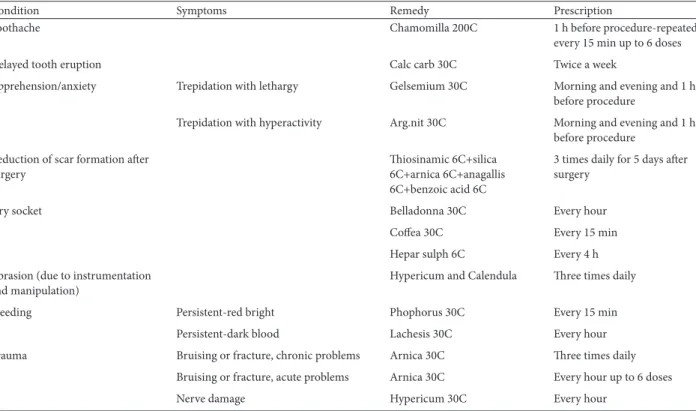
In dentistry, homeopathic remedies have been proposed for oral ulcers, sialorrhea, neuralgia, temporomandibular joint disorders, xerostomia, lichen plan, and bruxism. However, there is not enough evidence to support them. Diff erent situations and relative homeopathic drugs are shown in Table 1.[9-19]
Condition Symptoms Remedy Prescription
Toothache Chamomilla 200C 1 h before procedure-repeated
every 15 min up to 6 doses
Delayed tooth eruption Calc carb 30C Twice a week
Apprehension/anxiety Trepidation with lethargy Gelsemium 30C Morning and evening and 1 h
before procedure
Trepidation with hyperactivity Arg.nit 30C Morning and evening and 1 h
before procedure
Reduction of scar formation aft er surgery
Th iosinamic 6C+silica
6C+arnica 6C+anagallis 6C+benzoic acid 6C
3 times daily for 5 days aft er surgery
Dry socket Belladonna 30C Every hour
Coff ea 30C Every 15 min
Hepar sulph 6C Every 4 h
Abrasion (due to instrumentation and manipulation)
Hypericum and Calendula Th ree times daily
Bleeding Persistent-red bright Phophorus 30C Every 15 min
Persistent-dark blood Lachesis 30C Every hour
Trauma Bruising or fracture, chronic problems Arnica 30C Th ree times daily
Bruising or fracture, acute problems Arnica 30C Every hour up to 6 doses
Nerve damage Hypericum 30C Every hour
Table 1: Remedies recommended for diff erent conditions
3
Condition Symptoms Remedy Prescription
Puncture wounds Ledum 30C Every hour
Incisional wound Staphysagria 15C Every hour
Sore jaws-improved by warmth Mayphos 30C Every hour
Sore jaws-not improved by warmth Arnica 30C Every hour
Abcess Initially with throbbing and mild Belladonna 30C Every half hour
Halitosis, excessive salivation Merc sol 6C Every hour
Obvious pus Hepar sulph 6C Every 2 h
Swollo-numbness Myristica 6X Every hour
Draining pus Silica 6C Twice daily
Aphtous ulcers Nervous patient Barox 30C Every 4 h
Foul breath, large tongue retains the imprint of teeth
Merc sol 30C Every 4 h
Yellow base, swollen uvula Kalibich 30C Every 4 h
Bleeding base Nit. Acid 30C Every 4 h
Oral candidiasis Borax 4X Twice daily
Sulphur 30C Twice daily
Hypersalivation During sleep Baryta carbonica
Swollen gums that bleed easily Phosphorus
Xerostomia Great thirst Bryonia alba
No thirst Pulsatilla
Bruxism During sleep Cina 30C 1 h before sleep
While awake Nux vomica 30C Th ree times a week
Gingivitis Heavily coated tongue Merc sol 30C Th ree times daily
Clean tongue Nit. Acid 30C Th ree times daily
Destruction of tissue Kali chlor 30C Th ree times daily
Sore gums following scaling Arnica 30C Every 2 h
Halitosis Carboveg 30C+Merc sol 30C Every 2 h
Periodontitis Bleeding gum, foul breath, large tongue Merc sol 6C One time daily
Bleeding gum+substantial loss of bone Phosphorus 15C One time daily
TMJ dysfunction Pain in joint on swallowing Arum triphyllum
Hypermobile joint Calcarea fl ourica
Pian in mouth opening Calcarea phosphorica
Vertigo, nusea, tinnitus Carbo vegetabilis
Low pain threshold, unbearable spasm of pain radiating to ear
Chamomilla
Trismus Cuprum metallicum
Painful crack Granatum
Pain radiating to ear, teeth, throat Phytolacca decandra
Joint stiff ness Rhus toxicodendron
TMJ: Temporomandibular joint
Table 1: Contd...
Constitutional Types
By examining person’s craniofacial structures, we can defi ne his or her constitutional type. Based on the theory of constitutional
and thereby is responsible for diff erent anatomical characteristics and diff erent metabolic types and diff erent disease presentation. Every ones belongs to one of these three constitutional types: Calcarea carbonica, calcarea phosphoricum and calcarea
fl uricum. Based on which salt predominates in our structures. While it is common to see individuals who exhibit combinations of these three constitutional types but one type will always predominant.[20]
Calcarea Carbonica
They had a broad forearm, large jaws, white and well-aligned teeth. Their teeth erupt slowly with diffi cult teething, and their tongue is dry. Their teeth are very sensitive to coldness. They don’t like to talk and are very resistant to any change. They are logical and good with mathematics. Their bones, joints, and muscles are as rigid and infl exible as their opinions. They tend to develop hypertension, hypothyroidism, and obesity due to failure to remove toxins from body and are prone to digestive complaints. The remedies prescribed to eliminate toxins are nat. em, kali carb, iodum, arsenicum album, phosphorours, stannum.
Calcarea Fluoricum
Their muscles and ligaments are very lax, producing s shape posture. Their bones are deformed. Their teeth are irregular aligned, and they have maxillary protrusion. They have instability both mentally and physically, dislike exercise and have little physical endurance and cannot concentrate on anything for a long period of time. Their temperature is unstable. They have little control over their reactions and will say whatever is on their mind. They tend toward arteriosclerosis, arthritis, and hypertension. Their major remedies include mercurius, aurum metalicum, argenticum nitricum, kali bichromicum, platina, nitricum acidum, baryta carbonica and syphilinum.
Calcarea Phosphoricum
They have long arms and legs. The skull is long (front to back) and narrow. The forehead is elevated and nose strong. The teeth
are ovale and have yellow cast to them. The palate is narrow with a gothic (high) vault. They are very imaginative and artistic and don’t tolerate manual labor or any regularity in their life. They have long eyelashes. They tend toward hyperthyroidism, palpitation and tuberculosis.[20]
The characteristics of three calcarea groups are shown in Table 2.
Conclusion
Homeopathy is an alternative therapy that seems to be eff ective in cases of treatment failure to conventional drugs. Because there isn’t any strong evidence to support its remedies, a note of caution should be applied. Although the homeopathy appears to be a physician’s option for treatment of disease but more evidence are required to fi rmly establish the fi eld of its use. We recommended more research be done to evaluate the eff ectiveness of homeopathic remedies for treatment of conditions that seem to be dependent on spiritual and mental conditions of patients or the conventional drugs just have alleviative eff ect and poor response.
References
1. Th akur N, Bagewadi A, Keluskar V. Holistic dentistry: Natural
approaches to oral health. J Int Oral Health 2011;3:9-13. 2. Ulman D. Discovering Homeopathy: Medicine for the
21st Century. California, U.S.A: North Atlantic Books; 1991.
3. Dynamization and Dilution, Complementary and Alternative Medicine, Creighton University Department of Pharmacology, 2009, Accessed from http://altmed.creighton.edu/Homeopathy/ philosophy/dilution.htm. [Last retrieved on 2009 Mar 24]. 4. Eames S, Darby P. Homeopathy in dentistry – An overview. Int
J Contemporary Dent 2011;2:8-14.
5. Society of Homeopaths. About the Society. Code of Ethics and Practice. Available from: http://www.homeopathy-soh.org/ about-us/. [Last accessed on 2010 Oct 22].
6. British Homeopathic Association. Available from: http://www. britishhomeopathic.org/about-us/. [Last accessed on 2010 Oct 22]. 7. Faculty of Homeopathy. Available from: http://www.faculty of
homeopathy.org/about –us/. [Last accessed on 2010 Oct 22]. Table 2: Characteristics of diff erent calcarea groups
Organ Calcarea carbonica Calcarea phosphoricum Calcarea fl ouricum
Skeleton Strong and thick Fragile Irregular, exostoses
Orofacial Large, broad head, open fontanelles Elongated head, open fontanelles Asymmetrical head
Jaws and arches Large elliptical Narrow elongated, elliptical V shaped, irregular
Vault (palate) Low Gothic Narrow and very deep
Tooth eruption Delayed and diffi cult dentition Early but painful teething Teeth erupt out of normal sequence
Teeth White with broad stocky crowns, upper
incisor fl at and square, sensitive to cold
Yellow and long upper incisor, rectangular with curved facial surfaces
Grey white teeth, gum boils, sensitive to pressure and eating, looseness of teeth
Occlusion Teeth well aligned Oft en malposition in anterior teeth Irregularly set into arches (forward and
backward malposition)
TMJ Strong and tight Fine and slack Hyper stretch
5
8. British Homeopathic Association. Homeopathy and dental care: Your guide to treatment. http://www.britishhomeopathic.org/ export/sites/bha-site/how–we-can-help/advice-sheets/Dental-care.pdf. [Last accessed on 2010 Oct 22].
9. Fischer RD. Dentistry and homeopathy: An overview. J Am Inst Homeopath 1985;78:140-7.
10. Srivastava P. Periodontal disease and homeopathy.
Homeopath J 2012;5. Accessed from http://www.homeorizon. com/homeopathic-articles/dentistry/periodontal-disease-cure-in-homeopathy. [Last retrieved on 2015 May 26].
11. Goldstein MS. Use and satisfaction with homeopathy in a patient
population. Altern Th er Health Med.1998;2007:4(2):60-5.
12. Mousavi F, Mojaver YN, Asadzadeh M, Mirzazadeh M. Homeopathic treatment of minor aphthous ulcer: A randomized, placebo-controlled clinical trial. Homeopathy 2009;98:137-41.
13. Feldhaus HW. Cost eff ective of homeopathic treatment in dental practice. Br Homeopath J 1993;82:22-8.
14. Albertini H, Goldberg W, Sanguy B, Toulza CL. Homeopathic
treatment of dental neuralgia by Arnica and Hypericum. J Am
Inst Homeopath 1985;3:126-9.
15. Mojaver YN, Mosavi F, Mazaherinezhad A, Shahrdar A, Manshaee K. Individualized homeopathic treatment of trigeminal neuralgia: An observational study. Homeopathy 2007;96:82-6.
16. Mathie RT, Farrer S. Outcomes from homeopathic prescribing in dental practice: A prospective, research-targeted, pilot study. Homeopathy 2007;96:74-81.
17. Raak C, Ostermann T, Matthiessem PF. Reports on the usage of homeopathy in dentistry –A comprehensive literature review.
Focus Altern Complement Th er 2007;S1:41-2.
18. Haila S, Koskinen A, Tenovuo J. Eff ects of homeopathic treatment on salivary fl ow rate and subjective symptoms in patients with oral dryness: A randomized trial. Homeopathy 2005;94:175-81.
19. Steinchler F. Homeopathy in dentistry. Br Homeopath J 1985;73:145-9.