p-ISSN:2460-1497 and e-ISSN: 2477-3840 DOI: https://doi.org/10.26858/est.v5i3.10660
245
Analysis of The Effect of PBL-Based Experimental and Project Methods on
Science Learning Achievement
Ulin Nuha Rosyida1, Sukarmin2, Widha Sunarno3
1Science Education, Universitas Sebelas Maret, Indonesia
Email : [email protected]
2Science Education, Universitas Sebelas Maret, Indonesia
Email : [email protected]
1Science Education, Universitas Sebelas Maret, Indonesia
Email : [email protected]
This is an open access article distributed under the Creative Commons Attribution License CC-BY-NC-4.0 ©2019 by author (https://creativecommons.org/licenses/by-nc/4.0/ ).
ABSTRACT
This research aim was to find out the interaction between Problem Based Learning with experimental and project methods with thinking skill toward student’s cognitive learning outcomes. This research was held in SMP A on second semester of 2017/2018. The type of this research was experimental research. This research’s subject was 55 7th
grade students, determined with the cluster random sampling technique. Data were collected using test technique. Analysis technique was using quantitative analysis with two-way analysis of variance. Based on the results, in the first hypothesis the result means that there was difference between the student’s cognitive learning achievement with Problem Based Learning with the project method and experimental method. In the second hypothesis, the result means that there was difference between student’s cognitive learning achievement which have higher order thinking skill and lower order thinking skill. In the third hypothesis, the result means no interaction between Problem Based Learning with experimental method and project method with thinking skill toward student’s cognitive learning achievement.
Keywords: Problem Based Learning, Thinking Skill, Cognitive Learning Achievement
INTRODUCTION
Science lessons are important for students to learn because they contain natural phenomena and they occur around us. Learning science by interacting directly with nature, making it easier for concepts in science to be accepted and will be stored longer in memory. Science learning in schools can be taught with various learning models and methods. Science learning based on the 2013 curriculum requires a fundamental change in the process of delivering learning that can provide direct experience for students (Rahayu et al., 2015). The science learning process is good if it is meaningful for
students, so they can understand well and explore every natural phenomenon that occurs around them. In this regard, science is one of the subjects that is the main tool to support the development of 21st century skills in students
because in general, science is taught through a scientific approach.
Problem-Based Learning (PBL) is a learning models that can be applied to support the development of students' thinking skills. According to (Muhson, 2009; Arends, 2012; Trianto, 2010), PBL begins with the problem to gather and integrate new knowledge. It its process, two-way communication occurs, so
(Received: October-2019; Reviewed: October-2019; Accepted: November-2019;
students are expected to be able to build their knowledge independently. Made Wena (2009) states that the characteristics of the PBL model are as follows: (1)starting the learning process with a problem; (2)giving the problem related to the real world; (3)organizing learning with the problem; (4)giving a big responsibility in forming and running directly their own learning process; (5)using small groups; and (6)requiring students to present what they have learned in the form of products and performance. Problems in PBL are considered as challenges for students to start in their own learning process (Christiansen, E.T., et al., 2013)
.
Based on the results of the research conducted by Fitriani et al. (2017), the application of PBL makes students more active in the learning process, discussions run well, and students more motivated in learning. Learning with PBL has a positive impact on students and the learning process. Another research result by Wahyudi et al. (2017) shows that PBL gives a positive influence on students’ learning outcomes indicated by the increase in the students’ average scores, students become more active in interacting with their friends.
To support PBL learning, the appropriate learning method whose stages represent a scientific approach, namely experimental and the project methods. Both methods require students to think independently. Both methods are very common methods in science learning. It can be seen from their processes. Both methods provide full opportunities for students to build their knowledge independently.
Learning achievement become a benchmark of the success of a learning. Learning achievement are not always in line with problem-solving skills. It is assumed that people with a good problem - solving skills will tend to display higher levels of learning achievement and produce more original solutions (Yaw et al., 2016; Sung, 2017; Ismail et al., 2018;). The results of the science subject in SMP A don’t show positive development. This can be seen from the results of the National Examination (NE) in the science subject in the last 3 years. In the 2014/2015 academic year, the average NE score reached 66.74 while in 2015/2016 it decreased with a national average of 67.14 and in 2016/2017 it was 56.16, on a scale of 100 and all of them are in category C.
The success of learning cannot be
separated from various factors that affect both internal and external factors (Mayasari et al., 2016).One of the internal factors that influence the success of learning is thinking skills. Humans have a level of thinking skills different from one another. Thinking skills are one of 21st
century skills, so training thinking skills need to be habituated from an early age. In life, humans cannot be separated from thinking activities. Anderson and Krathwohl (2001) have revised Bloom's taxonomy, higher-order thinking consists of the cognitive domains of analyzing, evaluating, and creating while remembering, understanding, and applying belong to lower-order thinking. Good thinking and problem-solving skills make the knowledge learned able to be applied in the real world, so that the quality of education increases (Mainali, 2012). The increase in the quality of education is closely related to the improvement in the quality of human resources in a country. This must be a special concern for the creation of quality generations that can advance this country.
The learning material in this research is global warming material. Global warming is a material that is closely related to the environment. Based on the research conducted by Atmojo (2013), the application of PBL model to environmental management materials is considered appropriate because the material is very related and close to the daily lives of students. The application of the PBL model with the experimental and project methods is expected to be able to develop students' thinking skills and help them adapt and integrate into society which is a major concern in the world of education today for the future (Hoang, LH, et al., 2010).
METHODS
Table 1. Research Design
Problem Based Learning
Experimental Method (A1) Project Method (A2)
Thinking Skills High (B1) A1B1 A2B1
Low (B2) A1B2 A2B2
This research instrument consisted of two kinds of tests, namely the thinking skill test and the knowledge achievement test. The thinking-skill test were developed from the indicators of Anderson and Krathwohl (2001) in the form of multiple-choice questions totaling 10 questions with four validated distractors. Then, the questions of the knowledge achievement test were developed from the teaching materials of global warming in the form of multiple choice-questions with a final
number of 25 questions with four distractors that have been measured for validity, reliability, level of difficulty, and discriminating power. The data used in this research are the scores of thinking-skill tests that are categorized as high and low and the scores of the learning achievement. The higher-order thinking indicators according to Anderson and Krathwohl (2001) can be seen in Table 2:
Table 2. Higher-Order Thinking Indicators
Category and Higher-Order
Cognitive Process Definition
4. ANALYZING
The skills for specifying a situation or knowledge according to the smaller component.
4.1 Differentiating Differentiating parts which arrange a structure based on relevance, function, and importance.
4.2 Organizing Identifying element a situation and recognizing how that’s element related to forming a structure in accordance.
4.3 Attributing Finding point of view and the purpose of a communication type.
5. EVALUATING
The skill for doing assesment about a situation, values, and ideas.
5.1 Evaluating Examining consistency or the lack of a project based on internal criteria.
5.2 Critizing Rating a project, excess or deficiency based on external criteria. 6. CREATING
The skill for combining some elements become a unit until obtained product or idea.
6.1 Creating Making hypothesis based on criteria
6.2 Planning Planning prosedure for finishing a task
6.3 Producing Making a product
The data analysis technique used in this research was two-way analysis of variance. Analysis of variance is a statistical analysis used to test the average between groups or types of treatment. Before the analysis of variance, normality and homogeneity tests were first performed and it must be ensured that the samples come from a normally distributed population and a homogeneous population. In the two-way analysis of variance, there are three null hypotheses and three alternative hypotheses 1 in pairs. From each pair of hypotheses, the decision can be taken to reject or accept the hypothesis after seeing the results of the
variance analysis. The results of the two-way analysis of variance were analyzed using SPSS 23 software.
RESULTS AND DISCUSSION
low category. Other data used were student
learning achievement. Learning achievement
data were obtained from the results of the cognitive test about Global Warming subject. The results can be seen in Table 3 and Table 4.
Table 3. Students’ Learning Achievement of
PBL Experimental Methods
Score Frequency
64 7
68 5
72 7
76 5
80 3
Table 4. Students’ Learning Achievement of PBL Project Methods
Score Frequency
68 3
72 3
76 6
80 6
84 7
88 3
From the Table 3 and Table 4 above, it can be seen that in the PBL project methods class the average value is 78.85. While in the PBL experimental methods class the average value is 70.81. After the students’ learning achievement were obtained, the results were included in each of the students’ scores which have been grouped based on higher-order and lower-order thinking skills. The results can be seen in Table 5.
Table 5. The Average of Cognitive Achievement
on Thinking Skills
Thinking Skills
Student (N)
Average Learning Achievement
High 30 78.27
Low 25 70.88
Based on Table 5, it shows that thinking skills are categorized as high and low. In the higher-order thinking skills, there are 30 students while in the lower-order thinking skills, there are 25 students. The average score of the students with higher-order thinking skills is 78.27 and lower-order thinking skills 70.88. The students’ average score in the two categories have a difference of 7.39.
The data in Table 6 and from the
knowledge test were analyzed using statistical analysis, namely two-way analysis of variance. Before the two-way analysis of variance, the prerequisite requirement must be fulfilled, which is the samples must be from the population that is normally distributed and homogeneous by conducting normality and homogeneity tests. The results of the normality and homogeneity tests are as follows:
Table 6. The Result of Normality Test on Class
Methods Result (Sig)
Experimental 0.066
Project 0.094
Based on Table 6, the normality test on the class learning with PBL using the experimental method obtains a significance value of 0.066>0.05, which means that H0 is
accepted. Thus, the class taught with PBL using the experimental method is normally distributed. Then, the significance value of the normality test given to the class learning with PBL using the project method is 0.094>0.05 showing that H0 is accepted.
Table 7. The Result of Normality Test on
Thinking Skills
Thinking Skills Hasil (Sig)
High 0.074
Low 0.114
Based on Table 7, the high category has a sig. value of 0.074. Because 0.074>0.05, the sample of the high-order thinking skills comes from a normally distributed population. For the lower-order thingking skills, it has a sig. value of 0.114. Because 0.114>0.05, the sample of the low-order thinking skills comes from a normally distributed population.
The homogeneity test used in this research was the Levene test. The homogeneity test results are shown in Table 8.
Table 8. The Results of Homogeneity Test
Thinking
skills Result (Sig)
High and Low
Based on mean 0.805
Based on Table 8, the significance value of 0.586>0.05 meaning that H0 is
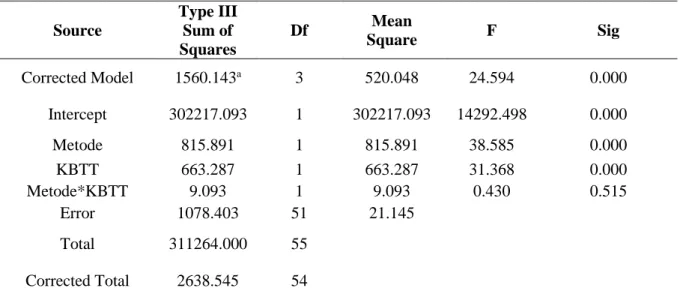
After the two requirements above had been fulfilled, the two-way analysis of variance as conducted. The results of the two-way
analysis of variance are shown in Table 9.
Table 9. Test of Between-Subjects Effects
Source
Type III Sum of Squares
Df Mean
Square F Sig
Corrected Model 1560.143a 3 520.048 24.594 0.000
Intercept 302217.093 1 302217.093 14292.498 0.000
Metode 815.891 1 815.891 38.585 0.000
KBTT 663.287 1 663.287 31.368 0.000
Metode*KBTT 9.093 1 9.093 0.430 0.515
Error 1078.403 51 21.145
Total 311264.000 55
Corrected Total 2638.545 54
Based on the results of the two-way analysis of variance, the first hypothesis obtains Fvalue 38.585>Ftable 3.175 and Fvalue of 0.000<
0.05 (significance level of 5%), so H01 is
rejected and H11 is accepted. This result
indicates that there are differences in the effect of PBL Project Methods and PBL Experimental Methods models on students’ learning achievement. Based on the marginal average, the achievement of the students treated with the PBL model using the project method is 78.417 higher than those treated with the PBL model using the experimental method of 70.670, thus, it can be concluded that students who are taught by applying the PBL model using the project method model have better learning achievement than those who are taught with PBL model using the experimental method.
In the source analysis, the Fvalue is
31.368 and the significance is 0.000. The Fvalue
of 31.368>Ftable 3.175 and sig. 0.000<α 0.05
indicates that H0 is rejected. This means that
there are differences in the effect of high and low thinking skills on students’ learning achievement. Based on the table of the marginal mean of thinking skills, the higher-order thinking skill is higher than that of the lower-order thinking skill. The higher-lower-order thinking skill has a marginal mean of 78.036 while the lower-order thinking skill has a marginal mean of 71.051. Thus, it can be concluded that students with higher-order thinking skills have
better learning achievement than those with lower-order thinking skills.
In the source methods*KBTT, the Fvalue is 0.430 and the significance is 0.515. The
Fvalue of 0.430<Ftable 4.08 and sig 0.515>α 0.05
indicates that H0 is accepted. This means that
there is no interaction between the effect of the learning methods and thinking skills on students’ learning achievement.
The Effect of PBL model using Project and
Experimental Methods on Learning
Achievement
and use any media in finding information. As for the experimental method, time and media are more limited. These experiments are conducted at school and only at limited class hours. This is what makes it possible for differences in the learning achievements of students who are given PBL learning achievement. Another possibility is that in the project method, the students spend more time discussing with group friends, in contrast to those who conduct experiments in schools with their teachers’ supervision that make them lack confidence in expressing their ideas.
The Effect of Higher-order and Lower-order Thinking Skills on Learning Achievement
The results of this research are in line with those of Nguyen tmt and Nguyen ttl (2017) stating that students who are given higher-order thinking skill learning have a positive influence on the learning process, performance, creativity, and learning motivation better than those who aren’t. According to F.J King et al. (2010, p. 46), higher-order thinking skills occur when students face new problems so they can solve them through complex thinking processes. By having such skills, students will always be interested in problems and will be motivated to solve them, so in their future lives, they will get used to facing existing problems and try to find the best solution. The results of this research are in line also with research Vijayaratnam (2012) that students who work on real-world related tasks, and students are taught to work in small groups, will energize and help students connect theory with practice. Appropriate assignments enable students to do research and build knowledge that can be shared with groupmates, tested in real-world scenarios and applied appropriately. This unconsciously develops their thinking skills. So students with high category thinking skills will be superior in solving a problem, therefore their learning outcomes are higher than students with low category thinking skills. The thinking skills at a higher level is very much needed in the 21st
century, for the survival of the young generation in this country.
Interaction between Learning Methos and
Thinking Skills towards Learning
Achievement
PBL models with experimental and project methods are one of the innovative ways of learning used by teachers in the classroom, while the thinking skills both high and low is an
ability that already exists in each student. Students with high category thinking skills when taught with PBL models project methods have higher learning achievement, it is because in the learning process students can explore their knowledge freely unlimited so that students can achieve better grades in other words PBL models project methods to support the thinking abilities of students who are already in the high category. As for the experimental method, students who can think higher levels also enrich their knowledge but only limited to the material so they are less free than the project method so that the learning achievement obtained are lower. Based on this, it can be concluded that the thinking skills isn’t the only factor that affects the learning achievement. Many other factors can affect the process of achieving learning achievement, possibly due to factors within students.
CONCLUSION AND SUGGESTION
This research is an experimental research with the data analysis using statistical analysis calculations, namely two-way analysis of variance. From these results, it can be concluded that there are differences in learning achievements between the students taught by PBL with project method and experimental method. There are differences in learning achievements between the students who have higher-order thinking skills and lower-order thinking skills. There is no interaction between PBL with experimental and project methods and thinking skills on the students’ learning achievements. Thinking skills is one of the important competencies needed in the 21st
century. They can be achieved by applying learning that can improve 21st century skills as
an appropriate means. The results of this research can be used as a reference for other researches with different themes or problems and can also be developed by replacing the existing variables with others or adding the required variables.
REFERENCES
Bloom’s Taxonomy of Educational Objectives (Complete edition). New York: Longman. p. 214 Anggriani, W, Ariani, SRD, & Sukardjo. (2012).
Pengaruh Pembelajaran Kimia dengan Pendekatan CTL melalui Metode Eksperimen dan Proyek terhadap Prestasi Belajar Ditinjau dari Minat Berwirausaha Siswa Pada Materi Destilasi Kelas X SMK Negeri 2 Sukoharjo Tahun ajaran 2011/2012. Jurnal Pendidikan Kimia, Volume 1, No.1 p. 80-88.
Arends, R I. (2012). Learning to Teach ninth edition. New York : McGraw-Hill. p. 41
Atmojo, SE. (2013). Penerapan Model Pembelajaran Berbasis Masalah dalam Peningkatan Hasil Belajar Pengelolaan Lingkungan. Jurnal Kependidikan, Volume 43, No.2. p. 134-143
Christiansen, E.T; Kuure, L; Mørch, A; Lindström, B. (2013). Problem Based Learning for the 21st Century. Denmark: Aalborg University. p. 5-393
Fitriani, D. (2017). Pengaruh Pembelajaran Berbasis Masalah terhadap Kemampuan Literasi Sains Siswa pada Materi Laju Reaksi. Jurnal Edusains, Volume 9, No 2, p. 117-126
Hmelo-Silver, C. E. (2004). Problem-Based Learning: What and How Do Students Learn? Educational Psychology Review. p. 235-266. (http://dx.doi.org/10.1023/B:EDPR. 0000034022.16470.f3)
Ismail., Indri Astuti., Aloysius Mering. (2018). Evaluation of learning outcome assessment system in health and sports physical education subject in junior high school. Journal of Education, Teaching, and Learning, 3(2): p. 296-301
King, F.J., Goodson, L., Rohani, F. (2010).
Higher Order Thinking Skills. www.cala.fsu.edu. p. 46
Hoang LH, Khoi NV, Anh VTM. (2010).
Module Probem Based Learning Training Manual. Hanoi: Pham Van Dong University. p. 77-79
Made, Wena. (2009). Strategi Pembelajaran Inovatif Kontemporer: Suatu Tinjauan Konseptual Operasional. Jakarta : Bumi Aksara. p. 53 Mainali, BP. (2012). Higher Order Thinking In
Education. Academic Voices a Multidiciplinary Journal, Volume 2, No.1:7. p. 5-10.
Mayasari, T., Kadarohman, A., Rusdiana, D., Kaniawati, I. (2016). Apakah model pembelajaran problem based learning dan project based learning mampu melatihkan keterampilan abad 21?. Jurnal Pendidikan Fisika dan Keilmuan, 2(1): p. 48-55. Muhson, Ali. (2009). Peningkatan Minat Belajar
dan Pemahaman Mahasiswa melalui Penerapan Problem-Based Learning. Jurnal Kependidikan, Volume XXXIX, No. 2. p. 171-182.
Nguyễn Thị Minh Tâm & Nguyễn Thị Thùy Linh. (2017). Influence of Explicit Higher-Order Thinking Skills Instruction on Students’ Learning of Linguistics. Jurnal of Thinking Skills and Creativity. p. 113-127. Purwaningtyas, R, Ashadi, & Suparmi. (2012).
Pembelajaran Kimia Menggunakan Pendekatan Sains Teknologi Masyarakat dengan Metode Proyek dan Metode Eksperimen Ditinjau dari Kreativitas dan Kemampuan Berpikir Kritis. Jurnal Pendidikan Sains, Volume 1, No.1. p. 14-19. Rahayu, R., FX Laksono, EW. (2015).
Pengembangan Perangkat
Pembelajaran IPA Berbasis Problem-Based Learning di SMP.
Jurnal Kependidikan, Volume 45, No.1. p. 29-43.
Sugiyono. (2010). Metode Penelitian Kuantitatif Kualitatif dan R&D. Bandung: Alfabeta, p. 109
Sunarsih, A, Sukarmin, Sunarno W. (2017). The Impact of Natural Science Contextual Teaching trough Project Method to Students’ Achievement
in MTsN Miri Sragen.
International Journal of Science and Applied Science: Conference Series, Volume 2, No. 1. p. 45-50. Sung, Eunmo. (2017). The Influence of
Learning Achievement of Primary School Students in South Korea.
Thinking skills and Creativity, 26: 168-175.
(https://doi.org/10.1016/j.tsc.2017.1 0.007. )
Trianto. (2010). Mendesain Model Pembelajaran Inovatif-Progresif. Jakarta : Kencana Prenada Group, p. 64
Vijayaratnam, Phawani. (2012). Developing Higher Order Thinking Skills and Team Commitment via Group Problem Solving: A Bridge to the Real World. Social and Behavioral Sciences 66, p. 53-63
Wahyudi, EE, Aminah NS, Sukarmin. (2017). Pembelajaran Optika Geometri melalui Problem Based Learning (PBL) ditinjau dari Kemampuan Berpikir Kritis Siswa dan Kemampuan Berpikir Kreatif Siswa SMA Kelas X Tahun 2014/2015.
Jurnal Inkuiri, Volume 6, No 3, p. 49-6