75
EFFICACY OF SOME TREATMENTS ON MONILINIA FRUCTIGENA
(ADERH. & RUHL.) HONEY FUNGUS ATTACK ON APPLE
LUCIAN CHIŢULESCU, STELICA CRISTEA
University of Agronomic Sciences and Veterinary Medicine of Bucharest, Bucharest
e-mail: [email protected]
Keywords: fungus, variety, efficacy, moniliosis
ABSTRACT
The researches were carried out in the experiments on the attack of Monilinia fructigena on apple in the Hartiesti location, Arges county. The evolution of the pathogen attack in the years 2015 and 2016 was monitored, in control variants and in variants treated with specific fungicides, included in a treatment scheme. The microscopic examination of the morphology of the pathogen corresponded to the fungus Monilinia fructigena. The biological material was Florina, Generos, Goldrush, Idared and Topaz varieties. In the conditions of year 2015, Monilinia fructigena's attack recorded values between 18.5% for Florina, 21% for Generos, 34% for Idared and 29.5% for Topaz. In the year 2016 the control variants of the fungus attack was 22% for the Florina variety and 36.5% for the Idared variety. The application of a treatment scheme that included specific products for the control like Dithane Neotec 0.2%, Topsin 0.07% and Switch 62.5WG 0.066% which had an efficacy of more than 66% in 2015 and 68% in the year 2016. In the varieties Florina and Topaz it have been calculated the highest efficacy values of over 70% during the experimentation period. Generos and Idared varieties recorded relatively close values of the efficacy of moniliosis treatments, ranging from 66.6% to 67.6% in 2015 and 69.4% respectively and 68.5% in the year 2016. The Florina variety was noted throughout the research period with the highest efficacy value E = 70.2% in 2015 and 77.25 in 2016.
INTRODUCTION
76
MATHERIAL AND METHOD
The researches were carried out in the apple orchard in Hartieşti, Arges County, under the conditions of year 2015 and year 2016, and they watched the effectiveness of some treatments on the attack of the fungus Monilinia fructigena, integrated into a disease and pest control scheme. The biological material was Florina, Generos, Goldrush, Idared and Topaz varieties. Observations were made on the fungus attack on the fruit, in autumn before harvesting. The frequency and severity of attack was noted using the following formulas: F (%) = nx100/ N, in which: n = percentage attacked organs, N = total analyzed organs and I (%) = Σ (ixf )/ n, where i = percentage granted, f = number of plants (organs) with the respective percentage, n = total number of attacked plants (organs) analyzed. In the autumn observations, prior to harvesting, the intensity of the attack was considered the highest, both in the control variants and in the variants treated, considering the attacked fruits unfit for marketing and storage. The attack rate was calculated by: DA = F x I / 100 (%), where: F = attack frequency (%), I = attack intensity (%), DA = degree of attack. Intensity was noted as a percent. The efficacy of the treatments was calculated by the formula E = [(Gam-Gav) / Gam] x100, where Gam = control level, Gav = variant attack level. Data on environmental conditions was provided by the Maracineni – Pitesti RIFG meteorological station.
Obtained results
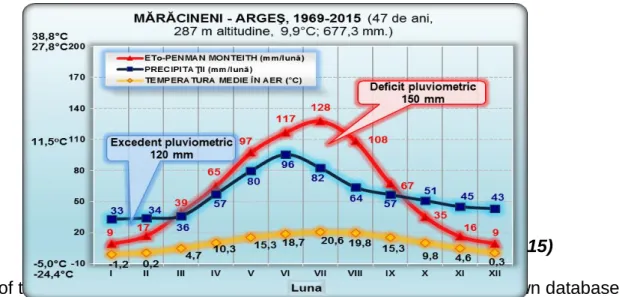
Observations of the Monilinia fructigena attack on fruits were made prior to harvest in the conditions of year 2015 and year 2016. The values of the meteorological parameters of the research period allowed favoring the attack of the fungus Monilinia fructigena.
Figure 1. Climate chart Mărăcineni, Argeș county (1969-2015)
The values of the meteorological parameters used, were extracted from the own database of the Research Institute for Fruit Growing Pitesti-Mărăcineni, consisting of average
77
Figure 2 . Meteogram of year 2015 at Mărăcineni, Argeș county
In 2015, the average annual air temperature recorded a very high value of 11.3°C, exceeding the multiannual values by 1.4°C. Also, the amount of precipitation (725.2 mm) exceeded by 47.9 mm multiannual average (677.3 mm). If we compare the water regime of 2015 with the multiannual values, we find that there were very large deviations in both the surplus and the rainfall deficit. Thus, the excess rainfall of 287 mm exceeded by 167 mm the multiannual value and was noted especially in September, and the 304 mm deficit exceeded the normal value by 154 mm, especially in May and July (fig. 2).
Figure 3. Meteogram of year 2016 at Mărăcineni, Argeș county
78
the very large pluviometric surplus of 241 mm exceeded the multi-annual value by 121 mm and was reported mainly in March, May, October and November, and the deficit of 179 mm exceeded only by 29 mm the normal value, being registered mainly in July and August (fig. 3).
Table 1
The attack of Monilinia fructigena on fruits 2015 - 2016 (Hartiesti)
No. Variety
2015 2016
Frequency (F)(%)
Intensity (I)(%)
Degree of attack (DA)(%)
Frequenc y (F)(%)
Intensity (I)(%)
Degree of attack (DA)(%)
1 Florina 18.5 100 18.5 22 100 22
2 Generos 21 100 21 24.5 100 24.5
3 Goldrush 26 100 26 28.5 100 28.5
4 Topaz 29.5 100 29.5 31 100 31
5 Idared 34 100 34 36.5 100 36.5
The data in Table 1 show that during the research period, the attack of Monilinia fructigena
on control variants had the highest level of attack of the Idared variety, 34% in 2015 and 36.5% in 2016. In the Topaz variety, the values of the attack were close in the two years of experimentation with DA = 29.5% in 2015 and DA = 31% in 2016. A lower attack was recorded in the Florina variety at which the attack level was 18.5% in 2015 and 22% in the 2016. Also, the Generos and Goldrush varieties recorded higher attack values in 2016. The value of the attack was due to the incidence of the attack, as the intensity value was considered the maximum at the harvest date, the affected fruit being considered unfit for storage or commercialization.
Between 2015 and 2016 years, treatments against moniliosis were introduced into the treatment scheme for diseases and pests of apple. The data from Table 2 show that in the phenophase of the buttock - the opening of the first flower, treatments against moniliosis were applied, the size of the fruit was half the normal size, and 15 days after the previous treatment, fungicides were applied to fight the moniliosis of the apple in the recommended concentrations.
Table 2
Scheme of treatment applied during the period 2015- 2016 No.
Treat ment
The pathogen / pest Phenophase
2015 2016
Product Concentration
(%) Product
Concentration (%)
1
Quadraspidiotus perniciosus; Eriosoma lanigerum
Tetranychus urticae Aphis pomi
(hibernated eggs)
The beginning of sprout opening; mouse ears
Confidor
Oil SC 004 1.5
Confidor
79
2
Venturia inaequalis ; Adoxophyes reticulana; Defoliation (Hyphantria cunea, Lymantria dispar dispar, Malocosoma neustria, Euproctis chrysorhoea) Floral sprouts (visible) Antracol 70 WP; Decis Mega 50EW 0.2 0.015 Clarinet; Bravo; Decis Mega 50EW 0.1 0.25 0.015 3 Venturia inaequalis; Podosphaera leucotricha; Monilinia fructigena Pink button (opening first flower) Clarinet; Bravo; Decis Mega 50EW Topsin 0.1 0.25 0.015 0.07 Antracol 70 WP; Decis Mega 50EW; Topsin 0.2 0.015 0.07 4 Erwinia amylovora; Venturia inaequalis; Podosphaera leucotricha; Haplocampa testudinea; The beginning of the petals fall
(end of bloom)
Topas; Flint plus 64 WG; Calipso 0.03 0.125 0.02 Topas; Flint plus 64 WG; Calipso 0.03 0.125 0.02 5 Podosphaera leucotricha; Venturia inaequalis; Cydia pomonella;
10 mm fruit (as a hazel) Apple's Worm Generation 1
Luna Experienc e 400 SC; Bravo; Decis Mega 50EW 0.05 0.25 0.015 Folicur solo; Bravo; Calipso 0.05 0.25 0.02 6 Venturia inaequalis; Podosphaera leucotricha; Eriosoma lanigerum; Monilinia fructigena
The fruit is ½ of
normal size Folicur solo; Calipso Dithane Neotec 0.05 0.02 0.2 Luna Experienc e 400 SC; Decis Mega 50EW Dithane Neotec 0.05 0.015 0.2 7 Cydia pomonella; Venturia inaequalis; Podosphaera leucotricha; Monilinia fructigena;
80
Table 3
Efficacy of treatments on Monilinia fructigena attack ( 2015-2016)
Variety Variant 2015 2016
DA (%)
Efficacy (%)
DA (%)
Efficacy (%)
Florina treated 5.5 70.2 5 77.2
control 18.5 - 22
-Generos treated 7 66.6 7.5 69.4
control 21 - 24,5
-Goldrush treated 8. 69.2 7 75.4
control 26 - 28.5
-Topaz treated 8 72.8 9 71
control 29.5 - 31
-Idared treated 11 67.6 11.5 68.5
control 34 - 36.5
-Observations on the efficacy of treatments for the Monilinia fructigena attack show that the applied treatment sheme (Table 2) provided an efficacy of over 66% in 2015 for all varieties. The highest value of efficacy under the conditions of 2015 was calculated for Topaz variety with E = 72.8% followed by Florina with E = 70.2%. For Generos and Idared varieties, efficacy had values close to 67%. Efficacy was 69.2% for Goldrush variety (Table 3).
Under the conditions of 2016, the treatments used to combat moniliosis had an efficacy of over 68%. The Florina variety had the highest efficacy value, 77.2%. Applying treatments for Goldrush and Topaz varieties in the year 2016 also had high values of 75.4% and 71%, respectively. In all varieties analyzed, the efficacy of treatments was higher in 2016 than in 2015.
CONCLUSIONS
Under the conditions of 2015 and 2016 years, the attack of the Monilinia fructigena
fungus recorded values between 18.5% for Florina variety and 34% for Idared variety and 22% for Florina and 36.5% for Idared varieties. The application of the treatments determined the significant reduction of the attack in the experimental period, ensuring values of efficacy of over 66% in 2015 and more than 68% in the conditions of 2016. In Florina variety the treatments applied according to the scheme presented in this work had the greater efficacy over the analyzed period. We consider that the treatments applied against the pests have contributed to reducing the incidence of the Monilinia fructigena fungus attack.
BIBLIOGRAPHY
1. Agrios G., 2005. Plant pathology.Fiftth edition. Department of Plant pathology,
University of Florida. Elsevier Academic Press.
2. Batra l. R. 1991. World species of Monilinia (Fungi): Their ecology, biosystematics
81
3. Berrie A.M., 1989- Storage rots of apple and pear in South East England 1980-88:
incidence and fungicide resistance. In: Gessler, B. K.Ed IOBC Bulltin, vol. II. Integreted control of pome fruit diseases, Locarno, Switzerland,IOBC: 229-239.
4. Byrde R.J.W & Willetts H. J., 1977 – The Brown Rot fungi of Fruits: Their Biology and Control. Oxford: Pergamon Press
5. Chitulescu L., Cristea S., 2017. Researches on the reaction of apple varieties to
Monilinia fructigena fungus attack. Journalof Biotechnology 256 S(2017) S44-S116,S100. http://dx.doi.org/10.106/ j.jbiotec.2017.06.1142
6. Falconi G. J., Mendegen D.H., 1994 – Epiphytic fungi on apple leaves and value for
control of the post-harvest pathogens Botrytis cinerea, Monilinia fructigena and Penicillium expansum. Journal of Plant Disease and Protection, 101.1 : 38-47.
7. Gheorghieş C., Cristea S., 2001 – Fitopatologie Vol 1, Ed. Ceres, Bucuresti.
8. Holb I., 2003 – Analyses of temporal dynamics of brown rot development on fruit in
organic apple production. Int. J. Hortic. Sci. : 97- 100.
9. Holb I., 2008– Monitoring conidial density of Monilinia fructigena, in the air in relation
to brown rot development in integrated and organic apple orchards, European Journal of Plant Pathology.https://link.springer.com/article/10.1007/s10658-007-9233-6 .
10. Holb I., Scherm H., 2008 – Quantitative relationships between different injuri factors and development of brown rot caused by Monilinia fructigena in integrated and organic apple orchards, Phytopathology 98: 79-86.
11. Holb . J. and H. Scherm.2007. Temporal dynamics of brown rot in different apple management systems and importance of dropped fruit for disease development. Phytopathology 97 ( 9): 1104-1111.
12. Lack H., 1989 – The spred of apple brown rot (Monilinia fructigena) by insects. Annals of Applied Biology, 115.2: 221-227.
13. Popa Tudorel, Cristea Stelica, Zala Cristinel, 2012 – Preliminary research regarding Monilinia laxa (Aderhold & Ruhland) honey ex Whetzel attack in plum tree. Scientific papers Series A. Agronomy, vol. LV: 225-228, Bucharest.
14. Popa Tudorel, Cristea Stelica, Zala Cristinel, Manole Mali Sanda, 2013 –
Research on the efficacity of fungicides for control of Monilinia laxa ( Aderh.& Ruhl.) Honey on plum tree. Scientific Papers Series A Agronomy Vol LVI : 333-336, Bucharest.
15. Van Leewen G. C.M., Stein A., Holb I., Jerger M.J., 2000 – Yield loss caused by