
MODERN METHODS FOR FREEZING USED IN FOOD INDUSTRY
SORICĂ C.1), PIRNĂ I.1), GRIGORE I.1), SORICĂ E.1), PRUTEANU A.1), DANCIU A.1)
1)INMA Bucharest;
E-mail:[email protected]
Keywords: freezing, foods, preservation.
ABSTRACT
Foods have a limited duration of preservation, due to factors that worsen quality, leading ultimately to their total depreciation. In order to preserve perishable foods and prolong the allowable period for storage and sales, one of the best methods that use artificial cold is freezing. The paper aims to present the most used methods of freezing food, focusing on the advantages and disadvantages of these methods.
INTRODUCTION
In general, on the technological chain of food products, between harvest (or production) and consumption, products losses may reach values between 30-80% of total production, depending on the nature of the product, commercialization, food habits, climatic conditions etc. [4]
The main causes of these losses are mechanical actions (structural degradation by crushing), drying processes, aging (particularly for fruit) and degrading action of pests (micro-flora, rodents, birds, etc.).
Currently, for maintaining the quality of food products, several methods of conservation can be used, namely:
- Thermal methods;
- Methods with the use of natural and artificial substances for conservation; - Methods with the use of artificial cold.
When using thermal method and preservative substances in food products essential chemical changes occur and can substances that adversely affect human health can be accumulated [1].
Using modern methods of cold treatment greatly reduces essentially the losses of animal and plant resources.
Artificial cold is widely used in the food industry because of the effects it presents in terms of action for conserving perishable products, by stopping or braking the activity of modifying agents at low temperatures.
An important aspect is that the artificial cold is the universal method of preservation of perishable products having superior advantages over other methods of conservation.
The main factors on which the quality of these products depends on are: - Product quality at the moment of cold processing;
- The nature and quality of the packaging;
- The product temperature in the links of the chain; - Storage period.
In general, the cold does not improve the original quality of the food but only concerns the proper keeping of one aspect and sometimes of a specific consistency (butter, chocolate), slows down or halts the possible alterations and can produce a pleasant feeling of freshness (drinks, ice cream, etc.).
The cold changes very little the original taste of fresh products, unlike other preservation methods such as salting, smoking or dehydrating [1].
In food products, microorganisms grow at different temperatures. Specific temperature zone is the result of the adaptation of a microorganism to the environment. The optimum temperature is the temperature at which a microbial strain development is done in the best conditions. The minimum temperature is the lowest temperature that can withstand a micro-organism (below the minimum value, the growth of microorganisms is turned off). The maximum temperature is the highest temperature at which a species is developed (more than the maximum value, producing a lethal effect on micro-organisms). Temperatures lower than minimum temperature have a microbiostatic effect. Temperatures higher than the maximum temperature have a microbicidal effect.
Depending on the optimum growth temperature, microorganisms can be divided as follows:
- Cryophilic (psychrophilic), t <10 °C (examples: most molds, Pseudomona bacteria, champagne yeast). These organisms show active enzyme systems at low temperatures;
- Mesophilic t = 10 ... 45 °C, (for example: acetic bacteria, the majority of lactic bacteria, most yeasts, etc.);
- Thermophilic, t > 45 °C (for example: bacteria, butyric acid, lactic acid bacteria of the genus Thermobacterium, viruses etc.). These synthesize stable and active enzymes at high temperatures [1].
The main purpose of freezing is to preserve perishable food products. From this point of view, freezing, as a method of conservation extends the permitted storage of food of over 5...50 times the preservation compared to refrigeration. Increasing preservation obtained by freezing is based on the effects of low temperatures by slowing down or by complete inhibiting the growth of microorganisms, reducing or ceasing of metabolic processes for products with life and reducing chemical and biochemical reactions [2].
Given the minimum temperatures for the propagation of psychrophilic microorganisms, it is considered as a maximum freezing temperature of food products to be in general of -10 °C. Below this temperature the growth of microorganisms is practically negligible. Within the freezing technologies of various food products of animal origin, lower temperatures are used in the product, and eventually, methods of inactivating own enzymes are used, for reducing the activity of all modifying agents [2].
Freezing provides appreciable increase of food preservation, but it requires to enforce, besides the specific conditions of the respective technology, other conditions generally applicable:
-Use of raw materials and products of appropriate quality; placing them in freezing spaces or devices as soon as possible after producing them;
-Ensuring all necessary sanitary items to avoid microbial contamination of products before freezing or after defrosting;
-Ensure proper refrigeration temperatures where products are not introduced directly in the premises or freezing appliances or are not used immediately after defrosting; - Avoiding freezing food products unfit for consumption, because this method of preservation does not improve the original qualities [2].
Freezing food products is considered completed when the average temperature is equal to the temperature at which storage is going to take place.
Food cooling below 0 °C is accompanied by a process of ice formation, starting with a certain temperature characteristic for each product, called the freezing point temperature [1].
Classification of freezing methods can be made according to other criteria beyond the average speed of freezing. Thus, in many countries products preserved by freezing are met under the following names:
- Frozen products ("Frozen foodstuffs");
Frozen products are obtained by a usual freezing, during which their average temperature drops below -10 °C in a period that doesn’t allow triggering unwanted enzymatic and microbiological reactions. This method is characterized by adopting average linear freezing speeds of 0.1 ... 0.5 cm / h and is used for products with bigger thickness, such as meat carcasses or meat blocks, butter or other fat packed in crates etc. [1]
Depending on how the process of freezing takes place, three freezing systems are known, namely: with discontinued operation, with continuous operation and with semi-continuous operation [1].
The discontinued freezing system implies the introduction of products to be subjected to freezing in special spaces, after which the cooling installation enters into operation; after reaching the prescribed product temperature, the cooling stops and frozen products are unloaded. This freezing system is simple, but has the following disadvantages:
- Requires significant manipulation of the products subject to freezing, due to low level of mechanization and automation of loading / unloading;
- The need to oversize the refrigeration installation due to the non-uniformity of the load;
- Relatively larger freezing periods;
- Long stationary period for products before the commencement of the freezing process [1].
The semi-continuous freezing system is characterized in the fact that a certain quantity of product is introduced (for freezing) or removed (frozen) into / from the freezing machine at a constant time interval. In this way, the freezing devices are loaded permanently with the same amount of goods (excluding start - stop – maintenance operations), the load being constant. Introducing and removing the frozen products in the semi-continuous system can be mechanized and automated [1].
The continuous freezing system is characterized by the fact that the passage of the products through the freezing apparatus is carried out continuously or is rhythmically interrupted. Applying the continuous freezer system implies the following conditions:
- The existence of continuous lines for preliminary treatments;
- Limiting the thickness of products subject to freezing in order to shorten the duration and to reduce the size of freezing equipment;
- Relatively large freezing capacity (usually capacities of over 1 ton/h) because at small capacities the amortization costs of mechanization and automation become unacceptably high [1].
The main methods of freezing food products are: - Freezing with cooled air;
- Freezing by contact with cooled metal surfaces; - Freezing through contact with intermediary agents; - freezing with cryogenic freezing agents [3].
Cooled air freezing method is most common because most food products are
suitable for this type of conservation.
In general, the method of freezing with cooled air implies the existence of a closed space, insulated, an aggregate for chilling the air and a system for the distribution of cooled air over the products.
Depending on the status of the product, throughout the freezing process relative to the material support in which they are placed, are distinguished:
Freezing systems with fixed position for the products, in relation to the material support on which they can be placed can be:
-discontinued, in which case the products together with the substrate material on which they are positioned remain in a fixed position in the area of freezing until the end of the process;
-semi-continuous, in which case, at certain intervals of time products are placed in the area of freezing to be cooled and at the same time, those already frozen are discharged;
-continuous, in which case, at all times, in the area of freezing products are placed to be cooled and move through the cooling area (the period of time in which they are frozen) and at all times the products that are already frozen are discharged [1].
Freezing systems with fluidized bed are used for the freezing of fruits and vegetables. The cooling in fluidized bed is carried out by blowing a gas from the bottom side of a perforated carrier material on which there is a product (as particulate). Streamlining a product is the gas-dynamic process by which the particles of solid material execute, under the influence of the gas stream, a continuous movement. The thickness of the product, when cooling in fluidized bed may vary widely depending on the particle sizes, and is limited to a maximum of 150 mm.
Freezing with air in fluidized bed offers a number of advantages over fixed bed freezing:
- Avoiding agglomeration of product particles on their surface area after preliminary washing before freezing;
- Cooling at much higher speeds and much lower product freezing durations; - Increased productivity;
- Smaller specific sizes and weights of the apparatus;
- The possibility of mechanization and automation of the process, which can be achieved in a continuous manner in this case [1].
In case of freezing by contact with metal surfaces, heat is taken from the
products by direct transfer, by the cold surface. Surface cooling is achieved either with refrigerant evaporates or an intermediary agent. Heat transfer is achieved in most cases only through thermal conductance, which is an important energetic advantage as compared with the method of freezing the forced convection that the fan power is consumed.
Freezing by direct contact with cooled metal surfaces ensures low duration of the cooling process, but it is only the price of products with relatively regular shapes, and relatively small thicknesses.
In relation to the cooled air freezing devices, these devices achieve process durations 50% smaller (in the case of the 50 mm thickness of the product). In these devices are typically frozen products with a thickness ranging between 25 and 100 mm. The electricity consumption of these devices is smaller by 30%, and the area occupied is 50% lower compared with a freezing device cooled air of the same capacity [1].
Freezing by contact with intermediate agents consists in cooling the product by contact with a cooled intermediate agent (aqueous propylene glycol, etc.).
Freezing contact with intermediate agents presents advantages compared with freezing in air achieving durations several times smaller, avoiding weight losses and surface protection for products for the adverse effects of contact with oxygen in the air. To avoid direct contact with products that are to be frozen and avoiding agent penetration in the product, vacuum packaging practice in impermeable film is used, or the sealed metallic packaging. After freezing, packaged products can be washed with cold water to remove traces of agent from the surface of the package.
Most freezing devices with intermediary agent are made in versions with continuous operation. There are devices where the contact between the product and the intermediate agent is done by immersion, spraying or mixed.
When freezing products where direct contact with intermediate cooling agent has to be avoided, it is necessary that those products are previously packaged under vacuum in plastic and waterproof membranes [1].
The method of freezing in contact with cryogenic agents consists in the use of
latent vaporization heat at atmospheric pressure of some substances (cryogenic agents) as well as sensible heat that vapors absorb increasing their temperature from a very low level of vaporization up to a level close to the temperature at which the product is frozen. Cryogenic agents that are used in this case are: liquid nitrogen, nitrous oxide, carbon dioxide [1].
MATERIAL AND METHOD
Liquid nitrogen freezing devices may have discontinuous or continuous operation. Devices for freezing with liquid nitrogen with discontinuous operation are built in the form of cabinets or freezing cell freezing with relatively small capacity of 100...500 kg product per hour. Consumption of nitrogen for freezing depends on the nature of the products and on their initial and final temperatures, considering the heat that 1 liter of nitrogen can absorb.
Freezing devices with liquid nitrogen with continuous operation can be with immersion in liquid nitrogen, with liquid nitrogen spraying or by cooling with nitrogen gas. The most commonly used method is by spraying with liquid nitrogen, in which case the devices are made with linear moving belt or a spiral belt.
Freezing food products with liquid carbon dioxide can be carried out in devices with discontinuous or continuous operation. Devices for freezing with liquid carbon dioxide with discontinuous operation are made in the form of cells or refrigeration cabinets similar to those using liquid nitrogen as a cryogenic agent. The devices for freezing with liquid carbon dioxide with continuous operation are made similar to those for liquid nitrogen, respectively, with moving belt and with linear spiral belt.
Using liquid nitrogen for rapid freezing of food products is one of the most common applications of gases in the food industry.
Freezing in the food industry is a preservation process used not only for technical reasons related to the distribution of food products, but also because of the practical needs of modern society that has little time to devote to food preparation, becoming more inclined towards the consumption outside the home (canteens, restaurants, bars, etc.).
These requirements have led to the improvement of freezing techniques of food producing companies, in order to maintain as much the quality of products, both from the organoleptic and the nutritional point of view. Hence comes the importance of new technologies allowing rapid temperature descent at values below -18° C inside the product so as to inhibit the activity of microorganisms.
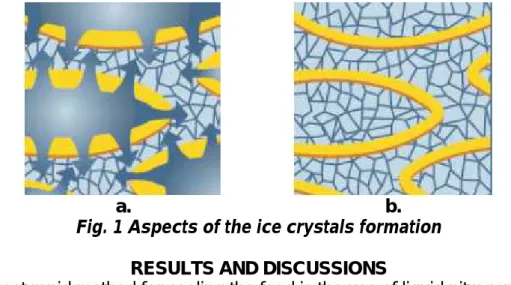
rapidly reached, crystallization can be avoided by creating an amorphous phase that favors products stability during storage period.
a. b.
Fig. 1 Aspects of the ice crystals formation
RESULTS AND DISCUSSIONS
The most rapid method for cooling the food is the use of liquid nitrogen, which come into direct contact with the food to be frozen. Nitrogen, the main component of the atmosphere, is odorless, colorless, tasteless, and inert and has no detrimental effect on the food. At atmospheric pressure the liquid nitrogen is found at -196 °C, its main feature consisting in the ability to absorb high amounts of energy even at lower temperatures, allowing high refrigeration yields and energy transfer coefficients much higher than mechanical systems.
The use of cryogenic freezers in food production lines brought undeniable economic and qualitative advantages, allowing to obtain a rigid surface for products and facilitates automated packaging operations.
Freezing with liquid nitrogen allows:
• reduction of losses by dehydration below 0.5% by weight; • avoiding the damage of the cell structure of food;
• maintaining unaltered the superficial appearance;
• performing freezing and storage in the absence of oxygen;
• significant reduction in investment costs of the production facilities.
The cryogenic freezers are extremely flexible and are able to work with high efficiency within a range from 50% to 120% of the project capacity. An advantage of freezing with liquid nitrogen or solid carbon dioxide is the possibility to operate in the full range of cryogenic temperatures. This allows obtaining high freezing speeds. In addition, the operating temperature in the startup phase is achieved in only a few minutes.
Installing a liquid nitrogen freezing device requires low capital investment, incomparable to that required for a traditional freezing plant with the same production capacity. Even the maintenance and cleaning of cryogenic freezing devices have low cost and does not require specialized personnel.
The cryogenic freezers may be the following types:
a. b.
Fig. 2 Cryogenic cabinet (a – Linde [6]; b – Praxair [7])
-Liniar tunnel: consists of an isolated room in which the product is placed by means of a stainless steel conveyor belts. In the pre-cooling area, the product is covered in counterflow by a cold nitrogen gas stream; in the median area, appears a first superficial freezing where it occurs a partial contact between the product and the liquid nitrogen which, by vaporisation, takes the heat from the product, causing rapid freezing of it. In the last area, the temperature of the product is homogeneous, being brought to the desired value in the center of the product. The tunnel is equipped with an automated system that regulates the introduction of cryogenic fluid so as to maintain in the interior, the regulated temperature. In addition, there are provided a speed control system for the conveyor and a number of homogenization fans and vacuum cleaner for waste gas extraction.
a. b. c.
Fig. 3 Liniar tunel (a – Linde [6]; b – Praxair [7]; c – Kelox [5])
- Spiral Freezer: is a compact equipment that allows obtaining high production capacities, occupying an extremely reduced space. It consists of an isolated room in which the product is placed with a stainless steel conveyor belt, moving spiral. The liquid nitrogen is introduced at the top where, by vaporisation, forms a rapid freezing area. With a ventilation system, the cold gases are directed to the bottom, where it pre-cools the product that enters. Spiral freezer is equipped with an automated system for the control of the temperature and the conveyor belt speed.
a. b. c.
- Immersion tunnel: is the ideal system if space available is limited, when a fast freezing is necessary or it is desirable to obtain a surface crust. The product is introduced into the tunnel with a stainless steel conveyor belts and cross the liquid nitrogen bath. In this way, the superficial crust is formed instantly, while the freezing into the center of the product requires very low durations.
a. b.
Fig. 5 Immersion tunnel (a – Linde [6]; b – Praxair [7])
CONCLUSIONS
The essential role of the freezing technology, within the food sector, is widely recognized due to the following reasons:
- ensures the distribution in time and space of the existing agrifood materials and goods or products in certain periods of the year;
- ensures optimal storage and distribution of perishable agrifood goods with minimal loss of nutritional value;
- stores qualitative characteristics, especially the nutritional of raw materials and products;
- ensures optimum microclimate for conducting biochemical processes at low
temperatures;
- promotes saving resources through reduced consumption of raw materials; - ensures food quality, diversifying their assortments.
Having in mind the current needs in terms of frozen food, the cryogenic technology will represent a benchmark in terms of preserved products quality using artificial refrigeration.
BIBLIOGRAPHY
1. Dimitriev V., 2012 - Fundamentals of refrigeration technology - lecture series, Technical University of Moldavia Publishing House, Chisinau;
2. Niculita P.,1998 - Refrigeration technology in agrifood domains, Didactic si Pedagogic Publishing House, Bucharest, ISBN 973-30-5719-3;
3. Porneala S., Balan M., 2003 - The use of artificial cold - course in electronic format, Todesco Publishing House, ISBN: 973.8198-64-X;
4. Tofan I., 2005 – The cold chain of perishable food products, Agir Publishing House, Bucharest;
![Fig. 4 Spiral freezer (a, b – Linde [6]; c – Praxair [7])](https://thumb-us.123doks.com/thumbv2/123dok_us/8072059.2138318/7.892.123.777.965.1145/fig-spiral-freezer-linde-praxair.webp)
![Fig. 5 Immersion tunnel (a – Linde [6]; b – Praxair [7])](https://thumb-us.123doks.com/thumbv2/123dok_us/8072059.2138318/8.892.98.805.258.473/fig-immersion-tunnel-a-linde-b-praxair.webp)
