1
Women’s empowerment in Ghana and its Influence on Facility
Delivery: a secondary data analysis
By
Grace Ngozi Onyebuchi
A paper presented to the faculty of The University of North Carolina at Chapel Hill in partial fulfillment of the requirements for the degree of Master in Public Health in the Department of Maternal and Child Health.
Chapel Hill, N.C.
04/07/2016
Approved by:
2 Acknowledgement
My deepest gratitude goes to God Almighty, the Extraordinary Strategist for His
unconditional love, grace and mercies towards me. I am grateful to my family: Ijeoma (mother),
Uchenna, Chinyerem, Nkiru, Christie, Kelechi Onyebuchi, and Sam Okwulehie for their love
and support. I am also grateful to Kalu and Nnenna for their encouragement.
. I sincerely thank Kavita Ongechi and Nana Twum-Danso for their patience,
guidance and constructive criticisms. Lastly, I’m grateful to all who have directly or indirectly
3 TABLE OF CONTENTS:
ABSTRACT ……….4
INTRODUCTION………5 - Maternal Mortality
- Maternal Mortality in Ghana
LITERATURE REVIEW……….6
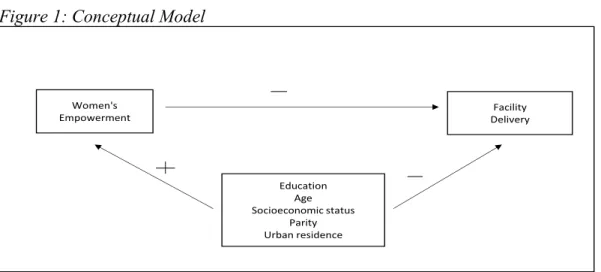
HYPOTHESES……….8 - Figure 1: Conceptual Model
METHODS………9 - Data Sampling and Collection
- Measures
- Statistical Analyses
RESULTS……….11 - Descriptive Analyses
Table 1: Distribution of facility delivery by variables of primary interest - Bivariate and multivariate Analyses
Table 2: Facility Delivery and Primary Interest Variables
DISCUSSION……….14
4 Abstract
Objectives: This study seeks to determine if women’s empowerment contributes to higher rates of facility delivery in Ghana.
Methods: We pooled data from Ghana Demographic and Health Surveys 2014 and used
multivariate logistic regression on facility delivery and women’s empowerment. We controlled
for confounders of women’s socioeconomic status, place of residence, parity, age and education.
Results: After adjusting for the covariates of interest, the odds of facility delivery for women with high empowerment was 1.47(95% CI: 1.08, 1.98) times the odds for women with low
empowerment.
Conclusions for Practice: Female empowerment is associated with higher rates of facility delivery in Ghana. Interventions aimed at improving facility delivery must consider gender
measures and continue to focus on promoting female education, and improving women’s
5 Introduction
According to WHO, more than 830 women between the ages of 15 and 49 die daily of
causes related to pregnancy and child birth.1Virtually all the maternal deaths occur in the
developing world with Sub-Saharan Africa accounting for two-thirds of the daily maternal
deaths.1, 2
Maternal death is the death of a woman while pregnant or within 42 days of termination
of pregnancy, irrespective of the duration and site of the pregnancy, from any cause related to or
aggravated by the pregnancy or its management but not from accidental or incidental causes.3
Maternal Mortality in Ghana
Ghana’s maternal mortality ratio is much higher than global averages and estimated to be
between 216-458 deaths for every 100,000 live births.1,4The top causes of maternal death in
Ghana are hemorrhage (21.8%), abortion (20.8%), hypertensive disorders (19.4%), ectopic
gestation (8.7%), uterine rupture (4.3%) and genital tract sepsis (2.5%).5,6 The vast majority of
these deaths can be prevented. Facility delivery is recognized as an important strategy in
preventing maternal deaths.7
The Ghana Demographic and Health Survey (GDHS) estimate that 73 percent of all
deliveries in Ghana in 2010 occurred at health facilities. 5 Although strategies like free maternity
services and community-based health planning services (CHPS) have enhanced access to care,
gender inequality still poses a barrier to utilizing health facilities in Ghana.8
In Ghana, women’s position are subordinate to men’s and health seeking behavior largely
6 women’s empowerment as a major determinant of maternal mortality and morbidity in Ghana.
Access to antenatal care, delivery assistance from a skilled provider, and postnatal care within
the first two days of delivery go up as women’s empowerment increases.5
Literature review
Women’s empowerment is one of the cornerstones to effective maternal health
programs.9The lack of female empowerment is a major contributing factor to the high prevalence
of preventable deaths and disabilities resulting from childbirth.10
Women’s empowerment is defined by United Nations Population Information Network
to encompass women having a sense of self-worth, access to opportunities and resources, choices
and the ability to exercise them, control over their own lives, and influence over the direction of
social change.11
Based on the measurements gathered in the GDHS 2014, this study will measure
women’s empowerment through employment, household decision-making power, and
justification of wife beating.5 This is in line with previous study that examined women’s
empowerment using DHS.12
There is a positive association between women’s empowerment and positive health
outcomes including a reduction in maternal mortality.10 In Nigeria, women with high household
decision-making authority were more likely to have a facility delivery than those with low
decision-making authority (OR=1.6, SE=0.1, p<0.05).13 Women who believed that wife beating
was not justified were more likely to have a facility delivery than those who felt that wife beating
7 decisions alone were associated with less use of antenatal care and skilled delivery care
compared to households that practiced joint decision-making.14
Employment appeared to empower married women towards participation in decision
making and also increased their access to health care.13
Several studies have shown that women’s use of health facility delivery services is
influenced by their demographic background characteristics and their socioeconomic status. In
Nigeria socio-economic status was found to be most consistently associated with the use of
health institutions for delivery. 13 Institutional deliveries were more common in comparatively
younger age groups compared with women >35 years in India (43% vs 23%), Nepal (70% vs
58%) and Tanzania (58% vs 49%), and for first births than for subsequent births15, 16, 17 In
Malawi and Tanzania, living in urban areas increased the probability of a woman having her
most recent birth in a health facility. 17 In Kenya, women residing in urban areas were more
likely than women in rural areas to utilize delivery care services (OR=2.13 (1.47 – 3.10) 18
Facility delivery is more common among wealthier than poorer women .A multi- country
study using DHS data showed that women in the richest quintile had the highest odds of a
facility delivery in each of the countries. The odds ratios for the richest women compared to the
poorest were 12.8 in Nigeria, 10.4 in the Democratic Republic of Congo and 10.1 in
Zambia.19 Parity is also an independent predictor of place of delivery; women who had had four
or more deliveries were 65% less likely to deliver in health facilities when compared to those for
whom this was the first child.18, 20
Education is fundamental to the empowerment of women, and also plays a role in
8 Education also affords women opportunities in the labor market, which provides greater access
to financial resources and other benefits.18
Studies have consistently shown that women's educational attainment, social status,
household wealth and decision-making power are associated with care-seeking behaviors for
maternal health services and maternal survival.22-25
Hypothesis
This study seeks to examine the relationship between women’s empowerment and facility
delivery in Ghana. The conceptual model used in this study hypothesizes that women’s
empowerment measures are associated with increased use of facilities for delivery (Fig 1). Our
hypothesis is that greater empowerment will increase facility delivery while controlling for
confounders.
Figure 1: Conceptual Model
Women's
Empowerment DeliveryFacility
Education Age Socioeconomic status
9 Methods
This study is a secondary analysis of individual recode data of 2014 Ghana Demographic
and Health Survey (DHS). The 2014 Ghana Demographic and Health Survey (2014 GDHS) was
implemented by the Ghana Statistical Service (GSS), the Ghana Health Service (GHS), the
National Public Health Reference Laboratory (NPHRL) of the GHS and ICF International. The
2014 GDHS sample was selected using a stratified, two-stage cluster design and enumeration
areas (EA) or a segment of an EA were the sampling units for the first stage. The sample
included 427 EAs (216 in urban areas and 211 in rural areas.). Households were the units for the
second stage of sampling. A total of 12,810 residential households, 6,480 in urban areas and
6,330 in rural areas were selected. The household response rate was 95 percent. 9,396 women of
reproductive age 15-49 years old were interviewed, yielding a response rate of 95 percent. 5A
total of 6511 women who had at least one birth were eligible for the study. 4140 of the eligible
women had no missing data on covariates of interest and hence included in the final sample
(Fig2). Approval to use the data was given by Measure DHS.
Figure2. Final analysis sample, Women’s Empowerment and facility delivery, Ghana DHS, 2014
All women in Ghana DHS 2014 ages 15-49
n= 9,396
All women ever given birth
n=6,511
Women with information on covariates of interest
10 The independent variable women’s empowerment is an index that includes three separate
questions from the DHS; decision making power, justification of wife beating and current
employment status. For decision making, three questions were asked about women’s
participation in decision-making about healthcare, household purchases, and visits to family or
relatives. Five questions were asked about their attitudes towards wife beating, specifically
asking if a man was justified in beating their wife if she goes out without permission, neglects
the children, refuses sex, argues with husband, or burns the food. Each of these indicators of
empowerment was dichotomized, with each empowered answer receiving 1 point and each
disempowered answer receiving 0 points. The points were then summed, and the dichotomous
variables were combined to create a categorical scale index comprising of low empowerment
status, moderate empowerment status, and high empowerment status. Women who had high
empowerment status were employed, were the decision maker in at least on instance, and did not
ever justify wife-beating. Moderately empowered women fit two out of these three categories
and low empowered women fit only one category. This index is line with previous studies that
examine women’s empowerment using DHS data.12
Confounders include women’s socioeconomic status shown as low, middle, and high; the
index is generated through a principal-components analysis to score household wealth assets.
Subsequently, the score distribution is divided into quintiles: low, middle, and high.
Women’s age was divided into four categories 15-19 years, 20-29 years, 30-39 years and
40-49 years, place of residence divided into urban and rural, and parity regrouped into <2 births
and >2 births, based on the mean number of children ever born among all women in Ghana (2.4
children).5 Education was constructed as a country specific standardized variable providing level
11 The outcome measure of facility delivery was constructed from the responses of women
who had their last birth in the last five years, to the question: Where did they give birth. The
responses falling under private, government and maternity sectors were categorized as facility
delivery and the other’s such as home (respondent’s home, other’s home and others) were
categorized as non-facility.
The analysis was conducted in Stata version 14. Sampling weights were applied and the
cluster sampling design of the DHS data was taken into account using STATA’s svy command.
Table 1, shows the sample characteristics, the primary independent variable,
empowerment status stratified by the main outcome of interest, facility delivery. Descriptive
statistics (frequencies and percentages) were used to examine the relationship between sample
characteristics by the main outcome of interest, facility delivery. To test for our main hypothesis,
we ran a crude logistic regression model with empowerment index and facility delivery to
examine whether there is a statistically significant bivariate association and reported a crude
odds ratio, confidence intervals, and Wald test p-value. The results of our bivariate tests are
shown in Table 2 column 1.Then a multiple logistic regression model was used to examine
whether a statistically significant relationship persists between the independent variable and
facility delivery after controlling for confounders and we reported adjusted odds ratios,
confidence intervals and the p-values
Results
Table 1 presents characteristics of the sample, 75% of the women were found to have
delivered their children in a healthcare facility. 35% of women in our sample were highly
12 not justify wife-beating, and were employed), over 40% were considered to have moderate
empowerment with two of these characteristics and about 24% had low empowerment status.
The sociodemographic characteristics of women that delivered in the facility were as expected: a
greater percentage were from urban residences, of younger or older age groups, of higher
education levels and riches wealth quintile. The only exception was parity which had no
correlation to place of delivery
Education was highly correlated with the use of facilities with about 62% of the women
with secondary/higher education having a facility delivery compared to only 36% of the women
with no education. The use of facilities for delivery was higher among the women with higher
empowerment than among those with lower empowerment.
Table1. Sociodemographic, women’s empowerment stratified by facility delivery (n=4140)
Facility delivery
No Facility
delivery Total
N % N % N %
Characteristic 3115 75.24 1025 24.76 4140
Sociodemographic Characteristics Age (years)
15-24 659.2 21.16 225.7 22.02 885 21.38 25-39 2111 67.79 640.3 62.48 2752 66.47 40-49 344.1 11.05 158.9 15.5 503 12.15
Socioeconomic Status
Low 943.6 30.29 765 74.64 1709 41.27 Middle 637.9 20.48 188.3 18.37 826.1 19.96 High 1533 49.23 71.67 6.99 1605 38.77
Place of Residence
Urban 1745 56.04 167.1 16.31 1913 46.2 Rural 1369 43.96 857.8 83.69 2227 53.8
Education Level
13 Parity
Low 1587 50.94 336.6 32.84 1923 46.46
High 1528 49.06 688.3 67.16 2217 53.54
Empowerment Status
Low 740.2 23.76 350.2 34.17 1090 26.34 Moderate 1283 41.18 441.6 43.08 1724 41.65 High 1092 35.06 233.1 22.75 1325 32.01 ___________________________________________ ______ _____ _______ _____ ______ ______
Source: Demographic Health Survey, Ghana, 2014. N = frequency; % = percent
Table 2 presents our bivariate and multivariate logistic regression outcomes. All the
variables of primary interest except women’s age were significantly associated with the outcome
variable of facility delivery. Women’s education showed a significant positive relationship with
facility delivery with the odds ratio increasing as the education level got higher. Women with
higher education have higher odds of facility delivery compared to those with primary education
(OR 24.46) women with high empowerment status showed higher odds of having a facility
delivery when compared with low empowerment status (OR2.22). After adjusting for the
covariates of interest, the odds of facility delivery for women with high empowerment was
1.47(95% CI: 1.08, 1.98) times the odds for women with low empowerment. Similarly, the odds
of facility delivery for women with higher education was 3.51 (95% CI: 0.47, 26.44) times the
odds for women with primary education.
Table 2. Crude and adjusted odds ratios with 95% confidence intervals for sociodemographic characteristics, empowerment characteristics and Facility delivery
Unadjusted OR Infant Mortality
Adjusted OR Infant Mortality
95% CI p 95% CI p
14
Low 1.00 (Referent) 1.00 (Referent)
Moderate 1.37(1.11, 1.70) *** 1.16(0.93, 1.45)
High 2.22 1.63, 3.01) *** 1.47(1.08, 1.98) **
Age (years)
15-24 0.88(0.74, 1.06) 0.89 (0.72,1.13)
25-39 1.00 (Referent) 1.00 (Referent)
40-49 0.66(0.52, 0.84) *** 1.14 (0.89,1.45)
Socioeconomic Status
Low 1.00 (Referent) 1.00 (Referent)
Middle 2.75(2.11, 3.583) *** 1.721.31, 2.27) ***
High 17.35(11.96,25.15) *** 6.01(3.85,9.54) ***
Place of Residence
Urban 1.00 (Referent) 1.00 (Referent)
Rural 0.15(0.11, 0.21) *** 0.44 (0.31, 0.63) ***
Education Level
Primary 1.00 (Referent) 1.00 (Referent)
Secondary 4.07(3.24, 5.10) *** 1.93(1.50, 2.47) ***
Higher 24.46(3.4,175.98) *** 3.51(0.47, 26.44)
Parity
<2 births 1.00 (Referent) 1.00 (Referent)
>2 births 0.47(0.39, 0.576 *** 0.63(0.50, 0.80) ***
Abbreviations: CI, Confidence Interval; OR, Odds Ratio Source: Demographic Health Survey, Ghana, 2014. *p<0.1, **p<0.05, ***p<0.01
Discussion
This paper aimed to study the associations between women’s empowerment and facility
delivery. The finding that higher women’s empowerment is associated with higher rates of
facility delivery in Ghana after controlling for possible confounders confirms that the same
patterns of female empowerment leading to improved health outcomes for women in other
countries also hold true in Ghana. 6,11 Our findings support previous literature on empowerment
with a specific look at our index of decision making power, employment status, and justification
of wife beating in the context of Ghana. In our sample, 75.24% of women delivered in a facility,
a higher percent than the reported national average for Ghana of about 73%. This is most likely a
15 births. We also found that 35% of women were highly empowered and about 41% were
moderately empowered. Among the three variables that measured empowerment, decision
making power was significantly associated with facility delivery.
Education was found to be highly associated with facility delivery; the likelihood of
facility delivery increased as the education level became higher. The effect of education could be
explained by factors such as increased sense of self-worth and confidence and, increased
attitudes to seek healthcare .23, 24An important finding in our study, was that 35% of women were
highly empowered. The implications for these findings are that there is a need for programs and
policies that support women’s empowerment through education, employment and improvement
in gender equality in Ghana.
Women residing in urban area had increased likelihood of facility delivery. However the
lower utilization of services in rural areas could be due to lack of availability and accessibility of
facilities. 26Overall our study’s findings suggest that maternal health care utilization is
significantly influenced by both empowerment measures and socioeconomic factors.
Strengths of the study included the large sample size and high response rate of the
respondents, which ensures increased accuracy. Another strength is the use of nationally
representative data through the GDHS 2014, making us confident that errors in the study were
unlikely to be caused by information bias.
Limitations to our study include the inability to establish a causal relationship between
women’s empowerment and facility delivery given the cross-sectional nature of the data. A
second limitation is that DHS only gathers some of many possible indications of empowerment
16 social or national level. Another limitation is the lack of a variable measuring distance to the
nearest health facility providing delivery services.
Conclusion
This study builds upon previous studies of the role of empowerment in health outcomes.
It contributes meaningfully to the field by establishing that female empowerment is associated
with higher rates of facility delivery in Ghana. Improving the healthcare utilization of women in
Ghana, as an effort to reduce maternal mortality will need an integrated/holistic approach.
Recommendations from this study would be that interventions aimed at improving
facility delivery must consider gender measures and continue to focus on promoting female
17 References
1. http://www.who.int/gho/maternal_health/countries/gha.pdf?ua=1. Accessed 2/14/2016 2. Making pregnancy safer: a strategy for action. Safe Motherhood Newsletter. 2002;29 3. World Health Organization (WHO). 1999. Reduction of Maternal Mortality: A Joint
WHO/UNFPA/UNICEF/World Bank Statement. Geneva: WHO. Development Goals 4 and 5 on maternal and child mortality: an updated systematic
analysis. Lancet.2011;378:1139–1165. doi: 10.1016/S0140-6736(11)61337-8. [PubMed] [Cross Ref]
4. MEASURE DHS. Measure DHS Statcompiler. Calverton, MD: ORC Macro; 2008. 5. Ghana Demographic and Health Survey 2014 – FR307.pdf. Available at:
http://dhsprogram.com/publications/publication-FR307-DHS-Final-Reports.cfm. Accessed 2/12/2016
6. Lozano R, Wang H, Foreman KJ, Rajaratnam JK, Naghavi M, Marcus JR, Dwyer-Lindgren L, Lofgren KT, Phillips D, Atkinson C, Lopez AD, Murray CJL. Progress towards Millennium Der EM, Moyer C, Gyasi RK, et al.
7. Pregnancy Related Causes of Deaths in Ghana: A 5-Year Retrospective Study. Ghana Medical Journal. 2013;47(4):158-163.
8. Senarath U, Gunawardena NS.Women's Autonomy in Decision Making for Health Care in South Asia. Asia Pac J Public Health. April 2009; 21(2):137- 143
9. United Nations Population Information Network 1995.
http://www.un.org/popin/unfpa/taskforce/guide/iatfwemp.gdl.html. Accessed 2/10/2016 10.Ahmed, S., Creanga, A. A., Gillespie, D. G., & Tsui, A. O. (2010). Economic status,
education and empowerment: implications for maternal health service utilization in developing countries. PloS one, 5(6), e11190.
11.Singh, K., Bloom, S., & Brodish, P. (2015). Gender equality as a means to improve maternal and child health in Africa. Health care for women international, 36(1), 57-69. 12.Do M, Kurimoto N. Women's empowerment and choice of contraceptive methods in
selected African countries. Int Perspect Sex Reprod Health. 2012: 38(1);23-33
13.Nwakoby BN. Use of obstetric services in rural Nigeria. J R Soc Health. 1994;114:132– 136.
14.Story WT, Burgard SA: Couples’ reports of household decision-making and the
utilization of maternal health services in Bangladesh.Soc Sci Med 2012, 75:2403–
2411.PubMed CentralPubMedView Article
15.Kesterton, Amy J., et al. "Institutional delivery in rural India: the relative importance of accessibility and economic status." BMC pregnancy and childbirth 10.1 (2010): 1. 16.Acharya DR, Bell JS, Simkhada P et al. Women's Autonomy in Household
Decision-Making: A Demographic Study in Nepal. Reprod Health. 2010; 7:15–27.
18 18.Kitui, J., Lewis, S., & Davey, G. (2013). Factors influencing place of delivery for women
in Kenya: an analysis of the Kenya demographic and health survey, 2008/2009. BMC pregnancy and childbirth, 13(1), 1.
19.Singh, K., Bloom, S., & Brodish, P. (2015). Gender equality as a means to improve maternal and child health in Africa. Health care for women international, 36(1), 57-69. 20.Magadi M, Diamond I, Rodrigues RN: The determinants of delivery care in Kenya. Soc
Biol 2000, 47(3–4):164–188
21.Hakim A, Salwy S, Mumtaz Z. Women’s autonomy and uptake of contraception in Pakistan. Asia Pac Popul J. 2003; 18(1): 64–82
22.Subbarao KY, Raney L. Social gains from female education: a cross-national study. Econ Dev Cult Change. 1995;44:105–128.
23. Caldwell JC. Health transition: the cultural, social and behavioural determinants of health in the Third World. Soc Sci Med. 1993;36:125–135. [PubMed]
24. Bloom SS, Wypij D, Das GM. Dimensions of women's autonomy and the influence on maternal health care utilization in a north Indian city. Demography. 2001;38:67–
78. [PubMed]
25.Caldwell J. Education as a factor in mortality decline: An examination of Nigerian data. Pop Stud. 1979; 33:395–413
26.Gething, P. W., Johnson, F. A., Frempong-Ainguah, F., Nyarko, P., Baschieri, A.,