The NC Latina BEAUTY Salon Project
(North Carolina Latina Bringing Education And Understanding To You)
Student Team: Sivan Goobich, Julie Hasken, Adrianna (A.C.) Rothenbuecher, Ryan Rowe
Capstone Partner Organization: NC BEAUTY & Barbershop Advisory Board and Florence Simán, MPH, Health Program Director at El Pueblo, Inc.
Faculty Advisers: Laura Linnan, ScD, CHES and Barbara Baquero, PhD, MPH
Chapel Hill, NC April 25, 2012
2
ACKNOWLEDGEMENTS
3 ABSTRACT
Background: Latino beauty salons have the potential to provide a unique opportunity to reach the U.S. Latino population with information and activities that will promote healthy behaviors, reduce risk, prevent chronic disease and improve quality of life. Methods: By conducting a pilot test in a Latino salon, the Capstone team explored the feasibility of a physical activity intervention, adapted from a previous physical activity campaign included as part of the NC BEAUTY and Health Project. The adaptation was informed by engaging with multiple community members, conducting formative research, and a literature review. Results: The formative research aided the team in developing an intervention and evaluation plan including: evaluation and intervention materials and trainings of lay health educators and salon stylists. Results from the implementation of the pilot intervention, which includes 3 weeks of recruitment and baseline assessment, 6 weeks of intervention activities, and 2-3 weeks of post-intervention assessment, will likely be used in the development of a grant proposal and a manuscript, helping to fill the gap in evidence-based literature about health interventions in Latino beauty salons. Discussion: Although this Capstone project succeeded at developing a pilot test study and engaging with a Latino beauty salon, ongoing challenges include time constraints, insufficient formative research, language barriers, lack of entrée into the community, and threats to sustainability. Recommendations for next steps are discussed.
Deliverables:
1. Formative Research Report to Inform NC Latina BEAUTY Salon Intervention Development 2. Literature Review on Community Health Interventions
3. NC BEAUTY Advisory Board Presentation
4. Latino Beauty Salon Intervention and Evaluation Manual 5. Latino Beauty Salon Intervention and Evaluation Materials
6. Latino Beauty Salon Intervention Promotora1 (Lay Health Advisor) Training Materials 7. Latino Beauty Salon Intervention Stylist Orientation Training Materials
8. Latino Beauty Salon Recruitment Data Summary Report
4
Table of Contents
INTRODUCTION ... 6
Capstone Overview ... 6
Community Partner Organization ... 6
Faculty Advisers, Team Members, and Research Assistants ... 7
Project Overview ... 7
Report ... 8
BACKGROUND ... 8
Intervention Setting ... 9
Intervention Topic ... 10
Previous NC BEAUTY Interventions ... 11
Intervention Justification ... 11
METHODS ... 11
Logic Model ... 12
Planning for Sustainability ... 14
Engagement and Assessment Activities ... 15
Work Plan Deliverables ... 17
RESULTS ... 18
Sustainability Findings ... 18
Project Design & Implementation Factors ... 18
Factors within the Organizational Setting ... 19
Factors within the Broader Community Environment ... 19
Institutionalization ... 20
Capacity-building ... 20
Engagement and Assessment Findings ... 21
Central intercept interviews ... 21
Windshield Tour ... 21
Salon Visits ... 22
Key Informant Interviews ... 22
Enumerated List of Salons ... 23
5
Summary ... 24
Summary of Deliverables ... 24
DISCUSSION ... 32
Strengths and Limitations ... 32
Information Gaps... 33
Potential Impact and Benefits ... 33
Considerations for Sustainability ... 34
CONCLUSION AND RECOMMENDED NEXT STEPS ... 36
REFERENCES ... 38
APPENDIX 1 ... 38
6
INTRODUCTION
Latinos in the United States (U.S.) are at high risk for many chronic diseases, including heart disease, diabetes, and certain types of cancer (Kochankek, Xu, Murphy, Minino, & Kung, 2011). As Latinos acculturate, critical health behaviors such as consuming high fat/calorie diets, alcohol abuse, and physical inactivity are associated with increased risk of being overweight and experiencing many chronic diseases (Lara, Gamboa, Kahramanian, Morales, & Bautista, 2005). Beauty salons are one potential place for reaching this population with information and activities that will promote healthy behaviors, reduce risk, prevent chronic disease and improve quality of life. This potential intervention location was explored by a group of Master of Public Health (MPH) students in the Department of Health Behavior and Health Education (HBHE) at the University of North Carolina at Chapel Hill (UNC) MPH as part of their culminating field experience in HBHE.
Capstone Overview
The Capstone project is one of the core components of the Master of Public Health degree in Health Behavior and Health Education at the University of North Carolina at Chapel Hill. The purpose of Capstone is to provide an applied learning experience in which students use the skills and knowledge developed during year one of the MPH program to work with, and develop public health solutions for, a Capstone partner organization. A community partner associated with the Capstone partner organization and HBHE faculty advisers guide this work. Capstone projects range in length between 8-12 months and combines both in-class instruction and a fieldwork component.
Community Partner Organization
The Capstone community partner organization for this project was the NC BEAUTY &
7
delivered in collaboration with local beauty salons. Over the last 12 years, the Advisory Board has been working primarily with the African-American population in North Carolina and the success of those activities led the Advisory Board to consider expanding to the Latino community. For this Capstone project, Advisory Board member Florence Simán was the primary liaison between the Advisory Board and the Capstone team. Ms. Simán is also the Health Program Director at El Pueblo, Inc., a non-profit advocacy and public policy organization based in North Carolina and focused on strengthening the Latino community.
Faculty Advisers, Team Members, and Research Assistants
The faculty advisers for this project were Laura Linnan, ScD, CHES and Barbara Baquero, PhD, MPH. The student team comprised of Sivan Goobich, Julie Hasken, Adrianna (A.C.) Rothenbuecher, and Ryan Rowe. The team also included three additional personnel who were instrumental in the
implementation of the intervention: Sadiya Muqueeth, a HBHE MPH candidate and current research assistant working with Dr. Laura Linnan; Karen Roque and Aubrey Delaney, research assistants working with Dr. Barbara Baquero.
Project Overview
The student team worked collaboratively with beauty salon owners, stylists, their customers, and the NC BEAUTY & Barbershop Advisory Board members to plan, design, implement, and evaluate an intervention to be conducted in a Latino beauty salon in Wake, Durham, or Orange County. The main goals of the project were 1) to determine health topics of interest to NC Latinos; 2) to understand what strategies (e.g. materials and messages) might work well in reaching this population; and 3) to document what type of intervention might be successful in delivering messages related to these health topics through local beauty salons.
8
physical activity logs and pedometers, weekly goal setting opportunities, and stylists’ endorsement, encouragement, and participation in the intervention.
Report
This report satisfies the UNC Graduate School Masters thesis requirement and summarizes the NC Latina BEAUTY Capstone experience and the work produced by the team from August 2011-April 2012. Sections of this report include: background; methods and findings for sustainability and
engagement and assessment activities; a list of deliverables; potential impacts and benefits; lessons learned and challenges; and recommendations for next steps.
BACKGROUND
In the past decade, the U.S. Latino population grew by 43% and Latinos now account for 16.3% of total US population (Ennis, Rios-Vargas, & Albert, May 2011). Between 2000 and 2010, North Carolina had the 6th largest Latino population growth with the addition of 421,157 Latinos (Ennis et al., May 2011). In 2010, there were 414,000 foreign-born Latinos living in North Carolina with the majority (83.2%) emigrating from Mexico (Acosta & de la Cruz, G. Patricia, September 2011). Regardless of being foreign-born or U.S.-born, Latinos suffer disproportionally from many chronic diseases compared to their non-Latino counterparts (Centers for Disease Control and Prevention, 2004). Acculturation (the process of adopting new cultural behavior and thinking) has been linked to adverse health outcomes such as increased risk for strokes, diabetes, colorectal cancer, and cardiovascular disease (Carter-Pokras et al., 2008; Farley, Galves, Dickinson, & Perez Mde, 2005; Hunt et al., 2003; Stern & Wei, 1999). As Latino immigrants live longer in the United States, they become more likely to become victims of physical abuse, less likely to breastfeed, less likely to meet US dietary guidelines, increase tobacco use and substance abuse, and become les physically active (Carter-Pokras et al., 2008).
9
2010, the leading causes of death among Latinos were: cancer, motor vehicle injuries, heart disease, homicide, other unintentional injuries, birth defects, stroke, suicide, and diabetes (State Center for Health Statistics and Office of Minority Health and Health Disparities, 2010). Many deaths could be prevented with lifestyle changes, such as eating at least five fruits and vegetables per day, being physically active, avoiding smoking, maintaining a healthy weight, and seeking preventive medical services (American Cancer Society, 2008). Barriers to preventative healthcare among Latinos are financial costs, lack of insurance coverage, insufficient free time to seek medical attention, the necessity to take care of family members before oneself, general cultural health beliefs, language barriers, lack of trust in the U.S. healthcare system, racism, and fear of deportation (Sanchez, 2007).
Intervention Setting
10
salon frequently; and stylists and customers have a unique rapport. This intervention will try to emulate the successes in African-American salons (Linnan et al., 2005; Linnan & Ferguson, 2007; Linnan et al., 2011) by adapting a culturally appropriate intervention for a Latino salon.
Intervention Topic
There are many evidence-based interventions specifically designed for Latinos. Common topics for Latino-specific interventions include: nutrition, physical activity, cancer prevention,
sexual/reproductive health, and depression/stress. Many of these interventions take a holistic approach and address multiple health behaviors during a single intervention. However, formative research with the Latino community demonstrated that stress was the most salient health issue for both men and women. Likewise, physical activity ranked high as a salient issue.
Physical activity has been shown to moderate the levels of cortisol hormone, which is responsible for the physiological symptoms experienced while stressed (Puterman et al., 2011). When experiencing a stressor, people who engage in regular activity release less cortisol hormone resulting a milder stress response (Rimmele et al., 2009). Increasing physical activity may reduce negative thoughts, increase social support, promote normal hormone regulation, and improve both physical and mental health (Brumby et al., 2011). People who are depressed tend to engage in less physical activity than people who are not depressed while increasing physical activity has been shown to alleviate both depression and anxiety (Dunn, Trivedi, Kampert, Clark, & Chambliss, 2005). Given the substantial evidence for using physical activity as a mechanism to reduce stress (Anderson, King, Stewart, Camacho, & Rejeski, 2005; Brumby et al., 2011; Dunn et al., 2005; Mier et al., 2011; Ricanati et al., 2011; Taylor-Piliae, Haskell, Waters, & Froelicher, 2006), the Capstone team decided to develop an intervention which focused increasing physical activity as the primary outcome and stress reduction as a secondary outcome.
11
Previous NC BEAUTY Interventions
For over 12 years, the NC BEAUTY Advisory Board has been working with North Carolina salons to improve health. In collaboration with African-American barbers and licensed stylists, the Board has developed physical activity and nutrition interventions for men and women. As part of previous work, the NC BEAUTY team has developed health campaigns for salons and barbershops that included training manuals to train stylists to serve as lay health educators, print materials such as interactive, educational displays and targeted health magazines. Topics of the health campaigns included cancer prevention, physical activity, and nutrition. A major activity in these interventions was a FITStop assessment, which was completed in the shop or salon, included: seated heart rate, blood pressure, hand grip strength, height and weight measurement, waist circumference, and a 3 minute cardiovascular fitness step test. FITStop was developed and piloted in African-American barbershops (Linnan et al., 2011). These intervention components served as a springboard for the development of the Latino physical activity and stress reduction intervention.
Intervention Justification
Research shows that significant barriers for Latinos to engage in physical activity is lack of self-motivation to want to engage in physical activity, lack of social support, and limited knowledge on how to engage in physical activity (Bautista, Reininger, Gay, Barroso, & McCormick, 2011; Martinez,
Arredondo, Perez, & Baquero, 2009; Parra-Medina & Hilfinger Messias, 2011; Ramirez, Chalela, Gallion, & Velez, 2007). A salon-based intervention has the potential to address these barriers by providing stylists and promotoras to provide physical activity knowledge and increased social support and accountability (motivation) through group physical activity sessions.
METHODS
12
salons; an intervention and evaluation plan for a pilot intervention; and the planning of a six week pilot intervention. The formative research component began with reviewing previous formative research from 2009-2011 and identifying any gaps in information needed to move forward. Additional formative
research by the team included in-depth interviews with key informants, observations in salons, and central intercept interviews2 with Latinos at a community event to aid in the selection of the health issue(s) and to inform the development of an intervention and evaluation plan before piloting the intervention in one Latino beauty salon. A literature review further supplemented the information on health issues and the development of the intervention. The Capstone team developed a program and evaluation plan for a 6-week physical activity intervention, began implementing the plan, and analyzed preliminary recruitment data. A logic model guided this process.
Logic Model
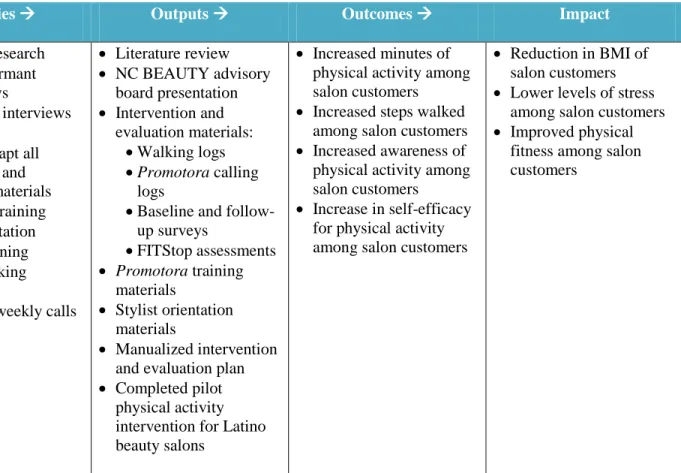
The NC Latina BEAUTY Project planning and implementation was guided by a logic model (Figure 1 in the Appendix), a visual guide that explains all of the components necessary to complete a project from start to finish. The Capstone team used the logic model to guide the work and the decision-making process. Additionally, the logic model helped to orient the project towards strategic health impact goals.
A logic model is a “systematic and visual way to present and share your understanding of the
relationships among the resources you have to operate your program, the activities you plan, and the changes or results you hope to achieve” (W.K. Kellogg Foundation, 2004). Commonly used in public health interventions, a logic model is a tool used to describe in pictures and words how a program is intended to work. It illustrates a series of activities, which follow a logical path from beginning to end, from inputs to outputs, from work to results. There are five stages of the logic model: 1) inputs, 2) activities, 3) outputs, 4) outcomes, and 5) impact (W.K. Kellogg Foundation, 2004).
2
13
The NC Latina BEAUTY project was implemented with input from multiple stakeholders, including the Capstone team, faculty advisers, community partner, research assistants, volunteers, health promotoras, salon owners, and stylists. Funds from the HBHE department and Lineberger
Comprehensive Cancer Research Center also contributed to the project. Other resources used in this project include car transportation, printing supplies, FITStop supplies, and the use of the salon. Finally, the NC BEAUTY project’s previous formative research and mentorship from the NC Beauty Advisory board were necessary for the project’s success.
The Capstone team used these inputs to undertake several activities to support the pilot project’s
creation and implementation. Using past formative research and advice from the community partner and faculty advisers, the Capstone team carried out additional formative research including creating in-depth interview guides, conducting intercept interview survey, and visiting salons. The team intended to do in-depth interviews and focus groups with stakeholders but were limited by time constraints, and as such, the interviews/focus groups did not take place. The team also held a formative research retreat to inform stakeholders of formative research results and brainstorm ideas for the intervention. The next activity was creating the intervention itself which consisted of several components. First, creating all of the materials, including those for three evaluation timepoints (baseline, process, and post evaluation), adapting FITStop materials, creating talking points and weekly activity guides for the promotoras, creating training and orientation materials, and creating advertising for the salon-based intervention. Additional activities included two promotora training sessions, a stylist orientation, a FITStop training for the Capstone team, volunteers, and research assistants. See Summary of Deliverables table in the Results section for more detail.
14
manual3, and recruitment data summary report. Most importantly, these will contribute to the output of a completed pilot physical activity intervention for Latino beauty salons. See Summary of Deliverables table in the Results section for more detail.
The outputs are intended to lead to several short- and long-term changes for salon customers. Short-term changes, called outcomes, included increased minutes of physical activity; increased steps walked, and increased awareness of physical activity among salon customers. These short-term outcomes will eventually lead to long-term impacts, such as a reduction in the body mass index (BMI), lower levels of stress, improved physical fitness, and increased self-efficacy for physical activity among salon
customers. As these health outcomes are quite distal from the intervention, it may not be possible to record significant changes in these impacts in a short time frame. However, including long-term impacts in the logic model helped guide the evaluation and provided a goal for the overall project.
Planning for Sustainability
After outlining the planned project work and its intended results in a logic model, the team assessed for the sustainability of the Capstone team’s work. Sustainability of public health interventions is of vital importance to ensure efficient use of limited public health resources for maximum benefit and to optimize the opportunity for long-term success. According to Rabin et al. (2008), “sustainability describes the extent to which an evidence-based intervention can deliver its intended benefits over an extended period of time after external support from the donor agency is terminated.” Not all health programs
should endure, but there are three main reasons why some health programs should be sustained over the long term (Shediac-Rizkallah & Bone, 1998). First, programs that address the control of chronic or infectious diseases must be sustainable so as to control or eradicate the given disease. Second, many community health programs incur significant start-up costs in human, fiscal, and technical resources before even beginning. Thus, ensuring self-sufficiency and integration of the program into the community over the long-term will help to make these initial costs worthwhile. Third, when a program encourages
15
and sustains community support and trust in communities where there has been a history of programs that were abruptly or inappropriately terminated. Consequently, sustainability has been an important
consideration for the Capstone team, and indeed, has been emphasized and prioritized from the beginning. It is important to plan for sustainability well in advance of intervention implementation.
Sustainability of public health programs can be influenced by project design and implementation factors, factors within the organizational setting, and factors in the broader community environment, a framework outlined by Shediac-Rizkallah & Bone (1998). Further, three indicators are used to assess sustainability: 1) the maintenance of health benefits achieved through the initial program, 2) the level of
institutionalization of the program within an organization, and 3) measures of capacity building in the recipient community (Shediac-Rizkallah & Bone, 1998). The Capstone team used these factors and indicators to guide an assessment of the project’s potential for sustainability. The following sections will
discuss the methods for the Capstone team’s engagement and assessment activities and work plan deliverables.
Engagement and Assessment Activities
A community can be defined in a variety of ways. It can be a group of people who are united by social ties, geographic location, or shared common perspectives, values, and beliefs (MacQueen et al., 2001). Community engagement can enhance a community’s ability to identify and strategize solutions for their own health problems, thus helping to reduce health disparities (Ahmed & Palermo, 2010). As outsiders, public health practitioners, who are not members of the community they work in, may
experience difficulty in gaining entrée4 and may not fully understand a community’s health issues and the root causes of the health concern (Kauffman, 1994).
To effectively engage a community, practitioners must collect, analyze, and mobilize efforts to act on community priorities (Friedman & Parrish, 2009). Then practitioners are able to build upon
community assets as well as provide their outsider perspective. By combining both the community’s input
16
and the practitioner’s perspective, the result is a more comprehensive understanding of the health priorities and knowledge, which can inform the future development of action steps to address a health concern (Eng et al., 2005).
The most proximal intended beneficiaries of the Capstone team’s community intervention were the owners and stylists of Latinos salons while the distal intended beneficiaries are the customers of Latino salons. Based on the formative research and needs and wants of the target population, the Capstone team derived the goals and activities based on the Social Cognitive Theory (SCT) for a physical activity intervention. Specific SCT constructs addressed in this intervention included: observational learning (through promotoras leading weekly group physical activity sessions), reinforcement (through weekly phone calls from promotoras), reinforcement (through the use of pedometers), and self-efficacy (through educational information provided by promotoras). By participating in the intervention, salon owners and stylists may improve their own health in addition to providing health education information to customers. Owners, stylists, and customers may see increases in health knowledge, attitudes, and beliefs as well as improved self-efficacy to engage in a specific behavior change. Additionally, if this feasibility study proved to have a positive impact on physical activity levels, the intervention may be implemented in more Latino salons. If the intervention is successfully replicated, it may ultimately improve the health of Triangle-area Latinos and reduce health disparities in North Carolina.
Previous formative research for this project occurred in 2009-2011 and consisted of salon observations, stylist interviews, and customer focus groups. The Capstone team added to this formative research. The additional formative research was conducted to determine the priority health issues facing the community, to identify interventions already in place by other entities, and to obtain community buy-in.
Methods used by the Capstone team consisted of 1) 80 central intercept interviews at a public event in September 2011, 2) windshield tours5 of six salons in Wake, Durham, and Orange Counties
5
17
conducted in October 2011, 3) Nine in-person salon meet-and-greet observations6 completed in October 2011, 4) Four key informant interviews conducted in November 2011, 5) and enumerated list of salons and 6) obtained approval for additional owner, stylists, and customers interviews (however, due to time constraints, these additional interviews were not actually conducted). Key informant interviews occurred with Florence Simán from El Pueblo, Inc., a Durham based salon owner named Alberto, Maritza Chirinos (Health Program) and Colleen Blue (Director of Programs) from El Centro Hispano, and three
promotoras from El Pueblo, Inc.
In addition to intercept interviews at the La Fiesta event in September 2011, in-depth formative research with salon owners, stylists, and customers was originally planned to inform the content of the salon-based health intervention; however, due to time and logistical constraints, these plans were abandoned. Since the Capstone team had access to previously completed formative research, the intervention was developed on the basis of those findings which were conducted primarily with female salon stylists and customers.
Work Plan Deliverables
The deliverables for this Capstone project were chosen because the end goal was to determine feasibility of a Latino salon-based health intervention and for the eventual creation of a grant proposal and manuscript. The formative research summary report describes the formative research which was
completed by the Capstone team to better understand the Latino population in North Carolina that frequent beauty salons and to determine the health issue(s) of focus. The literature review identified evidence-based interventions done in beauty salons and barbershops as well as those done with Latinos for key health risk behaviors. Both of these deliverables, in addition to a presentation to the NC BEAUTY Advisory Board, informed the development of the intervention and evaluation plan, the intervention and Durham, and Orange counties in a vehicle, observing and taking notes on the Latino salon business community. For more information, see the Deliverable 1, methods section of the Work Plan Deliverables table(Eng, September 7, 2011).
18
evaluation materials, and the pilot test intervention. The promotora training and stylist orientation materials are components necessary for the preparation of the pilot test intervention. Each of these deliverables is described in more detail in the results section.
RESULTS
Sustainability Findings
Project Design & Implementation Factors
As a pilot intervention program, this will ideally be scaled up to provide health education and promotion in additional Triangle-area Latino salons. The purpose of the pilot is to test the intervention in a small group and provide a valuable opportunity to monitor the implementation process and outcomes, and to gain community feedback for improvement.
The formative research completed by the Capstone team was essential for creating a sustainable design. Engaging the community is important in creating a high-quality, effective program in that it builds buy-in and support for implementation. In order to be sustainable and successful, the project must address real needs of the community in ways that are relevant and effective. The salon selected for this pilot project was chosen because the physical size of the salon could accommodate the recruitment staff and equipment; was located in a Latino-serving commercial strip mall; was surrounded by a residential neighborhood; had on open grassy field with two soccer goals located behind the salon; was
recommended by Latinos during formative research; geographical proximity to promotoras; and the owner reported all customers were Latinos. As the salon is the primary setting for the project, a strong and positive partnership with the salon’s owner and staff is essential for sustainability. As a native speaker of
19 Factors within the Organizational Setting
In the absence of a community-based organization leading this project, the Board serves as a community surrogate by reviewing and pre-testing ideas as the NC BEAUTY Model is adapted to meet the needs of the Latino community. Consequently, representation from the Latino community is important to ensure that socio-cultural and contextual factors are taken into account. The Capstone team proposed assisting with identification and recruitment of Latino community members for the Board, and engaged in initial efforts to establish relationships with organizations such as El Centro Hispano, The Durham County Hispanic Council, and a local church with strong attendance from Latinos. The Capstone team arranged and attended a meeting with El Centro Hispano but no further discussions have been held. At the instruction of the faculty advisers, the Capstone team focused its efforts on other project activities. At present, Latino representation on the Board remains limited.
Florence Simán, a Board representative and member of the Latino community, facilitated the recruitment of a team of health promotoras from El Pueblo, Inc, a non-profit North Carolina advocacy organization dedicated to serving the Latino community. The team of three promotoras was an essential component of the recruitment and intervention activities, serving as a bridge between the salon, stylists, customers, and the Capstone team.
Factors within the Broader Community Environment
Health promotion programs in salons and barbershops serving the African-American community have been shown to be effective (Linnan et al., 2011; Reiter & Linnan, 2011). Adapting the intervention strategy for the Latino community may have several challenges including the larger socioeconomic factors that may affect Latino communities differently than African-American communities, such as problems with legal documentation/status and cultural/linguistic barriers. These factors may affect the ability to recruit participants for the intervention and may make salon interventions potentially less suitable for the Latino community which can negatively affect sustainability.
20
As NC Latina BEAUTY is primarily in a formative research and pilot stage, the maintenance of health benefits is not within the scope of the project at the current time. However, the project did strongly emphasize weekly participation in the intervention so as to increase the dose during the six-week pilot stage.
Institutionalization
Institutionalization can be measured by assessing the partner organization implementing the program in the community. This organization could be El Pueblo, El Centro Hispano or another
organization that has not yet been identified. Given the crucial involvement of the El Pueblo promotoras in the implementation of the pilot project, the Capstone team assumed that El Pueblo is the most likely community partner going forward. While the Capstone team has had limited interaction with El Pueblo’s senior management, the promotoras have identified a strong interest in participating, which could be due to a number of factors, including interest in the program and helping the community, opportunity for financial compensation, and gaining practical experience in public health programs. Sustainability may be enhanced if these incentives are entrenched at the organizational level, either through an organizational budget or strategic plan, as suggested by (Rabin, Brownson, Haire-Joshu, Kreuter, & Weaver, 2008).
Capacity-building
Finally, capacity-building in the recipient community is intended to strengthen the abilities of local community partners or the community itself to continue the program once external support has ended which in this case is support from the Capstone team and faculty advisers at UNC. Capacity-building activities focused primarily on the promotoras and the program participants themselves for both assessing ownership for and competence in taking the program forward. Promotoras were trained in participant recruitment and customer interaction techniques, but needed occasional refresher courses. This enabled them to recruit participants and potentially be able to train other promotoras over time.
21
Engagement and Assessment Findings
Central intercept interviews
The Capstone team obtained important information from the 80 central intercept interviews conducted in September 2011. The Capstone team learned that men get their haircut more often than women and that 77.5% of those interviewed receive hair cuts at a salon as opposed to someone’s home.
This was promising as it suggested that the salon might be a good setting to access Latinos. The team also learned that a large proportion (46.3%) of Latinos interviewed get their hair cut less frequently than once every two months, suggesting that the pilot intervention was unlikely to engage customers more than once during the six-week pilot test intervention. Additionally, the Capstone team was able to identify 16 salons that respondents had patronized in the past. These salons were cross-checked with the list of salons the Capstone team obtained from the state and were used to triangulate data for an enumerated list of Latino salons. Informants also ranked the top three health topics most of interest to them. For males, stress (1st), cancer prevention (2nd) and children’s health (3rd) were listed as the most important whereas the ranking for females were stress (1st), reproductive health, children’s health, and obesity (tied for 2nd), and physical activity (3rd).
Windshield Tour
22 Salon Visits
In-person salon visits were made in order to better understand the community and salons as intervention settings as well as to identify potential salons key informants. During the visit, an overview of the NC BEAUTY and Health project and an explanation of the the research team was given.
Owners/managers were asked if they would be interested in possibly being involved in the study. Because salon visits occurred on the weekend when salons were busy, the Capstone team briefly observed the ebb and flow of customers as well as the structural layout of the various salons. During the busy weekend, salon employees had limited time to engage in long conversations with non-customers especially since a single salon may see up to 80 customers in single day. Of the nine salons, none had an employee monitoring the cash register/front desk and all had a television, which was tuned to telenovelas (soap operas). Many salons seemed to have a family-friendly atmosphere, with families sitting in the waiting areas while one member of the family was receiving services, and some salons had toys available for children.
Key Informant Interviews
23
community. They mentioned that stress and mental health issues had not arisen during a recent health forum they had hosted and they would be interested to see the results of the central intercept interviews conducted by the Capstone team in September 2011. Finally, El Centro Hispano said salon stylists receive educational credits from the NC Board of Barber Examiners for their trainings, and this could potentially be eligible. The El Pueblo promotoras were supportive of a zumba or walking club intervention, and in fact mentioned they had previously been interested in a walking club but had not been able to organize one. They also suggested that men be connected to soccer leagues. The promotoras also suggested a salon located closer to where they lived, and one of the promotoras assisted with successful engagement and recruitment efforts to bring that salon on board as the intervention site.
Enumerated List of Salons
The original list from the state contained 13,563 salons. After excluding all counties except Orange, Wake and Durham, the list of salons totalled 1,649. Franchise salons were excluded which left a list of 1,281 salons. After excluding salons that did not have a Spanish sounding name of the salon and/or name of the salon owner, 61 salons remained on the list. Nine salons were added from a website that lists local Latino businesses; 46 salons were excluded because we were unable to find a phone number, the number was disconnected, there was no answer even after multiple attempts, or the salon was listed multiple times on the list under different names. Four salons reported that they did not serve a primarily Latino clientele. The final list was 20 salons. This enumerated list of Latino/a salons may not be a complete list. By excluding salons that did not have a Latino “sounding” salon name and/or Latino “sounding” salon owner we may have missed out on some Latino salons. Additionally, this list does not
include unlicensed salons in the tri-county area. Even with these limitations, this list will be helpful in future intervention work with Latino salons in the NC Triangle-area.
Interviews with salon owners, stylists and customers
24
owners in the area, the Capstone team did identify four salons that were interested in learning more about the project and potentially becoming involved.
Summary
By conducting additional formative research (intercept interviews, windshield tour, salon visits, and key informant interviews), assessing program sustainability as well as engagement and assessment activities, the Capstone team was able to develop an intervention plan that avoided duplicating efforts of other community-based organizations and identified the potential for collaboration among stakeholders. Additionally, these assessments informed the project deliverables which are explained in detail below.
Summary of Deliverables
Deliverable 1: Formative Research Report to Inform NC Latina BEAUTY Salon Intervention Development
Purpose: To engage and better understand the Latino population in North Carolina and the extent to which they frequent beauty salons, to identify potential intervention beauty salons in the Triangle area, to determine the health issue(s) that will be the focus of the intervention, and to inform the intervention and evaluation plan.
Timeline: The formative research was conducted between September and December 2011.
Methods Key Findings
Methods used by the student team consisted of 1) central intercept interviews at a public event in September 2011, 2) 1 windshield tour conducted in October 2011, 3) salon visits, and 4) an enumerated list of Latino salons, 5) key informant interviews, and 6) the development of interview guides and an observation checklist.
1. Central intercept interviews were conducted at La Fiesta del Pueblo, in Raleigh, NC on September 18, 2011. The Capstone team conducted intercept interviews by approaching potential participants who entered the health fair-designated area at La Fiesta del Pueblo. The Capstone team approached 104 people to complete the interview questionnaire during the 4 hours of interviewing. A total of 80 people completed the interview, a completion rate of 77%. Given a list of 8 health topics, participants were asked to select their health concerns and rank the three most important to them. Interviews were completed in English or Spanish depending on the preference of the participant. 2. On the morning of October 11, 2011, the Capstone team conducted a Windshield Tour of beauty salons in three North Carolina counties: Orange, Wake, and Durham. Salons were selected based on a method of triangulation using results of the central intercept interviews, cross-checking them against a list of all licensed salons in the tri-county area, and then being able to validate their location using Google Maps. Using the licensed list, we also added additional salons by
Customers will likely only have one contact with a stylist during the 6-week intervention. Based on this information we have decided to do a low stylist involvement intervention and instead focus on promotoras as the primary health educators.
The physical size
constraints of the salon were considered and guided the decision for the main intervention activity, the walking club, taking place outside of the salon. The formative research
25
selecting those, which contained the word peluqueria (hair salon) or salon de belleza (beauty salon) and looked them up in Google Maps. Via these two methods we aimed to identify salons that serve the Latino community. We ended up with a list of 16 salons, which enabled us to visit multiple salons in each of the 3 counties, Wake, Durham, and Orange. Over a three and a half hour period, we surveyed six of the 16 beauty salons. This list was specifically used for the windshield tour but influenced the enumeration of salons. The six salons were selected based on ability to observe from an outside location (some were located inside apartment complexes) and geographic proximity to Chapel Hill due to being faced with tight time constraints. We developed a semi-structured windshield tour checklist of 17 yes/no and open-ended questions to guide our thinking and act as triggers for things to look for. Methods of observation included parking and watching, walking tours, and neighborhood driving tours.
3. Sivan, Ryan, and Barbara visited nine salons in Durham and Raleigh on a Saturday in October. All conversations were conducted in Spanish. The group members took turns leading conversation and doing introductions.
4. To create an enumerated list of Latino salons in the tri-county area of North Carolina, we began with a list of NC licensed salons that we received from the state in an excel spreadsheet. We came up with enumeration and exclusion criteria, looked up phone numbers, made phone calls and created a final list of 20 salons. We began with enumeration criteria. To be considered eligible, a salon had to:
Be owned by a Latino
Be located in Orange, Durham, or Wake counties Serve primarily Latinos
5. We have had four successful meetings with key informants to discuss our formative research and intervention plans. These include a meeting with Florence Simán from El Pueblo, Inc., a Durham based salon owner named Alberto, Maritza Chirinos (Health Program) and Colleen Blue (Director of Programs) from El Centro Hispano and promotoras from El Pueblo, Inc.
6. In addition to these methods, additional activities/products created include two Internal Review Board (IRB) modifications, development of central intercept interview surveys, developing interview guides for salon owners, stylists and customers and an observation checklist that were never used due to time constraints. All materials had to be translated into Spanish.
We prioritized promotora involvement as the primary method for selecting the salon since they are
essential to the intervention. One of the main
promotoras, Griselda, has a relationship with Salon Alis and the location of the salon makes transportation to the salon for promotoras less of a barrier as it is closer to many of their homes. Entrée to the community is
extremely important for a successful project such as this.
Customers will likely be coming to the salon and this Latino business area to accomplish multiple tasks such as grocery shopping. This may limit their time in the salon the time they may be able to participate in the intervention. Additionally, customers may be bringing multiple family members with them on these outings, which may increase the opportunity to reach men, women, and children in this intervention.
26
Deliverable 2: Literature Review on Community Health Interventions Purpose: To identify other salon-based interventions including their effectiveness on specific health outcomes and identify evidence-based interventions for Latinos and Latino families on key health risk behaviors: tobacco use, physical inactivity, eating habits, alcohol use, weight
management (and other topics that arise from formative research), and to inform the intervention plan.
Timeline: September 2011- February 2012
Methods Key Findings
1. Salon-based review of the literature
To build upon the salon-based literature review, a search completed September 15, 2011 through October 1, 2011 in PubMed, Web of Science, Google Scholar, and EBSCO Host yielded 426 results (including duplicates). Search terms included “(Latino or Hispanic Americans or black or African-Americans) and/or (Health or obesity or nutrition or depression or reproductive health or physical activity or cancer prevention or children’s health or stress or violence prevention or alcohol or hypertension) and/or (Beauty salons or hair salons or barber shops or nail salons or stylists or estheticians or cosmetologists or manicurists).” Articles were excluded if they were non-peer reviewed or assessed knowledge/attitudes/beliefs/ behaviors of non-Latino population or primary outcomes were not a health-specific outcome or not a salon-based intervention. After cross-checking the 21 remaining articles for duplicates with D’Angelo’s original literature review, only 3 new articles were reviewed. 2. Non salon-based Latino Interventions
Search queries consisted of “(Latino or Latina or Hispanic) and (Intervention) and a specific health topic including: (depression), (stress), (reproductive health or sexual health), (“child health”), (“weight control”), (“cancer prevention”), (“physical activity”).” Parentheses were use to ensure the query resulted in articles that contained the phrase within the quotes rather than articles that merely had one of the words within the quotes. A search completed in PubMed resulted in 960 results (including duplicates). To be included in the review, articles must have had the target population be the general Hispanic adult population, must have a primary health outcome, and not be school-based nor be medical-provider based. After exclusion, 42 were deemed relevant.
3. Physical Activity Interventions as a Mechanism for Stress Reduction
A final literature search was conducted for (walking and intervention and stress). The search resulted in 88 articles; however, only one article was deemed relevant; thus a second search of (walk and intervention) resulted in four additional articles to review. To be included, an article’s sample had to be non-disease US adults and the primary intervention activity had to be walking.
Salons are a promising yet under-explored setting. Although no
Latino-salon-based interventions have been implemented, the idea seems plausible.
When designing a salon-based intervention for the Latino community, stylists should be involved in the planning and implementing of the health education campaign. Lay health workers
(promotoras) are an effective mechanism to promote behavior change among Latinos.
The presence of promotoras helps establish the credibility and trust of external
researchers working within the community
There are cultural ideas such as familismo, personalismo, that must be considered when designing an intervention. Community-based physical
activity interventions have been shown to be an effective way to improve the mental health of participants.
27
Deliverable 3: NC BEAUTY Advisory Board Presentation
Purpose: To summarize Phase 1 formative research and present Phase 2 pilot study plan to the Advisory Board members and get feedback
Timeline: Preparation of slides – September – October 3, 2011. Presentation on October 3, 2011
Methods Key Findings
October 3, 2012: Dr. Barbara Baquero presented the Phase 1
formative research results and Julie Hasken and A.C. Rothenbuecher presented the Phase 2 plan. There was a short question and answer section.
The Advisory Board approved of the Phase 2 plan.
Deliverable 4: Latino Beauty Salon Intervention and Evaluation Manual Purpose: To develop a multi-level intervention and evaluation plan addressing physical activity and stress target that is culturally/contextually appropriate for use with Latinos in a beauty salon setting, using PRECEDE-PROCEED the planning process.
Timeline: January – April 2012
Methods Key Findings
Use health behavior theory and the PRECEDE – PROCEED model to develop an intervention and evaluation manual. The manual describes the protocol for implementing a six week physical activity and stress reduction intervention. It contains instructions for on-boarding salons, training promotoras, recruiting participants, performing initial
assessments, delivering the intervention, and follow-up assessments. The manual consists of a written document and all accompanying materials needed for the intervention and evaluation, attached in a series of folders by way of CD, thumb drive, or ZIP folder. This deliverable, in addition to serving as a written guide for future endeavors, is the Capstone team’s record of the intervention and evaluation activities completed in the spring of 2012. This phase of the project began with promotora and stylist trainings in February, four weeks of participant recruitment in a salon, six weeks of intervention activities, and two weeks of follow-up data collection. Stylist orientation: 1 hour-long session held at Salon Alis Promotora training: 2 three-hour long training sessions Recruitment: Four hour shifts on Friday afternoons, six hour
shifts each on Saturdays and Sundays, three weekends in a row Intervention: Phone calls throughout the week, one hour physical
activity session on Saturdays
Follow-up: Four hour shifts on Friday afternoons, six hour shifts each on Saturdays and Sundays, two weekends in a row
The Capstone team planned and prepared materials for all of these components, and directly participated in the training and recruitment phase. The intervention and post assessment phases were continued by Barbara Baquero, Karen Roque, Laura Linnan and other members of Laura Linnan’s research team.
Findings from the manual: Determine the purpose of
the manual and decide on what components to include based on this purpose. Prioritize brevity and
ease-of-use over lengthy explanations.
Make materials easy to locate and reproduce. Findings from recruitment:
Ebb and flow of salon customers.
Be mindful of resources and time.
Stylist buy-in is important. One project manager for the
complete recruitment process and someone to ensure protocol is followed. Main reason participants did
not participants is lack of time.
It takes 30 minutes to complete the baseline interview and FITStop assessment.
28
Deliverable 5: Latino Beauty Salon Intervention and Evaluation Materials Purpose: To develop intervention and evaluation materials to be used in the 6 week pilot intervention.
Timeline: January – April 2012
Methods Key Findings
Adapted and created intervention and evaluation materials. Activities for this deliverable include 2 IRB modifications and one full electronic IRB renewal. All materials were adapted from previous work done by Drs. Barbara Baquero and Laura Linnan, reviewed and revised and translated into Spanish by two of the team members and Karen Roque.
Should have pre-tested with customers at Latino salons not just Latinos
All materials should have multiple revisions Need sufficient time to
review materials Adapting materials to
another community is a lengthy process and needs input from many people and time and resources
Adaptation vs. tailoring vs. creating a new intervention Lack of fidelity to the
protocol.
Need to have a background in physical education and physical activity
Speaking Spanish is
essential for this population. Not all Spanish is the same
29
Deliverable 6: Latino Beauty Salon Intervention Promotora (Lay Health Advisor) Training Materials
Purpose: To develop a training guide and accompanying materials to inform the promotoras of the intervention, get their feedback and input, provide them with CITI training, and train them in multiple roles.
Timeline: January – April 2012
Methods Key Findings
We created a Spanish-language promotora training guide, which includes a facilitator’s guide, training materials, sample intervention materials, and an accompanying PowerPoint presentation. Some of the materials had first been created in English and thus were translated into Spanish by two Capstone team members and Karen Roque. Dr. Baquero and the Capstone team trained two promotoras in February at El Pueblo Inc. offices in Raleigh, NC. Two promotoras attended an additional training facilitated by Dr. Baquero in February 2012 but not all materials could be reviewed due to time constraints. Thus, a third and final training was held in the salon during the recruitment phase by one Capstone team member to complete the review of all materials. During these separate trainings, feedback was taken on board from the participants so as to improve and refine the materials resulting in this final version.
Schedule and design training according to participants’ needs Should be participatory
and involve a two-way dialogue so that both facilitators and participants can learn from each other CITI training tends to be
more of a one-way dialogue and should be conducted separately so as not to throw off the dynamic
Multiple sessions and even refreshers may be required as not everyone may show up the first time, nor remember everything that has been discussed Participants in the training
30
Deliverable 7: Latino Beauty Salon Intervention Stylist Orientation Training Materials Purpose: To develop orientation materials to provide the stylists at the intervention salon with an overview of the intervention, explain their role in the intervention, and get their feedback and consent.
Timeline: January – April 2012
Methods Key Findings
We created a Spanish and English language stylist orientation guide which includes a calendar of activities, an overview of the intervention and the types of promotional and informational materials used, and consent forms. The stylist orientation took place in February 2012 in the intervention salon in Raleigh, NC and was administered by the Capstone team members and Dr. Baquero.
Approach the orientation as a participatory, ongoing two-way dialogue during which to engage and learn from the stylists
Schedule the orientation according to participants’ needs and be prepared for further follow-up
Engage the stylists early in the process of intervention design so as to take on board their expertise Hold the orientation as
soon after the intervention has been designed so that the stylists are aware of what is involved, and may provide feedback on potential challenges with implementation
31
Deliverable 8: Latino Beauty Salon Recruitment Data Summary Report Purpose: To summarize data from the pilot test that will allow us to determine the feasibility and initial impact of the intervention on owner, stylist, customer and salon-level outcomes.
Timeline: March – April 2012
Methods Key Findings
Developed a SPSS database for the data. Prior to analysis, data was coded, entered, verified, and cleaned. Analyzed data as outlined by the evaluation. This analysis focused on the recruitment data and not pre/post intervention data. Prepared a summary report containing summary of demographic data about participants, recruitment rate, baseline physical characteristics (FITStop assessments) of participants.
The promotoras spent a total of 53-hours in the salon, recruiting participants. During the 53-hours, at least two promotoras were present. Promotoras approached a total of 133 customers (56 females and 77 males). Of the 77 males
approached, 18% were enrolled into the study. Of the 56 females approached, 34% were enrolled into the study.
All eligible individuals enrolled into the study and opted to complete FITStop. The mean BMI was 27.5
(SD = 4.8), with 21% classified as normal or underweight, 52% as overweight, and 15% as obese class I and 12% as obese class II/III. Almost all (93%) of male
participants and 75% of female participants reported visiting the salon at least once a month. While nearly three-quarters
intend to engage in at least 150 minutes of physical activity in the next week, only a quarter reported doing 150 minutes in the previous week.
32
DISCUSSION
Strengths and Limitations
In future implementation efforts, effective engagement of salons should be a key consideration in the implementation of the intervention and sustainability. Though this project did included attempts to engage the target community, these efforts could be strengthened considerably to ensure appropriateness and community ownership.
The original NC BEAUTY intervention consisted of 6 behavior change campaigns developed for African American salon customers, stylists, and owners. This Capstone project sought to adapt one of these campaigns, “Every Little Move Counts,” for Latino populations. This process required data and knowledge about the community’s needs in order to make it culturally and contextually appropriate. The Capstone project was significantly strengthened by the prior formative research and data collected in 2009-2011, which provided insight into the relationship between stylists and customers, customer demographics, and whether stylists and customers might be interested in such an intervention. Still, gaps existed and due to time constraints on the part of the Capstone team as well as the need to take into account the schedules of salon owners, not all community engagement activities were implemented as planned.
Particular challenges included going beyond observational methods to more interactive methods such as focus groups and face-to-face interviews. Though previous formative research provided
information on the potential salience of a salon-based intervention and potential health topics, the Capstone project would have benefited from more detailed information on the types of intervention activities and additional demographic information about customers. For example, a few weeks before the intervention began, the team found out that the chosen salon had a mostly young, male clientele, not the family-oriented, primarily female audience the intervention had been designed for. This may have resulted in a less appropriate intervention.
33
phone calls were needed to schedule an appointment with one salon’s management. Then, at the appointed time, the salon owner did not show up, and the Capstone team was not able to re-establish interest. Although it may not be possible to know the precise reasons for this, it may be due to cultural misunderstandings, insufficient incentives, concern about participating related to legal or immigration issues, and busy schedules. Eventually, the Capstone team sought assistance from one of the faculty advisers, a native Spanish speaker, to assist in gaining entrée and securing a salon for the pilot stage. The faculty adviser’s past experience in working with the Latino community proved essential to recruiting the
salon and was a key strength of the project.
Overall, the truncated timeline for formative research and community engagement presents a risk that the final intervention design may be neither reflective of the services desired by the community nor relevant to the target population.
Information Gaps
Had additional resources and time been available, further engagement may have been beneficial to the intervention design. Specifically, additional engagement may have allowed the Capstone team to gain more first-hand knowledge and understanding of the community rather than relying on previous formative research conducted by others. Furthermore, additional engagement would have allowed more collaborative intervention development among stakeholders. Specifically, earlier involvement of the pilot intervention salon’s owner may have resulted in a more appropriate and relevant intervention for the salon’s customers. Earlier involvement would have also facilitated more co-ownership among the
stakeholders.
Potential Impact and Benefits
34
activity. Additional longer-term benefits may include: increased physical activity, reductions in BMI and stress levels, improved physical fitness, and self-efficacy to perform physical activity.
Other beneficiaries included the promotoras, who received training on physical activity and stress, and may use this knowledge in their other activities. In addition, the NC BEAUTY Advisory board now has a comprehensive salon-based physical activity promotion and stress reduction pilot intervention to consider for possible use in other Latino beauty salons. The documentation of lessons learned from this experience will also add to institutional knowledge and capacity for future implementation efforts of this project and other adaptations of the original NC BEAUTY project.
Finally, the Capstone team members gained significant experience in planning, implementing, and evaluating a community-based research project. Skills developed include conducting formative research, building and maintaining relationships with community stakeholders, creating a multi-component intervention, managing a research team of over ten individuals, coordinating complex timelines, documenting project plans with multiple components, and speaking and writing in Spanish. Consistent with the goal of the Capstone program, these experiences built on the lessons learned during two years of MPH coursework and will be invaluable to the team in their future public health careers.
Considerations for Sustainability
In this section, the Capstone team has outlined a set of strategies intended to address the limitations of the project and how to best build on its strengths in order to enhance sustainability. These strategies have been developed in line with recommendations by Shediac-Rizkallah & Bone (1998).
35
and any community stakeholders that may be involved in future implementation efforts. Such formative research will also help to identify whether and what types of capacity-building measures might be appropriate. Capacity building through skill-development can be an important contributing factor to sustainability (Shediac-Rizkallah & Bone, 1998).
However there are certain threats to sustainability, which need to be addressed such as: the need to conduct further formative research on intervention design, the identification of a more involved community partner for the implementation of the full intervention, and the appropriateness of the intervention for the target audience, as discussed above.
Secondly, the Capstone team recommends greater community ownership of the project. The university researchers and majority of members of the NC BEAUTY Advisory Board are not
representative of the local Latino community. One significant advantage is that one of the faculty advisers became the main liaison with the salon and promotoras during the course of this Capstone project and a strong institutional or organizational champion within the university system and research community. This could significantly help in engaging other community-based, Latino-focused organizations that the Capstone team has previously identified and contacted in relation to this project. Continuing to engage with these organizations may spark interest from additional community partners. The Capstone team hopes that the faculty adviser will continue to remain involved in the project. Continued engagement with the community may also lead to other potential community partners emerging in a leadership role, championing it locally, and ultimately institutionalizing it within the organization. This process will also inform the development of a culturally linked and relevant Advisory Board. In these ways, the Capstone team hopes future modification of the intervention be driven by the needs of the community and creates a greater sense of ownership, which is a critical element to sustainability as per Shediac-Rizkallah & Bone (1998).
36
whether the opportunity to participate in a walking club is likely to resonate as effectively with young men as it might with young women, but results from the intervention evaluation will shed light on participation and behavior change among both genders. Research shows that high-stylist involvement (e.g. training stylists to serve as “natural helpers”) is an effective way to promote behavior change
(Linnan & Ferguson, 2007; Linnan et al., 2011). Although high stylist involvement was not a strategy that was possible for this project, it may be possible in a future iteration of this work. Furthermore, continuing to use or expanding on the natural helper strategy may also be effective. Utilizing the promotoras in this project appeared effective in the recruitment stage. Perhaps through the use of multiple natural helpers, such as stylists or even individuals in alternate environments such as local churches, social support can be strengthened and reinforce key intervention messages. Promotoras could be invited to share thoughts on how this might be possible in future implementation efforts.
Finally, the Capstone team anticipates that the products of this project will contribute to the evidence base on the health nexus between salon stylists and their customers. There is already a significant evidence base as a result of NC BEAUTY’s work in the African-American community
(Linnan et al., 2005; Linnan & Ferguson, 2007; Linnan et al., 2011; Reiter & Linnan, 2011). By adapting the intervention to a different ethnic community and documenting it in the published literature, other researchers may seek to develop the work further in other populations and places. If enough evidence were accumulated, simple measures for health improvement of salon customers could potentially be included in cosmetologist or stylist training programs at the state level, creating the potential to strengthen community competence as suggested by Shediac-Rizkallah & Bone (1998). Through a number of written deliverables, the Capstone team is informing the development of manuscripts for publication on the activities and results of the project.
CONCLUSION AND RECOMMENDED NEXT STEPS
37
project explore additional community-based funding sources, not only those tied to university-based research, so as to improve the sustainability and community involvement in the project.
If the project moves past a pilot stage, it would be advisable to explore means of monitoring health behaviors and health benefits for program participants over time, through surveys and/or
38
REFERENCES
Ahmed, S. M., & Palermo, A. G. (2010). Community engagement in research: Frameworks for education and peer review. American Journal of Public Health, 100(8), 1380-1387. doi:10.2105/AJPH.2009.178137
American Cancer Society. (2008). Cancer facts & figures: 2008. (). Atlanta, GA:
Anderson, R. T., King, A., Stewart, A. L., Camacho, F., & Rejeski, W. J. (2005). Physical activity counseling in primary care and patient well-being: Do patients benefit? Annals of Behavioral Medicine : A Publication of the Society of Behavioral Medicine, 30(2), 146-154.
doi:10.1207/s15324796abm3002_7
Bautista, L., Reininger, B., Gay, J. L., Barroso, C. S., & McCormick, J. B. (2011). Perceived barriers to exercise in hispanic adults by level of activity. Journal of Physical Activity & Health, 8(7), 916-925.
Bright, M. A. (2005). The national cancer institute's cancer information service: A new generation of service and research to the nation. Journal of Health Communication, 10 Suppl 1, 7-13.
doi:10.1080/10810730500263687
39
Brumby, S., Chandrasekara, A., McCoombe, S., Torres, S., Kremer, P., & Lewandowski, P. (2011). Reducing psychological distress and obesity in australian farmers by promoting physical activity. BMC Public Health, 11, 362. doi:10.1186/1471-2458-11-362
Carter-Pokras, O., Zambrana, R. E., Yankelvich, G., Estrada, M., Castillo-Salgado, C., & Ortega, A. N. (2008). Health status of mexican-origin persons: Do proxy measures of acculturation advance our understanding of health disparities? Journal of Immigrant and Minority Health / Center for Minority Public Health, 10(6), 475-488. doi:10.1007/s10903-008-9146-2
Cavazos-Rehg, P. A., Zayas, L. H., & Spitznagel, E. L. (2007). Legal status, emotional well-being and subjective health status of latino immigrants. Journal of the National Medical Association, 99(10), 1126-1131.
Centers for Disease Control and Prevention. (2004). Health disparities experienced by hispanics---united states. Morbidity and Mortality Weekly Report, 53(40), September 25, 2011-935-937.
Dunn, A. L., Trivedi, M. H., Kampert, J. B., Clark, C. G., & Chambliss, H. O. (2005). Exercise treatment for depression: Efficacy and dose response. American Journal of Preventive Medicine, 28(1), 1-8. doi:10.1016/j.amepre.2004.09.003
Eng, E. (September 7, 2011). Field notes from participant observation
Eng, E., Moore, K. S., Rhodes, S. D., Griffith, D. M., Allison, L. L., Shirah, K., & Mebane, E. M. (2005). Insiders and outsiders assess who is "the community". In B. Israel, E. Eng, A. Schulz & E. Parker (Eds.), Methods for community based partcipatory research for health (1st ed., pp. 77-100). San Francisco: John Wiley and Sons.