Trauma Patient Mortality at a Level I
Trauma Center:
Is the Tiered Trauma System Effective at Minimizing Mortality?
A Systematic Review and Original Secondary Data Analysis
By Samuel Ross
A Master’s Paper submitted to the faculty of the University of North Carolina at Chapel Hill
in partial fulfillment of the requirements for the degree of Master of Public Health in
the Public Health Leadership Program.
Chapel Hill
2010
_____________________________________
First Reader: Date
Table of Contents
1. Introductory Statement 2
2. Systematic Literature Review Abstract 3
Introduction 4
Methods 7
Results 9
Discussion 16
References 19
Figures and Tables 21
3. Secondary Data Analysis: A Retrospective Cohort Study Abstract 26
Introduction 27
Methods 29
Results 32
Discussion 34
References 37
Introductory Statement
Is Inter-hospital Transfer Status Associated with Adverse Outcomes in Trauma Patient?
Abstract
Background: The goal of the trauma system is to minimize patient mortality by facilitating rapid transport,
stabilization, and early definitive care through higher level inter-hospital transfer of the severely injured.
However, evidence is currently mixed on whether inter-hospital transfer is associated with worse patient
outcomes. We sought to systematically review the current evidence on the effect of inter-hospital transfer
on patient mortality.
Methods: All study of varying methodology carried out on a trauma patient population in the United
States and Canada since 1985, having mortality as the main outcome and inter-hospital transfer as the
main exposure variable were eligible for inclusion. EMBASE, Pubmed, the Cochrane Library, and
Google scholar were searched for key terms to identify all relevant articles. Articles were screened by
title, abstract, and full text review. Data was abstracted and evidence quality was assigned by the primary
author, and any poor quality studies were excluded.
Results: 7 retrospective cohort studies were identified that met all criteria. Three were of good evidence
quality and four were of fair evidence quality. Two studies found that transferred patients had an adverse
increase in mortality, while five found no association between transfer status and mortality. Additionally,
two studies found an increase in intensive care unit (ICU) and hospital stay for transferred patients.
Conclusion: After considering the paucity, quality and direction of the studies reviewed, it is still unclear
whether hospital transfer is associated with increased mortality. However, it seems likely that
Is Inter-hospital Transfer Status Associated with Adverse Trauma Patient
Outcomes?
A Systematic Literature Review
Introduction
Trauma is among the top leading causes of death in the United States (US) each year according to the Center for Disease Control WISQARS database.1 In 2006 it was the fifth leading cause of mortality among all age groups, responsible for 121,599 deaths.1 Additionally, un-intentional trauma is the leading cause of death in all age groups from age 1 to 44 years.1 In 2006 unintentional injury was the leading cause of Years of Potential Life Lost (YPLL) with nearly 2.4 million years of life lost in that year alone.1 This accounts for over 20% of YPLL per annum in the US. In 2008 there were 30 million non-fatal injuries in the US out of the
approximately 300 million US residents.1 Besides direct human death and injury, the economic cost of trauma injuries is staggering, totaling $80 billion in medical costs and $326 billion in lost productivity over a lifetime for those injured just in the year 2000.2
In order to more effectively treat trauma patients a tiered system now exists in most areas of the US to triage patients and provide optimum care while being aware of resource constraints. Level IV-II trauma centers receive local patients, triage their injuries, and transfer them to higher level care if needed. Regional Level I trauma centers receive the more severely injured patients from lower level centers, in addition to local patients of all severities. Level I centers are usually regional tertiary, or even state quaternary, care centers that take an active role in
and fellows. Clinically, Level I trauma centers have an attending trauma surgeon and
neurosurgeon, anesthesiologists, and other specialists on-call 24 hours per day, 7 days per week, as well as on-demand access to advanced procedures and imaging. Additionally they must admit at least 1200 trauma patients or 240 major trauma patients a year to keep their level one status. 3 Level II centers have similar clinical criteria but do not have to admit the same number of patients or engage in the education, research, and public health activities. Traditionally, Level II centers have served as adjunct hospitals to Level I centers in urban areas, or as the primary regional center in rural areas. Level III centers are generally large community hospitals that have emergency, resuscitative, and operative capabilities and less specialized physicians. However, when their capabilities and expertise are exceeded their goal is to stabilize and transfer the injured patient to a Level I or II facility. Level IV facilities are rural hospitals that are only capable of basic emergency resuscitative measures. Their prime goal is to stabilize the patient for Emergency Medical Services (EMS) transport to any of the higher tier facilities.4
Level I centers. This is because every trauma case is unique in severity and location, varying by the type of injuries, the geographical proximity to lower tier hospitals and to Level I trauma centers, and additionally by the type of EMS transport available and their transport protocols.
All these factors are taken into consideration by EMS personnel to make a transport decision for the patient that primarily weighs the patient’s severity vs. being stabilized quickly or receiving definitive care quickly. Stabilization of any patient can occur at any hospital trauma level, whether they receive definitive care, however, is dependent on the patient’s severity and the hospital trauma level. A critically injured patient is unlikely to receive definitive care at a Level IV center because they do not have the personnel, expertise, and/or equipment to definitively care for that patient. The trauma system is designed to give flexibility in care intensity so that EMS and hospital personnel have many options in choosing care based on patient severity and whether they deem stabilization or early definitive care is more important. This system is utilized in the hope that patient outcomes like mortality and hospital length of stay (LOS) will ultimately be minimized by the flexibility it offers, but is it actually accomplishing that? What if time to definitive care (TTDC) is more important than stabilization, and those patients transported directly to a Level I center are actually getting a survival advantage?
In an ideal world this question would be best answered by a database covering all trauma patients in the US regardless of what level of facility they were admitted. In actuality only patients admitted to Level I trauma centers are entered into such databases, and these databases are not commonly shared with other institutions. Unfortunately, this means that patients’ outcomes at lower level centers are not recorded. Therefore the best way to assess trauma
are stabilized at lower tier hospitals and then transferred to Level I centers can be compared to severely injured patients who are brought directly to the Level I center, and therefore receive earlier definitive care. The difference in trauma patient transfer status at a Level I trauma center and its effect on patient outcomes like mortality, intensive care unit (ICU) LOS, and hospital LOS was the primary research question for this study. This study sought to systematically review all pertinent studies in the US and Canada that measured differences in trauma patient outcomes by transfer status in a Level I trauma center cohort.
Methods
Eligibility Criteria: Studies were considered for inclusion in the review if they were randomized control trials, cohort studies, and/or case-control studies carried out with a trauma patient
population since 1985. No selection criteria were made for by the type of trauma injury. Inter-hospital transfer had to be a primary variable of interest in the study, and the primary patient outcome measures of mortality, ICU LOS, and/or hospital LOS had to be measured as well. Since this is a review of the effect of inter-hospital transfer on mortality in the US, no non-English language studies were considered. Additionally only studies carried out in the US or Canada were considered for review (Canadian articles were considered due to the similar nature of US/Canada trauma systems). A final criterion was made that any study that was graded to be of poor evidence quality would be excluded from the review.
considered for selection. The search strategy below was applied to PubMed (1985-Present), EMBASE (1985-Present), and The Cochrane Library (1985-Present). The last search was run on March 28, 2010.
Search Strategy: We used the following search terms and various combinations in PubMed, EMBASE, and Cochrane Library databases as the primary means of collating an initial study pool: trauma patient; inter-hospital transfer; transfer; transport; time to definitive care (TTDC); transfer time; transport time; Level I trauma center; trauma systems; mortality; ICU length of stay; hospital length of stay. Relevant studies then underwent reference review by hand to find additional articles that were missed in the database searches. A tertiary search was then
conducted using Google Scholar and the above terms to find any additional references and/or full text articles not otherwise available.
Data Collection and Validity Assessment: The studies identified for final selection then underwent data abstraction by the principal author using a pre-rendered data template. Data abstracted from the individual studies included 1) study characteristics (inclusion and exclusion criteria, population size, study setting, i.e. rural to urban), 2) basic patient characteristics (age, sex, comorbid disease status), 3) patient injury status (hemodynamic state, injury severity, TTDC), 4) patient outcome measures (mortality, ICU LOS, and Hospital LOS), and 5) characteristics of statistical analysis (multivariate vs. bivariate, confounders accounted for, stratification used). The evidence quality of each study was then rated by the principal author using a simple three tier grading system where poor < fair < good. Evidence quality is a direct reflection of the study’s internal validity. Additionally generalizability, or external validity, was assessed. Evidence quality was graded on a number of parameters including potential for selection, measurement, and confounding bias as well as statistical analysis strategy and overall study design. The grade of evidence quality was not validated by an additional reviewer.
Results
Study Selection
inter-hospital transfer of trauma patients. The full text of each of the remaining 15 studies was then reviewed, and an additional eight studies were excluded. Four studies were excluded for not addressing inter-hospital transfers, three studies were excluded for not being conducted in the US or Canada, and one study was excluded for having poor evidence quality. The effect direction of the four pertinent studies excluded and the seven included are reported in Figure 1.
Study Characteristics
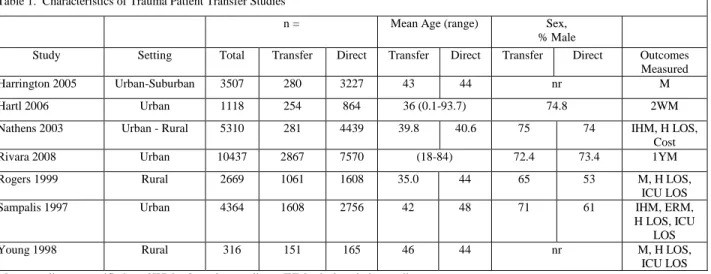
All seven of the studies included were retrospective cohort studies, six of which utilized local Level I center trauma registries as the data source6-11 and one of which included a national multi-center trauma database comprised of only Level I center data.12 The studies were
published from 1997 to 2008 and varied in sample size from 316 11 to 10,437 (although the largest study used weighted patient data).12 The exposure of interest in every study included was inter-hospital transfer from a lower level trauma center to a Level I trauma center. Basic
characteristics about the studies are reported in Table 1, including the setting of the trauma center, the sample size of each cohort, mean age and age range of the patients, sex distribution of
patients, and the primary and secondary outcomes measured by the studies.
Outcome Characteristics
The primary outcome of interest was trauma patient mortality by transfer status, however there was significant heterogeneity in how mortality was measured. Three studies did not
while Rivara et al measured mortality over a significant time (one year) and incorporated patient time into their analysis. In addition to in-hospital mortality, Sampalis et al also measured
emergency department (ED) mortality. The mortality cases were also selected in different manners across the studies. Most studies included all cases of patient death,6, 8-11 while Hartl et al only included non-ED deaths7 and Rivara et al excluded deaths within 30 minutes of arrival.12 Secondary outcomes of ICU LOS and hospital LOS were reported in three studies,9-11 and an additional study reported only hospital LOS.8
Evidence Quality
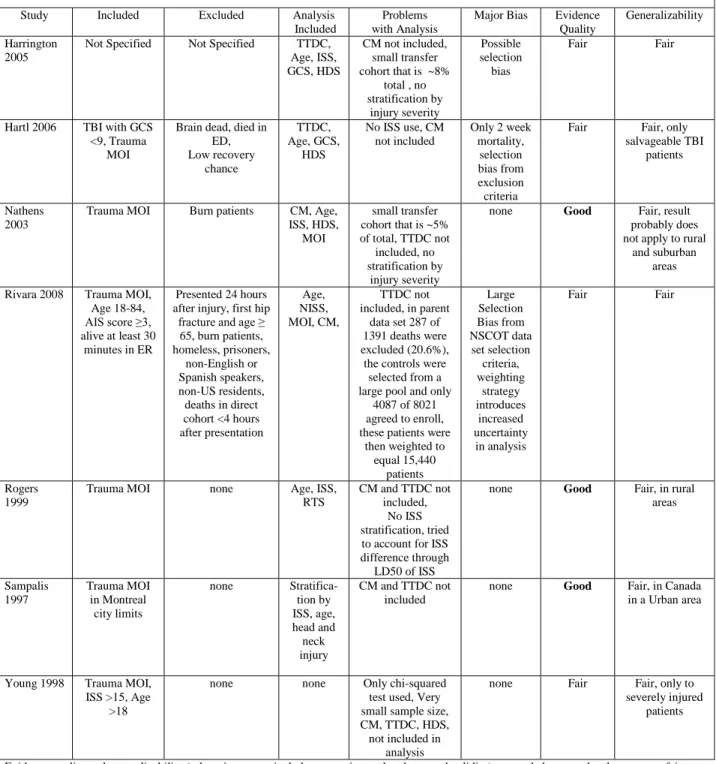
The evidence quality and generalizability of each study, in addition to factors contributing to the quality grade, are reported in Table 2. Factors that contributed to the evidence quality included inclusion and exclusion criteria, analysis strategy, and major biases (selection, measurement, and/or confounding bias). Three studies were judged to be of good level of internal validity and therefore received a good evidence quality rating,8-10 while four studies were judged as fair.6, 7, 11, 12 All the studies received a fair rating for generalizability because no study exhibited a diverse setting (i.e., rural and urban, multi-center).
Harrington et al received a fair evidence rating mainly because they failed to report their inclusion and exclusion criteria and little can be known about potential selection bias.
Hartl et al received a fair rating because of a large measurement bias and additionally because of selection bias in their eligibility criteria. Measurement bias is introduced by using only two week mortality, since a great deal of cases will not be caught after the two week window. It is likely that the more severely injured transfer cohort will have more deaths in the two week window and the direct cohort will have more deaths outside the two week window, thereby making it appear that those in the transfer group are more likely to have higher mortality. Additionally, a large selection bias exists in the exclusion criteria as patients with brain death, those who died in the ED, and those that were deemed unsalvageable by Glasgow Coma Score (GCS) score and pupillary response were excluded. These patients could be more likely to be in the transfer group, and excluding them will eliminate many cases from the transfer cohort group, making it appear that the mortality is lower in the transfer group than it actually is..
Generalizability for this study result is also limited due to only including traumatic brain injury (TBI) patients.
Nathens et al received a good evidence quality rating because of their lower potential for major biases. They only excluded burn patients, which can be justified since burn patients may skew results of studies due to the potential high proportion of them in transfer groups and their high death, ICU stay, and hospital stay rates. Their analysis strategy was sound but did not include TTDC in their statistical model, which can be a serious confounding variable. In
addition the study suffered from the same small transfer cohort problem as Harrington with only ~5% of the sample size in the transfer cohort.
chart review of 18 Level I trauma center and 51 non-trauma hospitals across the US. However the selection process for who was enrolled in the study introduced significant selection bias. All the cases of death were eligible for the study, but 287 of 1391 (20.6%) deaths were excluded from the study. Of those excluded 146 (50.6%) were excluded because of death within 30 minutes of arrival of the ED. Additionally, there were 8021 eligible controls (non-deaths) but only 4087 of these patients agreed to be enrolled in the study. Further uncertainty was
introduced in the study when these control patients were weighted to approximate the entire control population from the beginning. Giving those 4087 individuals and there characteristics the weight of 14,336 patients. Rivara et al then used these weighted numbers to perform their analysis. However, their analysis strategy was unique in that it incorporated patient time using a one year mortality end point. Another strong point of their analysis was their recognition of selection bias in the usual transfer analysis schemas, in that the transfer group lacks the
immediate death cases at the referring hospital that the direct group will always incorporate. To account for this the authors did not count any death cases in the direct group before the mean TTDC in the transfer group. However this strategy did not change the results of the analysis.
moderately to severely injured might very well have a survival benefit from more advanced care. That is why it is important to differentiate the level of ISS and to stratify the analysis by the injury severity score corresponding to ability to modify survival chances. While the authors of this study did not stratify their analysis by ISS they did analyze the mean ISS level at which patients in each cohort died. The study created a dose response curve with ISS as the dose and death as the response. The study then used the 50% death response ISS “dose” as a severity proxy of the cohorts. Using the lethal dose of 50% (LD50ISS) they found that both groups had
identical LD50ISS. While this is not replacement for a stratified analysis on a statistical level, it is
very creative and shows the authors were aware of the difference in severity of the two cohorts and how that could affect the results of their study,
Sampalis et al also received a good evidence quality rating because of the minimal
potential for major biases, as well as the excellent analysis strategy they employed. Although the authors did not include comorbid disease and TTDC in their analysis they did utilize a stratified analysis by both ISS and head and neck injuries. The only drawback to this study is that it was carried out within the city limits of Montreal, Canada and thus it may not be generalizable to the US or to suburban and rural areas.
Young et al received a fair evidence quality rating mostly because of the lack of
Patient Outcomes
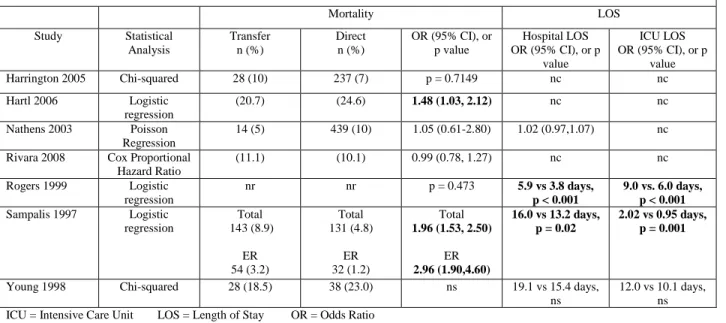
Primary and secondary outcomes of the included studies are reported in Table 3. For the primary outcome measure of mortality five studies found a statistically non-significant difference in mortality by transfer status, while two studies found a statistically significant difference in mortality. Of the studies that found no difference in mortality, three were rated fair and two were rated good in evidence quality. Of the studies that found a difference in mortality, one was rated fair and the other was rated good in evidence quality. In addition to having a good rating and finding a significant difference in in-hospital mortality (OR = 1.96 (1.53, 2.50)), Sampalis et al found an even larger effect measure in ED mortality (OR = 2.96 (1.90,4.60)). In the stratified analysis the same study found that patients in the ISS range of 13-24 had a large significant difference in mortality risk (OR = 3.1 (1.3, 8.63)), which exemplifies the rationale for using ISS stratification in these analyses. The other positive study, by Hartl et al, found a smaller effect measure of mortality difference by transfer status (OR = 1.48 (1.03, 2.12)).
Hospital LOS was found to be statistically significantly different in two studies and non-significantly different in two studies. The two studies that found a difference were rated good in evidence quality, while the two studies that found no difference were rated fair and good. ICU LOS was found to be statistically significantly different in two studies and non-significant in one study. The two studies that found a difference were rated good in evidence quality, while the study that found no difference was rated fair. Of note, Young et al found no statistical difference in ICU and hospital LOS, but their sample size was small and the observed difference in rate of stay is clinical relevant (19.1 vs. 15.4 days in hospital, and 12.0 vs. 10.1 days in ICU).
Sampalis et al results for mortality, ED mortality, ICU LOS, and hospital LOS for a sample population of 1000 patients per cohort. This 50/50 split in cohort sample size does not reflect the actual incidence of inter-hospital transfer or direct transport from the scene, but is being used purely for ease in demonstrating patient outcomes. The cost estimates used in the calculations for a day in the hospital was $1,121.5914 and $3,500.00 for a day in the ICU.15
Discussion
Given the mixed results of the studies it is inconclusive whether or not there is a significant mortality difference by transfer status in trauma patients at Level I centers. The studies that were appraised as having good quality found two null results and one positive result for patient mortality, but these studies were conducted in very different populations and
In contrast to mortality, the results are clearer that transferred trauma patients have longer hospital stays and ICU stays than those directly admitted from the scene of injury. Two of the studies clearly demonstrated statistical significance in hospital LOS, and while Young et al did not, their result of 19 versus ~15 hospital days is clinically significant. Similarly for ICU LOS, two studies found statistical significance and the Young et al study found a clinically relevant difference of 12 versus 10 days. These results show that while mortality may or may not differ by transfer status, the length of stay in the hospital and critical care is longer in the transfer group. This difference is important clinically due to risk of nosocomial infections and medical errors while in the hospital and economically due to the high cost of ICU and hospital care.
The limitations of the individual studies were describbed extensively in Table 2. In general, these retrospective cohort studies are not a good representation of all trauma patients in the trauma system because the data have been collected from the perspective of a Level I trauma center. Patients that are never seen at the Level I center are not counted and their outcomes are not measured. Therefore the Level I center data reflect a highly injured transfer group and a diversely injured direct group. To more adequately study these types of questions on trauma patients in the future, a large national database incorporating patient data from all tier’s of the trauma system needs to be formed. Until then studies will have to use flawed methodology and a skewed patient population to answer questions on trauma patient outcomes.
statistical model. Because mortality has been shown to be drastically different in different ISS strata, analyses should be stratified to see which ISS groups have the most difference in mortality risk. Other variables such as patient age, comorbidity, GCS, and hemodynamic status should be analyzed to determine if they confound the relationship.
Additionally, due to the variety in study settings between urban, suburban, and rural environments it is difficult to generalize the results. It could be that transfer status makes a huge difference in mortality (positively or negatively) in rural and suburban areas where the transport time is very long. But in urban areas where a Level I center is only minutes away from the lower tier hospital, EMS crews will already take the most severe patients to the Level I center.
Databases in urban trauma centers would therefore have the most severe patients directly
admitted while the same patient in a rural and suburban setting would have been transferred from a lower tier hospital. This could be the reason that the transfer cohorts were so small in some of the studies. Because of all the biases present in retrospective designs and the issues of rural versus urban settings, it will be important in the future to perform prospective pilot studies in many different environment settings. These studies will have to be designed to identify severely injured patients by EMS crews, and randomly assign them to HEMS to Level I centers or ground transport to the closest hospital. This will continue to evolve the science of trauma triage and trauma systems in the modern era of HEMS, and will hopefully be able to provide better outcomes to severely injured trauma patients than the current system allows.
Acknowledgements
Funding for this systematic review was provided through a short-term research training (STRT) grant from the National Institute of Diabetes, Digestive and Kidney diseases (NIDDK), number T35-DK007386 from the National Institutes of Health. The funding agency had no role in the study design, study selection, collection, analysis, or interpretation of data, or review report writing process.
References
1. Web-based Injury Statistics Query and Reporting System (WISQARS). Centers for Disease Control and Prevention. http://www.cdc.gov/injury/wisqars/index.html. Accessed March 14, 2010.
2. Corso P, Finkelstein E, Miller T, Fiebelkorn I, Zaloshnja E. Incidence and lifetime costs of injuries in the United States. Inj Prev. Aug 2006;12(4):212-218.
3. MacKenzie EJ, Hoyt DB, Sacra JC, et al. National inventory of hospital trauma centers.
JAMA. Mar 26 2003;289(12):1515-1522.
4. Hoyt DB, Coimbra R. Trauma systems. Surg Clin North Am. Feb 2007;87(1):21-35, v-vi. 5. MacKenzie EJ, Rivara FP, Jurkovich GJ, et al. A national evaluation of the effect of
trauma-center care on mortality. N Engl J Med. Jan 26 2006;354(4):366-378. 6. Harrington DT, Connolly M, Biffl WL, Majercik SD, Cioffi WG. Transfer times to
definitive care facilities are too long: a consequence of an immature trauma system. Ann Surg. Jun 2005;241(6):961-966; discussion 966-968.
7. Hartl R, Gerber LM, Iacono L, Ni Q, Lyons K, Ghajar J. Direct transport within an organized state trauma system reduces mortality in patients with severe traumatic brain injury. J Trauma. Jun 2006;60(6):1250-1256; discussion 1256.
8. Nathens AB, Maier RV, Brundage SI, Jurkovich GJ, Grossman DC. The effect of interfacility transfer on outcome in an urban trauma system. J Trauma. Sep 2003;55(3):444-449.
9. Rogers FB, Osler TM, Shackford SR, Cohen M, Camp L, Lesage M. Study of the outcome of patients transferred to a level I hospital after stabilization at an outlying hospital in a rural setting. J Trauma. Feb 1999;46(2):328-333.
10. Sampalis JS, Denis R, Frechette P, Brown R, Fleiszer D, Mulder D. Direct transport to tertiary trauma centers versus transfer from lower level facilities: impact on mortality and morbidity among patients with major trauma. J Trauma. Aug 1997;43(2):288-295; discussion 295-286.
11. Young JS, Bassam D, Cephas GA, Brady WJ, Butler K, Pomphrey M. Interhospital versus direct scene transfer of major trauma patients in a rural trauma system. Am Surg.
Jan 1998;64(1):88-91; discussion 91-82.
13. Baker S, O'NEILL B, Haddon Jr W, Long W. The injury severity score: a method for describing patients with multiple injuries and evaluating emergency care. The Journal of trauma. 1974;14(3):187.
14. Candrilli S, Mauskopf J. How much does a hospital day cost. 2006. [conference poster] 15. Dasta JF, McLaughlin TP, Mody SH, Piech CT. Daily cost of an intensive care unit day:
Figure 1. Trauma Patient Transfer Studies Systematic Literature Search Results
+ indicates a statistically significant difference in mortality with direct admissions being favored Null indicates a lack of statistical significant difference in mortality
- indicates a statistically significant difference in mortality with transfer admissions being favored
n = 481
Articles identified from database searches
n = 2
Articles identified from searches of articles references
1° Screen, n = 183
Articles identified for consideration after removal of duplicates
2° Screen, n= 28
Articles identified by title screening
Included, n = 15
Articles selected by abstract review
Excluded, n =13
Articles excluded by abstract review screening
Final, n = 7
Articles selected after full text review which included:
- 2 + - 4 Null - 0 -
Excluded, n = 8
Articles excluded after full text review because:
- 4 did not truly address the study question
- 1 Poor quality study
o Null - 3 foreign studies
o 1 +
o 1 Null
Table 1. Characteristics of Trauma Patient Transfer Studies
n = Mean Age (range) Sex, % Male
Study Setting Total Transfer Direct Transfer Direct Transfer Direct Outcomes Measured Harrington 2005 Urban-Suburban 3507 280 3227 43 44 nr M Hartl 2006 Urban 1118 254 864 36 (0.1-93.7) 74.8 2WM Nathens 2003 Urban - Rural 5310 281 4439 39.8 40.6 75 74 IHM, H LOS,
Cost Rivara 2008 Urban 10437 2867 7570 (18-84) 72.4 73.4 1YM Rogers 1999 Rural 2669 1061 1608 35.0 44 65 53 M, H LOS,
ICU LOS Sampalis 1997 Urban 4364 1608 2756 42 48 71 61 IHM, ERM,
H LOS, ICU LOS Young 1998 Rural 316 151 165 46 44 nr M, H LOS,
ICU LOS M = mortality, unspecified 2WM = 2 week mortality IHM = in-hospital mortality
Table 2. Evidence Quality of Trauma Patient Transfer Studies Study Included Excluded Analysis
Included
Problems with Analysis
Major Bias Evidence Quality
Generalizability Harrington
2005
Not Specified Not Specified TTDC, Age, ISS, GCS, HDS
CM not included, small transfer cohort that is ~8%
total , no stratification by
injury severity
Possible selection bias
Fair Fair
Hartl 2006 TBI with GCS <9, Trauma
MOI
Brain dead, died in ED, Low recovery chance TTDC, Age, GCS, HDS
No ISS use, CM not included
Only 2 week mortality,
selection bias from exclusion criteria
Fair Fair, only salvageable TBI
patients
Nathens 2003
Trauma MOI Burn patients CM, Age, ISS, HDS,
MOI
small transfer cohort that is ~5% of total, TTDC not
included, no stratification by
injury severity
none Good Fair, result probably does not apply to rural
and suburban areas Rivara 2008 Trauma MOI,
Age 18-84, AIS score ≥3, alive at least 30 minutes in ER
Presented 24 hours after injury, first hip
fracture and age ≥ 65, burn patients, homeless, prisoners,
non-English or Spanish speakers, non-US residents, deaths in direct cohort <4 hours after presentation
Age, NISS, MOI, CM,
TTDC not included, in parent
data set 287 of 1391 deaths were excluded (20.6%), the controls were
selected from a large pool and only
4087 of 8021 agreed to enroll, these patients were
then weighted to equal 15,440 patients Large Selection Bias from NSCOT data set selection criteria, weighting strategy introduces increased uncertainty in analysis
Fair Fair
Rogers 1999
Trauma MOI none Age, ISS, RTS
CM and TTDC not included,
No ISS stratification, tried to account for ISS difference through
LD50 of ISS
none Good Fair, in rural areas Sampalis 1997 Trauma MOI in Montreal city limits
none Stratifica-tion by ISS, age, head and neck injury
CM and TTDC not included
none Good Fair, in Canada in a Urban area
Young 1998 Trauma MOI, ISS >15, Age
>18
none none Only chi-squared test used, Very small sample size, CM, TTDC, HDS, not included in
analysis
none Fair Fair, only to severely injured
patients
Evidence quality and generalizability (otherwise respectively known as internal and external validity) are graded on a scale where poor < fair < good, poor quality studies were no included in this review
TTDC = time t definitive care ISS = Injury Severity Score GCS = Glasgow Coma Score
Table 3. Primary and Secondary Results of Trauma Patient Transfer Studies
Mortality LOS
Study Statistical Analysis
Transfer n (%)
Direct n (%)
OR (95% CI), or p value
Hospital LOS OR (95% CI), or p
value
ICU LOS OR (95% CI), or p
value Harrington 2005 Chi-squared 28 (10) 237 (7) p = 0.7149 nc nc Hartl 2006 Logistic
regression
(20.7) (24.6) 1.48 (1.03, 2.12) nc nc Nathens 2003 Poisson
Regression
14 (5) 439 (10) 1.05 (0.61-2.80) 1.02 (0.97,1.07) nc Rivara 2008 Cox Proportional
Hazard Ratio
(11.1) (10.1) 0.99 (0.78, 1.27) nc nc Rogers 1999 Logistic
regression
nr nr p = 0.473 5.9 vs 3.8 days, p < 0.001
9.0 vs. 6.0 days, p < 0.001
Sampalis 1997 Logistic regression Total 143 (8.9) ER 54 (3.2) Total 131 (4.8) ER 32 (1.2) Total
1.96 (1.53, 2.50)
ER
2.96 (1.90,4.60)
16.0 vs 13.2 days, p = 0.02
2.02 vs 0.95 days, p = 0.001
Young 1998 Chi-squared 28 (18.5) 38 (23.0) ns 19.1 vs 15.4 days, ns
12.0 vs 10.1 days, ns ICU = Intensive Care Unit LOS = Length of Stay OR = Odds Ratio
Table 4. Patient Outcomes by Transfer Status using Worst Case Scenario, per 1,000 patients a cohort* n = Deaths in
Hospital
ED Deaths Hospital Days Hospital Costs†
ICU Days ICU Costs‡ Transfer 1000 94 36 16,000 $17,945,440 2020 $7,070,000 Direct 1000 48 12 13,200 $14,804,988 950 $3,325,000 *Calculated using Sampalis et al results for in-patient mortality, ED mortality, ICU LOS, and hospital LOS, and an even sample of 1000 patients per cohort (this 50/50 split is not actual incidence rates for transfer but is being used for ease in demonstrating outcomes)
Trauma Patient Mortality at a Level I Trauma Center: Is Inter-hospital Transfer Associated with Adverse Patient Outcomes?
Abstract
Background: The goal of the trauma system is to minimize patient mortality by facilitating rapid
transport, stabilization, and early definitive care through higher level inter-hospital transfer of the severely
injured. However, evidence is currently mixed on whether inter-hospital transfer is associated with worse
patient outcomes. We sought to evaluate whether patients transferred to a Level I trauma center had
worse outcomes compared to patients directly transferred from the scene of injury.
Methods: This was a retrospective cohort study utilizing the University of North Carolina (UNC) Trauma
Registry database. The study period included patients from January 1, 1999 to December 31, 2008
admitted to trauma services at UNC. The primary outcome of interest was in-hospital mortality, with
intensive care unit (ICU) stay and hospital stay as secondary outcomes. Mortality was compared using
logistic regression and lengths of stay were compared using analysis of covariance adjusting for injury
severity, time to care, and other key physiologic indices.
Results: 11,315 patients were included in the analysis and there were 610 deaths. There was no
difference in mortality or ICU stay among the entire sample or within strata. Mean hospital stay was
longer within the lowest injury severity strata for transferred patients (3.38 days vs. 3.95, p <0.001), but
the difference was not clinically relevant.
Conclusion: When adjusting for key patient characteristics, inter-hospital transfer is not associated with
adverse outcomes in trauma patients. Additionally, it may be that EMS personnel are already directly
Trauma Patient Mortality at a Level I Trauma Center: Is Inter-hospital
Transfer Associated with Adverse Patient Outcomes?
Introduction
Trauma is among the top leading causes of death in the United States (US).1 In 2006 it was the fifth leading cause of mortality among all age groups, responsible for 121,599 deaths. Additionally, un-intentional trauma is the leading cause of death in all age groups from age 1 to 44 years. In 2006 unintentional injury was the leading cause of years of potential life lost (YPLL) with nearly 2.4 million years of life lost in that year alone.1 This accounts for over 20% of YPLL per annum in the US. Additionally, out of the approximately 300 million US residents, in 2008 there were 30 million non-fatal injuries.1 Besides the cost of trauma related mortality, the economic cost of trauma morbidity and disability is staggering, totaling $80 billion in medical costs and $326 billion in lost productivity over a lifetime for those injured just in the year 2000.2
to higher level care if needed. This system was initially designed to rapidly transport the injured by ambulance to the nearest hospital, facilitate early hemodynamic stabilization, and avoid long transport times for critically ill patients. However, with recent advances in aeromedical
transportation, the increased utilization of helicopter EMS (HEMS), and better
telecommunication, it is as yet to be determined whether the current trauma transfer system of transporting critically ill patients to the closest hospital instead of Level I centers is the most effective paradigm for optimal care of the critically injured patient.
Over the past 15 years several studies in the US and Canada have been designed to evaluate whether critically injured patients have better survival rates if they are taken directly to a Level I trauma center.6-12 These studies have all been retrospective cohort studies using data collected at Level I trauma centers. Consequently, the patient populations consisted of a large number of directly admitted patients of all injury severities and inter-hospital transfer patients of moderate-critical severity. Hartl et al found that transfer patients were 1.48 (95% CI:1.02, 2.12) times as likely to die as direct patients,7 while Sampalis et al found that transfer patients were 1.96 (95% CI: 1.53, 2.50) times as likely to die as directly transported patients.11 Contrarily, five other retrospective studies have shown no association between inter-hospital transfer and
mortality.6, 8-10, 12 The study populations varied from all trauma patients in the databases,6, 8-11 to only critically injured patients,12 to only patients with traumatic brain injury.7
accurately capturing true injury severity compared to the traditional severity score systems. NISS is unique because it factors in the patient’s most severe injuries regardless of where the injury occurs, in contrast to Injury Severity Score (ISS) which only factors in the most severe injury in each body region. This has been shown to allow better prediction of patient mortality,13 as well as hospital and intensive care unit (ICU) length of stay (LOS).14 Additionally, few studies have attempted to adjust their statistical model by time to definitive care (TTDC), and only two studies 8, 9 have attempted to account for current or past comorbid disease effect on patient outcomes. In conclusion, the current evidence on this issue has yielded conflicting results, because of the large number of confounding elements present in any such analysis.
The goal of this study is to examine the outcome differences in critically ill trauma patients, comparing those transferred to a Level I trauma center from a lower level center and patients brought directly from the scene of injury to a Level I trauma center, while controlling for foreseeable biases and confounding variables.
Methods
Study Design and Data Source:
care, and surgery subspecialty services and enter them into the registry based on their chief complaint and/or mechanism of injury.
Subjects:
The UNC Trauma Registry was queried for all adult patients admitted to UNC for a trauma related chief complaint or mechanism of injury for the last ten years of complete data, from January 1, 1999 to December 31, 2008. All patients were included in this query if they were 18 years or older at the time of injury. Patients with burn mechanisms of injury were excluded from the study, as UNC is home to the Jaycee Burn Center which receives burn patients from across the state. We used the above time frame because in its initial years the registry did not collect all of the data points required for this analysis. The study was submitted and approved by the UNC Biomedical IRB.
Variables:
In-hospital mortality was the primary outcome of interest. ICU LOS and hospital LOS were secondary outcomes of interest. The main exposure variable was transfer status, defined as “direct” if the patient was brought directly from the scene of injury to UNC or “transfer” if brought to UNC from a referring hospital.
defined as transport time to UNC for the direct transport group and transport time to transfer hospital plus inter-hospital transfer time in the transfer group. Unfortunately much of the transport time to transfer hospital data is not recorded, and in an effort to account for this time variable the following strategy was employed. The transport time to UNC and the inter-hospital transfer time data were mostly available, therefore we used the mean transport time to UNC (28.5 minutes) as a surrogate for the transport time in the transfer group. This mean value plus the inter-hospital transfer time of individual patients was used as the time to definitive care in all transfer patients. Comorbidity was accounted for using the Charlson Comorbidity Index16
(CCI) which has been extensively validated in the past for predicting patient in-hospital mortality. The UNC Trauma Registry was queried for the ICD-9 codes of specified diseases using
guidelines set by Sundararajan et al.17 The Charlson Score was then tabulated for each patient and entered into the database.
Data Analysis:
The main outcome of interest was in-hospital mortality, and secondary outcomes of interest were hospital LOS and ICU LOS. The analysis was stratified by NISS and TTDC separately. Strata were chosen after observing trends in death by transfer status. NISS strata corresponded to scores of 1-10, 11-25, and ≥26. TTDC strata corresponded to times of 1-45, 46-90, >91 minutes.
ED Glasgow Coma Score (GCS), Shock Index (SI), TTDC, and CCI. However, TTDC, CCI, and gender were unrelated to mortality using the Wald Test and were dropped from the logistic model. Additionally, TTDC, Shock Index, and gender were unrelated to ICU LOS and hospital LOS using the Partial F-Test and were dropped from the ANCOVA models. Statistical
significance level was defined as a two sided alpha of 0.05. Analysis was carried out using StataIC 11 software.
Results
Characteristics of Study Subjects:
From January 1, 1999 to December 31, 2008 there were 11,321 trauma patients identified by a trauma mechanism of injury that met the inclusion criteria. Of these 11,315 had complete transfer and mortality data and were included in the study. The average age of the population was 46, and was 65.3% male. 6,195 patients were transported from the scene (54.75%), while 5,120 patients were transferred from another hospital (45.25%). Patients were transported by personal vehicle (10%), basic life support (BLS) ambulances (8%), advanced life support
ambulances (54%), and HEMS (28%). The average NISS was 15.6, and the mean TTDC was 67 minutes.
depressed levels of consciousness (GCS), more hemodynamically instability (SI), more severely injured (NISS), and tranport by HEMS.
Age, TTDC, CCI, ED GCS, NISS, ICU LOS, and hospital LOS were statistically
significantly different by transfer status using the student’s t-test (Table 2). Gender, mechanism of injury, transport mode, and transfer status were statistically significantly different by mortality outcome using Pearson’s chi-squared test. Only SI was not significantly different by transfer status. Important clinically significant differences in those patients that were transferred include being younger, more likely to be male, having longer TTDC, lower level of consciousness (GCS), more severe injuries (NISS), and are more likely to arrive by HEMS and less likely to arrive by private vehicle.
Adjusted Analysis:
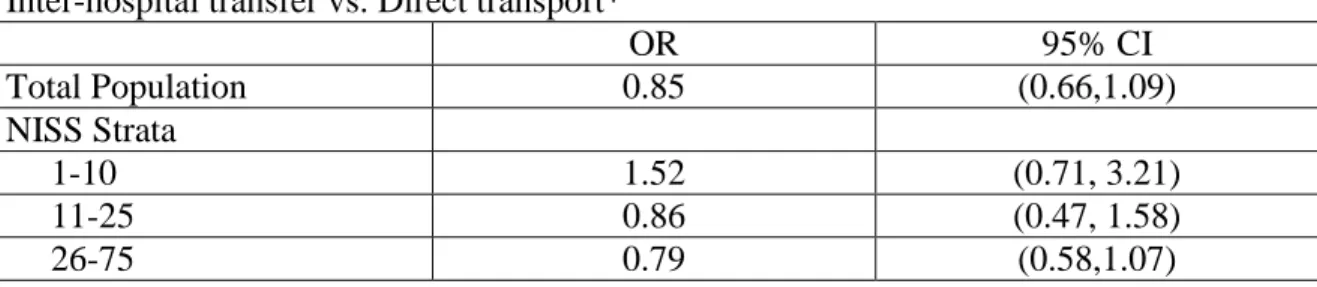
For the whole study population, patients that are transferred from lower tier trauma centers were not more likely to die than those that were brought directly from the scene of injury, OR=0.85 (95% CI: 0.66,1.09) (Table 3). Additionally, transfer patients in all NISS strata were not more likely to die than direct patients. The NISS strata with the most association, but did not reach statistical significance, were the lowest severity patients of NISS=1-10, OR=1.52 (95% CI: 0.71, 3.21). The effect of TTDC strata on the analysis was unable to be determined because the logistic model for mortality failed for any TTDC strata.
significance in the lowest NISS strata, 1-10 (Adjusted Means: Direct=0.28 days, Transfer=0.43 , p <0.051).
On the study population level, when adjusted for potential confounders, transfer status was not statistically significantly associated with longer hospital LOS. However, in the lowest NISS severity strata, 1-10, transfer status was statistically significantly associated with longer hospital LOS (Adjusted Means: Direct=3.38 days, Transfer=3.95 , p <0.001). In the other NISS and TTDC strata transfer patients were not more likely to have longer hospital LOS than direct patients.
Discussion
The goal of our study was to evaluate the potential differences in trauma patient
outcomes by their inter-hospital transfer status. However, we found no significant differences in trauma patient mortality and only a small significant difference in hospital LOS in one NISS subgroup. While transfer patients obviously had proportionally more deaths than direct patients, they also had more severe injuries to account for the higher rate of death. Transfer patients also had a much higher TTDC, but we found that this was unrelated to death when adjusted for NISS, GCS, SI, and age. This finding suggests that for severely injured patients an extended TTDC in pursuit of stabilization at lower tier traumas center does not adversely affect patient mortality. Similarly, ICU and hospital LOS are not related to TTDC but to the physiologic extremis (GCS, SI, NISS) of the patient.
care level. However, we consistently found that there was the most difference in patient
outcomes in the lowest NISS strata. Our only statistically significant result of hospital LOS was in the first NISS strata (Adjusted Means: Direct=3.38 days, Transfer=3.95 , p <0.001), but ICU LOS approached statistical significance in this strata as well (Adjusted Means: Direct=0.28 days, Transfer=0.43 , p <0.051). However, while a third of day difference in hospital LOS and a fifth of day difference in ICU LOS are not clinically significant, the mortality OR in the first NISS was more clinically relevant. With an OR of 1.52 (0.71, 3.21) the first NISS strata had the most difference in mortality by transfer status. These results all suggest that mildly injured patients may do worse if they are transferred to a Level I trauma center. Several possible factors could explain this: a lack of early stabilization before transfer, incorrect triage, delayed TTDC and/or cryptic disease or injury not captured by the NISS. It is possible that many of these patients had potentially fatal injuries like pulmonary contusions or blunt aortic trauma that were not
recognized initially and factored into their NISS. Additionally they could have suffered from fatal non-injury causes such as arrhythmia. However, it is also possible that these patients were over-triaged and inappropriately transferred, leading to delayed TTDC and worse outcomes.
“should severely injured patients be transported directly to Level I trauma centers?” is already being decided by EMS personnel at the scene of injury.
The flexibility of these “on the ground” decisions is beneficial to the patient’s ultimate outcome, but it does present a problem with our analysis. This is because many patients, who in decades past would have been brought to a lower tier hospital and then transferred by ambulance to UNC, are being directly transported to UNC by helicopter. Our analysis has several other additional limitations to its interpretation. While our study population is very large compared to other similar studies, our power to detect a significant difference is impaired by low mortality. With only 610 deaths (5.4%) the power to detect a difference in outcomes is limited especially when it is further reduced in the stratified analyses. Additionally, there is a selection bias present in the transfer group as any deaths that occur at lower level centers are not available to the UNC Trauma registry while every death is counted in the direct group. This could substantially reduce the number of cases of death in the transfer group and underestimate the mortality OR. In
addition, while we attempted to account for the lack of TTDC data in the transfer group, we realize that this is only a surrogate for the true data and may not be an accurate representation.
answer this question. Ethical misgivings for such a study could be alleviated by giving EMS the capability to override the randomization assignment if needed based on individual patient characteristics. This would increase cross-over of sample populations and therefore reduce the power to detect a difference, but keep the flexibility needed for on the ground decisions. For now, however, in regions with robust trauma systems such as ours, transfer patients have comparable outcomes as directly admitted patients of the same injury severity level.
Acknowledgements
Funding for this study was provided through a short-term research training (STRT) grant from the National Institute of Diabetes, Digestive and Kidney diseases (NIDDK), number T35-DK007386 from the National Institutes of Health. The funding agency had no role in the study design, study selection, collection, analysis, or interpretation of data, or review report writing process.
References
1. Web-based Injury Statistics Query and Reporting System (WISQARS). Centers for Disease Control and Prevention. http://www.cdc.gov/injury/wisqars/index.html. Accessed March 14, 2010.
2. Corso P, Finkelstein E, Miller T, Fiebelkorn I, Zaloshnja E. Incidence and lifetime costs of injuries in the United States. Inj Prev. Aug 2006;12(4):212-218.
3. Hoyt DB, Coimbra R. Trauma systems. Surg Clin North Am. Feb 2007;87(1):21-35, v-vi. 4. MacKenzie EJ, Hoyt DB, Sacra JC, et al. National inventory of hospital trauma centers.
JAMA. Mar 26 2003;289(12):1515-1522.
5. MacKenzie EJ, Rivara FP, Jurkovich GJ, et al. A national evaluation of the effect of trauma-center care on mortality. N Engl J Med. Jan 26 2006;354(4):366-378.
7. Hartl R, Gerber LM, Iacono L, Ni Q, Lyons K, Ghajar J. Direct transport within an organized state trauma system reduces mortality in patients with severe traumatic brain injury. J Trauma. Jun 2006;60(6):1250-1256; discussion 1256.
8. Nathens AB, Maier RV, Brundage SI, Jurkovich GJ, Grossman DC. The effect of interfacility transfer on outcome in an urban trauma system. J Trauma. Sep 2003;55(3):444-449.
9. Rivara FP, Koepsell TD, Wang J, Nathens A, Jurkovich GA, Mackenzie EJ. Outcomes of trauma patients after transfer to a level I trauma center. J Trauma. Jun 2008;64(6):1594-1599.
10. Rogers FB, Osler TM, Shackford SR, Cohen M, Camp L, Lesage M. Study of the outcome of patients transferred to a level I hospital after stabilization at an outlying hospital in a rural setting. J Trauma. Feb 1999;46(2):328-333.
11. Sampalis JS, Denis R, Frechette P, Brown R, Fleiszer D, Mulder D. Direct transport to tertiary trauma centers versus transfer from lower level facilities: impact on mortality and morbidity among patients with major trauma. J Trauma. Aug 1997;43(2):288-295; discussion 295-286.
12. Young JS, Bassam D, Cephas GA, Brady WJ, Butler K, Pomphrey M. Interhospital versus direct scene transfer of major trauma patients in a rural trauma system. Am Surg.
Jan 1998;64(1):88-91; discussion 91-82.
13. Lavoie A, Moore L, LeSage N, Liberman M, Sampalis JS. The New Injury Severity Score: a more accurate predictor of in-hospital mortality than the Injury Severity Score. J Trauma. Jun 2004;56(6):1312-1320.
14. Lavoie A, Moore L, LeSage N, Liberman M, Sampalis JS. The Injury Severity Score or the New Injury Severity Score for predicting intensive care unit admission and hospital length of stay? Injury. Apr 2005;36(4):477-483.
15. Cannon CM, Braxton CC, Kling-Smith M, Mahnken JD, Carlton E, Moncure M. Utility of the shock index in predicting mortality in traumatically injured patients. J Trauma.
Dec 2009;67(6):1426-1430.
16. Charlson M, Szatrowski T, Peterson J, Gold J. Validation of a combined comorbidity index. Journal of Clinical Epidemiology. 1994;47(11):1245-1251.
Table 1. Characteristics of Level I Trauma Center Patients by Death Status Lived
Mean (%) n = 10705
Died Mean (%)
n = 610
Age† 45.4 53.6
Gender
Male 6985 (65.21) 409 (67.05)
Female 3726 (34.79) 201 (32.95)
Mechanism of Injury‡
MVC* 4859 (45.39) 308 (50.49)
Pedestrian vs Auto 495 (4.62) 48 (7.87)
Fall 2887 (26.97) 149 (24.43)
Machine/Accident 647 (6.05) 11 (1.80)
Assault 782 (7.30) 21 (3.44)
GSW 540 (5.04) 62 (10.16)
Stabbing 275 (2.57) 6 (0.98)
Other** 220 (2.06) 5 (0.82)
Transfer Status‡
Direct 5923 (55.33) 272 (44.59)
Transfer 4782 (44.67) 338 (55.41)
Transport Mode‡
Private/Police/Other 1111 (10.44) 8 (1.32)
Ambulance/BLS 897 (8.43) 27 (4.44)
ALS 5843 (54.88) 205 (33.72)
Helicopter 2795 (26.25) 368 (60.53)
Time to Definitive Care† 68.0 min 59.5 min
Charlson Score † 0.34 0.56
Physiologic Profile
Shock Index† 0.67 1.14
ED GCS† 13.3 5.8
NISS† 14.4 38.5
Patient Outcomes
ICU Days† 2.0 4.8
Hospital Days† 7.6 6.3
* Includes passenger automobiles, trucks, bicycles, motorcycles, off-road bikes and ATVs, golf carts, and aircraft **Includes animal attack, electrocution, sports injuries, and attempted suicides
† Characteristic is statistically significantly different (p<0.05) using the student’s t-test ‡ Characteristic is statistically significantly different (p<0.05) using Pearson’s chi-squared test MVC = motor vehicle collision GSW= gunshot wound BLS= basic life support
Table 2. Characteristics of Level I Trauma Center Patients by Transfer Status Direct
Mean (%) n = 6195
Transfer Mean (%)
n = 5120
Age† 48.4 42.8
Gender‡
Male 3732 (60.24) 3660 (71.48)
Female 2463 (39.76) 1460 (28.52)
Mechanism of Injury‡
MVC* 2719 (43.89) 2448 (47.81)
Pedestrian vs Auto 271 (4.37) 272 (5.31)
Fall 2132 (34.41) 901 (17.60)
Machine/Accident 336 (5.42) 320 (6.25)
Assault 305 (4.92) 498 (9.73)
GSW 178 (2.87) 424 (8.28)
Stabbing 133 (2.15) 148 (2.89)
Other** 121 (1.95) 109 (2.13)
Transport Mode‡
Private/Police/Other 1030 (16.75) 88 (1.72)
Ambulance/BLS 519 (8.44) 405 (7.93)
ALS 3151 (51.25) 2896 (56.74)
Helicopter 1448 (23.55) 1715 (33.60)
Time to Definitive Care† 21 min 101 min
Charlson Score† 0.38 0.32
Physiologic Profile
Shock Index 0.69 0.70
ED GCS† 13.6 12.0
NISS† 13.2 18.4
Patient Outcomes
Death‡ 272 (4.39) 338 (6.60)
ICU Days† 1.5 2.9
Hospital Days† 6.4 9.0
* Includes passenger automobiles, trucks, bicycles, motorcycles, off-road bikes and ATVs, golf carts, and aircraft **Includes animal attack, electrocution, sports injuries, and attempted suicides
Table 3. Association of Transfer Status with Trauma Patient Mortality: Inter-hospital transfer vs. Direct transport*
OR 95% CI
Total Population 0.85 (0.66,1.09)
NISS Strata
1-10 1.52 (0.71, 3.21)
11-25 0.86 (0.47, 1.58)
26-75 0.79 (0.58,1.07)
Table 4. Association of Transfer Status with Trauma Patient Length of Stay (LOS)* Unadjusted Means
(days)
p Adjusted Means** (days)
p ICU LOS
Direct 1.54 <0.001 2.41 0.842
Transfer 2.85 2.38
Hospital LOS
Direct 6.35 <0.001 7.84 0.531
Transfer 9.02 8.02
* ICU and Hospital LOS by Transfer status ANCOVA models were also calculated using NISS strata of
1-10, 11-25, >26, however all of the adjusted models within the strata returned statistically non-significant except NISS 1-10 strata for hospital LOS which was; Adjusted Direct Mean: 3.34 days, Adjusted Transfer Mean 3.95 days (p <0.001).
** ANCOVA models were adjusted for age, Charlson Comorbidity Score, new injury severity score (NISS), Glasgow Coma Scale (GCS), and transport mode