Shannon L Harris. Minority Language Learners: A look at culturally relevant resources available at elementary schools in North Carolina.A Master’s Paper for the M.S. in L.S. degree. April, 2012. 51 pages. Advisor: Sandra Hughes-Hassell
English language learners represent a growing population that requires educators to take a serious look at instructional programs to support these students’ learning. The issue of educating these students has received increased emphasis due to the requirements of the No Child Left Behind Act and schools’ accountability for achievement of various student populations. English language learner students are at an obvious academic disadvantage since content area curriculum is typically taught in English. This study will focus on theories of language acquisition, strategies to support the needs of English language learner teachers and learners, and specifically look at the library’s role in providing resources.
Headings:
Collection Development (Libraries)
English Language Learner
Libraries & Immigrants
Minority Language Learners
Multicultural Literature
by
Shannon L Harris
A Master’s paper submitted to the faculty of the School of Information and Library Science of the University of North Carolina at Chapel Hill
in partial fulfillment of the requirements for the degree of Master of Science in
Library Science.
Chapel Hill, North Carolina
April 2012
Approved by
_______________________________________
Table of Contents
Introduction ... 2
Literature Review... 4
Methodology ... 12
Results ... 15
Summary and Conclusions ... 32
Implications for Further Research ... 37
Appendix A ... 39
Appendix B ... 43
Appendix C ... 44
Appendix D ... 45
Introduction
Changing immigration patterns over recent years have created increasingly rich
linguistic diversity in our classrooms. This has resulted in a tremendous rise in English
Language Learners (ELL) and new challenges associated with teaching literacy to ELLs.
Until the 1950’s the majority of immigrants in the United States originated from Europe.
By 1980, however, many immigrants arrived from developing countries representing a
number of languages (Hadaway, Vardell & Young, 2002).
North Carolina became home to 2,128 immigrants in 2011, representing an 88%
increase from 2004 (USDHHS, 2012). According to United States Census Bureau data
(2012), 10.4% of the population of North Carolina speaks a language other than English
and 7.4% are foreign born. These numbers are even greater when narrowed to the two
cities examined for this study. In City A, 17.4% of the population speaks a language other
than English at home and 16.2% are foreign born. In the City B, 27% of the population
speaks a language other than English and 24.4% are foreign born. These numbers are
paralleled in the population of students in the cities’ school district system (District A).
There are 897 students receiving ELL services in District A elementary schools
outside of the traditional grade level classrooms. This number does not account for
students that speak a minority language but are no longer in the Limited English
Proficient (LEP) database, or for students in Dual-Language classrooms (J. Nambo,
ELLs represent a growing population that requires educators to take a serious look
at instructional programs to support these students’ learning. The issue of educating
these students has received increased emphasis due to the requirements of the No Child
Left Behind Act (NCLB) and schools’ accountability for achievement of various student
populations. ELL students are at an obvious academic disadvantage since content area
curriculum is typically taught in English. Throughout the year, a student may be
expected to learn irregular spelling patterns, diphthongs, syllabication rules, regular and irregular plurals, common prefixes and suffixes, antonyms and synonyms; how to follow written instructions, interpret words with multiple meanings, locate information in expository texts, use comprehension strategies and background knowledge to understand what you read, understand cause and effect, identify alliteration and rhyme, understand structural features of texts such as theme, plot, and setting; read fluently and correctly at least 80 words per minute, add approximately 3,000 words to your vocabulary, read tens if not hundreds of thousands of words from different types of texts; and write narratives and friendly letters using appropriate forms, organization, critical elements, capitalization, and punctuation, revising as needed (Goldenberg, 2008, p. 8).
Students have a similar list of standards for math, science, and social studies. The
expectations created by national, state and district standards are often
overwhelming for both students and teachers, particularly for minority language
learners. ELL students are expected to master content areas as well as the English
language.
In order to help improve English literacy, and ultimately the achievement,
of minority language learners, it is important to understand how ELLs acquire a
second language and how to support learning. This study will focus on theories of
and specifically look at the library’s role in providing resources. Based on
findings from the research, an analysis of library content in District A elementary
schools will attempt to answer the following research question:
1. Are culturally relevant resources that have been proven effective with
ELLs available to representative minority language populations within
each elementary school?
a. Picture books
b. Folklore
c. Poetry
d. Home language resources
e. Non-fiction literature
Literature Review
Second Language Acquisition
In order to improve English literacy of ELL students, it is important to understand
how language is acquired.
First language develops without formal instruction by children being constantly exposed to language rich environments over the course of many years…. In contrast, learning a second language usually depends heavily on learning experiences in more constricted environments associated with the classroom or some other formal setting. In these settings, a major goal frequently is to formally teach children the elements of language that are learned much more informally in their native language (Baker & Baker, 2012).
There are many models that describe the process of Second Language Acquisition
has been influential in school settings for teaching a second language. This
approach employs relaxed, acquisition like situations with rich, understandable
input (Hadaway et al., 2002; Baker & Baker, 2012; Freeman & Freeman, 2000;
Krashen 2009).
The Natural Approach is based on Krashen’s five hypotheses of SLA:
1. The Acquisition versus Learning Hypothesis (acquisition is an unconscious
process, learning is conscious);
2. The Natural Order Hypothesis (grammatical structures and language rules
occur in a fairly predictable order);
3. The Monitor Hypothesis (the learned system acts as an internal editor of the
acquired system);
4. The Input Hypothesis (comprehensible input suitable to a learner’s
proficiency level improves acquisition); and
5. The Affective Filter Hypothesis (greater acquisition occurs with relaxed
learners more receptive to input) (Hadaway et al., 2002; Baker & Baker, 2012;
Freeman & Freeman, 2000).
Krashen’s Input Hypothesis is central to his theory of second SLA. According to
Krashen adequate input must be fine-tuned to a learner’s proficiency level. He asserts
that students understand more in a second language than they can produce, so it is
important to provide abundant comprehensible input via meaningful activities. For
example, teachers may provide relevant content and background knowledge prior to
introducing a new topic, or provide instruction that draws on students’ experiences. Other
input is comprehensible, students understand most aspects of what is required for
learning, and the learning experience pushes them to greater understanding” (Teacher
Vision, para.2).
In addition to relying on comprehensible input for SLA, Cloud and her colleagues
argue that ELL students employ a strategy known as “bootstrapping” (Cloud, Genesee &
Hamayan, 2009). That is, students use what they know about their home language when
learning to read and write in English. They draw on personal experiences to interpret and
make sense of happenings in school and their surroundings. ELLs bring background
knowledge and experiences to the text such as values and cultures in an attempt to make
connections between their home language and English (Freeman & Freeman, 2000).
Impact of Literacy in the Primary Language on Second Language Acquisition
Considerable research has shown that literacy in a first language transfers to
reading and literacy in a second language (Cloud et al., 2009; Hadaway et al., 2002;
Hamayan & Freeman, 2006; August & Shanahan, 2006; Krashen, 2009). ELLs who can
already read and write in their native language acquire literacy skills in English relatively
quickly when compared to ELLs with no reading or writing skills in their home language.
Goldenberg (2008) states, “…if you learn something in one language—such as decoding,
comprehension strategies, or a concept such as democracy— you either already know it
in (i.e., transfer it to) another language or can more easily learn it in another language” (p.
15). Krashen (1997) agrees that “…developing literacy in the primary language is an
extremely efficient means of developing literacy in the second language. To become
language” (para. 23). This implies the need for students to have access to resources in
their home language in classrooms and libraries.
According to Cloud and her colleagues, “When students are introduced to reading
through the use of highly predictable texts in their home language, they can master the
initial steps of literacy more easily and begin to feel comfortable with the written
language” (2009, p. 36). Access to text in a student’s first language leads to increased
vocabulary acquisition, positive attitudes toward reading, and long-term reading habits
(McQuillan & Rodrigo, 1998). Students with limited proficiency in their native language
benefit from culturally relevant texts and resources in their home language as well. These
provide familiarity for ease of comprehension and identifying with story characters.
Strategies for Improving English Literacy of ELL Students
Based on research that supports promoting literacy in a student’s native language,
access to resources that bring familiarity and experiences in the home language is a
necessity. In addition, in order to provide sufficient comprehensible input and promote
inclusion, ELLs also need culturally relevant texts. Helping students learn English
through culturally relevant texts enables ELLs to focus on learning English as opposed to
trying to interpret unfamiliar English words and comprehend unfamiliar cultural elements
(Agosto, 2007). To feel a valued part of school culture, ELL students should see people
and characters similar to themselves in the school library; settings and aspects of cultural
backgrounds should be reflected in materials (Agosto, 2007). Familiar concepts build
openness to learning, greater engagement and increased student learning, supporting
Krashen’s Affective Filter Hypothesis.
Free Voluntary Reading (FVR) has also been shown to improve language literacy
development among students. “Research shows that more free voluntary reading
consistently means more literacy development, that children read more when they have
more access to books….” (Constantino, 1998, p. 1). Krashen (2004) argues that when
controlling for formal instruction, studies consistently report a positive correlation
between the amount of free reading done and various aspects of SLA. He states “In the
last few decades, evidence from several areas continues to show that those who do more
recreational reading show better development in reading, writing, grammar and
vocabulary, [sic] These results hold for first and second language acquisition, and for
children and adults” (para. 1). FVR is a powerful form of learning, which can effectively
help accelerate SLA. FVR is self-selected, meets the criteria for comprehensible input, is
done for enjoyment, and has no “accountability,” tests, or reports. Students have the
freedom to choose what interests them in a low anxiety environment, promoting pleasure
reading and encouraging students to be autonomous language learners (Jakarta Post,
2009).
School Library’s Role in Supporting ELL Learners
According to Constantino (1998), “There is a powerful circumstantial case for the
role of the library in helping children develop literacy. Research shows … that children
read more when they have more access to books, and that children get a significant
students that engage in a great deal of comprehensible, interesting reading read better,
write better, have better vocabularies, spell better and have better grammar construction.
This is true for both first and second language learners (Krashen, 2009).
To support reading in primary languages, library collections should reflect
perspectives from range of cultures and provide native language texts. Research supports
providing culturally relevant resources for language minority students in a several
specific categories.
Picture Books
Picture books are not just for young learners. There are a growing number of
picture books suited to older children’s interest and developmental needs. Picture books
are highly visual with clear images, and language used in these books is often
straightforward. Students may rely on visual and textual cues for gaining meaning
(Hadaway et al., 2002; Agosto, 2007). Visual clues help learners decipher unfamiliar
concepts, words or phrases. Wordless picture books can be used to support oral language
development (Cloud et al., 2009). Words and vocabulary can be introduced orally to
students while reading aloud. Wordless books are not language specific and many contain
universal or self-contained topics. Alphabet and counting books are also benefit ELLs
due to their built in structure and predictability. Predictable books with repetitive text
structure are important for building language and allow ELLs to quickly function as
readers of English text (Hadaway et al., 2002; Cloud et al., 2009). “Books with repetitive
sentence patterns or phrases help ELLs learn grammatical patterns in English, which
Folklore and Fables
All cultures participate in oral storytelling, so all students bring a wealth of
background knowledge to this type of reading regardless of literacy level. Folklore
encompasses traditional stories, customs, beliefs, and sayings preserved orally among a
group or culture. This genre is generally short and published in picture book format with
rich illustrations to help cue the reader. Folktales and fables, particularly if from a
student’s own culture, present personally relevant stories and familiar language and
activities. Students are more apt to be engaged and participate more freely if they are
comfortable, have sense of belonging and are open to input (Hadaway et al., 2002; Cloud
et al., 2009).
Poetry
Poetry is especially effective with minority language students because it is
predictable, recursive, and rhythmic (Cloud et al., 2009). Poetry has a strong oral quality
and is meant to be read aloud. Oral reading helps ELLs acquire correct word
pronunciation and incorporates listening vocabulary. Second language learners begin to
get a sense of sound of English words through rhythm and rhyme. Brevity is also a
benefit of poetry. Poems can be read and reread quickly, promoting fluency. Short lines
and brief passages appear manageable and less intimidating to beginning readers. Poetry
also tends to be about one topic. The focus of the poem helps provide clarification and
Home Language Resources
“It is much easier to learn to read in a language you already know, and once you
can read, you can read. The ability to read transfers rapidly across languages, even when
the writing systems are different” (Krashen, 2006, para. 3). Access to texts in a student’s
native language promotes a sense of belonging to the school, increasing engagement and
comfort. The library values that learner’s home language, regardless if child can read or
not, and promotes feelings of inclusion among minority and immigrant students. Students
recognize familiar characters and text, and for many these resources may dispel the belief
held by some ELL children that all books for and about children are in English (Klein,
1985). Home language resources bring relevance and personal meaning to the school
library and learning. These resources may include multilingual books, world news, word
banks, online resources and academic content in a student’s native language.
Non-fiction Literature
Non-fiction literature supports contextualized language that is more meaningful
than skill oriented materials. Information is found in natural and meaningful language at a
variety of levels which supports multiple literacy development components such as
vocabulary development, fluency and independent reading. Non-fiction is typically more
current, relevant and interesting than content area textbook, and appeal through highly
visual designs. The variety of non-fiction published today provides models for various
writing styles and includes formats such as picture books, concept books and chapter
books. Unlike comprehensive textbooks specific to grade levels that may overwhelm
the scope of information and suited to share across ages and grade levels. Concept books,
in particular, are designed to teach and present information on challenging concepts yet
are very simple and highly visual (Hadaway et al., 2002).
Multicultural Literature
As Bishop (1997) notes, “multicultural literature can have a beneficial effect on
the school achievement of children who have historically been denied realistic images of
themselves and their families, communities, and culture” (p. 4). High quality
multicultural literature presents stories that all students can relate to, yet accurately
reflects a particular culture. Culturally relevant texts reflect the experiences, values and
beliefs of a particular culture and bring a sense of familiarity and belonging to ELL
students. Relevance in resources increased engagement and interest. Cloud et al. (2009)
agree that meaning and interest are important components of literacy development. So
much so “that they are crucial at all stages of learning to read and write. For reading and
writing to be meaningful and interesting, ELLs must be able to relate what they are
reading and writing about to their lives and to things in the world around them” (p. 16).
Methodology
Descriptive research was used to determine the number of culturally relevant
library resources available in ten elementary schools within District A. In the context of
this study, elementary school libraries are a part of a large school district in North
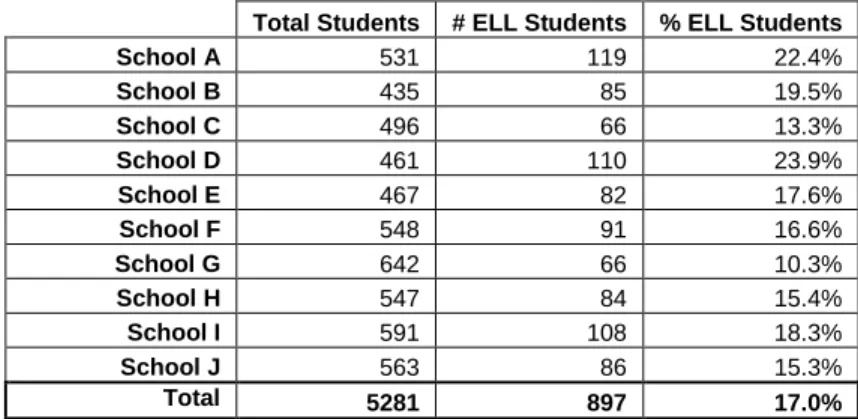
As a whole, the district has an elementary population that includes 897 (17%)
minority language learners receiving English language services. As Table 1 shows, half
of the ELL students speak Spanish (49%), with the next largest language group being
Korean (16%). Other languages representing at least 5% of the ELLs include Karen (9%),
Chinese (8%), and Burmese (6%). Language statistics for individual schools are listed in
Appendix A.
Total Students # ELL Students % ELL Students
School A 531 119 22.4%
School B 435 85 19.5%
School C 496 66 13.3%
School D 461 110 23.9%
School E 467 82 17.6%
School F 548 91 16.6%
School G 642 66 10.3%
School H 547 84 15.4%
School I 591 108 18.3%
School J 563 86 15.3%
Total 5281 897 17.0%
For the purposes of this paper, culturally relevant denotes materials in the home
language, or multicultural resources in English catalogued under selected Sears Subject
Headings (Appendix B). Sears Subject Headings included topics that represented
culturally relevant materials for the minority language groups. These included countries
of origin, home language materials, immigrant and refugee resources, and religious
holiday titles. Once categorized by subject headings, duplicate data were removed and all
resources within a school library were combined and organized by call number. Using
call numbers allowed for categorization of resources into genres of literature, as well as
non-fiction content areas. English language materials were further analyzed to determine
whether identified ELL cultures were represented based on subject headings in library
catalogs, or if the multicultural resources were generic to all cultures.
Each of the ten school’s library catalogs was analyzed for holdings specific to that
school’s ELL population. ELL populations for each school were identified based on their
inclusion in the district LEP database. Language groups representing at least 10% of the
total ELL population of individual schools were included in the study.
Validity and Reliability
Validity and reliability of the results depend upon consistent and accurate
cataloging of resources across all elementary schools within the district. Due to
non-standard cataloging techniques employed across the district, the results are prone to
inaccuracies. Subject headings, in some cases, are manually added or input into the
library catalog resulting in inaccuracies and inconsistency. In other instances, subject
headings are uploaded with cataloging software. The reliance on subject headings in
order to find available resources, in lieu of physically examining each library, was the
most reliable and efficient form of data collection. To account for inconsistencies,
broader Sears Subject Headings were utilized to capture the largest range of results (i.e.
Refugees versus Burmese Refugees). Additionally, school libraries are dynamic.
Although available data represents what was available at the time of this paper, materials
and resources are in flux.
Weaknesses
While library catalogs were analyzed for quantity, the resources found were not
analyzed for quality. Culturally relevant texts should be free of bias, stereotypes, and be
culturally accurate both textually and visually. In general, books should be well written
the numbers may be overstated in terms of quality materials. Materials identified as
culturally relevant to specific ELL groups in English may also be overstated. Subject
headings such as Burma give an indication that the material is relevant to Burmese ELLs.
Unfortunately, the quality of information or whether information is substantial in a
particular resource cannot be determined. In addition, the results do not include additional
resources that: may exist in classrooms independent of library materials; book room sets
of books not catalogued with library materials or accessible through the library catalog;
or resources incorrectly catalogued.
Results
Each school had a variety of resources available in varying numbers, yet
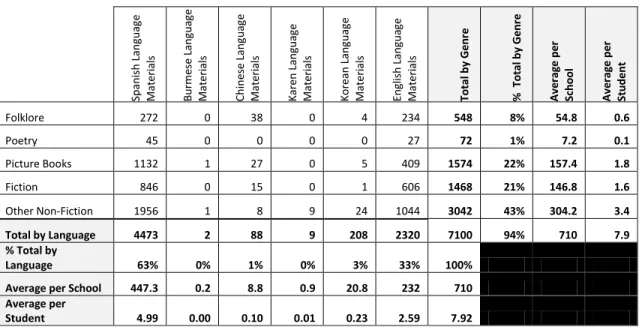
non-Spanish minority language materials and poetry resources were consistently lacking.
Table 2, below, summarizes findings across all 10 elementary schools in District A. As
the table shows, culturally relevant folklore and poetry resources are underrepresented,
having less than one resource per student across the district. Additionally, language
materials in Burmese, Chinese and Karen are scarce. While students speaking those
languages represent 23% of the district ELL population, home language resources
represent <1% of district resources. Spanish resources are largest in number (64%) and
Korean language materials comprise 3% of the total.
Culturally relevant resources in English totaled 33% of district’s resources for
ELLs. These materials include non-fiction, fiction, picture books, poetry and folklore that
were identified under the Sears Subject Headings for minority language learners
resources for indentified ELLs in each school (Appendix C). Results across the district
demonstrated a gap in culturally relevant English resources for Karen (<1%), Burmese
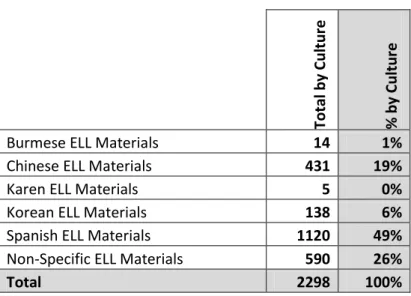
(1%) and Korean (6%) ELL students. Non-specific multicultural materials totaled 26% of
English language resources and materials relevant to Spanish ELLs comprised nearly half
(49%) of all English language materials. Table 2 below summarizes findings for English
language resources in District A.
To
ta
l by
C
u
ltu
re
% by
C
u
ltu
re
Burmese ELL Materials 14 1%
Chinese ELL Materials 431 19%
Karen ELL Materials 5 0%
Korean ELL Materials 138 6%
Spanish ELL Materials 1120 49%
Non-Specific ELL Materials 590 26%
Total 2298 100%
When comparing availability of various genres, non-fiction and fiction resources
each account for 43% of district resources for ELLs. Within fiction, picture books
represent 22% and other fictional books 21%. The discrepancy in genre totals (94%
versus 100%) is due to cataloging ambiguities. In some cases (6%), it was not clear what
genre a resource belonged to based on catalog resource lists and call numbers. The total
number of materials for ELLS in individual schools ranges from under 200 to over 2000.
Table 3 below summarizes findings for the number of culturally relevant resources in
District A .
Table 2: Summary of English language resources in District A.
Spa ni sh L an gua ge M at er ial s B ur m ese L an gua ge M at er ial s C hi ne se L an gua ge M at er ial s Kar en La ng ua ge M at er ial s Kor ean L an gua ge M at er ial s Eng lish L an gua ge M at er ial s To tal by G e n re % To tal by Ge nr e A ve rag e pe r
School Ave
rag e pe r St ud e nt
Folklore 272 0 38 0 4 234 548 8% 54.8 0.6
Poetry 45 0 0 0 0 27 72 1% 7.2 0.1
Picture Books 1132 1 27 0 5 409 1574 22% 157.4 1.8
Fiction 846 0 15 0 1 606 1468 21% 146.8 1.6
Other Non-Fiction 1956 1 8 9 24 1044 3042 43% 304.2 3.4 Total by Language 4473 2 88 9 208 2320 7100 94% 710 7.9 % Total by
Language 63% 0% 1% 0% 3% 33% 100% Average per School 447.3 0.2 8.8 0.9 20.8 232 710 Average per
Student 4.99 0.00 0.10 0.01 0.23 2.59 7.92
School A
School A has an ELL population of 119 students, representing roughly 23% of
their total school population. Most of the minority language population is Spanish
speaking (79%), with the next largest group speaking Burmese (12%). School A has the
largest collection of culturally relevant materials, with a total of 2,281 resources.
Although impressive in quantity, the language resources are quite imbalanced. Spanish
home language materials represent 89% of available resources, while culturally relevant
English materials make up 11% and Burmese language resources account for less than
1%.
The 248 English resources, when further examined, provided additional
information as to which cultures were represented in the material. Within English
language materials, resources specifically relevant to Burmese language speakers made
Table 3: Total number of culturally relevant resources in District A.
up 3% of the total, while Spanish resources accounted for 60% and non-specific materials
37% of the culturally relevant English collection. Table 4 below summarizes findings for
English language resources at School A.
Culturally Specific English Language Resources
Burmese ELL Materials 8 3%
Spanish ELL Materials 148 60%
Non-Specific Materials 92 37%
Total 248 100%
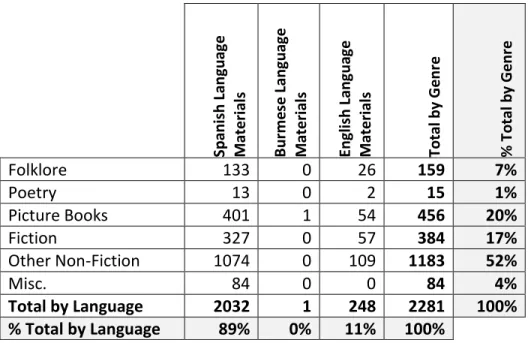
Among the genres of ELL resources, non-fiction texts are greatest in quantity
accounting for 52% of the collection, followed by picture (20%) and fiction (17%) books
respectively. In addition to the identified categories, there are 84 Spanish language
resources that, due to unfamiliar or unrecognizable cataloging codes, did not fall into the
predefined genres. Table 5 below summarizes the findings for School A.
Sp an is h L an gu ag e M ateri al s B u rme se L an gu ag e M ateri al s En gl is h L an gu ag e M ateri al s To ta l by G e n re % T o ta l b y G e n re
Folklore 133 0 26 159 7%
Poetry 13 0 2 15 1%
Picture Books 401 1 54 456 20%
Fiction 327 0 57 384 17%
Other Non-Fiction 1074 0 109 1183 52%
Misc. 84 0 0 84 4%
Total by Language 2032 1 248 2281 100%
% Total by Language 89% 0% 11% 100%
Table 5: Total number of culturally relevant resources at School A.
Note: English materials included in the table are defined as culturally relevant based on Sears Subject Headings related to representative ELL populations.
School B
School B has 89 ELL students, representing close to 20% of the school’s
population. As with School A, Spanish speakers are the majority (59%) of ELL learners
with Burmese students the second largest group (12%). Minority Language materials are
limited in quantity at School B. There are no home language materials for Burmese
students, and only 62 Spanish language resources.
Examination of culturally relevant English materials further demonstrates a void
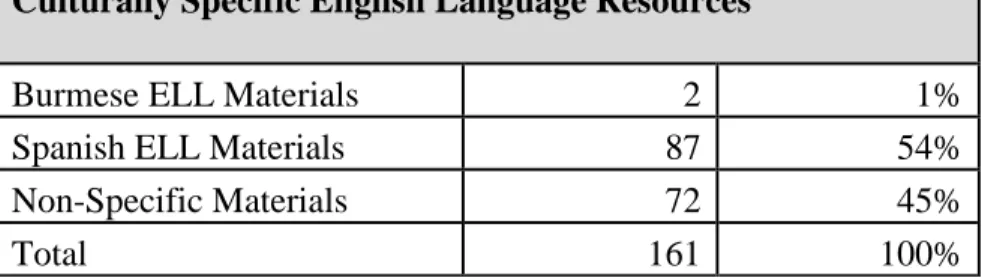
of materials for Burmese ELLs. There were two resources specific to Burmese culture, 87
specific to Spanish ELLs and 72 non-specific multicultural resources. Table 6 below
summarizes findings for English language resources at School B.
Culturally Specific English Language Resources
Burmese ELL Materials 2 1%
Spanish ELL Materials 87 54%
Non-Specific Materials 72 45%
Total 161 100%
The bulk of School B’s collection is made up of culturally relevant non-fiction
books (51%) followed by picture books (29%) and fiction (16%). The remaining
resources are catalogued as folklore, and based on subject headings there appear to be no
multicultural poetry materials available. Table 7 below summarizes the findings for
School B.
Spa n ish L an gu ag e M ater ia ls Bur m e se La n gu ag e M ater ia ls En gl ish L an gu ag e M ater ia ls Tot al b y Gen re % To tal b y Genr e
Folklore 0 0 9 9 4%
Poetry 0 0 0 0 0%
Picture Books 32 0 32 64 29%
Fiction 2 0 33 35 16%
Other Non-Fiction 28 0 87 115 52%
Total by Language 62 0 161 223 100%
% Total by Language 28% 0% 72% 100%
School C
School C has a total school population of 496 students, serving 66 (13.3%)
language minority students. Among the largest populations are Spanish and Chinese
speaking students, representing 65% and 12% of the ELL total respectively. Home
language materials were well represented for Spanish speaking students with a total of
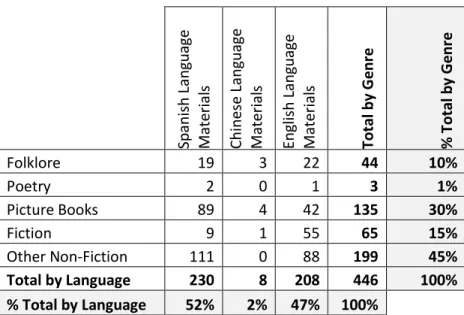
230 resources. For Chinese speaking students, however, a total of 8 books in Chinese
were listed in the library catalog: 4 picture books; 1 fiction book; and 3 folklores. There
were no non-fiction or poetry texts available in Chinese, and Spanish materials were
predominantly picture book and non-fiction formats.
Culturally relevant English language materials included a total of 208 resources.
Unlike Chinese home language materials with little representation, Chinese ELL
materials written in English (35%) were much more substantial in number. Resources for
Spanish ELLs represented 40% and non-specific multicultural resources accounted for
Table 7: Total number of culturally relevant resources at School B.
25% of English materials. Table 8 below summarizes findings for English language
resources at School C.
Culturally Specific English Language Resources
Chinese ELL Materials 72 35%
Spanish ELL Materials 84 40%
Non-Specific Materials 52 25%
Total 208 100%
Within the minority language collection, each genre represented a minimum of
10% of the total. The exception was poetry (1%), which only had one available resource.
Non-fiction (45%) and picture book (30%) materials were greatest in number, while
fiction and folklore represented 25% combined. Table 9 below summarizes the findings
for School C.
Sp an ish L an gu ag e M ate ria ls Ch in ese L an gu ag e M ate ria ls Eng lish L an gu ag e M ate ria ls To ta l by G e n re % T o ta l b y G e n re
Folklore 19 3 22 44 10%
Poetry 2 0 1 3 1%
Picture Books 89 4 42 135 30%
Fiction 9 1 55 65 15%
Other Non-Fiction 111 0 88 199 45%
Total by Language 230 8 208 446 100%
% Total by Language 52% 2% 47% 100%
Table 9: Total number of culturally relevant resources at School C.
Note: English materials included in the table are defined as culturally relevant based on Sears Subject Headings related to representative ELL populations.
School D
School D serves 110 ELL students, approximately 24% of the school population.
Of the languages represented, Karen and Spanish account for 90%, with 44 and 55
students respectively. Although Karen accounts for a large portion of ELL learners,
minority language materials are not reflective of the student language populations. There
is one resource in Karen and a total of 508 in Spanish.
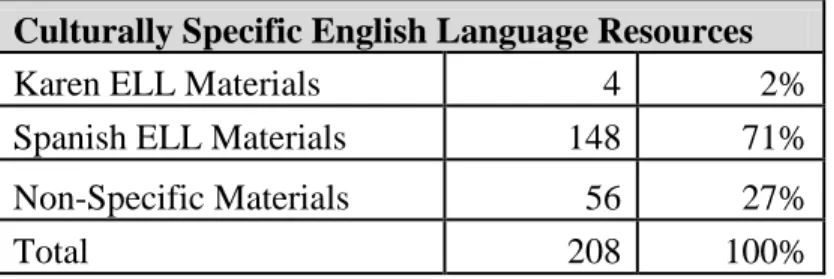
Of the resources written in English, materials that are specific to Spanish ELLs
represent a majority (71%) of resources. Resources for Karen students account for only
2% and non-specific resources 27%. Table 10 below summarizes findings for English
language resources at School D.
Culturally Specific English Language Resources
Karen ELL Materials 4 2%
Spanish ELL Materials 148 71%
Non-Specific Materials 56 27%
Total 208 100%
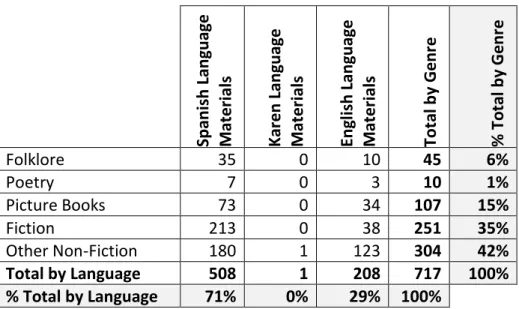
Overall, the collection contains 717 culturally relevant resources with non-fiction
accounting for 43% of the total. Fiction (35%) and picture books (15%) are the next
largest groups, while folklore (6%) and poetry (1%) total only 55 of the 717 minority
language materials. Table 11 below summarizes the findings for School D.
Spa n ish L an gu ag e M ater ia ls K ar e n L an gu ag e M ater ia ls En gl ish L an gu ag e M ater ia ls Tot al b y Gen re % To tal b y Genr e
Folklore 35 0 10 45 6%
Poetry 7 0 3 10 1%
Picture Books 73 0 34 107 15%
Fiction 213 0 38 251 35%
Other Non-Fiction 180 1 123 304 42%
Total by Language 508 1 208 717 100%
% Total by Language 71% 0% 29% 100%
School E
School E has a total of 18 languages represented in their ELL population. The
majority of ELLs speak Chinese (34%) or Korean (28%). Spanish is a smaller group with
8 (10%) ELLs. School E has a Mandarin Chinese language immersion program similar to
that of Carrboro’s Spanish immersion program. Students participating in the dual
language classes are not included in the ELL population receiving services. Although
extremely linguistically diverse, minority language materials are predominantly in
Spanish and Chinese. There are 69 Spanish language resources, 70 Mandarin Chinese
books, and no Korean language materials.
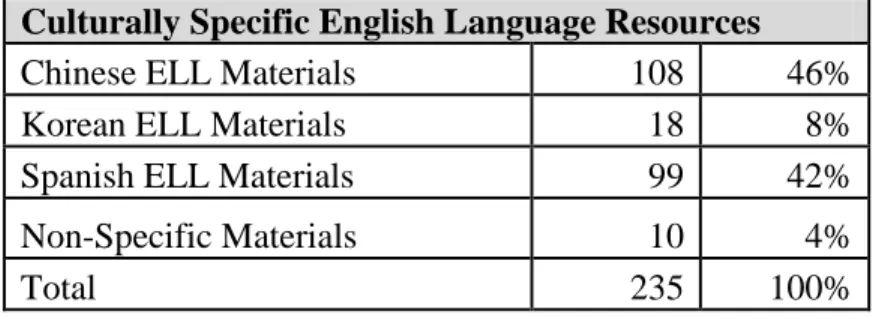
Of the 235 English language materials, only 4% were not specific to an identified
minority culture. Although there are no Korean language materials, there are English
language resources culturally relevant to Korean ELLs (8%). Resources in English for
Spanish and Chinese ELLs are fairly equal in number, representing 42% and 46%
Table 11: Total number of culturally relevant resources at School D.
respectively. Table 12 below summarizes findings for English language resources at
School E.
Culturally Specific English Language Resources
Chinese ELL Materials 108 46%
Korean ELL Materials 18 8%
Spanish ELL Materials 99 42%
Non-Specific Materials 10 4%
Total 235 100%
Culturally relevant picture books and fiction resources are equal in number and
together make-up 44% of ELL resources. Non-fiction books represent 36% of available
materials, while folklore (18%) and poetry (2%) round out the minority language
resources. Table 13 below summarizes the findings for School E.
Sp an is h L an gu ag e M ateri al s C h in e se L an gu ag e M ateri al s En gl is h La n gu ag e M ateri al s To ta l by G e n re % T o ta l b y G e n re
Folklore 6 35 27 68 18%
Poetry 3 0 5 8 2%
Picture Books 23 14 44 81 22%
Fiction 5 14 63 82 22%
Other Non-Fiction 32 7 96 135 36%
Total by Language 69 70 235 374 100%
% Total by Language 18% 19% 63% 100%
Table 13: Total number of culturally relevant resources at School E.
Note: English materials included in the table are defined as culturally relevant based on Sears Subject Headings related to representative ELL populations.
School F
School F has a total of 91 ELL students, representing 17% of the school’s
population. Spanish speakers make up 66% of minority language students, while 15 other
languages account for the remaining 34%. School F is unique in that it shares its library
with the middle school on campus, as well as serves as City B’s public library. In order to
find culturally relevant materials appropriate to elementary aged children, ‘Interest Level’
was used as an additional search limiter to retrieve resources for students in Kindergarten
through 6th grade. This search strategy may cause data to be over or understated due to
items incorrectly catalogued according to interest level, or missing interest level
information.
Home language materials had an equivalent number of Spanish and English
resources to total 194 books. English language resources were further split into
non-specific multicultural resources (54%) and culturally relevant materials for Spanish ELLs
(46%). Table 14 below summarizes findings for English language resources at School F.
Culturally Specific English Language Resources
Spanish ELL Materials 45 46%
Non-Specific Materials 52 54%
Total 97 100%
Overall, non-fiction was greatest in number (42%) followed by fiction (31%) and
picture books (24%). Folklore and poetry accounted for 2% and 1% respectively. Table
15 below summarizes the findings for School F.
Sp an is h L an gu ag e M ateri al s En gl is h L an gu ag e M ateri al s To ta l by G en re % T o ta l b y G en re
Folklore 1 3 4 2%
Poetry 0 2 2 1%
Picture Books 33 13 46 24%
Fiction 25 35 60 31%
Other Non-Fiction 38 44 82 42%
Total by Language 97 97 194 100%
% Total by Language 50% 50% 100%
School G
School G has the smallest proportion (10.3%) of minority language learners when
compared to all District A elementary schools. There are 66 ELLS out of a school
population of 642; 71% that speak Spanish. Karen is the next largest language,
accounting for 12% of the ELL total. Burmese represented just under10% of the
population, so they too were included in this study.
As with all schools studied, Spanish language materials were more available than
other representative languages. There were 234 Spanish resources, while Burmese (1)
and Karen (8) language resources totaled only 2% of ELL materials.
Table 15: Total number of culturally relevant resources at School F.
English language resources totaled 188 (44%) and most were culturally relevant
for Spanish ELLs. Those resources made up 76% of multicultural English materials,
while Karen (1%) and Burmese (2%) were lacking in numbers. Non-specific cultural
resources represented 21% of English language resources. Table 16 below summarizes
findings for English language resources at School G.
Culturally Specific English Language Resources
Burmese ELL Materials 4 2%
Karen ELL Materials 1 1%
Spanish ELL Materials 143 76%
Non-Specific Materials 40 21%
Total 188 100%
Unlike other elementary schools in the district, culturally relevant fiction
resources (48%) outnumbered non-fiction resources (35%). Folklore, poetry and picture
books accounted collectively for only 17% of the collection. Table 17 below summarizes
the findings for School G.
Sp an ish L an gu ag e M ate ria ls Bu rm es e Lan gu ag e M ate ria ls Karen L an gu ag e M ate ria ls Eng lish L an gu ag e M ate ria ls To ta l by G e n re % T o ta l b y G e n re
Folklore 11 0 0 9 20 5%
Poetry 11 0 0 8 19 4%
Picture Books 20 0 0 14 34 8%
Fiction 120 0 0 89 209 48%
Other Non-Fiction 72 1 8 68 149 35%
Total by Language 234 1 8 188 431 100%
% Total by
Language 54% 0% 2% 44% 100%
Table 17: Total number of culturally relevant resources at School G.
Note: English materials included in the table are defined as culturally relevant based on Sears Subject Headings related to representative ELL populations.
School H
School H has a total of 84 ELL students, representing 15.4% of the school
population. The predominant language is Korean (49%). Spanish comprises 15% of the
minority languages and Chinese 10%. The remaining 26% is made up of 12 additional
languages. Due to cataloging practices at School H, Spanish and Korean language
materials were unable to be categorized into genres, however it was determined that those
resources comprised nearly half of the minority language materials. There were 138
materials in Spanish and 174 in Korean.
English language materials totaled 349 resources, or 52% of the minority
language resources. Of those resources, nearly two-thirds were culturally relevant to
Chinese ELLs (36%) and Spanish ELLs (34%). The remaining materials were either
relevant to Korean ELLs (13%) or culturally non-specific (18%). Table 18 below
summarizes findings for English language resources at School H.
Culturally Specific English Language Resources
Chinese ELL Materials 124 36%
Korean ELL Materials 44 13%
Spanish ELL Materials 119 34%
Non-Specific Materials 62 18%
Total 349 100%
Non-fiction made up 21% of the culturally relevant collection, with 143 of the
144 resources written in English. Fiction materials, including picture books, accounted
for 26%, folklore 6% and poetry <1%. Table 19 below summarizes the findings for School H. Sp an ish L an gu ag e M ate ria ls Ch in ese L an gu ag e M ate ria ls Ko re an L an gu ag e M ate ria ls Eng lish L an gu ag e M ate ria ls To ta l by G en re % T o ta l b y G en re
Folklore N/A 0 N/A 39 39 6%
Poetry N/A 0 N/A 3 3 0%
Picture Books N/A 9 N/A 59 68 10%
Fiction N/A 0 N/A 105 105 16%
Other Non-Fiction N/A 1 N/A 143 144 21%
Total by Language 138 10 174 349 671 100%
% Total by Language 21% 1% 26% 52% 100%
School I
School I has a total population of 591 students, 108 of which are ELLs. Of the
108 minority language students, 49% are Spanish speaking and 39% speak Korean.
Although there are nearly as many Korean speaking students as there are Spanish
speaking, Korean language materials only represent 1% of the ELL collection while
Spanish materials account for 77% and English materials 22%.
English materials, when further subdivided by culturally specific resources, were
predominantly relevant for Spanish ELLs (56%). While Korean language materials only
represented 1% of the minority language collection, there were 43 resources within the
English language subgroup (16%). Non-specific cultural materials (28%) were the second
Table 19: Total number of culturally relevant resources at School H.
largest group within multicultural English materials. Table 20 below summarizes findings
for English language resources at School I.
Culturally Specific English Language Resources
Korean ELL Materials 43 16%
Spanish ELL Materials 155 56%
Non-Specific Materials 77 28%
Total 275 100%
Picture books represent the largest portion of the collection at 38%. Non-fiction
resources account for 40% of the collection and fiction makes up 14%. Folklore (7%) and
poetry (1%) make up less than 10% of materials. Table 21 below summarizes the
findings for School I.
Sp an ish L an gu ag e M ate ria ls Ko re an L an gu ag e M ate ria ls Eng lish L an gu ag e M ate ria ls To ta l by G e n re % T o ta l b y G e n re
Folklore 51 3 33 87 7%
Poetry 6 0 3 9 1%
Picture Books 409 4 61 474 38%
Fiction 128 0 46 174 14%
Other Non-Fiction 369 4 132 505 40%
Total by Language 963 11 275 1249 100%
% Total by Language 77% 1% 22% 100%
Table 21: Total number of culturally relevant resources at School I.
Note: English materials included in the table are defined as culturally relevant based on Sears Subject Headings related to representative ELL populations.
School J
School J serves 86 ELL students, representing 15.3% of the school’s population.
Majority languages include Korean (33%), Spanish (23%) and Chinese (17%). Although
Chinese speaking students represent 17% of the ELL population, there are no Chinese
language resources in the library catalog. Korean (5%) language materials are minimal,
while 28% of the materials are written in Spanish and 67% in English.
Of the 329 culturally relevant English resources, 28% are pertinent to
Spanish ELLs and 10% to Korean ELLs. Although Chinese language materials are not
present in the library catalog, culturally relevant resources specific to Chinese ELLs
represent the majority of English resources (39%). Table 22 below summarizes findings
for English language resources at School J.
Culturally Specific English Language Resources
Chinese ELL Materials 127 39%
Korean ELL Materials 33 10%
Spanish ELL Materials 92 28%
Non-Specific Materials 77 23%
Total 329 100%
Non-fiction represents 40% of the ELL collection with fiction (29%) and picture
books (19%) making up the next largest genres. As has been the case with all elementary
schools, folklore (11%) and poetry (1%) are the least represented materials. Table 23
below summarizes the findings for School J.
Sp an ish L an gu ag e M ate ria ls Ko re an L an gu ag e M ate ria ls Eng lish L an gu ag e M ate ria ls To ta l by G en re % T o ta l b y G en re
Folklore 16 1 34 51 10%
Poetry 3 0 0 3 1%
Picture Books 52 1 56 109 22%
Fiction 17 1 85 103 21%
Other Non-Fiction 52 20 154 226 46%
Total by Language 140 23 329 492 100%
% Total by Language 28% 5% 67% 100%
Discussion and Recommendations
Based on the findings across the 10 elementary schools in District A, it is clear
that more resources are needed for minority language learners. Across the district,
Spanish language materials (63%) and culturally relevant English materials (33%)
dominate the ELL collection. Korean (3%), Chinese (1%), Burmese (<1%) and Karen
(<1%) language resources combined represent less than 4% of materials throughout the
district. The needs of Burmese, Karen, Korean and Chinese speaking students are not
being met at the district level, and in most cases are neglected at the school level.
Acquiring more home language materials is critical for the success of minority language
students. Access to these resources shows the ELL student, as well as their family, that
Table 23: Total number of culturally relevant resources at School J.
libraries and schools value their language and culture. With a greater sense of inclusion,
students are more engaged, read more and are open to more comprehensible input.
“Additionally, students who feel welcome in their schools are more likely to succeed both
socially and educationally than are students who feel unwanted and insignificant”
(Agosto, 2007).
Access to home language resources improves language in the community and
impacts parents as well. Aside from being acknowledged and feeling welcomed, parents
are able to participate in their child’s education through reading and writing at home.
Cloud and her colleagues (2009) emphasize,
By bringing multicultural literature into your school and by making the home language part of the everyday life of the classroom, you are linking the school with the students’ families and communities at the same time as you promote literacy experiences that are authentic and relevant to them
(p. 108).
Clark asserts that increased parent involvement positively impacts SLA as well. “How
often and how well parents communicate with their children is a strong predictor of how
rapidly children expand their language learning.” In addition to having a positive impact
on student learning, parental involvement is beneficial for the classroom and school
community as well. Parents can be a source of information for vocabulary, cultural
artifacts, language materials and translation (Cloud et al., 2009; Clark).
Home language materials provide familiarity for ease of comprehension and
support learners in SLA through transfer. Considerable research has shown that literacy
in a first language transfers to reading and literacy in a second language (Cloud et al.,
2009; Hadaway et al., 2002; Hamayan & Freeman, 2006; August & Shanahan, 2006;
skills in their home language, access to materials in their first language provide students
opportunities to improve strategies and transfer these skills to learning a second language.
Additionally, content area resources in student’s home language prevent the learner from
falling behind in the classroom while learning English. With the increasing number of
minority language learners in our school system, it is imperative schools provide them
with the necessary resources to be successful learners.
In additional to acquiring more minority language materials, there is a need for
additional culturally relevant resources in English specific to ELL student cultures.
Specific populations in need of additional materials based on minimal findings across the
district include Burmese, Karen and Korean ELLs. Picture books provide visual clues
with clear images that help learners decipher unfamiliar concepts, words or phrases.
Many wordless books contain universal or self-contained topics. Predictable books with
repetitive text structure are important for building language. Non-fiction is now available
in a variety of formats, and narrows the scope of information covered as compared to a
classroom text. Resources such as concept books are highly visual support academic
language in a simple and straightforward manner.
Collection development in English language materials needs to emphasize poetry
and folklore in particular. Poetry lends itself to oral reading and its structure is beneficial
to ELLs. Repetition, rhyming and rhythm promote fluency while poetry’s brief nature is
less intimidating to beginning readers. Folklore typically encompasses traditional tales,
customs and beliefs of various cultures and is typically presented in picture book format
visual cues, helps ELLs to not only have a sense of belonging but may help them to
engage more freely.
Potential Barriers
School library media specialists face challenges in terms of providing culturally
relevant resources. Not only are budgets an issue, but finding resources in minority home
languages can be difficult. While Spanish and English language print materials are more
readily available, home language resources in Karen, Burmese, Chinese, Korean and
other minority languages are harder to find. An online search of two book vendors’
catalogs used in District A revealed a large gap in minority language resources. Capstone
offers materials in English, Hmong, Somali and Spanish. A closer look at what is
available reveals that there are only 4 resources in Hmong, 4 in Somali and over 800 in
Spanish. Not only are Hmong and Somali extremely limited, there are no other minority
languages represented. A search of Perma-Bound offers materials in 16 languages
(English included). As with Capstone, however, languages other than Spanish are scarce.
When limiting the search to materials in Korean only two books were returned, while
Spanish had over 4000. Other languages predominant in District A were not available at
all (Karen, Burmese, and Chinese).
Suggestions for Improvement
In order to overcome the challenges faced by educators, a number of strategies are
suggested to help improve access to culturally relevant materials. Professional
development in the areas of SLA and ELL students should be made available to help
culture, language, racial or social class group. Staff development may take the form of
professional learning communities, graduate course work, conferences or workshops,
hands on training, or peer coaching. Davis (2006) asserts that administrators, teachers and
support staff be provided with “opportunities to develop knowledge and skills to address
the needs of these students at school” and that professional development be
“comprehensive, focused in its delivery, and sustained over time” (p. 164-165).
Inclusion of minority language parents and family in the process of language
acquisition helps to strengthen the home language in the community. In order to access
home language materials, Cloud et al. (2009) recommend several strategies to implement:
Invite family or community members to share stories in a minority language
that can later be translated and turned into books by students.
Ask ELL students and parents if there are newspapers, radio or TV stations in
the home language that they use.
Collaborate with the local public library for services and resources in minority
languages.
Investigate community events that may involve literacy such as plays,
meetings or museum exhibits.
Ask ELL students and parents for written letters in the home language or to
provide other resources from travel to share.
With regards to print materials, alternative vendors should be investigated rather
than relying on mainstream publishers. There are several publishers that provide bilingual
materials in multiple languages. Asia for Kids provides books, textbooks, DVDs, and
educational materials in Burmese, Sgaw Karen and English languages. Children’s Book
Press is an independent press that focuses on home language literature for children from
the Latino, African American, Asian/Pacific Islander and Native American communities.
In addition to print materials, there are several electronic resources available to
teachers and students. The International Children’s Digital Library is an online library of
bilingual books currently representing 19 languages. Ultimately, the ICDL would like to
represent all cultures and languages represented. Paper Tigers is a website about
multicultural books in English, with a particular focus on the Pacific Rim and South Asia.
Although resources for some minority languages may be more difficult to find, it is
crucial that minority language students be acknowledged and valued in their school
community. Efforts must be made to represent each and every student, as well as provide
them with appropriate resources to improve literacy and achievement. (Appendix D
provides a listing of resources for educators to assist in building a collection of home
language and culturally relevant resources.)
Implications for Further Research
Looking at what is available through school library catalogs just scrapes the
surface for supporting minority language learners. Materials should be evaluated for
quality, bias, and stereotypes. Classroom collections and book room sets should be
analyzed for additional materials. The examination of circulation patterns of ELL
students would determine the types of materials most frequently utilized. Surveys
regarding library signage, orientations, and programming would give further insight into
library. Comparisons between reading scores of those schools with a greater number of
materials can be compared to schools with limited resources to determine the impact on
SLA and reading comprehension. Overall, there is still much to be looked at in terms of
minority language learners, second language acquisition, reading comprehension, the
most effective resources, and library programming. Providing library resources supported
Appendix A
Detailed ELL information for each of the ten elementary schools studied.
School Language Total
School A Burmese/Myanmasa 14
Chinese 1
German 1
Karen 9
Spanish 94
School A Total 119
School B Arabic/Egyptian/LebaneseSyrian 2
Bengali/Bangla 1
Burmese/Myanmasa 10
Chin 1
Chinese 6
Japanese 1
Karen 7
Korean 2
Russian 3
Shona 1
Spanish 50
Vietnamese 1
School B Total 85
School C Arabic/Egyptian/LebaneseSyrian 1
Chinese 8
Croatian/Hrvatski 1
French 2
German 3
Japanese 3
Karen 1
Korean 1
Polish 1
Portuguese 2
Spanish 43
School Language Total
School D Amharic/Ethiopian 1
Burmese/Myanmasa 5
Chinese 2
Japanese 2
Karen 44
Spanish 55
Swahili/Kiswahili 1
School D Total 110
School E Arabic/Egyptian/LebaneseSyrian 5
Burmese/Myanmasa 2
Chinese 28
Chinese (Cantonese) 1
Chinese (Mandarin) 2
Hebrew 1
Hindi/Indian/Urdu 1
Indonesian 1
Japanese 2
Korean 23
Mongolian 1
Spanish 8
Swahili/Kiswahili 1
Swedish 1
Tagalog/Filipino 1
TAI (OTHER) 1
Telugu 1
Turkish 2
School Language Total
School F Arabic/Egyptian/LebaneseSyrian 2
Bengali/Bangla 1
Buginese 1
Burmese/Myanmasa 6
Chickawa 1
Chinese 3
Hindi/Indian/Urdu 1
Italian 1
Karen 8
Korean 1
Romanian/Moldavian 1
Russian 1
Singhalese/Sinhalese 1
Spanish 60
Tagalog/Filipino 2
Thai/Tai/Thaiklang 1
School F Total 91
School G Burmese/Myanmasa 6
Chinese 2
French 1
Karen 8
Korean 2
Spanish 47
School G Total 66
School H Arabic/Egyptian/LebaneseSyrian 1
Chinese 8
Danish 2
French 4
German 1
Hindi/Indian/Urdu 1
Japanese 3
Karen 1
Kishwahali/Kwa/Kitendo 2
Korean 41
Mandingo 2
Russian 3
Spanish 13
Swahili/Kiswahili 1
Vietnamese 1
School Language Total
School I Burmese/Myanmasa 1
Catalan/Catalonian 1
German 5
Hebrew 1
Japanese 5
Korean 42
Spanish 53
School I Total 108
School J Burmese/Myanmasa 5
Chinese 15
Chinese (Taiwan) 1
Finnish 1
French 2
Hebrew 2
Hungarian/Magyar 1
Icelandic/Islenzk 1
Italian 1
Japanese 2
Karen 1
Korean 28
Russian 2
Spanish 20
Thai/Tai/Thaiklang 1
Turkish 2
Vietnamese 1
School J Total 86
Appendix B
Sears Subject Headings used for each school based on language populations > 10% of total ELL population.
Sears Subject Heading
S c h o o l A S c h o o l B S c h o o l C S c h o o l D S c h o o l E S c h o o l F S c h o o l G S c h o o l H S c h o o l I S c h o o l J
Alien X x x x x x x x x x
Burma X x x
Burmese X x x
Burmese -- United States X x x
Burmese Language Materials X x x
Children of Immigrants X x x x x x x x x x
China x x x x
Chinese x x x x
Chinese American X X x X
Chinese -- United States x x x x
Chinese Language Materials x x x x
Hispanic American X X X X X X X X X X
Illegal Alien X x x x x x x x x x
Immigrants X x x x x x x x x x
Immigration X x x x x x x x x x
Immigration and Emigration X x x x x x x x x x
Karen x x
Karen Language Materials x x
Korea x x x x
Korean x x x x
Korean -- United States x x x x
Korean Language Materials x x x x
Mexican X x x x x x x x x x
Mexican American X X X X X X X X X X
Mexican -- United States X x x x x x x x x x
Mexico X x x x x x x x x x
Myanmar X x x
Political Refugees X x x x x x x x x x
Religious Holidays X x x x x x x x x x
Refugees X x x x x x x x x x
Spanish Language Materials X x x x x x x x x x
United States -- Foreign Populations X x x x x x x x x x
Appendix C
Non-specific versus culturally specific Sears Subject Headings.
Non-Specific Sears Subject Heading Culturally Specific Sears Subject Heading
Alien Burma
Children of Immigrants Burmese
Illegal Alien Burmese -- United States
Immigrants China
Immigration Chinese
Immigration and Emigration Chinese American
Political Refugees Chinese -- United States
Religious Holidays Hispanic American
Refugees Karen
United States -- Foreign Populations Korea
United States -- Immigration and Emigration Korean
Korean -- United States Mexican
Mexican American Mexican -- United States Mexico