Adam M Iona Variations of Natural Language Questions and Impacts On Information Retrieval. A Master's Paper for the M.S. in I/L.S degree April
2013, 62 pages Advisor: Jaime Arguello Abstract
This paper is an investigation of the impact that varieties of natural language questions have on information retrieval. Ten questions were chosen and ten
paraphrases of each were input into Google and Bing. The results indicated that the templates do not have a significant impact on the performance of these search engines. Instead, the results showed that questions about culturally salient information is more likely to yield an effective query, regardless of how it is phrased. Queries about other kinds of information do not perform as well because the indexing of web pages does not appear to favor more obscure topics.
Headings:
VARIATIONS OF NATURAL LANGUAGE QUESTIONS AND IMPACTS ON INFORMATION RETRIEVAL
by Adam M Iona
A Master's paper submitted to the faculty of the School of Information and Library Science of the University of North Carolina at Chapel Hill
in partial fulfillment of the requirements for the degree of Master of Science in
Information/Library Science
Chapel Hill, North Carolina April 2013
Approved by:
Table of Contents
Chapter 1 Introduction to the Problem ... 2
Asking Questions ... 3
Chapter 2 Review of the Literature ... 5
Web Search Engines ... 5
Web Search versus Question-Answering Systems ... 7
Question Classification ... 8
Supervised Classifiers ... 9
Pattern-Based Classifiers ... 11
Searching for Answers Using a Focus and Patterns ... 13
Answer Extraction... 15
Assessment of Results ... 17
TREC Questions and Answers ... 19
Chapter 3 Methodology ... 20
Question Selection ... 22
Question Templates ... 24
Measured Quantities: ... 27
Determining Answer Rank ... 28
Determining User Effort ... 29
Analysis Techniques ... 30
Chapter 4 Data and Analysis ... 30
Comparing Correct Answers ... 32
Comparing Answer Ranks By Question... 35
Comparing Answer Ranks By Template ... 41
Comparing Answer Scores By Question ... 42
Comparing Answer Score By Template ... 44
Chapter 5 Recommendations and Conclusions ... 47
Impacts ... 47
Limitations ... 48
Summary: ... 49
Conclusion ... 51
References ... 52
Chapter 1 Introduction to the Problem
Searching for information on the web has become one of the activities most characteristic of the information age. There is so much information at our fingertips that was not available to us a generation ago. The problem with this glut of
information is that there is so much more information than humans can possibly use. It takes a great deal of time and mental effort to extract the information that is needed to address a specific information need.
Through necessity, humans have created a variety of tools to help sift
through the millions of information resources that can now be accessed via the Web. For any particular information need, one can find information that is relevant to a specific question while at the same time creating a plan of action that will help solve the problem or answer the question. The most influential tools humans have at their disposal for dealing with information are online search engines. These search
engines allow users to find the resources they need to help them solve problems by matching strings of text in their query with strings of text in a document corpus. In this way, search engines are an extremely valuable resource for answering our everyday questions while also furthering the pursuit of knowledge in more sophisticated ways, across many different disciplines. Today's search engine
are retrieved though depend on the query that is input by the user. These queries are developed based on the problem the user wishes to solve. A user needs to have a query that allows the search engines to identify relevant information and must be specific enough to present only the relevant information. Receiving the right
information helps the user answer his question, solve his problem, and enjoy a high level of satisfaction. However, many user queries are not optimal. The quality of the response depends on the quality of the questions asked using natural language and the accuracy of the documents analyzed. I predict that I will find differences in search results from different web search engines when natural language questions are used
as input; moreover, these differences will be based on how the questions are
structured.
Asking Questions
Humans often seek information by asking questions, and this sometimes carries over when they query a search engine. It seems to be a uniquely human ability to observe the state of the world and search for some kind of meaning behind it. Whether this involves discovering general principles or identifying one specific piece of information to answer a specific question depends on the information need of the individual. Alternatively, finding an answer to a question by narrowing the set of possible answers may also be a useful strategy. Since seeking information
is flexible, complex and often varies by individual, it is necessary to create tasks that isolate particular elements at play in questions that are asked. These include: the kind of question being asked, the type of answer that is expected and what subject area the question pertains to. It seems reasonable to expect that structural elements of the question will affect its answerability because the syntax impacts how humans (and therefore, likely machines) interpret the question. Knowing that either the type of question that is asked or how it is asked can facilitate finding the answer is
Chapter 2 Review of the Literature
Web Search EnginesGoogle and Bing are highly useful resources for addressing the information needs of many users. Searching with these tools is fairly straightforward, because all they ask of the user is to provide a few keywords. Then, they generate a list of
results based on page-rank, a query-independent score given to each document based on a heuristic that measures a document’s accuracy and authority. Retrieving information in this way is satisfactory for addressing the needs of many users. For example, one could type in an actor's name and find a number of helpful results including the actor's biography and filmography, as well as some recent news articles about the actor. However, these search engines also might list results in an order that is based on criteria that do not match those of the user. For example, companies can cause their page to be ranked higher in the list based on
advertisements; additionally, pages that are viewed frequently may be ranked higher based on their popularity. This order may be contrary to the wishes of the user.
is problematic because many search engines base their results list based on
similarity between the terms in the query and terms in the document (Agichtein et al., 2001). Some common measures of similarity include: cosine similarity, term frequency (TF) and term frequency x inverse document frequency (TF•IDF).
Calculate cosine similarity by creating binary query and document vectors and then comparing them. If terms appear in either document or query, they are given a score of "1"; otherwise they receive a zero score. Once the vectors are created, they are evaluated based on the cosine of the angle between the vectors. If the value is 1, there is a match between them. Otherwise, there is no match. Other approaches are based on how often query terms appear in the document. Models based on TF retrieve documents based on how frequent the query terms appear. Models based on TF•IDF retrieve documents based on terms that appear frequently in the
document but appear less frequently throughout the corpus. Using natural language questions and transforming them to generate terms that are likely to appear in the document is a way of leveraging the current capabilities of many search engines and showing how their use could be extended. This natural language approach has been suggested by Agichtein et al (2001) and Brill and Soricut (2006).
similar between the query and document, and documents with the most useful answers may not contain many words that are in the query (Agichtein et al., 2001).
It would be fruitless to attempt to change the way these search engines work. However, if users are more aware of how the back-ends of these systems work, they will likely be able to create queries to produce results that are more germane to their information needs. This study will provide more information to inform users about how these search engines parse natural language questions and help them form queries that will yield accurate answers.
Web Search versus Question-Answering Systems
Many researchers and thinkers have tried to devise ways to improve search results from different information tools. In many cases, they have tried to devise an entirely new system that emphasizes natural language and semantic relationships in ways that Google and other search engines do not. Other authors have proposed ways to design systems that build on the massive amount of information accessible and leverage that information to find answers in new ways. One such study, done by Kwok, Etzioni and Weld (2000) at the University of Washington, examines question-answering techniques and investigates a system they've created called MULDER. They are interested in scaling question-answering techniques to the web. (Kwok et al, 2000).
and votes for each cluster, choosing the top answer in the top cluster (Kwok et al, 2000).
Additionally, MULDER employs a voting algorithm to judge the reliability of the results. Unlike the goal of web search engines, which is to find documents that match query terms, their goal is to provide accurate natural language answers to natural language questions.
One important distinction that needs to be made for helping users answer their questions is to separate the problem a user is trying to solve, and the actual question they are asking. The problem they want to solve is typically a broad concept, whereas a question is aimed at seeking a fact or otherwise concise
description or analysis. For example, a user interested in Lincoln and the Civil War might want to know about the role Congress played in passing the 13th Amendment. A query to a search engine is a way some users get some background information that will help them guide their analysis, and Google & Bing are good places to start. However, a user might also seek the answer to a more specific question, pertaining to individual members of Congress and their viewpoints. Question answering systems are typically calibrated to answer these kinds of questions in a way that Google and Bing are not. Accurately describing different classes of questions is a task that will help improve the performance of Web search engines and question-answering systems.
Question Classification
language questions often determines what makes an answer acceptable.
Understanding the classification process will help developers of search engines and question-answering systems provide more effective answers to users’ queries. Even though Google and Bing are not question-answering systems in the strictest sense, it would be beneficial if users are not restricted to typical query-based searches for these systems, precisely because they are used so often. One aspect of question classification is determining the type of answer that is expected in order to satisfy the query. Humans do this using signal words within the question. According to Buscaldi, Rosso, Gomez-Soriano and Sanchis (2009), there are two main types of question classification: "pattern-based classifiers" and "supervised classifiers". Pattern-based classifiers are intended to detect various question words ("who", "what", "when", etc.), while supervised classifiers use a machine learning approach that is informed by a human expert.
Supervised Classifiers
Machine learning systems are often beneficial for question classification because they are able to utilize and analyze large sets of question data.
Pattern-Based Classifiers
Categorization becomes easier if there are specific features that are
associated with different kinds of questions. Li and Roth (2002) build this kind of thinking into their classification system. One entering the question: "What is a prism?" is most likely looking for a definition of a prism, or what makes an item a prism. Certain words like “what” and “why” are important for providing candidate answers to questions, but systems need more robust patterns to accurately predict possible answers, and this study aims to provide that insight. While “what”
questions are relatively simple to answer, it is possible that patterns in simple questions could be applied to help answer more complex questions. The first step for the classification system should be identifying the target of the question as a definition. As such, there are specific strategies that can be used to identify answers that are definitions, like phrasing templates that can be used to search for an
answer, including: "a prism is…" and "prisms are…".
In looking at pattern-based classifiers to provide an appropriate answer to a given question, it is necessary to determine whether the question is about a person, an object or a place. A first step is examining the wh-word in the question. Those questions that begin with "who" are likely to be about people. "What" questions can be about a variety of different subjects. For these cases, Hirschman and Gaizauskas (2001) note the importance of indicating syntactic or semantic relations that are present in the question, because these often provide information about appropriate answer candidates. To answer a question like "What is the capitol of North
state, and associate the property of having a capitol city, in order to answer
"Raleigh". While humans often take this information for granted, it can be extremely beneficial for NLP systems to have this be explicit. Huang, Thint and Qin (2008) reiterate the non-triviality of question classification in their article. However, it is not enough to only classify questions based on wh-words; a more pressing challenge is what and which type questions because they can be phrased in a myriad of ways, yet they still seek the same type of answer. For example, "Which planet is closest to the sun?" and "What is the name of the planet that is furthest from the sun?" are seeking the same answer type. Huang et al (2008) suggest using machine learning as a way to classify questions. They look at headwords and use WordNet to augment semantic features of those words, as well as a word sense disambiguation algorithm that assumes words in a given context share a similar meaning (Huang et al., 2008).
questions to be categorized into multiple classes. So, while Question 3 above might seek a definition, a satisfactory answer could also contain a numerical value. Therefore, the question should be cross-classified.
Searching for Answers Using a Focus and Patterns
Moldovan et al (1999) suggest a feature of questions that can help find candidate answers regardless of the question type. They believe that all questions have some kind of focus. Beyond classifying the question, the focus indicates "what the question is all about" (Moldovan et al., 1999). This is beneficial, because it provides the question answering system with more semantic information. For example, should the answer be a definition or an explanation? What subject area is the question about?
Some systems, like those described by the creators of a system called Mulder (Kwok et al., 2001) are looking for patterns in documents that could match
candidate answer patterns. Unfortunately, in some cases this is limiting, because the flexibility of language allows an answer to be expressed in multiple different
phrasings. Moreover, while humans can comprehend different representations of knowledge and find an answer even when it is presented in an unexpected way, such as graphically or through audio, computers can have difficulty. Using pattern matching alone only works with text, so this method has some limitations.
One goal of question answering software is to make it easier for computers to find the answers to a variety of kinds of questions. In the system called LASSO
unlikely to occur in the answer, it should not be in the list. The system uses a set of ordered heuristics to narrow the search space to a manageable range, and removes keywords in reverse order if it becomes too narrow. One trying to learn the name of the female counterpart to "El Niño" might use a specific query with many keywords like "female El Nino dry weather cooling temperature" but broaden it by shortening it to "female El Nino dry weather cooling" then to "female El Nino dry weather". LASSO works in much the same way (Moldovan et al., 1999).
Once the system categorizes the question that has been entered, it must find an acceptable result set of candidate answers before eventually selecting a final result. In LASSO, it is necessary for all the keywords to be in the documents
procedure described by Jacquemin (1999), where a term with small variants is rated highest, and decreases as the degree of variation increases. Non-variants are given a weight of 3.0, changes to the word form (morphology) or syntax (run vs. running, or where the word is in the sentence) are rated 2.0, and variations that include changes to semantics, morphology and syntax are rated lowest. Based on the proportion of proper nouns to common ones, each document in the answer result list receives a score that also accounts for the number of words in the document and in the query, and the top 100 documents are retrieved (Ferret et al,, 2002).
In contrast, Grau et al (2006) examined a system with a more methodical approach. Their system, QALC, looks at every sentence in the set of collected answer documents, and selects the N^28 sentences that are the most like the question based on recognition of named entities, terms and question focus. Next, it associates a score with each feature. The term score is calculated by "adding the weights of the terms of the question that are in the document sentence." A similar process
determines the named entities' score, while the focus score is based on whether the head of the focus phrase can be found in the question and the answer. (Grau et al., 2006). Calculating a score for each feature is beneficial because it provides more bases for comparison when there are multiple candidate answers (Ferret et al., 2002). This is often shown in the ordering of the answer list.
Answer Extraction
et al (2006) found that the QALC system utilizes information drawn from the question analysis phase of the process. The answer is extracted based on heuristics relevant to each category, including a named entity, noun or verb phrase or others. These heuristics are often based on pattern matching, especially for named entities, because the pattern is what allows humans and machines to recognize that a name is referring to the same entity. A named entity lexicon called CELEX (CELEX, 1998) is used for pattern matching of named entities.
If the answer type is a noun or verb phrase, then QALC utilizes semantic and syntactic pattern matching techniques and uses the question's focus to choose an answer when there are multiple candidates (Grau et al., 2006). According to Ferret et al (2002), the "syntactic structure of the question determines the possible syntactic structure of the answer" and that the structure of direct answers often provide insight into the range of possible answer syntaxes. The semantic
relationships in these sentence structures informs the extraction of answer patterns because the type of semantic relations between two objects in a sentence often determines how that question can be classified, whether that is based on the
question wh-word, semantic focus or other category (Ferret et al., 2002). If the focus of the question and candidate answer match, as well as the type of answer, then that answer is more likely to be selected.
that have a high inverse document frequency, IDF) and how close they are together, based on the square root of the distances between keywords, divided by the number of terms minus one. It then uses a voting procedure that is based on proximity of answers to keywords. Then the system creates clusters, which group similar answers together and selects an appropriate cluster by voting. The clustering process helps reduce noise in the form of random or otherwise irrelevant answers and allows for some variation (Kwok et al., 2001). Mulder is able to accept similar answers (like full names with or without a middle initial), even though they are not identical. Kwok et al (2001) assume that grouping similar (if not identical answers) together will result in a higher score as a cluster than counting all the individual variants separately. They also assume that accurate statements will occur more often than false or inaccurate ones, and that clustering facilitates this separation.
Assessment of Results
a system is incapable of performing a task, the user is likely to be extremely frustrated.
Accuracy of the results is one metric that can be utilized. This measures whether the result produced is correct. In order to gauge the effectiveness of query terms for text retrieval and question answering systems, it is useful to test questions to which the answer is known. One of the issues many users have is that they often do not know the answer to their question and need a retrieval system to find it. Google and other search engines connect to a wide variety of resources, which allows users to find new knowledge, but an evaluation of Google or other search engines might be more informative if they verify what we know already. If they cannot verify current knowledge, it makes sense to be skeptical of new information they retrieve. Additionally, it allows users to establish a baseline expectation for performance, which could allow future tuning of the system or query terms. This factor also mediates user satisfaction in general.
The time that search engines require to return results is another metric I will use. It is worthwhile to understand how much user effort is required to find the answer to a question. While it is difficult to directly assess the amount of effort, one can use length of time required to complete the search as a surrogate. This
technique was suggested in Ong et al (2009). I expect that the more time a user spends looking for an answer to a question, the less satisfied he will be at the end, even if he has found what he's looking for.
frustrated the more times they restructure their query and the more results they have to sift through. The MULDER study specifies for word distance an upper bound of 5000 words, assuming an ideal user spends 15 minutes searching. Like their study, I would "compute total effort at recall r% by summing up the user effort required from 0% recall up to r%" (Kwok et al). I expect this will allow one to track the way changes in level of recall affect the effort a user needs to expend to find their result (Kwok et al). Recall is defined as the percentage of relevant results that are retrieved, which eventually reaches its maximum value. In many cases, the more results a user sees, the more likely they are to be irrelevant to his search. A related metric is precision, which is the percentage of the retrieved documents that are relevant. The authors of the MULDER do not believe precision is appropriate—they believe that either the answer is correct or incorrect (Kwok et al). That said,
precision is still a standard metric in information retrieval.
The rank of the first correct answer and the general amount of user effort were used as metrics. While I did not specifically measure user effort in the study, the rank of the first correct answer and the word can shed light on the amount of effort required to find an answer. Additionally, it was necessary to expend some effort to verify whether or not the answer was present in the document if it was not in the snippet.
TREC Questions and Answers
judgments are appropriate for question-answering tasks (Voorhees and Tice, 2000). Thanks to the creation of their question and answer set, question-answering
systems can be further evaluated in a number of ways.
TREC selected questions from a large pool of candidate questions, including some from "TREC QA participants, the NIST TREC team, the NIST assessors, and question logs from the FAQ Finder system" (Voorhees and Tice, 2000). One would think that creating a set of questions from various sources is a way to approximate the way users search for information in everyday circumstances. However, this appears not to be the case, because, according to Voorhees and Tice, questions were created "specifically for the [question answering] track", so they are not
representative of unsupervised user search behavior (Voorhees and Tice, 2000). This study will use questions that were part of past TREC studies, but will revise them as a way to investigate user effort and system performance of different search systems.
Chapter 3 Methodology
This study will examine the following characteristics of the web search engines Google and Bing: the time required to complete the search (often given by Google and other systems), the degree to which the answers selected by TREC match the search results and the user effort based on word distance between the first word in the main text in a document and the answer string. I will analyze the first ten results of each query based on three factors: whether a correct answer is retrieved, the rank of the first correct answer on the results page and the score of a query based on that rank. For this study, ten validated questions were used and ten variations of the questions were created using templates based on semantic,
linguistic and syntactic similarities.
My goal is to develop queries that represent possible different information needs of the general public and to look for patterns among the queries that
adequately address that need. In order to find phrases and types of queries that yield satisfactory results, it is extremely helpful to test a number of different query structures with a wide variety of different keywords.
Question Selection
Asking questions is an important way that humans seek information. Humans can ask questions in various different ways, yet still be seeking the same type of information for an answer, so electronic question answering systems must have enough flexibility to parse these variations. An important step in this process is determining the factors that make certain questions easier to answer than others.
I will use 10 questions to test the systems. Six are problems from the Eighth Text Retrieval Conference (TREC) factoid category and four that I created myself. TREC questions come from a variety of disciplines and domains, and the question set contains questions with a range of complexities, which helps gain a more
nuanced assessment of how a retrieval system parses questions. Kwok et al (2001) note in their study that they can look at the performance of MULDER in the context of other search systems that were tested with TREC questions. Based on the sets of questions I choose, I can then revise the questions while keeping the same answer sets that could also be input into the search engines. For the questions I created, I looked for information that was readily accessible and verifiable. For example, on IMDB and Wikipedia one can find a list of recent Academy Award winners;
additionally, there are many other entertainment related pages that show similar information. So, while I do not have a panel of judges to review my answers like TREC, mine are validated by a consensus of multiple Internet resources. This consensus is valuable for answering the types of questions most users will ask.
in the set, there was minimal agreement among different sources. It's likely that the answer to the question: "Who created the cotton gin" will be verified across many different searches because it is a historical fact. However, the answer to a question like "How much could you rent a Volkswagen bug for in 1966?" is less likely to have the same agreement. Several questions were created that had a well-documented, historical basis for their answer. Popular albums and award-winning actors fit into that category.
The questions that were selected from TREC included:
• What was the monetary value of the Nobel Peace Prize in 1989? • What was the target rate for M3 growth in 1992?
• What large U.S. city had the highest murder rate for 1988?
• What nuclear-powered Russian submarinesank in the Norwegian Sea on April 7, 1989?
• What two US biochemists won the Nobel Prize in medicine in 1992?
• What was the leader of the Branch Davidian Cult confronted by the FBI in
Waco, Texas in 1993?
The questions that I chose included:
• What was the price of a regular stamp in 1900?
• What recording artist released the album "Thriller" in 1982?
• What actor won the "Best Actor" Oscar for his role in "Forrest Gump" in 1994?
Question Templates
Since different users might phrase their questions in different ways for the same problem, I created five question templates using question-phrasing variations. These variations kept the same answer sets. I will use one type of wh-question in order to minimize the challenges of using complex questions on these search engines. Certain question words can make a particular question easy or more
difficult. Many "what" questions, those where the question seeks one entity or object as an answer are easier because there is typically one correct, verifiable answer. "Why" and "how" questions are difficult because formulating an answer involves some analytical thought or a description of the relationship between certain historical questions. A good answer explaining why World War II happened must involve an account from multiple perspectives. This is not something that Google and Bing are currently equipped for, because it involves more analysis than word matching or even shallow semantic parsing.
I will use some of the ways Kwok et al (2001) suggest for question
transformation, including verb conversion and syntax modification. Verb conversion is a way humans typically answer questions, by using a conjugated verb rather than an auxiliary verb (e.g. do, did) paired with an infinitive (e.g. to walk). For example, "When did Eli Whitney invent the cotton gin?" becomes "Eli Whitney invented the cotton gin in 1807." Where applicable, I reversed this process for several questions in order to standardize the question templates. One syntax modification as
artist that released "Thriller" in 1982" becomes "recording artist that released "Thriller" in 1982 was".
It was necessary to create templates that could be standardized relatively simply. All of the questions from TREC or those written had a standard format. Each requires an entity, a property, a value for that property and a year. For example, in the question, "What was the monetary value of the Nobel Peace Prize in 1989?", the entity is "Nobel Peace Prize", the property is "monetary value", the year is "1989" and the answer quantifies the monetary value. Creating a standard format made it relatively easy to create controlled variations that became the different templates. The most important difference between the main templates is the sentence
structure and the order of the arguments in the sentence. The templates are as follows:
• T1: What was the (value) (in units) of the (entity) in (year)? • T2: In (year), what was the (value) (in units) of the (entity)? • T3: In/on (year), what (value) (in units) did the (entity) have? • T4: What (value) (in units) did the/a/an (entity) have in (year)? • T5: The (entity) in (year) had what (value) (in units)?
Question Text
Q1 What was the monetary value of the Nobel Peace Prize in 1989? T1 What was the
monetaryvalue in dollars of the Nobel Peace Prize
in 1989?
Q2 What was the target rate for M3 growth in 1992?
T2 In 1992, what was the target rate percentage of M3 growth? Q3 What large U.S. city had the highest murder rate for 1988?
T3 In
1988, what name did the large U.S. city with the highest murder rate have?
Q4 What
nuclear-powered Russian submarinesank in the Norwegian Sea on April 7, 1989?
T4 What name did the nuclear-powered Russian submarine sank in the Norwegian Sea, April 7, 1989 have?
Q5 What
two US biochemists won the Nobel Prize in medicine in
1992?
T5 The 1992 had what names? two US biochemists that won the Nobel Prize in medicine in Figure 1: Sample Questions and Templates
In order to distinguish between possible effects of using full sentences as queries and using a string of arguments, two other types of queries were created. One set contained all of the arguments in each question, arranged in alphabetical order; this was labeled Q1-Q10. I created a subtype that contained the same
original questions. It turned out that QnU (where n is the question number) was virtually identical to T1 for each question, aside from stop words in the question.
For example, Question Text
Q6U What was the pricein cents of a regular stamp in 1900? T1 What was the price in cents of a regular stamp in 1900? A1 price, cents, regular stamp, 1900
Q7 What recording artist released the album "Thriller" in 1982? T2 In 1982, what was the name of the recording artist released the album "Thriller"? A2 1982, name, recording artist, released the album "Thriller"
Q8 What actor won the "Best Actor" Oscar for his role in "Forrest Gump" in 1994?
T5 The actor that won the "Best Actor" Oscar for his role in "Forrest Gump" in 1994 had what name? A5 actor that won the "Best Actor" Oscar, "Forrest Gump", 1994, name
Q9 What inventor created the cotton gin and got a patent in 1807? Q9U What was the name of the inventor that created the cotton gin and got a patent in 1807? Figure 2: Chart comparing the questions and corresponding templates.
Measured Quantities:
I will input these questions into each of the tested search engines and look through the first page of results.
Dependent Variables:
• Whether a correct answer is returned by the search. This will be determined based on whether the answer matches the TREC answer. For the answers to my questions, I relied on consensus across
• The time needed for each search engine to run a query
• The rank of the answer. The rank is based on which of the top ten results has the first correct answer. If the correct answer does not appear in either the snippets or the document, then a query will receive a zero score.
• The score of the query based on the numbered result that answered the original question. Calculate the score by taking the inverse of the result rank (1/rank #) (Abney, Collins & Singhal, 2000). Only the first ten results for each query will be shown, and the query will receive a zero score if neither the snippets nor the documents contain the answer.
• The user effort by where the correct answer appears in the query result.
Determining Answer Rank
the correct answer is located in those results provides insight as to whether the search engine is generally satisfying the user.
The rank of a result on the results page is an indicator by the search engine as to how relevant each result is. While this may work for queries where relevance means a certain correspondence between query terms and document terms,
question answering requires a different kind of assessment. This is because finding an answer to a question means finding a sequence of text that contains a particular semantic content, based on semantic and syntactic information in the question. Yet, while answers to questions are judged differently than matching query and
document terms, ranking the results still makes sense because it allows one to quantify how relevant each result is, compared to the others. Once the ranks for both search engines are compared statistically, for both the questions and the templates, it will then be possible to show whether the differences between the rankings are due to a factor beyond chance. By extension, since the score is calculated based on the ranking of the results, comparing the scores will follow a similar procedure and hopefully align with the rank comparisons. However, this did not distinguish between whether an answer appeared in the result snippet or document.
Determining User Effort
distance is zero. Otherwise, the word distance comes from counting words in the result text (Kwok et al., 2001). For this study, I chose to use the first ten results, because in some cases the first correct answer is lower in the result rankings than the top three. Additionally, the top ten results seemed like a reasonable surrogate for an upper bound on user effort, since typically, users do not look through more than the first results page (Joachims, Granka, Pan, Hembrooke and Gay, 2005). This also creates a surrogate for precision that may be more suitable for evaluating question-answering retrieval.
Analysis Techniques
I will calculate the mean and standard deviation for both the rank of the first correct result and the score for each query. Using a t-test, I will compare for both Google and Bing the questions and the question templates for both Google and Bing based on the average and standard deviation. This will determine whether the search engines' performance is statistically affected by either the question
Chapter 4 Data and Analysis
This study is designed to better understand how the structure of natural language questions impacts the attributes of producing a correct answer using the Bing and Google web search engines.
Ten questions were selected from TREC and five variations were developed for each question using a variety of semantic modifications. These were called “exact templates.” These were numbered T1, T2, T3, T4, T5. For four of the templates a listing of the question arguments was developed these were called “attribute listings.” These were called A1, A2, A3 and A5 because they mirrored the order of the order of T1-T5. For two of the templates, the attribute listings were identical so no listing was included for one of the templates. One other variation of the question was included. This variation was based on an alphabetical ordering of the arguments, in order to create a baseline for the degree to which the system would parse a question based on the word order. This was called Qn or QnU where n refers to the question number. Qn just contains the arguments in alphabetical order, while QnU also contains the main attribute of the subject (entity questions contain a person's name, or the appropriate units for a numerical value).
(score = 1/rank); the user effort based on where the answer appears in the main text of the document; and the time required for the query to execute.
Three main statistical tests were run on the raw data: a comparison of means and standard deviations checking whether there was a statistical difference between rank and score values for each question and each template based on search engine results, a one-way ANOVA comparing these values, and a two-way ANOVA comparing the values for each search engine.
Comparing Correct Answers
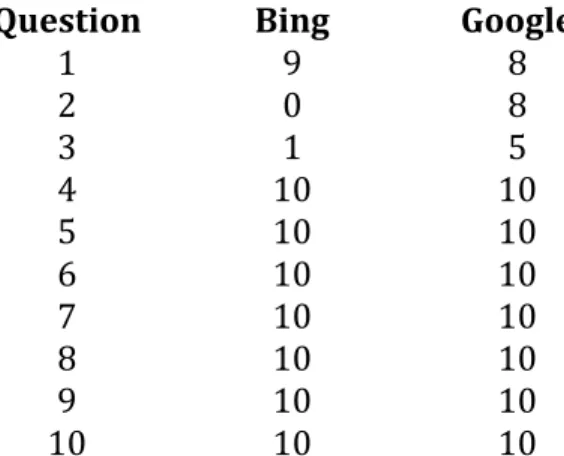
The number of correct answers was identified for the search engines Bing and Google using ten questions and tem templates for the questions.
Question Bing Google
1 9 8
2 0 8
3 1 5
4 10 10
5 10 10
6 10 10
7 10 10
8 10 10
9 10 10
10 10 10
Figure 3: Number of correct answers produced by search engines for each question. (Note: there are ten template variations for each question.)
correct answer, but for questions 1, 2 & 3, the templates generated 9,0 and 1 correct answer respectively.
The data also show how well each template performed across all questions. The exact templates performed accordingly:
Template # Correct Bing # Correct Google
T1 8 9
T2 8 9
T3 8 9
T4 8 7
T5 9 10
Figure 4: The number of queries for each exact template that generated a correct answer.
Comparisons were also run for the attribute templates and for the unit template. Note only one question could offer an attribute variation for template 3.
Arguments # Correct Bing
Google # Correct
A1 9 10
A2 8 10
A3 1 (out of 1) 1 (out of 1)
A5 8 10
Arguments # Correct Bing
Google # Correct
Qn 7 9
QnU 8 8
Figure 6: The number of queries that generated a correct answer when the question and the unit templates were used as a query.
To better understand these comparisons, it is necessary to identify which questions and which template variations showed correct answer differences between the two search engines.
Question Bing Google
1 T3 Q1
2 Q2, T1,T2,T3,T5,A1,A2,A5
3 T3,T5,A1,A2,A5
4 5 6 7 8 9 10
Figure 7: Chart showing which template variations yielded a correct answer for one search engine but not the other. (e.g., for Question 3: Google showed a correct answer for Template 3, and attribute templates 1-3, but Bing did not)
Between the two search engines it appears as if there are certain kinds of questions that are easier for Google to answer than Bing. Question 2, " What was the
rate for 1988?" may be facing similar issues. Bing found a correct answer with only one of the templates, while 5 templates generated a correct response using Google. One common theme between these two questions is that the answer requires associating a number with an attribute, but in order to parse the answer phrases, they have to be stated in a manner similar to the question. In contrast, questions like "What recording artist released the album "Thriller" in 1982?" has an answer
structure that is based more on relationships between entities and not only on a property of an object.
Since most questions and their variations provided correct answers by both Google and Bing, additional comparisons were needed.
Comparing Answer Ranks By Question
For each query, the placement of the first correct answer within the response page was measured. This value was the rank. The ranks were compared based on averages and standard deviations across questions and across templates. They were also compared across search engines.
ANOVA
Source of Variation SS d.f. MS F p-level F crit
Omega Sqr. Factor #1 (Engine) 3.34653 1 3.34653 3.12009 0.07901 5.50846 0.00761 Factor #2 (Question) 34.71823 9 3.85758 3.59655 0.00038 2.26385 0.08389 Factor #1 + #2 (Engine
x Question) 64.44892 9 7.16099 6.67643 0. 2.26385 0.18339 Within Groups 195.20909 182 1.07258
Total 297.72277 201 1.48121 Omega squared for
combined effect 0.27489
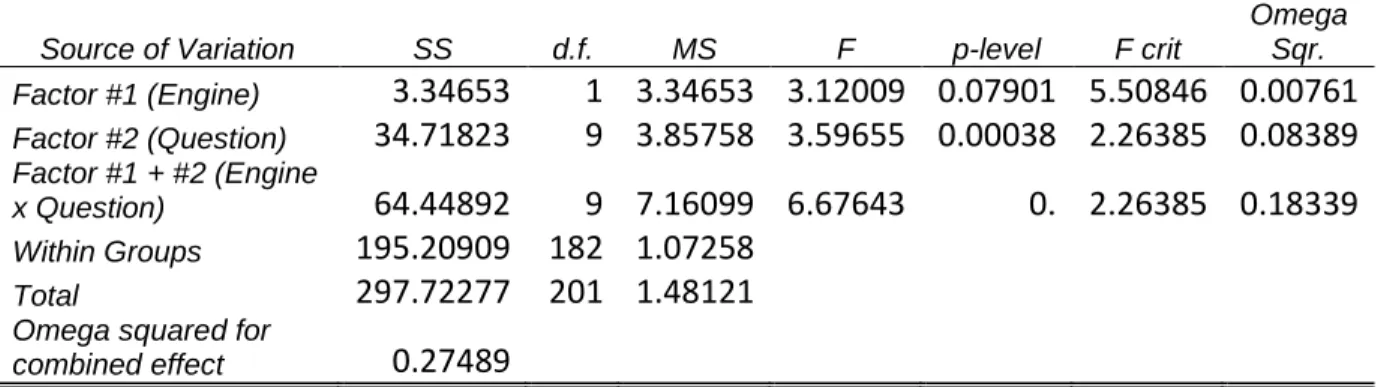
Figure 8: Two-way ANOVA comparing query rank by engines and questions
This two-way ANOVA shows that there is a significant difference in how the two search engines process some questions. The two factors individually are significant at the .05 level, but combined, the effect is even more pronounced.
Looking specifically at the question, one can see significant differences in rank for certain questions. In this figure, all the template ranks for each question were averaged together.
Google Rank By Question Bing Rank By Question
Question Mean SD Mean SD p-value t df
1 2.1 1.45 0.9 0.32 0.02* 2.56 18
2 1 0.67 0 0 0.002** 4.72 18
3 2.6 2.84 0 0 0.009** 2.89 18
4 1.09 0.3 1 0 0.36 0.95 18
5 1 0 2.3 1.95 0.05* 2.11 18
6 1.5 0.97 2.9 2.08 0.07 1.93 18
7 1 0 1.3 0.48 0.06 1.98 18
8 1.6 0.84 1.2 0.42 0.19 1.35 18
9 1 0 1.3 0.67 0.17 1.42 18
10 1.6 0.52 1 0 0.002** 3.65 18
Question Text
Q1 What was the monetary value of the Nobel Peace Prize in 1989? Q2 What was the target rate for M3 growth in 1992?
Q3 What large U.S. city had the highest murder rate for 1988?
Q4 What
nuclear-powered Russian submarinesank in the
Norwegian Sea on April 7, 1989?
Q5 What
two US biochemists won the Nobel Prize in medicine in
1992?
Q6 What was the price of a regular stamp in 1900?
Q7 What recording artist released the album "Thriller" in 1982? Q8 What actor won the "Best Actor" Oscar for his role in "Forrest Gump" in 1994?
Q9 What inventor created the cotton gin and got a patent in 1807? Q10 What was the leader of the Branch Davidian Cult confronted by the FBI in Waco, Texas in 1993?
Group vs. Group
(Contrast) p-level
Q01 vs. Q02 4.98882E-11
Q01 vs. Q03 4.98882E-11
Q02 vs. Q04 3.40838E-14
Q02 vs. Q05 0.
Q02 vs. Q06 0.00152
Q02 vs. Q07 0.
Q02 vs. Q08 4.98882E-11
Q02 vs. Q09 0.
Q02 vs. Q10 1.41775E-13
Q03 vs. Q04 3.40838E-14
Q03 vs. Q05 0.
Q03 vs. Q06 0.00152
Q03 vs. Q07 0.
Q03 vs. Q08 4.98882E-11
Q03 vs. Q09 0.
Q03 vs. Q10 1.41775E-13
Q04 vs. Q06 0.01233
Q06 vs. Q10 0.01694
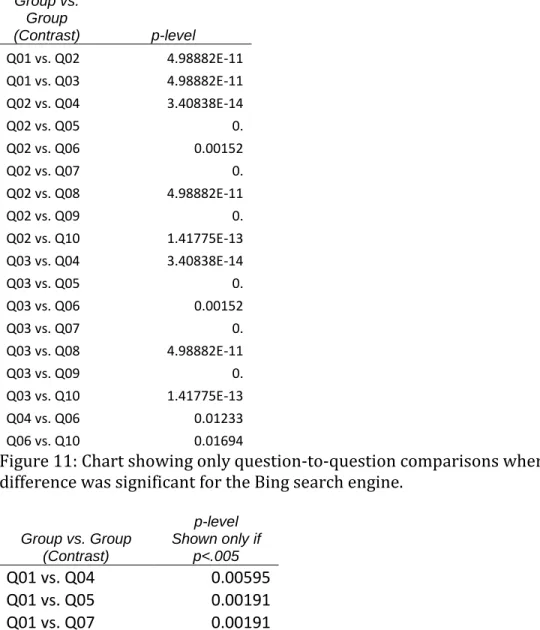
Figure 11: Chart showing only question-to-question comparisons where the difference was significant for the Bing search engine.
Group vs. Group (Contrast)
p-level Shown only if
p<.005
Q01 vs. Q04 0.00595
Q01 vs. Q05 0.00191
Q01 vs. Q07 0.00191
Q01 vs. Q09 0.00191
Q02 vs. Q03 0.00014
Q03 vs. Q04 0.
Q03 vs. Q05 4.71275E-11
Q03 vs. Q06 0.
Q03 vs. Q07 4.71275E-11
Q03 vs. Q08 0.00001
Q03 vs. Q09 4.71275E-11
Q03 vs. Q10 0.00014
Figure 12: Chart showing only question to question comparisons where the difference was significant for the Google search engine.
Group vs. Group (Contrast)
p-level Shown only if
p<0.05
Q01 vs. Q02 0.02358
Q01 vs. Q03 0.00033
Q01 vs. Q04 0.
Q01 vs. Q05 0.
Q01 vs. Q06 0.00054
Q01 vs. Q07 0.
Q01 vs. Q08 0.00375
Q01 vs. Q09 0.
Q01 vs. Q10 0.02358
Q02 vs. Q03 0.
Q02 vs. Q04 0.01081
Q02 vs. Q05 0.00342
Q02 vs. Q07 0.00342
Q02 vs. Q09 0.00342
Q03 vs. Q04 1.9984E-15
Q03 vs. Q05 4.44089E-16
Q03 vs. Q06 1.5193E-11
Q03 vs. Q07 4.44089E-16
Q03 vs. Q08 0.
Q03 vs. Q09 4.44089E-16
Q03 vs. Q10 0.
Q04 vs. Q08 0.05808
Q04 vs. Q10 0.01081
Q05 vs. Q08 0.02185
Q05 vs. Q10 0.00342
Q07 vs. Q08 0.02185
Q07 vs. Q10 0.00342
Q08 vs. Q09 0.02185
Q09 vs. Q10 0.00342
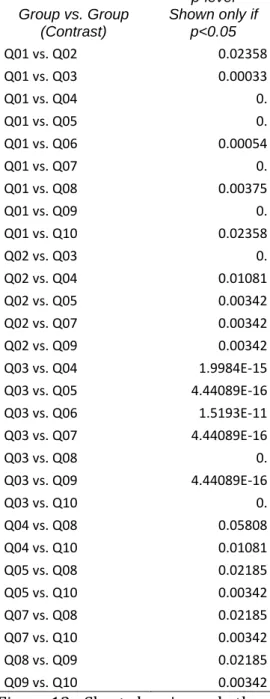
Figure 13: Chart showing only those question-Question comparisons that showed significant differences in rank between the Bing and Google search engine based on a two-way ANOVA .
However, there were no significant differences between Q4 and the other questions. Questions six, eight and ten were not statistically different from the other questions.
The main effect of the question on rank for Bing showed some significance (p= .000). While many of the questions were equally answerable, there were some pairs of questions that were different. Questions 1 & 5 (p=.045) and Questions 1 & 6 (p=.000). Questions 2 & 5 (p=.000), 2 & 6 (p=.000) and questions 2 & 7 (p=.045). The differences between question 3 and questions 5, 6 & 7 had the same significance values. There is a significant difference between question 4 and 6 (p=.001). There is a difference between question 5 and 1 (p=.045), 5 and 2 (p=.000), 5 and 3 (p=.000). There was a significant difference between question 6 and many others; 6 & 1, 6 & 2, 6 &3 (p=.000); 6 & 4 (p=.001); 6 & 7 (p=.023) and 6 & 9 (p=.011) and 6 & 10
(p=.001). Questions 6 & 8 were nearly significantly difference (p=.05). The
difference between question 7 and questions 2 & 3 were at p=.045. Questions 6 and 7 were different at a level of p=.023. Questions 8 & 6 were nearly different (p=.005). Question 10 & 6 were different as well (p=.001).
the other questions for Google. Additionally, the city with the highest murder rate in any particular year is not likely to be well-referenced or agreed upon, compared to a question about pop culture.
Comparing Answer Ranks By Template
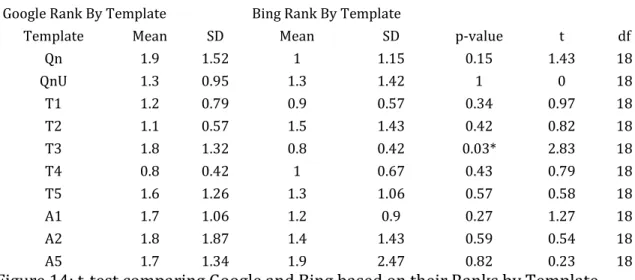
In order to compare the results between Google and Bing, it was necessary to perform t-tests to compare the mean and standard deviations of the templates and the questions. The comparisons revealed that there were significant differences between the mean and standard deviations for the ranks and scores of five out of the ten questions: questions 1, 2, 3, 5 and 10.
Google Rank By Template Bing Rank By Template
Template Mean SD Mean SD p-value t df
Qn 1.9 1.52 1 1.15 0.15 1.43 18
QnU 1.3 0.95 1.3 1.42 1 0 18
T1 1.2 0.79 0.9 0.57 0.34 0.97 18
T2 1.1 0.57 1.5 1.43 0.42 0.82 18
T3 1.8 1.32 0.8 0.42 0.03* 2.83 18
T4 0.8 0.42 1 0.67 0.43 0.79 18
T5 1.6 1.26 1.3 1.06 0.57 0.58 18
A1 1.7 1.06 1.2 0.9 0.27 1.27 18
A2 1.8 1.87 1.4 1.43 0.59 0.54 18
A5 1.7 1.34 1.9 2.47 0.82 0.23 18
Figure 14: t-test comparing Google and Bing based on their Ranks by Template
clearly a subject, verb and object of the sentence that is distinguished from the stop words. In contrast, template 3 combines all the argument into one complex chunk that the system has to parse through. It is possible that the structure of the sentence makes it less clear for the system how each part of the question is functioning syntactically and semantically.
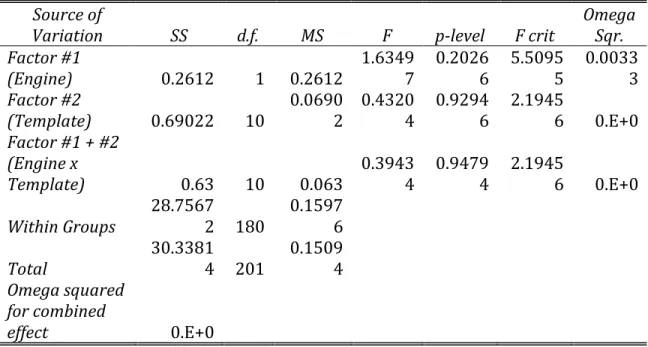
None of the ANOVA comparisons of templates showed any significant differences for rank. This was true for each of the search engines.
Comparing Answer Scores By Question
The answer ranks identified the first result number on the first page of the query that had the correct answer. The importance of this ordinal value can be illustrated by using a score. The score is the inverse of the rank. So, if the rank was 1 (i.e., the correct answer was shown in the first entry), then the score would be 1. If the rank was 2 (i.e., the correct answer was shown in the second entry), then the score would be 0.5.
ANOVA
Source of Variation SS d.f. MS F p-level F crit
Omeg a Sqr.
Factor #1 (Engine) 0.2612 1 0.2612 5.09798 0.02514
5.5084 6
0.0069 1
Factor #2 (Question)
16.0249
7 9
1.7805 5
34.7516
6 0.E+0
2.2638 5
0.5121 5 Factor #1 + #2 (Engine x
Question) 4.72693 9
0.5252 1 10.2507 9 9.98202 E-13 2.2638 5 0.1403 7
Within Groups 9.32504 182
0.0512 4
Total
30.3381
4 201
0.1509 4 Omega squared for
combined effect 0.65943
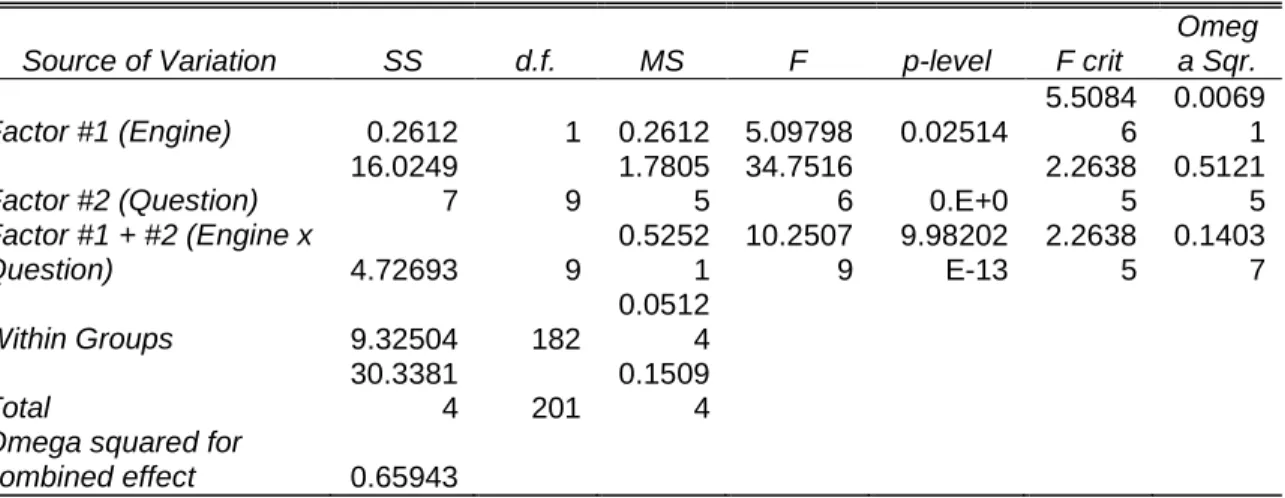
Figure 15: Two-Way ANOVA showing score values for each question comparing the search engines
Again, this indicates that there is a significant difference in the Score values between the two Engines. There is a significant difference in the Score values
among the Questions. That shows that the Engine type and the Questions interacted to a significant degree. Since the rank and the score are mathematically related, it makes sense that differences in ranks will translate to differences in scores. The ANOVAs show that both the search engine and the question create significant differences in the scores and ranks, and the effect is magnified when the effects are combined.
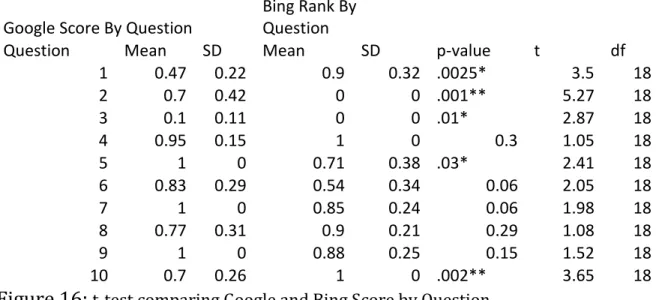
Google Score By Question Bing Rank By Question
Question Mean SD Mean SD p-value t df
1 0.47 0.22 0.9 0.32 .0025* 3.5 18
2 0.7 0.42 0 0 .001** 5.27 18
3 0.1 0.11 0 0 .01* 2.87 18
4 0.95 0.15 1 0 0.3 1.05 18
5 1 0 0.71 0.38 .03* 2.41 18
6 0.83 0.29 0.54 0.34 0.06 2.05 18
7 1 0 0.85 0.24 0.06 1.98 18
8 0.77 0.31 0.9 0.21 0.29 1.08 18
9 1 0 0.88 0.25 0.15 1.52 18
10 0.7 0.26 1 0 .002** 3.65 18
Figure 16:
t-test comparing Google and Bing Score by QuestionComparing Answer Score By Template
The query results by rank can also be compared looking at the templates across all the questions. This would provide information about how different semantic variations affect search results. Attribute and unit templates were also compared.
ANOVA
Source of
Variation SS d.f. MS F p-level F crit Omega Sqr.
Factor #1
(Engine) 0.2612 1 0.2612 1.63497 0.20266 5.50955 0.00333
Factor #2
(Template) 0.69022 10 0.06902 0.43204 0.92946 2.19456 0.E+0
Factor #1 + #2 (Engine x
Template) 0.63 10 0.063 0.39434 0.94794 2.19456 0.E+0
Within Groups 28.75672 180 0.15976
Total 30.33814 201 0.15094
Omega squared for combined
effect 0.E+0
Figure 17: Two-way ANOVA comparing templates for Google and Bing.
Google Score By
Template Bing Score By Template
Template Mean SD Mean SD p-value t df
Qn 0.6 0.38 0.63 0.49 0.87 0.16 18
QnU 0.58 0.4 0.72 0.45 0.47 0.74 18
T1 0.78 0.37 0.75 0.42 0.87 0.17 18
T2 0.8 0.35 0.57 0.41 0.19 1.35 18
T3 0.75 0.33 0.8 0.42 0.77 0.29 18
T4 0.8 0.42 0.7 0.42 0.6 0.53 18
T5 0.82 0.3 0.73 0.45 0.61 0.57 18
A1 0.76 0.32 0.63 0.42 0.45 0.78 18
A2 0.81 0.32 0.62 0.43 0.28 1.12 18
A5 0.8 0.33 0.63 0.48 0.37 0.92 18
Figure 18: t-test comparing Google and Bing Score by Template
The templates as chosen for this query did not have a noticeable impact on the retrieval output. The search engines appear to parse variations of questions in a way that is not impacted by the sentence structure.
Chapter 5 Recommendations and Conclusions
This study shed more light on the way that a user's natural language questions are processed. With varying query structures, I investigated whether users can address their information need in a more effective way by using query reformulation techniques. Additionally, I measured how using different search engines impacted the level of effort required by a user. One goal was to help users find the appropriate tools (e.g. query structure and search engine) for particular tasks.
This study measured search accuracy and answer location using a variety of queries based on semantic, linguistic and syntactic variations of natural language questions. By examining specific characteristics of the two web search engines, a goal was to identify those characteristics that could help users better structure their natural language queries to produce higher satisfaction with the results.
Impacts
just typing in a few keywords. According to Ozmutlu, Ozmutlu and Spink (2003), users are more inclined to use simpler queries than complex one, though their data suggests that some users prefer to enter questions rather than keyword queries. It is difficult to tell for sure, because there is a lack of research on how users specifically create queries. Additionally, the data is limited because it is over ten years old, and lacks data from Google. It is one example of a question type that is not easily
accessible by Google even if the query is adequate. This is very frustrating to users. While well documented people and events are more popular search terms, users still want to be able to rely on Google for more difficult questions. This study could be generalized to an investigation of other search engines and text retrieval systems. It might encourage the designers of other text retrieval systems to consider
implementing more or different natural language parsers.
Keyword search has been a tremendous boon to information access because while there are many documents available by searching the World Wide Web, it is also possible to retrieve a great deal of them just by typing in a few keywords. Whether your search is motivated by a complex problem or question or just a desire to learn an interesting factoid, the information is at your fingertips. However,
Limitations
A major weakness in this study is inherited from previous TREC studies. Their questions (and by inheritance my own) were not necessarily meant to simulate real user behavior. So, while some of the questions (like those from the FAQ Finder logs) were asked by undergraduate students invested in the question-answering search, many more were created to facilitate TREC's research (Voorhees and Tice, 2000). As such, my questions may not be generalizable to the public. This study could also be limited because some of the TREC factoid question answers are not totally consistent. They do not all follow the same format or utilize the same specificity. In other cases, they might differ relative to their content. For example, question 4.2 asks when James Dean passed away. Some answers say he died in September 1955, or just 1955. Others say he died in 1965 or 1995. I chose questions where there was general agreement among the answers in the answer set.
Additionally, neither the question variations nor their answers are validated since I will create the variations. Based on the questions I designed, the main limitation is that the answers were not validated in a systematic way. Another potential problem is that the scores did not distinguish between whether the answer is in the snippet or the document. For Google, most of the answers appeared in the snippet, and it was not until I ran queries with Bing that I noticed a discrepancy.
Summary:
for classification at the current moment, it will likely be helpful to expand that emphasis by using insight about the semantic relationships within the sentences, and properties of the answers. For example, information about a music album can be parsed into a semantic triple: album artist, title and the release year. While answers to other questions can be similarly represented, the information is more difficult to find because it may not be as closely linked to well-documented events, and sources may agree less on the answers to certain questions. The question about the highest murder rate of a large city in 1988 is particularly difficult in this regard. Many sources suggested that Albany, Georgia was the correct answer, but I rated those incorrect because it did not match the TREC answer. Somewhere, the most correct answer is recorded, but that value is likely not as common a search query as popular culture, and based on the results of both Bing and Google, it is clearly not as well indexed as other categories of information. Names of people and places are culturally salient and easy to find because people associate emotions with entities like these. Tom Hanks is a well-known actor and his role in "Forrest Gump" helped solidify his status in Hollywood. In contrast, numbers are often more difficult to remember and do not have the same emotional meaning. Question seven about Michael Jackson is answered easily not just because Michael Jackson was an immensely popular artist, but also because that information is presented in many different documents and many different formats. Other questions containing references to well-known events, like Oscar-winning actors and famous inventions were similarly well-answered by Google and Bing. It should probably not be
easily. It would be worth exploring whether one could systematically impact retrieval by manipulating different knowledge representations. Perhaps one could leverage the semantic web technology of creating semantic triples and putting them into a graph structure as a way of precisely locating answers to different questions. Additionally, if there were a way to use the question classification system for
popular answers and train it with questions that are more difficult, that could be an important step in the right direction. Question answer systems like the one
described by Kwok et al are different than web search engines because unlike
Google and Bing, Mulder and others are built with question answering in mind. They are calibrated to find the best answer to a question, while Google and Bing seem to be more concerned with finding information that addresses one's information need. One of the most important factors for retrieval with these systems is the type of information need one has. They are calibrated to answer certain questions, like those about pop culture, restaurants & entertainment and sports, rather than ones about less salient historical or political details. That is why although using certain templates may seem to make an impact, it is negligent compared to the effect that asking the right question has. Additionally, whether the result appears in the snippet of the document was noticeably different whether I used Bing or Google. With Google, most of the result snippets contained the answers, while Bing’s results more frequently showed up in the document itself than the snippet.
Conclusion
substantial effect on the results that are retrieved, the types of questions one asks do impact the rank (i.e., the location of the answer in the list of search results) and score (i.e., the inverse of the rank order) of the answers to questions. This was true for both Google and Bing.
Other evidence shows that questions about culturally salient topics like pop culture and important historical events where names occur are more likely to be answered correctly and early in the results listing than obscure data containing numbers and statistics, because these events are more thoroughly documented and there is more interest in retaining that knowledge. Numbers and statistics may be important to give context, but most people care more about the overall story than the details; therefore, the pages are indexed to favor those kinds of information, so users ought to use different search engines or change their approach to their search (i.e. using an encyclopedia, or starting with resources that focus on a specific
content area).
References
Abney, S., Collins, M., & Singhal, A. (2000). Answer Extraction. Applied Natural Language Processing (ANLP): Proceedings of the Conference. 2000. , 6, 296-301. Retrieved March 15, 2013, from http://www.vinartus.net/spa/99f.pdf
Agichtein, E., Lawrence, S., & Gravano, L. (2001). Learning search engine specific query transformations for question answering. Proceedings of WWW10, 10, 169-178. Retrieved October 20, 2012, from
http://web3.cs.columbia.edu/~gravano/Papers/2001/www10.pdf
Buscaldi, D., Rosso, P., Gómez-Soriano, J. M., & Sanchis, E. (2010). Answering questions with an n-gram based passage retrieval engine. Journal of Intelligent Information Systems, 34, 113-134. Retrieved March 14, 2013, from
http://link.springer.com.libproxy.lib.unc.edu/article/10.1007/s10844-009-0082-y/fulltext.html
Al-Maskari, A., & Sanderson, M. (2010). A review of factors influencing user satisfaction in information retrieval. Journal of the American Society for Information Science and Technology, 61(January 2010), 859-868. Retrieved November 15, 2012, from
http://dblp.uni-trier.de/db/journals/jasis/jasis61.html#Al-MaskariS10
CELEX. (n.d.). Celex. Celex readme. Retrieved March 16, 2013, from www.
Ferret, O., Grau, B., Hurault-Plantet, M., Illouz, G., Jacquemin, C., Monceaux, L., et al. (2002). How NLP can improve question answering. Revue Knowledge Organization, 29(3), 135-155. Retrieved March 10, 2013, from
http://perso.limsi.fr/Individu/bg/pageWebPHP/fichiers/GrauKO02.pdf
Grau, B., Ferret, O., Hurault-Plantet, M., Jacquemin, C., Monceaux, L., Robba, I., et al. (2006). Coping With Alternate Formulations Of Questions And Answers.
Advances in Open Domain Question Answering (pp. 189-226). Houten: Springer Netherlands.
Hirschman, L., & Gaizauskas, R. (2001). Natural language question answering: the view from here. Natural Language Engineering, 7(4), 275-300. Retrieved March 5, 2013, from
http://www.loria.fr/~gardent/applicationsTAL/papers/jnle-qa.pdf
Huang, Z., Thint, M., & Qin, Z. (2008). Question Classification using Head Words and their Hypernyms. Proceedings of the 2008 Conference on Empirical Methods in Natural Language Processing , 5, 927-936. Retrieved March 12, 2013, from
http://www.aclweb.org/anthology-new/D/D08/D08-1097.pdf
Jacquemin, C. (1999). Syntagmatic and Paradigmatic Representations of Term Variation. Proceedings of the 37th Annual Meeting of the Association for Computational Linguistics, 37, 341-348. Retrieved March 15, 2013, from
http://aclweb.org/anthology-new/P/P99/P99-1044.pdf
Joachims, T., Granka, L., Pan, B., Hembrooke, H., & Gay, G. (2005). Accurately
Interpreting Clickthrough Data as Implicit Feedback. Proceedings of the ACM Conference on Research and Development on Information Retrieval (SIGIR) ,
http://ils.unc.edu/courses/2013_spring/inls509_001/papers/Joachims05.p
df
Kwok, C., Etzioni, O., & Weld, D. (2001). Scaling question answering to the Web.
Tenth International World Wide Web Conference (WWW-10), 10, 1-22. Retrieved March 1, 2013, from
http://homes.cs.washington.edu/~etzioni/papers/p150-kwok.pdf
Li, X., & Roth, D. (2002). Learning Question Classifiers. Proceedings of the
international conference on Computational linguistics, 19, 1-7. Retrieved March 13, 2013, from
http://acl.ldc.upenn.edu/coling2002/proceedings/data/area-11/co-384.pdf
Moldovan, D., Harabagiu, S., Pasca, M., Mihalcea, R., Goodrum, R., Girju, R., et al. (1999). LASSO: A tool for surfing the answer net. Proceedings of TREC 8, 8, 175-184. Retrieved March 13, 2013, from
http://trec.nist.gov/pubs/trec8/papers/smu.pdf
Nguyen, T. T., Nguyen, M. L., & Shimazu, A. (2008). Using semi-supervised learning for question classification. Information and Media Technologies, 3(1), 3-21. Retrieved March 15, 2013, from
https://www.jstage.jst.go.jp/article/imt/3/1/3_1_112/_pdf
Ong, C., Day, M., & Hsu, W. (2009). The measurement of user satisfaction with question answering systems. Information & Management, 46, 397-403. Retrieved November 12, 2012, from
http://lms.ctl.cyut.edu.tw/sysdata/55/12655
April 1, 2013, from
http://www.emeraldinsight.com.libproxy.lib.unc.edu/journals.htm?issn=14
68-4527&volume=27&issue=6&articleid=862233&show=html
Soricut, R., & Brill, E. (2006). Automatic question answering using the web: Beyond the factoid. Information Retrieval, 9(2), 191-206. Retrieved October 25, 2012, from
http://acl.ldc.upenn.edu/hlt-naacl2004/main/pdf/104_Paper.pdf
Voorhees, E., & Tice, D. (2000). Building a question answering test collection.