Melanie A Sturgeon. Marketing to an Engineering School: Promotion of Library Resources, Services and the Subject Librarian. A Master’s Paper for the M.S. in L.S degree. April, 2012. 74 pages. Advisor: Rebecca Vargha
The communication between the library and the school of engineering needed to be reestablished a few years after the dedicated engineering library was consolidated with the main library at a small private research university. To accomplish this, a marketing plan was developed to promote available library resources and services including the engineering reference librarian to the engineering students and faculty. The plan was developed by following the steps of a business marketing plan that was adapted for non-profit service organizations. These steps included identifying the target user groups, evaluating the status quo with a SWOT analysis and using a Qualtrics web survey to further understand and define the user groups and their needs. The information from the market analysis was then used to create a promotional marketing program aimed to influence engineering students, faculty and staff to increase the use of library services and improve information literacy.
Headings:
Academic libraries -- Mergers Engineering libraries
Information literacy Libraries & propaganda Libraries -- Marketing
MARKETING TO AN ENGINEERING SCHOOL: PROMOTION OF LIBRARY RESOURCES, SERVICES AND THE SUBJECT LIBRARIAN
by
Melanie A. Sturgeon
A Master’s paper submitted to the faculty of the School of Information and Library Science of the University of North Carolina at Chapel Hill
in partial fulfillment of the requirements for the degree of Master of Science in
Library Science.
Chapel Hill, North Carolina April 2012
Approved by
Table of Contents
Table of Figures ... 3
Acknowledgements ... 4
Introduction ... 5
Background ... 5
Project Aims... 6
Literature Review... 7
Library Consolidation & Mergers ... 7
Engineers & Engineering Libraries ... 8
Information Literacy for Engineers ... 10
Marketing & Promotion ... 11
Methodology ... 13
Step One – Market Segmentation ... 13
Step Two – Marketing Positioning ... 15
Step Three – Consumer Analysis ... 16
Step Four – Marketing Program ... 17
Product. ... 18
Price. ... 19
Promotion. ... 19
Place. ... 20
People. ... 21
Process. ... 21
Physical evidence. ... 22
Results ... 24
SWOT Analysis ... 24
Survey Findings ... 25
Library... 27
Resources. ... 28
Services. ... 32
Engineering librarian. ... 35
Consolidation of engineering library. ... 36
Marketing Program ... 39
Future Study ... 43
Conclusion ... 45
Appendix A – Summary of ACRL Standards... 47
Appendix B – Email to Listserv... 49
Appendix C – Reminder Email to Listserv ... 50
Appendix D – Qualtrics Survey ... 50
Appendix E – Suggestions from the Survey Open Text ... 65
Appendix F – Promotional Email ... 66
Appendix G – Promotional Document ... 67
Table of Figures
Figure 1: SWOT Analysis ... 15
Figure 2: Four P's ... 17
Figure 3: Seven P's ... 18
Figure 4: Promotional Building Blocks ... 20
Figure 5: Promotion through people example ... 21
Figure 6: Marketing Cycle ... 23
Figure 7: Completed SWOT Table ... 25
Figure 8: Survey Response by User Group... 26
Figure 9: Graduate Student Survey Responses ... 26
Figure 10: Q - Tour of main library ... 27
Figure 11: Q - Visits to library in past month ... 27
Figure 12: Q - Reasons for visiting Lib ... 28
Figure 13: Q - Use of Scholarly articles ... 29
Figure 14: Q - Do you know how to search for patents? ... 29
Figure 15: Q - Do you know how to find current standards? ... 30
Figure 16: Q - Are you familiar with ISI Web of Science? ... 30
Figure 17: Q - Are you familiar with Ulrichs for finding information on journals? ... 30
Figure 18: Q - What citation style / formatting do you use (or assign) most frequently? 31 Figure 19: Q - Do you use a bibliographic (citation) management ... 31
Figure 20: Q - What bibliographic (citation) management software do you prefer?... 32
Figure 21: Q - Have you used "Ask a Librarian" to get help? ... 33
Figure 22: Q - Are you familiar with the Engineering Subject Guides? ... 34
Figure 23: Q - Have you worked with a librarian for the following tasks? ... 34
Figure 24: Q - Have you worked with a librarian to have in-class instruction? ... 35
Figure 25: Q – Did you know there is an engineering reference librarian? ... 35
Figure 26: Awareness of engineering reference librarian by user group ... 36
Figure 27: Q - Did you ever use the Engineering Library? ... 37
Figure 28: Q - Do you think the same level of service is offered? ... 37
Figure 29: Q - What do you miss about the Engineering Library? ... 38
Acknowledgements
The author wishes to thank the engineering librarian and the school of engineering for their time and honesty. Many thanks are also due to Rebecca Vargah for having the conviction and confidence that this project could be done, and for providing feedback and encouragement throughout the production of this paper. Recognition and appreciation are also given to Lara Bailey for her continuous support and assistance throughout the SILS masters journey, and to my fellow GA’s at both UNC and NCSU for the
Introduction
Background
With constant pressure on budgets in today’s economy, universities are forced to constantly re-evaluate library services in order to best meet the goals of the library and university while meeting budget constraints. An area that has consistently been in the middle of these discussions is the opposing theories of using a consolidated library approach or branch libraries. Evolution of technology has made strong arguments for both models of service, however more and more branch libraries are being closed and consolidated as a cost savings measure. Much of the research that has been done on these consolidation projects at universities included lessons learned, best practices and things to avoid. One of the main takeaway points is the importance of communication between the previous specialized user group that a branch library served and the new consolidated library.
Project Aims
Literature Review
Library Consolidation & Mergers
The topic of branch libraries and consolidation is so prominent in library science that there are official guidelines for how to evaluate a branch library by the Association of College and Research Libraries (ACRL 1991). These guidelines are discussed and examined with case studies by Madison, Fry and Gregory (1994). The documentation includes a methodology for reviewing the branch in terms of meeting university goals and determining if a centralized or decentralized library system would be better suited. Byrne and Mood (1994) also discuss the criteria for the consolidation of branch libraries. In addition to reviewing the steps, they also address the inconvenience to primary users.
Lessin (2001) reviews the specific challenges and potential advantages of mergers for science and technology libraries. Poland also discusses the integration of science and technology libraries (1999) and address important things to consider such as the unique identity of each library and its users along with addressing user and staff concerns and establishing new communication patterns. The examination of a library merger at Cornell University provides the backdrop for the lessons that were learned and are discussed in detail with recommendations. Czechowski, Barger, Fort and Maxeiner (2010) discuss a case study of a branch library closing at the University of Pittsburgh. They include the steps followed, lessons learned and some advice for those who are facing similar difficult decisions. The most recent research was conducted at the
University of North Carolina (Barden et al, 2011) during an evaluation to determine if the four science libraries should be consolidated. The UNC Science Libraries Task Force discovered that the science library patrons were likely to frequent more than one of the science libraries, thereby supporting the merger of science materials. The report also reflected on the task of evaluating the branch libraries, especially in a tight time frame, and provided recommendations for future undertakings.
Engineers & Engineering Libraries
applications, information competencies and management. This collection of articles is not only an emphasis on what library products and services are needed for engineering students, but also what skills engineering students need to possess for industry today. These skills consist of knowing how to find engineering journals and scholarly articles along with the use of patents, safety and industry standards and guidelines for publication and the use of technology. Also in 2001, Ackerson presented findings on challenges specific to engineering libraries. This includes two case studies to illustrate the problems of research and education in a field where the volume of information and the
advancement of technology has become overwhelming.
New research released in 2011 (Engle, Robbins and Kulp) focused on the engineering faculty. They reviewed how the faculty finds and shares information along with the tasks they are doing that requires the information seeking. The data is further broken down into specific engineering disciplines and looks for ways to promote library services to the faculty along with improving collection development to support the faculty’s research.
Information Literacy for Engineers
The topic of information literacy for science and engineering has become
increasing prevalent over the last decade. Palmer and Tucker (2004) studied how to plan, deliver and evaluate training for information literacy with engineering students. They discuss their types of outreach and what had the most successful results. Also in 2004, Finn and Johnston did a survey about the information literacy skills of engineering graduate students and faculty in regards to using indexes and other primary sources. The ACRL released a new version of their information literacy standards in 2006 that are specific to science and engineering technology. A summary of these standards can be seen in Appendix A.
The new standards have focused much of the engineering and science
information literacy skills and actual skills for science and engineering students was studied by Simard in 2009. She used her research to develop a learner-centered program for both undergraduate and graduate students. A main lesson learned was the importance of support from the faculty. Fosmire (2012) also worked on developing an information literacy model for engineering students. He focused on an integrated concept that was based on active learning with the students and faculty.
Marketing & Promotion
The idea of marketing a library has been around since the 1870’s with Melvin Dewey and other founders of library science as Renborg pointed out in 1997. How the need for marketing a library has evolved to the point of being considered essential is discussed by Dempsey (2009). She includes an overview of the marketing life cycle from business literature and how it applies to libraries with specific examples for developing the marketing plan and brainstorming ideas for promotion. Also in 2009, Islam & Islam did a theoretical analysis of marketing not just the library but also the information products and services. Their approach is based on the addition to the standard business marketing plan to include a non-profit customer service orientated model. Islam & Islam tailor this further for information services and library needs with revised steps and considerations. Helinksy (2008) takes a different approach to the business marketing platform, and discusses marketing the librarians instead of marketing the library. She emphasizes expertise, visibility and the importance of personalizing the experience for the user.
customer service and user satisfaction is provided by Cundari and Stutz (1995) in a proposal to use the business concept of Total Quality Management (TQM) to meet customer needs.
While marketing literature for libraries has focused on public libraries, Gupta (1998, 2002, 2003, 2007, and 2009) has been studying the use and implementation of marketing in academic libraries for the last many years. Academic libraries have been slow to embrace the need for marketing as the library was always considered an essential part of the university. However, trends for accountability and proof of value in regards to the allocation of budgets have increased the need for marketing the academic library. Empey and Black (2005) utilize the American Library Association’s (ALA) “@ your library” marketing platform for their first venture into marketing the libraries at University of Northern British Columbia. This “@ your library” platform has been further developed into a toolkit for academic and research libraries by the ACRL (2007).
Methodology
While multiple traditional marketing plans can lend themselves to libraries, the plan proposed by Islam & Islam (2009) takes into account that the library does not only have library products to market but also the services that the librarians provides. It was this type of marketing plan that was followed as the methodology for this project. Islam & Islam, referencing prior work by Mishra (1994-5), use five basic steps to create a marking plan for libraries and information services:
1. Market segmentation 2. Market positioning 3. Consumer analysis 4. Marketing program 5. Marketing audit
Step One – Market Segmentation
The school of engineering is already a segmentation of the university, with a many traits attributed to the population as discovered in the literature review about engineers and engineering students. Further segmentation could be divided school of engineer into a variety of populations; including by major, level or by nationality. For this project, the focus was on the graduate students at the school of engineering and employees at the school of engineering. This decision of how to segment the population was based on the research available and prior studies done. Each of these groups can be further defined as:
• School of Engineering Graduate Students o Masters Students
o Doctoral Students o Researchers
• School of Engineering Employees o Staff
o Faculty
Step Two – Marketing Positioning
In order to create a new marketing plan for the user groups, it was crucial to have a clear understanding of the status quo. This includes defining the products and services currently offered along with what is missing and where else potential users can go for the information. Standard marketing principles from business theory have a variety of templates for doing this analysis. These techniques include:
• SWOT – Strengths, Weaknesses, Opportunities, Threats
• PEST – Political, Economic, Socio-cultural, Technological
• Porter’s five forces analysis
• Boston matrix
• Ansoff’s matrix
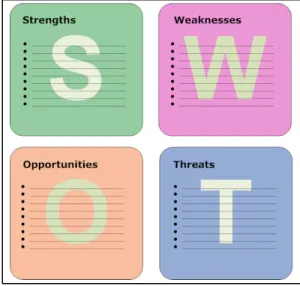
SWOT is probably the most well-known of the techniques, and it is also one that is the most applicable to analyzing the relationship between the academic library and the school of engineering. The basic format for performing a SWOT is shown in Figure 1.
This table was filled out with information gathered during interviews with the engineering librarian, along with a thorough review of resources and services available at the library and through the library’s website. This was combined with lessons learned during the literature review to achieve a complete appreciation of the current situation.
Step Three – Consumer Analysis
In order to gain a better understanding of the defined user groups and gather data on their current use and perception of library products and services, a survey was
conducted. This review was done by the means of an optional Qualtrics web survey sent to the school of engineering graduate students, researchers, staff and faculty via the listserv. See Appendix B for the survey cover letter email, Appendix C for the reminder email and Appendix D for the survey.
The survey was designed to collect both quantitative and qualitative data through a mix of open ended and closed questions. Qualtrics integrates the use of survey logic, where the questions asked depend on the answers of previous questions. This allows for an easier way to focus the information gathered by affiliation and subject. It also means that the survey length is minimized since users are only faced with questions relevant to them. This results in less time needed to complete the survey and therefore reduces the burden on the subjects. The survey was designed to take less than ten minutes. There were a total of fifty-three questions, with a maximum of forty-four questions that any one participant could be faced with.
the SWOT analysis. The basic areas being studied were the knowledge and use of the library as place, resources available and services offered. All questions were phrased and biased to focus on information gleaned in the literature review about how engineers use information and what information they need. Specific questions were also asked about the loss of the engineering library and familiarity with the engineering librarian.
Step Four – Marketing Program
After the survey was completed, the results were downloaded into excel and
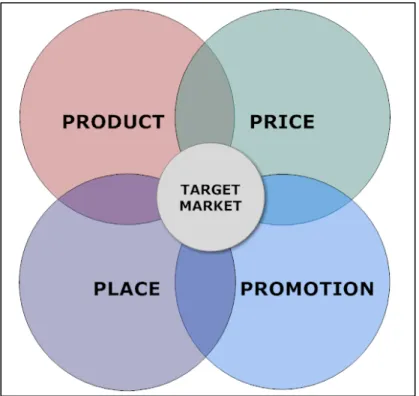
statistically analyzed for areas of significance and correlating factors from the data to aid in the creation of a marketing program. This is also known as the marketing mix. Traditionally, this step is most commonly known as the ‘four P’s’ (Dempsey, 2009) as shown in Figure 2.
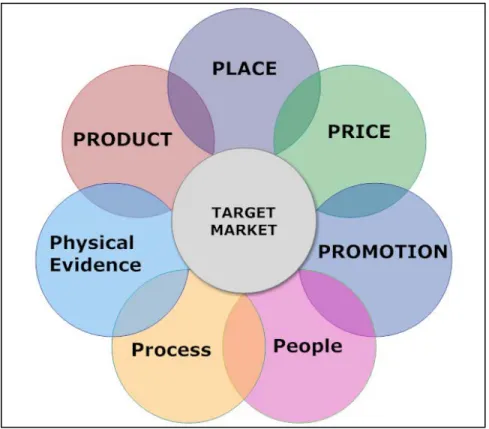
However, there is an expansion to that model for customer service industries that is known as the ‘seven P’s’ (Islam & Islam, 2009) and it was decided that this approach would be more useful in meeting the project’s goals. Therefore the seven P’s were used as seen in Figure 3.
Figure 3: Seven P's
Product.
staff and faculty in regards to assignments, in-class instruction and assistance with personal research.
Price.
The price, in regards to the students is not defined in terms of money (anything along that line would be covered in their tuition) but instead is defined as the amount of time and effort that the engineering students are willing to invest in using the “product” offered and if it is worth it. The same is true for faculty, where time is important for both their own research and for questions on assignments that they receive during office hours, through emails, and in class questions, on basic information literacy that could be
covered by the librarian.
Promotion.
Promotion is the main component of marketing program step that this project focuses on. Promotion is a term that is often confused with marketing, yet it is a distinct part of marketing. According to Dempsey (2009), promotion is, “the actions and
techniques you use to develop or increase the demand for a product or service. The goal is that the information gleaned in analyzing the Qualtrics data, from the consumer analysis, step will allow for a specific promotional campaign for the engineering reference librarian and services that will not only appeal to the engineering graduate students, researchers, staff and faculty, but also be useful and produce results.
giveaways, brochures, advertisement and many other creative ways to promote the library. An example of a possible promotion campaign is illustrated Figure 4 (Mathews, 2001).
Figure 4: Promotional Building Blocks
Place.
People.
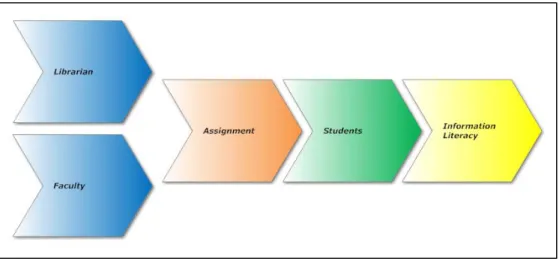
The people for this marketing plan are both the target users as well as the librarians. The interaction of the people is part of the promotion. An example is if the faculty and librarian collaborate on an assignment for students as illustrated in Figure 5. The librarian and faculty and staff all become involved with providing experience in information literacy for engineers.
Figure 5: Promotion through people example
Process.
Physical evidence.
Physical evidence is feedback to the marketing promotion. Examples of this include word of mouth, buzz, recommendations and referrals. One of the best ways to promote, especially with the known information behavior of engineers, is through peers and colleagues.
Step Five – Marketing Audit
Finally, step five of the marketing plan is taking an unbiased appraisal of the marketing program. This includes gathering information on the success (or failure) of the campaign. Evaluating if the goals and objectives of the project were met is crucial, as well as understanding what worked in achieving those goals or what could have been done better. Therefore it will be necessary for this marketing audit to be completed after the implementation of the marketing program. Due to the limitations of this specific project, this final step can be conducted by the university librarians at a future date.
As part of the cyclic nature of the marketing life cycle, as shown in Figure 6, the data gathered will need to be used to improve the process and refine the marketing plan. Another survey of students and faculty may need to be conducted to determine
Figure 6: Marketing Cycle
Results
The five steps of the methodology were followed to create a marketing plan. For this project, the goal is to reach the point of recommending a promotional marketing campaign to target the user groups, with the rest of the plan being implemented at a future date by the librarians at the university. The analysis, results and finding from the tasks involved in the five steps are described below, along with a discussion of the lessons learned and how that shaped the marketing plan.
SWOT Analysis
The SWOT table was filled out by taking into account the strengths, weaknesses, opportunities and threats that the university library, and the engineering librarian,
Figure 7: Completed SWOT Table
Survey Findings
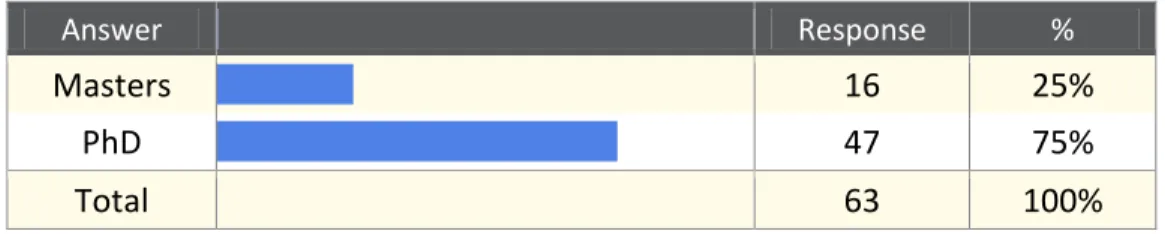
survey closed, totaling ninety-eight responses. This was approximately an 11% response rate spread across the user groups as shown in Figure 8. A further breakdown of the graduate students is shown in Figure 9.
Answer Response %
Graduate
Student 64 65%
Researcher 1 1%
Staff 7 7%
Faculty 26 27%
Total 98 100%
Figure 8: Survey Response by User Group
Answer Response %
Masters 16 25%
PhD 47 75%
Total 63 100%
Figure 9: Graduate Student Survey Responses
Library.
The first area of interest had to do with familiarity and use of the main university library. A surprising number of people had never been on a tour of the library, as seen in Figure 10. This was unexpected as it was believed that tours were given as part of orientation. Therefore, this identified a gap in perception and need that can be addressed and improved upon.
Answer Response %
Yes 19 19%
No 79 81%
Total 98 100%
Figure 10: Q - Tour of main library
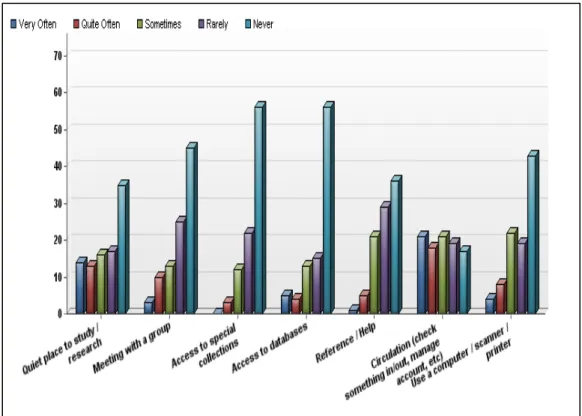
The survey also addressed frequency of visits to one of the university’s libraries (Figure 11) and the reasons for visiting the libraries shown in Figure 12. This information is helpful to better understand the needs and habits of the user groups, as well as supplying information on location for some of the promotional materials.
Answer Response %
0 18 19%
1-2 33 34%
3-6 27 28%
7-14 13 13%
15+ 6 6%
Total 97 100%
Figure 12: Q - Reasons for visiting Lib
Resources.
The next area studied in the survey was the use of resources. Information was gathered about the use of print journals, engineering databases and knowledge about ILL and request to purchase materials. The data did not reveal anything significant or
unexpected. However, questions about the use of scholarly articles proved interesting. There is a notion that engineering students do not need or use scholarly articles, as revealed in the literature review. As shown in Figure 13, the use of scholarly journals was plotted for graduate students in regards to their current practices and their
Figure 13: Q - Use of Scholarly articles
Some resources that engineers are known for using were also explored. These include patents and industry / government standards. The results of these two areas are shown in Figures 14 & 15. While the ability to search for patents was relatively high, there is still room for improvement in communicating how to find these resources and the industry / government standards.
Answer Response %
Yes 37 59%
No 26 41%
Total 63 100%
Figure 14: Q - Do you know how to search for patents
0 5 10 15 20 25 30 Never Less than Once a Month Once a MonthTimes a2-3
Month Once a
Week Times a2-3 Week
Daily
Graduate
Answer Response %
Yes 16 25%
No 47 75%
Total 63 100%
Figure 15: Q - Do you know how to find current engineering industry / government standards
Other resources that might be helpful to engineering students are tools for journal rankings and citations. Familiarity with ISI Web of Science and Ulrichs were reviewed.
Answer Response %
Yes 35 56%
No 17 27%
Not Sure 11 17%
Total 63 100%
Figure 16: Q - Are you familiar with ISI Web of Science for finding journal rankings and citations?
Answer Response %
Yes 1 2%
No 57 90%
Not Sure 5 8%
Total 63 100%
Figure 17: Q - Are you familiar with Ulrichs for finding information on journals?
standard that the library does not currently offer many resources on, whereas APA and MLA were expected to be the most frequently used.
Answer Response %
ACS 18 24%
APA 22 29%
Chicago 8 11%
CSE 2 3%
MLA 23 31%
Turabian 2 3%
Total 75 100%
Figure 18: Q - What citation style / formatting do you use (or assign) most frequently?
There are a variety of programs that can be used to help manage all the bibliographic data that is collected during research. Most databases allow for direct exportation of the article citation to the program. These programs then format the articles correctly to the chosen standard, and help create the bibliography. This is a powerful tool that engineers can utilize to organize and manage their research. The library and
librarians offer a variety of information, tutorials and instructional classes on some of the popular programs. Figure 19 shows how many of the respondents take advantage of one of these programs. The choice of program is then illustrated in Figure 20.
Answer Response %
Yes 59 63%
No 31 33%
Not sure 4 4%
Total 94 100%
Figure 20: Q - What bibliographic (citation) management software do you prefer?
Majority of the ‘other’ response was a program called “BibTex”. This citation information was very useful for comparing to which programs the library offers information and instruction about. For example, the main programs with library resources are RefWorks and EndNote, yet none of the respondents use RefWorks. Understanding these differences can be used as opportunities for the promotional awareness campaign.
Services.
The next section focused on awareness and use of library services. There is an impressive list of services available to both students and faculty. The main ones
addressed are reference help, knowledge of subject guides and collaboration between the faculty and librarian.
about satisfaction of the reference services and if the user would recommend the reference service to peers or colleagues had more positive results. The categories of “Ask a Librarian” of IM/Chat, Phone and Research Consultation were all 100% for recommendation. Email was the only category that was not; with a rate of 89% of positive recommendation.
Figure 21: Q - Have you used "Ask a Librarian" to get help?
Figure 22: Q – Are you familiar with the Engineering Subject Guides?
The other group of services the library and engineering library have are geared towards faculty and staff. The goal of these resources is to assist faculty with various library related tasks. The utilization of this collaboration for different tasks is seen in Figure 23. The in-class instruction by a librarian is further broken down by topic in Figure 24.
Figure 24: Q – Have you worked with a librarian to have in-class instruction for the following?
Engineering librarian.
One of the most important things that the survey exposed was that majority of respondents did not know that there was an engineering reference librarian. This is shown in Figure 25, and broken down by user group in Figure 26.
Answer Response %
Yes 44 46%
No 51 54%
Total 95 100%
Figure 26: Awareness of engineering reference librarian by user group
The engineering librarian is the most important resource that the library has to offer the school of engineering. It is this librarian that helps create and support all the other services in addition to the collection development of the engineering resources. This lack of awareness is evidence of the lost communication between the library and school of engineering.
Consolidation of engineering library.
The engineering library was merged into the main university library a few years ago, and while the effect of that is noticeable to the librarian, some of the user groups are not even aware that there previously was a specific engineering library located in the main school of engineering building. Figure 27 illustrates the breakdown of those patrons that used the engineering library.
0 5 10 15 20 25 30
Researcher Staff Faculty Masters PhD
Figure 27: Q - Did you ever use the Engineering Library?
Of the forty-three people who had used the library, questions were posed about the difference in service between the engineering library and the main library and what patrons missed about the engineering library, as seen in Figure 28 and Figure 29.
# Answer Response %
1 Yes 23 55%
2 No 19 45%
Total 42 100%
Figure 29: Q - What do you miss about the Engineering Library?
There was also an open text block on the survey for any comments about the engineering library consolidation. One response summed up the reason that this marketing and promotion plan is needed, “the engineering library was not a
Marketing Program
The information gleaned from the SWOT analysis and the Qualtrics Survey demonstrated the need for marketing the engineering librarian and the services available to the school of engineering. The recurring theme was a lack of awareness by the user groups of the resources and services available to them from the library. Therefore the marketing program needed to focus first on rebuilding communication and improving visibility.
The beginning building blocks of the marketing program are shown in Figure 30. The first step is an email to the school of engineering listserv. This email, shown in Appendix F, thanks the user groups for participating in the survey and highlights some of the main findings and suggestions received. A document will be attached, see Appendix G, with quick tips and links to some of the main services available that were referenced in the survey. The goal of this initial step is simply exposure to facts, such as there is an engineering reference librarian.
The rest of the marketing promotion steps are more involved and will take collaboration with a variety of departments and services. Therefore, these ideas are presented as recommendations to the engineering librarian and the university library’s reference department as ways to market to the school of engineering in the future.
Recommendations for engineering librarian:
• Promote office hours to be held in the main engineering building’s coffee shop for informal reference help and research consultations.
• Advertise and hold bibliographic / citation management workshops for programs that the university offers (such as RefWorks) that are not currently being used, and for ones frequently used (such as BibTex) that the library does not have workshops on.
• Celebrate National Engineering Week with some type of library promotional contest or giveaway.
• Implement more instructional sessions for engineering students on finding and using scholarly articles and primary sources.
• Supply contact information to engineering students, faculty and staff for direct IM/Chat with the engineering librarian during specified office hours.
Recommendations for the university library:
• Research the possibility of having a book delivery and return location in one of the engineering buildings, as suggested frequently in the feedback portion of the survey.
• Advertise the office hours and location of the engineering librarian through the university library website.
• Try to create a “space” in the main library for engineering resources with signage and strategically placed furniture, then promote the new ‘engineering den’ to the school of engineering.
• Add section to library website under citation help to include ACS.
• Review suggestions for improvement to ILL/DDS.
• Review suggestions for improvement to off-campus access to library resources.
Recommendations to collaborate with the school of engineering:
• Integrate a link to librarian’s website and subject guides through their home page.
• Feature information on library resources available to their users in the school of engineering’s monthly newsletter.
• Advertise the office hours and location of the engineering librarian through the school of engineering website.
• Have the engineering librarian attend the school of engineering’s department meetings and collaborate with faculty on assignments and instruction.
• Discuss the possibility of using screen savers on the computers at the school of engineering to include promotional ads for the library resources and services.
Recommendations to collaborate with admissions department:
• Be a larger part of orientation for graduate students, provided during all
semesters. This could include tours of the library and an information packet about resources and services available to aid the students in their assignments and research.
• Discuss the possibility of using screen savers on the computers at the school of engineering to include promotional ads for the library resources and services.
Recommendations to utilize other departments and students:
• Do a project with business students for a marketing plan for the library to reach the user groups in the school of engineering. Can be focused on one of the new ideas or services discussed above.
• Have a contest to design a ‘brand’ or poster for promoting the library to engineers.
Future Study
Further work will need to be done to collect statistics and get user feedback about the marketing campaign so it can be refined and improved for continual use with each academic year in order to build a solid communication link between the school of engineering and the engineering librarian.
In addition to refining the marketing to the user groups defined in the market segmentation, a major group to be included in the future would be that of undergraduate students at the school of engineering. The literature in this subject emphasizes the importance of information literacy skills and need for engineering students to meet these standards. Reaching the students at initial undergraduate matriculation could build a solid foundation for these skills to assist the students throughout their academic and professional careers.
There are a few other subjects that are beyond the scope of this project, yet are important topics in engineering education and libraries. The issue of plagiarism and copyright has been in a lot of recent articles due to availability of information and images on the internet and the blur between common and academic sources. Also, accountability and value that the library provides to the university and in-turn that the university
Conclusion
The combination of a bad economy and advanced technology has made marketing crucial for libraries and librarians to remain successful, even in academia. Like any other service industry, the consumer (students and faculty in this case) cannot take full
advantage of what the library has to offer if they are not aware of it, do not know how to access it, or do not understand how it benefits them. In this specific project, the private research university’s library has many excellent resources available for engineering students and faculty including the expertise of the engineering reference librarian.
This project focused on rebuilding the communication between the school of engineering and the engineering librarian through a successful marketing campaign after the dedicated engineering library was consolidated into the main library. A similar marketing plan and development method could be applied to any departmental/academic library division that is removed, consolidated, merged or even simply underutilized.
The objective of the marketing plan for the engineering librarian is to increase use of library resources and services available to the school of engineering. These
Appendix A – Summary of ACRL Standards
Standard one:
The information literate student determines the nature and extent of the information needed
1. Defines and articulates the need for information.
2. Identifies a variety of types and formats of potential sources for information. 3. Has a working knowledge of the literature of the field and how it is produced. 4. Considers the costs and benefits of acquiring the needed information.
Standard two:
The information literate student acquires needed information effectively and efficiently 1. Selects the most appropriate investigative methods or information retrieval
systems for accessing the needed information.
2. Constructs and implements effectively designed search strategies. 3. Retrieves information using a variety of methods.
4. Refines the search strategy if necessary.
5. Extracts, records, transfers, and manages the information and its sources.
Standard three:
The information literate student critically evaluates the procured information and its sources, and as a result, decides whether or not to modify the initial query and/or seek additional sources and whether to develop a new research process.
1. Summarizes the main ideas to be extracted from the information gathered. 2. Selects information by articulating and applying criteria for evaluating both
the information and its sources.
3. Synthesizes main ideas to construct new concepts.
5. Validates understanding and interpretation of the information through
discourse with other individuals, small groups or teams, subject-area experts, and/or practitioners.
6. Determines whether the initial query should be revised. 7. Evaluates the procured information and the entire process.
Standard four:
The information literate student understands the economic, ethical, legal, and social issues surrounding the use of information and its technologies and either as an individual or as a member of a group, uses information effectively, ethically, and legally to
accomplish a specific purpose.
1. Understands many of the ethical, legal and socioeconomic issues surrounding information and information technology.
2. Follows laws, regulations, institutional policies, and etiquette related to the access and use of information resources.
3. Acknowledges the use of information sources in communicating the product or performance.
4. Applies creativity in use of the information for a particular product or performance.
5. Evaluates the final product or performance and revises the development process used as necessary.
6. Communicates the product or performance effectively to others.
Standard five:
The information literate student understands that information literacy is an ongoing process and an important component of lifelong learning and recognizes the need to keep current regarding new developments in his or her field.
1. Recognizes the value of ongoing assimilation and preservation of knowledge in the filed
Appendix E – Suggestions from the Survey Open Text
Q – Are there any library services you feel are missing or would like to have?
A – Changes to circulation policies (1x) A – More hours / access (2x)
A – Better off campus access (2x)
A – Tours & training for new students & faculty (2x) A – Engineering Librarian doing a great job (2x)
A – Delivery of books near engineering / book drop-off near engineering (3x) A – No / Nothing (3x)
A – More resources (journals, textbooks, etc.) (5x)
Q – Are there any improvements you would recommend?
A – Better off campus access (1x)
A – Engineering Librarian doing a great job (1x)
A – Delivery of books near engineering / book drop-off near engineering (1x) A – Changes to circulation policies (2x)
A – Library as ‘place’ (2x)
A – Improvements to ILL / DDS (2x) A – No / Nothing (3x)
References
Ackerson, L. (2001). Challenges for engineering libraries: Supporting research and teaching in a cross-disciplinary environment. Science and Technology Libraries, 21(1), 43-43-52.
ACRL guidelines for branch libraries in college and universities. (1991). College and Research Libraries News, 52(3)
Aydelott, K. (2007). Using the ACRL information literacy competency standards for science and Engineering/Technology to develop a modular critical-thinking-based information literacy tutorial. Science & Technology Libraries, 27(4), 19-42. doi:10.1300/J122v27n04_03
Babbie, E. R. (2010). The practice of social research. Belmont, Calif: Wadsworth Cengage
Baldwin, V. (2008). Resources for assessment of information literacy. Science & Technology Libraries, 28(4), 367-374. doi:10.1080/01942620802204952
Bardeen, A., Haefele, C., Kameri, Z., Romito, D., Sessoms, P., Swogger, S., Vaughan, K. T. (2011). Gauging the use of academic science libraries. Information Outlook, 15(6), 27-30.
Bender, L., Chang, R., Morris, P., & Sugnet, C. (1997). A science-engineering library's needs assessment survey: Method and learnings. Science and Technology Libraries, 17(1), 19-19-34.
Bennett, D. B., & Buhler, A. G. (2010; 2010). Browsing of E-journals by engineering faculty. Issues in Science & Technology Librarianship, (61), NP-NP.
Bracke, M., Chinnaswamy, S., & Kline, E. (2008). Evolution of reference: A new service model for science and engineering libraries. Issues in Science & Technology
Librarianship, (53)
Branch libraries in ARL institutions (1983). In Association of Research Libraries.
Systems and Procedures Exchange Center. (Ed.), . Washington, D.C.: Association of Research Libraries, Office of Management Studies.
Byrne, E. D., Moon, R. H., & Peete, G. R. (1994). Criteria for consolidation of branch libraries. College and Research Libraries News, 55(6), 348-348.
Calderhead, V. (1996). A user-based perspective of an academic chemistry library relocation: People first. Science and Technology Libraries, 16(1), 51-60. Campbell, D. K., & Cook, R. G. (2010). An experiential market research analysis: A
partnership between teaching and library faculty. Journal of Business & Finance Librarianship, 15(3), 171-178. doi:10.1080/08963568.2010.487433
Clarke, J. B., & Coyle, J. R. (2011). A capstone wiki knowledge base: A case study of an online tool designed to promote life-long learning through engineering literature research. Issues in Science & Technology Librarianship, (65), 1-14.
Cundari, L., & Stutz, K. (1995; 1995). Enhancing library services: An exploration in meeting customer needs through total quality management. Special Libraries, 86(3), 188-188-194.
Czechowski, L., Barger, R., Fort, M., & Maxeiner, G. (2010; 2010). Letting go: Closing a branch library of the health sciences library system, university of pittsburgh. Library Resources & Technical Services, 54(3), 153-153-163.
Dempsey, K., 1965-. (2009). The accidental library marketer. Medford, N.J.: Information Today.
Doraswamy, M. (2009). The relationship of academic role and information use by engineering faculty. Library Philosophy and Practice, (1522-0222, 1522-0222), NP-NP.
Dubicki, E. (2007). Basic marketing and promotion concepts. Serials Librarian, 53(3), 5-15. doi:10.1300/J123v53n03_02
Duke, J., Hartman, S., & Locknar, A. (2006). Reaching the engineering and science communities: New technologies and approaches at MIT. Issues in Science and Technology Librarianship, (45)
Empey, H., & Black, N. E. (2005). Marketing the academic library: Building on the “@ your library” framework. College & Undergraduate Libraries, 12(1), 19-33.
Engineering libraries : Building collections and delivering services (2001). In Musser L. R. (Ed.), . Binghamton, N.Y.: Haworth Information Press.
Fisher, P. H. (. H. (2006). In Miller E. G., Pride M. M. (. M. (Eds.), Blueprint for your library marketing plan : A guide to help you survive and thrive. Chicago: American Library Association
Gupta, D. K., & Jain, A. K. (2009). Marketing library and information services: A study of periodical literature. Annals of Library and Information Studies, 56(4), 217-217-226.
Gupta, D. K. (1998). Marketing in library and information context: Myths and realities.
Library Science with a Slant to Documentation and Information Studies, 35(2), 99-104.
Gupta, D. K., & Jambhekar, A. (2002). Developing a customer focus approach to marketing of library and information services. DESIDOC Bulletin of Information Technology, 22(3), 5-13.
Gupta, D. K., & Jambhekar, A. (2002). What is marketing in libraries? Concepts, orientations, and practices. Information Outlook, 6(11), 24-26.
Gupta, D. K. (2003). Marketing of library and information services: Building a new discipline for library and information science education in asia. Malaysian Journal of Library and Information Science, 8(2), 95-108.
Gupta, D. K. (2007). Literature on LIS marketing: Growth and pattern. Annals of Library and Information Studies, 54(1), 32-36.
Hakala, U., & Nygrén, U. (2010). Customer satisfaction and the strategic role of university libraries. International Journal of Consumer Studies, 34(2), 204-211. doi:10.1111/j.1470-6431.2009.00834.x
Helinsky, Z., 1950-. (2008). A short-cut to marketing the library. Oxford: Chandos. Hertzum, M. & Petjersen, A.M. (2000). The information seeking practices of engineers:
Searching for documents as well as for people. Information Processing and Management, 36(5), 761-778.
Hiller, S. (2004). Measure by measure: Assessing the viability of the physical library.
Bottom Line, 17(4), 126-131.
Information literacy standards for science and engineering/technology: Approved at ALA annual conference, June 2006. (2006). College & Research Libraries News, 67(10), 634-641.
Islam, S., & Islam, N. (2009). Marketing of library and information products and services. Business Information Review, 26(2), 123-132.
doi:10.1177/0266382109104414
King, D.W., Casto, J., & Jones, H. (1994). Communication by engineers: A literature review of engineers’ information needs, seeking processes, and use. Washington, DC: Council on Library Resources.
Leckie, G. J., Pettigrew, K. E., & Sylvain, C. (1996). Modeling the information seeking of professionals: A general model derived from research on engineers, health care professionals, and lawyers. Library Quarterly, 66(2), 161-161-193.
Leckie, G., & Fullerton, A. (1999). Information literacy in science and engineering undergraduate education
Lessin, B. A. (2001). Merging science/technology libraries: A valuable planning option.
Science and Technology Libraries, 21(1/2), 3-3-15.
Libraries hope marketing will forestall budget cuts. (2010). Information Outlook, 14(3), 8-8.
Madison, O. M. A., Fry, S. A., & Gregory, D. (1994). A model for reviewing academic branch libraries based on ACRL guidelines and standards. College and Research Libraries, 55(4), 342-354
Marketing libraries in a web 2.0 world (2011). In Gupta D. K., International Federation of Library Associations and Institutions. Management and Marketing Section. and Savard R. (Eds.), . Berlin ;New York: De Gruyter Saur.
Mathews, B. (2009). Marketing today's academic library : A bold new approach to communicating with students. Chicago: American Library Association. Mathews, B. (2008). In Association of Research Libraries., Bodnar J. M. (Eds.),
Promoting the library. Washington, DC: Association of Research Libraries. Mount, E. (1985). University science and engineering libraries. Westport, Conn.:
Greenwood Press.
Pinelli, T. E. (1991). The information-seeking habits and practices of engineers. Science & Technology Libraries, 11, 5-25.
Pinelli, T.E., Bishop, A.P., Barclay, R.O., & Kennedy, J.M. (1993) The information-seeking behavior of engineers. In a Kent, & C.M. Hall, Encyclopedia of library and information science. Vol. 52 (pp. 167-201). New York: Marcel Dekker.
Real-life marketing and promotion strategies in college libraries : Connecting with campus and community (2005). In Petruzzelli B. W. (Ed.), . Binghamton, NY: Haworth Information Press.
Simard, S. (2009). An information literacy program built for relevance and purpose.
Reference Services Review, 37(4), 386.
Stitz, T. (2010). Learning from personal experience what's needed in information literacy outreach: An engineering student returns to her alma mater as an engineering librarian. United States: Taylor & Francis, Philadelphia PA.
Swanepoel, A. (2004). Library mergers in higher education institutions: Different theories, beliefs and practices. Mousaion, 22(1), 1-1-14.
Using the engineering literature (2006). In Osif B. A. (Ed.), . London ;New York: Routledge.