Appearance-Related Factors in Relation to Body Dissatisfaction, Dieting, and Excessive Exercise: Competitiveness as a Moderator
Jenna L. Schleien
The University of North Carolina at Chapel Hill Spring 2014
A thesis presented to the faculty of The University of North Carolina at Chapel Hill in partial fulfillment of the requirements for the Bachelor of Arts degree with Honors in
Psychology
Acknowledgments
I am truly indebted to my mentor, Dr. Anna Bardone-Cone, for guiding and supporting me through this project, which has been one of the most challenging, intellectually exciting, and rewarding of my academic career. I deeply value the genuine warmth and patience you have shown me. Moreover, your tremendous desire to understand eating disorders and body image is contagious. Your invaluable mentorship on this project has played an enormous role in
Abstract
Previous research has established relationships between appearance-related factors and disordered eating attitudes and behaviors, but it is not clear which appearance-focused
individuals are most at risk for engaging in maladaptive eating-related attitudes and behaviors. Thus, this study examines competitiveness as a moderator of the relationships between
appearance-related factors (i.e., thin-ideal internalization and appearance contingent self-worth) and disordered eating attitudes and behaviors (i.e., body dissatisfaction, dieting, and excessive exercise) both cross-sectionally and longitudinally. The sample consisted of 441 undergraduate women at Time 1 and a subsample of 237 undergraduate women at Time 2 approximately one year later. Survey data were analyzed with hierarchical multiple regression analyses. Results showed that thin-ideal internalization and appearance contingent self-worth both interact with competitiveness to identify concurrent levels of dieting and excessive exercise. Additionally, individuals who were high in thin-ideal internalization and high in competitiveness exhibited the most elevated levels of body dissatisfaction, dieting, and excessive exercise one year later. Lastly, after controlling for baseline levels of the dependent variables, results showed that individuals who were high in thin-ideal internalization and high in competitiveness exhibited increased levels of body dissatisfaction and excessive exercise one year later. The current study brings the field of eating disorders one step closer to identifying which individuals are most at risk for developing disordered eating attitudes and behaviors, allowing psychologists to improve prevention and intervention efforts.
Appearance-Related Factors in Relation to Body Dissatisfaction, Dieting, and Excessive Exercise: Competitiveness as a Moderator
Appearance has become a central focus in today’s increasingly image-obsessed society, especially for young women in Western, industrialized cultures. Individuals are inundated with images of extremely thin women and messages about ideal beauty, particularly through media sources such as magazines, television, and the Internet. However, this standard is unrealistic and difficult for most women to attain. Consequently, women may become dissatisfied with their bodies and experience shame or guilt for failing to meet the thin ideal that they may have
internalized or that they perceive to be important to society or important to others. Further, they may engage in behaviors such as dieting and excessive exercise to attempt to approach the beauty ideals they see promoted. Research has shown that body dissatisfaction, dieting, and excessive exercise have negative consequences, including low levels of self-esteem (LePage, Crowther, Harrington, & Engler, 2008), high levels of social anxiety (Koff, Benavage, & Wong, 2001), depression, and eating disorder symptoms (Ackard, Croll, & Kearney-Cooke, 2002). It is therefore important to understand factors associated with these unhealthy attitudes and behaviors. In this study, I will examine the relationship between two appearance-related factors, thin-ideal internalization and appearance contingent self-worth, both of which may emerge from cultures focused on appearance, and body dissatisfaction, dieting, and excessive exercise. Moreover, I will explore competitiveness as a possible moderator of these relationships.
engages in behaviors to achieve this ideal. Substantial research has indicated that thin-ideal internalization is associated with body dissatisfaction (Fitzsimmons-Craft et al., 2011; Homan, 2010; Juarascio et al., 2011). A meta-analysis conducted by Cafri, Yamamiya, Brannick, and Thompson indicates that thin-ideal internalization has a statistically significant relationship with body image (2005). Indeed, one of the prominent theories of body dissatisfaction and disordered eating, the sociocultural model, posits that thin-ideal internalization leads to body dissatisfaction because of the unrealistically thin standard, which then instigates both restrained eating and negative affect, which increases risk for bulimia nervosa (Stice, 1994). The correlation between thin-ideal internalization and body dissatisfaction holds true for more specific samples, including college women in a sorority (Kroon Van Diest & Perez, 2013), young girls (Evans, Tovée, Boothroyd, & Drewett, 2013; Sands & Wardle, 2003), and Asian American women (Nouri, Hill, & Orrell-Valente, 2011), indicating that the results are generalizable. Moreover, it has been suggested that neither age nor ethnicity is a statistically significant moderator of the thin-ideal internalization-body image relationship (Cafri et al., 2005). Interestingly, what matters is not only an awareness of this ideal, but its personal adoption. For example, research has shown that thin-ideal internalization, but not thin-ideal awareness, is associated with eating and weight concerns (Low et al., 2003), and that thin-ideal internalization has a stronger relationship to body image than does thin-ideal awareness (Cafri et al., 2005). Thin-ideal internalization may become problematic among individuals who perceive themselves as overweight, but who are in reality in the healthy weight range (Juarascio et al., 2011).
dissatisfaction pathway. For example, research shows that thin-ideal internalization is correlated with dieting (Heinberg, Thompon, & Stormer, 1995; Stice, Mazotti, Krebs, & Martin, 1998; Stice, Nemeroff, & Shaw, 1996). One study of female high school seniors indicated that internalization of the thin ideal was positively correlated with dieting, but did not prospectively predict change in dieting over time (Stice et al., 1998). Thin-ideal internalization has also been linked to excessive exercise, including evidence for thin-ideal internalization predicting increases in compulsive exercise (Homan, 2010) and evidence that high levels of thin-ideal internalization were present only among individuals who both vigorously exercised and fasted (LePage, et al., 2008). Of note, while exercise is generally regarded as a positive and important health behavior, the focus in this paper is on “excessive” exercise, which captures a negative side of exercise that is often also characterized by compulsivity and negative emotionality associated with missing an exercise session (De Young & Anderson, 2010). Further, excessive exercise is included as an inappropriate compensatory behavior for bulimia nervosa (American Psychiatric Association, 2013).
Compared to thin-ideal internalization, the relations between appearance contingent self-worth and the constructs of body dissatisfaction, dieting, and excessive exercise are much less studied. Appearance contingent self-worth reflects deriving one’s sense of self and worth from physical appearance (Crocker, Luhtanen, Cooper, & Bouvrette, 2003) and is one of the many domains of contingent self-worth identified by Crocker and Wolfe (2001). External
eating disorders and controls (Geller et al., 1998), which suggests an important relationship between appearance contingent self-worth and disordered eating. Also, there is evidence that appearance contingent self-worth may serve as a moderator of the relationship between anxiety and disordered eating (Bardone-Cone, Brownstone, Higgins, Fitzsimmons-Craft, & Harney, 2013) and between need satisfaction and engagement in unhealthy weight control behaviors (Thøgersen-Ntoumani, Ntoumanis, Cumming, & Chatzisarantis, 2011). Despite the much more limited research base for appearance contingent self-worth and the dependent variables of interest, I chose to test both thin-ideal internalization and appearance contingent self-worth as independent variables as they are both relevant to young women but explore differing nuances of cognitions about physical appearance. I hypothesize that individuals who base their self-esteem largely on appearance will be particularly driven to look as physically attractive as possible, which in current Western society is very thin, in order to feel good about themselves, contrasting with individuals who base their self-esteem primarily on other constructs such as relationships or academic achievement. Since appearance is core to their sense of self, these individuals will be motivated to achieve their definition of “success” in the appearance domain (i.e., being thin), likely causing them to turn to dieting and excessive exercise in order to achieve the thin ideal. These individuals high in appearance contingent self-worth will likely be dissatisfied with their bodies because they are not able to achieve the thin ideal.
Past research has clearly demonstrated a significant link between thin-ideal
disordered eating behaviors, which accentuates the need to identify moderators of this relationship. Minimal research has been conducted on the conditions under which thin-ideal internalization and appearance contingent self-worth are most related to disordered eating attitudes and behaviors. In the present study, I hypothesize that the underlying trait of
competitiveness may serve as a moderator in these models, identifying which individuals high in thin-ideal internalization or appearance contingent self-worth may be most likely to exhibit disordered eating attitudes and behaviors.
Competitiveness is defined as the extent to which an individual compares his or her athletic ability, academic ability, or appearance to others and strives to be equal to and surpass the abilities or appearance of others (Peden, Stiles, Vandehey, & Diekhoff, 2008). Thus,
competitiveness is closely related to social comparison, but has an additional motivational factor embedded in it (Sides-Moore & Tochkov, 2011). Furthermore, if a woman is highly competitive in one domain, it is hypothesized that she also will be competitive in other domains, including attempts at weight loss, such as dieting and excessive exercise, to meet the thin ideal (Sides-Moore & Tochkov, 2011).
substantial evidence in support of the relationship between competitiveness and body dissatisfaction, dieting, and excessive exercise.
Competitiveness contributes positively to body dissatisfaction (Sides-Moore & Tochkov, 2011), with perceived competition with and inferiority to other women a strong predictor of body dissatisfaction (Muñoz & Ferguson, 2012). In one study, competitiveness was positively
correlated with characteristics of eating disorders and body dissatisfaction in a general sample, while competitiveness was positively correlated with body dissatisfaction, but not disordered eating, in an athletic sample (Peden et al., 2008). Conceptually, competitiveness and body
dissatisfaction have been linked in the Catalyst Model of Body Dissatisfaction, which asserts that women’s body dissatisfaction is influenced by peer competition with other proximal women rather than distal depictions of women in the media (Buss, 1989; Ferguson, Winegard, & Winegard, 2011).
flexibility/agility, social recognition, health benefits, weight management, and fitness) (Duda and Tappe, 1989). There is research demonstrating a link between competitiveness and exercise, though to my knowledge, none has been conducted specifically on excessive exercise, and most of it focuses on competitiveness in relation to sports and elite athletes. While one study suggests that competitiveness is the primary variable discriminating competitive sport participants and nonparticipants, with win orientation strongly related to competitiveness scores (Gill,
Dzewaltowski, & Deeter, 1988), another study shows no effect of competition on the
performance of a sit-up task designed to test endurance (Lerner and Locke, 1995). One study on exergames (video games that also serve as a source of exercise) linked competitiveness to exercise intensity (Snyder, Anderson-Hanley, & Arclero, 2012). These results demonstrated that highly competitive riders on a cybercycle (a virtual reality-enhanced stationary bicycle) rode more intensely in the presence of a live versus a virtual competitor (Snyder et al., 2012).
Given the empirical and/or theoretical relations between both thin-ideal
internationalization and appearance contingent self-worth and body dissatisfaction, dieting, and exercise, the question posed in this research is: among individuals high in thin-ideal
thinness due to their competitiveness; wanting to be thin and finding that others’ appearance may be better than theirs would amplify body dissatisfaction. In sum, I hypothesize that among individuals high in thin-ideal internalization or appearance contingent self-worth, those who are highly competitive will exhibit the highest levels of body dissatisfaction, dieting, and excessive exercise concurrently and prospectively. In a more exploratory fashion, these interactive models will also be examined prospectively controlling for baseline levels of the dependent variables.
Method
Participants
Participants consisted of undergraduate female students (N = 441) at a large, public Southeastern university. Participants were recruited through introductory psychology classes with the selection criterion of being female. Participants ranged in age from 17 to 24 with a mean age of 18.71 years (SD = 1.01 years). The majority (73.2%) self-reported as Caucasian/ White, 9.1% as African American/Black, 8.0% as Hispanic/Latina, 5.0% as Asian, 0.4% as other races/ethnicities, and 4.3% as multiple race/ethnicities. Highest parental education attained was used as a proxy for socio-economic status, with a mean of 17.01 years (SD = 2.67), which
reflects a little over 4 years of post-secondary education. Based on the participants’ self-reported current height and weight, average body mass index (BMI) was 22.39 kg/m2 (SD = 3.73; range 16.76-41.24).
Procedure
directed to the questionnaires, which were presented in a fixed order and took 45-60 minutes to complete in a private setting (e.g., their home). Participants received course credit for
completing the survey at this initial time point (Time 1).
Participants who, at Time 1, agreed to be contacted for follow-up data (N = 352; 79.8%) were contacted via phone and email by research assistants about one year after their Time 1 participation. The procedure used in Time 1 was applied in Time 2; after participants provided electronic consent, they were directed to the electronic questionnaires, which were presented in a fixed order and took 30-45 minutes to complete. As an incentive for completing Time 2,
participants received an electronic $5 gift certificate to their choice of a popular coffeehouse or a discount retail store. Of the 352 individuals who agreed to be recontacted, 237 completed the Time 2 survey. Thus, of the original 441 participants who provided Time 1 data in the previous year, 53.7% completed Time 2. Of those eligible for follow-up, 67.4% completed Time 2. This study was reviewed and approved by the university’s Institutional Review Board.
Participants providing data at both time points were compared to those who only
completed Time 1 on demographics and core variables collected at Time 1. Attrition analyses are included in the results section.
Measures
Thin-ideal internalization. The Internalization subscale of the Sociocultural Attitudes Toward Appearance Questionnaire (SATAQ-4) was used to assess the degree to which
part of a validation study for the SATAQ-4, and thus psychometric properties of this
questionnaire are only readily available for the earlier version of this measure, the SATAQ-3. The Internalization subscale of the SATAQ-3 demonstrated strong reliability (α = .96) and good construct validity in a sample of female undergraduates, as samples of individuals with
disordered eating and eating disorders scored higher on the Internalization subscale than control samples (Thompson, van den Berg, Roehrig, Guarda, & Heinberg, 2004). In the current sample, α = .87.
Appearance contingent self-worth. The Appearance subscale of the Contingencies of Self-Worth Scale (Crocker et al., 2003) was used to assess the degree to which self-worth was contingent on appearance. This 5-item subscale (e.g., “My sense of self-worth suffers whenever I think I don’t look good”) is rated from 1 = strongly disagree to 7 = strongly agree, with higher scores reflecting greater dependence of self-worth on appearance. This subscale has
demonstrated adequate internal consistency (α = .83) and three-month test-retest reliability (r = . 75) in undergraduate samples, as well as convergent validity via significant positive correlations with narcissism, shopping, grooming, and increases in exercising (Crocker et al., 2003). In the current sample, α = .76.
Body dissatisfaction. Body dissatisfaction was assessed using the combined Weight Concern and Shape Concern subscale of the Eating Disorder Examination-Questionnaire (EDE-Q 6.0; Fairburn & Beglin, 2008), which is one of the most commonly used measures of
combined Weight Concern and Shape Concern subscale, measuring weight/shape dissatisfaction and the degree to which an individual’s self-worth is defined by weight/shape, as experienced over the past 28 days. Five of these items (e.g., “Have you had a definite fear that you might gain weight?”) are quantified on a 7-point response scale from 0 = no days to 6 = every day with a midpoint of 3 = 13-15 days. The other seven items (e.g., “How dissatisfied have you been with your shape?”) are quantified on a 7-point response scale from 0 = not at all to 6 = markedly. Items were averaged to compute an overall weight/shape concern score, with higher scores reflecting greater concern. The Weight Concern and Shape Concern subscales of an earlier version of the EDE-Q have demonstrated good internal consistency in an undergraduate female sample (α = .89-.93), and good test-retest reliability (r =.92-.94) (Luce & Crowther, 1999). Furthermore, the Weight/Shape subscale of version of the EDE-Q that we used in this study demonstrated good reliability (α = .94) (Barnes, Prescott, & Muncer, 2012). The two versions are quite similar; the only difference relevant to the constructs used in this study is that the new version contains minor adjustments in the phrasing of some items (Aardoom, Dingemans, Slof Op't Landt, & Van Furth, 2012). In the current study, α = .95 at Time 1 and .95 at Time 2.
original version of the EDE-Q, the Restraint subscale demonstrated good internal consistency in a sample of undergraduate women (α = .85), and good test-retest reliability (r = .81) (Luce & Crowther, 1999). Furthermore, the Restraint subscale of the EDE-Q used in this study showed good convergent validity (r = .37) with frequency of regular meals (Berg, Peterson, Frazier, & Crow, 2012). In the current study, α = .81 at Time 1 and .85 at Time 2.
Excessive Exercise. Excessive exercise was assessed using the following question from the Eating Disorder Examination-Questionnaire: “How many times have you exercised in a ‘driven’ or ‘compulsive’ way as a means of controlling your weight, shape or amount of fat, to burn off calories?” (EDE-Q 6.0; Fairburn & Beglin, 2008). Participants responded with their frequency of this type of exercise over the past 28 days.
Competitiveness. Items from the Hypercompetitive Attitude Scale (HCA) were used to assess an individual’s degree of competitiveness (Ryckman, Hammer, Kaczor, & Gold, 1990). This 26-item scale aims to measure hypercompetitiveness, a concept developed by Horney (1950) that describes a maladaptive, manipulating attitude toward competition. We used a short version of the HCA that included five items (e.g., “I compete with others even if they are not competing with me”) that measure competitiveness on a 5-point scale, where 1 = strongly
disagree and 5 = strongly agree. Higher scores indicate a higher degree of competitiveness. Dru (2003) used factor analytic methods to identify a subset of nine items from the HCA that
scale has strong internal consistency (α = .91), and good test-retest reliability (r = .81) (Ryckman et al., 1990). Furthermore, it demonstrated convergent validity with a Win-at-any-Cost Sports Competition Scale (r = .24) (Ryckman et al., 1990). In the current study, α = .75.
Analytic Strategy
I conducted descriptive analyses to obtain means, standard deviations, and percentiles, as relevant, for the study variables. I also conducted correlational analyses to identify relationships between the appearance-related factors of thin-ideal internalization and appearance contingent self-worth, the hypothesized moderator of competitiveness, and disordered eating attitudes and behaviors. To test the interactive models, I conducted a series of hierarchical multiple regression analyses following the guidelines prescribed by Cohen, Cohen, West, and Aiken (2003). In Step 1, the appearance-related independent variables (i.e., thin-ideal internalization or appearance contingent self-worth) and the moderator of competitiveness were entered simultaneously. In Step 2, the two-way interaction of the independent variable and the moderator was entered (e.g., thin-ideal internalization x competitiveness). I created interaction terms by multiplying together the appearance-related variable (i.e., thin-ideal internalization or appearance contingent self-worth) and competitiveness, both centered. I ran separate regression analyses for the dependent variables of body dissatisfaction, dieting, and excessive exercise and graphed significant
interactions to determine the nature of the interactions. Results
Attrition Analyses
completed Time 1 of the study, on thin-ideal internalization, appearance contingent self-worth, competitiveness, body dissatisfaction, dieting, excessive exercise, or the demographic variables of age, BMI, or highest parental education (used as a proxy for socioeconomic status) (ps > . 254). Groups did differ, however, in the distribution of self-identified race; a significantly lower percentage of completers identified as Caucasian (69.1%) than did noncompleters (77.9%), χ (1) = 4.39, p = .040.
Descriptive Statistics
Table 1 contains means and standard deviations for the full sample for the study variables at T1, as well as their correlations. As shown in Table 1, all correlations between the
independent variables (i.e., thin-ideal internalization, appearance contingent self-worth, and competitiveness) and the dependent variables (i.e., body dissatisfaction, dieting, excessive exercise) were significant. Of note, it appears that both thin-ideal internalization and
appearance-contingent self worth have a stronger bivariate relationship with body dissatisfaction and dieting compared with excessive exercise.
Thin-ideal internalization x competitiveness interaction predicting body
dissatisfaction. Three categories of regression analyses were run to test the thin-ideal
For the cross-sectional analyses, the thin-ideal internalization x competitiveness
interaction was not significant in identifying levels of T1 body dissatisfaction, t(1, 425) = 1.53, β = .06, ΔR2 = .003, p = .127.
For the prospective analyses, the thin-ideal internalization and competitiveness
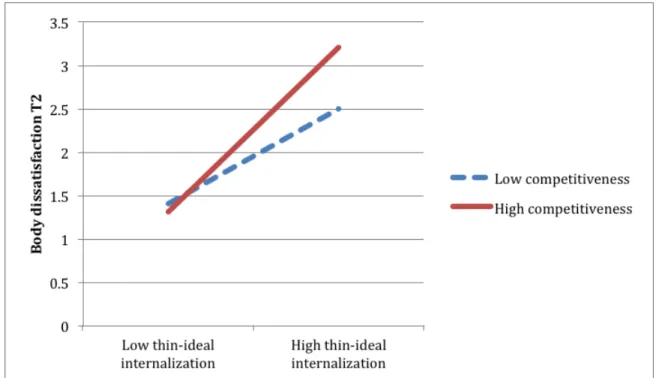
interaction was significant in predicting T2 body dissatisfaction, t(1, 229) = 2.11, β = .12, ΔR2
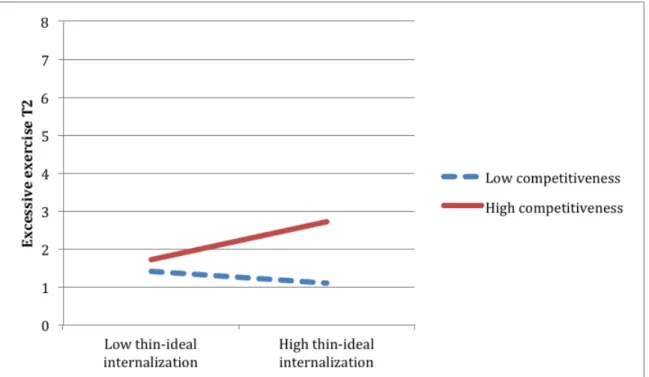
= .01, p = .036. As depicted in Figure 1, individuals who were high in thin-ideal internalization and were competitive exhibited the highest levels of T2 body dissatisfaction one year later. For all figures, high and low levels of the independent variables were determined by one standard deviation above and below the mean, respectively, with the exception of the graphs depicting the interactions of thin-ideal internalization and competitiveness in relation to T2 excessive exercise, both prospectively and controlling for initial levels of excessive exercise. In these two graphs, high and low levels of the independent variables were determined by one half of a standard deviation above and below the mean, respectively, in order to evade negative predicted values of T2 excessive exercise.
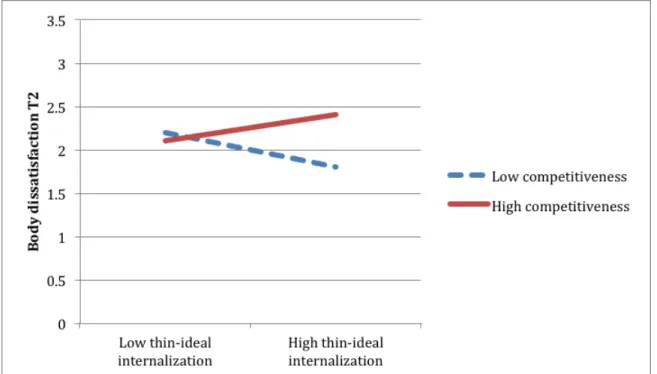
For the change analyses controlling for baseline levels of T1 body dissatisfaction, the thin-ideal internalization and competitiveness interaction was significant in predicting change in body dissatisfaction, t(1, 228) = 2.69, β = .10, ΔR2 = .01, p = .008. As depicted in Figure 2,
individuals who were high in thin-ideal internalization and were competitive exhibited the highest levels of body dissatisfaction one year later after controlling for initial levels of body dissatisfaction.
interaction in relation to dieting: cross-sectional, prospective, and change, the results of which are displayed in Table 3.
For the cross-sectional analyses, the thin-ideal internalization x competitiveness
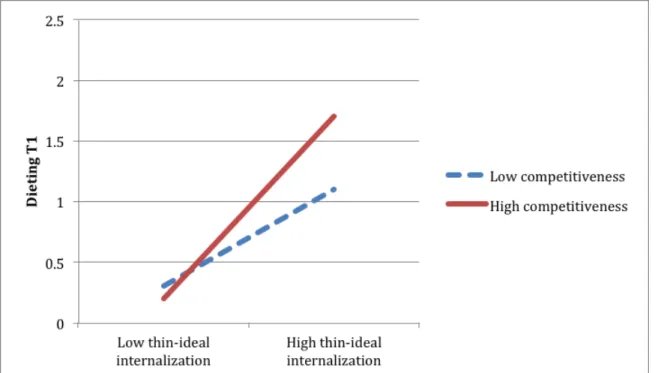
interaction was significant in identifying levels of T1 dieting, t(1, 425) = 4.22, β = .17, ΔR2 = .03,
p < .001. As depicted in Figure 3, individuals who were high in thin-ideal internalization and were competitive exhibited the highest levels of T1 dieting.
For the prospective analyses, the thin-ideal internalization and competitiveness
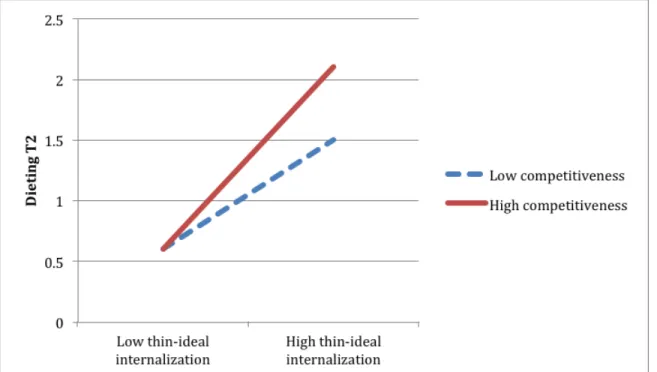
interaction was significant in predicting T2 dieting, t(1, 229) = 1.99, β = .11, ΔR2 = .01, p = .048.
As depicted in Figure 4, and similar to the cross-sectional findings, individuals who were high in thin-ideal internalization and were competitive exhibited the highest levels of dieting one year later.
For the change analyses controlling for baseline levels of T1 dieting, the thin-ideal internalization and competitiveness interaction was not significant in predicting change in dieting, t(1, 228) = .57, β = .03, ΔR2 = .001, p = .571.
Thin-ideal internalization x competitiveness interaction predicting excessive
exercise. Three categories of regression analyses were run to test the thin-ideal internalization x competitiveness interaction in relation to excessive exercise: cross-sectional, prospective, and change, the results of which are displayed in Table 4.
For the cross-sectional analyses, the thin-ideal internalization x competitiveness interaction was significant in identifying levels of T1 excessive exercise, t(1, 418) = 3.77, β = . 17, ΔR2 = .03, p < .001. As depicted in Figure 5, individuals who were high in thin-ideal
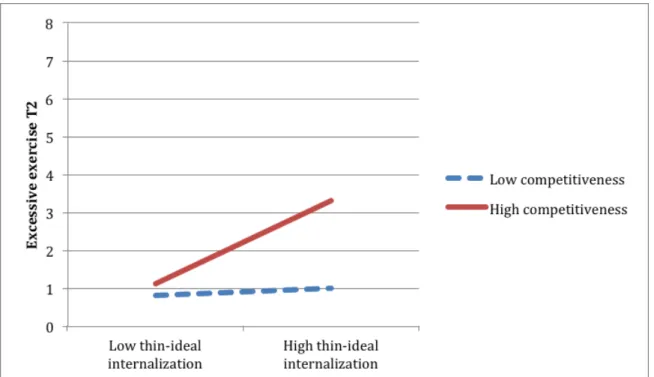
For the prospective analyses, the thin-ideal internalization and competitiveness
interaction was significant in predicting T2 excessive exercise, t(1, 229) = 3.95, β = .25, ΔR2 = .
06, p < .001. As depicted in Figure 6, and similar to the cross-sectional findings, individuals who were high in thin-ideal internalization and were competitive exhibited the highest levels of excessive exercise one year later.
For the change analyses controlling for baseline levels of T1 excessive exercise, the thin-ideal internalization and competitiveness interaction was significant in predicting change in excessive exercise, t(1, 226) = 2.93, β = .18, ΔR2 = .03, p = .004. As depicted in Figure 7,
individuals who were high in thin-ideal internalization and were competitive exhibited the highest levels of excessive exercise one year later one year later after controlling for initial levels of excessive exercise.
Appearance contingent self-worth x competitiveness interaction predicting body
dissatisfaction. Three categories of regression analyses were run to test the appearance contingent self-worth x competitiveness interaction in relation to body dissatisfaction: cross-sectional, prospective, and change, the results of which are displayed in Table 5.
For the cross-sectional analyses, the appearance contingent self-worth x competitiveness interaction was not significant in identifying levels of T1 body dissatisfaction, t(1, 428) = .47, β = .02, ΔR2 = .00, p = .638.
For the prospective analyses, the appearance contingent self-worth and competitiveness interaction was not significant in predicting T2 body dissatisfaction, t(1, 229) = 1.11, β = .07,
For the change analyses controlling for baseline levels of T1 body dissatisfaction, the appearance contingent self-worth and competitiveness interaction was not significant in predicting change in body dissatisfaction, t(1, 228) = 1.36, β = .05, ΔR2 = .003, p = .177.
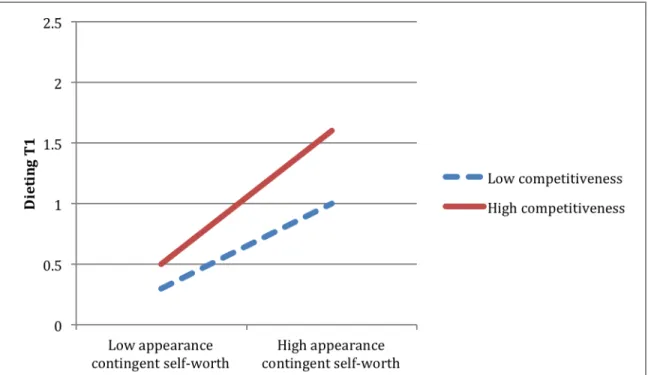
Appearance contingent self-worth x competitiveness interaction predicting dieting. Three categories of regression analyses were run to test the appearance contingent self-worth x competitiveness interaction in relation to dieting: cross-sectional, prospective, and change, the results of which are displayed in Table 6.
For the cross-sectional analyses, the appearance contingent self-worth x competitiveness interaction was significant in identifying levels of T1 dieting, t(1, 428) = 2.36, β = .10, ΔR2 = .01,
p = .019. As depicted in Figure 8, individuals who were high in appearance contingent self-worth and were competitive exhibited the highest levels of T1 dieting.
For the prospective analyses, the appearance contingent self-worth and competitiveness interaction was not significant in predicting T2 dieting, t(1, 229) = 1.20, β = .07, ΔR2 = .01, p = .
233.
For the change analyses controlling for baseline levels of T1 dieting, the appearance contingent self-worth and competitiveness interaction was not significant in predicting change in dieting, t(1, 228) = .44, β = .02, ΔR2 = .00, p = .662.
Appearance contingent self-worth x competitiveness interaction predicting excessive
exercise. Three categories of regression analyses were run to test the appearance contingent self-worth x competitiveness interaction in relation to excessive exercise: cross-sectional,
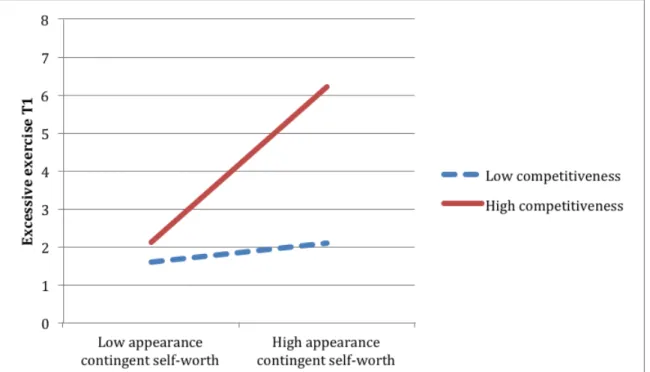
For the cross-sectional analyses, the appearance contingent self-worth x competitiveness interaction was significant in identifying levels of T1 excessive exercise, t(1, 421) = 2.73, β = . 13, ΔR2 = .02, p = .007. As depicted in Figure 9, individuals who were high in appearance
contingent self-worth and were competitive exhibited the highest levels of T1 excessive exercise. For the prospective analyses, the appearance contingent self-worth and competitiveness interaction was not significant in predicting T2 excessive exercise, t(1, 229) = 1.38, β = .09, ΔR2
= .01, p = .169.
For the change analyses controlling for baseline levels of T1 excessive exercise, the appearance contingent self-worth and competitiveness interaction was not significant in predicting change in excessive exercise, t(1, 226) = 1.22, β = .07, ΔR2 = .01, p = .224.
Discussion
As expected, the present study showed a pattern of significant positive correlations between appearance contingent self-worth, thin-ideal internalization, competitiveness, body dissatisfaction, dieting, and excessive exercise. It is noteworthy that appearance contingent self-worth and thin-ideal internalization both appeared to have stronger bivariate relationships with body dissatisfaction and dieting compared with excessive exercise. Perhaps excessive exercise is less narrowly appearance-focused than body dissatisfaction and dieting. It is possible that
individuals are dissatisfied with their bodies and turn to dieting because they want to be thinner, but these same individuals over-exercise for a wider variety of motivations, including a desire to be thinner, but also including an aspiration to be healthy or an intrinsic motivation for
In the cross-sectional analyses, the thin-ideal internalization x competitiveness interaction was significant in identifying T1 dieting and excessive exercise, but was not significant in
identifying T1 body dissatisfaction. Similarly, the appearance contingent self-worth interaction was significant in identifying T1 dieting and excessive exercise, but was not significant in identifying T1 body dissatisfaction. This suggests that individuals who are high in thin-ideal internalization or appearance contingent self-worth and who are competitive are more likely to exhibit dieting and excessive exercise (but not body dissatisfaction) than individuals who are only high in thin-ideal internalization or appearance contingent self-worth, or who are only high in competitiveness. It could be that competitiveness only moderates the relationship between concurrent appearance-related factors and disordered eating behaviors (i.e., dieting and excessive exercise) and not attitudes (i.e., body dissatisfaction). Perhaps the combination of being
appearance-focused and competitive encourages deliberate action in the form of food restriction and over-exercise as attempts to “catch up” to their peers who may be perceived as
outperforming them in appearance. On the other hand, appearance-focused individuals may not need the extra boost of competitiveness in order to feel dissatisfied with their bodies, which does not require planning or action like dieting and exercise do. In this way, dieting and excessive exercise may serve as focused individuals’ attempts to approximate the appearance-level of their peers when they realize they do not match up, or alternatively, these behaviors may serve as ways to continue to gain fulfillment from outperforming others in the appearance domain if they believe that they do match up.
predicting T2 body dissatisfaction, dieting, and excessive exercise, whereas the appearance contingent self-worth interaction was not significant in predicting T2 body dissatisfaction, dieting, or excessive exercise. This suggests that individuals who are high in thin-ideal internalization (but not appearance contingent self-worth) and who are competitive are more likely to exhibit body dissatisfaction, dieting, and excessive exercise one year later than
individuals who are only high in thin-ideal internalization or appearance contingent self-worth, or who are only high in competitiveness. Because the thin-ideal internalization x
competitiveness interaction has predictive power while the appearance contingent self-worth x competitiveness interaction does not, it appears that there is something in particular about buying into and striving for the thin ideal that interacts with competitiveness to produce disordered eating attitudes and behaviors. Individuals high in appearance contingent self-worth derive their sense of self-esteem from others’ approval of their appearance. Appearance approval may include liking of one’s outfit, makeup, hair style, or body shape. Therefore, it may be pursued in multiple ways and not just limited to dieting and exercise. Additionally, it seems to be that thin-ideal internalization has a more competitive element inherent in it than appearance contingent self-worth, given that thin-ideal internalization entails buying into the importance of the thin ideal and believing one should strive for it. Therefore, the combination of thin-ideal
The change analyses controlling for baseline levels of Time 1 body dissatisfaction, dieting, and excessive exercise showed a similar pattern to the prospective analyses. The thin ideal internalization x competitiveness interaction was significant in predicting T2 body dissatisfaction and excessive exercise (but not dieting) on year later, controlling for baseline levels of body dissatisfaction and excessive exercise. The appearance contingent self-worth x competitiveness interaction was not significant in predicting T2 body dissatisfaction, dieting, or excessive exercise. In this way, individuals high in thin-ideal internalization (but not appearance contingent self-worth) and who are competitive are more likely to exhibit change (increases) in body dissatisfaction and excessive exercise (but not dieting) one year later than individuals who are only high in thin-ideal internalization or appearance contingent self-worth, or who are only high in competitiveness. It is unclear why the thin-ideal internalization x competitiveness interaction did not apply to change in dieting. Future research is needed to replicate and understand this finding.
The current research extends our knowledge in important ways. Not all people who internalize the thin ideal or whose self-worth is highly dependent on their appearance will develop disordered eating attitudes and behaviors. Therefore, it is crucial to be able to identify which individuals are most at risk for developing these maladaptive attitudes and behaviors so that we can create effective interventions. Proactively, if we can identify individuals that are both highly competitive and high in thin-ideal internalization or appearance contingent self-worth, we can intervene in order to prevent eating- and body-related pathology. For example, to counter competitiveness, we can design team-building programs or teach groups about
thin-ideal internalization and appearance contingent self-worth, we can use a cognitive
dissonance intervention. Given that competitiveness does interact with these appearance-related factors, at-risk groups may include those who are encouraged to be competitive, such as athletes, dancers, and individuals who participate in academic competitions. The interactive prospective and change findings have clinical implications in that intervening by decreasing competitiveness or challenging the thin ideal should contribute to decreases in body dissatisfaction, dieting, and excessive exercise. In sum, psychologists interested in designing interventions and therapists working with individuals with disordered eating could use these findings to guide their prevention and treatment efforts.
The current study has several strengths. The introduction of competitiveness as it relates to the independent and dependent variables is novel and adds to the crucial understanding of which individuals are likely to develop eating disorder symptoms. Additionally, to my
knowledge, this is the first study that directly compares thin-ideal internalization and appearance contingent self-worth in relation to body dissatisfaction, dieting, and excessive exercise.
Because both independent variables are appearance-related but do not interact with
competitiveness in exactly the same way, it is important to distinguish them in both research and practice. Another strength is that the longitudinal design permitted cross-sectional analyses, prospective analyses, and change analyses predicting body dissatisfaction, dieting, and excessive exercise after controlling for initial levels.
undergraduate female sample is appropriate given the high occurrence of disordered eating symptomology in this population, the generalizability of these findings to other groups is unclear. These groups include men, racial minorities, and adolescents, all who are affected by eating disorders. Second, only 54% of the T1 participants completed T2, which represented 67% of those who agreed to be contacted for T2. This is a higher rate of attrition than desired. However, the T2 subsample did not differ on the core study variables. Third, a significantly lower
percentage of completers identified as Caucasian than did noncompleters. It is unknown why this occurred or what the implications are. Lastly, excessive exercise was measured by a single item, which limits the ability to draw conclusions about this construct. Furthermore, we do not know specific information about the excessive exercise, such as its duration, intensity, or compulsive nature, which may be helpful in further characterizing exercise in meaningful ways in relation to pathology. It should be noted, however, that other studies have found using one item to assess similar constructs to be a reliable approach (e.g., Joiner and Tickle, 1988; Mechanic and Hansell, 1987).
up or are amplified in a sample of men, given that society generally encourages and rewards competitiveness in men, as opposed to cooperativeness in women.
Future research should also continue to explore differences between thin-ideal
internalization and appearance contingent self-worth, as this information may yield important disparities in which individuals may be most at risk for eating disorder symptoms. Lastly, it may be interesting to investigate the potentially differential effects of competitiveness and
competition on these relationships between appearance-related factors and disordered eating attitudes and behaviors. While competitiveness is trait-level and thereby relatively stable over time, competition is state-level and fluctuates according to the circumstances and situation. It would be interesting to see if situational competition with other individuals, especially if it is repeated over time such as on a sports team or a reality television dating show, interacts with appearance-related factors in a similar way to trait competitiveness.
In sum, thin-ideal internalization and appearance contingent self-worth both interact with competitiveness concurrently to identify dieting and excessive exercise (but not body
dissatisfaction). Results also exhibited predictive value; individuals who were high in thin-ideal internalization (but not appearance contingent self-worth) and high in competitiveness were most likely to exhibit body dissatisfaction, dieting, and excessive exercise one year later. Lastly, after controlling for baseline levels of the dependent variables, results showed that individuals who were high in thin-ideal internalization (but not appearance contingent self-worth) and high in competitiveness were most likely to exhibit increases in body dissatisfaction and excessive exercise (but not dieting) one year later. Thus, given the support of competitiveness as a
References
Aardoom, J. J., Dingemans, A. E., Slof Op't Landt, M. T., & Van Furth, E. F. (2012). Norms and discriminative validity of the Eating Disorder Examination Questionnaire (EDE-Q). Eating Behaviors, 13, 305-309. doi:10.1016/j.eatbeh.2012.09.002
Ackard, D. M., Croll, J. K., & Kearney-Cooke, A. (2002). Dieting frequency among college females: Association with disordered eating, body image and related psychological problems. Journal of Psychosomatic Research, 52, 129-136. doi:10.1016/
S0022-3999(01)00269-0
American Psychiatric Association. (2013). Diagnostic and statistical manual of mental disorders (5th ed.). Washington, DC: Author.
Anderson, D. A., & Williamson, D. A. (2002). Outcome measurement in eating disorders. In W. W. IsHak, T. Burt, & L. I. Sederer (Eds.), Outcome measurement in psychiatry: A critical review (pp. 289-301). Washington, DC: American Psychiatric Press.
Bardone-Cone, A. M., Brownstone, L. M., Higgins, M. K., Fitzsimmons-Craft, E. E., & Harney, M. B. (2013). Anxiety, appearance contingent self-worth, and appearance conversations with friends in relation to disordered eating: Examining moderator models. Cognitive Therapy and Research, 37, 953-963. doi:10.1007/s10608-013-9520-9
Barnes, J., Prescott, T., & Muncer, S. (2012). Confirmatory factor analysis for the Eating Disorder Examination Questionnaire: Evidence supporting a three-factor model. Eating Behaviors, 13, 379-381. doi: 10.1016/j.eatbeh.2012.05.001
systematic review of the literature. International Journal of Eating Disorders, 45, 428-438. doi: 10.1002/eat.20931
Blowers, L. C., Loxton, N. J., Grady-Flesser, M., Occhipinti, S., & Dawe, S. (2003). The relationship between sociocultural pressure to be thin and body dissatisfaction in preadolescent girls. Eating Behaviors, 4, 229-244. doi:10.1016/S1471-0153(03)00018-7 Buss, D.M. (1989). Sex differences in human mate preferences: Evolutionary hypotheses tested
in 37 cultures. Behavioral and Brain Sciences, 12, 1-49. doi:10.1017/ S0140525X00023992
Cafri, G., Yamamiya, Y., Brannick, M., & Thompson, J. (2005). The influence of sociocultural factors on body image: A meta-analysis. Clinical Psychology: Science and Practice, 12, 421-433. doi:10.1093/clipsy/bpi053
Cohen, J., Cohen, P., West, S. G., & Aiken, L. S. (2003). Applied multiple regression/correlation analysis for the behavioral sciences (3rd ed.). Mahwah, NJ US: Lawrence Erlbaum Associates Publishers.
Crocker, J., Luhtanen, R. K., Cooper, M. L., & Bouvrette, A. (2003). Contingencies of self-worth in college students: Theory and measurement. Journal of Personality and Social
Psychology, 85, 894–908. doi:10.1037/0022-3514.85.5.894
Crocker, J., & Wolfe, C. T. (2001). Contingencies of self-worth. Psychological Review, 108, 593– 623. doi:10.1037/0033-295X.108.3.593
motivational climate in female gymnasts and dancers. Psychology of Sport and Exercise, 10, 72-79. doi:10.1016/j.psychsport.2008.07.002
De Young, K. P., & Anderson, D. A. (2010). Prevalence and correlates of exercise motivated by negative affect. International Journal of Eating Disorders, 43, 50-58. doi: 10.1002/eat. 20656
Dru, V. (2003). Relationships between an ego orientation scale and a hypercompetitive scale: Their correlates with dogmatism and authoritarianism factors. Personality and Individual Differences, 35, 1509-1524. doi:10.1016/S0191-8869(02)00366-5
Duda, J. L., & Tappe, M. K. (1989). The Personal Incentives for Exercise Questionnaire: Preliminary development. Perceptual and Motor Skills, 68, 1122. doi: 10.2466/pms. 1989.68.3c.1122
Evans, E. H., Tovée, M. J., Boothroyd, L. G., & Drewett, R. F. (2013). Body dissatisfaction and disordered eating attitudes in 7- to 11-year old girls: Testing a sociocultural model. Body Image, 10, 8-15. doi:10.1016/j.bodyim.2012.10.001
Fairburn, C. G., & Beglin, S. J. (2008). Eating Disorder Examination Questionnaire (EDE-Q 6.0). In: Fairburn C.G., editor. Cognitive Behavior Therapy and Eating Disorders. New York: Guilford Press, 309-313.
Ferguson, C. J., Winegard, B., & Winegard, B. M. (2011). Who is the fairest one of all? How evolution guides peer and media influences on female body dissatisfaction. Review of General Psychology, 15, 11-28. doi:10.1037/a0022607
and body dissatisfaction among college women: The roles of social comparison and body surveillance. Body Image, 9, 43-49. doi:10.1016/j.bodyim.2011.09.002
Geller, J., Johnston, C., Madsen, K., Goldner, E. M., Remick, R. A., & Birmingham, C. L. (1998). Shape- and weight-based self-esteem and the eating disorders. International Journal of Eating Disorders, 24, 285–298. doi:10.1002/
(SICI)1098-108X(199811)24:3<285::AID-EAT6>3.0.CO;2-I
Gill, D. L., Dzewaltowski, D. A., & Deeter, T. E. (1988). The relationship of competitiveness and achievement orientation to participation in sport and nonsport activities. Journal of Sport and Exercise Psychology, 10, 139-150. Retrieved from: https://auth.lib.unc.edu/
ezproxy_auth.php?url=http://search.ebscohost.com/login.aspx?
direct=true&db=psyh&AN=1989-10590-001&site=ehost-live&scope=site
Harrison, K. (2001). Ourselves, our bodies: Thin-ideal media, self-discrepancies, and eating disorder symptomatology in adolescents. Journal of Social and Clinical Psychology, 20, 289-323. doi:10.1521/jscp.20.3.289.22303
Heinberg, L. J., Thompson, J. K., & Stormer, S. (1995). Development and validation of the Sociocultural Attitudes Towards Appearance Questionnaire. International Journal of Eating Disorders, 17, 81-89.
doi:10.1002/1098-108X(199501)17:1<81::AID-EAT2260170111>3.0.CO;2-Y
Horney, K. (1950). Neurosis and human growth: The struggle toward self-realization. New York: Norton.
Huon, G., Hayne, A., Gunewardene, A., Strong, K., Lunn, N., Piira, T., & Lim, J. (1999). Accounting for differences in dieting status: Steps in the refinement of a model. International Journal of Eating Disorders, 26, 420-433. doi:10.1002/
(SICI)1098-108X(199912)26:4<420::AID-EAT8>3.0.CO;2-G
Joiner, T. E., Tickle, J .J. (1998). Exercise and depressive and anxious symptoms: what is the nature of their interrelations? Journal of Occupational Rehabilitation, 8, 191–198. doi: 10.1023/A:1021326406744
Juarascio, A. S., Forman, E. M., Timko, C. A., Herbert, J. D., Butryn, M, & Lowe, M. (2011). Implicit internalization of the thin ideal as a predictor of increases in weight, body dissatisfaction, and disordered eating. Eating Behaviors, 12, 207-213. doi:10.1016/ j.eatbeh.2011.04.004
Koff, E., Benavage, A., & Wong, B. (2001). Body-image attitudes and psychosocial functioning in Euro-American and Asian-American college women. Psychological Reports, 88, 917-928. doi:10.2466/PR0.88.3.917-928
Kroon Van Diest, A. M., & Perez, M. (2013). Exploring the integration of thin-ideal
internalization and self-objectification in the prevention of eating disorders. Body Image, 10, 16-25. doi:10.1016/j.bodyim.2012.10.004
Lerner, B. S., & Locke, E. A. (1995). The effect of goal setting, self-efficacy, competition, and personal traits on the performance of an endurance task. Journal of Sport and Exercise Psychology, 17, 138-152. Retrieved from: https://auth.lib.unc.edu/ezproxy_auth.php? url=http://search.ebscohost.com/login.aspx?
direct=true&db=psyh&AN=1996-06707-001&site=ehost-live&scope=site
Low, K. G., Charanasomboon, S., Brown, C., Hiltunen, G., Long, K., & Reinhalter, K. (2003). Internalization of the thin ideal, weight and body image concerns. Social Behavior and Personality, 31, 81-90. doi:10.2224/sbp.2003.31.1.81
Luce, K. H., & Crowther, J. H. (1999). The reliability of the Eating Disorder Examination—Self-Report Questionnaire Version (EDE-Q). International Journal of Eating Disorders, 25, 349-351. doi:10.1002/(SICI)1098-108X(199904)25:3<349::AID-EAT15>3.0.CO;2-M Mechanic, D., Hansell, S. (1987). Adolescent competence, psychological well-being, and
self-assessed physical health. Journal of Health and Social Behavior, 28, 364–374. doi: 10.2307/2136790
Muñoz, M. E. & Ferguson, C. J. (2012). Body dissatisfaction correlates with inter-peer competitiveness, not media exposure: A brief report. Journal of Social and Clinical Psychology, 31, 383-392. doi:10.1521/jscp.2012.31.4.383
Peden, J., Stiles, B. L., Vandehey, M., & Diekhoff, G. (2008). The effects of external pressures and competitiveness on characteristics of eating disorders and body dissatisfaction. Journal of Sport and Social Issues, 32, 415-429. doi:10.1177/0193723508325638 Peterson, C. B., Crosby, R. D., Wonderlich, S. A., Joiner, T., Crow, S. J., Mitchell, J. E., & ... le
Grange, D. (2007). Psychometric properties of the eating disorder
examination-questionnaire: Factor structure and internal consistency. International Journal of Eating Disorders, 40, 386-389. doi:10.1002/eat.20373
Ryckman, R. M., Hammer, M., Kaczor, L. M., & Gold, J. A. (1990). Construction of a
Hypercompetitive Attitude Scale. Journal of Personality Assessment, 55, 630-639. doi: 10.1207/s15327752jpa5503&4_19
Sands, E. R., & Wardle, J. (2003). Internalization of ideal body shapes in 9-12-year-old girls. International Journal of Eating Disorders, 33, 193-204. doi:10.1002/eat.10121
Schaefer, L. M., Burke, N. L., Thompson, J. K., Heinberg, L. J., Calogero, R. M., Bardone-Cone, A. M., Higgins, M. K., Frederick, D. A., Nerini, A., Stefanile, C., Dittmar, H., Clark, L., Adams, Z., Macwana, S., Klump, K. L., Vercellone, A. C., Paxton, S. J., & Swami, V. (2013). Development and validation of the Sociocultural Attitudes Towards Appearance Questionnaire-4 (SATAQ-4). Manuscript submitted for publication.
Sides-Moore, L. & Tochkov, K. (2011). The thinner the better? Competitiveness, depression and body image among college student women. College Student Journal, 45, 439-448. Retrieved from: https://auth.lib.unc.edu/ezproxy_auth.php?url=http://
search.ebscohost.com/login.aspx?
Snyder, A. L., Anderson-Hanley, C., & Arclero, P. J. (2012). Virtual and live social facilitation while exergaming: Competitiveness moderates exercise intensity. Journal of Sport and Exercise Psychology, 34, 252-259. Retrieved from: https://auth.lib.unc.edu/
ezproxy_auth.php?url=http://search.ebscohost.com/login.aspx?
direct=true&db=psyh&AN=2012-12250-006&site=ehost-live&scope=site
Stice, E. (1994). Review of the evidence for a sociocultural model of bulimia nervosa and an exploration of the mechanisms of action. Clinical Psychology Review, 14, 633-661. doi: 10.1016/0272-7358(94)90002-7
Stice, E., Mazotti, L., Krebs, M., & Martin, S. (1998). Predictors of adolescent dieting behaviors: A longitudinal study. Psychology of Addictive Behaviors, 12, 195-205. doi:
10.1037/0893-164X.12.3.195
Stice, E., Nemeroff, C., & Shaw, H. (1996). A test of the dual pathway model of bulimia nervosa: Evidence for restrained-eating and affect-regulation mechanisms. Journal of Social and Clinical Psychology, 15, 340-363. doi:10.1521/jscp.1996.15.3.340
Thøgersen-Ntoumani, C., Ntoumanis, N., Cumming, J., & Chatzisarantis, N. L. D. (2011). When feeling attractive matters too much to women: A process underpinning the relation between psychological need satisfaction and unhealthy weight control behaviors. Motivation and Emotion, 35, 413-422. doi:10.1007/s11031-011-9226-9
Table 1
Correlations Among Means and Standard Deviations of Time 1 Measures
Variable 1 2 3 4 5 6 M SD
1. Appearance Contingent
Self-Worth - .40** .24** .49** .43** .18** 5.12 0.94
2. Thin-Ideal Internalization - .29** .59** .54** .32** 17.18 4.42
3. Competitiveness - .22** .26** .20** 17.39 3.89
4. Body Dissatisfaction - .77** .31** 2.33 1.59
5. Dieting - .38** 0.89 1.14
6. Excessive Exercise - 3.20 7.45
Table 2
Hierarchical Multiple Regression Analyses of the Interaction of Thin-Ideal Internalization and
Competitiveness Predicting Body Dissatisfaction Cross-Sectionally and Longitudinally (With and Without Controlling for Baseline Levels)
Step and predictors B SE B β t (dfs) ΔR2
Step 1 DV = Body
Dissatisfaction T1
.36***
Thin-Ideal Internalization 0.21 0.02 0.58*** 14.38 (2, 426)
Competitiveness 0.02 0.02 0.05 1.33 (2, 426)
Step 2 0 .003
Thin-Ideal Internalization x
Competitiveness 0.01 0.004 0.06 1.53 (1, 425)
Step 1 DV = Body
Dissatisfaction T2
.24***
Thin-Ideal Internalization 0.17 0.02 0.46*** 7.67 (2, 230)
Competitiveness 0.04 0.03 0.09 1.48 (2, 230)
Step 2 .01*
Thin-Ideal Internalization x
Competitiveness 0.01 0.01 0.12* 2.11 (1, 229)
Step 1 DV = Body
Dissatisfaction T2
.66***
Body Dissatisfaction T1 0.79 0.04 0.81*** 21.01 (1, 231)
Step 2 0 .004
Thin-Ideal Internalization -0.001 0.02 -0.004 -.08 (2, 229)
Competitiveness 0.03 0.02 0.07 1.71 (2, 229)
Step 3 .01**
Thin-Ideal Internalization x
Table 3
Hierarchical Multiple Regression Analyses of the Interaction of Thin-Ideal Internalization and
Competitiveness Predicting Dieting Cross-Sectionally and Longitudinally (With and Without Controlling for Baseline Levels)
Step and predictors B SE B β t (dfs) ΔR2
Step 1 DV =
Dieting T1 .31***
Thin-Ideal Internalization 0.13 0.01 0.51*** 12.08 (2, 426)
Competitiveness 0.03 0.01 0.11** 2.65 (2, 426)
Step 2 .03***
Thin-Ideal Internalization x
Competitiveness 0.01 0.003 0.17*** 4.22 (1, 425)
Step 1 DV =
Dieting T2 .25***
Thin-Ideal Internalization 0.14 0.02 0.45*** 7.53 (2, 230)
Competitiveness 0.04 0.02 0.11 1.85 (2, 230)
Step 2 .01*
Thin-Ideal Internalization x
Competitiveness 0.01 0.004 0.11* 1.99 (1, 229)
Step 1 DV =
Dieting T2 .43***
Dieting T1 0.76 0.06 0.65*** 13.09 (1, 231)
Step 2 .02*
Thin-Ideal Internalization 0.05 0.02 0.15* 2.54 (2, 229)
Competitiveness 0.02 0.02 0.06 1.09 (2, 229)
Step 3 0 .001
Thin-Ideal Internalization x
Table 4
Hierarchical Multiple Regression Analyses of the Interaction of Thin-Ideal Internalization and
Competitiveness Predicting Excessive Exercise Cross-Sectionally and Longitudinally (With and Without Controlling for Baseline Levels)
Step and predictors B SE B β t (dfs) ΔR2
Step 1 DV =
Excessive Exercise T1
.12***
Thin-Ideal Internalization 0.49 0.08 0.29*** 6.01 (2, 419)
Competitiveness 0.23 0.09 0.12* 2.45 (2, 419)
Step 2 .03***
Thin-Ideal Internalization x
Competitiveness 0.07 0.02 0.17*** 3.77 (1, 418)
Step 1 DV =
Excessive Exercise T2
.07**
Thin-Ideal Internalization 0.32 0.12 0.18** 2.70 (2, 230)
Competitiveness 0.27 0.13 0.14* 2.03 (2, 230)
Step 2 .06***
Thin-Ideal Internalization x
Competitiveness 0.11 0.03 0.25*** 3.95 (1, 229)
Step 1 DV =
Excessive Exercise T2
.18***
Excessive Exercise T1 0.57 0.08 0.42*** 7.00 (1, 229)
Step 2 0 .01
Thin-Ideal Internalization 0.08 0.12 0.05 .69 (2, 227)
Competitiveness 0.19 0.13 0.10 1.53 (2, 227)
Step 3 .03**
Thin-Ideal Internalization x
Table 5
Hierarchical Multiple Regression Analyses of the Interaction of Appearance Contingent Self-Worth and Competitiveness Predicting Body Dissatisfaction Cross-Sectionally and Longitudinally (With and Without Controlling for Baseline Levels)
Step and predictors B SE B β t (dfs) ΔR2
Step 1 DV = Body
Dissatisfaction T1
.25***
Appearance Contingent
Worth 0.79 0.07 0.46*** 10.79 (2, 429)
Competitiveness 0.05 0.02 0.11* 2.59 (2, 429)
Step 2 0.00
Appearance Contingent
Worth x Competitiveness 0.01 0.02 0.02 .47 (1, 428)
Step 1 DV = Body
Dissatisfaction T2
.20***
Appearance Contingent
Worth 0.65 0.10 0.39*** 6.44 (2, 230)
Competitiveness 0.06 0.03 0.14* 2.31 (2. 230)
Step 2 0 .004
Appearance Contingent
Worth x Competitiveness 0.03 0.02 0.07 1.11 (1, 229)
Step 1 DV = Body
Dissatisfaction T2
.66***
Body Dissatisfaction T1 0.79 0.04 0.81*** 21.01 (1, 231)
Step 2 0 .01
Appearance Contingent
Worth 0.06 0.07 0.04 .86 (2, 229)
Competitiveness 0.03 0.02 0.06 1.59 (2, 229)
Step 3 0 .003
Appearance Contingent
Table 6
Hierarchical Multiple Regression Analyses of the Interaction of Appearance Contingent Self-Worth and Competitiveness Predicting Dieting Cross-Sectionally and Longitudinally (With and Without Controlling for Baseline Levels)
Step and predictors B SE B β t (dfs) ΔR2
Step 1 DV =
Dieting T1 .21***
Appearance Contingent
Worth 0.48 0.05 0.39*** 8.94 (2, 429)
Competitiveness 0.05 0.01 0.17*** 3.78 (2, 429)
Step 2 0 .01*
Appearance Contingent
Worth x Competitiveness 0.03 0.01 0.10* 2.36 (1, 428)
Step 1 DV =
Dieting T2 .16***
Appearance Contingent
Worth 0.44 0.09 0.32*** 5.11 (2, 230)
Competitiveness 0.06 0.02 0.18** 2.82 (2, 230)
Step 2 0 .01
Appearance Contingent
Worth x Competitiveness 0.03 0.02 0.07 1.20 (1, 229)
Step 1 DV =
Dieting T2 .43***
Dieting T1 0.76 0.06 0.65*** 13.09 (1, 231)
Step 2 0 .01
Appearance Contingent
Worth 0.08 0.08 0.06 .97 (2, 229)
Competitiveness 0.03 0.02 0.08 1.46 (2, 229)
Step 3 0.00
Appearance Contingent
Table 7
Hierarchical Multiple Regression Analyses of the Interaction of Appearance Contingent Self-Worth and Competitiveness Predicting Excessive Exercise Cross-Sectionally and Longitudinally (With and Without Controlling for Baseline Levels)
Step and predictors B SE B β t (dfs) ΔR2
Step 1 DV = Excessive
Exercise T1 .06***
Appearance Contingent
Worth 1.11 0.39 0.14** 2.85 (2, 422)
Competitiveness 0.32 0.09 0.17** 3.42 (2, 422)
Step 2 .02**
Appearance Contingent
Worth x Competitiveness 0.24 0.09 0.13** 2.73 (1, 421)
Step 1 DV = Excessive
Exercise T2 .05**
Appearance Contingent
Worth 1.10 0.53 0.14* 2.08 (2, 230)
Competitiveness 0.32 0.13 0.16* 2.41 (2, 230)
Step 2 0 .01
Appearance Contingent
Worth x Competitiveness 0.17 0.13 0.09 1.38 (1, 229)
Step 1 DV = Excessive
Exercise T2 .18***
Excessive Exercise T1 0.57 0.08 0.42*** 7.00 (1, 229)
Step 2 0 .02
Appearance Contingent
Worth 0.55 0.50 0.07 1.11 (2, 227)
Competitiveness 0.19 0.12 0.09 1.52 (2, 227)
Step 3 0 .01
Appearance Contingent