Belief Mediates the Font-Size Effect on Judgements of Learning By:
E. Brandon Kelly
Senior Honors Thesis
The University of North Carolina at Chapel Hill Department of Psychology and Neuroscience
26 April 2019
Approved:
Dr. Neil W. Mulligan, Thesis Advisor Dr. Kelly S. Giovanello, Reader John T. West, Reader
Acknowledgments
First, I extend my gratitude to my thesis committee. I am thankful for the continued support and guidance along the way to completing my thesis. This experience was invaluable in my development as a researcher. During the past year, I was fortunate enough to work alongside my faculty advisor, Dr. Neil Mulligan, who willingly served in this role despite not having previously worked with me in a lab setting. He was not obligated to do so, and I am grateful he did. I was also fortunate to have worked alongside my graduate mentor, John West, who aided me with setting up my experiments and assisted me with data analyses. The mentorship provided by these people over the course of the past year has not only helped me develop new research skills and fine-tune others but also inspired a deep passion for metacognitive research.
Second, I would like to thank Dr. Beth Kurtz-Costes, and my peers in the psychology honors program. Their support, advice, and friendships were imperative to managing my thesis and refining this very manuscript to reflect the very best of my abilities.
Third, I am appreciative of all the principle investigators, graduate students, and other undergraduate researchers I have worked with over the past four years. Each project exposed me to a new topic, influenced my research interests, and encouraged my intellectual curiosity.
Fourth, I am grateful for the Office for Undergraduate Research for supporting me during my Carolina career. I am especially grateful for Monica Richard and Denise Carter, whom both provided me with a space where I was comfortable identifying as an LGBTQ+ researcher and encouraged me to pursue my passion for research even when I felt uncomfortable with my identity.
Abstract
The font-size effect is a metacognitive illusion characterized by assigning higher judgments of learning to words in larger than in smaller font sizes, although actual memory performance is unaffected by font-size. The basis of the font-size effect is unclear as previous research has proposed two contending theories – fluency theory and belief theory – because the effect has still been observed by researchers without observing significant differences in perceptual fluency (Mueller, et al., 2014). A recent study by Yang and colleagues (2018) challenged this notion by showing that some methods are inappropriate for measuring differences in perceptual fluency. Theoretical explanations of the font-size effect propose differing confidence judgments based on the source of the effect for words presented in very large fonts that disrupt fluency. To clarify the source of the font-size effect, 2 experiments were conducted utilizing the same methodology of Rhodes and Castel (2008) and presented words in either 18-, 48-, and 140-point font (Experiment 1) or in 48- and 160-point font (Experiment 2). There were no significant differences in the perceptual fluency of words based on font-size in Experiment 1 but were significant differences in Experiment 2. A robust font-size effect was observed and confidence judgments were highest for words in the largest font in both experiments regardless of if fluency was manipulated. This reveals that belief is the primary mediator of the font-size effect and refutes a pure-fluency hypothesis.
Belief Mediates the Font-Size Effect on Judgments of Learning
Assessing and monitoring one’s own memory is a core component of metamemory – a term that refers to our beliefs and judgments about how our memory operates. Investigating these core components is important because predictions and judgments of memory performance can influence the manner in which people allocate cognitive resources. Metamemory judgments are frequently made in everyday decision making, education, and more consequential moments (i.e. remembering directions to a particular location). For example, people often make a list of needed groceries to get if they believe they will forget something or, contrarily, rely on their ability to remember what they need if confident in their memory. If a student believes s/he is more likely to remember some information for a test better than other information, s/he may allocate more study time to the information s/he believes is less likely for them to remember. If someone perceives one topic is harder to learn than another, s/he may allocate more time to learning the harder topic compared to the easier one.
memory performance (Besken & Mulligan, 2013). In cases when metamemory performance is not accurately predicted by cues, cognitive resources are not optimally allocated, making these situations important for researchers to analyze.
One specific cue that has inaccurately informed future memory performance is font-size (e.g., Rhodes & Castel, 2008). Font-size is believed to disrupt the perceptual fluency, or ease of processing, of a stimulus and has been identified as a potential factor causing discrepancies between predicted and actual memory performance. The font-size effect was first reported by Rhodes and Castel (2008) when studying the effect of perceptual fluency cues on metamemory. Participants studied individual words, one at a time, in either large (48-point) font- or small (18-point) font-sizes. Participants made judgments of learning (JOLs) after each word, indicating their confidence in recalling the word during a later memory test. Results showed that JOLs were higher for words in large font than small font even though actual memory performance on the later recall test was unaffected by font-size. This effect has been repeatedly observed and persists even when participants are informed that font-size is not related to memory performance or are exposed to words with an alternating format. Rhodes and Castel argued that perceptual fluency mediated the observed effect, but researchers have debated this explanation because the researchers did not measure participants’ response time to words. Without this measurement, it is difficult to attribute the observed effect to a disruption in fluency since it is unclear if fluency was disrupted.
perceptual fluency as a mediator of the font-size effect and serves as the foundation for an alternative explanation of the font-size effect. Mueller and colleagues argued that the font-size effect is mediated by belief instead of fluency.
The belief hypothesis states the font-size effect occurs because people believe words printed in larger fonts are better remembered. Various research has supported this hypothesis by investigating the influence of beliefs on the font-size effect (Hu et al., 2015; Mueller et al., 2013, 2014, 2016; Susser et al., 2016). Typically, belief is investigated by describing an experiment to participants and having them predict the performance of subjects (e.g., Mueller et al., 2014, Experiment 3). In contrast, the fluency hypothesis states that the font-size effect occurs because the font-size of larger words is more easily perceived and processed than smaller words, leading to higher confidence in memory retrieval. In other words, perception influences memory based on the premise that “the easier information is perceived, the easier it is remembered.” Like the belief hypothesis, recent research has abundantly supported the fluency hypothesis explanation of the font-size effect (Ball, et al., 2014; Besken, 2016; Kornell et al., 2011; Rhodes & Castel, 2008; Undorf & Erdfelder, 2015; Undorf et al., 2017; Yang et al., 2018). Additionally, auditory and motoric fluency are cues that have been shown to produce similar cognitive illusions, supporting a generalized fluency hypothesis (Rhodes & Castel, 2009; Susser et al., 2013, 2017).
theory by applying a continuous identification (CID) task (Experiment 1) and a lexical decision task (Experiment 2).
During the CID task, participants were alternately presented a word and a mask and directed to identify the word as quickly as they could. Half of the words were presented in a small (18-point) font and half were presented in a large (48-point) font. The word and mask alternated up to 14 times. For each cycle, the word remained on the screen for 17 ms longer than the last time it was presented. For example, the word was presented for 17 ms followed by the mask for 233 ms during the first cycle, then it was presented for 34 ms followed by the mask for 216 ms for the second cycle. Participants were instructed to press the space key as soon as they could identify the word and were then prompted to type in the word using the keyboard. Their responses were automatically checked for correctness. If correct, participants were asked to provide a rating on how likely they were to recall the word during a later memory test. During the lexical decision task, participants were randomly presented with words and non-words, one at a time. Half the words were in a large font and half were in a small font. Participants were then asked to judge whether the presented item was a word or non-word as rapidly and accurately as they could.
One challenge researchers face when trying to study the font-size effect is that alternative factors unaware to the researcher can affect the results of the study. This can likely explain why lexical decision does not indicate a difference in fluency while CID does. A second challenge researchers face is that not all manipulations assumed to affect perceptual fluency have been found to impact JOLs (i.e. Sungkhasettee, Friedman, & Castel, 2011; Susser, et al, 2013). These two challenges increase the difficulty of studying the font-size effect with a variety of methods with minimal error. Another challenge faced by researchers is minimizing the risk of response bias. Ensuring the risk of response bias is minimized is typically done by making experimental manipulations subtle. Manipulating font-size, however, is a noticeable manipulation, increasing the likelihood a response bias can influence results.
Considering these challenges, the current study aims to investigate the font-size effect by employing a similar methodology used by Rhodes and Castel (2008). As previously stated, the meaning of Rhodes and Castel’s (2008) results were ambiguous because the study did not possess a measure of latency (i.e. response time) to determine if font-size actually affected perceptual fluency. The current study measured the response time of participants to identify differences in perceptual fluency across sizes. Furthermore, stimuli were presented in a third, larger font-size as fluency has been shown to decrease for words presented in sufficiently large fonts (Legge & Bigelow, 2011). A larger font is subjected to both hypotheses, as increases in font-size cue a priori beliefs while also trending toward higher response times and, thus, a lower fluency. If the font-size effect is mediated by belief, however, then JOLs should be higher for the large font words. However, if the illusion is mediated by perceptual fluency, then large font words should exhibit lower JOLs than medium font words.
Method
Participants
Thirty-two undergraduate students (9 males, 23 females) from the University of North Carolina at Chapel Hill participated in exchange for course credit. Each participant was tested individually and provided consent prior to starting the experiment.
Materials
Materials consisted of sixty words, all common nouns, high frequency (100-500 per million), and five letters in length. Three additional words were presented at the beginning of the list as a primacy buffer, and six more were used as practice trials to calibrate the microphone voice key (see Procedure). Words were presented in either a small (18-point), medium (48-point), or large (140-point) font. Each condition consisted of twenty words that were counterbalanced across subjects to control for order effects.
Procedure
During the study phase, participants read study words aloud into the microphone but did not receive feedback. Words in the large-font condition were presented in 140-point font. Words in the medium condition were presented in 48-point font. Words in the small condition were presented in 18-point font. Each word was displayed for five seconds. Participants were instructed to read each word as quickly and accurately as possible, and to try to remember the word for a later memory test. Following each item, participants were requested to rate how confident they were in their ability to recall the word for a later memory test on a scale from 0 (not at all confident) to 100 (very confident). Participants were encouraged to use the full range of the scale. Participants had much time as they wanted to type in their rating after each word.
Immediately following the study phase, participants completed a three-minute distractor task comprised of arithmetic problems. After the distractor task, participants completed a memory test. Participants were instructed to write down as many words from the study phase that they could remember on a blank sheet of paper. Participants received up to five minutes for the free recall test.
Results and Discussion
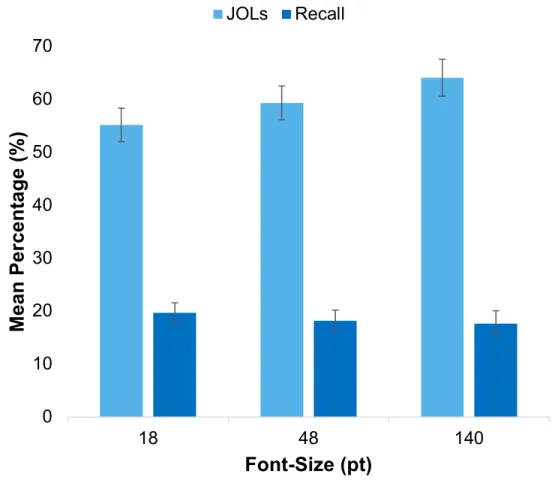
Participants recalled an average of 11.10 (SD=5.96), or18.5%, of words on the recall test. Words in small font (M=3.93, SD=2.08) were better recalled than those in the medium font (M=3.63, SD=2.20) and in large font (M=3.53, SD=2.62). This exhibited a trending negative effect of font-size on memory recall (Figure 1). A one-way repeated-measures ANOVA was conducted with an alpha level of 0.05. There was no observed main effect between recall and font-size, F(2, 58)=0.614, p=0.54. This indicates that font-size did not impact memory recall.
The average confidence rating, or judgments of learning (JOLs), per subject was extracted from the data for each font-size. JOLs displayed an increasing trend among the three font-sizes (Figure 1). On average, subjects indicated lower levels of confidence for small font words (M=55.15, SD=17.29) than medium font words (M=59.31, SD=17.50) and large font words (M=64.06, SD=19.09) were accompanied with the highest JOLs. A one-way repeated-measures ANOVA was conducted with an alpha level of 0.05. There was an observed main effect between font-size and JOLs (F(2,58)=23.386, p<0.001). A pairwise comparison showed significant differences between each of the font-sizes (small-medium: t(29)=3.913, p=0.001; medium-large: t(29)=4.521, p<0.001; small-large: t(29)=5.264, p<0.001). These findings indicate that font-size significantly influenced predicted memory performance even though actual memory performance was not significantly impacted.
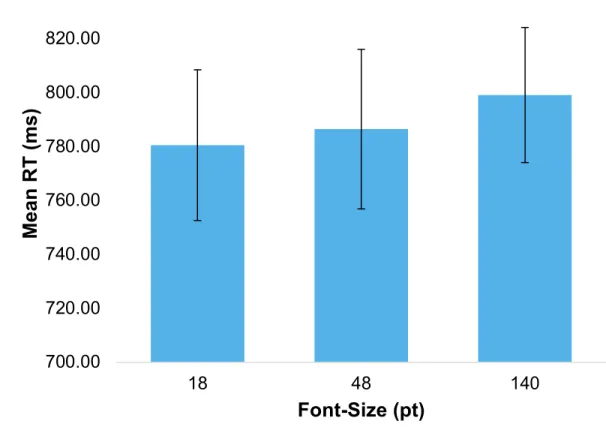
main effect of font-size on RT (F(2,58)=1.827, p=0.17). This indicates that perceptual fluency was not successfully manipulated in the experiment.
Previous studies observed a significant positive effect of font-size on confidence judgments between items presented in 18-point and 48-point font while not significantly impacting actual memory performance (e.g, Rhodes & Castel, 2008). These findings were replicated in the current experiment despite introducing a third, larger font-size. This experiment observed a significant positive effect of font-size on confidence judgments between 48-point and 140-point font words, and between 18-point and 140-point font words, without significantly impacting recall of the items. These findings extend current knowledge of the font-size effect by showing a continuing increase in JOLs with a larger font than those previously employed by Rhodes and Castel (2008).
Similar to prior studies, the effect between 18-point and 48-point font items was replicated though fluency was not significantly impacted (Muller et al, 2015; Susser, et al, 2013). No significant differences in fluency were observed between medium and large font items though there was a trend toward decreases in fluency with increases in font-size. These results suggest that fluency is not the primary mediator of the font-size effect.
remain significantly higher for large font words after fluency is manipulated, then the fluency hypothesis will be refuted. This possibility was examined in Experiment 2.
Experiment 2
Experiment 1 successfully replicated the font-size effect between small and medium font words and also observed the illusion between medium and large font items. These findings provide strong evidence against the fluency hypothesis because the large font increased JOLs while also producing a trend toward higher RTs and, thus, lower perceptual fluency than the medium font. This implies that confidence judgments are informed by pre-existing beliefs and not by differences in fluency. However, since there was not a significant difference in fluency between medium and large words, the fluency hypothesis remains as a possible explanation for the font-size effect.
Experiment 2 aimed to increase the size of the large-font condition to increase the likelihood of observing a significant negative effect on perceptual fluency. Since Experiment 1 replicated the font-size effect between the small and medium-font conditions and observed the same effect between the medium and large-font conditions, the small-font condition was removed to increase the power of the current experiment.
Method
Participants
Twenty-eight undergraduate students (7 males, 21 females) from the University of North Carolina at Chapel Hill participated in exchange for course credit. Each participant was tested individually and provided consent prior to starting the experiment.
Materials
list as primacy buffers, and six more were used as practice trials to calibrate the microphone voice key. The font-size for large words was increased from 140-point to 160-point. Words were presented in either a medium (48-point) or large (160-point) font. Each condition consisted of thirty words that were counterbalanced across subjects to control for order effects.
Procedure
The experimental procedure was the same as Experiment 1 with a few changes. Participants were presented words in either a medium or large font. One of the three words previously used as primacy buffers was randomly removed. One of the study words from Experiment 1 did not fit the screen after increasing the font-size of large words and was replaced with a new study word. Results and Discussion
Response times were recorded in E-Prime after the microphone’s voice key was tripped when participants read an item aloud. In cases where the voice key did not detect a response, an RT of 0 was automatically assigned by the program. These were deemed as recording errors and removed from analyses. None of the twenty-eight participants (7 males, 21 females) that completed the study were removed from the analysis for excessive data loss (data loss >25%). This resulted in a sample of twenty-eight participants – 14 in each of the two counterbalance conditions. A total of 2.92% of the study trials could not be analyzed because of recording errors.
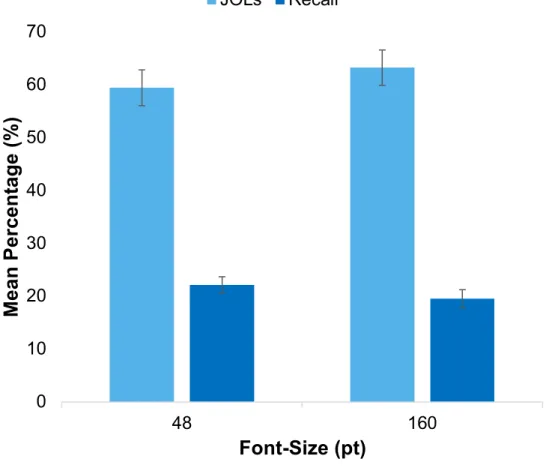
t(27)=1.93, p=0.064, Cohen’s d=0.303. This indicates that font-size did not significantly impact memory recall.
The average JOLs of subjects were extracted from the data for each font-size. Figure 3 shows that subjects indicated higher levels of confidence for large font words (M=63.23, SD=17.67) than medium font words (M=59.42, SD=17.91). JOLs for large font words were significantly higher than JOLs for medium font words, t(27)=2.729, p=0.011, Cohen’s d=0.214. These findings indicate that font-size significantly influenced predicted memory performance even though actual memory performance was not significantly impacted, which replicated the effect observed in Experiment 1.
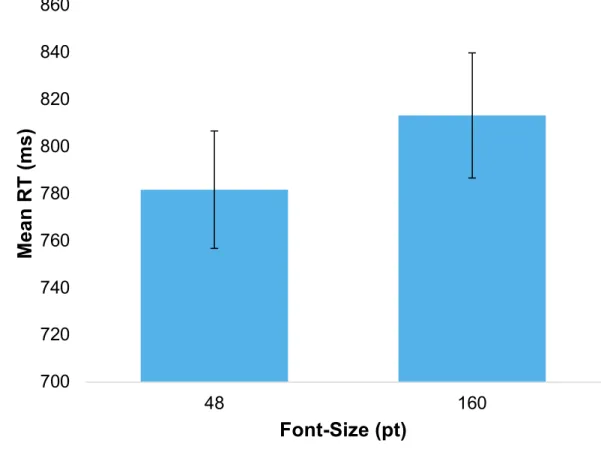
The median RTs of subjects were extracted from the data for each font-size. RT presented the same trend observed in Experiment 1. Figure 4 shows that the large font words (M=813.21, SD=140.51) were processed more slowly than medium font words (M=781.70, SD=131.86). An independent sample paired t-test was conducted with an alpha level of 0.05. RTs for large font words were significantly slower than RTs for medium font words, t(27)=3.432, p=0.002, Cohen’s d=0.231. In contrast with the previous experiment, this experiment successfully manipulated perceptual fluency. RTs for the large font condition were significantly higher than the medium font condition, indicating that font-size had a significant negative effect on perceptual fluency.
effect is mediated by belief and not fluency. This provides conclusive evidence against the fluency hypothesis.
General Discussion
The literature supports an effect of font-size on JOLs, and the font-size effect is replicated here in both experiments. The mechanism driving this effect is currently debated with two competing hypotheses. The fluency hypothesis argues that the ease of processing a stimulus serves as a cue to inform confidence judgments and that more easily processed items are accompanied by higher JOLs. The belief hypothesis argues that participants make their judgments based on a prior belief that large font words, and larger font in general, is better remembered, driving the font-size effect. To test these hypotheses, the experiments presented employed a large font-size subjected to both competing hypotheses, supporting one hypothesis based on if JOLs for these words were higher or lower than those of medium font words.
the results of Mueller and colleagues (2014). However, perceptual fluency was not successfully manipulated between large and medium font words, meaning the fluency hypothesis was not adequately tested and could not have been definitively rejected.
The second experiment aimed to manipulate fluency and replicate the results from the first experiment. In Experiment 2, the large font was increased from 140-point to 160-point and the small font was removed. Participants were again asked to read aloud individual words presented in one of two font-sizes – 48-point, and 160-point. After reading each word aloud, and before being presented the next word, participants judged how likely they were to recall the word on a later memory test using a scale of 0 (not confident at all) to 100 (extremely confident). Based on the results of Experiment 1, it was expected that confidence judgments would be higher for large font than medium font words even with disruptions in fluency. The font-size effect on JOLs was replicated between the two font-sizes. JOLs were significantly higher for large font words than medium font words. This finding replicated those of Experiment 1 and further supported the belief hypothesis. Perceptual fluency was also successfully manipulated in the experiment. The results show that medium font words had a lower response latency and were, therefore, processed with a higher perceptual fluency than large font words. If the effect resulted from fluency, then the JOLs of the large font words would have been lower than those of medium font. This provided definitive evidence that refuted the claim that perceptual fluency is the primary basis for the metacognitive illusion.
smaller than that caused by belief; fluency may possess a relatively minor impact while belief has a major impact on JOLs. Since the current literature cannot definitively reject the possibility that both belief and fluency impact JOLs, a third, joint hypothesis is worthy of consideration.
A joint hypothesis is supported by two possible theories, the dual-base theory and the analytic processing theory (Koriat, 1997). Dual-base theory proposes that belief and fluency are both equally important contributors to JOLs (Koriat et al., 2004; Undorf et al., 2017). In contrast, analytic processing theory proposes that a priori beliefs play a dominant role in the production of JOLs and perceptual fluency plays a smaller or possibly no role in JOLs (Mueller & Dunlosky, 2017). A few prior studies attempted to investigate these two theories but obtained inconclusive results (Mueller & Dunlosky, 2017; Mueller et al., 2014, 2016; Undorf et al., 2017). Research into these theories has primarily used the font-sizes employed by Rhodes and Castel (2008) and did not employ font-sizes larger than 48-point. Yang and colleagues (2018) conducted two experiments that employed a multilevel mediation analysis and proposed that JOLs increase by 3.34-4.35 points on a 100 point scale for every second that response time increases. However, Undorf and Zimdahl (2019) found that fluency begins decreasing at extremely large font-sizes, as shown in Experiment 2 of the current study. Theoretically, if fluency serves as a minor mediator of the font-size effect, then the negative effect on JOLs will compete against the positive effect of belief:
[JOLs] = Belief – Fluency
Where the effect of fluency is dependent on differences in response time to its peak and the effect of belief on JOLs increases at a currently unknown constant rate associated with font-size:
[Fluency] = (RTObserved – RTMax*) x Rate of Change* [Belief] = Constant* x Font-Size
then the effect of fluency will outweigh the effects of belief and ultimately decrease the JOLs of font-size. Future research should aim to investigate the joint hypothesis by either eliminating belief or fluency without manipulating the other. Manipulating belief will likely require experimenters to present false beliefs to participants. Manipulating beliefs may be challenging because there is no guarantee that subjects will fully implement any new beliefs presented by experimenters. Yet, if belief can be successfully manipulated while holding perceptual fluency constant, and vice versa, then the joint hypothesis can be tested.
References
Alter, A. L., & Oppenheimer, D. M. (2009). Uniting the tribes of fluency to form a metacognitive nation. Personality and Social Psychology Review, 13(3), 219–235.
Ball, B. H., Klein, K. N., & Brewer, G. A. (2014). Processing fluency mediates the influence of perceptual information on monitoring learning of educationally relevant materials.
Journal of Experimental Psychology: Applied, 20(4), 336–348.
Besken, M. (2016). Picture-perfect is not perfect for metamemory: Testing the perceptual fluency hypothesis with degraded images. Journal of Experimental Psychology:
Learning, Memory, and Cognition, 42(9), 1417–1433.
Besken, M., & Mulligan, N. W. (2013). Easily perceived, easily remembered? Perceptual interference produces a double dissociation between metamemory and memory performance. Memory & Cognition, 41(6), 897–903.
Dunlosky, J., Mueller, M., & Tauber, S. K. (2014). The contribution of processing fluency (and beliefs) to people’s judgments of learning. Remembering: Attributions, processes, and
control in human memory: Papers in honour of Larry L. Jacoby (pp. 46–64). New York,
NY: Psychology Press.
Dunlosky, J., & Rawson, K. A. (2012). Overconfidence produces underachievement: Inaccurate self evaluations undermine students’ learning and retention. Learning and Instruction, 22(4), 271-280.
Hu, X., Li, T., Zheng, J., Su, N., Liu, Z., & Luo, L. (2015). How much do metamemory beliefs contribute to the font-size effect in judgments of learning? PLoS One, 10(11), e0142351. Koriat, A. (1997). Monitoring one’s own knowledge during study: A cue-utilization approach to
Koriat, A. (2007). Metacognition and consciousness. In P. D. Zelazo, M. Moscovitch, and E. Thompson (Eds.), The Cambridge handbook of consciousness (pp. 289–325). New York: Cambridge University Press.
Koriat, A., Bjork, R. A., Sheffer, L., & Bar, S. K. (2004). Predicting one’s own forgetting: The role of experience-based and theory-based processes. Journal of Experimental
Psychology: General, 133(4), 643–656.
Kornell, N., Rhodes, M. G., Castel, A. D., & Tauber, S. K. (2011). The ease-of- processing heuristic and the stability bias: Dissociating memory, memory beliefs, and memory judgments. Psychological Science, 22(6), 787–794.
Legge, G. E., & Bigelow, C. A. (2011). Does print size matter for reading? A review of findings from vision science and typography. Journal of vision, 11(5), 8-8.
McCabe, J. (2011). Metacognitive awareness of learning strategies in undergraduates. Memory & Cognition, 39(3), 462–476.
Mueller, M. L., & Dunlosky, J. (2017). How beliefs can impact judgments of learning: Evaluating analytic processing theory with beliefs about fluency. Journal of Memory and
Language, 93, 245–258.
Mueller, M. L., Dunlosky, J., & Tauber, S. K. (2016). The effect of identical word pairs on people’s metamemory judgements: What are the contributions of processing fluency and beliefs about memory? The Quarterly Journal of Experimental Psychology, 69(4), 781-799.
Mueller M. L., Tauber SK, & Dunlosky J (2013). Contributions of beliefs and processing fluency to the effect of relatedness on judgments of learning. Psychonomic Bulletin & Review, 20(2), 378–384.
Rhodes, M. G., & Castel, A. D. (2008). Memory predictions are influenced by perceptual information: Evidence for metacognitive illusions. Journal of Experimental Psychology:
General, 137(4), 615–625.
Schwartz, B. L., & Efklides, A. (2012). Metamemory and memory efficiency: Implications for student learning. Journal of Applied Research in Memory and Cognition, 1(3), 145-151. Son, L. K. (2010). Metacognitive control and the spacing effect. Journal of Experimental
Psychology: Learning, Memory, and Cognition, 36(1), 255.
Susser, J. A., Jin, A., & Mulligan, N. W. (2016). Identity priming consistently affects perceptual fluency but only affects metamemory when primes are obvious. Journal of Experimental
Psychology: Learning, Memory and Cognition, 42(4), 657–662.
Susser, J. A., Mulligan, N. W., & Besken, M. (2013). The effects of list composition and perceptual fluency on judgments of learning (JOLs). Memory & Cognition, 41(7), 1000– 1011.
Susser, J. A., Panitz, J., Buchin, Z., & Mulligan, N. W. (2017). The motoric fluency effect on metamemory. Journal of Memory and Language, 95, 116–123.
Toppino, T. C., & Cohen, M. S. (2010). Metacognitive control and spaced practice: clarifying what people do and why. Journal of Experimental Psychology: Learning, Memory, and Cognition, 36(6), 1480.
Undorf, M., & Zimdahl, M. F. (2019). Metamemory and memory for a wide range of font sizes: What is the contribution of perceptual fluency?. Journal of Experimental Psychology:
Learning, Memory, and Cognition, 45(1), 97.
Undorf, M., Zimdahl, M. F., & Bernstein, D. M. (2017). Perceptual fluency contributes to effects of stimulus size on judgments of learning. Journal of Memory and Language, 92, 293– 304.
Figures
Figure 1. Exp. 1: Replication of the Font-Size Effect on Judgments of Learning across Font Conditions. This figure illustrates that font size had a significant positive effect on JOLs without eliciting a significant effect on memory recall performance. The significant effect between the small and medium font conditions replicated the font-size effect from previous studies, whereas the effect between the medium and large font conditions expanded the font-size effect to even larger font sizes. JOLs: F(2,58)=23.386, p<0.001, Recall: F(2, 58)=0.614, p=0.54. Error bars represent standard errors.
0 10 20 30 40 50 60 70
18 48 140
Me a n P e rc e n ta g e ( %) Font-Size (pt)
Exp. 1: Confidence Judgments and Recall by Font-Size
Figure 2. Exp. 1: Font-Size Produced a Positive Trend on Response Time (RT). The graph shows a positive trend on RTs and, therefore, a negative trend on fluency, but there are no significant differences in fluency between font conditions, F(2,58)=1.827, p=0.17. Error bars represent standard errors.
700.00 720.00 740.00 760.00 780.00 800.00 820.00 840.00
18 48 140
Me
a
n
R
T
(
ms
)
Font-Size (pt)
Figure 3. Exp. 2: Replication of the Font-Size Effect on Judgments of Learning across Font Conditions. This figure illustrates that font-size had a significant positive effect on JOLs without eliciting a significant effect on memory recall performance. The significant effect between the large and medium font conditions replicated the results from Experiment 1. JOLs: t(27)=2.729, p=0.011, Cohen’s d=0.214, Recall: t(27)=1.93, p=0.064, Cohen’s d=0.303. Error bars represent standard errors.
0 10 20 30 40 50 60 70
48 160
Me
a
n
P
e
rc
e
n
ta
g
e
(
%)
Font-Size (pt)
Exp. 2: Confidence Judgments and Recall by Font-Size
Figure 4. Exp. 2: Font-Size Produced a Positive Significant Effect on Response Time (RT). The graph shows a significant effect on RTs and, therefore, a negative effect on fluency, between font conditions, t(27)=3.432, p=0.002, Cohen’s d=0.231. Error bars represent standard errors.
700 720 740 760 780 800 820 840 860
48 160
Me
a
n
R
T
(
ms
)
Font-Size (pt)