Exploring Stakeholder Perceptions of Safe
Injection Facilities as a Harm Reduction
Method to Combating the Opioid Crisis in
North Carolina
By
Kevin Parham
Senior Honors Thesis
Department of Health Policy and Management
Gillings School of Global Public Health
University of North Carolina at Chapel Hill
May 2, 2018
Approved:
Karl Umble, PhD, MPH Director, BSPH Program Clinical Assistant Professor
Department of Health Policy and Management Gillings School of Global Public Health
Dorothy Cilenti, DrPH, MPH, MSW Clinical Associate Professor
Despite significant efforts to curtail the impact of the opioid epidemic, overdose deaths
continue to grow exponentially across the United States (Ahrnsbrak et al., 2017).. With 22 of the
top 25 cities for opioid abuse in the Southeastern United States, including 4 in North Carolina
alone, it is crucial to consider new and innovative interventions in the political context of the
South to effectively combat the negative effects of this crisis (Knopf, 2017). Safe injection
facilities are a harm reduction method that have been proven to decrease the likelihood of drug
overdose and connect injection drug users to reliable healthcare information in other countries,
but they have yet to launch in the United States due to social and legal obstacles (Small et al.,
2008). Using in-depth interviews with public health officials, medical providers, and law
enforcement officers across North Carolina, I explored the potential benefits and concerns that
key stakeholders have concerning the potential implementation of safe injection facilities in
response to the opioid crisis. Interviews were audio-recorded with consent, transcribed, and
coded by hand for thematic analysis to identify prevailing claims, concerns, and challenges
associated with the implementation of SIFs in North Carolina. By using the themes and related
information collected in this study, public health workers, legislators, and policy advocates can
make informed decisions about how to effectively and efficiently pass policy that benefits the
overall health and safety of injection drug users and the general population in North Carolina.
Acknowledgements
I would like to thank Dr. Karl Umble and Dr. Dorothy Cilenti for their unwavering support and
enthusiasm throughout this journey. I am tremendously grateful to the commitment each has
Table of Contents
Abstract 2
Acknowledgements 2
Table of Contents 3
Introduction 4
Research Questions 5
Background 6
Methods 11
Research Design and Data Source 11
Participants and Sampling Methods 11
Data Analysis Methods 12
Limitations 12
Ethical Considerations 13
Results 14
Claims 15
Concerns 18
Challenges 22
Summary of Thematic Analysis 26
Discussion 28
Conclusion 29
References 31
Introduction
Despite significant efforts to curtail the impact of the opioid epidemic, overdose deaths in
the United States continue to grow at rates far above those in other countries (Lopez, 2017). With
approximately 52,000 drug overdose deaths in 2015, the opioid epidemic remains a major public
health crisis (Lopez, 2017). Historically, many interventions, such as prescription monitoring and
pharmacy lock-in programs, have focused on addiction prevention. Alternatively, harm-reduction
methods, defined as interventions that reduce the negative consequences of a problem rather than
prevention, can help prevent accidental overdose in the population of those that are addicted. In
particular, safe injection facilities (SIFs) are a harm reduction approach that aims to decrease
opioid overdose by providing a medically supervised environment where drug users can
consume illicit drugs intravenously (Small et al., 2008). SIFs help decrease the likelihood of drug
overdose by providing sterile injection equipment, reliable drug and healthcare information, and
quick access to medical staff in the case of an emergency (Hedrich, 2004).
The threat of political backlash hinders the implementation of SIFs in the United States.
Critics of SIFs often prefer to direct taxpayer dollars towards interventions focused on addiction
prevention and treatment, and claim that SIFs would exacerbate the overall issue by enabling
drug abuse and normalizing illicit substances (Elliot, Malkin, Gold, 2002). This argument has
prevented the adoption of SIFs in the United States, despite significant evidence of their efficacy
and effectiveness in other countries. Due to the politically volatile climate surrounding this topic,
it is important for policymakers to consider all of the involved stakeholders before implementing
Few stakeholder analyses of safe injection facilities have been published, and fewer are
focused on the political environment in the Southeastern United States, which has 22 of the top
25 cities in America for opioid abuse. Moreover, North Carolina has four cities from this list,
including the number one city (Knopf, 2017). Thus, implementing SIFs across the Southeast
could vastly decrease the rate of overdose deaths caused by opioid abuse. Due to the lack of
agreement in which strategies to implement, it is important to critically examine the stakeholders
that would be involved in this specific region to determine the feasibility and efficacy of
implementing such an intervention. This stakeholder analysis is crucial to determine if potential
positive effects can outweigh opposing political repercussions.
Research Question
By analyzing qualitative data from interviews with medical providers, law enforcement
officials, public health advocates, and health policy experts, I will address the following
questions:
Ø What claims and concerns do various stakeholders express about the use of SIFs as a
harm reduction method?
Ø What are the challenges that limit the feasibility of implementing SIFs for the use of
Background
The opioid epidemic is one of the largest public health problems ever experienced in the
United States. Over the past 2 decades, this epidemic has grown at unprecedented rates, with the
consumption of hydrocodone increasing by more than 200% and 500%, respectively, between
1999 and 2011 (Kolodny et al., 2015). The Substance Abuse and Mental Health Services
Administration estimated that almost 12 million Americans misused opioids in 2016, with almost
1 million of those being heroin users (Ahrnsbrak et al., 2017). Furthermore, the rate of overdose
death related to opioid pain relievers quadrupled during this time frame, which coincided with a
900% increase in people seeking treatment for addiction to opioid pain relievers between 1997
and 2011 (Kolodny et al., 2015). These striking increases in opioid consumption and related
deaths has led to what the Center for Disease Control (CDC) has labeled the “worst drug
overdose epidemic in [US] history” (Paulozzi 2010, p. 47).
Additionally, the total economic burden of the opioid crisis is estimated to be $78.5
billion, with costs directly linked to fatalities from opioid overdose estimated at $21.5 billion
(Florence et al., 2016). This economic burden is mostly borne by the government on local, state,
and federal levels, with an estimated 25% of the economic burden being funded by public
sources (Florence et al., 2016). As a result, society is paying dearly for the opioid epidemic,
through increased health care costs and insurance premiums, forgone productivity and tax
revenue, and social programs aimed at treating substance abuse.
In North Carolina, the opioid epidemic has been particularly destructive. North Carolina
is home to four of the top 25 cities for opioid abuse in America as determined by the percentage
of prescription holders who abuse, including Wilmington and Hickory, which are ranked number
overdose deaths, 9 related hospitalizations, 12 related emergency room visits, 1,140 instances of
opioid misuse, and 25,500 opioid prescriptions dispensed every day (NC State Center for Health
Statistics, 2016). The number of unintentional opioid deaths in North Carolina has increased
10-fold since 1999, with heroin and other synthetic narcotics being involved in over half of these
cases in 2016 (NC State Center for Health Statistics, 2016). As the opioid crisis continues to
facilitate greater utilization of injection drug use, the public safety of North Carolina’s citizens is
jeopardized by the increased crime (Small et. al., 2007), violence (Haynes, 2015), hepatitis and
HIV cases (Metz, Sullivan, Jones, 2018), loss of productivity (Birnbaum et. al., 2011) and
incapacitated driving(Searle, 2017) that are associated with these behaviors. The consequences
of this crisis create a major financial burden, with the CDC estimating the total cost of the opioid
crisis to North Carolina at over $1.3 billion in 2015 alone (CDC WISQARS, 2010). Ultimately,
the opioid epidemic results in three major consequences for North Carolina and its citizens:
increased morbidity and mortality connected to prescription opioids and related drug use,
negative externalities and societal risks that harm public safety,and an overwhelming economic
burden that is largely borne by public funds.
While most public health professionals agree on the severity of the opioid epidemic, there
is much debate about how to best respond to this crisis. This debate can be broken into three Addiction
Prevention
•Targets those at risk for opioid addiction •Decreases surplus of prescription opioids •Reduces superfluous prescribing practices
Treatment
•Targets those who regularly use and abuse opioids
•Increases access to both physical and mental healthcare services •Provides evidence-based treatment for addiction
Harm Reduction
•Targets those who regularly use and abuse opioids by prioritizing pubilc safety •Eliminates negative consequences of drug use
categories of solutions: addiction prevention, treatment, and harm reduction (Hawk, Vaca,
D’Onofrio, 2015). Each of these solutions aims to tackle a different aspect of the crisis and
alleviate the consequences of increased morbidity and mortality, decreased public safety, and
increased financial burden as summarized in Figure 1. More specifically, harm reduction
methods center around individuals who are already addicted, with a focus on eliminating the
consequences of the opioid crisis and increasing the quality of life for addicts (Marlatt et al.,
2011). These methods are primarily controversial because do not directly prevent addiction from
occurring, nor directly provide treatment, and they involve extensive policy changes that involve
exceptions in criminal law for addicts.
One harm reduction method that has been creating extensive dialogue in public health
spheres for over two decades are safe injection facilities (SIFs). SIFs are medically supervised
facilities that provide a secure, hygienic place for injection drug users (IDUs) to self-administer
previously obtained illicit drugs with healthcare providers on hand to intervene in the event of
any complications or overdose (Small et al., 2008). Additionally, SIFs serve as a link to
healthcare and health education for IDUs who are more likely to lack important preventative
healthcare resources due to barriers from cost, transportation, stigma, and discrimination (Small
et al., 2008). These facilities are currently found in a handful of large cities throughout Europe,
Canada, and Australia, with no legally sanctioned SIF currently operating in the United States.
Since many IDUs lack sterile injection equipment or an innocuous place for injecting,
SIFs are essential to providing a secluded environment for IDUs to avoid public injection and
administer drugs outside of public parks or department store restrooms, and to receive helpful,
reliable healthcare information. Additionally, SIFs are even more important when considering
from following safe, hygienic injection practices (Small et al., 2006). This fear of the criminal
justice system discourages IDUs from utilizing needle exchange programs, resulting in increased
syringe sharing and improper syringe disposal (Small et al., 2006). All of these factors increase
the risk of infectious disease transmission and fatal overdose, despite the wide availability of
needle exchange programs and initiatives to distribute naloxone for reversing the onset of
overdose. This environment of fear among IDUs increases the risks from public injection, which
acts as a significant barrier to maintaining public safety and controlling crime (Small et al.,
2007). Thus, local officials must consider small-scale harm reduction interventions, such as SIFs,
that do not compromise the health and safety of IDUs and the general public.
As a harm reduction method, SIFs have been shown to reduce the negative consequences
of injection drug use associated with the opioid crisis, including reductions in needle/syringe
sharing (Kerr et. al., 2005 & Stolz, Wood, Small, 2007) public injecting and publicly discarded
syringes (Wood, Kerr, Small, 2004, Thein et. al., 2005, & Kerr et.al., 2007) overdoses (Hedrich,
2004) and increased enrollment in drug treatment(Wood, Tyndall, Zhang, 2006) without
increases in relapse rates(Kerr, Stolz, Tyndall, 2006) or drug related crime (Wood et. al. 2006).
IDUs have an increased risk of fatal overdose and transmission of blood borne infections, and
this is only exacerbated by the social and legal factors that work against IDUs (Fairbairn et al.,
2008). Through SIFs, IDUs have increased access to healthcare resources, including addiction
treatment, which has been shown to decrease their risky health behaviors and improve their
health outcomes (Small et al., 2008). Despite this evidence, SIFs are fiercely debated due to their
facilitation of illicit substance use by IDUs.
As with any controversial issue, it is necessary to consider all involved parties using a
method of attending to “any group or individual who can affect or is affected by the achievement
of an organization’s objectives” (Bryson 2004, p. 46). This tool is used to answer questions about
the position, influence, and invested interests of stakeholders on a particular issue, and to
understand the decision-making process that stakeholders utilize in a specific context (Brugha
and Varvasovszky, 2000). This is particularly important for public health organizations, and can
be critical in launching an intervention by distinguishing potential allies from prospective threats.
Stakeholder analysis has been a fundamental part of implementing many controversial public
health interventions in the past, including needle exchange programs for IDUs (Philbin and
FuJie, 2014), wide-spread availability of contraceptives (Petruney et al., 2010), and mandatory
vaccine programs (Nodulman et al., 2015).
In the case of SIFs, stakeholders are defined as any person, group, or organization that is
affected by or has influence over the implementation and operation of an intended SIF. This
includes government officials, pharmacists, health care providers, IDUs, local public health
organizations, drug treatment providers, law enforcement personnel, and community leaders. By
conducting qualitative interviews with these stakeholders, we can map the dialogue surrounding
SIFs in North Carolina and explore the feasibility and acceptance of this intervention as a
method of reducing opioid-related harm. Due to the scale of the opioid epidemic and its
consequences, we must consider controversial harm reduction interventions such as SIFs as a
possibility to reduce the overall harm and cost to society. By conducting a stakeholder analysis,
we will examine the position, influence, and interests of all involved parties and begin to
understand the potential benefit of SIFs and how these compare to their disadvantages. From this
understanding, public health leaders can make decisions about the political possibility of SIFs
Methods
Research Design and Data Source
Using in-depth qualitative interviews conducted from February 2018 - March 2018, with
8 key stakeholders -- legal professionals, public health officials, law enforcement personnel, and
medical providers -- I explored the current dialogue and acceptability of safe injection facilities
for the purpose of reducing drug-related harm in North Carolina. These groups were identified as
stakeholders based on their influence and interaction with drug related policy and injection drug
users. To ensure a diverse array of perspectives and understanding of acceptability of safe
injection facilities in this region, I used a targeted sampling method adapted from the Rapid
Policy Assessment and Response (RPAR) techniques for interviewing two levels of stakeholders,
experts and interactors, across three concentrations -- public health, policy, and treatment. RPAR
techniques were first developed as a legal analysis that uses empirical data to evaluate how
structural factors can impact local-level public health interventions (Burris & Lazzarini, 2006).
Participants and Sampling Methods
Upon identification of an initial list of experts and informants, each interviewee was
approached with an explanation of the study. After obtaining informed consent, each individual
was then asked background questions to assess key demographics, such as education level, age,
and gender. The interviews themselves were semi-structured, with a focus on general opinions
and awareness of IDUs and the opioid crisis, barriers and limitations to safe injection facilities
and other harm reduction methods, and implementation recommendations (Appendix A).
Interventions-specific questions were prefaced with definitions and explanations in an effort to
candidates for future interviews were solicited and snowball sampling was used to further
explore critical stakeholders and experts. These interviews were conducted telephonically to
maximize convenience, accessibility, safety, and comfort for the participants.
Data Analysis Methods
Interviews were approximately 30 minutes long, and digitally recorded. These recordings
were destroyed after being transcribed and coded to ensure anonymity. To reflect the new
information found during the study, content analysis was conducted simultaneously with
interviewing and interview guides were adjusted accordingly. A thematic analysis was conducted
in an adapted style of that created by Guba and Lincoln (1989), categorizing themes into claims,
concerns, and challenges that stakeholders express. Claims identified assertions that stakeholders
held about favorable aspects of the program, concerns characterized assertions regarding
unfavorable aspects of the program, and challenges represented potential occlusions to reconcile
before successful implementation of the program (Guba and Lincoln, 1989). The data identified
general themes concerning harm reduction in North Carolina, the acceptability of safe injection
facilities, barriers and limitations foreseen by stakeholders, and implementation suggestions. The
transcripts of the interviews were hand-coded, and a codebook was created with key themes and
concepts. These concepts were used to identify the general claims, concerns, and perceived
challenges of each stakeholder in relation to safe injection sites.
Limitations
As with other stakeholder analyses and snowball sampling studies, this study has the
strength of adaptation, and aims to characterize the dynamic environment around self-injection
about safe injection facilities, or harm reduction and the opioid crisis in general, which made it
difficult for them to form fully informed and thoughtful opinions about the issue. Since a brief
description was provided in the interview, these results may more effectively characterize the
initial reactions to stakeholders rather than their fully formed opinions. Additionally, this study
was limited by the number of stakeholders that could be interviewed with the resources at hand,
as well as by which stakeholders were willing to speak about such a politically contentious issue,
and therefore may not be fully representative of the population in North Carolina.
Ethical Considerations
Since this study is concerned with the use of illicit substances and injection drug users,
there are ethical concerns with maintaining anonymity and privacy of individuals who consent to
being interviewed. Every measure was taken to protect the privacy of individuals and de-identify
their responses so they would be free of any emotional, legal, or social repercussions. The
Institutional Review Board at the University of North Carolina at Chapel Hill reviewed and
Results
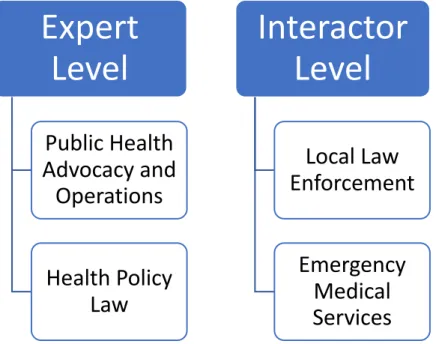
The eight stakeholders interviewed consisted of 4 expert level and 4 interactor level
participants. As described in Figure 2, their professions included public health advocacy and
operations (n=3) and health policy law (n=1) as expert level stakeholders, as well as local law
enforcement (n=2) and emergency medical services (EMS) (n=2) composing the interactor level
stakeholders. Despite the different professions of the participants, they were all familiar with the
basic consequences of the opioid crisis in relation to North Carolina, with some varying degrees
of knowledge into specific local consequences and comparisons on a national level. They all
expressed awareness of harm reduction methods and many of the participants have spent
significant time in their professional careers interacting with the North Carolina Harm Reduction
Coalition. In relation to perceived benefits and concerns surrounding safe injection facilities,
attitudes were assessed for each stakeholder group in regards to three main areas: claims,
concerns, and challenges. In regards to
these themes, claims represent the
perceived benefits and factors that support
the implementation of SIFs, concerns
characterize the worries that these
stakeholders hold, and challenges signify
the hurdles that are currently obstructing a
clear path towards the possible
implementation of SIFs within North
Carolina.
Expert
Level
Public Health
Advocacy and
Operations
Health Policy
Law
Interactor
Level
Local Law
Enforcement
Emergency
Medical
Services
Claims
SIFs are Effective at Promoting Health and Safety for IDUs
All of the public health experts interviewed demonstrated extensive knowledge and
personal experience with SIFs, and were adamant that SIFs achieve their designed goals of
improving public safety and reducing morbidity and mortality amongst injection drug users.
They referenced peer reviewed research that informed these claims, and demonstrated familiarity
with the positive effects that SIFs have had in communities outside of the United States.
“We know that the highest risk of overdose is when you’re actually consuming the drug, so if you can be in a place where if you do overdose, it’s not gonna lead to overdose death—that’s a good thing. That’s what they are designed to do, that’s what they do—the evidence is overwhelming.”
–Health Policy Lawyer
“I think if it was purely based off of scientific merits, then there wouldn’t even be a conversation about this.”
–Public Health Advocacy Organization Staff Member
These opinions were echoed in the interviews with law enforcement officials, as well as
EMS providers. While both groups demonstrated less knowledge on the secondary benefits of
SIFs, many indicated confidence in their effectiveness for decreasing mortality, with one EMS
provider stating “no one has ever died at a safe injection or safe consumption center.” They also
expressed understanding in the consistency with harm reduction philosophy and other harm
reduction methods, despite the presence of personal comfort with the intervention.
“I understand the science behind safe injection sites and how that can be a good thing, but like I still am like, “I don’t know man, it’s kind of weird.” I think you’d get that gamut of opinions across law enforcement.”
–Law Enforcement Officer
SIFs are Effective at Improving Public Safety
Law enforcement officers focused on potential benefits of SIFs for public safety,
syringes. These opinions were influenced by personal anecdotes on the job that primarily
involved the harm or increased harm of innocent bystanders as a result of IDU behavior.
“People who are using are gonna try to find places to use and often times leave behind byproducts of that use. So, the potential there for a child to come in contact with that needle or anyone else for that matter is one of concern. So immediately when you talk about safe injection facilities, I think about maybe that reduces the number of encounters at a McDonald’s bathroom.”
–Law Enforcement Officer
While EMS providers did not express as much familiarity with public safety benefits of
SIFs, the theme of effectiveness towards improving public safety was reflected in the responses
of many of the public health experts. These perceived benefits were influenced by peer reviewed
research on both underground SIFs in the United States and legally operating SIFs abroad,
resulting in “decreased public nuisance and injection in the public domain,” “decreased HIV and
hepatitis,” and “decreased crime in the public domain.”
“Most importantly, it will decrease drunk driving and inebriated driving. So, in cities which are being hard hit by traffic fatalities and traffic injuries related around drug use, what a fabulous thing to do and help people not use while in motor vehicles, and not use in parking lots and drive off because you can medically check people.”
–Public Health Advocacy Organization Staff Member
Common Sense Policy
Despite differing comfort with the possibility of SIF implementation, members from each
of the four stakeholder groups expressed understanding of how SIFs fit into the overall harm
reduction philosophy and spoke to how much it aligned with common sense. This idea of
common sense policy was more comfortable for the public health advocates and the EMS
providers who expressed more familiarity with harm reduction, but it was also present in the
responses of law enforcement despite clear discomfort with the concept of medically supervised
and legally-authorized injection drug use.
–Public Health Advocacy Organization Staff Member
“I think the safe injection idea is a logical pretty big step forward—but also a logical extension of those other philosophies…To me, the idea of administering narcan to someone is not that different from having medical supervision while someone uses, and those things are not philosophically very far apart in my head.”
–Law Enforcement Officer
SIFs Demonstrate Compassion and Humanity
Another common claim that several public health experts and EMS providers expressed
is the idea that SIFs are an intervention that demonstrate humanity and compassion towards
IDUs. This theme primarily focuses on SIFs as a way to show support to those that are in the
throes of addiction, and to demonstrate concern for the lives of this vulnerable population. This
epidemic has had a major effect in close-knit rural communities, where everyone has been
directly impacted by the crisis, and SIFs are an intervention that can rebuild a ravished
community by demonstrating compassionate care.
“I think when you humanize healthcare, it can become incredibly fulfilling as a provider, but it also is incredible for the patient to feel like they’re cared for. And I think the nature of IV drug use, most of these folks are very disenfranchised, with their social support networks, and I think trying to reconnect them to that becomes really an essential part of their recovery.”
–EMS Provider
“Now in a lot of rural communities, which I think have had an undue burden of the opiate epidemic, the people who are dying are people who everybody know. So, I think there will be a shocking amount of support [for SIFs] in some of the rural areas and
conservative jurisdictions because that’s where everybody grew up together and they’re sick of seeing their loved ones die.”
–Public Health Advocacy Organization Staff Member
“It’s just a hotbed of harm reduction down here [in North Carolina], and people are really engaged and they want to work, and they want to save lives…harm reduction is treating people with dignity and respect, that’s the golden rule—do unto others as you’d have others do unto you.”
–Public Health Advocacy Organization Staff Member
going to treat you like a human being, [which is a foundational belief of harm reduction and SIFs].”
–Health Policy Lawyer
Concerns
SIFs Stifling Treatment
One of the primary concerns expressed in the interviews across stakeholder groups is the
concern that SIFs would become a substitute to implementing treatment interventions which
increase access to medication assisted treatment. While these stakeholders viewed SIFs as a
necessary piece of the puzzle for solving the opioid crisis, they were not convinced that SIFs
were the most impactful intervention. Ultimately, they believed that SIFs should be utilized as a
part of a greater response to the opioid crisis that provides a comprehensive set of public health
policy targeting prevention, treatment and harm reduction.
“I think that supervised injection facilities are great, they should absolutely be part of the response. [But,] it doesn’t replace evidence-based treatment.”
–Health Policy Lawyer
“I believe that monitored injection sites are the next step in that continuum of harm reduction. I don’t know how heavily they would be utilized, but I do know that at a monitored site, the likelihood of a fatality from an overdose is exponentially lower. So, from the medical side it makes a lot of sense to me that it would be available in our continuum, and do that along with safe injection practices and other harm reduction strategies.”
–Law Enforcement Officer
“I think [the most effective way to promote health and safety among injection drug users in North Carolina is] a combination between safe consumption sites and targeted mobile outreach and syringe exchange. Because even if we do create safe consumption sites, not everyone is going to visit and not everyone is going to be able to visit.”
–EMS Provider
SIFs Stifling Prevention
Related to the concern of SIFs being perceived as a replacement for treatment,
addiction prevention. Since SIFs are inherently targeted at opioid abusers in the latest stages of
addiction, there is a tendency to overlook interventions that can prevent users from reaching the
stage of injecting. While SIFs are proven to help people in this stage, there is concern that this
intervention could dilute the focus on prevention and mental health services that are necessary
for combating the opioid crisis.
“Sometimes I think we do people a disservice by jumping to people who are injecting drugs and all of the stereotypes that come with that. They kind of sort of [portray] people who are using drugs in a way that is harmful to themselves and to their families, but [separate themselves from IDUs by saying] ‘Wow, I never shot heroin, I’m not one of those people.”
–Health Policy Lawyer
“The lack of investment in mental health services in North Carolina is a primary driver of the opioid crisis [and should be a priority].”
–Public Health Advocacy Organization Staff Member
SIFs’ Relation to Other Drug Use
While SIFs have been widely debated in the public within the context of the opioid crisis,
many stakeholders expressed concern for how this intervention would work for users of other
intravenous drugs. The framework for existing SIFs abroad is not set up exclusively for opioid
users, and many of the public health officials echoed the idea that successful implementation of
SIFs must also include access for users of cocaine, methamphetamines, and other illegal drugs,
especially since the opioid epidemic is so intertwined with the use of other drugs. In regards to
associated stigma of these drugs, stakeholders also expressed concern that the general public
regarded the use of all IV drugs as unacceptable. While it is reasonable that the general public
may allow the implementation of SIFs as a response to the extenuating consequences from the
opioid crisis, stakeholders expressed concern that many may not consider this intervention
“I am deeply concerned that they’ll do this [SIFs] for opiates only and if the opiates ever get under control then they’ll throw everybody else under the bus, especially meth users.”
–Public Health Advocacy Organization Staff Member
“I think that there’s large scale education that really needs to happen, like really
regionally. There’s certainly a lot of conversation in the media, you know, like what does it mean to have safer injection facilities. That’s not just opioids, we’re talking about people who are into shooting crack, or methamphetamine, or [et cetera].”
–Public Health Advocacy Organization Staff Member
Privacy for IDUs
One of the primary concerns expressed by both public health advocacy staff members
and law enforcement is that of privacy for IDUs. Since SIFs typically operate on a bring your
own policy, those who would use a SIF are likely participating in illegal activity with a dealer
and individually in the form of possession of a controlled substance. The concern with this, is
that people may be hesitant to use a SIF if they believe a law enforcement officer could monitor
their activity at the site, proceed with surveillance, and ultimately arrest the user or their dealer
off site from the SIF.
“Clearly someone walking in the front door, as you said, it’s BYO. Which means someone has acquired these substances and almost undoubtedly acquired them illegally and therefore the possession is also illegal. So, on its face, that’s a legal hurdle that you just kind of have to reconcile.”
–Law Enforcement Officer
“My biggest concern, what I stated earlier is, my fear of law enforcement, like waiting outside, or waiting around the corner, or hiding somewhere watching these drug users come and go. Watching them, and then following them to the big-time drug dealers, just that would be my biggest fear over all, is continuing the secret or public criminalization of drug users in general.”
–Public Health Advocacy Organization Staff Member
Not in My Backyard (NIMBY)
Another common concern with the logistics of implementing SIFs that was mentioned by
the public health experts is that of the “not in my backyard” contingent. This theme centers on
attracts crime, violence, and other negative externalities that are associated with drug use. While
most of the stakeholders that were interviewed did not cite this as a personal concern, they did
discuss this as a common concern for the general public.
“Then you have the NIMBY [Not In My Backyard] people who are kind of like “well, you know I’m not saying I don’t understand what you’re saying but I don’t want a bunch of junkies in my backyard.” And that’s not, not understandable. You know, of course the counter to that is that people are already using drugs and overdosing in your backyard.”
–Health Policy Lawyer
As mentioned by some stakeholders, this can be combated with statistics and anecdotes
about people using injection drugs regardless of the implementation of a safe injection facility;
however, some people still expressed discomfort with the implementation of SIFs even with a
close connection to addiction in their own neighborhood.
“I’ve kind of seen it firsthand, personally, and when it comes to safe injection sites, I mean I understand conceptually the science behind it, I understand the thinking behind it, I understand the harm reduction philosophy behind it. It still is a little bit far of a reach for me to be completely comfortable with it.”
–Law Enforcement Officer
SIFs are Perceived as Enabling Drug Use
One of the universal concerns that was expressed across stakeholder groups was the
belief that SIFs (along with harm reduction interventions in general) enable IDUs to use and
promote illegal and unhealthy behavior. This has been a concern in every educational campaign
related to harm reduction, from syringe exchange to naloxone distribution, and continues to be a
struggle with SIFs. While there are ways to educate people on the effectiveness of SIFs as an
intervention, this preconceived notion of SIFs enabling dangerous and illegal activity is a major
concern if they are going to be successfully implemented in North Carolina.
“I think the other thing we continue to fight is the whole stigma of, we’re enabling drug use. When I started first doing naloxone distribution, that was the most common thing that we heard [but] the reality is that they were already using the drugs”
“People think we’re just enabling people to shoot more drugs. I presume that’s the number one thing. It’s the same reason that people fought us on naloxone, and people fought us on syringe exchange for a while.”
–Public Health Advocacy Organization Staff Member
“I think there are certain moral parts of our country that struggle with the idea that you in some ways enable the behaviors [of injection drug use] … and fundamentally that would be a challenge for some people [to overcome].”
–Law Enforcement Officer
Challenges
Reframing the Dialogue Around Effectiveness
Taking into account the claims and concerns above, one of the main challenges discussed
by the stakeholders regarding the potential implementation of SIFs was the need to reframe the
public dialogue around the effectiveness of this intervention. Several stakeholders mentioned the
need to educate the public on the benefits that this intervention has for a community rather than
to let people maintain a negative image on IDUs and drug use in general. As explained, many
people immediately assume that this intervention encourages and enables drug use, which is a
challenge to the overall feasibility of this intervention.
“Obviously when I say safe injection facilities, it sounds like I’m enabling people to get high, but if you frame it and teach people exactly what is happening inside a facility like this, I think you’d have a better shot at changing the public’s mind.”
–Public Health Advocacy Organization Staff Member
“I think just the pitch to the general public can be a bit of a challenge too. I think it would have to be framed carefully. Because some people are gonna see it as ‘so you just want a spot where people can come use drugs?’”
–Law Enforcement Officer
War on Drugs Rhetoric
Another challenge that was widely discussed, especially by law enforcement officers,
was the “war on drugs” attitude that has been the primary driver of drug policy in recent
many years punishing those who use by imprisoning them, rather than connecting them to
treatment and harm reduction resources. This attitude is still endorsed in North Carolina by many
federal and state laws, and it is apparent in the actions of many law enforcement officials when
working a drug case. Although a slight shift in this mindset has begun to spread across the US
with the movement for legalization of marijuana, the war on drugs rhetoric persists as a major
challenge to overcome in presenting IDUs as worthy of treatment and life-saving harm reduction
interventions.
“We’re not far removed from the war on drugs kind of mindset in law enforcement, and not just law enforcement, kind of in our communities. So, harm reduction philosophies are actually a pretty significant departure from the idea of the war on drugs, and it’s gonna take a little time to undo that sense in our community”
–Law Enforcement Officer
“We have to walk the walk and talk the talk. We have to do both, which means if your police chief is saying certain progressive things about harm reduction strategies, but your operational employees are actually acting like it’s still the war on drugs then you’re not gonna be successful. So, you need to have policies in place, training in place to police to understand why these strategies are important.”
–Law Enforcement Officer
“Well, we’ve done everything wrong, and therefore we have everything that we thought. We’ve criminalized drugs, we’ve locked people up instead of giving them help. The criminal justice system is the largest treatment provider which is the worst thing that you could do. We have historically criminalized harm reduction, we’ve historically
criminalized harm reductionists. We’ve criminalized people who do drugs, we’ve
criminalized people who treat them. We’ve prevented people from gaining treatment due to their criminal record.”
–Public Health Advocacy Organization Staff Member
Legal Framework
In relation to the war on drugs rhetoric, another significant challenge that occludes the
implementation of SIFs is the lack of a current legal framework. SIFs are not an intervention that
can currently exist under federal laws or North Carolina state laws and unless these are altered to
prosecution. While this challenge has been present with other harm reduction interventions such
as syringe exchange, as well as the legalization of marijuana, the degree to which SIFs defy the
current laws that are in place is more extreme and unpredictable. Additionally, stakeholders
expressed interest in observing the implementation and operation of SIFs in a legally sanctioned
context within the United States before forming a final opinion on the logistics of
implementation in North Carolina. Ultimately, if SIFs are ever going to be widespread across
North Carolina, there will need to be major alterations to both federal and state drug policy that
allow for it, and close examination on previously existing frameworks is necessary to ensure
stakeholder buy-in on new legislation.
“I would say the greatest legal barrier is that it’s federally illegal to use drugs or to have a place for people to be using drugs. I think that’s a major barrier.”
–Public Health Advocacy Organization Staff Member
“The law is symbiotic with social norms—we create them, we can reinforce them, and American drug law kind of says ‘well, it’s okay to use some drugs, but it’s not okay to use others.’ And of course, the drugs that are largely used in supervised consumption spaces are in the not okay category. So, in general, most people want to obey those laws most of the time, and they take their cues from the law, and if the law says these are illegal then a lot of people who haven’t looked into the matter too closely, you know, [their] standard first pass rubric is ‘well if something’s illegal, then it’s probably bad.’ So, they think well this is probably a bad idea.”
–Health Policy Lawyer
“The federal law [that makes it illegal to maintain any place for the purpose of
manufacturing, distributing, or using any controlled substance] is called the Crack House Act, [which] wasn’t designed to stop or limit public health interventions. And that’s the argument about why the federal law shouldn’t be enforced this way, and the same with the state laws. States cannot be forced to follow federal law, you know if the feds want to come in and shut down a SIF under federal law, they can do that. Of course, if the feds want to come in and shut down syringe exchange programs under federal law, they can do that too. They never have.”
–Health Policy Lawyer
“First somebody else needs to do it. I know like Philadelphia, San Francisco, Seattle, New York, are all looking at it [legislation that allows for SIFs]. I think a lot of it is that we are interested in how the feds respond to this.”
Funding for SIFs
Stakeholders also identified funding as a challenge to overcome if SIFs are to be
effectively implemented in North Carolina. While there is a lot of dialogue in the media about
the opioid crisis, there is a severe lack of funding for the necessary interventions which is only
exacerbated with politically contentious and legally questionable interventions such as SIFs.
Especially in the early stages of implementation, it will be nearly impossible to fund these
facilities with state or federal dollars, making its success dependent on private funding.
“I think other barriers [to overcome if SIFs are to be implemented in North Carolina] are public criticism [and] cost barriers—[there’s] not a lot of funding for it.”
–EMS Provider
“I think [SIFs are] a good model, I just think the challenge is always, resources, funding, you know that’s the big thing for long term therapy for a lot of these folks that are addicted, because as I understand it, it’s a hell of a challenge to get off this stuff.”
–Law Enforcement Officer
“The other thing is that we still don’t have funding for syringe exchange, [so] who’s gonna fund SIFs? They’re not gonna want to put any state dollars to this. Maybe RTI or somebody else could help us get funding for it. I think UNC, Duke, NC State, RTI, FHI360 are all viable funding sources. RTI has already invested in safe injection facilities in the United States underground for research. So, I think that there’s definitely interest in it, and you know having a base in the research triangle I think there’s a lot of interest in there.”
–Public Health Advocacy Organization Staff Member
Racial Implications
The racial undertone of the opioid crisis is another nuanced challenge that stakeholders
discussed in their interviews. This epidemic, as well as the response of the media and the public
to this epidemic, are not independent of racial factors that dictate social patterns across the
United States. While this challenge is not directly apparent to many who are directly impacted by
the opioid crisis, there are factors of race that put people at greater risk of overdose or death from
responses to previous drug crises. In order to successfully implement SIFs and provide equitable
care across racial and socioeconomic divides, it is critical to consider the impact of America’s
racist drug history and how this history has created the current disparities that exist.
What’s different [about the opioid crisis now]? I mean a few things are different. One, there’s a lot more people dying. Two, they’re differently hued and they’re taking different drugs then people were taking in the ‘90s. They’re not gay. So, it’s a more socially acceptable epidemic now, which certainly has something to do with [the public dialogue and current public health response].
–Health Policy Lawyer
“There’s a strong correlation with race and religion that are really risk factors for overdose, and I’m keenly aware of that.”
–Public Health Advocacy Organization Staff Member
Summary of Thematic Analysis
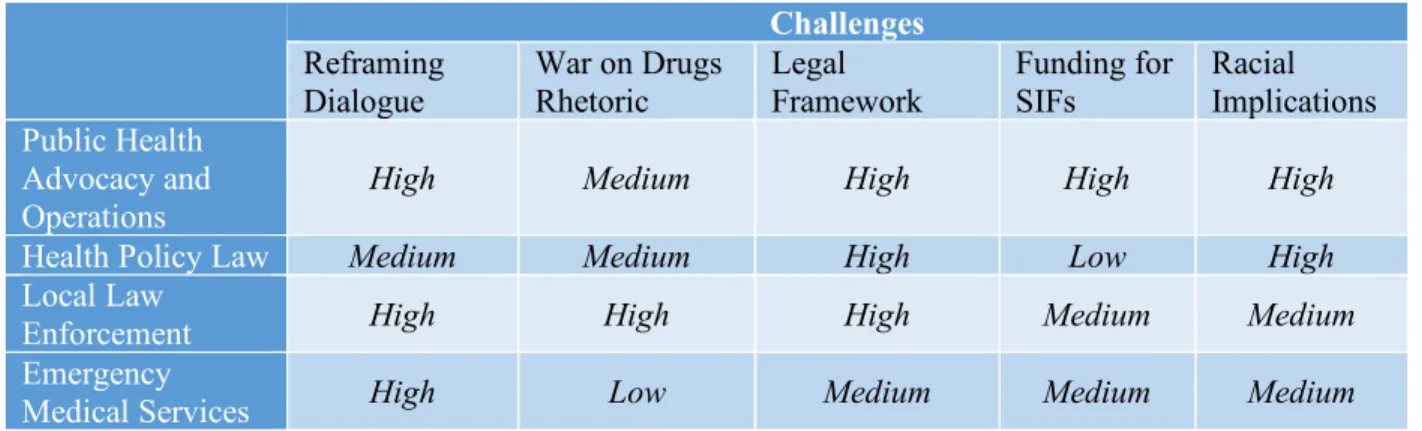
In consideration of all of the claims, concerns, and challenges revealed above, each of
these themes were evaluated by stakeholder group for levels of awareness, concern, and priority,
respectively. This was measured on a scale of high, medium, or low with regard to two factors:
the prevalence in which the theme arose in interviews and a subjective measurement of apparent
significance within each group. The summary of this assessment is presented in Tables 1-3 on
page 27 below. Ultimately, while each of the themes outlined previously was identified across
several stakeholder groups, a handful of the topics were determined to hold a high level of
interest. The claim of highest awareness level was identified as the effectiveness of SIFs in
relation to promoting health and safety of IDUs. In terms of concerns, the worries of SIFs stifling
efforts at prevention, as well as efforts for treatment, were of the most concern across the
stakeholder groups, but each of the other concerns was of high interest to specific stakeholders.
The two primary challenges identified were the reframing of dialogue to focus on effectiveness
Table 1: Degree to which each stakeholder group states these claims
Claims
Effectiveness of Promoting Health and Safety for IDUs
Effectiveness of Improving Public Safety Common Sense Policy Demonstrate Compassion and Humanity Public Health Advocacy and Operations
High High High High
Health Policy
Law High Medium High High
Local Law
Enforcement Medium High Medium Medium
Emergency
Medical Services High Low Medium Medium
Table 2: Degree to which each stakeholder group states these concerns
Concerns Stifling Treatment Stifling Prevention Relation to Other Drug Use Privacy for IDUs
NIMBY Enabling of Drug Use
Public Health Advocacy and Operations
Medium High High High Low Low
Health Policy
Law High High High Low High Low
Local Law
Enforcement Medium Medium Low High High High
Emergency
Medical Services Medium Medium Low Low Low High
Table 3: Degree to which each stakeholder group states these challenges
Challenges
Reframing Dialogue
War on Drugs Rhetoric Legal Framework Funding for SIFs Racial Implications Public Health Advocacy and Operations
High Medium High High High
Health Policy Law Medium Medium High Low High
Local Law
Enforcement High High High Medium Medium
Emergency
Discussion
This qualitative study among key stakeholders with interests in the North Carolina opioid
epidemic primarily examined the acceptance and potential feasibility of SIFs across the state.
While the methods used were not designed to assess the overall frequency of opinions and their
distribution in the general public, many themes were recurrently discussed amongst stakeholder
groups. Each of these themes, representing different claims, concerns, and challenges of
implementing SIFs, characterized the dialogue surrounding this intervention from the perspective
of both public health experts and those who interact directly with the crisis. The experiences of
these stakeholders suggest that there is much to consider before SIFs can be effectively
implemented in North Carolina in the current social and political context of the state.
Overall, there is lot of optimism amongst experts in the public health field, as well as law
enforcement officers and EMS providers, in regards to favorable factors for implementing SIFs
in North Carolina—effectiveness of promoting health and safety for IDUs, effectiveness of
improving public safety, perception of SIFs as a common-sense policy, and the idea that SIFs
demonstrate compassion for IDUs as people. These claims are accompanied by equally valid
concerns—fear of SIFs stifling treatment or prevention efforts, external effects on non-opioid
drug use and policy, privacy for IDUs, the NIMBY aversion, and the stigma of enabling drug
use. Each of these factors are important to consider in overcoming the challenges that
stakeholders identified—reframing the dialogue to focus on effectiveness, combating the war on
drugs rhetoric, developing a comprehensive legal framework, procuring adequate funding and
resources, and remaining sensitive to the racial implications of the crisis.
There are several potential reasons that these themes emerged in this study. Countless
perspectives evolves into a unique approach to managing drug use in society. Harm reduction is
a specific category of intervention that does not neatly conform to the current set of US drug
legislation, and SIFs are an extreme representation of this philosophy. Both people and
institutions are often resistant to change, and SIFs represent a disruption to the status quo in
American societal norms. Ultimately, the implementation of SIFs are a large step to take and
stakeholders are hesitant to ensure that the step is being taken in the right direction.
Although this study intended to examine stakeholder interests on multiple levels within
the opioid crisis, limitations of time and resources made it difficult to assess such a complex
issue. The participants’ responses were also limited by their own individual experience and
knowledge concerning safe injection facilities, which are not necessarily representative of North
Carolina as a whole. Finally, the study was limited to interviewing those who consented, and
guided by snowball sampling which likely excluded people with negative attitudes towards harm
reduction and safe injection facilities. Despite these limitations, the identified themes reached
saturation as demonstrated by their recurrence across stakeholder groups, providing confidence
that these results are meaningful and useful for guiding further research.
To fully measure attitudes towards SIFs in North Carolina, next steps include assessing
opinions and interests of IDUs in regard to regularly using SIFs, promoting unbiased educational
campaigns that inform the general public on the benefits and concerns of SIFs, and researching
effective legal frameworks that align with the socio-political context of North Carolina.
Conclusion
The prospect of implementing SIFs in North Carolina is a complex issue that involves
understanding of the intervention. While most stakeholders have the same goals of decreasing
morbidity and mortality from opioids, and increasing public safety, they seem to disagree on the
necessity of certain interventions to achieve these goals. My findings suggest that several key
stakeholders in North Carolina are aware of the possible benefits of SIFs and receptive to their
possible implementation, but simultaneously hesitant to endorse such an intervention without
further precedent in a local American context. Although more research needs to be conducted on
IDU receptiveness to SIFs, by addressing the challenges presented and gathering more relevant
evidence that this intervention satisfies a legitimate need, SIFs could be feasible within the
References
Ahrnsbrak, R., Bose, J., Hedden, S.L., Lipari, R.N. and Park-Lee, E. (2017). Key Substance Use and Mental Health Indicators in the United States: Results from the 2016 National Survey on Drug Use and Health. Rockville, MD: Center for Behavioral Health Statistics and Quality, Substance Abuse and Mental Health Services Administration.: Substance Abuse and Mental Health Services Administration.
Birnbaum, HG, White, AG, Schiller, M, Waldman, T, Cleveland, JM, Roland, CL. (2011). Societal Costs of Prescription Opioid Abuse, Dependence, and Misuse in the United States. Pain Medicine, 12(4);657-667
Brugha, R. and Varvasovszky, Z. (2000). Stakeholder analysis: a review. Health Policy and Planning 15(3), pp. 239–246.
Bryson, J.M. (2004). What to do when Stakeholders matter. Public Management Review 6(1), pp. 21–53.
Burris, S., & Lazzarini, Z. (2006). Rapid Policy Assessment and Response. Retrieved December 06, 2017, from http://www.temple.edu/lawschool/phrhcs/rpar/index.html
CDC WISQARS for opioid-related drug deaths (unintentional), Cost of Injury Reports, National Center for Injury Prevention and Control, CDC. Base year (2010) costs indexed to state 2015 prices for poisoning deaths.
Elliott, R., Malkin, I., & Gold, J. (2002). Establishing safe injection facilities in Canada: Legal and ethical issues. Montréal: Canadian HIV/AIDS Legal Network.
Fairbairn, N., Small, W., Shannon, K., Wood, E. and Kerr, T. (2008). Seeking refuge from violence in street-based drug scenes: women’s experiences in North America’s first supervised injection facility. Social Science & Medicine 67(5), pp. 817–823.
Florence, C.S., Zhou, C., Luo, F. and Xu, L. (2016). The economic burden of prescription opioid overdose, abuse, and dependence in the united states, 2013. Medical Care 54(10), pp. 901–906.
Guba, E. G., & Lincoln, Y. S. (1989). Fourth generation evaluation. Newbury Park, CA: Sage Publications.
Havnes, I. (2015). Violence and diversion of prescribed opioids among individuals in opioid maintenance treatment. Institutt for Klinisk Medisin.
Hedrich D. (2004). European report on drug consumption rooms. Lisbon: European Monitoring Centre for Drugs and Drug Addiction.
Kerr T, Stoltz J, Tyndall M, et al. (2006). Impact of a medically supervised safer injection facility on community drug use patterns: a before and after study. BMJ 332: 220-222.
Kerr T, Tyndall M, Li K, Montaner J, Wood E. (2005). Safer injection facility use and syringe sharing in injection drug users. Lancet 366:316-318.
Kerr, T., Tyndall, M.W., Zhang, R., Lai, C., Montaner, J.S.G. and Wood, E. (2007).
Circumstances of first injection among illicit drug users accessing a medically supervised safer injection facility. American Journal of Public Health 97(7), pp. 1228–1230.
Kitsenko, G.; Shakhov, A.; Lazzarini, Z.; Case, P.; Chintalova-Dallas, R.; Burris, S. Harm reduction training in law schools in Ukraine. Proceedings of the 19th international harm reduction conference (IHRC); 2008.
Knopf, T. (2017). Four North Carolina Cities Make Top 25 List for Opioid Abuse. Retrieved March 1, 2018, from https://www.northcarolinahealthnews.org/2017/07/27/four-north-carolina-cities-make-top-25-list-opioid-abuse/
Kolodny, A., Courtwright, D.T., Hwang, C.S., Kreiner, P., Eadie, J.L., Clark, T.W. and Alexander, G.C. (2015). The prescription opioid and heroin crisis: a public health approach to an epidemic of addiction. Annual Review of Public Health 36(1), pp. 559– 574.
Kozachenko, N.; Darbekova, G.; Mingazova, I.; Burris, S.; Case, P.; Chintalova-Dallas, R., et al. Evaluation of drug policy and HIV/AIDS prevention programs in Kazakhstan (Temirtau and Shymkent): Summary of RPA results. Proceeding of the 19th international harm reduction conference (IHRC); 2008.
Lazzarini, Z.; Case, P.; Burris, S.; Chintalova-Dallas, R. Three easy policy changes to improve the risk environment for IDUs in Eastern Europe and the former Soviet Union Abstract #970 . Proceedings of the 18th International Harm Reduction Conference (oral
presentation); 2007.
Lopez, G. (2017, June 28). America leads the world in drug overdose deaths - by a lot. Retrieved December 06, 2017, from
https://www.vox.com/policy-and-politics/2017/6/28/15881246/drug-overdose-deaths-world
Metz V, Sullivan M, Jones JD. (2018). Sexual and drug use risk behaviors and HIV- and Hepatitis-C transmission knowledge among non-treatment-seeking individuals with opioid use disorders in NYC. Drug Alcohol Depend, 171:e143-e144.
doi:10.1016/j.drugalcdep.2016.08.397.
N.C. State Center for Health Statistics, Vital Statistics-Deaths, (1999-2016); N.C. State Center for Health Statistics, Vital Statistics- Hospitalizations, 2016; NC DETECT,
2014.NSDUH 2013-2016. CSRS 2014.
Nodulman, J.A., Starling, R., Kong, A.S., Buller, D.B., Wheeler, C.M. and Woodall, W.G. (2015). Investigating stakeholder attitudes and opinions on school-based human
papillomavirus vaccination programs. The Journal of School Health 85(5), pp. 289–298.
Paulozzi LJ. (2010). The epidemiology of drug overdoses in the United States. Presented at Promis. Leg. Responses to the Epidemic of Prescr. Drug Overdoses in the U.S., Maimonides Med. Cent. Dep. Psychiatry, Dec. 2, Grand Rounds, Brooklyn
Petruney, T., Harlan, S.V., Lanham, M. and Robinson, E.T. (2010). Increasing support for contraception as HIV prevention: stakeholder mapping to identify influential individuals and their perceptions. Plos One 5(5), p. e10781.
Philbin, M.M. and FuJie, Z. (2014). Exploring stakeholder perceptions of facilitators and barriers to using needle exchange programs in Yunnan Province, China. Plos One 9(2), p. e86873.
Pishchulin, V.I., Rogacheva, L.I., Fokina, L.V., Fadeeva, O.M., Novikov, R.A. and Kolupaev, R.V. (2014). Drug addiction prevention: experience of high education institute. Life Science Journal 11(12), pp. 566–569.
Searle, R. (2017). Opioids and Driving. Rheumatology, 56(2) https://doi.org/10.1093/rheumatology/kex060.107
Small, W., Kerr, T., Charette, J., Schechter, M.T. and Spittal, P.M. (2006). Impacts of intensified police activity on injection drug users: Evidence from an ethnographic investigation. International Journal of Drug Policy 17(2), pp. 85–95.
Small, W., Rhodes, T., Wood, E. and Kerr, T. (2007). Public injection settings in Vancouver: physical environment, social context and risk. The International journal on drug policy 18(1), pp. 27–36.
Small, W., Wood, E., Lloyd-Smith, E., Tyndall, M. and Kerr, T. (2008). Accessing care for injection-related infections through a medically supervised injecting facility: a qualitative study. Drug and Alcohol Dependence 98(1–2), pp. 159–162.
Poland. Abstract #668. Proceedings of the 18th international harm reduction conference (poster presentation); 2007.
Stoltz J, Wood E, Small W, et al. (2007). Changes in injecting practices associated with use of a medically supervised safer injection facility. J Public Health (Oxf) 29:35-39.
Thein H-H, Kimber J, Maher L, MacDonald M, Kaldor JM. (2005). Public opinion towards supervised injecting centres and the Sydney Medically Supervised Injecting Centre. Int J Drug Policy 16:275-280.
Vyshemirskaya, I.; Osipenko, V.; Burkhanova, O.; Lazzarini, Z.; Burris, S.; Chintalova-Dallas, R., et al. Initiating practical health interventions for IDUs in Kaliningrad, Russia: Results of a rapid policy assessment and response (RPAR). Proceedings of the 19th international harm reduction conference (IHRC); 2008.
Wood E, Kerr T, Small W, et al. (2004). Changes in public order after the opening of a medically supervised safer injecting facility for illicit injection drug users. Can Med Assoc J
171:731-734.
Wood E, Tyndall M, Lai C, Montaner J, Kerr T. (2006). Impact of a medically supervised safer injecting facility on drug dealing and other drug-related crime. Subst Abuse Treat Prev Policy 1:1 – 4.
Appendix A
Interview Guide
1. What do you know about the opioid crisis in North Carolina?
a. What causes it?
b. Is it getting any better?
c. What interventions have been effective at combating this?
2. What information do you already know about SIFs and how does this impact your
opinions?
3. What opinions do you think others have about SIFs and harm reduction methods?
4. What are possible legal and social obstacles to the implementation of SIFs in North
Carolina?
a. Do bigger obstacles exist on a local, state, or national level?
5. Which harm reduction interventions do you see as feasible in North Carolina’s current
political and social context?
6. What do you see as the most effective way to promote health and safety among IDUs in
North Carolina?
7. As a community member and as a professional, what role do you see yourself playing in
overcoming the opioid crisis?
8. What further information would you like to know about to form an opinion on SIFs?
a. If SIFs were to be implemented in North Carolina tomorrow, what would be your