Differences in Applying Gender Double Standards to STEM Careers through Narratives Teniola O. Coker
Abstract
Acknowledgments
I would like to thank my advisor, Dr. Melanie Green, for her patience and guidance throughout the thesis process, and for all the inspiration she has provided for me during my time in her lab. I would also like to give special thanks to Dr. Steven Buzinski and Keenan Jenkins, for serving on my Honors Committee and for their helpful feedback. I want to thank everyone in the Green Lab for their help acquainting me with the lab equipment, for their constructive feedback on my research, and for making me feel like a welcome part of the lab since day one. I would like to give special acknowledgements to Dr. Nalin Parikh and Dean Harold Woodard for heading the Duke Energy Bioscience Scholars (DEBS) and Science and Math Achievement and Resourcefulness Track (SMART) programs, which had introduced me into undergraduate
Differences in Applying Gender Double Standards to STEM Careers through Narratives A large and continuously growing amount of research in psychology has been dedicated to gender roles. Some studies have focused more closely on double standards that are created and perpetuated by gender stereotypes, as well as how people apply them in their lives. Double standards can be defined as social norms and expectations that, while viewed as acceptable for one group, might be viewed as unacceptable for the other. An area where gender stereotypes and double standards have long been prevalent is within the workforce, and the discrepancy in the amount of women working in certain fields of study is of particular interest to researchers. Women in STEM Careers
Although women in general have successfully branched out to careers that had been
previously dominated by men, women are still underrepresented in careers associated within the fields of science, technology, engineering, and mathematics (STEM) (Diekman, Brown,
Johnston, & Clark, 2010). According to Diekman et al., this discrepancy is not due to some general trend for male-dominant fields; women have made much more significant gains in studying medicine and law, as an example of prior male-dominant careers, compared to women studying a STEM field (Diekman et al., 2010). Rather, the researchers proposed that a reason for the discrepancy may be due to a perception that STEM careers lack the opportunity for
communal goals -- that is, the ability to work with or help other people -- a more notable trait in traditionally feminine careers as well as in medicine and law.
indeed, women perceived STEM careers to inhibit communal goals more than men, particularly those that highly endorse those goals in their self-reports.
Results from this study offer a few key observations to consider. One main observation is that the motivation to adopt a communal role has a clear effect on women, and what may drive them to steer away from STEM careers that they perceive to inhibit those goals, even for those women that have the ability to perform just as well as their male counterparts (Diekman, 2010). The researchers express the need to help individuals considering STEM careers, particularly women, understand that those career choices aren’t necessary devoid of communal goals. Rather, many STEM careers provide the opportunity to collaborate with others and ultimately help others. It is important that women understand this in making their career choice, and not hold on to the “perceived misalignment between STEM and communal goals” (Diekman et al., 2010, p. 1056).
Gender Roles and Double Standards
The results from the Diekman study, and their implications about women’s reasons to steer away from STEM careers, have little to with applying double standards to the women
themselves, but rather on the women’s explicit and implicit attitudes about STEM careers. Nonetheless, their results, and prior findings that had been used to develop their hypothesis -- that women value communal goals more than men -- is a testament to why some stereotypes for double standards persist. Namely, the fact that there may be some truth to these stereotypes regarding what is typical of women compared to men.
within each gender. For example, if men are generally viewed to be assertive and strong, they should be expected to act that way (Prentice & Carrenza, 2003). The same circumstance could be said for women and the general view and expectation that they should be caring and gentle, and that this perhaps stereotypical behavior would be applied in their daily lives, such as in their ideal career choices.
Additionally, previous studies concerning gender roles have been carried out, such as the early keystone studies conducted by Bem on psychological androgyny, or the blending of both masculine and feminine traits (1974). Bem focused on gender roles to define what is considered masculine and feminine, and her findings led to the development of a list of 60 characteristics based on traditional gender roles, known as the Bem Sex Role Inventory (1974). This list was originally developed as a method used to independently apply masculine and feminine
characteristics to a person, such as “self-reliant” and “understanding,” respectively (Bem, 1974). Rather than having merely two classifications, the inventory allows for people to be
characterized as one of four distinct gender-role orientations: masculine, feminine, androgynous, or undifferentiated. It should be noted, however, that while the inventory includes positive gender traits, it also includes negative traits for each gender, such “gullible” being a feminine trait, and “aggressive” being masculine (Bem, 1974).
difference in how certain traits are typical, desirable, and/or acceptable. Their results revealed a general overlap of both typicality and desirability, for most positive and negative traits, that differed significantly for each gender (Prentice & Carrenza, 2003).
Although Prentice and Carrenza (2003) had not necessarily focused on the application of double standards, such results reveal the complex, and perhaps unconscious, nature of assigning certain traits to each gender. They not only further support the validity of the Bem Sex Role Inventory (1974), but also help support reasons for the persistence of gender stereotypes. Use of Double Standards
Not surprisingly, stereotypes based on the more negative traits -- and double standards that stem from those stereotypes – are also unfair for the target gender, such as the idea that women are normally weak, and that men tend to be violent. Though many of these double standards would be considered archaic in nature, they still persist and seem to have influence in people’s lives. This is clearly notable in the workforce, both for STEM and non-STEM careers, but also in other areas where double standards are applied. Implications from past research that explored the perceptions cause by gender and sexual stereotypes (Muehlenhard & McCoy, 1991), suggest that women may subject themselves to double standards due to the common belief that such behavior is expected of them, even ones that are unequal or unfair.
It’s clear that even generally “archaic” stereotypes, and the double standards used to
particularly in situations where both men and women are evaluated or viewed differently on the basis of their gender.
Foschi (1996) explored how double standards for gender can have a noticeable effect on how either gender may be perceived and evaluated in parallel tasks. Using a contrast-sensitivity task, participants were given instructions that primed them to accept the view that men were generally better at completing this task than women, thus labeling the task as more “masculine.” The researchers expected that this view would activate the use of a double standard of expectation and competence for each participant in the opposite-sex dyad, for both their partner’s ability and their own ability (Foshi, 1996).
The preliminary experiment, having manipulated individual performance, feedback, and evaluation prior to completing the task in dyads (versus not completing it individually beforehand), showed less than significant results. However, these results did show some evidence of the activation of using double standards. The second experiment then focused on trying to eliminate or lessen this activation by using self-accountability as the new manipulation. Results from that experiment showed that evaluation of performance was more relaxed, or less influenced by double standards, when participants had to be held accountable for their
performance (Foshi, 1996). This suggests that double standards are likely to be activated more strongly when a persona’s accountability for themselves is low, as well as further imply how expectations may affect how people use double standards to evaluate others based on gender.
from both genders, but primed participants with task expectations in favor of males, acknowledging the lack of using an equivalent “feminine” task (1996). This lack of gender control was in part compensated in the Diekman study (2010), which had obtained information from both female and male participants, despite the female responses being the most relevant to their research question. However, as the study was survey based and not an experiment, it lacked a means to suggest a causal relationship for why women perceived STEM careers to inhibit communal goals.
While there are follow-up studies which took experimental approaches to this issue, few have explored the influence of double standards being portrayed in the media such as narratives. Some studies that acknowledged this portrayal in media explored the perceptions that women would make after meeting a peer in a computer science field, who either expressed or didn’t express stereotypical interests, and found that the main influence for women to consider a STEM career was if those interests expressed a sense of belonging (Cheryan, Drury, & Vichayapai, 2012). Other non-experimental studies have put more focus on the personal narratives of women pursuing a STEM field, and revealed findings that confirmed the presence of barriers and the need for belongingness that encouraged persistence in the field (Packard, Gagnon, LaBelle, Jeffers, & Lynn, 2011). In particular, we are interested in exploring this aspect and using the narratives of those within the field as a tool to examine the perceptions of others.
Narrative Transportation
transportation (Green & Brock, 2006). Reasons why people tend to form connections with fictional characters stem from empathic qualities that are seemingly inherent among people, and that allow individuals to connect and relate with others (Green & Brock, 2006); therefore, readers are more likely to invest feelings of familiarity, even a sense of intimacy, for characters that they find more relatable or more likable. In addition to making connections with the characters and the worlds, highly transporting narratives are known to also have strong persuasive effects for the readers (Green & Brock, 2006). This evidence explains why media remains so popular and entertaining.
That said, the entertainment media also has a tendency to portray stereotypes and double standards; though there is a progressive trend away from such stereotypes, they still remain at least implicitly present in entertainment media such as fiction. Such exposure to stereotypes in the media might allow potential for them to stay with the reader and contribute to their attitudes, raising the supplemental question of how people may apply double standards to evaluate others based on gender, as well as how it can be applied to other areas of life, such as their area of study and career choices.
Research Plan
We would like to further explore reasons why few women are involved in STEM careers by focusing on whether it is mainly due to perceived gender roles, or whether it has more to do with perceptions of the environment. For the latter, we are specifically interested in whether people can perceive differences in a working environment that is more collaborative versus more
masculinity versus femininity. To do this, we will use narratives that differ in two areas -- the type of working environment, motivated by either individualistic goals or communal goals, and the gender of the protagonist. The narrative would be controlled to use a STEM field career across all versions of the story.
Based on the implications presented by these prior studies and literature, we believe there will likely be a difference in how people will evaluate both the career and the character of this narrative based on the type of motivational goals and the gender of the character. A difference between responses for different gendered characters will suggest the use of double standard in evaluating the character and their career choice. Meanwhile, a difference between responses for motivational environment would suggest an influence of perceived environment on the
evaluation of STEM careers. Furthermore, a difference between both variables will reveal an interaction effect for both gender and environment on perceptions of the narrative. We also expect a three-way interaction effect, with the gender of the participants as an added third variable, where there may be a difference between how female and male participants perceive the information in the story.
Our goal is that results gained from this might help provide more answers to questions concerning why women avoid STEM careers, and whether these reasons are due to individual perceptions or by cues from outside sources. Additional questions concerning the application of double standards among gender and gender-labeled careers might also be addressed.
Method Participants
Participants for the study were 187 undergraduate students (110 men, 77 women) from the University of North Carolina at Chapel Hill, and were recruited through the UNC Human Participant Research Website. Participants ranged in age from 18 to 24. These participants received an hour of class credit towards their Introductory Psychology course research requirement as compensation for their participation.
Materials and Procedure
Participants were tested in groups of up to eight in a computer lab in the Davie Hall. The stimuli were presented and responses were collected through an online survey created using Qualtrics. Each participant was seated at an individual desk using random assignment. Dividers separated the side of each desk to assure privacy.
Before beginning the study, participants signed a consent form. Participants were then prompted to follow the instructions on the Qualtrics survey. The first block and section of the survey were preceded by a welcome screen. Then this block had brief introductory instructions that reiterated their choice of consent, before explaining what they were expected to do as the survey progresses.
influence the participants by activating the use of gender double standards in their responses. The second manipulation was the type of motivational environment promoted within the narrative (individualistic or collaborative). This was indicated by several key shifts in word choice and phrases throughout the narrative to promote either a more individualist or collaborative
environment (e.g. “the years of independent research, and working long hours alone in the lab” versus “the years of collaborative research, and consulting with his other colleagues”). This manipulation was used as an additional influence that could affect participant responses based on their perceptions of the working environment. The full narratives for the male individualistic and the female collaborative conditions and are displayed in the Appendix.
Following the narrative, participants were presented with a second block containing eight sections of different sets of questions and prompts for each measure of the study. Each section was displayed separately with individual instructions per section, and questions for the same section were all displayed on the same webpage. Response types per section varied between the use of Likert scales, multiple choice, drop-down menus, and free response. They were arranged in the following order to best facilitate the flow of the participant responses, and to prevent revealing information regarding the intended measures too early that could bias their remaining responses.
participants to indicate how well they believed each characteristic fit the main character in the narrative. The scale ranged from 1 indicating “not at all” to 10 indicating “very well.”
Character perceptions. The second section was a set of four character evaluation questions, asking participants to report their impression of the main character. Using an identical 10-point Likert scale to the previous section, these four questions ask participants to evaluate how likable and skilled they thought the main character was, how typical they believed the character’s career choice is, and how successful they thought the character’s career path will be.
Transportation scale. The third section was a set of 13 narrative transportation questions originally developed by Green and Brock (2000). Using a similar 7-point Likert scale to the previous sections (1 indicating “not at all,” 7 indicating “very well”), these questions asked participants to evaluate how much they agreed with the statements involving their overall impression of the narrative (e.g., “I was emotionally involved in the narrative while reading it”).
STEM career perceptions. The fourth section was a set of 11 “Personal Impressions and Goals” questions asking participants to report their own motivational preference and interests in STEM majors and careers. Question responses varied between the use of 10-point Likert scales, yes/no/undecided choices, and free response. Of particular interest were the set of Likert scale questions that asked participant to indicate their personal interest in a STEM career, how successful they would be in the field, how comfortable women were in STEM careers, and how much potential women would have.
remaining two questions checked to make sure the participants were aware of the manipulations to each corresponding version of the narrative. This included the motivational environment encouraged in the narrative (e.g., “Did Alex’s university encourage more independent work or more collaborative work?”), and gender of the main character (e.g.,“Is Alex a man or a
woman?”).
Individualism-Collectivism scale. The sixth section was a set of 16 “Individualism-Collectivism” questions (Singelis, Triandis, Bhawuk, & Gelfand, 1995). Using a similar 5-point Likert scale to the previous sections (1 indicating “not at all,” 5 indicating “very well.”), these questions asked participants to evaluate how well they believed the statements describe themselves regarding their preference for individuality versus collaboration.
Transportability scale. The seventh section was a set of four “Transportability” questions originally developed by Green (1996). Using a similar 7-point Likert scale to the previous sections, these questions asked participants to report their typical reactions to reading narratives, and how much they become immersed in narratives in general.
Demographics and debriefing. Finally, the eighth section asked participants to report their demographic information, which include providing their ethnicity, gender, age, year in school, and grade point average (GPA). Participants then had an option to type any comments they had on the study, including whether or not they had heard anything about the study from other prior to their session.
Results
We first examined the frequencies of participants in each narrative condition. The male-to-female ratio of participants, although slightly skewed, remained consistent at approximately 7:10 across all conditions. However, a number of participants had to be omitted from further analysis due to failure to meet the manipulation check. Participants failed the manipulation check by either incorrectly recalling the main character’s correct gender for their condition, or by incorrectly recalling the described motivational environment within their narrative (individual versus collective).
Of the original 187 participants, 147 met the manipulation checks and were used for further analysis. Of these 147, there were 36 responses for the male individualistic narrative, 31 for the male collaborative, 36 for the female individualistic, and 44 for the female collaborative.
Our primary analyses were targeted to determine any predicted effects and interactions of the main variables from our hypotheses. Overall means for each measure are summarized in Table 1. We also looked at the main effect of character gender and motivational environment on these measures, then conducted ANOVAs to analyze the interaction effects of character gender and motivational environment for each measure of interest. We later added the gender of the participant as a third variable to look at main effects as well any three-way interaction. For all analyses, an alpha level of p < .05 was used to determine significance.
We first started by analyzing how gender of the character and the motivational
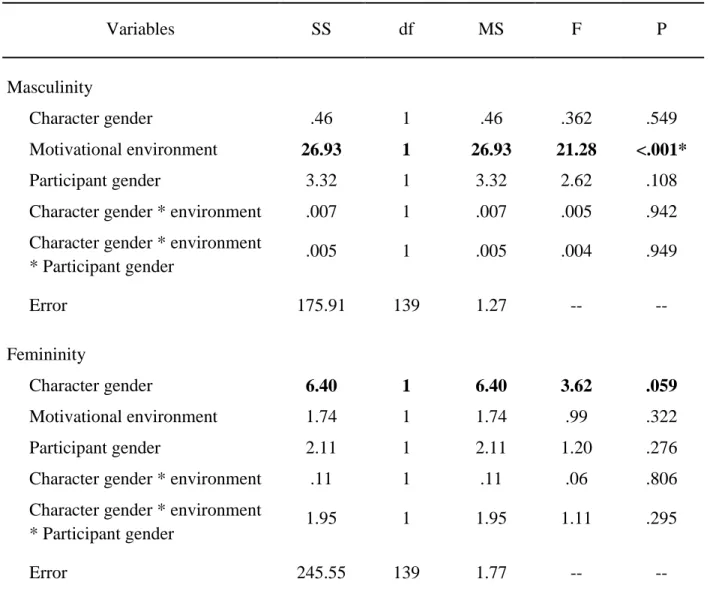
ANOVA was conducted to detect any significant differences in how the character was perceived for each dimension of masculinity and femininity. Results of this analysis are summarized in Table 2.
Results showed a marginal main effect of the gender of the character on their perceived femininity, F(1, 146) = 3.62, p = .059. Specifically, and surprisingly, participants tended to rate the main character as more feminine when the character was male (M = 7.08, SD = 1.23) than when they were female (M = 6.51, SD = 1.41), a pattern which seems counterintuitive to the predicted results. An interesting contrast was shown while looking at the main effect of motivational environment on responses. There was a sizable main effect on perceived
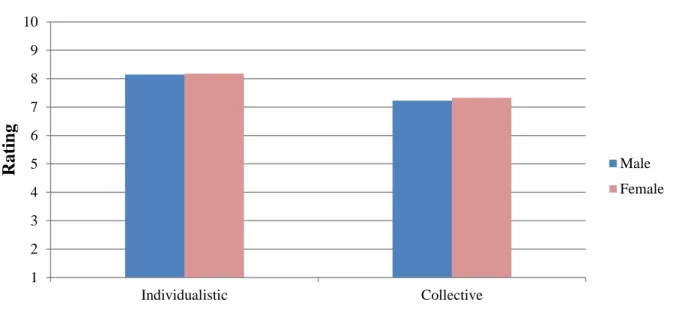
masculinity, F(1, 146) = 21.28, p < .001, wherein the character were rated to be more masculine in the individual story (M = 8.16, SD = .94) than in the collectivist story (M = 7.29, SD = 1.26). Additionally, this effect seemed to generally hold true regardless of the gender of the character themselves and participant’s gender. Both these findings are displayed in Figure 1 and Figure 2.
Despite these patterns, results did not show significant effects of the gender of the character on their perceived masculinity, nor any significant effect of motivational environment on perceived femininity. Similarly, there were no significant interaction effects between gender of the character and the motivational environment, and results were the same when gender of the participant was introduced as a variable. In fact, whether or not the participants were women or men seemed to have no significant effect on how they evaluated perceived masculinity or femininity of the character.
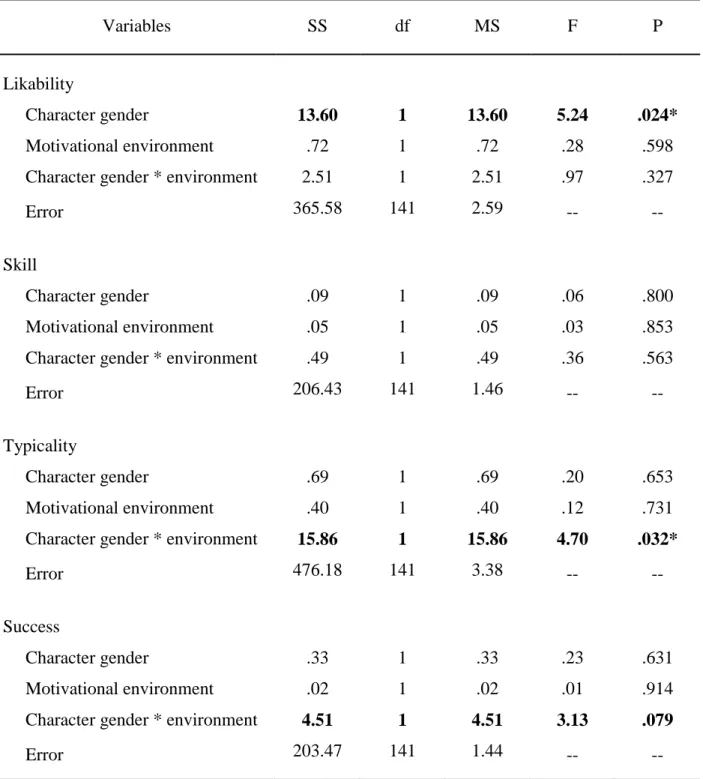
covariate, are summarized in Table 3 and Figures 3, 4, and 5. Concerning any differences in likability, the gender of the character had a marginal effect on the likeability of the character F(1, 146) = 3.07, p = .082. The main character was rated as more likeable when they were male (M = 5.24, SD = .024) than when they were female (M = 7.26, SD = 1.64). There were also no
significant main effects for motivational environment or participant gender on likability, and no significant interactions.
There were no main effects of gender of the character and the motivational environment on typicality and success. However, there was evidence of interactions between both variables on typicality and success, specifically when transportability was used as a covariate. These
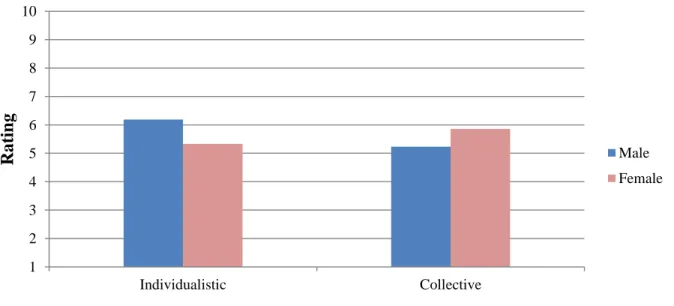
interaction effects became significant for the character’s typicality, F(1, 146) = 4.70, p = .032, and marginally significant for their success, F(1, 146) = 3.15, p = .079. This finding suggests that, when controlling for individuals’ immersion into the narratives, both the character’s gender, and whether their environment was individualistic or collectivistic, affected how typical and successful they were perceived for their career. As predicted in the hypotheses, when the character was male, he was rated to be more typical in the individual narrative (M = 6.19, SD = 1.97) than in the collective narrative (M = 5.23, SD = 1.92). Meanwhile, a female character was rated as more typical in the collective narrative (M = 5.86, SD = 1.68) than in the individual (M = 5.33, SD = 2.00). A similar marginal effect was shown for perceived success.
individual = 5.57, SD = 1.56; M collective = 5.58, SD = 1.78). Men, however, rated both the female (M individual = 5.05, SD = 1.62; M collective = 4.86, SD = 1.66) and male characters (M
individual = 5.57, SD = 1.56; M collective = 5.58, SD = 1.78) with more similarity.
A similar set of ANOVAs were conducted to analyze participants’ individual preferences for and opinions on STEM careers. Interest in STEM careers was about even for both genders,
F(1, 146) = .002, p = .963, albeit with high variation (M = 5.36, SD = 3.06). There were also no significant main effects of character gender or motivational environment on the participants’ responses for preferences in STEM careers.
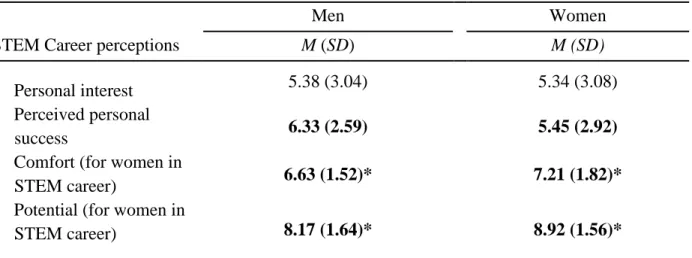
There were, however, notable gender differences among participant responses, outlined in Table 4 and Figure 6. These differences included a significant main effect of gender on how comfortable they believed women were in STEM careers, F(1, 146) = 4.79, p = .03, and how much potential they believed women had in STEM careers, F(1, 146) = 11.81, p = .001. Women gave significantly higher ratings on how comfortable they believed women were in STEM careers (M = 7.21, SD = 1.82), compared to men (M = 6.63, SD = 1.52). This was similar in the ratings for how much potential women had in STEM careers, with women participants giving significantly higher ratings than men (M = 8.92, SD = 1.56; M = 8.17, SD = 1.64). However, when it concerned how much success they would have in a STEM careers, the pattern showed a non-significant reversal, F(1, 146) = 2.496, p = .116. Women rated themselves as less likely to be successful (M = 5.45, SD = 2.920) than the men had rated (M = 6.33, SD = 2.585).
individualistic tasks did not affect their response to any of the narratives. Similarly, both
transportation into the narrative (α = .77) and transportability of an individual (α = .82) had high reliability, and while both were used as a covariate in the analysis, the effects of transportability were most significant, while transportation showed little change in the results.
Discussion
This study was conducted to explore further reasons for the underrepresentation of women in STEM careers, by manipulating and examining the perceptions of both gender double standards of the motivational environment. The study was also interested in determining whether there were differences between perceptions of women and men, and if any differences
contributed to an interaction effect with the manipulated variables, specifically between the gender of the character, the motivational environment, and the gender of the participant. Perceived Masculinity and Femininity
Only a few variables showed any main effects on perceived masculinity and femininity, significant or marginal, and ones that did were surprising. Of particular surprise was the marginal finding that participants rated the main character as more feminine when they were male, than when they were female, a finding quite contradictory to expectations. To make this finding more questionable, the pattern was not reversed, or even significant, for the masculine traits. Thus, while character gender did have marginal effect on responses for perceive masculinity and femininity, confirming one of our hypotheses, the effect was in the opposite direction than both expectations and past research (Bem, 1974) would have predicted, as was only exclusive to one dimension of the scale.
consideration might be the effect from the brief description of the character in a teaching role, a traditional feminine occupation, despite this being a normal task of grad students.
An interesting contrast to these findings for character gender is the significant effect of motivational environment on perceived masculinity. Both male and female characters were perceived to be more masculine in the individualistic narrative than in the collaborative narrative. This finding not only partially supported our second hypothesis, predicting differences in
perception to motivational environment, but also went in the direction that was expected based on previous research. Because many of the masculine traits were individualistic in description, and seemed to suit the environment of a STEM career (e.g. analytical, independent), it might explain why participants would apply these traits more strongly to a character placed in an individualistic environment, regardless of any gender stereotypes.
However, this main effect for motivational environment was not shown to be significant for ratings of femininity. That is to say, characters in a collaborative environment were not rated as more feminine than those in the individualist environment, or vice versa. Perhaps because the feminine traits were less linked to communal motivation, and more attributed to personality or social traits (e.g. warm, understanding), participants felt less inclined to attribute them to the character.
Another finding worth mentioning is that the gender of the participants did not have a significant effect on perceived masculinity or femininity. This lack of significance implies that men and women do not perceive gender traits and roles differently, which is different than what previous research would suggest. Furthermore, no significant interactions between the gender of the character and the motivational environment were found for perceived masculinity or
Perceived Character Traits
Other areas where gender of the character had an effect on response included likability and typicality, both of which showed some promising results, particularly when using
transportability as a covariate. As the male character was rated as significantly more likable and typical than the female character, this supported our prediction of a difference in perception of the character’s qualities based on gender double standards. Specifically, it suggests that male characters might simply be perceived more favorably and more suited to a STEM career role than an equally skilled female character, which might ultimately perpetuate the stereotype and contribute to the discrepancy. Gender of the characters also had a similar, but marginal main effect on success, with the male character being rated as having higher perceived success than the female character.
It should be noted however, that the gender of the character did not affect perceived skill. This might suggest that, disregarding how likable or typical a person is in a STEM career, both men and women in said careers may be regarded as having similar qualities of ability. These finding do not necessarily support the hypothesis, but is promising for how gender roles and double standards may have less effect on the evaluation of a person’s ability.
In consideration of our second hypothesis, motivational environment was not shown to have significant effect on the evaluation of the character’s likability and ability in the field.
Finally, a two-way interaction, between the gender of the character and the motivational environment, showed a significant interaction effect on perceived typicality of career when transportability was used as a covariate. Participants perceived the male character as more typical in an individualistic environment, and the female character as more typical in a collective
STEM career, particularly if the field is presented as a more competitive and individualistic and when controlling for how immersed individuals were in the narrative. But the findings also suggest that women can be perceived to be suitable in the same career if the same field is presented as more collaborative and communal. A similar, though only marginal effect was shown for perceived success in the same career.
Additionally, perceived typicality seemed to be the only measure affected by a three-way interaction between the gender of the character, the motivational environment, and the gender of the participant. Without transportability as a covariate, the three-way interaction was marginal. But using transportability as a covariate made this effect significant, suggesting that a person’s general tendency to be immersed in the narrative affects the results.
STEM Career Perceptions
There were no significant effect of the gender of the character on preferences and opinions on STEM careers. This lack of a difference, however, does make some sense; it might have been surprising, albeit interesting, to see a shift in the participant’s attitudes about STEM fields based on the gender of the main character. There were also no significant effect of
motivation environment on perceptions of STEM careers, possibly for similar reasons as the non-significant effect from the gender of the character. Further analysis would be needed to make a clearer judgment of whether motivational environment in fact does or does not affect perception of ability and of STEM careers, as well as individual interests in the field.
The gender of the participant, however, did show some effect on preferences and
might in fact suggest something about the mindset of women who evaluate STEM careers. Perhaps women have ingrained the perception that they, as a gender population, are as capable as men are in STEM careers, and would be able to blend in and offer insight to the field. But when considering how successful they themselves would be in a STEM career, women display less self-confidence.
Whether this potential discrepancy -- between women’s perception of their gender and of themselves -- can be attributed to what women see portrayed in the media, has not been
answered through this study due to low significance. But the pattern offers another potential variable to look at in further detail that could explain the low prevalence of women in a STEM career, if perhaps self-image is having an effect on women’s perceptions of how they’d succeed in the field.
Limitations and Further Research
There are a number of reasons that could be considered to explain why some
manipulations did not show significant results, particularly for interaction effect, based on a few notable limitations of the study. Although the initial sample of 187 participants had exceeded our target of 160 for the study, the sheer amount of participants that had to be dropped due to failing the manipulation check had reduced viable responses to 147. This was a necessary reduction, however, for the sake of the study, in order to ensure that the responses reliably reflected the participants’ understanding of the narrative.
Perhaps one larger reason that could explain these mixed results stems from a
they were quite capable in their work. Furthermore, the cover story for the instructions had mentioned that the participants’ task would be to read “stories of success.”
Because of these specific details in the plot and the instructions, it’s possible that participants might have been given less chance to make their own judgment on their perception of the character’s overall success. If this is that case, these details might have affected how they evaluated success, and perhaps skill. In fact, there is a notable ceiling effect of average ratings, for both perceived skill (M = 8.76, SD = 1.19) and success (M = 8.20, SD = 1.21) across all conditions.
Due to the potentially telling effect that this narrative detail might have had on
perceptions, a follow-up study is currently being conducted to address this very concern. Each of the narratives has been revised to depict the main character waiting in anticipation for a grant, rather than having just earned the grant. The hope is that this revision will allow participants to make more reliable, independent judgments when evaluating the main character’s success. It’s even possible, though not necessarily expected, that this revision might have a significant effect on responses to the other measures.
Implications and Conclusion
There is also the possible implication of self-image having an effect on perceptions from women that had not been considered in the hypothesis of this study. Due to marginal results, we cannot confirm if our narratives had caused participants to report this difference due to one particular manipulation. But the results do bring up a possible question worth exploring, whether women’s self-confidence of their own success in the field might be influenced by their
perception of STEM field, or if it’s perhaps the reverse.
While this study produced varied results, the significant results it had produced offer a sense of direction for further research to take. More refined follow up studies that correct key limitations and other concerns may be able to produce even more promising results. Although not utilized in the follow up study, there might be need to consider the use of more reliable scales, particularly for individualism and collectivism.
As explained by Diekman (2010), the main aim is to help women perceive that STEM careers do not necessarily lack communal goals, and does in fact rely on collaboration. In that regard, an additional set of narratives describing those in other areas of STEM careers might also be worth consideration, such as those involving fieldwork or in more. In fact, an additional observation Diekman and colleagues made is the idea that careers in psychological science could perhaps be used to break those misconceptions (2010). The researchers did not go into detailed explanation about this claim, but it may be inferred that psychological science careers, which contains much of the rigor as other traditional STEM careers, may be seen as a more
STEM field might offer more evidence for difference in perception due to both gender and motivational environment.
References
Bem, S. L. (1974). The measurement of psychological androgyny. Journal of Clinical and Consulting Psychology, 42, 155-162.
Cheryan, S., Drury, B. J., & Vichayapai, M. (2012). Enduring Influence of Stereotypical Computer Science Role Models on Women’s Academic Aspirations. Psychology of Women Quarterly, 00(0), 1-8.
Diekman, A. B., Brown, E. R., Johnston, A. M., & Clark, E. K. (2010). Seeking congruity between goals and roles: A new look at why women opt out of science, technology, engineering, and mathematics careers. Psychological Science,21(8), 1051-1057. Foschi, M. (1996). Double standards in the evaluation of men and women. Social Psychology
Quarterly, 59(3), 237-254.
Green, M. C., Brock, T. C., & Kaufman G. F. (2006). Understanding media enjoyment: The role of transportation into narrative worlds. Communication Theory, 14(4), 311–327.
Muehlenhard, C. L., & McCoy, M. L. (1991). Double standard/double bind: The sexual double standard and women’s communication about sex. Psychology of Women Quarterly,
15(3), 447-461.
Packard, B. W. L., Gagnon, J. L., LaBelle, O., Jeffers, K., & Lynn, E. (2011). Women's
Experiences in the STEM Community College Transfer Pathway. Journal of Women and Minorities in Science and Engineering, 17(2), 129-147.
Prentice, D. A., & Carranza, E. (2003). What women and men should be, shouldn’t be, are allowed to be, and don’t have to be: The contents of prescriptive gender stereotypes.
Singelis, T. M., Triandis, H. C., Bhawuk, D. P., & Gelfand, M. J. (1995). Horizontal and vertical dimensions of individualism and collectivism: A theoretical and measurement
Appendix Narratives
Male Individualistic condition. Alex tried to maintain a calm and professional
expression as he made his way down the hallway, yet he couldn’t help but feel an inward sense of accomplishment. Especially after his colleague confirmed that everyone had heard the news he had been waiting for.
“So, word around the department is that you received the grant for your next study?” “Oh, really?” Alex asked teasingly, wearing a small smile. “Yes, I did actually, thanks.” Though he hesitated to admit this aloud to his colleague, Alex was inwardly thrilled that he was getting some recognition in the field. It wasn’t that he hadn’t earned some before; the university was well known for its superb program in engineering, and it only made sense that his studies would benefit from what it had to offer. But the years of independent research, and working long hours alone in the lab, finally seemed to be paying off.
For the past few weeks, Alex had waited anxiously for his grant application to be reviewed, but he had known he was not the only one. Many researchers in the department had wanted the grant, to support their own individual research projects. But Alex was confident that he was as capable as the others, and had meticulously toiled over his own application in the hopes of presenting himself as a more hardworking and driven candidate.
They were an exemplification of what the department valued and encouraged most in its graduates. And Alex wanted to project the same work ethic to the undergrad students in his Physics recitation class.
When he finally entered the classroom Alex was greeted with an encouraging sight: students who were already spread out to study their notes. Everyone was aware about final projects that would soon be due for the lecture course, and Alex was glad that his students were already getting to work during the recitation. He was both glad and, admittedly, amused that his prior incentive to earn some extra credit for individual quality of the projects was motivating them to work individually and stay on task. To be fair, Alex was already aware that they were hardworking students and were brimming with potential, but he also knew that sometimes the right motivation could bring out their best effort.
Female Collaborative condition. Alex tried to maintain a calm and professional
expression as she made her way down the hallway, yet she couldn’t help but feel an inward sense of accomplishment. Especially after her colleague confirmed that everyone had heard the news she had been waiting for.
“So, word around the department is that your lab received the grant for your next study?” “Oh, really?” Alex asked teasingly, wearing a small smile. “Yes, we did actually,
thanks.”
For the past few weeks, Alex had waited anxiously for her grant application to be reviewed, but she had known she was not the only one. Many researchers in the department had wanted the grant, to support their own lab group’s research projects. But Alex was confident that she and her lab were as capable as the others, and had meticulously toiled over her own
application in the hopes of presenting herself as a more hardworking and collaborative team member on behalf of her lab.
To her colleague’s congrats, Alex gave her thanks with a nod and turned down the hallway. She passed by the open doors to the office of the other researcher and professors, each displaying banners and motivational posters with quotes of inspiration. There was one that read “Coming together is a beginning; keeping together is progress; working together is success.” Another, “Alone we can do so little; together we can do so much.”
They were an exemplification of what the department valued and encouraged most in its graduates. And Alex wanted to project the same work ethic to the students in her Physics recitation class.
When she finally entered the classroom Alex was greeted with an encouraging sight: students who were already sitting together to study their notes. Everyone was aware about final projects that would soon be due for the lecture course, and Alex was glad that her students were already getting to work during the recitation. She was both glad and, admittedly, amused that her prior incentive to earn some extra credit for group quality of the projects was motivating them to work together and stay on task. To be fair, Alex was already aware that they were hardworking students and were brimming with potential, but she also knew that sometimes the right
Tables
Table 1. Means of Dependent Variables by Gender and Motivational Environment
Conditions
Male character Female character individualistic collectivistic individualistic collectivistic Dependent Variables M (SD) M (SD) M (SD) M (SD) Gender perceptions
Femininity 7.14 (1.39) 7.00 (1.02) 6.71 (1.39) 6.35 (1.42) Masculinity 8.15 (1.09) 7.23 (1.29) 8.18 (.76) 7.33 (1.26) Character perceptions
Likability 7.69 (1.70) 8.00 (1.37) 7.33 (1.62) 7.20 (1.68)
Skill 8.69 (1.28) 8.77 (1.12) 8.86 (1.10) 8.70 (1.27)
Typicality 6.19 (1.97) 5.23 (1.92) 5.33 (2.00) 5.86 (1.68) Success 8.44 (1.16) 8.03 (1.08) 7.97 (1.23) 8.30 (1.30) STEM Career perceptions
Personal interest 4.94 (3.31) 5.61 (2.92) 5.58 (3.15) 5.33 (2.93) Perceived personal
success 5.14 (2.84) 5.97 (2.56) 6.14 (3.03) 5.95 (2.79) Comfort (for women in
STEM career) 6.61 (1.90) 7.10 (1.67) 6.86 (1.84) 7.27 (1.50) Potential (for women in
STEM career) 8.94 (1.82) 8.48 (1.39) 8.47 (1.48) 8.57 (1.74) Note. All values are from responses from a 10-point Likert scale (1 indicating “not at all,” 10 indicating “very
Table 2. Between-Subjects ANOVA for Main Effects and Interaction Effects on Perceived Gender
Variables SS df MS F P
Masculinity
Character gender .46 1 .46 .362 .549
Motivational environment 26.93 1 26.93 21.28 <.001*
Participant gender 3.32 1 3.32 2.62 .108
Character gender * environment .007 1 .007 .005 .942 Character gender * environment
* Participant gender .005 1 .005 .004 .949
Error 175.91 139 1.27 -- --
Femininity
Character gender 6.40 1 6.40 3.62 .059
Motivational environment 1.74 1 1.74 .99 .322
Participant gender 2.11 1 2.11 1.20 .276
Character gender * environment .11 1 .11 .06 .806
Character gender * environment
* Participant gender 1.95 1 1.95 1.11 .295
Error 245.55 139 1.77 -- --
Table 3. Between-Subjects ANOVA for Main Effects and Interaction Effects on Character Perceptions, Using Transportability as a Covariate
Variables SS df MS F P
Likability
Character gender 13.60 1 13.60 5.24 .024*
Motivational environment .72 1 .72 .28 .598
Character gender * environment 2.51 1 2.51 .97 .327
Error 365.58 141 2.59 -- --
Skill
Character gender .09 1 .09 .06 .800
Motivational environment .05 1 .05 .03 .853
Character gender * environment .49 1 .49 .36 .563
Error 206.43 141 1.46 -- --
Typicality
Character gender .69 1 .69 .20 .653
Motivational environment .40 1 .40 .12 .731
Character gender * environment 15.86 1 15.86 4.70 .032*
Error 476.18 141 3.38 -- --
Success
Character gender .33 1 .33 .23 .631
Motivational environment .02 1 .02 .01 .914
Character gender * environment 4.51 1 4.51 3.13 .079
Error 203.47 141 1.44 -- --
Table 4. Means of STEM Career Perceptions by Participant Gender
Men Women
STEM Career perceptions M (SD) M (SD)
Personal interest 5.38 (3.04) 5.34 (3.08)
Perceived personal
success 6.33 (2.59) 5.45 (2.92)
Comfort (for women in
STEM career) 6.63 (1.52)* 7.21 (1.82)*
Potential (for women in
STEM career) 8.17 (1.64)* 8.92 (1.56)*
Figures
Figure 1. Comparative mean difference values of perceived masculinity ratings for each
narrative condition, by motivational environment and character gender. A significant difference was found due to motivational environment (p < .001).
Figure 2. Comparative mean difference values of perceived feminity ratings for each narrative condition, by motivational environment and character gender. A marginal difference was found due to character gender (p = .059).
Figure 3. Comparative mean difference values of perceived likability ratings for each narrative condition, using Transportability as a covariate (α = .817). A significant difference was found due to character gender (p = .024).
Figure 4. Comparative mean difference values of perceived likability ratings for each narrative condition, using Transportability as a covariate (α = .817). A significant two-way interaction was found between character gender and motivational environment (p = .032)
Figure 5. Comparative mean difference values of perceived likability ratings for each narrative condition, using Transportability as a covariate (α = .817). A marginal two-way interaction was found between character gender and motivational environment (p = .079)
Figure 6. Comparative mean difference values of STEM Career Perceptions between men and women participants. 1 2 3 4 5 6 7 8 9 10 Individualistic Collective Rat in g Motivational Environment Male Female 1 2 3 4 5 6 7 8 9 10
Comfort for Women in STEM (p = .030)
Potential for Women in STEM (p = .001)
Perceived Personal Success (p = .116)
Rat
in
g