FOOD HUBS AS COMMUNITY
ECONOMIC DEVELOPMENT:
Lessons from TRACTOR Food & Farms
Submitted in partial fulfillment of the requirements for the Master’s Degree
in
City & Regional Planning
Grace Basinger Tuschak
2 Introduction and Literature Review
Economic development theory has moved through three distinct waves of thought, generating various regional economic development strategies, from industrial recruitment, or “smokestack chasing” (first wave), to business retention and expansion (second wave), to fostering
agglomeration economies and industry clusters (third wave) (Fitzgerald & Green Leigh, 2002). Shaffer, Deller, and Marcouiller posit that as this evolution in theory has progressed, the
economic development field has shifted from understanding the regional economy in a vacuum (as implied by the neoclassical economics framework of “all else being equal”) toward a more holistic view of the interactive roles of economics, politics, culture, and other forces. Traditional economic development theory can be helpful in offering a simplified framework through which to analyze real world conditions. However, more and more practitioners are recognizing that economic development does not occur in a vacuum, and the field has steadily moved toward “the removal of unreasonable assumptions” about economics as a field distinct from other societal influences (Shaffer, Deller, & Marcouiller, 2006). In a parallel movement, a number of voices have raised questions about whether conventional economic development strategies consistently affect residents in positive and/or uniform ways (Boothroyd & Davis, 1993; Fitzgerald & Leigh, 2002; Bartik, 2005). In addition, it is often unclear whether municipalities actually benefit fiscally by using subsidies to attract export-oriented industries to their region, a practice commonly prescribed by regional economic development approaches (Bartik, 2005). Shaffer, Deller and Marcouiller’s (2006) observations that economic development is continually moving toward a broader and more interdisciplinary practice means that interest is likely increasing in development projects that transcend traditional economic development metrics like jobs and output, to also consider non-monetized forms of wealth more akin to community development metrics. It is in this spirit that community economic development (CED) has garnered interest as a field which links aspects of community development and economic development. CED is also characterized by a more grass-roots approach, which may be able to benefit communities left out by more conventional forms of economic development.
3 especially pertinent in areas of rural Appalachia, where exogenous structural economic changes in manufacturing and agricultural industries have wreaked havoc on the economies of many communities. In these communities, CED may be an attractive alternative to traditional economic development practices as a strategy to increase economic resilience and promote community development, in addition to more narrowly defined economic development goals.
One way in which communities are beginning to utilize CED strategies is through investment in local food economies. Encouraging local agriculture can offer a place-based development strategy that draws on local assets of arable land, agricultural heritage, and skilled farmers (Rosenfeld 2010; Becky, Kennedy & Whitman 2012; Jenkins, Schepker, & Rhodes-Conway 2014). This case study will focus on Yancey County, a small rural county in the mountains of Western North Carolina. It will explore the publically-funded food hub TRACTOR (Toe River Aggregation Center Regional) Food & Farms, Inc. as an example of rural, place-based
community economic development. Both qualitative data and quantitative economic impacts using IMPLAN software are reported, in an effort to capture both monetary and non-monetary community benefits resulting from the first 5 years of TRACTOR’s operation. The primary research question is whether local food hubs should be considered an effective form of community economic development for rural Appalachian communities.
Community Economic Development – A framework for building rural resilience
Community economic development has a long history, grounded in social movements like the civil rights movement of the 1950s and 1960s (Clay & Jones, 2009; Philips & Pittman, 2014). While CED continues to evolve and remains loosely-defined, one can define CED as community-led action to improve economic and social conditions of the local community (Loxley & Lamb, 2006; Shaffer et al, 2006). Some also define CED as a process of a community understanding the full range of choices available to them (not just falling back on old approaches) and working with collaborators to implement a long-term strategy (Halebski, Gruidl, & Green, 1999). Metrics of CED include some monetary measurements akin to economic development, in addition to other considerations of community development, such as increased sense of connection and increased local control or participation (Boothroyd & Davis, 1993), decreased inequality (Virgil, 2010), and strengthening of social capital (Defilippis, 2001). A common understanding of current CED was well summarized by Shaffer, Deller, and Marcouiller (2016), “community economic development occurs when people in a community analyze the economic conditions of that community, determine its economic needs and unfulfilled opportunities, decide what can and should be done to improve the economic conditions in that community, and then move to achieve agreed upon economic goals and objectives.”
A theoretical framework for community economic development was also developed by Shaffer, Deller, and Marcouiller, 2016. The framework utilizes a “star of community economic
4 systems and community economic development. In their case study of Hardwick, MA, local food proved to be an effective tool for driving community economic development because of its ability to provide a unifying purpose and build social capital (Christenson & Phillips 2016). Local food projects and community economic development will be the focus of the remainder of this paper.
Some have suggested community economic development as a strategy for addressing
inequality and poverty, particularly in rural areas (Virgil, 2010). According to Virgil (2010), CED in rural areas is effective when characterized by: (1) increased involvement of local
government; (2) projects that are scaled proportionately to the local population and landscape; (3) building on local competitive advantage; and (4) collaborative efforts to reach larger
markets. Particularly in rural Appalachia, community economic development may be an alternative to narrowly-defined economic development in communities impacted by the decline of U.S. manufacturing in the 1980s and 1990s, and/or communities that have
experienced instability as a result of “smokestack chasing” policies. Large employers and multi-national corporations often take advantage of subsidies offered in rural areas but may leave the region at any time if incentives or labor conditions elsewhere prove more enticing. Parts of Appalachia, including Western North Carolina, have also historically relied on tobacco as a main cash crop, with the guarantee of federal price-supports. When the Fair and Equitable Tobacco Reform Act was signed into law in 2004, it ended the tobacco quota program established by the Agricultural Adjustment Act of 1933 and established the Tobacco Transition Payment Program (commonly referred to as the “Tobacco Buyout”). As many growers exited the tobacco farming industry, states, counties, and communities were left to figure out how to fill the economic hole left behind. Annual payments from the Tobacco Buyout were available to eligible tobacco quota holders for 10 years, in order to ease the burden of transitioning away from tobacco
production; final payments were dispersed in 2014. The decline of tobacco in Western North Carolina, as we will see later in the paper, constituted a huge economic blow, but according to interview data for the present study, may also may have damaged social cohesion and
contributed to “brain drain” as young people left the area in search of opportunity. Finally, less attention and fewer options are generally available for economic development in less densely-populated areas, and creative solutions like CED strategies may be attractive in communities wanting to take development matters into their own hands.
5 development is an increasingly accepted route to CED in areas that have not benefited from one-size-fits-all approaches to economic development.
Local Food Systems
Beginning in the 1990s, mainstream consumer demand for local foods has dramatically increased, as has interest in local food systems among academics in many fields (Deller 2017) and among planning/economic development practitioners (Soma & Wakefield, 2010; Vitiello & Brinkley 2014). Though there is no commonly agreed-upon definition, local foods generally have been characterized by small-scale producers selling direct-to-consumer through farmers market or Community Supported Agriculture models. With increasing consumer demand for local produce, many large-scale grocery retailers are interested in local foods procurement. This has presented new infrastructural and logistical challenges, since many small-scale local
producers have difficulty meeting the marketing, product volume or consistency, and food safety requirements of large retailers. Food hubs have emerged as the prevailing model for aggregation of produce from small-scale growers for distribution to mainstream markets. In this role, a food hub can help small farmers overcome structural barriers to selling wholesale by aggregating produce from many growers and providing technical assistance with navigating food safety regulations, packaging, skills training, and shared equipment use. Food hubs also help large retailers boost local foods procurement, as consumer demand remains high but working with many small producers is often prohibitively time consuming for traditional grocery stores or wholesalers. Many food hubs also sell direct to consumer, or to retail food
cooperatives, school systems, restaurants, and hospitals (2015 Food Hub Survey).
Much as economic development has historically ignored social and cultural factors that are embedded in local and regional economies, mainstream agriculture has narrowly focused on production and ignored the community and “place-based” aspects of agriculture (Chrisenson & Philips, 2016). Agriculture in the U.S. has long been trending toward agro-industrial operations focusing on economies of scale and industrial-style production over small-scale localized production. This began to change in the 1970s, when some questioned the stability and beneficence of the industrial agriculture system (Christenson & Philips, 2016). Interest in local, sustainable agriculture and local food systems has steadily increased over the past several decades, but only recently has work been done to integrate local food systems into the bigger picture of community and economic development in rural agricultural areas.
In very recent years, some researchers have suggested that public investment in local foods as an economic engine may help to accomplish: (1) import substitution for food products
6 investment in community economic development. This is because non-monetized benefits are often equally important in agricultural communities, and because it may be difficult to make a case for local foods projects based on economic benefits alone, since local food typically makes up only a small fraction of a region’s economy and direct economic impacts are likely to be small.
In order to explore the question of whether a publically-supported local food hub should be considered a viable form of community economic development, this paper uses both qualitative and quantitative approaches. The quantitative component of relies on economic modeling using IMPLAN software to estimate how much economic impact small food hubs may be expected to have in rural Appalachian counties. In addition, the qualitative component explores the particular circumstances in which investment in food hubs may be an attractive alternative to traditional economic development tactics. Because of the small economic impact and complex nature of community benefits of food hubs, a more comprehensive and nuanced answer provided by a broader qualitative case study is necessary in order to answer the research question.
History of TRACTOR
Shortly after the great recession and the tobacco buyout delivered a double blow to Yancey County, several public agencies and organizations came together to brainstorm ways to support Yancey County agriculture – historically the economic and cultural backbone of the region. Representatives from County government, Burnsville City government, North Carolina State Cooperative Extension, Yancey County Economic Development Commission, and local businesses began to develop new ideas for a market-based mechanism that could support farmers in the county and stimulate local agricultural economic development. After many preliminary planning meetings, an initial feasibility study was conducted in 2010 by Smithson Mills, Inc. to explore whether sufficient demand existed for an agricultural center, and if so, how it could be most useful to Yancey County farmers (Yancey County Commissioners, 2010). After engaging with farmers in Yancey County and neighboring Mitchell County, the study reported a total of 49 farmers interested in producing for an aggregation center, or food hub. It recommended that if Yancey and Mitchell Counties worked together, as there was sufficient producer demand for a food hub if the two counties were both included in the study area. (Smithson Mills, Inc. 2012). TRACTOR was set up as a nonprofit 501(c)3, with initial funding provided by Yancey County government. Today, TRACTOR’s operations continue to be subsidized by county funding as well as grant funding, with the goal that it will eventually become independently solvent as it slowly increases the number of growers it works with. TRACTOR aggregates fresh produce directly from between 37-48 growers each year, and assists in washing, packaging, marketing, training, renting shared use equipment, and ensuring food safety standards are met. TRACTOR serves as a broker for sales of the aggregated produce to large retailers, wholesalers, and local restaurants, which are often inaccessible to many small-scale growers because of requirements for product volume, consistency, or food safety
7 of their $20 annual membership fee. Profits from the produce sales are distributed 80% to the grower and 20% to the food hub to cover operating costs.
Applied Research Methods
This case study’s objective is to understand whether a publically-supported local food hub should be considered a worthwhile form of community economic development for rural
Appalachian communities. Both qualitative and quantitative approaches are employed in order to find a more comprehensive to this research question. The qualitative component utilizes interview and survey data to paint a more complete picture of TRACTOR’s role in the community, in order to illuminate which particular circumstances might make food hubs an attractive alternative to traditional economic development approaches. The quantitative component of relies on IMPLAN analysis to estimate how much economic impact small food hubs may be expected to have in rural Appalachian counties.
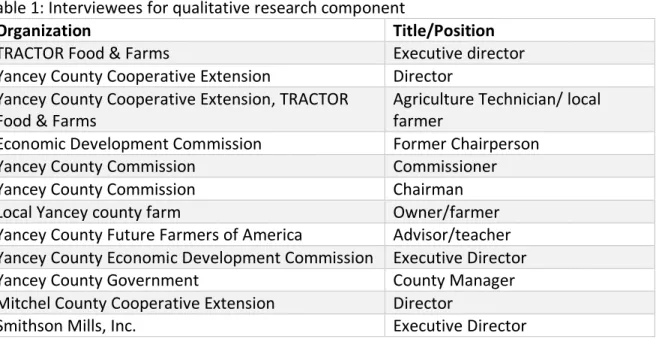
The qualitative component of this study is based on 17 semi-structured phone or in-person interviews with 11 key actors, and a survey of 19 farmers who sell produce through TRACTOR. Interviewees included Yancey county government officials, NC cooperative extension
employees, TRACTOR employees, and growers who produce for TRACTOR (Table 1). A snowball sampling method was used with initial contacts identifying additional interviewees. Interviews were recorded and transcribed, then coded and analyzed for thematic trends. Interviews were coded using Dedoose software, through which 89 codes were developed and applied to all interview transcripts. Codes were organized into families of sub-codes such as “support from local government,” under which several codes were
grouped thematically, such as “financial support” and “’giving back to community’.” Occurrence tables and co-occurrence matrices were used to identify
prominent themes for further analysis. All actors shared unique perspectives on the background, formation, and outcomes of the food hub over its first 5 years in operation. One grower shared his family’s experience of reliance on tobacco growing
and the Tobacco Buyout, and another shared his experience of starting out in farming during the Tobacco Buyout period.
County officials contributed their views on how TRACTOR fits in with the County’s broader economic development goals, and why they supported its formation as a place-based economic development project. Finally, TRACTOR’s executive director conveyed her experiences working with growers, county extension, local officials, and the community, to illustrate TRACTOR’s community development impacts and partnerships with other organizations.
A survey was distributed to growers that sell through TRACTOR food hub at the annual growers meetings on October 19, 2017 and January 11, 2018. Of the 37 growers that sold consistently through TRACTOR in 2017, information was captured from 19 (51% response rate). Responses came from 15 individuals who filled out the paper survey at grower meetings, and from an
8 additional four growers who completed the online survey in January 2018. The survey
instrument included both qualitative and quantitative questions about how involvement with TRACTOR has changed growers’ production practices or volume produced, roughly how much income they make from sales through TRACTOR, and their perceived impacts of working with TRACTOR (see appendix 1).
Table 1: Interviewees for qualitative research component
Organization Title/Position
TRACTOR Food & Farms Executive director Yancey County Cooperative Extension Director
Yancey County Cooperative Extension, TRACTOR
Food & Farms Agriculture Technician/ local farmer Economic Development Commission Former Chairperson
Yancey County Commission Commissioner Yancey County Commission Chairman Local Yancey county farm Owner/farmer Yancey County Future Farmers of America Advisor/teacher Yancey County Economic Development Commission Executive Director Yancey County Government County Manager Mitchel County Cooperative Extension Director
Smithson Mills, Inc. Executive Director
A quantitative evaluation of TRACTOR’s impacts on the regional economy was performed using the input-output modeling software, IMPLAN. The study area was defined by the six North Carolina counties containing farms that sell produce to TRACTOR - Yancey, Buncombe,
Rutherford, Avery, Burke, and Mitchell. The majority of TRACTOR’s produce is grown in Yancey County. Detailed financial data was obtained from TRACTOR and then used to model the food hub’s spending patterns to each individual industry sector.
Recent studies have suggested that IMPLAN’s default agricultural sectors do not accurately reflect the spending patterns of small scale, diversified farming operations (Bauman &
Thilmany-McFadden, 2017; Meter & Goldenberg, 2015). Income and spending patterns of small scale farms are difficult and time consuming data to collect, though it has been done
successfully in order to model larger scale food hubs (Shmit, Jablonski & Kay, 2015). This was not possible in the scope of this study, so sensitivity analysis was performed by changing to volume of sales to the Vegetable and Melon sector (the amount of produce purchase by TRACTOR) in order to enhance the rigor of this quantitative analysis.
9 Jablonski, & Mansury 2016; O’Hara & Pirog, 2013; Deller, 2017). Most recently, local food systems scholars have raised concerns that countervailing effects should be taken into account when analyzing the impact of local foods projects, since a positive shock to the local foods producers sector often co-occurs with a negative shock to the produce wholesale (or non-local) retail produce sector in the region (Deller, 2017; Jablonski, 2015; Bauman &
Thilmany-McFadden, 2017; Schmit, Jablonski & Kay, 2016). Opportunity costs were not taken into account in this study, because a negative shock to the vegetable and melon farming sector would occur predominantly outside the study region, not within it. This is because TRACTOR sells to mainstream retailers (grocers and restaurants) rather than to individuals, and there is only one produce wholesaler-distributor in the study region. TRACTOR’s operations would not produce a negative shock to the retail grocery sector. Furthermore, any negative shock to the wholesale sector would occur outside the region, as retailers substituted local produce for non-local produce. Any negative shock to the distributor that exists within the region should be negligible in reference to the whole regional economy.
Results
Survey results:
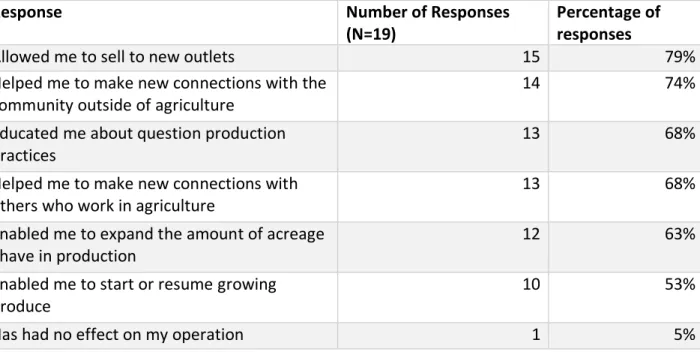
Of the 19 survey respondents, 6 self-identified as full time farmers. Reflective of the general pool of TRACTOR growers, the 14 of the respondents farmed in Yancey County and 5 farmed only in nearby counties. When asked about how working with TRACTOR has affected their operation, the majority of responding farmers reported positive impacts on the amount that they are able to grow and sell, and an increase in their connections in the community. This has important implications for community economic development benefits, as discussed later in the paper.
Table 2: Answers to survey question #8: “Being involved with TRACTOR has: (circle all that apply)”
Response Number of Responses
(N=19) Percentage of responses
Allowed me to sell to new outlets 15 79%
Helped me to make new connections with the
community outside of agriculture 14 74%
Educated me about question production
practices 13 68%
Helped me to make new connections with
others who work in agriculture 13 68%
Enabled me to expand the amount of acreage
I have in production 12 63%
Enabled me to start or resume growing
produce 10 53%
10
c. caused me to shrink the amount of acreage
I have in production 0 0%
Survey data also revealed a relatively small amount of income being generated through TRACTOR sales for most growers (see figure 2). This result corroborates the moderate impacts demonstrated by the IMPLAN analysis later in this paper, and emphasizes that TRACTOR is only working with a small percentage of all dollars moving through the local economy. However, with the county’s low median household income of $37,480 (compared to state average of $46,868) even $2000-$4000 may be a meaningful amount in this context (U.S. Census ACS 5-year Estimate 2011-2015). Interview results also corroborated this point, as one grower explained:
So if you have a farmer that is able to add another $5000 a year, which from a lot of people's standpoint what's five grand? So that five grand can allow that family to do several things, possibly purchase a new vehicle. Being able to afford the payment on your vehicles. Possibly to buy a home. Possibly to… save up to send a kid off to get a secondary education. Possibly help them expand their
operation to next year it's 10 grand and the following year it's 20 grand. If you start looking at the percentage of their income to begin with, I'm just using $5,000 as a number because a lot of them are around $5000, that is a huge impact on their lives, their ability to do a lot of things that they would have been unable to do otherwise.
Figure 2: response to survey question #4: "About how much in gross revenue did you earn from sales to TRACTOR over the past year?"
0 2 4 6 8 10 12
Under $2,000 $2,000-$4,000 $4000-$6000 $6,000-$8,000 Over $8,000
Number of responses (N=19)
Response to survey question #4: “About how much in
gross revenue did you earn from sales to TRACTOR over
11 Finally, growers were asked about other outlets used to sell their product. Nine participants did not indicate any additional outlets besides TRACTOR, and those that did utilize other outlets were most likely to sell through a farmstand or grocery store. The breakdown of these outlets indicate support for the claim that TRACTOR is opening new markets to small growers, as many food hubs are trying to do. Some respondents are selling directly to grocery stores (37%) but relatively few are reaching restaurants or wholesale markets, and none are working with brokers. A partial explanation for the lack of sales directly to restaurants may be a logistical one; the majority of “farm to table” style restaurants are located in Buncombe County, in and around Asheville, NC, and transport may not be feasible for some growers. TRACTOR is intended to provide the entry point into and transportation to both wholesale and restaurant market, and indeed only a few out of this pool of respondents are working directly with those markets independent of TRACTOR’s mediation.
Table 3: Responses to survey question #5: “In addition to selling through TRACTOR, do you sell through any of the following outlet? (select all that apply)”
Response Number of Response (out of 19)
Farmstand/home 8
Grocery 7
Restaurant 5
Farmers market 5
Wholesale 2
Other cooperative 0
Community supported agriculture program 0
Broker 0
Open-ended questions were included on the survey instrument, in order to get a personal account of how interacting with TRACTOR has impacted growers directly. In response to the open-ended question, “What is the main benefit of working with TRACTOR?” eleven out of nineteen growers said that it was access to new markets, with comments such as “allowing me to reach new markets and increase my farm income,” or “helping to move and sell produce.” Four additional growers said that the main benefit was being able to sell more produce, for example, “selling more, more more!” and “The amount of product moved at one time.” Other responses received were “networking with experienced farmers. The ability to use the
equipment and facility at TRACTOR and help with distribution;”“outlet for different grades of produce, ability to purchase packaging at a reduced rate;" and “better prices on some
products.”
Interview Themes
12 most important components of the TRACTOR project to these stakeholders; this section will outline each theme as described by participants.
Benefits to Farmers
The most prevalent theme was TRACTOR’s impact on local farmers, and the ways that it was intentionally set up to benefit them. TRACTOR is partially a response to the loss of tobacco and overall decline of agriculture in the county, which lost 6,000 acres of farm land in a seven-year period of the early 2000s. One local grower explained the importance of tobacco and its impact on TRACTOR’s model of business this way:
So tobacco was a huge, huge part. It enabled us to move a rung up on the economic ladder. When it was gone, that option was gone. Hence that's one of the reasons Tractor was set up the way it was set up to kind of resemble the way the tobacco market worked. As far as a single location and you take your product in, stuff like that. To get folks who still were trying to farm part-time to add to their income to move up that economic ladder, that option. That's one reason TRACTOR came into being.
From the perspective of local government and local cooperative extension, a major benefit of the TRACTOR project has been to harness the pool of existing farmers who were interested in continuing to farm, but needed guidance on growing other crops besides tobacco. According to Yancey County’s Planning & Economic Development Director:
I think you've seen Tractor here show folks that you can market crops other than tobacco. You can make a living growing something other than tobacco. You can learn to operate a farm and a business and get yourself out of the mindset we're going to grow tobacco and take it once a year to the warehouse and sell it. So there's a re-education.
Local officials also explained that supporting local farmers is very important to the county because of its strong agricultural heritage. Though TRACTOR is considered an economic development project, it is also performing the valuable function of preserving agricultural heritage and helping to keep an older generation of farmers growing on their land. The County manager explained it this way:
Basically TRACTOR is saying we'll handle the marketing, broker it for you, and then you bring us your produce and you sell it. See if you want to get back into farming as a side deal. There are a good number of farmers here who farm as their sole income and still sell through Tractor because they would rather spend the 20% that Tractor takes on the sale than to try to maintain their own
operation, to engage those markets, and keep up the financial records and so forth and so on. They find it more advantageous for them not to have to
13 So certainly it's also been a benefit to that older generation, when I say old I
don't necessarily mean old age, who have that mentality.
Partnerships:
Participants stressed the importance of partnerships both during the process of TRACTOR’s founding and in its current function. This theme encompassed both the interinstitutional partnerships that have helped to bring TRACTOR into being (local government, county extension, economic development) and the partnerships that TRACTOR continues to foster between agencies and civic groups. During TRACTOR’s formation, many groups were involved from the beginning in conceiving, refining, and executing the creation of a regional food hub in Yancey County. The county’s manager described the partnerships that made TRACTOR’s formation possible:
The cooperative extension was involved in all of this, because they're such a great community resource in the area, so we had cooperative extension service, economic development tradition in the county government, all these, and then a few key private business owners here. Everybody worked together in a
collaborative effort, and that's why it's successful here.
One of TRACTOR’s most significant impacts on the community has been the formation of many partnerships with other organizations, resulting in a network of agriculturally-focused
community organizations. According to TRACTOR’s director,
I think the biggest thing is [TRACTOR] is drawing in a lot of partnerships. Yancey County is really unique in that a lot of the groups, whether it be non-profit groups or whether it be other county agencies or county governments, work closely together and try to find ways that they can leverage each other, to benefit all the program areas and not just a targeted program area.
TRACTOR continues to work regularly with organizations devoted to community development (Gardens of Hope inmate rehabilitation program, Dig In Community Garden), youth
development (Yancey County Future Farmers of America) and food security (PATH,
Reconciliation House food pantry). Participants also expressed surprise at how TRACTOR has evolved over time from a more narrowly-defined economic development project, into one that involves many non-monetized community benefits, in part because of its many partnerships. According to Yancey County’s Director of Planning and Economic Development:
TRACTOR’s been fantastic because its success has spun off a great deal of other projects. It's been a good vehicle to pursue other ag related projects as well. It's also impacted food security issue here. Because a lot of the seconds and
14 Table 4: TRACTOR’s current partnership organizations
Partner Function/Purpose
North Carolina Cooperative
Extension Education, training for growers who sell through TRACTOR Sheriff’s Office Rehabilitative gardening work release
program for county inmates
Dig In! Community Garden Community building, food security; TRACTOR rents tools for free to community gardeners Future Farmers of America Encouraging younger generations to farm,
land leasing & educational partnership Partners Aligned Towards
Health (PATH) TRACTOR assists PATH with sourcing/packing produce for USDA summer feeding program Reconciliation House Food pantry, receives “seconds” from
TRACTOR
Fostering a younger generation of farmers:
Resulting from the partnership with Future Farmers of America, a “spin off” program has been created to help foster a younger generation of growers. Early on, TRACTOR attracted the attention of local private philanthropists who donated several acres of land to help TRACTOR toward its mission of growing new farmers. This parcel is called Bowditch Bottoms, and a partnership between TRACTOR, Cooperative Extension, and Mountain Heritage High School has increased the membership in FFA threefold since the partnership began in 2016. This has been an important partnership to the county because of concerns over the rising average age of farmers in the county, as well as the perceived “brain drain,” as younger generations move away in search of economic opportunity. The local high school’s agriculture teacher and advisor to FFA explained the motivation behind this partnership:
The average farmer's age in Yancey County is 59. We want to get younger farmers interested. We want just to increase the number of people that know where their food comes from, even if they don't have interest in growing it... Knowing what to do in a
time of crisis, knowing how to appreciate, and understanding giving food and security…
We want to increase the interest in younger farmers, but more importantly to educate humans on where their food comes from and the importance of knowing how to do that; them not losing touch with importance of raising their own food.
15
We've actually seen a renewed interest of young people here in farming. And they never had the predisposition to consider farming as being something that was tobacco related. This is the generation that came after that. They don't have that. We didn't have to educate it out of them. These are kids who are coming along who value locally grown food and they have a heart to educate others to value it as well. Their goal is to see some of their food served in the cafeteria. They discuss the pros and cons of organic growing and explore the growing need to help feed the growing population. They have an interest in growing specialty crops to help fund their FFA program and promote young farmers. The kids who are becoming interested in farming now are much more diverse and have a different mindset toward farming.
Other participants elaborated on the need to provide agricultural jobs to younger residents who may be considering moving away because of a lack of opportunity in the County. Yancey County’s Extension Director explained,
Yancey County never wanted to be a huge tourist destination, but to maintain the small town charm that is so evident when one walks around the Town Square and visits the shops. Everyone recognizes Yancey has a natural beauty that attracts people to travel here, the streams. the mountains and the wonderful farm land. The goal is to put the farmland back in production and provide quality jobs related to agriculture to prevent the youth from having to leave their home county.
The county’s tobacco heritage has had a profound effect on people of all ages in Yancey County. One local grower who also works for County Cooperative Extensive commented specifically on how the loss of tobacco influenced younger generations:
When we lost tobacco, one of the things we lost was a lot of the youth in this county left for work, which they had been doing for years anyhow. You had a choice, you either had to live in poverty, grow tobacco, or leave. Those were your three choices, for the most part, for the most part. So when tobacco left, we lost a lot of youth.
Interview data also suggests some initial success in enticing a younger generation of county residents toward a career - or at least part time work - in agriculture. The agriculture teacher at local Mountain Heritage High School has reported a tripling of enrollment in Horticulture II classes between the 2016-2017 and 2017-2018 academic years. As the advisor of Future Farmers of America for Yancey County, she also reported an uptick in students doing farming projects as a result of having access to TRACTOR’s Bowditch Bottoms property:
16 entrepreneurship. One student started her own business, and applied for and
received a thousand-dollar grant from Organic Valley/CROPP Cooperative that was housed on the Agriculture Education Tractor used by students completing their SAE. With this grant she expanded her flock of chickens, and she is partnering with TRACTOR to provide eggs as a part of a pilot CSA program developed by NC State students in coordination with Blue Ridge Regional Hospital. Currently I have over 50 students completing an SAE, supervised agricultural experience, which include experiences ranging from
entrepreneurship, placement, agriscience research, agricultural service learning, exploratory, improvement, supplemental and directed school laboratory. These hands-on learning experiences count 20% of their grade for me and is outside of class time. It's essentially an agricultural experience they do at home.
Cohesive Local Government
Through the interview process, a cross-cutting theme of cohesive local government surfaced as a key component of TRACTOR’s success. Participants identified different reasons for this
cohesion, including Yancey County’s simple municipal structure (only one municipality in the county), the County Commissioners’ sincere desire to support residents and local agricultural heritage, the “bonding experience” of the 2008 recession and budget constraints, and the small, low-wealth nature of the county.
The County Commission Chairman described the deep commitment of the Commission to supporting farmers and local agricultural heritage:
When it first started, there was only three commissioners and we were all 300% on board with it, and now that we're a five-member board we're still on… as far as the county goes and the heritage of our county and the growers, the farmers here, we're all in accordance with we want to see them thrive and survive.
From the local governments perspective, economic and size or scale constraints have fostered a spirit of cooperation, which allowed TRACTOR to come into formation. According to the county’s Director of Planning and Economic Development:
The nature of our county and town is such that it forces us to think outside the box for solutions to problems… Because we're, for a tier one or a tier two county, which we vacillate between depending on the formula and the year, we tend to do pretty well in competing with other counties our size because I think there's a very large sense of community and it's much easier to work together between groups of stakeholders in Yancey County.
The Executive Director of Smithson Mills, Inc. conducted the initial feasibility which
17 community leaders was probably the most notable characteristic that you don't find in a lot of places.”
Finally, TRACTOR’s Director also described the county’s cohesiveness and lack of partisanship as both unusual and critical to TRACTR’s success:
The county government doesn't just sit back on its laurels, it takes part. It puts money where its mouth is. If County Commissioners believe that a program is impacting the community for the better, then the county supports the
program. That's unique because it doesn't necessarily occur in other counties…I think our County Commissioners should be recognized for the fact that they're willing to be involved. They work together, regardless of the party lines, for the betterment of their community. That is just unheard of anymore. I think it's a unique situation we have in Yancey County and I'm proud to be part of this county.
Agricultural Heritage and Agriculture as Economic Development:
As described earlier in the paper, tobacco has played a large role in the county’s history, both culturally and economically. After the end of the tobacco quota and subsequent halting of many acres of tobacco production, community leaders felt the need to act in order to stem the ongoing loss of agricultural knowledge, land, and heritage from the area. A further illustration of the importance of tobacco comes from a grower’s perspective:
We lost a lot of that reliable income. I don't know how to express the importance that it played in our everyday life. Dad might make $12,000 a year on a job and make $10,000 a year on tobacco. We worked in it almost every day, summer vacation was spent on working in with a hoe... You know it was a very, very important crop to us. It was basically the only thing in our lives that was
guaranteed, with the price support system in place. Textile mills came and went, but with the price support on tobacco that was ... you could pretty much count on it, baring a huge catastrophe. Adam)
The county commission chairman explained the overall vision from the beginning of TRACTOR, and how that process was influenced by an understanding of preserving local culture and heritage:
18 they're supplementing their income and creating ... Still doing the heritage that's
been in their family for years.
Other government officials shared this perspective and the intention to come up with a project to serve as economic development and also protect and invest in the farming industry for non-economic reasons. The County Manager alluded to the negative environmental impacts that sometimes occur as a result of traditional industrial recruitment strategies in his description of the county’s investment in TRACTOR:
County looks at it from an economic perspective as well as the agriculture development perspective. We would offer an incentive, if you will, to a business to create jobs, and very similar that this is an incentive to grow agriculture and make our county a better place, and I'd much rather have a good, clean farming industry that's something that's gonna pollute or be an eyesore or something like that. Farming and that is such a cultural heritage for us here.
The County Planning and Economic Development Director elaborated on this idea of investing in the agricultural economy:
The overreaching idea, if it were possible, is to prop Tractor so long as it needs to be supported until such time it has enough farmers to be self-sufficient. But we don't view it purely as a business enterprise. We see it as subsidizing the agriculture economy here. A lot of places, some folks can take the opinion that we're supporting this organization that's really not breaking even yet and that's a bad thing. Well, the commission here bipartisan-lye doesn't really take that view of TRACTOR. They think of it as an investment in economic development… that it's money that they're spending in order to grow the agriculture section of the economy here. So they see it as an investment.
Overall, interview themes reveal an interest in the welfare of farmers and resulting economic impacts in the region, but also a heavy emphasis on non-monetary community impacts. Interview themes of partnerships, promoting agricultural heritage, and fostering a younger generation of farmers were repeated in different ways by different interview subjects. In addition, some subjects also spoke of TRACTOR as a tool to promote agricultural land preservation by encouraging more farmers to continue producing, particularly in the face of increased real estate development pressure. The overall trends in interview data show the value placed on community connections and social benefits generated by TRACTOR, all
examples of non-monetary impacts of interest in the community economic development field.
IMPLAN Results
19 local and national economic conditions to allow users to perform input-output analysis,
modeling the additional output generated by one unit of input. By utilizing IMPLAN, researchers can derive an estimate of direct (or “first round” spending) impacts as money flows into a new economic entity or project, as well as the effects of subsequent rounds of spending, in indirect impacts (business to business transactions) and induced impacts (household spending of by employed through the new project). From these estimated impacts, a multiplier effect is
calculated as a ratio of total effects (direct, indirect, and induced) to direct effects. This ratio is a snapshot of the overall economic impact of a given project, so a multiplier of 2.0 means that for every direct dollar spent in the new economic activity, and additional dollar of output is created in the region through indirect or induced effects.
IMPLAN relies on an abstraction of real world conditions derived from economic theory, so IMPLAN results should be treated as a “best guess” projection of real world conditions, and not as a statement of actual observed impacts. Finally, the stated impact of any project assumes that all demand for TRACTOR’s goods/services is new, and not cannibalized from other firms or sectors in the region.
These results list three separate scenarios. The first is a model of TRACTOR’s spending and indirect impacts as they were captured from TRACTOR’s 2017 sales and expenditures. The second scenario is a sensitivity test, modeling an increase in sales from TRACTOR’s growers of 20%. The third scenario models sales from TRACTOR’s growers increasing up to $1,000,000 in an attempt to project how scaling up TRACTOR’s activities would impact the local economy.
Scenario 1
The study region includes the seven counties that TRACTOR sources produce from: Buncombe, Burke, Madison, McDowell, Mitchell, Rutherford, and Yancey Counties. In 2013 (the year corresponding with the IMPLAN dataset available for this study), the population of the study area in 2013 was 503,587, and the gross regional product was $20,032,662,161.00 (IMPLAN Group, 2013). To model TRACTOR’s sales in 2017, the food hub’s annual spending was mapped into corresponding industry sectors. Eleven months of data were available, and spending for the month of December was extrapolated from the available data.The majority of spending, as expected, is allocated to purchasing produce from local farmers. These purchases were mapped into sector 03, “Vegetable and Melon Farming.” This industry code is used as an approximation for the spending pattern of TRACTOR’s growers, in lieu of creating a custom sector to more accurately reflect their spending patterns. IMPLAN analysis results revealed TRACTOR’s
multipliers to range from 1.35 in labor income to 1.68 in output. The multipliers in Table 7 can be interpreted as follows:
• Employment: the employment multiplier is 1.45; each job created by TRACTOR generates an additional 0.45 jobs in the region.
20 • Value-added: value added describes the amount by which a product increases in value
through a given activity, exclusive of input costs. The value added multiplier is 1.55; for every dollar of direct value added through TRACTOR, and additional $0.55 of value added is generated in the local economy.
• Output: the output multiplier is 1.68; for every dollar of output generated through TRACTOR, an additional $0.68 is generated in the local economy.
According to the IMPLAN group, county-level output multipliers average between 1.0-2.0, and state-level output multipliers average between 2.0-3.0. TRACTOR’s activities are therefore in the average impact range for projects being evaluated using IMPLAN, which includes all types of economic development endeavors.
Table 5: IMPLAN Analysis Results Summary for Scenario 1
Impact Type Employment Labor Income ($) Value Added ($) Output ($)
Direct Effect 4.87 212,192.56 262,267.76 369,284.66 Indirect Effect 0.79 23,261.3 45,354.29 81,461.06 Induced Effect 1.43 52,039.37 98,621.24 170,130.58 Total Effect 7.08 287,493.00 406,243.00 620,876.00
Multiplier 1.45 1.35 1.55 1.68
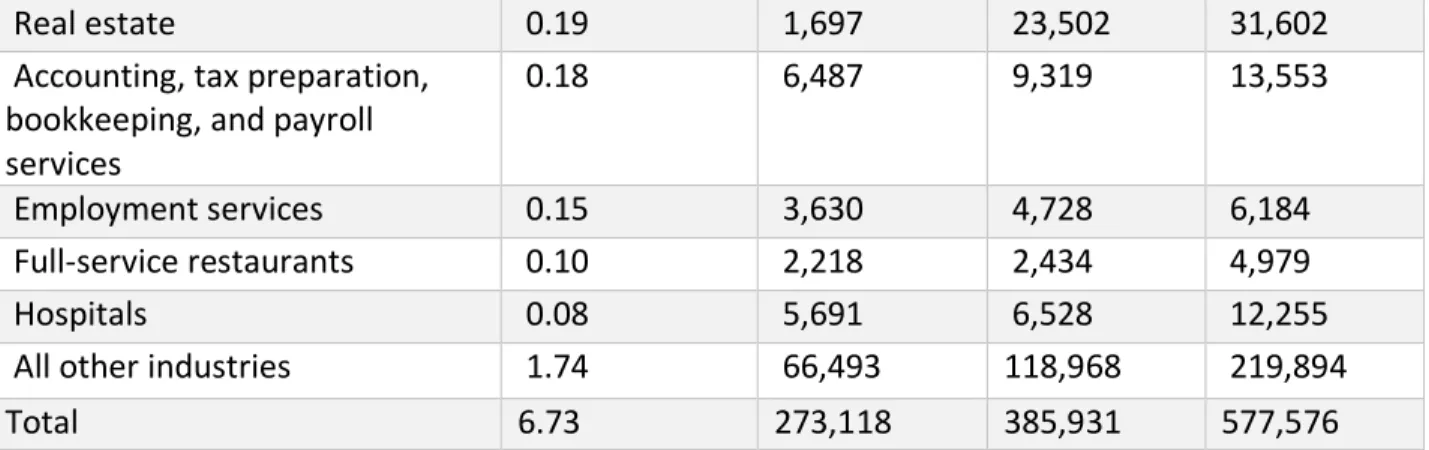
Direct effects represent the sales generated directly between TRACTOR and other industry sectors. IMPLAN utilizes the definition of employment used by Bureau of Economic Analysis Regional Economic Accounts (CEA REA) and the Bureau of Labor Statistics Covered Employment and Wages (CLS CEW) and includes full time, part time, and seasonal work. Office and
administrative services see the most impacts, with 3.36 jobs generated. This represents TRACTOR’s office and warehouse employees, and actually underestimates the effect, as TRACTOR currently has recently scaled up to 6 employees. Only .93 jobs have been created in the Vegetable and Melon Farming sector under this scenario, largely because it is a small amount of money changing hands and because it is difficult for IMPLAN to discern between supporting existing jobs and creating new ones.
This table shows evidence of the challenges associated with using IMPLAN to analyze impacts of non-traditional projects. There is no industry sector for either “food hub” or “small scale local agriculture” and the software has been adapted in an attempt to reflect the spending patterns of TRACTOR and the growers it does business with.
Table 6: Summary of direct effects on employment, labor income, value added, and output for Scenario 1
Industry Employment Labor
Income ($) Value Added ($) Output ($)
21 Real estate 0.19 1,697 23,502 31,602 Accounting, tax preparation,
bookkeeping, and payroll services
0.18 6,487 9,319 13,553
Employment services 0.15 3,630 4,728 6,184 Full-service restaurants 0.10 2,218 2,434 4,979
Hospitals 0.08 5,691 6,528 12,255
All other industries 1.74 66,493 118,968 219,894
Total 6.73 273,118 385,931 577,576
The indirect effects reported here indicate how backward-linked industries are affected by TRACTOR’s operations (Table 7). By far the biggest impact is in the real estate sector, likely as a result of rental fees for TRACTOR’s headquarters. Other business support sectors also see impacts from TRACTOR, such as employment, banking, insurance, and accounting services.
Table 7: Summary of output results for backward-linked industries for scenario 1
Sector Description Indirect Effect ($)
440 Real estate 15,776
464 Employment services 4,934
433 Monetary authorities and depository credit
intermediation 3,881
438 Insurance agencies, brokerages, and related 3,563 448 Accounting, tax preparation, bookkeeping, and
payroll services 3,194
19 Support activities for agriculture and forestry 2,677 454 Management consulting services 2,469 427 Wired telecommunications carriers 2,464 62 Maintenance and repair construction of
nonresidential structures 2,013
395 Wholesale trade 1,970
430 Data processing, hosting, and related services 1,568
447 Legal services 1,539
457 Advertising, public relations, and related
services 1,281
470 Other support services 1,133 461 Management of companies and enterprises 1,064 435 Securities and commodity contracts 1,033 503 All other food and drinking places 1,032
All other sectors 29,859
22 Scenario 2
Since this analysis did not include the creation of a new sector to reflect specific spending patterns of TRACTOR’s growers, it may underestimate the economic impact on the region. Through survey data, we see that the small-scale growers who sell through TRACTOR are likely purchasing more inputs locally than the larger farms represented by IMPLAN’s default
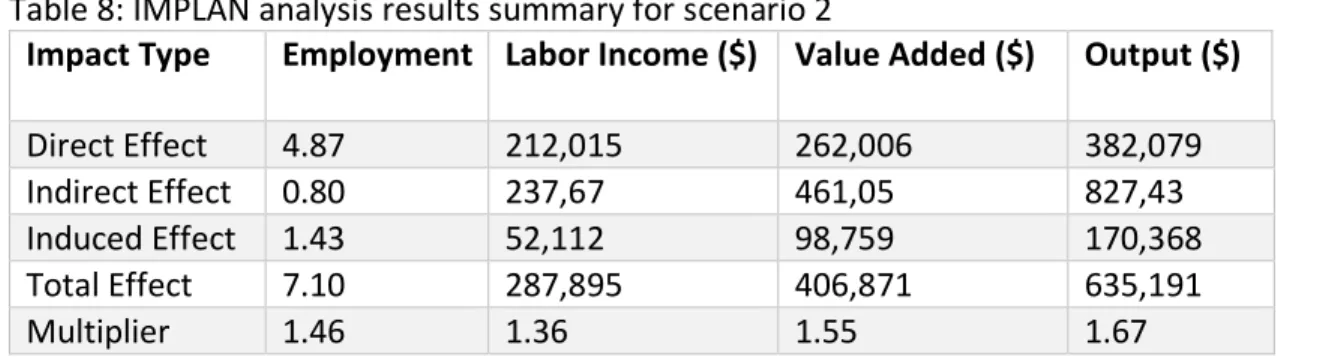
agriculture sector that was used here, Vegetable and Melon Farming (sector 03). Because of this, business to business sales are likely higher in reality than is reflected in this model. Scenario 2 attempts to compensate for this by increasing sales to the vegetable and melon farming industry by 20%. According to TRACTOR, growers that they work with sell roughly 80% of their produce through TRACTOR, and 20% through other outlets. For this reason, 20% was chosen as the inflation factor for this scenario in an attempt to account for additional sales that would not be realized but for TRACTOR’s activities.
Table 8 shows that the multiplier increases by only .01 as a result of increasing sales by vegetable and melon farmers by 20%. The initial multiplier of 1.45 under scenario 1 is most likely a reliable estimate for the current amount of purchases that TRACTOR makes to this sector.
Table 8: IMPLAN analysis results summary for scenario 2
Impact Type Employment Labor Income ($) Value Added ($) Output ($)
Direct Effect 4.87 212,015 262,006 382,079 Indirect Effect 0.80 237,67 461,05 827,43 Induced Effect 1.43 52,112 98,759 170,368 Total Effect 7.10 287,895 406,871 635,191
Multiplier 1.46 1.36 1.55 1.67
Scenario 3
23 Table 9: IMPLAN analysis results summary for scenario 3
Impact Type Employment Labor Income ($) Value Added ($) Output ($)
Direct Effect 4.87 212,015 262,006 1,301,052 Indirect Effect 2.25 62,222 104,051 182,928 Induced Effect 1.67 60,614 114,869 198,160 Total Effect 8.78 334,850 480,926 1,682,140
Multiplier 1.80 1.58 1.84 1.29
IMPLAN Results Summary:
TRACTOR represents a small but vital part of the economy. The multiplier effects are close to county averages for economic development projects, though the total amount of money being circulated through TRACTOR is small relative to the entire economy. However, as demonstrated by interview data, the labor income effects in particular are important to contextualize in terms of median household income for Yancey County (where the majority of growers are located). Extra income for these farmers, and possibly, for the businesses that they transact with, may be a more meaningful amount than it appears.
In terms of total jobs and income created, the effect is small in a traditional economic development sense. However, the scaling up a project like TRACTOR could yield more significant economic gains, as seen in scenario 3. IMPLAN assumes that all demand for local produce in this scenario is new demand, and certainly some of TRACTOR’s growers were in business prior to TRACTOR’s establishment. It is difficult to estimate how much of TRACTOR’s activities are truly new, but based on survey results in the previous section, many growers indicated that TRACTOR’s existence caused them to start or expand their operation.
IMPLAN is an imperfect tool for this type of analysis, but is in demand among practitioners and elected officials looking for basic justifications for local food projects as economic drivers. These results are promising but also indicate the importance of considering broader community economic benefits when analyzing the success of a new local foods project. TRACTOR is
important to Yancey County not only because of its potential economic impacts, but because of its impacts on community development, as described in the interview and survey results. A more robust justification for local food system projects will be reached by providing evidence of both economic and community benefits.
Discussion
24 case of TRACTOR, many participants stressed that the project was valuable in part because it helped increase food security in the county, preserve regional agricultural heritage, preserve farmland, increase community connectivity, and encourage younger generations to farm. Though initially TRACTOR was created primarily to help increase local farmers’ income and bring more dollars into the county from neighboring areas, the project quickly took on new functions and meanings in the community. According to the Yancey County Extension Director,
“We were looking at economic development, here's the potential that we think. But what it's become and what we recognize is it's really also that social, cultural ... It's all those other things that local foods encompasses.” (Tres)
Social capital can also be considered a non-monetized metric of CED. Survey results indicate that TRACTOR has helped increase social capital, at least among farmers in the area. Social capital is a concept which has been both fuzzy and widely debated in the community development circles. This discussion is referring to social capital understood as community networks and relationships, intimately connected to economic capital and power dynamics (Defilippis, 2001; Loury 1997, Markusen 1998, Portes 1998). The majority of growers (Table 2) indicated that being involved with TRACTOR has helped them to either make new connections with others who work in agriculture or make new connections with the community outside of agriculture. Social capital building activity can also be seen in the partnerships that TRACTOR has made with many other community partners. As increasingly dense network of community leaders and organizations that work in agriculture and food security is developing around TRACTOR. These relationships will be an important component of social capital in Yancey County as TRACTOR continues to grow and evolve. TRACTOR has also granted many local growers access to new markets, as evidenced by both grower survey results and interview data. These new relationships and networks are another example of social capital building around TRACTOR.
This food hub can also be considered a CED project because of its community-driven nature. The partnership of local government, cooperative extension, local business owners, and local farmers was essential to its formation. The initial feasibility study and subsequent planning of the food hub was highly influenced by input from local growers, in terms of how much producer demand existed, what types of product were being produced, and what kind of support farmers needed in order to be most successful. Though government was involved, grass-roots input and participation was critical to the process, and is a hallmark of community economic
development.
The many partnerships formed by TRACTOR are evidence of its growth into an
agricultural umbrella organization which serves to protect local heritage and promote awareness of agriculture in the area. In addition, TRACTOR is ostensibly promoting its agricultural brand both inside and outside of the county, with overall
25 Conclusion
This case study holds two main lessons for economic development practice today. The first one is that in low resource areas, blending economic and community development may be a good use of limited public dollars. A more explicit acknowledgment of economic and non-economic benefits may justify a wider variety of projects and yield a broader range of community benefits. In Yancey County, local government acknowledges that TRACTOR is one of the few publically-funded projects that is not explicitly related to basic services such as police, utilities, and education. TRACTOR is considered a success because of its agricultural economic
development potential, but also because of the gains in social capital, food security, and cultural preservation that are already evident.
The second lesson learned is that community economic development should be considered in areas of rural Appalachia specifically. Many Appalachian communities have experienced adverse or inadequate outcomes as a result of traditional economic development strategies, and also need to build resilience against exogenous economic changes, like deindustrialization or the changes in consumer demand. In particular, food hubs and other local foods projects can be appropriate place-based development solutions in communities where agriculture is
26 Appendix 1: Survey instrument administered to TRACTOR growers
1. How many acres of produce did you farm over the past year (Jan 1, 2017-Jan 1, 2018)?
2. What county or counties do you farm in?
3. Is farming your primary occupation?
4. About how much in gross revenue did you earn from sales to TRACTOR over the past year? a. under $2,000 b. $2,000-$4,000 c. $4,000-$6,000 d. $6,000-$8,000 f. over $8,000
5. In addition to selling product through TRACTOR, do you sell through any of the following outlets?
a. farmers markets b. other cooperatives c. community supported agriculture d. direct to grocery stores e. direct to restaurants f. wholesaler
g. broker h. farmstand/roadside stand i. other (please explain: _____________)
6. Please indicate in which categories you have made purchases over the last 5 years for your farm. In the space next to each category, estimate the percentage of money you spent locally (in Yancey, Mitchell, Buncombe, Madison, McDowell, Burke, Rutherford counties) for that category. (circle all that apply)
a. Seeds: %
b. Fertilizers and pesticides: % c. Equipment & Tools: % d. Fuel, type: %
e. Produce packaging: % f. Agricultural plastics: % g. Transplants: %
h. Greenhouses/season extension materials: % i. Vehicles (on farm or delivery): %
j. Post-harvest equipment (sorting lines/coolers/freezers): % k. Construction materials: %
l. other _______________: %
8. Being involved with TRACTOR has: (circle all that apply)
a. enabled me to start or resume growing produce
b. enabled me to expand the amount of acreage I have in production c. caused me to shrink the amount of acreage I have in production d. educated me about different production practices
e. allowed me to sell to new outlets
27 g. helped me make new connections with the community outside of agriculture
h. helped me make ends meet financially i. has had no effect on my operation
9. Have you hired any additional help as a result of being involved with TRACTOR? a. yes b. no
If yes, how many hours per week? _______________________
10. What would you say is the main benefit of being involved with TRACTOR?
28 Appendix 2: Sample questions for semi-structured interviews
1. Who were the key players in TRACTOR’s formation?
a. Why do you think it came about when it did? What was the impetus?
2. How does TRACTOR fits into broader economic development goals for the county?
3. Can you tell me about the perspective that county government has toward TRACTOR
and how they have been involved with the project? Why so proactive?
a. Why do you think TRACTOR has gotten so much support from local government?
4. How does TRACTOR interact with local government, which local governments, and what
does that relationship look like?
5. What do you see as unique about Yancey county government?
6. Can you tell me about reception from the community, how supportive they have been?
7. What do you see as the biggest challenges for TRACTOR’s success right now?
8. What are the greatest assets that TRACTOR has for being a successful economic
development tool?
29 References
Bartik, T. (2005). Solving the problems of economic development incentives. Growth and Change, 36(2), 139-166.
Bauman, A. & Thimany-McFadden, D. (2017). Exploring localized economic dynamics: methods-driven case studies of transformation and growth in agricultural and food markets. Economic Development Quarterly, 31(3), 244-254.
http://journals.sagepub.com/doi/10.1177/0891242417709530
Beckie, M., Kennedy, E., Wittman, H. (2012). Scaling up alternative food networks: farmers' markets and the role of clustering in western Canada. Journal of Agriculture and Human Values, 29, 333-345. DOI 10.1007/s10460-012-9359-9
Boothroyd, P., & Davis, D. (1993). Community Economic Development: Three approaches. Journal of Planning Education and Research, 12, 230-240
Christenson, B., & Phillips, R. (2016). Local food systems and community economic
development through the lens of theory. Community Development, 47(5). 638-651.DOI: 10.1080/15575330.2016.1214609
Clay, R., & Jones, S. (2009) A Brief History of Community Economic Development. Journal of Affordable Housing & Community Development Law, 18(3), 257-267.
Deller, S. Lamie, D., & Stickel, M. (2017) Local foods systems and community economic development. Community Development, 48:5, 612-638. DOI:
10.1080/15575330.2017.1373136
Dougherty, M., Brown, L., & Green, G (2013). Architecture of local food tourism: challenges and opportunities for community economic development. Journal of Rural Social Sciences, 28(2), 1-27.
Fitzgerald, J, & Green Leigh, N. (2002). Economic revitalization: cases and strategies for cities and suburbs. Thousand Oaks, Calif.: SAGE Publ.
Halebsky, S., Gruidl, J., & Green, G. P. (1999). Community benefits of supply- and demand-side economic development tools. Journal of Regional Analysis and Policy, 29(2), 85-104.
"Hardy, J., Hamm M., Pirog, R., Fisk, J., Farbman, J., & Fischer, M. (2015) Findings of the 2015 National Food Hub Survey. Michigan State University Center for Regional Food Systems & The Wallace Center at Winrock International. Retrieved
from http://foodsystems.msu.edu/activities/food-hub-survey"
30 Random House.
Jenkins, C., Schepker, A., & Rhodes-Conway, S. (2014). Local Food and Economic Development: A guide for Local Governments. Center on Wisconsin Strategy, University of Wisconsin-Madison.
Loury, G. (1997). A dynamic theory of racial income differences. Women, Minorities, and Employment Discriminated, ed. Phyllis Wallace & Annette Lamond, pp 153-88. Lexington, MA: Heath.
Loxley, J., & Lamb, L. (2006). Economics for CED Practitioners. In E. Shragge & M. Sydney, NS: Cape Breton University Press.
Markusen, A. (1999). Fuzzy Concepts, Scanty Evidence, Policy Distance: the case for rigour and policy relevance in critical regional studies. Regional Studies, 33(9), 869-884.
Methodologies. In Exploring Economic and Health Impacts of Local Food. Methodologies. In Exploring Economic and Health Impacts of Local Food. Procurement. Chicago, IL: Illinois Public Health Institute.
Mills, S. (2012). A report on the feasibility of establishing a local foods aggregation, sales, and marketing center in Yancey County, North Carolina. Smithson Mills, Inc. Retrieved from
https://yancey.ces.ncsu.edu/spotlight/files/library/100/Smithson%20Final%20Study%20 draft.doc.
North, D. (1955). Location Theory and Regional Economic Growth. Journal of Political Economy, 63(3), 243-258. DOI: http://www.jstor.org/stable/1825076
O’Hara, J.K., & Pirog, R. (2013). Economic impacts of local food systems: Future research priorities. Journal of Agriculture, Food Systems, and Community Development, 3(4), 35-42.
Phillips, R.G., & Besser, T.L. (2013). Community Economic Development. New York: Routledge.
Portes, A. (1998). Social Scapital: Its origins and applications in modern sociology. Modern Sociology, 21, 1-24
Rosenfeld, S. (2010). Sustainable Food Systems Cluster, Vermont style. European Planning Studies, 18(11), 1897-1908. DOI: 10.1080/09654313.2010.512173
Shaffer, R., Deller, S., & Marcouiller, D. (2006). Rethinking Community Economic Development. Economic Development Quarterly, 20(1), 59-74.
31 Schmit, T.M., Jablonski, B.B.R., & Mansury, Y. (2016). Assessing the economic impacts of local
food system producers by scale: a case study from New York. Economic Development Quarterly, 30(4), 316-328. DOI: 10.1177/0891242416657156
Soma, T., & Wakefield, S. (2011). The emerging role of a food system planner: Integrating food considerations into planning. Journal of Agriculture, Food Systems, and Community Development, 2(1), 53-64.
Thilmany McFadden, D., Conner, D., Deller, S., Hughes, D., Meter, K., Morales, A., Schmit, T., Swenson, D., Bauman, A., Phillips Goldenberg M., Hill, R., Jablonski, B., & Tropp, D. The Economics of Local Food Systems: A Toolkit to Guide Community Discussions,
Assessments, and Choices. U.S. Department of Agriculture, Agricultural Marketing Service, March 2016. Web.
Vidal, A., & Keating, D. (2004). Community development: current issues and emerging challenges. Journal of Urban Affairs, 26(2), 125-137.
Virgil, S. (2010). Community Economic Development and Rural America: Strategies for Community-Based Collaborative Development. Journal of Affordable Housing & Community Development Law, 20(1). 9-33.
Vitiello, D., & Brinkley, C. (2013). Journal of Planning History, 13(2), 91-112. DOI: 10.1177/1538513213507541
Yancey County Board of Commissioners (2010, October 5) Regular Meeting of the Yancey County Board of Commissioners. Yancey County Courthouse, Burnsville, NC.