Obsessive-compulsive symptoms and scrupulosity among Muslims living in the United States Saima A. Akbar
University of North Carolina at Chapel Hill 28 March 2016
Author Note
Acknowledgements
Abstract
OCD and scrupulosity among Muslims living in the United States
Obsessive-compulsive disorder (OCD) is an anxiety disorder distinguished by obsessions and compulsions (American Psychiatric Association [APA], 2013). Obsessions refer to intrusive and unwanted thoughts that cause distress, and compulsions refer to frequent urges to complete repetitive behaviors, rituals, or mental tasks to reduce anxiety. This psychiatric disorder affects about 2.3% of people in the United States at some point in their lifetime and about 1.2% of people in one year (Goodman et al., 2014). Similar prevalence rates were found in Puerto Rico, Germany, New Zealand, and South Korea (Weissman et al., 1994). OCD can be a very
debilitating disorder as it can interfere in daily life, in relationships with others, and can cause unwanted anxiety. While most people in the general population experience intrusive thoughts from time to time (de Silva & Rachman, 1978), patients with OCD have these experiences frequently, causing undue distress.
Consider a young man who fears having blasphemous thoughts. He might be disturbed by intrusive thoughts about whether God actually exists, or whether he sinned and God wants to punish him. These thoughts make him believe he is a bad person, so he spends an exorbitant amount of time praying for forgiveness to help reduce his anxiety. However, his obsessions (the ruminations about God) and compulsions (time spent praying) prevent him from properly focusing on his job, causing him to get fired. In such a case, this young man should seek culturally and religiously sensitive treatment to help him overcome his OCD so that he can reduce his anxiety and return to work without compromising his beliefs.
The above case example is consistent with scrupulous presentations of OCD. Within this context, scrupulosity refers to obsessions and compulsions related to religious fears (e.g.,
scrupulosity in OCD varies widely around the world, from 0-93%, implying that occurrence of scrupulosity may be strongly influenced by one’s environment (Greenberg & Huppert, 2010). According to this review of scrupulosity studies, rates tend to be higher in Muslim-majority countries, although the highest rate (93%) was found in a sample of ultra-Orthodox Jews (Greenberg & Huppert, 2010). Such a high percentage suggests that clinical measures for scrupulosity should account for cultural and religious factors, as certain behaviors may be non-pathological in different environments. This study aims to expand knowledge about the
relationship between obsessive-compulsive symptom presentation, religiosity, and immigration status in American Muslims (i.e., any Muslim who resides in the United States) to help improve clinical practice.
The Role of Religion in OCD
A heterogeneous disorder, OCD does not take the same form in each patient; specific content of obsessions and compulsions can vary from person to person (APA, 2013) and across cultures and societies (Fontelle et al., 2004; Saleem & Mahmoud, 2009). Many previous studies have examined OCD symptoms and scrupulosity in diverse populations to determine what differences exist as a function of religion and culture, highlighting the importance of
whole story as obsessional doubts and compulsive washing may have religious undertones, and current clinical questionnaires may not be able to make a clear distinction. In Iranian culture specifically, washing and cleaning often symbolizes spiritual cleansing as well, combining both religious and physical symptoms (Ghassemzadeh et al., 2002).
Religious symptoms of OCD (e.g., excessive praying) may be more likely than non-religious symptoms to go unnoticed, as the symptoms are outwardly similar to non-pathological religious activities. Even when the symptoms are distressing enough to be noticed as abnormal, they may not be seen as worthy of attention. For example, a series of interviews with young Saudi Arabian women with OCD revealed that patients were more likely to view scrupulosity symptoms as a religious issue rather than a mental health concern amenable to treatment and ended up suffering for a long time before seeking mental health services (Al-Solaim & Loewenthal, 2011). Alternatively, common religious practices may seem pathological if examined from the perspective of someone who does not identify with that religion. For
Religiosity and Religious Symptoms
A common question that arises when examining religious symptoms of OCD is: How does religiosity influence the presentation of OCD? While one may explicitly identify with a religion, how central their religion is to their identity or how important religious practices are to them, will vary.The findings regarding the relationship between religiosity and scrupulous OCD symptoms are inconsistent. Tek and Ulug (2001) surveyed 45 OCD outpatients and did not find a conclusive relationship between religiosity and any clinical OCD symptoms. Similarly, Assarian, Biqam, and Asqarnejad (2006) did not find any significant relationship between OCD and
religiosity, but did find that religiosity influenced contents of obsessions and compulsions. Yorulmaz, Gencoz, and Woody (2009) found that Canadian Christian students who scored higher on religiosity were more likely to score higher on symptoms related to thoughts, but the same trend was not seen in Turkish Muslims students, where only a weak correlation was found. This may be because of differences in religiosity or because of cultural differences, as the Muslims participants were recruited from a university in Turkey, and the Christian participants were recruited from a university in Canada.
(Abramowitz et al., 2002). This question defines religiosity in terms of personal identification with one’s religious beliefs instead of outward religious practice. When comparing populations in which outward religious acts may be influenced by varying social pressure, measuring religiosity through one’s personal identification with religion as opposed to outward religious acts can help avoid measuring social conformity as opposed to religiosity.
The Role of Immigration
In a globalized world, working with immigrants is increasingly common, especially in the United States. About 40 million US residents are born overseas, making up about 13% of the total US population (Census, 2011b). This number does not take into account American-born children of immigrants, another important factor as the impact of immigration extends to subsequent generations. Immigrants to America often face language barriers, culture shock, and isolation; acculturation to a new environment takes time and can occur in stages as immigrants juggle their cultures, beliefs and values, many of which may clash with those of their host country and social environment (Suárez-Orozco et al., 2013). One study highlights the importance of therapists’ knowledge of different religions and cultures. Al-Solaim and Loewenthal (2011) found that Saudi Arabian women reported feeling more comfortable
disclosing OCD symptoms to a therapist who (a) shared their religion, (b) were perceived to be more religious and (c) used more religious words in conversation than to a therapist who did not. This study shows that a lack of understanding of a patient’s religion can also serve as a barrier to treatment. Children of immigrants similarly grow up with their parents’ cultures (specific to their country of origin) in addition to their host culture, which may directly influence the experience of scrupulosity and religious-based OCD symptoms.
importance of immigration status (Yorulmaz & Isik, 2011). This study sampled Turkish citizens living in Turkey, Turkish immigrants living in Bulgaria, and Turkish re-migrants (i.e. Turkish individuals who were born in Bulgaria and moved to Turkey). Results showed that Turkish immigrants to Bulgaria and Turkish re-migrants scored lower on measures related to TAF and thought control, than Turkish citizens (Yorulmaz & Isik, 2011). These results suggest that culture and religion can have differential effects on psychopathology. In the US, American Muslim immigrants have spent a wide range of time abroad and the different amounts of time may be a better predictor of the effects of immigration instead of a dichotomous variable. In this study, immigration will be measured by percent of life abroad to take into account immigrant Muslims who have lived in the US for most or a large percentage of their lives.
The above review highlights the need for mental health professionals to better understand their patients’ religio-cultural background. Accordingly, this study was designed to elucidate the experience of scrupulosity among American Muslims, accounting for both religiosity and immigration status. In light of previous research, I hypothesized that:
1. Religiosity will be correlated with scrupulosity (but not OC symptom severity; Greeneberg & Huppert, 2010), while all clinical measures except social anxiety symptoms will be significantly correlated as they measure similar constructs.
2. Years spent abroad will be a significant predictor of OC symptoms but religiosity and other demographic variables will not, showing an effect of culture more so than religiosity, as shown in the study by Yorulmaz and Isik (2011).
3. Years spent abroad and religiosity will both significantly predict scrupulosity scores but general distress will not, as scrupulosity is likely influenced by a mixture of culture and religion (Yorulmaz & Isik, 2011; Greeneberg & Huppert, 2010).
Participants
A total of 50 participants initiated the Qualtrics survey, and 32 completed the full survey, giving a completion rate of 64%. Of the participants who completed the full survey, 22 were born in the US and 10 were born outside the US. Participants were recruited from mosques around North Carolina through flyers, list-servs, and word-of-mouth. Participants were
incentivized to participate in this study by having the opportunity to supply their email address to be entered in a drawing for one of four $50 Amazon gift cards.
Measures
Depression Anxiety Stress Scale-21 (DASS-21; Lovibond & Lovibond, 1995). The DASS-21 is a measure of general distress. Participants rate the extent to which 21 statements apply to them over the past week on a 0 (Did not apply to me at all) to 3 (applied to me very much or most of the time) scale.
Social Interaction Anxiety Scale (SIAS; Mattick & Clarke, 1998). The SIAS is a 20-item measure of social anxiety symptoms. Participants rate how much each statement pertains to them on a scale of 0 (not at all) to 4 (extremely). The SIAS assesses specificity of assessed constructs to OCD symptomatology.
Dimensional Obsessive Compulsive Scale, (DOCS; Abramowitz et al., 2010). The DOCS measures four OCD dimensions: 1) concerns about germs and contamination, 2) responsibility for harm, injury, or bad luck, 3) unacceptable thoughts, and 4) symmetry, completeness, and the need for things to be “just right”. Participants answer 5 questions per category, rating the extent to which each question applies to them on a 0 (not at all) to 4 (very much) scale.
many of the items can be categorized using the same categorization as the DOCS. The statements are rated on how much each statement pertains to the respondent on a scale of 0 (not at all) to 4 (very much).
Modified Penn Inventory of Scrupulosity, (PIOS; Abramowitz et al., 2002). The PIOS measures scrupulosity, or religious symptoms of OCD. One item has been removed (I feel urges to confess sins over and over again) to keep the scale relevant to Muslim participants. The original scale consists of 19 statements, resulting in the inclusion of 18 in the present study’s survey. Each item is rated on a scale of 0 (Never) to 4 (Almost always).
Religiosity Index, (RI). The religiosity scale is a 10-item scale developed for this study in which participants answer questions either about the role that their religion plays in their life or about OC symptoms related to their religious beliefs. The items are rated on a Likert scale of 1 (strongly disagree) to 5 (strongly agree).
Demographics Questionnaire. At the end of the survey participants will answer questions about their age, place of birth, zip code, education, ethnicity, parents’ country of origin, and years living in the United States.
Procedure
The survey was completed online through Qualtrics, a secure online survey program. Participants first read and agreed to a consent form. Next, they completed the clinical
Results
The total scores for the clinical questionnaires (DASS, DOCS, VOCI, modified PIOS, SIAS) and RI for all participants were all within 3 standard deviations of the mean, indicating no outliers in the dataset. All the available data was used despite some missing demographic
information from some (n = 32) participants.
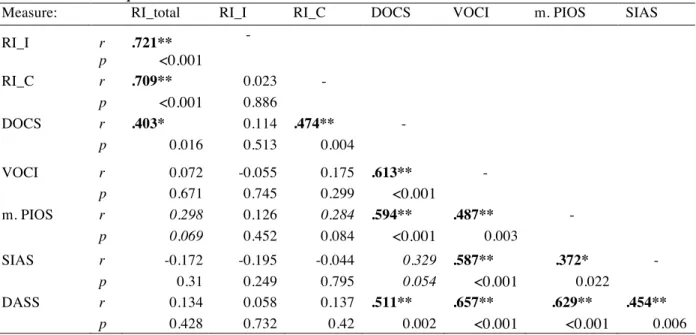
Immigration status was transformed into a continuous variable (“percentage abroad”), by dividing years abroad by participants’ age. The RI questions focused on either religious identity or religious compulsions and were therefore separated into two RI subscales, RI-Identity (RI-I) and RI-Compulsions (RI-C). Correlation analyses showed that the RI-I score was not
significantly correlated with the the RI-C score, r = .023, p = .886.
An independent samples t-test was performed to compare the SIAS, DASS, and RI subscale scores between participants born in the US and participants born abroad. While there were no significant group differences along the DASS and RI subscales, there was a trend toward a significant group difference in SIAS scores, such that social anxiety symptoms were marginally higher in US born participants (M = 34.2, SD = 14.9) relative to participants born abroad (M = 23.9, SD = 12.6), t(30) = 1.89, p = .068. A subsequent correlational analysis between the total SIAS scores and percentage abroad similarly revealed a trend towards significance, r = -.343, p = 0.055.
Hypothesis 1: Correlations
When looking at the RI subscales, there is a trend toward significant association between the RI-C and modified PIOS, but no trend between the modified PIOS and the RI-I subscale. The RI and the RI-C subscale are specifically correlated with the DOCS contamination subscale (r=.387, p=0.018; r=.359, p=.029, respectively). Furthermore, the RI-C subscale is significantly correlated with the DOCS harm subscale (r=.447, p=0.007) and the DOCS symmetry subscale (r=.340, p=.046), but not the DOCS thoughts subscale (r=.254, p=0.141). The DOCS and SIAS scores were strongly trending towards significance though not significantly correlated.
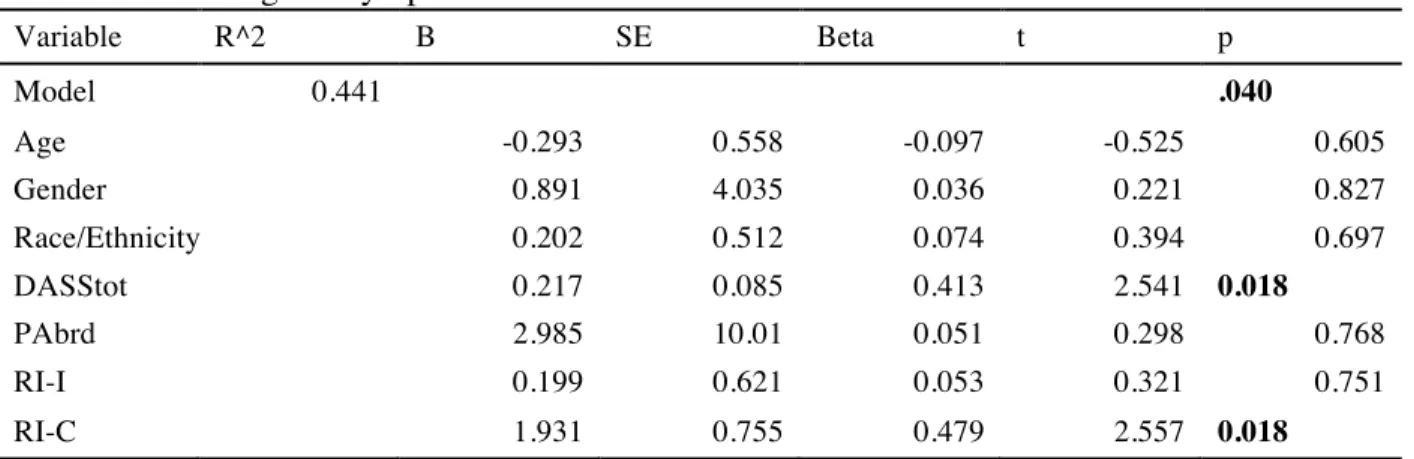
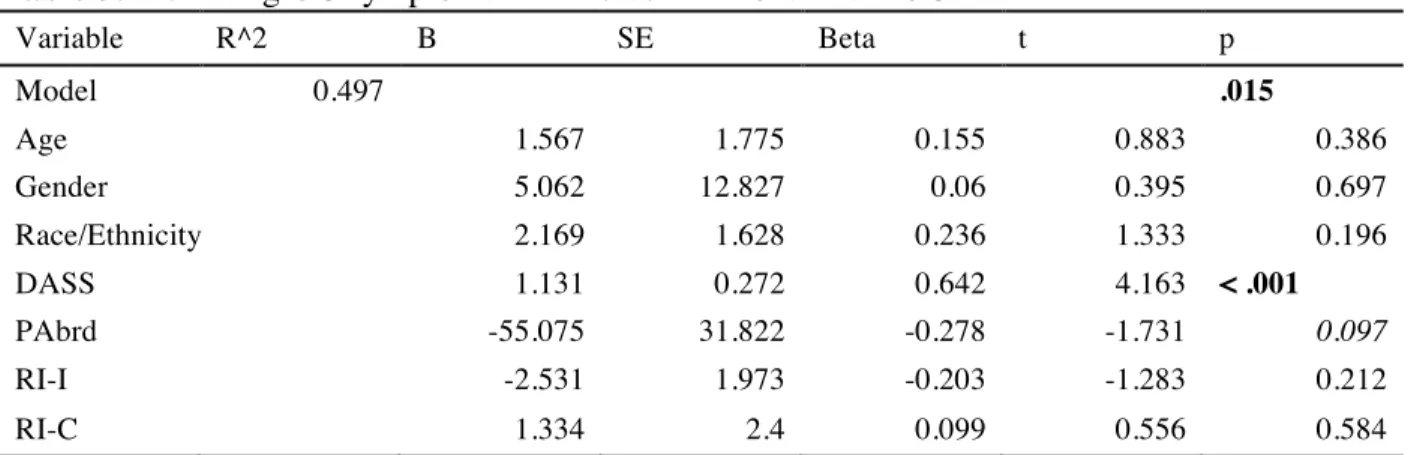
Hypothesis 2: Regression for DOCS and VOCI (OC symptoms) using Percent Abroad Two regression analyses were conducted for predicting OC symptoms as measured by the DOCS and VOCI (separately) using percentage abroad, age, gender, race/ethnicity, RI-I, RI-C, and DASS scores. The results are displayed in Table 2 (using the DOCS) and Table 3 (using the VOCI). The overall regression model predicting DOCS scores using percentage abroad is significant where the two variables that significantly predicted DOCS scores are the DASS score and RI-C subscale. The regression model predicting VOCI scores is also significant. However, in this model, the only significant unique predictor is the DASS score. The percentage abroad predictor is trending towards significance while both RI subscales are non-significant predictors. In both models, demographic variables are non-significant predictors, including percent abroad.
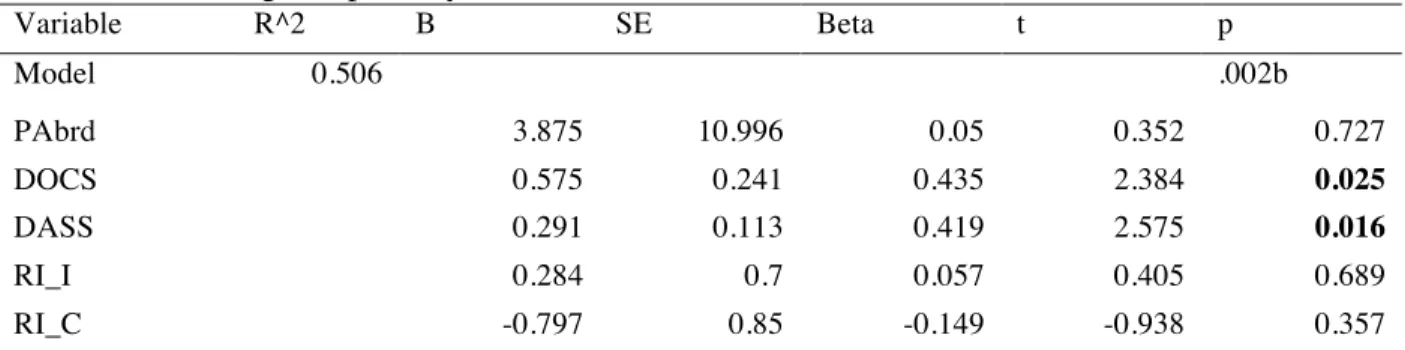
These results do not support our hypothesis that percent abroad would be a significant predictor of OC symptoms. In both cases, only the DASS is significantly predictive of both the DOCS and VOCI scores and the RI-C subscale is only a significant predictor in the DOCS model. Hypothesis 3: Predictors for Scrupulosity
regression models are significant, as shown on Table 3 (DOCS model) and Table 4 (VOCI model). The DASS and DOCS scores are significant predictors for scrupulosity while the RI-C and RI-I subscales, and percent abroad are not significant predictors of scrupulosity, contrary to our hypothesis. The VOCI scores are not predictive of scrupulosity although the DOCS scores are.
Discussion
This study aimed to elucidate the specific predictors of OC symptoms and scrupulosity among American Muslims while accounting for immigration status and religiosity. Previous studies have suggested that mental illness can have varying presentation depending on culture and religion. Understanding the different factors that can influence mental illness is important for clinicians to treat their patients sensitively and effectively.
Initial independent samples t-tests showed no effect of immigration status on any of the measures except for a trend towards significance in total SIAS scores, in which US born participants scored higher than participants born abroad. A correlational analysis similarly showed a marginally significant negative correlation between percent abroad and SIAS scores. These results may suggest an effect of culture on social anxiety. A future study should examine this potential phenomenon using a larger sample including participants of other religious beliefs to check for potential predictors for social anxiety and possible interaction effects between religion and culture as measured by percent abroad.
significance in correlation with the modified PIOS. It is possible that the RI-C questions did not measure religiosity as much as religiously compulsive practices which may be why it leaned towards significance for scrupulosity and is significantly correlated with the DOCS total score. It is not, however, significantly correlated with the VOCI scores even though the VOCI has similar subscales to the DOCS and is significantly correlated with the DOCS score. It is possible that the VOCI and DOCS measure different aspects of OCD and the VOCI does not adequately touch on scrupulous symptoms.
Upon further investigation, the RI-C subscale is significantly correlated with the DOCS symmetry, contamination, and harm subscales but not the DOCS thoughts subscale, which is surprising because many religious OC symptoms involve thought control (Greenberg & Huppert, 2010). It may be that the questions on the DOCS pertaining to unacceptable thoughts were too vague to measure specific religious symptoms related to unwanted thoughts. It is also possible that thought symptoms are not necessarily relevant to religious practice for Muslims. Yorulmaz and colleagues (2009) found a similar trend when comparing Canadian Christians and Turkish Muslims; religiosity was related to thought symptoms only in Christian participants but not with Muslims. Future studies can clarify this phenomenon by comparing thought symptoms as related to religiosity in different populations.
where they found a greater influence of culture than religion. However, in this study, only 10 participants were born abroad and many of those participants moved to the US after only a few years (Figure 1). Additionally, the sample in this study represented 17 different countries either in participants’ or their parents’ places of birth, which may also explain this discrepancy. The trend towards significance in the VOCI model may indicate that a larger sample size would support Yorulmaz and Isik’s study. Additional analyses should include a larger sample of participants who lived abroad for varying numbers of years, along with a control for which country participants, or their parents, were born, to help shed more light on this phenomenon. The consideration of parents’ birthplace is also an important factor to study as it influences the home environment in which children are raised. In the DOCS model, RI-C also turned out to be a significant predictor, which is not surprising since the RI-C is also significantly correlated with most DOCS subscales as well. This finding is also important for clinicians to take into account as there may be some scrupulous compulsions that are unique to Islamic practices that are different from scrupulous practices in other religious practices. For example, repeating prayers over again may easily go undetected if the clinician is not aware of typical practices. The addition of a supplemental scrupulosity measure specific to symptoms related to Islamic religious practices may be beneficial to clinicians in diagnosing OCD.
would reduce the effect of time spent abroad. In general, the diversity of the US Muslim
populations’ background cultures cannot be generalized into immigrant vs. non-immigrants i.e., a single construct without taking into account other potential factors such as preference for one’s previous culture, a feeling of belonging in host culture (in this case the US), or number of older generations who have spent all (or the majority) of their time living in the US. It is interesting that the RI-I subscale was not significant in any statistical analysis. This implies that strongly identifying with one’s religion (or not) does not have an effect on OC symptom presentation. This finding will hopefully help reduce stigma around studying and exploring the intersection of religion and mental illness.
Another topic for future research to explore is how immigrant and US-born Muslims compare to a larger sample of Americans. It’s possible that clinical measures for OCD are normed on a greater population and do not adequately measure more specific groups. As the US becomes an increasingly diverse country, it’s important for researchers and mental health
specialists to learn more about individual cultures and the way specific religions and religiosity is influenced by different culture to adequately understand and treat a diverse patient population.
Muslim-majority countries may not be generalizable to Muslims in the US, though there likely is some comparability.
References
Abramowitz, J. S., Deacon, B. J., Olatunji, B. O., Wheaton, M. G., Berman, N. C., Losardo, D., Timpano, K. R., McGrath, P. B., Riemann, B. C., Adams, T., Björgvinsson, T., Storch, E. A., & Hale, L. R. (2010). Assessment of obsessive-compulsive symptom dimensions: development and evaluation of the dimensional obsessive-compulsive scale.
Psychological Assessment, 22, 180–198
Abramowitz, J. S., Huppert, J. D., Cohen, A. B., Tolin, D. F., & Cahill, S. P. (2002). Religious obsessions and compulsions in a nonclinical sample: The Penn Inventory of Scrupulosity (PIOS). Behaviour Research and Therapy, 40, 824–838.
Al-Solaim & Loewenthal (2011). Religion and obsessive-compulsive disorder (OCD) among young Muslim women in Saudi Arabia. Mental Health, Religion, & Culture, 14(2), 169-182.
Amer, M. M., & Bagasra, A. (2013). Psychological Research With Muslim Americans in the Age of Islamophobia. American Psychologist, 68(3), 134–144.
http://doi.org/10.1037/a0032167
American Psychiatric Association. (2013). Diagnostic and statistical manual of mental disorders
(5th ed.). Arlington, VA: American Psychiatric Publishing.
Assarian, F., Biqam, H., & Asqarnejad, A. (2006). An epidemiological study of obsessive-compulsive disorder among high school students and its relationship with religious attitudes. Archives of Iranian Medicine, 9(2), 104-107.
Ghassemzadeh, H., Mojtabai, R., Khamseh, A., Ebrahimkhani, N., Issazadegan, A., & Saif-Nobakht, Z. Symptoms of obsessive-compulsive disorder in a sample of Iranian patients.
International Journal of Social Psychiatry, 48(1), 20-28.
Greeneberg, D., & Huppert, J. D. (2010). Scrupulosity: A unique subtype of obsessive-compulsive disorder. Current Psychiatry Reports, 12, 282-289.
Inozu, M., Clark, D. A., & Karanci, A. N. (2012). Scrupulosity in Islam: A comparison of highly religious Turkish and Canadian samples. Behavior Therapy, 43, 190-202.
Lovibond, P., & Lovibond, S. (1995). The structure of negative emotional states: Comparison of the Depression Anxiety Stress Scale (DASS) with the Beck Depression And Anxiety Inventories. Behaviour Research and Therapy, 33(3), 335–343.
Mattick, R.P., & Clarke, J.C. (1998). Development and validation of measures of social phobia scrutiny fear and social interaction anxiety. Behaviour Research and Therapy, 36, 455– 470.
Okasha, A., Saad, A., Khalil, A. H., Seif El Dawla, A., & Yehia, N. (1994). Phenomenology of obsessive-compulsive disorder: A transcultural study. Comprehensive Psychiatry, 35(3),
191-197.
Rachman, S., & de Silva, P. (1978). Abnormal and normal obsessions. Behaviour Research and Therapy, 16, 233–248.
Rosmarin, D. H., Pirutinsky, S., & Siev, J. (2010). Recognition of scrupulosity and non-religious OCD by Orthodox and non-Orthodox Jews. Journal of Social and Clinical Psychology, 29(8), 930-944.
Saleem, S. & Mahmood, Z. (2009). OCD in a cultural context: A phenomenological approach.
Shooka, A., Al-Haddad, M. K., & Raess, A. (1998). OCD in Bahrain: A phenomenological profile.
International Journal of Social Psychiatry, 44(2), 147-154.
Suárez-Orozco, C., Birman, D., Casas, J. M., Nakamura, N., Tummala-Narra, P., & Zárate, M. (2013). Working With Immigrant-Origin Clients. American Psychological Association. Retrieved from
http://www.apa.org/topics/immigration/immigration-report-professionals.pdf
Tek, C. & Ulug, B. (2001). Religiosity and religious obsessions in obsessive-compulsive disorder. Psychiatry Research, 104, 99-108.
Thordarson, D. S., Radomsky, A. S., Rachman, S., Shafran, R., Sawchuk, C. N., & Hakstian, A. R. (2004). The Vancouver obsessional compulsive inventory (VOCI). Behaviour Research and Therapy, 42(11), 1289–1314.
U.S. Census Bureau. (2011b). Selected social characteristics in the United States: Foreign-born. 2011 American Community Survey 1-year estimates. Retrieved from
http://factfinder2.census.gov/faces/tableservices/jsf/pages/productview.xhtml?pid=ACS_1 1_1YR_DP02&prodType=table
Weissman, M. M., Bland, R. C., Canino, G. J., Greenwald, S., Hwu, H. G., Lee, C. K., Newman, S. C., Oakley-Browne, M. A., Rubio-Stepec, M., & Wickramaratne, P. J., et al. (1994). The cross national epidemiology of obsessive compulsive disorder. The Cross National Collaborative Group. Journal of Clinical Psychiatry, 55, 5-10.
Yorulmaz, O. & Isik, B. (2011). Cultural context, obsessive-compulsive disorder symptoms, and cognitions: A preliminary study of three Turkish samples living in different countries.
Table 1. Clinical questionnaire score correlations
Measure: RI_total RI_I RI_C DOCS VOCI m. PIOS SIAS
RI_I r .721** -
p <0.001
RI_C r .709** 0.023 -
p <0.001 0.886
DOCS r .403* 0.114 .474** -
p 0.016 0.513 0.004
VOCI r 0.072 -0.055 0.175 .613** -
p 0.671 0.745 0.299 <0.001
m. PIOS r 0.298 0.126 0.284 .594** .487** -
p 0.069 0.452 0.084 <0.001 0.003
SIAS r -0.172 -0.195 -0.044 0.329 .587** .372* -
p 0.31 0.249 0.795 0.054 <0.001 0.022
DASS r 0.134 0.058 0.137 .511** .657** .629** .454**
p 0.428 0.732 0.42 0.002 <0.001 <0.001 0.006
Table 2. Predicting OC symptoms with Percent Abroad and DOCS
Variable R^2 B SE Beta t p
Model 0.441 .040
Age -0.293 0.558 -0.097 -0.525 0.605
Gender 0.891 4.035 0.036 0.221 0.827
Race/Ethnicity 0.202 0.512 0.074 0.394 0.697
DASStot 0.217 0.085 0.413 2.541 0.018
PAbrd 2.985 10.01 0.051 0.298 0.768
RI-I 0.199 0.621 0.053 0.321 0.751
RI-C 1.931 0.755 0.479 2.557 0.018
Table 3. Predicting OC symptoms with Percent Abroad and VOCI
Variable R^2 B SE Beta t p
Model 0.497 .015
Age 1.567 1.775 0.155 0.883 0.386
Gender 5.062 12.827 0.06 0.395 0.697
Race/Ethnicity 2.169 1.628 0.236 1.333 0.196
DASS 1.131 0.272 0.642 4.163 < .001
PAbrd -55.075 31.822 -0.278 -1.731 0.097
RI-I -2.531 1.973 -0.203 -1.283 0.212
RI-C 1.334 2.4 0.099 0.556 0.584
Table 4. Predicting scrupulosity with RI subscales and DOCS
Variable R^2 B SE Beta t p
Model 0.506 .002b
PAbrd 3.875 10.996 0.05 0.352 0.727
DOCS 0.575 0.241 0.435 2.384 0.025
DASS 0.291 0.113 0.419 2.575 0.016
RI_I 0.284 0.7 0.057 0.405 0.689
RI_C -0.797 0.85 -0.149 -0.938 0.357
Table 5. Predicting scrupulosity with RI subscales and VOCI
Variable R^2 B SE Beta t p
Model 0.419 .011
PAbrd 8.266 12.444 0.106 0.664 0.512
VOCI 0.077 0.08 0.195 0.971 0.341
DASS 0.337 0.139 0.485 2.428 0.022
RI_I 0.535 0.777 0.108 0.688 0.498
RI_C 0.103 0.818 0.019 0.126 0.9
Figure 1. Frequency of Percent Abroad
APPENDIX
Religiosity Index
Likert scale of 1-5, with 1 being strongly disagree, and 5 being strongly agree.
RI-Identity
1) I consider myself very religious.
2) Other people would perceive me as very religious.
3) Religion is central to my identity.
4) My religion is the most important thing in my life.
5) It is important to me that others know my religious identity.
6) I think my religion should be kept to myself.
7) I don’t often think about my religion.
RI-Compulsivity
8) I sometimes repeat my prayers.
9) I sometimes repeat my ablutions (wudhu).