ORIGINAL ARTICLE
UDP-glucose promotes neutrophil recruitment in the lung
Juliana I. Sesma1&Clarissa D. Weitzer2&Alessandra Livraghi-Butrico1&Hong Dang1& Scott Donaldson1&Neil E. Alexis3&Kenneth A. Jacobson4&T. Kendall Harden2& Eduardo R. Lazarowski1
Received: 4 March 2016 / Accepted: 5 July 2016 / Published online: 15 July 2016
#Springer Science+Business Media Dordrecht 2016
Abstract In addition to their role in glycosylation reactions, UDP-sugars are released from cells and activate widely dis-tributed cell surface P2Y14receptors (P2Y14R). However, the
physiological/pathophysiological consequences of UDP-sugar release are incompletely defined. Here, we report that UDP-glucose levels are abnormally elevated in lung secre-tions from patients with cystic fibrosis (CF) as well as in a mouse model of CF-like disease, theβENaC transgenic (Tg) mouse. Instillation of UDP-glucose into wild-type mouse tra-cheas resulted in enhanced neutrophil lung recruitment, and this effect was nearly abolished when UDP-glucose was co-instilled with the P2Y14R antagonist PPTN
[4-(piperidin-4-yl)-phenyl)-7-(4-(trifluoromethyl)-phenyl-2-naphthoic acid]. Importantly, administration of PPTN toβENaC-Tg mice re-duced neutrophil lung inflammation. These results suggest that UDP-glucose released into the airways acts as a local mediator of neutrophil inflammation.
Keywords UDP-glucose . P2Y14receptor . Purinergic
receptors . Neutrophils . Lung inflammation
Introduction
Nucleotides are released from cells in a regulated fashion, activate cell surface purinergic receptors, and promote a broad range of physiological processes [1,2]. Purinergic receptors comprise three subfamilies. The G protein-coupled A1R,
A2AR, A2BR, and A3R are activated by adenosine [3], the G
protein-coupled P2Y receptors are activated by ATP (P2Y2R,
P2Y11R), ADP (P2Y1R, P2Y12R, P2Y13R), UTP (P2Y2R,
P2Y4R), UDP (P2Y6R, P2Y14R), or UDP-sugars (P2Y14R)
[4], and the P2X receptors are ligand-gated ion channels acti-vated by ATP [5].
Extracellular nucleotides and nucleosides regulate mucociliary clearance (MCC) activities, thereby promoting the primary innate defense mechanism that removes foreign particles and pathogens from airway surfaces. Purinergic reg-ulation in the airways is mediated mainly by the P2Y2R and
the A2BR [6]. Activation of the A2BR results in cyclic
AMP-dependent activation of the cystic fibrosis transmembrane reg-ulator (CFTR) Cl− channel and stimulation of ciliary beat frequency. Activation of the P2Y2R promotes inhibition of
Na+ absorption as well as dependent and CFTR-independent Cl−secretion, ciliary beating, and mucin secre-tion [6,7]. In addition, nucleotides within the airway surface liquid (ASL) are potent pro-inflammatory signaling molecules acting on purinergic receptors expressed on immune/ inflammatory cells or by promoting the release of cytokines and other chemoattractants from lung epithelial cells [8–11]. Thus, the rates of nucleotide release and metabolism in healthy airways are finely regulated to maintain effective MCC without promoting airway inflammation.
Electronic supplementary materialThe online version of this article (doi:10.1007/s11302-016-9524-5) contains supplementary material, which is available to authorized users.
* Eduardo R. Lazarowski
1 Marsico Lung Institute/Cystic Fibrosis Research Center, University
of North Carolina School of Medicine, 6007 Thurston-Bowles Building, CB 7248, Chapel Hill, NC 27599-7248, USA 2
Department of Pharmacology, University of North Carolina School of Medicine, Chapel Hill, NC, USA
3
Center for Environmental Medicine, Asthma, and Lung Biology, University of North Carolina School of Medicine, Chapel Hill, NC, USA
4 Laboratory of Bioorganic Chemistry, National Institute of Diabetes
Mucus plugging, infection, and neutrophil inflammation in the lung are pathological features of chronic inflammatory lung diseases such as cystic fibrosis (CF) and chronic bron-chitis [CB, a form of chronic obstructive lung disease (COPD)]. While polymorphonuclear neutrophils (PMN) are key players in fighting infections, they also are major contrib-utors to the inflammatory response causing lung destruction in CF and COPD [12]. Failure to effectively manage lung in-flammation in CF and COPD is due, in part, to a limited understanding of the processes responsible for neutrophil re-cruitment, activation, and clearance in diseased airways.
The P2Y14R is a Gi-coupled receptor that is activated by
UDP-sugars with a relative potency order of UDP-glucose > UDP-galactose > UDP-glucuronic acid > UDP-N -acetylglucosamine [13, 14]. UDP also is an agonist of this receptor, but ATP, UTP, or other naturally occurring nucleo-side 5′- di- or triphosphates have no P2Y14R activity [13–16].
P2Y14R mRNA expression has been reported in the brain and
several peripheral tissues [13], including the lung, circulating neutrophils, and other immune/inflammatory cells [17–21].
Studies from our lab have illustrated the occurrence of reg-ulated release of UDP-sugars from several cell types, includ-ing airway epithelial cells [22–28]. Notably, enhanced UDP-sugar release was observed in mucin-secreting cells. For ex-ample: (i) primary cultures of human bronchial epithelial (HBE) cells induced to develop goblet cell metaplasia by fection with respiratory syncytial virus or treatment with in-terleukin 13 (IL-13) exhibited enhanced release of UDP-glucose concomitantly with increased mucin secretion [22]; and (ii) goblet cell-like Calu-3 cells exhibited enhanced Ca2+-regulated exocytosis of mucin granules, which was ac-companied by increased release of UDP-glucose [27]. Bronchoalveolar lavage fluids (BALF) from patients with CF and control diseases exhibit robust accumulation of UDP-sugars [24]. In spite of the apparent association between UDP-sugar levels in airway surface liquids and mucin hyper-secretion and inflammation, the pathophysiological conse-quences of UDP-glucose release into the airways are not well understood.
Two lines of evidence suggest that UDP-sugars accumulat-ing in the airway/alveolar space potentially trigger neutrophil infiltration in the lung. Müller and co-workers reported ex-pression of P2Y14R mRNA in primary cultures of human
alveolar epithelial type II cells, as well as in immortalized human lung epithelial cell lines [11]. They also showed that addition of UDP-glucose to these cells resulted in enhanced secretion of interleukin 8 (IL-8), a potent neutrophil chemoattractant [11]. In addition, we recently demonstrated that UDP-glucose promotes P2Y14R-mediated chemotaxis of
freshly isolated human neutrophils.Enhanced PMN migration was observed in response to UDP-glucose gradients, and this activity was abolished when the P2Y14R antagonist PPTN
[4-(piperidin-4-yl)-phenyl)-7-(4-(trifluoromethyl)-phenyl-2-naphthoic acid] was included in the cell suspension buffer [29,30]. We also showed that UDP-glucose-promoted chemo-taxis in neutrophil-like HL60 cells was absolutely dependent on the expression of P2Y14R in these cells and was abolished
by PPTN [29,30].
Whether UDP-glucose acts as a pro-inflammatory media-tor in the lung is not known. To this end, we examined the effect of UDP-glucose administration on neutrophil lung in-filtration in wild-type mice and used the mucin-hypersecreting
βENaC transgenic mouse to further investigate the effect of PPTN on the spontaneous neutrophil lung inflammation asso-ciated with this mouse model.
Materials and methods
Materials UDP-glucose (Fluka catalog # 94335) was pur-chased from Sigma-Aldrich (St. Louis, MO); high-performance liquid chromatography (HPLC) analysis indicat-ed that UDP-glucose was not contaminatindicat-ed with ATP, UTP, or other nucleotide-signaling molecules [29]. PPTN was synthe-sized as previously described [30] and used as a dimethylsulfoxide (DMSO) stock solution (100 mM), which was stored at−20 °C. PPTN was freshly diluted in endotoxin-free PBS before its administration to mice and an equivalent dilution of DMSO in PBS was used as vehicle in control animals.
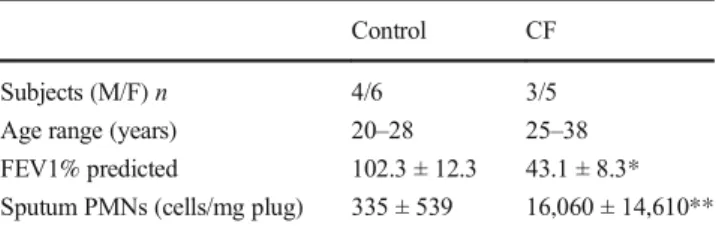
SubjectsHealthy (n= 10) and CF (n= 8) adults were recruited to provide sputum specimens. Healthy subjects were non-smokers without a history of asthma or allergy. CF subjects were at their baseline state of health and had not been treated for acute infection or exacerbation in the prior 4 weeks. Five of 8 CF subjects used cycling inhaled antibiotics chronically, but no samples were collected during anBon^treatment peri-od. All but one CF subject were pancreatic insufficient, and all had moderate to severe lung disease. See Table1for addition-al demographic features. All subjects were studied at the University of North Carolina at Chapel Hill (Chapel Hill,
Table 1 Study subject demographics
Control CF
Subjects (M/F)n 4/6 3/5
Age range (years) 20–28 25–38
FEV1% predicted 102.3 ± 12.3 43.1 ± 8.3* Sputum PMNs (cells/mg plug) 335 ± 539 16,060 ± 14,610**
Data are presented as mean ± SD. Neutrophil values were available for seven CF patients
Mmale,Ffemale,FEV1forced expiratory volume in 1 s
*
NC, USA), and studies were approved by the Institutional Review Board.
Sputum collection and processingSpontaneous sputum from CF patients and induced sputum from healthy control subjects were collected and processed as previously described [31,32]. Briefly, mucus plug was selected and weighted. Aliquots were treated with Sputolysin (DTT) and 1 mM EDTA, filtered, and centrifuged, and the cell-free supernatant was stored at−80, until further nucleotide analysis.
Measurements of nucleotides in lung secretions UDP-glu-cose concentration was measured using the UDP-gluUDP-glu-cose pyrophosphorylase-catalyzed conversion of UDP-glucose and32PPi to [32P]UTP and glucose-1P; the resulting32 P-la-beled species were quantified by HPLC, as described [28]; s a m p l e s w h e r e s u p p l e m e n t e d w i t h 2 5 m M 4 ( 2 -hydroxyethyl)-1-piperazineethanesulfonic acid (HEPES) pH 7.4, 2 mM MgCl2, and 2 mM CaCl2prior UDP-glucose
mea-surements. ATP levels were quantified by the off-line lucifer-in-luciferase assay, using a GloMax luminometer (Promega, Madison, WI) equipped with an automated injector. Sample aliquots (20μl) were transferred to a 96-well plate containing 150μl H20/well and placed in the luminometer chamber. Seventy-five microliters of the luciferin-luciferase buffer [33] were subsequently injected, and luminescence was read and integrated every 4 s using the GloMax® Discover soft-ware. ATP calibration curves were performed in parallel to samples.
Metabolism of UDP-glucose and ATP in sputumSputum samples (50μl) were incubated at 37 °C with 5μM ATP or 5μM UDP-Glc in the presence of 25 mM HEPES, 2 mM MgCl2and 2 mM CaCl2. At the indicated times, samples were
heat inactivated and cooled on ice, and ATP and UDP-Glc were quantified as indicated above.
MiceAll mice used in these studies were on C57BL/6 back-ground. For intratracheal instillation studies, wild-type mice were purchased from Taconic (Hudson, NY). The airway spe-cificβENaC transgenic (βENaC-Tg) mouse (overexpressing theβ-subunit of the epithelial sodium channel ENaC encoded by theScnn1bgene) [34] and littermate controls (wild type) were obtained from the UNC CF Center Mouse Model Core. Mice were housed in individually ventilated micro-isolator cages, in a specific pathogen-free facility maintained at the University of North Carolina at Chapel Hill, on a 12-h day/ night cycle. They were fed a regular chow diet and given water ad libitum.Animal protocols were reviewed and ap-proved by the Institutional Animal Care and Use Committee of the University of North Carolina at Chapel Hill.
Intratracheal instillation Eight-week-old wild-type mice were treated with sterile, endotoxin-free PBS (2 μl/g body weight, 40–50μl via intratracheal instillation) either alone or containing 10 mM UDP-glucose, 10μM PPTN, or both [35]. Animals were sacrificed 12 h after treatment (unless specified otherwise) and bronchoalveolar lavage (BAL) obtained and analyzed as described below.
Bronchoalveolar lavage and differential cell countsBAL was performed as previously described [36]. Briefly, mice were euthanized, the chest cavity opened, and PBS was gently injected (and retrieved) on the whole lung (800 μl in adult mice; 200 μl in 13–14-day-old pups). This procedure was conducted three times with an equal volume of PBS and frac-tions were pooled. Cells were pelleted and the cell-free super-natant (i.e., BALF) was stored at−80 °C for further analysis. Cells were resuspended, counted with a hemocytometer, and centrifuged (StatSpin CytoFuge 2) and the resulting cytospin was stained for differential cell counting (Wright staining). Cytospin images were obtained with a Nikon Microphot-SA microscope interfaced with a DXM 1200 camera.
PPTN treatment of newborn βENaC-Tg miceNewborn
βENaC-Tg mice were subjected to intranasal instillation [37] of PPTN (100μM PPTN once a day, 1μl/g body weight) or equal volume of vehicle for 12 days. Pulmonary deposition studies in newborn mice indicated that approximately 4 % of drug doses delivered by intranasal instillation were deposited into the lungs [37]. No differences in growth and survival were observed between control and PPTN-treated mice. Twelve hours after the last treatment, animals were sacrificed and BAL performed as described above.
Cytokine measurements Mouse CXCL1/GRO alpha (keratinocyte-derived cytokine, KC) was measured in BALF by the UNC Immunotechnology Core (CGIBD Advanced Analytics Core), using the developing reagent 3,3′,5,5′ -tetramethylbenzidine and the reader BioTek Synergy HT mi-croplate spectrophotometer, BioTek’s Gen5.
Results
Increased levels of UDP-glucose in neutrophil-inflamed CF lung secretions
Previous studies indicated robust levels of UDP-sugars in in vivo airway surface liquid (BALF) from chronically dis-eased lungs (e.g., cystic fibrosis) [24], but the extent to which concentrations of UDP-sugars in CF airway secretions differ from healthy controls is not known. Therefore, we examined the nucleotide content in sputum samples (believed to reflect secretions from the large airways) [38] obtained from CF pa-tients with moderate or severe lung disease and from healthy control subjects. As indicated in Table1, CF patients exhibited decreased pulmonary function (assessed as forced expiratory volume, FEV1% predicted) and increased (but broadly spread) number of neutrophils in sputum. UDP-glucose con-centrations in control sputa were in the low nanomolar range (UDP-glucose 9.5 ± 2.1 nM) but increased up to 11-fold in CF (Fig.1a), i.e., reaching concentration values capable of pro-moting P2Y14R-mediated responses [29]. Although the small
sample size prevented us from establishing a correlation be-tween UDP-glucose levels and lung function or sputum neu-trophils within the CF group (Suppl. Fig.1), the data suggest an association between CF lung disease and ASL UDP-glucose.
ATP levels seemed to increase in CF but were not signifi-cantly different between CF and control samples (Fig. 1). Ecto-nucleotidases expressed on (or secreted/shed from) epi-thelial cells and inflammatory cells [29,39,40] could have contributed to the pattern of nucleotide accumulation ob-served in control and CF sputum. To gain an insight into potential metabolism differences between ATP and UDP-glucose in lung secretions, rates of ATP and UDP-UDP-glucose hydrolysis were assessed in sputum supernatants. Incubation
of control sputum with ATP resulted in 23 ± 5, 68 ± 9, and 78 ± 10 % hydrolysis after 10, 20, and 60 min, respectively (Fig.1b). ATP hydrolysis increased considerably (to 61 ± 14, 89 ± 7, and 95 ± 4 % at 10, 20, and 60 min, respectively) in CF sputum. ATP half-life value in CF sputum (t1/2= 7.3 min) was
3-fold shorter than ATP t1/2 value in control samples
(23.2 min) (Fig. 1b). In contrast to ATP, UDP-glucose remained essentially unchanged in both control and CF sputa after 60 min (Fig.1b).
CF/CB-like diseased mouse airways contain elevated levels of UDP-glucose
Overexpression of the epithelial Na+ channel β-subunit (Scnn1b gene,βENaC protein) in transgenic mouse airways (βENaC-Tg mice) results in epithelial Na+hyperabsorption, airway dehydration, impaired mucus clearance, and airway inflammation [34, 41]. This phenotype recapitulates many features of CF and other chronic airway diseases [34,41]. For example,βENaC-Tg mice exhibit signs of chronic bron-chitis, with macrophage and neutrophil accumulation in the lumen of the conducting airways and elevated neutrophil counts in BAL [34,41]. Our data indicate that theβ ENaC-Tg mouse exhibits enhanced levels of UDP-glucose in BALF. As shown in Fig. 2, UDP-glucose concentrations in BALF from wild-type mice were 17 ± 14 nM, but levels increased to 87 ± 15 nM in BALF fromβENaC-Tg littermates. Taking into account the substantial ASL dilution occurring during BAL procedures, extracellular levels of UDP-glucose in
βENaC-Tg mouse lungs likely reach concentrations capable of promoting robust activation of P2Y14R. ATP levels were
not statistically elevated inβENaC-Tg BALF (Fig.2), likely reflecting hydrolysis of released ATP.
Fig. 1 Elevated UDP-glucose levels in CF sputa. Nucleotide levels (a) and nucleotide metabolism rates (b) were assessed in sputum samples obtained from ten control (CTL) subjects and eight CF patients. The data are expressed as mean ± SEM. Anasterisk symbolindicates p< 0.05; adouble-barred pipe symbolindicatesp< 0.005 against CTL. UDP-GlcUDP-glucose
UDP-glucose promotes neutrophil lung inflammation
The observation that UDP-glucose concentrations are elevated in lung secretions from neutrophil-inflamed airways prompted us to investigate a potential pro-inflammatory action of UDP-glucose in the lung. UDP-UDP-glucose or PBS was administrated to the lungs of wild-type mice via tracheal instillation and BAL was performed after 12 h. BAL obtained from PBS-treated mice exhibited little or no neutrophils, and alveolar-resident macrophages were the predominant cells recovered in these lavages (Fig.3a, b) [36]. In contrast, instillation of UDP-glucose resulted in a robust increase of neutrophils in BAL after 12 h (Fig.3a, b). Similar effects of UDP-glucose were also observed after pre-treatment of UDP-glucose with apy-rase to eliminate potential contamination with ATP/UTP [29] (not shown). Time-course experiments indicated that maximal PMN recruitment occurred within 12 h following UDP-glucose instillation; neutrophil levels declined considerably after 24 h (Fig.3c).
We recently reported that the naphthoic acid derivative PPTN is a high-affinity competitive antagonist of the P2Y14R that does not interact with any of the other seven
P2Y receptor subtypes [30]. UDP-glucose-stimulated neutro-phil lung infiltration was almost completely blocked when the UDP-sugar was co-instilled with PPTN (Fig.4). These results strongly suggest that UDP-glucose-stimulated neutrophil re-cruitment in mouse lungs involves activation of the P2Y14R.
The P2Y14R antagonist PPTN reduces neutrophil inflammation in theβENaC-Tg mouse
Having shown that administration of UDP-glucose resulted in P2Y14R-dependent neutrophil recruitment in wild-type mice,
we asked whether the P2Y14R contributes to the spontaneous
inflammatory phenotype associated with the βENaC-Tg mouse. Previous studies indicated that βENaC-Tg mouse lung inflammation is acquired over the perinatal period [34, 41,42]. Therefore, we examined the effect of PPTN on neu-trophil lung recruitment after daily intranasal instillation of the P2Y14R antagonist to neonatal mice for 12 days. BALs from
βENaC-Tg mice treated with PBS displayed elevated neutro-phils (and eosinoneutro-phils) relative to wild-type mice (Fig.5a and [36]). Levels of the neutrophil chemoattractant cytokine mKC also were elevated (Fig.5b), consistent with the inflammatory phenotype described in 10-day-oldβENaC-Tg mice [41,42]. Notably, PMN infiltration and mKC levels were markedly
Fig. 3 UDP-glucose promotes neutrophil recruitment in mouse lungs. PBS or UDP-glucose was instilled into wild-type mouse trachea and BAL was performed after 12 h (a,b) or at the times indicated (c).a
Representative photomicrograph of BAL cytospin preparations. Neutrophils are indicated with arrow heads; Wright staining (magnification = 40×).bDifferential cell counting (mean ± SD,n= 4,
*p< 0.05 against PBS).Macmacrophages, PMNneutrophils,Eos eosinophils, Lym lymphocytes. C Time-course of UDP-glucose-promoted neutrophil recruitment in the lung; the data are the mean ± difference to the mean from a representative experiment performed with duplicate samples; similar results were obtained in two separate experiments
reduced inβENaC-Tg mice treated with PPTN (Fig.5a, b). PPTN had no effect on macrophage and eosinophil counts (Fig.5a).
Discussion
Neutrophil infiltration and mucus plugs are a hallmark of lung diseases such as COPD and CF [12,31,43,44], but the mech-anism of neutrophil lung recruitment in mucus-obstructed lungs is incompletely understood. In the present study, we demonstrate that UDP-glucose levels are abnormally elevated in lung secretions from CF patients and from a mouse model of CF/chronic bronchitis, theβENaC-Tg transgenic mouse (Figs.1 and 2). We also show that administration of UDP-glucose into mouse lung resulted in robust accumulation of neutrophils in BAL (Fig.3).
Availability of PPTN provides an important molecular probe for interrogation of the functional role(s) played by the P2Y14R in lung physiology and pathophysiology. PPTN
acts as a high-affinity competitive antagonist of the P2Y14R
and does so without interacting with any of the other seven P2Y receptor subtypes [30]. Furthermore, PPTN blocks UDP-glucose-promoted chemotaxis of human neutrophils without affecting responses to bacterial peptides [30]. Here, we show that PPTN not only blocked the effect of exogenous UDP-glucose on neutrophil lung recruitment (Fig.4) but also atten-uated the spontaneous neutrophil inflammation that character-izes theβENaC-Tg mouse (Fig.5). Collectively, these results strongly suggest that UDP-glucose released into CF-like dis-eased airways acts as a pro-inflammatory mediator, via stim-ulation of the P2Y14R.
P2Y14R mRNA is expressed in human [45] and murine
[46] lungs [17,46] and inflammatory cells [17–21], but the identity of the cell type(s) potentially sensing UDP-glucose in airway surface liquids is not known. We observed no P2Y14R
mRNA amplification in well-differentiated primary cultures of bronchial epithelial cells (data not shown). However, rele-vant to this study, Müller and co-workers reported that P2Y14R mRNA is expressed in cultured human alveolar
epi-thelial type II cells and also reported that addition of UDP-glucose to these cells resulted in enhanced secretion of IL-8 [11]. Our data indicating that PPTN decreased mKC levels in theβENaC-Tg mouse BAL (Fig.5) could reflect a contribu-tion of P2Y14R-promoted cytokine release from alveolar
epi-thelial cells, upstream of neutrophil recruitment [47]. In addi-tion to the above-discussed scenario, published gene expres-sion analyses indicated high levels of P2Y14R mRNA in
mu-rine alveolar macrophages [48]. Therefore, activation of P2Y14R on lung resident macrophages also potentially results
in production of pro-inflammatory cytokines leading to neu-trophil recruitment.
We recently illustrated that the P2Y14R is functionally
expressed in freshly isolated blood neutrophils, promoting cytoskeleton rearrangement, Rho activation, and cell migra-tion [29,30]. Therefore, an additional mechanism likely con-tributing to UDP-glucose-promoted neutrophil lung inflam-mation is via activation of the neutrophil P2Y14R. For
exam-ple, UDP-glucose released into ASL could diffuse through the paracellular pathway generating epithelial and trans-endothelial gradients that direct neutrophils from the vascula-ture to the airways. Alternatively, cytokines released from alveolar cells and/or macrophages could guide neutrophils out the blood vessels, and UDP-glucose could direct them into the airways. Furthermore, UDP-glucose-stimulated neutro-phils may produce and release chemoattractants such as leu-kotriene B4 and IL-8, potentiating the recruitment of addition-al neutrophils at the inflammation site.
What is/are the cellular source(s) of extracellular UDP-glucose in the CF lung? UDP-sugars are synthesized in the cytosol and translocated into the lumen of the secretory path-way where they serve as substrates of glycosylation reactions. Thus, one mechanism potentially contributing to UDP-glucose accumulation in ASL is its release from vesicles as co-cargo with exported glycoconjugates. Indeed, we have shown that, by controlling the entry of UDP-sugars into the Golgi, SLC35 nucleotide-sugar transporters contribute to the vesicular release of UDP-sugars from cultured airway epithe-lial cells [24]. Furthermore, goblet cell-rich airway epithelial cell models exhibit enhanced release of UDP-glucose con-comitantly with mucins, heavily glycosylated proteins. Thus, the mucin hypersecreting airway epithelia likely are an impor-tant source of UDP-glucose accumulation in CF sputa and
βENaC-Tg mouse BALF. However, we cannot rule out that activated and/or necrotic/apoptotic inflammatory cells also contributed to the enhanced levels of UDP-glucose observed in these samples.
It is worth noting that, in most cases where regulated nu-cleotide release was assessed, rates of UDP-glucose release
Fig. 5 PPTN reduces neutrophil lung infiltration and BALF mKC levels inβENaC-Tg mice. NewbornβENaC-Tg mice were treated with PPTN (n= 17) or vehicle (n= 16) for 12 days, as indicated in theBMaterials and methods^section. BAL was performed 24 h after the last treatment anda
were markedly lower than ATP release rates, whereas steady-state levels of UDP-glucose were often higher than ATP levels [28]. Differences in rates of extracellular metabolism account for this apparent discrepancy. For example, ecto-nucleoside triphosphate diphosphohydrolases (E-NTPDases) sequential-ly dephosphorylate ATP to ADP and AMP (ATP→ADP→ AMP + 2 phosphates) and are abundantly expressed on the surface of most cell types [49], including airway epithelial cells [39, 50] and neutrophils [51]. Alkaline phosphatase, which is expressed on airway epithelial cells [52], sequentially dephosphorylates ATP, ADP, and AMP. UDP-sugars are not metabolized by E-NTPDase or alkaline phosphatase activities [49]. An additional group of ecto-nucleotidases includes members of the ecto-nucleotide pyrophosphatase/ phosphodiesterase (E-NPP) family. E-NPPs break down UDP-sugars (UDP-sugar → sugar-1P + pyrophosphate) as well as ATP (ATP→AMP + pyrophosphate) [49]. Our pre-vious studies with primary cultures of HBE cells indicated that inorganic [32P]-phosphate, but not [32P]-pyrophosphate, was the product of [32γP]ATP hydrolysis on these cells [53], sug-gesting that E-NPP activities are not present on human airway epithelia. Consistent with this observation, we observed no hydrolysis of UDP-[3H]glucose after a 2-h incubation of this radiotracer on primary HBE cells, whereas [32γP]ATP was completely hydrolyzed (Lazarowski, unpublished). Our data with CF lung sputum (Fig.1B) indicated that, unlike ATP, UDP-glucose was not hydrolyzed after 1 h, suggesting that secreted/shed NTPDases and/or phosphatases, but not E-NPPs, are present in the soluble phase of CF lung secretions. Previous studies indicated that UDP-N-acetylglucosamine is present in BALF isolated from patients with CF and other inflammatory diseases at concentrations similar to UDP-glucose concentrations [24]. On a speculative basis, UDP-N -acetylglucosamine and potentially galactose and UDP-glucuronic acid may contribute to P2Y14R-dependent lung
phenotypes. However, given the low P2Y14R agonist potency
exhibited by these UDP-sugars, relative to UDP-glucose [13, 54], UDP-glucose predictably is the most important autocrine/ paracrine regulator of P2Y14R-mediated lung inflammation.
Recent studies examining P2Y14R-dependent second
messen-ger formation in model cell lines revealed that UDP is a very potent agonist of this receptor [15]. However, since UDP serves as a substrate of most E-NTPDases [49], it is unlikely that the concentration of extracellular UDP approaches that of UDP-sugars under most physiological and pathological con-ditions. Collectively, our findings suggest that UDP-glucose is a highly stable pro-inflammatory mediator present in CF-like diseased airways.
In summary, this study indicates that UDP-glucose levels are elevated in CF and CF-like lung secretions and that ad-ministration of UDP-glucose into mouse lungs results in neu-trophil inflammation. The hypothesis that nucleotide-sugars act as pro-inflammatory signaling molecules in the lung is
further supported by the observation that a P2Y14R-selective
antagonist reduces the spontaneous neutrophil lung inflamma-tion associated with the CF-likeβENaC mouse. The extent to which P2Y14R expressed on lung epithelial cells, alveolar
macrophages, and neutrophils contribute to this phenotype remains to be elucidated.
Acknowledgments The authors are grateful to Dr. Silvia Kreda and Dr. Michael Chua (Histology/Microscopy Core) for the use of the Nikon Nicrophot-SA microscopy, Dr. Wanda O’Neal and Kristen Wilkinson (Mouse Core) for assisting with theβENaC-Tg mouse studies, and to Catharina van Heusden for technical assistance with the use of the HPLC. This work was supported by the National Institutes of Health (NIH) National Institute of General Medical Sciences [R01-GM38213] (TKH), the NIH National Heart, Lung, and Blood Institute [P01-HL110873] (ERL), the National Institute of Diabetes and Digestive and Kidney Diseases Intramural Research Program (KAJ), the NIH Specialized Centers of Clinically Orientated Research [P50-HL084934] (SD), the US EPA cooperative agreement CR 833463015-35475 and NHLBI-RO1 HL080337 (NEA), and the American Cystic Fibrosis Foundation [SESMA1510] and North Carolina Translational & Clinical Science [NCTraCS 550KR101513] (JIS). The Histology/Microscopy and Mouse Cores were supported by NIH P30-DK065988.
Compliance with ethical standards All subjects were studied at the University of North Carolina at Chapel Hill (Chapel Hill, NC, USA), and studies were approved by the Institutional Review Board. Animal proto-cols were reviewed and approved by the Institutional Animal Care and Use Committee of the University of North Carolina at Chapel Hill.
Conflict of interest The authors declare that they have no competing interests.
References
1. Burnstock G (2006) Purinergic signalling. Br J Pharmacol 147(Suppl 1):S172–S181
2. Lazarowski ER (2012) Vesicular and conductive mechanisms of nucleotide release. Purinergic Signal 8:359–373
3. Fredholm BB, IJzerman AP, Jacobson KA, Klotz KN, Linden J (2001) International Union of Pharmacology. XXV. Nomenclature and classification of adenosine receptors. Pharmacol Rev 53:527– 552
4. Abbracchio MP, Burnstock G, Boeynaems JM, Barnard EA, Boyer JL, Kennedy C, Knight GE, Fumagalli M, Gachet C, Jacobson KA, Weisman GA (2006) International Union of Pharmacology LVIII: update on the P2Y G protein-coupled nucleotide receptors: from molecular mechanisms and pathophysiology to therapy. Pharmacol Rev 58:281–341
5. Khakh BS, North RA (2006) P2X receptors as cell-surface ATP sensors in health and disease. Nature 442:527–532
6. Lazarowski ER, Boucher RC (2009) Purinergic receptors in airway epithelia. Curr Opin Pharmacol 9:262–267
7. Boucher RC (2003) Regulation of airway surface liquid volume by human airway epithelia. Pflugers Arch 445:495–498
8. Idzko M, Ferrari D, Eltzschig HK (2014) Nucleotide signalling during inflammation. Nature 509:310–317
mechanism for the larger agonist-mediated Ca2+ i signals in human cystic fibrosis airway epithelia. J Biol Chem 280:10202–10209 10. Douillet CD, Robinson WP III, Milano PM, Boucher RC, Rich PB
(2006) Nucleotides induce IL-6 release from human airway epithe-lia via P2Y2 and p38 MAPK-dependent pathways. Am J Physiol Lung Cell Mol Physiol 291:L734–L746
11. Muller T, Bayer H, Myrtek D, Ferrari D, Sorichter S, Ziegenhagen MW, Zissel G, Virchow Jr JC, Luttmann W, Norgauer J, Di Virgilio F, Idzko M (2005) The P2Y14 receptor of airway epithelial cells: coupling to intracellular Ca2+ and IL-8 secretion. Am J Respir Cell Mol Biol 33:601–609
12. Downey DG, Bell SC, Elborn JS (2009) Neutrophils in cystic fi-brosis. Thorax 64:81–88
13. Chambers JK, Macdonald LE, Sarau HM, Ames RS, Freeman K, Foley JJ, Zhu Y, McLaughlin MM, Murdock P, McMillan L, Trill J, Swift A, Aiyar N, Taylor P, Vawter L, Naheed S, Szekeres P, Hervieu G, Scott C, Watson JM, Murphy AJ, Duzic E, Klein C, Bergsma DJ, Wilson S, Livi GP (2000) A G protein-coupled recep-tor for UDP-glucose. J Biol Chem 275:10767–10771
14. Lazarowski ER, Harden TK (2015) UDP-sugars as extracellular signaling molecules: cellular and physiologic consequences of P2Y14 receptor activation. Mol Pharmacol 88:151–160
15. Carter RL, Fricks IP, Barrett MO, Burianek LE, Zhou Y, Ko H, Das A, Jacobson KA, Lazarowski ER, Harden TK (2009) Quantification of Gi-mediated inhibition of adenylyl cyclase activ-ity reveals that UDP is a potent agonist of the human P2Y14 recep-tor. Mol Pharmacol 76:1341–1348
16. Harden TK, Sesma JI, Fricks IP, Lazarowski ER (2010) Signalling and pharmacological properties of the P2Y14 receptor. Acta Physiol (Oxford) 199:149–160
17. Moore DJ, Murdock PR, Watson JM, Faull RL, Waldvogel HJ, Szekeres PG, Wilson S, Freeman KB, Emson PC (2003) GPR105, a novel Gi/o-coupled UDP-glucose receptor expressed on brain glia and peripheral immune cells, is regulated by immu-nologic challenge: possible role in neuroimmune function. Brain Res Mol Brain Res 118:10–23
18. Skelton L, Cooper M, Murphy M, Platt A (2003) Human immature monocyte-derived dendritic cells express the G protein-coupled re-ceptor GPR105 (KIAA0001, P2Y14) and increase intracellular cal-cium in response to its agonist, uridine diphosphoglucose. J Immunol 171:1941–1949
19. Lee BC, Cheng T, Adams GB, Attar EC, Miura N, Lee SB, Saito Y, Olszak I, Dombkowski D, Olson DP, Hancock J, Choi PS, Haber DA, Luster AD, Scadden DT (2003) P2Y-like receptor, GPR105 (P2Y14), identifies and mediates chemotaxis of bone-marrow he-matopoietic stem cells. Genes Dev 17:1592–1604
20. Gao ZG, Ding Y, Jacobson KA (2010) UDP-glucose acting at P2Y14 receptors is a mediator of mast cell degranulation. Biochem Pharmacol 79:873–879
21. Scrivens M, Dickenson JM (2006) Functional expression of the P2Y(14) receptor in human neutrophils. Eur J Pharmacol 543: 166–173
22. Okada SF, Zhang L, Kreda SM, Abdullah LH, Davis CW, Pickles RJ, Lazarowski ER, Boucher RC (2011) Coupled nucleotide and mucin hypersecretion from goblet cell metaplastic human airway epithelium. Am J Respir Cell Mol Biol 45:253–260
23. Lazarowski ER (2010) Quantification of extracellular UDP-galac-tose. Anal Biochem 396:23–29
24. Sesma JI, Esther CR Jr, Kreda SM, Jones L, O’Neal W, Nishihara S, Nicholas RA, Lazarowski ER (2009) ER/golgi nucleotide sugar transporters contribute to the cellular release of UDP-sugar signal-ing molecules. J Biol Chem 284:12572–12583
25. Kreda SM, Seminario-Vidal L, Heusden C, Lazarowski ER (2008) Thrombin-promoted release of UDP-glucose from human astrocy-toma cells. Br J Pharmacol 153:1528–1537
26. Esther CR Jr, Sesma JI, Dohlman HG, Ault AD, Clas ML, Lazarowski ER, Boucher RC (2008) Similarities between UDP-glucose and adenine nucleotide release in yeast: involvement of the secretory pathway. Biochemistry 47:9269–9278
27. Kreda SM, Okada SF, van Heusden CA, O’Neal W, Gabriel S, Abdullah L, Davis CW, Boucher RC, Lazarowski ER (2007) Coordinated release of nucleotides and mucin from human airway epithelial Calu-3 cells. J Physiol 584:245–259
28. Lazarowski ER, Shea DA, Boucher RC, Harden TK (2003) Release of cellular UDP-glucose as a potential extracellular signaling mol-ecule. Mol Pharmacol 63:1190–1197
29. Sesma JI, Kreda SM, Steinckwich-Besancon N, Dang H, Garcia-Mata R, Harden TK, Lazarowski ER (2012) The UDP-sugar-sensing P2Y14 receptor promotes Rho-mediated signaling and che-motaxis in human neutrophils. Am J Phys Cell Physiol 303:C490– C498
30. Barrett MO, Sesma JI, Ball CB, Jayasekara PS, Jacobson KA, Lazarowski ER, Harden TK (2013) A selective high-affinity antag-onist of the P2Y14 receptor inhibits UDP-glucose-stimulated che-motaxis of human neutrophils. Mol Pharmacol 84:41–49 31. Loughlin CE, Esther CR Jr, Lazarowski ER, Alexis NE, Peden DB
(2010) Neutrophilic inflammation is associated with altered airway hydration in stable asthmatics. Respir Med 104:29–33
32. Esther CR, Alexis NE, Clas ML, Lazarowski ER, Donaldson SH, Pedrosa Ribeiro CM, Moore CG, Davis SD, Boucher RC (2008) Extracellular purines are biomarkers of neutrophilic airway inflam-mation. Eur Respir J 31:949–956
33. Lazarowski ER, Boucher RC, Harden TK (2000) Constitutive re-lease of ATP and evidence for major contribution of ecto-nucleotide pyrophosphatase and nucleoside diphosphokinase to extracellular nucleotide concentrations. J Biol Chem 275:31061–31068 34. Mall M, Grubb BR, Harkema JR, O’Neal WK, Boucher RC (2004)
Increased airway epithelial Na + absorption produces cystic fibrosis-like lung disease in mice. Nat Med 10:487–493
35. Jones LC, Moussa L, Fulcher ML, Zhu Y, Hudson EJ, O’Neal WK, Randell SH, Lazarowski ER, Boucher RC, Kreda SM (2012) VAMP8 is a vesicle SNARE that regulates mucin secretion in air-way goblet cells. J Physiol 590:545–562
36. Livraghi A, Grubb BR, Hudson EJ, Wilkinson KJ, Sheehan JK, Mall MA, O’Neal WK, Boucher RC, Randell SH (2009) Airway and lung pathology due to mucosal surface dehydration in {beta}-epithelial Na + channel-overexpressing mice: role of TNF-{alpha} and IL-4R{alpha} signaling, influence of neonatal development, and limited efficacy of glucocorticoid treatment. J Immunol 182: 4357–4367
37. Zhou Z, Treis D, Schubert SC, Harm M, Schatterny J, Hirtz S, Duerr J, Boucher RC, Mall MA (2008) Preventive but not late amiloride therapy reduces morbidity and mortality of lung disease in betaENaC-overexpressing mice. Am J Respir Crit Care Med 178:1245–1256
38. Anderson WH, Coakley RD, Button B, Henderson AG, Zeman KL, Alexis NE, Peden DB, Lazarowski ER, Davis CW, Bailey S, Fuller F, Almond M, Qaqish B, Bordonali E, Rubinstein M, Bennett WD, Kesimer M, Boucher RC (2015) The relationship of mucus concen-tration (hydration) to mucus osmotic pressure and transport in chronic bronchitis. Am J Respir Crit Care Med 192:180–190 39. Picher M, Burch LH, Boucher RC (2004) Metabolism of P2
recep-tor agonists in human airways: implications for mucociliary clear-ance and cystic fibrosis. J Biol Chem 279:20234–20241
40. Fausther M, Pelletier J, Ribeiro CM, Sevigny J, Picher M (2010) Cystic fibrosis remodels the regulation of purinergic signaling by NTPDase1 (CD39) and NTPDase3. Am J Physiol Lung Cell Mol Physiol 298:L804–L818
beta-epithelial Na + channel-overexpressing mice. Am J RespirCrit Care Med 177:730–742
42. Livraghi-Butrico A, Kelly EJ, Klem ER, Dang H, Wolfgang MC, Boucher RC, Randell SH, O’Neal WK (2012) Mucus clearance, MyD88-dependent and MyD88-independent immunity modulate lung susceptibility to spontaneous bacterial infection and inflamma-tion. Mucosal Immunol 5:397–408
43. Evans CM, Koo JS (2009) Airway mucus: the good, the bad, the sticky. Pharmacol Ther 121:332–348
44. Yoshida T, Tuder RM (2007) Pathobiology of cigarette smoke-induced chronic obstructive pulmonary disease. Physiol Rev 87: 1047–1082
45. Rollins BM, Burn M, Coakley RD, Chambers LA, Hirsh AJ, Clunes MT, Lethem MI, Donaldson SH, Tarran R (2008) A2B adenosine receptors regulate the mucus clearance component of the lung’s innate defense system. Am J Respir Cell Mol Biol 39: 190–197
46. Freeman K, Tsui P, Moore D, Emson PC, Vawter L, Naheed S, Lane P, Bawagan H, Herrity N, Murphy K, Sarau HM, Ames RS, Wilson S, Livi GP, Chambers JK (2001) Cloning, pharmacology, and tissue distribution of G-protein-coupled receptor GPR105 (KIAA0001) rodent orthologs. Genomics 78:124–128
47. Arase T, Uchida H, Kajitani T, Ono M, Tamaki K, Oda H, Nishikawa S, Kagami M, Nagashima T, Masuda H, Asada H, Yoshimura Y, Maruyama T (2009) The UDP-glucose receptor P2RY14 triggers innate mucosal immunity in the female reproduc-tive tract by inducing IL-8. J Immunol 182:7074–7084
48. Saini Y, Dang H, Livraghi-Butrico A, Kelly EJ, Jones LC, O’Neal WK, Boucher RC (2014) Gene expression in whole lung and pul-monary macrophages reflects the dynamic pathology associated with airway surface dehydration. BMC Genomics 15:726 49. Zimmermann H, Zebisch M, Strater N (2012) Cellular function and
molecular structure of ecto-nucleotidases. Purinergic Signal 8:437– 502
50. Zuo P, Picher M, Okada SF, Lazarowski ER, Button B, Boucher RC, Elston TC (2008) Mathematical model of nucleotide regulation on airway epithelia. Implications for airway homeostasis. J Biol Chem 283:26805–26819
51. Corriden R, Chen Y, Inoue Y, Beldi G, Robson SC, Insel PA, Junger WG (2008) Ecto-nucleoside triphosphate diphosphohydrolase 1 (E-NTPDase1/CD39) regulates neutrophil chemotaxis by hydrolyzing released ATP to adenosine. J Biol Chem 283:28480–28486 52. Picher M, Burch LH, Hirsh AJ, Spychala J, Boucher RC (2003)
Ecto 5′-nucleotidase and non-specific alkaline phosphatase: two AMP-hydrolyzing ectoenzymes with distinct roles in human air-ways. J Biol Chem 278:13468–13479
53. Seminario-Vidal L, van Heusden C, Mugesh G, Lazarowski ER (2010) Ebselen is a potent non-competitive inhibitor of extracellular nucleoside diphosphokinase. Purinergic Signal 6:383–391 54. Fricks IP, Carter RL, Lazarowski ER, Harden TK (2009)