The Alaska Arctic Vegetation Archive (AVA-AK)
Donald A. Walker*, Amy L. Breen, Lisa A. Druckenmiller, Lisa W. Wirth, Will Fisher, Martha K. Raynolds, Jozef Šibík, Marilyn D. Walker, Stephan Hennekens, Keith Boggs, Tina Boucher, Marcel Buchhorn,
Helga Bültmann, David J. Cooper, Fred J.A Daniëls, Scott J. Davidson, James J. Ebersole, Sara C. Elmendorf, Howard E. Epstein, William A. Gould, Robert D. Hollister, Colleen M. Iversen, M.Torre Jorgenson, Anja Kade, Michael T. Lee, William H. MacKenzie, Robert K. Peet, Jana L. Peirce, Udo Schickhoff, Victoria L. Sloan, Stephen S. Talbot, Craig E. Tweedie, Sandra Villarreal, Patrick J. Webber, Donatella Zona
Abstract: The Alaska Arctic Vegetation Archive (AVA-AK, GIVD-ID: NA-US-014) is a free, publically avail-able database archive of vegetation-plot data from the Arctic tundra region of northern Alaska. The archive currently contains 24 datasets with 3,026 non-overlapping plots. Of these, 74% have geolocation data with 25-m or better precision. Species cover data and header data are stored in a Turboveg database. A standardized Pan Arctic Species List provides a consistent nomenclature for vascular plants, bryophytes, and lichens in the archive. A web-based online Alaska Arctic Geoecological Atlas (AGA-AK) allows viewing and downloading the species data in a variety of formats, and provides access to a wide variety of ancillary data. We conducted a preliminary cluster analysis of the first 16 datasets (1,613 plots) to examine how the spectrum of derived clusters is related to the suite of datasets, habitat types, and environmental gradients. We present the contents of the archive, assess its strengths and weaknesses, and provide three supplementary files that include the data diction-ary, a list of habitat types, an overview of the datasets, and details of the cluster analysis.
Keywords: Circumpolar, cluster analysis, database, tundra, Turboveg, vegetation classification
Nomenclature: Elven (2011) for vascular plants; Kristinsson et al. (2010) for lichens; Belland (2012, unpub-lished Arctic moss database for the Conservation of Arctic Flora and Fauna) for mosses; and Konstantinova & Bakalin (2009) for liverworts.
Abbreviations: AVA = Arctic Vegetation Archive; AVA-AK = Alaska Arctic Vegetation Archive; GIVD = Global Index of Vegetation-Plot Databases.
Submitted: 28 March 2016; revised version submitted: 8 May 2016; accepted: 17 May 2016 Co-ordinating Editor: Jürgen Dengler
Long Database Report*Corresponding author’s address: Alaska Geobotany Center, Intitute of Arctic Biology and Department of Biology and Wildlife, University of Alaska Fairbanks, Fairbanks, AK 99775, United States; [email protected]. Complete addresses of all authors can be found at the bottom of the paper.
Introduction
The goal of the Arctic Vegetation Archive (AVA) project is to gather all the available Arctic vegetation plot data into a publically accessible database and apply it to north-ern issues, including a circumpolar Arctic vegetation classification (Walker et al. 2013a, 2013b, Walker 2014a). The conceptual basis for the AVA originated in the Flora Group of the Conservation of Arctic Flora and Fauna (CAFF) (Walker & Raynolds 2011). CAFF is the biodi-versity working group of the Arctic Council, which is an intergovernmental forum that promotes international co-operation, coordination and interaction among the eight Arctic Nations. The plan for the AVA calls for each Arc-tic nation to build their piece of the panarcArc-tic archive. Here we describe the Alaska AVA (AVA-AK, GIVD-ID: NA-US-014), the first prototype for the AVA. A work-shop to organize the Alaska piece was held in Boulder, CO, October, 2013, where most of the key datasets were presented in a series of papers (Walker 2014b). This Long Database Record describes the methods for constructing the AVA-AK, its current content, and the results of a pre-liminary numerical analysis.
Background
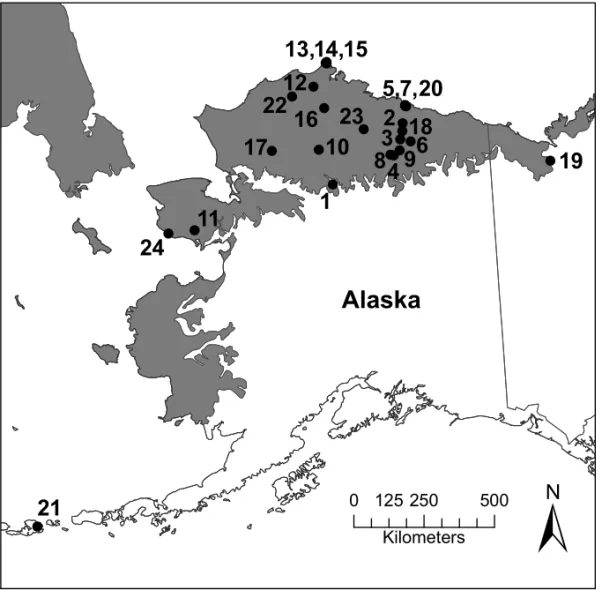
The geographic scope of the AVA-AK is mainly the Arc-tic portion of Alaska, although the archive also contains a few boreal plots and a dataset from Canoe and Trout lakes in far northwestern Canada (Fig. 1). Early vegeta-tion reconnaissance surveys in Arctic Alaska were con-ducted during the exploration of Naval Petroleum Re-serve No. 4 and early surveys of reindeer ranges in the 1950s. More focused vegetation surveys began with the International Biological Program (IBP) Tundra Biome research starting in the late 1960s. These and later surveys were aimed at an ecological understanding of the controls of tundra vegetation spatial and temporal patterns. Nu-merous vegetation surveys in the 1980s up to the present were done in conjunction with a wide variety of regional landcover mapping and process-level studies. A brief overview of the history and current contents of the AVA-AK are in Supplement S1 with key references. A list of the current datasets in the AVA-AK is in Table S1-1, along with a summary of the available ancillary data and the current status of each record.
*,9''DWDEDVH,'1$86 /DVWXSGDWH
$ODVND$UFWLF9HJHWDWLRQ$UFKLYH :HEDGGUHVVKWWSJHRERWDQLFDOSRUWDOJLQDDODVNDHGXSORWDUFKLYH
'DWDEDVHPDQDJHUV$P\%UHHQDOEUHHQ#DODVNDHGX/LVD'UXFNHQPLOOHUOGGUXFNHQPLOOHU#DODVNDHGX-R]HI6LELNMR]HIVLELN#VDYEDVN 2ZQHU'RQDOG$:DONHU$P\/%UHHQ-R]HI6LELN/LVD'UXFNHQPLOOHUDQG0DUWKD.5D\QROGV
6FRSH7KH$ODVND$UFWLF9HJHWDWLRQ$UFKLYH$9$$.LVDUHJLRQDOGDWDEDVHWKDWLVSDUWRIWKHODUJHU$UFWLF9HJHWDWLRQ$UFKLYH7KHGDWDEDVH FRQWDLQVYHJHWDWLRQSORWVIURPKRPRJHQHRXVSODQWFRPPXQLWLHVZLWKWDEOHVRIFRYHURUFRYHUDEXQGDQFHVFRUHVIRUDOOVSHFLHVDQG
DFFRPSDQ\LQJHQYLURQPHQWDOVLWHGDWD'DWDDUHFROOHFWHGXVLQJ%UDXQ%ODQTXHW861DWLRQDO9HJHWDWLRQ&ODVVLILFDWLRQSURWRFROVRUFRPSDUDEOH PHWKRGV
$YDLODELOLW\IUHHRQOLQH 2QOLQHXSORDG\HV 2QOLQHVHDUFKQR
'DWDEDVHIRUPDWV785%29(* ([SRUWIRUPDWV785%29(*([FHO&69ILOH
3ORWW\SHVQRUPDOSORWVWLPHVHULHV 3ORWVL]HUDQJHPð
1RQRYHUODSSLQJSORWV (VWLPDWHRIH[LVWLQJSORWV &RPSOHWHQHVV 6WDWXVHPHUJLQJ 7RWDOQRRISORWREVHUYDWLRQV
1XPEHURIVRXUFHVELEOLRUHIHUHQFHVGDWDFROOHFWRUV 9DOLGWD[D
&RXQWULHV&$86
)RUPDWLRQV)RUHVW 7HUUHVWULDO1RQ)RUHVW$TXDWLF)UHVKZDWHU6HPL$TXDWLF)UHVKZDWHU7HUUHVWULDO $UFWLFDOSLQH
*XLOGVDOOYDVFXODUSODQWVEU\RSK\WHVWHUULFRORXVRUDTXDWLFOLFKHQVWHUULFRORXVRUDTXDWLF
(QYLURQPHQWDOGDWDDOWLWXGHVORSHDVSHFWVORSHLQFOLQDWLRQPLFURUHOLHIVRLOGHSWKVXUIDFHFRYHURWKHUWKDQSODQWV RSHQVRLOOLWWHUEDUHURFNHWFVRLOS+RWKHUVRLODWWULEXWHV
3HUIRUPDQFHPHDVXUHVFRYHUPHDVXUHPHQWVOLNHGLDPHWHURUKHLJKWRIWUHHVELRPDVV
*HRJUDSKLFORFDOLVDWLRQ*36FRRUGLQDWHVSUHFLVLRQPRUOHVVSRLQWFRRUGLQDWHVOHVVSUHFLVHWKDQ*36XSWRNPSROLWLFDOXQLWV RURQO\RQDFRDUVHUVFDOH!NP
6DPSOLQJSHULRGV±±±±±±±
Information as of 2016-17-05; further details and future updates available from http://www.givd.info/ID/NA-US-014
The AVA-AK Turboveg database
The AVA-AK uses a Turboveg v2 database management system to store, select, and export the plot data (Henne-kens & Schaminée 2001). The archive includes standard-ized species-cover and header data. The workflow for the database includes data gathering, digitization of data, georeferencing of plots, assembly of bibliographic mate-rials, import into Turboveg, and creation of metadata (Breen et al. 2014). Data are standardized for import into Turboveg according to a data dictionary (Supplement S2: Table S2-1). The header data include those required for all Turboveg datasets (plot coordinates, elevation, basic environmental data, and canopy structure information) and some recommended environmental data specific to the AVA-AK including habitat type (Supplement S2: Ta-ble S2-2).
The Pan-Arctic Species List (PASL, beta 1.1) (Ray-nolds et al. 2013) provides a uniform taxonomic frame-work for plant species names. The PASL is composed of the Pan Arctic Flora checklist for vascular plants (Elven 2011) and lists of accepted species names and synonyms for the Arctic lichens (Kristinsson et al. 2010), Arctic
mosses (Belland unpubl., provided in 2012), and a Russ-ian list of Arctic liverworts (Konstantinova & Bakalin 2009).
Forty-seven datasets containing approximately 5,300 plots were initially identified for possible inclusion in the database (Breen et al. 2014). This initial list was based largely on our personal knowledge of the literature and other known vegetation datasets in northern Alaska, sev-eral of which are unpublished. Sevsev-eral other potential datasets were identified later. After closer evaluation, some of the datasets were excluded from the Turboveg database for various reasons, including: (1) poor quality of the taxonomic information; (2) use of sampling meth-ods that did not result in complete species lists from ho-mogenous areas of tundra; (3) species cover values were available only in summary form for vegetation types and did not include data from individual plots; and (4) the original data were unavailable because they were consid-ered proprietary information. In some cases, datasets were included in the AVA-AK but with notes regarding the quality of the data that could limit future applica-tions. For example, some datasets were of historic value but had no photographs of the plots or specific location
Fig. 1. Locations of the 24 datasets currently in the Turboveg AVA-AK database. The shaded area is the region of Arctic tun-dra. Names and authors of the datasets are in Supplement S1: Table S1-1.
!
! ! !
!
! !
!! !
!
! !!!
!
!
!
! !
!
!
!
!
1
2
3
4
5,
6
7,
8 9
10
11
12
13,14, 15
16
Alaska
±
0 125250 500
Kilometers
17
18
19
20
21
22
23
information. Some datasets had good information for vascular plants, but weak or no information for crypto-gams. Datasets that were not included in the AVA-AK Turboveg database were still referenced and described in a “Catalog” record of the Alaska Arctic Geoecological Atlas (see below).
The AVA-AK Turboveg database currently contains 24 datasets (3,026 plots) (Fig. 1 and Supplement S2). An-other 13 datasets, containing approximately 1,000 plots are in the process of review and data entry. The data are also being entered into the VegBank database (http://veg-bank.org), which is the main vegetation-plot archive for the U.S. (Peet et al. 2012). Vegetation metadata standards follow those of the Global Index of Vegetation-Plot Da-tabases (GIVD) (Dengler et al. 2011) and standards de-veloped for the Oak Ridge National Laboratory Distri-buted Active Archive Center, which is the archive of the National Aeronautics and Space Administration’s Arctic Boreal Vulnerability Experiment (http://above.nasa.gov), which funded the AVA-AK. The 3,024 AVA-AK plots are also included in sPlot, a global vegetation-plot data-base with standardised plant nomenclature and header data (Dengler & the sPlot Core Team 2014).
A web-based approach for viewing and accessing the plot data
The Turboveg database is a free and publically-accessible through a web-based portal, the Alaska Arctic Geoeco-logical Atlas (AGA-AK, http://alaskaaga.gina.alaska. edu) housed at the Geographic Information Network of Alaska (GINA), University of Alaska Fairbanks. Each dataset has a “Catalog” record, where a detailed descrip-tion of the dataset can be found along with links to a va-riety of available data and information, including: (1) The main Turboveg file containing all the species data for all the datasets; (2) a link to the Turboveg software; (3) raw source data, which are stored in their original form as .csv files; and (4) available ancillary data. Ancillary data can include any of the following: original species and envi-ronmental data before they were standardized for the Turboveg database, key publications and data reports, maps of plot locations, plot photographs, vegetation structure information, soil and environmental site fac-tors, aboveground phytomass, and ground-based spec-tral information (e.g. hand-held spectroscopy, Normal-ized Difference Vegetation Index (NDVI), and leaf-area-index (LAI) measurements).
Preliminary cluster analysis
We performed a preliminary cluster analysis to character-ize the contents of the AVA-AK up until June 2015. The purpose of the analysis was to determine if a numerical
anlaysis would result in meaningful clusters that would prove useful for characterization of the contents of the archive and for vegetation classification and analysis. These datasets included 1,603 plots within 16 broad habi-tat types (Supplement S2: Table S2-1, Accession numbers 1 to 16), representing 16 high quality datasets from most habitat types along two long north-south bioclimate transects from the Beaufort Sea to the Brooks Range on the eastern transect and from Barrow to the Seward Pen-insula on the western transect. See Supplement S3 for de-tails of the cluster analysis.
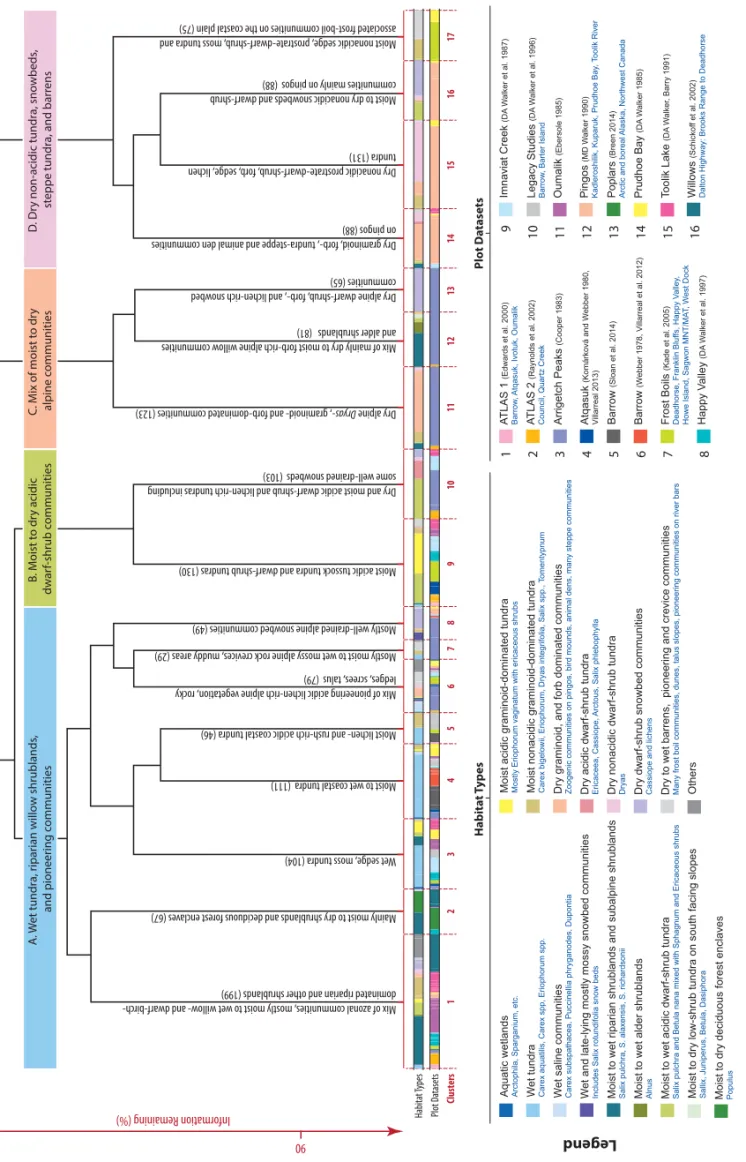
The peak separability of clusters in the diagram, using the crispness of classification method (Botta-Dukát et al. 2005) within the JUICE program (Tichý et al. 2011), was achieved with four clusters as shown by the top color bar in Fig. 2. At this level, the clusters are heterogeneous, but show sensible ecological organization. Cluster A is the largest and most heterogeneous cluster with 684 relevés, containing many azonal communities, including most wetlands, riparian shrublands, deep late-melting snowbeds, and pioneering communities along streams, rock crevices, and talus slopes. Cluster B contains 233 re-levés, mostly moist to dry acidic ericaceous heath
com-munities, including tussock tundra dominated by
Erio-phorum vaginatum. Cluster C contains 269 relevés, the bulk of which are from the communities in the one large alpine dataset from the Arrigetch Peaks region in the Brooks Range with many dry-graminoid- and forb-dom-inated communities, and drier dwarf-shrub snowbeds
dominated by Cassiope tetragona and lichens. Cluster D
contains 382 relevés, most of which are from dry non-acidic tundra and tundra steppe communities on south-facing slopes of pingos and which contain high numbers of Beringian species. Pingos are large ice-cored dome-shaped mounds, sometimes with heights exceeding 20 meters, which are important landscape components of the thaw-lake plains of northern Alaska (Walker 1990). There is a clear break at the highest level in the dendrogram be-tween communities on mainly wet to moist acidic sub-strates of clusters A and B and the mainly moist to dry nonacidic substrates of clusters C and D.
The next highest level of separation power was achieved with 17 subclusters that reflect geographical or ecological affiliation of groups of plant communities (Fig. 2, labels on the branches of the dendrogram). Table S3-1 in Supplement S3 contains lists of the diagnostic, con-stant and dominant taxa within each of the 17 subclusters that were used to further characterize the four main clus-ters. Several subclusters are nearly entirely composed of plots from one of two large datasets. Subclusters 11, 12, and 13 are almost entirely from the Arrigetch Peaks data-set (Cooper 1986), and subclusters 14, 15, and 16 are nearly totally from the Pingos dataset (Walker 1990).
phytosociologi-Fig. 2.
Cluster analysis of the first 16 dataset (1,568 plots) entered into the AVA-AK (accession numbers 1 to 16 in Fig. 1 and Table
1). The color bars across the top
sum-marize the broad groups of habitat types included in the four clusters that had highest separability in the analysis. The color
bars at the bottom show the distribution of
habitat types and datasets within each of the 17 subclusters that showed the next highest level of separability. See Supplement
S3 for details of the cluster analysis and
brief description of the included datasets.
T
oolik Lake
(DA
W
alker
, Barry 1991)
Pingos
(MD W
alker 1990)
Kadleroshilik, Kuparuk, Prudhoe Bay
,
T
oolik River
Willows
(Schickof
f et al. 2002)
Dalton Highway: Brooks Range to Deadhorse
Frost Boils
(Kade et al. 2005)
Deadhorse, Franklin Bluf
fs, Happy V
alley
,
Howe Island, Sagwon MNT/MA
T
, W
est Dock
A
TLAS 2
(Raynolds et al. 2002)
Council, Quartz Creek Arrigetch Peaks
(Cooper 1983)
Happy V
alley
(DA
W
alker et al. 1997)
Prudhoe Bay (DA W alker 1985) Barrow (W
ebber 1978, V
illarreal et al. 2012)
Oumalik
(Ebersole 1985)
Barrow
(Sloan et al. 2014)
A
TLAS 1
(Edwards et al. 2000)
Barrow
,
Atqasuk, Ivotuk, Oumalik
Imnaviat Creek
(DA
W
alker et al. 1987)
Poplars
(Breen 2014)
Arctic and boreal
Alaska, Northwest Canada
Atqasuk
(Komárková and W
ebber 1980, V illarreal 2013) Legacy Studies (DA W
alker et al. 1996)
Barrow
, Barter Island
Plot Da tasets Habita t T ypes Plot Da tasets Clust ers 100 90
Information Remaining (%)
Aquatic wetlands Arctophila, Sparganium, etc. W Wet and late-lying mostly mossy snowbed communities Includes Salix rotundifolia snow beds Moist to wet acidic dwarf-shrub tundra Salix pulchra and Betula nana mixed with Sphagnum and Ericaceous shrubs Moist to dry low-shrub tundra on south facing slopes Sallix, Juniperus, Betula, Dasiphora
et tundra
Carex aquatilis, Carex spp, Eriophorum spp. Wet saline communities Carex subspathacea, Puccinellia phryganodes, Dupontia Moist to wet riparian shrublands and subalpine shrublands Salix pulchra, S. alaxensis, S. richardsonii Moist to wet alder shrublands Alnus Moist to dry deciduous forest enclaves Populus
Moist acidic graminoid-dominated tundra Mostly Eriophorum vaginatum with ericaceous shrubs Dry acidic dwarf-shrub tundra Ericaceea, Cassiope,
Arctous, Salix phlebophylla
Dry to wet barrens, pioneering and crevice communities Many frost boil communities, dunes, talus slopes, pioneering communities on river bars Others Moist nonacidic graminoid-dominated tundra Carex bigelowii, Eriophorum, Dryas integrifolia, Salix spp.,
T
omentypnum
Dry nonacidic dwarf-shrub tundra Dryas Dry dwarf-shrub snowbed communities Cassiope and lichens
Dry graminoid, and forb dominated communities Zoogenic communities on pingos, bird mounds, animal dens, many steppe communities
Habita t T ypes Legend 12 3 4 5 6 7 8 9 10 11 12 13 14 15 16 17 A. W
et tundra, riparian willo
w shrublands
,
and pioneering c
ommunities B . M oist t o dr y acidic dwar f-shrub c ommunities C. M
ix of moist t
o dr y alpine c ommunities D . Dr
y non-acidic tundra, sno
wbeds
,
st
eppe tundra, and barr
ens
Mix of azonal c ommunities, mostly moist t
o wet willo w- and dwar
f-birch-dominated riparian and other shrublands (199) Mainly moist to dr y shrublands and deciduous forest encla
ves (67)
Wet sedge , moss tundra (104)
Moist to w et coastal tundr a (111)
Moist lichen- and rush-rich acidic coastal tundr a (46)
Mix of pioneering acidic lichen-rich alpine vegeta tion, rocky
ledges, scr ees, talus (79)
Mostly moist to w et mossy alpine rock cr
evices , muddy areas (29)
Mostly well-drained alpine sno wbed communities (49)
Moist acidic tussock tundra and dw arf-shrub tundr as (130)
Dry and moist acidic dw arf-shrub and lichen-rich tundr
as including
some well-drained sno wbeds (103)
Dry alpine Drya s-, graminoid- and forb -domina
ted c ommunities (123)
Mix of mainly dry t o moist forb-rich alpine willo w communities
and alder shrublands (81)
Dry alpine dw arf-shrub , forb-, and lichen-rich sno wbed
communities (65) Dry gr aminoid, forb -, tundra-st eppe and animal den communities
on pingos (88) Dry nonacidic pr ostrat
e-dw arf-shrub , forb, sedge , lichen
tundra (131) Moist to dr y nonacidic snowbeds and dw
arf-shrub
communities mainly on pingos (88) Moist nonacidic sedge, pr
ostrat e-dw arf-shrub , moss tundra and
associated fr ost-boil communities on the c oastal plain (75)
9 10 11 12 13 14 15 16
cal classes or alliances, as well as geographical or ecologi-cal affiliation of individual plant communities (Cluster A. – azonal as well as pioneer communities affected by spe-cific environmental condition such as water gradient or disturbance regime; B. – Boreal heathland communities; C. – Alpine communities, D. – Graminoid tundra and dwarf-shrub vegetation including various vegetation types from pingos. There are some artifacts/errors of spa-tial autocorrelation in our analysis where some plots from small regions representing different communities seem to be more similar than the same units from remote areas. The dominance of plots from the large Arrigetch Peaks (439 plots) and Pingos (293 plots) datasets in six of 17 subclusters of the preliminary cluster analysis indi-cates that these two datasets sampled much of the total habitat diversity at the drier end of the ecological gradi-ents. These relatively large datasets also resulted in some spatial autocorrelation that resulted in the close cluster-ing of most of these plots in a few large clusters at the highest level of the dendrogram.
Evaluation
The Alaska Arctic Vegetation Archive (AVA-AK) consti-tutes a major step toward consolidating existing plot data from Arctic Alaska into a single database with consistent species names that can be used for future classification and analysis of Arctic vegetation. A major strength of the AVA-AK is its web-portal, which makes the information easily accessible to users. The “Catalog” function of the portal links the species information in the Turboveg files to a wide variety of ancillary information for analyses. Several of the datasets are linked to field-based geoeco-logical maps and remote-sensing land-cover maps in the Alaska Arctic Map Archive (AMA-AK).
Data gaps
Despite the importance of vegetation for studies of Arc-tic ecosystem change, the vegetation of large areas of Arctic Alaska remains unsurveyed. Only a few areas have been intensively sampled and mapped, mainly in the vi-cinity of permanent Arctic observatories, such as Barrow and the Toolik Research Station. Major data gaps occur in the sand region west of the Colville River, nearly all of the Arctic Foothills, the central and eastern Brooks Range, the west coast of Arctic Alaska, including Bering-ian, and species-rich habitats of the Seward Peninsula and the Yukon-Kuskokwim River delta. More data are needed from under-sampled habitat types, such as coastal salt marshes, sand dunes, aquatic communities, and the large variety of bedrock types and alpine habitats in the Brooks Range and Arctic Foothills.
Need for a more consistent approach to tundra vegetation surveys
The assembly and review of the AVA-AK revealed the need for a more consistent approach to survey Arctic vegetation so as to better support description and classi-fication of Arctic vegetation. Although considerable amounts of vegetation data have been collected for vari-ous projects, much of the available information was pro-ject specific and was based on sampling protocols that are difficult to compare across sites. The older historical datasets were collected prior to the advent of the network of Global Positioning System (GPS) satellites and do not have accurate location information or permanently marked plots, thereby making it impossible to accurately resample these sites or link them to satellite-based obser-vations. Some had questionable taxonomic determina-tions that were not supported by voucher collecdetermina-tions, particularly for the cryptogam species, which limits the extrapolation potential of spatial distribution models that use these data. These and other inconsistencies across datasets point to the need for international standards for Arctic vegetation data collection (Walker et al. 2016). This problem is also recognized globally (De Cáceres et al. 2015).
Urgency of archiving legacy data sets
Assembly of the information for the archive pointed to the urgency to continue this work. Nearly every dataset required close communication with the author(s) to in-sure the accuracy of the information and that everything retrievable is archived, including field photos, maps, and information that may not have been in published reports. The retirement or death of the author(s) often meant loss of the original data and/or critical metadata information. For example, Vera Komárková collected a potentially major data set containing over 700 plots using Braun-Blanquet protocols in the sand region of northern Alaska (Komárková & McKendrick 1988), but the dataset could not be recovered because of her premature death in 2005 before the data could be processed and published.
Conclusions
next step will be a full analysis of all the available datasets from Arctic Alaska. We expect this will be an iterative process as we link to Arctic vegetation archives from other parts of the Arctic.
The protocols developed for the AVA-AK could be applied elsewhere in the Arctic toward the goal of a pan-arctic vegetation database. Efforts are currently under-way to apply the approach in Canada (MacKenzie 2014), Greenland (Bültmann & Daniëls 2013) and to the Yamal Peninsula region of northwestern Russia (Ermokhina 2013). Application to the entire circumpolar region will require consensus approval of the approach with appro-priate modification by the international community of Arctic vegetation scientists. The vision for an eventual panarctic AVA is that we will move to Turboveg v3 (Hen-nekens 2014), and model the AVA after the European Vegetation Archive (EVA) (Chytrý et al. 2016). This would allow several independent national databases to be stored in the archive.
Author contributions
M.D.W. & D.A.W. conceived the database. D.A.W., A.L.B., L.A.D.& J.S. created the database and wrote the manuscript. J.P. prepared the figures and edited the report. S.H. provided advice and help with the Turboveg database. J.S. conducted the cluster analysis. H.E.E. and M.B. provided remote-sens-ing and biomass ancillary datasets and organized these data. M.K.R., A.L.B, S.H. and several other coauthros developed the Pan Arctic Species List. L.W.W., W.F., M.B. & J.P. were principally responsible for the web portal and system sup-port; R.K.P. & M.T.L. provided guidance for transferal of data to VegBank and overall database guidance. F.J.A.D. & H.B. provided help with Braun-Blanquet classification and conceptual framework for the study. D.A.W., A.L.B., M.K.R., M.B., M.D.W., K.B., T.B., D.J.C., S.J.D., J.J.E., H.E.E., S.C.E. W.A.G., R.D.H., C.M.I., M.T.J., A.K., W.H.M., U.S., V.L.S., S.S.T., S.V., P.J.W., and D.Z. provided datasets.
Acknowledgments
Funding for the AVA-AK came from the NASA Arctic-Boreal Vulnerability Experiment (ABoVE) initiative (Grant No. NNX13AM20G). The project was conceived and en-dorsed by the Flora Working Group of the Conservation of Arctic Flora and Fauna (CAFF), the biodiversity working group of the Arctic Council. Other funding came from the NASA Land Cover and Land-Use Change program (Award No. NNX14AD0G) and the NSF Arctic Science Engineer-ing and Education for Sustainability (ArcSEES) inititiative (Award No. 1233854).
References
Botta-Dukát, Z., Chytrý, M. & Hájková, P. 2005. Vegetation of lowland wet meadows along a climatic contenentality
gradi-ent in Cgradi-entral Europe. Preslia 77: 89–111.
Breen, A.L., Druckenmiller, L., Hennekens, S.M., Raynolds, M.K., Walker, M.D. & Walker, D.A. 2014. Progress toward an Alaska prototype for the Arctic Vegetation Archive:
Workflow and data dictionary. CAFF Proceeding Series
Re-port 11: 7–21.
Bültmann, H. & Daniëls, F.J.A. 2013. Greenland data stored in
the Arctic Vegetation Archive (AVA) in Münster. CAFF
Pro-ceedings Series Report 10: 29–32.
Chytrý, M., Hennekens, S.M., Jíménez-Alfaro, B., Knollová, I., Dengler, J., Jansen, F., Landucci, F., Schaminée, J.H.J., Aćić, S., (…) & Yamalov, S. 2016. European Vegetation Archive (EVA): an integrated database of European vegetation plots.
Applied Vegetation Science 19: 173–180.
Cooper, D.J. (1986) Arctic-alpine tundra vegetation of the
Ar-rigetch Creek Valley, Brooks Range, Alaska.
Phytocoenolo-gia, 14: 467–555.
De Cáceres, M., Chytrý, M., Agrillo, E., Attorre, F., Botta-Dukát, Z., Capelo, J., Czúcz, B., Dengler, J., Ewald, J., (…) & Wiser, S. K. 2015. A comparative framework for
broad-scale plot-based vegetation classification. Applied Vegetation
Science, 18: 543–560.
Dengler, J. & the sPlot Core Team. 2014. sPlot: the first global vegetation-plot database and opportunities to contribute.
IAVS Bulletin 2014(2): 34−36.
Dengler, J., Jansen, F., Glöckler, F., Peet, R.K., De Cáceres, M., Chytrý, M., Ewald, J., Oldeland, J., Lopez-Gonzalez, G., (…) & Spencer, N. 2011. The Global Index of Vegetation-Plot Databases (GIVD): a new resource for vegetation
sci-ence. Journal of Vegetation Science 22: 582–597.
Elven, R. 2011. Annotated checklist of the panarctic flora (PAF):
vascular plants. National Centre of Biosystematics, Natural
History Museum, University of Oslo, Oslo, NO.
Ermokhina, K. 2013. Yamal and Gydan vegetation datasets.
Arctic Vegetation Archive CAFF Proceedings Series Report
10: 40–44.
Hennekens, S.M. & Schaminée, J.H.J. 2001. TURBOVEG, a comprehensive data base management system for vegetation
data. Journal of Vegetation Science 12: 589–591.
Hennekens, S. 2014. Turboveg v3: a gateway to vegetation
plot data. URL: http://www.botanik.uni-greifswald.de/
fileadmin/workshop/2014/TV3_Koblenz_Feb_2014.pdf [accessed 14 May 2016].
Komárková, V. & McKendrick, J.D. 1988. Patterns in vascular plant growth forms in arctic communities and environment at Atkasook, Alaska. In: Werger, M.J.A., van der Aart, P.J.M.
During, H.J. & Verhoeven, J.T.A. (eds.) Plant form and
ve-getation structure, pp. 45−70. SPB Academic Publishing, The
Hague, NL.
Konstantinova, N.A. & Bakalin, V.A. 2009. Checklist of
liver-worts (Marchantiophyta) of Russia. Arctoa 18: 1−64.
Kristinsson, H., Steen Hansen, E. & Zhurbenko, M.P. 2010.
Panarctic lichen checklist. CAFF Technical Report 20: 1−120.
MacKenzie, W.H. 2014. The Canadian Arctic Vegetation Ar-chive (CAVA) and a preliminary classification of Canadian
arctic vegetation. CAFF Proceedings Series Report 11: 56−59.
Peet, R.K., Lee, M.T., Jennings, M.D. & Faber-Langendoen, D. 2012. VegBank – a permanent, open-access archive for
vege-tation-plot data. Biodiversity and Ecology 4: 233–241.
Hennekens, S.M. 2013. The Pan-Arctic Species List (PASL).
CAFF Proceedings Series Report 10: 92−95.
Tichý, L., Holt, J. & Nejezchlebová, M. 2011. JUICE program
for management, analysis and classification of ecological data
(2nd edition). Vegetation Science Group, Masaryk University,
Brno, CZ. URL: http://www.sci.muni.cz/botany/juice/ JCman2011_1st.pdf.
Walker, D.A. 2014a. Toward a pan Arctic vegetation archive
and classification: Two recent workshops. IAVS Bulletin
2014(1): 12–16.
Walker, D.A. (ed.) 2014b. Alaska Arctic Vegetation Archive
(AVA) Workshop, Boulder, Colorado, USA, October 14-16,
2013. Conservation of Arctic Flora and Fauna (CAFF)
[CAFF Proceedings Report no. 11], Akureyri, IS.
Walker, D.A. & Raynolds, M.K. 2011. An International Arctic Vegetation Database: a foundation for panarctic biodiversity
studies. CAFF Strategy Series Report 5: 1−28.
Walker, D.A., Breen, A.L., Raynolds, M.K. & Walker, M.D.
(eds.) 2013a. Arctic Vegetation Archive Workshop, Krakow,
Poland, April 14-16, 2013 . Conservation of Arctic Flora and
Fauna (CAFF) [CAFF Proceedings Report no. 10], Akureyri, IS.
Walker, D.A., Alsos, I.G., Bay, C., Boulanger-Lapointe, N., Breen, A.L., Bültmann, H., Christiansen, T., Damgaard, C., Daniëls, F.J.A., (…) & Wisz, M.S. 2013b. Rescuing valuable Arctic vegetation data for biodiversity models, ecosystem
models and a panarctic vegetation classification. Arctic 66:
133–137.
Walker, D.A., Daniëls, F.J.A., Alsos, I., Bhatt, U.S., Breen, A.L., Buchhorn, M., Bültmann, H., Druckenmiller, L.A., Ed-wards, M.E., (…) & Webber, P.J. 2016. Circumpolar Arctic vegetation: A hierarchic review and roadmap toward an in-ternationally consistent approach to survey, archive and
clas-sify tundra plot data. Environmental Research Letters 11:
Article 055005.
Walker, M.D. 1990. Vegetation and floristics of pingos, Central
Arctic Coastal Plain, Alaska. Dissertationes Botanicae 149:
1−283.
Author addresses
Donald A. Walker (Corresponding author: [email protected])1, Amy L. Breen ([email protected])1,2, Lisa A.
Drucken-miller ([email protected])1, Lisa W. Wirth ([email protected])3, Will Fisher ([email protected])3, Martha K. Raynolds
([email protected])1, Jozef Šibík ([email protected])4, Marilyn D. Walker ([email protected])5, Stephan
Hennekens ([email protected])6, Keith Boggs ([email protected])7, Tina Boucher ([email protected])7,
Marcel Buchhorn ([email protected])1,8, Helga Bültmann ([email protected])9, David J. Cooper (David.
[email protected])10, Fred J.A Daniëls ([email protected])9, Scott J. Davidson ([email protected])11,
James J. Ebersole ([email protected])12, Sara C. Elmendorf ([email protected])13, Howard E. Epstein
([email protected])14, William A. Gould ([email protected])15, Robert D. Hollister ([email protected])16, Colleen M. Iversen17,
M.Torre Jorgenson ([email protected])18, Anja Kade ([email protected])1, Michael T. Lee ([email protected])19,
William H. MacKenzie ([email protected])20, Robert K. Peet ([email protected])19, Jana L. Peirce ([email protected])1,
Udo Schickhoff ([email protected])21, Victoria L. Sloan ([email protected])22, Stephen S. Talbot (stephen_
[email protected])23, Craig E. Tweedie ([email protected])23, Sandra Villarreal ([email protected])23, Patrick J. Webber
([email protected])24, Donatella Zona ([email protected])11,25
1 Alaska Geobotany Center, Institute of Arctic Biology, University of Alaska Fairbanks, Fairbanks, AK, 99775, United States
2 International Arctic Research Center, University of Alaska, Fairbanks, AK, 99775, United States
3 Geographic Information Network of Alaska, Geophysical Institute, University of Alaska Fairbanks, Fairbanks, AK, 99775,
United States
4 Institute of Botany, Department of Geobotany, Slovak Academy of Sciences, Dúbravská cesta 9, 845 23, Bratislava, Slovak
Republic
5 HOMER Energy, 1790 30th St. Boulder, CO, 80301, United States
6 Alterra, Wageningen, Box 47, 6700 PB, The Netherlands
7 Alaska Natural Heritage Program, Alaska Center for Conservation Science, University of Alaska Anchorage, 3211 Providence
Drive, Anchorage, Alaska 99508, United States
8 HyLab, Geophysical Institute, University of Alaska Fairbanks, Fairbanks, AK, 99775, United States
9 Institute for Plant Ecology, University of Münster, Schlossplatz 8, 48143 Münster, Germany
10 Department of Forest and Rangeland Stewardship, Colorado State University, Fort Collins, CO, United States
11 Department of Animal and Plant Sciences, University of Sheffield, Western Bank, south Yorkshire, S10 2TN, United Kingdom
12 Biology Department, Colorado College, Colorado Springs, CO, 80903, United States;
13 NEON, Inc., 1685 38th St, Boulder, CO, 80301, United States
14 Department of Environmental Sciences, University of Virginia, Charlottesville, VA, 22904, United States
15 US Forest Service, International Institute of Tropical Forestry, Jardin Botanico Sur, Rio Piedras, Puerto Rico, 00926, United
States
16 Department of Biology, Grand Valley State University, Alendale, MI, 49401, United States
17 Environmental Science Division, Oak Ridge National Laboratory, Oak Ridge TN, 37831, United States
18 Alaska Ecoscience, 2332 Cordes Way, Fairbanks, AK, 99709, United States
19 Department of Biology, University of North Carolina, Chapel Hill, NC, 27599-3280, United States
20 B.C. Ministry of Forests, Lands and Natural Resources, Bag 6000, Smithers, B.C. VOJ 2NO, Canada
22 Faculty of Engineering, Queens Building, University Walker, Clifton, BS8 1TR, United Kingdom
23 US Fish and Wildlife Service, 1011 E. Tudor Road, Anchorage, AK, 99503, United States
24 Systems Ecology Lab, Department of Biological Sciences, University of Texas El Paso, TX, 79902, United States
25 Department of Plant Biology (Emeritus), Michigan State University, Ann Arbor, MI, 48824, United States
25 Department of Biology, San Diego State University, San Diego, CA, 92182, United States
Electronic Supplements
Supplementary material associated with this article is embedded in the pdf of this article. The online version of Phytocoenologia is hosted at www.ingentaconnect.com/content/schweiz/phyt and the journal’s website http://www.schweizerbart.com/journals/ phyto. The publisher does not bear any liability for the lack of usability or correctness of supplementary material.
Supplement S1: Data dictionary for the AVA-AK.
Supplement S2: Overview of vegetation surveys in Arctic Alaska and contents of the AVA-AK.
Supplement S3: Cluster analysis of the first 16 datasets in the Alaska Arctic Vegetation Archive (AVA-AK).