YOUNG WOMEN’S RESPONSES TO NARRATIVE AND PICTORIAL MESSAGES ABOUT INDOOR TANNING: A QUALITATIVE STUDY
Stephanie S. Lane
A thesis submitted to the faculty at the University of North Carolina at Chapel Hill in partial fulfillment of the requirements for the degree of Master of Arts in the School of Journalism and
Mass Communication (Interdisciplinary Health Communication).
Chapel Hill 2015
Approved by: Seth M. Noar Joan R. Cates Deborah K. Mayer
ABSTRACT
Stephanie S. Lane: Young Women’s Responses to Narrative and Pictorial Messages about Indoor Tanning: A Qualitative Study
(Under the direction of Seth M. Noar)
This study examined perceptions of indoor tanning behavior and anti-tanning messaging among college-aged women in order to better understand what types of messages and message elements might be effective in persuading young women to not tan indoors.
Two focus groups were conducted with participants who tan indoors either currently or who have tanned indoors in the past. Participants discussed benefits and harms of tanning indoors, and the relative effectiveness of several narrative and non-narrative anti-tanning messages.
The results of this study suggest that young women believe there to be significant benefits and harms from tanning indoors. Results also point to several strategies for future anti-tanning message design, including the importance of presenting a threat that is perceived as both real and highly possible for individuals who tan indoors, using key informants who have
personal experiences with indoor tanning and its harmful outcomes, and with whom target audiences can identify.
ACKNOWLEDGEMENTS
I would like to thank Dr. Seth M. Noar, my committee chair and program advisor, for his support and guidance through every step of this project. This project would not have been possible without his invaluable guidance on decisions in the research process, his willingness to read and offer thorough feedback on drafts and ideas, and his passion and expertise in this area of health communication. I would also like to thank my committee members, Dr. Joan Cates and Dr. Deborah K. Mayer, for their subject and research expertise, their feedback throughout this research, and their overall support of this area of study.
I would like to thank Jennah Sontag, whose assistance in researching and designing test messages and coding study results allowed this study to happen effectively and within the project’s timeline.
Lastly, I would like to thank the Roy H. Park Fellows Program at the School of
Journalism and Mass Communication at the University of North Carolina at Chapel Hill, which provided the funds for compensation and other funds necessary to complete this study.
TABLE OF CONTENTS
I. LIST OF TABLES..……….. vii
II. LIST OF FIGURES….………..…. viii
III. INTRODUCTION…….………... 1
IV. BACKGROUND……...…...……… 2
V. LITERATURE REVIEW…...………….….………...….. 4
VI. RESEARCH QUESTIONS..……...……….………..……… 15
VII. METHODS….………...………....… 15
VIII. FINDINGS……...…………..………... 20
IX. DISCUSSION…………..………...……...….… 43
X. LIMITATIONS AND SUGGESTIONS FOR FUTURE RESEARCH………...… 46
XI. APPENDIX A: RECRUITMENT MATERIALS………….….….………..….…… 50
XII. APPENDIX B: PARTICIPANT SCREENER………….…..………..….…… 52
XIII. APPENDIX C: FOCUS GROUP PROTOCOL……...………..….…… 54
XIV. APPENDIX D: FOCUS GROUP CONSENT FORM …...………..….….… 55
XV. APPENDIX E: FOCUS GROUP PARTICIPANT QUESTIONNAIRE………...….…… 58
XVII. APPENDIX G: TEST MESSAGES………..………...………….…..….…… 64 XVIII. REFERENCES……...………...………...…….… 67
LIST OF TABLES
LIST OF FIGURES
Introduction
Research has suggested that greatly decreasing use of indoor tanning devices will prevent future skin cancers, and reports a need for a comprehensive, multilevel approach. This approach should include implementing age restrictions for indoor tanning devices, limiting the amount of time individuals are allowed to use indoor tanning devices, among other regulations that limit the indoor tanning industry. Communication and health education campaigns are also urgently needed (Holman et al., 2013). This multi-faceted approach should coordinate efforts across local, state and national levels to most effectively reduce use indoor tanning devices (Holman et al., 2013). Studies state the need for targeted and tailored interventions as well as large-scale collaborative efforts that seek to reduce indoor tanning at the national, state, and local levels. A long-term goal is to gradually shift social norms, reduce indoor tanning behavior, and prevent future cases of skin cancer (Holman et al., 2013).
Though there have already been some indoor tanning interventions targeted at college students, particularly females, there have been no interventions that primarily use graphic or pictorial images, and there is only a limited amount of research that examines reactions to fact-based versus narrative-fact-based messages. The research that does exist has found mixed results, and suggests that overall, statistical messages provide better overall information, but narrative
population. This research should test specific messages, as this information could be useful to campaign strategists and those who wish to create messages to persuade this population to stop tanning indoors (Noar et al., 2015).
The current study will use a focus group method to garner rich, qualitative data and responses in two areas. First, this study will explore indoor tanning motivations and deterrents in young women who have tanned indoors. Second, this study will test the strengths and
weaknesses of persuasive, pictorial, narrative and non-narrative messages intended to stop individuals from tanning indoors. Findings from this study will help guide message designers on future campaigns to convince young women to stop indoor tanning.
Background
Skin cancer is the most common form of cancer in the United States, with more than 3.5 million skin cancer cases diagnosed annually, and more than 76,000 melanomas that were diagnosed in 2014 alone (American Cancer Society, 2014). In 2015, nearly 10,000 people in the United States are expected to die from melanoma (American Cancer Society, 2015). While most types of cancer have decreased over the past decade, the rates of most types of skin cancer continue to rise, especially among teenagers and young adult women. The increase in skin cancer rates leads to unnecessary morbidity, mortality, and healthcare costs (Guy & Ekwueme, 2011).
year tanned regularly (Federal Trade Commission, 2010). Despite all of the evidence of its harms, indoor tanning remains a common practice, particularly among young, white female adolescents and young adults (CDC 2010; Eaton, Kann & Kinchen 2011; Albert & Ostheimer, 2003). Recent studies show that approximately 32% of white women aged 18-21 in the United States have gone indoor tanning in the past 12 months. In addition, the average individual in this group tanned 27 times per year (CDC, 2012).
Many cases of skin cancer are preventable, and reducing indoor tanning rates is an important public health goal that will help in decreasing skin cancer. Reducing indoor tanning can also reduce other health and appearance harms that are consequences of indoor tanning, such as wrinkles and leathery skin, burns, and eye damage (CDC, 2014).
Indoor tanning is more harmful than tanning in natural sunlight for multiple reasons. UV radiation emitted from tanning beds can have an even greater intensity level than the rays of the sun; there is usually a greater amount of exposed skin when individuals use indoor tanning devices; and lastly, indoor tanning exposes parts of the body to UV radiation that are not normally exposed to UV from the sun (Miller, Hamilton, Wester & Cyr, 1998).
widely and frequently cited as a public health problem and an issue of public and societal
concern. Factors that influence tanning behaviors are numerous, and range from individual-level factors to societal factors (Holman et al., 2013).
This study adds to the research literature and further explains why young women use indoor tanning devices, what motivates them to use these devices, and what may deter them from using indoor tanning devices. It will also look at what types of messages might be most effective in convincing young women to stop indoor tanning.
Literature Review
Indoor tanning fulfills a desire held by many fair skinned individuals in our society: to have tan skin. Having a tan first became fashionable in the United States in the late 1920s (Holman et al., 2013). Mass media was the first widespread promoter of the beauty of tan skin, and magazine articles and advertisements across the country promoted tanning as a way to enhance one’s appearance (Holman et al., 2013). In the same way that mass media has been, for nearly a century, used to promote tanned skin, it now has the potential to influence social norms for the better, by denormalizing indoor tanning and encouraging people to embrace their natural, untanned skin (Holman et al., 2013). This literature review will examine the literature on indoor tanning, specifically looking at literature dealing with why women use indoor tanning devices, as well as how communication can be used to reduce indoor tanning. This will include a discussion of graphic messaging and visual communication, as well as the use of narratives in health
Why Young Women Use Indoor Tanning Devices
Several studies have reviewed factors that influence indoor tanners or would-be tanners. Hillhouse’s review found that the most common reason cited for indoor tanning behavior is the belief that being tan is more attractive (Hillhouse & Turrisi, 2012). The second most common reason that individuals reported indoor tanning was for relaxation and stress relief. Other
commonly reported reasons individuals reported indoor tanning were favorable parental attitudes toward indoor tanning, the belief that having a tan looks healthy, and the belief that indoor tanning is safer and better than tanning in the sun (Hillhouse & Turrisi, 2012).
In Watson et al.’s study, the researchers reviewed several additional factors that may influence indoor tanning use (Watson et al., 2013). The study identified several individual factors that influence indoor tanning behaviors, along with interpersonal and societal factors, and
broader contextual factors. This suggests that indoor tanning is a complex behavior that is affected by influences at several levels.
Age and gender differences are some of the most basic determinants of indoor tanning: a previous study by the Centers for Disease Control and Prevention (CDC) found that indoor tanners were more likely to be women than men, and more likely to be younger rather than older adults (CDC, 2012). The most frequent indoor tanners were adult females aged 18-21 years (CDC, 2012). Among the adult population, indoor tanning is most common among younger adults aged 18-25 years, and becomes less common as people age.
female, Caucasian, and have unhealthy behaviors, such as frequent alcohol use, binge drinking, smoking, recreational drug use, a poor diet, and nonregular sunscreen use (Choi, Lazovich, Southwell, Forster, Rolnick & Jackson, 2010; Mosher & Danoff-Burg, 2010).
Indoor tanning is associated with self-esteem. Indoor tanners are likely to be appearance-oriented and view tanned skin as attractive (Choi et al. 2010). In essence, women use indoor tanning devices because they want to improve their appearance, and believe that this will also improve how they think about their own level of attractiveness. In addition, research has found that perceived social norms about indoor tanning and tan skin are associated with indoor tanning use by adolescents (Watson et al., 2013).
Finally, one study found that female adolescents who had college-educated mothers were less likely to tan than peers who did not (Demko, Borawski, Debanne, Stange & Cooper, 2003). This could be related to the finding mentioned above that indoor tanning behavior is related to favorable parental attitudes towards the behavior (Hillhouse & Turrisi, 2012). Research has shown that parental permission to tan and parental tanning bed use are strong predictors that teenagers will begin and continue indoor tanning (Watson et al., 2013).
How Can Communication Be Leveraged to Reduce Indoor Tanning?
study will focus mostly on the individual factors that affect indoor tanning such as an
individual’s desire to have tanned skin or an individual’s understanding of the consequences of indoor tanning, since we posit that these factors, rather than societal factors, can best inform messages targeted to young women.
There are key determinants at the individual level that inform how interventions could and perhaps should address tanning behavior. As one example, indoor tanning is associated with a desire for tanned skin and to better one’s physical appearance (Holman et al., 2013). These attitudes and beliefs are driven by perceptions of social norms that greatly value physical appearance, especially among females. Though research suggests that this is what needs to be changed in order to drastically reduce or stop the practice of indoor tanning, studies have acknowledged that work to change societal norms would require a coordination of efforts spanning several years or even decades (Noar et al., 2015). Changing young women’s perceptions of social norms could be more feasible, but would still require comprehensive strategies and efforts. Some studies suggest that, in order to make anti-tanning messages salient for indoor tanners, they should focus on appearance-related effects of indoor tanning, such as premature skin aging, and that these types of messages could have the potential to initiate long-term behavior change (Hillhouse et al., 2002; Hillhouse et al., 2008).
A 2014 study developed a comprehensive scale to assess indoor tanning outcome
al., 2014). The Comprehensive Indoor Tanning Expectations (CITE) Scale gives a reliable and valid assessment of the beliefs that influence indoor tanning behavior, both the beliefs that would motivate someone to engage in indoor tanning, as well as those that would deter someone from indoor tanning (Noar et al., 2014). This study found that, in most cases, there were significant differences observed between the groups of current tanners, former tanners, and non-tanners. The authors suggest that this indicates that former tanners no longer see the potential appearance and health benefits to indoor tanning, but that they do recognize both the appearance and health harms of tanning. These findings imply that an individual’s beliefs can change, and that these factors may be avenues by which to persuade current tanners to become former tanners (Noar et al., 2014). This gives hope to indoor tanning message designers that there are potential ways to create effective messaging that could be persuasive for current indoor tanners.
A second study that applied the CITE scale in an analysis of indoor tanning behavior among sorority women confirmed the existence of robust CITE positive and negative
expectations (Noar et al., 2015). The study suggested that, due to the deeply embedded cultural perceptions about the attractiveness of tan skin and how much time and effort is needed to change the underlying issue, a fruitful approach for campaign designers would be to focus messages on outcome expectations about indoor tanning. This study further suggested ways in which outcome expectations could be translated into messages- challenging indoor tanning positive expectations, enhancing negative expectations, and reducing temptations to tan indoors (Noar et al., 2015).
Graphic Messaging and Visual Persuasion
2006). Health communication research has shown that visual images can influence an
individual’s attention, how one recalls and understands health information, and an individual’s health behaviors (Houts, Doak, & Loscalzo, 2006). As one example, graphic pictorial warnings on cigarette packs have been shown to be more effective than text-only warnings for impacting a range of smoking cessation-related outcomes (Hammond, 2011; Noar et al., 2014).
Research has shown that images and graphics are especially relevant for messages around skin cancer, since the signs and symptoms of skin cancer, irregularities of the skin, are largely if not completely visual (Abbasi et al., 2004). In addition, the behavior of indoor tanning and exposing oneself to the ultraviolet light of tanning beds results in direct and visible alterations to the skin: individuals who use indoor tanning devices often return with tanned skin, burns, freckles, or some combination (McWhirter & Hoffman-Goetz, 2014). Research has found that images can positively impact knowledge, attitudes and behaviors related to UV exposure and protection (McWhirter & Hoffman-Goetz, 2013).
Visual persuasion references how an image persuades the viewer (Foss, 2005). Lester (2006) defined persuasion as the use of “factual information and emotional appeals to change a person’s mind and promote a desired behavior”. Visual persuasion has long played a significant role in the promotion of health-related attitudes and behaviors (McWhirter & Hoffman-Goetz, 2014).
will explore the effectiveness of persuasive visual communication, and will focus specifically on the visual element in testing indoor tanning messages and elements of messages. We will also consider elements of visual communication theory in the methodology and analysis in order to contribute to the visual health communication field.
McWhirter & Hoffman-Goetz found that, overall, individuals who were exposed to images of attractive, tan people had more positive attitudes towards tanning, increased tanning intentions and increased their attempts to suntan (McWhirter & Hoffman-Goetz, 2013). For many decades and continuing in the present, mass media imagery including advertising and celebrity culture often promoted tanned skin as the “ideal” (Gamble et al., 2011). Individuals who consume a substantial amount of media – which is increasing as media becomes even more accessible – are more likely to see these images of “ideal skin”, and to potentially be influenced to want and seek out ways to achieve tan skin for themselves. This phenomenon can be
skin and refrain from indoor tanning.
Narrative as a Tool in Health Communication Messaging
There is a growing body of research on the effectiveness of narrative messaging in health communication, and evidence-based indoor tanning interventions have already seen some
success using this method. Narrative has been defined as “a representation of connected events and characters that has an identifiable structure, is bounded in space and time, and contains implicit or explicit messages about the topic being addressed.” (Kreuter et al., 2007). Narrative communicates through stories and is a way in which people around the world are comfortable and familiar giving and receiving information. Narrative can make a message resonate more deeply with the target audience based on a number of factors, including: to what extent the message recipient identifies with the person delivering the message; to what extent the message recipient is “transported” into the message; the emotion a message evokes in the message
recipient; and, how effectively the message models or communicates the recommended behavior (Hinyard & Kreuter, 2007).
Studies show that stories are very much a cultural phenomenon, and that stories resonate with people. This is likely because of cultural identifications by the target audience that provide lessons with consequences in simple ways that engage and transport the recipient through a sense of identification (Larkey & Hecht, 2010). Any campaign that targets young women with anti-tanning messages should deeply understand the target audience’s culture and utilize key informants from the target audience’s culture. This will help individuals identify with and be persuaded by the message. This study will address the need for deeper insights into the culture of the target audience, college-aged females, including insights into their attitudes and
perceptions about indoor tanning.
Conclusion
Theoretical Perspectives
Although there were several relevant theories that apply to this area of research and practice, the present study was guided by the Extended Parallel Process Model (EPPM). The Extended Parallel Process Model is a helpful tool for understanding how to best construct effective risk messages that are grounded in fear appeals and scare tactics (Edgar & Volkman, 2012). If created correctly, messages that effectively communicate the risks of indoor tanning could be effective in persuading current tanners to stop indoor tanning. Also, such messages could inform future messages or campaigns that the Food and Drug Administration or Centers for Disease Control might implement.
Figure 1
other hand, if the individual decides that both the severity of the threat and their own
susceptibility to it are high enough that they feel threatened, that individual will engage in an efficacy appraisal, in which they evaluate two forms of efficacy. The first is self-efficacy, which focuses on that individual’s confidence in his or her ability to perform the recommended
behavior. The second is response efficacy, in which the individual asks whether the
recommended behavior will actually make a difference. The EPPM puts forth that a fear appeal will likely only be successful if both forms of efficacy appraisal are high (Edgar & Volkman, 2012). In the case of our subject matter, this means that individuals receiving messages about indoor tanning and risks around indoor tanning will only be persuasive if the individual is both confident that she can stop indoor tanning, and also believes that stopping indoor tanning will make a difference in protecting her health and/or appearance.
Research Questions
The current study sought to examine perceptions of indoor tanning behavior and anti-tanning messaging among college-aged women using focus group methodology. Focus groups were determined to be the best method in this study for two reasons. First, there is a lack of qualitative research in this area of study, and the present study will help fill this gap, providing in-depth and thematic data around perceptions of indoor tanning behavior. Second, because this study focused on message testing, and focus groups are an efficient way to glean in-depth information from a substantial number of participants, this was viewed as the most appropriate methodology to best answer the research questions and advance the body of work on effective anti-tanning messages.
The three research questions were as follows:
RQ1: What are the perceived benefits and potential harms that young women have about indoor tanning?
RQ1a: Are there differences between current and past indoor tanners? RQ2: What are young women’s reactions to anti-indoor tanning narrative messages versus simple, direct fact-based messages (both which include graphic images)?
RQ2a: Are there differences between current and past indoor tanners?
RQ3: What characteristics of anti-indoor tanning messages (e.g., graphic images, indoor tanning outcomes, “call to action”) do young women perceive as most effective?
RQ3a: Are there differences between current and past indoor tanners?
Methods
Recruitment
Council that governs the 10 National PanHellenic sororities at UNC to facilitate participant recruitment through sororities at UNC-Chapel Hill. Delegates from each sorority introduced the study to their sororities at their weekly chapter meetings, and provide interested students with the link to the online study screener. Flyers were also taken to sorority houses by delegates to post and give to interested students. Lastly, each delegate included an invitation to participate in the study in their weekly chapter email that was sent to all members of each sorority. The study announcement for the sorority delegates, a sample recruiting flyer, and a sample follow-up email are available in Appendix A.
The email and flyers invited participants to access a microsite created for the study, through which interested individuals filled out a brief questionnaire that included basic
demographic information and screening questions to determine eligibility for the study. Basic demographic information included: First name, age, and methods of contact (phone number and email address). In addition, individuals were asked to submit their availability for several possible times for focus groups. A copy of the screener can be found in Appendix B.
Confirmation emails were sent to participants the week prior and reminder text messages were sent the day of the group to each participant. Both reminders included the date, time and location of the participant’s scheduled group.
Participants
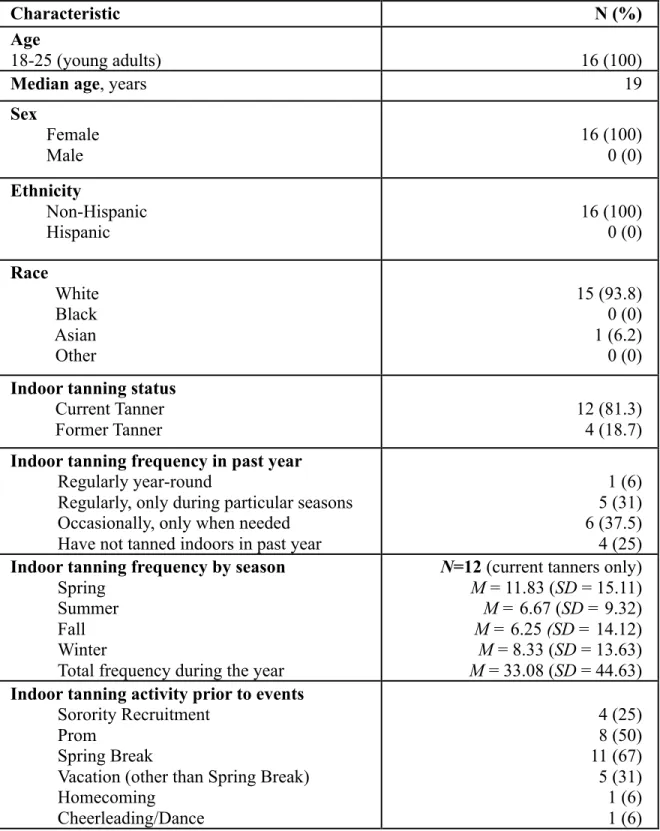
A total of 32 respondents completed the screening survey. Of the completed recruitment surveys, all respondents were deemed eligible to participate based on the predetermined criteria for inclusion (age 18 or over, had gone indoor tanning at least once in their life, and available for some focus group times). Once eligibility was determined, respondents were called and, if they did not answer, were sent text messages to determine their availability to participate in one of the two scheduled focus groups. At the end of recruitment, N=19 individuals were scheduled for focus groups, N=9 individuals responded but were not available to participate at the scheduled times, and N=4 survey respondents never responded to the follow-up recruitment communication regarding participation in a focus group. Recruitment resulted in a total of 19 participants who agreed and were scheduled to participate in one of the two focus groups. Three of these participants did not show up the day of their scheduled focus groups, resulting in a total of 16 focus group participants across the two groups, with nine participants in the first group and seven participants in the second group.
regularly but only during particular seasons, and n=6 (37.5%) reported indoor tanning occasionally, only when needed (Table 1).
Moderator Guide
The Moderator Guide was created to address the three key research questions listed above. Questions investigated two central areas: participants’ opinions and perceptions of the benefits and harms of indoor tanning, and the effectiveness of different message elements in persuading young women to not tan indoors. The guide was created with guidance from Dr. Seth M. Noar from The School of Journalism and Mass Communication at The University of North Carolina at Chapel Hill. The Focus Group Moderator Guide and a full list of questions can be found in Appendix F.
Message Testing
As part of this study, pictorial messages, intended to persuade current indoor tanners to stop indoor tanning, were tested. The content of these messages was based on prior research reviewed above and fell into three categories:
• Health threats of indoor tanning (e.g., skin cancer)
• Long-term appearance harms of indoor tanning (e.g., wrinkled skin) • Immediate harms of indoor tanning (e.g., burns)
Each message included an image of a young woman with a depiction of one of the above consequences of indoor tanning. (All test messages can be found in Appendix G).
The content for all messages was written with input and feedback from a collaborating doctoral candidate (Jennah Sontag) and a faculty member (Dr. Seth Noar) at the School of Journalism and Mass Communication at UNC-Chapel Hill. The messages were graphically designed by Grayson Mendenhall, a graphic designer and Master’s candidate in visual communication at UNC’s School of Journalism and Mass Communication.
Procedures
The IRB at the University of North Carolina approved all research procedures, study documents and consent forms before this study began.. One moderator conducted the focus groups, and a note-taker was also present to help with set-up and take notes. The focus groups were audio recorded and the recordings were fully transcribed. Each focus group session lasted
Data Analysis
Transcriptions from each focus group were read and coded independently by two coders, and potential themes were independently identified by each coder. The two coders then came together to agree on a common set of themes in the data. The analysis used a primarily directed form of content analysis (Hsieh & Shannon, 2005). A codebook with predetermined themes and concepts was used, based on constructs of the Extended Parallel Process Model and the messages themselves, and concepts from prior research, which helped guide coding and analysis. These included things like “Comparison of narrative vs. direct messages”, “Perceived harms of indoor tanning,” “Perceived severity of indoor tanning,” etc. During analysis, researchers read through transcripts and coded any content that related to the predetermined theme. Any content that researchers felt warranted a new code was given a new code. All pre-determined and new themes are reflected in the final results (Hsieh & Shannon, 2005).
In addition, extensive coding was conducted on the indoor tanning graphic messages that were discussed in the second half of each focus group. This section included in-depth discussion by participants on what was perceived as effective and ineffective, and provided insights into what message sources, message framing, and word choice would be most effective for the target population. The analysis of this content provides a tool to guide researchers and practitioners in the future study of and campaign creation for indoor tanning, with the purpose of creating more effective anti-indoor tanning messages for this population (Mills, Durepos, & Wiebe, 2009).
Findings
RQ1. What are the perceived benefits and potential harms that young women have about indoor tanning?
Perceived Benefits of Indoor Tanning
The perceived benefits that young women have about indoor tanning fell into three general categories: Appearance benefits, health benefits, and efficiency/time benefits. Before the discussion began, participants were informed that, for the purpose of the group discussion, “indoor tanning” was defined as “the use of a sunlamp, tanning bed or tanning booth to get a tan.” It was clarified that this did not include the use of tanning lotions or sprays of any kind.
Appearance Benefits
The most frequently mentioned category of benefits was that of appearance benefits. It was agreed upon universally among both current and former tanners that being tan makes them look better, and makes them both look and feel more attractive. More specifically, participants discussed the benefits of having a base tan before going on vacation, the benefit of being tan/not being pale for events such as prom or formal, and the commonly held perception that you look skinnier when you’re tan. This last perception was affirmed by several individuals, who indicated they would prefer to be tan and in not quite as good physical condition, rather than more slender but with paler skin.
“So, when people are like ‘oh, you look really tan’, I’m like ‘I also look skinny!’ and like, have you heard the saying that if you can’t tone it, tan it?”
“Yeah, it makes your muscles look more defined.”
“I’d rather be like, a little chunky and tan than like, pale…”
“I’d rather be a little thicker than a snicker instead of being like, super skinny and like, transparent.”
tan, and cited the importance of being tan in order to look your best and attract potential romantic partners.
“Well, people compliment you a lot, they’re like ‘oh my god!’”
Health Benefits
One theme that surfaced was the idea that indoor tanning makes participants feel healthy. Participants discussed how going indoor tanning is a part of an overall healthy lifestyle, and that it is often grouped with other healthy behaviors. Participants mentioned that indoor tanning is motivation to engage in other healthy behaviors like eating well, exercising, and taking better care of their skin. This was cited largely by current and more regular tanners, rather than former or occasional tanners.
“Everything goes together when I’m tanning…I tend to also be working out more, because like, you’re going to, if you’re always checking out your tan, then you’re always checking out your bod, and you’re like “damn, I should be working out too.” “It makes you take care of yourself a little more, because you’re like, if this part looks so good, like, let me make the rest look good.”
“I feel like I take better care of my skin when I tan, because I use lots of moisturizer and stuff.”
Participants also brought up the benefits of getting Vitamin D from indoor tanning along with general mood enhancement, and also that indoor tanning can help prevent burning in the sun, especially during vacations and other extended time spent outdoors.
“I’ve heard that in the wintertime, when women go through seasonal depression, sometimes their doctor will tell them ‘oh, if you go in the tanning bed, like, once a week, it will make you happy.”
“The place where I go at home has like ‘Vitamin D – It’s good for you’ posters everywhere.”
improving or even eliminating both acne and eczema. One participant even noted that a dermatology clinic she used to work at had a modified tanning bed that they used in treating patients with certain skin conditions.
“I think it helps with acne and stuff, and my friend said it helped with eczema.” “I’ve also heard that it’s good for your skin, I mean, as far as breakouts go. Not good for your skin-skin, but I heard it heals breakouts.”
Efficiency and Convenience of Indoor Tanning
Other benefits cited included the time and convenience benefits. Participants agreed that indoor tanning is a much more efficient way to get a tan than having to spend several hours outdoor in the sun to get a tan. In both groups participants cited busy school and work schedules as barriers to being tan, but that indoor tanning was a way they could always be tan, as it is so flexible. Some participants even discussed how they most frequently go indoor tanning before going on vacation, so that they don’t feel the pressure to be laying out the entire time they are on vacation, and can still return with the tan people expect them to have and will comment on.
“I hate when I go somewhere and I’m like, so pressured to be tan that I just spend the entire time, on vacation laying out, baking myself…I kind of like that you can go to the tanning bed and get that base tan.”
“It’s so easy too…you take 18 minutes in the tanning bed, and you just spent 4 hours in the sun…it’s so easy.”
“I only tan in the spring and summer, which is silly, because I know I can go outside, but it’s so much easier when I’m working and in school and all that stuff, I’d rather just go and lay in a bed, and I probably still will.”
It Feels Good
Participants across both groups also expressed the sentiment that they and others go indoor tanning simply because being inside a tanning bed or tanning booth feels good, and is an
enjoyable activity for them. Participants discussed how it’s a relaxing thing to do, a great study break, and, especially in the winter, very warm.
“It is really relaxing to me, like if you had kind of music playing or something, and sometimes they can put a fan on you, so it’s almost like you’re at the beach, and you have a breeze.”
“It’s such a nice little relaxer, and then I can go take my shower and get it all taken care of.”
Perceived Harms of Indoor Tanning
Participants discussed several harms and potential consequences to indoor tanning, which fell into three general categories: appearance harms, health harms, and social harms.
Appearance Harms
Participants acknowledged the potential of indoor tanning to harm one’s appearance, and mentioned specifically that wrinkles, sunspots, and burns can and often do happen as a result of indoor tanning. Participants, especially the current tanners, overall did not suggest that
appearance harms were deterrents to indoor tanning or would stop them from going, but did acknowledge that the potential harms to their appearance were something they thought about regularly, and for some influenced their frequency of indoor tanning.
The perception that tanning bed tans don’t look as natural as real tans was also communicated, and participants talked about how it doesn’t look as natural, and that it can be easy to tell the difference between a fake (indoor) tan and a real tan.
“I don’t need to be tan all year round I don’t think. It looks unnatural. If it’s like, the dead of winter, and you’re really orange.”
Another perceived appearance harm was the burns that can occur as a result of indoor tanning, although, as discussed later, current regular tanners especially noted that burns from indoor tanning are easily preventable.
“I know I like when people say when you’re tan, but I hate when people say, ‘You look like you got burned.’”
Health Harms
Participants mentioned several health harms of indoor tanning, including aging, skin cancer, burns, and sunspots. The most severe and important health harm acknowledged in both groups was that of skin cancer, and specifically melanoma. Skin cancer was seen as the most severe, worse than wrinkles or burns, as shown later in the message testing results, and participants acknowledged the reality that many die from skin cancer.
Some participants, especially former tanners, suggested that getting burned in a tanning bed is worse than getting burned from the sun.
“I know if you get burnt in the sun it hurts really bad. But like, when I imagine a tanning bed burn, it’s bright red, and it just hurts.”
Some participants acknowledged that indoor tanning is unsanitary, and one participant even shared the story of a friend who got some sort of bacteria on her from a tanning bed and had to take antibiotics to treat it.
“They clean it, but it’s kind of gross if you think about it.”
Social Harms
A common theme that came up, and something not discussed in depth in the previous research was the presence of stigma around indoor tanning and those who tan indoors. Participants discussed the fact that, although they feel that they receive more compliments about their looks when they are tan, when someone finds out their tan is from indoor tanning, there can be
somewhat of a dismissal of that compliment, as though their tan is no longer valid or attractive. “And people will say, if they don’t know you’ve been tanning, like “oh, you look
really great today”, and you’re like “Oh, I went tanning,’ and they’re like ‘ohhhhh.’”
“It’s like, they take it back.”
There was also a common perception that there was somewhat of a catch-22 with members of the opposite sex, as participants expressed that most males they knew did not like the idea of girls going indoor tanning and found it fake, but that, at the same time, it was the males that wanted girls to be tan.
“I don’t know what it is with guys…because they’ll be like ‘Oh I hate it when girls go fake tanning,’ but then they obviously like it when girls are tan.” “Yeah, or like ‘this is half the reason we do it, is for you!”
some cases, parent’s disapproval of indoor tanning was so strong that the participant has still not informed her mother that she goes indoor tanning.
“My mom hates it…she knows that I tan, obviously, but she hates it. And my aunt, she works in a hospital, and she was like ‘you’re insane – stop.”
“Yeah, my mom always tries to get me to wear sunblock in the tanning bed.”
Interestingly enough, though a majority of the participants acknowledged parental or familial disapproval of indoor tanning, this was not seen as a barrier or a motivating reason for young women to stop indoor tanning or not go in the first place. Instead, it was discussed as a negative reality that was considered by all but not taken by any as a reason to change behavior.
Other harms or reasons young women might decide to not go indoor tanning included the expense of regular indoor tanning and the claustrophobia some individuals experience from being inside a tanning bed.
“It’s not really a necessity, so if people are trying to cut back on their spending, maybe cut that out.”
The remaining two research questions will be addressed through the following themes that emerged during the message-testing section of focus groups.
RQ2: What are young women’s reactions to anti-indoor tanning narrative messages versus simple, direct fact-based messages (both which include graphic images)?
RQ2a: Are there differences between current and past indoor tanners?
Message Characteristics
Messages need to be realistic
Of the six messages that were shown to participants, almost all were found to be in need of editing to make the graphics look more realistic. Participants not only knew and were quick to point out the elements of each image that did not seem real, but this proved to be a distraction in processing and discussing the more central elements (the condition and text) of each message. The test messages, all of which used stock images and not real people with the condition, also damaged the credibility and subsequent persuasive effects of each message.
“I’ve never seen anyone look like this.”
“It doesn’t look like a burn. She would literally need to only hold that part of her face to the lamp by itself to get that weird of a burn.”
“It just doesn’t look the way wrinkles usually look. Usually it’s like around the mouth, and eyes…these are just lines.”
“If I saw this, I would just turn the page.”
“Make her more realistic looking more personalized.”
“I think she should be older. Because we don’t get wrinkles til we’re older. So it’s not believable, even if you do tan indoors.”
“I wish it would be like, a real picture, someone with premature aging, instead of like, weirdly Photoshopped.”
“If I see a fake like, completely fake looking ad, I’m going to be like ‘I don’t care, that’s not real, it’s not going to happen.”
age was defined so that the condition shown was not confusing (i.e. someone with early aging wrinkles was defined as being in her 30s vs. close to college-aged). Participants also responded to one of the more illustrative messages that depicted wrinkles on one side of the face and not the other, and felt that it would be more effective if the image were more realistic rather than
illustrative, so as to help the target audience better identify and not be confused.
Participants also mentioned that using as many real-life stories as possible, and utilizing key informants who had or currently do actually suffer from the condition, could effectively demonstrate the reality of the threat to the target audience.
“Maybe get someone that actually has it, and use that person, because I Just feel like, she doesn’t look like she would have that.”
“Also having like, actual victims, like people that don’t look like models.” “I think you need like, a picture of real people, doing before and after, and like, a story that’s relatable, but about something serious like cancer, or something that lasts a lifetime.”
Messages need to be clear
Participants also suggested that messages that were in any way ambiguous or confusing were ineffective. The burn condition message and wrinkle condition message both perceived as somewhat confusing, and participants believed that the image in both messages could easily be part of an ad for something else, and suggested that this confusion could result in less persuasion.
“It doesn’t have enough information on it.” “It doesn’t even look like a burn.”
“It looks like I’m watching a Chem. 101 lab.”
In addition, in both groups highlighted the importance of specifying the condition, and providing enough context around it in order for the target audience to get a good picture of what was going on. In the case of wrinkles, it was suggested that by providing details like the key informant’s name and age, and possibly how frequently they indoor tanned or for how many years, this would provide a better, and more believable message for the target audience to process. For burns, it was suggested that how a burn occurred from indoor tanning would be important to specify, since some participants had never heard of severe burns occurring from indoor tanning.
“It’s just like ‘I got a really bad burn’ like, say a 3rd degree burn, or…that’s kind of more intense. A 3rd degree burn would blow…”
“I feel like things spread easily when there’s an actual story, like, if one of your friends was like ‘don’t go tanning, I heard this girl got burned,’ which is all you can really tell from this, she got a really bad burn. If someone was like ‘don’t go tanning, I heard this stuff spill on her…had a light break on her face…” that’s a lot scarier than someone just being like ‘I heard this girl got burned really bad.”
In addition, messages where the graphic image was not perceived as realistic created a mismatch between the image and the text, which damaged the overall credibility of the message and made it less persuasive for participants.
“I think the picture has to match the story. Like, the story is believable, but the picture’s not.”
Lastly, participants suggested that messages should be careful not to highlight too many of the benefits of indoor tanning. Participants discussed how this was both confusing, and could lead message recipients to believe the key informant did not actually stop indoor tanning, and could also act as a cue in reminding message recipients of the benefits of indoor tanning.
“Don’t tell me all about how great it was before it happened.” “Yeah, the first half, I’m like ‘Yeah, go to the tanning bed!’”
Narratives are effective overall, but should be limited in length and channels carefully chosen
The narrative messages were, overall, received more positively than the non-narrative direct messages, and were perceived to be overall more effective in persuading young women to not indoor tan. The most commonly stated reason that participants preferred the narrative messages was that the narrative messages were found more relatable for participants, as the stories
included reasons participants go indoor tanning (i.e. to get a glow for formal) and also indicated common times when they began indoor tanning (in highs school, college, etc.) Some other reasons participants found narrative messages more effective were due to it putting the condition into a more understandable context, the fact that participants could relate better to the key
informant in the message, and that the key informants were communicating through stories rather than a more direct and paternalistic manner.
“It’s more personalized. Easier to relate.”
“I think it would be more effective, because this one [non-narrative] is a little more aggressive, and people can kind of shut that stuff out when she’s like ‘this is going to cause aging and wrinkled skin’, but this [narrative] is kind of presented in a nicer way, just like someone telling their story, which people would be more receptive to.”
“It’s a relatable story. More age-appropriate. And it brings up things that we relate to, like formal, and how it was quick.” - melanoma: narrative
ad was preferred only for the burn condition, mostly due to the fact that the context given in the narrative failed to provide clarity on how the informant in the message actually was burned.
“As far as advertising goes, I’ve heard that it’s more effective if it’s shorter text. I do think that the paragraph is more relatable, but, also just the fact that it’s
bigger…some people probably wouldn’t stop to read it.”
“Yeah, I like it…it goes better…but if you’re going down the street and you see this, you’d be like ‘I’m NOT stopping to read that.” –Burn: narrative.
Participants did suggest that utilizing a different channel, such as video testimonials or PSAs, or even a print ad in a space where the reader/viewer would likely have more time, such as in a magazine, would make narrative messages much more effective. If using a still print ad in a channel where participants may be able to otherwise ignore it, participants suggested simple graphic messages that indicate narrative, but keeping the number of words to a minimum.
“I think they could’ve just said “I started indoor tanning in high school, I didn’t realize this is how I would look 10 years later” – that’s all you would need to say.” – wrinkles: narrative
“I think saying when she started is good, but all the extra stuff doesn’t do
anything for me. And saying when she started only helps because that’s the time that it could affect me.”
“I think they put that in for the relatability, but it doesn’t really do them a favor, because I think the relatability is the person in the picture, more than anything is like the superficial ‘oh wow, I can see that being me’…so you don’t need more of them talking about it to make it more relatable.”
The presence of an image, and an image of a girl with whom the target audience can relate and identify with, was found to be an essential element in any anti-indoor tanning message.
superfluous and unnecessary, because the image with a few simple descriptors, often speaks for itself.
“I think it’s be really impactful if like, say it was a 30-something girl who had wrinkles, and made her look a lot older, if you, even if you just put “Sarah, 30 years old”, that would be like “wow, damn.” And then like, that’s a name, age, that you place that person that makes them seem more relatable…if she really was 30 and looked like she was 60, even that in itself, you don’t need any
explanation.”
Messages need to show indoor tanning harms as both sufficiently severe and plausible
It was clear from the discussions in both groups that the messages tested did not effectively convince participants that the threat was severe, nor that they were susceptible to the threat presented, across all three conditions of burns, wrinkles, and melanoma.
Participants repeatedly suggested that the harmful outcomes of indoor tanning behavior needs to be shown as sufficiently serious and severe, or else it will not be effective in persuading young women to not indoor tan.
“Skin cancer, I think there’s a lot more to it than just having a mole.” –melanoma: narrative
“Like, she doesn’t look like she’s going to die from this, she doesn’t look like, serious.” – melanoma: narrative
“Some places are really good about making sure you don’t go longer than you need. And looking at your skin tone, and seeing what they would suggest.” “They’ll make sure you do the right amount of time.”
“They will NOT let you do more than you’re allowed to.”
And participants indicated that even melanoma, which was acknowledged by all participants to be a serious threat and something they think about when indoor tanning, needs to be portrayed in a sufficiently serious, life-threatening way. Participants wanted the key informant to look sicker, and to be set in a clearly negative and somewhat dramatic situation in order to effectively
communicate that.
“But if you said like, the girl was in a hospital bed, I think that was more like ‘wow, you could really get cancer.”
“Yeah, saying it causes deadly skin cancer, like, show me an image that reinforces that.”
“People with cancer look more sick…maybe have a girl in a prom dress who bawled going through chemo…”
It was made clear by nearly every single participant that they believe statistics to be highly effective in this type of messaging, and that, without statistics, it is difficult for message recipients to understand the context of the situation, as well as the message recipient’s true susceptibility to the threat. Essentially, many participants indicated that statistics were necessary in order to effectively convince members of the target audience that the threat was relevant to them.
“I think it’s also important to put into context, because it’s easy to be like ‘Oh, she must be addicted to tanning…I don’t go that often, like, to contextualize it, and to be like ‘this woman went this many times a week and then, over this period of time’ type thing.”
“That’s not going to scare me, because I’m going to be like, well, she was 1 in 5 million that that happened to, so that’s not going to happen to me.”
“It makes it more real, and not like, ‘Oh, she’s just an extreme case.’”
Participants also suggested that incorporating statistics into messaging would be more attention catching and better highlight the severity of the harmful effects of indoor tanning, and also mentioned the possibility of including multiple individuals as key informants in messages, to help illustrate that it’s not only an isolated incident that happens to very few young women.
“I think a statistic would probably be more effective, just because we all know like that’s kind of a well-known fact, so if it’s something a little more shocking, people would pay more attention to it, and I don’t think the majority of people know statistics as well as they know general facts.”
“Yeah, if there were multiple people that this actually happened to, then it’d be like ‘o wow, that actually happens.” –burns: narrative
Lastly, the permanence of conditions like wrinkles and skin cancer was noted, and text that highlighted the permanence of a harmful outcome (such as wrinkles or melanoma) was seen as more persuasive than messages that did not call attention to this.
“I like the last part – it says, I would look just 10 years later, and then, for the rest of my life, like, it’s going to be permanent. It’s never going to go away.”
“I like ‘and for the rest of my life’ too, because it kind of like, is not just 10 years later.”– wrinkles: narrative
Refraining from indoor tanning was not seen as an effective way to prevent harmful outcomes
going indoor tanning will prevent the harmful outcomes they know to be caused by indoor tanning. Participants know that indoor tanning is harmful and causes health and appearance harms, but also discussed how a lot of other factors contribute to those outcomes. For example, groups discussed that tanning or just being outdoors in the sun can lead to melanoma, that not sleeping and stress can lead to wrinkles, etc. It was clear that, while participants don’t see these outcomes as inevitable, they don’t believe that indoor tanning contributes largely enough or is linked closely enough to those outcomes to motivate a change in behavior.
“I’m not as worried about wrinkles and sunspots, because I know I’m in the sun during the summer. I’m going to get them regardless. The only way I could prevent is not intentionally tanning outside in the summer.“
“But drinking does the same thing, smoking does the same thing, not sleeping does the same thing…there’s like, a lot more factors that lead to wrinkles than that.”
“Obviously I’m not going to be ignorant – I know when you put those sort of rays on you from a bed, it’s a lot different from the normal sun, but, skin cancer is a problem, and it always has been a problem just with the sun, just with people who would lay out the whole summer.”
“I think if they’re really just trying to prevent indoor tanning, they need to have some sort of statistic about the difference between regular tanning outside and indoor tanning.”
Another interesting point was made that, due to the present-day “media overload”, participants and others are constantly inundated with messages about things that are harmful to them and many that “could cause cancer.” Participants noted the difficulty of taking any of these things seriously and see themselves as very susceptible, because of the sheer volume of threats they are constantly informed about via social media and other channels.
“I feel like it needs a statistic, because, nowadays you can get cancer from anything. So people are just going to look at it and be like ‘okay.’” –melanoma: non-narrative
“I feel like social media is always telling us what’s going to harm us and stuff, so it doesn’t seem like ‘oh, that’s great’ unless you actually have statistics and things like that.”
Fear in messages could be maximized for increased persuasion
Participants in both groups, but especially the current tanners, believed that messages that are more startling, depicting more severe and frightening situations, would be more effective in persuading young women to not indoor tan.
“I think it should say like ‘deadly melanoma’ or something…because then even anyone who doesn’t know what that is, they’re like ‘oh my goodness, what is that?’”– melanoma: graphic
Participants asked for messages that were scarier, that depicted something that couldn’t be ignored. In addition, participants from both groups referenced the intense fear they felt at seeing indoor tanning utilized in recent horror movies, and that those images, although clearly not real and didn't ultimately influence participants to not indoor tan, had stuck with them for several years.
Comparison of Conditions
Burn condition lowest perceived effectiveness
“I just don’t think like having painful burns as a reason to not tan, I don’t think that’s realistic.”
“The thought of having wrinkles freaks me out, the thought of skin cancer freaks me out a lot, but, if it’s like a burn that’s painful, but goes away, that doesn’t really freak me out.”
One participant did acknowledge that, although the current and former tanners knew the potential harmful outcomes of indoor tanning, those who were younger and had never gone indoor tanning might not know as much about its reality, and therefore could be persuaded by a message
depicting painful burns.
“To someone who’s never tanned, I guess that could be scary, because you wouldn’t know what happened. Like, obviously we know that’s ridiculous, but if someone had never been, it’d probably scare me.”
The burn condition clearly showed that the threat of painful burns as depicted in the test messages did not effectively heighten perceived severity or susceptibility.
Melanoma seen as most compelling and severe condition
In both groups, participants overwhelmingly agreed that melanoma was the best condition for a campaign to persuade young women not to indoor tan. Participants discussed how skin cancer, and especially melanoma, is something that is hard or impossible to ignore. Both current and former tanners in each group were consciously aware of the danger of melanoma and that indoor tanning increases their risk of skin cancer. Both groups agreed that this condition would be most effective due to its severity as well as the understanding by most that indoor tanning increases an individual’s risk of developing skin cancer.
“It’s more effective saying that ‘you can die from this’ than ‘oh, you can get wrinkles’ type of thing.”
“You kind of know you could get sunburned, you kind of know you get wrinkled, and you kind of say, even if it does actually happen to me, I can handle that…and then, the cancer thing is…I don’t think I could handle that.”
“Cancer’s one of the effects that you can’t really take lightly. Burn, you can heal, you get wrinkles, bummer, you would’ve gotten them later anyways. Cancer like, you kind of have to hit hard with it.”
“And like, I haven’t tanned in over a year, and if cancer wasn’t a factor, I’d be tanning right now.”
But, as was the case for all of the messages tested, even messages depicting melanoma should be made as realistic as possible, and participants did not believe the portrayal of the key informant with a large mole on her face was entirely realistic.
“I don’t think the picture’s believable at all. She’s not tan, she’s not sick, and she has a huge mole on her face. Nobody would let it grow to that size.”
Participants suggested that a message about skin cancer should either depict the scar after a melanoma spot is removed, or a girl in a hospital getting cancer treatment. It was believed that a mole-like melanoma on an otherwise perfect and attractive key informant did not effectively communicate how serious the condition is, and doing it through a more serious scenario, thereby increasing the perceived severity of the condition, would be more effective. Participants
suggested either changing the mole to a post-melanoma scar, or having a girl in a hospital bed who is undergoing treatment for skin cancer.
Wrinkles seen as permanent but unavoidable
Participants liked the idea of a campaign depicting early aging wrinkles, and acknowledged that, because of the fact that most young women indoor tan to increase their physical attractiveness, a campaign highlighting how indoor tanning harms physical appearance could be a good strategy. Because wrinkles are a natural part of aging, and because most participants knew that wrinkles can be made worse by exposure to UV rays, this condition was seen as effective, and one that would, for most, be very clear and believable as an outcome.
“No one’s going to be like ‘it doesn’t cause aging or wrinkling’ because like, everyone can see that in their day-to-day life.”
“That’s a lot more effective because it’s something we actually think could happen, and could happen to anybody.”– wrinkles: non-narrative
One problem with the wrinkles condition, as mentioned above, is that participants did not feel that they were particularly susceptible to early aging wrinkles, especially if they didn’t tan regularly, and even if they did, it didn’t seem a severe enough condition to motivate a change in indoor tanning behavior.
“I don’t know if this one makes me not want to tan…just because, I’m going to age regardless.” – wrinkles: non-narrative
“I would only think about getting actual wrinkles while I still looked that young if I was tanning every single day, for years, no lotion.” – wrinkles: non-narrative “I’m sure we’re all going to get wrinkly, and I feel like, you’re just going to be like ‘damn, I’m getting old’, you’re not going to be like...oh, this is because I tanned.”
“If I saw real wrinkles that bad, and she looked like she was 25, I’d still be scared, I’d be like ‘alright, bye.’”
Comparison of Calls To Action
The bottom of each message contained a brief one-line call to action, with bold white text in a black box. The CTAs were evaluated highest when they promoted self-efficacy for the message recipients rather than simply mandating an action. Both groups mentioned that all three calls to action at the bottom with the black background stood out enough to call attention to the message. 1. Protect Yourself: Rethink Indoor Tanning
The “Protect Yourself” CTA was seen as especially effective because it gave control to the message recipient, rather than sounding like a paternalistic directive statement.
“It feels more empowering, like, you can take care of yourself type thing.” 2. It Isn’t Pretty: Learn the Truth About Indoor Tanning
This CTA, paired with the wrinkle condition, also received very positive feedback overall, and mostly for the same reason: it invites message recipients to learn more of the facts and realities about the harms of indoor tanning. Some participants also thought it was a clever play on words and that there are other elements that could be incorporated into this message to match its focus on appearance.
“It’s good that they say ‘learn the truth’ because it’s not trying to say that this is the only reason to, because then people would be like “learn”, well maybe go and learn more”.
“It’s getting you to inform yourself.”
“You could use that, like, getting ready for formal, like ‘it isn’t pretty’, that could be effective.”
The call to action at the bottom of the burn condition messages, “Don’t get burned by indoor tanning” was the most criticized of all the calls to action, and the only one that both groups agreed would not be very effective as part of a message. Participants saw this CTA as misleading, passive, and ineffective overall.
“It’s kind of like, challenging to it, like ‘don’t get burned by indoor tanning’, but you can still go, just don’t get burned…see if you get burned or not.”
“It’s like, very passive.”
“This is saying ‘you’re going to get burned’…you won’t.”
Overall, the comparison of CTA reveals that participants preferred direct messages with a clear call to action that enhance self-efficacy, and indicated that these would be most effective for the target audience.
Current vs. Former Indoor Tanners
Discussion
The results of this study demonstrate that the area of indoor tanning beliefs and messaging is complex, and provides in-depth data to support previous quantitative work and pave the way for future work in this area. The findings from this study are useful in informing message designers regarding how future persuasive messages about indoor tanning could be effective in convincing young women not to tan indoors. Researchers and message designers should keep in mind the following insights, gleaned from the results of this study.
1. Statistics may be necessary: Though other areas of health promotion may have steered away from statistics-based messaging, it seems that, in the case of indoor tanning, statistics could be helpful in communicating the prevalence of an outcome, and helping message recipients to better understand the threat they face from indoor tanning. This aligns with a previous study that suggests statistics-based messaging in indoor tanning messages most effectively communicates information about the issue to the target audience (Greene et al., 2003). Because the evidence on health risks of indoor tanning is fairly new, young women may not really know how many women get skin cancer from tanning, and statistical messaging could help raise awareness of this risk. Without statistics, the target audience is likely to either 1) not pay attention to the message at all or 2) not believe that the threat is relevant to them as an individual, believing that the outcome happens to perhaps one in a million indoor tanners.
messages. Using key informants with whom the target audience identifies, and incorporating situational factors that resonate with experiences of the target audience (such as when they started indoor tanning), are strategies that should be tested further and could be more effective and persuasive than simple, fact-based messages (Greene & Brinn, 2003; Greene et al., 2010; Larkey & Hecht, 2010).
3. Real Stories: Message designers should consider using key informants who have real experience with indoor tanning and its effects. While previous research has found that factual narratives could be more effective for some situations, but that fictional stories can also influence attitudes and behaviors, this study suggests that real stories could provide higher credibility and be more likely to persuade than messages that use models or actors (Kreuter et al., 2007). Participants in this study believed that realistic images, that were highly believable as depicting real people in real situations, would be more effective and clearer than illustrative images. This again points to narrative as a potentially effective and persuasive channel to be explored further (Greene & Brinn, 2003; Greene et al., 2010).
likely to be ignored. Narrative messages could be of great advantage to effectively communicate susceptibility, as narrative allows for quicker identification and more active engagement with the message, which often leads to greater persuasive effects (Larkey & Hecht, 2010; Greene & Brinn, 2003).
5. Response efficacy should be heightened, and self-efficacy maintained: It was clear from the study results that a possible major issue with indoor tanning messages is that, if the target audience does not believe that stopping indoor tanning will prevent harmful outcomes, the message will not be effective. One area that needs to be addressed is the difference in indoor vs. outdoor tanning, the serious negative outcomes and increased likelihood of negative outcomes due specifically to indoor tanning (Lazovich, Vogel, Berwick, Weinstock, Anderson &
Warshaw, 2010; Noar et al., 2014). Another possible way to do this is by utilizing stronger narrative messages that are placed in an appropriate channel, such as video testimonials,
including before and after scenarios. Though this doesn’t provide a direct link to the benefits of not indoor tanning, it may increase response efficacy due to the messages specifically and deeply depicting individuals who have experienced harmful outcomes from indoor tanning (Larkey & Hecht, 2010). This would provide a much more real and relevant picture of the harms that could be avoided by not indoor tanning.