PREPARING STUDENTS TO BE GLOBALLY COMPETITIVE IN THE 21ST CENTURY: EXPLORING EDUCATIONAL LEADERS’ GLOBAL-MINDEDNESS AND STUDENT
ACHIEVEMENT IN NORTH CAROLINA PUBLIC HIGH SCHOOLS
Susan Elizabeth Sutherland
A dissertation submitted to the faculty of the University of North Carolina at Chapel Hill in partial fulfillment of the requirements for the degree of Doctorate of Education in the School of
Education.
Chapel Hill 2015
Approved by:
Dana Thompson Dorsey Eric A. Houck
Fenwick W. English Sam Oertwig
© 2015
ABSTRACT
Susan Elizabeth Sutherland: Preparing students to be globally competitive in the 21st century: Exploring educational leaders’ global-mindedness and student achievement in North Carolina
public high schools
(Under the direction of Dana Thompson Dorsey)
As globalization asserts a greater presence in our society, schools are faced with ensuring their structure and curriculum are preparing students for the demands of living and working in a new, expanded economy. Schools must prepare students to succeed through an infusion of 21st century skills, while also preparing them to be able to compete and collaborate at an international level. Although teachers have daily and direct contact with students, it is the principal’s
leadership that provides the vision and focus for the school. The principal’s role in initiating and/or sustaining a successful global focus is pivotal to student success; thus, a principal’s mindedness is potentially a critical factor. According to Hett (1993), high levels of global-mindedness emphasize the development of responsibility, awareness, and appreciation based on global, rather than ethnocentric or national standards.
necessary for shaping school communities to be better equipped to respond to the challenges and complexities of globalization.
This study identifies several variables associated with a principal’s global-mindedness. Namely, a principal’s gender, race/ethnicity, and travel experience are most strongly related to global-mindedness. The school size, number of fluent languages, and years in education are marginally associated with global-mindedness. However, this study failed to find an association between a principal’s global-mindedness as quantified by the GMS and student achievement.
Additionally, this study found that principals are still developing their conceptualization of global awareness in the 21st century. The analysis demonstrated the principals’
This dissertation is dedicated to my mom who has always given me an abundance of love.
If you can dream it, you can do it.
-Walt Disney
ACKNOWLEDGMENTS
There are numerous people that have supported me in my journey, and for that, I will always be grateful. I have learned from you, and will carry that knowledge forward into new
Dr. Thompson Dorsey, you believed in me from the very beginning. I thank you for your continual support and guidance.
Dr. Hartness, you have made the biggest impact in my professional career. Your faith in me will never be forgotten. Thank you for believing in me and being the kind of leader that I aspire to be.
Dr. English, thank you for your passion. This field needs passionate leaders who are unwilling to give in to the status quo. You inspire me to work hard for social justice and equity.
Dr. Houck, you challenge my thinking beyond the books. Thank you for pushing me to new heights and encouraging me along the way.
Dr. Oertwig, I thank you for your kind words and support throughout this process. You always validated my work and truly motivated me to stay the course.
My friends and family, I thank you for staying in my corner. Throughout this journey, you have provided me with laughter, kindness, reassurance, encouragement, support, and love. I would not be the person I am today without each and every one of you.
TABLE OF CONTENTS
LIST OF TABLES ... x
LIST OF FIGURES ... xii
Chapter 1: Introduction to the Study ... 1
Background ... 1
Statement of the Problem ... 5
Purpose of the Study ... 6
Significance of the Study ... 7
Conceptual Framework ... 8
Research Questions ... 11
Definition of Terms ... 11
Assumptions ... 12
Delimitations ... 13
Limitations ... 14
Summary ... 15
Organization of the Research ... 15
Chapter Two: Literature Review ... 16
Globalization ... 16
International Comparisons in Education ... 23
Conceptual Framework for 21st Century Skills ... 27
History of the School Principal ... 37
Principals’ Impact on Student Achievement ... 39
The Task of the Principal in the 21st Century ... 45
The Development of Hett’s Global-Mindedness Scale ... 50
Findings from Subsequent Research Using Hett’s Global-Mindedness Scale ... 54
Selected Demographic Factors as Potential Confounders or Effect Modifiers for this Study .. 59
Selected School Characteristics as Potential Confounders of Effect Modifiers for this Study 63 Chapter Three: Methodology ... 82
Research Questions and Hypotheses ... 84
Participant Sample and Data Collection ... 86
Protection of the Subjects ... 88
Research Instruments ... 89
Internal Consistency, Reliability and Validity of the GMS ... 91
Student Achievement ... 92
Data Collection and Analysis Methods ... 94
Statistical Analysis Plan ... 101
Summary ... 110
Chapter Four: Data Analysis ... 111
Measurement Tool ... 112
North Carolina School Demographics ... 115
Population and Demographic Analysis ... 117
Research Questions ... 120
Summary ... 157
Chapter Five: Discussions and Recommendations ... 162
Overview of Study ... 162
Conceptual Framework ... 164
Review of Methods ... 165
Discussion of Research Findings ... 165
Implications and Recommendations for Educational Leaders ... 189
Limitations and Recommendations for Future Research ... 195
Conclusion ... 198
Appendix A: Partnership for 21st Century Skills Framework ... 202
Appendix B: Future-Ready Students: Goals for the 21st Century ... 203
Appendix C: Characteristics of Global-Mindedness ... 204
Appendix D: Hett’s Global-Mindedness Scale (GMS) ... 206
Appendix E: North Carolina Standards for Schools Executives (Principal Evaluation) ... 214
Appendix F: TIMSS 8th Grade Math Report ... 221
Appendix G: TIMSS 8th Grade Science Report ... 223
Appendix H: Principal Background Questionnaire ... 225
Appendix I: GMS Scoring Key ... 227
Appendix J: GMS Permission ... 234
Appendix K: Understanding the ACT Scores ... 235
LIST OF TABLES
Table 1. Data Sources ... 87
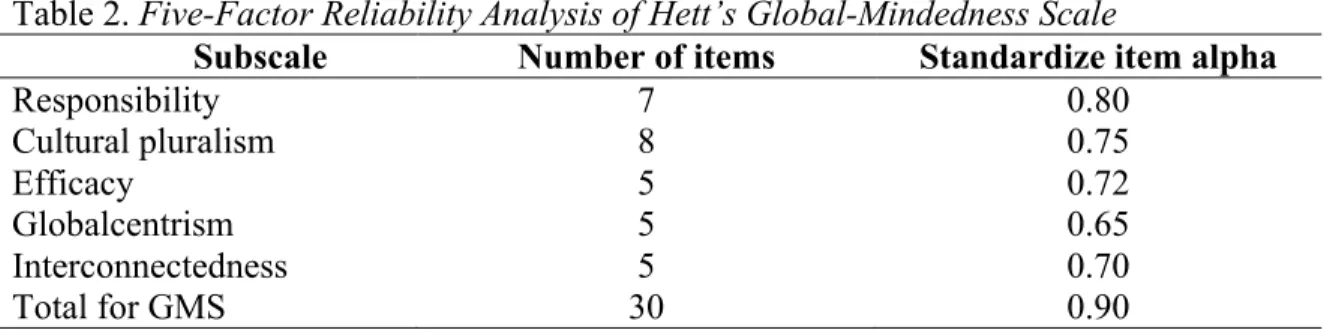
Table 2. Five-Factor Reliability Analysis of Hett’s Global-Mindedness Scale ... 92
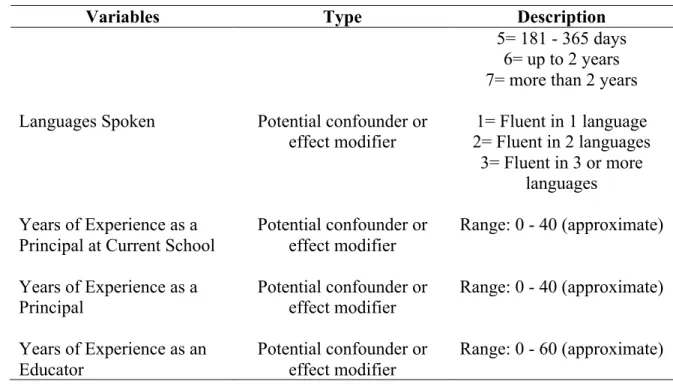
Table 3. Data Description ... 113
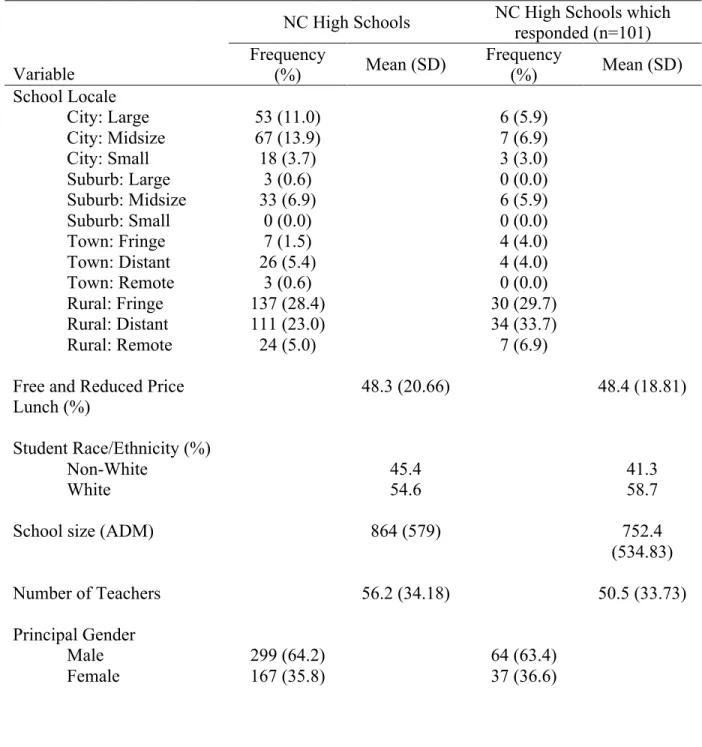
Table 4. Profile of NC High Schools and of Respondents ... 116
Table 5. Descriptive Statistics for NC High School Principals Responding to Survey ... 118
Table 6. Total Global-Mindedness Scores Among NC High School Principals ... 121
Table 7. Emergent Themes and Definitions ... 123
Table 8. Frequency of Responses to Question 1A ... 125
Table 9. Frequency of Responses to Question 1B ... 128
Table 10. Global-Mindedness Scores by Global Awareness Scores ... 131
Table 11. Association Between Global-Mindedness and Student Achievement ... 137
Table 12. Association of Total Global-Mindedness Scores Among NC High School Principals with School Characteristics ... 139
Table 13. Association of Total Global-Mindedness Scores Among NC High School Principals with Principal Characteristics ... 140
Table 14. Association of Student Achievement with School Characteristics ... 141
Table 15. Student Achievement by School Locale ... 142
Table 16. Association of Student Achievement (ACT) with Principal Characteristics ... 142
Table 17. Association of Student Achievement (EOC) with Principal Characteristics ... 144
Table 18. Association of Student Achievement (Graduation Rates) with Principal Characteristics ... 145
Table 20. Bivariate Correlations with Potential Regression Variables ... 147 Table 21. Regression Results for ACT Composite Scores Presented as Standardized Coefficients
... 150
Table 22. Regression Results for ACT Composite Scores Restricted to White Principals ... 151 Table 23. Regression Results for EOC Composite Scores Presented as Standardized Coefficients
... 153
LIST OF FIGURES
Figure 1: Theoretical Framework ... 9
Figure 2: Annual Expenditure per Student by Educational Institutions, by Type of Service (2010) ... 27
Figure 3: enGauge Framework ... 28
Figure 4: The Asia Society’s 21st Century Framework ... 30
Figure 5: OECD DeSeCo Framework Student Outcomes - How Collective Competencies Affect Society ... 32
Figure 6: DeSeCo Competencies ... 33
Figure 7: Partnership for 21st Century Skills Framework ... 34
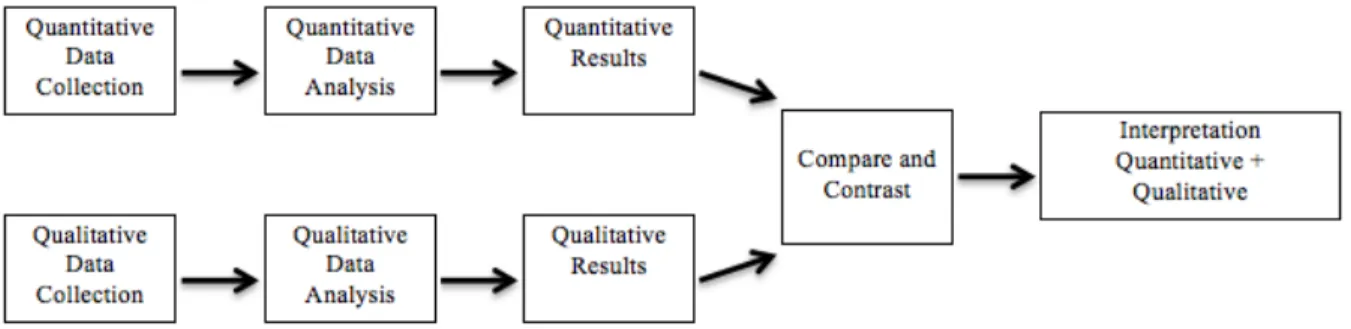
Figure 8: Triangulation Design: The Convergence Model ... 102
Figure 9: Total Global-Mindedness Scores Among NC High School Principals ... 122
Figure 10: Frequency of Global Awareness Scores ... 132
Chapter 1: Introduction to the Study
Background
Survival in an interdependent, global world requires specialized skills and knowledge. Furthermore, because students will most assuredly compete in a global job market, public K-12 schools must provide students with the requisite skills for jobs that do not exist at this point in time, but will become prominent in the near future. While predicting the exact jobs that will emerge in the future is difficult, it is clear from examining the employment trends that a myriad of current jobs did not exist ten years ago, and that trend will most assuredly continue.
Examples of recently created jobs include social media/online community manager,
sustainability manager, and user experience manager (Kiplinger, 2011). Additionally, factors such as rapid technological innovations and the rise of a knowledge economy— forces that occur under the umbrella of globalization— are pressuring educational leaders, and others in field of education, to respond to private industry (Nam & Park, 2014).
emphasis on four essential skills students need to succeed in the 21st century: collaboration, problem solving, technology integration, and global awareness (see Appendix A). The skills promoted by Partnership for 21st Century Skills are mirrored in the North Carolina statewide principal evaluation instrument, which requires that school leaders infuse global awareness into curriculum and incorporate such skills as collaboration and critical thinking into classroom instruction (North Carolina State Department of Education, 2013; Partnership for 21st Century Skills, 2011).
The curriculum response designed by education policy makers at the macro-level, as described above, results from a conglomeration of factors that contribute to a perceived sense of urgency to restructure education policy. For instance, due to regional and geo-political factors, the labor market has expanded beyond localities so that workers now compete with each other on a global scale, not just at the regional or local level (Freeman, 2006). Furthermore, as a result of rapid technological advancements – an integral aspect of globalization – the world is now more interconnected, competitive, and collaborative (Friedman, 2007). Yet, even as the job market has globalized, international academic achievement indicators reveal that American students are not prepared to compete in this global context (Program for International Student Assessment, 2012).
The Program for International Student Assessment (PISA) measures reading literacy, mathematics literacy, and science literacy for 15-year-olds, every three years (Program for International Student Assessment, 2012). American students, when compared to their
Literacy Study (PIRLS) in 2011 reveal that while the scale score for American students of 556 is significantly above the PIRLS average of 500, it lags behind the top performing nations by approximately 15 scale score points (Institute of Education Sciences, 2011). For a nation with a GDP over $16 trillion – which ranks number one in the world (Central Intelligence Agency, 2013) – American public school students are not performing at a level commensurate with the wealth potential of their nation. Ultimately, the sense that American students lack the skills to compete against international students supports the narrative mandating structural changes to the education system.
The public school system in the United States has experienced several waves of school reform throughout the years such as the effective schools movement, school restructuring, systemic reform, and comprehensive school reform. Since, school principals have become the focus of policy makers, and therefore the expectation had become that these school leaders increase student achievement (Waters, Marzano, & McNulty, 2003). This increased
accountability has resulted in principals assuming a greater degree of responsibility for student achievement than in the past (Zepeda, 2007).
Throughout the United States, school principals are subjected to increasingly high demands for student accountability. This demand for accountability holds the principal
ultimately responsible for student achievement (Gruenert, 2005; Lashley, 2007; Praisner, 2003). Principals seek ways to positively affect student achievement scores in order to meet today’s demands. In doing so, they have turned their attention to strategic ways in which students’ academic performance can be increased. Under the pressures and mandates of federal
one of the most significant factors affecting student achievement, and this in turn indicates principals must have a thorough understanding of the skills and behaviors needed to be effective leaders in the 21st century (Leithwood, Louis, Anderson, & Wahlstrom, 2004; Marzano et al., 2005).
As globalization asserts a greater presence in the realm of education, schools must modify their structure, curriculum, and academic focus to prepare students for the demands of the new economy. In the current globalized environment, schools should prepare students to succeed at an international level through an infusion of 21stcentury skills, while also
enlightening students so that they can compete and collaborate at an international level. While teachers have daily and direct contact, it is the principal’s leadership and vision that provides the impetus and focus for those teachers. Given that research names the principal as a critical player in determining the success of any program within the school (Marzano et al., 2005), certainly his or her role in initiating and/or sustaining a successful global focus within the school will be pivotal to student success.
the school. Thus, a principal’s global-mindedness will be a critical factor in determining any global focus that is initiated or sustained within the school.
Statement of the Problem
The current world for preparing youth is exceptionally different from the industrial world in which the public school system was created. In recent decades, numerous reports and policy statements have emphasized the need for new skills in the 21st century. Partnership for 21st Century Skills established a list of these skills and engaged a growing movement to embed them in the K-12 curriculum (Partnership for 21st Century Skills, 2011). They include research and technology, communication and collaboration, and problem solving and critical thinking skills. In other words, the current approach advocates for infusion of global thinking and
principles into education whereby educators nurture students’ substantive understanding of, and action in, our increasingly complex, diverse, and interdependent world.
Educational leaders are struggling to keep up with the pace of change as new challenges arise related to how to best prepare students to be knowledgeable, compassionate, active, and responsible citizens in a globally, interconnected society. With this in mind, conversations related to the preparation of students for the 21st century have come to the forefront of social, economic, political, and cultural agendas. If educational leaders are to be seen as responsive and active participants, and if real change in education is to occur, then an understanding of the perspectives, skills, characteristics, and mindsets needed for life in a global world must be identified and understood.
Given the critical role principals play in sustaining and developing a vision and
forms. Hanvey (1976) identified five dimensions related to global perspectives: perspective consciousness, state of the planet awareness, cross-cultural awareness, knowledge of global dynamics, and awareness of human choices. Other researchers including Anderson (1982), Lamy (1983), Torney-Purta, (1982), and Tucker (1982) studied global education in the classroom and in teacher education programs. Taking global education further, Hett (1993) coined the term global-mindedness (see Appendix C) and designed an instrument to measure it (see Appendix D).
Hett’s (1993) research and findings, as well as the findings of subsequent studies
employing the Global-Mindedness Scale (GMS) have significant implications for school leaders in terms of identifying the attributes and dimensions necessary for shaping school communities better equipped to respond to the challenges and complexities of globalization. If principals are expected to develop a global educational context, they must be able to demonstrate the values and understandings necessary to manage the forces of continuity, change and inequality that are being exacerbated by globalizing forces. However, little is known about the impact of a
principal’s level of global-mindedness on student achievement. Given the lack of empirical study of this relationship, more research is needed.
Purpose of the Study
The purpose of this study is to investigate the levels of global-mindedness of principals in North Carolina public high schools and the potential relationship of global-mindedness to student achievement. The principal is often identified as an essential element to the
of leadership and education, the perspectives of school leaders and the relationships that may exist across and between the dimensions of global-mindedness need to be elucidated.
This study’s investigation of the global-mindedness of principals is predicated upon Hett’s (1993) research, which was spurred by the educational imperative of fostering the development of a global perspective in university students. Hett’s research and identification of the five dimensions of global-mindedness (responsibility, cultural pluralism, efficacy,
globalcentrism, interconnectedness) draws upon a substantial field of study related to the development of a global perspective and has been replicated on several occasions within a variety of contexts, including public K-12 education. The extensive research conducted by Hett and subsequent studies employing the GMS (Acolatse, 2010; Carano, 2010; Cogan and
Grossman, 2009; Duckworth, Walker-Levy, and Levy, 2005; Gillian, 1995; Kehl and Morris, 2008; Kirkwood-Tucker, Morris, and Lieberman, 2011; Smith, 2008; Walton, 2002; Zhai and Scheer, 2004; Zong and Farouk, 1999) support the use of the GMS in this study. It is the intent of the researcher to explore the differences across the dimensions of global-mindedness as identified by Hett (1993) for high school leaders and to investigate the association of these dimensions with student achievement. This research will provide information that does not currently exist on the global-mindedness of high school leaders and its potential link to student achievement as measured by students’ composite ACT scores, EOC composite scores, and school graduation rates.
Significance of the Study
leadership and cultural or contextual influences that can lead to improvement in its practice (Dimmock & Walker, 2005; Hallinger, 2005). These ideals support the need for a study of the relationship between the global-mindedness of educational leaders and student achievement in order to understand the development of the knowledge, skills, and attitudes that are essential to preparing students for life in a globally interconnected world.
This call for a global-minded approach to education emphasizes the need for
investigating global-mindedness as an essential leadership skill or attribute. It is the intent of the researcher to add to the body of knowledge about effective educational leadership in order to ensure a relevant 21st century education that addresses the complex, multidimensional processes of globalization and issues related to diversity, inequality and interconnectedness (Cambridge & Thompson, 2004; Walker, 2008).
Conceptual Framework
Figure 1: Theoretical Framework
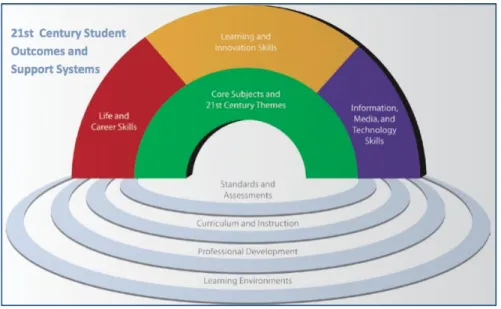
Partnership for 21st Century Skills framework. Partnership for 21st Century Skills (2011) has been a major influence in American education. The organization identified four key elements of 21st century learning including core subjects and 21st century themes; learning and innovation skills; information, media, and technology skills; and life and career skills
(Partnership for 21st Century Skills, 2011). The skills outlined by Partnership for 21st Century Skills are the competencies that all administrators must ensure teachers are providing to students in order for them to become successful workers in the new information age. The content that all schools should incorporate into the curriculum are: global awareness (promotion of understanding and tolerance of diversity), civic awareness (understand, analyze and
participate in government, locally and globally), financial and economic literacy (understanding the choices for personal success) and health literacy (understanding nutritional choices that will allow for a long life) (Partnership for 21st Century Skills, 2011).
bring about the infusion of 21st century skills across the curriculum in North Carolina (North Carolina State Board of Education, 2008). The framework was then used to rewrite the State’s mission: “Every public school student will graduate from high school, globally competitive for work and postsecondary education and prepared for life in the 21st century” (North Carolina State Board of Education, 2008, p. 1).
The Board felt as though this new mission required a new vision of school leadership, and therefore developed North Carolina’s “Future-Ready Students” initiative. This statewide vision framed the collaborative efforts between education, business, and community leaders to improve teaching and learning, and to inform North Carolina’s 21st century skills work in standards, professional development, curriculum, and assessment (North Carolina State Board of Education, 2008).
North Carolina Standards for School Executives. After developing a mission and vision that reflected the needs for students in the 21st century, the Board then wrote a new set of standards (see Appendix E) to guide school leaders (North Carolina Department of Instruction, 2006). In December of 2006, the North Carolina State Board of Education approved the “North Carolina Standards for School Executives”— a new set of standards that placed 21st century learning at the forefront (North Carolina Department of Instruction, 2006).
Global-mindedness. Hett (1993) defines global-mindedness as “a worldview in which ones sees oneself as connected to the world community and feels a sense of responsibility for its members. This commitment is reflected in an individual’s attitudes, beliefs and behaviors.” (p. 143) According to Hett (1993), global-mindedness consists of five dimensions: responsibility, cultural pluralism, efficacy, globalcentrism, and interconnectedness.
parts of the world, and feels a moral responsibility to try to improve conditions. People who are globally-minded believe they can individually have an impact on the world, and that each individual has something to offer. They have a strong sense of appreciation of diversity and differences and an awareness and appreciation for the interconnectedness of the world (i.e. global awareness). This study will explore the relationship, if any, between global-mindedness in North Carolina public high school principals and student achievement.
Research Questions
The three primary questions addressed in this study are:
• Q1: What is the level of global-mindedness among NC public high school principals?
a. How do principals view their roles in promoting global-mindedness? b. What have principals done to support global-mindedness?
c. How do the principals’ viewpoint and actions relate to their level of global-mindedness?
• Q2: Is the principals’ level of global-mindedness, including the total score and each
dimension, associated with student achievement in NC public high schools?
• Q3: Do other factors influence the association, or lack of association, between
global-mindedness and student achievement? Definition of Terms
There are some operational definitions of concepts that are critical to understanding this research. They are as follows:
• Cultural Pluralism: An appreciation of the diversity of cultures in the world and a belief
• Efficacy: A belief that an individual’s actions can make a difference and that
involvement in national and international issues is important (Hett, 1993, p. 143).
• Global Education: An education that opens people’s eyes and minds to the realities of
the globalized world and awakens them to bring about a world of greater justice, equity and human rights for all (The Maastricht Global Education Declaration, 2002, p. 67).
• Global Educational Leader: An educator who feels it is important to incorporate a global
perspective into curricula using pedagogy that engages learners in real-world issues with a goal of enhancing students’ learning, academic performance, and workforce
preparation (Hett, 1993, p. 143).
• Global-mindedness: A worldview in which one sees oneself as connected to the world
community and feels a sense of responsibility for its members and reflects this
commitment through demonstrated attitudes, beliefs, and behaviors (Hett, 1993, p. 143).
• Globalization: A multidimensional phenomenon that employs a process approach which
intensifies and connects global flows of knowledge, power, economy, technologies, people, values and ideas across borders with a variety of affects (Cohen & Kennedy, 2000).
• Interconnectedness: An awareness and appreciation of the interrelatedness of all peoples
and nations, which results in a sense of global belonging or kinship with humankind (Hett, 1993, p. 143).
• Student achievement: Measurable outcomes of student learning. Assumptions
marketplace. Under this type of competitive pressure, the United States has subscribed to neoliberal economic policies, which support the privatization of public entities (i.e. public schools) and the deregulation of private industries (Friedman, 2007). Consequently, these types of policies encourage systems to use education as the means to employment, not for the pursuit of knowledge or critical thinking skills.
This current reality describes the foundation for this study’s measure of student achievement. Essentially, the global pressures that drive nations to compete are also creating standardized ways to measure the success. The United States has fallen to this pressure and therefore requires state agencies, schools, and school leaders to track progress through the use of achievement tests, course completion, and other standardized measures. Therefore, it is an assumption of this study that the three outcome measures chosen (ACT composite score, EOC composite score, and graduation rate) are appropriate in measuring student success. The state of North Carolina uses these measures in various ways: to conduct principal evaluations, to
measure school success, and to study trends and gain insights (North Carolina State Board of Education, 2008). In the case of this particular research study, this assumption was integral in examining the relationship between a principal’s global-mindedness and student achievement. Delimitations
A delimitation of this study exists in the researcher’s decision to emphasize the
(1) make generalizations to a population; (2) quantify the level of association between achievement and each component of the Global-Mindedness Survey; and (3) control for confounders and identify effect modifiers. This research also explores characteristics of high versus low global-mindedness through qualitative assessments, thus utilizing mixed
methodology to assess potential relationships. Limitations
Summary
In these times of increased concern for student achievement, the increased accountability on schools prompts principals to focus on various leadership skills. School principals are being held accountable not only for the structures and processes they establish, but also for the
performance of their students (Leithwood & Riehl, 2003). Leithwood et al. (2004) maintain that leadership is key to improving student learning.
The potential benefit of this research identifying the relationship between principals’ levels of global-mindedness and student achievement will be useful to practitioners, as it could be used to outline specific leadership behaviors necessary to impact school improvement. Results of this study will add to the school leadership literature and may be used to enhance principal preparation programs as well as district and state staff development initiatives for school administrators. In summary, the merit of this study is its attempt to move beyond general leadership theories by examining the impact of certain aspects of principal behaviors on student achievement.
Organization of the Research
Chapter One has presented the introduction, statement of the problem, purpose of the study, significance of the study, theoretical framework, research questions, definition of terms, delimitations, limitations, and summary. Chapter Two presents a review of related literature and research pertaining to the study. The methodology is further explained in Chapter Three. The results and analysis of the research are included in Chapter Four, and Chapter Five contains a summary of the findings, conclusions from such findings, and a discussion and
Chapter Two: Literature Review
The purpose of this research is to examine the level of global-mindedness within the leadership of North Carolina public high schools and its relationship to student achievement. This chapter includes a review of the literature that introduces the concepts related to
globalization, global education and 21st century skills. The past and present role of the school principal are identified and explored as it relates to student achievement. Additionally, the five dimensions of global-mindedness and their importance to educational leadership will be identified to assist readers with an understanding of the essential elements of this multifaceted approach, which is key to the success of students. Lastly, this study’s inclusion of demographic variables and school characteristics are identified and their rationale explained.
Globalization
National lines are blurring, citizens of the world are blending, and the cultures of different peoples are fusing (Langenfeld & Nieberding, 2005; Stewart, 2007). Trade policies, immigration laws, and emerging technologies all contribute to this homogenization of the human population. For example, recent innovations in technology make more detailed information available to more people than ever before. Cable news, instant messaging, voiceover IP services, email, tweets, and blogging are just a few types of technological
advances that keep people globally connected and informed. Considerable mobility within and between populations results in greater racial and ethnic diversity, especially within large cities. Immigration and emigration are no longer the remarkable phenomenon they once were.
activities and coordinate resources across national borders. Kagan and Stewart (2004)
expounded upon the interconnected economies of companies and industries, the importance of avoiding cultural missteps to the maintenance of national security, and the need to reduce misinformation. Countries that traditionally have been largely unable to compete on a global economic scale have been thrust to the forefront of business development. For example, India has developed its own accomplished, export-oriented software and IT service industry since the United States began outsourcing many jobs to this low-wage country. These changes have allowed India to increase its wealth and industrial prowess, thus allowing for increased international competition (Friedman, 2007).
Historically, globalization has been predominantly driven by the norms and culture of European and American businesses. However, consistent with the growth and dispersal of current technologies, the emerging face of globalization is changing rapidly from the once dominant Western ideals, to become more flat—meaning that there have been major shifts in the world (e.g. wireless technology) that have made it possible for us to connect with the rest of the world much effortlessly (Friedman, 2007). In other words, globalization enables everyone to be a player and take part in shaping of the future. For example, Friedman wrote that in 2004, there were 100,000 American tax returns outsourced to India. In 2005, there were 400,000 outsourced. This number continues to rise each year, indicating that the world is flattening out (Friedman, 2007). In his book, Friedman concludes that it would behoove young Americans to think of themselves as competing against every young person in the world. He cautions people to think globally, instead of just in a local context. For students, this means acquiring new, challenging and innovative skills.
foster the development of students to be open-minded and able to think in a global context. Therefor, schools are faced with finding innovative and inclusive methods of instruction. According to the American Council on Education (n.d.), individuals who are able to transition easily across cultural and political boundaries will be exceptionally well placed for success. This will require schools to identify evolving global issues and find inventive and
comprehensive methods of instruction.
Kagan and Stewart (2004) call for the deliberate educational preparation of all students, so they can be decisive contributors in an integrated world. They propose educational
institutions in the United States shift their paradigm from community concerns to international concerns, from federal and state accountability benchmarks to the skills demanded by the global marketplace.
According to Clarke (2004), established processes to provide for an increasingly diverse society are essential. However, according to Bryan and Vavrus (2005) and Waks (2006),
Workforce Trends in the 21st Century Global Economy
The 21st century global economy demands a new kind of worker. Wonacott (2002) uses the term “gold collar” worker to describe the creative and strategic thinkers needed to compete in the global economy of the 21st century. Pink (2005) believes that economic survival will rely on workers’ creative capacity as well as their ability to think unconventionally, question the status quo, and deal with ambiguous situations and problems.
Twenty-first century technological advances bring a demand for highly skilled workers in order to support high productivity. The famous futurist thinker, Toffler (1970), believed that societies are caught up in the “third wave” of industrialization and can look to computer technology as a means to shape a high-wage, high-skill future. Toffler (1970) described this concept when he wrote, “By instructing students how to learn, unlearn and relearn, a powerful new dimension can be added to education.” (p. 271) The meaning in Toffler’s statement is found in the studies conducted by the RAND Corporation, which also asserted that 21st century work requires higher level cognitive skills such as managing, interpreting, validating,
transforming, communicating and acting on information (Karoly & Panis, 2004). Non-routine analytic skills such as abstract reasoning and problem solving will be essential in jobs from high-level engineers to mail delivery workers (Karoly & Panis, 2004).
Technological progress increases the demand for highly skilled work, which in turn increases the value for higher education degrees and unique skill sets. Using personal
imaginative (Wagner, 2008). Wagner’s set of survival skills is reflected in many 21st century frameworks, such as the one adopted by the state of North Carolina, Partnership for 21st Century Skills framework (Partnership for 21st Century Skills, 2011).
Building on Friedman’s (2007) ideas and on the skills that are needed in the 21st century, a 2008 report “Ensuring U.S. Students Receive a World-Class Education” claims that due to the flattening of the global economy, Americans are losing ground while people from places such as Eastern Europe, India, China, and Brazil are gaining access, and thus gaining ground
(National Governors Association, the Council of Chief State School Officers, and Achieve, Inc., 2008). Additionally, the report states, “More jobs are going to the best educated no matter where they live, which means that Americans will face more competition than ever for work.” (p. 5) Highly skilled workers can now be found anywhere around the globe, regardless of the business’s location. By doing business in this fashion, companies are selecting locations that reflect low cost benefits during the stages of production. With the emergence of technology and information technology careers, workers can now collaborate without physically relocating (National Governors Association, the Council of Chief State School Officers, and Achieve, Inc., 2008).
the U.S. needs to focus on re-educating the workforce if it is to tackle long-term joblessness.” (p. 1)
The Levin Institute (2005) rationalizes that this predicted shortage is due to new participants in the international economy, especially from the BRIC countries (Brazil, Russia, India, and China). The rise of the BRIC countries is changing the power dynamics in world affairs. The BRICs are defined as countries at the equivalent stage of economic development, but not yet at the point where they would be classified as more developed (The Levin Institute, 2005). The BRIC stance argues that since the four countries are developing with such rapidity, their combined economies could surpass the collective economies of the current wealthiest countries by 2050. These four countries represent roughly 40% of the world’s population and 25% of global GDP (The Levin Institute, 2005). Virtually unscathed from the recent worldwide financial crisis, these countries are poised for long-term growth (The Levin Institute, 2005).
The BRIC countries offer investors the opportunity for growth. Multinationals
worldwide are flocking to these countries, hoping to take advantage of their markets (Goldman Sachs, 2003; The Levin Institute, 2005). For example, in 2010 General Motors sold more cars in China than in the U.S (China Buisness Review, 2011). By the year 2020, China is expected to become the world’s largest aviation market, and by 2025 it is expected to become the world’s largest luxury good market (Goldman Sachs, 2003; The Levin Institute, 2005). A Goldman Sachs report notes, “The developed world cannot compete with the four BRIC countries in terms of growth and incremental consumption in the decade ahead and beyond” (Goldman Sachs, 2003).
Viguerie, 2010). However, in addition to the BRIC countries’ influence in the global economy, American college-age adults may be contributing to this worker shortage by not pursuing degrees in mathematics, science and engineering fields, which have potential for high economic growth (Bisson, Stephenson, & Viguerie, 2010). In fact, according to National Science Board (2014), in 2010, more than 5.5 million university degrees were awarded in Science and Engineering worldwide. Students in China earned about 24%, those in the European Union (EU) earned about 17%, and those in the United States earned about 10% of these degrees. This trend is troubling given that jobs in the science and engineering sectors are growing nearly five times faster than other jobs in the marketplace (Friedman, 2007).
This shift in the global economy and changes in technology have impacted the nature of business and work. Florida (2007) describes this innovative new global economy as the creative age. The real challenge is to prepare future workers, our students, to be prepared for these changes (Partnership for 21st Century Skills, 2011). Therefore, the economic health and future of the country depends upon the education of today’s youth, which can better equip them to succeed in the 21st century.
a changing world, instantaneous communication and new human relationships in virtual as well as in real worlds.
International Comparisons in Education
The United States is not alone in realizing the importance of preparing students to collaborate and compete in the world. Recently, countries around the globe have seen the rise in initiatives to imbed global principles in their curricula. For example, in a landmark document titled the Maastricht Global Education (2002), representatives of the European Council expanded the global education framework to “open people’s eyes and minds to the realities of the world and awaken them to bring about a world of greater justice, equity, and human rights for all.” (p. 67) From the European Council’s viewpoint, global education is thought to
encompass, but is not limited to, education for human rights, sustainability, peace and conflict prevention, interculturality, and citizenship.
promote peace and understanding between all nations for human prosperity (National Council of Educational Research and Training, 2013). The framework expects global education to be embedded in existing subjects, although particular curricula focusing on social justice and peace have also been recommended (National Council of Educational Research and Training, 2013).
Another international example of educational reform comes from The Royal Society of the Arts (RSA) in Great Britain (Royal Society for the Encouragement of Arts, 2014). This organization responded to the changing demands of the 21st century by launching an educational campaign called Opening Minds (Aynsley, Brown, & Sebba, 2012). In 1999, the RSA initiated this framework based on eight years of educational research in teaching specific student competencies. The overarching goals for this educational reform initiative in Great Britain are to prepare young people for the uncertain social and economic demands of the future. The
Opening Minds framework emphasizes practices and standards that engage students to become lifelong learners (Royal Society for the Encouragement of Arts, 2014). The organization advocates a student-centered approach to learning that integrates educational standards and competencies needed to be successful workers and responsible citizens (Aynsley, Brown, & Sebba, 2012). Competencies such a meta-cognitive skills, citizenship and global awareness are examples of skills the RSA feels are integral for 21st century success. They reaffirm the need for development of a new digital literacy for 21st century learners (Royal Society for the
As these examples illustrate, countries around the world are articulating their global education agendas in alignment with 21st century skills. In its effort to stay competitive with other industrialized nations, the United States has participated in international assessments. The PISA (Program for International Student Assessments) assessed whether 15 year-old students could recall what they learned in science, mathematics and reading, and how well they could apply their knowledge in new situations. In its latest assessment, more than 510,000 15-year-old students from 65 countries participated (Program for International Student Assessment, 2012). The assessment measured literacy in mathematics, reading, science and problem solving and served as a tool to revise and guide new international competency domains. The test’s
objectives were to measure the aptitude of an individual working in teams, independently and with information tools such as language and technology. In 2009, PISA results ranked the United States 23rdin reading, 36thin math, and 27thin science (Program for International Student Assessment, 2012).
Similarly designed, the Progress in International Reading Literacy Study (PIRLS) is another measure that was developed to assess the reading literacy of fourth grade students around the world. Data from the PIRLS 2011 assessment revealed that while the scale score for American students of 556 was significantly above the PIRLS international average of 500, it lagged behind the top performing nations by approximately 15 scale score points (Institute of Education Sciences, 2011).
mathematics score (541) was higher than the TIMSS scale average of 500. Although the United States was among the top 15 education systems, many other countries scored above the U.S., including Singapore, Korea, Hong Kong-China, Chinese Taipei, Japan, Northern Ireland, and Flemish Belgium. In eighth grade, the U.S. average mathematics score (509) was higher than the TIMSS scale average of 500; however, the United States dropped to be among the top 24 education systems in mathematics. Among the education systems that scored above the U.S. average were Korea, Singapore, Chinese Taipei, Hong Kong-China, Japan, Russia, and Quebec-Canada (see Appendix F).
In fourth grade, the U.S. average science score (544) was higher than the TIMSS scale average of 500. The United States was among the top 10 education systems. Nations with average science scores above the U.S. average were Korea, Singapore, Finland, Japan, Russia, and Chinese Taipei. However, by eighth grade the United States dropped to an average of 525. Countries with average science scores above the U.S. were Singapore, Chinese Taipei, Korea, Japan, Finland, Alberta-Canada, Slovenia, Russia, and Hong Kong-China (see Appendix G).
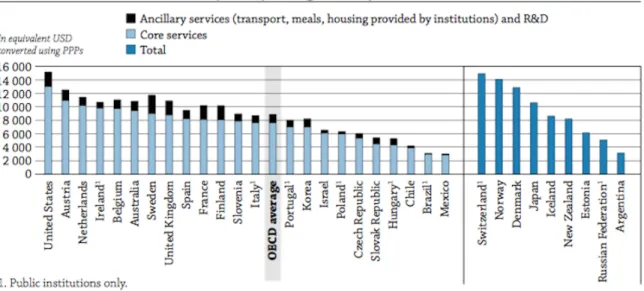
Although the United States lags behind other industrialized nations in regards to
Figure 2: Annual Expenditure per Student by Educational Institutions, by Type of Service (2010)
For a nation with a GDP over $16 trillion, which ranks number one in the world (Central Intelligence Agency, 2013), American public school students are not performing at a level commensurate with the wealth potential of their nation. Ultimately, the sense that American students lack the skills to compete against international students supports the narrative mandating structural changes to the education system.
Conceptual Framework for 21st Century Skills
Century Skills conceptual framework was adopted by the state of North Carolina, it was selected as a foundation this study. The following section compares and contrasts the four 21st century frameworks.
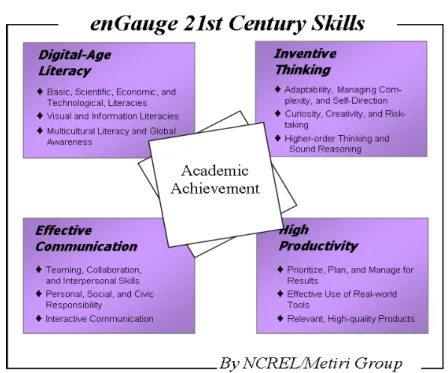
enGauge framework. Developed in 2003, the enGauge framework took an important step forward into the digital age (The Metiri Group & NCREL, 2003). Similar to Partnership for 21st Century Skills framework, the enGauge framework focuses on the importance of
integrating digital literacy, innovative thinking, communication, and productivity competencies into academic content (Figure 3).
Figure 3: enGauge Framework
digital literacies. Defined by the organization, visual literacy is the ability to create, use, and interpret visual media to further knowledge, decision-making, communication and learning (The Metiri Group & NCREL, 2003). Although Partnership for 21st Century Skills does not dedicate a specific section to visual literacy, the organization stresses the necessity for students to be digitally literate, and to be able to analyze, apply and create media products (Partnership for 21st Century Skills, 2011).
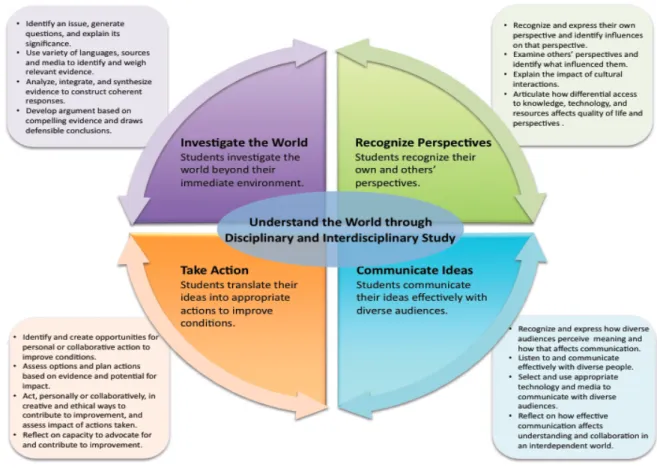
Figure 4: The Asia Society’s 21st Century Framework
The Asia Society (2013) recommends that curriculum be infused with a global focus. Additionally, The Asia Society (2013) recommends collegial collaboration to strategically plan and share resources. This practice reflects a knowledge-based economy, which demands workers to communicate and solve problems collaboratively (Karoly & Panis, 2004).
Digital technology skills allow students to investigate the world, recognize and weigh perspectives, communicate ideas with peers in other countries, and take action to improve the world (Asia Society, 2013). These skills include media literacy, which prepares students to determine the accuracy and bias of sources, and digital technology, which demands that
students be proficient at nonlinear thinking and multitasking (Friedman, 2007; Karoly & Panis, 2004). Service-learning, travel exchanges and connections with parents and community are further priorities of 21st century learning as defined by the Asia Society (2013).
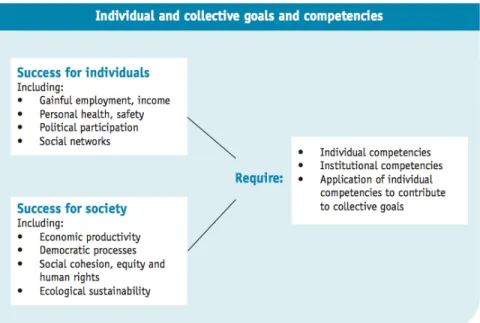
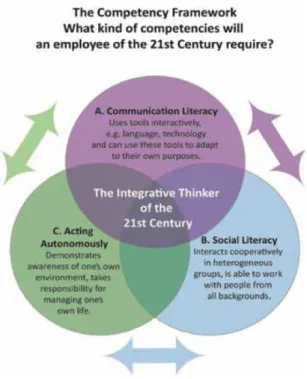
DeSeCo framework. The DeSeCo framework outlines competencies that are linked and complement PISA (Organization for Economic Cooperation and Development, 2005). Like the other 21st century frameworks, the competencies in this framework relate to knowledge and skills that students must acquire in order to be successful in the 21st century. The DeSeCo competencies, however, stress that the total competencies of combined individuals affect the ability to achieve common societal goals (Organization for Economic Cooperation and
Development, 2005). As explained in Figure 5, the DeSeCo framework describes competencies that make individuals successful in their personal, social and work life. These individual actions also contribute to a profitable society (Organization for Economic Cooperation and
Figure 5: OECD DeSeCo Framework Student Outcomes - How Collective Competencies Affect Society
Figure 6: DeSeCo Competencies
Partnership for 21st Century Skills framework. Partnership for 21st Century Skills defines 21st century student outcomes as the knowledge and skills (competencies) that students should learn and understand to be successful in their life and work (Partnership for 21st Century Skills, 2011). Under Partnership for 21st Century Skills framework, 21st century students have to have competencies in core subjects. The core subjects include language arts, world languages, art, mathematics, economics, science, geography, history, government and civics. Furthermore, students must be globally aware and have financial, economic, business, entrepreneurial, civic, health and environmental literacy. These 21stcentury themes should be woven into the
curriculum to promote higher-order learning. To be prepared for the work and life demands of a global world, Partnership for 21st Century Skills believes that students must also possess
learning, innovation, creativity, critical thinking, problem solving, communication and
life and career skills to be prepared and be able to meet the demands of a globalized world and economy (Partnership for 21st Century Skills, 2011).
The key elements of 21stcentury learning in this framework are represented in Figure 7. The image embodies both 21st century student outcomes, represented by the rainbow arches, and support systems, represented by light blue pools at the bottom. Although the 21st century competencies and skills are delineated separately, they are designed to be integrated into content curriculum and academic learning. The critical elements in this framework are the emphasis on core subjects and learning skills; the ability to use 21st century tools; and economic, social and civic awareness (Partnership for 21st Century Skills, 2011).
Figure 7: Partnership for 21st Century Skills Framework
financial, economic, business and entrepreneurial literacy; and health, civic and environmental literacy (p. 2).
As described by Partnership for 21st Century Skills (2011), a major student outcome is global awareness— being able to work collaboratively and communicate effectively with people from diverse cultures, perspectives, and religions. Furthermore, students must be able to comprehend and sympathize with other nations and cultures. This includes being
knowledgeable of global issues and having the initiative to become informed. Researchers, educators and business leaders also propose that, to thrive in life and work, individuals must possess learning and innovation skills (Friedman, 2007; Partnership for 21st Century Skills, 2011; Wagner, 2008).
In 2008, the North Carolina State Board of Education revised their guiding mission to state, “Every public school student will graduate from high school globally competitive for work and postsecondary education and prepared for life in the 21st century.” (p. 1) And by design, the North Carolina State Board of Education embraced Partnership for 21st Century Skills framework in order to bring the infusion of 21st century skills across the state (North Carolina State Board of Education, 2008). Additionally, the North Carolina State Board of Education stated that 21st century leaders should govern North Carolina public schools in order to achieve its mission (North Carolina State Board of Education, 2008). Principals today are called upon to be the change agents, to provide the leadership and vision for instructional change within the school. Given this information, the global-mindedness of the principal will be a critical factor in determining any global focus that is initiated or sustained within the school.
four frameworks place an enormous emphasis on learning, innovation, information, media, life skills, and career skills. The difference is that enGauge, Asia Society, and DeSeCo emphasize some of the skills that Partnership for 21st Century Skills classifies as sub-skills. Partnership for 21st Century Skills, however, delves deeper and specifies 21st century interdisciplinary themes (global awareness, and financial, economic, business, entrepreneurial, civic, health and
environmental literacy) as essential components of the framework.
Unlike the enGauge, Asia Society, and the DeSeCo frameworks, the Partnership for 21st Century Skills framework focuses on integrated curriculum, rather than a set of contextual skills (Partnership for 21st Century Skills, 2011). Partnership for 21st Century Skills framework uses the 20th century K-12 core subjects and specifies the integration of 21st century themes into the core content areas. Partnership’s framework takes 20th century skills to a higher level where students can apply the knowledge and use it in real-world situations while integrating 21st
century skills. Partnership for 21st Century Skills framework shows how students, their ability to apply knowledge using different mediums and environments, and technology work together to accomplish 21st century tasks that otherwise would be unattainable (Partnership for 21st Century Skills, 2011).
As discussed in the previous section, Partnership for 21st Century Skills framework further emphasizes the important elements that support the integration of 21st century skills in the core curriculum. For the skills and knowledge to be implemented, 21st century standards, assessments, curriculum, instruction, professional development, and learning environments have to be aligned to support the 21st century outcomes. Partnership for 21st Century Skills
History of the School Principal
The emergence of the school principal began in the mid-nineteenth century
(Rousmaniere, 2007). With the formation of graded schools in urban areas, a head teacher came into existence to help guide or lead the other teachers in the school. According to Rousmaniere (2007), the lead teacher or principal teacher was the authority in the school who organized curriculum, served as the disciplinarian, and supervised operations of the school. With the continuation of urbanization in the United States, the development of the principal’s position continued until majority of urban schools had a principal. However, the role of the principal was different within schools—principals either taught and assumed minor operational duties or served as a clerk with record keeping duties (Rousmaniere, 2007).
From the mid 1800s to the 1930s, the principal had a position of standing and power (Kafka, 2009). Due of the increase of students and teachers, school principals were called to lead the daily operations of schools and given increased managerial responsibilities (McFadden, Maahs-Fladung, Becck-Frazier, & Bruckner, 2009). As schools grew, the duties and
responsibilities of principals grew to include finance, personnel, management of the facility, and instructional leadership (Goodwin, Cunningham, & Eagle, 2005). Leading into the 20th century, the principal’s role further evolved into administrator, supervisor, instructional leader, and politician (Kafka, 2009).
2005). Additionally, the National Education Association established that the principal should hold specific knowledge and skills— these led to the development of professional associations, research studies, and publications (Kafka, 2009).
The report by the CRSE also recognized the principal as the coordinator of all school related activities and ultimately responsible for curriculum, instruction, and all school-related activities (Goodwin et al., 2005). From this point forward, principals were given independence and autonomy by their superintendents and allowed to lead their schools as they deemed necessary (Kafka, 2009).
By the mid 1930s, principals had no teaching duties and were responsible for their own professional growth (Kafka, 2009). In this era, their chief responsibility was to improve and supervise instruction (Goodwin et al., 2005), which included evaluating, hiring, retaining, and firing teachers (Kafka, 2009). Principals were also responsible for building community relations (Goodwin et al., 2005), thus establishing themselves as local community leaders by reaching beyond parents and teachers and involving the community as a whole (Kafka, 2009).
As the United States moved into the latter part of the 20th century, a new era of school effectiveness and accountability underscored the importance of school leadership. Research on effective schools during this era highlighted the importance of the role of the school principal. The principal was the person who oversaw the distribution of resources, supervised programs, communicated legislation, provided instructional leadership, and encouraged collaboration (Usdan, McCloud, & Podmostko, 2000).
Now, in the 21st century, principals have more responsibility and are held more
have effective principals as leaders. As educational leaders, principals face the challenge of improving teaching and ensuring academic success for all students. According to Lashway (2003), the role of the principal is rapidly changing from simply encouraging teachers’ efforts to leading teachers to produce tangible results.
Principals’ Impact on Student Achievement
Existing research supports the notion that school leadership is one of the most important factors for improving student achievement. Researchers at the Mid-continent Research for Education and Learning (McREL) have concluded that effective principals impact student achievement through their leadership practices (Waters et al., 2003). Although teachers play the most vital role in the success of students, leadership is also considered to be a crucial
component as it relates to students’ academic achievement.
Nicholson and Tracy (2001) suggest that principals have the power and authority to affect change in a school. They argue that leaders are either facilitators or blockers of change in education. This powerful idea implies that principals can either be the lifeline or the ruination of a school. Nicholson and Tracy declare that principals have this power because they have access to both the structure of the organization and the life of the classroom. Principals are required to understand the intricate workings of a school’s organization and the way that both the classroom and the teacher impact student achievement.
2009). According to Moore (2009), a principal’s leadership “has a direct effect on school organization, school ethos, teacher efficacy, staff morale and satisfaction, staff retention, teachers’ commitment, teachers’ extra work, and teachers’ attitude,” (p. 22) all of which affects student success (Stephens & Hermond, 2009).
Ultimately, it is the principal who is responsible for the success or failure of the school. Although teachers and students both play a role in the school’s success, the final responsibility falls on the principal’s shoulders. Karhuse (2007) emphasizes this notion by stating, “While teacher quality is vitally important, research increasingly shows that the quality of school leadership is also crucial to student and school performance” (p. l).
School leaders have also been recognized as the catalyst for instructional changes in schools, and their level of involvement can determine the success of these changes (Bays & Crockett, 2007; Cooner, Tochterman, & Garrison-Wade, 2004; Riordan, 2003). Waters et al. (2003) describe effective leadership as “balanced” – a matter of knowing when, how, and why to do what needs to be done. In an extensive review of more than 5,000 school leadership studies, Waters et al. (2003) found that an effective principal can have as much as a ten percentile point gain influence on norm referenced tests.
Cotton (2003) identified principals’ behaviors related to student outcomes, including achievement. Cotton’s synthesis of the research spanned the 1970s to the early 2000s (with a focus on post-1985 research), covering 81 reports that represented an extensive sample, including multiple school contextual variables (e.g. socioeconomic status, school level,
as having a positive effect on student achievement. Examples of these leadership behaviors included the following: high expectations for student learning; self-confidence, responsibility, and perseverance; visibility and accessibility; positive and supportive school climate;
communication and interaction; parent and community outreach and involvement; and collaboration. Cotton’s influence can be seen in the meta-analysis of Marzano et al. (2005).
In 2005, Marzano et al. conducted a meta-analysis of existing studies on school
leadership as practiced by principals. The researchers considered all existing studies on school leadership and principals conducted from 1978-2001, which resulted in quantitative analysis of 69 studies. Overall, their meta-analysis yielded a computed “correlation between the leadership behavior of the principal and the average academic achievement of students in the school to be 0.25” (Marzano et al., 2005, p. 10). In perspective, if a principal with average leadership competence (50th percentile) were leading an typical school (50th percentile), and the
principal’s ability increased by one standard deviation (from 50th to 84th percentile), the 0.25 correlation would indicate that student achievement would jump to the 60th percentile (Marzano et al., 2005). However, taking the example further, if that average principal’s ability jumped to 99%, the 0.25 correlation would indicate that student achievement would jump to the 72nd percentile (Marzano et al., 2005). Based on their meta-analysis, “a highly effective school leader can have dramatic influence on the overall academic achievement of students” (Marzano et al., 2005, p. 10). This meta-analysis led other researchers to conclude that “effective educational leadership makes a difference in improving learning” (Nettles & Herrington, 2007, p. 725). In other words, school principals make a difference in the schools they serve (Marzano et al., 2005).
of school leadership on student achievement. These studies included qualitative case studies in exceptional school settings (i.e., settings where students achieve significantly above or below expectations), large-scale quantitative studies of direct and indirect effects of school leadership on student outcomes, and large-scale quantitative studies examining specific leadership
practices. Based on their research, Leithwood et al. (2004) estimated a correlation range of 0.17 and 0.22 between leadership and student achievement (as cited in Marzano et al., 2005). As Marzano et al. (2005) note, the 0.17 - 0.22 correlation range is very similar to their meta-analysis correlation of 0.25. As a result of their study, Leithwood et al. (2004) determined “that successful leadership can play a highly significant – and frequently underestimated – role in improving student learning” (p. 5). A large amount of the literature reviewed by these authors emphasized the principal’s role in instructional leadership and frequently cited that an effective principal is attuned to his/her own beliefs and values.
scenario with the Witziers et al. 0.02 correlation, if an average principal at an average school improved one standard deviation (to the 84th percentile), it could be predicted that student achievement would only increase 1% to the 51st percentile (Marzano et al., 2005). However, Witziers et al. (2003) acknowledged that indirect effects between principals and student achievement could exist.
Seashore-Louis, Wahlstrom, Leithwood, and Anderson (2010) and Marks and Printy (2003) examined the relationship between principal leadership behaviors and student
achievement. From survey data of 4,491 teachers in 2005 and 3,900 teachers in 2008 (n = 106 schools), Seashore-Louis et al. (2010) conducted a stepwise linear regression between the dependent variable (math proficiency) and the independent variables (focused instruction, professional community, building level, instructional leadership, trust in principal, and shared leadership) to determine if leadership behaviors and attributes (trust, instructional leadership, and shared leadership) were related to student achievement. Correlation analysis revealed that while achievement scores in mathematics were significantly related to focused instruction (r=0.27, p ≤ .01), professional community (r=0.20, p ≤ .05), and teachers’ trust in the principal (r=0.25, p ≤ .05), achievement scores were not significantly associated with principal behaviors of shared leadership (r=0.17, p ≥ .05) and instructional leadership (r=-0.07, p ≥ .05) (Seashore-Louis et al., 2010). The regression analysis suggested that when leadership behaviors were added to the regression model, a large increase in variance (r=0.44; r2 =0.19) for student math proficiency was found. Seashore-Louis et al. (2010) concluded that shared and instructional leadership behaviors, when considered together, had the potential to improve student learning. They also asserted that their findings were complex and in need of further analysis.
levels and enrolling substantial proportions of economically disadvantaged and minority students. Their mixed method research design of teacher questionnaires, site visits, and interviews of teachers and administrators at the school and district level sought to identify the effect of transformational and shared instructional leadership on school performance. School performance was represented by the dependent variables of pedagogical quality and authentic achievement. Pedagogical quality was based on standardized ratings of teachers’ scores on classroom instruction and assessment tasks as observed by raters. Authentic achievement was based on student performance in mathematics and social studies on three standards of
intellectual quality: (1) analysis, (2) disciplinary concepts, and (3) elaborated written
communication. Marks and Printy (2003) found schools that displayed integrated leadership (the coexistence of high levels of transformational and shared instructional leadership) had greater student performance, although they cautioned about generalizing their findings due to the school characteristics of the sample they used.
samples; however, the relatively small sample size of 12 schools (12 principals and 65 teachers) limited the findings.
In reviewing all of these study findings, it is noted that principal behaviors, practices, and/or responsibilities can have a direct or indirect impact on student achievement (Cotton, 2003; Leithwood et al., 2004; Marzano et al., 2005). As stated by Marzano, et al. (2005) and Leithwood et al. (2004), there are significant correlations between principal responsibilities, core practices (and associated behaviors), and student achievement.
The Task of the Principal in the 21st Century
Historically, effective principals only needed to possess sound managerial and political skills (e.g. community engagement). However, 21st century expectations of schools now require different types of leadership skills from principals. In addition to instructional and programming pressures, today’s principals also face challenges that include budgetary reductions, school safety, contract administration, supervision, data management, and marketing. Thus, in addition to effective instructional leadership skills, a principal’s effectiveness during this new
educational era also requires complex knowledge and skills related to organizational culture and management. According to Lashway (2002), this necessitates not just innovative practices, but a different mindset.