US Cystic Fibrosis Foundation and European Cystic
Fibrosis Society consensus recommendations for the
management of non-tuberculous mycobacteria
in individuals with cystic
fi
brosis
R Andres Floto,
1,2Kenneth N Olivier,
3Lisa Saiman,
4Charles L Daley,
5Jean-Louis Herrmann,
6,7Jerry A Nick,
8Peadar G Noone,
9Diana Bilton,
10Paul Corris,
11Ronald L Gibson,
12Sarah E Hempstead,
13Karsten Koetz,
14Kathryn A Sabadosa,
13Isabelle Sermet-Gaudelus,
15Alan R Smyth,
16Jakko van Ingen,
17Richard J Wallace,
18Kevin L Winthrop,
19Bruce C Marshall,
20Charles S Haworth
2▸Additional material is published online only. To view please visit the journal online (http://dx.doi.org/10.1136/ thoraxjnl-2015-207360)
For numbered affiliations see end of article.
Correspondence to Dr R Andres Floto, Cambridge Institute for Medical Research, University of Cambridge, Cambridge Biomedical Campus, Hills Road, Cambridge CB2 0XY, UK; [email protected]
Received 1 June 2015 Revised 17 September 2015 Accepted 2 October 2015
▸ http://dx.doi.org/10.1136/ thoraxjnl-2015-207983
To cite:Floto RA, Olivier KN, Saiman L,et al. Thorax2016;71:i1–i22.
ABSTRACT
Non-tuberculous mycobacteria (NTM) are ubiquitous environmental organisms that can cause chronic pulmonary infection, particularly in individuals with pre-existing inflammatory lung disease such as cysticfibrosis (CF). Pulmonary disease caused by NTM has emerged as a major threat to the health of individuals with CF but remains difficult to diagnose and problematic to treat. In response to this challenge, the US Cystic Fibrosis Foundation (CFF) and the European Cystic Fibrosis Society (ECFS) convened an expert panel of specialists to develop consensus recommendations for the screening, investigation, diagnosis and management of NTM pulmonary disease in individuals with CF. Nineteen experts were invited to participate in the
recommendation development process. Population, Intervention, Comparison, Outcome (PICO) methodology and systematic literature reviews were employed to inform draft recommendations. An anonymous voting process was used by the committee to reach consensus. All committee members were asked to rate each statement on a scale of: 0, completely disagree, to 9, completely agree; with 80% or more of scores between 7 and 9 being considered‘good’agreement.
Additionally, the committee solicited feedback from the CF communities in the USA and Europe and considered the feedback in the development of thefinal
recommendation statements. Three rounds of voting were conducted to achieve 80% consensus for each recommendation statement. Through this process, we have generated a series of pragmatic, evidence-based recommendations for the screening, investigation, diagnosis and treatment of NTM infection in individuals with CF as an initial step in optimising management for this challenging condition.
BACKGROUND
Epidemiology of non-tuberculous mycobacteria in individuals with cysticfibrosis
Non-tuberculous mycobacteria (NTM) are increas-ingly being isolated from the sputum of adults and children with cystic fibrosis (CF), both in North America and in Europe.1–17Estimates of the preva-lence of NTM in the CF population have ranged
from 1.3% in the earliest study reported in 19841 to 32.7% in a review of individuals with CF over the age of 40 years in Colorado.9 To date, the largest studies published examined 986,6 121615
and 158217individuals with CF and reported rates of NTM-positive cultures of 13.0%, 13.7% and 6.6%, respectively. Recently, analysis of US Cystic Fibrosis Foundation (CFF) registry data has shown prevalence rates for NTM-positive culture in the USA of 12%18 but with considerable variation
between individual states (0–28%).19
The NTM species most commonly identified in individuals with CF from North America and Europe are the slow-growingMycobacterium aviumcomplex (MAC) (includingM. avium,M. intracellulareandM. chimaera), which can be found in up to 72% of NTM-positive sputum cultures,6 and the rapid-growingM. abscessuscomplex (MABSC) (comprising the subspecies M. abscessus subsp abscessus (M. a. abscessus), M. a. bolletii20 and
M. a. massiliense21 22(the latter currently classified as part ofM. a. bolletii)), which in many centres has now become the most common NTM isolated from indivi-duals with CF.7 15 17 21 23–25 Other less commonly
isolated species includeM. simiae,11M. kansasiiand M. fortuitum.26There are geographical differences in
both the prevalence of NTM-positive cultures and also the relative frequency of different species seen between but also within countries.6 17 19 24 25 27
NTM acquisition is strongly associated with age in individuals with CF, with prevalence increasing from 10% in children aged 10 years, to over 30% in adults over the age of 40 years.9 In individuals with an adult diagnosis of CF, over 50% (mostly females) have NTM-positive airway cultures.9 There appear to be species-specific differences in age-related prevalence within CF cohorts, with MAC more commonly isolated from adults over 25 years of age,6 7 14 17 27 while MABSC is iso-lated from all age groups, but peaks between those 11 and 15 years of age in some studies.17 28 There may also be species-specific differences in virulence: individuals with MABSC-positive cultures are more likely to meet American Thoracic Society (ATS)/Infectious Diseases Society
Open Access Scan to access more
of America (IDSA) criteria for diagnosing NTM pulmonary disease (NTM-PD, see Diagnosis of NTM-PD in CF section), and have worse morbidity and mortality associated with a more rapid decline in lung function.15 27 29 30
There has been a rise over the last four decades in the reported prevalence of NTM-positive cultures in respiratory samples from individuals with CF,1 6 15 17 18 23 an increase in part mirroring temporal changes seen in the non-CF cohort.31–38 While increasing detection rates may reflect enhanced surveillance and/or improved microbiological detec-tion,6 27 39–42 there are a number of lines of evidence suggesting a true rise in the frequency of NTM infection. A number of CF studies43 show year on year increases in NTM-positive cultures with no change in surveillance inten-sity or culture methodology. There has been an increase over time in rates of skin test reactivity to NTM antigens in US population-based testing studies,44 potentially indicating increasing exposure to NTM (see below). Furthermore, the relative frequency of M. abscessus detection in NTM-positive samples from individuals with CF has increased remarkably over time both in the USA and in Europe,2 6 15 17 23 27 sug-gesting real changes in NTM acquisition rates (rather than increased sampling).
Possible reasons for the potential increased frequency of NTM-positive cultures in individuals with CF include: increases in environmental exposure to NTM through more permissive temperature settings of home water heaters45and more contact with shower aerosols,46 47 increased antibiotic usage creating
more NTM favourable lung niches,27 greater chronic use of medications that might impair host immunity to NTM,43and/or
spread of NTM through person-to-person transmission.48 49
NTM-PD in individuals with CF
NTM can cause progressive inflammatory lung damage, a condi-tion termed ‘NTM pulmonary disease’(NTM-PD),50 51which is defined by the presence of specific microbiological, clinical and radiological features described in Diagnosis of NTM-PD in CF section. However, it has become clear that NTM can also transiently, intermittently or permanently reside within the lungs of individuals with CF without causing NTM-PD, thus representing asymptomatic infection and creating considerable difficulties in deciding how best to screen for and diagnose NTM.30Further challenges exist in knowing how best to iden-tify NTM in respiratory samples, when and how to initiate treat-ment for NTM-PD (as highlighted by a recent Cochrane review52) and how NTM may impact individuals under
consid-eration for lung transplantation. As a consequence, the CFF and European Cystic Fibrosis Society (ECFS) sought to generate a consensus recommendations document to support and standard-ise the management of NTM infection in individuals with CF, permitting prospective evaluation of current best practice and forming a foundation for future research programmes.
These consensus statements have been developed to assist in the management both of adults and children with CF who are infected with NTM. Given the virtual absence of published evidence to guide paediatric care,53 recommendations for children with CF
infected with NTM are based on extrapolated adult data, the prac-tical experience of experts and appropriate adjustment of drug regimens, and are, except where stated, the same as for adults.
METHODS
Expert committee structure
The CFF and the ECFS invited experts to participate in the statement development process. The 19-member committee
consisted of professionals (10 US and 9 European) with expert-ise in CF and NTM, and included adult and paediatric CF phy-sicians, lung transplant phyphy-sicians, microbiologists, infectious disease specialists and a parent of an individual with CF. The committee convened in May 2012 and was divided into five subgroups, each responsible for a specific topic: Epidemiology and Risk Factors, Screening, Microbiology, Treatment and Transplantation. Each subgroup developed topic-specific ques-tions using the PICO format (Population, Intervention, Comparison, Outcome.54) Questions were reviewed and
approved by the entire committee before systematic literature searches were conducted.
Review process and consensus vote
The members of each subgroup used the PICO questions to guide literature searches in PubMed. Searches were limited to the English language and the period 1984 to 2013. Subgroup members also searched for topic-relevant guidelines through searches of the ATS website, the IDSA website, the Clinical Laboratory Standards Institute (CLSI) website and the UK CF Trust website.
After reviewing the relevant literature and existing guidelines, subgroup members drafted recommendation statements. In October 2012, a second meeting was convened and subgroups
finalised draft recommendation statements. The committee also voted to set 80% agreement of all 19 members as the threshold for acceptance of a recommendation statement and not to use the GRADE system of evaluating published evidence, given the paucity of clinical trial data.
Each subgroup submitted final draft questions for entry into an electronic survey tool (Survey Monkey) for the purposes of anonymous voting and comment by all members. A project coordinator administered the survey and committee members were asked to rate each statement on a scale of: 0, completely disagree, to 9, completely agree; with 80% or between 7 and 9 being considered‘good’agreement. Space for entering free text was also provided after each statement to allow members to cite literature in support of their opinions or suggested revisions. All committee members were required to vote on each statement regardless of their role or expertise. Multiple rounds of voting and revisions to the statements were conducted, and for each round committee members were requested to complete their voting within 3 weeks. The committee chairs reviewed the results from each round and updated the statements based on comments entered by respondents for subsequent rounds.
External review
A draft of the recommendations was presented at the 2013 North American Cystic Fibrosis Conference and the European Cystic Fibrosis Society Meeting. Additionally, the committee solicited feedback from the CF communities in the USA and in Europe, which included physicians, nurses, physical and respira-tory therapists, parents and individuals with CF. All comments collected from this process were reviewed and addressed by the committee in the development of the final recommendation statements.
RESULTS
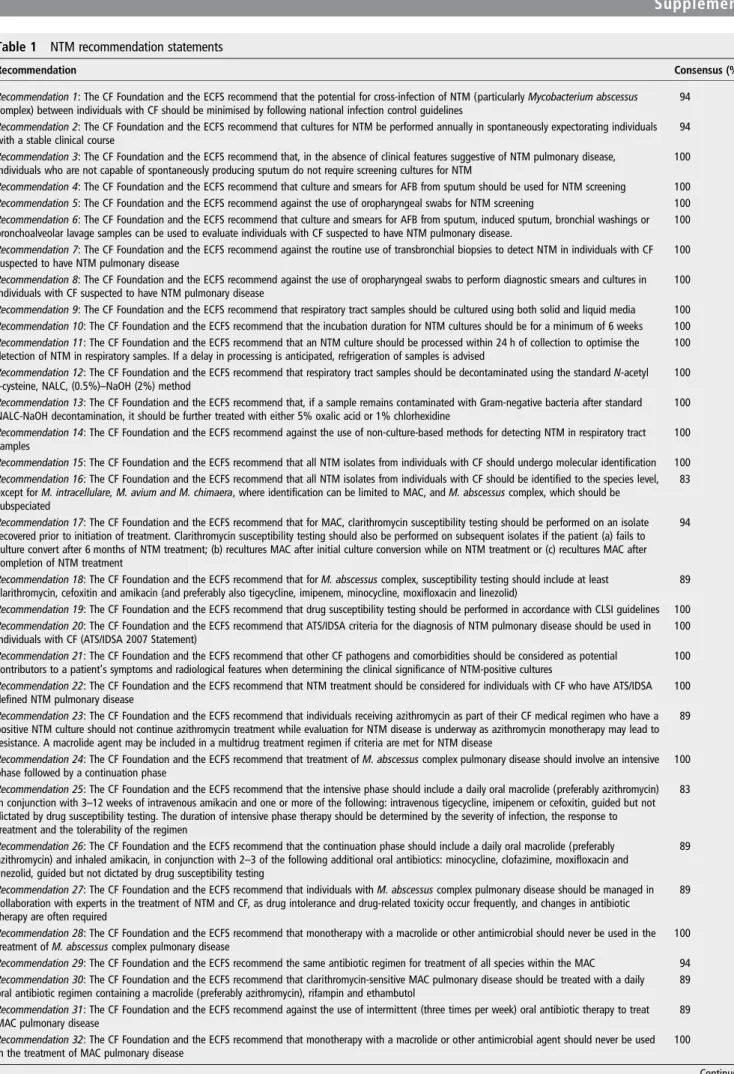
Table 1 NTM recommendation statements
Recommendation Consensus (%)
Recommendation 1: The CF Foundation and the ECFS recommend that the potential for cross-infection of NTM (particularlyMycobacterium abscessus
complex) between individuals with CF should be minimised by following national infection control guidelines
94
Recommendation 2: The CF Foundation and the ECFS recommend that cultures for NTM be performed annually in spontaneously expectorating individuals with a stable clinical course
94
Recommendation 3: The CF Foundation and the ECFS recommend that, in the absence of clinical features suggestive of NTM pulmonary disease, individuals who are not capable of spontaneously producing sputum do not require screening cultures for NTM
100
Recommendation 4: The CF Foundation and the ECFS recommend that culture and smears for AFB from sputum should be used for NTM screening 100
Recommendation 5: The CF Foundation and the ECFS recommend against the use of oropharyngeal swabs for NTM screening 100
Recommendation 6: The CF Foundation and the ECFS recommend that culture and smears for AFB from sputum, induced sputum, bronchial washings or bronchoalveolar lavage samples can be used to evaluate individuals with CF suspected to have NTM pulmonary disease.
100
Recommendation 7: The CF Foundation and the ECFS recommend against the routine use of transbronchial biopsies to detect NTM in individuals with CF suspected to have NTM pulmonary disease
100
Recommendation 8: The CF Foundation and the ECFS recommend against the use of oropharyngeal swabs to perform diagnostic smears and cultures in individuals with CF suspected to have NTM pulmonary disease
100
Recommendation 9: The CF Foundation and the ECFS recommend that respiratory tract samples should be cultured using both solid and liquid media 100
Recommendation 10: The CF Foundation and the ECFS recommend that the incubation duration for NTM cultures should be for a minimum of 6 weeks 100
Recommendation 11: The CF Foundation and the ECFS recommend that an NTM culture should be processed within 24 h of collection to optimise the detection of NTM in respiratory samples. If a delay in processing is anticipated, refrigeration of samples is advised
100
Recommendation 12: The CF Foundation and the ECFS recommend that respiratory tract samples should be decontaminated using the standardN-acetyl
L-cysteine, NALC, (0.5%)–NaOH (2%) method
100
Recommendation 13: The CF Foundation and the ECFS recommend that, if a sample remains contaminated with Gram-negative bacteria after standard NALC-NaOH decontamination, it should be further treated with either 5% oxalic acid or 1% chlorhexidine
100
Recommendation 14: The CF Foundation and the ECFS recommend against the use of non-culture-based methods for detecting NTM in respiratory tract samples
100
Recommendation 15: The CF Foundation and the ECFS recommend that all NTM isolates from individuals with CF should undergo molecular identification 100
Recommendation 16: The CF Foundation and the ECFS recommend that all NTM isolates from individuals with CF should be identified to the species level, except forM. intracellulare, M. avium and M. chimaera, where identification can be limited to MAC, andM. abscessuscomplex, which should be subspeciated
83
Recommendation 17: The CF Foundation and the ECFS recommend that for MAC, clarithromycin susceptibility testing should be performed on an isolate recovered prior to initiation of treatment. Clarithromycin susceptibility testing should also be performed on subsequent isolates if the patient (a) fails to culture convert after 6 months of NTM treatment; (b) recultures MAC after initial culture conversion while on NTM treatment or (c) recultures MAC after completion of NTM treatment
94
Recommendation 18: The CF Foundation and the ECFS recommend that forM. abscessuscomplex, susceptibility testing should include at least clarithromycin, cefoxitin and amikacin (and preferably also tigecycline, imipenem, minocycline, moxifloxacin and linezolid)
89
Recommendation 19: The CF Foundation and the ECFS recommend that drug susceptibility testing should be performed in accordance with CLSI guidelines 100
Recommendation 20: The CF Foundation and the ECFS recommend that ATS/IDSA criteria for the diagnosis of NTM pulmonary disease should be used in individuals with CF (ATS/IDSA 2007 Statement)
100
Recommendation 21: The CF Foundation and the ECFS recommend that other CF pathogens and comorbidities should be considered as potential contributors to a patient’s symptoms and radiological features when determining the clinical significance of NTM-positive cultures
100
Recommendation 22: The CF Foundation and the ECFS recommend that NTM treatment should be considered for individuals with CF who have ATS/IDSA defined NTM pulmonary disease
100
Recommendation 23: The CF Foundation and the ECFS recommend that individuals receiving azithromycin as part of their CF medical regimen who have a positive NTM culture should not continue azithromycin treatment while evaluation for NTM disease is underway as azithromycin monotherapy may lead to resistance. A macrolide agent may be included in a multidrug treatment regimen if criteria are met for NTM disease
89
Recommendation 24: The CF Foundation and the ECFS recommend that treatment ofM. abscessuscomplex pulmonary disease should involve an intensive phase followed by a continuation phase
100
Recommendation 25: The CF Foundation and the ECFS recommend that the intensive phase should include a daily oral macrolide (preferably azithromycin) in conjunction with 3–12 weeks of intravenous amikacin and one or more of the following: intravenous tigecycline, imipenem or cefoxitin, guided but not dictated by drug susceptibility testing. The duration of intensive phase therapy should be determined by the severity of infection, the response to treatment and the tolerability of the regimen
83
Recommendation 26: The CF Foundation and the ECFS recommend that the continuation phase should include a daily oral macrolide (preferably azithromycin) and inhaled amikacin, in conjunction with 2–3 of the following additional oral antibiotics: minocycline, clofazimine, moxifloxacin and linezolid, guided but not dictated by drug susceptibility testing
89
Recommendation 27: The CF Foundation and the ECFS recommend that individuals withM. abscessuscomplex pulmonary disease should be managed in collaboration with experts in the treatment of NTM and CF, as drug intolerance and drug-related toxicity occur frequently, and changes in antibiotic therapy are often required
89
Recommendation 28: The CF Foundation and the ECFS recommend that monotherapy with a macrolide or other antimicrobial should never be used in the treatment ofM. abscessuscomplex pulmonary disease
100
Recommendation 29: The CF Foundation and the ECFS recommend the same antibiotic regimen for treatment of all species within the MAC 94
Recommendation 30: The CF Foundation and the ECFS recommend that clarithromycin-sensitive MAC pulmonary disease should be treated with a daily oral antibiotic regimen containing a macrolide (preferably azithromycin), rifampin and ethambutol
89
Recommendation 31: The CF Foundation and the ECFS recommend against the use of intermittent (three times per week) oral antibiotic therapy to treat MAC pulmonary disease
89
Recommendation 32: The CF Foundation and the ECFS recommend that monotherapy with a macrolide or other antimicrobial agent should never be used in the treatment of MAC pulmonary disease
100
RISK FACTORS
Are there modifiable risk factors for the development of NTM-PD in individuals with CF?
Recommendation 1: The CF Foundation and the ECFS recom-mend that the potential for cross-infection of NTM ( particu-larly MABSC) between individuals with CF should be minimised by following national infection control guidelines. CF-related lung disease is a clear risk factor for the development of NTM-PD and is presumed to relate to the presence of struc-tural lung damage, impaired mucociliary clearance and inflamed airways; all of which are thought to favour the development of chronic NTM infection.55Cystic Fibrosis Transmembrane con-ductance Regulator (CFTR) dysfunction may, of itself, predis-pose to NTM infection (although the pathophysiology is unknown), since rates of heterozygosity for CFTR mutations within the non-CF population with pulmonary NTM disease are high (30–50%).56 57
However, other risk factors that predispose specific indivi-duals with CF to acquire NTM or to develop NTM-PD are, for
the most part, poorly understood, with many studies presenting conflicting results. Potential risk factors for NTM acquisition are listed below.
Lung function
There have been conflicting reports on whether an individual’s spirometry results are related to the likelihood of finding NTM-positive samples, with some studies suggesting no associ-ation with lung function,13a positive association of NTM
acqui-sition with higher FEV1% predicted6or, conversely, with worse
lung function.11 15 30 Support for the possibility that NTM
acquisition is more likely in CF individuals with severe lung disease comes from observations that the prevalence of NTM-positive sputum samples in patients referred for lung transplantation has been reported to be as high as 19.7%.29
Lung infection with specific pathogens
In some studies, individuals with CF with NTM-positive samples are more likely to haveStaphylococcus aureusinfection Table 1 Continued
Recommendation Consensus (%)
Recommendation 33: The CF Foundation and the ECFS recommend that an initial course of intravenous amikacin should be considered for the treatment of MAC pulmonary disease in the presence of one or more of the following:
i. AFB smear positive respiratory tract samples
ii. Radiological evidence of lung cavitation or severe infection iii. Systemic signs of illness
94
Recommendation 34: The CF Foundation and the ECFS recommend that clarithromycin-resistant MAC pulmonary disease should be managed in collaboration with experts in the treatment of NTM and CF
89
Recommendation 35: The CF Foundation and the ECFS recommend that individuals with CF receiving NTM treatment should have expectorated or induced sputum samples sent for NTM culture every 4–8 weeks throughout the entire course of treatment to assess the microbiological response
94
Recommendation 36: The CF Foundation and the ECFS recommend that a schedule for detecting drug toxicity (including hearing loss, visual loss, renal impairment and liver function test abnormalities) should be set in place at the time of NTM treatment initiation and implemented throughout treatment based on the specific drugs prescribed
100
Recommendation 37: The CF Foundation and the ECFS recommend that an HRCT scan of the lungs should be performed shortly before starting NTM treatment and at the end of NTM treatment to assess the radiological response
94
Recommendation 38: The CF Foundation and the ECFS recommend that NTM antibiotic therapy should be prescribed for 12 months beyond culture conversion (defined as three consecutive negative cultures, with the time of conversion being the date of the first of the three negative cultures) as long as no positive cultures are obtained during those 12 months
94
Recommendation 39: The CF Foundation and the ECFS recommend that individuals who fail to culture convert despite optimal NTM therapy may benefit from long-term suppressive antibiotic treatment
94
Recommendation 40: The CF Foundation and the ECFS recommend that, when amikacin is given intravenously or when streptomycin is given intravenously or intramuscularly, serum levels should be monitored and dosing adjusted to minimise ototoxicity and nephrotoxicity
100
Recommendation 41: The CF Foundation and the ECFS recommend against routinely obtaining serum levels of other anti-mycobacterial drugs. However, absorption of oral medications is often reduced in CF. Therefore use of therapeutic drug monitoring should be considered for individuals failing to improve despite taking recommended drug regimens or for those on concomitant medications with significant interactions with NTM drugs
100
Recommendation 42: The CF Foundation and the ECFS recommend against the use of interferonγas adjuvant therapy for NTM pulmonary disease in individuals with CF
89
Recommendation 43: The CF Foundation and the ECFS recommend that vitamin D should be supplemented according to national CF care guidelines 94
Recommendation 44: The CF Foundation and the ECFS recommend that lung resection should only be considered under extraordinary circumstances and in consultation with experts on the treatment of NTM and CF
83
Recommendation 45: The CF Foundation and the ECFS recommend that all individuals with CF being considered for lung transplantation should be evaluated for NTM pulmonary disease
100
Recommendation 46: The CF Foundation and the ECFS recommend that the presence of current or previous respiratory tract samples positive for NTM should not preclude individuals being considered for lung transplantation
94
Recommendation 47: The CF Foundation and the ECFS recommend that individuals with CF who have NTM pulmonary disease and are being evaluated for transplantation should start treatment prior to transplant listing
100
Recommendation 48: The CF Foundation and the ECFS recommend that individuals with CF receiving NTM treatment with sequential negative cultures may be eligible for transplant listing
100
Recommendation 49: The CF Foundation and the ECFS recommend that individuals with CF who have completed treatment for NTM pulmonary disease with apparent eradication of the organism may be eligible for transplant listing
100
Recommendation 50: The CF Foundation and the ECFS recommend that the presence of persistentM. abscessuscomplex or MAC infection despite optimal therapy is not an absolute contraindication to lung transplant referral
94
and less likely to havePseudomonas aeruginosachronic pulmon-ary infection.6 7 58Other studies, however, have reported NTM
positivity associated with higher rates of P. aeruginosa infec-tion,11and variably associated withS. maltophiliainfection.6 58
In contrast, Aspergillus fumigatus has consistently been asso-ciated with the presence of NTM-positive cultures,11 15 59with
some reports indicating an association with allergic bronchopul-monary aspergillosis.7 27 60
Medications
Corticosteroids
The impact of systemic steroids on NTM acquisition is contro-versial. There have been suggestions that steroids may protect against58 or predispose towards NTM infection,60 or may not
influence the risk of NTM acquisition.4 11 12Recent data from non-CF populations, however, have suggested that oral as well as some types of inhaled corticosteroids are associated with increased risk of NTM acquisition.61–63
Proton pump inhibitors
The impact of proton pump inhibitor (PPI) is unclear. PPI use has been reported to be associated with the development of MAC pulmonary disease in non-CF cohorts,64 and may
promote gastrointestinal survival of NTM and subsequent lung infection through gastric aspiration.
Azithromycin
Particular attention has recently been paid to the role of long-term azithromycin use as a risk factor for the acquisition of NTM. In a single centre study of CF adults, Renna et al43 reported increases in annual rates of NTM infection associated with chronic azithromycin use, postulating, through in vitro studies and mouse infection models, that azithromycin blocked autophagic killing of NTM within macrophages. While sup-porting findings from a previous case–control study reporting increased azithromycin use in individuals with NTM,11 other large retrospective studies have shown no such associ-ation.12 13 59 65–67 This includes a recent nested case–control analysis within the CF registry, which suggested long-term azi-thromycin use may protect against infection with NTM.67
Acquisition of NTM through cross-infection
Person-to-person transmission of NTM has traditionally been considered unlikely. Two separate studies have shown that patients, even siblings living in the same household for more than 10 years, have unique strains,7 68 suggesting a lack of person-to-person transmission. However, a case report from the University of Washington described a possible outbreak of M. a. massiliensein five patients48 with potential transmission
occurring during synchronous clinic visits. Recently, whole genome sequencing and antimicrobial susceptibility testing per-formed on 168 consecutive isolates of M. abscessus from 31 patients attending an adult CF centre in the UK revealed fre-quent, probably indirect, transmission of M. a. massiliense between individuals with CF despite conventional cross-infection measures.69 The results of these studies indicate that cross-infection may be an important mechanism for the acquisi-tion of M. abscessus (at least within the CF population). To date, there has been no published evidence suggesting person-to-person transmission of other NTM species.
Other factors extrapolated from data in non-CF populations or studies on M. tuberculosis that might contribute to NTM acquisition in individuals with CF include: low vitamin D,70 71
the presence of gastro-oesophageal reflux disease,64 72low body mass index56 73or malnutrition.74
SCREENING
How often should individuals with CF be screened for NTM?
Recommendation 2: The CF Foundation and the ECFS recom-mend that cultures for NTM be performed annually in spontan-eously expectorating individuals with a stable clinical course.
Recommendation 3: The CF Foundation and the ECFS rec-ommend that, in the absence of clinical features suggestive of NTM-PD, individuals who are not capable of spontaneously producing sputum do not require screening cultures for NTM.
Over the past two decades, a number of expert opinions and reviews have urged routine screening for NTM in the general CF population. However, the optimal frequency and methodo-logy for NTM surveillance in individuals with CF are not known. NTM are common in the environment, and are likely to be transiently introduced on a regular basis into the airways of individuals with CF. More frequent screening will, therefore, result in detection of more positive cultures,11 many of which
will not be associated with the presence of NTM-PD,6 30 58 gen-erating anxiety in patients and caregivers and initiating further ( potentially invasive) investigations. However, signs and symp-toms of NTM disease are often subtle and non-specific, and the diagnosis can be delayed for years or missed altogether in the absence of effective surveillance.4 Furthermore, systematic
screening may help researchers more accurately identify factors influencing poorly understood host susceptibility, acquisition, transmission and virulence of NTM. It is important to empha-sise that screening refers to obtaining samples from individuals with no clinical, microbiological or radiological suspicion of NTM infection, and should be distinguished from strategies to investigate and diagnose NTM disease (covered in Diagnosis of NTM-PD in CF section).
While our understanding of those factors predisposing indivi-duals with CF to NTM infection is incomplete, there is, never-theless, agreement that certain patient populations are at greater risk and therefore probably require more frequent surveillance. These populations include: those with advanced lung disease and previous NTM-positive cultures, and those living in areas with high NTM prevalence. Conversely, in individuals with no recognised risk factors, the prevalence of NTM infection is likely to be low; thus less frequent, perhaps annual, surveillance is warranted. In addition, NTM screening is important before starting long-term azithromycin treatment to avoid inadvertent macrolide monotherapy in individuals with undiagnosed NTM infection (in keeping with published guidelines.75)
How should screening for NTM be performed?
Recommendation 4: The CF Foundation and the ECFS recom-mend that culture and smears for acid-fast bacilli (AFB) from sputum should be used for NTM screening.
Recommendation 5: The CF Foundation and the ECFS rec-ommend against the use of oropharyngeal swabs for NTM screening.
The majority of published reports describing the prevalence of NTM in the CF population utilised AFB smear and culture from sputum as the standard screening method.4 6 7 11 13 17To date,
However, the Consensus Committee felt that, due to its incon-venience, induced sputum collection should not be used as a screening tool in individuals with no features suggestive of NTM-PD who are incapable of spontaneously producing sputum. As discussed in Microbiology section, there are currently no other validated screening methods to detect NTM in indivi-duals with CF. Although positive cultures have been detected through laryngeal suction, oropharyngeal swabs, or gastric aspir-ate, there are insufficient data to support their use. Skin testing for delayed-type hypersensitivity against NTM antigens does not appear sufficiently sensitive or specific to use for surveillance in the CF population. Serological assays, such as IgG against Mycobacterium antigen A60 for NTM surveillance, appear promising,42but have not been validated in the CF population.
MICROBIOLOGY
What respiratory tract samples should be used to evaluate individuals with CF for suspected NTM-PD?
Recommendation 6: The CF Foundation and the ECFS recom-mend that culture and smears for AFB from sputum, induced sputum, bronchial washings or bronchoalveolar lavage samples can be used to evaluate individuals with CF suspected to have NTM-PD.
Recommendation 7: The CF Foundation and the ECFS rec-ommend against the routine use of transbronchial biopsies to detect NTM in individuals with CF suspected to have NTM-PD.
Recommendation 8: The CF Foundation and the ECFS rec-ommend against the use of oropharyngeal swabs to perform diagnostic smears and cultures in individuals with CF suspected to have NTM-PD.
Currently, sputum, induced sputum, bronchial washings and bronchoalveolar lavage samples are routinely used to evaluate individuals for suspected NTM-PD.77Samples for NTM should
be processed for smear microscopy, preferably byfluorescence, and for culture. Microscopy allows for direct evaluation of the bacterial burden, and may indicate false-negative culture results through excessive sample decontamination or overgrowth of conventional bacteria. Oropharyngeal swabs should not be used for the detection of NTM, since they do not consistently provide sufficient material for culture.77
A staged approach should be adopted for obtaining diagnostic samples; testing spontaneously expectorated or induced sputum (if available) before resorting to bronchoscopy. Although there are no published studies comparing the relative performance of these different methods for detection of NTM, the presence of negative sputum samples in individuals with radiological and clinical suspicion of NTM disease should prompt CT-guided bronchoscopic sampling, as, for example, in nodular bronchiec-tatic disease.78–80 While trans-bronchial biopsies can reveal
NTM (on microscopy or culture) and may demonstrate granu-lomatous inflammation (supporting NTM disease rather than transient colonisation), they should not be obtained routinely in individuals with CF given the significant risks of bleeding and pneumothorax.81
How should respiratory tract samples from individuals with CF be cultured for NTM?
Recommendation 9: The CF Foundation and the ECFS recom-mend that respiratory tract samples should be cultured using both solid and liquid media.
Recommendation 10: The CF Foundation and the ECFS rec-ommend that the incubation duration for NTM cultures should be for a minimum of 6 weeks.
Recommendation 11: The CF Foundation and the ECFS rec-ommend that an NTM culture should be processed within 24 h of collection to optimise the detection of NTM in respiratory samples. If a delay in processing is anticipated, refrigeration of samples is advised.
The most sensitive and rapid way to detect viable mycobac-teria is to culture samples (following decontamination to remove conventional bacteria and fungi) in liquid media using an automated growth detection system (such as Mycobacteria Growth Indicator Tube (MGIT)77 82 83); a process widely used
around the world. However, concomitant culture on solid media may increase the diagnostic yield since NTM can be detected despite incomplete sample decontamination.84 Since decontamination procedures substantially reduce the viability of mycobacteria in samples, attempts have been made to use highly selective agar for solid culture of unprocessed sputum. A recent study, using agar designed for Burkholderia cepacia complex culture,84 demonstrated an improvement in detection
of rapidly growing mycobacteria from 0.7% with conventional liquid culture to 2.8%. The duration, both of liquid and solid culture methods, has not been rigorously tested but the vast majority of pathogenic NTM will grow by 6 weeks—the current recommended duration in US and European laboratories.77
Laboratory processing of samples should ideally be performed within 24 h of collection to avoid overgrowth by conventional bacteria, which can reduce NTM viability85and prevent success-ful decontamination.85Studies have shown that refrigeration of
samples may improve NTM detection from sputum samples86 and should be considered if delays longer than 24 h in process-ing are anticipated.
How should respiratory tract samples from individuals with CF be decontaminated to optimise the detection of NTM?
Recommendation 12: The CF Foundation and the ECFS recom-mend that respiratory tract samples should be decontaminated using the standard N-acetyl L-cysteine, NALC, (0.5%)-NaOH (2%) method.
Recommendation 13: The CF Foundation and the ECFS rec-ommend that, if a sample remains contaminated with Gram-negative bacteria after standard NALC-NaOH decontam-ination, it should be further treated with either 5% oxalic acid or 1% chlorhexidine.
Adequate sample decontamination to remove conventional bacteria and fungi is essential to permit culture-based detection of mycobacteria,77 87 88 but often fails in CF samples given high densities of P. aeruginosa and other microbes.39–41 89 90
Since enhanced decontamination protocols adversely impact on NTM viability in samples,90 a two-step approach to sample
processing should be adopted.41Virtually all US and European clinical microbiology laboratories currently use an NALC-NaOH decontamination step prior to mycobacterial culture.41 87 88
The addition of a second decontamination step using oxalic acid has been shown to permit the recovery of NTM from per-sistently contaminated samples albeit with reduced sensitivity.40 Alternatively, use of 1% chlorhexidine as a first step may improve the recovery of mycobacteria, but at the expense of higher rates of residual sample contamination.89 Chlorhexidine
Should non-culture-based methods be used to detect NTM in respiratory tract samples from individuals with CF?
Recommendation 14: The CF Foundation and the ECFS recom-mend against the use of non-culture-based methods for detect-ing NTM in respiratory tract samples.
A number of studies have been published on the use of PCR-based detection methods for NTM from respiratory samples.91–95 To date, however, none have been robustly evalu-ated for CF sputum samples, nor have they demonstrevalu-ated suffi -ciently high sensitivity and specificity on smear-negative samples91 to recommend their routine diagnostic use.
Furthermore, the clinical significance of PCR-positive respira-tory samples is currently unknown.
How should NTM isolates from individuals with CF be identified?
Recommendation 15: The CF Foundation and the ECFS recom-mend that all NTM isolates from individuals with CF should undergo molecular identification.
Recommendation 16: The CF Foundation and the ECFS rec-ommend that all NTM isolates from individuals with CF should be identified to the species level, except forM. intracel-lulare,M. avium and M. chimaera, where identification can be limited to MAC and MABSC, which should be subspeciated.
As individual NTM species differ in their potential to cause clinical disease in humans96 and in their response to specific
antibiotics, correct species identification of NTM isolates is clin-ically important. Moreover, in the case of M. abscessus, the ability to identify isolates to the subspecies level (M. a. abscessus, M. a. bolletii,M. a. massiliense) may predict treatment response97and potentially permit targeted therapy.98 M. a. massiliense harbours a partial erm41 gene deletion, pre-venting inducible macrolide resistance,97 99 and leads to more successful outcomes with macrolide-based antibiotic regimens than in infections withM. a. abscessus(which has a full length, functionalerm41 gene).97
There is no gold standard for NTM species identification. Molecular methods have now surpassed biochemical tests for NTM identification in many laboratories.100–107 Although matrix-assisted laser desorption ionisation-time of flight mass spectrometry has shown promise in providing rapid speciation of NTM,108–112the optimal method for protein extraction from
mycobacteria and the exact discriminatory power of this method have yet to be established.
Among molecular methods, three techniques are in current clinical use. The first includes line probe assays,103–105 113
which are easy to perform but costly, and permits accurate iden-tification of the most frequently encountered NTM species but not subspeciation ofM. abscessus. The second technique is PCR product restriction analysis in which amplified gene fragments are restriction digested to yield different sized fragments, which are then resolved by gel electrophoresis and correlated with spe-cific species.114 This technique is mostly used in low-resource settings and is at least comparable to the line probe assays.106
The third technique is ( partial) gene sequencing, which permits a higher level of discrimination, often to subspecies level, but is only available in laboratories with access to sequencing facilities. The choice of the optimal sequencing strategy is not straightfor-ward. Although partial 16S ribosomal RNA (rRNA) gene sequencing provides insufficient discrimination, particularly between M. abscessus and M. chelonae,115 a number of other gene sequences (such as partial hsp65 and rpoB gene sequences) have been successfully used.107 116For subspeciation of M. abscessus, a multilocus sequence typing approach has
recently been validated.116–118 An alternative strategy close to subspeciation is to measure erm gene associated inducible macrolide resistance by phenotypic drug susceptibility testing (DST). This does not distinguish accurately betweenM. absces-sus subspecies but does offer the data for which the subspecia-tion is generally performed—whether or not there is inducible macrolide resistance.
Should DST be performed on NTM isolates from individuals with CF?
Recommendation 17: The CF Foundation and the ECFS recom-mend that for MAC, clarithromycin susceptibility testing should be performed on an isolate recovered prior to initiation of treat-ment. Clarithromycin susceptibility testing should also be per-formed on subsequent isolates if the patient (a) fails to culture convert after 6 months of NTM treatment; (b) recultures MAC after initial culture conversion while on NTM treatment or (c) recultures MAC after completion of NTM treatment.
Recommendation 18: The CF Foundation and the ECFS rec-ommend that for MABSC, susceptibility testing should include at least clarithromycin, cefoxitin and amikacin (and preferably also tigecycline, imipenem, minocycline, moxifloxacin and linezolid).
Recommendation 19: The CF Foundation and the ECFS rec-ommend that DST should be performed in accordance with CLSI guidelines.
Based on current published data, the exact role of DST and its potential to guide regimen selection and predict outcomes in NTM lung disease in patients with CF, remains unknown.119 The CLSI has published guidelines on DST of NTM.17 120 121
Its European counterpart, the European Committee on Antimicrobial Susceptibility Testing (EUCAST), presently has no guidelines for DST of NTM.77
It is important to appreciate that, although CLSI guidelines provide breakpoint concentrations to interpret minimum inhibi-tory concentrations (MICs) as ‘susceptible’or ‘resistant’, these cut-offs have had very limited clinical validation, and no clinical validation has been performed in patients with CF. Moreover, limited pharmacokinetic (PK) data are now available for MAC lung disease to support breakpoint concentrations,122there are
no representative PK or pharmacodynamic data to guide treat-ment of patients with CF.
Breakpoints for clarithromycin susceptibility of MAC have been validated in HIV-related disseminated MAC disease and in retrospective series of MAC lung disease.119 123 124 Since the presence of macrolide resistance predicts worse clinical out-comes125 126and requires augmented treatment,126 susceptibil-ity to macrolides should be tested on isolates prior to treatment initiation and during treatment in refractory cases defined as those individuals who (1) fail to culture convert after 6 months of NTM treatment; (2) reculture MAC after initial culture con-version while on NTM treatment or (3) reculture MAC after completion of NTM treatment.
A very recent study has shown that amikacin MICs >64 mg/L are measured only in MAC isolates that have mutations asso-ciated with amikacin resistance, that is, in the 16S rRNA gene. These strains are cultured from patients with significant amino-glycoside exposure, such as individuals with CF, and for disease caused by these strains, amikacin is unlikely to have any benefi -cial effect.127
outcomes of macrolide-based treatment are generally poor and do not correlate well with in vitro susceptibilities119 129
poten-tially due to erm41-dependent inducible macrolide resistance and relative short duration of adequate regimens, which were often interrupted because of toxicity. Indeed, in the absence of a functional erm41 gene, response to macrolide-containing
treat-ments has been good.94 The CLSI has recommended routine testing for inducible macrolide resistance by performing extended incubation of isolates in the presence of clarithromy-cin, as inducible resistance may predict treatment failure.120For
M. simiae, the role of DST is unknown, although the generally poor outcomes of treatment have been correlated with a lack of synergistic activity between rifampicin and ethambutol, an in vitro observation that still awaits clinical validation.130 Some
molecular methods to assess drug susceptibility exist, but are not yet routinely available. For example, sequencing of the 16S rRNA and 23S rRNA genes can reveal mutations associated with high-level resistance to aminoglycosides and macrolides, respectively.119 127
DIAGNOSIS OF NTM-PD IN CF
Should the ATS/IDSA criteria for the diagnosis of NTM-PD be used in individuals with CF?
Recommendation 20: The CF Foundation and the ECFS recom-mend that ATS/IDSA criteria for the diagnosis of NTM-PD should be used in individuals with CF (ATS/IDSA 2007 Statement).
Recommendation 21: The CF Foundation and the ECFS rec-ommend that other CF pathogens and comorbidities should be considered as potential contributors to a patient’s symptoms and radiological features when determining the clinical signifi -cance of NTM-positive cultures.
Recommendation 22: The CF Foundation and the ECFS rec-ommend that NTM treatment should be considered for indivi-duals with CF who have ATS/IDSA defined NTM-PD.
Recommendation 23: The CF Foundation and the ECFS rec-ommend that individuals receiving azithromycin as part of their CF medical regimen who have a positive NTM culture should not continue azithromycin treatment while evaluation for NTM disease is underway, as azithromycin monotherapy may lead to resistance. A macrolide agent may be included in a multidrug treatment regimen if criteria are met for NTM disease.
In contrast to M. tuberculosis, a single positive culture of NTM does not necessarily indicate that an individual has NTM-PD. To address the difficulty of making a diagnosis of NTM-PD, the ATS/IDSA proposed a set of clinical, radiological and microbiological criteria required to define an individual as having NTM-PD (ref22; box 1). Although these criteria have not been validated for individuals with CF, they have been widely adopted by NTM specialists around the world and provide an operational definition for NTM-PD, which supports clinical decision-making and facilitates research. The Statements Committee therefore concluded that, in the absence of an alter-nate, CF-validated definition, the ATS/IDSA criteria should be used for the definition of NTM-PD in individuals with CF.
Microbiological criteria for NTM-PD
Individuals should have two or more positive sputum cultures of the same NTM species or one positive culture from broncho-scopic lavage or wash. The threshold for the number of positive sputum samples is derived from an observational study of individuals without CF with MAC in which 98% individuals with at least two positive sputum cultures developed progressive radiographic change compared to only 2% with one positive
culture.131The type of NTM species isolated is also important. Thus, isolation of M. abscessus is more likely to reflect NTM-PD than culturing usually non-pathogenic species such as M. gordonaeandM. terraecomplex.
Radiological criteria for NTM-PD
In the context of CF-related lung disease, a chest radiograph is unlikely to be of use for the investigation of NTM-PD. High-resolution CT (HRCT) scan changes supporting a diagno-sis of NTM-PD would include: inflammatory nodules, new tree-in-bud opacities ( particularly in areas of mild underlying bronchiectasis) and cavitation.132 However, these changes are non-specific, particularly in individuals with severe CF-related lung disease, and may reflect infection with more common CF pathogens, inadequate airway clearance or the development of allergic bronchopulmonary aspergillosis (ABPA).
Clinical criteria for NTM-PD
NTM-PD should be suspected in individuals with worsening respiratory symptoms (breathlessness, increased cough and sputum production) and/or declining pulmonary function tests that do not respond to antibiotic therapy targeting conventional CF-associated bacteria and optimised airway clearance. Night sweats, fevers, chest pains and weight loss (although uncom-mon) may also suggest possible NTM-PD.
NTM treatment should be considered in individuals with CF who fulfil ATS/IDSA criteria for NTM-PD. However, the deci-sion to start treatment is a clinical one based on an
Box 1 ATS/IDSA clinical and microbiologic criteria for diagnosing non-tuberculous mycobacterial pulmonary disease (NTM-PD) (based on ref22)
Clinical (both required)
1. Pulmonary symptoms with nodular or cavitary opacities on chest radiograph, or a high-resolution CT scan that shows multifocal bronchiectasis with multiple small nodules. 2. Appropriate exclusion of other diagnoses.
Microbiologic (one of the following required)
1. Positive culture results from at least two expectorated sputum samples. If the results from samples are non-diagnostic, consider repeat sputum acid-fast bacilli (AFB) smears and cultures.
2. Positive culture results from at least one bronchial wash or lavage.
3. Transbronchial or other lung biopsy with mycobacterial histopathological features (granulomatous inflammation or AFB) and positive culture for NTM or biopsy showing mycobacterial histopathological features (granulomatous inflammation or AFB) and one or more sputum or bronchial washings that are culture positive for NTM.
A. Expert consultation should be obtained when either infrequently encountered NTM or those usually
representing environmental contamination are recovered. B. Patients who are suspected of having NTM-PD but who
do not meet the diagnostic criteria should be followed until the diagnosis isfirmly established or excluded. C. Making the diagnosis of NTM-PD does not, per se,
amalgamation of patient factors, the NTM species involved, the risks of treatment side effects, adherence concerns and the expected outcomes of treatment.
Recommended clinical practice for diagnosis
A suggested algorithm for the investigation of individuals with CF suspected of having NTM-PD is shown infigure 1.
When being investigated for potential NTM-PD, individuals should discontinue drugs liable to compromise NTM culture (such as macrolides, fluoroquinolones, aminoglycosides, co-trimoxazole, linezolid and doxycycline) prior to sputum sample collection. In the case of azithromycin, intracellular accumulation within phagocytes may require a washout period of 2 weeks or more to allow for drug clearance.133 134 If sputum samples are persistently culture negative, but clinical or radiological suspicion of NTM-PD remains, bronchoscopy with targeted sampling of areas with suggestive HRCT changes may be indicated. Individuals receiving azithromycin as part of their CF medical regimen, who have a positive surveillance NTM culture, should not continue azithromycin treatment while evaluation for NTM disease is underway, as azithromycin mono-therapy may lead to the development of macrolide resistance.
Other CF pathogens and comorbidities should be considered as potential contributors to a patient’s symptoms and radio-logical features when determining the clinical significance of NTM-positive cultures. All aspects of CF care should be reviewed and optimised in order to determine the clinical sig-nificance of NTM in the sputum. Specifically, consider a trial of NTM-sparing intravenous antibiotics (ie, avoid carbapenems, cefoxitin, tigecycline,fluoroquinolones, linezolid and amikacin) that target conventional bacteria; and assess for CF-related dia-betes, uncontrolled gastrointestinal reflux disease, and clinical and immunological features of ABPA. Likewise, adequate
treatment of sinus disease, nutritional support and effective airway clearance strategies should be implemented.
Before starting NTM treatment, side effects, the importance of adherence to therapy and complications of treatment should be discussed with patients, and these discussions documented in the medical notes. Discussion of the risk of treatment failure should be clearly documented.
TREATMENT
Which antibiotic regimen should be used in individuals with CF who have ATS/IDSA-defined MABSC pulmonary disease?
Recommendation 24: The CF Foundation and the ECFS recom-mend that treatment of MABSC pulmonary disease should involve an intensive phase followed by a continuation phase.
Recommendation 25: The CF Foundation and the ECFS rec-ommend that the intensive phase should include a daily oral macrolide ( preferably azithromycin) in conjunction with 3– 12 weeks of intravenous amikacin and one or more of the fol-lowing: intravenous tigecycline, imipenem or cefoxitin, guided but not dictated by DST. The duration of intensive phase therapy should be determined by the severity of infection, the response to treatment and the tolerability of the regimen.
Recommendation 26: The CF Foundation and the ECFS rec-ommend that the continuation phase should include a daily oral macrolide ( preferably azithromycin) and inhaled amikacin, in conjunction with 2–3 of the following additional oral antibio-tics: minocycline, clofazimine, moxifloxacin and linezolid, guided but not dictated by DST.
Recommendation 27: The CF Foundation and the ECFS rec-ommend that individuals with MABSC pulmonary disease should be managed in collaboration with experts in the treat-ment of NTM and CF, as drug intolerance and drug-related
toxicity occur frequently, and changes in antibiotic therapy are often required.
Recommendation 28: The CF Foundation and the ECFS rec-ommend that monotherapy with a macrolide or other anti-microbial should never be used in the treatment of MABSC pulmonary disease.
There are no published randomised controlled trials evaluat-ing treatment outcomes in individuals with M. abscessus pul-monary infections. Current treatment recommendations from the ATS and IDSA recommend consideration of a multidrug treatment regimen, but note that long-term sputum conversion is difficult to achieve and thus, alternative goals such as symp-tomatic improvement, radiographic regression of opacities or microbiological improvement, may be more realistic.26 The
ATS/IDSA recommendations were based primarily on a single large study of 154 patients with lung disease caused by rapidly growing mycobacteria, in which more than 80% of patients were infected by M. abscessus.135 Treatment outcomes were
extremely poor; however, the patients did not receive the cur-rently recommended combination of antibiotics.
Since the publication of the last ATS/IDSA guidelines,26there have been several studies that reported treatment outcomes in individuals without CF with pulmonary disease due to M. abscessus. Jeon et al136 described treatment outcomes in 65
non-CF adults, in South Korea, withM. abscessuslung disease, who received a standardised treatment regimen. The regimen included 4 weeks of amikacin (15 mg/kg/day in two divided doses) and cefoxitin (200 mg/kg/day in three divided doses) along with clarithromycin (1000 mg/day in two divided doses), ciprofloxacin (1000 mg/day in two divided doses) and doxycyc-line (200 mg/day in two divided doses). The total duration of therapy was 24 months and at least 12 months after sputum culture conversion. Fifty-four (83%) patients responded with improved symptoms and 48 (74%) with improved HRCTfi nd-ings. Sputum conversion and maintenance of negative sputum cultures for more than 12 months was achieved in 38 (58%) patients. This rate was significantly lower (17%) in patients whose isolates were resistant to clarithromycin. In contrast, in the 14 (22%) patients who underwent resectional surgery, nega-tive sputum cultures were achieved and maintained in 7 (88%) of 8 with preoperatively positive cultures. The authors con-cluded that a standardised regimen was moderately effective, but adverse reactions were frequent.
Among 107 patients withM. abscessus pulmonary infection at National Jewish Health in Denver, CO, 69 non-CF indivi-duals were treated and followed for a mean duration of 34 months.129 Patients were treated with individualised treatment regimens following ATS/IDSA recommendations. Twenty (29%) patients remained culture positive, 16 (23%) converted but experienced relapse, 33 (48%) converted to negative and did not relapse, while 17 (16%) died during the study period. There were significantly more surgical patients than medical patients whose culture converted and remained negative for at least 1 year (57% vs 28%, p=0.022). As in the previous study from South Korea, surgery may have been beneficial. However, surgical management is less likely to be applicable in individuals with CF in whom focal pulmonary disease is uncommon.
In a follow-up study, Kohet al97 reported significant
differ-ences in outcomes based on which subspecies of M. abscessus was causing the infection. Treatment response rates to a standar-dised multidrug regimen were much higher in patients with M. a. massiliense than in those with M. a. abscessus: sputum culture conversion occurred in 88% of patients with M. a. massiliense compared with 25% with M. a. abscessus
( p<0.001). All of the M. a. abscessusisolates contained a full length, functional erm41 that was shown to result in inducible
macrolide resistance when the isolates were incubated with clari-thromycin. In contrast, the MIC ofM. a. massiliensestrains did not increase after incubation with the macrolide agent because theerm41 gene contained a deletion, making it non-functional.
Recent data from this same group of investigators have indicated that clarithromycin is a much stronger inducer of erm41 than
azithromycin, suggesting that the latter macrolide may be a better choice when treatingM. a. abscessusinfections.98
Despite the clinical significance ofM. abscessuslung infection in patients with CF, data on treatment outcomes are extremely limited. There is one anecdotal report that describes eradication of M. abscessus in an individual with CF who received a pro-longed course of therapy with alternating month inhaled amika-cin plus oral clarithromyamika-cin.137However, this appears to be an
uncommon outcome in practice. A recent case series of 52 indi-viduals, including 15 with CF, withM. abscessusand/orM. che-lonaeinfection, suggests that tigecycline-based regimens may be of benefit, with 10/15 individuals with CF showing some improvement.138
Recommended clinical practice for antibiotic treatment for
M. abscessuspulmonary disease in CF
A typical treatment schedule for individuals with CF with M. abscessus infection is shown in figure 2. Antibiotic dosing regimens are listed intable 2with important side effects/toxici-ties described intable 3.
Given the lack of clinical trial data to inform treatment deci-sions there is a lot of variation in how patients are treated. An initial intensive phase is typically used to rapidly decrease the bacterial load. A combination of two intravenous drugs with demonstrated in vitro activity is administered for several weeks to months in combination with one or more oral drugs. Intravenous drug regimens of amikacin with cefoxitin and/or imipenem and/or tigecycline are the most commonly used com-binations. Oral drugs with demonstrated in vitro activity include the macrolides (clarithromycin and azithromycin), linezolid, clo-fazimine and, occasionally, ciprofloxacin and/or moxifloxacin. After the intensive phase of therapy, patients are usually treated with at least two oral drugs in addition to a macrolide with or without inhaled antibiotics.
However, there is growing concern that treatment of M. abscessus isolates that have either a functional erm41 gene
(resulting phenotypically in inducible macrolide resistance) or a 23S rRNA mutation (leading to high level constitutive macrolide resistance) may be compromised by switching from intravenous to oral therapy (given the relatively poor efficacy of oral antibio-tics) and, therefore, continuous/very extended intravenous therapy with two or more effective antibiotics may be indicated in these cases.
The choice of intravenous agents is based on in vitro activity and the toxicity profile of the drug. In addition to amikacin, imi-penem is perhaps the best choice as companion intravenous therapy; the drug shows in vitro activity and the side effect profile is better than that of cefoxitin and tigecycline. In the study reported by Jeonet al,13660% of the patients started on cefoxitin had to have the drug discontinued due to drug-related toxicity, after a median of 22 days of treatment. Neutropaenia occurred in 51% and thrombocytopaenia in 6% of patients on cefoxitin. Tigecycline has a low MIC againstM. abscessusand showed effi -cacy againstM. abscessusin combination.138However, it is
There are few oral drugs with significant in vitro activity against M. abscessus; the macrolides are the only oral drugs with consistent activity although their use may be potentially limited by inducible resistance (as described above) or acquired point mutations in the 23S rRNA. There are no clinical trials comparing azithromycin to clarithromycin inM. abscessus infec-tion, so the choice of which macrolide to use is typically based on the in vitro activity, side effects profile and consideration of drug interactions. Clarithromycin has slightly better in vitro activity than azithromycin but there are conflicting reports regarding the impact of erm41 gene expression with each of these drugs.98 139 140Clarithromycin is a stronger inhibitor of
the P450 enzyme system than is azithromycin, so drug interac-tions are more common.
Linezolid shows in vitro activity in approximately 50% of M. abscessus isolates (although there is considerable geograph-ical variation); however, haematologgeograph-ical (anaemia, thrombocyto-paenia) and neurological ( peripheral neuropathy, optic neuritis) toxicities are common, particularly when linezolid is dosed 600 mg two times a day for prolonged courses. For this reason, many practitioners give 600 mg once daily to reduce the risk of adverse effects. However, care should be exercised in individuals chronically co-infected with methicillin-resistantStaphylococcus aureus(MRSA) since long-term linezolid therapy may encourage MRSA resistance. Thefluoroquinolones and minocycline/doxy-cycline rarely show in vitro activity although they were included in the standardised treatment regimen used in the report by Jeonet al.98 Finally, clofazimine has significant in vitro activity
against M. abscessus.141 However, this drug, used to treat leprosy, is not readily available in the USA at this time, although
it can be obtained with an IRB-approved protocol through sub-mission of an individual patient use IND to the Food and Drug Administration. Instructions for this process can be found on the NTM Info and Research, Inc, website (http://www.ntminfo. org/clofazimine).
The lack of oral antibiotics with activity againstM. abscessus has led clinicians to use inhaled amikacin, usually during the continuation phase of therapy. There are no studies correlating treatment outcomes in patients withM. abscessusinfection with the dose of inhaled amikacin and, therefore, there is a great deal of variation in the dose used (250–500 mg), and frequency of administration (daily to twice daily). A recent study, targeting treatment refractory NTM patients, most of whom were without CF with M. abscessus, evaluated the effect of adding inhaled amikacin to their oral and/or intravenous drug regi-mens.142 Among the 20 patients with persistently positive
cul-tures, 8 (40%) had at least one negative culture and 5 (25%) had persistently negative cultures after addition of inhaled ami-kacin. Inhaled amikacin was stopped in 7 (35%) due to toxicity. There is currently significant interest in the potential use of a liposomal formulation of amikacin (which may improve drug delivery within the lung and into infected macrophages) as part of a multidrug regimen for bothM. abscessusand MAC. Large multicentre studies are ongoing.
The optimum duration of therapy is not known. Based on studies in individuals without CF, even prolonged treatment regimens were associated with high rates of failure and recur-rence. Many patients who do not convert their cultures to nega-tive on therapy may still benefit from continuing or repeating courses of treatment.
Figure 2 Typical treatment schedules for individuals with CF withMycobacterium abscessusor MAC pulmonary disease. (A)M. abscessus
treatment is divided into an initial intensive phase with an oral macrolide ( preferably azithromycin) and intravenous amikacin with one or more additional intravenous antibiotics (tigecycline, imipenem, cefoxitin) for 3–12 weeks (depending on severity of infection, response to treatment, and the tolerability of the regimen), followed by a continuation phase of oral macrolide ( preferably azithromycin) and inhaled amikacin with 2–3 additional antibiotics (minocycline, clofazimine, moxifloxacin, linezolid). Antibiotic choices should be guided but not dictated by drug susceptibility testing. Baseline and interval testing for drug toxicity is essential (B). MAC treatment (for clarithromycin-sensitive disease) should be with a daily oral macrolide ( preferably azithromycin), rifampin and ethambutol. An initial course of injectable amikacin or streptomycin should be considered in the presence of (i) AFB smear positive respiratory tract samples, (ii) radiological evidence of lung cavitation or severe infection and (iii) systemic signs of illness. Baseline and interval testing for drug toxicity is essential (AFB, acid-fast bacilli; CF, cysticfibrosis; HRCT, high-resolution CT; MAC,
Treatment for MAC
Which antibiotic regimen should be used in individuals with CF who have ATS/IDSA-defined MAC pulmonary disease?
Recommendation 29: The CF Foundation and the ECFS recom-mend the same antibiotic regimen for treatment of all species within the MAC.
Recommendation 30: The CF Foundation and the ECFS rec-ommend that clarithromycin-sensitive MAC pulmonary disease should be treated with a daily oral antibiotic regimen containing a macrolide ( preferably azithromycin), rifampin and ethambutol.
Recommendation 31: The CF Foundation and the ECFS
recommend against the use of intermittent (three times per week) oral antibiotic therapy to treat MAC pulmonary disease.
Recommendation 32: The CF Foundation and the ECFS rec-ommend that monotherapy with a macrolide or other anti-microbial agent should never be used in the treatment of MAC pulmonary disease.
Recommendation 33: The CF Foundation and the ECFS
recommend that an initial course of intravenous amikacin should be considered for the treatment of MAC pulmonary disease in the presence of one or more of the following: (i) AFB smear positive respiratory tract samples, (ii) radiological evi-dence of lung cavitation or severe infection and (iii) systemic signs of illness.
Recommendation 34: The CF Foundation and the ECFS rec-ommend that clarithromycin-resistant MAC pulmonary disease should be managed in collaboration with experts in the treat-ment of NTM and CF.
Table 2 Antibiotic-dosing regimens used to treatMycobacterium aviumcomplex andMycobacterium abscessuscomplex pulmonary disease in cystic fibrosis
Antibiotic Route Dose suitable for children/adolescents Dose suitable for adults
Amikacin* Intravenous Children: 15–30 mg/kg/dose once daily
Adolescents: 10–15 mg/kg/dose once daily Maximum dose 1500 mg daily
10–30 mg/kg once daily or
15 mg/kg/day in two divided doses Daily to 3× weekly dosing
Amikacin*†‡ Nebulised 250–500 mg/dose once or twice daily 250–500 mg once or twice daily
Azithromycin Oral Children: 10–12 mg/kg/dose once daily
Adolescents: adult dosing regimen Maximum dose 500 mg
250–500 mg once daily
Cefoxitin Intravenous 50 mg/kg/dose thrice daily (maximum dose 12 g/day) 200 mg/kg/day in three divided doses (maximum
dose 12 g/day)
Clarithromycin Oral 7.5 mg/kg/dose twice daily (maximum dose 500 mg) 500 mg twice daily§
Clarithromycin Intravenous Not recommended 500 mg twice daily§
Clofazimine†¶ Oral 1–2 mg/kg/dose once daily (maximum dose 100 mg) 50–100 mg once a day
Co-trimoxazole (sulfamethoxazole and trimethoprim)
Oral 10–20 mg/kg/dose twice daily 960 mg twice daily
Co-trimoxazole (sulfamethoxazole and Trimethoprim)
Intravenous 10–20 mg/kg/dose twice daily 1.44 g twice daily
Ethambutol Oral Infants and children: 15 mg/kg/dose once daily
Adolescents: 15 mg/kg/dose once daily
15 mg/kg once daily
Imipenem Intravenous 15–20 mg/kg/dose twice daily (maximum dose 1000 mg) 1 g twice daily
Linezolid** Oral <12 years old: 10 mg/kg/dose thrice daily
12 years and older: 10 mg/kg/dose once or twice daily (maximum dose 600 mg)
600 mg once or twice daily
Linezolid** Intravenous <12 years old: 10 mg/kg/dose thrice daily
12 years and older: 10 mg/kg/dose once or twice daily (maximum dose 600 mg)
600 mg once or twice daily
Moxifloxacin Oral 7.5–10 mg/kg/dose once daily (maximum dose 400 mg daily) 400 mg once daily
Minocycline Oral 2 mg/kg/dose once daily (maximum dose 200 mg) 100 mg twice daily
Rifampin (Rifampicin) Oral 10–20 mg/kg/dose once daily (maximum dose 600 mg) <50 kg 450 mg once daily >50 kg 600 mg once daily
Rifabutin Oral 5–10 mg/kg/dose once daily (maximum dose 300 mg) 150–300 mg once daily
150 mg if patient taking strong CYP3A4 inhibitor 450–600 mg if patient taking strong CYP3A4 inducer
Streptomycin* Intramuscular/
intravenous
20–40 mg/kg/dose once daily (maximum dose 1000 mg) 15 mg/kg once daily (maximum dose 1000 mg)
Tigecycline†,†† Intravenous 8–11 years: 1.2 mg/kg/dose twice daily (maximum dose 50 mg)
12 years and older: 100 mg loading dose and then 50 mg once or twice daily
100 mg loading dose and then 50 mg once or twice daily
*Adjust dose according to levels. Usually, starting dose is 15 mg/kg aiming for a peak level of 20–30mg/mL and trough levels of <5–10 micrograms/ml. †As tolerated.
‡Mixed with normal saline.
§For individuals under 55 kg, many practitioners recommend 7.5 mg/kg twice daily. ¶Only available in the USA through an IND application to the FDA.
**Usually given with high dose (100 mg daily) pyridoxine (vitamin B6) to reduce risk of cytopaenias.