doi:10.1093/ntr/ntw294 Original investigation Advance Access publication January 28, 2017
© The Author 2017. Published by Oxford University Press on behalf of the Society for Research on Nicotine and Tobacco. All rights reserved. For permissions, please e-mail: [email protected].
401
Original investigation
A Genetic Epidemiological Mega Analysis of
Smoking Initiation in Adolescents
Hermine H. Maes PhD
1,2,3,4, Elizabeth Prom-Wormley MPH, PhD
1,5,
Lindon J. Eaves PhD
1,2,PhD Soo Hyun Rhee PhD
6, John K. Hewitt PhD
6,
Susan Young PhD
6,7, Robin Corley PhD
6, Matt McGue PhD
8,
William G. Iacono PhD
8, Lisa Legrand PhD
8, Diana R. Samek PhD
8,9,
E. Lenn Murrelle PhD
10, Judy L. Silberg PhD
1,2, Donna R. Miles PhD
11,
Richard M. Schieken MD
12, Gaston P. Beunen PhD
4, Martine Thomis PhD
4,
Richard J. Rose PhD
13, Danielle M. Dick PhD
2,14, Dorret I. Boomsma PhD
15,
Meike Bartels PhD
16, Jacqueline M. Vink PhD
15,16, Paul Lichtenstein PhD
17,
Victoria White PhD
18, Jaakko Kaprio MD, PhD
19,20, Michael C. Neale PhD
1,2 1Department of Human and Molecular Genetics, Virginia Institute for Psychiatric and Behavioral Genetics, Virginia Commonwealth University, Richmond, VA; 2Department of Psychiatry, Virginia Institute for Psychiatric and Behavioral Genetics, Virginia Commonwealth University, Richmond, VA; 3Massey Cancer Center, Virginia Commonwealth University, Richmond, VA; 4Department of Kinesiology, KU Leuven, Leuven, Belgium; 5Division of Epidemiology, Department of Family Medicine and Population Health, Virginia Commonwealth University, Richmond, VA; 6Institute for Behavioral Genetics, University of Colorado, Boulder, CO; 7Department of Psychiatry, University of Colorado, Denver, CO; 8Department of Psychology, University of Minnesota, Minneapolis, MN; 9Human Development and Family Studies Department, Auburn University, Auburn, AL; 10Venebio Group, LLC, Richmond, VA; 11Carolina Population Center, University of North Carolina at Chapel Hill, Chapel Hill, NC; 12Department of Pediatric Cardiology, Virginia Commonwealth University, Richmond, VA; 13Department of Psychological and Brain Sciences, Indiana University, Bloomington, IN; 14Department of Psychology, Virginia Commonwealth University, Richmond, VA; 15Department of Biological Psychology, VU University, Amsterdam, The Netherlands; 16Behavioural Science Institute, Radboud University, Nijmegen, The Netherlands; 17Department of Medical Epidemiology and Biostatistics, Karolinska Institutet, Stockholm, Sweden; 18Centre for Behavioural Research in Cancer, Cancer Council Victoria, Melbourne, Australia; 19Department of Public Health and Institute for Molecular Medicine (FIMM), University of Helsinki, Helsinki, Finland; 20Department of Health, National Institute for Health and Welfare, Helsinki, FinlandCorresponding Author: Hermine H. Maes, PhD, Virginia Institute for Psychiatric and Behavioral Genetics, PO Box 980033, Richmond, VA 23298-0033, USA. Telephone: 804-828-8145; Fax: 804-828-8801; E-mail: [email protected]
Abstract
Introduction: Previous studies in adolescents were not adequately powered to accurately disen-tangle genetic and environmental influences on smoking initiation (SI) across adolescence.
Results: Although prevalences differed between samples, twin correlations did not, suggesting similar etiology of SI across developed countries. The estimate of additive genetic contributions to liability of SI increased from approximately 15% to 45% from ages 13 to 19. Correspondingly, shared environmental factors accounted for a substantial proportion of variance in liability to SI at age 13 (70%) and gradually less by age 19 (40%).
Conclusions: Both additive genetic and shared environmental factors significantly contribute to variance in SI throughout adolescence. The present study, the largest genetic epidemiological study on SI to date, found consistent results across 11 studies for the etiology of SI. Environmental factors, especially those shared by siblings in a family, primarily influence SI variance in early adolescence, while an increasing role of genetic factors is seen at later ages, which has important implications for prevention strategies.
Implications: This is the first study to find evidence of genetic factors in liability to SI at ages as young as 12. It also shows the strongest evidence to date for decay of effects of the shared envi-ronment from early adolescence to young adulthood. We found remarkable consistency of twin correlations across studies reflecting similar etiology of liability to initiate smoking across differ-ent cultures and time periods. Thus familial factors strongly contribute to individual differences in who starts to smoke with a gradual increase in the impact of genetic factors and a corresponding decrease in that of the shared environment.
Introduction
Smoking remains a serious public health problem. Briefly, tobacco smoking is associated with increased morbidity, mortality, personal, and public cost, even after 50 years since the first Surgeon General’s report.1 Tobacco kills nearly 6 million people each year, of whom
more than five million are users and ex-users and more than 600 000 are nonsmokers exposed to secondhand smoke.2 In the United
States, smoking is responsible for 69% and 74% of all cancer deaths and 69% and 61% of deaths from cardiovascular disease in female and male smokers, respectively.3 Up to half of current users will
eventually die of a tobacco-related cause.2
According to the Surgeon General’s report on “Preventing Tobacco Use Among Youth and Young Adults,” “…evidence is sug-gestive that tobacco use is a heritable trait, more so for regular use than for onset.” The expression of genetic risk for smoking among young people may be moderated by small group and larger social-environmental factors.4 The editorial from JAMA in 19645 seems
like it could have been written today. Its statements “Why some teenagers smoke and others do not is not fully understood” and “… reduction or elimination of cigarette smoking can only be achieved if today’s nonsmokers never start” remain true. Given tobacco use and addiction6—which can occur quickly with smoking as few as
100 cigarettes4—almost always begins before age 18, efforts must
be directed toward adolescents and even younger children. Even though substantial reductions in smoking rates have occurred in some countries,7 the number of smokers worldwide is still
increas-ing. That the largest reduction in daily smoking between 1980 and 2012 was among 15- to 19-year olds8 is encouraging but gains are
still modest.
Twin studies have consistently found a significant genetic compo-nent to the liability to smoking initiation (SI) and nicotine depend-ence.9 Recent reviews10,11 show heritability estimates for SI from 40%
to 70% with family environmental influences more pronounced in adolescence than in adulthood.12–20 Furthermore, there is evidence
for overlapping genetic and environmental risk factors between SI and nicotine dependence in adults21,22 suggesting that partly the
same genes contribute to liability to SI and nicotine dependence. This evidence for a correlated liability of SI and nicotine dependence
makes it more important to study SI as a necessary stage to nicotine addiction.23,24
Previous studies of SI in adolescence have been unable to accu-rately assess the role of shared environmental factors in the develop-ment of smoking behavior for several reasons. First, most studies were underpowered for estimating shared environmental influences in the presence of genetic factors.25 Thus, while evidence for familial
resemblance may be strong, sample sizes are often too small to dis-tinguish between shared environmental and genetic factors. Second, given the need for large samples for genetic studies of binary traits, data from different ages and cohorts are often combined, which can overestimate contributions of shared environmental factors for traits correlated with age.23,26 This problem is exacerbated by low
preva-lence of SI in early adolescence, reducing power of individual stud-ies. We use prevalence here to refer to lifetime prevalence of having initiated smoking.
In this report, we attempt to address these concerns by per-forming a mega-analysis by pooling data from available adolescent prospective longitudinal twin studies with data on SI. Substantial sample sizes are available for all ages throughout adolescence which allows, for the first time, familial resemblance of SI to be separated into genetic and shared environmental factors. Our aims are to: (1) estimate prevalence of SI across adolescence and test heterogeneity across samples; (2) estimate twin correlations for SI and test their equivalence across samples by age; (3) estimate contributions of genetic, shared environmental, and specific environmental factors to liability of SI at every age across adolescence; and (4) test for sex differences.
Methods
SubjectsSamples are organized by continent, starting in North America, followed by Europe and Australia, alphabetically by abbreviation. Participating studies were approved by their respective human sub-jects protection committees. Inclusion criteria were availability of population-based adolescent twin data on smoking.
Measures
Data were collected via questionnaire or personal interview. For the pur-poses of this report, we focused on ever use of tobacco, thus including those who have experimented with tobacco by trying just one or a few cigarettes. We use the term “smoking initiation” as it has been widely used in genetic epidemiologic studies of smoking behavior. SI was coded 0/1 and defined according to responses to questions like “Have you ever smoked cigarettes or tried any form of tobacco?”. Exact word-ing of questions, and codword-ing of answers is presented in Supplementary Appendix 1. Two studies (CardioVascular Twin Study and Leuven Longitudinal Twin Study) asked “Have you ever smoked at least 100 cigarettes in your life?” thus requiring a higher threshold for SI.
Statistical Approach
Structural equation models were fit to the twin data, in order to esti-mate the proportions of variance of additive genetic (A), shared (C), and unique (E) environmental factors contributing to individual dif-ferences in liability to SI, using the statistical package OpenMx.27,28
In brief, greater similarity of monozygotic (MZ) than dizygotic (DZ) twins implicates genetic factors, whereas DZ similarity greater than half that of MZ suggests shared environment29 (see Supplementary
Material for further detail).
Results
Descriptive Statistics
Data from 11 samples were analyzed for SI at each age from 10 to 19. Sample sizes are provided by sample, age, and zygosity in
Table 2. Prevalence rates for SI and their standard errors are shown
in Figure 1 by age, sex, and sample, with a mean estimate across all samples. Few children (<1%) had initiated smoking by age 10. From age 11 onwards SI rates increased almost linearly to age 19, by which time ~60% of adolescents/young adults have smoked at least one cigarette. There was considerable variability across sam-ples at each age; rates were consistently higher in AYATS compared than all others, and lower in CardioVascular Twin Study and Leuven Longitudinal Twin Study. Variability likely stems from differences in cultural background or in wording between assessments. We for-mally tested equality of prevalences by twin order, zygosity, sex of co-twin, sex, and sample using structural equation modeling.
Model Assumptions Testing
Models were fitted by maximum likelihood to the combined SI data, separately at each age from 12 to 19 years, allowing prevalence of SI to differ by twin order, zygosity, sex of co-twin, sex and sample, and correlations to differ by zygosity and sample (Supplementary eTable 1). Prevalences of SI at ages 10–11 were too low to permit meaningful analysis. Model assumptions, including equality of prevalences across twin order (model T1), zygosity (model T2), and sex of co-twin (model T3) were met across all samples at each age. However, prevalences for males were higher than those for females at all ages between 12 and 19, and significantly so at ages 16, 18, and 19 (model T4). Furthermore, prevalences could not be constrained to be equal across samples at any age (model T5).
We further tested whether twin correlations could be equated across all 11 samples. Tests were performed separately for MZ (model C1) and DZ (model C2) twins, for all same sex twins (model C3) and including opposite sex twins (model C4). Correlations could be equated across samples at most ages, except for MZ correlations at age 16 and DZ correlations at age 14 (Supplementary eTable 1). When applying Bonferroni or false discovery rate corrections, no equality tests were significant, except at age 16, which was bor-derline significant. Testing equality of correlations and prevalences across datasets simultaneously (models CT1 and CT2) suggested
Table 1. Years of Assessments, Ages of Participants, Number of Data Collection Waves, Number of Unique Individuals and Geographical Location of Participating Studies
Years Ages Wave N# Location Abbreviationa
Add health 1994– 12–18, 13–19, 18–26, 24–32 1–4 1556 United States US
LTS 1992– 12–13, 17–19 2 3166 United States: Colorado CO
CTS 13–18 1
MFTS 1990– 11–12, 14–15, 17–18, 20–21 1–6 4137 United States: Minnesota MN
MASATS 1995–1997 11–18 1 2211 United States: VA, NC NC
VTSABD-YAFU-TSA 1986–2007 8–16, 18–30, 22–32 1–6 2832 United States: VA VA
CVT 1983–1993 9–17 1–5 1180 United States: VA VA2
EFPTS: LLTS 1986–1999 10–16, 18 1–8 210 Belgium: EFPTS BE
FTC: FinnTwin16 1991–1997 16, 17,18 1–3 14 279 Finland FI
FTC: FinnTwin12 1997–2004 14, 17 2, 3
FTC: Old cohort 1975 18–19 1
NTR 1991– 13–22 1–8 13 425 the Netherlands NL
STR: TCHAD 1993– 8–9, 13–14, 16–17, 19–20 1–4 2942 Sweden: STR SW
ATR: AYATS 1988–1996 13–18 1–3 2888 Australia: ATR AU
Add Health = National Longitudinal Study of Adolescent Health; ATR: AYATS = Australian Twin Registry: Australian Young Adult Twin Study; CTS = Colorado Twin Registry Community Twin Sample; CVT = Medical College of Virginia CardioVascular Twin Study; EFPTS: LLTS = East Flanders Prospective Twin Survey: Leuven Longitudinal Twin Study; FTC = Finnish Twin Cohort; NTR = Netherlands Twin Registry; LTS = Colorado Longitudinal Twin Sample; MATR: MASATS = Mid-Atlantic Twin Registry: Mid-Atlantic School Age Twin Study; MFTS = Minnesota Family and Twin Studies; STR: TCHAD = Swedish Twin Registry: Twin Study of Child and Adolescent Development; VTSABD-YAFU-TSA = Virginia Twin Study of Adolescent Behavioral Development-Young Adult Follow-up-Transitions to Substance Use.
Prevalence for Males (boxes) & Females (circles) − Smoking Initiation
Age
Pr
ev
alence
0.0 0.2 0.4 0.6 0.8 1.0
●●● ●●●
●
●
● ●
●
●●
●
●
●
●
● ●
●
● ●
●
●
●
●
● ●
●
●
● ●
●
●
●
● ●
● ●
●
●
●●
●
●
●
●
● ●
●
●
● ●
●
●
●
● ●
● ●
●
●
● ●
●
●
●
● ●
● ●
●
●
● ●
●
● ●
●
● ●
●
● ●
●
●
●
● ●
●
●
● ●
●
●
●
● ●
●
●
10 11 12 13 14 15 16 17 18 19
US CO MN NC VA VA2 BE FI NL SW AU All
Figure 1. Prevalence rates of smoking initiation (SI) by sex (males in boxes, females in circles), age and sample.
Table 2. Number of Twins Assessed for Smoking Initiation (SI) Across Age and Sample (Top), Including Number of Individual Assessments (IA), Number of Unique Individual Twins per Sample (UI) Between the Ages of 10 and 19, and by Zygosity and Sample (Bottom), Including Number of Unique Individuals (UIZ) and Pairs of Twins (UPZ) With Known Zygosity per Sample
Age 10 11 12 13 14 15 16 17 18 19 IA UI
US 86 161 346 442 491 448 295 251 2520 1480
CO 401 363 418 321 298 958 528 510 3797 2770
MI 646 1763 105 535 1629 383 1024 1979 474 8538 4128
NC 164 335 404 382 277 276 211 122 2171 2172
VA 565 636 619 755 884 755 829 660 183 5886 2710
VA2 476 826 178 712 542 40 434 305 72 3585 1148
BE 124 187 187 186 186 196 181 114 181 1542 210
FI 4709 5729 10 683 6490 1133 28 744 13 262
NL 10 132 494 993 1090 1410 1536 2089 1944 9698 6036
SW 853 1352 43 924 1395 41 672 5280 2561
AU 112 328 329 507 496 956 761 709 399 4597 2869
Total 1165 2581 4029 4362 10 854 5289 11 911 18 095 12 506 5566 76 358 39 346
MZm MZf DZm DZf DZo UIZ MZm MZf DZm DZf DZo UPZ
US 268 282 246 220 380 1396 138 143 127 113 201 722
CO 613 729 440 457 529 2768 309 365 222 229 266 1391
MI 1166 1226 642 728 0 3762 583 613 321 364 0 1881
NC 329 560 283 393 497 2062 179 301 159 209 286 1134
VA 623 805 345 370 559 2702 312 403 173 185 281 1354
VA2 288 308 146 164 242 1148 144 154 73 82 121 574
BE 42 44 42 40 42 210 21 22 21 20 21 105
FI 1828 2241 2436 2393 3542 12 440 919 1125 1235 1208 1775 6262
NL 939 1535 793 1009 1646 5922 494 816 421 551 913 3195
SW 475 515 337 388 754 2469 241 258 170 195 387 1251
AU 574 751 395 441 704 2865 288 376 199 225 356 1444
Total 7145 8996 6105 6603 8895 37 744 3628 4576 3121 3381 4607 19 313
that twin correlations could be equated across samples, when allow-ing for differences in prevalence by sex and sample. Twin correla-tions by zygosity for each sample are presented in Supplementary eFigure 1, a and b, along with joint estimates after equating correla-tions across samples, for ages 12–19 (see Supplementary eFigure 2, a and b for correlations by sample).
MZ correlations were consistently high during adolescence. Like-sex DZ correlations varied more and gradually decreased towards young adulthood. Opposite-sex DZ correlations showed a more pronounced decreasing trend. This pattern of correlations over ado-lescence is broadly consistent with a changing role of sources of SI familial resemblance from shared environmental to genetic factors. The nature and/or magnitude of these effects possibly differ by sex.
Genetic Analyses
Twin models were fitted to data from all samples at ages 12–19. DZ twin correlations for SI were invariably greater than half those of MZ twins, consistent with A, C, and E factors contributing to individual differences in liability to SI. Based on results from test-ing model assumptions, prevalences for SI were equated across twin order, zygosity, and sex of co-twin, but allowed to differ by sex and sample. Models were tested for heterogeneity across samples by equating variance components (ACE), genetic correlations (rg) and shared environmental correlations (rc) parameters (Supplementary eTable 2). Parameters could be equated across all samples at all ages, as indicated by more parsimonious fits of D1–D4 models compared to the corresponding S1–S4 models.
We fitted alternative models testing whether different genetic or different shared environmental factors contributed in males and females, and whether the magnitude of ACE contributions was the same across sexes. At ages 12, 13, 15, and 19, neither type of sex
difference was significant. At remaining ages (14, 16, 17, and 18), models including different proportions and different types of genetic and shared environmental factors in males and females—by estimat-ing correlations between them (rc) across sex—performed better suggesting sex differences in etiology of liability to SI at later ages. Neither genetic (model D5) nor shared environmental (model D6) parameters could be dropped from models at any age.
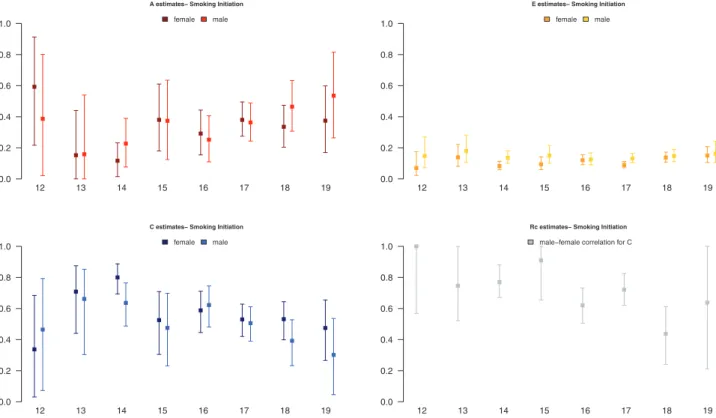
We present results for models with separate parameters for males and females. Estimates and confidence intervals for A, C, E, and rc
from the best fitting models, with parameters constrained across samples, are presented for ages 12–19 in Figure 2. Results showed an increase in proportion of liability to SI explained by additive genetic factors from 15% to 45%, and a corresponding decrease in propor-tion of variance accounted for by shared environmental factors, with unique environmental factors explaining a small stable amount of variance in liability to SI. Gender differences in factors influencing SI increased across adolescence: the shared environmental correlation between males and females decreased from 1.0 to about 0.6 from ages 12 to 19, suggesting that in early adolescence environmental factors that increase similarity between twins are mostly the same in males and females, whereas in later adolescence, only about half are. Although the magnitude of genetic and environmental factors was allowed to differ by sex, the trend of increasing contributions of genetic factors and decreasing contributions of shared environmen-tal factors was observed for both.
Discussion
We set out to combine SI data across 11 primarily longitudinal twin datasets to obtain stable and reliable estimates of additive genetic, shared, and unique environmental contributions to liability of SI
A estimates− Smoking Initiation
0.0 0.2 0.4 0.6 0.8 1.0
12 13 14 15 16 17 18 19
female male
C estimates− Smoking Initiation
0.0 0.2 0.4 0.6 0.8 1.0
12 13 14 15 16 17 18 19
female male
E estimates− Smoking Initiation
0.0 0.2 0.4 0.6 0.8 1.0
12 13 14 15 16 17 18 19
female male
Rc estimates− Smoking Initiation
0.0 0.2 0.4 0.6 0.8 1.0
12 13 14 15 16 17 18 19
male−female correlation for C
across adolescence. Previous studies on individual samples and review articles indicated a trend towards increasing contributions of additive genetic factors and decreasing contributions of shared environmental factors from early to late adolescence and into young adulthood.13,15–17,19,20,30–33 However, no single study was large enough
to estimate genetic and shared environmental variance components accurately at every age across adolescence, especially at younger ages where prevalence of smoking is relatively low which limits statistical power. We successfully combined data from 11 samples, primarily of European descent, comprising five samples from the United States, four European, and one Australian, resulting in sample sizes ranging from ~4000 to >18 000 individuals at each age from 12 to 19 years.
We draw five main conclusions. First, smoking prevalence increased rapidly and almost linearly between ages 10 and 19 from zero to >60% of adolescents having tried smoking cigarettes. Furthermore there appeared to be substantial consistency in longitu-dinal trends as well as variability within each age in smoking preva-lence by sample. There were significant sex differences in prevapreva-lence, however, with higher rates in males than in females, consistent with epidemiological literature on smoking in adolescents from European, North American, and global surveys.34–37
Second, model fitting confirmed that prevalence of SI could not be equated across samples. This could reflect differences in assessment of SI, availability, access, and attitudes towards smoking across cul-tures and variation in stage of the tobacco epidemic.37 Assumptions
of the classical twin method were met in that prevalences could be equated across twin order, zygosity, and sex of co-twin. Differences in prevalence by zygosity could be interpreted as sibling coopera-tion or sibling competicoopera-tion.38 Our results suggest little role for
sib-ling interaction, because prevalences were similar across zygosity. Prevalence of SI did not differ significantly if the twin was the same or opposite sex of their twin. While we did not have singletons in the analysis, these analyses indicate the absence of twin-specific effects on SI and support the generalization of our results to the populations from which they were drawn.39
Third, even though prevalences could not be equated across samples, twin correlations could. This suggests that etiology of lia-bility to initiate smoking is broadly consistent across samples—of primarily European descent—collected on three continents. To our knowledge, this is the first report to show this notable similarity in twin correlations across cultures for smoking in adolescence. It sug-gests that similar etiological factors operate within families in high-income countries of mostly European ancestry. The implication is that preventive measures found to be effective in one such country would likely work well in others. Although twin correlations, and thus heritability of SI, could be equated across samples collected on different continents, this does not imply that social factors at the school, state, population composition level do not moderate aspects of smoking behavior.40–42 However, this type of genotype by
environ-ment effect appeared stronger for regular smoking than for initia-tion. Furthermore, changing policies across time, such as the Surgeon General’s Report about the effects of smoking on health, has also been shown to affect the magnitude of genetic influences on regular smoking.43 As the majority of the samples in the current report were
collected in the 1990s, we did not take genotype by cohort effects into account. Future analyses, however, should investigate whether macro and micro environmental factors cause variation in liability to SI.
Fourth, at each age across adolescence both additive genetic and shared environmental factors contribute significantly to variance in
liability to SI. Consistent with prior literature on SI from early to late adolescence, the influence of additive genetic factors appears to increase while that of the shared environment decreases.10,31
Although at first sight these results may not appear novel, the current study is the first to be sufficiently powered to detect a contribution of additive genetic factors of 20% of the variance in early adoles-cence, and a modest contribution of shared environmental factors in later adolescence, thus stressing the importance of both sources throughout adolescence. While assortative mating could mimic effects of shared environmental influences, and given significant spousal correlations for smoking behavior,13 it seems unlikely that
assortment would account for the shared environment found here. Assuming a marital correlation for SI of 0.20, shared environmental contributions would be overestimated by 2% and 15% for MZ cor-relations of 0.85 and DZ corcor-relations of 0.50 and 0.70 respectively. Correspondingly, heritability would be underestimated.
Fifth, while sex differences in genetic and environmental factors were nonsignificant in early adolescence, they were postpuberty, sug-gesting that to some degree environmental factors that contribute to SI liability in males differ from those in females. Models allowing for different shared environmental factors across sex fitted margin-ally better than those allowing different genes across sex, although power is limited in comparing these alternative explanations, even with current sample sizes. While it seems plausible that girls are exposed to partially different environmental factors than boys, we cannot exclude sex-specific genetic factors. A possible source of such genetic differences between boys and girls across adolescence would be differential rates of maturation, which is known to be partly influ-enced by genetic factors.44
Results from this study increase the evidence beyond sugges-tive4 that smoking behavior, and in particular SI in adolescence, is a
heritable trait. However, genome-wide studies of smoking behavior have only identified some genes underlying SI in contrast to major findings underlying variability in consumption of cigarettes.45–48 The
strongest association for SI was reported for SNPs in the BDNF gene.46 A handful of other SNPs have been found to be genome-wide
significant for SI, but require replication.49,50 Given the broad age
range of individuals in the large scale consortia, selective attrition by genotype due to smoking related mortality could have obscured signals for SI.51 Furthermore, evidence for shared environmental
contributions, especially in early adolescence, is strong. Even though a recent review of behavioral genetics research suggests that “most environmental effects are not shared by children growing up in the same family,”52 evidence is accumulating that shared environmental
factors contribute significantly to behavior in early adolescence, and especially for externalizing behaviors and substance use.53–55 These
shared environmental effects may result from: parents and older siblings (including secondhand smoke and effects of assortative mating); peers56,57; or social environment factors such as
advertis-ing controls, tobacco pricadvertis-ing, smoke-free regulations and tobacco availability.58
Heritability of SI is significant even at young ages and jumps at ages 14–15, the transition from middle to high school in the United States, which therefore appears to be a critical period to tar-get prevention measures. Most individual differences in SI in ado-lescence are accounted for by familial factors, although they shift from being more shared environmental to more genetic. It would seem justified to target prevention at the whole family, rather than solely at teenagers.59 These results are consistent with a review of
and adolescent from starting to smoke,60 which report a moderately
positive effect of high intensity programs that address family func-tioning. Furthermore, office-based interventions by pediatric pro-viders engaged in delivering prevention and cessation counseling to both patients and parents/caregivers show great promise.61 We also
believe that providing personalized information—including genetic information—about smoking risks could improve smoking preven-tion.62 Finally, prevention efforts might be especially effective if
tar-geted at children with both high genetic and environmental risk, as they are at greatest risk of nicotine addiction. Our results suggest an increase in risk for children having one or two parents who smoke which could be considered when evaluating the cost-benefit ratio of targeted (families, high-risk children) versus whole population intervention campaigns.
In summary, this study showed that even though substantial differences exist in prevalence of SI across samples, etiology of SI liability is markedly similar across different populations of Western European descent.
Limitations
This study should be interpreted in the context of four potential limi-tations. First, items used to query participants about their SI differed across studies. While most samples included questions about lifetime SI, two samples only recorded SI when participants had smoked at least 100 cigarettes. This difference likely accounts for differences in prevalence across studies. A re-analysis excluding these samples showed almost identical results; the largest difference was <1 change in A and C estimates at ages 12–13 (results available upon request). Second, results may not generalize to the entire US population as over 95% of participants were of European ancestry. Results from analyses limited to European ancestry twins were very similar to those that included twins of other ethnicities (results available upon request), thus strengthening generalizability of results. Furthermore, available samples are from high-income countries, so results may not generalize to low- and middle-income countries. Third, sample sizes at different ages differed, which affected power to detect cer-tain effects, including sex differences at younger ages. Fourth, the current study only included data on twins, thus limiting to three the sources of variance to be estimated. Future modeling including other relatives such as parents and siblings would allow estimation of the effects of assortative mating, parent–child environmental transmis-sion, and the action and interaction of additional types of genetic and environmental factors.
Supplementary Material
Supplementary Appendix 1, eFigures 1 and 2, and eTables 1 and 2 can be found online at http://www.ntr.oxfordjournals.org
Funding
Data analysis supported by the National Institutes of Health (DA025109, DA024304 and DA018673). Add Health: This research uses data from Add Health, a program project directed by Kathleen Mullan Harris and designed by J. Richard Udry, Peter S. Bearman, and Kathleen Mullan Harris at the University of North Carolina at Chapel Hill, and funded by grant P01-HD31921 from the Eunice Kennedy Shriver National Institute of Child Health and Human Development, with cooperative funding from 23 other federal agencies and foundations. Special acknowledgment is due to Ronald R. Rindfuss and Barbara Entwisle for assistance in the
original design. Information on how to obtain the Add Health data files is available on the Add Health website (www.cpc.unc.edu/addhealth). No direct support was received from grant P01-HD31921 for this analysis. LTS-CTS: Data collection was supported by DA011015. MFTS: Data col-lection was supported by DA05147 (male MFTS twins), AA09367 (female MFTS twins), DA013240 (OS twins) and DA036216. MATR: MASATS: Data collection was supported by the Templeton Foundation and the Keck Foundation (K01 DA000386). VTSABD-YAFU-TSA: Data collection was supported by MH045268, MH068521, DA024413, and Virginia Tobacco Settlement Foundation grant 8520012. CVT: Data collection was supported by HL031010. EFPTS: LLTS: Data collection was supported by Research Fund K.U.Leuven (OT/86/80), the National Bank of Belgium, the Fund for Medical Research (Belgium) (3.0038.82, 3.0008.90, 3.0098.91) and (NATO 860823). FTC: Data collection in the Finnish twin cohorts was supported by National Institute of Alcohol Abuse and Alcoholism (AA-08315, AA-12502, AA-00145, and AA-09203 to RJR, and AA018755 and AA015416 to DD), the Academy of Finland Center of Excellence in Complex Disease Genetics (213506, 129680 to JK), and the Academy of Finland (100499, 205585, 118555, 141054, 265240, 263278 and 264146 to JK). NTR: Data collec-tion was supported by Netherlands Organizacollec-tion for Scientific Research (NWO: 463-06-001, 451-04-034) and (MagW/ZonMW: 904-61-090, 985-10-002, ZonMw 912-10-020, ZonMw 904-61-193, 451-04-034, 400-05-717, ZonMw Addiction-31160008, ZonMw Middelgroot 911-09-032), Spinozapremie (SPI 56-464-14192); BBMRI–NL (184.021.007): Biobanking and Biomolecular Resources Research Infrastructure and from European Science Council (ERC) Genetics of Mental Illness (230374) and Beyond the Genetics of Addiction (284167). VU University: Institute for Health and Care Research (EMGO+) and Neuroscience Campus Amsterdam (NCA). STR: TCHAD: Data collection supported by the Swedish Council for Working Life and Social Research (2004-0383) and the Swedish Research Council (2004-1415). ATR: AYATS: Data collection in the Australia twin cohorts was supported by National Health and Medical Research Council grants, Victorian Health Promotion Foundation, and the NHMRC Australian Twin Registry. Prof J. Hopper established the cohort and received the funding grants. JMV is supported by the European Research Council (ERC) starting grant (284167 to PI JMV).
Declaration of Interests
All authors reviewed and approved the final manuscript before its submission. JK has consulted for Pfizer on nicotine dependence in 2012–2014.
Acknowledgments
We thank Amir Toor for his helpful comments on the manuscript.
References
1. U.S. Department of Health and Human Services. The Health Consequences of Smoking—50 Years of Progress: A Report of the Surgeon General. Atlanta, GA: U.S. Department of Health and Human Services, Centers for Disease Control and Prevention, National Center for Chronic Disease Prevention and Health Promotion, Office on Smoking and Health; 2014.
2. Tobacco. www.who.int/mediacentre/factsheets/fs339/en/. Accessed October 28, 2016.
3. Jha P, Ramasundarahettige C, Landsman V, et al. 21st-century hazards of
smoking and benefits of cessation in the United States. N Engl J Med. 2013;368(4):341–350.
6. U.S. Department of Health and Human Services. Prezmting Tobacco Use Among Young People: A Report of the Surge & General. Atlanta, GA: U.S. Department of Health and Human Services,Public Health Service, Centers for DiseaseControl and Prevention, National Center for Chronic Disease Prevention and Health Promotion, Office on Smoking and Health; 1994. 7. Ng M, Freeman MK, Fleming TD, et al. Smoking prevalence and cigarette
consumption in 187 countries, 1980-2012. JAMA. 2014;311(2):183–192. 8. Vink JM, Boomsma DI. Interplay between heritability of smoking and
environmental conditions? A comparison of two birth cohorts. BMC Public Health. 2011;11:316.
9. Sullivan PF, Kendler KS. The genetic epidemiology of smoking. Nicotine Tob Res. 1999;1(suppl 2):S51–57; discussion S69–70.
10. Maes HH, Neale MC. Genetic modeling of tobacco use behavior and trajecto-ries. In: Swan GE, Baker TB, Chassin L, et al., eds. National Cancer Institute. Phenotypes and Endophenotypes: Foundations for Genetic Studies of Nicotine Use and Dependence. Tobacco Control Monograph No. 20. Bethesda, MD: U.S. Department of Health and Human Services, National Institutes of Health, National Cancer Institute. NIH Publication No. 09-6366; 2009.
11. Rose RJ, Broms U, Korhonen T, Dick DM, Kaprio J. Genetics of smoking behavior. In: Kim Y, ed. Handbook of Behavior Genetics. New York, NY: Springer; 2009:411–432.
12. Langinvainio H, Kaprio J, Koskenvuo M, Tarkkonen L. Structural analysis of smoking, alcohol use, and personality factors in MZ and DZ twin pair relationships. Prog Clin Biol Res. 1981;69(pt C):23–35.
13. Boomsma DI, Koopmans JR, Van Doornen LJ, Orlebeke JF. Genetic and social influences on starting to smoke: a study of Dutch adolescent twins and their parents. Addiction. 1994;89(2):219–226.
14. Koopmans JR, Slutske WS, Heath AC, Neale MC, Boomsma DI. The genetics of smoking initiation and quantity smoked in Dutch adolescent and young adult twins. Behav Genet. 1999;29(6):383–393.
15. Maes HH, Woodard CE, Murrelle L, et al. Tobacco, alcohol and drug use in eight- to sixteen-year-old twins: the Virginia Twin Study of Adolescent Behavioral Development. J Stud Alcohol. 1999;60(3):293–305.
16. Han C, McGue MK, Iacono WG. Lifetime tobacco, alcohol and other substance use in adolescent Minnesota twins: univariate and multivariate behavioral genetic analyses. Addiction. 1999;94(7):981–993.
17. McGue M, Elkins I, Iacono WG. Genetic and environmental influences on adolescent substance use and abuse. Am J Med Genet. 2000;96(5):671–677. 18. Hopfer CJ, Stallings MC, Hewitt JK. Common genetic and environmental
vulnerability for alcohol and tobacco use in a volunteer sample of older female twins. J Stud Alcohol. 2001;62(6):717–723.
19. White VM, Hopper JL, Wearing AJ, Hill DJ. The role of genes in tobacco smoking during adolescence and young adulthood: a multivariate behav-iour genetic investigation. Addiction. 2003;98(8):1087–1100.
20. Rhee SH, Hewitt JK, Young SE, et al. Genetic and environmental influ-ences on substance initiation, use, and problem use in adolescents. Arch Gen Psychiatry. 2003;60(12):1256–1264.
21. Maes HH, Sullivan PF, Bulik CM, et al. A twin study of genetic and envi-ronmental influences on tobacco initiation, regular tobacco use and nico-tine dependence. Psychol Med. 2004;34(7):1251–1261.
22. Vink JM, Willemsen G, Boomsma DI. Heritability of smoking initiation and nicotine dependence. Behav Genet. 2005;35(4):397–406.
23. Neale MC, Harvey E, Maes HH, Sullivan PF, Kendler KS. Extensions to the modeling of initiation and progression: applications to substance use and abuse. Behav Genet. 2006;36(4):507–524.
24. Neale MC, Røysamb E, Jacobson K. Multivariate genetic analysis of sex limitation and G x E interaction. Twin Res Hum Genet. 2006;9(4):481–489. 25. Sullivan PF, Eaves LJ. Evaluation of analyses of univariate discrete twin
data. Behav Genet. 2002;32(3):221–227.
26. Neale MC, Martin NG. The effects of age, sex, and genotype on self-report drunkenness following a challenge dose of alcohol. Behav Genet. 1989;19(1):63–78.
27. Boker S, Neale M, Maes H, et al. OpenMx: an open source extended struc-tural equation modeling framework. Psychometrika. 2011;76(2):306–317. 28. Mx: Statistical Modelling (6th ed) [computer program]. Richmond, VA:
Department of Psychiatry; 2006.
29. Neale MC, Cardon LR. Methodology for Genetic Studies of Twins and Families. Dordrecht, The Netherlands: Kluwer Academic Publishers BV; 1992.
30. Kaprio J, Hammar N, Koskenvuo M, et al. Cigarette smoking and alcohol use in Finland and Sweden: a cross-national twin study. Int J Epidemiol. 1982;11(4):378–386.
31. Hopfer CJ, Crowley TJ, Hewitt JK. Review of twin and adoption stud-ies of adolescent substance use. J Am Acad Child Adolesc Psychiatry. 2003;42(6):710–719.
32. Kaprio J. Genetic epidemiology of smoking behavior and nicotine depend-ence. COPD. 2009;6(4):304–306.
33. Baker JH, Maes HH, Larsson H, Lichtenstein P, Kendler KS. Sex differ-ences and developmental stability in genetic and environmental infludiffer-ences on psychoactive substance consumption from early adolescence to young adulthood. Psychol Med. 2011;41(9):1907–1916.
34. Harrell JS, Bangdiwala SI, Deng S, Webb JP, Bradley C. Smoking initiation in youth: the roles of gender, race, socioeconomics, and developmental status. J Adolesc Health. 1998;23(5):271–279.
35. WHO Europe. The European Tobacco Control Report 2007. Copenhagen, Denmark: World Health Organization Regional Office for Europe; 2007. 36. Okoli C, Greaves L, Fagyas V. Sex differences in smoking initiation among
children and adolescents. Public Health. 2013;127(1):3–10.
37. Lopez AD, Collishaw NE, Piha T. A descriptive model of the tobacco epi-demic in developed countries. Tob Control. 1994;3(3):242–247 38. Eaves L. A model for sibling effects in man. Heredity (Edinb).
1976;36(2):205–214.
39. Andrew T, Hart DJ, Snieder H, et al. Are twins and singletons compara-ble? A study of disease-related and lifestyle characteristics in adult women. Twin Res. 2001;4(6):464–477.
40. Boardman JD. State-level moderation of genetic tendencies to smoke. Am J Public Health. 2009;99(3):480–486.
41. Boardman JD, Blalock CL, Pampel FC, et al. Population composition, public policy, and the genetics of smoking. Demography. 2011;48(4):1517–1533. 42. Boardman JD, Saint Onge JM, Haberstick BC, Timberlake DS, Hewitt JK. Do schools moderate the genetic determinants of smoking? Behav Genet. 2008;38(3):234–246.
43. Boardman JD, Blalock CL, Pampel FC. Trends in the genetic influences on smoking. J Health Soc Behav. 2010;51(1):108–123.
44. Eaves L, Silberg J, Foley D, et al. Genetic and environmental influences on the relative timing of pubertal change. Twin Res. 2004;7(5):471–481. 45. Liu JZ, Tozzi F, Waterworth DM, et al. Meta-analysis and imputation
refines the association of 15q25 with smoking quantity. Nat Genet. 2010;42(5):436–440.
46. The Tobacco and Genetics Consortium. Genome-wide meta-analyses identify multiple loci associated with smoking behavior. Nat Genet. 2010;42(5):441–447.
47. Thorgeirsson TE, Gudbjartsson DF, Surakka I, et al. Sequence variants at CHRNB3-CHRNA6 and CYP2A6 affect smoking behavior. Nat Genet. 2010;42(5):448–453.
48. Loukola A, Hällfors J, Korhonen T, Kaprio J. Genetics and smoking. Curr Addict Rep. 2014;1(1):75–82.
49. Vink JM, Smit AB, de Geus EJ, et al. Genome-wide association study of smoking initiation and current smoking. Am J Hum Genet. 2009;84(3):367–379.
50. Yoon D, Kim YJ, Cui WY, et al. Large-scale genome-wide association study of Asian population reveals genetic factors in FRMD4A and other loci influencing smoking initiation and nicotine dependence. Hum Genet. 2012;131(6):1009–1021.
51. Taylor AE, Morris RW, Fluharty ME, et al. Stratification by smoking status reveals an association of CHRNA5-A3-B4 genotype with body mass index in never smokers. PLoS Genet. 2014;10(12):e1004799.
52. Plomin R, DeFries JC, Knopik VS, Neiderhiser JM. Top 10 replicated find-ings from behavioral genetics. Perspect Psychol Sci. 2016;11(1):3–23. 53. Buchanan JP, McGue M, Keyes M, Iacono WG. Are there shared
54. Burt SA. Rethinking environmental contributions to child and adolescent psychopathology: a meta-analysis of shared environmental influences. Psychol Bull. 2009;135(4):608–637.
55. Korhonen T, Latvala A, Dick DM, et al. Genetic and environmental influ-ences underlying externalizing behaviors, cigarette smoking and illicit drug use across adolescence. Behav Genet. 2012;42(4):614–625. 56. Dick DM, Rose RJ, Viken RJ, Kaprio J. Pubertal timing and substance
use: associations between and within families across late adolescence. Dev Psychol. 2000;36(2):180–189.
57. Rose RJ, Viken RJ, Dick DM, et al. It does take a village: nonfamilial environments and children’s behavior. Psychol Sci. 2003;14(3):273–277. 58. Do E, Maes H. Narrative review of genes, environment, and cigarettes.
Ann Med. 2016;48(5):337–51.
59. Hudziak JJ, Bartels M. Genetic and environmental influences on well-ness, resilience, and psychopathology: a family-based approach for pro-motion, prevention and intervention. In: Hudziak JJ, ed. Developmental Psychopathology and Wellness. Washington, DC: American Psychiatric Publishing, Inc.; 2008:267–286.
60. Thomas RE, Baker PR, Thomas BC, Lorenzetti DL. Family-based pro-grammes for preventing smoking by children and adolescents. Cochrane Database Syst Rev. 2015;2:CD004493.