LOCALITY AWARENESS
FOR TASK PARALLEL COMPUTATION
Stephen Lecler Olivier
A dissertation submitted to the faculty of the University of North Carolina at Chapel Hill in partial fulfillment of the requirements for the degree of Doctor of Philosophy in the Department of Computer Science.
Chapel Hill 2012
Approved by
Jan F. Prins, Advisor
James H. Anderson
Bronis R. de Supinski
Robert J. Fowler
©2012
ABSTRACT
STEPHEN LECLER OLIVIER: Locality Awareness for Task Parallel Computation (Under the direction of Jan F. Prins)
The task parallel programming model allows programmers to express concurrency at a high level of abstraction and places the burden of scheduling parallel execution on the run time system. Efficient scheduling of tasks on multi-socket multicore shared memory systems requires careful consideration of an increasingly complex memory hierarchy, including shared caches and non-uniform memory access (NUMA) characteristics. In this dissertation, we study the performance impact of these issues and other performance factors that limit parallel speedup in task parallel program executions and propose new scheduling strategies to improve performance. Our performance model characterizes lost efficiency in terms of overhead time, idle time, andwork time inflationdue to increased data access costs.
Deo Optimo Maximo
ACKNOWLEDGEMENTS
Throughout my graduate study I have had the support of exceptional colleagues, steadfast friends, and loving family during the completion of this dissertation. These acknowledgments include only a small subset of all the people who have helped to make this dissertation possible.
My advisor Jan Prins taught me how to be a researcher and put in countless hours to that end. Allan Porterfield showed me how to work in the bowels of multithreading libraries, funded me through his MAESTRO grant, and has been a tireless mentor and advocate. Bronis de Supinski connected me with the OpenMP community and the broader HPC community. He also directed my work during my semester at Lawrence Livermore National Laboratory. Jim Anderson taught me how to reason about concurrency, and Rob Fowler introduced me to counter-based performance measurement.
I thank the High Performance Computer Modernization Office for their sponsorship of my National Defense Science and Engineering Graduate Fellowship, which funded me for three years and gave me the freedom to pursue my research interests. Thanks to the RENCI and UNC Research Computing for the use of their computing facilities.
The computer science department at Carolina is an exceptional place to work. Thanks especially to Tim Quigg for making students a priority. Many of my fellow students have become cherished friends, including Keith Lee, Jamie Snape, Bjoern Brandenburg, Sasa Junusovic, Aaron Block, Russ Gayle, Srinivas Krishnan, Jason Sewall, Robbie Cochran, Catie Welsh, Cory Quammen, Tabitha Peck, Todd Gamblin, and Jeff Terrell. I am grateful to the generous alumni whose support of the Alumni Fellowship has allowed me to focus on my dissertation during my last year.
Bryan Davis, and Erin Buller. Thanks especially to Susan Metallo, with whom I’ve shared the ups and downs of the final stages of graduate school.
TABLE OF CONTENTS
LIST OF TABLES . . . x
LIST OF FIGURES . . . xi
LIST OF ABBREVIATIONS . . . xv
1 INTRODUCTION . . . 1
1.1 Multicore Architectures . . . 1
1.2 Shared Memory Parallel Programming . . . 3
1.3 Task Parallel Programming Model . . . 4
1.4 Thesis . . . 6
1.5 Contributions. . . 6
1.6 Organization . . . 8
2 BACKGROUND AND PRIOR WORK . . . 9
2.1 Expressing Task Parallelism . . . 9
2.2 Scheduling Theory . . . 12
2.2.1 Task Parallel Computations as DAGs . . . 12
2.2.2 Overview of Task Scheduling Policies . . . 14
2.2.3 Breadth-first and Greedy Scheduling . . . 15
2.2.4 Work Stealing . . . 17
2.2.5 Parallel Depth-first Scheduling . . . 21
2.2.6 DFDeques . . . 23
2.2.7 Bounds on Cache Misses . . . 23
2.3 Run Time System Implementations . . . 26
2.3.1 Cilk . . . 26
2.3.2 OpenMP . . . 27
2.4 Other Task Parallel Languages and Libraries . . . 28
2.5 Performance Analysis Tools . . . 32
3 UTS: STRESS TEST FOR LOAD BALANCING . . . 34
3.1 The UTS Benchmark . . . 34
3.2 UTS Implementations . . . 35
3.3 Performance Evaluation . . . 39
3.4 Summary . . . 45
4 CATEGORIZING EXECUTION TIME. . . 46
4.1 UTS Revisited . . . 47
4.2 Analysis of BOTS . . . 49
4.3 Work Time Inflation . . . 53
4.4 Available Parallelism . . . 57
4.5 Summary . . . 58
5 QTHREADS-BASED RUN TIME SYSTEM . . . 60
5.1 Qthreads . . . 60
5.2 Compilation . . . 62
5.3 Execution . . . 64
6 HIERARCHICAL SCHEDULING . . . 66
6.1 Limitations of Work Stealing and PDF Schedulers . . . 66
6.2 Hierarchical Scheduling withMTS . . . 68
6.3 Scheduler Implementation in Qthreads . . . 69
6.4 Evaluation . . . 71
6.4.1 Performance on Intel Nehalem . . . 72
6.4.1.2 Variability . . . 85
6.4.1.3 Performance Analysis of MTS . . . 86
6.4.2 Performance on AMD Magny Cours. . . 88
6.4.3 Performance on SGI Altix . . . 92
6.5 Summary . . . 96
7 LOCALITY-BASED SCHEDULING . . . 97
7.1 Work Time Inflation inHealthandHeat. . . 97
7.2 First Touch and Scheduling . . . 99
7.3 A Framework for Locality-Based Scheduling . . . 102
7.3.1 A Concise API for Programmer-Specified Scheduling . . . 102
7.3.2 Run Time Scheduling Policy and Implementation . . . 103
7.4 Evaluation . . . 106
7.4.1 Performance and Speedup . . . 106
7.4.2 Performance Counter Measurement . . . 111
7.4.3 Visualizing Observed Task Schedules . . . 114
7.5 Summary . . . 117
8 CONCLUSIONS AND FUTURE DIRECTIONS. . . 119
8.1 Future Directions . . . 119
8.2 The Big Picture . . . 120
LIST OF TABLES
3.1 Sequential performance on UTS. . . 39
4.1 Sequential execution times (in seconds) on BOTS. . . 51
6.1 Scheduler implementations evaluated: five Qthreads implementations, ICC, and GCC. . . 71
6.2 Sequential and parallel execution times (in seconds) using ICC, GCC, and Qthreads MTS. . . 73
6.3 Variability in performance on the Intel Nehalem using ICC, GCC, MTS, and WS (standard deviation as a percent of the fastest time). . . 85
6.4 Number of remote steal operations during execution by Qthreads MTS and WS schedulers on Intel Nehalem. . . 86
6.5 Tasks stolen and tasks per steal using the MTS scheduler. Average of ten runs. . . 87
6.6 Memory performance data forHealthusing MTS and WS. Average of ten runs on Intel Nehalem. . . 87
6.7 Memory performance data forSortusing MTS and WS. Average of ten runs on Intel Nehalem. . . 87
6.8 Sequential execution times using ICC and GCC on the AMD Magny Cours. . . 89
6.9 Variability in performance on AMD Magny Cours using 16 threads (stan-dard deviation as a percent of the fastest time). . . 91
6.10 Sequential execution times on the SGI Altix. . . 92
7.1 Run times (elapsed) onHealth. . . 108
7.2 Run times (elapsed) onHeat. . . 108
LIST OF FIGURES
1.1 A typical four-socket X86 multicore system. . . 3
1.2 Thread parallel matrix multiplication in OpenMP. . . 4
1.3 Task parallel mergesort in OpenMP. . . 5
2.1 Calculating Fibonacci numbers in Cilk and OpenMP.. . . 10
2.2 Counting tree nodes in OpenMP. . . 11
2.3 Code, task graph, and schedule offibon two threads. . . 12
2.4 A taxonomy of task scheduling policies. . . 14
2.5 Task graph and breadth-first schedule on two threads. . . 15
2.6 Task graph and work-first schedule on two threads. . . 18
2.7 Task graph and PDF schedule on two threads. . . 22
2.8 Counting tree nodes in Cilk and Cilk++. . . 28
2.9 Categorization of selected task parallel languages and libraries. . . 31
2.10 Task graph executing on three threads. . . 33
3.1 Example binomial tree. . . 36
3.2 Sequential code for UTS traversal function. . . 37
3.3 UTS using OpenMP tasks. . . 37
3.4 UTS using Threading Building Blocks. . . 38
3.5 UTS using Cilk++. . . 38
3.6 Parallel speedup of UTS using OpenMP Tasks. . . 40
3.7 Speedup of UTS: OpenMP versus other task parallel languages and libraries. . . 41
3.8 Tasks executed per thread during UTS execution. . . 42
3.9 Average moved tasks per thread during UTS execution. . . 43
3.10 UTS speedup using OpenMP tasks as a function of tasks executed in-place. . . 44
4.1 Total time over all threads on a 24-thread UTS execution. . . 47
4.2 Total time over all threads on UTS (custom implementation) as a function of tasks stolen per steal. . . 48
4.3 Simplified code for the two versions ofAlignment. . . 50
4.4 Speedup on BOTS using ICC and GCC with 32 threads. . . 51
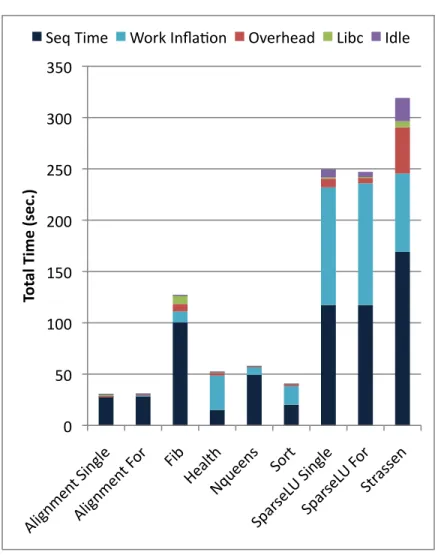
4.5 Total time over all threads on BOTS using ICC with 32 threads. . . 52
4.6 Total time over all threads on BOTS using GCC with 32 threads. . . 53
4.7 Topology of the four-socket Intel Nehalem-EX system. . . 54
4.8 Total time on BOTS using ICC: Work time inflation. . . 55
4.9 Total time on BOTS using GCC: Work time inflation. . . 56
4.10 Speedup limitations due to work time inflation. . . 57
4.11 Queue length during execution ofSortusing a work-first schedule. . . 58
4.12 Queue length during execution ofSortusing a help-first schedule. . . 59
5.1 Software architecture of Qthreads. . . 61
5.2 Compilation process using ROSE. . . 62
5.3 Code forfibbefore and after transformation by ROSE. . . 63
5.4 State diagram for a worker thread during execution. . . 65
6.1 Task graph for a computation executing on three threads. . . 67
6.2 Topology of the four-socket Intel Nehalem-EX system. . . 68
6.3 Health on 4-socket Intel Nehalem . . . 74
6.4 Total time over all threads on Health using 32 threads. . . 75
6.5 Sort on 4-socket Intel Nehalem . . . 76
6.6 Total time over all threads on Sort using 32 threads. . . 76
6.7 NQueens on 4-socket Intel Nehalem . . . 77
6.8 Total time over all threads on NQueens using 32 threads. . . 78
6.9 Fib on 4-socket Intel Nehalem . . . 78
6.11 Alignment-singleon 4-socket Intel Nehalem . . . 79
6.12 Alignment-foron 4-socket Intel Nehalem . . . 80
6.13 Total time over all threads on Alignment-singleusing 32 threads. . . 80
6.14 Total time over all threads on Alignment-forusing 32 threads. . . 81
6.15 SparseLU-singleon 4-socket Intel Nehalem . . . 81
6.16 SparseLU-foron 4-socket Intel Nehalem . . . 82
6.17 Total time over all threads on SparseLU-singleusing 32 threads. . . 82
6.18 Total time over all threads on SparseLU-forusing 32 threads. . . 83
6.19 Strassen on 4-socket Intel Nehalem . . . 83
6.20 Total time over all threads on Strassen using 32 threads. . . 84
6.21 Performance onHealthusing MTS based on the choice of chunk size for stealing on Intel Nehalem. . . 87
6.22 Topology of the 2-socket/4-chip AMD Magny Cours. . . 89
6.23 Six BOTS benchmarks on 2-socket AMD Magny Cours using 16 threads that show linear or near-linear speedup using Qthreads. . . 90
6.24 Three BOTS benchmarks on 2-socket AMD Magny Cours using 16 threads showing sub-linear speedup. . . 90
6.25 NQueens on SGI Altix . . . 92
6.26 Fib on SGI Altix . . . 93
6.27 Alignment-singleon SGI Altix . . . 93
6.28 Alignment-foron SGI Altix . . . 94
6.29 SparseLU-singleon SGI Altix . . . 94
6.30 SparseLU-foron SGI Altix . . . 95
6.31 Health, Sort, and Strassen on SGI Altix using 32 threads . . . 95
7.1 Total time over all threads onHealth. . . 98
7.2 Total time over all threads onHeat. . . 99
7.3 Simple first-touch initialization under OpenMP. . . 100
7.5 A task parallel program using locality-based scheduling. . . 104
7.6 A mapping of locality domains to a two-socket system. . . 105
7.7 Total time over all threads forHealth. . . 106
7.8 Speedup onHealth. . . 107
7.9 Total time over all threads forHeat. . . 108
7.10 Speedup onHeat. . . 109
7.11 CDF showing data access latency forHealth. . . 110
7.12 Ranges of load latencies (cycles) forHealth. . . 111
7.13 CDF showing data access latency forHeat. . . 112
7.14 Ranges of load latencies (cycles) forHeat. . . 113
LIST OF ABBREVIATIONS
API Application Programming Interface BOTS Barcelona OpenMP Tasks Suite CnC Concurrent Collections
CQ Centralized Queueuing GCC GNU Compiler Collection DAG Directed Acyclic Graph FEB Full/Empty Bit
ICC Intel C Compiler
MTS Multithreaded Shepherds NUMA Non-Uniform Memory Access PDF Parallel Depth-First
PGAS Partitioned Global Address Space QPI QuickPath Interconnect
CHAPTER 1
INTRODUCTION
Emerging trends in computer hardware present new opportunities and challenges for high performance scientific computing. In this introductory chapter, we explain how these trends motivate our work on locality awareness for task parallel computation, assert our thesis, and describe the contributions and organization of this dissertation.
1.1
Multicore Architectures
In the context of this dissertation, parallel computation is the use of concurrent execution of operations to achieve performance, i.e., faster execution times, not possible with sequential (non-concurrent) computation. While parallel computers date back to the earliest electronic computer systems (Goldstine and Goldstine, 1946), only recently has parallel computation become the primary route to increased performance. Throughout the second half of the 20th century, computational per-formance of sequential programs grew exponentially and, from the point of view of the programmer, transparently. A program written in one year could execute several times faster in succeeding years with minimal programmer effort due to increases in clock speed frequency and hardware-managed instruction level parallelism (ILP), such as deep pipelining and multiple arithmetic units.
Operating at theoretical peak performance, a 1 Ghz four-core processor can perform the same calculations in the same time using less power than a 4 Ghz single-core processor using the same instruction set. However, concurrency is required to use all cores and maximize performance. The operating system can simultaneously launch different applications, or separate instances of a scientific simulation with different experimental parameters, on each core. In this paradigm, calledcapacity computing, the goal is to execute as many sequential application instances as possible in an interval of time. On the other hand, the operating system can instead launch a single application that uses all the cores of the chip in a coordinated effort to solve a single large problem, such as a high resolution simulation. In this paradigm, calledcapability computing, the goal is to execute the single application in as short a time as possible. Unlike capacity computing, capability computing requires the programmer to either write a parallel program or to convert an existing sequential program into a parallel program, and requires efficient hardware and software infrastructure to coordinate parallel execution. This dissertation extends the state-of-the-art in software infrastructure for capability computing on multicore architectures.
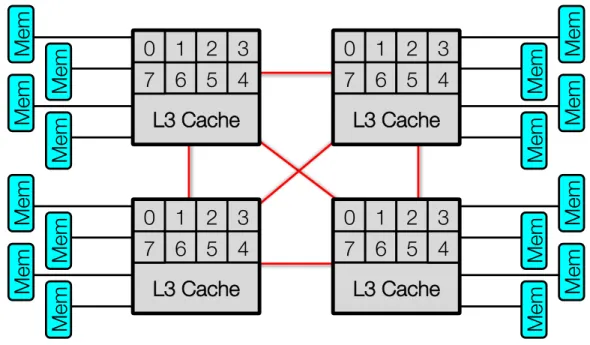
The number of cores per chip in production microprocessor designs has increased from one to sixteen in the period from 2006 to 2012, and Intel has announced a production processor with more than 50 cores. The complexity of memory subsystems has also increased to keep pace with concurrent memory requests. In addition to each core’s private instruction and data caches, cores on the same chip often share a larger last-level cache. Multiple on-chip memory controllers distribute memory references to banks of memory through multiple memory channels. In many configurations, two to eight multicore chips are installed on the same motherboard and connected using a high speed interconnect. Each chip is installed in asocketwith direct links to banks oflocal memoryand additional links to other sockets to access banks ofremote memory. Figure 1.1 shows an example four-socket multicore system with memory attached to each socket.
6!
The University of North Carolina at Chapel Hill
!
Typical SMP System Layout!
2
!
5
!
6
!
3
!
4
!
L3 Cache
!
Mem
!
Mem
!
Mem
!
Mem
!
1
!
0
!
7
!
2
!
5
!
6
!
3
!
4
!
L3 Cache
!
Mem
!
Mem
!
Mem
!
Mem
!
1
!
0
7
!
1
!
6
!
5
!
0
!
7
!
L3 Cache
!
Mem
!
Mem
!
Mem
!
Mem
!
2
!
3
!
4
!
1
!
6
!
5
!
0
!
7
!
L3 Cache
!
Mem
!
Mem
!
Mem
!
Mem
!
2
!
3
!
4
!
Figure 1.1: A typical four-socket X86 multicore system.
differences in access times between remote memory, local memory, and the various caches impact the efficiency of parallel computations executed on these systems. This dissertation characterizes these effects and proposes strategies to mitigate them.
1.2
Shared Memory Parallel Programming
#pragma omp parallel for
for (i = 0; i < nrows; i++) {
for(j = 0; j < ncols; j++) {
for (k = 0; k < nrows; k++) {
c[i][j] = a[i][k] * b[k][j]; }
} }
Figure 1.2: Thread parallel matrix multiplication in OpenMP.
The OpenMP API provides a portable higher-level programming environment for shared memory programming (OpenMP Architecture Review Board, 2008) through the support of the compiler and a run time system for thread management. The programmer specifies parallel regions, i.e., code to be executed by multiple threads. A team of threads is implicitly created to execute the parallel regions. The OpenMP run time also maintains mutual exclusion for critical sections and coordinates progress of the team of threads. OpenMP was originally designed for and is particularly well suited to the expression ofloop-level parallelism, in which different iterations of a loop are executed concurrently. Within parallel regions, the programmer can mark aforloop for parallel execution. The loop iterations are scheduled among the threads in the team using either a static schedule determined by the compiler during compilation or a dynamic schedule determined by the run time system during execution. This programming model has been successfully applied to a large number of computational problems, e.g., matrix multiplication as shown in Figure 1.2. The iterations of the outer loop are spread among the threads that execute the program, and elements of the output matrixcare computed in parallel.1
1.3
Task Parallel Programming Model
Some forms of application parallelism are not expressed easily using parallel loops. For example, recursive divide-and-conquer algorithms often create subproblems that can be solved in parallel. In the mergesort algorithm, the input array is subdivided into smaller arrays that are recursively sorted and then merged. The control flow of the program is clearly not iterative. The quicksort algorithm presents an additional challenge in that the division of work between subproblems is frequently
1
void sort(int a[ ], int length) {
if (length > 1) {
half = length / 2;
#pragma omp task
sort(a[0] , half);
#pragma omp task
sort(a[half], length - half);
#pragma omp taskwait
merge(a[0], half, a[half], length - half); }
}
Figure 1.3: Task parallel mergesort in OpenMP.
unequal due to imperfect pivot selection. A still more challenging example is a time-dependent computation using an oct-tree decomposition of three-dimensional space that changes over time to reflect the changing locations of objects in space. Not only do different branches of the oct-tree create subproblems with different amounts of work, but the distribution of work changes over time. The thread-centric focus of loop-level parallelism does not express the parallelism of these applications well.
The task parallel programming model is an alternative, complementary model that takes a problem-centric approach to the expression of parallelism. Rather than considering the division of code regions and loop nests among the available threads, the programmer only needs to identify the units of computational work in the application and the dependencies between them. These computational units, calledtasks, express available parallelism and consist of a segment of code and its data context. Figure 1.3 shows example task parallel code for mergesort. The subproblems that sort subarrays are indicated as tasks that may execute concurrently.
scientific and technical computing deployments have much to gain from the productivity potential of task parallel programming, but their increasing complexity makes performance even more elusive. This dissertation describes systematic performance analysis techniques to diagnose the sources of performance loss and new scheduling strategies for efficient execution on these architectures.
1.4
Thesis
Existing performance analysis methods and run time systems that implement the task parallel programming model are agnostic to characteristics of the target hardware, limiting their efficacy. These characteristics include increased memory latency to access remote data, cache effects, and inter-chip synchronization costs. During execution, scheduling decisions that neglect hardware characteristics result in stalls on load instructions and increased overhead costs. This dissertation measures the impact of these issues and demonstrates the benefits of techniques that incorporate knowledge of the machine topology into performance analysis, run time systems, and program code. Our thesis is as follows.
A run time scheduler informed by knowledge of the hardware architecture and locality
specifications in the application code can improve the performance of task parallel
programs in comparison to performance using uninformed schedulers.
1.5
Contributions
Performance of task parallel programs is limited by overhead costs, load imbalance, and data access costs due to non-uniform memory access (NUMA) and other related issues in the memory subsystem. This dissertation contributes to better understanding and mitigation of these issues in the following ways.
We demonstrate the trade-off between maintaining load balance and limiting overhead costs. We define the Unbalanced Tree Search (UTS) benchmark to evaluate load balancing capabilities of parallel systems. We identify inadequate load balancing strategies, subsequent thread idleness, and overhead costs as primary factors contributing to poor speedup of task parallel executions of UTS, and show that better performance is possible using aggregation in load balancing operations.
We define the concept ofwork time inflationin task parallel executions as the total additional time spent by all threads on the work of the computation beyond the time required to perform the same work in a sequential execution. We characterize the performance loss in the execution of task parallel computations due to work time inflation, which arises from cache misses, memory bandwidth saturation, and non-local memory accesses on NUMA architectures.
We propose a hierarchical task scheduling strategy that targets modern multi-socket multicore shared memory systems with NUMA architectures that are not well supported by either work-stealing schedulers with one queue per core or by centralized schedulers. Our approach combines work stealing and shared queues for low-overhead load balancing and exploitation of shared caches.
We describe a working prototype OpenMP run time system implementing our hierarchical sched-uler, as well as other task scheduling strategies. The run time extends the work of collaborators at the Renaissance Computing Institute (Porterfield et al., 2011) and Sandia National Laboratories (Wheeler et al., 2008) that enables the compilation and execution of a wide range of task parallel programs expressed in OpenMP.
We evaluate our hierarchical scheduler for OpenMP tasks on a 32-core Intel system. We compare against other schedulers implemented in our OpenMP run time and those from GNU and Intel, the first such performance study on a multi-socket multicore machine. Both improved speedup and several secondary metrics confirm the benefits of hierarchical scheduling. Evaluations on AMD and SGI machines show that our methods extend to different processors and interconnects, and we demonstrate the first scaling of OpenMP tasks on over 100 cores.
We evaluate the performance of our locality-based scheduling framework as implemented in extensions to the hierarchical scheduler of our OpenMP run time system on a multi-socket multicore NUMA architecture. Both speedup results and performance metrics from hardware performance counters confirm the effectiveness of the framework.
In addition to the original contributions listed above, our survey of prior work provides an overview of the landscape of task parallel computation, particularly task scheduling algorithms.
1.6
Organization
CHAPTER 2
BACKGROUND AND PRIOR WORK
The body of knowledge concerning the task parallel programming model is both broad and deep. We examine prior work regarding several key aspects: the expression of task parallelism through language syntax and semantics, theoretical analysis of task scheduling algorithms, run time systems to support task parallelism, and software tools and methods for performance analysis. A complete software development environment combines elements of each, and we point out some of the interrelationships between them.
2.1
Expressing Task Parallelism
Many of the concepts used in task parallel programming languages originated in early attempts at multithreaded programming using functional languages, e.g., MultiLisp (Halstead, 1985). Cilk borrowed from and expanded upon these concepts to design and to implement a seminal task parallel extension to the declarative C programming language (Blumofe et al., 1996; Frigo et al., 1998). Its authors made several key choices in favor of language simplicity, compiler support, and run time efficiency that have been widely imitated in more recent task parallel languages such as OpenMP 3.0 and X10, although other implementation choices have not.
A Cilk program is a C program with three additional keywords: cilk,spawn, andsync. The cilkkeyword indicates the declaration of a Cilk procedure, i.e., a function that may be executed in parallel. Parallel invocations to Cilk procedures are made using thespawnstatement. Thesync statement directs the run time to wait for the completion of any outstanding Cilk procedures spawned by the current procedure up to that point.
par-cilk int fib(int n) {
if (n < 2)
return n;
else {
int x, y;
x = spawn fib(n-1);
y = spawn fib(n-2);
sync;
return (x+y);
} }
int fib(int n) {
if (n < 2)
return n;
else {
int x, y;
#pragma omp task
x = fib(n-1);
#pragma omp task
y = fib(n-2);
#pragma omp taskwait
return (x+y);
} }
Figure 2.1: Calculating Fibonacci numbers in Cilk and OpenMP.
allel programming added explicit task parallelism to complement its existing data parallel con-structs (OpenMP Architecture Review Board, 2008). Thetaskandtaskwaitdirectives resemble Cilkspawnandsyncstatements respectively, as shown in Figure 2.1. However, the OpenMPtask directive generates a task from a statement or structured block, not a procedure. In addition to the taskwaitsynchronization, the OpenMPbarrierdirective also provides task synchronization. Threads encountering a barrier must complete all outstanding tasks generated by threads in that team before they may pass the barrier. Data clauses define whether tasks get shared, private, or initialized private copies of variables from surrounding scopes.
The Cilk language and prior proprietary extensions of OpenMP for task parallelism, e.g., the Intel work-queueing model (Su et al., 2002), impose strict scheduling restrictions. However, the OpenMP 3.0 task model allows considerable flexibility in scheduler design (Ayguad´e et al., 2009). This flexibility, along with the wide-spread support of OpenMP among hardware vendors and parallel programmers, prompted our choice of OpenMP 3.0 as the language to target in our scheduler implementations.
...
int nodecount;
#pragma omp threadprivate(nodeCount)
void traverse(Node* node)
{
nodeCount++;
for (i = 0; i < node->numChildren; i++) {
#pragma omp task firstprivate(i)
traverse(node->childNode[i]); }
}
int main(int argv, char *argc[])
{
int total;
...
#pragma omp parallel
{
#pragma omp single
#pragma omp task
traverse(root);
#pragma omp barrier
#pragma omp atomic
total += nodeCount; }
printf("Total=%d\n", total); ...
}
Figure 2.2: Counting tree nodes in OpenMP.
may migrate between different threads during execution. Untied tasks allow for greater flexibility in scheduling, but care must be taken if athreadprivate(thread-local) variable is used in the task. A threadprivate variable is a global variable of which each thread has a copy. If such a variable is updated without anatomicdirective, a race condition between untied tasks could potentially be created. The task may be swapped out in favor of another task that also modifies it.
int fib(int n)
{ // A
if (n < 2)
return n;
else
{
int x, y;
#pragma omp task
x = fib(n-1); // B
#pragma omp task
y = fib(n-2); // C
#pragma omp taskwait
return (x+y); // D
} }
15! The University of North Carolina at Chapel Hill !
A!
B! C!
Time! t0! t1! t2!
Thread 0! A! B! D!
Thread 1! C!
D!
15! The University of North Carolina at Chapel Hill !
A!
B! C!
Time! t0! t1! t2!
Thread 0! A! B! D!
Thread 1! C!
D!
Figure 2.3: Code, task graph, and schedule offibon two threads.
pass the counts as return values of the function calls, but that would requireO(logn)taskwait synchronizations to wait for the intermediate values to be returned. The generation of the first task in mainoccurs within the context of OpenMPparallelandsingleconstructs. Theparallel construct opens a parallel region, creating a team of threads to execute the tasks. Thesingle construct specifies that only one of those threads should create the first task, leaving the others to execute descendants of that task.
2.2
Scheduling Theory
A task scheduler assigns each task in the computation to a worker thread for execution, according to the constraints expressed as dependencies among tasks and the scheduling policy. Because this dissertation proposes new scheduling strategies for task parallelism, we now examine several existing task scheduling policies, along with their strengths and weaknesses.1
2.2.1 Task Parallel Computations as DAGs
The execution of a task parallel computation is viewed as a dynamically unfolding task graph. A task graph is a directed acyclic graph (DAG) in which each node represents a task instance and each edge represents a dependency between tasks: a new task creation (spawn edge) or synchronization
1
(join edge). An execution schedule is a mapping of the task graph ontopworker threads for execution in which each node appears exactly once in the schedule, no node may be scheduled before its ancestors, and at mostpnodes are scheduled concurrently. Figure 2.3 shows the code for a function fib, a corresponding DAG, and a schedule for an execution offibon two threads.
The computations that we consider in this dissertation are a subset of the class of all computations that can be represented as DAGs. In the general case, there can be an edge in a DAG from any vertex
v1to any vertexv2, as long as there is no path fromv2back tov1. For a computation, this would represent the possibility that any task may have a dependency on any other task. Instead, we consider only a set of computations with a restricted set of possible task dependencies. In these computations, calledstrictcomputations, each dependency must be between a task and one of its ancestors. In afully strictcomputation, each dependency must be between a task and its parent (Blumofe and Leiserson, 1999). Aterminally strictcomputation is a strict task in which each synchronization dependency is fulfilled upon the completion of the descendent task, not by the completion of some earlier instruction of the descendent task (Agarwal et al., 2007). The example in Figure 2.3 is both fully strict, since the two dependencies are both on child tasks, and terminally strict, since those child task must complete to satisfy thetaskwait. This dissertation concerns only computations that are at least terminally strict.
26! Task
Schedulers!
Static! Dynamic!
Breadth-First! Depth-First!
Parallel
Depth-First! Depth-FirstLocally !
Work-First! Help-First!
Figure 2.4: A taxonomy of task scheduling policies.
2.2.2 Overview of Task Scheduling Policies
Prior to examining particular schedulers in detail, consider the broad taxonomy of scheduling policies summarized in Figure 2.4. Static scheduling is not applicable for computations in which tasks are generated dynamically and not known a priori (Johnson et al., 1996). Even for applications in which the task graph is known a priori, static schedulers fail to provide dynamic load balancing required for efficient execution of many task parallel programs (Blumofe and Papadopoulos, 1998). Thus, we do not consider static scheduling in this dissertation.
17! The University of North Carolina at Chapel Hill !
A!
B!
D! E!
C!
F! G!
H! I! J! K!
T0!
T0!
T0!
T0!
T0!
T0!
T1!
T1!
T1!
T1!
T1!
16!
The University of North Carolina at Chapel Hill !
Thread! Steps!
T0
!
A
!
B
!
D
!
F
!
H
!
J
!
T1
!
-
!
C
!
E
!
G
!
I
!
K
!
BF
!
Figure 2.5: Task graph and breadth-first schedule on two threads.
generated task, while ahelp-firstscheduler enqueues each new task and continues execution of the parent task.
2.2.3 Breadth-first and Greedy Scheduling
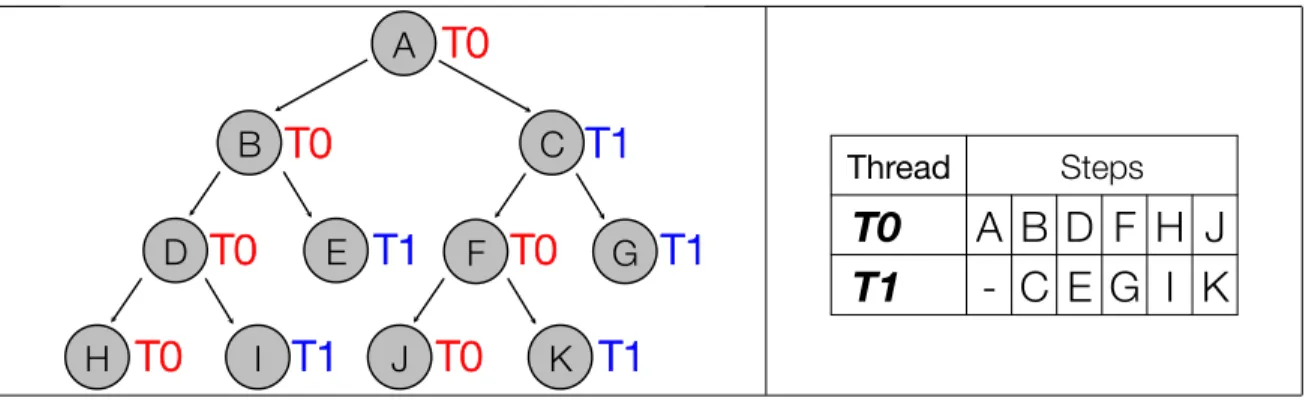
In a breadth-first schedule, all tasks at depthirelative to the root are executed before tasks at depthi+ 1. Figure 2.5 gives an example task graph and a breadth-first schedule for its execution. In the initial step, thread T0 executes task A. Task A generates tasks B and C. In the next step, thread T0 executes task B, T1 executes task C, and tasks D, E, F, and G are generated. In the following step, thread T0 executes task D, thread T1 executes task E, and tasks H and I are generated. Maintaining breadth-first order, tasks F and G are executed next while tasks H and I remain in memory. Tasks J and K are generated by task F. In the penultimate step, tasks H and I are executed. Finally, tasks J and K are executed.
Richard Brent derived a time bound on multithreaded computations that evaluate arithmetic expressions using a breadth-first schedule (Brent, 1974):
Theorem 2.1(Brent’s Theorem). For a computation that completes in timeT1on one processor and
in timeT∞with an infinite number of processors available, the timeTP required to complete the
computation onP processors is
TP ≤T∞+
T1−T∞
P . (2.1)
TP ≤ T∞ X i=1 & si P ' (2.2)
TP ≤ T∞ X
i=1
si+P −1
P (2.3) = T∞ X i=1 P P + T∞ X i=1
si−1
P (2.4)
= T∞+
1
P
T∞ X
i=1
si− T∞ X i=1 1 ! (2.5)
= T∞+
T1−T∞
P (2.6)
To benefit from parallel execution, a multithreaded computation must have sufficient parallel slack, defined asT1 T∞andT1 P. In that case, Brent’s Theorem simplifies to
TP ≤T∞+
T1
P (2.7)
and speedup approaches linear speedup, i.e.,
TP ≈
T1
P . (2.8)
Proof. LetTp?be the execution time required to complete a computation using an optimal scheduler onP threads. SinceT∞time is required even with an infinite number of processors available and assuming all work in the serial computation must be done,TP? =max{T∞, T1/P}.
TP ≤ T∞+
T1−T∞
P (2.9)
≤ T∞+
T1
P (2.10)
≤ 2·max{T∞,
T1
P } (2.11)
= 2·TP? (2.12)
Apart from Brent’s work, implementations of the Pthreads multithreading library (IEEE, 1995) use breadth-first scheduling by default. As observed by Narlikar and Blelloch, attempts to use the pthread scheduler to schedule fine-grained tasks typically result in out-of-memory errors even for small programs (Narlikar and Blelloch, 1998). Also, the time bounds in Brent’s Theorem do not include overhead times. Breadth-first scheduling is most easily implemented using a FIFO centralized queue, which is prone to contention and fails to exploit cache locality. The suboptimal performance of breadth-first schedulers in practice due to overhead costs and inefficient use of memory and cache motivated the development of depth-first schedulers.
2.2.4 Work Stealing
18!
The University of North Carolina at Chapel Hill !
A!
B!
D! E!
C!
F! G!
H! I! J! K!
T0
!
T0
!
T0
!
T0
!
T0
!
T0
!
T1
!
T1
!
T1
!
T1
!
T1
!
T1
!
17! The University of North Carolina at Chapel Hill !
Thread! Time!
T0
!
A
!
B
!
D
!
H
!
I
!
E
!
-
!
T1
!
-
!
A
!
C
!
F
!
J
!
K
!
G
!
WS
!
Figure 2.6: Task graph and work-first schedule on two threads.
thief dequeues and executes a task from the head of the victim’s queue. In a failed steal attempt, no task is available in the victim’s queue. In that case, the thief selects a new victim and again attempts to steal.
In thework-firstclass of work stealing schedulers, a worker thread that generates a new task enqueues the parent task on the local queue and immediately executes the new task. Figure 2.6 gives an example task graph and a work-first schedule for its execution. In the example, the root taskA
is stolen by threadT1afterT Ohas generated and started execution of taskB, so taskCand its descendants are generated on threadT1. A computation using a work-first scheduler completes in timeTP =T1/P +O(T∞), and requires spaceSP ≤ S1P, i.e., linear in the number of threads used (Blumofe and Leiserson, 1999). Proof sketches follow.
Theorem 2.2. The time required to execute a computation on P processors using a work-first
scheduler is
TP =T1/P +O(T∞). (2.13)
Proof Sketch. At each time step, a worker thread is either working on a task or stealing. The total time all threads spend working on tasks is equivalent toT1, the amount of time required to execute the work on a single thread, assuming overhead costs for task creation do not depend onP.
probability1/P. Since a stolen task is executed immediately, each steal operation reduces the critical path by one with probability1/P. WithP expected steal attempts decreasing the critical path by at least 1, and a total ofT∞steps on the critical path, the total expected stealing time isO(P T∞).
Since there areP processors, the execution time is1/P of the total time spent working and stealing by all threads:
TP = 1
P T1+O(P T∞)
!
(2.14)
= T1/P+O(T∞) (2.15)
In practice, online scheduling incurs overhead costs. Work stealing mitigates overheads by following thework-first principle: “Minimize the scheduling overhead borne by the work of a computation. Specifically, move overheads out of the work and onto the critical path” (Frigo et al., 1998). Analysis of the relative impact of overhead costs to the work and critical path supports the work-first principle. Let c∞be the smallest constant such thatTP =T1/P +c∞T∞. LetTS be the time required to execute a sequential program that is the serial equivalent of the task parallel program. We define the work overhead as the factorc1 =T1/TS. Now we can express the time bound incorporating overhead costs:
TP ≤c1
TS
P +c∞T∞. (2.16)
Assume the computation has sufficient parallel slack, i.e.,T1 T∞. With high probability, only
O(P T∞)steals occur. If the time cost of each steal is much less thanT1then
TP ≈c1
TS
P (2.17)
much lower in a distributed work-first scheduler because local enqueue and dequeue operations are lower latency than remote queue operations and the queues in a work stealing scheduler are rarely contended.
Theorem 2.3. The space required to execute a computation onP processors using a work-first
scheduler is
SP ≤S1P. (2.18)
Proof Sketch. Define aleaf taskas a task with no non-completed children. Define aprimary leaf task as a non-completed leaf task generated earlier than any of its non-completed siblings. A schedule maintains thebusy-leaves propertyif every primary leaf task has a thread working on it. We can reason by induction that a work-first schedule maintains the busy-leaves property.
Base case:At the start of the computation, the root task is a primary leaf task because it has no siblings and initially has no children. A thread works on the root task until it generates a child.
Inductive step:Assume the busy-leaves property: each primary leaf task has a thread working on it. Consider possible schedule actions:
1. A primary leaf tasktgenerates a child task. Thentis no longer a primary leaf task, and it’s child is now a primary leaf task. The thread working ontimmediately suspendstand schedules its child for execution. The busy-leaves property is maintained.
2. A primary leaf task tcompletes andthas non-completed siblings. The sibling which was generated earliest is now a primary leaf task. The thread that was working ontschedules that sibling for execution. The busy-leaves property is maintained.
3. A primary leaf tasktcompletes andthas no completed siblings and its parent is non-completed and not already executing on some other thread. The parent oftis now a primary leaf task. The thread that was working ontschedules its parent for execution. The busy-leaves property is maintained.
5. A task tthat is not a primary leaf task becomes a primary leaf task following a steal. The thread executingtwas idle prior to the steal, so no busy task was left unscheduled on its queue immediately before the steal. The tasktmust be scheduled for execution, because it must be the newest task in the leftmost path on the thread and first in the work-first schedule for that thread. The busy-leaves property is maintained.
We can associate each non-completed task with a primary leaf task according to the following rules: If the task is a primary leaf task, it is associated with itself. It the task is non-leaf task, then it is associated with the same primary leaf task as its earliest non-completed child. If the task is a leaf task that has earlier non-completed siblings, then it is associated with the same primary leaf task as its earliest non-completed sibling. The rules apply recursively. The tasks associated with a primary leaf are a subset of the non-completed tasks in a sequential execution of the computation. Thus, the total space of these tasks is at mostS1, the space of a sequential execution. By the busy-leaves property, each primary leaf task has a thread working on it. Since there areP threads, there are at mostP primary leaf tasks. Thus, the total space requirement is at mostS1P.
Help-first schedulingis a variant of work stealing in which a worker thread that generates a new task enqueues the new task on the local queue and continues execution of the parent task. The space bounds for work-first scheduling are not guaranteed to hold for help-first scheduling. In general, more space is required for help-first scheduling than for work-first scheduling, since sibling tasks at each level of the graph can be on the stack at once. However, the earlier generation of sibling tasks exposes available parallelism earlier in the execution, which can be helpful for task graphs that are wide and shallow (Guo et al., 2009). Also, help-first scheduling is useful when the migration of partially completed tasks is disallowed, as with tied tasks in OpenMP. Under that condition, a partially completed parent task could never be stolen, so a work-first scheduler would serialize the execution. Newly generated and unexecuted child tasks generated by a help-first scheduler can be stolen, enabling parallel execution.
2.2.5 Parallel Depth-first Scheduling
17! The University of North Carolina at Chapel Hill !
A!
B!
D! E!
C!
F! G!
H! I! J! K!
T0!
T0!
T0!
T0!
T0!
T0!
T1!
T1!
T1!
T1!
T1!
18!
The University of North Carolina at Chapel Hill !
Thread! Steps!
T0
!
A!
B!
D!
H!
F!
J!
T1
!
-!
C!
E!
I!
G!
K!
PDF!
Figure 2.7: Task graph and PDF schedule on two threads.
paths of the computation graph. The parallel depth-first (PDF) schedule is an approach designed to coordinate the threads to execute as close as possible to a single path in the computation, resulting in a lower memory requirement. The particular single path to be followed is the sequential order. Because sequential execution is depth-first, concurrent execution according to sequential order can be approximated using a LIFO queue shared among all threads. A departure from sequential order is required when there is not enough available parallelism in the current branch of execution to keep all threads busy. In that case, an idle thread must then schedule apremature task, a task with predecessors in the serial order that have not all been executed. Figure 2.6 gives an example task graph and a work-first schedule for its execution. In the example, two tasks,CandG, are executed prematurely by threadT1. The space bound for a PDF schedule isSP =S1+O(P T∞), and the reasoning is based on bounding the number of premature tasks scheduled (Blelloch et al., 1999).
Theorem 2.4. The space required to execute a computation onP processors using a PDF scheduler
is
SP ≤S1+P T∞. (2.19)
step to keep all threads busy. The longest possible path in the computation isT∞, so there are at most(P−1)T∞premature tasks with space allocated at any time. A schedule exactly following the sequential order would have spaceS1, so the total space bound adds to that the maximum space for premature tasks:
SP ≤ S1+ (P −1)T∞ (2.20)
SP ≤ S1+P T∞ (2.21)
WhenP tasks are available on the shared queue, PDF schedulesPtasks. When less thanP tasks are available on the shared queue, it schedules all available tasks. Thus, a PDF schedule is a greedy schedule. By Brent’s Theorem, it has the time boundTP =O(T1/P +T∞)given sufficient parallel slack. In practice, a PDF scheduler implementation can incur overhead costs due to contention on the shared task queue.
2.2.6 DFDeques
Work stealing uses individual per-thread task queues rather than the contention-sensitive shared queue of a PDF scheduler. However, PDF has better space bounds. The DFDeques scheduler explicitly parameterizes a limit on the amount of space used, allowing sufficient parallelism to be exposed without exceeding memory capacity or driving up queue contention. As in work stealing, each thread schedules tasks from a local queue, but the number of queues can exceed the number of threads. When the memory consumed on a thread exceeds the limit K, the task currently executing on that thread is suspended, the entire queue is deferred, and a new queue is stolen for execution. The space bound on DFDeques isSP(K) = S1+O(KP T∞) and the time bound is
TP =O(T1/P +T∞)(Narlikar, 1999). Work stealing is a special case of DFDeques in which no queue is ever deferred due to exceeding memory constraints.
2.2.7 Bounds on Cache Misses
number of cache misses during an execution should be minimized. There is a class of algorithms, known ascache oblivious algorithms, that attempt to exploit cache locality using a recursive divide-and-conquer strategy (Frigo et al., 1999). The subproblem size becomes smaller at each level of the recursive problem decomposition, and at some level the data for a level fits into cache without spilling. Also, function calls at adjacent levels of recursion typically use a subset of the same data that can be resident in cache due to temporal locality. For example, a matrix of sizen×ncan be decomposed into four matrices of sizen/2×n/2.
Consider a parallelization of divide-and-conquer algorithms using the task parallel model. Recursive function calls become tasks. Since the sequential strategy has good locality, it is desirable to schedule the tasks so as to maintain that locality as much as possible. Analogous to the notion that function calls at adjacent levels of recursion use an overlapping set of data is the notion that a parent task and its child task use an overlapping set of data. For best maintenance of cache locality, the parent and child tasks should be scheduled successively and by either the same thread or a set of threads that share the same cache.
The LIFO queue discipline of work-first scheduling is designed to exploit private (per-core) caches. The most recently generated tasks are near the tail of the queue, and tasks are dequeued locally from the tail to be scheduled for execution. When an idle thread steals, the stolen task is taken from the head of the victim’s queue. It is thus the least recently created task and least likely to have associated data resident in cache. If the depth of the queue is small, however, a cache miss that follows the steal is a miss that would not have occurred if the task had not been stolen. The intuition that the number of cache misses is a function of the number of steals is confirmed by theoretical analysis (Acar et al., 2000):
Theorem 2.5. The number of cache missesMP in a multithreaded computation scheduled by work
stealing onP threads is
MP ≤M1(C) + 2C·τ (2.22)
whereM1(C)is the number of cache misses in a sequential execution of the computation,Cis the
cache size, andτ is the number of steals.
of the same computation. Each steal results in at most two drifted tasks. The stolen task is a drifted task. If its parent has a dependency on the stolen task then the join with the parent makes the parent a drifted task when it is rescheduled. The total number of cache misses is the sum of the cache misses in a sequential execution,M1(C), and the number of cache misses due to stealing,2C·τ.
Recall that in the proof sketch for the time bound on work-first scheduling, we derived the expected number of steals as a function of critical path length and the number of threads,P T∞. Acar et al. refine this expected value to includem, the time spent by an instruction that incurs a cache miss, ands, the time required to perform a steal (Acar et al., 2000). Their analysis gives
τ =O
&
m s
'
·P ·T∞ !
. (2.23)
Acar et al. also derive a time bound based on their analysis of the cache misses:
TP =O
T1(C)
P +m·
&
m s
'
·C·T∞+ (m+s)·T∞ !
. (2.24)
Note that this is a refinement of the bound of Blumofe et al.,TP =T1/P +T∞.
While work stealing is well suited to private caches, PDF scheduling is well suited to shared caches. With the exception of data used by premature nodes, the cache usage of a PDF schedule is the same as that of a sequential execution. With a shared cache of sizeCP =C1+P T∞, where
C1is the size of the cache used in a single processor execution, a PDF schedule incurs at mostM1 misses, the same number of misses as the sequential execution (Blelloch and Gibbons, 2004). The proof resembles the proof of the space bound on PDF scheduling. Since a work-first schedule hasP
active paths in memory, the capacity required in a shared cache to limit the number of misses to the same number as a single processor execution is linear in the number of threads. With a shared cache of the same size as the cache used in a single processor execution, the number of cache misses is
2.2.8 General DAG Scheduling
Computations that are not at least terminally strict, such as those generated in languages that support futures (Friedman and Wise, 1978; Halstead, 1985), are outside of the scope of this disser-tation. Such computations with arbitrary dependencies can be scheduled efficiently in time (Arora et al., 2001). However, some are impossible to schedule efficiently in space (Blumofe and Leiserson, 1998), and the space bounds of schedulers for fully strict and terminally strict computations are not guaranteed to hold for the set of all possible multithreaded computations representable by DAGs.
2.3
Run Time System Implementations
In addition to the choice of scheduling policy, other design choices and implementation details impact the efficiency of run time systems. Moreover, each run time system implementation must conform to the semantics and constraints of the particular task parallel language it supports.
2.3.1 Cilk
work stealing schedulers cannot use it, and must employ other methods to combat task generation and synchronization overheads.
Work stealing requires concurrent access to each thread’s task queue. Again, Cilk follows the work-first principle. To maintain low overheads when enqueuing tasks, the localdequeueoperation requires no locking. The local enqueueoperation requires locking only if the queue is nearly empty. Thestealoperation always requires locking, but that overhead cost is borne on the critical path – ideal if executions have parallel slack. The protocol is called T.H.E., after the three variables used to implement it (Blumofe et al., 1996). The ABP work stealing queue was later developed to eliminate locking (Arora et al., 2001), and that queue was demonstrated in the contemporary Hood work stealing library (Blumofe and Papadopoulos, 1998).
2.3.2 OpenMP
The first implementation of OpenMP 3.0 was the open-source Nanos run time developed at the Barcelona Supercomputing Center (Ayguad´e et al., 2007). They evaluated different scheduler implementations in Nanos, including centralized breadth-first schedulers and work stealing (Duran et al., 2008b). They observed that tied tasks cannot be scheduled work-first without serialization. Recall that tied tasks cannot be migrated once they have been partially executed. Thus, a tied parent task once suspended cannot be migrated to another thread to continue execution. The Nanos groups also shows that the performance of some applications with very fine-grained tasks can be improved by serializing tasks beyond somecut-offor threshold depth in the task graph or when the number of active tasks exceeds the number of threads by some factor. They later developed a scheduler that estimates cut-offs at run time by measuring application characteristics early in execution and applying a set of heuristics (Duran et al., 2008a).
cilk int traverse(Node* node) {
long nodeCount = 1;
int i;
inlet void accumulate (int result) {
count += result; }
for (i = 0; i < node->numChildren; i++)
accumulate(spawn traverse(node->child[i]));
sync;
return count;
}
cilk::hyperobject<cilk::reducer_opadd<long> > nodeCount;
void traverse(Node* node)
{
nodeCount()++;
for (int i = 0; i < node->numChildren; i++)
cilk_spawn traverse(node->child[i]);
}
Figure 2.8: Counting tree nodes in Cilk and Cilk++.
proposed locality extensions for OpenMP based on thread sub-teams and demonstrated performance improvement on parallel loop-based benchmarks in OpenUH (Huang et al., 2010)
ForestGOMP is an OpenMP library that supports thread parallelism but not tasks. It schedules threads generated from deep loop nests by oversubscription, i.e., generating more threads than available cores. Groups of threads generated together at the same level form abubble, and bubbles are co-scheduled when possible (Thibault et al., 2007). The run time schedules threads using work stealing at two levels: on-chip and off-chip (Broquedis et al., 2010a).
2.4
Other Task Parallel Languages and Libraries
In addition to Cilk and OpenMP 3.0, a plethora of task parallel languages and libraries are available to programmers. They differ in the additional features provided, level of compiler support required, and scheduling restrictions imposed.
embedded function calledinletsthat can be used to combine return values from Cilk procedure spawns atomically, e.g., for reduction operations. Rather than inlets, Cilk++ provides a family of templated classes calledhyperobjectsto share and to update concurrent data objects safely. Hyperobjects are global objects with member functions and overloaded operators to present a well-defined interface to the implicitly synchronized data (Frigo et al., 2009). Figure 2.8 shows example code to count nodes in a tree: The top code segment shows the use of a Cilk inlet and the bottom code segment shows the use of a Cilk++ reducer hyperobject.
Like Cilk++, Intel Thread Building Blocks (TBB) offers data and task parallel programming constructs based on C++ (Kukanov and Voss, 2007). Unlike Cilk Plus, TBB is a user-level library that may be used with any C++ compiler. A TBB task is an object of a derived class that extends thetaskbase class. A constructor of that derived class may be used to initialize data members. The execute member function contains the user code for the task and returns a pointer to a task. Tasks are allocated usingnewand generated using thespawnstatic member function. The programmer must set a reference count with a value that is one more than the total number of tasks to be generated and synchronized. As tasks complete execution, the reference count is decremented. Thewait for allsynchronization function waits for the reference count to decrease to one then resets it to zero. A host of other classes are provided for concurrent data structures, parallel loops, locks, and mutexes (Reinders, 2007).
Microsoft Task Parallel Library (TPL) operates in the Microsoft .NET programming framework as part of the software ecosystem for Microsoft Windows systems (Leijen et al., 2009). At the most basic level, four basic constructs are supported: tasks, futures, replicable tasks, and replicable futures. A task takes adelegate(anonymous function) at creation and is executed by a single processor as assigned by the scheduler, and may be waited upon elsewhere in the code by theWaitmethod. A future returns a value with a generic type. A replicable task or future may itself be executed on multiple processors. These constructs are used to create the higher level abstractions of TPL for iteration. Microsoft has implemented several versions of parallel for loops, including a reduction-like Aggregateconstruct.
scheduling (Kambadur et al., 2009). Wool is a library-based solution for task parallelism in C (Fax´en, 2009). The Java fork-join framework allows the expression of task parallelism in Java (Lea, 2000).
Several projects have applied concepts from Cilk to task parallel computation across distributed memory, including CilkNOW (Blumofe and Lisiecki, 1997), Satin (van Nieuwpoort et al., 2000), and kaapi (Gautier et al., 2007) for clusters and ATLAS (Baldeschwieler et al., 1996) for grids. The Scioto task parallel framework builds upon a software global address space layer for distributed memory and has been shown to scale to 8k cores on some codes (Dinan et al., 2008, 2009). In Scioto, tasks are generated and added to atask collection. The explicittc process()call directs the run time to execute all initial tasks in a collection and any others spawned by those tasks. While only one collection may be active at a time, tasks may be added to other collections at any time to support phased computations.
IBM X10 is a Java-based parallel language designed to meet the dual goals of performance and productivity specified by the DARPA High Productivity Computing Systems (HPCS) pro-gram (Charles et al., 2005). X10 targets a distributed cluster of multiprocessor nodes with a Parti-tioned Global Address Space (PGAS) memory. Anasyncstatement creates anactivity. Execution of each activity is fixed to a particular processor or group of processors, called aplace. Thefinish statement provides deep synchronization: the entire hierarchy of activities created in the scope of the enclosed code block must be completed before execution moves beyond it. In contrast, Cilk can only synchronize a hierarchy of spawned procedures by includingsyncstatements at every level. Deep synchronizations on activities created within the scope of an X10finalstatement result in terminally strict computations that need not be fully strict, but Guo et al. show that work stealing is still feasible for these computations (Guo et al., 2009).
Shared Memory Distributed Memory
Language Integration Cilk X10, Chapel
Language Extension OpenMP
Library TBB, MS TPL Scioto, Satin
Figure 2.9: Categorization of selected task parallel languages and libraries.
Programs in CnC are combinations of input data streams, labels that select ranges of the input, and operations to be applied to those inputs, with the scheduling of operations left to the run time system (Budimli´c et al., 2010). Intel has an implementation of CnC for TBB.
Cray’s Chapel language is another HPCS language based on the task parallel model (Chamberlain et al., 2007). While our work focuses on OpenMP tasks, the Chapel developers at Cray also use the run time system described in this dissertation to implement support for their language.
Figure 2.9 shows a categorization of some of the task parallel languages and libraries mentioned above based on the architecture they target and the level of language integration. Explicit task parallelism is integrated into the shared memory language Cilk and the PGAS languages X10 and Chapel, which can run on distributed memory. Compiler directives in OpenMP extend C/C++ and Fortran to support task parallelism on shared memory. TBB and MS TPL are libraries for shared memory, while Scioto and Satin are libraries for distributed memory.
Supporting task parallelism has also been investigated outside the programming language community. Scheduler activations, implemented in some versions of NetBSD, support anm :n
2.5
Performance Analysis Tools
Improvement in task parallel application performance motivates the need for a software ecosys-tem of tools and analysis methods for the attribution of less than ideal speedup to particular perfor-mance issues. In the execution of task parallel applications, what are the actual impacts of overhead costs? To synchronization overheads in particular? Or to poor locality manifested in excessive memory access times? Effective performance analysis and tools enable the interpretation of data to identify performance issues in both applications and the run time system itself. They should assemble and present both thread-level and task-level data in a meaningful and actionable way. Lacking suitable tools and methodologies, users often turn to ad hoc performance analysis techniques.
While toolkits for serial and data parallel programming have matured considerably, limited solutions for task parallel performance analysis exist. A Cilk tool called the Nondeterminator detects race conditions (Feng and Leiserson, 1997), and Cilk Plus calls its race detector Cilkscreen. Cilkview is a tool to determine available parallelism given the work and span of a Cilk Plus program (He et al., 2010). Threadscope allows the display of task graphs, as well as graphs that show memory usage, enabling the identification of bottlenecks and memory leaks (Wheeler and Thain, 2010). An experimental extension to the ompP profiling tool allows timing and performance counter measurement for OpenMP tasks. It runs at user level, allowing portability among run time systems. However, it is unable to access information at the run time level, limiting its utility when tasks are allowed to migrate (F¨urlinger and Skinner, 2009). Sun’s OpenMP suite allows call stack profiling and task-related event monitoring with some limited visualizations, but those features are only fully supported in the Solaris/SPARC platform (Lin and Mazurov, 2009). Intel VTune and Thread Profiler provide interesting analysis of thread level but not task level timings (Intel Corp., 2011).
The University of North Carolina at Chapel Hill 4
A
B
C
D
E
Thread 0
Thread 1
Thread 2
Figure 2.10: Task graph executing on three threads.
Although taskAdoes not execute on Thread 2, it is considered part of the logical path profile for Thread 2 (A → B → E → ...) as the parent of taskB. Capturing such relationships allows the collection and presentation of performance data despite the migration of tasks by the Cilk work stealing scheduler.
CHAPTER 3
UTS: STRESS TEST FOR LOAD BALANCING
∗
Unbalanced Tree Search (UTS) is a synthetic benchmark designed to measure the ability of diverse parallel architectures and programming environments to support continuous dynamic load balancing. Since task parallel programming delegates the responsibility of scheduling computation to the run time system, UTS evaluates the ability of the run time system to accomplish load balancing efficiently.
3.1
The UTS Benchmark
The UTS problem is to count the number of nodes in an implicitly constructed tree that is parameterized in shape, depth, size, and imbalance (Prins et al., 2003; Olivier et al., 2007). Implicit construction means that each node contains all information necessary to construct its children. Thus, starting from the root, the tree can be traversed in parallel in any order as long as each parent is visited before its children. The imbalance of a tree is the variation in the size of its subtrees. Highly unbalanced trees pose significant challenges for parallel traversal because the work required for different subtrees may vary greatly. Consequently an effective and efficient continuous dynamic load balancing strategy is required to achieve good performance. This requirement is characteristic of the class of applications that UTS models, search and optimization problems that must enumerate a large state space of unknown or unpredictable structure.
The trees are generated using a Galton-Watson process (Harris, 1963), in which the number of children of a node is a random variable with a given distribution. To create deterministic results, each node is described by a 20-byte descriptor. The child node descriptor is obtained by application
∗
Contents of this chapter previously appeared in preliminary form inProceedings of the 19th International Workshop
on Languages and Compilers for Parallel Computing(Olivier et al., 2007), Proceedings of the Fifth Workshop on