Approved By:
Prasun Dewan James Anderson Nicholas Graham Saul Greenberg
TOWARDS SELF-OPTIMIZING FRAMEWORKS FOR COLLABORATIVE SYSTEMS
Sasa Junuzovic
A dissertation submitted to the faculty of the University of North Carolina at Chapel Hill in partial fulfillment of the requirements for the degree of Doctor of Philosophy in the
Department of Computer Science.
ABSTRACT
Sasa Junuzovic: Towards Self-Optimizing Frameworks for Collaborative Systems (Under the direction of Prasun Dewan)
Two important performance metrics in collaborative systems are local and remote response times. For certain classes of applications, it is possible to meet response time requirements better than existing systems through a new system without requiring hardware, network, or user-interface changes. This self-optimizing system improves response times by automatically making runtime adjustments to three aspects of a collaborative application.
One of these aspects is the collaboration architecture. Previous work has shown that dynamically switching architectures at runtime can improve response times; however, no previous work performs the switch automatically.
The thesis shows that (a) another important performance parameter is whether multicast or unicast is used to transmit commands, and (b) response times can be noticeably better with multicast than with unicast when transmission costs are high. Traditional
architectures, however, support only unicast – a computer that processes input commands must also transmit commands to all other computers. To support multicast, a new
bi-architecture model of collaborative systems is introduced in which two separate bi-architectures govern the processing and transmission tasks that each computer must perform.
iv
policies trade-off noticeable improvements in local (remote) for noticeable degradations in remote (local) response times. A new lazy policy for scheduling these tasks on a single-core is introduced that trades-off an unnoticeable degradation in performance of some users for a much larger noticeable improvement in performance of others. The thesis also shows that on multi-core devices, the tasks should always be scheduled on separate cores.
vi
ACKNOWLEDGEMENTS
There are many people who have helped me during my graduate student career, and I offer my gratitude to all of them. For brevity, I have kept the list short here: my advisor Prasun Dewan for his support; members of my dissertation committee for their insightful feedback; Kori Inkpen, Yong Rui, Zhengyou Zhang, Rajesh Hegde, and everyone else in Microsoft Research for the opportunity to work with them.
This dissertation was funded in part by a Natural Science and Engineering Research Council of Canada scholarship, a Microsoft Research fellowship, a Scholars for Tomorrow fellowship, and NSF grants ANI 0229998, IIS 0312328, IIS 0712794, and IIS 0810861. Thank you all for your help and support.
TABLE OF CONTENTS
Chapter 1: Introduction ... 1
1.1 Performance Metrics ... 4
1.2 Performance Comparisons ... 4
1.3 Performance Factors ... 7
1.3.1 Collaboration Architecture ... 7
1.3.2 Unicast and Multicast ... 12
1.3.3 Scheduling of Tasks ... 15
1.3.4 Analytical Model ... 20
1.4 Scope ... 22
1.4.1 Driving Problems ... 23
1.4.2 Program Component Type ... 24
1.4.3 User Interface Type ... 25
1.4.4 Collaborative Functionality ... 27
1.4.5 Assumptions ... 29
1.5 Applicability of Results ... 32
1.6 Summary ... 32
Chapter 2: Automating Processing Architecture Maintenance ... 37
2.1 Overview ... 37
viii
2.2.2 Local Response Times in Replicated Architectures ... 44
2.2.3 Remote Response Times in Centralized Architectures ... 44
2.2.4 Remote Response Times in Replicated Architectures ... 45
2.3 Self-Optimizing System Implementation ... 45
2.3.1 Sharing Applications ... 46
2.3.2 Changing Architectures of Shared Applications ... 47
2.3.3 Accommodating Late-comers ... 50
2.3.4 Optimization System Architecture ... 51
2.3.5 Gathering Parameter Values ... 54
2.3.6 Applying the Analytical Model ... 57
2.3.7 Re-using Parameter Values Across Sessions ... 61
2.4 Evaluation ... 62
2.4.1 Dynamically Switching Architecture at Runtime ... 63
2.4.2 Choosing Architecture at Start Time ... 72
2.4.3 Impact on Response Times of Self-Optimizing System Overheads ... 74
2.4.4 Other Results ... 75
2.5 Summary ... 76
2.6 Relevant Publications... 77
Chapter 3: Automating Communication Architecture Maintenance ... 79
3.1 Overview ... 79
3.2 Bi-Architecture Model ... 84
3.2.1 Implementation Issues ... 86
3.3 Formal Analysis ... 92
3.3.1 Quiescent State Commands ... 93
3.3.2 Implications for Quiescent State Commands ... 100
3.3.3 Consecutive Commands by a Single User ... 106
3.3.4 Implications for Consecutive Commands by a Single User ... 119
3.3.5 Response Times of Simultaneous Commands ... 126
3.4 Self-Optimizing System Implementation ... 127
3.4.1 Gathering Parameter Values ... 127
3.4.2 Applying the Analytical Model ... 131
3.4.3 Multiple Multicast Trees... 134
3.4.4 Communication Architecture Switch Mechanism ... 135
3.4.5 Users Leaving and Joining... 137
3.5 Evaluation ... 138
3.5.1 Experiments ... 141
3.5.2 Simulations ... 142
3.5.3 Validating Simulations ... 146
3.5.4 Cost of Switching Communication Architecture ... 152
3.5.5 Limitations ... 154
3.6 Summary ... 155
3.7 Relevant Publications... 156
Chapter 4: Automating Scheduling Policy Maintenance ... 157
4.1 Overview ... 157
x
4.2.1 Lazy Policy Approach ... 163
4.2.2 Lazy Policy Implementation ... 164
4.3 Single-Core Response Time Analysis ... 167
4.3.1 Replicated Remote Response Time ... 168
4.3.2 Replicated Local Response Time ... 179
4.3.3 Centralized Architecture ... 180
4.3.4 Implications ... 182
4.3.5 Consecutive Commands by the Same User ... 190
4.3.6 Implications for Consecutive Commands by a Single User ... 209
4.3.7 Simultaneous Commands ... 215
4.4 Multi-Core Scheduling Policies ... 215
4.5 Multi-Core Performance Analysis ... 220
4.5.1 Replicated Remote Response Time ... 220
4.5.2 Replicated Local Response Time ... 221
4.5.3 Centralized Response Times... 221
4.5.4 Consecutive and Simultaneous Commands ... 222
4.6 Single-Core vs. Multi-Core ... 226
4.6.1 Quiescent State Commands ... 226
4.6.2 Consecutive and Simultaneous Commands ... 228
4.7 Self-Optimizing System Implementation ... 231
4.7.1 Gathering Parameter Values ... 231
4.7.2 Applying the Analytical Model ... 234
4.7.4 Lazy Policy Implementation ... 237
4.8 Evaluation ... 238
4.8.1 Single-Core Simulations ... 240
4.8.2 Multi-Core Simulations ... 245
4.8.3 Experiments ... 247
4.8.4 Cost of Switching Scheduling Policies ... 255
4.9 Summary ... 256
4.10 Relevant Publications... 257
Chapter 5: Related Work ... 259
5.1 Overview ... 259
5.2 Guidelines for Improving Response Times ... 260
5.2.1 Abstract Architectures ... 260
5.2.2 Concrete Architectures ... 263
5.2.3 Empirical Results ... 266
5.2.4 Summary ... 269
5.3 Techniques for Improving Response Times ... 270
5.3.1 Reducing Processing Times ... 270
5.3.2 Reducing Transmission Times ... 274
5.3.3 Reducing Both Processing and Transmission Times... 286
5.3.4 Other Lazy Systems ... 287
5.3.5 Summary ... 289
5.4 User Studies ... 289
xii
5.6 Summary ... 293
Chapter 6: Discussions ... 295
6.1 Overview ... 295
6.2 Self-Optimizing All At Once ... 296
6.3 Thick-Client Architectures ... 302
6.4 Collaborative Functionality ... 304
6.4.1 Concurrency Control ... 305
6.4.2 Consistency Maintenance ... 306
6.4.3 Access Control ... 309
6.4.4 Awareness ... 310
6.5 Immediate Applicability of Results ... 311
6.5.1 Self-Optimizing System Complexity ... 312
6.5.2 Application Complexity... 312
6.5.3 Networking Issues ... 313
6.5.4 Windows of Opportunity ... 314
6.6 Future Applicability of Results ... 315
6.6.1 Increasing Processing Powers... 315
6.6.2 Increasing Network Speeds ... 316
6.6.3 Increasing Numbers of Cores ... 316
6.7 Summary ... 317
Chapter 7: Conclusions and Future Work ... 319
Appendix A: Collecting Data for Simulations and Experiments ... 329
1.2 Gathering Performance Parameter Values ... 329
1.3 Gathering User Parameters ... 330
1.3.1 Logs of Users’ Actions ... 330
1.3.2 Processing and Transmission Costs ... 333
1.4 System Parameters ... 335
1.4.1 Network Latencies ... 335
1.4.2 Number of Users ... 336
1.4.3 Types of Users’ Computers ... 336
1.5 Overlay Parameters ... 336
CHAPTER 1
INTRODUCTION
Performance can be the difference between life and death in the world of
collaborative systems. To illustrate, consider the following scenario. During candidates’ day at UNC, the computer science department invites a number of students for demos of the research projects within the department. Unfortunately, some of these candidates are also invited to the candidates’ days at Duke and MIT, both of which happen on the same day as UNC’s candidates’ day. To give all of the invited students a taste of research at UNC, UNC shares the demo applications using an application-sharing system. Therefore, the students visiting the other schools can remotely try the applications as long as they have with them Internet-connected portable devices, such as laptops, netbooks, and smart phones. The
interactivity of the demo is of the utmost importance. The shared application must respond to the operations by the students at Duke and MIT quickly and notify the students of any
operations by other users in a timely fashion; otherwise, a student may get bored and quit the demo, which could result in the student not coming to UNC. Even worse, the student may end up going to Duke!
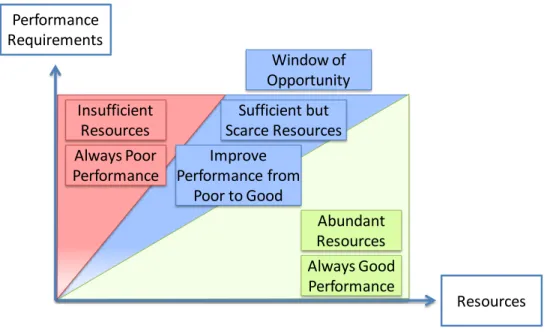
window of opportunity [55] (Figure 1-1). In the window of opportunity, it is possible for a system to have good performance, although new algorithms and implementations may be necessary to achieve it. To illustrate this idea, consider the multimedia networking discipline and its window of opportunity shown in Figure 1-2. When network bandwidth utilization is
Figure 1-2. Window of opportunity in multimedia networking. Performance
Requirements
High Bandwidth Utilization
Low Bandwidth Utilization Fairly High Bandwidth
Utilization Network Management Can Help Performance
Resources Figure 1-1. Window of opportunity for improving performance. Performance
Requirements
Resources Insufficient
Resources
Abundant Resources Sufficient but
Scarce Resources Improve
Performance from Poor to Good Always Poor
Performance
3
below some threshold, multimedia network systems perform well. When, on the other hand, the network utilization is above some other threshold, these systems suffer from poor performance. And if the maximum bandwidth utilization is between these thresholds, then clever network management techniques, such as jitter buffers and congestion control
mechanisms, can make a poorly performing system perform well without requiring hardware or network changes.
As in multimedia networking systems, a window of opportunity also exists for improving the performance of collaborative systems. Our work focuses on improving performance of collaborative systems when resources are sufficient but scarce, which brings us to our thesis:
The thesis raises four questions:
1. How is the performance of a shared application measured?
2. What does it mean for one system to better meet performance criteria than another?
3. What are the parameters of performance?
4. How can the performance of a system be improved? THESIS
The answers to the first two questions are relatively brief; they are given in the next two subsections. The remainder of this chapter answers the third question. Finally, the remainder of this thesis is needed to answer to the fourth and final question.
1.1
Performance Metrics
One important performance metric illustrated in the above candidates’ day scenario is the local response time for an input command [80], which is defined as the time that elapses from the moment a user enters an input command to the moment that user sees the output for the command. Another, related performance metric illustrated is the remote response time for an input command [33], which is defined as the time that elapses from the moment a user enters an input command to the moment a different user sees the output for the command. Previous work has identified several other performance metrics, such as jitter [50],
throughput [42], task completion time [22], and bandwidth consumption [51]. While all of these metrics are important, in this thesis, we focus on response times.
1.2
Performance Comparisons
Human-perception studies have shown that users cannot distinguish between response times below a certain threshold. For instance, Shneiderman [80] has shown that users cannot distinguish between local response times below 50ms. Jay et al. [54] complement these
Our Focus:
5
results by showing that remote response times for visual and haptic operations above 50ms and 25ms, respectively, are noticeable. In addition, they found that 50ms increments in remote response times are noticeable for both kinds of operations.
While no study has directly addressed noticeable changes in local response times, one can derive them indirectly from the study of acceptable local response times by Youmans [95]. To find acceptable response time thresholds, Youmans created a system in which users can request system speed-ups if the system appears slow. Each time a speed-up is requested, the response times improve by one eighth. For example, if a user requests a speed-up when the response times are 800ms, the response times decrease to 700ms. Youmans found that users requested system speed-ups until the response times reached the 300-500ms range. By working backwards from this range, it seems that participants requested system speed-ups when response times were in the 343-571ms range. While these results could imply that users can notice response time decreases between 343-300=43ms and 571-500=71ms, they could also imply that users did not notice the effect of the final speed-up and as a result stopped asking for further speed-ups. Therefore, we take another step backwards from the 343-571ms range and find that participants requested system speed-ups when the response times were in the 392-653ms range. These values imply that users can notice decreases in local response times between 392-343=49ms and 653-571=82ms. Based on these results of this study and studies by Shneiderman [80] and Jay et al. [54], we assume that a 50ms change in local or remote response times is noticeable to users.
Assumption:
Using the noticeable response time thresholds, we can compare the performances of two systems. A simplistic approach is to define the performance of system A to be better than that of system B if the number of users whose response times are noticeably better with system A than with system B is higher than the number of users whose response times are noticeably worse. One issue with this approach is that there is no way to distinguish between local and remote response times, which may be important in some scenarios. To illustrate, consider the candidates’ day scenario in which the professor is demoing an application to students at Duke and MIT. Since the professor is familiar with the application, the professor knows in advance what the result of performing a particular command will be. On the other hand, the students cannot anticipate exactly what will happen when a command is entered. In this case, it is more important for the students to see result of a professor’s command quickly than it is for the professor because the professor knows what the result will be while the students do not. In other words, the remote response times may be more important than remote response times. Therefore, if the remote response times are better with system B than with system A, then system B is better than system A even if system A is better than system B according to the simplistic definition.
7
infinitely many external criteria exist. To make the thesis tractable, we consider only two: the list of inputting users and the identities of the collaborators.
The exact application of the external criteria depends on the users’ response time requirements. Therefore, what is needed is a user-defined function that accepts as parameters the response times of systems, the list of inputting users, and the identities of all users, and returns a total performance order of the systems. Therefore, the total performance order function is an expression of the users’ response time requirements. Given such a function, we define the performance of system A to be better than that of system B if the function ranks A as better than B.
1.3
Performance Factors
In order to improve performance, we first need to identify the parameters that impact performance. Previous work has shown that the collaboration architecture is a parameter [21][27][42]. Our thesis is that multicast and scheduling are also performance parameters. In this section, we derive six theses regarding these three parameters. The proofs of the sub-theses, when combined, serve as a proof of the main thesis.
Definition:
We say that system A better meets users’ response time requirements than system B if system A is given a higher rank than system B by a user-defined total
1.3.1 Collaboration Architecture
One factor that impacts response times is the collaboration architecture used by the system [27]. A collaboration architecture defines the logical system components, their physical distribution, and the interaction between them. A well-known collaboration
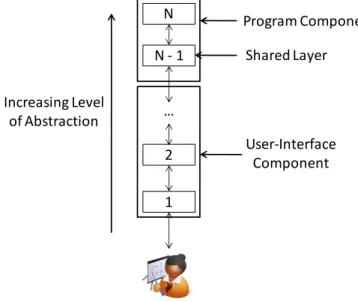
architecture model is Dewan’s general model [27], which represents an application as a stack of N layered components as shown in Figure 1-3. Each component in the stack provides an abstraction to and services requests from the component at the next lower layer. To share an application, a layer is selected to be logically shared. The part of the application contained in shared (non-shared) layers is called the program (user-interface) component. A program component may perform user-interface related tasks. For example, in a shared window system, all layers above the window system, such as the toolkit layer, are part of the program component. These two terms denote the fact that the shared (non-shared) layers are closer to the program (user-interface). The program component manages the object that is shared by all of the users of the application. The user-interface component allows interaction with the
Figure 1-3. Program and user-interface component definition. User-Interface
Component Program Component
1 2 N - 1
N
…
Shared Layer
9
shared object by manipulating state that is not shared by the users. A separate user-interface component runs on each user’s machine. The program component, on the other hand, may or may not be replicated. Regardless of the number of program component replicas, each user-interface component must be mapped to a program component to which it sends input
commands and from which it receives outputs [21]. To keep the program component replicas synchronized in this many-to-one mapping of user-interfaces to program components, each program component must send input commands it receives from the user-interfaces mapped to it to all of the other program components.
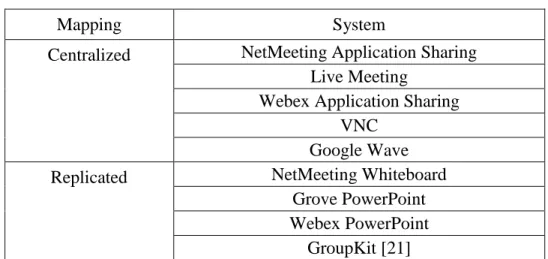
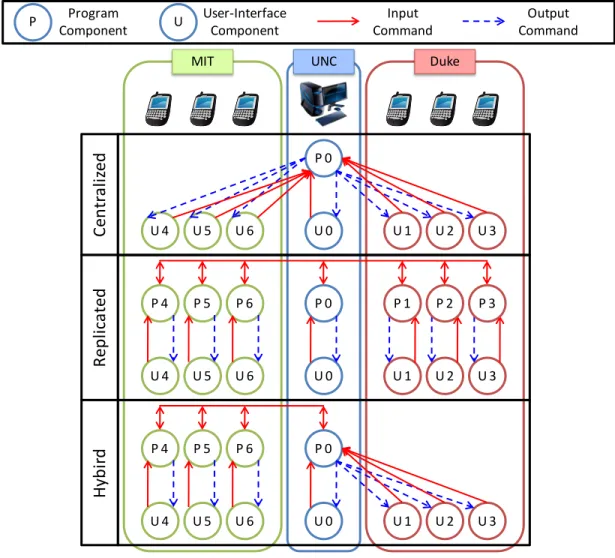
Three popular mappings have been used in the past: centralized, replicated, and hybrid (Table 1-1). The centralized mapping maps all of the user-interface components to a single program component. The replicated mapping maps each user-interface to its local program component. All other mappings are hybrid mappings. To illustrate the three kinds of mappings, consider the above candidates’ day scenario in which six students, three from Duke and three from MIT, are using smart phones to remotely join the application-sharing session. The professor demoing the application is also in the session and is using a desktop computer. A centralized mapping in which the program component on the professor’s
Table 1-1. Systems employing different collaborative architectures.
Mapping System
Centralized NetMeeting Application Sharing Live Meeting
Webex Application Sharing VNC
Google Wave
Replicated NetMeeting Whiteboard
Grove PowerPoint Webex PowerPoint
computer is used is shown in Figure 1-4 (top). The replicated mapping is shown in Figure 1-4 (middle). A hybrid mapping in which the user-interfaces on the Duke smart phones are mapped to the program component on the UNC desktop and all of the other user-interfaces are mapped to their local program components is shown in Figure 1-4 (bottom). This thesis focuses on the centralized and replicated mappings. As the figure shows, the hybrid mapping consists of a mix of centralized and replicated mappings. Hence our centralized and
Our Focus:
We focus on the centralized and replicated mapping cases.
Figure 1-4. Centralized, replicated, and hybrid mappings.
P 0
P 4 P 5 P 6
U 0 U 1 U 2 U 3
U 4 U 5 U 6
P 0
P 4 P 5 P 6
U 0 U 1 U 2 U 3
U 4 U 5 U 6
UNC Duke
MIT
U 0 U 1 U 2 U 3
U 4 U 5 U 6
P 0 U P Program Component User-Interface Component Input Command Output Command
P 1 P 2 P 3
11
replicated results can be extended to cover the hybrid mapping case. We defer those arguments until the discussions chapter.
The choice of mapping can impact the interactivity of the shared application. Suppose that the professor is demonstrating an exceptionally good but computationally expensive Checkers AI and is inviting the students at Duke and MIT to challenge it. What mapping should be used to provide good local response times to Checkers moves entered by the students? As UNC and Duke are near each other, the network latency between them is low. Suppose that the network latency between UNC and MIT is also low. Assume that the professor’s desktop is much more powerful than the smart phones. Since the AI algorithm is computationally heavy, a centralized mapping (Figure 1-4 (top)) in which the UNC desktop runs the program component may offer the best local response times. The reason is that it pays for the smart phones to incur the round-trip costs between them and UNC for using the desktop as a high-speed computation server. If the network latencies were high, then the high round-trip times between the smart phones and the desktop would annul the benefit of using the desktop as a high-speed server. In this case, the replicated mapping shown (Figure 1-4 (middle)) could give optimal local response times.
In general, there are infinitely many collaboration scenarios and choosing the architecture that best satisfies the users’ response time requirements on a case-by-case basis is a difficult task. This leads us to our first sub-thesis:
SUB-THESIS I
1.3.2 Unicast and Multicast
In the centralized and replicated architectures, a computer running the program component is responsible for delivering input commands or outputs to multiple other computers: in the centralized architecture, it sends outputs to the user-interfaces running on all of the other computers, and in the replicated architecture, it sends input commands to the program components running on all of the other computers. One question left unanswered is whether the input commands and outputs are unicast or multicast.
Previous work in operating systems and networking has shown that multicast can reduce the worst case remote response times in content-streaming systems [18][56]. The remote response times are improved by 1) minimizing the maximum sum of transmission delays and network latencies on a path from the source to any receiver (maximum end-to-end latency) and 2) respecting the bandwidth capabilities of the devices. In collaboration systems, optimizing these conditions can actually increase remote response times. To illustrate,
13
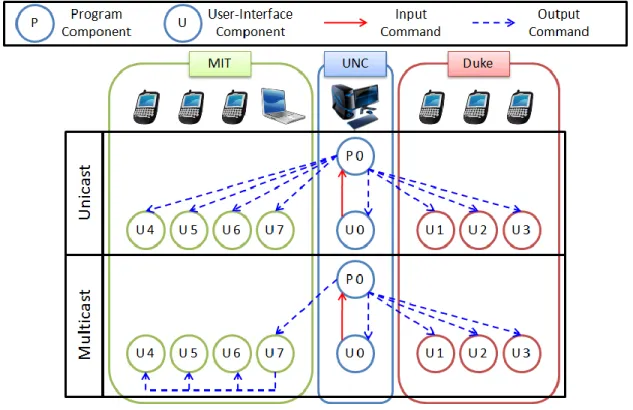
With unicast, the professor’s desktop must transmit commands to all of the students’ devices, as shown in Figure 1-5 (top). The figure shows the transmission of an output for an input command entered by the professor. Therefore, the student to whose device the
professor’s desktop transmits last has the highest remote response time. The student’s response time includes the time the desktop requires to transmit the output to all of the other devices first.
An example of a multicast overlay that optimizes end-to-end latency and respects bandwidth capabilities, which are the two traditionally optimized conditions, is shown in Figure 1-5 (bottom). In this multicast overlay, the desktop first sends the output to the laptop at MIT, which then forwards the output to the smart phones at MIT. As Figure 1-5 (bottom) shows, multicast divides the transmission task between the desktop and the laptop and, hence, effectively parallelizes it. The net effect is that once the laptop receives the output, the multicast transmission speed becomes twice that of unicast. Since the output is transmitted to six of the seven destinations at the multicast speed, the maximum multicast remote response times will be approximately half of the maximum unicast remote response time. It is not exactly half because before multicast speed is achieved, the desktop must first transmit the output to the laptop.
contain both the times that the desktop and the laptop require to process the output. On the other hand, the unicast remote response times do not contain the time the laptop requires to process the output. Hence, if the time the laptop requires to process the output is high, then the multicast overlay may actually increase remote response times compared to unicast.
As Figure 1-5 (bottom) illustrates, multicast requires the formation of communication overlays. But as discussed above, all of the existing collaboration architectures couple the processing of input commands with the distribution of input commands and outputs. As a result, these architectures do not support the distribution of input commands and outputs along arbitrary paths, which is required for multicast. To support multicast, a new bi-architecture model of collaborative systems is needed, which models collaboration systems as two separate sub-architectures: the processing architecture,
15
which governs the mapping of user-interface and program components, and the
communication architecture, which governs the maintenance of communication overlays. This leads to our second and third sub-theses:
1.3.3 Scheduling of Tasks
The systems proposed in the previous two sections automatically maintain the processing and communication architectures. Each of these architectures mandates specific tasks that the users’ devices must perform. The processing architecture dictates which computers process input commands in addition to processing outputs, while the
Definition:
The bi-architecture collaborative systems model represents a system through two separate sub-architectures: the processing architecture, which governs the mapping of user-interface and program components, and the communication architecture, which governs the maintenance of communication overlays.
SUB-THESIS III
It is possible to develop a system that automatically switches to the communication architecture that satisfies any user-specified response time criteria better than existing approaches.
SUB-THESIS II
communication architecture dictates the destinations to which a computer transmits commands. One question left unanswered is the relationship between the execution of the processing and transmission tasks, in particular, how these independent tasks are scheduled on the users’ devices.
The implementation and evaluation of scheduling schemes for these tasks depend on how many cores are available for scheduling. For example, if two or more cores are available for scheduling, it is possible to carry out processing and transmission tasks in parallel. We will consider both single-core and multi-core scheduling policies.
Single-Core Scheduling Policies
17
on our experience with state-of-the-art multicast schemes, usually a small number of computers actually forward commands. Moreover, an even smaller number of computers forward commands to many destinations. Therefore, we expect the transmit-first policy to provide better response times than the process-first policy to most destinations when a state-of-the-art multicast scheme is used.
An alternative to sequentially scheduling the processing and transmission tasks is to create separate threads for these tasks and schedule the threads using a round-robin policy. Intuitively, such a concurrent policy may seem to give response times in between those supported by the two sequential policies. In fact, with this policy, it is possible to get local response times that are as bad as those of the transmit-first policy. The reason is that when two tasks are scheduled concurrently, the shorter of the two tasks completes earlier than the longer task. Therefore, the longer task completes at the same time with the concurrent policy as it does with the sequential policy that schedules the longer task second. Thus, if the time the source computer requires to perform the processing task is larger than the time it requires to perform the transmission task, then the concurrent local response time is as bad as the transmit-first local response time. Similarly, the concurrent remote response times can be as bad as the process-first remote response times. Consider a destination computer which does not forward commands to other computers. If each computer on the path from the source to the destination, including the source but excluding the destination, completes the processing task before transmitting to the next computer down the path, then the concurrent remote response time is as bad as the process-first remote response time.
local and remote response times that are in between those supported by the other two policies.
One issue with the previous policies is that there is no way to control the tradeoff between local and remote response times. Controlling the tradeoff is particularly attractive when an unnoticeable increase in one metric can result in a noticeable decrease in the other metric. Research in human-computer interaction has shown certain increases are indeed unnoticeable – users cannot distinguish between local response times below 50ms [80]. Therefore, we designed a new lazy scheduling policy that, like the process-first policy, gives precedence to the processing task, but delays its execution if the resulting increases in response times cannot be noticed by humans. By performing a part of the transmission task while the processing task is delayed, such a policy should be able to improve the remote response times of some users. More importantly, the reduction in remote response times does not result in a noticeable increase in the local response times.
Multi-Core Scheduling Policies
Each single-core policy also has a multi-core equivalent. The multi-core transmit-first policy first uses all available cores for the transmission task. Once the transmission task is completed, the policy assigns a core for the processing task. The multi-core process-first policy initially uses one core to perform the processing task and the remaining core for the transmission task. Once the processing task completes, all cores perform the remainder of the
Definition:
19
transmission task. The multi-core concurrent policy runs the two tasks in parallel, using one core for the processing task and the rest of the available cores for the transmission task. Finally, the multi-core lazy policy initially uses all of the available cores for the transmission task. Once the processing task cannot be delayed further without the user noticing the delay, the policy assigns a core to perform the processing task and uses the remaining cores for the transmission task.
We evaluate the impact on response times of the process-first, transmit-first,
concurrent, and lazy scheduling policies for both the single-core and multi-core cases. This leads to our fourth and fifth sub-theses:
1.3.4 Analytical Model
So far, we have proposed a framework that can automatically switch to the processing architecture, communication architecture, and scheduling policy that best meet users’
response time requirements. In order to decide when to make a switch, the framework must invoke the user-defined total performance order function. As described earlier, that function takes as parameters the response times of the systems which it is supposed to order, the list of inputting users, and the identities of the users. Each combination of the processing
architecture, communication architecture, and the scheduling policy defines a system. Therefore, to invoke the total order function, our framework must first be able to predict the response times for any combination of these factors. Therefore, what is needed is a model
SUB-THESIS V
It is possible to develop a system that automatically switches to the scheduling policy that satisfies any user-specified response time criteria better than existing systems.
SUB-THESIS IV
21
that can analytically evaluate the impact on performance for any of these combinations, which leads to our sixth and final sub-thesis:
In order to apply the model, we need to develop algorithms that can perform runtime measurements and predictions of the values of collaboration conditions that impact response times. These algorithms can be based on the mechanisms used for similar purposes in other computer science disciplines. For example, in multi-processor systems, an algorithm is used to estimate the resource requirements of a job before the job is scheduled on a particular processor. This algorithm can serve as a basis for estimating the amount of work required to process an input command on a particular computer in the collaboration. Moreover, in server-farm systems, load balancing algorithms continuously estimate server loads so that when a request arrives, it is forwarded to the server with the lowest load. This algorithm can be reused to estimate the non-collaboration load on a computer. The system load and input command work estimates can be combined to get an estimate of how much time a computer requires to process an input command.
The parameter estimation algorithms described will have to extend to the multi-core case. In particular, the algorithms will have to consider the fact that even though multiple cores can transmit to different destinations in parallel, the device typically has only one network connection. Hence, all of the commands are actually transmitted serially on the
SUB-THESIS VI
physical link. Thus, using N cores to perform the transmission task may not actually result in a factor of N reduction in the total transmission time.
New algorithms for measuring collaboration-specific parameters will also need to be developed. For example, think time, which is the amount of time a user thinks for about the last output before entering the next input command, can have an impact on performance: low think times can result in queuing and temporary system overload as new input commands arrive before the system has a chance to process those already in the system. Accurate think time predictions are therefore a key element for providing optimal performance. For
example, they can help with preemptive architecture transitions if the current architecture is expected to be overloaded soon.
1.4
Scope
We have given one collaborative scenario so far, namely, the Checkers scenario in our example, but we have not qualitatively described the types of scenarios we consider. In this section, we present three driving problems that motivated the thesis and outline the design space of applications that the thesis considers. We carve the design space by
23
1.4.1 Driving Problems
In general, collaborative scenarios can be classified along the time and place design space [33]. The thesis focuses on the same-time different-place part of the design space. Three driving problems from this part of the design space motivated the thesis:
1. A distributed PowerPoint presentation 2. A collaborative Checkers computer game 3. Instant messaging
These three problems are important examples of real collaborative scenarios. Distributed presentations are becoming common, instant messaging is pervasive, and collaborative games, such as checkers, chess, and online poker, are extremely popular. In fact, by itself, distributed PowerPoint presentations are an important scenario as an entire industry has been created around it. Microsoft LiveMeeting and Webex are just two of many commercial applications that allow users to give presentations to distributed audiences. The company whose product offers the best performance is going to have an advantage over all of the other companies.
In addition to being important practical scenarios, a nice feature of the driving problems behind our work is that we have available to us a collaborative Checkers game, an instant messaging application, and a way to programmatically interact with PowerPoint. Moreover, we have been able to integrate these applications with our proposed systems, and hence we can perform experiments with the applications to evaluate the systems.
The discussion focuses on three orthogonal dimensions in the application design space. The first two are architecture related and the last one is implementation related.
1.4.2 Program Component Type
As mentioned above, collaboration architectures model a shared application as a set of layers as shown in Figure 1-3. To share the application, a layer is selected to be shared. The shared layer and the layers above it, which are also shared, form the program
component. The layers below the shared layer, which are not shared, form the user-interface component. Here we focus on the program component. In the next sub-section, we focus on the user-interface component.
The program component manages the object that is shared by all of the users of the application. Program components can be classified by whether or not they process
computationally heavy input commands and whether or not they distribute large amounts of data. Based on these distinctions, four types of program components can be derived: logic-centric: processes computationally heavy input commands; data-logic-centric: distributes large amounts of data; logic-and-data-centric: both processes computationally heavy input commands and distributes large amounts of data; and stateless: neither processes computationally heavy input commands nor distributes large amounts of data.
The type of program component affects the degree to which changing the processing architecture, communication architecture, and scheduling policies will impact response times.
Scope:
25
For example, in a logic-centric application, the choice of processing architecture matters more than the choice of communication architecture or scheduling policy. In a data-centric application, the communication architecture matters the most. And in a logic-and-data centric application, not only do the processing and communication architecture matter but so does the scheduling policy. Finally, in stateless applications, the potential performance
improvements that can be achieved by automating these three aspects of the application are lower than in the other cases. Therefore, it is important to consider applications from each of these categories when investigating performance.
The thesis considers all four types of program components from a theoretical perspective. In particular, the analytical model proposed in sub-thesis VI applies to all four program component types. From an experimental perspective, which is used to validate the theoretical analysis, the types of program components considered are determined by the applications in our driving problems. As a result, the thesis considers three of the four types of program components from an experimental perspective: instant messaging, which is stateless; Checkers, which is logic-centric; and PowerPoint, which is data-centric.
Scope:
1.4.3 User Interface Type
While the program component manages the object that is shared by all of the users of the application, the user-interface component allows interaction with the shared object by manipulating state that is not shared by the users. Not all user commands need to be sent from the user-interface to the program component, that is, not all commands need to be shared. In particular, if a user command interacts with only the state on the local user’s device that is not shared with other users, then there is no reason to distribute the command to other users. The number and frequency of non-shared commands determines the thickness of the user-interface [42].
Ideally, the analysis of response times should account for both the non-shared and shared commands. After all, non-shared commands should have good local response times. Moreover, these commands can impact the response times of shared commands and vice versa. To correctly analyze the interplay between the response times of these two types of commands, we need a model of the event flow of the non-shared commands. This event flow is application dependent. Therefore, we need a separate model for each application. As there are infinitely many applications, creating a model for each one of them is beyond the scope of a single work. In order to make the thesis tractable, the analysis presented does not account for non-shared commands.
27
negligible on any device in use today. When incremental sharing is supported, as in Google Wave [39], then the typing commands are actually shared commands because the typed text is displayed incrementally to all collaborators.
Of course, many popular applications, such as some massively multiplayer online games [42], have thick user-interface components in which non-shared commands have high processing costs. We return to the potential impact on response times of these commands in the discussions chapter.
1.4.4 Collaborative Functionality
In addition to classifying collaborative applications according to the type of program and user-interface components they have, we can also classify these applications by the type of collaborative functionality they provide. Some functionality, which we refer to as
mandatory functionality, are common to all collaborative applications. For instance, the mandatory functions required to share an object are the processing of user commands invoked on the object and distributing the results of these commands to all users. In addition to the mandatory functions, there are optional collaborative functions that an application can provide which can increase response times [27]. Some of these functions, such as
concurrency control, access control, merging (i.e. consistency maintenance), and awareness, Scope:
can increase response times. Concurrency control impacts performance because it can delay the execution of an action until it determines that the action does not conflict with other actions. Access control can increase response times because before the program component executes commands from a user, it must first verify that the commands are authorized. Merging algorithms impact performance because the merge result must be calculated when a command is merged with previous commands, which effectively increases the processing cost, and hence, the response time of the command. Finally, awareness mechanisms can increase response times as they increase the amount of data that has to be communicated between users’ machines, which can impact the transmission costs of the user commands.
Ideally, analyzing the impact on response times of changing the processing
architecture, communication architecture, and scheduling policies should account for all of collaborative functions that impact response times. However, each of these functions has a large design space. Moreover, each point in a function’s design space can have several implementations. The matter is further complicated by the fact the impact depends on the type of communication and collaboration architecture that is used [42]. To make the thesis tractable, we consider only the mandatory functions. The analysis can later be extended to support some of the optional functions.
29
analyzed, the users employed a social-protocol to prevent entering conflict commands. Finally, in instant messaging, simultaneous actions can occur, but no merging of commands is done. The result is that the local message histories for two users may be out of order. Thus, the users may have an inconsistent view of the chat history. Fortunately, in this and some other cases [43], the users do not care that their views are inconsistent.
The lack of optional collaborative functions in the applications we consider does not mean that these functions are not important. On the contrary, these mechanisms are important in many applications. For example, concurrency control and merging are important in
massively multiplayer online games [42] and multi-user editors [7][35]. Moreover, numerous user studies have shown the benefits of having awareness mechanisms [29][48][75]. We will return to the discussion regarding the impact on response times of these and other optional functions in the discussion chapter.
1.4.5 Assumptions
So far, we have outlined the scope of our thesis by pointing out the points in the design space of collaborative applications that the thesis considers. For the considered applications, the thesis makes one additional implementation assumption:
When an idle computer receives a command, it immediately begins
performing the tasks for the command. In particular, there are no delays added Scope:
We consider only the response times of mandatory commands in isolation of
in performing these tasks, such as the delays necessary for atomic broadcast or causal consistency.
We make the assumption to keep response times low. As mentioned above, users can notice 50ms increments in response time and hence the processing of the commands cannot be delayed for long. This assumption can lead to several problems in practical scenarios. We will discuss these issues in the discussions chapter.
In addition, the thesis makes two user assumptions:
Users interactively discuss each other’s actions.
Users communicate verbally through a pre-established channel, such as a telephone.
The user-related assumptions are consistent with our driving problems. The interactive discussion assumption is satisfied by definition in a distributed PowerPoint presentation as the presenter is discussing the presentation while the presentation is being advanced. Moreover, other users may discuss among themselves the topic the presenter is currently presenting. The external communication channel assumption holds true in commercial in systems, such as LiveMeeting.
The user-related assumptions dictate the types of scenarios considered by the thesis. Examples of scenarios that do not satisfy these criteria are streaming multimedia applications
Assumption:
31
that playback pre-recorded audio and video streams, videoconferencing systems without a shared workspace, and shared file repositories and versioning systems. Our criteria also exclude systems which capture workspace interactions as a video stream and then stream the video to all of the other users. While such a system is interesting, it does not satisfy our criteria of allowing all users to interact with the shared workspace. In addition, the criteria exclude adding a large delay to commands before either sending them or when they are received. Such delays can be used to ensure that the changes to the shared state are shown at approximately the same time to all users or that all users have reached a consistent state when the inputting user changes. Unfortunately, delaying the display of the result to the inputting user may noticeably increase local response times. Thus, the delay in displaying the result should only be done on the receiver side. In this case, the user who performs an action will see the result of the action sooner than the other users. In fact the user may perform several other actions before the action is seen by others. As a result, these delays prevent other users from reacting in a timely fashion to the initial action. Timely reactions can be extremely important. Consider an online Checkers game that is being followed by a large audience. When the players make a good move against the computer, the audience will want to congratulate them by sending them a happy face or thumbs up in an instant message. If the
Scope:
players receive such feedback much after they had performed the action, the feedback may not make any sense.
1.5
Applicability of Results
This dissertation shows that under certain conditions, specifically when processor and network resources are neither over-stressed nor under-stressed, the self-optimizing system can have clear performance benefits over traditional groupware systems. While we speculate that these conditions occur in actual scenarios, further analysis of network and processor bottlenecks is needed to determine whether they actually occur. At the same time, the thesis clearly states several simplifying assumptions. Moreover, the self-optimizing system is a complex prototype that may have high development costs. Therefore, the question is whether the costs of using the system are worth the benefits in actual scenarios. The simple answer is that the system is a realistic alternative to existing groupware; however, it cannot be applied blindly as it involves a series of tradeoffs and unknowns. We will return to the cost-benefit analysis in the discussion section.
1.6
Summary
In this chapter, we have presented 1) our thesis, 2) its six sub-theses, 3) its scope, and 4) its assumptions. Thus, we can state our thesis statement in full:
Thesis
33
1. Given the result shown in previous work that the processing architecture impacts response times, it is possible to develop a system that automatically switches to the processing architecture that satisfies any user-specified response time criteria better than existing approaches.
2. In addition to the processing architecture, the choice of communication architecture also impacts response times.
3. It is possible to develop a system that automatically switches to the communication architecture that satisfies any user-specified response time criteria better than existing approaches.
4. Not only do the processing and communication architectures impact response times but so does the scheduling policy used for executing the processing and transmission tasks.
5. It is possible to develop a system that automatically switches to the scheduling policy that satisfies any user-specified response time criteria better than existing approaches. 6. It is possible to develop a model that analytically evaluates the impact on response
times of different processing architectures, communication architectures, and scheduling policies to the degree necessary to automate their maintenance.
The analytical performance model proposed in the sixth sub-thesis is an important contribution of its own. First, like analytical models in other computer science fields, it increases our understanding of the subject analyzed. In the case of collaboration
guidance for users with varying degrees of choice regarding the combination of the processing architecture, communication architecture, and scheduling policy in the collaboration systems they use. It can be used by (a) users of adaptive systems to decide when to reconfigure the systems, (b) users who have a choice of systems with different configurations to choose the system most suited for a particular collaboration mode (defined by the values of the collaboration parameters), and (c) users locked into a specific
configuration to decide how to change the hardware and other collaboration parameters to improve performance. The model is also necessary prove the first five sub-theses. As a result, we will develop the model incrementally as we prove the first five sub-theses.
In the first five sub-theses, we consider three performance factors of collaborative systems: 1) processing architecture, 2) communication architecture, and 3) scheduling policies. Systems are proposed that automate the maintenance of each of the three factors. These three factors are independent of each other. If one or two of them are fixed, then those that are not fixed can still be changed. For instance, for any processing architecture, we can use either a unicast or multicast architecture. And for any processing and communication architecture pair, multiple scheduling policies can be used. Therefore, to prove the thesis, it is sufficient to show automating the maintenance of one of these factors in isolation of the others can improve response times. We first show that automating the processing architecture maintenance can improve response times when the communication architecture and
scheduling policy are fixed. We then show that when the scheduling policy is fixed,
35
The rest of this thesis is organized as follows. Chapter 2 proves sub-thesis I. Chapter 3 proves sub-theses II and III. Chapter 4 proves sub-theses IV and V. The proof of sub-thesis VI is given incrementally in chapters 2 through 4. Chapter 5 presents related work. Chapter 6 discusses the applicability and limitations of our work. Finally, Chapter 7 presents
CHAPTER 2
AUTOMATING PROCESSING ARCHITECTURE MAINTENANCE
2.1
Overview
As mentioned in the introduction chapter, previous work has shown that the choice of the architecture impacts the response times of the shared program. In general, choosing the architecture that provides the best response times is a difficult task. Therefore, Chung [21] developed an analytical model that can predict the architecture that gives the best response times. The model assumes two-user collaborations, a constant cost of processing each input command, zero cost of processing each output command, zero cost of transmitting inputs and outputs, constant think times before each command, and no type-ahead (no type-ahead means that users do not enter a command until they see the output for the previous commands). Chung showed both analytically and experimentally that (a) low network latency favors the centralized architecture and (b) asymmetric processing powers favor the centralized
architecture. As these conditions can change dynamically, he developed a system that supports architecture changes at runtime. He also performed experiments showing that when a user with a powerful computer joins the collaboration, it is useful to dynamically centralize the shared program to the new user’s computer.
maintains the architecture would be useful because it would relieve the users of performing these tasks. In this chapter, we present such a self-optimizing system for small-scale
collaboration scenarios, where by small-scale, we mean two or three users.
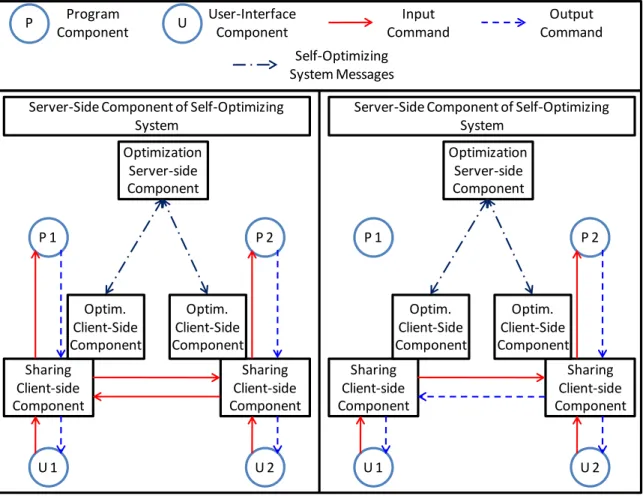
In the process of creating the self-optimizing system, we extended Chung’s work in two ways. First, we present a three-user version of Chung’s two-user model that relaxes three of the six assumptions made by the original model. In particular, the new model does not assume a constant cost of processing each input command, zero cost of processing each output command, or constant think time before each input command. The updated model still assumes negligible transmission costs and no type-ahead. Second, we present a system that can automatically gather the parameters of the three-user model and apply the model to decide which architecture should be used. By combining this new system with our own version of Chung’s system that can dynamically switch architectures at runtime, we create a self-optimizing system that automates the maintenance of the architecture. Therefore, our system consists of two-sub systems. The first is our version of Chung’s system, which we call the sharing sub-system to denote the fact that it is responsible for sharing the application. The second is the new system we develop, which we call the optimization sub-system to denote to the fact that it is responsible for improving response times.
Chapter Scope:
39
Each of the systems of the self-optimizing system raises several issues that must be addressed in order for the system to function correctly. A fundamental issue raised by the sharing sub-system is how it shares an application among the users. The system must somehow intercept users’ input commands and the corresponding outputs and send them to the appropriate computers. Ideally, it should do so in a manner transparent to the application. Moreover, the system needs to be configurable so that the same application can be shared using both centralized and replicated architectures.
Another fundamental issue is how the sharing sub-system switches between replicated and centralized architectures dynamically at runtime. Whenever the system switches from a centralized to a replicated architecture, the system must bring the program components on the new master computers up to date; otherwise, these program components may be out of sync with the program component running on the computer which was the master in the centralized architecture. Moreover, if an architecture switch is not performed atomically with respect to user commands, then the shared application may be shared in a manner that is inconsistent with the notion of centralized and replicated architectures. To illustrate, suppose that the system switches from the replicated (centralized) to the centralized (replicated) architecture. Suppose that during the switch, an input (output) command was en-route to the computer that is (was) a slave in the centralized architecture. Therefore, a slave
Chapter Goals:
(master) user in the new architecture will receive an input (output) command from a remote user which is inconsistent with the notion of centralized (replicated) architectures.
A related issue is how the system accommodates late-comers. When a late-comer joins as a master, the system must as above, bring the program components on the
late-comer’s computer up to date; otherwise, these program components may not be synchronized with the program components on other computers. Similarly, when a late-comer joins as a slave, the system must bring the user-interface component on the late-comer’s computer up to date; otherwise, future outputs may not make sense.
Chung’s framework has provided solutions to all of these issues. Since our sharing sub-system is a version of Chung framework, for each issue, we will describe Chung’s solution. If in our system we use a different approach than Chung, then we will state the difference between ours and Chung’s systems. If we do not state a difference, it means that we have reused Chung’s solution.
The optimization sub-system raises a different set of issues. One issue is how the system is organized. Implementations in which the system is organized in a client-server or peer-to-peer fashion on the users’ machines both seem promising. However, the former can overload the machine on which it is running and hence degrade the response times of the local user, while the latter must reach an agreement among the peer components, which is a version of the distributed consensus problem commonly found in distributed systems.
Another important issue is how the optimization sub-system gathers values of the parameters in the analytical model, which it must do in order to apply the model. In
41
Once the system gathers the parameter values, it can use the analytical model to predict replicated and centralized architecture response times. The next issue is how it passes the predicted response times to the total order function and then invoke the functionality in the sharing sub-system for switching architectures to change to the architecture returned by the total order function.
We address the issues raised by both the sharing and optimization sub-systems system when we describe them below. The rest of this chapter is organized as follows. We first derive our three-user version of Chung’s analytical model. We then describe our version of Chung’s system that can dynamically switch architectures at runtime. Following this, we discuss the upgrades to the system necessary to turn it into our self-optimizing system. Then, we describe experiments conducted with the self-optimizing system. Finally, we present discussions and a brief summary.
2.2
Formal Analysis
Developing an analytical model is a complex task. Therefore, like Chung [21], we make certain assumptions in our response time model of collaboration architectures: the collaboration involves at most three users, who we denote as user1, user2, and user3; the
transmission costs are negligible; and there is no type-ahead. Because of the second assumption, whenever a computer must both send a command to the other computers and process the command, we assume that it first sends the command and then processes it.
outputs to the local user. The impact of think times on response times is somewhat less apparent. Think times can impact response times because when think times of commands are low, slower computers may fall behind the faster computers in processing the commands. In particular, when a command reaches slower computers, these computers may not be ready to begin processing the command immediately if they are still busy processing previous
commands. The delays in processing the commands increase the response times of the commands.
In all of the small-scale collaborations we logged, the users’ think times were high enough that computers were always ready to process the next command whenever it arrived. These collaborations included commands that were generated fairly rapidly, such as those of telepointers. Telepointing actions are typically generated thirty times each second, that is, they have think times of 33ms. Even though these think times appear low, they are much higher than the processing times of telepointing commands, which were 1.5ms on a P3 desktop, the slowest computer we used in our experiments. Thus, the think times are effectively high even for telepointing actions. Therefore, in this chapter, we present the analysis only for the case when think times are high.
Analysis Scope:
43
We will introduce the remaining parameters of our model as we develop the
equations. We start by considering the equations for the local response times in centralized architectures.
2.2.1 Local Response Times in Centralized Architectures
In a centralized architecture, the shared program executes on a computer belonging to one of the collaborators, receiving input from and broadcasting output to all users. The computer running the shared program is called the master while all other computers are called slaves.
In cases where a master user inputs commands, the commands are processed by the local computer. It processes each input command immediately after the local user provides it, computes the output for the command, transmits the output to the slave users, and process the output to display the result to the local user. Let 𝑝𝑖,𝑗𝐼𝑁 (𝑝𝑖,𝑗𝑂𝑈𝑇)denote the time userj’s computer
requires to process input (output) command 𝑖. Hence, if userm is the master in a centralized
architecture, userm’s local response time is 𝑝𝑖,𝑚𝐼𝑁 + 𝑝𝑖,𝑚𝑂𝑈𝑇.
Now, consider the case where a slave user inputs command. The slave user’s
computer must first transmit the command to the master, which must then travel to the master computer. When the master computer receives the command, it then processes the command without interruption, computes an output message, and transmits the output back to the slave user, which must then travel back to the slave’s computer. When the slave’s computer receives the output, it processes the output. Let 𝑑(𝑗, 𝑘) denote the network latency a command experiences as it travels from userj’s to userk’s computer. Therefore, if users1
(users2’s) local response time is 𝑑 𝑠1, 𝑚 + 𝑝𝑖,𝑚𝐼𝑁 + 𝑑(𝑚, 𝑠1) + 𝑝𝑖,𝑠1𝑂𝑈𝑇 (𝑑 𝑠2, 𝑚 + 𝑝𝑖,𝑚𝐼𝑁 +
𝑑(𝑚, 𝑠2) + 𝑝𝑖,𝑠2𝑂𝑈𝑇). Hence, if user
m is the master and users1 and users2 are slaves, we have 𝑙𝑜𝑐𝑎𝑙𝐶𝐸𝑁𝑇,𝑖,𝑚𝑢𝑚 = 𝑝𝑖,𝑚𝐼𝑁 + 𝑝𝑖,𝑚𝑂𝑈𝑇 if userm is master 𝑙𝑜𝑐𝑎𝑙𝐶𝐸𝑁𝑇,𝑖,𝑠1𝑢𝑚 = 𝑑 𝑠1, 𝑚 + 𝑝𝑖,𝑚𝐼𝑁 + 𝑑(𝑚, 𝑠1) + 𝑝
𝑖,𝑠1𝑂𝑈𝑇 if userm is master 𝑙𝑜𝑐𝑎𝑙𝐶𝐸𝑁𝑇,𝑖,𝑠2𝑢𝑚 = 𝑑 𝑠2, 𝑚 + 𝑝𝑖,𝑚𝐼𝑁 + 𝑑(𝑚, 𝑠2) + 𝑝
𝑖,𝑠2𝑂𝑈𝑇
We next derive the equations for the local response times in the replicated architecture.
2.2.2 Local Response Times in Replicated Architectures
In the replicated architecture, a separate replica of the program executes on the computer of each user, receiving input from all users and producing output for only the local user. Hence, all computers are masters in the replicated architecture. Thus, userj’s local
response time in the replicated case is 𝑝𝑖,𝑗𝐼𝑁+ 𝑝𝑖,𝑗𝑂𝑈𝑇. Hence,
𝑙𝑜𝑐𝑎𝑙𝑅𝐸𝑃,𝑖,𝑗 = 𝑝𝑖,𝑗𝐼𝑁+ 𝑝 𝑖,𝑗𝑂𝑈𝑇
2.2.3 Remote Response Times in Centralized Architectures
Recall that a non-inputting user’s remote response time for a command is defined as the time that elapses from the moment the command is input to the moment the user sees its output. In centralized architectures, a user’s remote response time depends on whether the non-inputting and inputting users are both slaves or if one of them is the master. If the master user provides the input, a slave user will see the output once the input command is processed, the output traverses the network, and the slave user’s computer processes the output. Thus, we have
𝑟𝑒𝑚𝑜𝑡𝑒𝐶𝐸𝑁𝑇,𝑖,𝑠1𝑢𝑚 = 𝑝𝑖,𝑚𝐼𝑁 + 𝑑(𝑚, 𝑠1) + 𝑝
𝑖,𝑠1𝑂𝑈𝑇 if master userm inputs
45
If a slave user provides the input, the master user will see the output once the input command reaches the master computer and the computer processes it and the corresponding output. The other slave user will see the output once the input command reaches the master computer, the master computer processes and transmits the output to the other slave, the output travels to the other slave’s computer, and finally the other slave’s computer processes it. Thus,
𝑟𝑒𝑚𝑜𝑡𝑒𝐶𝐸𝑁𝑇,𝑖,𝑚𝑢𝑚 = 𝑑 𝑠1, 𝑚 + 𝑝𝑖,𝑚𝐼𝑁 + 𝑝 𝑖,𝑚𝑂𝑈𝑇
𝑟𝑒𝑚𝑜𝑡𝑒𝐶𝐸𝑁𝑇,𝑖,𝑠2𝑢𝑚 = 𝑑 𝑠1, 𝑚 + 𝑝𝑖,𝑚𝐼𝑁 + 𝑑(𝑚, 𝑠2) + 𝑝 𝑖,𝑠2𝑂𝑈𝑇
if slave users1 inputs, and
𝑟𝑒𝑚𝑜𝑡𝑒𝐶𝐸𝑁𝑇,𝑖,𝑚𝑢𝑚 = 𝑑 𝑠2, 𝑚 + 𝑝𝑖,𝑚𝐼𝑁 + 𝑝 𝑖,𝑚𝑂𝑈𝑇
𝑟𝑒𝑚𝑜𝑡𝑒𝐶𝐸𝑁𝑇,𝑖,𝑠1𝑢𝑚 = 𝑑 𝑠2, 𝑚 + 𝑝𝑖,𝑚𝐼𝑁 + 𝑑(𝑚, 𝑠1) + 𝑝𝑖,𝑠2𝑂𝑈𝑇
if slave users2 inputs.
2.2.4 Remote Response Times in Replicated Architectures
In the replicated architecture, the remote response time of a command includes the time the command requires to travel from the inputting user’s computer to the receiving user’s computer and the time the receiving user’s computer requires to process the command and its output. Thus, the userk’s remote response time of command 𝑖 entered by userj is given
by
𝑟𝑒𝑚𝑜𝑡𝑒𝑅𝐸𝑃,𝑖,𝑘 = 𝑑 𝑗, 𝑘 + 𝑝𝑖,𝑘𝐼𝑁+ 𝑝𝑖,𝑘𝑂𝑈𝑇
2.3
Self-Optimizing System Implementation
sub-system, is a version of Chung’s system that provides the functionality necessary to switch architectures at runtime. The other sub-system, called the optimization sub-system, provides the functionality that decides when to invoke the architecture change functionality of the first system. In this section, we describe how we implemented these systems. Since our sharing sub-system is a version of Chung framework, we describe Chung’s solutions to any issues it raises. If there is a difference between how Chung system and our version of it handle an issue, we present the difference.
2.3.1 Sharing Applications