Colin Post
A thesis submitted to the faculty at the University of North Carolina at Chapel Hill in partial fulfillment of the requirements for the degree of Master of Arts in Art History in the College of
Arts & Sciences
Chapel Hill 2019
ii © 2019 Colin Post
iii
ACKNOWLEDGMENTS
iv ABSTRACT
Colin Post: Talking/Speaking/Stalking/Streaming: Artist’s Browsers and Tactical Engagements with the Early Web
(Under the direction of Cary Levine)
The thesis discusses three artist-made browsers from the late 1990s. As the Web transitioned from a niche information system to global telecommunications infrastructure, these artists created functional software that explored the socioeconomic, political, and cultural ramifications of these rapidly changing networked technologies. The thesis argues that these artworks seized upon the browser—an interface between users and information—as a tactical point of
v
TABLE OF CONTENTS
CHAPTER 1: ARTIST’S BROWSERS AS TACTICAL MEDIA ... 1
1.1) Browsing as Writing ... 1
1.2) Artist’s Browsers Coming Online ... 3
1.3) Browsing in Transition ... 6
1.4) Tactical Media ... 9
1.5) Interrogating the Modes of Production Online ... 12
CHAPTER 2: FROM SURFING TO STALKING ... 15
CHAPTER 3: PUTTING THE WEB THROUGH THE SHREDDER ... 28
CHAPTER 4: FORDING THE STREAM ... 39
CHAPTER 5: BELIEVING IN USERS AND BELIEVING IN THE WEB ... 50
FIGURES ... 56
1
CHAPTER 1: ARTIST’S BROWSERS AS TACTICAL MEDIA
1.1) Browsing as Writing
The World Wide Web (the Web) has always been a technology for both the production and consumption of information. Every few years, new developments exert renewed influence on practices for finding and sharing information: graphical websites interconnected via hyperlinks, search engines capable of retrieving information from these millions of pages, weblogs (or blogs) facilitating personal expression, and social media platforms fostering further interpersonal
interaction. Across these practices, though, rests a core tension between producing and sharing information: practices of information consumption, like conducting queries in search engines or clicking between links, also generate data made differently legible to both humans and machines; practices of information production like creating a website or blog require literacy of the tools used to make this writing possible. As a technology enabling new ways of reading and writing, the Web has altered the relationship between producing and consuming information, along with the social, cultural, and economic valences of these information practices.
2
information as webpages and translating individuals’ physical actions of clicking and typing into data interpreted by system.1 In the late ‘90s, popular commercial browsers like Netscape
Navigator and Microsoft’s Internet Explorer established an interface paradigm that persists today, representing the Web as visually-rich pages with formatted text and inline media objects. These browser interfaces were inviting and accessible, even for novice computer users, but provided little insight into how the Web functioned as a network for reading, writing, and sharing
information. Users could readily browse across pages by clicking links, but this was essentially the limit of the interactive possibilities as these browsers presented the Web as a read-only media.
The artist’s browsers discussed in this thesis all present alternative interfaces, visualizing the Web in ways that directly contrast the page paradigm and offering users a range of
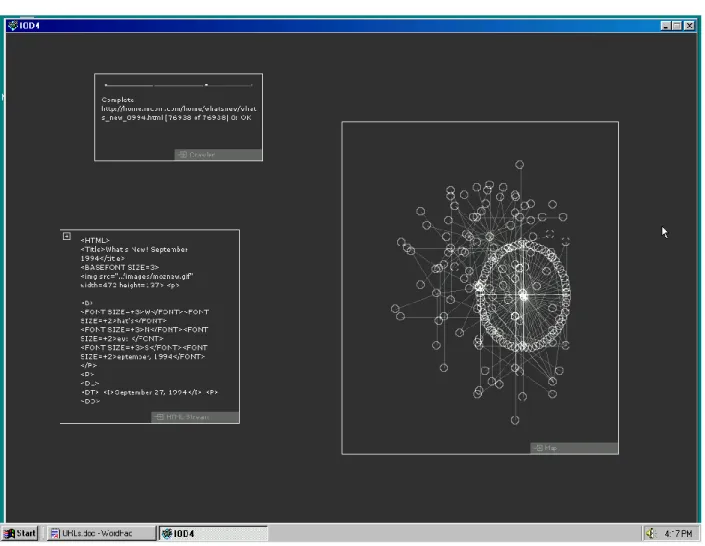
interactions with networked information obscured by mainstream browsers. The Web Stalker
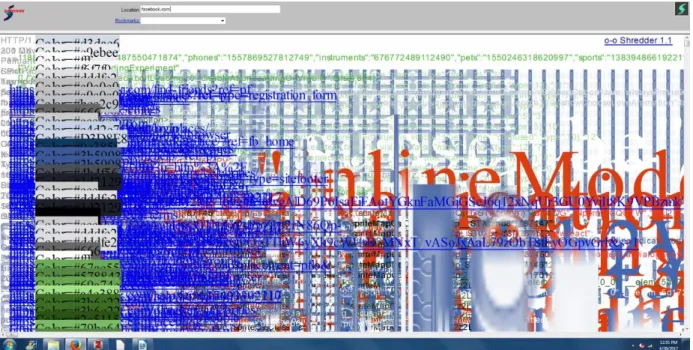
(1997) (fig. 1), created by the artist collective I/O/D, eschews the single page, instead rendering the node and link connections between pages as spindling diagnostics. As per its name, Shredder
(1998) (fig. 2) by Mark Napier shreds through sites, reshaping the constituent images, text, and code as a collage that juxtaposes the surface and guts of webpages. Just as Google emerged as a pathbreaking tool for finding information online, Maciej Wisniewski’s netomat (1999) (fig. 3) imagined an alternative approach to web searching that represented results as a dynamic stream of text, image, and audio culled together from disparate sites. Though each work functions in quite different ways, all critique the predominant means for interacting with the Web afforded by mainstream browsers, which offer users access to networked information but close off any insight into the browser itself. Instead advancing ‘browsing’ as a union of creative acts—both the
1 Johanna Drucker, “Performative Materiality and Theoretical Approaches to Interface,” Digital Humanities
3
perusal and production of information, or in other words, a form of writing—these artists fashioned the browser as a tool that users could learn to wield in any number of ways. With the ability to both read and write the Web, users of this technology might also see themselves as producers of the technology, driving the development of this open communications
infrastructure.
1.2) Artist’s Browsers Coming Online
In the following chapters, I detail how each artist’s browser operated within the extant infrastructure of the Web in the late 1990s while demonstrating alternative configurations for how the Web could function as a communication technology and making available tactics for realizing these possibilities.2 As I elaborate in the following section, the Web at this time was in a period of transition with the communicative potential of the technology very much in flux. In all of this, browsers act as a critical juncture point between the networked documents that make up the Web and the individuals who create, share, and read those documents. Out of a flurry of diverse browsers developed largely as pet projects by computer scientists or hobbyists—all of which represented the Web in markedly divergent ways—a couple commercial browsers emerged that cemented the paradigm for browsing we know today.3 Responding to this commercialization, these artists considered the socioeconomic tendencies pulling browsing
2 As a brief historiographical and stylistic note, I will largely be talking about how these works were created and
experienced during the late 1990s. However, both The Web Stalker and Shredder remain operational in various ways, although netomat is obsolete for all intents and purposes. As two of these works remain functional, I will generally discuss these works in the historical present tense, except in instances where I am explicitly discussing these works in the time period of the late 1990s, in which case I use the past tense.
3 Tim Berners-Lee and Mark Fischetti describe this heyday of browser development occurring in 1993 and 1994,
with many concurrent projects developing like Lynx, Arena, and Cello alongside Berners-Lee’s own eponymous WorldWideWeb browser. This early atmosphere was collegial, with browser developers discussing and sharing projects on Internet newsgroups and mailing lists. Tim Berners-Lee and Mark Fischetti, Weaving the Web: The
Original Design and Ultimate Destiny of the World Wide Web by Its Inventor, (San Francisco: HarperSanFrancisco,
4
toward read-only interactions, and explored the productive potential of the Web mediated by browsers as dynamic implements for understanding, configuring, and creating information online.
The first chapter focuses on The Web Stalker, which jostles users out of the flow of surfing across discrete webpages by providing a diagrammatic overview of the link-and-node structure of websites. Rather than browsing from page to page, the user invokes commands— stash, dismantle, crawl, map—interacting with the Web at a higher level of networked
information that can be configured or processed in any number of ways. ‘Map,’ perhaps the most powerful of these commands, zooms up from the individual page to display how countless pages are linked together in a dense web. Through this overlooking visualization and added
functionalities for interacting with sites, The Web Stalker introduces an alternative lexicon, ‘stalking’ in place of ‘surfing,’ recasting how to move through the information space of the Web. Unlike earlier mass communications technology like television or radio, web users control how they navigate and direct the flow of information. The Web Stalker illustrates that users can attain an even greater degree of agency than mainstream browsers afford.
5
language that can be pulled apart, copied, altered, and refashioned for the users’ expressive purposes.
Finally, I compare netomat to these two artist’s browsers. While The Web Stalker and
Shredder deconstruct the Web, offering alternative views into the component technologies,
netomat represented a largely distinct information system, integrating a novel programming
6 1.3) Browsing in Transition
As noted above, the late 1990s marked a crucial point in the development of the Web as corporate interests increasingly exerted influence to maximize the commercial potential of a globally expanding communications technology. Recent popular and scholarly attention to the algorithmic processes underlying current Web systems has shed light on the pervasive extent to which personal information is mined for corporate profit4 and governmental control,5 raising urgent discussions about many core social and cultural norms, such as privacy.6 Marking a growing ambiguity between producer and consumer, the so-called ‘prosumer’ economic model has matured with the emergence of social and mobile web applications, as proprietors of social media platforms gain direct and immediate economic value by capitalizing on users’ interactions. As the Web develops to include a broader range of interactions with information, such as
emotively responding to other user-generated content with ‘likes,’ the users of web systems and services increasingly become the producers of information driving the Web.
However, the relationship between the production and consumption of information on the Web has always been complex and intertwined, with the current situation built on existing capabilities of the Web, as well as broader socioeconomic tendencies. Daniel Bell,7 among others,8 foresaw the economic value of information for capitalist societies generally; for
4 Christian Fuchs, “Labor in Informational Capitalism and on the Internet,” The Information Society 26, no. 3 (April
30, 2010): 179–96.
5 Zeynep Tufekci, Twitter and Tear Gas: The Power and Fragility of Networked Protest (New Haven: Yale
University Press, 2017).
6 Jens-Erik Mai, “Big Data Privacy: The Datafication of Personal Information,” The Information Society 32, no. 3
(May 26, 2016): 192–99.
7 Daniel Bell, The Coming of Post-Industrial Society: A Venture in Social Forecasting. (New York: Basic Books,
1973).
8 Although Bell popularized the term ‘post-industrial’ to describe the changing conditions of production and
7
information technology specifically, the centrality of end-users as productive agents has long been fundamental to discourses of human-computer interactions (HCI) and interface design.9 In creating these works, these artists grappled with this sociopolitical tendency in the technologies constituting the Web. The works prompt users to recognize the capacity for browsers to implicate individuals in productive interaction with the information systems undergirding the Web, and in service of the entities monitoring these flows of information.
The artist’s browsers all visually manifest this tension between production and
consumption at the level of the browser interface. While mainstream browsers obscure the Web’s technical mechanisms and protocols, each of these artworks foregrounds the necessarily
productive act of browsing the Web, which involves the user in countless, data-generative interactions with various human and machinic agents in a dense media ecology. The artist’s browsers offer alternative interfaces to the Web that not only visualize these constitutive processes, but simultaneously furnish individuals with novel productive capacities to engage with, demarcate, and alter these underlying technological components on their own terms. Put another way, the artworks enact both how browsers can read their users, as well as how users can compose the browser.
The current era of Internet capitalism—in which the users of systems generate value to be appropriated and capitalized—has been built upon the foundation established during this period in the late ‘90s, when the popularity of the Web skyrocketed. In large part, this popularity was fueled by the uptake of the first commercial browsers, Netscape Navigator and Internet Explorer.
technologies in this regard, namely Walter Benjamin and Raymond Williams from the cultural Marxist tradition, both of whom contribute significantly to my analysis of the artworks in question.
9 Johanna Drucker, Graphesis: Visual Forms of Knowledge Production (Cambridge, MA: Harvard University Press,
8
These first mainstream browsers encouraged particular ways of interacting with hypertext documents that were not too far removed from consuming page-based media like newspapers or magazines: reading discrete webpages in their fully-rendered forms; navigating by clicking back and forth between links; and creating webpages with specialized software like Dreamweaver10 or specialized hosts like Geocities.11 Rhapsodizing on Mosaic (later Netscape), the first browser to breakthrough to widespread use, Gary Wolf praises the visually-rich interface, presenting text and image in a familiar page format, as “the most pleasurable way” to find information online.12 Through this immersive interface, the “online world appears to be a vast interconnected universe of information” that the individual can travel through “along paths of whim and intuition.”13 As Wolf augurs that the Web has passed from cool idea to the arena of global capitalist competition, the easy-to-use browser interface takes central stage in initiating this transition.
The artists behind the The Web Stalker, Shredder, and netomat likewise homed in on the browser interface as a critically significant point—but with markedly different intentions than corporations like Apple and Microsoft that sought to capitalize on the exploding popularity of the Web, inaugurating the cutthroat battles of the ‘browser wars.’14 While mainstream browsers (then and now) obscure the protocols that structure interactions with information online, these
10 Released by the makers of Photoshop, Adobe Dreamweaver was a ‘what you see is what you get’ (WYSIWYG)
web editor. Much like a word processor, which allows an individual to print out a document that resembles what she was editing on the computer screen, individuals could use Dreamweaver to create a webpage as it would appear live on the Web, without having to directly edit the underlying code.
11 A precursor to blogging platforms like Wordpress, Geocities provided individuals with free web space and
preformatted webpages that could be easily customized.
12 Gary Wolf, “The (Second Phase of the) Revolution Has Begun,” Wired, October 1, 1994,
https://www.wired.com/1994/10/mosaic/.
13 Ibid.
14 Eric Sink, “Memoirs From the Browser Wars,” ericsink.com, April 15, 2003,
9
artists created artworks that visualized these techniques of information production and consumption. The artists seized on the interface as a site of tactical resistance to mainstream browsers, proposing means for interacting with the Web that still function within the technical protocols but exceed the typical prescriptions for producing and consuming information online. 1.4) Tactical Media
These artistic interventions into the Web are part of a longer history of artists critically and actively considering the role of media technologies in the production and consumption of information. Throughout the thesis, I describe this history as tactical media in an expanded sense, broadly construed as art that infiltrates information systems to both foster critical awareness of sociopolitical tendencies of these technologies while also suggesting tactical means for re-appropriating these technologies to other productive ends. Rita Raley has written about a range of artworks engaging with digital technologies under the banner of tactical media, such as the performative interventions organized by Electronic Disturbance Theater like FloodNet (1998), in which the group deployed an application to overwhelm and temporarily shut down websites supporting anti-immigration legislation and other conservative political causes.15 More than just digital technologies, tactical media works engage all manner of information systems. As David Garcia and Geert Lovink describe in their manifesto on tactical media, these artistic interventions necessarily assume multifarious and hybrid forms, taking up whatever media individuals can deploy at the time: “here in Amsterdam we have access to local TV, digital cities and fortresses of new and old media. In other places they might have theater, street demonstrations,
experimental film, literature, photography.”16 In this thesis, I position these artist’s browsers
15 Rita Raley, Tactical Media (Minneapolis, MN: University of Minnesota Press, 2009), 40-3.
10
within this tactical media tradition, drawing comparisons to artists working across this diverse range of materials.
Michel de Certeau’s elaboration of tactics as integral to everyday practices like reading, shopping, and walking has fundamentally undergirded the artistic and scholarly discourses surrounding tactical media, influencing the texts already cited. As Roger Silverstone applies de Certeau’s ideas to critically understand how individuals watch television,17 this sense of tactics can illuminate how artist’s browsers might stake out alternative approaches to interacting with the Web. While consumers of goods—including information—are typically construed as passive and removed from the active processes of production, de Certeau argues that daily use constitutes a “secondary production hidden in the process of its utilization.”18 Through innumerable minute, makeshift, and obscure actions, individuals alter objects of consumption to fit disparate and unanticipated uses, exercising a transformational creativity that is difficult, and at times impossible, to register.
While many artworks engaging with digital technologies that Raley has described as tactical media target specific political issues, such as immigration in the Floodnet piece
mentioned above, these artist’s browsers address a more general concern over how commercial web browsers impact the use and development of this nominally public communications technology. Drawing on de Certeau’s theorization of tactics, these artworks can be seen as tactical media in an expanded sense. They confront the conditions for how the consumption and production of information are structured by this technological infrastructure and offer utilities for
17 Roger Silverstone, “Let Us Then Return to the Murmuring of Everyday Practices: A Note on Michel de Certeau,
Television and Everyday Life,” Theory, Culture & Society 6, no. 1 (February 1, 1989): 77–94.
18 Michel de Certeau, “General Introduction,” in The Practice of Everyday Life, trans. Steven Rendall (Berkeley, CA:
11
users to resist, subvert, and manipulate this infrastructure. With these artist’s browsers, users could leverage the same web infrastructure and protocols to read and write information in ways blocked off by mainstream browsers. Throughout the thesis, I make comparisons to artworks that pose similar critical considerations for how other kinds of mass media systems, most notably television, structure the consumption and production of information. As with the artist’s browsers, these works function as tactical media not in how they address a specific issue, but rather in how they prompt viewers to critically consider their engagement with these
technologies.
As individuals with varying levels of computer expertise flocked to the Web in the late 1990s, they encountered new kinds of information objects and technologies. In learning to use these systems, individuals developed and deployed repertoires of tactical engagements for creating, finding, and sharing information online: small tricks like swapping background images and MIDI audio files to bedeck homepages, or linking out to other homepages as a way to build social connections. The net artist Olia Lialina has described this body of idiosyncratic uses of the Web as constituting a vernacular, now lost to an increasingly ubiquitous professionalized and corporate Web design aesthetic.19 The role that artist’s browsers have played has been to guide these tactical engagements, visualizing the workings of the Web so as to inform these tactics and offering functional tools for advancing these interactions to alternative ends—recruiting Web users as collaborators. The artist’s browsers outline trajectories for how reading and writing on the Web could take shape, providing tools to actualize these trajectories, in ways that both resist and harmonize with commercial browser interfaces.
19 Olia Lialina, “A Vernacular Web. Indigenous and Barbarians,” 2005.
12
These artworks, and the alternative interactions they make possible, do not fundamentally remake the protocols undergirding the Web. The Web continues to function because of manifold software and hardware that work with Hypertext Transfer Protocol (HTTP) and HTML, among many other protocols and standards. In order to function at all, the artist’s browsers too needed to interoperate as part of this broader infrastructure. Yet, the ability of these artworks to critically engage with the Web gets to the heart of de Certeau’s distinction between tactics and strategy: strategy operates from a place of power and permanence, building up infrastructure that is firmly situated in a place, intended to endure; tactics insinuate into these places of power, leveraging moments of opportunity to exploit established systems toward some desired change.20 As with the artist’s browsers, tactical media necessarily operates as part of the systems that it critiques, “[eluding]discipline without being outside the field in which it is exercised.”21 In distinct ways, each artist’s browser performs a style of browsing that—albeit temporarily—transforms the Web and how people make use of it.
1.5) Interrogating the Modes of Production Online
The tactical engagements made available by these artist’s browsers help users to develop a deeper understanding of how the Web functions as a networked system for producing and consuming information. Illuminating different aspects of the Web, all of these artworks foster critical awareness about how this technology functions as a means of information production and consumption. However, each work seeks to build on this critical awareness, prompting users to take up tactics like stalking or shredding the Web so as to envision how the Web can be reshaped
20 De Certeau, The Practice of Everyday Life, 38-9.
13
as a means of production, driven by individual users rather than the corporate developers of technologies.
Walter Benjamin articulates an aesthetic philosophy that cuts across this history of tactical media in the idea of the author or artist as producer.22 Breaking with the Romantic notion of the artist as an autonomous creator working outside social structures and apart from material economies, Benjamin describes the artist as directly involved in processes of production and consumption. In this frame, many artists and authors can be seen to create discrete works for ready consumption; the artist as a producer, though, transforms the technologies of production as part of the artistic process, like an engineer manipulating her tools to achieve different results. The object for consumption, then, is not only a discrete artwork, but technologies for production that have been altered, opened up to new kinds of production. In transforming the technology of production, this artistic engagement too transforms the relationship between consumption and production as figured by that technology, encouraging others to actively produce by taking up this reconfigured technology. This concept of the artist as producer aptly characterizes the artists behind the artist’s browsers. For these artists, art is a method to critically think through material technologies, making works that redesign the technology itself.
The Web has continued to develop since this time, although to ends that further exploit users, and in ways all too presciently prefigured by these artworks. As the Web comprises a continually changing infrastructure, analysis of these artworks provides insight into the nature of this ecology at a given time, steps toward a media archaeology for how earlier technological, social, and economic developments led to the current state of the Web. The Web of the 1990s is
22 Walter Benjamin, “The Author as Producer,” in Selected Writings: Volume 2, part 2, 1931-1934, eds. Howard
14
quite different from the Web of today, but many of the same technologies, organizations, and corporate interests are at work now as then. Although technological and social particularities have changed, the critiques leveraged by these artist’s browsers remain relevant. Even as the Web and people’s uses of the Web have developed, current browsers continue to obscure how users produce and consume information online. The key difference is that the Web of the 1990s was an emergent technology, whereas the Web of today is firmly entrenched as essential
15
CHAPTER 2: FROM SURFING TO STALKING
Released in 1997, The Web Stalker was the fourth and final installment of I/O/D, a multimedia zine put together by a British artist collective also known as I/O/D.1 The hybrid publication disseminated new artworks on floppy disks and via the Web,2 all issues sharing an overarching concern with how software interfaces condition experiences of digital information. As Florian Cramer and Matthew Fuller describe, interfaces “conjoin asymmetries of power,”3 referring both to the ability of software interfaces to make computational capacities available to humans, but the power also to configure human relationships as individuals interact with each other through software. While previous issues of I/O/D featured software for standalone computers, The Web Stalker functioned as a web browser, bringing both dimensions of
asymmetry to the fore—web browsers connected users to massive amounts of information, and introduced the potential for global communication among a network of users.
While mainstream browsers display a single webpage at a time, The Web Stalker expands the interface to the Web, visualizing an overview of densely interconnected nodes and links
1 Matthew Fuller, Colin Green, and Simon Pope were the trio of artists principally behind I/O/D. They were also the
creators of The Web Stalker, specifically, although earlier installments of I/O/D included work by other artists and writers, like the novelist Ronald Sukenick.
2 All issues of I/O/D, along with supplemental materials are available on the group’s website:
http://bak.spc.org/iod/index.html.
3 Florian Cramer and Matthew Fuller, “Interface,” in Software Studies: A Lexicon, ed. Matthew Fuller (Cambridge,
16
alongside the underlying HTML code (see fig. 1).1 Offering perspectives from both the top-down and the bottom-up, The Web Stalker encourages users to critically reflect on the totality of the Web, understanding this as a technology of information exchange and not just information presentation and consumption. Using mainstream browsers, individuals have a limited range of interactions at hand—scrolling and clicking—experiencing the Web as a series of pages to surf across. However, the Web has always been a sophisticated ecology of technologies and
protocols, potentiating a range of practices for consuming and composing information. The Web
Stalker does not dramatically change the Web,2 but does change the user’s perception, this
altered awareness incited by an expanded set of interactions: stalking, stashing, and dismantling the Web. Trying out this vocabulary, users enter The Web Stalker as a kind of laboratory, learning many possible ways to articulate the Web.
Though this artwork is limited in effect, not seeking to unseat the dominant surfing paradigm, The Web Stalker fosters critical attention in order to politicize the browser,
demonstrating the potential of networked computing to configure interactions among humans and information resources in manifold ways beyond just clicking a link and loading a page. While mainstream browsers in the late 1990s presented the Web as a means for users to consume information in self-directed ways, The Web Stalker empowers users to organize, traverse, and exchange information resources also according to self-directed motivations, augmented by
1 While Windows 95, the operating system required to run The Web Stalker, is now obsolete, individuals can still
access the artwork in emulated form via Rhizome’s Net Art Anthology: https://anthology.rhizome.org/the-web-stalker. My own interactions with The Web Stalker have been through this and other emulated versions of the software.
2The Web Stalker would render a custom tag, <shout>, not recognized by mainstream browsers, much like these
17
greater insight into the underlying technologies. The Web Stalker does not transform the Web but does suggest how alternative configurations of networked computing can serve other social and economic relationships, among users of the system and between users and information.
Upon launching The Web Stalker, the user confronts what Fuller describes as a “reverse nihilist moment.”3 The screen is black, devoid of apparent functionality, but this darkness is marked by depth and plenitude, not emptiness. Either through experimentation or with reference to the help documentation included with the work,4 the user learns to draw rectangles on this black screen, each invoking one of six functions. Already hinted at above, each function offers an interaction with the Web either obscured or altogether not supported by commercial browsers. ‘Map’ creates a diagrammatic overview of the links and pages that constitute a given website; ‘dismantle’ isolates particular web resources like images or audio files; ‘stash’ enables
individuals to save webpages for later use offline. In effect, the user writes the browser interface. Each function replicates an action carried out by a mainstream browser—the ‘crawl’ window replaces the address bar, for instance—but the user separates these out and brings them into being, constructing the browser in the process of using it.
Reaching individuals who were just beginning to interact with the Web, The Web Stalker
was distributed widely as a kind of viral software, available online, as freeware in magazines, and advertised with stickers and leaflets posted around the UK. As Fuller recounts, The Web
Stalker disseminated through these myriad networks, reaching an estimated 500,000 users early
on: “it was circulated on the front cover of computer magazines, and on free CDs. I thought that was a very good place to be circulating artwork, along with trashy freeware—that was exactly
3 Matthew Fuller, Behind the Blip: Essays on the Culture of Software (Brooklyn, NY: Autonomedia, 2003), 58.
18
where we wanted to be really.”5 The Web Stalker confronted the constrained mode of ‘just surfing’ to offer these users a more robust repertoire of productive acts online. At a time when accessing online information was both expensive and time-intensive—coming via slow connections brokered by telecommunications companies—Fuller recalls that people used The
Web Stalker to ingeniously subvert these obstacles.6 For instance, Fuller remembers that early
adopters used the ‘map’ function to look ahead, finding desired information by traversing across the overview of a site, rather than clicking through links to navigate through complexly or poorly organized pages. Others used this function as a diagnostic tool, analyzing the structure of
websites, or even using the tool to better organize their own websites, early examples of what we might now call ‘web science.’ In conjunction with ‘map,’ the ‘stash’ and ‘dismantle’ functions allow individuals to selectively download text, HTML, or images for offline use. Individuals might amass these in their own collections of information resources, removing these from their original context in webpages and repurposing them as digital information that can be freely shared, manipulated, and copied.
The Web Stalker does not provide means for editing existing webpages or writing new
web content, like another alternative browser called Amaya,7 created by Tim Berners-Lee, the inventor of the Web.8 However, the alternative reading practices that The Web Stalker offers—
5 Personal interview with the artist, December 4, 2017.
6 Ibid.
7 https://www.w3.org/Amaya/
8 Tim Berners-Lee and Mark Fischetti, Weaving the Web: The Original Design and Ultimate Destiny of the World
19
diagnosing the structure of websites or selectively downloading web resources—are nonetheless productive, reminiscent of de Certeau’s description of reading as poaching. While reading is typically construed as passive consumption, removed from the work of cultural creators like those coding and designing websites, de Certeau argues that reading and writing are interwoven, as the reader actively manipulates the written: “in fact, to read is to wander through an imposed system (that of the text, analogous to the constructed order of a city or of a supermarket).”9 Although The Web Stalker, like commercial browsers, does not enable users to alter published webpages, the artist’s browser augments users’ capacities and capabilities for wandering through the Web. The tools made available via the browser interface—especially ‘map’ and ‘stream’— alter users’ orientation toward the Web, shifting attention away from discrete, published
webpages and toward the intricate infrastructure constituting the Web as an information system. Rather than providing tools for writing web content, such as editors like Adobe Dreamweaver,
The Web Stalker interface illustrates the overall production process for how webpages and
websites are coded and interconnected.
Aided by The Web Stalker, wandering through the Web in de Certeau’s sense becomes productive as users gain an awareness for how the Web functions as a dense media ecology of protocols, code, and myriad interactions between humans and machines. More than just
developing an understanding of this infrastructure of information production and consumption, though, The Web Stalker provides users with a laboratory for imagining how the Web might be otherwise configured. As Benjamin describes, artists who directly engaged with apparatuses of production—like web browsers—can seek to transform the apparatus itself, aligning technical
9 Michel De Certeau, The Practice of Everyday Life, trans. Steven Rendall (Berkeley, CA: University of California
20
progress as the foundation for political progress.10 However, to suture political progress and technological development, the productive apparatuses generated by artists need to be opened up to users, encouraging users to also engage in production process: “the exemplary character of production is able, first, to induce other producers to produce...and this apparatus is better, the more consumers it is able to turn into producers—that is readers or spectators into
collaborators.”11 Following Benjamin, a ‘better’ web browser is not necessarily one that makes it easier to find information online, but rather a browser that encourages users to understand how it functions and to continue to develop the technology toward their own ends—to stop surfing the Web and to start stalking it.
For Benjamin, these transformed apparatuses are recursive and reflexive: users of the technology become producers themselves, continuing to improve the apparatus through the process of use. The Web Stalker has not changed the Web in this way, but it does function as a kind of laboratory, much in the way that Benjamin characterizes Bertolt Brecht’s Epic Theater as a “dramatic laboratory.”12 Brecht’s plays employ innovative techniques that interrupt the
traditional narrative plot, but in doing so recruit the audience to participate in the drama and reflect on their position in relation to processes of dramatic production—and the position of this artform within an entire socioeconomic field. Similarly, The Web Stalker interrupts immediate access to a fully-rendered webpage, but does so to shift attention to the overall structure of the Web. Instead of clicking links and scrolling through pages, users interact with the protocols and
10 Walter Benjamin, “The Author as Producer,” in Selected Writings: Volume 2, part 2, 1931-1934, eds. Howard
Eiland and Michael Jennings (Cambridge, MA: The Belknap Press of Harvard University Press, [1934] 1999), 776.
11 Ibid., 777
21
the streams of information composing websites. Moving around these building blocks of the Web, users begin to see how the Web might be otherwise configured.
As the user confronts how both the Web and web browsers are constituted as they stalk, using The Web Stalker is necessarily recursive and reflexive. While interacting with the Web has been described with passive idioms of ‘surfing’ or ‘browsing,’ the constructive engagement encouraged by The Web Stalker is more consistent with the broader history of hypertext as a technology for both producing and consuming information. Theodor Nelson first proposed hypertext as a technology specifically for writers, taking advantage of computing power to augment messy authoring practices that involve working across countless notes and drafts to endlessly rearrange ideas and expressions.13 Many of the first functioning hypertext systems, developed through the 1970s and 80s, were also designed for encouraging the active construction of knowledge. Educators at Brown University taught poetry with the File Retrieval and Editing System (FRESS), a hypertext system that enabled students to exchange and discuss annotations of poems with their peers.14 Jay David Bolter and Michael Joyce, two of the individuals behind StorySpace, one of the first systems for literary hypertext works, describe the platform not only as a tool for writers, but as introducing a new degree of agonistic interplay between author and reader, both exercising creativity to determine the meaning of the text.15 As Belinda Barnet argues in her history of these pre-Web systems,16 the cultural imaginary of hypertext exceeds the
13 Theodor Nelson, “Complex Information Processing: A File Structure for the Complex, the Changing and the
Indeterminate,” in Proceedings of the 1965 20th National Conference, ACM ’65 (Cleveland, OH: ACM, 1965), 87.
14 James V. Catano, “Poetry and Computers: Experimenting with the Communal Text,” Computers and the
Humanities 13, no. 4 (October 1, 1979): 269–75, https://doi.org/10.1007/BF02400138.
15 Jay David Bolter and Michael Joyce, “Hypertext and Creative Writing,” in Proceedings of the ACM Conference on
Hypertext, Hypertext ’87 (Chapel Hill, NC: ACM, 1987), 49.
22
relatively limited functionality of clicking between webpages—and inevitably running into broken links, or worse, clickbait.
The Web significantly departed from these earlier hypertext systems by privileging connections across networked computers, forgoing some of the robust reading and writing functionality possible in standalone software, but with the potential for the global exchange of information. The first graphical web browsers emerged just as the Internet infrastructure transferred into the private sphere in the early 1990s,17 laying the foundation for the Web to become a commercial media akin to television or radio. Thinking of the Web as commercial media, browsing or surfing can be compared to Williams’ conception of the experience of ‘flow’ in watching television. The seeming miscellany of programs, advertisements, and trailers all form part of a regimented flow that reflects a broader logic: “the flow of meanings and values of a specific culture.”18
Jaime Davidovich’s public-access television art program The Live! Show (1979-1984), which aired on Manhattan Cable Channel J, rendered Williams’ cultural logic of flow strange with absurdity and humor, transforming the vocabulary for viewing. For example, in the
‘Museum of Television Culture’ (1982) sketch,19 Davidovich’s alter ego ‘Dr. Videovich’ acts as a curator of plastic toys variously adorned with mirrors and screens, flatly describing how viewers might use these accouterments to imagine themselves on TV while a canned laugh track and neon-tinged transition effects interrupt at irregular intervals. This sketch, and the program more generally, invited viewers to reconsider how they were watching, while calling attention to the
17 Paul Ceruzzi, A History of Modern Computing, 2nd ed. (Cambridge, MA: MIT Press, 2003), 320-322.
18 Raymond Williams, Television: Technology and Cultural Form (London: Routledge, 2003), 120.
23
limits of television as a one-to-many broadcast technology. Another of Davidovich’s public-access artworks, a proposal for QUBE in Columbus, Ohio, took advantage of a special remote control developed by the station that enabled viewers to interact with programs in real-time. Davidovich demoed a talk show, during which viewers could direct cinematography by voting on different camera positions and other options, but as Kris Paulsen argues, this and other artist’s proposals for QUBE highlighted the paucity of these interactions.20 The viewer is still just pushing buttons on a remote.
While the Web is an altogether different medium than television (though the two blur more and more), mainstream browsers encourage a similar routinized practice, links leading in and out of commercial hubs: first the “What’s Hot” button on Netscape, now Netflix
recommendations. Still, key differences distinguish the Web and television, particularly in the late ‘90s. For one, web users can choose where they click, exercising more agency than flipping through channels. Related to this, the information space of the Web is far vaster than television, including ways for individuals to readily post their own content and respond to content posted by others. The experience of surfing the Web departs from Williams’ description of flow: the
television viewer is subjected to a barrage of seemingly endless content, which they can do little to change or directly respond to. Although the Web overcomes some of these limitations to interactivity—program creators and viewers separated by a screen—web user interactions are still constrained to the actions made available by the interface to the system.
20 Kris Paulsen, Here/There: Telepresence, Touch, and Art at the Interface (Cambridge, MA: MIT Press, 2017),
24
As Stallabrass observes, net art has long been praised for achieving new levels of interactivity, breaking down longstanding barriers between artist and audience, 21 such as in Douglas Davis’ The World’s First Collaborative Sentence (1994-),22 in which Davis invited users to add to a potentially never-ending sentence, always live and online.23 However, this
‘interactivity’ is often more rhetoric than reality; Stallabrass details the many shortcomings of the Web as a communications platform, such as the one-directional nature of hyperlinks and the difficulties involved in coding with HTML, making it mostly a read-only media stocked with commercial content, much like TV.24 While some net artworks play up interactivity, others dramatize the limitations, like Weightless (1999) by Thompson & Craighead, a work that presents viewers with a plethora of buttons and check boxes, all dynamically shifting over the course of interacting with the work, but with an obtuse—almost randomized—logic governing how particular actions lead to the delivered outcomes.25Weightless recalls Davidovich’s television work, as the viewer is again at a remove from exercising any agency over the production process, separated by an interface offering a constrained set of choices.
As with the other artist’s browsers discussed below, The Web Stalker directly confronts this issue of interactivity, advancing models for productive interactions with the Web that
21 Julian Stallabrass, Internet Art: The Online Clash of Culture and Commerce (London: Tate Publishing, 2003), 60.
22 Douglas Davis, “The Work of Art in the Age of Digital Reproduction (An Evolving Thesis: 1991-1995),”
Leonardo 28, no. 5 (1995): 381–6.
23 This artwork presents an especially interesting case of conservation intersecting with the aesthetic intent of the
work. In order to keep the work live, conservators at the Whitney had to fundamentally change the underlying code for the work to function on the current Web, effectively fossilizing the original piece. The price of maintaining interactivity was sealing off the original instance of the Sentence from further interaction. See the current website of the work for more: https://whitney.org/artport/douglas-davis
24 Stallabrass, Internet Art, 64-5.
25
illuminate how information online is constructed, organized, and disseminated. Importantly, the new vocabulary of information practices proffered by The Web Stalker—mapping, stashing, and crawling—position processes of information production and consumption into a broader media ecology, of which the browser is just one element. Referencing Kurt Schwitters’ notion of collage, Fuller describes media ecologies as dense and dynamic meshes of technologies and people that “set in play a process of mutual stimulation that exceeds what they are as a set. They get busy, become merzbilder.”26For the Web, these media ecologies include not only personal computers, servers, and protocols, but also people writing code, swapping software on floppies and CDs, both at computer science conferences and in popular computer magazines.
Fuller accords artworks a unique role in media ecologies, as compositional drives that can reinvent, misuse, and adapt seemingly standard objects like web protocols.27I/O/D sought to incite such radical change by virulently dispersing The Web Stalker to individuals across these media ecologies, hoping to foster an alternative “grammar of participation.”28 While commercial browsers encourage users to see the Web as a series of information sources to consume, The Web
Stalker invites users to see the Web as a living corpus of information being continually
assembled and disassembled, illuminating how sites are connected by links, how pages are coded, and how information resources are embedded. By offering tools for dissecting this media ecology, the browser incites users to take part in these active processes of construction. This altered grammar of participation—stalking rather than surfing—changes the user’s perception of
26 Matthew Fuller, Media Ecologies: Materialist Energies in Art and Technoculture (Cambridge, MA: MIT Press,
2005), 1.
27 Ibid., 169.
26
the media ecology altogether, as she steps out of a Web filled with pop-up ads and slickly designed homepages and into a Web of HTML and HTTP, of nodes and links.
For Fuller, media ecologies effect particular ‘dimensions of relationality,’ inscribed ways that the various objects and entities relate to one another.29 Tactical media artworks have the capacity to shift the perspective on these inscribed relations, rattling seemingly fixed structures and imagining other ways these might be composed. Similarly, Oskar Negt and Alexander Kluge argue that a political critique of television as a communications media is hampered if it only attends to individual programs.30 Instead, attention needs to rise to the level of television overall as an industrial process of production. For Negt and Kluge, a democratic broadcast system directed by the needs of the viewers would need to exist as a “counterproduct,” an apparatus operating at the level of commercial television, but running against the grain of the capitalist interests driving television as it already exists.31 As noted above, the goal of Benjamin’s artist-cum-engineer is not to create a ‘better’ browser or a ‘better’ television program, but rather to produce tools that incite users to become active participants in the production process—or, counterproducts in Negt and Kluge’s terminology.
These counterproducts necessarily involve shifting the dimension of relationality for the users of the technology, away from discrete information content and up toward the processes of production for creating, sharing, and consuming that information. The Web Stalker effects such a shift in the dimension of relationality. The interface breaks with the rich presentation of image
29 Fuller, Media Ecologies, 131.
30 Oskar Negt and Alexander Kluge, Public Sphere and Experience: Toward an Analysis of the Bourgeois and
Proletarian Public Sphere, trans. Peter Labanyi, Jamie Owen Daniel, and Assenka Oksiloff (Minneapolis, MN:
University of Minnesota Press, 1993), 103.
27
and text offered by contemporaneous and current commercial browsers, presenting users with a black screen, populated by wire-frame shapes and streaming code. However, by experimenting with the various functions and tools, users interact with the constituent components of the Web rather than individual webpages, experiencing the Web at the level of the production of
28
CHAPTER 3: PUTTING THE WEB THROUGH THE SHREDDER
While The Web Stalker surfaces technological protocols and processes impacting the experience of browsing across a network of documents, Mark Napier’s Shredder (1998) deconstructs individual webpages. Programmed as a Perl script that runs within commercial browsers,1Shredder presents users with an address bar to type in a universal resource locator (URL), but something seems wrong when the page loads. Instead of a structured page with formatted text and inline images, the user sees seemingly garbled code, morphed images, and a spectrum of color swatches, all in a dense collage. Like The Web Stalker, Shredder provides an alternative interface to the Web, transforming information transmitted with web protocols to unexpected ends; rather than opening the Web up to new tactical interactions, though, Shredder
seems to shut down further engagement. Like a paper document put through a shredder, the artist’s browser deconstructs a webpage beyond the grasp of typical reading practices. At first glance, Shredder produces interesting images—mashups of the surface and the underbelly of a webpage—but impedes browsing the Web as a network of interconnected documents.
As with The Web Stalker, though, this unfamiliar browsing experience reveals its own underlying logic through extended exploration of the Web using the distinctive interface. While
The Web Stalker provides users with a birds-eye view, browsing at the level of network
protocols, Shredder pushes users into the guts of the Web, opening up webpages to expose the constituent code as elements and objects that can be used and repurposed in composing new web
29
documents. Lialina posits 1998 as a crucial turning point, when an active ‘vernacular web’ culture characterized by amateur, early adopters experimenting with HTML and sharing code, images, and audio files to develop communities of personal pages began “to be washed away by dot.com ambitions, professional authoring tools and guidelines designed by usability experts.”1
Shredder shares this approach to the Web, deconstructing fully-rendered pages back into
component parts that can be reconfigured by readers into new documents. Released at this
turning point in web culture, Shredder also signals the role that browsers play as a framework for these dynamic interactions with the Web. Fueling the commercialism identified by Lialina, browser makers like Apple and Microsoft took on an increasingly pronounced role in shaping the development of HTML and other web technologies at this time. Shredder opens up webpages, surfacing malleable code, images, and text—all components of a potentially living language shaped by web users—but also dramatizes how browsers serve as necessary interfaces to the technical materials constituting the Web.
Given the outsize influence of companies like Google and Amazon, corporate control of web technologies currently seems to be a matter of fact, but the Web is still nominally an open infrastructure with web standards stewarded by the World Wide Web Consortium (W3C).2 The Web is ‘open’ in that the protocols constituting the Web are created through transparent processes open to public comment, and that the final standards are made public, open for anyone to use or adapt. Despite the philosophy of openness, real barriers impinge upon openness in practice, namely the technical knowledge required to understand these protocols and the resources
1 Olia Lialina, “A Vernacular Web. Indigenous and Barbarians.,” 2005,
http://art.teleportacia.org/observation/vernacular/.
30
required to develop technologies—like web browsers—that put these protocols to work. The openness of the Web may have been easier to maintain when the Web was still a niche
technology used by a small group of computer scientists and other specialist users, but openness became less tenable when the commercial potential of the Web as a global communications infrastructure became apparent—clearly signaled in 1995, when Netscape made an initial public offering worth over four billion dollars.3 By the late 1990s, browsing had become big business, with Netscape, Apple, and Microsoft all competing with one another for the largest share of web users.
One the one hand, this massive commercial development promised far greater access, thus augmenting how open the Web was to users with limited technical expertise. On the other hand, this development came as a result of corporations exerting control over users’ access, directing use of a public information commons through privately-owned gateways. Although web protocols like HTML and HTTP have always been open to the public, the interfaces implementing these protocols increasingly came under proprietary control through the late ‘90s and up to the present. Even though the Web is more suited for public access than earlier mass media like television, the Web exhibits a deep contradiction running throughout the history of capitalist society: though public spheres make claims to broadly represent all social experience, in practice they are comprised of a handful of individuals, organizations, and institutions driven by private interests.4 As Negt and Kluge elucidate, what is typically described as a ‘public
3 Tim Berners-Lee, inventor of the Web, describes early tensions between consortium development and emerging
corporate interests in the mid-90s. Tim Berners-Lee and Mark Fischetti, Weaving the Web: The Original Design and Ultimate Destiny of the World Wide Web by Its Inventor, (San Francisco: HarperSanFrancisco, 1999), 118.
4 Oskar Negt and Alexander Kluge, Public Sphere and Experience: Toward an Analysis of the Bourgeois and
Proletarian Public Sphere, trans. Peter Labanyi, Jamie Owen Daniel, and Assenka Oksiloff (Minneapolis, MN:
31
sphere’ actually consists of a heterogeneous aggregate of many “industrialized public spheres of production,” with attempts to arrive at a coherent order undermined by countless fissures
between disparate entities with diverging interests.5 Even in its infancy, the Web was always the product of many groups with competing interests—the ‘browser wars’ only amplified the stakes of this competition.
Writing at this time of transition, Peter Flynn warns that commercial competition threatens the ongoing health of the Web, as browsers serve as users’ principal interface to the Web but are developed outside of the consultative processes utilized to develop web protocols.6 Netscape and Microsoft created browsers that parsed HTML in different ways, and introduced proprietary code that only worked on their respective browsers. Most infamously the <blink> and <marquee> tags generated playful text animations but only when viewed by the ‘correct’ browser.7 As Flynn cautions, commercial browsers may introduce innovations, but this corporate competition ultimately limits the potential of the Web as a shared communications technology, pushing HTML from an open to an owned standard.8 In the years since, this privatization has increasingly come to pass. Starting in 2004, representatives from leading browser vendors have taken charge of the ongoing development of HTML under the banner of the Web Hypertext Application Technology Working Group (WHATWG).9 Ian Hickson, the editor of the HTML5
5 Ibid., 13-15.
6 Peter Flynn, “W{h}ither the Web? The Extension or Replacement of HTML,” Journal of the American Society for
Information Science 48, no. 7 (July 1997): 614–21.
7 Bob Whipple, “The Evil Tags <blink> and <marquee>: Two Icons of Early HTML and Why Some People Love to
Hate Them” in From A to <A>: Keywords of Markup, ed. Bradley Dilger and Jeff Rice (Minneapolis: University of Minnesota Press, 2010), 98-110.
8 Flynn, “W{h}ither the Web?” 620.
32
specification and an employee at Google, summarizes the profound influence maintained by these corporations: “the reality is that the browser vendors have the ultimate veto on everything in the spec, since if they don’t implement it, the spec is nothing but a work of fiction.”10
As evidenced by Flynn and Lialina, though, the effects of this corporate influence over web technologies and web design aesthetics could already be felt in the late ‘90s. In part, Napier created Shredder in response to the precarity of the Web engendered by this ramping up of corporate competition: “the browsers agree on how to present this text called HTML, this standard…That is also a consensual hallucination in a sense: all these browsers—this industry— has agreed to represent HTML one way.”11 As Napier warns, the apparent stability of how browsers interpret the underlying code of web documents is only founded upon agreements among a few corporations—a foundation showing its cracks in the late ‘90s. Shredder dramatizes this precarious position, demonstrating how simple it was to radically alter this shared
interpretation of web documents. Describing the process of creating Shredder, Napier states that “by just injecting a few hundred lines of Perl into the pipeline of loading and rendering a page, I can completely alter your entire experience of surfing the Web and alter the reality of what this thing is and how it appears…introducing a hallucinogen into the pipeline, and saying, ‘this is what the Web looks like when you’re on the Shredder.’”12
Shredder’s interpretation of the underlying code dramatically departs from any of the
commercial browsers at the time—an intervention more profound than the differences between
10 Bruce Lawson and Ian Hickson, “Interview with Ian Hickson, Editor of the HTML 5 Specification.,” The Web
Standards Project (blog), May 13, 2009,
https://www.webstandards.org/2009/05/13/interview-with-ian-hickson-editor-of-the-html-5-specification/index.html.
11 Personal interview with the artist, December 26, 2017.
33
the <blink> and <marquee> tags—but the work nonetheless illuminates the ‘asymmetries of power’ conjoined by interfaces.13 Web users necessarily (and often unwittingly) follow how browser developers have chosen to implement otherwise open web standards like HTML, which in part is motivated by corporate interests like locking in users to the given browser or directing web traffic through sites owned by the corporation. When driven by corporate interests, browsers optimize the Web for corporate needs, making it easier to consume information on the Web albeit opaquer as to how that information is structured or composed. Shredder steps between the user and the commercial browser, breaking through the programmed opacity of the interface and wresting together the underlying code with the rendered colors, images, and text. The user partakes in this, pressing the button to ‘shred’ rather than to surf. In the process of shredding through the surface of the webpage, the user uncovers these constituent components of online information—code that can be copied, re-written, and rendered anew. Rather than render,
Shredder decompiles webpages back into elements of raw material.
Recalling Stallabrass’ comments about the limits of interactivity online, Shredder does not function well as a browser: this first interaction with the interface is also effectively the last. Instead of a structured document, the shredded page collages text with code, images are warped, and spelled-out links are replaced with URLs. The user can still click around, but unsure of where the next click will lead—and even this will be to another shredded page. To this end,
Shredder stages a breakdown of the Web, interrupting the fluidity with which commercial
browsers facilitate the reading and writing of information online. Michele White describes this ‘aesthetics of failure’ as a characteristic common to net art, employing “misquotation,
13 Florian Cramer and Matthew Fuller, “Interface,” in Software Studies: A Lexicon, ed. Matthew Fuller (Cambridge,
34
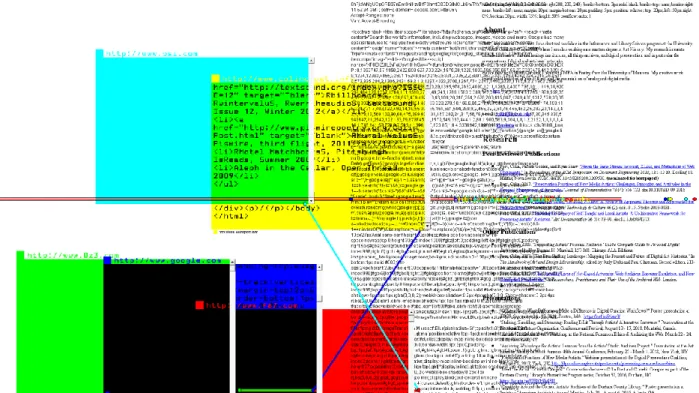
misdirection, and interface breakdown [to] offer a distance from the Internet’s effects and a critical commentary on its vernacular.”14 White points to another artist’s browser, JODI’s
WRONG Browser (2001), which performs a deconstruction like Shredder (fig. 4). With the
WRONG Browser, the user sees squares of color resembling windows open on a desktop,
interspersed with shards of code. The semblance of windows invites users to click around or enter URLs, but any attempt at navigation is thwarted by an inexplicable interface. As with other works by JODI, the user can slowly—and frustratingly—learn the idiosyncratic rules governing the artwork, but never feels totally comfortable.
With Shredder, this aesthetics of failure—a browser that fails to browse the Web—fosters a critical literacy of the components that make up a webpage and how this information is
structured by the browser. Shredder confronts users with apparently illegible representations of webpages in order to elucidate the logic by which commercial browsers compose pages. As Alexander Galloway compares workable and unworkable interfaces, the interface that ‘just works’ maintains a coherent logic, centralizing focus on the content presented by the interface, while inoperative interfaces remain incoherent, pushing attention outward from the edges of the interface.15Shredder inhibits users from reading any particular webpage but instructs users in how to read the browser itself, as a technology that pulls together many components into a structured document. The seeming garble of HTML, Cascading Style Sheets (CSS), scripts, and other component elements a user encounters when first launching Shredder can be clearly read in productive terms—that is, as information that web users can take up to produce webpages.
14 Michele White, “The Aesthetic of Failure: Net Art Gone Wrong,” Angelaki 7, no. 1 (April 1, 2002): 173.
35
Unworkable interfaces encourage the user to look beyond the content presented because this in and of itself is illegible, instead pointing outward to how this particular system is
embedded in broader technological infrastructures and social contexts. As Galloway suggests, “the edges of the work are the politics of the work.”16 As a script running within commercial browsers, Shredder not only surfaces the code constituting websites, but presents this as a visually-rich collage butting up against the edges of the browser interface. As discussed in the previous chapter, Fuller describes media ecologies as collage: a work like Kurt Schwitters’ Der Harz (1921) exercises a logic of parataxis, bringing together beer labels, ticket stubs, leaflets, and bits of cloth, demonstrating how these seemingly disparate objects actually cohere as part of a shared information economy.17 Likewise, Shredder articulates the relationships between disjunct components of the information economy of the Web—HTML, CSS, .jpegs, .gifs, and snatches of text—which elsewhere appear fluid and naturalized.
Shredder’s act of parataxis brings surface and code into contact, creating a new interface
that compresses the many layers constituting a webpage into one inoperable document. The beer label and ticket stub are two different objects, but they also intersect, both economically, as the holder of the ticket may have also purchased the beer, but also materially, both objects fabricated using the same print technologies. Shredder similarly illuminates points of confluence in the media ecology of the Web: not only do surface and code interrelate, but these layers are coordinated by browsers. These browsers have a materiality, as software embodying countless decisions made by corporate developers, all impacting how the Web is visually represented and
16 Ibid., 41.
17 Matthew Fuller, Media Ecologies: Materialist Energies in Art and Technoculture (Cambridge, MA: MIT Press,
36
experienced by end-users. As Schwitters’ collage contorts the material products of a paper-based economy, Shredder irrupts through layers of digital material immanent to a webpage to force otherwise unseen connections that determine how the Web functions as an information economy. The code, files, and links that Shredder brings to the fore are no longer unseen elements
functioning behind the browser interface but are highlighted as the elements productive of online information.
Users of Shredder engage in this productive activity in multiple ways. From their first interactions with the work, users undertake productive destructions, as clicking on a link or entering a URL into the browser creates a novel deconstruction. Users might actively seek out particular pages to shred, curious to see the results of destroying a favorite (or maligned) site and exposing the digital material beneath the surface. Reviewing Shredder for The New York Times’ “arts@large” column at the time of its initial release, Matthew Mirapaul observes that shredding commercial sites, those replete with high-res images and bloated code like microsoft.com or Madonna’s homepage, produces some of the most “eye-popping results.”18 Mirapaul suggests
Shredder might serve as useful tool for deconstructing the visual language of the Web,
transforming “graphic design disasters” into visually-striking works.19 This intervention, pressing ‘shred’ on a webpage designed by a crack team of web designers and information
architects, constitutes a small act of tactical resistance, recalling de Certeau’s notion of reading as poaching discussed in the previous chapter.
18 Matthew Mirapaul, “When Artists Build Their Own Browsers,” The New York Times, December 3, 1998,
https://partners.nytimes.com/library/tech/98/12/cyber/artsatlarge/03artsatlarge.html.