THE POLITICS OF PUBLIC HEALTH IN FLORIDA: INSIGHTS FROM DEBATES OVER MEDICAL CANNABIS AND NEEDLE/SYRINGE EXCHANGE LEGISLATION
Tamara Y. Demko
A dissertation submitted to the faculty of the University of North Carolina at Chapel Hill in partial fulfillment of the requirements for the degree of Doctor of Public Health in the Department of Health Policy and Management in the Gillings School of Global Public Health.
Chapel Hill 2020
ABSTRACT
Tamara Y. Demko: The Politics of Public Health in Florida: Insights from Debates Over Medical Cannabis and Needle/Syringe Exchange Legislation
(Under the direction of Pam Silberman)
This study examined the question of why some health-related legislative bills in the state of Florida pass into law while others do not. Using a retrospective, sequential, mixed methods case study design that included in-depth, key informant interviews, I explored how
sociopolitical factors and stakeholder actions influenced policymakers and the outcomes of two Florida bills on medical cannabis and needle/syringe exchange.
Both bills were considered during the 2014 election year by a Republican majority legislature. The medical cannabis bill passed, and the needle exchange bill died in return messages at the end of the legislative session. Several sociopolitical and policy themes
influenced the outcome of the bills: window of opportunity; persuasive health and/or economic arguments; effective grassroots mobilization with active, in-person citizen/constituent
majority party sponsorship; and a sympathetic focus on sick children, viewed as blameless relative to injectable drug users.
This work provides insights into Florida legislative processes and can be used as a
roadmap for success for future public health legislation. An advocacy checklist for public health and health-related professionals and organizations provides recommendations on how to
To the One who makes all things possible To my beloved mother, who is in hospice To all my loved ones who have gone before
&
ACKNOWLEDGEMENTS
It is with the deepest appreciation that I thank my infinitely patient and talented dissertation committee. Tom Ricketts, Jonathan Oberlander, Kathleen Kaney, and Catherine Howard-McCann provided invaluable guidance over many years of work. As committee chair, Pam Silberman ensured my successful completion with just the right mix of feedback and encouragement. Thank you all for helping me to climb this mountain.
I am grateful for the constant love and support of my parents, Dr. Charles and Maria Yang. Thank you to my beloved sons, Cole and Josh Demko, for giving me the inspiration to
continuously learn and grow. A special thank you to my husband, Rob Siedlecki, Jr., for giving up many date nights so I could finish this dissertation. I would also like to thank Ed and Ronnie Demko, Thomas Yang, Angela Yang, Karen Halperin Cyphers, Diosa Moran, and Alrica Goldstein for countless years of support and encouragement.
Thank you to the many wonderful teachers I have had in my life, to all study participants and advisors, to Virginia Gray, to my favorite cohort C7, and to everyone who has encouraged me to keep going on the unexpectedly obstacle-ridden paths of dissertation writing and life.
TABLE OF CONTENTS
LIST OF TABLES ... xii
LIST OF FIGURES ... xiii
LIST OF ABBREVIATIONS...xiv
CHAPTER 1: INTRODUCTION ...1
Overview of Dissertation ...1
Discussion: Loss of Health Ideas When Health-Related Legislation Fails to Pass ...3
Main Research Question & Contextual Scope of State Health Legislation...4
State Selection: The Fate of Health-Related Policy Ideas in Florida ...5
About Florida ...5
About Florida Health Legislative Processes ...6
Health-Related Legislation—Topic & Bill Selection ... 10
SB 1030 (2014)—Cannabis (Low-THC Cannabis/Charlotte’s Web) ... 12
Health Significance... 12
Bill Purpose ... 12
Recent Prior Legislative Attempts... 13
Brief 2014 Bill History ... 13
SB 408 (2014)—Infectious Disease Elimination Pilot Program ... 14
Health Significance... 15
Bill Purpose ... 15
Brief 2014 Bill History ... 16
CHAPTER 2: LITERATURE REVIEW ... 18
Time Period Selection... 18
Sources Used ... 18
Selection Criteria: Inclusion and Exclusion ... 19
Keywords and Search Strategy ... 20
Search Process ... 20
Emergent Themes & Focus in the Literature ... 22
General Policy Themes ... 23
Health Policy Distinction Themes ... 25
The Legislative Stage in the Policymaking Spectrum ... 25
Importance of Health Policy Focus at the State Level ... 26
Discussion of the Literature ... 27
Convergence of Political Policymaking Paradigms with Public Health Theories ... 27
Emergent Overarching Themes in Health Legislation ... 27
Additional Key Themes in the Case Studies ... 34
Gaps in Research and Knowledge/Bridging the Gaps ... 37
Search Strategy Limitations and Weaknesses ... 37
Informing a Dissertation & Conclusion ... 38
CHAPTER 3: METHODS ... 39
Study Design ... 39
Data Collection Procedures ... 40
Consent & Confidentiality ... 45
Interview Recording Procedures ... 47
Data Analysis Strategy ... 47
Quantitative Analysis... 47
Coding Guide ... 47
Key Informant Interviews ... 48
CHAPTER 4: RESULTS ... 49
Summary of Qualtrics Survey Results ... 49
Medical Cannabis ... 49
Needle Exchange ... 50
Summary of Key Informant Interview Results ... 50
Medical Cannabis ... 51
Needle and Syringe Exchange... 75
Study Limitations ... 87
CHAPTER 5: SUMMARY/INTERPRETIVE ANALYSIS ... 91
Window of Opportunity ... 91
Persuasive Arguments and Economic Considerations ... 93
Grassroots Mobilization, Persistent Constituent Advocacy, and the Children ... 96
Professional Lobbying ... 97
Legislative Relationships ... 98
Legislative Power and Perception ... 100
Governor’s Office Impact and State Health Agency Influence ... 101
Conclusion ... 102
1. Thoroughly Assess the Sociopolitical Environment ... 105
2. Thoroughly Assess the Target Audience ... 106
3. Strategically Select the Health Issue to Bring Forward as Legislation ... 108
4. Carefully Craft the Message and Select the Messenger ... 109
5. Locate a Legislative Champion or Legislative Champions ... 111
6. Focus on Visibility, Influence, and Persistence in Advocacy Efforts ... 111
7. Remain Vigilant in the Final Hours of the Legislative Session ... 113
8. Evaluate and Plan for Continuous Strategic Advocacy Improvement ... 114
Plan for Change ... 114
Diffusion of Innovations Theory ... 115
Dissemination of Recommendations ... 117
Moving Toward Diffusion of Innovations: The Advocacy Checklist ... 119
APPENDIX A: QUANTITATIVE SURVEY AND CONSENTS ... 121
APPENDIX B: QUALITATIVE KEY INFORMANT INTERVIEW AND CONSENTS ... 125
APPENDIX C: KEY TERMS DEFINED ... 131
APPENDIX D: QUALTRICS SURVEY QUESTION CODING AND HOVER FUNCTION DESCRIPTIONS ... 133
APPENDIX E: SELECT RESULTS FROM QUALTRICS SURVEY ... 136
APPENDIX F: FACTORS OF INFLUENCE, DESCRIPTIONS, SOURCES OF CONCEPT, AND GENERAL INTERVIEW FINDINGS... 141
APPENDIX G: CODING GUIDE FOR KEY INFORMANT INTERVIEWS ... 148
APPENDIX J: DRAFT ADVOCACY CHECKLIST ... 159
APPENDIX K: FLORIDA-SPECIFIC RESOURCES FOR ADVOCACY ... 165
ENDNOTES ... 169
LIST OF TABLES
Table 1. Florida demographics ...6
Table 2. Florida government overview ...8
Table 3. PubMed search strategy ... 20
Table 4. Initial key informant interview goals... 44
Table 5. Description of the categories of key informants interviewed for each bill ... 45
LIST OF FIGURES
LIST OF ABBREVIATIONS
CS Committee substitute
D Democrat
HB House bill
IDEA Infectious Disease Elimination Act
R Republican
CHAPTER 1: INTRODUCTION
The topic of this dissertation is state public health legislation and how it is formally developed. Every year, important pieces of public health-related legislation are passed into law. What sets these items apart from those that do not? What factors granted them favored status above all other health-related ideas? Was there a moment, action, actor, or event that changed their fate? Are there factors that helped them be successful? If so, can a working guide or roadmap of suggested actions be created for use by a public health advocate to improve chances of having the idea made into law or policy?
Overview of Dissertation
Health sector policy advocates often encounter significant problems in promoting desirable health legislation. Their efforts often fail or are passed over for other priorities. As such, critical population health needs may not be met. While no study can fully capture the totality of interpersonal and political transactional elements that shape the outcomes of particular bills, this dissertation seeks to add insight to the larger picture. Using two specific examples, one successful, one not, I hope to assist public health professionals, related professionals, and policy advocates in expediting the enactment of beneficial, but potentially controversial, health policy legislation. I also hope to add to the discussion of factors impacting health-related legislation.
The passage of state health-related legislation has been explored periodically in academic and general literature. These studies identified potential factors that influence passage of
policymaking theories. Few studies, however, examine the breadth of potential influencing factors specifically impacting the health policy sector that confront state legislative processes.
This dissertation used a retrospective, sequential, mixed methods case study design to explore the factors influencing the outcome of health-related legislation in the state of Florida. It focused on two controversial health bills in the 2014 Florida legislative session, one that passed (use of Charlotte’s Web/Low-Level Cannabis, SB 1030), and one that ultimately failed
(Infectious Disease Elimination Pilot Program, SB 408). The study used a Qualtrics-based online survey that combined categorical Likert-scale questions of factors that influenced specific
legislation with open-ended survey fields for participants to write in additional factors. The Qualtrics survey was sent to legislators and stakeholders of record. The survey results were used to inform key informant interviews of 20 selected stakeholders (“influencers”). These influencers included legislators, including primary bill sponsors, executive branch employees involved with the bills, lobbyists, and citizen stakeholders who both supported and opposed the legislation. Data were coded, analyzed, and then triangulated by examining the legislative history and media reports of actions occurring during the legislative process.
The study explored more than 22 sociopolitical and interpersonal factors that have been posited to influence policy formation. They were derived from the literature review, Qualtrics survey write-ins, and my personal knowledge of Florida’s political mechanisms. These factors were thematically grouped for coding purposes into “General Factors” (e.g., window of
To increase internal validity and reliability, a second coder was used to classify the responses. Given the specific legislative leadership and climate during 2014, potential researcher bias in factor and interviewee selection, and limitation to Florida, the results need to be viewed with caution. However, I believe that the results will be useful to the public health community through the sharing of study insights with public health associations and schools. Research-based suggestions for the effective deployment of monetary and manpower efforts will help to improve chances of legislative success.
Discussion: Loss of Health Ideas When Health-Related Legislation Fails to Pass
Important ideas that would advance the public’s health are often lost when higher priority topics supersede them, when reports gather dust on shelves, when administrations change, or when public health champions lose energy on the long, tedious paths to legislation and policymaking. A practical paradigm for any health professional or interest group to change health-related ideas into accepted health policies/laws in the fastest, most effective way possible could enable those groups to move issues “up the agenda” and maximize their impact on public health.
For example, prevention, early detection, and early treatment for cancer, obesity, and diabetes are challenging political “sells” that can have high costs attached. Yet prevention and evidence-based interventions can, over time, increase the chances for improved quality of life and health, reduced long-term health care expenditures, and a stronger workforce. As another example, the concept of newborn screening has gained support in state legislation to varying degrees over the years. While the Health Resources and Services Administration (HRSA) recommends screening for 35 core disorders and 26 secondary conditions, state newborn
screening for more conditions can improve long-term prognoses or functionality in many cases and allow families to make informed decisions for health care earlier, saving money for families and the state.
In the limited number of studies of factors influencing state health legislation, analysis has primarily focused on specific aspects of influence, rather than on integrating factors into a larger picture or schema. In large part, either quantitative or qualitative investigations describe certain behaviors, attributes, or actions, without providing an understanding of the meaning behind such actions or an observation of the degree to which the factors weighed or interacted to provide the desired legislative success. While quantitative results can indicate that a factor of influence was or was not present, or even provide a scale of how influential a factor was
subjectively thought to be, by themselves they fail to provide a complete picture that could lead to greater effectiveness in future legislative efforts. However, reviewing quantitative results with the additional qualitative narrative provided by key informant interviews can add situational context and better guide future legislative efforts. For example, interviews can provide behind-the-scenes political context about why there was sponsorship by the majority party, not merely that there was or wasn’t support as indicated through a survey instrument. For this reason, I used a retrospective, sequential, mixed methods case study design to illuminate case studies of state health legislation. Because of its large population and political influence, and because of my experience in health policy in the state, I chose to study Florida.
Main Research Question & Contextual Scope of State Health Legislation
implementation inclusive of rulemaking and subsequent programming, this research study was exclusively focused on a policy formulation step involving the passage of health legislation. This is an important preliminary step in broader policy adoption and change—but also a culmination of policy work. Specifically, the research issues had already reached a level of salience to be introduced as legislative bills, and this study explored what factors influenced whether these bills successfully passed legislative scrutiny.
State Selection: The Fate of Health-Related Policy Ideas in Florida
I selected Florida for ease of access to research and participants. It is my state of residence, which reduces transportation costs and improves the accessibility in scheduling interviews as part of the qualitative component of this mixed methods study. In addition, my knowledge of Florida’s legislative and governmental processes provides additional context for data interpretation. Further, public health legislation has historically met resistance in Florida, with public health professionals and advocates rarely achieving desired legislative ends despite some knowledge of the legislative process.
About Florida
Florida was ranked fourth largest in population with 18.8 million reported in the 2010 U.S. Census2 but eclipsed New York in December 2014 to become the third most populous state in the nation.3 Florida ranks near the bottom of all states for the number of people without health insurance, and about two-thirds of all states have better overall health than Florida.4 With an increase in population (especially in persons 65 or older) and impending physician and nursing shortages,5 the health of Florida’s residents needs greater attention.
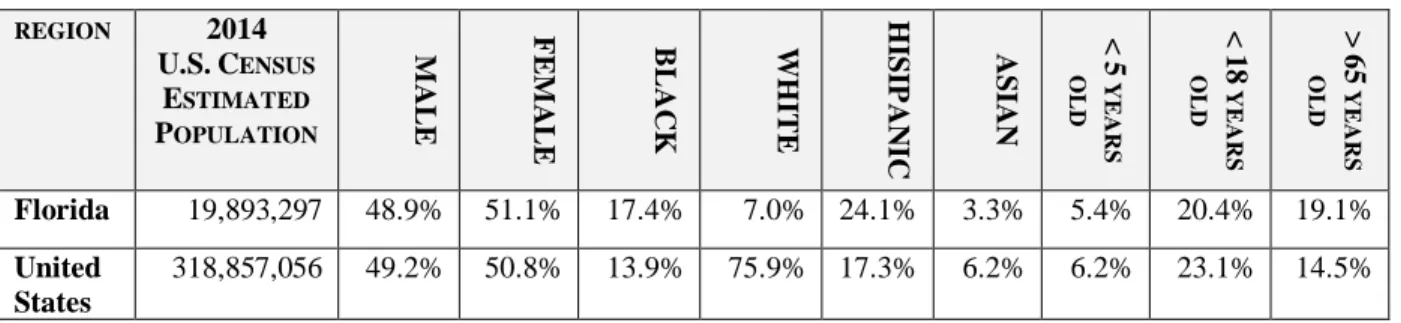
adults (65 or older) in Florida than in the United States may increase the influence of certain stakeholders or change the “window of opportunity” for particular health topics to reach the legislative policy agenda. Florida is older and more Hispanic than the rest of the United States.
Table 1. Florida demographics7
REGION 2014
U.S.CENSUS ESTIMATED POPULATION M A LE F EM A LE BLA C K WH ITE H IS IP A N IC
ASIAN <5
Y EA R S O LD < 18 Y EA R S O LD > 65 Y EA R S O LD
Florida 19,893,297 48.9% 51.1% 17.4% 7.0% 24.1% 3.3% 5.4% 20.4% 19.1%
United States
318,857,056 49.2% 50.8% 13.9% 75.9% 17.3% 6.2% 6.2% 23.1% 14.5%
About Florida Health Legislative Processes8
Health care programs comprise approximately one-third of Florida’s state budget, making health care an important topic du jour. At times, Florida has been at the vanguard of health policy issues, and the state has been known previously as a health policy “innovator.”9 However, in 2014, when the medical marijuana and needle/syringe exchange program bills reviewed in this dissertation were introduced, Florida ranked 35th among the states in public health funding, allocating $58 per person.10 In contrast, as the top-ranking states in public health funding in 2014, Alaska allocated $219 per person, Hawaii allocated $213 per person, and New York allocated $149 per person.11 Florida ranked 31st in health determinants and 36th in health outcomes among the states in 2014.12
focused on health issues. In 2014, despite having both a Republican legislature and governor, Florida ranked 32nd in the nation in percentage of adults identifying as Republican or
Republican leaning at 37%. Texas, Virginia, North Carolina, and Georgia were among the 31 states with greater Republican-leaning tendencies. Florida ranked 15th highest nationally for adults identifying as being neutral (19% showed no lean) and 22nd nationally for Democrat or Democrat-leaning at 44%.13 The explanation for the apparent mismatch between the population and the politics of Florida is hard to explain easily, and this analysis partly speaks to the paradox.
In the executive branch, several separate agencies comprise the “health” grouping: Department of Health, Agency for Health Care Administration, Agency for Persons with
Disabilities, Department of Elder Affairs, Department of Children and Families, and Department of Veterans’ Affairs. The agency heads report to a deputy chief of staff in the Executive Office of the Governor.
8
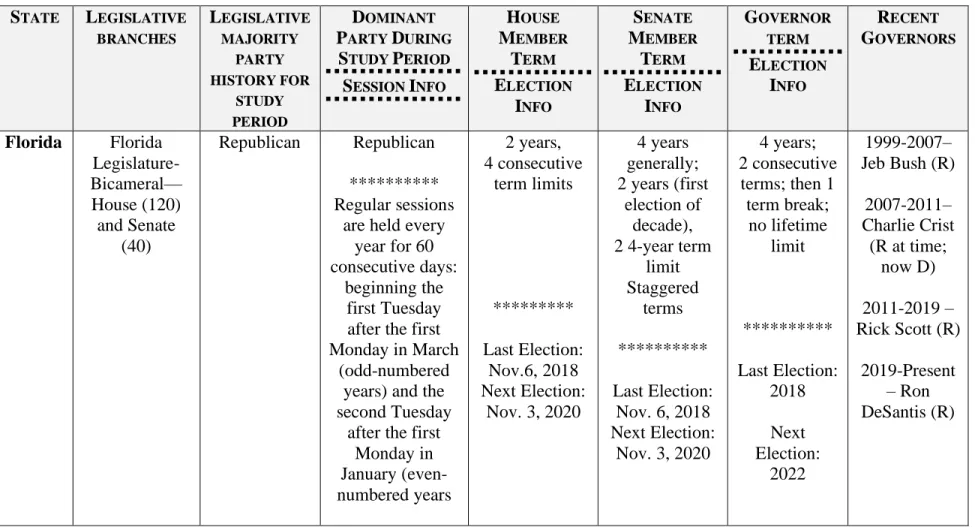
Table 2. Florida government overview
STATE LEGISLATIVE BRANCHES LEGISLATIVE MAJORITY PARTY HISTORY FOR STUDY PERIOD DOMINANT PARTY DURING
STUDY PERIOD SESSION INFO
HOUSE MEMBER TERM ELECTION INFO SENATE MEMBER TERM ELECTION INFO GOVERNOR TERM ELECTION INFO RECENT GOVERNORS
Florida Florida Legislature- Bicameral— House (120) and Senate
(40)
Republican Republican ********** Regular sessions
are held every year for 60 consecutive days:
beginning the first Tuesday after the first Monday in March
(odd-numbered years) and the second Tuesday
after the first Monday in January (even-numbered years 2 years, 4 consecutive term limits ********* Last Election: Nov.6, 2018 Next Election:
Nov. 3, 2020
4 years generally; 2 years (first
election of decade), 2 4-year term
limit Staggered
terms ********** Last Election:
Nov. 6, 2018 Next Election:
Nov. 3, 2020
4 years; 2 consecutive terms; then 1
term break; no lifetime limit ********** Last Election: 2018 Next Election: 2022 1999-2007– Jeb Bush (R)
2007-2011– Charlie Crist
(R at time; now D) 2011-2019 – Rick Scott (R)
In simplified form, a typical progression of a Florida bill involves referral to committees following its introduction by a member of one of the houses (first reading is accomplished by publication). If the bill is voted favorably out of all committees, it is placed on the chamber calendar for second reading (consideration of questions and amendments) and then for third reading (consideration of questions and amendments only by two-thirds vote, debate on the bill, and the sponsor’s closing statement) before being voted on the chamber floor. If passed by a chamber, the bill will be sent in “messages” for approval to the other chamber. If both legislative chambers pass the bill, it is ordered enrolled and sent to the governor’s desk for approval or veto. Several situations can occur in the progression of a bill. For example, a bill can be voted
favorably off the floor in one chamber and then referred to the other chamber’s committees. A bill can be voted favorably by each chamber but amended so heavily that there is no final agreement. At any of these points, a bill may die. In other instances, a bill may die in one chamber, but its similar companion bill14 in the other chamber may pass, in original or highly amended forms. Successful bill language in one chamber is sent to the other chamber for review (the bill is said to be “in messages”), at which point the second chamber may refer it to
additional committees of references in that chamber.15 This study focused on the legislative progression to the point of legislative passage and, therefore, did not explore factors in the governor’s approval process.
A five-year average of Florida legislative bill data surrounding the time of the bill, 2012-2016, indicated that, of the bills that died, 87% of bills died in committee, 8% died on a chamber calendar waiting to be voted on the floor, and 4% died in messages.16 In the 2014 Florida
and 53 bills died in messages.18 This study examined two bills, both of which survived all committees of reference and were voted favorably off both chamber floors. However, one of the bills was ordered enrolled into law, while the other bill died in return messages before final legislative passage.
Florida is known for having an unusually large pool of lobbyists and lobbying interests.19 In 2007, Florida had 411 interest groups registered to lobby on health issues, more than any other state. By comparison, New York had the second highest number of health lobby groups
registered at 368.20 In addition, Florida had more interest groups registered to lobby (across all sectors) than any other state, at an average of 2,305 interest groups from 1980 to 2007.21 In 2014, Florida remained one of the top states for lobbying with more than 3,500 registered lobbyists.22 In comparison, New York had more than 5,800, and California had more than 2,100 registered lobbyists that year.23
Health-Related Legislation—Topic & Bill Selection
To limit the scope of the study, this research retrospectively analyzed two instances of controversial, health-related legislation in Florida’s 2014 regular legislative session, each with a different legislative outcome. A single legislative session was selected to remove confounders attendant to changes in political actors and political climates. The 2014 legislative session saw both a Republican House and Senate majority, and a Republican governor, Rick Scott. It was an election year and, therefore, both House and Senate leadership were well-established—and were, perhaps, more sensitive to the public’s perception of the intent of legislation.
legislative leaders believed the bill topic to be substantive to health: Health and Human Services Committee in the House, and Health Policy in the Senate. From 2013-2016, 447 bills were referred to the House Health and Human Services Committee,24 and 379 bills were referred to the Senate Health Policy Committee.25 These bills were reviewed for passage or defeat and, if defeated, for how far the bills had progressed when they died. In addition, to reduce source confusion and narrow the basis for passage or defeat, omnibus or “train” bills (bills that start as single issue or single topic, but by the end of the legislative session have additional issues tacked on in the hope of resurrecting dead issues on still-viable bills), and bills that originated with appropriations language were not included. Substantive, single-issue bills were selected.
The year 2014 bills specifically selected for this study were SB 1030 on the use of
medical cannabis, and SB 408 on an Infectious Disease Elimination Pilot Program. Each selected bill, described briefly below and detailed in Chapter 4, addressed a relevant, present-day, health-related concern that raised some degree of ethical or social controversy: the compassionate use of cannabis for certain medical conditions, and an infectious disease pilot program for clean needle and syringe exchange. Although the cannabis bill was referred to appropriations, bill selection was focused on substantive policy significance, and bill referrals to appropriations committees were not used in selection criteria. Therefore, any attached funding or appropriation related to the selected bills was not specifically examined as part of this study.
insights into how public health issues are managed as well as the strategies used by those who seek to implement substantive public health policy.
SB 1030 (2014)—Cannabis (Low-THC Cannabis/Charlotte’s Web)26
Health Significance
The use of medical marijuana or medical cannabis in the treatment of a variety of health conditions has been a topic of much attention and controversy for decades, with extensive anecdotal experience and some research supporting beneficial claims.27 With varying degrees of evidentiary support, medical cannabis use has been explored in the treatment of cancer,28
epilepsy,29 amyotrophic lateral sclerosis (ALS or Lou Gehrig’s disease),30 chronic pain,31 and other health conditions.32 Florida was expected to have more than 114,000 new cancer cases and 43,000 cancer deaths in 2015, higher than any state except California.33 At the time of the bill, more than 1,500 individuals in Florida had ALS,34 and an estimated 375,000 individuals (125,000 children) in Florida had epilepsy.35
Bill Purpose
Recent Prior Legislative Attempts37
Medical cannabis legislation was previously introduced in both the 2012 and 2013 Florida legislative sessions. In 2012, Senator Dwight Bullard (D-Parts of Miami-Dade and other counties) and Representative Jeff Clemens (D-Palm Beach) introduced joint resolutions (HJR 353 and SJR 1028) that would create Section 28 of Article X and Section 32 of Article XII of the State Constitution to allow the medical use of cannabis. The resolutions died unheard in their respective first committees of reference. In 2013, Representative Katie Edwards (D-Broward) and Senator Jeff Clemens (D-Palm Beach) introduced more extensive bills (HB 1139 and SB 1250) authorizing medical cannabis with corresponding rulemaking authority. Despite additional legislator cosponsors, both bills died before being heard in their respective first committees of reference.
Brief 2014 Bill History
CS/CS/SB 1030 developed from a series of committee substitutes in language put forward by the Senate Appropriations and Health Policy Committees, and the original sponsors Senators Rob Bradley (R-Baker County and Parts of 11 others), Aaron Bean (R- Nassau County and part of Duval County), and Jeff Brandes (R-Pinellas County). When the Senate bill went forward, six senators (which included Senate leadership) had appended their names to the
sponsorship list as cosponsors. Groups supporting the bill included the Florida Democratic Party, and specialty health nonprofits (e.g., American Cancer Society, Florida chapter). Groups
favorably out of the Senate Health Policy, Criminal Justice, and Appropriations committees of reference with minor objection and several changes to bill language via committee substitutes. At least nine legislators offered amendments at various points close to the end of the voting period. Over the course of the bill’s progression, 17 amendments were offered. It was voted favorably by the full Senate (36-3), favorably by the full House with amendment (111-7), sent via return messages back to the Senate and then favorably by the Senate with amendment (30-9). The bill underwent final passage and was ordered engrossed then enrolled on May 2, 2014, the last day of the legislative session.39
SB 1030’s substantively similar companion bill in the House CS/CS/HB 843, was sponsored by Representatives Matt Gaetz (R-Okaloosa), who is now a US representative, and Katie Edwards (D-Broward), the Judiciary Committee, and the Criminal Justice Subcommittee, and later cosponsored by 35 additional state representatives. Originally filed by Gaetz, HB 843 was referred to the Criminal Justice Subcommittee, where it passed favorably with committee substitute (12-1). HB 843 was then voted favorably out of the Appropriations Committee (24-0). In the Judiciary Committee, the bill’s last committee of reference, HB 843 was voted favorably with committee substitute (15-3). It was laid on the table and underwent first reading on April 22, 2014, but no additional action was taken, and it died pending review of the committee substitute.
SB 408 (2014)—Infectious Disease Elimination Pilot Program
once, but died in returning messages from the House when final consensus could not be reached following last-minute amendments.
Health Significance
As of 2011, Florida ranked third nationally for the number of newly diagnosed HIV infections and second nationally for the number of pediatric AIDS cases.40 As of January 31, 2014, more than 104,000 people were living with HIV/AIDS in Florida,41 with Miami-Dade ranking first in the state, and Broward County ranking second in the state for the number of new cases.42 By 2014, the number of people living with HIV/AIDS in Miami-Dade County had increased by 23% since 2004.43 The availability of clean, unused needles and syringes may help to prevent or reduce the transmission of blood-borne diseases such as HIV, hepatitis, and AIDS among IV drug users and their intimate partners and offspring.44
Bill Purpose
Recent Prior Legislative Attempts45
Legislation to create a Needle and Syringe Exchange Pilot Program for Miami-Dade County was previously attempted in the 2013 Florida legislative session. Representative Mark Pafford (D-Palm Beach) introduced a “similar” bill in the House (HB 735), which was
subsequently voted favorably, adopted, and additionally sponsored by the House Health Quality Committee, its first committee of reference. However, the bill died waiting to be heard in its second committee of reference. In the Senate, Senator Gwen Margolis (D-Miami-Dade), who previously served as that body’s first woman president, introduced the bill (SB 808), which was subsequently voted favorably, adopted, and additionally sponsored by the Senate Health Policy Committee, its first committee of reference. SB 808 also passed its second and final committee of reference but died on calendar for a third reading.
Brief 2014 Bill History
bill’s progression, four amendments were offered. Upon third reading, it was passed by the full Senate as amended (30-10). CS/SB 408 was then sent to the House in messages. On May 2, 2014, the last day of the 2014 legislative session, it was read a second time and a strike-all amendment (sponsored by Representative Mark Pafford, see below) was adopted. (A strike-all bill is when the bill title and enacting clause are kept but all substantive portions are deleted and replaced.) The House-amended version was read a third time and passed the House with the vote of 109-8. It was then sent back to the Senate in returning messages, where it died.
CHAPTER 2: LITERATURE REVIEW
I performed a literature review to investigate the question, “What determining factors most influence the outcome of state health legislation?”and focused on the period since 1990. I focused on studies of factors that determine legislative success. The results of the literature review contributed to the selection of factors of influence used in the disseration study design. Time Period Selection
The literature review examined scholarly work that investigated state health legislation published from 1990 through 2016. The earlier date was chosen to include recent, relevant research on state health policymaking processes and was extended through 2016 to include recent studies.
Sources Used
I obtained contextual background through a review of classic political science and policy books and research of additional references through the university library system. I
subsequent identification of relevant sources by first examining well-referenced sources. A snowball technique found additional references identified by these “core” sources. Only articles and reports for which a full-text version could be obtained were included in the review. For additional context and direction, I explored organizational websites, such as the National Conference of State Legislatures (NCSL), the National Governors Association (NGA), the American Legislative Exchange Council (ALEC), the National Academy for State Health Policy (NASHP), and the American Public Health Association (APHA).
Selection Criteria: Inclusion and Exclusion
Two basic inclusion criteria focused on determining which factors of health-related policy and legislation are widely considered influential: 1) The article or report must be published in English and refer to humans; 2) The health care legislation or policy discussed by the article must have passed between January 20, 1985, and July 1, 2016.
Keywords and Search Strategy
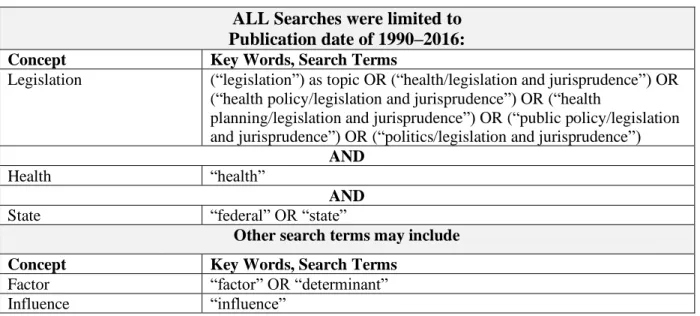
Table 3. PubMed search strategy
ALL Searches were limited to Publication date of 1990–2016:
Concept Key Words, Search Terms
Legislation (“legislation”) as topic OR (“health/legislation and jurisprudence”) OR (“health policy/legislation and jurisprudence”) OR (“health
planning/legislation and jurisprudence”) OR (“public policy/legislation and jurisprudence”) OR (“politics/legislation and jurisprudence”)
AND
Health “health”
AND
State “federal” OR “state”
Other search terms may include
Concept Key Words, Search Terms
Factor “factor” OR “determinant” Influence “influence”
Search Process
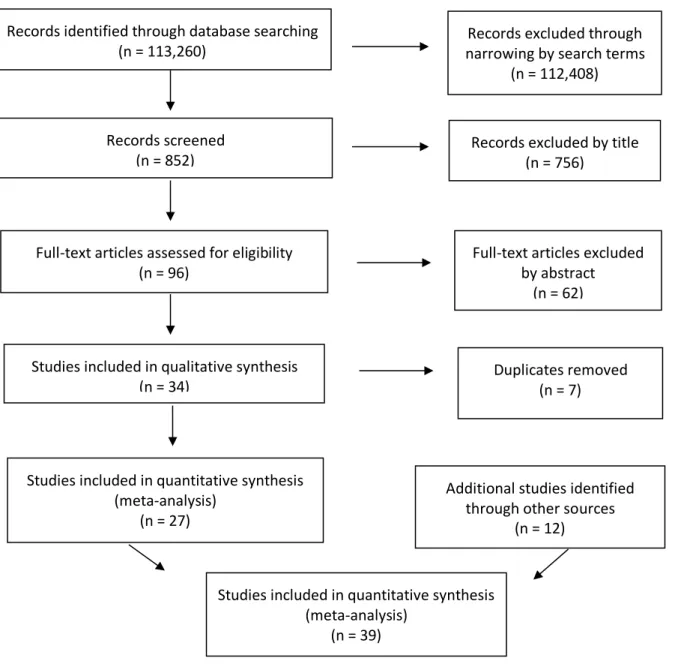
the elimination of duplicates. Twelve additional articles were found using a snowball method of cross-referencing works cited in the articles selected and included. Furthermore, health policy scholars recommended a handful of articles for inclusion, leading to more than 39 articles ultimately included for reference. I read these articles until themes and results began to repeat and saturation was presumed.
The systematic search and initial review of content resulted in the inclusion of 27 primary relevant articles detailing researched factors that influenced the outcome of health care
Figure 1. PubMed Search Results Based on Table 1 Search Terms46
After full-text review, 34 articles remained instructive and 27 were ultimately included after duplicates were removed. Search results reflect a previous limitation by date criteria.
Emergent Themes & Focus in the Literature
Policy themes in the literature were reviewed and resulted in a question of whether they Additional studies identified
through other sources (n = 12) Records screened
(n = 852)
Records excluded by title (n = 756)
Full-text articles assessed for eligibility (n = 96)
Full-text articles excluded by abstract
(n = 62)
Studies included in qualitative synthesis (n = 34)
Studies included in quantitative synthesis (meta-analysis)
(n = 27)
Records identified through database searching (n = 113,260)
Records excluded through narrowing by search terms
(n = 112,408)
Duplicates removed (n = 7)
Studies included in quantitative synthesis (meta-analysis)
policymaking includes a spectrum of activities from problem identification through policy implementation, I focused on those policies rising to the level of legislation, and research discussing other previous and post-enactment activities were culled out. In addition to the articles, I reviewed policymaking themes to provide context and to ensure that larger political and policy theories were not overlooked in the creation of research scope and methodology.
General Policy Themes
Across various resources and instructive policymaking academic books, several agenda-setting and policy paradigms emerged. Some of these models are not exclusive to health policy but, rather, encompass scholarly theories well-cited over time as applicable to health policy development.
These actors may include researchers, bureaucrats, and consultants. In addition, Kingdon’s research found special interest groups such as the media to be important in policymaking.
The streams model went beyond other previously considered models such as Lindblom’s (1952) incrementalism,50 Cohen, March, and Olsen’s (1972) “garbage can” mix of the conditions in a given time leading to outcomes;51 or even a potentially unrealistic concept of
comprehensive, “rational decision making.”52
Deborah Stone’s body of work53 argues that policymaking does not exist in a clean, logical vacuum devoid of politics. As such, it does not fit neatly into the concept of “rational decision making” and is necessarily messy as points of view will contradict, seem illogical, or appear to be in paradox. The larger political community, or “Polis,” has underlying paradoxical needs, thoughts, and ethics. A tension exists across goals, problems, and solutions. “Reasoned analysis is necessarily political … [p]olicy analysis is political argument, and vice versa.”54
subsets of lawmaking, intergovernmental processes, the policy “market,” politics, and making deals. Questions of “why” might include justice, for example.
Health Policy Distinction Themes
Although these paradigms are widely applied across political and policy topics, some political scientists consider health politics and health policymaking to be distinct from general policymaking. Carpenter (2012) finds that health politics is set apart from other policy areas along various lines such as organizational identity (e.g., groups nontraditionally aligned but unified under a disease banner), deference to professionals/experts in areas such as science and medicine, and governmental treatment of health access and inequities different from other social inequalities and injustices.62 In addition, the more involved role of the state and its regulatory agencies also differentiates health policy. For these and other reasons, health politics may not easily conform to more generalized political science and policymaking theories of analysis. Some scholars note a seemingly inherent conflict between population health and politics, with the “public health community seldom acknowledge[ing] that its work is pervasively political,” and find that few studies are devoted to the politics of public health within health
policymaking.63 Furthermore, the complex politics of health care, the varied effectiveness of “organized interests” across issues,64 and the intricate dance of various private actors65 set a distinct political health stage.
The Legislative Stage in the Policymaking Spectrum
The policymaking process is frequently portrayed as multiphase or multistage, with a minimum of three phases to include agenda setting, policy formulation, and program
policy formulation, certain policy agendas rise to legislative review and are passed into law.68 Because the research is aimed at determinants that predict the legislative voting outcome of state health legislation, the literature review excluded later-stage implementation and preliminary-stage agenda setting. Issues introduced as bills are assumed to have been deemed sufficiently salient to invest legislator effort. How the issue was introduced, however, may have implications for later passage and is noted whenever applicable.
Importance of Health Policy Focus at the State Level
Federalism and history suggest that state and federal health policymaking may involve both different health issues and different processes. While the federal government holds certain enumerated, implied, and plenary powers, those powers that are not delegated to the federal government nor prohibited to the states are reserved to the states by the Tenth Amendment to the Constitution. Traditionally, federalism has allowed concurrent governing of public health at the federal and state levels, with states often holding the role of innovator, public health regulator, and executor of core public health functions. This status remains unless or until a multistate or national health issue creates a need for congressional preemption or triggering of the Supremacy Clause.69 “Delivering public health services requires local knowledge, civic engagement, and direct political accountability. States and localities are also often the preferable unit of
government … a ‘laboratory of the states’ enables local officials to seek innovative solutions.”70 In the case of natural disasters and epidemics, federal action is frequently seen; however, states are fertile ground for novel public health policies.
has been seen historically and in more recent health reform efforts.73, 74 In addition, the adoption of health policy in one state can have a horizontal impact on the adoption of similar health policy in a neighboring state.75 States have also worked together through collaborative associations such as the National Conference of State Legislatures (NCSL), the National Governors Association (NGA), and the American Legislative Exchange Council (ALEC), to put checks and balances on federal decision-making,76 and provide analyses that impact state legislatures and federal
initiatives.77
Discussion of the Literature
Convergence of Political Policymaking Paradigms with Public Health Theories
Among renowned policy scholars, several policymaking and agenda-setting paradigms are widely consulted for political and policy analysis.78 While health policymaking can certainly be analyzed using these time-tested models, the models are not exclusively tailored to public health and health-related issues. Political scientists believe that the politics of health is different from other politics.79 Discussions by health policy experts appear to find classical paradigms instructive but requiring of additional health context.80
Emergent Overarching Themes in Health Legislation
ability of paid professional lobbyists to influence votes is discussed herein as the “Influence of Professional Lobbyists”; and 5) the influence of government officials in the legislative and executive branches at the highest position levels is discussed herein as the “Influence of Highest Government Leadership.”
Influence of General Factors
Various factors that do not clearly correspond to a traditional actor (e.g., legislator,
lobbyist) or are not easily categorized can influence the outcome of health-related legislation. For example, such “General Factors” may include celebrity attention, research, strength of argument, or bill timing, as in a “window of opportunity” opening.
“Time-tested general factors” were explored in a seven-state, health care reform legislation study by Paul-Shaheen (1998).81 She categorized her research results into three lessons that reinforced a current understanding of state health reform (crisis as a catalyst for action, the role of new special interests in game-changing opportunities, and expanded bureaucratic influence in health care reform) and six additional lessons that extended an
understanding of state health reform (timing, the continuum of many smaller steps leading up to a larger product, policy entrepreneurship, media and public opinion, Democratic introduction of the bill, and single-payer option). While factors such as “single-payer option” may be limited in applicability, Paul-Shaheen’s study supports the general influence of both non-categorical factors such as persistent action and “window of opportunity,” and actor-attributable influence, as in the case of policy entrepreneurship.
Furthermore, studies have reviewed the influence of evidence-based reports or research on legislative outcomes,87, 88, 89, 90 with some legislatures forming partnerships with universities for research purposes.91 Persuasive arguments on the health benefits92, 93, 94,95, 96 and economic benefits97, 98, 99 of health-related legislation also influence legislative outcomes. Whether a bill is viewed as being fiscally legitimate and consistent with state need and resources also plays a role.100
In recent political times, celebrity advocacy and endorsement have had a growing impact on policy focus and legislation.101, 102 Notably for this dissertation, famous personalities have visited Florida legislators to discuss current legislative bills.103
Finally, the strategic exchange of political support and/or opposition across bills and positions may occur across a variety of actors such as interest groups, lobbyists, and legislators. “It is difficult to conceive of a legislature without internal horse-trading, and recent work suggests that logrolling [prior agreement between legislators to vote for each other’s bills] is widespread among legislators and more frequent than commonly thought.”104 This practice of “horse-trading” may affect legislative decisions.105, 106
The Influence of the Legislature
In studying the influence of think tanks, media, and foundations on Minnesota legislators, Gray and Lowery (2000) noted that legislators determine how important a particular source of information is for legislative voting purposes.118
Some studies distinguish supportive legislators based on topic and timing. From Carol Weissert’s (1991) study of the North Carolina Legislature,119 policy entrepreneur legislators who have subject-matter knowledge and persistence are great influencers of successful legislation and are perceived to be highly effective (e.g., legislators known for health expertise become more effective when health issues are salient). Second to policy entrepreneurs, policy opportunist legislators, who identify and become associated with a topic during a window of opportunity, also become influential in the passage of bills. Opportunists did not necessarily have committee ties and generally lacked the substantive knowledge of entrepreneurs. Both policy opportunists and policy entrepreneurs varied from year to year. Legislative turnover could not explain a finding that legislative policy entrepreneurship was highly transient in nature. Thirty legislative entrepreneurs were identified over three legislative sessions, but only one legislator was named twice, and he was successful on a similar issue in a subsequent legislative session. Weissert concluded that any legislator could seize a window of opportunity and increase substantive knowledge to gain effectiveness.
Other studies explored how the personal attributes of legislators may be significant factors in whether legislation passed. In Ellickson’s 1992 study of the Missouri House of
were noted as particularly important as they impacted the level of influence the legislator had in formal office. In addition, Ainsworth (1997) found that legislators influence lawmaking by “selective associations” with professional lobbyists, interest groups, and other legislators, often in “lobbying enterprises” that vary distinctly across policy areas.122
General attitudes and norms appear to be important in predicting the voting intentions of legislators. A three-state, tobacco control legislation study by Flynn et al. (1998)123 found that the perception of the 444 legislators interviewed regarding whether the bill would have a
beneficial outcome to stakeholders was a strong, influential factor. Also, legislators’ perceptions of constituent pressure, perceptions of potential bill impact on various economic and social sectors, political party affiliation, and location (state) played roles in influencing voting intentions.
Legislative staff members such as legislative aides, committee staff, and staff directors may also play an important role in whether legislation passes.124, 125 Health policy staff functions involve intelligence, information gathering, agenda setting, and proposal shaping. Weissert and Weissert (2000)126 found a significant correlation between trust of staff and influence in studying health policy legislative staff across five states, including Florida. They reviewed public
documents and interviewed “forty-six legislative staff, former staff, governor’s advisors, agency liaison, lobbyists, and legislators.” Fiscal staff had a higher correlation for influence than trust. The role of legislative staff is paramount to state health policy in that staff members serve as the institutional memory of what is typically a highly transient state legislature.
The Influence of Constituencies
Constituencies may also present testimony or have direct discussions with legislators and
relevant government agencies.137. 138, 139, 140 For example, nurse practitioners have become active advocates in recent years for scope of practice expansion, directly engaging with legislators.141
In 2001, Zakocs, Earp, and Runyan142 explored 35 advocacy tactics regarding gun control policies to prevent related injury and found that legislative lobbying, media, and education were commonly used while litigation and electioneering (actions to influence voting during campaign and election seasons) were least used. Tactics also included administrative lobbying. Tactics to mobilize public support included public education, working with mass media, and protest events. Surprisingly, no association was found between an organization’s financial resources and the use of various advocacy tactics. The most effective group employed a wide range of tactics at
various stages of the policymaking process. The Influence of Professional Lobbyists
Increasing expenditures in legislative lobbying efforts in all states demonstrate the important role of lobbying as a factor in legislative success. In-house government relations personnel representing a single constituent may not have the same bargaining power as higher-paid professional lobbyists representing multiple interests, who have better ability to trade off client interest to obtain desired results (e.g., the “unprincipled agent hypothesis” posed by Lowery, 2013143).
anti-that federal health care-lobbying expenditures in 2000 were larger than the lobbying
expenditures of any other sector, with 1,192 organizations involved in health care lobbying.145 “There are sizeable disparities in the health care-lobbying expenditures of various groups. Health advocacy groups may need to consider the relative distribution of these expenditures as they formulate legislative strategies.”146
When studying the Georgia General Assembly, Bullock and Padgett (2007)147 observed that lobbyists had to change strategies at the time as the state legislature moved from a single- party to a two-party political system. Old lobbying methods of offering perks to legislators (e.g., golf outings) and single-legislator connections have become less effective than newer methods of lobbying committee members individually and reaching “across the aisle” to gain support for positions. Lobbyists must work harder to stay on top of their bills through the entire legislative process, to expand their contacts to be successful, and to become subject-matter experts to educate legislators and influence outcomes. In addition, negative lobbying strategies (lobbying against an issue) may be even more effective than positive lobbying strategies.148
Lobbying efforts may be hidden/“behind the scenes” (informal) or visible (formal), with a combination of both styles potentially yielding the greatest policy changes.149 Lobbyists further influence the outcome of legislation through financial contributions to legislators either directly, or indirectly through donations to political parties or political action committees in their name or their clients’ names.150, 151, 152 Campaign contributions have been correlated with influential changes in state legislative policymaking behavior, such as in the case of tobacco control.153 The Influence of Highest Government Leadership
governor’s office.159, 160, 161, 162, 163 Florida governors who use a verbal style that conveys realism, action, and passion are more successful in achieving legislative objectives than those who do not.164 Legislative leadership support is critically important to legislative bill outcomes.165, 166, 167, 168 In studying state health care reforms, Oliver and Paul-Shaheen (1997) found that “[b]y
attracting the support of highly placed elected officials, advocates of reform … were able to bring public opinion into greater prominence, secure the support and resources of many interest groups …” and fight off opposition.169
Additional Key Themes in the Case Studies
Although not included in the original literature review, two critical themes arose in these drug-related health policy case studies that necessitated additional selective literature review and discussion: “framing” and “deservingness.”
The “prudent choice of frames, and the ability to effectively contest the opposition’s frames, lie at the heart of successful policy advocacy.”170 “Frames” are based on internalized concepts or values that create meaning for people. They function as “existing constructs that allow us to interpret developing events” that can be impacted by “various elements, such as language choices and different messengers or images.”171 According to Ostrom (2007), frameworks “organize diagnostic and prescriptive inquiry” and “provide a metatheoretical language that can be used to compare theories.”172
environment or tropical rainforests, advocates can frame an issue to drive community and policymaker action.175
Negating a frame both activates and strengthens it; therefore, successful argument
introduces different frames while avoiding an opponent’s frames.176 Metaphors play a key role in framing issues, are used by people to reason and frame, and can be used to redirect reasoning.177 According to Lakoff (2014), reframing is “social change” and “new language is required for new frames.”178 “Sustained public discussion” may prepare an issue for effective reframing, or “the changing of millions of brains to be prepared to recognize a reality.”179
Framing influences all steps in the policymaking process, including policy formulation and adoption, the subject of this case study.180 Framing may be particularly salient in the context of drug-related policy, because in telling the political story, “the narrative is more powerful than the numbers, the meaning more memorable than the mean.”181 For example, needle exchange may seem a logical policy choice toward HIV prevention. However, policy options become limited when the issue is framed using the image of “illegal drug use” rather than using the “big picture” concept of preventing HIV and helping children and families. Framing the issue in a way that conflicts with the values of major groups in the country (e.g., the religious right) restricts alternatives.182
universalistic perspective frames social problems as issues of society and system that are “predictable and … preventable through public action,”185 while exceptionalism leads to classifications and change efforts focused on an individual’s differences such as culture, race, and socioeconomic class, and further sub-labeling of “the worthy poor” (the deserving) versus “the unworthy poor” (the undeserving).186
According to Morone (1997), “drug policy remains enmeshed in racial politics and biases.”187 While “crude racialist rhetoric is far less prevalent,”188 Netherland and Hansen (2016) observed that, historically, the “U.S. ‘War on Drugs’ has had a profound role in reinforcing racial hierarchies.”189 For example, history has shown legal action to coincide with “widespread” public fears of violence and deviance related to the use of opium (associated with Chinese immigrants), of cocaine (associated with African Americans), of recreational marijuana (associated with Mexicans) and, more recently, of crack cocaine (associated with African Americans).190 Use of powdered cocaine and opioids (associated with Caucasians) carried reduced criminal penalties in comparison and were framed more from a perspective of treatable illness (deserving) rather than deviant (undeserving).191
Gaps in Research and Knowledge/Bridging the Gaps
The articles reviewed were often specific to one health topic and may not be applicable across other health topics. Studies appear to favor the controversial topics of state health care reform and tobacco legislation, big-ticket items that may not be viewed in the state legislative process the same way as chronic disease prevention, for example.
Most of the articles in this literature review acknowledge that the determinants studied are not the only factors influencing legislation. Factors that influence the success or failure of legislation may not always be observable. For example, Lowery (2013) observed “many null findings in influence research” and synthesized divergent research into 12 null hypotheses on types of influence, while noting that “the dark matter of influence that is vitally important to the distribution of power in a society … [may be] … influence that cannot be readily observed.”195 A study based on factors gathered in this literature review, augmented with investigator-preferred factors from anecdotal experience, will improve understanding of how state health-related legislation is passed. Using mixed methods in qualitative and quantitative research design may allow for a more thorough exploration and understanding of the determinants identified. Search Strategy Limitations and Weaknesses
identified as relevant and reviewed explores different potential factors of successful legislation rather than merely supports prior theories. Expanding the date criterion further may have included significant primary articles that could have led to other newer articles through a snowball method.
Informing a Dissertation & Conclusion
This literature review served as the cornerstone to this dissertation to explore the development of a comprehensive assessment of the key determinants of successful health legislation. Specifically, the literature review identified factors that are associated with the successful passage of health policies at the state legislative level. The convergence of general policymaking theories with research supporting specific determinants of state health legislation formed a basis from which to develop a survey instrument to test the extent to which each of the selected determinant impacted specific legislation. Further, the literature review supported a research design involving a triangulation of resources to include legislation, public records, key informant interviews, and surveys. Certain studies provided ideas for selection of interviewees, questions, and scope. The literature review also highlighted differences across articles showing variations in validity, reliability, and quality. Additionally, the literature review aided in
CHAPTER 3: METHODS
Study Design196
This dissertation presented a retrospective, sequential, mixed methods case study design that seeks to gather information on what factors influence the passage or failure of health-related legislation in Florida. The research aimed to create a roadmap for stakeholders to follow for potentially increased efficacy in the pursuit of health-related legislative and policy changes. However, prospective policy analysis inherently brings many challenges.197 The mixed methods design allowed the testing of legislative factors, compiled using the literature review and
researcher-selected factors, through an online survey and key informant interviews.
Figure 2. Mixed Methods, Sequential Explanatory Design198
Data Collection Procedures [See Appendix C for Key Terms Defined.]
Data for this study were derived from two sources: an online survey of key stakeholders (quantitative) and 20 key informant interviews (qualitative).
Multiple information sources were examined and cross-referenced to: 1. identify bill proponents and opponents, including lobbyists and constituencies, 2. to add specific context to tested factors, 3. to better understand bill language changes that impacted bill support, 4. to observe the interactions of relevant parties, and 5. to inform additional guiding prompts for key informant interviews.These background data sources included relevant documents for each of
Quantitative Data Collection Cross-sectional, web-based survey
Integration of the Quantitative and
Qualitative Results Comparative interpretation and explanation of the quantitative and qualitative results,
discussion, implications
Qualitative Data Analysis ●Coding and thematic grouping analysis, within-case (bill) and across-within-case theme development, cross
thematic analysis, MAXQDA software ●Analysis by Influential
Stakeholder group ●Analysis by Influential
Factor group ●Review of Respondent
Role and Political Affiliation
Qualitative Data collection Key informant interviews
with 20 stakeholders, in-person, videoconference,
or on phone Connecting
Quantitative and Qualitative Phases
●Purposefully selecting participants
from each group (n=20) ●Derive additional interview questions based on survey
results Quantitative Data Analysis
*Data screening, analysis, frequencies, descriptive statistics
●Analysis by Influential Stakeholder group (5):
1) Legislative Branch, 2) Executive Branch, 3) Lobbyists, 4) Constituencies,
5) Other
●Analysis by Influential Factor group (6): 1) General Factors, 2) Constituencies, 3) Legislature,
4) Professional Lobbyists, 5) Highest Government
Leadership, 6) Other
records that are accessible as public records online or through special order via the Florida Legislature and The Florida Channel.
Online Qualtrics Survey (Quantitative Focus) [See Appendix A for Online Survey and Consent Forms.]
An online, self-administered survey entitled “Why Did That Bill Pass?”199 comprised the main quantitative survey research component. The survey was distributed via email through Qualtrics. Using a Likert scale, stakeholders were asked to weigh the level of influence of
different factors on the success or failure of the specific piece of legislation. Prior to distribution, the survey was tested on three individuals who each had been involved in Florida government for at least 10 years at the time of testing.
These individuals were asked for general feedback on items such as wording, the sensibility of the survey questions, and the amount of time needed for survey completion.
The survey consisted of five sections. The first section listed 22 factors derived primarily from the literature review and then augmented by factors from my knowledge of Florida politics. The survey taker was asked to respond to each factor’s level of influence in passing a particular bill on a scale of one (1) through five (5), with “1” being “Less Influential,” and “5” being “More Influential.” “I don’t know” was also an option. The respondent was able “hover” over each factor for additional description of the factor. (See Appendix D for more information on the Qualtrics Survey Question Coding and Hover Function Descriptions.) The survey allowed respondents the ability to type up to three unlisted subjective factors and provided respondents the opportunity to type additional thoughts into an open field.
of each stakeholder group. The third part asked the respondent to generally identify their occupational position/role at the time of the bill passage by clicking on one of 12 categories, such as “Professional Lobbyist.” The Qualtrics hover function was also employed in this section and provided detailed descriptions for the occupations listed. The fourth part asked the
participant to select their political affiliation as listed on their 2014 voter registration card. The fifth part, which was optional, asked the survey taker to type into an open field any additional comments or thoughts on what they felt was influential but not previously listed.
For each of the two selected bills, all legislative members on committees of reference, all registered health-related lobbyists of record for the bills (lobbyists representing organizations with interests in the bills derived from state lobbyist registrations in combination with legislative committee records and videos), executive branch agents, and testifying stakeholders, were invited to participate if contact information was available. Contact information was derived from the legislative lobbyist directory, government webpages, and public records. This totaled 215 unique individuals.
Surveys were sent electronically with an email introduction to 187 cannabis bill
while ensuring protection of the participant’s identity. I was not privy to the identity of survey participants. Participants were able to stop or pause the survey and resume it at a later time.
The results of the quantitative online survey were not statistically useful for
generalization because of a very low participation rate (see Chapter 4, Results, for additional details). However, survey results helped to inform the qualitative key informant interview guide. See Appendix E, Select Results from Qualtrics Survey, and Appendix G, Key Informant Interview Coding Guide.
Key Informant Interviews (Qualitative Focus) [See Appendix B for Key Informant Interview Question Guide and Consent Forms.]
Key informant interviews comprised the main qualitative research component. A draft of the semi-structured interview question guide was developed for all interviewees regardless of type of stakeholder (see Appendix B) and was slightly modified based on the results of the quantitative online survey and relevant legislative history. [For a list of sources and factors that influenced the development of the key informant interview script, see Appendix F.] The interview guide contained 15 questions in multiple parts consisting of both closed and open-ended questions.200 The respondents were asked primarily open-ended questions designed to elicit general information about the legislative process and capture information on any external factors not previously contemplated. Respondent answers to open-ended questions often led to free-flow commentary and additional follow-up questions.
Legislative records and media sources were used to identify interviewees who could provide diverse viewpoints. The four types of informants were categorized as legislative branch representatives, executive branch representatives, lobbyists, or constituencies. With time