Quality teaching and learning: a quality assurance
framework for initial teacher preparation programmes
Sylvia Chong*
National Institute of Education, Nanyang Technological University, 1 Nanyang Walk, Singapore 637616, Singapore Fax: 65 6896 9158 Email: [email protected] *Corresponding author
Pauline Ho
The Faculty of Education and Social Work, University of Sydney,
Education Building A35.548, NSW 2006, Australia
Email: [email protected]
Abstract: Education and the challenges of preparing quality teachers are important priorities in many countries. Singapore is no different. The success of what Singapore hopes to achieve in education depends on the quality of its teachers. Competent and effective teachers help build a strong educational system. In response to the nation’s need for quality teachers, the National Institute of Education (NIE), Singapore, reviewed and enhanced their initial teacher preparation programmes in 2005. A Values, Knowledge and Skills
(VSK) model listing the attributes of beginning teachers was developed to anchor the review and enhancement. This also provided first steps in developing an overarching Quality Assurance (QA) framework. The QA framework covers key aspects of programme delivery and development, from student’s entry profiles to beginning teacher’s competencies. The paper has two parts. Part one details the development and conceptual underpinning of the QA framework. Part two outlines the framework’s structure and components. Keywords: teacher education; quality assurance; teacher quality.
Reference to this paper should be made as follows: Chong, S. and Ho, P. (2009) ‘Quality teaching and learning: a quality assurance framework for initial teacher preparation programmes’, Int. J. Management in Education, Vol. 3, Nos. 3/4, pp.302–314.
Biographical notes: Sylvia Chong is an Associate Professor with the Visual and Performing Arts Academic Group, National Institute of Education (NIE), Nanyang Technological University, Singapore. She is also the Associate Dean for Programmes Planning and Development in the Foundation Programmes Office. She is responsible for the planning and development of the initial teacher preparation programmes at NIE. Her current research interests focus on preparing teachers as well as teacher education policy and reform.
Pauline Ho was a Research Associate at the National Institute of Education (NIE), Nanyang Technological University, Singapore. Her research interests focus on teacher quality and the development of pre-service teachers’ professional identities and experiences. She is currently pursuing her doctoral studies with the University of Sydney.
1 Introduction
A 2007 report (Barber and Mourshed, 2007) by international consulting group McKinsey and Company proclaimed that the ‘quality of an education system cannot exceed the quality of its teachers’. It has become increasingly clear that the quality of teacher education is among the most important factors shaping the learning and growth of students (Cochran-Smith, 2001; Darling-Hammond and Bransford, 2006; Goodwin, 2008). As Cochran-Smith (2001) states, in today’s ‘outcomes’ climate, it is pertinent to know about what teachers and teacher candidates should know and be able to do. In response to this, teacher education programmes need to continually provide evidence that their programmes and procedures are ‘accountable’, ‘effective’, and/or ‘value-added’ (Cochran-Smith, 2001, p.529) to be relevant to meet current and future needs.
The demand for high-quality teachers cannot be met without high-quality teacher education. Empirical evidence have suggested that inadequate preparation to teach has an impact on student achievement outcomes, teaching effectiveness, teacher attrition rates and school collegiality. Quality Assurance (QA) in teacher education has received growing interest. There is a need for teacher education institutions to seek ways to continually improve its academic staff, programme design and delivery, administrative procedures and support services (Mok, 2005).
Singapore is no different. The success of Singapore’s education depends on the quality of its teachers. In response to this, National Institute of Education (NIE) as the sole teacher education institution in Singapore developed a rigorous QA framework. This provided a systematic approach to assess the academic quality of the initial teacher preparation programmes to inform decisions made in relation to achieving desired beginning teacher outcomes. This paper sets out to discuss the conceptual development of a wide-ranging QA framework, for NIE’s initial teacher preparation teacher development programmes.
2 The context of QA in NIE
The Organisation for Economic Co-Operation and Development (OECD) stresses that the quality of a country’s higher education sector and its definition, assessment and monitoring is not only key to its social and economic well being but is also a critical factor for the education system’s international positioning. The OECD defined quality assurance as “a planned and systematic pattern of all the actions necessary to provide adequate confidence that a product will conform to established requirements” (OECD, 2004; OECD, 2008). It encompasses a review of multiple dimensions of inputs, processes
and outcomes that constantly evolve over time. QA is the ‘process of establishing stakeholder confidence that provision (input, process and outcomes) fulfils expectations and measures up to threshold minimum requirements’ (Harvey, 2004–2007).
In NIE’s context, this definition underlines the various aspects of support for quality teaching and learning, which relate to the inputs, processes and outcomes of teacher preparation. In practice, QA in initial teacher preparation covers a wide spectrum from student teachers’ point of entry into the programme (inputs), through their course of study in the programme (process) and at graduation (outcomes). However, the nature of quality assurance for NIE not only seeks to ensure minimum quality standards, but also aims at improving the quality of the teacher development provision over time.
This process of continual review can also be described as a ‘systematic, structured and continuous attention to quality in terms of maintenance and improvement’ (Vroeijenstijn, 2001). On a structural level, this call for policies, attitudes, actions and procedures necessary to ensure that quality is being maintained and enhanced. One of the main goals of NIE’s quality assurance framework is to develop evaluation processes that are integral to the programmes’ activities and processes. A strategic vision is to consolidate NIE’s initial teacher preparation programmes as one of the leading teacher development programmes globally. The aims of the Quality Assurance Framework are to:
• develop a wide ranging, professional and accountable prototype of QA framework that addresses processes, developments and components for initial teacher development.
• to identify quality components of programme evaluation and translate them into actual processes and performance indicators.
3 Background
Quality assurance is vital to ensure the continuous improvement of the content, delivery and development of initial teacher preparation in NIE. The key initial teacher preparation programmes are the Bachelor of Arts/Science (Education), Postgraduate Diploma in Education (PGDE) and Diploma in Education (Dip Ed). The objective of these programmes is to prepare and develop student teachers with values, skills and knowledge required to teach competently in the primary and secondary schools.
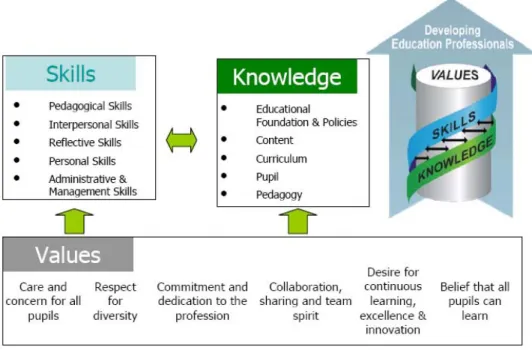
NIE has regularly conducted comprehensive programme evaluation and reviews. The recent initial teacher preparation programme review in 2003–2005 led to an enhanced curriculum and the establishment of the Values, Skills and Knowledge (VSK) model which maps the desired attributes of beginning teachers in Singapore. The VSK model was developed in broad components of skills and knowledge with the underlying core values as the basis of the curriculum (Figure 1). These values, skills and knowledge articulate the desired skills and knowledge components for beginning teachers. Through the VSK model the initial teacher preparation programmes are designed to emphasise inquiry, innovation, reflection, mutual respect, personal connection, collaboration and community. The guiding premise is that teaching is a dynamic and lively profession and in today’s knowledge economy and teachers are lifelong learners with specific
professional needs. Further, this conceptual framework is built on the strategies and pedagogies that enable student teachers to reflect on the values dimension of teaching and to develop the knowledge, values and skills necessary for inclusive practice, and teaching and learning in a culturally diverse society. The emphasis on values is deliberate.
Figure 1 NIE’s VSK framework (see online version for colours)
The VSK model provided the first steps in developing an overarching Quality Assurance (QA) Framework for NIE’s initial teacher preparation programmes. An overall QA will streamline academic, operational and developmental activities to better serve the demands of NIE’s programmes. Based on best practices and extended research in the field of QA, a theoretical basis was formed for the framework. The proposed framework covers key aspects of programme delivery and development to connect student’s entry profiles to beginning teacher’s competencies.
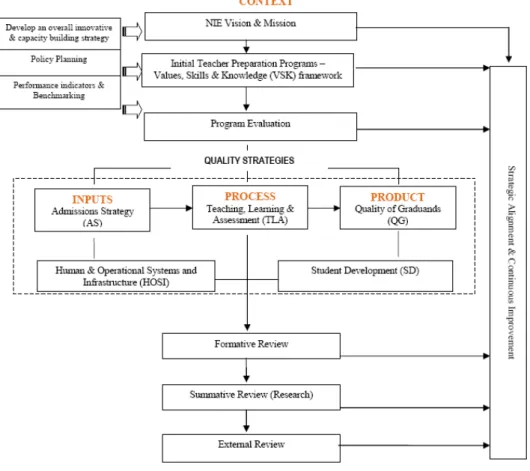
The development of the NIE’s QA framework (Figure 2) serves to achieve intertwined goals of organisational efficacy and quality teaching and learning. The rationale for this is two-fold:
• First, a wide-ranging QA framework will serve as a guide to link the myriad operational and developmental processes in programme management.
• Second, it is timely to focus on building QA processes to assess the effectiveness of the enhanced curriculum in meeting the VSK of beginning teachers.
Figure 2 QA Framework for initial teacher preparation programmes in NIE (see online version for colours)
4 Conceptual foundations of the QA framework
Quality is a complex concept that centres on three main principles, namely, control, accountability and improvement.
• Control refers to how resources are utilised and maximised for outcomes.
• Accountability seeks ways in which stakeholders’ needs are met.
• Improvement refers to how the necessary inputs, processes and outputs interact to meet goals and objectives (Harvey, 1998).
This ambivalence of purposes of quality assurance can result in activities that take many forms and cover a wide spectrum of processes to monitor, account for and enhance quality. In the accountability perspective, the key aspect is that of ‘rendering an account’ understood by those who have a need or right to the ‘account’ (e.g. the stakeholders). This summative approach is where quality assurance is seen as a way of providing an objective measure of quality, in the case of NIE to demonstrate that public funds are
spent effectively. Reflecting this stance, Stamoulas (2006) states that a basic objective of quality assurance is to safeguard and uphold the standards of higher education by publicly providing verified qualitative and quantitative information on programmes. In the improvement perspective, a formative approach and the quality processes are to support future performances rather than make judgements on past achievements (Thune, 1996). Quality assurance is seen as a means of improving the effectiveness. From the perspective of NIE, both purposes are essential. The difficulty lies in combining both purposes in designing of the quality assurance framework. As a result, there is some ambivalence in addressing the purposes of accountability and improvement. However, Woolhouse (1999) claims that accountability and quality improvement are ‘closely linked that it is more sensible to have the same agency attempting both than to try to separate them’ and that ‘accountability can always be re-phrased to focus on improvement’. The importance of formative and summative evaluation is increasingly recognised (McDavid and Hawthorn, 2006). When used in combination, formative and summative evaluations can achieve positive long-term effects for quality sustainability.
A review of evaluation models and educational quality assurance approaches was conducted. There are many evaluation models that view the organisation as an entire system with its programmes and functions in practice (e.g. the Total Quality Management System, Balanced Score Card). However, most of these industry and business-based concepts of quality presents significant limitations in the educational context. Educational practices such as the curriculum components (e.g. instructional implementation, design, programme, students, courses and faculty) need to be included in the overall quality assurance structures (Birnbaum and Desthoels, 1999; Mizikaci, 2006). It is important to identify and take into consideration these areas of teacher education quality. It is also equally important that there is an established link between the training, the competence of the graduates and ultimately, the achievement of the graduates’ students (Blanton et al., 2006).
In recent years, there has been a shift in paradigm from traditional evaluation models of programmes to a systems approach to impact its administration, teaching and research in Higher Education. Thus programme quality assurance should be considered beyond a measurement tool towards a systematic, scheduled and focused examination of the organisation as a whole. Vroeijenstijn’s (2001) general model is useful in showing how evaluation fits into the quality framework of the institution while focusing on the programme. It is appropriate to describe on the outset that programme evaluation, also known as programme assessment or programme review are but a sub-set of the larger debate about quality assurance in Higher Education. This model could be useful if it is adapted to the specific nature of the institution and field of study. The following categories were considered in the NIE’s QA model:
• vision and mission of the institution, the department and the programme
• programme design, approval and review
• programme delivery and management (assessment and evaluation procedures included)
• student development and support
• student communication and representation
Mizikaci (2006, p.44) proposed a model that suggests a systematic and comprehensive quality approach viewing the organisation as an entire system with its programmes and functions in practice. The social system requires a culture change in organisational culture (the values, norms, attitudes and role expectations); communications (quality of relationships between individual members and among groups, reward structure, symbols of power etc.); and behavioural patterns. Following six areas must be recognised.
• the environment
• product or services
• methods
• people
• organisational structure
• mindset of quality improvement.
Total Quality Management (TQM) is a management philosophy that focuses on perpetual process enhancement through the prevention of problems and errors. It requires continual monitoring and control of processes, performance and quality as well as a sense of awareness, commitment and involvement on the part of management, all the workers, the customers and suppliers (Waks and Moti, 1999). In other words, TQM is a management process implemented by any organisation through long-term planning, by consistently using long-term plans that gradually lead the organisation towards the fulfilment of its vision. In the need of reforming higher education system, new approaches and practices in management and industry have appealed decision makers of higher education. Witnessing businesses with continuous improvement principles of TQM, many began to advocate their use in higher education several universities in the USA first, then in Europe and other countries. Burkhalter (1996) reported that 160 universities in the USA were actively involved in TQM.
Stufflebeam et al.’s CIPP Evaluation Model (1971, 2007) is a comprehensive framework for guiding evaluations of programmes, projects, personnel, products, institutions and systems. The CIPP Evaluation Model was used as a framework by The Western Michigan University’s Centre of Evaluation. The model is a decision-focused approach to evaluation aimed at affecting long-term, sustainable improvements. It aims to provide an analytic and rational basis for programme decision-making, based on a cycle of planning, structuring, implementing and reviewing and revising decisions, each examined through a different aspect of evaluation – context, input, process and product evaluation.
With the CIPP model, information is most valuable to make better decisions. Data collection and reporting are undertaken to promote and support more effective programme management. Since programmes change as they are implemented, decision-makers’ needs will also change. The evaluation activities have to adapt to meet these changing needs as well as ensure continuity of focus where appropriate in order to trace development and performance over time. This is an attempt to make evaluation directly relevant to the needs of decision-makers during the different phases and activities of a programme. The four aspects of the CIPP (context, inputs, process, product) model are adapted into the NIE QA framework (Figure 2). The CIPP model takes a holistic
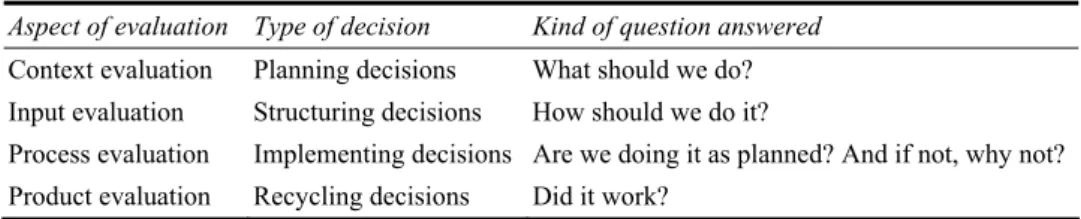
approach to evaluation, aiming to paint a broad picture of understanding of a particular project and its context and processes at work. The four aspects, context, input, process and outputs, assist a decision-maker to answer four basic questions (Table 1).
Table 1 The CIPP model of evaluation
Aspect of evaluation Type of decision Kind of question answered
Context evaluation Planning decisions What should we do? Input evaluation Structuring decisions How should we do it?
Process evaluation Implementing decisions Are we doing it as planned? And if not, why not? Product evaluation Recycling decisions Did it work?
Proponents of this model have suggested two different ways of viewing the CIPP approach. First, it can be viewed as four distinct kinds of evaluation and second, as steps or stages in a comprehensive evaluation model. One of the key strengths of the CIPP model is in tackling the problem of most evaluation processes, that is, to get its findings used. Through its decision-making focus, the CIPP ensures that its findings are used by the decision-makers in a project. However, critics of the CIPP have argued that it holds a top-down or managerial approach, dismissing stakeholders in the process of evaluation (Stufflebeam, 2003).
5 The framework’s central features – Context, Inputs, Process, Product (CIPP)
The Quality Assurance Framework (Figure 2) for NIE’s initial teacher preparation is adapted from the CIPP Model (Stufflebeam, 1971; Stufflebeam, 2007). The CIPP model, originally developed by Donald Stufflebeam in 1971, comprises of four quality components that build the process towards a holistic programme review – Context, Inputs, Process and Product. Context evaluation reflects the environment, identifies needs, vision and mission of the programme. Input evaluation assesses the competing ways to achieve the goals specified in the context evaluation. Process evaluation reviews how the programme operates. Product evaluation focuses on programme results, connecting outcomes with the data obtained via areas of evaluation. The CIPP can determine whether programmes are achieving their goals and objectives and inform the changes needed to improve the design, content, or delivery of processes and programmes (Stufflebeam et al., 2000; Scheerens et al., 2003). The model is adapted for two primary reasons: (1) the model places emphasis on guiding planning, programming and implementation efforts, and (2) the model emphasises that the most important purpose for evaluation is improvement (Stufflebeam, 2007).
The NIE’s overarching vision and mission as well as the VSK framework forms the overall Context (C) for the Quality Assurance framework. It provides the contextual roadmap for guiding all processes within the framework. The NIE vision, ‘To be an institute of distinction’ not only provide a clear focus for all quality processes it also articulates the goals and desired outcomes of NIE’s initial teacher preparation programmes (NIE, 2007). In this respect, the QA process ensures that all the planning, development and delivery of the initial teacher preparation programmes are strategically align to the vision and mission statements of the institute. Together with the vision and
mission, the VSK framework works like a rich thread that is woven through the framework. It defines the purpose for the QA and anchors the framework. Significantly, the values, skills and knowledge espoused in the VSK framework underpins all processes in the QA process which takes into consideration the development of the attributes for beginning teachers. Therefore, the VSK framework underscores the tenet that above all else, the development of the teachers is a paramount concern in the QA process.
At the heart of the quality assurance framework are five key strategies: Each strategy plays a key role in ensuring quality processes. Under each of these strategies, the performance indicators articulate the areas that need to be addressed and reviewed. 1 Admissions (AS)
2 Teaching, Learning & Assessment (TLA) 3 Quality of Graduands (QG)
4 Human & Operational Systems & Infrastructure (HOSI) and, 5 Student Development (SD)
Admission Strategy (AS) in the Inputs (I) component of the framework facilitates and supports equity and quality in the admission criteria into the programmes. Adherence to stipulated admissions criteria, consistent and effective admissions processes are key traits of a sound AS. The main goal is to provide a rigorous and professional admissions process that will support the admittance of suitable student teachers into NIE’s initial teacher preparation programmes. It signals the first steps in assuring overall equity and quality access. It also provides guidelines for coherent processes and procedures for admitting prospective students. The strategy encompasses shared guiding principles and performance indicators for key admission processes, ranging from the identification of prospective students, student selection criteria and process, application procedures and preparation for enrolment into the program of study. The AS is built upon six goals and its respective performance indicators.
• Widening Access
• Admissions Governance
• Admissions Data Management
• Marketing & Publicity
• Quality of Applicants
• Quality Developments
The Process (P) looks at the Teaching, Learning and Assessment (TLA) processes across programmes – Bachelor of Arts/Science (Education), Postgraduate Diploma in Education (PGDE) and Diploma in Education (Dip Ed). The instructional processes influence learning and assessments and bring in the connections within curriculum and pedagogy. Key components of TLA includes curriculum design and delivery, teaching and learning environments, staff quality, instruction, instructional resources and technology, assessment modes and delivery. Fundamentally, the TLA strategy aims to assure that the initial teacher preparation programmes have a rigorous curriculum to equip student teachers with the values, skills and knowledge to be effective and competent in schools
and classrooms and at the same time provide theory-practice linkages to ensure authentic learning. To this end, the TLA strategy ensures a relevant and current teaching, learning and assessment to meet the needs of the educational landscape in Singapore. In the QA framework, the TLA strategy signifies that each programme of study results in learning outcomes appropriate to the rigor and breadth of the degree or certificate awarded by the Institute. Quality assurance at this level ensures the full interaction between the academic tutors, programme offices and student teachers on matters related to programme curricula. Quality teacher development programmes integrate academic and professional learning and provide strong understanding and experience in aspects of teaching as a career. Quality programmes also empower student teachers by giving them the flexibility and skills they will need to cope with changes in the educational landscape.
There is a growing demand for accountability in teacher education (Cochran-Smith, 2001). Assessment of teacher education quality is increasingly aligned to the beginning teachers’ learning outcomes. The processes for monitoring the QG align to the Product (P) of the CIPP model. The quality of graduands determines the success of the programmes in preparing student teachers to perform effectively and efficiently in schools. Graduating teachers’ quality is related to outcomes of education and to the expectations of the public and stakeholders. Quality of teachers entering the profession affects a number of areas. For example, it guides decisions on distribution of resources, policies and most importantly it impacts student learning. In this strategy, the QA processes look at the ‘value-addedness’ of the programme in enhancing student teachers’ learning outcomes, that is, how competent, effective and ready are they for schools and classrooms. This involves analysing the student teachers’ academic and professional development from their entry profiles across the various programs throughout their course of study in NIE. Upon graduation, this strategy also monitors feedback from stakeholders (Ministry of Education, schools management, alumni and parents) on the beginning teachers’ competencies in schools and their career progression. Structurally, the emphasis here is on assessing trends and progress at three levels of student teachers’ development: pre-graduate, graduate progress and post-graduate development.
5.1 Enablers
The strategies, Human, Operational System & Infrastructure (HOSI) and Student Development (SD), support and facilitate the QA processes. In the HOSI strategy, performance indicators look at systems efficacy of NIE in supporting administration as well as teaching and learning processes. This includes the availability and accessibility of media and technological resources, human resource management, as well as facilities, space and infrastructure to support teaching and learning. This strategy reviews how the institute is able to manage and maximises the potential of its support systems to impact the efficacy of the programmes. Together with the HOSI, the Student Development (SD) strategy serves as an important support system for the holistic development of students from pre-enrolment and throughout their course of study in NIE. It is crucial that services and support are available to enrich student teachers’ academic and social development, including guiding student teachers’ general well-being in and outside their experience at NIE. Importantly, this involves building a sense of identity to NIE and the teaching profession through social and cultural programmes, service learning and community involvements to connect to real-world situations.
6 Quality assurance and review
The QA review takes place at three levels – formative, external and summative. While the Quality Strategies discussed above provide a framework of good practices in processes and procedures, the formative, external and summative reviews allows the staff and faculty to reflect on their relevant work areas and assess further actions for improvement. Processes and procedures are reviewed against best practices represented to identify their strengths and areas for improvement. External review is needed to ensure that quality processes are established in accordance to international benchmarks and standards. External quality evaluations are conducted periodically by an external expert panel. These evaluations identify areas of strengths and weaknesses in the programme quality processes. It supports decision-making processes to improve systems and processes of initial teacher preparation programmes. Finally, the summative reviews are important to provide long-term quality strategy for on-going review and improvement. The QA framework and its processes is not a static requirement. Research in teacher education has been identified as one of the key areas of research under the NIE 2007–2012 strategic plan (NIE, 2007) to support quality improvement. At this stage, research for teacher education will be conducted through various means and on multiple levels. The research outcomes are important in building step-wise strategies to improve the overall QA process.
7 Conclusion
The QA framework is a systematic programme review. Hence, it is developed as an internal review tool to provide long-term quality strategy for improvement and innovation by leveraging on information of the programmes’ overall value and the knowledge gathered to further develop its capacity. The QA framework serves as reference point for FPO staff to review current and future developments. Strong links exist among and between the components of the QA Framework. While each of the strategic goals and its respective performance indicators serves as professional benchmarks in various areas, they should be looked at as a whole in order to help FPO identify strengths and areas for further development.
Assuring high quality processes in the design and delivery of teacher education is crucial to meet the demand for high quality teachers. The QA framework for NIE’s initial teacher preparation programmes provides the first steps towards future quality assurance developments at NIE. In this respect, QA is not a means to an end. Rather, it is an on-going process to improve and impact the teaching and learning outcomes at NIE. This reflects the need to conduct regular and continuous reviews to make informed decisions. On another note, while resources and support systems facilitate the QA process, people are the source of innovation. Hence, it is important that NIE staff and faculty share a common vision and commitment towards the QA values, principles and goals. For sustainable long-term success in impacting teaching and learning, it is thus necessary that staff and faculty fully understand the QA processes and be responsive to changes and improvements, both individually and collectively. The NIE’s QA processes treats evaluation as an essential concomitant of improvement and accountability within a framework of appropriate values, skills and knowledge. It responds to the reality that
evaluations of innovative, evolving efforts towards improving the programmes typically cannot employ controlled, randomised experiments or work from available evaluation instruments. It cannot be overemphasised, however, that the QA framework is and must be subject to continuing assessment and further development.
References
Barber, M. and Mourshed, M. (2007) How the world’s best-performing school systems come out on top, McKinsey & Company. Available online at: http://www.mckinsey.com/ clientservice/socialsector/resources/pdf/Worlds_School_Systems_Final.pdf (accessed on 15 February 2009).
Birnbaum, R. and Deshotels, J. (1999) ‘Has the academy adopted TQM?’, Planning for Higher Education, Vol. 28, No. 1, pp.29–37.
Blanton, L.P., Sindelar, P.T. and Correa, V.I. (2006) ‘Models and measures of beginning teacher quality’, The Journal of Special Education, Vol. 40, No. 2, pp.115–127.
Burkhalter, B.B. (1996) ‘How can institutions of higher education achieve quality within the new economy?’, Total Quality Management, Vol. 7, pp.153–160.
Cochran-Smith, M. (2001) ‘The outcomes question in teacher education’, Teaching and Teacher Education, Vol. 17, No. 5, pp.527–546.
Darling-Hammond, L. and Bransford, J. (2006) Preparing Teachers for a Changing World: What Teachers Should Learn and Be Able To Do, Jossey Bass, San Francisco.
Goodwin, A.L. (2008) ‘Defining teacher quality: Is consensus possible?’, in Cochran-Smith, M., Feiman-Nemser, S., McIntyre, D.J. and Demers, K.E. (Eds): Handbook of Research on Teacher Education: Enduring Questions in Changing Contexts, Routledge, New York, pp.399–403.
Harvey, L. (1998) ‘An assessment of past and current approaches to quality in higher education’,
Australian Journal of Education, Vol. 43, No. 3, pp.237–255.
Harvey, L. (2004–2007) Analytic Quality Glossary, Quality Research International. Available online at: www.qualityresearchinternational.com/glossary/(accessed on 22 January 2009). McDavid, J.C. and Hawthorn, L.R. (2006) Programme Evaluation and Programme Measurement:
An Introduction to Practice, Sage Publications, California.
Mizikaci, F. (2006) ‘A systems approach to program evaluation model for quality in higher education’, Quality Assurance in Education, Vol. 14, No. 1, pp.37–53.
Mok, K.H. (2005) ‘Questing for internationalization of universities in Asia: critical reflections’,
Journal of Studies in International Education, Vol. 11, pp.433–454.
NIE (2007) 3:3:3 Roadmap: Towards an Institute of Distinction, National Institute of Education, Singapore.
OECD (2001) Teachers for Tomorrow’s School, OECD Publishing, Paris.
OECD (2004) Quality and Recognition in Higher Education: The Cross-Border Challenge, OECD Publishing, Paris.
OECD (2008) Assuring and Improving Quality, OECD Publishing, Paris.
Scheerens, J., Glas, C. and Thomas, S.M. (2003) Educational Evaluation, Assessment and Monitoring: A Systematic Approach, Swets and Zietlinger, Netherlands.
Stamoulas, A. (2006) ‘Greece before the Bologna process: confronting or embracing quality assurance in higher education?’, Higher Education Policy, Vol. 19, No. 4, pp.433–445. Stufflebeam, D.L. (2003) ‘The CIPP model for evaluation: an update, a review of the model’s
development, a checklist to guide implementation’, Presented at the AnnualConference of the Oregon Program Evaluators Network (OPEN), Portland, Oregon, 10 March 2003. Available online at: http://www.wmich.edu/evalctr/pubs/CIPP-ModelOregon10-03.pdf (accessed on 15 February 2009).
Stufflebeam, D.L. and Shinkfield, J.A. (2007) Evaluation Theory, Models, and Applications, Jossey-Bass, San Francisco.
Stufflebeam, D.L., Foley, W.J., Gephart, W.J., Guba, E.G., Hammond, R.L., Merriman, H.O. and Provus, M.M. (1971) Educational Evaluation and Decision Making, Peacock, Itasca, Illinois. Stufflebeam, D.L., Madaus, G.F. and Kellaghan, T. (2000) Evaluation Models: Viewpoints on
Educational and Human Services, Kluwer Academic Services, Boston.
Thune, C. (1996) ‘The alliance of accountability and improvement: the Danish experience’,
Quality in Higher Education, Vol. 10, No. 3, pp.21–32.
Vroeijenstijn, T. (2001) ‘How to assure quality in higher education’, in Baijnath, N., Maimela, S. and Singh, P. (Eds): Quality Assurance in Open and Distance Learning, Unisa and Technikon SA, Johannesburg, pp.65–80.
Waks, S. and Moti, F. (1999) ‘Application of the total quality management principles and ISO 9000 standards in engineering education’, European Journal of Engineering Education, Vol. 24, No. 3, pp.249–259.
Woolhoouse, D. (1999) ‘Quality and quality assurance’, Quality and Internationalisation in Higher Education, OECD, Paris.