Independent Pricing and Regulatory Tribunal
Local Infrastructure Benchmark
Costs
Costing infrastructure in Local Infrastructure Plans
Other — Draft Report
November 2013
Local Infrastructure Benchmark
Costs
Costing infrastructure in Local Infrastructure Plans
Other — Draft Report
November 2013
ii IPART Local Infrastructure Benchmark Costs
© Independent Pricing and Regulatory Tribunal of New South Wales 2013
This work is copyright. The Copyright Act 1968 permits fair dealing for study, research, news reporting, criticism and review. Selected passages, tables or diagrams may be reproduced for such purposes provided acknowledgement of the source is included.
ISBN 978 1 925032 48 2 S9-91 The Tribunal members for this review are:
Dr Peter J Boxall AO, Chairman Mr Simon Draper, Part Time Member Dr Paul Paterson, Part Time Member
Inquiries regarding this document should be directed to a staff member: Alison Milne (02) 9113 7710
Carly Price (02) 9113 7738 Nicole Haddock (02) 9290 8426
Independent Pricing and Regulatory Tribunal of New South Wales PO Box Q290, QVB Post Office NSW 1230
Level 8, 1 Market Street, Sydney NSW 2000 T (02) 9290 8400 F (02) 9290 2061
Local Infrastructure Benchmark Costs IPART iii
Invitation for submissions
IPART invites written comment on this document and encourages all interested parties to provide submissions addressing the matters discussed.
Submissions are due by 17 January 2014.
We would prefer to receive them electronically via our online submission form <www.ipart.nsw.gov.au/Home/Consumer_Information/Lodge_a_submission>. You can also send comments by mail to:
Local Infrastructure Benchmark Costs Independent Pricing and Regulatory Tribunal PO Box Q290
QVB Post Office NSW 1230
Late submissions may not be accepted at the discretion of the Tribunal. Our normal practice is to make submissions publicly available on our website <www.ipart.nsw.gov.au> as soon as possible after the closing date for submissions. If you wish to view copies of submissions but do not have access to the website, you can make alternative arrangements by telephoning one of the staff members listed on the previous page.
We may choose not to publish a submission—for example, if it contains confidential or commercially sensitive information. If your submission contains information that you do not wish to be publicly disclosed, please indicate this clearly at the time of making the submission. IPART will then make every effort to protect that information, but it could be disclosed under the Government Information (Public Access) Act 2009 (NSW) or the Independent Pricing and Regulatory Tribunal Act 1992 (NSW), or where otherwise required by law.
If you would like further information on making a submission, IPART’s submission policy is available on our website.
Contents
v IPART Local Infrastructure Benchmark Costs
Contents
Invitation for submissions iii
Part 1: Inquiry into Local Infrastructure Benchmarking 1
1 Executive Summary 3
1.1 About this review 3
1.2 Draft Recommendations 8
1.3 Key Issues for consultation 9
1.4 Structure of the Draft Report 10
2 Context 11
2.1 Current arrangements for local development contributions 11 2.2 Infrastructure contributions under the new planning system in NSW 12
2.3 What was IPART asked to do? 14
2.4 How are we conducting our review? 15
3 Development and application of benchmarks 17
3.1 What infrastructure items have been benchmarked? 17 3.2 What cost estimation approach was used? 20 3.3 How will the benchmarks be used by councils? 22
4 Components of the benchmarks 23
4.1 Base Costs 24
4.2 Adjustment Factors 25
4.3 Contingency allowance 29
5 Estimating efficient costs where there is no benchmark 35 5.1 When should these estimation methods be applied? 35
5.2 Types of estimating methodologies 36
5.3 What method and information sources should be used? 37
5.4 Contingency Allowance 39
5.5 What else can a council do to ensure good estimates where there is no benchmark? 40
5.6 Cash flow planning and management 41
6 Cost escalation and updating the benchmarks 43
6.1 How should benchmark costs be escalated? 43 6.2 When should the benchmarks be reviewed and updated? 47 6.3 Incorporating updated benchmark costs in local infrastructure plans 47
Contents
vi IPART Local Infrastructure Benchmark Costs
7 Valuing land for contributions 49
7.1 Overview of our recommended methods to estimate the cost of land in a
local infrastructure plan 49
7.2 What approach should councils take to costing land it needs to acquire
in a plan? 51
7.3 What approach should councils take to costing council-owned land in a plan? 53 7.4 Updating land costs in a local infrastructure plan 55
8 Dispute resolution mechanisms 60
8.1 Disputes about costs and costing methodologies in local infrastructure plans 62 8.2 Minimising disputes about local infrastructure costs 62 8.3 Proposed approaches for dealing with disputes about the application of
benchmarks or cost methodologies in preparing and implementing plans 63 8.4 Disputes about contributions rates and costs arising from conditions of
consent 65
9 Cost drivers for infrastructure delivery 66
Part 2: Developing cost estimate using benchmarks 69
10 Guide for councils 71
10.1 How should councils estimate the cost of local infrastructure items? 71 10.2 Determining the costing method to use 71 10.3 How to estimate costs of benchmark items 73 10.4 How to estimate costs of infrastructure items where there is no
benchmark 76 10.5 Worked examples of applying the benchmarks 77
11 Benchmark tables 80
Appendices 145
A Terms of Reference 147
B Infrastructure list from the Infrastructure Contributions Taskforce 150
C Consultation for the Draft Report 155
1 Executive Summary
Local Infrastructure Benchmark Costs IPART 1
1 Executive Summary
1 Executive Summary
Local Infrastructure Benchmark Costs IPART 3
1 Executive
Summary
1.1
About this review
The Independent Pricing and Regulatory Tribunal (IPART) has been asked to develop benchmark costs that will be used to inform local infrastructure contributions under the new planning system for NSW. This Draft Report sets out our preliminary recommendations, including estimates of benchmark costs for local infrastructure items.
We are seeking feedback on the recommendations and proposals in this draft report. We will also be holding a public roundtable on Tuesday 3 December and will be accepting submissions until 17 January 2014. We will submit our Final Report to the Government in March 2014.
Background
The Government’s planning reforms include a new infrastructure contributions framework allowing councils to levy local infrastructure contributions to fund the essential local infrastructure required to support growth. The costs of local infrastructure in councils’ infrastructure plans will be based on standardised, benchmarked costs for types of infrastructure.
IPART has been asked to provide a set of benchmark costs for items of local infrastructure. We have also been asked, where it is not reasonable to benchmark the cost, to identify methodologies to ensure councils can estimate the efficient cost of that infrastructure. The terms of reference from the Premier also ask us to investigate and make recommendations on a number of associated issues, including updating the benchmarks, valuing land for the purposes of preparing an infrastructure plan, and mechanisms for resolving disputes about applying the benchmarks and cost methodologies.
1 Executive Summary
4 IPART Local Infrastructure Benchmark Costs How are we conducting this review?
We have consulted with stakeholders and engaged consultants, Evans & Peck. The consultants’ advice to us forms the basis of the recommended benchmark components and values included in Chapter 11. The guidance provided in Part 2:Developing cost estimates using benchmarks is also based on Evans & Peck’s advice.
We have worked with the Infrastructure Contributions Taskforce appointed to advise the Government on implementing the new contributions framework. We have had discussions with government and industry stakeholders, and a range of councils from across NSW. Many councils and 1 industry group responded to an Information Paper we released in mid-October asking for stakeholders’ views about the key issues we identified for this review.
What infrastructure have we benchmarked?
The Planning White Paper indicates that local infrastructure includes land and capital works for local roads and traffic management (roads), local open space and embellishment and community facilities, as well as capital works for stormwater drainage. The items of infrastructure essential to support development and for which councils will be able to levy a contribution will be recommended to Government by the Infrastructure Contributions Taskforce. Until the Taskforce finalises the ‘essential infrastructure list’, we have used as a starting point the infrastructure on a ‘benchmark list’ of around 80 items of local infrastructure that the Taskforce provided to us. We provided benchmark costs for ‘standardised’ scopes for the majority of these items, plus a number of sub items.
Our methodology for determining what infrastructure could be benchmarked involved defining the typical configuration(s) of each infrastructure item (in terms of size, material, arrangement and the performance outcome of the item). If a configuration could be defined so it would apply to a reasonable proportion of projects, the cost of the infrastructure item was benchmarked. The benchmark items are listed at the start of Chapter 11 of this report. The benchmark cost is made up of 3 components, the base cost, adjustment factors, and contingency allowance. Datasheets for each benchmark item are in Chapter 11 and identify the benchmark base costs and the assumptions and scope of works relevant to these. The adjustment factors (for regional variation and congestion) and contingency allowances are outlined in Chapter 10.
We have not, to date, provided benchmark costs for 14 of the infrastructure items. We welcome submissions to the Draft Report on whether it would be useful to develop benchmark costs for these infrastructure items.
1 Executive Summary
Local Infrastructure Benchmark Costs IPART 5 How will the benchmarks be used?
The Department of Planning and Infrastructure is currently finalising the contributions framework for the new planning system. We consider that councils should use the benchmark costs and methodologies we recommend as a guide when estimating the costs of infrastructure in their local infrastructure plans. This should provide a higher level of consistency in the cost estimates of infrastructure levied on developers through local infrastructure contributions. The benchmark costs will also be used by the Department of Planning and Infrastructure and IPART to guide reviews of local infrastructure plans prior to the approval of the plans by the Minister. Councils will have to provide justification where they have deviated from the benchmark costs.
It is intended that the Department of Planning and Infrastructure will provide guidelines for the preparation of local infrastructure plans which will include the final benchmarks. The Guidelines will require plans to have transparent assumptions and cost estimates.
A worked example of how to use the benchmarks is in Chapter 10 of this report.
Costs of infrastructure which are not benchmarked
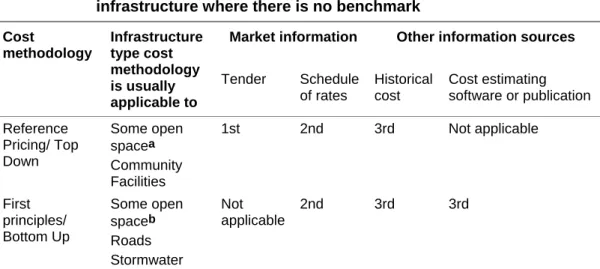
For items of infrastructure which we have not yet benchmarked, we have focused on the methodologies that will lead to the estimation of efficient costs, rather than on the delivery of the infrastructure. The Draft Report identifies how the best estimation method will depend on the nature of the infrastructure, the stage in the project’s planning and the council’s access to recent and reliable information. We have compared the ‘top down’ and ‘bottom up’ approaches to estimation and rank both approaches in terms of their usefulness or likely accuracy. In preparing cost estimates for infrastructure items where there is no benchmark cost estimate, councils should use the approaches presented in Table 5.1 to estimate base costs, and include a reasonable allowance for contingency.
Councils should use recent and reliable market rate or tender information if it is available. We note that tender information may not often be available when Local Infrastructure Plans are being prepared by councils. Price lists and schedules of rates are useful for certain types of open space facilities and works. A bottom up approach, like the one used by Evans & Peck in estimating the cost of the benchmark items, is generally considered preferable for civil works like stormwater works, but tends to be a more resource intensive costing method. Councils will also need to make a reasonable allowance for contingency, if possible, based on a risk assessment
1 Executive Summary
6 IPART Local Infrastructure Benchmark Costs
Cost escalation and updating the benchmarks
The benchmark costs that we have published in Part 2 of the Draft Report are presented in 2012/13 dollars. When a council is using the benchmark costs in future years to calculate the cost of infrastructure to include in a local infrastructure plan, it will need to adjust the benchmark costs to reflect the changes in those costs since 2012/13.
Benchmark costs could be reviewed annually, which is both time consuming and expensive. Alternatively, benchmarked costs could be adjusted by a relevant index and reviewed after a period of years.
We recommend that councils use relevant construction-based Producer Price Indices (PPIs) published by the Australian Bureau of Statistics (ABS) to escalate the benchmark costs in their plans. We also recommend that IPART should review the set of benchmark costs adopted for use in estimating costs in councils’ local infrastructure plans within 4 years.
Valuing land for infrastructure plans
In addition to the capital cost of infrastructure, councils will be able to include the cost of land associated with roads, open space and community facilities in local infrastructure plans. Land costs are a significant part of the total cost in many existing contributions plans, especially in growth areas with high land values.
Our recommended approach depends on whether or not the council needs to buy the land, or already owns it, and whether the land it owns was reserved for public purposes, prior to the land being rezoned for local infrastructure.
To value land to include in a plan, we recommend that council-owned land should be valued at its historic purchase price, indexed by CPI (All Groups) Sydney. On balance, we consider that there should be one exception to this approach, ie, when in the precinct planning process, the land was not previously reserved for a public purpose before it was rezoned for development. In this circumstance, the land could instead be sold by the council for the benefit of all ratepayers, so using current market value is warranted.
To escalate the value of land in the plan in future years, we recommend councils use the CPI (All Groups) Sydney for all the land they already own. To escalate the value of land that still needs to be purchased, we recommend that councils can choose either the CPI (All Groups) Sydney, or a ‘suitable’ land value index. We define the characteristics of a suitable land index as one that is representative and statistically robust.
We are seeking feedback on our suggested approaches to land valuation, to inform our recommendations in the final report.
1 Executive Summary
Local Infrastructure Benchmark Costs IPART 7 Resolving disputes about applying benchmarks and cost methodology
The terms of reference ask IPART to recommend effective mechanisms for resolving disputes about the application of benchmarks or cost methodologies in the local infrastructure plan process.
Developers may disagree with how councils interpret the guidelines or practice notes for preparing plans or calculating the costs of facilities and land for which a contribution will be levied.
We have considered how councils can minimise the potential for disputes about infrastructure contributions to arise. We recommend that councils should establish formal processes to address developers’ concerns. Where councils cannot resolve such disputes directly, the council should refer the matter for independent review to the Independent Hearing and Assessment Panel (IHAP), or the Joint Regional Planning Panel in its region if the council does not have an IHAP. When submitting their plans to the Minister for approval, councils should be required to report any contentious issues about infrastructure costs, and how they have been dealt with in the draft plan.
We also recommend that the Minister could refer matters concerning the application of benchmarks and costs methodologies in local infrastructure plans to IPART for advice and resolution.
Standards
Our terms of reference ask us to investigate the main planning and environmental standards that councils apply in the provision of local infrastructure. We define standards to be any guideline, legislative requirement, technical standard or specification that councils apply when providing local infrastructure.
The NSW Government intends that local infrastructure contributions reflect the efficient cost of providing infrastructure and be affordable. Therefore, as part of our review we are consulting with stakeholders to identify any standards that could have an unreasonable impact on the cost of local infrastructure (imposed by outside agencies or at the discretion of councils).
We have identified a number of standards councils apply in the provision of local infrastructure, but we have not yet received sufficient stakeholder feedback to confirm which of these standards are considered to have an unreasonable impact on cost.
1 Executive Summary
8 IPART Local Infrastructure Benchmark Costs
1.2 Draft
Recommendations
1 Councils should use the benchmark costs for items of local infrastructure set out in Chapter 11 in Part 2 of this report as a guide in developing cost estimates for the purposes of levying an uncapped contribution for the
efficient cost of local infrastructure. 22
2 Benchmark costs should be adjusted, if outside of the Sydney region, by a regional factor to account for variations in transportation costs, area specific prices and market competition for labour and materials, using: 29 – the index for the closest regional centre, in regional building cost indices
from the Rawlinsons Australian Construction Handbook for open space embellishment and community facilities 29 – the distance thresholds from the source of raw materials, for roads and
stormwater infrastructure, as reproduced in Table 10.2 in Part 2 of this report. 29
3 Councils can apply an optional adjustment factor for congestion-related costs, if there is significant congestion at the infrastructure site, based on different levels of congestion for roads and stormwater infrastructure (Table 10.3 in of
Part 2 of this report). 29
4 Councils should apply relevant final contingency allowance rates to their benchmark costs (adjusted for regional and congestion factors). IPART is consulting on the contingency allowances set out in Table 10.4 in Part 2 of this report and will finalise these for the Final Report. 34
5 In preparing cost estimates for infrastructure items where there is no benchmark cost estimate, councils should use the approaches presented in Table 5.1 to estimate base costs, and include a reasonable allowance for contingency. 40
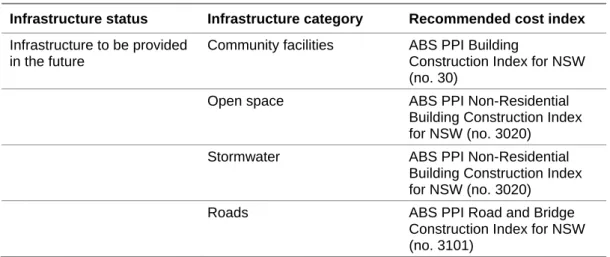
6 When preparing a local infrastructure plan, councils should escalate the benchmark costs (as listed in Part 2 of this report in 2012/13 dollar terms) using the latest available quarterly Producer Price Indices published by the Australian Bureau of Statistics, as listed in Table 6.1. 46
7 Local infrastructure benchmarks (as listed in Part 2 of this report) should be
reviewed by IPART within 4 years. 47
8 For the purpose of levying direct contributions on developers, councils should value land already acquired at historical purchase price indexed annually by
CPI (All Groups) Sydney except: 55
– if the land had not already been reserved for a public purpose before it is released for development in the precinct planning process. In this case, the council should value the land at current market value. 55
1 Executive Summary
Local Infrastructure Benchmark Costs IPART 9 9 To escalate the costs of land in a finalised local infrastructure plan from year
to year, councils should use: 59
– either a ‘suitable’ land cost index as defined in Box 7.1 or the CPI (All
Groups) Sydney for land to be acquired 59 the CPI (All Groups) Sydney for council-owned land. 59
10 Councils should have a formal council-based review mechanism to consider objections and address issues in dispute between councils and developers about benchmark costs and cost methodologies arising when infrastructure plans are being prepared and finalised. 64
11 Councils should refer disputes that cannot be resolved through internal processes to an independent expert panel. This function could be performed by existing Independent Hearing and Assessment Panels, where the council has appointed one, or the Joint Regional Planning Panel for the region. Councils should report to the Minister for Planning and Infrastructure about how they have responded to the recommendations from the Panel. 64
12 The Minister can refer disputes about the application of benchmarks and cost methodologies in local infrastructure plans to IPART for a recommended
resolution. 65
1.3
Key Issues for consultation
We seek feedback on all the recommendations in the Draft Report. We also welcome submissions on the following issues:
Benchmark cost estimates –the appropriateness of the benchmark values.
Infrastructure items for which there is no benchmark – whether it is useful
to develop benchmark costs for the infrastructure items in Box 3.1, or are these items too project-specific? Please include answers to the following questions: – Could the variation in scope be captured by sub items?
– What would the ‘typical’ configurations be for benchmarking purposes? – What proportion of the total number of projects within a local government
area and/or across the state is the benchmark likely to apply to?
Contingency allowances - the appropriate contingency allowance to be
applied when using the benchmarks. Standards - please consider:
– whether there are any standards imposed on councils by outside agencies that have an unreasonable impact on the cost of local infrastructure
– whether there are any standards councils adopt at their own discretion that have an unreasonable impact on the cost of local infrastructure.
1 Executive Summary
10 IPART Local Infrastructure Benchmark Costs
1.4
Structure of the Draft Report
The following chapters explain our review and preliminary recommendations in detail:
Chapter 2 sets out the context and processes for our review. Chapter 3 explains how the benchmarks were developed.
Chapter 4 outlines the components of the benchmark costs including base costs, adjustment factors and contingency allowances.
Chapter 5 outlines different methodologies councils could use to efficiently cost items of local infrastructure that cannot reasonably be benchmarked. Chapter 6 recommends a methodology for cost escalation.
Chapter 7 discusses how councils should value land for inclusion in a local infrastructure plan.
Chapter 8 considers options for resolving disputes about benchmark costs and cost methodologies.
Chapter 9 discusses the standards and requirements which may influence the cost of local infrastructure delivery.
Part 2: Developing cost estimates using benchmarks of this Draft Report is a guide for councils.
Chapter 10 provides guidance on in using the benchmarks, estimating the cost of infrastructure items where there is no benchmark, and a template for presenting cost information.
2 Context
Local Infrastructure Benchmark Costs IPART 11
2 Context
The Independent Pricing and Regulatory Tribunal (IPART) has been asked to develop benchmark costs that will be used to inform local infrastructure contributions under the new planning system for NSW.
This chapter outlines:
the current and proposed regime for infrastructure contributions what we were asked to do in this review
how we are conducting the review the next steps.
2.1
Current arrangements for local development contributions
The Environmental Planning and Assessment Act 1979 (EP&A Act) sets out a system of development contributions.1 Councils (and other consent authorities) canrequire a contribution to the cost (land and capital) of providing local infrastructure to support new development by one of the following means:
development contributions in accordance with a plan under section 94 a levy for a fixed percentage of the development cost under section 94A a planning agreement under section 93F.
Most contributions are levied through a section 94 contributions plan. Councils prepare section 94 contributions plans that set out the expected types of development in an area and the public amenities and services that will be needed to meet demand arising from that development. The facilities and services must be reasonable in that demand for them is created by the new development (nexus) and the cost reflects the demand generated only from the new development (apportionment). Contributions are imposed as a condition of consent to a development application.
1 See generally Environmental Planning and Assessment Act 1979 Div 6, Department of
Infrastructure, Planning and Natural Resources, Development Contributions Practice notes – July 2005, and Department of Planning, Local Development Contributions Practice Note for assessment of contributions plans by IPART, November 2010 (2010 Practice Note).
2 Context
12 IPART Local Infrastructure Benchmark Costs
Since 2010, the amount of contributions under a section 94 contributions plan has been capped at $20,000 per dwelling or lot for developments in brownfield areas, and $30,000 per dwelling or lot in greenfield areas.2
In addition to contributions for local infrastructure, the NSW Government also levies a Special Infrastructure Contribution (SIC) for developers to contribute to the cost of providing roads, rail, bus, education, health, emergency, and open space and conservation infrastructure, plus the cost of infrastructure planning and delivery. The SIC is levied on a per hectare of ‘net developable area’ basis.3
2.2
Infrastructure contributions under the new planning system in
NSW
In April 2013 the NSW Government published A New Planning System for NSW: White Paper (White Paper) proposing comprehensive reforms of the NSW planning system.4 The Planning Bill 2013 (the Bill) was introduced into
Parliament on 22 October 2013 and passed the Legislative Assembly on 30 October 2013. The provisions of the Bill are the same as those in the White Paper in all aspects material to our review.
The planning reforms include a new infrastructure contributions framework focused on providing a more transparent, simple, fair and affordable system that links to infrastructure plans at local and regional or subregional levels.5 The new
framework provides for infrastructure contributions at for 3 levels:
Local infrastructure contributions for the cost of infrastructure in a local
infrastructure plan.
Regional infrastructure contributions for the cost of infrastructure in Growth Infrastructure Plans (eg, regional or State roads, land for drainage, transport infrastructure, regional open space and education establishments).6 The
contributions will be imposed on a subregional basis. Contributions will vary by subregion but will be applied across Sydney and in other high growth areas in the state.7
2 Environmental Planning and Assessment (Local Infrastructure Contributions) Direction 2011, 4 March
2011 and 2010 Practice Note.
3 Minister for Planning, Environmental Planning and Assessment (Special Infrastructure Contribution – Western Sydney Growth Areas) Determination 2011, 14 January 2011, p 8.
4 NSW Government, A New Planning System for NSW – White Paper, April 2013 (White Paper). 5 See generally the White Paper Chapter 7.
6 Planning Bill 2013,Part 7.
2 Context
Local Infrastructure Benchmark Costs IPART 13
Contributions to the Planning Growth Fund for the cost of regional open
space and all land for drainage.8 The contributions will be imposed on a
regional basis.9
Mechanisms outside this system such as Planning Agreements will remain, but will not be the primary means for developers to contribute to the cost of local or regional infrastructure needed to support growth. Works-in-kind, where a developer provides infrastructure directly rather than making a monetary contribution, will also still be available.
2.2.1 What are local infrastructure contributions?
Councils will be able to levy local infrastructure contributions to fund essential local infrastructure required to support growth.10 Local infrastructure is defined
as:
local roads and traffic management (land and capital works) local open space and embellishment (land and capital works) community facilities (land and capital works)
stormwater drainage (capital works).
Councils will be required first to prepare local infrastructure plans setting out the infrastructure required in the area, and identify the infrastructure that can be funded by local infrastructure contributions (and also by regional infrastructure contributions). The local infrastructure plans will also explain the council’s policy for the assessment, collection, expenditure and administration of contributions.11
Councils will only be able to levy developers for the cost of local infrastructure on the ‘essential infrastructure list’. These contributions will be uncapped, so councils will be able to fund the essential local infrastructure associated with growth. Local infrastructure contributions will be imposed as a condition of development consent.
The NSW Government intends that local infrastructure contributions could vary across councils, but that they will be based on “standardised, benchmarked costs for types of infrastructure”.
8 NSW Government, A New Planning System for NSW – White Paper, April 2013, p 163; NSW
Government, Planning Bill 2013, section 7.16.
9 Further clarification is required from the Department of Planning and Infrastructure about how
regional infrastructure contributions and the Planning Growth Fund will operate.
10 The proposed contributions framework is explained in Chapter 7 of NSW Government, A New Planning System for NSW – White Paper, April 2013 and the Planning Bill 2013 Part 7.
2 Context
14 IPART Local Infrastructure Benchmark Costs
The benchmarks are not intended to limit councils’ choices about the infrastructure that they select to deliver to their community. The benchmarks will be used as a guide to determine the cost of the infrastructure that can be funded from infrastructure contributions. Councils have a range of other funding sources available to them to provide the infrastructure in the local infrastructure plan, should they choose to deliver a higher standard or additional infrastructure types to their community. The benchmarks will ultimately relate only to essential infrastructure that is necessary for growth, not all infrastructure delivered.
2.3
What was IPART asked to do?
The planning reforms propose that IPART will have an expanded role in benchmarking the costs of local infrastructure, setting regional contributions and reviewing contributions plans. Under Section 9 of the Independent Pricing and Regulatory Tribunal Act 1992 (NSW)the Premier issued terms of reference asking IPART to:
identify items of infrastructure for which benchmark costs can be reasonably established, and estimate benchmark costs for those items
for infrastructure items where benchmark costs cannot be reasonably established, identify methods that are likely to lead to efficient costs
recommend a method for updating cost benchmarks eg, for cost escalation recommend relevant adjustments eg, contingency and other allowances identify how different regions or development settings may affect costs recommend appropriate land valuation methodologies
recommend effective mechanisms for resolving disputes about the application of benchmarks or cost methodologies
investigate the main planning and environmental standards required by outside agencies, in the provision of local infrastructure, and also the extent to which councils exercise discretion in setting standards (eg, above the required minimum) and whether councils’ standards are reasonable.
A copy of our Terms of Reference is provided in Appendix A.
2.3.1 What items of local infrastructure will be benchmarked
The Infrastructure Contributions Taskforce (the Taskforce), comprising councils, state agencies and industry, was reconvened in mid-2013 to provide direction on a range of matters relating to the contributions reforms proposed in the White Paper. The Taskforce is to agree benchmarks for the cost of items in local infrastructure plans. IPART’s role is to assist the Taskforce by estimating benchmark costs for such infrastructure items.
2 Context
Local Infrastructure Benchmark Costs IPART 15
The Taskforce is currently finalising the specific list of items (the essential infrastructure list) for which councils will be able to levy local infrastructure contributions.12 In the interim, the Taskforce has provided IPART with a
‘benchmark list’ of local infrastructure to use until the ‘essential infrastructure list’ is finalised.13 The benchmark list is in Appendix B.
2.3.2 What IPART’s review does not cover
An important aspect driving the overall cost to councils of providing infrastructure for their communities is the number and type of facilities, or amount of open space that is considered necessary or essential. These constitute a different form of ‘standards’ of infrastructure provision that councils meet, and are often called ‘rates of provision’.
In preparing the rates of provision necessary to support the existing population and development, a council will use guidance from a range of sources. Councils can use existing guides, or commission studies by experts such as planners and engineers, to determine the amount of land and the type and number of each facility that are needed to service a population of the size expected in the area covered by the infrastructure plan. These ‘standards’ can indicate, for example the amount of open space per resident, the population to be served by facilities such as a branch library or community centre, the type and number of local and district parks, the number and type of sporting fields, or the number and locations of roundabouts. Commonly used benchmarks are 2.83ha of open space per 1,000 people, and a branch library of 2,400m2 for 33,000 people.14
Although these ‘rates of provision’ are important in determining of the local councils’ infrastructure costs, we have not been asked to set benchmarks for these rates of provision as part of this benchmarking project. We are advised that the Department of Planning and Infrastructure will consider these ‘rates of provision’ separately.
2.4
How are we conducting our review?
We received our terms of reference on 5 September 2013 and have 6 months to complete the review.
12 NSW Government, A New Planning System for NSW—White Paper, April 2013, p 165. 13 We expect that the Taskforce will finalise the essential infrastructure list in 2014.
14 Growth Centre Commission, Growth Centre Development Code, Section 2: What Must Precinct Planning Address?, October 2006, Table A.4, p 13.
2 Context
16 IPART Local Infrastructure Benchmark Costs
Before publishing this Draft Report:
We consulted with relevant stakeholders, including members of the Infrastructure Contributions Taskforce, to gain a broad understanding of the key considerations for the benchmarking review, in particular the local and regional cost variations for specific infrastructure items. Appendix C contains a list of stakeholders we have consulted to date.
We engaged consultants (Evans & Peck) to provide advice on various aspects of our terms of reference. Using the ‘benchmark list’ provided by the Taskforce, the consultants were asked to identify the items of infrastructure for which benchmark cost estimates could reasonably be established, and to calculate benchmark costs for them, and also advise on appropriate cost methodologies for the other infrastructure items that have not been benchmarked to date.
We issued an Information Paper on 11 October 2013 seeking comments on a range of issues relating to our review. Many councils have responded and provided useful insight into their practices and how the proposed contributions framework may operate.
2.4.1 Next steps
In the next few months we will:
hold a public roundtable meeting with stakeholders on 3 December 2013 to gather feedback on this Draft Report and other aspects of the terms of reference
take into account submissions to this Draft Report (which are due by 17 January 2014)
consult with relevant stakeholders to check the appropriateness of the benchmark cost estimates.
3 Development and application of benchmarks
Local Infrastructure Benchmark Costs IPART 17
3 Development and application of benchmarks
This chapter discusses our approach to developing the benchmark costs for local infrastructure items on the ‘benchmark list’. We engaged Evans & Peck to provide expertise in cost estimation and the development of the benchmarks. We also explain how Evans & Peck used different cost estimation approaches for different infrastructure types. The benchmarks are intended as a guide only and we suggest councils use the guidance in Part 2 of this report when costing local infrastructure.
3.1
What infrastructure items have been benchmarked?
As previously mentioned, we were given a list of infrastructure items to benchmark by the Infrastructure Contributions Taskforce (Appendix B). It includes 4 infrastructure types:
roads and traffic management (roads) stormwater management infrastructure open space embellishment
community facilities.
We have specified benchmark items for most of the infrastructure list provided to us by the Taskforce. We specified a typical configuration for each item, specified a scope and then estimated a cost of the benchmark item. In some instances, we have also created sub-items.
The list of benchmark infrastructure items for which we have estimated benchmark costs is listed at the start of Chapter 11 in Part 2 of this report.
There are some infrastructure items for which we have not developed a benchmark cost to date. These items are listed in Box 3.1. This is because the scope of these items can vary significantly and a ‘standardised’ scope would rarely apply. As previously mentioned, we welcome submissions to the Draft Report on whether it would be useful to develop benchmark costs for these additional infrastructure items.
In approaching this task, both Evans & Peck and IPART have consulted stakeholders including councils, developers, peak bodies and experts for each
3 Development and application of benchmarks
18 IPART Local Infrastructure Benchmark Costs
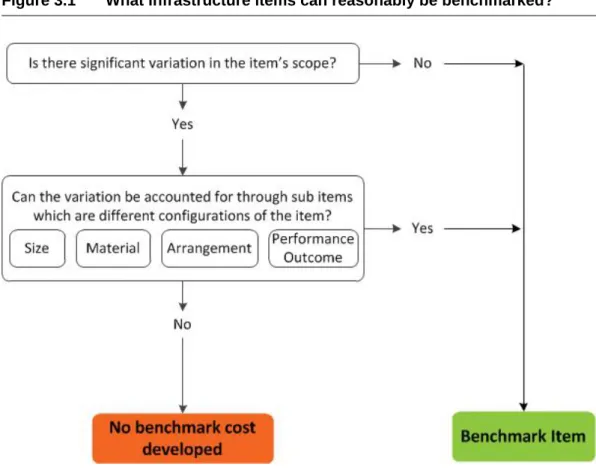
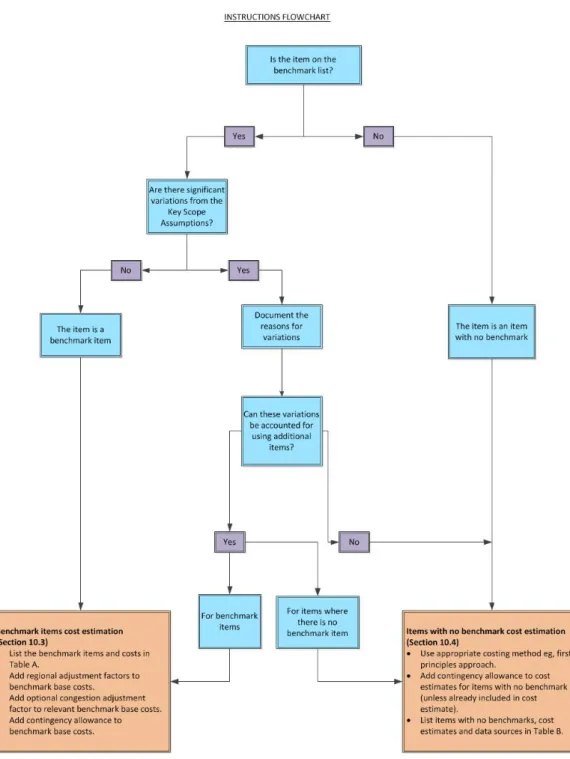
infrastructure type. The organisations we have consulted are listed in Appendix C. Our initial consultation with these groups was aimed at seeking views on what infrastructure items could be ‘standardised’ and where benchmarks might be useful. A range of views was expressed. We decided a consistent approach to determining standard items was required, and developed a decision tree outlining this process. The decision tree is shown in Figure 3.1.
Figure 3.1 What infrastructure items can reasonably be benchmarked?
Source: IPART based on unpublished advice from Evans & Peck.
There are many different ways to scope an infrastructure item, with resulting variations in cost. We examined the variation in the scope of each infrastructure item delivered by councils. If there was no significant variation in scope, we identified a ‘typical’ configuration for the infrastructure item and based the benchmark cost on this.
Where there was significant variation in the item’s scope, we investigated the use of sub items to account for this.
When the variation in the scope of an item was due to differences in size, materials, arrangement of the item, or the performance outcome expected, we tried to account for this through the use of sub items. Each sub item has its own ‘typical’ configuration, for which a benchmark cost was developed.
3 Development and application of benchmarks
Local Infrastructure Benchmark Costs IPART 19
One example of this is a sub-arterial road (Item 1.1 in Chapter 11), where the number of lanes will often vary. We therefore identified 2 different sub items to account for 3 or 4 lane sub-arterial roads.
When the variation in the scope of an item could not be accounted for through the use of sub items, a benchmark cost has not been developed yet. However, we invite further comment from stakeholders on our approach to these items.
3.1.1 What is the ‘typical’ configuration?
We determined what is considered to be the typical configuration for each infrastructure item. The minimum practically acceptable standard was used, except where we have strong evidence that a higher level is generally acceptable or expected. Turfing of soft surfaces provides an example of where we used a higher level. The most basic quality available may be hydroseeding, but more typically, rolled turf is being used. In this case, rolled turf could not be considered ‘gold-plating’ and so we have benchmarked this quality as well. This approach means that in general terms the benchmark represents the typical service and quality of the sector, but excludes an infrastructure scope which may constitute ‘gold plating’ by some councils.
Where more than one sub item has been provided for any one infrastructure item, the sub items represent different configurations of the infrastructure item, rather than different services or qualities. The sub items have been developed to enable councils to make a selection of what configuration is reasonable for their particular purpose and location.
3.1.2 What items did we not provide benchmark costs for?
We have not, to date, provided benchmark costs for the items listed in Box 3.1. We considered that the scope of these infrastructure items varies so greatly between projects, that potentially there may be no ‘typical’ configurations. Stormwater detention basins are in this list, and vary significantly in size and shape (due to catchment rainfall), in the cost of excavation (due to geotechnical conditions) and in outlet structures (due to downstream conditions).
We welcome submissions to the Draft Report on whether it would be useful to develop benchmark costs for these infrastructure items. If benchmark costs for any of the items in Box 3.1 would be useful, then please provide feedback on the following questions:
Could the variation in scope be captured by sub items?
What would the ‘typical’ configurations be for benchmarking purposes? Will the benchmark be able to be applied to many projects of this type within
3 Development and application of benchmarks
20 IPART Local Infrastructure Benchmark Costs
Box 3.1 Infrastructure items that have not been benchmarked to date Roads and traffic facilities
Demolition associated with road works
Road bridges (including over railways, waterways, grade separation) Pedestrian bridges/ cycleway bridges/ overpasses/ underpasses Intersection between state roads and local roads
On-going maintenance for the recurrent impact on mining related road infrastructure
Stormwater management works
Detention basins Constructed wetlands Revetment works
Ancillary (maintenance and access)
Open space embellishment
Waterproofing (in case of a park or civic space above a car park or other structure) Skatepark/ skate bowl
Applies to all categories
Decontamination and asbestos removal Relocation of utilities
Demolition and site clearance (except for open space or unless specifically included)
3.2
What cost estimation approach was used?
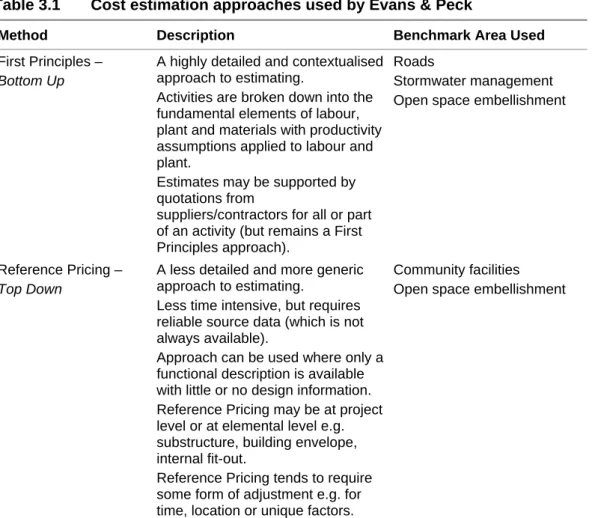
Evans & Peck provided us with the cost estimates for the benchmarks. Due to the different nature of the infrastructure types, Evans & Peck adopted either a ‘bottom up’ or ‘top down’ approach to estimating the costs for each type of infrastructure.
The ‘bottom up’ approach involves building up the estimate from its most basic cost elements. Using this approach, the cost of a road, for example, is built up by adding the costs of plant, labour, materials and allowances related to the infrastructure delivery, such as management and overheads.
3 Development and application of benchmarks
Local Infrastructure Benchmark Costs IPART 21
The ‘top down’ approach estimates the cost of an item of infrastructure by taking the known total cost of a similar item delivered at a specific place and time, and making relevant adjustments to take account of the different circumstances in which it is to be delivered. To estimate the cost of a library, for example, the cost of a similar library built for a nearby council a year ago would be adjusted to account for the differences in site conditions and cost escalations.
These cost estimation approaches are summarised in Table 3.1.
Table 3.1 Cost estimation approaches used by Evans & Peck
Method Description Benchmark Area Used
First Principles – Bottom Up
A highly detailed and contextualised approach to estimating.
Activities are broken down into the fundamental elements of labour, plant and materials with productivity assumptions applied to labour and plant.
Estimates may be supported by quotations from
suppliers/contractors for all or part of an activity (but remains a First Principles approach).
Roads
Stormwater management Open space embellishment
Reference Pricing – Top Down
A less detailed and more generic approach to estimating.
Less time intensive, but requires reliable source data (which is not always available).
Approach can be used where only a functional description is available with little or no design information. Reference Pricing may be at project level or at elemental level e.g. substructure, building envelope, internal fit-out.
Reference Pricing tends to require some form of adjustment e.g. for time, location or unique factors.
Community facilities Open space embellishment
Source: Unpublished advice to IPART from Evans & Peck.
The benchmark costs for local infrastructure items assume a commercially efficient delivery outcome. This means that benchmark costs reflect a delivery process that represents expected good practice in design, construction procurement and project management. It is intended to reflect a better outcome than what would be considered a reasonable or ‘mid-range’ outcome.
Further detail on how to use these cost estimation approaches for infrastructure which has not been benchmarked is provided in Chapter 5.
3 Development and application of benchmarks
22 IPART Local Infrastructure Benchmark Costs
3.3
How will the benchmarks be used by councils?
The benchmarks will be used by councils to develop a cost estimate for infrastructure delivery for use in a council’s local infrastructure plan.
Draft instructions on how to adopt the benchmarks for a cost estimate are set out in Part 2 of this report. We suggest the Department of Planning and Infrastructure prepare a guideline with input from IPART to assist councils in estimating efficient costs for local infrastructure when developing their local infrastructure plans.
The benchmark costs are intended for use as a guide only. We recommend the use of the benchmark costs to provide a council with a typical rate by which cost estimates for infrastructure delivery should be developed. This approach should establish greater consistency of cost estimates for infrastructure provision across NSW.
The benchmark costs will also be used by the Department of Planning and Infrastructure and IPART to guide reviews of local infrastructure plans prior to the approval of the plans by the Minister. Councils will have to provide justification where they have deviated from the benchmark costs.
There may be infrastructure items which councils consider necessary to deliver which we have been unable to benchmark. There is also likely to be some components of benchmarked infrastructure which are not covered by the benchmark, specifically the site preparation. In both of these cases, councils should develop cost estimates using the methodologies we recommend in Chapter 5.
Draft Recommendation
1 Councils should use the benchmark costs for items of local infrastructure set out in Chapter 11 in Part 2 of this report as a guide in developing cost estimates for the purposes of levying an uncapped contribution for the efficient cost of local infrastructure.
4 Components of the benchmarks
Local Infrastructure Benchmark Costs IPART 23
4 Components of the benchmarks
This chapter discusses the components of the benchmark and the assumptions made for the components.
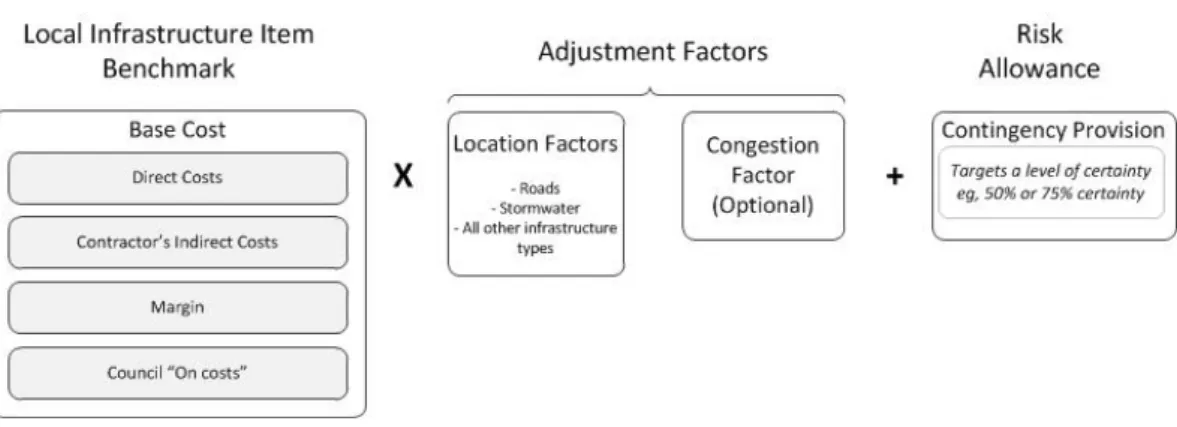
In calculating benchmarks, we broke down the cost of delivering each local infrastructure item into the following components:
base cost, consisting of the direct costs, contractor’s indirect costs, margin and council on-costs
adjustment factors, including a location factor and an optional congestion
factor
contingency allowance to account for risk events.
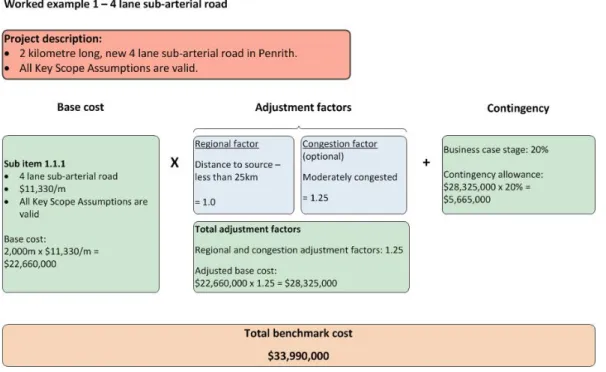
These components and their interaction are illustrated in Figure 4.1. A worked example is included in Part 2 of this Draft Report (section 10.5).
Figure 4.1 Benchmark item cost estimate
Data source: Based on Best Practice Cost Estimation Standard for Publicly Funded Road and Rail Construction, Australian Government Department of Infrastructure and Transport, May 2011.
The instructions on how to adopt the benchmarks for a cost estimate are in Part 2: Estimating costs of local infrastructure delivery.
4 Components of the benchmarks
24 IPART Local Infrastructure Benchmark Costs
4.1 Base
Costs
The base cost benchmarks are specified in the Benchmark Base Cost table on the datasheet for each infrastructure item. The datasheets are in Chapter 11.
The benchmark base cost for each infrastructure item in Chapter 11 is made up of direct costs, indirect costs, margin and client on-costs. Each of these cost types is explained in the following sections. The banding of the benchmark costs is also discussed.
4.1.1 Direct Costs
Direct costs are the costs of supplying and constructing the infrastructure and can be expressed as a specific metric, for example, $/m2 or $/m or $ each. The main drivers of direct costs are the infrastructure standards and market conditions for supplies and labour (usually by subcontractors).
The assumptions made about the scope of the infrastructure are detailed in the Key Scope Assumptions table on the datasheets. Councils should test that the assumptions are valid for the specific project before applying the benchmark.15
Infrastructure standards or guidelines assumed for scoping purposes are identified in the Standards table on each datasheet.
4.1.2 Contractor’s indirect costs and margin
Indirect costs are the costs incurred by contractors directly related to delivering the project, such as site office accommodation, management personnel and project insurances.
Margin costs include contractor’s overheads (non-project specific costs) and profit.
These costs are usually proportional to the size of the project, hence these costs are expressed as a percentage of the total direct costs.
4.1.3 Council on-costs
Council on-costs have been included in the base costs as a percentage of the direct costs, so councils do not need to add these to the base costs to estimate the cost of the infrastructure. The percentages assumed are specified in the Assumptions page in Chapter 11 for information only.
15 It may be necessary to add items to the benchmark value to account for variation from the
assumptions if the known scope of the project differs significantly from that upon which the benchmark is based.
4 Components of the benchmarks
Local Infrastructure Benchmark Costs IPART 25
Council on-costs may include: internal staff costs
professional fees (such as design and project management)
regulatory compliance costs (such as gaining environmental approval) levies and other government charges.
As these costs are usually proportional to the size of the project, these costs are expressed as a percentage of the total cost of the contractor, that is the direct, indirect and margin costs.
4.1.4 Benchmark Cost Banding
Quantity bands have been defined for some benchmark items where the unit rate cost is particularly sensitive to the quantity of work performed. This relationship between cost and quantity is commonly referred to as ‘economies of scale’.
The most significant factors influencing the use of quantity bands include:
Amortisation of site establishment costs. Site establishment refers to the
physical activities required to be undertaken before construction works begin and usually relate to site equipment mobilisation costs. Site establishment is a one-off cost and may be considered to be disproportionate when undertaking smaller quantities of work.
Minimum hire durations for plant. Plant is typically hired on a minimum
hire duration basis eg, 1 day, or 1 week. Therefore, activities that only require the hired plant for a portion of the minimum hire duration will have relatively higher plant costs.
Bargaining power through volume. Procuring materials and/or services in
larger quantities gives the buyer greater leverage for negotiating discounts. As a general rule, a maximum of 2 quantity bands have been identified for any single benchmark item. A quantity band has not been provided for very low quantities of work that would be deemed highly inefficient in terms of the unit cost rate.
4.2 Adjustment
Factors
We recommend the use of a regional factor and an optional congestion factor to account for a significant proportion of the variation in cost of infrastructure delivery across the state.
For the regional factor, we recommend using regional indices in the Australian Construction Handbook produced by Rawlinsons for some infrastructure types and specific indices for other infrastructure types to account for different
4 Components of the benchmarks
26 IPART Local Infrastructure Benchmark Costs
transportation costs, area specific supply prices and variations in market competition for labour and materials across the state.
For the optional congestion factor, we recommend using indices identified by Evans & Peck to account for costs due to different levels of congestion for roads and stormwater infrastructure.
The sections below explain why we have recommended each of the adjustment factors.
4.2.1 Different ways costs can vary across different regions or development settings
There are numerous issues that cause variation of costs in delivering the same item of infrastructure across different regions or development settings, including: geotechnical conditions, contamination and salinity issues
environmental sensitivity, especially of receiving waters topography and terrain factors
traffic and site accessibility constraints existing utilities and infrastructure
type of zoned development, density and congestion weather, rainfall and risk of flooding
accessibility to, and market price of labour and materials transportation and relocation costs.16
Not all geographical variations can be captured by an adjustment factor. We consider that it is not feasible to create a robust adjustment factor which covers all types of regional variation. To do so will lead to an overly complex methodology that would be administratively difficult to apply. It would also be inconsistent with the general nature of benchmark costs to assist councils in the preparation of their local infrastructure plans.
We recommend using the regional factor to account for different transportation costs, area-specific supply prices and variations in market competition for labour and materials where relevant.17 We consider that the other types of variations
are either addressed through a contingency allowance18 or, if the variations are
known and quantified, councils should use a relevant costing methodology identified in Chapter 5 to account for the variation from the benchmark value.
16 Roads and Traffic Authority, Project Estimating Guidelines, 31 March 2008, pp 44-45; IPART
correspondence and consultation with stakeholders.
17 Unpublished advice from Evans & Peck. 18 See section 4.3.
4 Components of the benchmarks
Local Infrastructure Benchmark Costs IPART 27 4.2.2 Regional factor
We recommend applying an adjustment factor to reflect the regional variation across NSW, but one that is different depending on the type of infrastructure:
For open space embellishment and community facilities we recommend
using the regional building cost indices from the Rawlinsons Australian Construction Handbook.
For roads and stormwater infrastructure we recommend using the indices in
Table 10.2 in Part 2 of this report. These indices are based on distance to the source of raw material.
For open space and community facilities
We recommend using the regional building cost indices because the main suppliers of materials are typically located in major centres and hence there are significant transportation, logistical, and storage costs for infrastructure delivery projects in regional areas.19 Also, there is likely to be less availability of
specialised skills in regional NSW compared with capital cities, which may be expected to result in higher labour costs.
We recommend indices based on Rawlinsons rather than other published data because we are advised that it is widely used and accepted in the construction industry and its indices are not significantly different to those in other published cost indices.20
Rawlinsons describes a significant variation in construction costs across NSW. The costs in Sydney are the basis for factors, and so councils in Sydney do not need to apply an adjustment factor. Construction costs in western NSW, for example, are typically 28% to 35% higher compared with the Sydney region due to their remote locations and small market size. In contrast, the index for Newcastle and Wollongong is 1% higher compared with Sydney due to their close proximity and market size.21
For roads and stormwater management infrastructure
For roads and stormwater management infrastructure, we recommend a different regional adjustment factor because this infrastructure is more affected by haulage costs of raw material from material sources across NSW.22 This is set
out in Table 10.2. As such, the variations in transportation and logistical costs in delivering roads infrastructure will be significantly different compared with delivering open space and community facilities. Rather than using specific
19 Unpublished advice from Evans & Peck. 20 Unpublished advice from Evans & Peck.
21 Rawlinsons Australian Construction Handbook, 2013, pp 22-23. 22 Unpublished advice from Evans & Peck.
4 Components of the benchmarks
28 IPART Local Infrastructure Benchmark Costs
locations, we have used distance thresholds from the raw material source to determine the relevant adjustment factor.
The indices range from 1.0 to 1.1 and apply to bands of between 25km and 75km and more than 75km from a material source.
4.2.3 Optional congestion factor
We also recommend an optional adjustment factor to reflect variations in congestion-related costs. This factor reflects that there will be greater costs when infrastructure is delivered in high density, congested areas.23
Works conducted in suburban business districts and heavily built up areas typically incur higher cost due to site difficulty constraints, including:
difficulty of access and site constraints
working around existing utilities and infrastructure increased night works
double handling of materials and spoil
additional safety barriers and temporary works, and increased traffic management.
This adjustment factor will only apply to roads and stormwater management facilities and it represents the upper limit of the additional congestion related costs (See Table 10.3).
Rather than provide prescriptive congestion factors to cover a wide variety of possible local infrastructure delivery situations, three bands of congestion level have been nominated, each with an upper percentage limit for additional costs that may arise due to works in a business district or heavily built up environment. In assessing what the appropriate bands and limits should be, situations such as the Sydney CBD have been excluded. It is considered more appropriate to treat Sydney CBD as a special case, and costs should be estimated using the methodologies we recommend in chapter 5.
The 3 proposed bands have been based on the following scenarios.
Band 1 – Lightly congested: Local infrastructure work on or adjacent to a suburban street, requiring minor and/or irregular traffic control and with only minor pedestrian movement.
Band 2 – Moderately congested: Local infrastructure work either:
– on a large contained development site bordered by a major thoroughfare and surrounded by medium and/or high density buildings; or
4 Components of the benchmarks
Local Infrastructure Benchmark Costs IPART 29
– on or adjacent to a main road or narrow suburban street requiring continuous traffic control and with moderate pedestrian movement.
Band 3 – Heavily congested: Local infrastructure work on or adjacent to a street within a suburban business district, with substantial and continuous traffic control and with significant pedestrian movement.
The congestion factor values in Table 10.3 are upper limit guides only. The additional costs incurred during local infrastructure work in congested areas are typically one off or time dependant costs that are not related to the quantity of work to be undertaken. Accordingly, the percentage increase over the benchmark costs is influenced by the number of infrastructure items being undertaken simultaneously in a single location. Where the additional costs are able to be spread over more than one infrastructure item, the increase in percentage terms would be expected to be lower than otherwise.
Draft Recommendations
2 Benchmark costs should be adjusted, if outside of the Sydney region, by a regional factor to account for variations in transportation costs, area specific prices and market competition for labour and materials, using:
– the index for the closest regional centre, in regional building cost indices from the Rawlinsons Australian Construction Handbook for open space embellishment and community facilities
– the distance thresholds from the source of raw materials, for roads and stormwater infrastructure, as reproduced in Table 10.2 in Part 2 of this report. 3 Councils can apply an optional adjustment factor for congestion-related costs, if
there is significant congestion at the infrastructure site, based on different levels of congestion for roads and stormwater infrastructure (Table 10.3 in of Part 2 of this report).
4.3 Contingency
allowance
Contingency allowances can be a significant element in costing infrastructure delivery and there is a diverse range of practices across NSW.24
Contingency allowances are to cover costs of risk events which have not been included in the base cost, because they have a less than 100% chance of occurring.25 The types of costs covered by contingency allowances can include
site contamination, encountering unexpected underground utility infrastructure, spikes in demand for labour or interruptions to supplies. Contingency allowances are not to cover a lack of planning or for an expansion of project scope.
24 IPART correspondence with Infrastructure New South Wales, 27 August 2013. 25 Unpublished advice from Evans & Peck.
4 Components of the benchmarks
30 IPART Local Infrastructure Benchmark Costs
The level of contingency applied to a project will depend on project phase, infrastructure type and the risk appetite of the organisation. Evans & Peck have recommended the contingency values in Table 10.4 and we are seeking feedback on these contingency values. We consider that these mid-point contingency allowances provided by Evans & Peck may over-estimate the impact of uncertainty when using the benchmark items.
We welcome submissions to the Draft Report on what is an appropriate level of contingency allowance to be applied when using the benchmark items.
4.3.1 Variation due to project phase
The appropriate contingency allowance will depend on the phase of the project delivery.
We have used NSW Treasury’s Gateway Review Toolkit to describe the different phases of project delivery. There are 6 gateways: from the strategic assessment at the start of a project, through tender evaluation to post implementation, as shown in Figure 4.2.
4 Components of the benchmarks
Local Infrastructure Benchmark Costs IPART 31
Figure 4.2 Procurement cycle and review gateways
Source: Procurepoint NSW, Gateway Review Toolkit 2006, p 3.
We are recommending appropriate contingency allowances for the first 2 gateways – strategic review and business case review. These planning phases are broadly consistent with the planning and preparation process for councils’ local infrastructure.26 The strategic review stage assesses whether the proposal
aligns with the council’s strategic plans and demonstrates best value to service the community needs. The business case review stage assesses whether options have been fully explored as well as the costs quantified.