A National Framework for
Continuing Competence Programs
for Registered Nurses
September 2000All rights reserved. No part of this book may be reproduced, stored in a retrieval system, or transcribed, in any form or by any means, electronic, mechanical, photocopying, recording, or otherwise, without written permission of the publisher.
© Canadian Nurses Association 50 Driveway
Ottawa ON K2P 1E2
Tel: (613) 237-2133 or 1-800-361-8404 Fax: (613) 237-3520
E-mail: [email protected] Web site: www.cna-nurses.ca
Table of Contents
Introduction... 1
Background ... 2
Key Elements for Developing a Continuing Competence Program... 4
Purpose and Goals of a Continuing Competence Program... 5
Competence Terminology ... 6
Definitions ... 6
Beliefs and Guiding Principles... 8
Continuing Competence ... 8
Continuing Competence Programs ... 8
Continuing Competence Program Components... 10
Standards / Code of Ethics / Competencies ... 10
Methods and Tools Selection... 11
Tool Box... 12
Considerations and Strategies for Development and Implementation ... 22
Quality Practice Environment... 22
Use of Language ... 22
Consultation and Communication ... 23
Monitoring Compliance... 23
Project Management Considerations ... 24
Legal/Ethical issues... 25
Evaluation ... 26
Summary... 28
Bibliography... 29
Introduction
The National Working Group on Continuing Competence for Registered Nurses (NWGCC), comprised of representatives from the Canadian Nurses Association (CNA), CNA’s jurisdictional members, the College of Nurses of Ontario (CNO) and L’Ordre des infirmières et infirmiers du Québec (OIIQ) has prepared A National Framework for Continuing Competence Programs for Registered Nurses. The purpose of the framework is to provide guidelines for a broad and flexible national approach for nursing regulatory bodies in developing continuing competence programs.
Participating Members of the NWGCC:
Patricia McGarr Yukon Registered Nurses Association Jo-Anne Hubert Northwest Territories Registered Nurses
Association
Sandra Regan Registered Nurses Association of British Columbia
Laurel Brunke Registered Nurses Association of British Columbia
Ruth Graham Alberta Association of Registered Nurses Joyce Butler Saskatchewan Registered Nurses’ Association Diane Wilson Maté Manitoba Association of Registered Nurses Jacqueline Choinière Registered Nurses Association of Ontario Bill Campbell (Chair) College of Nurses of Ontario
Debra Witmer College of Nurses of Ontario
Judith Leprohon Ordre des infirmières et infirmiers du Québec Gérène Gautreau Nurses Association of New
Brunswick/Association des infirmières et infirmiers du Nouveau-Brunswick
Jane Fahey-Walsh Registered Nurses’ Association of Nova Scotia Neala Gill Registered Nurses’ Association of Nova Scotia Joyce England Association of Nurses of Prince Edward Island Margaret (Pegi) Earle Association of Registered Nurses of
Newfoundland and Labrador
Linda Piazza Canadian Nurses Association Susan E. Hicks Canadian Nurses Association Joni Boyd Canadian Nurses Association
Background
Why are jurisdictions developing continuing competence programs for registered nurses?
Registered nurses practise in a variety of settings in clinical, administrative, education and research roles, often overlapping. The registered nurse’s practice environment is constantly changing in terms of resources, expectations, and evolving technologies. It is critical that registered nurses continue to develop knowledge and competence throughout their careers.
Professional and regulatory nursing organizations are accountable to the public to promote safe, ethical and competent care by registered nurses throughout their careers and to registered nurses to support them to continually acquire competence in their practice. Increasingly, the public demands assurance of continuing competence from all health professions. In an age of disappearing borders, continuing competence of health professionals is a global concern.
In some jurisdictions in Canada, regulated health professions are mandated by legislation to have a continuing competence program. Across Canada, jurisdictions are in various stages of developing continuing competence programs. However, similar approaches are evident in program development to date. Although a continuing competence program may include both promotion of individual continuing competence and assessment of individual competence, many jurisdictions are focusing on promoting continuing competence and quality practice. In most jurisdictions, there is no link between continuing competence programs and discipline processes.
Why is a national coordinated approach important?
Every province and territory has specific regulatory issues and approaches. However, regulatory bodies for registered nurses in Canada have developed a Mutual Recognition Agreement (MRA)1 that sets out commonly held national registration/licensure principles to facilitate mobility of registered nurses. Regulatory bodies have agreed that there is a high degree of commonality in scope of practice, entry level competencies, and initial registration requirements for registered nurses in Canada. One of the conditions for granting registration in another Canadian jurisdiction is that the applicant has met the continuing competence requirements imposed by the jurisdiction in which the nurse is registered/licensed or most recently registered to practice.
1. Mutual recognition: The acceptance by appropriate authorities in two jurisdictions that the qualifications of their workers in a given occupation conform to one another's occupational standard without requiring the worker to undergo any additional assessment or training. (Canadian Nurses Registration/Licensure Endorsement Document Abridged version, June 1998).
A National Framework for Continuing Competence Programs for Registered Nurses
Thus, a national coordinated framework for developing continuing competence programs is important to promote safe, ethical and competent care by registered nurses across the country and, in the spirit of the MRA, to facilitate mobility of registered nurses across provincial/territorial borders.
Key Elements for Developing a Continuing Competence Program
The following diagram illustrates the key elements within a flexible framework for jurisdictions developing and implementing continuing competence programs.Purpose and Goals Competence Terminology Beliefs and Guiding Principles
Continuing Competence Program Components Standards, Code of Ethics and Competencies
Methods/Tools Selection
Considerations and Strategies for Development and Implementation
Quality Practice Environment Use of Language
Consultation and Communication Monitoring Compliance Project Management Considerations
Legal/Ethical Issues Evaluation
The National Working Group on Continuing Competence for Registered Nurses has reached consensus on these elements as they are presented in this paper.
Purpose and Goals of a Continuing Competence Program
What are the purpose and goals of a continuing competence program?
A continuing competence program is designed to promote ongoing safe, ethical and competent practice by registered nurses, and to ensure that registered nurses have the opportunity to pursue and achieve professional growth throughout their careers. This in turn contributes to public protection.
The goals of a continuing competence program are the following: 1. To provide safe practice as per the code of ethics and the standards
of practice2 for registered nurses established by provinces and territories;
2. To facilitate practice development for registered nurses where areas for improvement exist or potentially exist;
3. To support registered nurses in their professional commitment to lifelong learning and excellence;
4. To support quality care by registered nurses for Canadians; 5. To increase the public's confidence in the nursing3 profession.
2. Note that in Quebec, the standards of practice for registered nurses take the form of descriptive statements that define the nature of nursing practice and essential criteria that refer to public protection (OIIQ, 1996). This concept is included in all references to standards of practice for registered nurses in this document.
3. For the purposes of this paper “nursing” refers to the practice of registered nurses.
Competence Terminology
Why is it important to achieve consensus on competence terminology?
Common definitions of competence and related terminology among jurisdictions across Canada promote a better understanding about the concept of continuing competence programs with the public, registered nurses and other key stakeholders.
The literature shows that competence can be described in a variety of ways and further articulates the difficult task of trying to define these terms (Smadu, 1997). Therefore, the definitions in this framework are based on important key concepts. These include:
§ Competence relates to adequacy in a role.
§ Competence is influenced by the practice setting and context of the environment.
§ Competence is comprised of many attributes and incorporates more than what is visible in a practitioner’s actions or performance (e.g. attitudes, values, beliefs, knowledge, skills, judgments, capabilities).
§ Competence is an integration of the various attributes. None of the key attributes can stand alone in defining competence.
The terms used in this paper are based on the following definitions.
Definitions
CompetenceThe ability of a registered nurse to integrate and apply the knowledge, skills, judgment, and personal attributes4 required to practise safely and ethically in a designated role and setting.
Competencies
The specific knowledge, skills, judgment and personal attributes required for a registered nurse to practise safely and ethically in a designated role and setting.
Continuing Competence
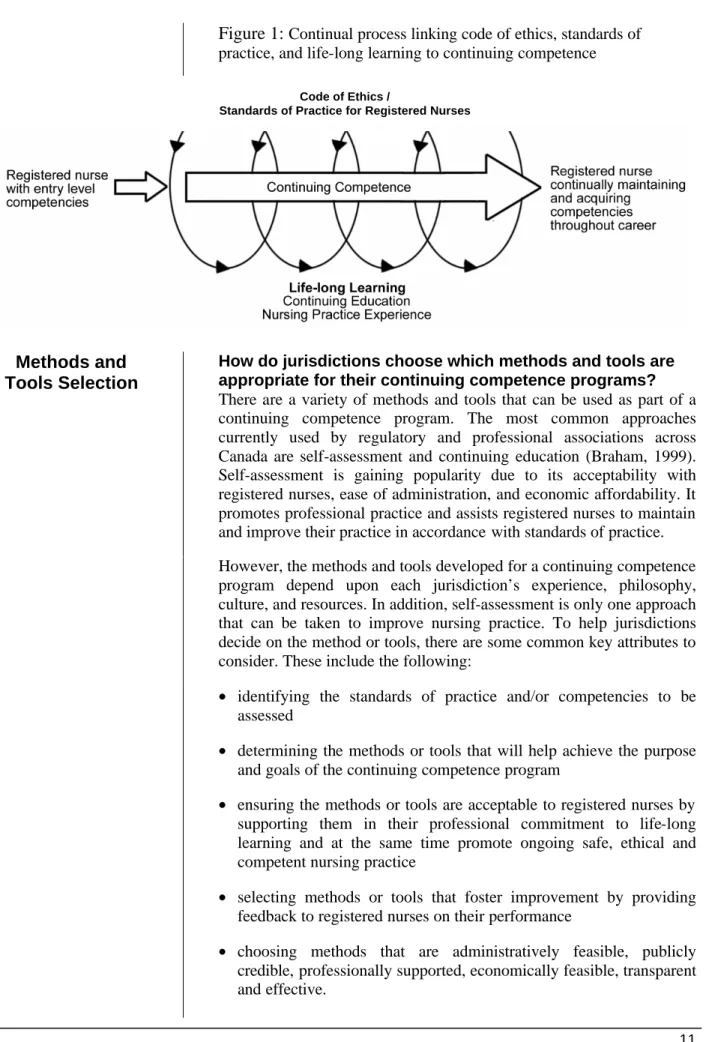
The ongoing ability of a registered nurse to integrate and apply the knowledge, skills, judgment and personal attributes required to practise safely and ethically in a designated role and setting. Maintaining this ongoing ability involves a continual process linking the code of ethics, standards of practice and life-long learning. The registered nurse reflects on his/her practice on an ongoing basis and takes action to continually improve that practice.
Continuing Competence Program
A program that focuses on promoting the maintenance and acquirement of the competence of registered nurses throughout their careers.
4. Personal attributes include, but are not limited to, attitudes, values, and beliefs.
A National Framework for Continuing Competence Programs for Registered Nurses
Competence Assessment
An external evaluation of the registered nurse’s ability to integrate and apply the knowledge, skills, judgment and personal attributes required to practise safely and ethically in a designated role and setting.
Beliefs and Guiding Principles
In order to achieve the purpose and goals, continuing competence programs are built on a solid foundation of beliefs and guiding principles. The beliefs and guiding principles underlie the concept of continuing competence itself and the development of continuing competence programs.
Continuing
Competence
1. The nursing profession as a whole, through its professional and self-regulatory organizations, promotes the advancement of nursing practice, identifies standards of practice, and promotes professional development.
2. Registered nurses are competent, self-regulating professionals and are committed to life-long learning.
3. Continuing competence is essential to professional nursing practice. It promotes good nursing practice, assists in preventing poor practice, and contributes to the quality of nursing practice and best possible client outcomes.
4. Competence is continually maintained and acquired through reflective practice, life-long learning, and integration of learning into nursing practice.
5. The individual registered nurse has a professional obligation and the primary responsibility for maintaining and continually acquiring competence.
6. Maintaining and continually acquiring competence requires support from others, including colleagues, employers, professional and regulatory nursing organizations, and government.
7. An individual’s ability to continually maintain, acquire, or demonstrate competence is influenced by the practice setting. Continuing competence can be facilitated or hindered by the environment in which individuals practise.
8. Nursing colleagues, through their moral commitment to their profession and to one another, support each other in demonstrating, developing, and maintaining competence.
Continuing
Competence
Programs
1. The public has the right to expect that registered nurses demonstrate continuing competence throughout their careers. The role of regulatory bodies is to establish mechanisms that promote the delivery of safe, ethical, and competent care by registered nurses throughout their careers.
2. Continuing competence programs should be developed in a manner to facilitate mobility of registered nurses in Canada.
A National Framework for Continuing Competence Programs for Registered Nurses
3. A continuing competence program is assumed to be an essential support to registered nurses in their professional practice whether or not it is required by legislation.
4. Provincial and territorial code of ethics and standards of practice for registered nurses provide the foundation for continuing competence programs.
5. Continuing competence programs should be: - administratively feasible
- publicly credible
- professionally supported - economically feasible - transparent
- effective (have benefits that are apparent).
(Adapted from the National Council of State Boards of Nursing Inc., 1997.)
6. A continuing competence program must be flexible, applicable to practice in a variety of settings, provide members with a choice of options for demonstration of continuing competence, and be clearly communicated to all stakeholders.
7. The confidentiality of information gathered for continuing competence purposes should be safeguarded to the extent possible within the legislative mandate of the jurisdiction.
Continuing Competence Program Components
Standards /
Code of Ethics /
Competencies
One of the characteristics of a self-regulating profession is the development of standards of practice, based on the values of the profession. The values of the profession are articulated in The Code of Ethics for Registered Nurses (CNA, 1997). Jurisdictions have the legal requirement to set standards of practice for registered nurses to protect the public in their province or territory. The code of ethics and standards of each jurisdiction provide the basis for the practice of nursing for registered nurses in Canada.
Standards of practice for registered nurses provide guidelines to determine what is acceptable practice and can be used to measure the quality of nursing care a client receives. The standards are applicable to nurses in all dimensions of practice – direct care, research, administration, and education.
Standards of practice support registered nurses by outlining practice expectations of the profession, and informing the public and others about what they can expect of registered nurses. Standards are used as a legal reference for reasonable and prudent practice. The code of ethics and standards of each jurisdiction, therefore, form the basis for development of a continuing competence program. They are the framework registered nurses use to reflect on their practice in order to ensure that they are maintaining competence throughout their nursing careers.
Jurisdictions may wish to further refine expectations for specific roles or settings through the development of competencies. The term competence is generally used to refer to the overall practice of the registered nurse. Competencies are the elements that make up overall competence and are the specific components of practice in a role or setting. They are more specific than standards of practice but are not simply a list of skills or tasks. For example, all jurisdictions have defined, or are in the process of defining, initial competencies for the registered nurse beginning to practise.
Where do the code of ethics, nursing practice standards and competencies fit in relation to continuing competence? Entry level competencies attained through approved educational programs provide the base upon which registered nurses build nursing practice experience. Registered nurses reflect on practice experiences, seek advice, and gain insight while meeting the challenges to respond to human needs. When confronted with new situations, registered nurses assess their learning needs and fill knowledge gaps through consultation with colleagues and peers, current literature, and education. Each experience adds a new dimension to a registered nurse’s practice and the opportunities to grow (see figure 1). The arrow and spiral in the diagram below represent a continual cycle over the course of a nurse’s career.
A National Framework for Continuing Competence Programs for Registered Nurses
Figure 1:
Continual process linking code of ethics, standards ofpractice, and life-long learning to continuing competence Code of Ethics /
Standards of Practice for Registered Nurses
Methods and
Tools Selection
How do jurisdictions choose which methods and tools are appropriate for their continuing competence programs? There are a variety of methods and tools that can be used as part of a continuing competence program. The most common approaches currently used by regulatory and professional associations across Canada are self-assessment and continuing education (Braham, 1999). Self-assessment is gaining popularity due to its acceptability with registered nurses, ease of administration, and economic affordability. It promotes professional practice and assists registered nurses to maintain and improve their practice in accordance with standards of practice. However, the methods and tools developed for a continuing competence program depend upon each jurisdiction’s experience, philosophy, culture, and resources. In addition, self-assessment is only one approach that can be taken to improve nursing practice. To help jurisdictions decide on the method or tools, there are some common key attributes to consider. These include the following:
• identifying the standards of practice and/or competencies to be assessed
• determining the methods or tools that will help achieve the purpose and goals of the continuing competence program
• ensuring the methods or tools are acceptable to registered nurses by supporting them in their professional commitment to life-long learning and at the same time promote ongoing safe, ethical and competent nursing practice
• selecting methods or tools that foster improvement by providing feedback to registered nurses on their performance
• choosing methods that are administratively feasible, publicly credible, professionally supported, economically feasible, transparent and effective.
Continuing Competence Program Components
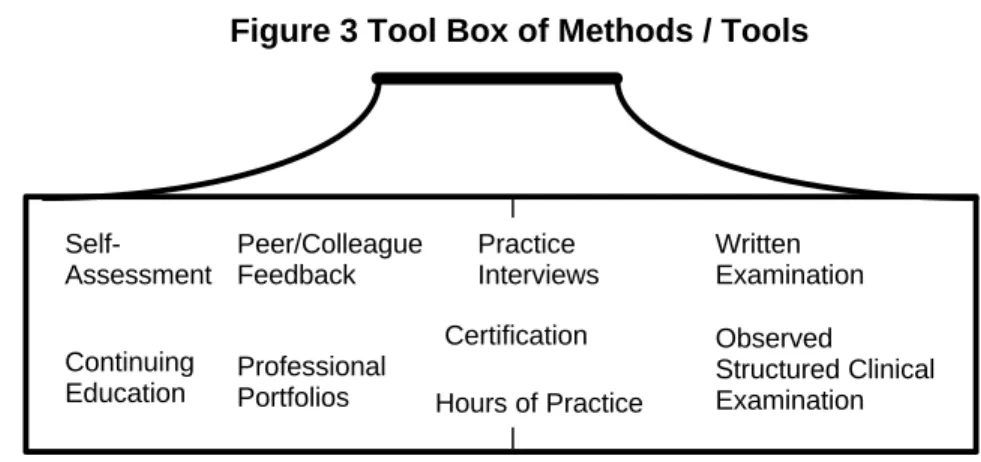
What methods and tools are currently used in Canada? What follows is a tool box of nine methods/tools that are currently being used by nursing and other regulatory bodies across Canada. Some regulatory bodies use a variety of methods or tools for the purpose of promoting professional growth. For the most part, these approaches are least intrusive for the registered nurse. In contrast, some regulatory bodies use methods or tools for the purpose of assessing competence. These approaches tend to be more intrusive for the registered nurse. The methods or tools developed by the individual regulatory body depend upon the desired outcomes. As such, regulatory bodies may select one or a combination of methods or tools as part of their program (see figure 3).
Figure 3 Tool Box of Methods / Tools
This is not an exhaustive list of potential methods or tools; rather, they represent those that are considered a reasonable approach for nursing regulatory bodies in Canada. Generally speaking, the tools in the left side of the box are used for promoting continuing competence and those in the right for competence assessment. Some tools, however, may be used for both promotion of continuing competence and competence assessment. Each method/tool includes a brief description, advantages, limitations, and regulatory considerations when developing a continuing competence program.
Tool Box
1. Self-AssessmentDescription
Self-assessment has been described as a form of learning in which individual learners take the initiative and the responsibility to assess their own educational needs, set goals and objectives, plan and identify appropriate educational activities, implement those activities, and evaluate the outcomes (Swankin, 1995). Therefore, registered nurses can use self-assessment to reflect on their practice, taking into account client outcomes, and assess their individual learning needs in relation to the standards of practice.
Continuing Competence Competence Assessment
Self-Assessment Continuing Education Peer/Colleague Feedback Professional Portfolios Practice Interviews Written Examination s Observed Structured Clinical Examination Certification Hours of Practice
A National Framework for Continuing Competence Programs for Registered Nurses
Self-assessments may be done informally, such as when registered nurses self-assess on a daily basis in their interactions with the health care team and with clients. They may also be done formally with the use of a tool that helps registered nurses to identify strengths and learning opportunities.
Advantages
Self-assessments are economical and affordable for regulatory bodies to develop and implement. They are readily accessible and may be completed at the registered nurse’s own pace at home. In addition, they require the registered nurse to become actively involved in determining his or her learning needs, thereby promoting professional accountability. Furthermore, they allow registered nurses to consider their practice within the context of their own practice environment (Cummings, 1997; ASI, 1998).
Limitations
Some registered nurses view self-assessment as time-consuming. Another limitation is that registered nurses who lack insight into their behavior may not identify areas where development is required (Braham, 1999). The use of client outcomes in the self-assessment process may help in this regard. Regulatory and professional associations should provide appropriate communication and education to registered nurses to ensure that they fully understand the intent of the self-assessment and realize the benefits of full participation.
Regulatory Considerations
If self-assessment is selected as part of a continuing competence program, consider the following suggestions:
§ Determine whether self-assessment is voluntary or mandatory. § If mandatory, identify mechanisms to monitor compliance and
address non-compliant members.
§ Decide whether the self-assessment should be submitted to the regulatory body for review.
§ Identify mechanisms to evaluate the self-assessment tool, processes and content of learning.
§ Identify, if necessary, other regulatory mechanisms to overcome the limitation of the self-assessment tool, e.g., the limited ability of the registered nurse to assess his or her own performance.
2. Peer/Colleague Feedback
Description
Peer/colleague feedback is an umbrella term that encompasses a number of processes. These may include performance appraisals by peers, clients and/or co-workers; chart audits; clinical case reviews, in which nursing interventions are evaluated against client outcomes; and/or on-site observations by peers. Peer/colleague feedback may also include feedback on documentation submitted by the registered nurse to a peer panel (ASI, 1998). Among the health professions, peer/colleague feedback is based on the belief that practitioners need periodic feedback on how their performance compares with that of colleagues in order to improve the quality of their practice (Palmer, 1996).
Continuing Competence Program Components
Another approach to peer/colleague feedback is called group practice peer feedback (Ellis and Whittington, 1994). This form of peer feedback involves general practitioners from a number of practice settings getting together to share their experiences and discuss the quality of their care. Actual topics discussed can vary, depending on the particular interests and practice experience of group members. They can include discussion of statistics or study results, or simply discussion of individual cases in terms of the application of guidelines, standards of practice and policies, and client outcomes. The College of Midwives of Ontario has adopted this model of peer feedback. Each midwife participates in a minimum of six peer case reviews each year as part of the individual’s continuing competence requirements (Cummings, 1997).
Advantages
Peer/colleague feedback can be done in most practice settings. It provides the registered nurse with information and awareness about his or her practice in relation to the practice of colleagues. Peer/colleague feedback provides opportunities for registered nurses to provide positive feedback to colleagues. Ideally, peer feedback should be based on standards of practice (ASI, 1998) and take into account client outcomes whenever possible.
Limitations
Peer feedback should be approached from a perspective of continuous quality improvement; however, registered nurses sometimes see peer feedback in a negative way and associated with discipline. For some registered nurses in independent practice or one-of-a-kind roles, it may be difficult to access knowledgeable peers to participate in peer feedback. In addition, peer feedback may be limited by its subjective bias or prejudice that comes into play when a peer is assessing the work of a practitioner who is known personally (Wagner, 1996). When peers know each other, it is seen to be difficult to be critical or provide negative feedback, for fear of damaging a social relationship (Parsley and Corrigan, 1994).
Regulatory Considerations
If peer/colleague feedback is used as part of a continuing competence program, consider the following suggestions:
§ Identify how the peer/colleague feedback will be used. For example, feedback could be incorporated into a registered nurse's learning plan.
§ Determine if the regulatory body needs to see the peer/colleague feedback.
§ Develop a communication and education plan to inform registered nurses how to give and receive constructive feedback.
§ Educate employers about the peer feedback process for the regulatory body as distinguished from performance appraisals conducted by the employer.
§ Develop a peer/colleague feedback process that is self-directed, offers the registered nurse the choice of peers, and remains confidential between the peer and the registered nurse.
A National Framework for Continuing Competence Programs for Registered Nurses
3. Continuing Education
Description
Continuing education can be voluntary or mandatory as part of a continuing competence program. Mandatory continuing education has been defined as, requiring practitioners to obtain a minimum number of continuing education credits in a specific time period. Credits can be earned only by participating in activities approved for credit by the regulatory body or professional association (ASI, 1998).
Currently, there is debate in the literature over the connection between mandatory continuing education and continuing competence. In particular, Swankin (1995) observes that there is a lack of agreement in the literature as to whether mandatory continuing education provides a guarantee of continuing competence.
There is recognition, however, that voluntary continuing education is one of the ways for a registered nurse to learn in order to continually maintain and acquire competence (CNA, 1998). CNA believes that no initial program of study can provide all the knowledge and skills that registered nurses will need in their careers, and supports the voluntary involvement of registered nurses in continuing education programs, where the choice of activities is based on individual needs, learning styles and practice requirements.
Advantages
Participating in voluntary or mandatory continuing education is based on the premise that professionals know what they need to learn, participate fully in their education, and apply what they have learned to their practice (Braham, 1999). Requiring mandatory continuing education credits leaves the onus on the practitioner to demonstrate the number of continuing education credits he/she has obtained in a specified period of time.
Limitations
While there is no disagreement that participating in voluntary continuing education activities is an important part of overall continual improvement, there are a number of limitations to requiring mandatory continuing education to maintain competence. Inequities between registered nurses who live in large metropolitan areas and can easily access such courses, and those registered nurses who live and work in isolated settings are created. Even nurses living in metropolitan areas do not have equal access to continuing education programs. Shift work, for example, is a limiting factor wherever the nurse is located. In addition, registered nurses may choose programs that are unrelated to their practice or that will impact it in a limited way.
Regulatory Considerations
If continuing education is used as part of a continuing competence program, consider the following suggestions:
§ Include participation in continuing education on a voluntary as opposed to mandatory basis until further evidence is acquired.
Continuing Competence Program Components
§ Integrate voluntary participation with the self-assessment. In doing so, registered nurses would be encouraged to select continuing education methods to strengthen areas of weakness they have identified.
§ Develop strategies to identify alternative learning and education approaches to provide registered nurses in remote parts of the province or territory with equal opportunities for continuing education.
4. Professional Portfolios
Description
§ The professional portfolio or profile is a tool that helps registered nurses identify, collect, reflect upon, and, most importantly, value their experiences, learning, and accomplishments. It helps them gain greater understanding of how they are developing as a professional and provides them with a system for identifying goals for future learning development. The purpose is to demonstrate that the registered nurse is taking action to maintain and develop professional knowledge and competence. The portfolio may include a summary of education and employment; a record of professional development; a self-assessment and plan to meet identified needs (ASI, 1998).
Advantages
The portfolio or profile is self-directed and can help registered nurses to realize the extent of their learning and abilities; develop short- and long-term goals; identify learning needs; keep a record of learning activities; and develop reflection skills. The portfolio or profile also provides the registered nurse with a permanent record of his or her career (CNO, 1996).
Limitations
Some registered nurses view portfolios or profiles as time-consuming. In addition, they are limited by the ability of the registered nurse to assess his or her own performance. Some registered nurses may not be able to accurately assess their strengths and weakness and to identify appropriate learning plans (ASI, 1998).
Regulatory Considerations
If professional portfolios or profiles are used in a continuing competence program, consider the following suggestions:
§ Determine whether the portfolio/profile is voluntary or mandatory. § Identify mechanisms to monitor compliance and address
non-compliance if mandatory.
§ Target the use of the portfolio/profile to nursing students and recent graduates of nursing programs.
§ Identify who should pay for the portfolio/profile, e.g., the regulatory body or the registered nurse.
§ Decide whether the portfolio/profile should be submitted to the regulatory body for review and who should submit, for example, all registered nurses or a random selection.
A National Framework for Continuing Competence Programs for Registered Nurses
5. Certification
Description
Certification is a voluntary program that allows a registered nurse to earn a credential in his/her area of specialty. In Canada, the Canadian Nurses Association (CNA) offers the certification credential as part of a national certification program. CNA now offers certification in 11 nursing specialties. Registered nurses must meet specific eligibility criteria in order to be admissible to write CNA’s annual exam. Once a registered nurse has earned the initial certification credential, maintaining certification is contingent upon maintaining licensure/ registration and meeting all re-certification eligibility criteria. These include current registration/licence in Canada; a set minimum of practice hours in the nursing specialty; a set minimum hours of continuous learning activities related to the nursing specialty; and a letter of endorsement/verification. CNA’s initial certification and re-certification credential are valid for five-year periods. The purpose of re-certification is to ensure that the nurse has continued to maintain his/her experience in the specialty area of nursing and has continued to expand his/her base of specialty nursing knowledge.
Certification programs are also offered by a variety of groups at local or regional levels in Canada. In addition, registered nurses may choose certification programs offered in other countries such as the United States. Eligibility criteria for initial certification and re-certification vary according to the program.
Advantages
Specialty certification programs are voluntary and allow the registered nurse to build on the solid foundation of his/her entry level competencies in a specialty area of choice. Registered nurses involved in a certification program are usually highly motivated with a commitment to continually maintaining and acquiring competence in order to achieve the best possible client outcomes. Eligibility criteria may be similar to continuing competence requirements at the provincial/territorial level.
CNA certification gives national scope to the principle of continuing competence encouraged at the provincial/territorial level. In addition, many university nursing programs have confirmed that they will recognize CNA certification in certain specialties for university credit.
Limitations
Although the certification process is a win-win situation for registered nurses, clients and employers, registered nurses may see the process as costly, time-consuming and undervalued by employers. The CNA Certification Program created an Employer Recognition Award to use as a mechanism to honor those employers that have demonstrated exemplary support of the certification process in nursing specialties. Nursing organizations may want to take measures to actively encourage employer recognition of specialty certification in their jurisdictions.
Continuing Competence Program Components
Regulatory Considerations
If certification is used as part of a continuing competence program, consider the following suggestions:
§ Determine the criteria necessary for a certification program to be recognized as fulfilling continuing competence requirements in the jurisdiction.
§ Explore confidentiality/privacy implications around documentation necessary for certification. For example, in order to prove eligibility for certification, a registered nurse may have to submit documents to the certifying organization and write an exam. Are these documents protected to the extent that continuing competence program participation documents are protected in the specific jurisdiction?
6. Written Examinations
Description
Examinations are popular as one component of assessing competence in the health professions. They are used at the entry level of the profession and also to assess the competencies of registered nurses in ongoing practice. The CNA Certification Program uses multiple-choice written examinations for registered nurses who qualify through experience and standards of practice development to become certified in a specialty area. Written examinations have well-established psychometric properties and are cost-effective (ASI, 1998). In Canada, there are eligibility criteria to qualify to write registered nursing exams at entry and certification levels.
Advantages
Written examinations can be used to assess a large number of registered nurses in a cost-effective manner. In addition, diagnostic feedback can easily be provided and the examinations are well suited to assessing knowledge and its application (ASI, 1998).
Limitations
Some registered nurses are skeptical about how well the multiple- choice written examination assesses their true level of competence. This is based on the belief that one needs to observe the registered nurse in actual practice to effectively assess a registered nurse’s overall competence. It is also debatable whether the written examination has the ability to assess other aspects of competence such as communication (ASI, 1998).
Regulatory Considerations
If written examinations are used as part of a continuing competence program, consider the following suggestions:
§ Determine who should be assessed, for example, all registered nurses or a sample selection, and how often.
§ Investigate using computerized technology to administer and/or mark the examinations.
§ Develop the competencies for the examination and the infrastructure for implementation and maintenance.
§ Explore alternative providers for the examination, for example using CNA’s Certification Program to assess competence of registered nurses in certain specialties.
A National Framework for Continuing Competence Programs for Registered Nurses
7. Practice Interviews
Description
In a structured interview, a pre-established set of questions and/or scenarios is presented to the registered nurse in a face-to-face meeting with an interviewer. This could be a meeting with a nursing practice consultant. The interview lasts about one to one and a half hours. The questions and/or scenarios can be developed using the standards of practice and/or the competencies to assess an individual’s ability to meet the standards (ASI, 1998).
Advantages
This type of competence assessment approach provides an opportunity to gain a deeper understanding of the registered nurse’s situation, constraints and context of practice. Having a structured interview provides a consistent approach for all registered nurses experiencing the same interview process. It can also be easily adapted to allow for less structure and further probing where the registered nurse’s knowledge appears to be weak. It may be easier to pinpoint a practice issue with a registered nurse in relation to meeting the standards of practice. In addition, the interview can be conducted in a variety of ways including over the phone, at a central office, or in health care or educational facilities to minimize cost (ASI, 1998).
Limitations
This approach limits the number of registered nurses that can be interviewed in one day. It could be viewed as costly in terms of the human resources and the time required to conduct the interviews. Inter-rater reliability can be a problem. As well, interviews are often stressful for the registered nurse.
This type of interview is associated more with competence assessment than with promoting continuing competence, and if it is linked to discipline or professional conduct review processes, could lead to conflicts of interest for organizational staff.
Regulatory Considerations
If practice interviews are used as part of a continuing competence program, consider the following suggestions:
§ Use this method for registered nurses who have not met acceptable standards of practice through previously identified mechanisms. § Identify the training and education needs of the assessor.
§ Determine how this approach could utilize existing resources. For example, if nursing practice advisers currently provide one-to-one nursing practice support, perhaps existing staff could provide this service.
§ Assess the training and education needs in terms of interviewing skills and standards of practice interpretation if individuals from outside the regulatory/professional body provide this service. § Explore a train-the-trainer approach whereby registered nurses
representing various regions across the jurisdiction become peer/colleague assessors.
Continuing Competence Program Components
§ Determine the location of the interviews, e.g., at the main office or off-site.
§ Develop an interviewing tool/guide to be used for the assessment. 8. Observed Structured Clinical Examination (OSCE)
Description
Observed structured clinical examinations (OSCE) differ from practice interviews or written examinations in that registered nurses actually demonstrate various clinical skills as they rotate through a series of stations. An examiner evaluates the candidate’s performance based on a pre-established set of criteria. Each station usually tests one or more specific components of clinical competence such as taking a history, conducting a physical examination, ordering diagnostic tests, making a diagnosis, planning treatment, or communicating with patients. These stations are set up like health offices, consulting rooms, or other clinical areas in a predetermined order, thus forming a circuit for the exam (CNO, 1998).
Advantages
The OSCE is objective as the examiners use a standardized checklist of expected clinical behaviors for evaluating candidates. It is structured, or planned, so that every candidate sees the same problems and is asked to perform the same tasks. And it is considered to be clinical because the tasks are representative of those faced in real clinical situations (CNO, 1998).
Limitations
The administration of an OSCE is complex and expensive. Standardized clients are required so they perform their roles in the same manner. There is limited opportunity to re-use an OSCE, as candidates will share with others the content of their examinations. Achieving reliability requires about 15 to 20 stations; therefore it may be difficult to fully assess all of the competencies. Additionally, it is possible to provide diagnostic feedback on only a limited number of dimensions of practice (ASI, 1998).
Regulatory Considerations
If OSCEs are used as part of a continuing competence program, consider the following suggestions:
§ Determine who should be assessed, for example, all registered nurses or a sample selection, and how often.
§ Identify the standards and competencies to be evaluated.
§ Explore using external facilities to host the examination, for example, hospitals and/or colleges or universities.
9. Hours of Practice
Description
Hours of practice is a continuing competence requirement by which the registered nurse must practise a prescribed number of hours within a specific time period in order to be eligible for registration renewal. For
A National Framework for Continuing Competence Programs for Registered Nurses
example, some jurisdictions require a registered nurse to practice 1,125 hours in the five years immediately prior to the registration year for which they are seeking renewal. This requirement is based on the assumption that recent practice suggests competence, while a protracted length of time with no nursing practice may indicate a need to update competencies. Hours of practice are self-reported on the registration renewal form. Some jurisdictions require that the reported hours be verified by the employer(s) while some may conduct random audits to verify reported hours. Some jurisdictions may allow approved hours of education, volunteer work, and other experiences as components of the required hours.
Advantages
Hours of practice is an economical strategy for jurisdictions to implement since it can be integrated into the annual registration renewal process. Hours of practice information is relatively easy for the regulatory body to track. Reporting is straightforward and places few demands on the individual registered nurse.
Limitations
The identified number of practice hours, below which a nurse is considered ineligible for registration, is an arbitrary standard not supported by research evidence. Registered nurses may have difficulty meeting the hours of practice requirement during periods when employment opportunities are limited. Individuals may attempt to use hours that the jurisdiction does not consider to be registered nursing practice.
Regulatory Considerations
If hours of practice is selected as part of a continuing competence requirements, consider the following suggestions:
§ Establish clear criteria for the type of practice hours that can be claimed
§ Develop a process to verify that the number of hours is correct and the type and setting of nursing practice is appropriate.
Considerations and Strategies for Development and Implementation
As regulatory bodies for registered nurses across Canada develop their continuing competence programs, it is important to learn from each other’s successes. This section outlines common considerations and suggested strategies for program development.Quality Practice
Environment
What role does the practice environment play in a registered nurse’s ability to maintain and enhance competence?
The practice environment is key to continuing competence over a nurse’s career. Increasingly, this is becoming an issue of concern as nurses continue to bear the burden of health system restructuring cutbacks. In the interest of achieving the best possible client outcomes, employers have a responsibility to create practice environments with strong organizational attributes that support registered nurses in continually maintaining and acquiring competence.
The registered nurse should work in partnership with the employer to identify, cultivate and maintain attributes in the workplace, such as opportunities to participate in continuing education, that support professional practice (Villeneuve et al, 1995).
The focus on continuing competence creates opportunities to highlight the importance of quality practice environments. Some jurisdictions are formally linking continuing competence programs to achieving quality practice environments. One way to do this is through voluntary programs offering consultation services to employer organizations. Other jurisdictions, in carrying out their legal mandate, may include the assessment of targeted practice environments and make recommendations for systems improvement. Many individual health care organizations are interested in creating quality practice environments as part of recruitment and retention efforts.
Use of Language
Why is careful use of language so important to jurisdictions developing continuing competence programs?Words are often value laden and mean different things to different people. In developing and implementing a continuing competence program, consideration of language used is important. Developing a common language facilitates understanding not only on a jurisdictional level, but also by members and stakeholders outside of nursing. Using value-laden words interchangeably, for example, continuing competence and competence assessment, may provide impediments to developing both a national strategy and jurisdictional programs. The phrase language is everything is of particular significance when working on the language of continuing competence. Defining terms of common usage decreases potential barriers with members, between jurisdictions and between professions. This framework has identified terms and definitions that will provide a foundation for jurisdictional development of continuing competence programs.
A National Framework for Continuing Competence Programs for Registered Nurses
Consultation and
Communication
Who should be involved and informed as jurisdictions develop continuing competence programs?
In developing and implementing a continuing competence program effective consultation and communication is critical to success. Take careful consideration in identifying key stakeholders and appropriate approaches and mechanisms to share information about continuing competence. Examples of stakeholders include members within nursing associations, counterparts between nursing associations and regulatory bodies, other regulatory bodies, government, employers, nursing unions and the public. Strategies, such as developing a communication plan, are critical to the implementation of a continuing competence program. Information that needs to be communicated to specific groups includes: § Members: Inform and involve registered nurses each step of the
way in the development of the program. There is a need to communicate that continuing competence is a benefit to each registered nurse, an obligation as a professional, and one aspect of being accountable to the public.
§ Other nursing associations and regulatory bodies: Keep up-to-date to ensure issues are addressed as they arise and to learn from each other’s experiences.
§ Educators in registered nurse programs at universities and colleges. § Labour union representatives for registered nurses.
§ Associations and regulatory bodies outside of nursing: Continuing competence is a hot topic for all occupations and professions. Work that is being done by one regulatory body may assist others to develop their programs and avoid duplication of resources. For example, as this national framework unfolds, other organizations may find it useful.
§ Public: Accountability to the public and ensuring that members are participating in activities to maintain their competence is often the impetus for associations and regulatory bodies to develop a continuing competence program. Accountability to the public is often a reflection of organizational mandates. Organizations should consider how they could communicate with the public about their continuing competence program. For example, organizations may have public representation on their board of directors and thus have a mechanism for being accountable to the public.
Monitoring
Compliance
Many regulatory bodies nationally and internationally are moving towards mandatory participation in continuing competence programs and are linking continuing competence requirements with the registration of a member. This provides one means of monitoring compliance and ensuring that members are participating in activities to continually maintain and acquire competence. Another means, less frequent, is through competence assessment and is usually limited to an annual random sample of nurses or to a target group.
Considerations and Strategies for Development and Implementation
Linking continuing competence participation to registration renewal helps to assure the public, employers, and the regulatory body itself that registered nurses possess the necessary competencies to practise nursing in that licensing year. Compliance is usually self-reported by the registered nurse at registration renewal. This method is relatively inexpensive as the registration renewal process is usually well developed in a regulatory body. Non-compliance may result in conditional, suspended or revoked registration.
Some regulatory bodies monitor compliance with continuing competence requirements by linking to discipline processes. For example, members who do not comply with continuing competence requirements as self-reported at registration renewal may be referred to a discipline process. This method may be relatively expensive as discipline processes are labour intensive and often not well defined for this specific purpose.
Audit is another method for monitoring compliance. This method is often used in addition to self-reporting methods. The audit may occur in a random sample of members or specific target groups of members. The audit usually involves a more in-depth method of ensuring member compliance with continuing competence requirements such as a review of documentation, provision of information, or a more detailed examination of the member's practice. Again, this method may be relatively expensive and labour intensive to carry out.
Project
Management
Considerations
What are the critical planning points to consider?
Consider the following points when planning to develop and implement a continuing competence program:
Board/governing body discussions
Decisions regarding strategic directions for continuing competence programs will need to be addressed within each jurisdiction by the governing body.
Policy implications
Policies are required at the jurisdictional level to support legislation and regulation and to deal with areas not covered under regulation. Policy development is particularly important for those jurisdictions without a legislative mandate to implement a continuing competence program. The purpose for the continuing competence program provides direction for the policy work and guides the overall development and implementation of the program.
Time lines
Consider jurisdictional time lines and how these fit within the national strategy. Individual jurisdictions should consider the impact of time lines on resource allocation. Implementation will occur over several years when factors such as consultation, research and development, education, and evaluation are considered.
A National Framework for Continuing Competence Programs for Registered Nurses
Components
Provincial legislation is changing, reflecting the public expectation that regulatory bodies provide assurance that their members are participating in activities to maintain competence. Jurisdictions, in developing continuing competence programs, should ensure that the components of the program honour both legislative mandates and public expectations. Organizations should strive for a balanced approach to continuing competence that meets the needs of the regulatory body and is not prohibitive to members.
Traditional approaches, such as reporting of practice hours and mandatory continuing education, are being re-examined for their role in ensuring continuing competence. Increasing numbers of regulatory bodies are moving towards a combination of activities that require their members to reflect on their practice using specific criteria, dialogue with peers, and participate in continued learning activities. This allows a nurse to choose which method works best for his/her individual practice. Many regulatory bodies in Canada have integrated this model of self-assessment, feedback, and continued learning with hours of practice requirements.
Resources
The process for establishing a continuing competence program, including research, consultation, development, implementation, and evaluation requires considerable financial and human resources. Many jurisdictions may find the cost prohibitive.
Further discussion may need to focus on who should pay and how jurisdictions that have a continuing competence program can support those who are developing a program. Jurisdictions with legislative mandates may find that delegating resources and securing member and stakeholder acceptance is easier to accomplish than for those jurisdictions that do not have a legislative mandate.
A continuing competence program requires personnel to provide support for the consultation, implementation, and evaluation phases, as well as for maintenance of the ongoing program. This may impact other programs within the organization, as workload is re-assigned.
Legal/
Ethical issues
Issues related to confidentiality, legislative protection of documents/ records maintained by members, and ethical implications related to a continuing competence program should be explored prior to implementation.
What are the confidentiality issues?
Confidentiality
Defining the nature of the records or documents that are part of a continuing competence program is very important. Who will have access to the documents/records maintained by members? Associations? Who in the association? Employers? Others? How a jurisdiction defines information is also important in relation to confidentiality and has implications for record keeping by members.
Considerations and Strategies for Development and Implementation
Are documents maintained by members protected by law?
Legal protection of documents
In many provinces and territories, there is very little legislated protection of the records/documents maintained by members. In many jurisdictions these records may be subpoenaed in a court of law.
Several jurisdictions are addressing this issue. Collaboration with other health regulatory organizations is a powerful way to advocate for protection of members’ records/documents. Legislation has been enacted in some areas to protect members’ continuing competence records from civil litigation and from being shared with any other committee (for example, complaints or discipline).
Why is careful consideration of ethical issues so important in developing a continuing competence program?
Ethical issues
Clearly stated beliefs and principles should guide organizational decisions about how continuing competence programs are developed and implemented. Organizations have an ethical obligation to ensure that their programs' policies reflect these beliefs and principles.
Consider whether the intent of the program is to support professional development or a mechanism for identifying incompetent members or a combination of these? How will the purpose and goals of the continuing competence program be communicated to members? What provisions are in place within the organization to address ethical conflicts as they arise during the development and implementation of the continuing competence program?
Evaluation
Why is an evaluation plan so important in developing a
continuing competence program?
A lack of research evaluating the impact of continuing competence programs on participants raises concerns about how jurisdictions choose the components and requirements of their program, how they implement, and subsequently how they evaluate the program.
How does a jurisdiction know if the continuing competence program is meeting its goal? Every jurisdiction, let alone every country, reflects the unique characteristics of its nursing population and evaluation results from other sources may not be applicable. Evaluation research is important in order to contribute to the evidenced-based literature on continuing competence.
How is a continuing competence program evaluated?
There are several ways to evaluate a program and jurisdictions should tailor the evaluation to meet their specific needs. There are two approaches to consider when evaluating a continuing competence program.
A National Framework for Continuing Competence Programs for Registered Nurses
First, there is the formative evaluation that is intended primarily to provide information to planners and implementers on how to improve and refine a developing program (Herman, Morris, Fitz-Gibbon 1987). Formative evaluations address the questions of how the program can be improved and how the program can become more efficient or effective. They occur over the lifetime of the program (Cummings, 1997).
The second type of program evaluation is called summative evaluation. It occurs after, or towards the end, of program completion. Summative evaluations are intended to draw conclusions about a program's value and its accomplishments to decide whether to continue or discontinue a program (Herman et. al, 1987).
When should evaluation plans be developed?
As continuing competence programs are being developed, evaluation models should be selected that are flexible and seek to continually improve the programs based on lessons learned. Jurisdictions are encouraged to develop baseline data at the start of their continuing competence program. This data is used to compare the success and progress of the program over time. To do so requires developing the evaluation plans as early as possible.
The variety and breadth of jurisdictional continuing competence programs requires that a combination of evaluation methods and approaches be used. One approach that regulatory bodies may consider is the results based management (RBM) model. (Cummings, Lipski, Wasteneys, 1997.) RBM focuses on the following components:
§ defining the expected results of different program components and of the program as a whole (ensuring that management is clear about what success will look like)
§ identifying ways to measure progress towards achieving expected results
§ measuring actual results, and progress towards longer term results, and
§ using information to redirect implementation/operations, and to provide lessons for future decision-making.
Summary
In his book about the practice of registered nurses across Canada, André Picard describes registered nurses as, “ . . . team players who know their precise role; caring professionals who know their limits; highly intelligent women and men who learn, and teach, continually; nurses who care deeply for their patients, and carry unbelievable workloads so as not to shortchange them” (Picard, 2000.) As a profession with an excellent track record in self-regulation, the concept of continuing competence is not new for nursing. In today’s consumer-focused environment, all professional licensing bodies in all sectors around the world are expected to address the issue of competence throughout their members’ entire careers.
In Canada, regulatory bodies for registered nurses recognize the importance of implementing formal continuing competence programs that assure the public that members are participating in activities directed towards continually improving the quality of their practice. The registered nurse in Canada today practises in a continually changing environment that is often not conducive to professional growth. Regulatory bodies for registered nurses recognize that a quality practice environment is essential in supporting a registered nurse to participate fully in a continuing competence program. As continuing competence programs for registered nurses evolve, there will be opportunities to focus on employers as partners with registered nurses to ensure quality practice environments.
Although nursing jurisdictions are in different stages of developing continuing competence programs, regulatory bodies are working together to achieve a flexible national approach that will contribute to maintaining high standards of nursing practice across the country. The broad framework presented in this paper takes into account differing needs and legislation of each jurisdiction, while at the same time reflecting the common values and issues that underlie nursing in Canada today.
Bibliography
Alberta Association of Registered Nurses. (April 1998). Final report: Project leading to a model for the monitoring of continued competence. Edmonton, AB: F. Picherack & Associates.
Assessment Strategies Inc. (October 1998). A cost/benefit analysis of assessment methodologies for continuing competence. Prepared for the College of Nurses of Ontario. Ottawa, ON: ASI.
Benner, P. (1982). From novice to expert. American Journal of Nursing. 83(3); 402-407.
Braham, J. (February 1999).Continuing competence assessment for regulated and non-regulated professionals. Ottawa, ON: Assessment Strategies Inc.
Canadian Nurses Association. (April 1998). A national framework for the development of standards for the practice of nursing: A discussion paper for Canadian registered nurses. Ottawa, ON: Author. Canadian Nurses Association. (1998). CNA policy statement on educational support for competent
nursing practice. Ottawa, ON: Author.
Canadian Nurses Association. (June 1998). Canadian nurse registration/licensure endorsement document (Abridged Version). Ottawa, ON: Author.
Citizen Advocacy Center. (December 1997). Continuing professional competence: Can we assure it? Proceedings of a Citizen Advocacy Center Conference. Washington, DC: Author; p.16-17.
College of Nurses of Ontario. (1998). Growing quality in nursing: A guide to the quality assurance program. Toronto, ON: Author.
College of Nurses of Ontario. (November 1998). Objective structured clinical examination information and examples. Toronto, ON: Author.
Cummings, H. Lipski and Wasteneys, C.U. (July 1997). A framework for evaluating the quality assurance programs of the colleges of health professions in Ontario. Submitted to the Health Professions Regulatory Advisory Council. Toronto, ON: p.29.
Donaldson, M. S. and Lohr, K. N. (1990). A Quality Assurance Sampler: Methods, Data and Resources. Chapter 6 in Lohr, K. N. (Ed.). Medicare: A strategy for quality assurance, Volume II: Sources and methods. Institute of Medicine. Washington, D.C.: National Academy Press.
Ellis, R. and Whittington, D. (1994). Quality assurance in healthcare: A handbook. London, England: Edward Arnold.
Fish, D. (1991). But can you prove it? Quality assurance and the reflective practitioner. Assessment and Evaluation in Higher Education. 16(1):22-36.
Herman, J. L., Lyons, L., Morris, and Taylor Fitz-Gibbon, C. (1987). Evaluator's handbook. Newbury Park: Sage Publications.
Hodkinson, P. (1992). Alternative models of competence in vocational education and training. JFHE, 16(2):30-39.
Bibliography
Inions, Noela J. (1990). Privilege and quality assurance: The issues for Canadian hospitals. Ottawa: ON Canadian Hospital Association. p. 185-194.
Marsick, VJ. (1988). Learning in the workplace: The case for reflectivity and critical reflectivity. Adult Education Quarterly, 38(4):187-198.
National Council of State Boards of Nursing, Inc. (1991). N.C.S.B.N. Assuring competence: A regulatory responsibility. Conceptual framework for continued competence. Chicago, IL: Author. National Council of State Boards of Nursing, Inc. (1996). N.C.S.B.N. Assuring competence: A regulatory
perspective. Chicago, IL: Author.
National Council of State Boards of Nursing, Inc. (1997). N.C.S.B.N. Continued competence and the personal accountability profile (attachment A). Chicago, IL: Author.
National Council of State Boards of Nursing, Inc. (1998). N.C.S.B.N. Continued competency accountability profile (CCAP). Chicago, IL: Author.
Norris, N. (1991). The trouble with competence. Cambridge Journal of Education. 21(3):331-341.
Palmer, R. H. (1996). Quality Health Care. Journal of the American Medical Association. 275(23); p. 1851-1852.
Parsley, K. and Corrigan, P. (1994). Quality improvement in nursing and health care: A practical approach. New York, NY: Chapman and Hall.
Picard, André. (2000). Critical care: Canadian nurses speak for change. Toronto, ON: HarperCollins Publishers Ltd.
Registered Nurses Association of British Columbia. (1996). Continuing competence: A shared responsibility. Vancouver, BC: Author.
Registered Nurses Association of British Columbia. (November 1996). Beliefs about continuing competence. Vancouver, BC: Author.
Registered Nurses Association of British Columbia. (October 1998). Nurses (registered) act rules (Pub. No. 274). Vancouver, BC: Author.
Registered Nurses Association of British Columbia. (October 1998). Continuing competence program principles. Vancouver, BC: Author.
Registered Nurses’ Association of Nova Scotia. (August 1997). Continuing competence of registered nurses in Nova Scotia: Consultation summary and recommendations. Halifax, NS: Author.
Registered Nurses’ Association of Nova Scotia. (1997, February). Continuing competence of registered nurses in Nova Scotia: A consultation paper. Halifax, NS: Author.
Regulated Health Professions Act. (1991). Statutes of Ontario Ch.18. Queen’s Printer for Ontario. (June 30, 1999).
A National Framework for Continuing Competence Programs for Registered Nurses
Smadu, M.(1997). National Nursing Competency Project. Literature review: A framework for entry-level competencies in nursing. Ottawa, ON: Canadian Nurses Association.
Staff, Steinecke, Martin, Maciura. (January 1998). Legal pitfalls for quality assurance programs. Grey areas: A commentary on legal issues affecting professional regulation. p. 1-2.
Steinecke, R. (August 1996). A complete guide to the regulated health professions acts. Aurora, ON: Canada Law Book Inc.
Swankin, D. (1995). The role of licensing in assuring the continuing competence of health care professionals: A resource guide. Washington, DC: Citizen Advocacy Center.
Villeneuve, M.J., Semogas, D., Peereboom, E., Irvine, D., Mcgillis Hall, L., Walsh, S., O'Brien-Pallas, L., Baumann, A. (1995). The worklife concerns of Ontario nurses. Hamilton: Quality of Nursing Worklife Research Unit Working Paper Series 95-11.
Wagner, P. S. (1996). Quality management challenges in Canadian health care. Chapter 15 in Schmele, J. A. (Ed.) Quality management in nursing and health care. Albany, NY: Delmar.