Using the Flipped Model to Foster Thai Learners’ Second Language
Collocation Knowledge
TODSAPON SURANAKKHARIN
Department of English, Faculty of Humanities, Naresuan University, Thailand
ABSTRACT
In recent years, interest in flipped classrooms has gained popularity among numerous ELT scholars. This research, therefore, explored the effect of flipping a classroom on Thai learners’ English collocation knowledge, and compared this instructional design with traditional instruction. The study also examined the students’ attitudes towards the flipped model. The experimental research design comprised an experimental and a control group. The experimental group (N = 35) was exposed to the flipped instruction, in which learning contents were provided outside of class time through electronic means and class time was used for activities. In the control group, the students (N = 35) were taught by the traditional method, where lectures were mainly delivered during class and supplementary exercises were given outside of class time. Two types of collocations: lexical and grammatical were studied. Receptive and productive tests were developed to measure the impact of the two instructional methods on the students’ collocation competence. A questionnaire and an oral interview were also distributed to determine the experimental students’ perceptions towards the flipped model. The findings revealed that flipped instruction helped enhance the students’ collocation knowledge. Interestingly, in terms of the effects the results yielded no significant differences between the flipped and traditional approaches. Most flipped learners generally had a favourable perception of the flipped classroom. Taken together, the study offers insightful implications to the line of research on flipped classrooms in ELT contexts.
Keywords: English collocations; experimental ELT research; EFL learners; flipped classrooms; interactive activities
INTRODUCTION
In recent years, flipped classrooms have gained the attention of numerous second language (henceforth L2) researchers (e.g. Ahmed 2016, Chen Hsieh, Wu & Marek 2016, Jehma 2016, Mehring 2016, Unruh, Peters & Willis 2016). By definition, flipped classrooms refer to a means of instruction where students learn new contents through electronic resources during
out-of-class time (Bergmann & Sams 2012, Herreid & Schiller 2013, Jungić, Kaur,
Mulholland & Xin 2015). As pointed out by a number of scholars (e.g. Brinks Lockwood 2014, Hung 2015, 2017, Jehma 2016), flipped instruction is highly beneficial for L2 learners as class time can be used more efficiently and practically by engaging students in active learning activities while they gain support from the instructor and peers. The opportunities in the flipped classroom ultimately empower learners to grow and expand their target language potential. As reported by Zainuddin and Attaran (2016), the flipped classroom is more engaging than the traditional one. Such a view has also been supported by other researchers (e.g. Davies, Dean & Ball 2013).
comprehend ideas more accurately and fluently, but collocation competence is reported as a problematic learning area for Thai speakers (e.g. Kittigosin & Phoocharoensil 2015, Meechai & Chumworathayee 2015, Phoocharoensil 2013). Thus, the current study sets out to explore whether the flipped classroom helps to improve Thai students’ collocation competence and to compare whether this instructional design is significantly more efficient in teaching English collocations than traditional instruction. The present study also explores the attitudes of Thai students towards flipped instructional design.
RESEARCH QUESTIONS AND HYPOTHESES
As this study aims to measure the effect of the flipped classroom on Thai students’ collocation competence, the following questions and hypotheses are addressed:
1. Does the flipped model of instruction have a significant effect on the participants’
collocation learning outcomes?
Based on Research Question (henceforth RQ) 1, it is hypothesised that the post-test scores obtained from the flipped students are significantly higher than their pre-test scores.
2. Is there any difference in the participants’ collocation learning outcomes between the
flipped teaching method and traditional instruction?
Under this RQ, it is hypothesised that the post-test scores gathered from the flipped classroom differ significantly from those obtained from the traditional classroom.
3. What are the experimental students’ attitudes towards the flipped model of instruction?
LITERATURE REVIEW
In this section, the theoretical concept of the flipped model is explained. Then previous research on flipped instruction is discussed. Finally, a brief overview of English collocation research within the context of Thailand is provided.
THE FLIPPED CLASSROOM APPROACH
During the past few years, flipped classrooms have received considerable attention because of the available use of technology to record and deliver video lectures (Herreid & Schiller
2013, Jungic̍ et al. 2015). Since then, the flipped learning model, initially implemented in a
FIGURE 1. Comparison between traditional and flipped classrooms (adapted from Jungić et al. 2015)
In Figure 1, students taught in the classroom by the traditional method are mainly engaged in a lecture, whereas flipped classroom students are encouraged to listen to a lecture delivered through electronic means outside of class time. Homework activities designed for use with traditional instruction are assigned to be done outside of class time. Conversely, flipped class learners are encouraged to do interactive activities with their peers and teacher in the classroom, subsequently allowing the teacher to spend less time lecturing and more time to stimulate and support the learners.
As remarked by Jungić et al. (2015), there are two stages required for learners to
gain new knowledge. One stage is that students must gather information. The other is that they must assimilate knowledge. Traditional instruction focuses mainly on the first step requiring students to learn content provided by the instructor in class. At the same time, they are left to make sense of this learning content on their own after class. In order to acquire what they have learnt in class, students need to connect the new knowledge they have gained with prior knowledge and apply it to solving problems. In contrast, the two learning stages are inverted in flipped instruction. Simply put, the first stage which encourages students to gather information is done at home, while the assimilation stage is moved into the classroom where they are guided through a variety of learning activities. The goal of out-of-class preparation is to expose learners to new materials first, enabling them to develop critical fundamental knowledge prior to class.
Generally, the flipped classroom can be divided into two sessions: inside and outside
of class time. The first stage involving the role of teachers and students outside of class time
is explicitly described in Table 1, whereas the second stage taking place inside the class is illustrated in Table 2.
TABLE 1. What happens outside the classroom?
Teacher’s role Student’s role
-Assigning students to do e-reading and research tasks -Uploading short and engaging digital media (e.g. lecture videos, PowerPoint presentations, and podcasts)
-Creating online activities relevant to reading and the media such as Moodle quizzes, short answer questions, blog posts, mini assignments, journal entries, and pre-class reading assignments
-Designing worksheets, questionnaires, or mini projects that can prepare students for class debates, enable them to receive formative feedback during classes, or allow them to continue working on at a deeper level
-Watching videos that can be in the form of mini online lectures, and doing e-reading
-Engaging in self-paced activities such as Moodle quizzes -Preparing for tasks to take place in class
-Producing work for feedback in class -Preparing questions to be asked in class -Completing worksheet
-Working on minimal assignments
TABLE 2.What happens in the flipped class?
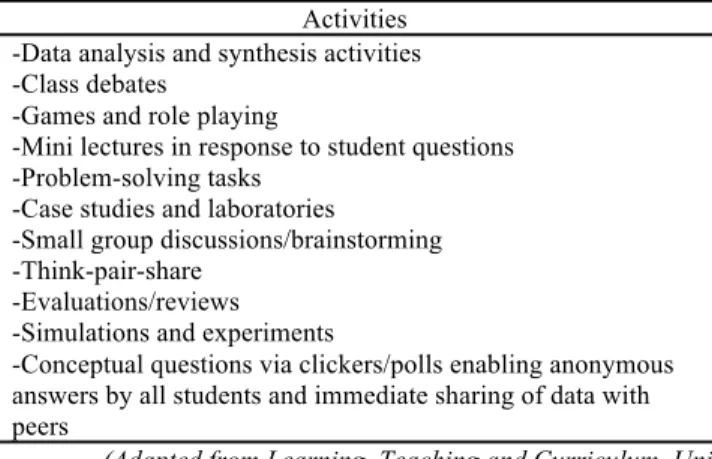
Activities -Data analysis and synthesis activities -Class debates
-Games and role playing
-Mini lectures in response to student questions -Problem-solving tasks
-Case studies and laboratories
-Small group discussions/brainstorming -Think-pair-share
-Evaluations/reviews -Simulations and experiments
-Conceptual questions via clickers/polls enabling anonymous answers by all students and immediate sharing of data with peers
(Adapted from Learning, Teaching and Curriculum, University of Wollongong 2015)
Table 2 illustrates what activities should be exercised in the flipped classroom. The teacher should provide classroom activities that promote the learning process, such as games, role plays and small group discussions. By providing problem-solving tasks and synthesis activities, the teacher can also enhance the student’s knowledge of a particular subject. Finally, the learning contents from both inside and outside of class time are evaluated, which helps the instructor to see what degree of knowledge has been gained by the students after the implementation of the flipped classroom.
Although flipped classrooms have been widely used by several scholars, its construct and practice relevant to ELT settings has not been well established. Thus, this present study has employed the flipped learning model proposed by Hamdan et al. (2013) to bridge this gap. The said model comprises four major principles: flexible language learning environments, language learning culture, intentional linguistic content and professional language instructors, serving as a theoretical basis for teachers seeking to effectively flip classrooms in ELT contexts more precisely and systematically. The four essential components are described in further detail as follows. By flexible learning environment, Hamdan et al. (2013) refer to a condition where learners are allowed to view learning materials at anytime and anywhere. According to Krashen (1982), this flexible language learning environment can lessen affective filters, such as anxiety, annoyance or boredom, which may impede the learning process. As pointed out by Chen Hsieh, Wu, and Marek (2016), instructional time can be used more freely, consequently resulting in more interactive and dynamic classroom learning environments. Another essential aspect required is language learning culture, which is a deliberate shift from teacher-centred to learner-centred classrooms. In the flipped learning model, in-class time is used to construct learners’ knowledge in greater depth and to facilitate their active participation in richer learning activities. The third important constituent involves learning linguistic content intended for teaching particular skills and enabling instructors to adopt various teaching methods, such as active learning strategies and problem-based learning. The last component deals with professional educators. In the flipped classroom, teaching methods that are more responsive to students’ needs should be offered, such as providing students with informative feedback, assessing their linguistic performance and observing their progress.
learning model, as proposed by Hamdan et al. (2013), to foster Thai learners’ collocation knowledge. The choice of this flipped learning model is appropriate in the sense that it provides a concise framework for the present study and it covers key factors (i.e. flexible environment, learning culture, intentional content and professional teachers) which enrich the flipped learning environment.
THE USE OF THE FLIPPED MODEL IN ENGLISH CLASSES
Regarding English skills, numerous scholars have implemented the flipped classroom model to measure its effect. One example of this can be found by several scholars in L2 writing research (Ahmed 2016, Baranovic 2013, Engin 2014, Jehma 2016, Mireille 2014), who have proposed that significant improvements in writing performance can be largely attributed to flipped instruction. They also found that students had favourable attitudes towards this instructional model. Recently, Ahmed (2016) affirmed that the flipped teaching method helped university students in Saudi Arabia perform better in different types of essays. Specifically, the students appreciated learning via the flipped classroom, in which they could digest the content of essays and writing exercises given outside of class time and could use class time to activate their own thinking skills more efficiently. Similarly, Jehma (2016) supported that Thai university students taught using the flipped classroom method largely succeeded in English writing skills. In this investigation, pre- and post-test scores of writing tests were used to gauge the participants’ written communication skills. As demonstrated, the learners’ writing performance significantly improved, and they appeared quite satisfied with the course instructed using the flipped model. Wang and Zhang (2013) also found that Chinese undergraduates in flipped classrooms showed improvement in translation, as well as listening and speaking skills.
To recapitulate, many L2 researchers have adopted the flipped model in EFL classes and found this instructional model to be useful and effective in English classes.
PREVIOUS RESEARCH ON ENGLISH COLLOCATIONS
Although it is widely acknowledged that collocations play an important role in the field of English language learning, decades of previous studies have indicated that most English language learners speaking different first languages (L1) experience difficulty learning
collocations (e.g. Begagić 2014, Guo 2009, Huo 2012, Laufer & Waldman 2011, Nakata
As discussed above, it is apparent that Thai learners have difficulty learning English collocations. Two major causes of collocational errors common to Thai learners are probably due to L1 interference and lack of collocation knowledge. However, previous research within the context of Thailand on how collocations can be most effectively taught in the English language classroom is quite limited. For example, Chatpunnarangsee (2013) implemented corpora and technology as effective teaching strategies to boost Thai learners’ collocation knowledge. Also, Dorkchandra (2015) used a noticing collocation technique to enhance Thai learners’ knowledge of English collocations. Despite effectiveness in the English classroom (Hung 2015, 2017), it is likely that research into the effects of the flipped learning model on Thai learners’ collocation knowledge has not been systematically conducted. As such, this study attempted to bridge this gap by investigating the effect of the flipped classroom model on Thai learners’ collocation knowledge.
METHODOLOGY
A number of studies (e.g. Boonyasaquan 2006, Bueraheng 2014, Phoocharoensil 2013) have
attempted to discover what collocations pose difficulty to Thai EFL learners. However, few
studies have addressed how collocations can be most effectively taught in the English classroom. To bridge this gap, the current study was thus designed based on an experimental method whereby the results would help provide teachers or educators with an effective means of collocation instruction. Under this section, the participants are described. After that, the instructional design and research instruments are explained. Finally, the procedures of data collocation and analysis are provided.
PARTICIPANTS
The participants were 70 Thai undergraduates from a university in Thailand. They were classified into experimental and control groups by a placement test known as World English Placement Test Package, adapted from Chase (2011). Analysed based on a t-test statistical test, the mean scores indicated that the two groups were statistically of the same English
proficiency at the level of significance (p-value 0.43 > α 0.05).
In the experimental group, 35 students majoring in physical therapy were targeted, while the remaining 35 studying medical technology were involved in the control group. The two groups of students were enrolled in the subject of Communicative English for Academic Analysis in the first semester of the academic year 2016. Since collocation knowledge is considered a central aspect of communication which helps facilitate learners to generate and comprehend ideas more fluently and correctly (Bahns & Eldaw 1993, Hedge 2000, Hill 2000, Howarth 1998, Hsu & Chiu 2008, Mallikamas & Pongpairoj 2005, Nesselhauf 2003, 2005, Pawley & Syder 1983), the students enrolled in such a course were selected to participate in the current study. This would not only help the students develop their English communication in general, but particularly advance their communicative skills for academic purposes.
INSTRUCTIONAL DESIGN
watch five-to-ten-minute videos that demonstrated how to use two types of English collocations. To enrich the flipped course, four lecture videos were created and posted in a private Facebook group where the learners were engaged, enabling them to gain exposure to more active learning activities in comparison to traditional instruction. The flipped model also helped increase one-to-one interactions between the learners and the instructor. Figure 2 shows the procedures of implementing and evaluating the flipped classroom employed in the present study.
FIGURE 2. Procedure of this study for RQ 1 and RQ 3
FIGURE 3. Procedure of this study for RQ 2
In Figure 3, the students’ collocation knowledge in both the experimental and control groups were evaluated in Weeks 8-10. Prior to class, the experimental group students were encouraged to watch video lectures created by the instructor and then to complete 10 collocation questions. During class, the flipped classroom students reviewed collocations facilitated by the teacher. After that, they participated in collaborative activities, such as group discussions and presentations. Finally, the instructor conducted an interactive feedback session by discussing the knowledge learnt. In the traditional instruction, there were two steps: in and after classes. In class, the students mainly listened to lectures given by the instructor and did exercises on the target collocations. After class, the learners were assigned to do individual and pair work such as homework assignments and present in the class the following week.
Attitudes: Weeks 11-‐12
Week 11:
Questionnaire (15 minutes)
Week 12: Semi-‐
structured Interview
(two hours)
Participants
(Total 70 students)
Control group (N=35)
1. Post-‐test 1
(week 8)
2. Post-‐test 2
(week 9)
3. Post-‐test 3
(week 10)
Procedures of flipped
instruction (4 weeks)
1. Prior to class
a. Watched video lectures b. Completed 10 collocation questions
2. In class
a. Reviewed collocations b. Collaborative activities
(group presentation and discussion)
c. Interactive feedback session
Procedures of traditional
instruction (4 weeks)
1. In class
a. Instructor gave lectures in class
b. Students did exercises based on four target collocations taught.
2. After class
a. Students did individual and pair work as homework and presented in the class the following week.
Experimental
group (N=35)
1. Post-‐test 1
(week 8)
2. Post-‐test 2
(week 9)
3. Post-‐test 3
(week 10)
Flipped Classroom: Weeks 4-‐7 Flipped Lesson 1 Flipped Lesson 2 Flipped Lesson 3 Flipped Lesson 4 Pre-‐tests: Weeks 1-‐3
Week 1: Pre-‐test 1 Week 2: Pre-‐test 2 Week 3: Pre-‐test 3
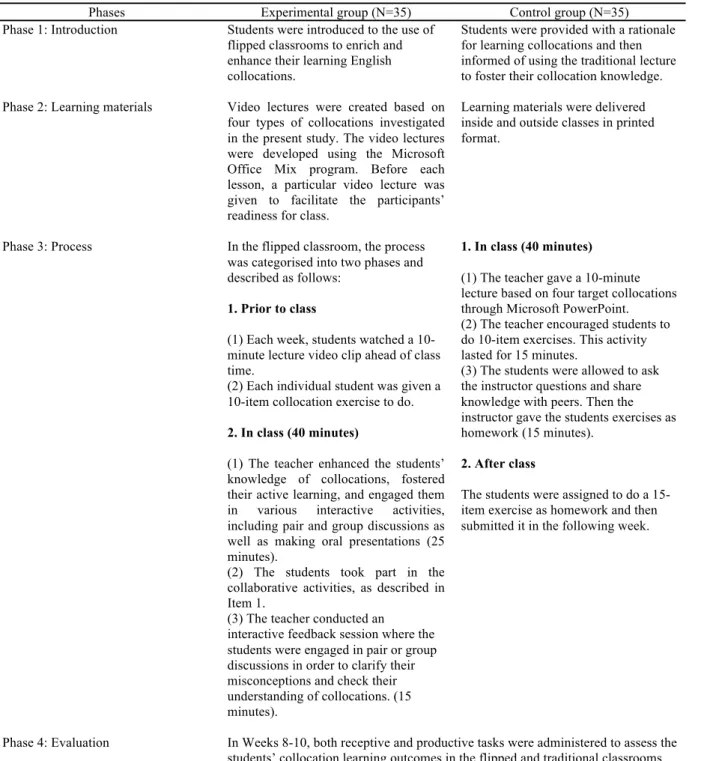
TABLE 3. A summary of lessons designed based on the two instructional settings
Phases Experimental group (N=35) Control group (N=35) Phase 1: Introduction Students were introduced to the use of
flipped classrooms to enrich and enhance their learning English collocations.
Students were provided with a rationale for learning collocations and then informed of using the traditional lecture to foster their collocation knowledge.
Phase 2: Learning materials Video lectures were created based on four types of collocations investigated in the present study. The video lectures were developed using the Microsoft Office Mix program. Before each lesson, a particular video lecture was given to facilitate the participants’ readiness for class.
Learning materials were delivered inside and outside classes in printed format.
Phase 3: Process In the flipped classroom, the process was categorised into two phases and described as follows:
1. Prior to class
(1) Each week, students watched a 10-minute lecture video clip ahead of class time.
(2) Each individual student was given a 10-item collocation exercise to do.
2. In class (40 minutes)
(1) The teacher enhanced the students’ knowledge of collocations, fostered their active learning, and engaged them in various interactive activities, including pair and group discussions as well as making oral presentations (25 minutes).
(2) The students took part in the collaborative activities, as described in Item 1.
(3) The teacher conducted an interactive feedback session where the students were engaged in pair or group discussions in order to clarify their misconceptions and check their understanding of collocations. (15 minutes).
1. In class (40 minutes)
(1) The teacher gave a 10-minute lecture based on four target collocations through Microsoft PowerPoint. (2) The teacher encouraged students to do 10-item exercises. This activity lasted for 15 minutes.
(3) The students were allowed to ask the instructor questions and share knowledge with peers. Then the instructor gave the students exercises as homework (15 minutes).
2. After class
The students were assigned to do a 15-item exercise as homework and then submitted it in the following week.
Phase 4: Evaluation In Weeks 8-10, both receptive and productive tasks were administered to assess the students’ collocation learning outcomes in the flipped and traditional classrooms. In Week 11, a questionnaire was administered, while in Week 12, a semi-structured interview was conducted.
lecture prior to class. During class, they were facilitated by the instructor by participating in various learning activities, such as pair and group discussions.
In terms of traditional instruction, the lessons were divided into two main phases: in and after classes, designed based on a study of Hung (2015), who studied the effect between flipped and traditional classrooms to enhance English language learners’ active learning. The lessons taught conventionally were also based on three concepts: introduce, define and explain, proposed by Chen Hsieh, Wu, and Marek (2016), who explored the benefits of flipped instruction for English learners. Specifically, the lecturer in the traditional classroom was required to introduce, define and explain the target collocations. In class, the students listened to lectures given by the instructor. After that, they were allowed to do exercises, share knowledge of collocations with classmates and ask the teacher questions. After class, the students were asked to do a homework assignment and submitted it in the following week.
In short, the flipped classroom in the present study focused mainly on the activities prior to and in class time, whereas the traditional classroom emphasised the activities in and after class time.
RESEARCH MATERIALS
In order to answer RQ 1 and RQ 2, a set of three receptive tasks (henceforth RT) and three productive tasks (henceforth PT) were developed based on Gyllstad (2007), which were subsequently applied to collect data in several collocation studies (e.g. Bueraheng 2014, Chorbwhan & McLellan 2016). Each type of task comprised 12 items in which lexical (adjective + noun and verb + noun) and grammatical (adjective + preposition and verb + preposition) collocations were presented. Initially, the lexical and grammatical collocations were extracted from previous studies from the EFL context of Thailand (Bueraheng 2014, Chorbwhan & McLellan 2016, Mongkolchai 2008, Yumanee & Phoocharoensil 2013). Then
the chosen collocations were checked with the Corpus of Contemporary American English
(COCA) to ensure their frequent use in everyday English communication. Finally, 72 collocations were targeted for the actual study.
In the RT (see Appendix A), the participants were required to decide whether a combination of words (the collocation) provided in each item was accurate. If it was correct,
the participants had to tick the box saying yes,if not, they had to tick the box indicating no.
In terms of the PT (see Appendix B), the participants were asked to fill in either a node or collocate in order to produce the correct collocation given in each sentence. To aid the participants, the Thai collocation equivalent for a particular node or collocate was indicated after each sentence.
To address RQ 3, a questionnaire (see Appendix C) with 14 five-point Likert scale items (rated as 5 for strongly agree, 4 for agree, 3 for neutral, 2 for disagree, 1 for strongly disagree) was developed based on seven constructs, namely flexibility, learning culture, materials and content, instructor, effect, engagement and motivation and overall satisfaction, three of which (effect, engagement and motivation and overall satisfaction) were adapted from a study of Chen Hsieh, Wu, and Marek (2016), while the others were developed by the researcher to gain the students’ perceptions of the flipped classroom. Overall, these constructs were designed to align with four key principles (flexible environment, learning culture, language content and professional educators) that were implemented in this investigation. Furthermore, a structured interview (see Appendix D for the semi-structured interview questions) was developed to elicit the opinions of students from the experimental group regarding the flipped classroom.
three English instructors, one of whom was a native speaker of English. Then the tasks were piloted with 15 Thai undergraduates to determine their task reliability measured with
Cronbach's Alpha. Tasks displayed reliability at the level of significance α = .88 (RT 1), .85
(RT 2) and .86 (RT 3) for the RT, α = .89 (PT 1), .84 (PT 2) and .85 (PT 3) for the PT and α
= .87 for the questionnaire.
DATA COLLECTION AND ANALYSIS
Before the actual study, the participants were asked to sign a consent form to ensure they were not forced to participate in the study. The tasks given each week were not associated with scoring towards their final grade for the subject. The purpose of this was to ensure that the learners felt comfortable and less anxious performing the tasks.
The data were gathered in two panels: before and after the treatment. In the first three weeks before the treatment, both RT and PT were administered. After the flipped instruction, the two types of tasks were utilised again to test the students’ collocation knowledge for three consecutive weeks.
The present study was based on a time series design which would help ensure the role of collocation learning retention. If the learning of L2 collocations was retained, the findings gained should be consistent across the tasks given. Finally, a questionnaire and a semi-structured interview were carried out to gain the students’ opinions on the flipped instruction.
In terms of statistical analysis, three statistical tests: Multivariate Paired T-Test, MANOVA and percentage and standard deviation (SD) were carried out. More specifically, for RQ1, two hypotheses formulated based on Multivariate Paired T-Test were as follows:
and In H0 and H1, refers to the mean vector of differences for
each corresponding variable. If the mean score of each variable from the post-test results is significantly higher than that from the pre-test results, the critical value must be lower than
the average score between the pre-tests and post-tests represented in the equation That is,
H1 is statistically accepted, which indicates that the results derived from the post-tests are significantly higher than those of the pre-tests.
For RQ 2, the results were statistically analysed based on MANOVA. In an effort to fully understand how the analysis was performed, two hypotheses were formulated as follows: H0: the methods have no effect on the score multivariate, and H1: the methods have an effect on the score multivariate.
In order to address RQ 3, the data gathered from the questionnaires were analysed based on percentage and standard deviation (SD). At this juncture, two research assistants were also asked to help transcribe and code the oral interview data.
FINDINGS
The goals of this research study were to measure the effect of the flipped classroom on the collocation knowledge of Thai students and to compare whether flipped instruction was significantly more effective in teaching English collocations than traditional instruction. The study also aimed to investigate the attitudes of students from the experimental group towards flipped instruction.
instructional design, motivating and engaging them to learn as well as fostering their collocation knowledge. For convenience, the findings are revealed and outlined as follows.
THE EFFECT OF THE FLIPPED CLASSROOM
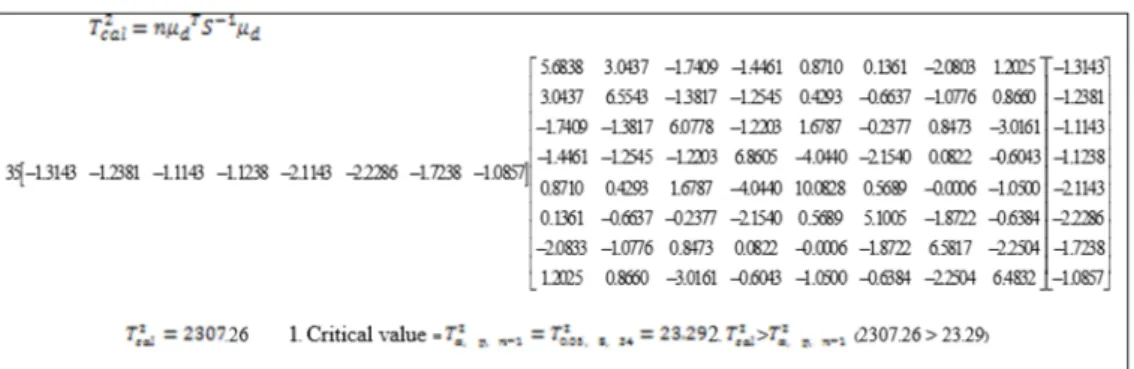
FIGURE 4. Pre- and post-test scores of the flipped classroom model
In Figure 4, the critical value in Item 1 is , which is
lower than ; therefore, H0 is rejected. The evidence indicates that the post-test
and pre-test scores for the flipped classroom are significantly different at α = 0.05. Simply
put, the students engaged in the flipped classroom produced the target collocations in the post-tests more easily than they did in the pre-tests.
THE EFFECT BETWEEN FLIPPED AND TRADITIONAL CLASSROOMS
In Table 4, the findings for RQ 2 are reported. Under the MANOVA technique, only two types of multivariate tests: Pillai’s Trace (labelled in 1) and Wilk’ Lamdha (labelled in 2) were chosen for the analysis. Since the data were gathered for three consecutive weeks after the implementation of the flipped and traditional classrooms, for convenience they are illustrated as Weeks 1-3 in parentheses following Pillai’s Trace and Wilk’ Lamdha.
TABLE 4. Results in three consecutive weeks following the flipped classroom and traditional instruction
Effect/statistical method Value Hypothesis df Error df Sig 1. Pillai’s Trace (Week 1)
2. Wilk’ Lamdha (Week 1) 1. Pillai’s Trace (Week 2) 2. Wilk’ Lamdha (Week 2) 1. Pillai’s Trace (Week 3) 2. Wilk’ Lamdha (Week 3)
0.15 0.85 0.22 0.79 0.86 0.91
8.00 8.00 8.00 8.00 7.00 7.00
61.00 61.00 61.00 61.00 0.62 0.62
0.23 0.23 0.50 0.50 0.57 0.57
As revealed in Table 4, there was no significant difference between the flipped classroom and the non-flipped classroom. Simply stated, the findings derived from the first week after the flipped classroom and the traditional instruction indicated that the effect
between the two instructional methods did not differ statistically at the significant level α =
0.05 (Sig = 0.23 > α = 0.05; H0 is accepted).
From the second week, the results obtained illustrated that the impact between the flipped classroom and non-flipped classroom were also not significantly different (Sig = 0.50
> α = 0.05; H0 is accepted). Following the flipped and traditional lectures, the findings in
Week 3 further revealed that there was no significant difference in terms of the impact
between the two teaching methods (Sig = 0.57 > α = 0.05; H0 is statistically accepted).
ATTITUDES TOWARDS THE FLIPPED LEARNING
In the study, RQ 3 sought to determine the students’ attitudes towards the flipped classroom, as gauged by the questionnaire and oral interview. The results obtained from the questionnaire were analysed quantitatively and presented in Table 5, followed by the findings from the semi-structured interview.
FINDINGS FROM THE QUESTIONNAIRE
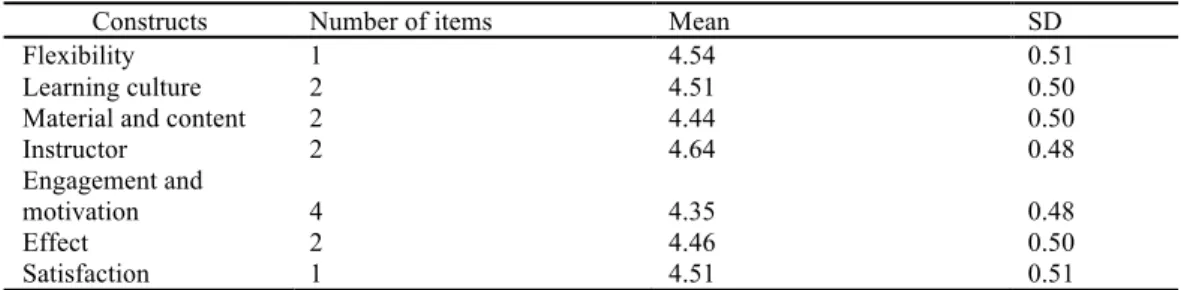
In Table 5, the quantitative results obtained from the questionnaire demonstrated the mean scores of the students’ responses to the seven constructs, namely flexibility (4.54), learning culture (4.51), material and content (4.44), instructor (4.64), engagement and motivation (4.35), effect (4.46), and satisfaction (4.51). These constructs were directly related to flexible environment, learning culture, intentional content and professional teachers, which were mainly implemented in this current study.
TABLE 5. Learners’ perception towards the flipped classroom learning experience
Constructs Number of items Mean SD
Flexibility Learning culture Material and content Instructor
Engagement and motivation Effect Satisfaction
1 2 2 2
4 2 1
4.54 4.51 4.44 4.64
4.35 4.46 4.51
0.51 0.50 0.50 0.48
0.48 0.50 0.51
As reported in Table 5, the findings revealed that the flipped learning style of instruction had a positive impact on the students’ collocational performance. Overall, the learners were happy and satisfied with the flipped learning model, as it enhanced their collocation knowledge and motivated them to learn the collocations through engagement.
The result of the construct instructor (the highest mean score) suggested that the instructor
made meaningful connections between the topics in the pre-recorded lectures and in-class
activities. The students’ responses to the construct engagement and motivation (the lowest
mean score)also demonstrated that they found the pre-recorded lectures useful for improving
their knowledge of L2 collocations.
FINDINGS FROM THE SEMI-STRUCTURED INTERVIEW
The qualitative findings gathered from the semi-structured interview yielded supportive evidence for a high level of satisfaction towards the flipped learning model. The students’ responses to the interview questions were analysed and grouped into four closely related themes: their satisfaction towards the collocation learning outcomes, instructor, learning materials and engagement and motivation.
In terms of overall learning satisfaction, many students (11 out of 15) expressed several comments of satisfaction related to their flipped learning experience in the interview. As one informant stated, “I am very happy and satisfied with learning collocations in the flipped classroom, allowing me to learn flexibly outside class.” One student additionally stated, “The flipped classroom provided me with a flexible and relaxing environment for learning English collocations.” According to the interview, 86% of the flipped learning students expressed that they benefited from this instructional approach.
between the learning topics available in and out of class time. Another student also stated that “My favourite learning part is the teacher who could engage me in learning English collocations through the flipped learning model.”
With respect to the materials designed, 73 percent of students (11 out of 15 participants) showed that the learning tasks designed by the instructor were useful and appropriate for learning English collocations. In the interview, as one informant stated, “I enjoy studying English collocations through the pre-recorded lectures created by the instructor, making comprehensible to me.” Another student pointed out that “I like viewing the pre-recorded lectures created by the instructor which engaged me to energetically participate in enhanced classroom activities." Another student also said, “The exercises given in the flipped classroom were easy to follow. I also found the lecture content in the pre-recorded lectures useful and interesting.”
Regarding the construct engagement and motivation, 60 percent of learners found the
time and effort they spent on learning English collocations in the flipped instruction worthwhile. One student reported, “I like viewing the video lectures regarding collocations at home prior to class, which motivated me to improve my collocation knowledge.” Another student explained, “I am happy with the time I spent viewing the lectures at home, allowing me to learn collocations better and preparing me for classroom engagement.” One of the informants also commented, “The pre-recorded lectures are easy for me to review the lessons any time, making me get ready for classroom activities.” When asked how they reviewed the lessons, one response was, “I reviewed the lessons when I was free or at any time I wanted to.”
In summary, the students generally preferred learning collocations through flipped instruction. As expected, the quantitative and qualitative findings were consistent in that the students tended to have improved their collocation knowledge following the flipped classroom method. Qualitatively, the results also demonstrated that the learners were facilitated to become more active in learning collocations.
DISCUSSION
The current study aimed to determine the effect of the flipped learning model on Thai learners’ collocation achievement and to compare whether flipped instruction was more effective than traditional instruction for teaching English collocations. The study also attempted to investigate students’ attitudes toward flipped instructional design. The overall results demonstrate that students’ collocation learning gains improve significantly after being in a flipped classroom. It is also found that the effects of flipped and traditional classrooms do not differ significantly. The participants express various satisfying aspects of learning L2 collocations through flipped instruction.
The results indicating that the experimental students’ post-test scores are statistically higher than their pre-test scores and that they have positive attitudes towards the flipped approach can be discussed in support of two potential determinants: a set of four major principles and the design of learning materials.
environment, and therefore leads to successful collocation learning among Thai students. Such a claim has been supported by several scholars. For example, Davies, Dean, and Ball (2013) remark that learning in a flipped classroom environment helps language learners succeed in academic performance as it enhances them in blended learning conditions. As pointed out by Hung (2015, 2017), flexibility in the flipped learning environment helps enhance learners’ comprehensible input, increasing their proficiency levels and supporting their learning preferences. Chen Hsieh, Wu and Marek (2016) further support that specific learning content required for in-class activities helps teachers interact with unprepared students more easily, subsequently promoting better learning of particular language features.
However, it is likely that the success of the flipped classroom depends largely on the instructor’s ability to maximise the benefits of the other three principles. Simply put, the flexibility of online self-study, the student-centred approach and appropriate instructional content may not be sufficient to make the flipped classroom the most successful without the help of an instructor acting as a facilitator. As proposed by Chen Hsieh, Wu and Marek (2016), teachers can help learners overcome challenges by giving timely feedback, allowing learners to realise that they are being facilitated and that their performance is being evaluated. From the questionnaire and semi-structured interview, the findings tend to support this view. That is, students from the flipped classroom believe that the teacher encourages them to fully participate in interactive classroom activities and make meaningful connections between the learning topics both inside and outside of class time. The present results align with Sarawagi’s (2014) study affirming that instead of acting as a lecturer, the teacher acting as a facilitator is beneficial in the classroom, enhancing active learning and learning confidence among students. From this proposed evidence, it can be speculated that the teacher can act as an effective facilitator in helping scaffold the learning of collocations among Thai students.
In terms of learning materials, it seems that learning materials exert a beneficial effect on the learning L2 collocations of students from flipped classrooms. These findings correspond with the findings of Hung (2015) in research on flipped instruction. Hung proposes that learning materials structured based on the flipped learning approach produce a positive impact on how learners perceive the learning environment and how they are exposed to the learning process. However, it seems difficult to determine how strong the effect of the flipped classroom is and whether it directly affects students’ learning gains. Additionally, several previous studies (e.g. Hung 2015, Marrs & Novak 2004) demonstrate that supplemental learning materials, such as websites or associated electronic resources, have a positive influence on active learning environments. With the application of technology, these scholars suggest that additional learning materials be integrated based on learners’ in-class activities and out-of-class learning environments. As revealed by the qualitative findings, flipped class students feel satisfied with the learning content presented in the materials. From the questionnaire, the findings also indicate that flipped classroom participants tend to be satisfied with the materials designed by the instructor. The results imply that the learning materials designed in terms of video lecture and exercise might greatly assist learners for their own learning inside and outside of class time.
As the collocation learning outcomes between the flipped and traditional classes yield no significant difference, two determinants: interaction-based learning and time needed to adjust to a new instructional approach may come into play.
exercises, ask teacher questions and share knowledge with peers, offering them an opportunity to interact with their teacher and classmates despite a small amount of class time. As discussed previously, the students from both groups are allowed to interact with their instructor and peers. From the evidence, it can be assumed that interactive learning activities do facilitate gains in the learning of English collocations, not only in students from flipped classroom, but also in students from traditional classroom. The view that interactive classroom activities positively affect language learners’ learning outcomes is supported by Tayjasanant and Suraratdecha (2016), who propose that interactive learning or peer coaching activities such as group work largely support language learners’ learning process.
The second plausible reason is that time required to adapt to the new learning environment (flipped approach) is not sufficient. In the current research, Thai students are exposed to the flipped approach for only four weeks which may be insufficient for them to adapt to this new learning mode. Several scholars (e.g. Wiriyachitra 2002, Simasathiansophon 2014) state that Thai students tend to be passive learners, who may be unaccustomed to an active learning context. This evidence is supported by Lee (2009) and Littlewood (1999), who remark that a number of East Asian students are accustomed to listening to lectures instead of being in an active learning environment. From the results, it is reasonable to assume that the insignificant difference found between the flipped and traditional classrooms is attributed to the time required for the Thai students to adapt to the new flipped learning model.
In conclusion, students involved in the flipped learning greatly benefit from learning English collocations through the flipped learning model. Such findings can be discussed in support of the set of the four major components and material design. The fact that the effect of flipped classrooms compared to that of traditional classrooms does not yield any significant difference may be that both classes have similar interaction-based learning and there may be more time needed for the students to adjust to a flipped learning environment.
CONCLUSION AND RECOMMENDATIONS FOR FURTHER RESEARCH
The current research investigated the effect of the flipped instructional model on Thai students’ collocation knowledge and compared whether the students taught by the flipped method were more successful in learning the target collocations than those by the traditional method. Also the study determined the students’ attitudes towards the flipped learning model. Overall, the findings showed that students’ collocation learning outcomes improved significantly after the implementation of the flipped classroom. The results also demonstrated that the effect between the flipped and traditional classrooms did not produce any significant difference. Students revealed various satisfying aspects of learning English collocations through the flipped method of learning.
investigate whether it helps enhance students’ learning of particular English skills. Accordingly, in further experimental classroom research, instructors seeking to flip a classroom are suggested to use LINE as an online learning platform to enhance students’ collocation knowledge. This would inform English language researchers of other helpful frameworks in ELT settings. Furthermore, instructors wishing to flip English collocation classes can create a WebQuest active learning strategy (see Hung 2015) or invent Qzone Blogs (see Xianwei, Asmawi & Samuel 2017) as a learning tool to see its impact on language learners.
In summary, teachers or researchers may apply a set of four principles (flexible learning environment, language learning culture, intentional linguistic content, and professional language teachers) to flipping English collocation classes which can help boost learners’ English proficiency. They can also use other learning tools such as LINE, WebQuest, or Ozone Blogs to promote their students’ collocation knowledge.
ACKNOWLEDGEMENTS
This research project was financially supported by Naresuan University (Grant No. R2560C013). The author’s heartfelt thanks are extended to Associate Professor Dr. Tipa Thep-Ackrapong and Kietnawin Sridhanyarat, whose constructive comments and insightful suggestions helped shape this research. The author would also like to thank Arthur J. Pollock for his careful proofreading. Sincere thanks go to the students at the Faculty of Allied Health Sciences, who participated in the study. Finally, the author is grateful to the two anonymous reviewers for their insightful comments and suggestions on an earlier draft of this article and the editors of the journal for their support.
REFERENCES
Ahmed, M. A. E. A. S. (2016). The effect of a flipping classroom on writing skill in English as a foreign language and students’ attitude towards flipping. US-China Foreign Language. Vol. 14(2), 98-114. Bahns, J. & Eldaw, M. (1993). Should we teach EFL students collocations? System. Vol. 21(1), 101-114. Baranovic, K. (2013). Flipping the first-year composition classroom: Slouching toward the pedagogically hip.
Unpublished Master’s thesis, Southeast Missouri State University, United States.
Begagić, M. (2014). English language students’ productive and receptive knowledge of collocations.
Explorations in English Language and Linguistics. Vol. 2(1), 46-67.
Bergmann, J. & Sams, A. (2012). Flip Your Classroom: Reach Every Student in Every Class Every Day. Eugene, OR: International Society for Technology in Education.
Boonyasaquan, S. (2006). An analysis of collocational violations in translation. Journal of Humanities. Vol. 27(2), 79-91.
Brinks Lockwood, R. (2014). Flip it! Strategies for the ESL Classroom. Ann Arbor, MI: University of Michigan Press.
Bueraheng, N. (2014). Receptive and productive knowledge of verb + noun and adjective + noun collocations of international program and English major students of Prince of Songkla University. Unpublished Master’s thesis, Prince of Songkla University, Thailand.
Chase, R. T. (2011). World English Placement Test Package. Retrieved 12 August 2016 from http://cengage.com.br /parcerias/go-up/pdfs/World_English_Placement_Test_Package.pdf
Chatpunnarangsee, K. (2013). Incorporating corpus technology to facilitate learning of English collocations in a Thai university EFL writing course. Unpublished PhD thesis, Indiana University Bloomington, United States.
Chen Hsieh, J. S., Wu, W. C. V. & Marek, M. W. (2016). Using the flipped classroom to enhance EFL learning.
Computer Assisted Language Learning. Vol. 30(1-2), 1-21.
Chorbwhan, R. & McLellan, J. (2016). First language transfer and the acquisition of English collocations by Thai learners. Southeast Asia: A Multidisciplinary Journal. Vol. 16, 16-27.
Davies, R. S., Dean, D. L. & Ball, N. (2013). Flipping the classroom and instructional technology integration in a college-level information systems spreadsheet course. Educational Technology Research and Development. Vol. 61(4), 563–580.
Dorkchandra, D. (2015). The Effects of Instruction of Noticing Collocation on Thai EFL Learners. Journal of Advances in English Language Teaching. Vol. 3(1), 1-11.
Engin, M. (2014). Extending the flipped classroom model: Developing second language writing skills through student-created digital videos. Journal of the Scholarship of Teaching and Learning. Vol. 14(5), 12-26. Firth, J. R. (1957). Modes of meaning. In F.R. Palmer (Ed.), Papers in Linguistics 1934 -1951 (pp. 190-215).
Oxford: Oxford University Press.
Guo, C. (2009). An analysis of the use of collocations by intermediate EFL college students in Taiwan.
ARECLS. Vol. 6, 141-155.
Gyllstad, H. (2007). Testing English Collocations: Developing Receptive Tests for Use with Advanced Swedish Learners. Lund: Lund University.
Hamdan, N., McKnight, P., McKnight, K. & Arfstrom, K. M. (2013). Extension of a Review of Flipped Learning. Retrieved October 25, 2016 from http://flippedlearning.org/wp-content/uploads/2016/07/Extension-of-FLipped-Learning-LIt-Review-June-2014.pdf.
Hedge, T. (2000). Teaching and Learning in the Language Classroom. Oxford: Oxford University Press. Herreid, C. F. & Schiller, N. A. (2013). Case studies and the flipped classroom. Journal of College Science
Teaching. Vol. 42(5), 62-66.
Hill, J. (2000). Revisiting priorities: From grammatical failure to collocational success. In M. Lewis (Eds.),
Teaching Collocation: Further Development in the Lexical Approach (pp. 47-69). London: Commercial Colour Press Plc.
Hou, Q. (2012). The effect of collocation instruction on non-English major EFL students’ use of collocations. Unpublished PhD thesis, Suranaree University of Technology, Thailand.
Howarth, P. (1998). Phraseology and second language proficiency. Applied Linguistics. Vol. 19(1), 24-44. Hsu, J. Y. & Chiu, C. Y. (2008). Lexical collocations and their relation to speaking proficiency of college EFL
learners in Taiwan. The Asian EFL Journal Quarterly. Vol. 10(1), 181-204.
Hung, H. T. (2015). Flipping the classroom for English language learners to foster active learning. Computer Assisted Language Learning. Vol. 28(1), 81–96.
Hung, H. T. (2017). Design-based research: Redesign of an English language course using a flipped classroom approach. TESOL Quarterly. Vol. 51(1), 180-192.
Jehma, H. (2016). Flipped learning as a strategy for an effective EFL classroom. Asian EFL Journal Professional Teaching Articles. Vol. 90, 54-65.
Jungić, V., Kaur, H., Mulholland, J. & Xin, C. (2015). On flipping the classroom in large first year calculus courses. International Journal of Mathematical Education in Science and Technology. Vol. 46(4), 508-520.
Kittigosin, R. & Phoocharoensil, S. (2015). Investigation into learning strategies and delexical verbs use by Thai EFL learners. 3L: The Southeast Asian Journal of English Language Studies. Vol. 21(2), 63-72. Krashen, S. D. (1982). Principles and Practice in Second Language Acquisition. Oxford: Pergamon
Laufer, B. & Waldman, T. (2011). Verb-noun collocations in second language writing: A corpus analysis of learners’ English. Language Learning. Vol. 61(2), 647-672.
Learning, Teaching & Curriculum, University of Wollongong. (2015). Hybrid Learning and Assessment: The
Flipped Classroom. Retrieved 23 February 2017 from
https://www.uow.edu.au/content/groups/public/@ web/@dvce/@tel/documents/doc/uow205449.pdf Lee, G. (2009). Speaking up: Six Korean students’ oral participation in class discussions in US graduate
seminars. English for Specific Purposes. Vol. 28(3), 142-156.
Littlewood, W. (1999). Defining and developing autonomous in East Asia contexts. Applied Linguistics. Vol. 20(1), 71-94.
Mallikamas, P. & Pongpairoj, N. (2005). Thai learners’ knowledge of English collocations. HKBU Papers in Applied Language Studies. Vol. 9, 1-28.
Marek, M. W. & Wu, P.-H. N. (2012). Selecting CMC systems for EFL instruction: Can standard social media platforms succeed? In Proceedings of World Conference on Educational Multimedia, Hypermedia and Telecommunications 2012 (pp. 967-972). Chesapeake, VA: AACE.
Marrs, K. A. & Novak, G. (2004). Just-in-time teaching in biology: Creating an active learner classroom using the internet. Cell Biology Education. Vol. 3(1), 49-61.
Meechai, D. & Chumworathayee, T. (2015). Verb + noun collocational competence of Thai university EFL students: A comparative study of a regular program and an English program. Language Education and Acquisition Research Network (LEARN) Journal. Vol. 8(2), 145-160.
Mehring, J. (2016). Present research on the flipped classroom and potential tools for the EFL classroom.
Mireille, F. (2014). The impact of using flipped classroom instruction on the writing performance of twelfth grade female Emirati students in the Applied Technology High School (ATHS). Unpublished Master’s thesis, the British University, Dubai, Emirates.
Mongkolchai, A. (2008). A study of university students' ability in using English collocations. Unpublished Master’s project. Srinakharinwirot University, Thailand.
Nakata, T. (2006). English collocation learning through meaning-focused and form-focused activities: Interactions of activity types and L1-L2 congruence. In Proceedings of the 11th Conference of Pan-Pacific Association of Applied Linguistics (pp. 154-168). Kangwon National University, Korea. Nesselhauf, N. (2003). The use of collocations by advanced learners of English and some implications for
teaching. Applied Linguistics. Vol. 24(2), 223-242.
Nesselhauf, N. (2005). Collocations in a Learner Corpus. Amsterdam: John Benjamins.
Pawley, A. & Syder, F. (1983). Two puzzles for linguistic theory: Nativelike selection and nativelike fluency. In J. C. Richards & N. Schmidt (Eds.), Language and communication (pp. 191-225). London: Longman. Phoocharoensil, S. (2013). Cross-linguistic influence: Its impact on L2 English collocation production. English
Language Teaching. Vol. 6(1), 1-10.
Phoocharoensil, S. (2014). Exploring learners’ developing L2 collocational competence. Theory and Practice in Language Studies. Vol. 4(12), 2533-2540.
Sarawagi, N. (2014). A flipped CS0 classroom: Applying Bloom’s taxonomy to algorithmic thinking. Journal of Computing Sciences in Colleges. Vol. 29(6), 21-28.
Shitu, F. (2015). Collocation Errors in English as Second Language (ESL) Essay Writing. International Journal of Social, Behavioral, Educational, Economic, Business and Industrial Engineering. Vol. 9(9), 3176-3183.
Simasathiansophon, N. (2014). A perspective on blended learning approach through course management system: Thailand’s case study. International Journal of Information and Education Technology. Vol. 4(2), 172-175.
Tayjasanant, C. & Suraratdecha, S. (2016). Thai EFL teachers and learners’ beliefs and readiness for autonomous learning. 3L: The Southeast Asian Journal of English Language Studies. Vol. 22(3), 153-169.
Thaichay, T. (2014). The use of flipped classroom to enhance Thai EFL students’ English accuracy and promote an active learning environment. Unpublished Master’s thesis, Thammasat University, Thailand. Unruh, T., Peters, M. & Willis, J. (2016). Flip this classroom: A comparative study. Computers in the Schools.
Vol. 33(1), 38-58.
Wang, X. D. & Zhang, C. J. Z. (2013). The application research of flipped classroom in university teaching—A case study on professional English of educational technology. Modern Educational Technology. Vol. 8, 11-16.
Wiriyachitra, A. (2002). English language teaching and learning in Thailand in this decade. Thai TESOL Focus.
Vol. 15(1), 4-9.
Xianwei, G., Asmawi, A. & Samuel, M. (2017). Critical peer feedback for business English writing through Qzone blogs: A mechanism among Chinese undergraduates. GEMA Online® Journal of Language
Studies. Vol. 17(1), 39-54.
Yumanee, A. & Phoocharoensil, S. (2013). Analysis of English collocational errors of Thai EFL students.
Language Education and Acquisition Research Network (LEARN) Journal. Vol. 6(1), 88-98.
Zainuddin, Z. & Attaran, M. (2016). Malaysian students’ perceptions of flipped classroom: A case study.
APPENDIX A
RECEPTIVE TEST
1. Mental health 2. Central class 3. Public opinion 4. Create sense
Yes Yes Yes Yes
No No No No
5. Take place 6. Make advantage 7. Related with 8. Interested on
Yes Yes Yes Yes
No No No No
9. Full of 10. Talk about 11. Deal to 12. Focus about
Yes Yes Yes Yes
No No No No
APPENDIX B
PRODUCTIVE TEST
1. You really should go to see a doctor if your leg hurts that much. It’s just ______ sense! (สามัญสำนึก) 2. The most dominant ______ parties in the US are the Democratic and the Republican. (พรรคการเมือง) 3. The term “________ arts” is used to refer to the visual arts such as painting and architecture. (ศิลปกรรม) 4. If you don’t ________ attention now, you'll get it all wrong later. (ตั้งใจ)
5. She usually ________ a lot of her time reading. (ใช้เวลา)
6. Susie was unable to ________ part in the game because she wasn’t feeling well. (เข้าร่วม)
7. Before trying any extreme sports, you need to be aware _______ the great risk involved. (ตระหนักถึง) 8. The first step towards moving into a happy state of mind is to understand that nobody is more responsible ________ your happiness than you are. (มีความรับผิดชอบต่อ)
9. It is normal that brothers look very similar ________ each other. (คล้ายคลึงกับ)
10. If I spend too much money on clothes, I won’t have enough left to pay _____ my rent. (จ่ายสำหรับ) 11. Jack wants to stay longer in Chiang Mai but nobody agrees ________ his plan. (เห็นด้วยกับ) 12. For thousands of years, people have strongly believed ________ supernatural powers. (เชื่อเกี่ยวกับ)
APPENDIX C
LEARNERS’ ATTITUDES TOWARDS THE FLIPPED CLASSROOM
Construct Strongly
disagree 1
Disagree
2
Neutral
3
Agree
4
Strongly Agree
5 1. Flexibility
(FL1) The flipped learning method allowed me to
view the video lectures anytime and anywhere. 2. Learning culture
(LC1) In the flipped instruction, I was encouraged
to be responsible for my own active learning. (LC2) I enjoyed learning the target collocations by
means of a student-centred approach. 3. Materials and content
instructor helped immense me in the flipped learning environment.
(MC2) The pre-recorded lectures created by the instructor helped me fully understand the target collocations.
4. Instructor
(ST1) The instructor made meaningful connections
between the topics in the pre-recorded lectures and
in-class activities.
(ST2) The instructor could engage me in the flipped classroom activities.
5. Engagement and motivation
(EM1) I participated and engaged myself more in
learning the target collocations in the flipped classroom.
(EM2) I became a more active learner in the flipped learning environment.
(EM3) I felt more motivated in learning the target
collocations in the flipped classroom.
(EM4) The flipped classroom has inspired me to
start learning collocations outside the classroom.
6. Effect
(EF1) I think the flipped classroom is effective in
learning the target collocations.
(EF2) After the implementation of the flipped classroom, I can use the target collocations more
accurately. 7. Satisfaction
(SF1) I am satisfied with the flipped learning experience.
APPENDIX D
SEMI-STRUCTURED INTERVIEW QUESTIONS
1. In what ways could the instructor help you be successful in learning collocations in the flipped class? 2. What do you know about the flipped classroom instruction?
3. What did you like about the flipped classroom model of instruction?