Matching Charge Extraction Contact for Wide-Bandgap
Perovskite Solar Cells
Yuze Lin, Bo Chen, Fuwen Zhao, Xiaopeng Zheng, Yehao Deng, Yuchuan Shao,
Yanjun Fang, Yang Bai, Chunru Wang, and Jinsong Huang*
forming tandem solar cells with another wide-bandgap (WBG) semiconductor. There are only two types of WBG semicon-ductor solar cells, III-V semiconsemicon-ductors and organic–inorganic halide perovskites (OIHPs),[1] have reach the efficiency that
may further enhance the efficiency of sil-icon solar cells.[2] It is not cost-effective to
integrate III-V solar cells onto silicon solar cells, because this would need sophisti-cated lattice matching and expensive thin film growth by existing techniques. Solu-tion-processed OIHPs bring a new oppor-tunity for WBG semiconductor/silicon tandem solar cells, because not only the lattice matching is not required to obtain high-efficiency perovskite solar cells on heterogeneous substrates, but also the low-cost, low-temperature growth of perovskite films onto silicon can compatible with sil-icon cell fabrication technology.[3–10]
Never-theless, the best reported power conversion efficiency (PCE) of the OIHP/silicon monolithic tandem cells is still lower than that of best silicon cells (≈26%), mainly due to the limited perfor-mance of the WBG perovskite solar cells employed in this struc-ture.[11,12] A photovoltaic material with bandgap (E
g) of ≈1.7 eV
is optimal for the two-terminal monolithic tandem cells to match the bandgap of silicon.[13] So far, the highest PCE of the
WBG (Eg≥ 1.7 eV) perovskite solar cells was around 17%, with
a stable PCE of 16%, where an OIHP material with composi-tion of FA0.83Cs0.17Pb(I0.6Br0.4)3 (FA = HC(NH2)2) was applied to
stabilize the phase under illumination.[14]
Compared to narrower bandgap OIHP solar cells (Eg < 1.6 eV), the WBG perovskite solar cells have
compa-rable external quantum efficiency (EQE) and fill factors (FF), but a much larger open circuit voltage (VOC) deficit, which is
the difference of Eg/q and VOC, where Eg is the bandgap of
the perovskites, and q is elementary charge. The VOC deficit
of perovskite solar cells with a bandgap of 1.40–1.55 eV have been pushed down to 0.37–0.40 V with composition and mor-phology engineering,[15,16] while it remained to be above 0.54 V
for WBG perovskite solar cells, imposing a severe limitation for the application WBG perovskite in perovskite/silicon tandem solar cells. Tremendous studies have been devoted to identify the origin of the much larger VOC deficit in WBG perovskite
solar cells.[17,18] Substitution partial of I− anions in MAPbI
xBr3−x
(MA = CH3NH3) is still the most reliable and widely applied
method to increase the bandgap of perovskites to above 1.7 eV,
Efficient wide-bandgap (WBG) perovskite solar cells are needed to boost the efficiency of silicon solar cells to beyond Schottky–Queisser limit, but they suffer from a larger open circuit voltage (VOC) deficit than narrower bandgap
ones. Here, it is shown that one major limitation of VOC in WBG perovskite
solar cells comes from the nonmatched energy levels of charge transport layers. Indene-C60 bisadduct (ICBA) with higher-lying lowest-unoccupied-molecular-orbital is needed for WBG perovskite solar cells, while its energy-disorder needs to be minimized before a larger VOC can be observed. A
simple method is applied to reduce the energy disorder by isolating isomer ICBA-tran3 from the as-synthesized ICBA-mixture. WBG perovskite solar cells with ICBA-tran3 show enhanced VOC by 60 mV, reduced VOC deficit of 0.5 V,
and then a record stabilized power conversion efficiency of 18.5%. This work points out the importance of matching the charge transport layers in perovs-kite solar cells when the perovsperovs-kites have a different composition and energy levels.
Solar cells, which efficiently convert sunlight into electricity to provide clean and renewable energy, represent a promising long-term solution for the environmental problems caused by the mass production and burning of fossil fuels. How-ever, the electricity from solar cells is still only around 1% of the world’s total electricity demand up to now. The main bar-rier that prevents solar cell technology from providing a larger fraction of energy is the high balance of system costs of solar cell systems. One promising strategy to drive down the cost of silicon solar cells, which dominate the solar cell market, is to increase their efficiency to beyond Shockley–Queisser limit by
Dr. Y. Lin, Dr. B. Chen, X. Zheng, Y. Deng, Dr. Y. Shao, Dr. Y. Fang, Dr. Y. Bai, Prof. J. Huang
Department of Mechanical and Materials Engineering and Nebraska Center for Materials and Nanoscience University of Nebraska-Lincoln
Lincoln, NE 68588, USA E-mail: [email protected] Prof. J. Huang
Department of Applied Physical Sciences University of North Carolina at Chapel Hill Chapel Hill, NC 27599, USA
F. Zhao, Prof. C. Wang Institute of Chemistry Chinese Academy of Sciences Beijing 100190, China
and is also very straightforward to carry out by simply changing the precursors. However, light induced phase separation was discovered in WBG MAPbIxBr3−x perovskite materials, which
was speculated to cause the much large VOC deficit in WBG MAPbIxBr3−x solar cells due to the charge trapping of the
formed lower bandgap phase under illumination. Tuning the tolerance factor of the perovskite structure with Cs substitu-tion has shown to be able to stabilize the WBG phase under illumination, which increased the device efficiency of WBG perovskite to 17.1%. However, the smallest VOC loss in WBG perovskite solar cells was still larger than 0.54 V, indicating the phase stability of WBG is not a limiting factor anymore. Therefore, there may be other origin of the large VOC deficit
in the WBG perovskite solar cells. We notice that MAPbIxBr3−x
perovskites with bandgap less than 1.68 eV or larger than 1.79 eV should not have phase separation based on the pho-toluminescence (PL) peak of the lower bandgap phase under illumination,[18,19] while their bandgaps are very close to that for
tandem devices with silicon solar cells.
In this work, we report that the energy level of electron trans-port layers could impose another limitation to the VOC of WBG
perovskite solar cells. Similar to bulk-heterojunction organic solar cells, a higher-lying lowest-unoccupied-molecular-orbital (LUMO) fullerene, indene-C60 bisadduct (ICBA), is shown to increase the efficiency of p-i-n structure WBG perovskite solar cells. Nevertheless, the benefit of higher-lying LUMO of ICBA is manifested by a larger VOC only if the energy disorder of
ICBA could be minimized to be comparable to other fullerenes. We report a simple and efficient strategy to overcome the large energy disorder issue of ICBA by isolating ICBA-tran3 isomer from mixture. WBG perovskite solar cells with ICBA-tran3 isomer shows enhanced VOC, and then a record stabilized PCE of 18.5% which is much higher than those (≤17.1% with a stable PCE of 16%) reported on WBG (>1.7 eV) solar cells in literatures, indicating the potential to enhance the efficiency by ≈2% enhancement for the state-of-the art OIHP/silicon tandem solar cells.[13] ICBA-tran3 possesses much lower energy
dis-order, better crystallinity and over ten-times higher conductivity than ICBA-mixture, which also contributes to the enhanced short-circuit current density (JSC) and FF.
To decrease VOC loss of WBG perovskite solar cells, ideal
hole/electron transporting layers (HTL/ETL) with low energy disorder[20] and appropriate energy levels are needed, besides
improving the morphology of perovskite layers. Compared to the rapid developing of new HTLs, there have been reports of much less ETLs which can be low-temperature solution-pro-cessed. The few dominating ETL materials include titanium and tin based oxide,[21–23] and fullerene derivatives[9,24–28] due
to their strong capability to accept the photogenerated elec-trons from the perovskite layers. Fullerene based ETLs gener-ally results in less photocurrent hysteresis due to its passiva-tion funcpassiva-tion.[27,29] In this work, we focused on the study of
fullerenes because their LUMO levels can be well tuned by bisadduct substitution fullerene derivatives.[30] For example,
ICBA[31] possess a shallow LUMO of −3.7 eV versus −3.9 eV of
[6]-phenyl-C61-butyric acid methyl ester (PCBM). Our previous study showed a comparable VOC was obtained regardless of the
LUMO levels of fullerene derivatives in narrower bandgap per-ovskite solar cells based on MAPbI3.[32] However, a shallower
LUMO level of fullerene derivatives, such as ICBA, was found to yield a larger VOC in WBG OIHP solar cells. We tested different
fullerene derivatives, including PCBM and ICBA in WBG solar cells with a planar OIHP/fullerene heterojunction structure. The device structure is shown in Figure 1a which constitutes of indium tin oxide (ITO)/poly(triaryl amine) (PTAA)/WBG OIHP/PCBM or ICBA/C60/bathocuproine (BCP)/copper (Cu). The WBG perovskite deposited by antisolvent method[33,34]
here had a composition (FA0.83MA0.17)0.95Cs0.05Pb(I0.6Br0.4)3,
which has a bandgap of 1.71 eV calculated from the optical absorption onset at 725 nm (Figure S1a, Supporting Informa-tion), which has a ≈2% difference with that calculated from PL peak (Figure S1b, Supporting Information). This composi-tion was used for the whole study reported here and is referred as WBG perovskite thereafter. PTAA was chosen as the HTL because of the large perovskite grain sizes formed on the non-wetting surface of PTAA.[35] Large grains of OIHP films with
the reduced total grain boundaries (GBs) area help decreasing charge recombination in the perovskite films, because the charge-trap density at GB of the OIHP polycrystalline films is several orders magnitude larger than grain interior[36–38] where
the photogenerated carriers can flow through with negligible charge recombination.[39–42] The top-view (Figure S2a,
Sup-porting Information) scanning electron microscopy (SEM) images show that the grain sizes of (FA0.83MA0.17)0.95Cs0.05
Pb(I0.6Br0.4)3 on PTAA covered ITO substrates was in the range
of 300–500 nm. Then cross-section SEM (Figure S2b, Sup-porting Information) confirmed the perovskite grains connect the electrodes without GBs, which benefit to transport photo-generated carriers rapidly, then reduce the charge recombina-tion in the bulk of perovskite films.
The influence of fullerene types on the VOC of the WBG
perovskite solar cells was evaluated. Among 30 devices fabri-cated for each type of fullerene derivatives, the WBG perovs-kite solar cells with ICBA (referred as ICBA-mixture thereafter) ETL showed a slightly improved VOC by 20 mV on average
over those with PCBM as ETL, as shown in Figure 1b. The typical current density–voltage (J–V) curves of these two types of devices were shown in Figure 1c, which showed a slightly larger VOC in the devices with ICBA ETL, in addition to the
obviously larger JSC and FF. The improvement of VOC can be
understood based on the energy diagram shown in Figure 1d. A higher LUMO of ICBA should elevate the quasi-Fermi level of electrons in the ETLs and thus increase device VOC.
Never-theless, we noticed that the VOC enhancement was much less
than the LUMO difference (0.2 eV) between PCBM and ICBA. This led us to consider the energy disorder of ICBA used, as the too large energy disorder of commercial ICBA limited the VOC improvement in perovskite solar cells according to our
pre-vious study.[20] Multiadduct substitution can cause a variety of
purified regular ICBA that contained four isomers (referred as ICBA-mixture).[31] ICBA-tran3 isomer was further isolated from
ICBA-mixture using the high performance liquid chromatog-raphy technique with a COSMOSIL 5PPB column and a bucky-prep D column.[43] The 1H NMR of the obtained ICBA-tran3
isomer confirmed the coexistence of 2 enantiomers and 1 ste-reoisomer, eliminating all other structure isomers of ICBA.[43]
ICBA-trans3 isomer has been shown to have very similar LUMO energy level (−3.7 eV) with that of the ICBA-mixture.[43]
Figure 1d illustrates how to enhance the VOC of the planar
heterojunction WBG perovskite devices by tuning LUMO level and reducing the energy disorder of the ETL. Though ICBA has a shallower-lying LUMO than PCBM, the large energy disorder of ICBA-mixture drags down the quasi-Fermi level of electrons,
which almost diminishes the energy level benefit of ICBA-mix-ture. ICBA-tran3 isomer with much smaller energy disorder can maintain a larger quasi-Fermi level splitting by confining the distribution of electrons in a narrower energy range. It is known that the total energy disorder of the organic semicon-ductor thin films may be contributed by the both static disorder and dynamic disorder, where the static disorder is caused by structural and chemical disorder, such as variation of chemical structure, low crystallinity, random molecular orientation, inter-actions with neighboring molecules, and so on.[20] In order to
characterize how much the energy disorder can be reduced by the simple chemical purification, we directly characterized the energy disorder in the perovskite solar cells with ICBA-mixture and ICBA-tran3 isomer by measuring the distribution of the Figure 1. Device structure and mechanism to enhance VOC by tuning energy level and reducing energy disorder of ETLs. a) Device structure of the
perovskite planar heterojunction solar cells: ITO/PTAA/Perovskite/PCBM or ICBA/C60/BCP/Cu. The chemical structure of ICBA is shown with an illustration of eight C60 bisadducts. b) Statistics of the VOC distribution (30 devices), and c) typical J–V curves of WBG perovskite/PCBM or
ICBA-mixture based solar cells. d) Schematic illustration of how energy level and energy disorder of ETLs influences the device VOC: high energy level and
a narrow distributed DOS raise the quasi-Fermi level of the photogenerated electrons (EFn) and thus increase the device VOC. EFp is the quasi-Fermi
electronic density of states (DOS). The distribution of the den-sity of states in organic semiconductors is often described by a Gaussian shape[44]
σ π σ
(
−)
= −(
−)
2 exp 2
L L
2
2
g E En Nn E E
n n
(1)
where EL is the energy center of the DOS, Nn is the total density
per unit volume, and σn is a disorder parameter that represents
the broadening of the DOS. Here we extracted the chemical capacitance (Cμ) by means of impedance spectroscopy to inves-tigate the variation of the DOS distribution. The Cμ reflects the capability of a photovoltaic device to accept or release addi-tional charge carriers as a result of shifts in the quasi-Fermi level, thus the Cμ in this type of measurement is proportional to the DOS.[45] When the quasi-Fermi level moves across these
electronic states, the release of occupied charge is recorded as a change in the Cμ, thus providing a perfect tool to study the DOS distribution in the devices. The measurement details can be found in Figure S3 (Supporting Information). Fittings of the Gaussian DOS for the perovskite solar cell devices with ICBA-tran3 isomer films by Equation (1) are shown in Figure 1e. The disorder parameter σn of ICBA-tran3 based device is 71 meV,
which is much smaller than that of the ICBA-mixture based device (188 meV) measured by the same method. Because only the ETL was changed, the measured σn change should reflect
the different degree of energy disorder in the ICBA-tran3 and ICBA-mixture.
Since the ICBA-tran3 isomer has smaller energy disorder than ICBA-mixture, the application of ICBA-tran3 as the ETL is expected to yield higher performance WBG devices with improved VOC. To demonstrate its potential, we applied
ICBA-tran3 as ETLs to fabricate planar heterojunction WBG per-ovskite solar cells with the same device structure shown in Figure 1a. The devices based on the WBG perovskite/ICBA-mixture yielded a PCE of 14.6%, with a VOC of 1.11 V, a JSC
of 18.0 mA cm−2, and a FF of 0.733. The WBG perovskite/
ICBA-tran3 based devices showed a much higher PCE of 18.3% (25% enhancement), with an improved VOC of 1.20 V, a JSC of
19.7 mA cm−2, and a FF of 0.775 (Figure 2a). EQE spectra in
Figure 2b show that the charge extraction efficiency of the WBG perovskite/ICBA-tran3 based solar cell is obviously higher than that of the control devices with ICBA-mixture. The photocur-rent density calculated from EQE agrees with the measured JSC from J–V scanning within an error bar of 4%. Figure S4
(Supporting Information) shows the steady photocurrent meas-ured at the maximum power output point of the most efficient devices with ICBA-tran3 ETL. The stabilized device PCE of the WBG perovskite/ICBA-tran3 solar cells reached 18.2% for the continuous measurement in the first 200 s. There is negligible difference (Figure 2c) between forward scan and reverse scan J–V curves, confirming the accuracy of the device efficiency characterization as well as excluding the existence of photo-current hysteresis which can be caused by ion migration and/ or the charge traps according to many of our previous studies and others.[27,29,46–48] The elimination of photocurrent
hys-teresis indicated both ion migration and the charge trapping have been minimized in our devices, thanks to the passiva-tion of charge traps by fullerene derivatives,[27,29] and blocked
ion migration channel at GBs.[47] Statistics of the V
OC and PCE
distributions of 30 devices fabricated are shown in Figure 2d,e, demonstrating the reliability and the repeatability of the per-formance enhancement by the ICBA-tran3 layer. Over 70% of the devices with ICBA-tran3 showed a VOC larger than 1.18 V
with a maximum VOC of 1.21 V. In the control devices based on
ICBA-mixture, the VOC ranged from 1.09 to 1.15 V. The average
VOC enhancement was ≈60 mV by replacing ICBA-mixture with
ICBA-tran3 isomer. Most (more than 65%) of devices based on ICBA-tran3 ETL showed PCEs larger than 17%. In contrast, the ICBA-mixture based devices exhibited lower PCEs of 11%–15%. Furthermore, the optimized WBG perovskite solar cells showed good stability as shown in Figure 2f. After storage in N2 for
3 d, the WBG perovskite/ICBA-tran3 devices showed a slightly increased PCE of 18.5%. Then after storage for 30 d, the device PCE with ICBA-tran3 decayed less than 10%.
Besides LUMO energy level and the degree of energy dis-order of ETLs, charge carrier recombination dynamics in a solar cell is another factor that can impact the device VOC,
because changes in the charge carrier recombination rate would cause variations of the equilibrium charge carrier concentra-tion, the quasi-Fermi level splitting, and thus the VOC in the
solar cells. Thus, a transient photovoltage spectroscopy (TPV) measurement was carried out to determine the carrier recom-bination. As shown in Figure 3a, ICBA-tran3 based solar cells showed a slightly longer carrier lifetime of 215 ± 26 ns than that (170 ± 10 ns) of the devices based on ICBA-mixture under illumination of one sun. We attempted to estimate whether this minor carrier lifetime increase dominates the photovoltage increase observed with a simple diode model which gives the relationship of the carrier lifetime and VOC[36,49,50]
ln ln 2
OC SC 0 SC eff V nkT q J J nkT q J qn Wi
τ = ≈ (2)
where n is the ideal factor (1–2), k is Boltzmann constant, T is absolute temperature, q is elementary charge (1.60 × 10⁻¹⁹ C),
J0 is reverse saturation current density, ni is the charge carrier
concentration, W is the depletion width (≈500 nm), τeff is the
effective charge recombination lifetime. The calculation shows that the longer carrier recombination lifetime in the ICBA-tran3 based solar cells contributed 8–16 mV VOC improvement.
Then we can assign the major part of VOC improvement to
the reduced low energy disorder with ICBA-tran3. To under-stand the origin of the charge-carrier lifetime enhancement by replacing ICBA-mixture with ICBA-tran3, we performed thermal admittance spectroscopy (TAS) measurement to examine the trap density of states (tDOS)[51] in the devices with
two different ETLs. TAS is a well-established, effective tech-nique for characterizing both shallow and deep defects, and then has been widely applied in understanding defects in solar cells.[52] In Figure 3b, the density of defect states was in the
order of 1 × 10¹⁶ to 1 × 10¹⁹ m−3 in the both type of devices. The
Along with the VOC improvement, the JSC of ICBA-tran3
based WBG devices was found to increase significantly com-pared to the ICBA-mixture based control devices, which may not be interpreted as the direct consequence of energy order reduction. Our previous study showed that energy dis-order change only impacted on the device VOC but not JSC.
We looked into the difference of the charge transport proper-ties of ICBA-tran3 than ICBA-mixture, which should affect the charge extraction efficiency.[9] The molecular disorder of
as-synthesized ICBA-mixture is expected to not only cause a larger energy disorder, but also reduce the carrier mobility by decreasing the intermolecular packing and thus electron-cloud overlapping, which is illustrated in Figure 3c. In addition to the removed polymorphs, ICBA-tran3 with two far-away pen-dants allows the large π–π electron coupling of the C60 cage to
form effective electron transport channels, which is expected to increase the electron mobility. X-ray diffraction (XRD) analysis
of ICBA-tran3 and ICBA-mixture neat films support a better packing of ICBA-tran3 molecules. As shown in Figure 3d, ICBA-tran3 film showed several distinct crystallization peaks, while in striking contrast, no XRD peak was observed from the ICBA-mixture film. The electron mobility of the ICBA-tran3 isomer was measured to be 3.1 × 10⁻⁴ cm2 V−1 s−1 by
space-charge-limited-current method, which is about sevenfold larger than that of the ICBA-mixture (4.5 × 10⁻⁵ cm2 V−1 s−1).[43] The
conductivities of ICBA-tran3 and ICBA-mixture were also com-pared by the current–voltage characteristics of the films depos-ited on glass substrates. Here the thickness of thin film was 20 nm, the length of silver (Ag) electrodes was 1 mm, and the spacing between the Ag electrodes was 100 μm. As shown in Figure 3e, the ICBA-tran3 showed 1–2 orders larger conduc-tivity than ICBA-mixture.
To further verify that it is better electron-transporting property of ETLs that dominated the improvement of JSC, we
Figure 2. Performance of the WBG perovskite devices with different ETLs. a) J–V curves and b) EQE of WBG perovskite solar cells based on ICBA-mixture and ICBA-tran3 ETLs. c) Forward and reverse scan J–V curves of WBG perovskite solar cells with ICBA-tran3 layer. Statistics of the d) VOC and
doped the as-synthesized low conductivity ICBA-mixture with CH3NH3I (MAI), and then applied them in the WBG solar
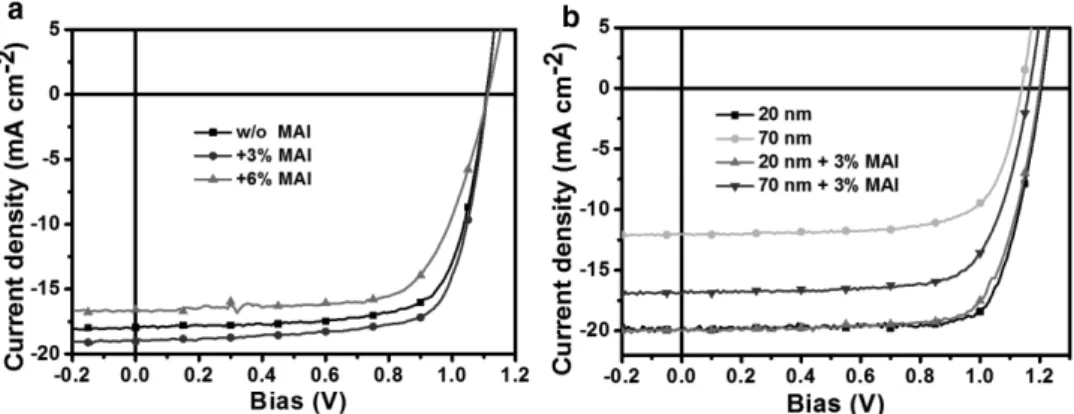
cells with the same structure shown in Figure 1a. In our pre-vious work, it has been demonstrated by us that adding MAI into fullerene derivatives can increase conductivity of the fullerene thin films.[9] Here introducing 3% weight ratio of
MAI into ICBA-mixture increased its conductivity by more than 3 times, as shown in Figure 3e. As shown in Figure 4a, an increased conductivity of ICBA-mixture enhanced JSC from
18.0 to 19.0 mA cm−2, confirming that the conductivity of
ICBA-mixture limited the charge extraction efficiency. Never-theless, further increasing the doping ratio in ICBA-mixture to 6% MAI yielded a decreased JSC, which can be explained to
severe charge recombination in doped ICBA-mixture and at the interface of perovskite/ICBA-mixture due to the too large den-sity of background charge carriers. It is noted that the VOC of
these devices were not varied by the doping of ICBA-mixture, which again confirmed that energy disorder is the dominating
factor that determines the VOC of the devices with
ICBA-mix-ture. Finally, we also evaluated whether further increasing the conductivity of ICBA-tran3 could impact the device current. It turns out that the device performance of optimized ICBA-tran3 based devices was almost unaffected by doping MAI (Figure 4b), indicating the conductivity of ICBA-tran3 does not impose a limitation to the charge collection when its thickness is thin enough (less than 30 nm). Nevertheless, when the ICBA-tran3 thickness reached 70 nm, the charge extraction efficiency dramatically reduced (Figure S5, Supporting Information). In this case, doping of ICBA-tran3 is necessary to recover the device efficiency (Figure 4b).
disorder of the as-synthesized ICBA due to the presence of many polymorphs diminished the photovoltage improvement. This study showed that isolating ICBA multiadducts is an efficient route to reduce its energy disorder. ICBA-tran3 iso-lated from ICBA-mixture showed the same high-lying LUMO level, but much smaller energy disorder and much larger con-ductivity compared to the as synthesized ICBA-mixture. The application of ICBA-tran3 isomers in WBG solar cells yielded a 25% enhanced PCE up to 18.5%, with a high VOC of up to
1.21 V. The VOC deficit of these WBG solar cell devices reached 0.5 V, which is lowest among WBG perovskite solar cells, but still larger than those of high-performance narrower bandgap ones. The isomers isolated from fullerene derivatives (e.g., indene-C60 triadduct) with higher LUMO than ICBA should be alternative ETLs to further push down the VOC deficit in WBG
devices. A simple calculation (see the Supporting Information) showed that the integration of these high-efficiency WBG solar cells with silicon solar cells with four-terminal geometry can increase the efficiency of tandem cells by 2% over the state-of-the art, and boost state-of-the efficiency two-terminal perovskite/silicon solar cells to around 30%.
Experimental Section
Fabrication and Characterization of Solar Cells: The spin coating process
was conducted in glovebox with oxygen level lower than 100 particle per million. The PTAA was dissolved in toluene with a concentration of 2 mg mL−1, and spun-coated on the ITO/glass substrates at the speed
of 5000 rpm for 35 s. The spun PTAA films were thermally annealed at 100 °C for 10 min. The (FA0.83MA0.17)0.95Cs0.05Pb(I0.6Br0.4)3 perovskite
layer was fabricated by the antisolvent method. The perovskite precursor solution composed of mixed cations (Cs+, Pb2+, FA+, and MA+) and halides (I−, Br−) was dissolved in mixed solvent (N, N-dimethylformamide (DMF): dimethyl sulfoxide = 4:1, v/v). In order to improve the wetting property of perovskite precursor on PTAA film, the PTAA film coated ITO substrate was prewetted by spinning 30 μL DMF at 4000 rpm for 10 s. Then 80 μL precursor solution was spun onto PTAA at 2000 rpm for 2 s and 4000 rpm for 20 s, the sample was quickly washed with 130 μL toluene at the 18th second of the 4000 rpm spin-coating. Subsequently, the sample was annealed at 70 °C for 10 min and 100 °C for 10 min. Fullerene derivatives solution in 1,2-dichlorobenzene with concentration of 20 mg mL−1 was coated onto the perovskite surface, and then
annealed at 100 °C for 30 min. The devices were finished by thermally evaporating C60 (20 nm), BCP (8 nm), and Cu (80 nm) in sequential order. The device area is 7.5 mm2. Simulated AM 1.5G irradiation
(100 mW cm−2) was produced by a Xenon-lamp-based solar simulator
(Oriel 67005, 150 W Solar Simulator) for current density–voltage (J–V) measurements. The light intensity was calibrated by a silicon diode (Hamamatsu S1133) equipped with a Schott visible-color glass-filtered (KG5 color-filtered). Keithley 2400 Source-Meter was used for J–V measurement. The scanning rate was 0.1 V s−1. Unless stated otherwise,
the scanning direction for J–V measurement was from positive bias to negative bias (reverse scan). The steady-state PCE was measured by monitoring current with largest power output bias voltage and record the value of photocurrent. EQE curves were characterized with a Newport QE measurement kit by focusing a monochromatic beam of light onto the devices.
Supporting Information
Supporting Information is available from the Wiley Online Library or from the author.
Acknowledgements
Y.L., B.C., and F.Z. contributed equally to this work. This work was supported by the SunShot Initiative in the Office of Energy Efficiency & Renewable Energy of Department of Energy under award DE-EE0006709. Manufacturing and characterization analyses were performed at the NanoEngineering Research Core Facility (part of the Nebraska Nanoscale Facility), which is partially funded from the Nebraska Research Initiative.
Conflict of Interest
The authors declare no conflict of interest.
Keywords
fullerene, isomers, perovskites, solar cells, wide bandgap
Received: January 30, 2017 Revised: March 9, 2017 Published online: May 3, 2017
[1] A. Kojima, K. Teshima, Y. Shirai, T. Miyasaka, J. Am. Chem. Soc. 2009, 131, 6050.
[2] Z. Yu, M. Leilaeioun, Z. Holman, Nat. Energy 2016, 1, 16137. [3] M. A. Green, A. Ho-Baillie, H. J. Snaith, Nat. Photonics 2014, 8,
506.
[4] M. M. Lee, J. Teuscher, T. Miyasaka, T. N. Murakami, H. J. Snaith,
Science 2012, 338, 643.
[5] H. Zhou, Q. Chen, G. Li, S. Luo, T.-B. Song, H.-S. Duan, Z. Hong, J. You, Y. Liu, Y. Yang, Science 2014, 345, 542.
[6] W. S. Yang, J. H. Noh, N. J. Jeon, Y. C. Kim, S. Ryu, J. Seo, S. I. Seok,
Science 2015, 348, 1234.
[7] W. Chen, Y. Z. Wu, Y. F. Yue, J. Liu, W. J. Zhang, X. D. Yang, H. Chen, E. B. Bi, I. Ashraful, M. Gratzel, L. Y. Han, Science 2015, 350, 944. [8] Y. Wu, X. Yang, W. Chen, Y. Yue, M. Cai, F. Xie, E. Bi, A. Islam,
L. Han, Nat. Energy 2016, 1, 16148.
[9] Y. Bai, Q. Dong, Y. Shao, Y. Deng, Q. Wang, L. Shen, D. Wang, W. Wei, J. Huang, Nat. Commun. 2016, 7, 12806.
[10] M. Saliba, T. Matsui, K. Domanski, J.-Y. Seo, A. Ummadisingu, S. M. Zakeeruddin, J.-P. Correa-Baena, W. R. Tress, A. Abate, A. Hagfeldt, M. Grätzel, Science 2016, 354, 206.
[11] M. Hu, C. Bi, Y. Yuan, Y. Bai, J. Huang, Adv. Sci. 2016, 3, 1500301. [12] C. Bi, Y. Yuan, Y. Fang, J. Huang, Adv. Energy Mater. 2015, 5,
1401616.
[13] M. H. Futscher, B. Ehrler, ACS Energy Lett. 2016, 1, 863.
[14] D. P. McMeekin, G. Sadoughi, W. Rehman, G. E. Eperon, M. Saliba, M. T. Hörantner, A. Haghighirad, N. Sakai, L. Korte, B. Rech, M. B. Johnston, L. M. Herz, H. J. Snaith, Science 2016, 351, 151. [15] M. A. Green, K. Emery, Y. Hishikawa, W. Warta, E. D. Dunlop,
D. H. Levi, A. W. Y. Ho-Baillie, Prog. Photovoltaics 2017, 25, 3. [16] D. Bi, W. Tress, M. I. Dar, P. Gao, J. Luo, C. Renevier, K. Schenk,
A. Abate, F. Giordano, J.-P. Correa Baena, J.-D. Decoppet, S. M. Zakeeruddin, M. K. Nazeeruddin, M. Grätzel, A. Hagfeldt, Sci.
Adv. 2016, 2, e1501170.
[17] X. Zheng, B. Chen, M. Yang, C. Wu, B. Orler, R. B. Moore, K. Zhu, S. Priya, ACS Energy Lett. 2016, 1, 424.
[18] E. T. Hoke, D. J. Slotcavage, E. R. Dohner, A. R. Bowring, H. I. Karunadasa, M. D. McGehee, Chem. Sci. 2015, 6, 613. [19] W. Rehman, D. P. McMeekin, J. B. Patel, R. L. Milot, M. B. Johnston,
H. J. Snaith, L. M. Herz, Energy Environ. Sci. 2017, 10, 361. [20] Y. Shao, Y. Yuan, J. Huang, Nat. Energy 2016, 1, 15001.
[21] S. S. Shin, W. S. Yang, J. H. Noh, J. H. Suk, N. J. Jeon, J. H. Park, J. S. Kim, W. M. Seong, S. I. Seok, Nat. Commun. 2015, 6, 7410.
[22] W. Ke, G. Fang, Q. Liu, L. Xiong, P. Qin, H. Tao, J. Wang, H. Lei, B. Li, J. Wan, G. Yang, Y. Yan, J. Am. Chem. Soc. 2015, 137, 6730. [23] K. Wojciechowski, M. Saliba, T. Leijtens, A. Abate, H. J. Snaith,
Energy Environ. Sci. 2014, 7, 1142.
[24] K. Wojciechowski, T. Leijtens, S. Siprova, C. Schlueter, M. T. Hörantner, J. T.-W. Wang, C.-Z. Li, A. K. Y. Jen, T.-L. Lee, H. J. Snaith, J. Phys. Chem. Lett. 2015, 6, 2399.
[25] Y. Li, Y. Zhao, Q. Chen, Y. Yang, Y. Liu, Z. Hong, Z. Liu, Y.-T. Hsieh, L. Meng, Y. Li, Y. Yang, J. Am. Chem. Soc. 2015, 137, 15540. [26] H. Yoon, S. M. Kang, J.-K. Lee, M. Choi, Energy Environ. Sci. 2016,
9, 2262.
[27] Y. Shao, Z. Xiao, C. Bi, Y. Yuan, J. Huang, Nat. Commun. 2014, 5, 5784.
[28] Z. Zhu, C.-C. Chueh, F. Lin, A. K. Y. Jen, Adv. Sci. 2016, 3, 1600027. [29] J. Xu, A. Buin, A. H. Ip, W. Li, O. Voznyy, R. Comin, M. Yuan,
S. Jeon, Z. Ning, J. J. McDowell, P. Kanjanaboos, J.-P. Sun, X. Lan, L. N. Quan, D. H. Kim, I. G. Hill, P. Maksymovych, E. H. Sargent,
Nat. Commun. 2015, 6, 7081.
[30] M. Lenes, G.-J. A. H. Wetzelaer, F. B. Kooistra, S. C. Veenstra, J. C. Hummelen, P. W. M. Blom, Adv. Mater. 2008, 20, 2116. [31] Y. He, H.-Y. Chen, J. Hou, Y. Li, J. Am. Chem. Soc. 2010, 132, 1377. [32] M. Hu, C. Bi, Y. Yuan, Z. Xiao, Q. Dong, Y. Shao, J. Huang, Small
2015, 11, 2164.
[33] M. Xiao, F. Huang, W. Huang, Y. Dkhissi, Y. Zhu, J. Etheridge, A. Gray-Weale, U. Bach, Y.-B. Cheng, L. Spiccia, Angew. Chem., Int.
Ed. 2014, 53, 9898.
[34] N. J. Jeon, J. H. Noh, Y. C. Kim, W. S. Yang, S. Ryu, S. I. Seok, Nat.
Mater. 2014, 13, 897.
[35] C. Bi, Q. Wang, Y. Shao, Y. Yuan, Z. Xiao, J. Huang, Nat. Commun. 2015, 6, 7747.
[36] J. Huang, Y. Shao, Q. Dong, J. Phys. Chem. Lett. 2015, 6, 3218. [37] H. Wei, Y. Fang, P. Mulligan, W. Chuirazzi, H.-H. Fang, C. Wang,
B. R. Ecker, Y. Gao, M. A. Loi, L. Cao, J. Huang, Nat. Photonics 2016,
10, 333.
[38] Y. Fang, Q. Dong, Y. Shao, Y. Yuan, J. Huang, Nat. Photonics 2015,
9, 679.
[39] H. J. Snaith, J. Phys. Chem. Lett. 2013, 4, 3623.
[40] Q. Dong, Y. Fang, Y. Shao, P. Mulligan, J. Qiu, L. Cao, J. Huang,
Sci-ence 2015, 347, 967.
[41] D. Shi, V. Adinolfi, R. Comin, M. Yuan, E. Alarousu, A. Buin, Y. Chen, S. Hoogland, A. Rothenberger, K. Katsiev, Y. Losovyj, X. Zhang, P. A. Dowben, O. F. Mohammed, E. H. Sargent, O. M. Bakr, Science 2015, 347, 519.
[42] S. De Wolf, J. Holovsky, S.-J. Moon, P. Löper, B. Niesen, M. Ledinsky, F.-J. Haug, J.-H. Yum, C. Ballif, J. Phys. Chem. Lett. 2014, 5, 1035.
[43] F. Zhao, X. Meng, Y. Feng, Z. Jin, Q. Zhou, H. Li, L. Jiang, J. Wang, Y. Li, C. Wang, J. Mater. Chem. A 2015, 3, 14991.
[44] J. Bisquert, Phys. Chem. Chem. Phys. 2008, 10, 3175.
[45] Z. Pomerantz, A. Zaban, S. Ghosh, J.-P. Lellouche, G. Garcia-Belmonte, J. Bisquert, J. Electroanal. Chem. 2008, 614, 49. [46] Y. Yuan, J. Huang, Acc. Chem. Res. 2016, 49, 286.
[47] Y. Shao, Y. Fang, T. Li, Q. Wang, Q. Dong, Y. Deng, Y. Yuan, H. Wei, M. Wang, A. Gruverman, J. E. Shield, J. Huang, Energy Environ. Sci. 2016, 9, 1752.
[48] Z. Xiao, Y. Yuan, Y. Shao, Q. Wang, Q. Dong, C. Bi, P. Sharma, A. Gruverman, J. Huang, Nat. Mater. 2015, 14, 193.
[49] N. Jensen, R. M. Hausner, R. B. Bergmann, J. H. Werner, U. Rau,
Prog. Photovoltaics 2002, 10, 1.
[50] N. Jensen, U. Rau, R. M. Hausner, S. Uppal, L. Oberbeck, R. B. Bergmann, J. H. Werner, J. Appl. Phys. 2000, 87, 2639. [51] J. A. Carr, S. Chaudhary, Energy Environ. Sci. 2013, 6, 3414. [52] C. Melzer, E. J. Koop, V. D. Mihailetchi, P. W. M. Blom, Adv. Funct.