TECHNICAL UNIVERSITY OF CLUJ-NAPOCA
ACTA TECHNICA NAPOCENSIS
Series: Applied Mathematics, Mechanics, and Engineering Vol. 60, Issue IV, November, 2017
THE DYNAMIC ANALYSE OF A CONSTRUCTION
WITH THE BASE INSULATION CONSISTING
IN ANTI-SEISMIC DEVICES MODELLED AS A
HOOKE-VOIGT-KELVIN
LINEAR RHEOLOGICAL SYSTEM
Polidor BRATU, Adriana STUPARU, Adrian LEOPA, Sorin POPA
Abstract: The paper presents the main results of theoretical and experimental researches regarding dynamic behaviour of constructions (building, bridge, or viaduct) with the base insulation, composed of series / parallel connection of elastomeric and dissipative anti-seismic devices. The purpose of the paper is to highlight the dynamic behaviour and the isolation capacity when the base insulation system can be constructed to respect the laws of the Hooke-Voigt-Kelvin linear rheological model. There were used the data of some rigid behaviour buildings, as well as the fundamental excitation of the 4thMarch 1977 earthquake. The carried out studies highlighted the possibility to assess the dynamic response and the isolation capacity at the action of fundamental spectral component of the 4thMarch 1977 earthquake. Key words: isolation capacity, elastomeric and dissipative anti-seismic devices, laws of the Hooke-Voigt-Kelvin linear rheological model
1. INTRODUCTION
The elastomeric and fluid dissipative anti-seismic devices currently manufactured in Europe production highlight a very good level of performances, with a wide range of parameters, and having all linear or nonlinear behavior.
For certain categories of constructions (rigid buildings, bridges, viaducts), technical solutions are sought in order to increase the insulation and dissipation capacity of the seismic energy depending on the high risk and significant vulnerability countries location. For this reason, some design solutions adopt the method of combining anti-seismic devices with predominantly elastic characteristic, with fluid dissipative anti-seismic devices, in a favorable connection following the Hooke-Voigt-Kelvin model.
In this case, the stiffness and damping characteristics of the system are determined on the basis of the in post-resonance dynamic
isolation criterion, taking into account the corner period Tc and the period T of the zonal seismic motion.
The computation excitation of the system consists in selecting the fundamental component from the spectral composition of the earthquake specific for a seismic area belonging to a defined geographic area. In this case, in the horizontal direction of action of the seismic movement, the fundamental spectral component of the acceleration was adopted, as a = ω2X0 sinωt, where: X0 is the horizontal displacement amplitude of the ground, and ω is the angular
frequency of the seismic movement, with the period T = ω / 2
π
.For the case analysis presented in the paper, the following values were adopted: T = 2 s, F
with the absolute coordinate system related to considered fixed mark.
2. THE DYNAMIC SYSTEM RESPONSE IN
RELATIVE INSTANTANEOUS
DISPLACEMENTS
¶ (12pt)
The Hooke-Voigt-Kelvin dynamic linear model (Figure 1), with composed viscous-elastic link E − (E/V), represents the isolation at the base realized by a convenient arrangement of anti-seismic devices. Thus, elastomeric devices with predominantly elastic behavior are used, with the elastic constants k, Nk, where N is a real positive multiplier, as well as fluid dissipative devices with viscous damping constant c, all with linear behavior.
Fig. 1. Dynamic model with viscous-elastic link E − (E/V)
The coordinate system is adopted as follows: the mark O1, considered fixed, linked to the
motionless axis O1X, defines the coordinates of
the absolute motion; the mark O (xo), linked to the ground defines the coordinates of the transport movement generated by earthquake, in the horizontal direction OX.
The relative movement of points A and B is defined by the horizontal instantaneous displacements and in relation to the mobile mark O(xo), namely x(t) and y(t). The mobile mark O (xo) identifies the ground motion during the earthquake for the fundamental spectral component according to the law: xo = X0 sin ωt
The motion differential equations of the mass m, for the hypothesis xo >y> x, can be written as follows:
∙ = ( − )
( − ) + ( − ) = ( − ) (1 ) and the complex formulation with the imaginary unit j = √−1 :
∙ + − = 0
( − ) + ( − ) − ( − ) = 0 (2)
where: x = X e ; = , ℎ =
; ; = , ℎ =
By replacing, in the relations (2) the complex measures and their derivatives in relation to time, it is we obtained the algebraic system in si , as:
(− ∙ + ) − − = 0
− ( + + ) = −( + ) (3)
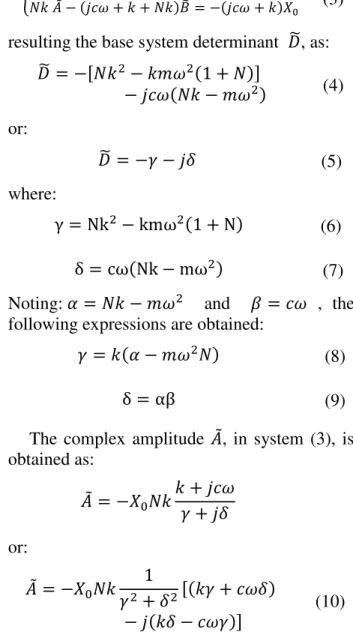
resulting the base system determinant , as: = − − (1 + )
− ( − ) (4)
or:
= − − (5) where:
γ = Nk − kmω (1 + N) (6)
δ = cω(Nk − mω ) (7)
Noting: = − and = , the
following expressions are obtained:
= ( − ) (8)
δ = αβ (9)
The complex amplitude , in system (3), is obtained as:
= − ++
or:
= − +1 ( + )
− ( − ) (10) From the equation (10), the instantaneous displacement amplitude x(t), is obtained as:
B
Nk A m
y(B)
O1
X k
x0(X0)
c
x(A)
| | = − ++ (11)
or:
| | = ( , )
= − (1 + ) ++ ( − ) (12)
and the dephasing θ1 expressed as:
= +−
The complex amplitude is obtained as:
= ++
or:
= + ( + )
− ( − ) (13)
Using the equation (13), the amplitude B of the instantaneous displacement y(t) and diphasing
θ
2 s expressed as:= | | = ( ++ ) (14)
or:
B = |B| = B(c, ω)
= X Nk − kmω (1 + N) + c ω (Nk − mω )(Nk − mω ) ∙ (k + c ω ) (15)
(!) Note: by reporting expression (15) to expression (12) it is obtained the amplitudes ratio B/ A as:
= , where: Ω = = ( 16) Analysing the expression (16) the following cases of dynamic behaviour are considered
a.if N→0, then B/A →∞, meaning amplitude A≡0. In this case, the spring Nk has a very low
stiffness, almost negligible, with “soft spring” effect, meaning that the motion from point B to point A cannot be transmitted.
b.if N→∞, then B/A →1, meaning that the motions of points A and B have the same amplitude. In this case, the spring Nk has such a
high stiffness, that its deformation is negligible, meaning that the elastic link Nk behaves as a rigid.
c.if N =Ω2 or Ω = √N , then B/A =0, respectively the amplitude B becomes so small that it can be neglected, ie B≡0. In this case, the mass moves in relation to the "fixed point" B as if it were linked only at this point.
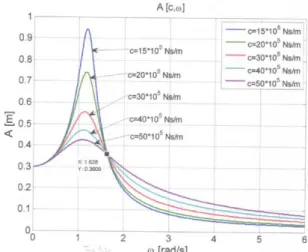
Figure 2 presents the amplitude A (c,ω)
variation depending on the continuous variation of ω and the discrete variation of c
Fig. 2. The variation curves of the amplitude A depending on the discrete variation of c and
the continuous variation of ω
Figure 3 presents the amplitude B variation depending on c and ω.
Fig. 3. The variation curves of the amplitude B depending on the discrete variation of c and
the continuous variation of ω
There are analysed the instantaneous deformation process of the two systems series linked, namely the viscous-elastic system Voight-Kelvin, respectively the elastic system Hooke, with Nk stiffness.
3.1. The deformation of the viscous-elastic system Voigt-Kelvin (E/V)
Considering that the instantaneous
deformations are = with =
, where V1 is the amplitude of the
viscous-elastic deformation (E/V). Taking into account the instantaneous displacements xo(t)
and y(t) , or o, and :
= − (17)
or:
= −
obtaining:
= − (18)
or:
= (− + ) (19) where:
= − = − (1 (20)
From the expressions (6), (7), (19) and (20) the amplitude of the deformation V1( c,ω) and
the dephasing ϕ1 can be obtained as: V c, ω
X kmω
Nk kmω 1 N c ω Nk mω
(21 )
or:
Nk mω
Nk kmω 1 N (22)
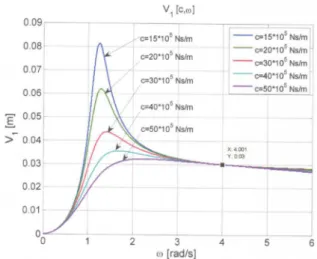
Figure 4 presents the amplitude variation of the system E/V system, depending on the discrete variation of C and continuous variation of pulsation ω
Fig. 4 The variation curves of the deformation V1
depending on the discrete variation of dumping c and the continuous variation of excitation pulsation ω
3.2. The deformation of the elastic system Hooke (E)
For the spring with the stiffness Nk, where N>0, the instantaneous elastic deformation is expressed as:
, (23)
or:
(24)
By expressing and in expression (24), results:
(25)
(26)
from where the amplitude V2 of the elastic
deformation and the dephasing ϕ2, can be
obtained as:
, (27)
Taking into account the expressions (6), (7) and (8), the equations (26) and (27) can be written as:
,
1 (28)
ckω mN
Figure 5 presents the variation of the maximum elastic variation V2 depending on the
discrete variation of c and continuous variation
of ω.
Fig.5 The variation curves of the amplitude V2 of the
elastic deformation depending on c and the continuous variation of ω
4. DYNAMIC INSULATION CAPACITY
The assessment of the dynamic insulation capacity is performed, as follows:
a.by determining the maximum transmitted force Qo from the construction support
invariably linked to the ground under seismic motion towards the construction having the mass m, by means of the base insulation system;
b.by establishing the calculus relation of the transmissibility T of the motion from the mobile mark O to the point A belonging to the mass m. In this case, the degree of seismic isolation is calculated with the relation I = 1- T.
4.1. The maximum transmitted force
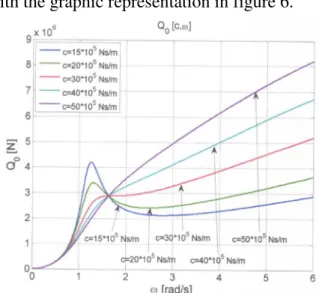
The maximum transmitted force Qo is
determined as the link force in the region of the spring with multiple stiffness Nk for the Hooke modelled elastic line (E). Thus, the expression is:
= (30)
taking into account the expression (28), it is obtained:
( ,
1 (31)
with the graphic representation in figure 6.
Fig. 6 The variation curves of the maxiumum transmitted forceQo depending on c and ω
4.2 Motion transmissibility
The motion transmissibility T from the excitation point Qo to the receiving point A(x) is
assessed using the expression:
(32)
where by expressing A as in expression (12), it is obtained:
,
1 (33)
with the graphic representation in figure 7.
5. THE DISSIPATED ENERGY
The amount of dissipated energy depends essentially on the equivalent viscous damping constant of the entire viscous fluidic dissipative system and on the amplitude of the deformation of the viscous-elastic system V1, Voigt-Kelvin modelled. Thus, the dissipated energy Wd can be
expressed as:
= (34)
where, by expressing V1 as in expression (21), it
is obtained:
( ,
1 (35)
with the graphic representation in figure 8.
Fig. 8 The variation curves of the dissipated energy Wd
depending on the viscous dumping c and the excitation pulsation ω
The initial data used for the case of study and for the plotting of the variation curves of the response parameters are as follows: m=3Mkg , k=4,8M N/m; N =10; c = ( 1,5 ; 2 ; 3 ; 4 ; 5 ) MN·s/m; a =3m/s2 la ω=π rad/s and Xo =0,3m.
6. CONCLUSIONS
The technical solutions for increasing the base dynamic isolation capability are realized in a wide variety of combinations, with serial / parallel connection of the anti-seismic devices with linear / non-linear behaviour.
In order to establish the strategy for the realization of a system composed of elastomeric
anti-seismic devices in series / parallel connection, with fluid dissipative anti-seismic devices it is necessary a systemic analysis for the components selection, so that the final objective of the dynamic isolation efficiency to be achieved.
For this, the most reliable and rational way is to establish parametric analytical relations in order to provide the possibility to assess the dynamic response to kinematic excitations of the seismic movement on the fundamental spectral component.
In this context, analytical and experimental researches were carried out in order to establish the efficiency of the rheological composed model E-(E/V) type Hooke-Voigt-Kelvin. The assessment scenario for the analytical approach was based on the initial numerical data presented in the paper, and the results of the study can be synthesized as follows:
a.dynamic response, to the given excitation is expressed by the instantaneous displacement x(t) = Asin( ωt+θ2) where the amplitude A = A
(c,ω) is represented by a family of curves
parameterized by the viscous damping c to the continuous variation of the excitation pulsation
ω.
b.instantaneous deformations v1(t) and v2(t)
have the amplitudes V1 and V2 corresponding to the viscous-elastic system (E/V) type Voigt-Kelvin and respectively the elastic system (E) type Hooke. The analytical expressions of the amplitudes V1(c,ω) si V2(c,ω) are useful in the
assessment and calculation of the dissipated energy Wd on the viscous linear damper c, and
accordingly for the calculation of the maximum transmitted force Qo on the elastic system with
the multiplied stiffness Nk.
c.dynamic isolation capability is assessed both by the maximum transmitted force Qo, as
well as by the motion transmissibility T = T (c,ω) depending on the discrete variations of c
and the continuous variation of ω.
d.dissipated energy Wd in the damper c with
fluid dissipation is expressed analytical form and graphically represented by a family of parameterized curves.
significant calculation method in the pre-stage of the parametric dynamic analysis. As a result, the parametric relations established for the dynamic response parameters, for the deformations of the composed system Hooke-Voigt-Kelvin, as well as for the isolation and dissipation capacity can be used in the calculations of dynamic analysis and for the dimensioning of the base insulation systems for constructions exposed to seismic actions.
7. REFERENCES
[1]Alexandru C., Influence of Position Angle of Elastic Anti-Vibration Elements on the Transmissibility, Romanian Journal of Acoustics and Vibrations, RJAV, vol. XI, issue 1/2014, pag. 59-62
[2]Bratu P., Physical instability and functional uncertainties of the dynamic systems in resonance. Applied mechanics and materials. Vol 430 (2013). Pg. 33-39. Trans Tech Publications, Switzerland. [3]Bratu P., Vasile O., Modal analysis of
viaducts supported on elastomeric insulation within the Bechtel constructive solution for the Transilvania Highway, Romanian Journal of Acoustics and vibration, 9 (2012), 77-82.
[4]Bratu P., Mitu A.M., Vasile O., "Dissipation Capacity Evaluation for Neoprene Anti-Seismic Isolators Under Harmonic Dynamic Excitations", RJAV, vol. 8 (1), 2011, pp.67-71, ISSN 1584-7284.
[5]Ciuncanu M., Test performance evaluation for elastomeric anti-seismic devices on specialized stands with controlled generation excitation functions, 22th International Congress on Sound and Vibration, Florance, Italy, 12-16. 07.2015.
[6]Dobrescu C., The rheological behaviour of stabilized bioactive soils during the vibration compaction process for road structures, 22th International Congress on
Sound and Vibration, Florance, Italy, 12-16. 07.2015.
[7]Gillich G.R., Bratu P., Frunzaverde D., Amariei D., Iancu V., Identifying mechanical characteristics of materials with non-linear behavior using statistical methods, PROCEEDINGS OF THE 4TH
WSEAS INTERNATIONAL
CONFERENCE ON COMPUTER
ENGINEERING AND APPLICATIONS (CEA 10), pp: 96-103, Published: 2009. [8]Iancu, V., Gillich, G.R., Iavornic, C.M.,
Gillich, N., Some models of elastomeric seismic isolation devices, (2013) Applied Mechanics and Materials, 430, pp. 356-361.
[9]Iancu, V., Vasile, O., Gillich, G.-R.,
Modelling and characterization of hybrid rubber-based earthquake isolation systems, (2012) Materiale Plastice, 49 (4), pp. 237-241.
[10] Kelly J., Konstantinidis A., Mechanics of rubber bearings for seismic and vibration isolation, J. Wiley & Sons, Ltd. 2011. [11] Murzea P., Alternative Kinematic
Assumptions for the Motions of Structures with Multiple Dynamic Degrees of Freedom Subjected to Seismic Actions, Romanian Journal of Acoustics and Vibrations, RJAV, vol. XI, issue 1/2014, pag. 53-58.
[12] Naeim F., Kelly J., Design of seismic isolated structures, J.Wiley & Sons, Inc (1999).
[13] Pintoi R., Rheological model for dynamic compaction evaluation with fresh concrete
stationary vibration, 21th International
Congress on Sound and Vibration, Beijing, China, 13-17.07.2014.
[14] Vasile O., Experimental evaluation of the hysteretic damping of elastomeric systems at low-cyclic harmonic kinematic displacements, (2013) Applied Mechanics and Materials, 430, pp. 323-328.
Analiza dinamica a unei constructii cu izolare la baza alcatuita din dispozitive antiseismice modelate ca sistem reologic liniar Hooke-Voigt-Kelvin
Rezumat: In lucrare se prezinta principalele rezultate ale unor cercetari teoretice si experimentale privind comportarea dinamica a unei constructii (cladire, pod, viaduct ) cu izolare la baza, aceasta fiind alcatuita din conexiunea in serie/ paralel a dispozitivelor antiseismice elastomerice si disipative. Scopul lucrarii este acela al evidentierii comportarii dinamice si a capacitatii de izolare atunci cand sistemul de izolare la baza poate fi alcatuit astfel incat sa respecte legitatile modelului reologic liniar Hooke-Voigt-Kelvin. Pentru aceasta au fost utilizate datele tehnice ale unor cladiri cu comportament de rigid cat si excitatia fundamentala a cutremurului de pamant din Romania de la data de 4 martie 1977. Asamblarea dispozitivelor elastomerice si disipative din productia existenta in Europa a permis stabilirea unei solutii tehnice de sistem de izolare dinamica modelat Hooke-Voigt-Kelvin. Ca urmare studiile efectuate au evidentiat posibilitatea evaluarii analitice a raspunsului dinamic si a capacitatii de izolare la actiunea componentei fundamentale spectrale a cutremurului din Romania ce s-a produs la 4 martie 1977
Polidor BRATU, Prof.dr., President, ICECON SA, Dynamic Behaviour of Structural Systems, [email protected], +40212025500
Adriana STUPARU, Drd. ,Scientific researcher, IMSAR, ICECON SA, Dynamic Behaviour of Structural Systems, [email protected], +40212025500
Adrian LEOPA, conf.dr., UGAL, [email protected]