UDC 811.111’243:168.522
IMPACT OF HUMANITIES AND SOCIAL SCIENCES
ON FOREIGN LANGUAGE LEARNING AND VERBAL
INTELLIGENCE: A MODEL STUDY ON BOSNIAN AND
TURKISH STUDENTS
Hakan Aydoğan1, Somali Gupta21Muğla Sıtkı Kocman University, Turkey, e-mail:[email protected]
2Professor & Head, Department of English, CLC Govt College, Dhamdha, Dist Durg., Chhattisgarh, India, e-mail: [email protected]
Abstract. This study addresses major areas relevant to the study and understanding of the relationships between human verbal intelligence, their social being and humanistic assets in an individual-differences framework. It aims to reinvigorate discussions of language learning intelligence types, speed of verbal access, verbal language interaction practises, language comprehension between foreign language learning and verbal ability in English. A total of 125 students participated in our research. The current research has been conducted in international high schools and universities in Sarajevo, Bosnia & Herzegovina. In order to fulfill the main purposes of this research, we have composed nine questions in the form of Likert five-point scale. In order to test the proposed hypothesis, we have conducted correlational analysis, t-tests for independent samples and multiple regression analysis (MRA).
The participants who showed verbal linguistic intelligence were found to be higher users of cognitive strategies which in turn plays an important role in the development of language and literacy skills. Self-reported verbal intelligence reveals statistically significant correlations with learning skills of our subjects and with their degree of liking humanities and social sciences. Bosnian students speak more languages than Turkish students, but these groups of participants have similar interest for learning foreign languages. Self-assessed verbal intelligence is in a statistically significant correlation with number of languages which are spoken by our respondents. Verbal intelligence is not significantly correlated with the interest to learn foreign languages, nor is the last mentioned variable with the number of spoken languages.
Key words: verbal intelligence, learning skills, foreign language learning, attitudes towards learning, motivation for learning
1. INTRODUCTION
English is, most definitely, a foreign language in these areas which is now being introduced and encouraged as a second language in these two countries.
Humanities and Social Sciences is at the heart of knowing about human condition. Language aids in this learning. This study seeks to find out to what extent English language learners internalize foreign language aptitude and Verbal Intelligence. During the study it was found that the students who understood the language were able to connect better with the culture and vice-versa. The learner-centered pedagogy in Foreign Language Learning in recent years has lead to a heightened need for Verbal Intelligence. This paper aims at drawing a correlation between Social Sciences and Humanities and Language Learning for the purpose of understanding and improving the subject knowledge and linguistic competence along with socio-cultural concerns of students from Turkey, Bosnia and Hercegovina, and Balkans in general, at the International University of Burch, through a wide ranging questionnaire built on culture education and verbal competencies.
Foreign Language Learning involves more than simple acquisition of a target language as learners develop cognitive, social and linguistic competences at the same time. This study rests on the hypothesis that verbal intelligence can be developed by incorporating humanistic education, social and emotional nurturing along with scientific education. During the study, the participants of verbal-linguistic type were found to be higher/better users of cognitive strategies which play an important role in the development of language and literacy skills.
There is no overarching theory of second language acquisition which would explain how people learn a second language. Worldwide, theories related to second language acquisition have popped up only when the instructional objective became ’oral competence’, or what we term ’verbal intelligence’. The 1990s saw a host of new theories introduced to the field, such as Michael Long’s interaction hypothesis, Merrill Swain’s output hypothesis and Richard Schmidt’s noticing hypothesis. However, two main areas of research interest were linguistic theories of Second Language Acquisition based upon Noam Chomsky’s universal grammar, and psychological approaches such as skill acquisition theory and connectionism. The latter category also saw the new theories of processability and input processing in this time period. The 1990s also saw the introduction of sociocultural theory, an approach to explain second-language acquisition in terms of the social environment of the learner. In the 2000s research was focused on much the same areas as in the 1990s, with research split into two main camps of linguistic and psychological approaches. VanPatten and Benati do not see this state of affairs as prone to changing in the near future, pointing to the support both areas of research have in the wider fields of linguistics and psychology, respectively.
the verbal aspects are taken into consideration. This is usually referred to as verbal intelligence or verbal fluency, and is commonly a reflection of an individual’s overall linguistic intelligence.
Good second language speakers are often considered to be talented people with special verbal abilities who possess more than one code to understand and acquire knowledge in order to use it in new situations. Various empirical studies (Gardner & Lambert, 1972; Skehan, 1982; Silva & White 2002) have investigated the relationship between IQ and the capacity for learning foreign languages but have found only a moderate level of correlation; therefore, Spearman’s traditional static concept of intelligence cannot be used as a predictor of successful language learning.
There are three general categories in which people learn: visual learners, auditory learners, and kinesthetic learners. Beyond these three general categories, many theories of and approaches toward human potential have been developed. Among them is the theory of multiple intelligences, developed by Howard Gardner, Ph.D., Professor of Education at Harvard University. Gardner’s early work in psychology and later in human cognition and human potential led to the development of the initial six intelligences. Today there are nine intelligences and the possibility of others may eventually expand the list. These intelligences (or competencies) relate to a person’s unique aptitude set of capabilities and ways they might prefer to demonstrate intellectual abilities.
According to Gardner’s theory of Multiple Intelligences Verbal-linguistic intelligence implies well-developed verbal skills and sensitivity to the sounds, meanings and rhythms of words. English as a Foreign Language (EFL), indicates the teaching of English in a non–English-speaking region. Study can occur either in the student’s home country, as part of the school curriculum or, for the more privileged minority, in an anglophone country that they visit as a sort of educational tourist, particularly immediately before or after graduating from university.
Theories related to second language acquisition popped up only when the instructional objective became oral competence. Structural linguists analyze how language is formed, not in a historical-descriptive, or diachronic sense, but as it is currently spoken in the speech community. Language is now seen as a set of abstract linguistic units that make up the whole language system. The realization that all languages are complex, unique systems, allowed linguists to understand the multifaceted, singular structure of English without comparing it to Latin, which had long been the paragon of excellence among prescriptive grammarians. This led to new thinking in terms of how language should be taught. Individual structures should be presented one at a time and practiced via repetition drills. Grammar explanations should be minimal or nonexistent, for students will learn grammatical structures by inductive analogy.
2. AIMS OF THE RESEARCH
This research aims to study if a personal preference for Humanities and Social Sciences facilitates better Verbal Intelligence and Foreign Language Learning. This is the reason behind the decision to examine the following:
1. Relationship between self-assessed verbal intelligence, number of spoken languages, and interest in language learning.
2. Difference in the number of spoken languages and the interest in language learning between Turkish and Bosnian students from the research sample.
3. Gender differences in spoken languages and interest in learning foreign languages. 4. Correlations between: self-assessed verbal intelligence, degree of liking humanities
and social sciences, and learning skills of students.
5. Potential of: general attitude toward studying, learning skills, overall motivation for learning, self-esteem, and extroversion, to predict to what extent students like humanities and social sciences.
3. RESEARCH HYPOTHESES
Based on the aims of the study/research questions and purposes, we have defined five hypotheses:
1. Correlations between self-assessed (self-reported) verbal intelligence, number of spoken languages, and interest in language learning are statistically significant. 2. Differences in number of spoken languages and interest in language learning
between Turkish and Bosnian students are not statistically significant.
3. There are no statistically significant gender differences in the number of spoken languages and interest in language learning.
4. Correlations between: self-assessed verbal intelligence, degree of liking humanities and social sciences, and learning skills are statistically significant.
5. Explained variance (by five mentioned predictors) of liking humanities and social sciences is statistically significant.
4. METHODOLOGY
4.1. Participants and procedure
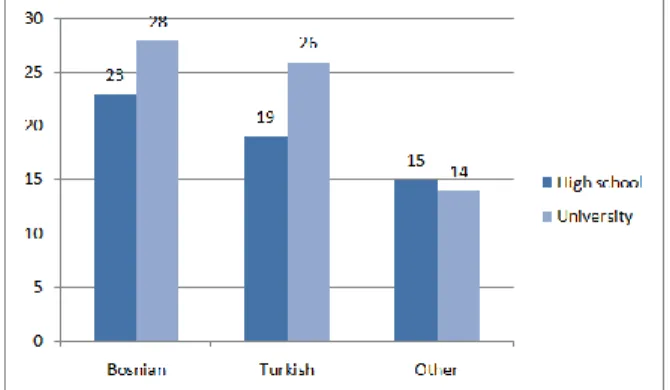
Fig. 1 Sample distribution by nationality and educational level/institution
Looking at Figure 1 and based on additional calculations, there were 51 Bosnian (40.8% of the total sample) and 45 Turkish students (36.0% of all respondents) in our sample. There were also 29 students of other nations (i.e. 23.2% of the total sample). Fifty seven of our subjects went to high school (45.6% of all respondents) and 68 of them are at university (54.4% of all participants).
Among Bosnian students, 23 went to high school and 28 were at university. Among Turkish students, 19 of them were at high school and 26 went to university. Fifteen participants who belonged to other nations were at high school and 14 of them were at university. Gender distribution of our sample is shown in Figure 2.
Fig. 2 Frequencies of males and females in the sample
As we can notice (Fig. 2), there were 59 males (or 47.2% of all participants) and 66 females (52.8% of all respondents) in our sample.
4.2. Instruments
1. How many languages (except for mother tongue) do you speak (please write the number).
2. To which extent are you (generally) interested in learning foreign languages (from 1 – not at all to 5 – very interested)?
3. How can you grade (evaluate) your overall verbal intelligence (from 1 – very poor to 5 – excellent)?
4. What is your general attitude towards studying (1 – don’t like it at all to 5 – I enjoy in it very much)?
5. How much do you like humanities and social sciences (1 – not at all to 5 – very much)?
6. Are you an extroverted person (1 – not at all to 5 - very extroverted)? 7. How would you grade your learning skills (1 – very poor to 5 – excellent)? 8. How would you grade your overall motivation for learning (1 – very poor to 5
excellent)?
9. How would you grade your personal self-esteem (1 – very low to 5 – very high)?
We have also asked our respondents some questions on: their age, number of years of formal education, gender, nationality, and educational level/institution, which have been relevant for the current research.
5. RESULTS AND DISCUSSION
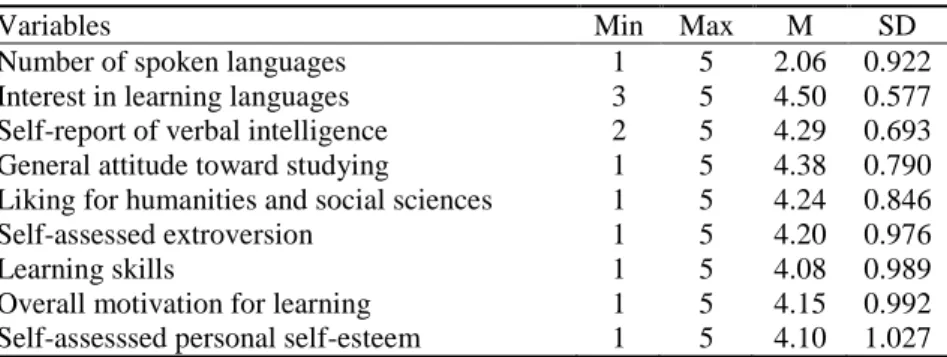
In order to test the proposed hypotheses, we have conducted correlational analysis, t-tests for independent samples and multiple regression analysis (MRA). First, we have calculated descriptive values for every analyzed variable. The results are displayed in Table 1. Note that the labels mean: Min – minimal value(s), Max – maximal value(s), M – arithmetic mean(s), & SD – standard deviation(s).
Looking at Table 1, we can conclude that the average number of languages which are spoken by our participants is M = 2.06 (i.e. approximately two languages). The range of spoken languages is from 1 to 5. Our participants are very interested in learning foreign languages (M = 4.50; the range is: 3 – 5). Our participants think that their verbal intelligence is above average (M = 4.29), and they have answered this question very similarly one to each other (SD = 0.693). General participants’ attitude toward studying is very positive (M = 4.38) and they like humanities and social sciences (M = 4.24).
Table 1 Descriptive statistical values
Variables Min Max M SD
Number of spoken languages 1 5 2.06 0.922 Interest in learning languages 3 5 4.50 0.577 Self-report of verbal intelligence 2 5 4.29 0.693 General attitude toward studying 1 5 4.38 0.790 Liking for humanities and social sciences 1 5 4.24 0.846 Self-assessed extroversion 1 5 4.20 0.976
Learning skills 1 5 4.08 0.989
Among our subjects, self-reported extroversion is above average (M = 4.20). They also think that their learning skills are very good (M = 4.08), as it is their overall motivation for learning (M = 4.15). Personal self-esteem of the subjects is also high (M = 4.10), but there is the greatest variability of their assessments (SD = 1.027). To test our first hypothesis, we have calculated correlation coefficients and displayed them as a matrix of intercorrelations (Table 2).
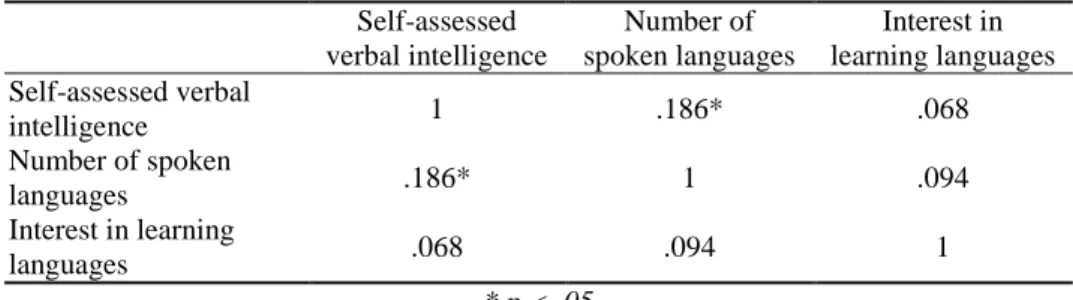
Table 2 Matrix of intercorrelations between: self-assessed verbal intelligence, number of spoken languages, and interest for learning foreign languages
Self-assessed verbal intelligence
Number of spoken languages
Interest in learning languages Self-assessed verbal
intelligence 1 .186* .068
Number of spoken
languages .186* 1 .094
Interest in learning
languages .068 .094 1
* p < .05
Looking at Table 2, we can see that self-reported verbal intelligence is in a positive, statistically significant correlation with the number of spoken (foreign) languages by our participants (r = .186, p < .05). It means that somebody who assesses his/her verbal abilities high, speaks more languages than somebody who gives low assessment of it. Self-reported verbal intelligence is not in a statistically significant correlation with the interest in learning foreign languages (r = .068, p > .05). The correlation between the number of spoken languages and interest for learning them is not statistically significant (r = .094, p > .05). Hence, we can reject the biggest part of our first hypothesis.
In the next two tables have tested differences between particular subsamples of our participants. The labels mean: N – number of participants in the subsample; M – arithmetic mean; SD – standard deviation; SEM – standard error of the arithmetic mean; Mdiff. – difference between two arithmetic means; t – t value; df – degrees of freedom; and p – significance of t value.
Table 3 Differences in number of spoken languages and interest in language learning between Turkish and Bosnian students
Variable Nationality N M SD SEM Mdiff. t df p Number of spoken
languages
Bosnian 51 2.59 0.78 0.11
1.39 10.464 94 .000 Turkish 45 1.20 0.46 0.07
Interest in learning languages
Bosnian 51 4.57 0.57 0.08
0.17 1.429 94 .156 Turkish 45 4.40 0.58 0.09
this difference is statistically significant (t = 10.464, df = 94, p < .001). On the other side, there is no statistically significant difference in interest in learning foreign languages between Bosnian and Turkish students (t = 1.429, df = 94, p > .05). Therefore, they are approximately equally interested in learning foreign languages. Thus, we have partially rejected and partially proved our second hypothesis.
Table 4 Gender differences in number of spoken languages and interest in language learning
Variable Gender N M SD SEM Mdiff. t df p Number of spoken
languages
Males 59 2.10 0.96 0.12
0.07 0.431 123 .668 Females 66 2.03 0.89 0.11
Interest in learning languages
Males 59 4.56 0.53 0.07
0.11 1.014 123 .313 Females 66 4.45 0.61 0.07
From Table 4, we can conclude that there are no statistically significant gender differences in the number of spoken languages (t = 0.431, df = 123, p > .05), nor in the interest in learning foreign languages by males and females (t = 1.014, df = 123, p > .05). Hence, we have proved the third hypothesis.
Table 5 Correlations between self-reported verbal intelligence, liking humanities/social sciences, and learning skills
Self-assessed verbal intelligence
Liking humanities and social sciences
Learning skills Self-assessed verbal intelligence 1 .426* .317* Liking humanities and social sciences .426* 1 .312*
Learning skills .317* .312* 1
* p < .001
As it can be seen in Table 5, self-assessed verbal intelligence is positively correlated with liking humanities and social sciences (r = .426, p < .001) and learning skills (r = .317, p < .001). Liking humanities and social sciences is also positively correlated with learning skills (r = .312, p < .001). We can make the following conclusion: someone who thinks that he/she has high verbal intelligence, likes humanities/social sciences and estimates his/her learning skills as good. By this finding, we have proved our fourth hypothesis.
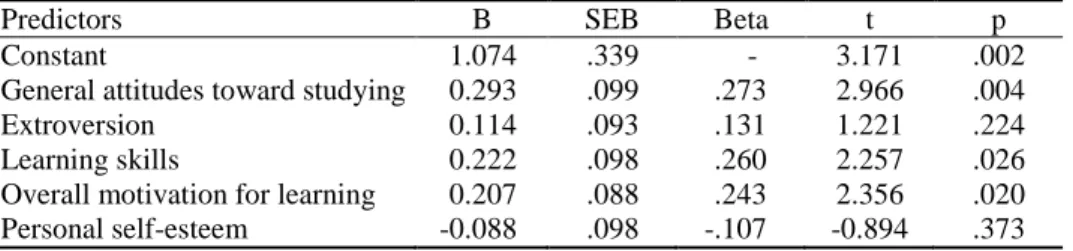
To test the last hypothesis, we conducted multiple regression analysis. The predictors were: general attitudes towards studying, extroversion (as a self-reported personality trait), learning skills, overall motivation for learning, and personal self-esteem/confidence (as a self-assessed personality trait). The criterion was the extent of liking humanities and social sciences.
Table 6 Results of multiple regression analysis
Predictors B SEB Beta t p
Constant 1.074 .339 - 3.171 .002
General attitudes toward studying 0.293 .099 .273 2.966 .004
Extroversion 0.114 .093 .131 1.221 .224
Learning skills 0.222 .098 .260 2.257 .026
Overall motivation for learning 0.207 .088 .243 2.356 .020 Personal self-esteem -0.088 .098 -.107 -0.894 .373
LEGEND: B – unstandardized regression coefficients; SEB – their standard error;
Beta (β) – standardized regression coefficients; t – t value; p – its significance.
From Table 6, we can see statistically significant predictors for liking humanities/ social sciences. They are: general attitudes towards studying (β = .273, p < .01), learning skills (β = .260, p < .05), and overall motivation for learning (β = .243, p < .05). Extroversion and personal self-esteem are not statistically significant predictors of liking humanities/ social sciences. Therefore, somebody who has positive general attitude toward studying, good learning skills and developed general motivation for learning will like humanities/ social sciences very much.
6. CONCLUSION
The participants who showed verbal linguistic intelligence were found to be higher users of cognitive strategies which in turn plays an important role in the development of language and literacy skills.
Conclusions have been defined as answers to the proposed hypotheses:
1. Self-assessed verbal intelligence is in a statistically significant correlation with the number of languages which are spoken by our respondents. Verbal intelligence is not significantly correlated with the interest to learn foreign languages, nor is the last mentioned variable with the number of spoken languages.
2. Bosnian students speak more languages than Turkish students, but these groups of participants have similar interest for learning foreign languages.
3. There were no gender differences in number of spoken languages, nor in interest to learn foreign languages.
4. Self-reported verbal intelligence is in statistically significant correlations with learning skills of our subjects and with their degree of liking humanities and social sciences.
REFERENCES
Bill VanPatten, and Alessandro Benati. Key terms in second language acquisition. London: Continuum, 2010.
Howard Gardner, and Thomas Hatch. “Multiple Intelligences Go to School: Educational Implications of the Theory of Multiple Intelligences.” Educational Researcher 18 (1989): 4-10.
Merrill Swain.”Problems in output and the cognitive processes they generate: A step towards second language learning.” Applied Linguistics 16 (1995): 371 - 391.
Robert C. Gardner, and Wallace E. Lambert. “Motivational variables in second language acquisition.” Canadian Journal of Psychology 13(1959): 266–272.