International Journal of Education
in Mathematics, Science and
Technology (IJEMST)
www.ijemst.com
Examining Teacher Actions Supportive
of Cross-Disciplinary Science and
Literacy Development among Elementary
Students
Lori A. Norton-Meier1, Brian Hand2, Yuliya Ardasheva3
1University of Louisville 2University of Iowa 3
University of Louisville
To cite this article:
Norton-Meier, L.A., Hand, B., & Ardasheva, Y. (2013). Examining teacher actions
supportive of cross-disciplinary science and literacy development among elementary
students.
International Journal of Education in Mathematics, Science and Technology, 1
(1),
43-55.
This article may be used for research, teaching, and private study purposes.
Any substantial or systematic reproduction, redistribution, reselling, loan, sub-licensing,
systematic supply, or distribution in any form to anyone is expressly forbidden.
Authors alone are responsible for the contents of their articles. The journal owns the
copyright of the articles.
Volume 1, Number 1, January 2013, 43-55
ISSN: 2147-611X
Examining Teacher Actions Supportive of Cross-Disciplinary Science and
Literacy Development among Elementary Students
Lori A. Norton-Meier1*, Brian Hand2, Yuliya Ardasheva3
1
University of Louisville 2University of Iowa 3University of Louisville
Abstract
The purpose of this study was to identify and describe teaching actions—embedded in the Science Writing Heuristic approach, a systematic teaching approach that integrates literacy instruction and argument-based inquiry learning of science—supportive of the cross-disciplinary literacy expectations necessary to compete in the 21st century. This article reports on qualitative findings from a mixed method longitudinal study conducted with 32 elementary teachers and over 700 students. The analysis of multiple layers of data identified two essential teaching action categories supportive of cross-disciplinary literacy skills development among students: (a) building an inquiry-based literacy community of social learning and (b) purpose setting, with a gradual shift of responsibility from the teacher to the student. A model is presented that emerged from the data and visually illustrates how teachers and students explore the purpose, function, mode, and audience within critical science-literacy events while engaging in science content learning.
Key words: Science education, Elementary education, Integrated science and literacy instruction, Inquiry learning, Science writing heuristic
Introduction
Language is an integral part of science because it “is a means to doing science and to constructing science understandings; language is also an end in that it is used to communicate about inquiries, procedures, and science understandings to other people” (Yore, Bisanz, & Hand, 2003, p. 5). Spoken and written language is most often used by scientists to construct and present science claims and arguments. While conveying different meanings in different contexts, the term scientific literacy as defined by the standards movement refers to an individual’s ability to construct understandings of science, to apply science cocepts to problems and issues, and to persuade others to take action based on this knowledge (Hand, Prain, & Yore, 2001).
Effective teaching of science in the early years, then, is critically important because children attitudes and valuing of science appears as early as Grade 1 (Andre, Whigham, Hendrickson, & Chambers, 1999). The guided, purpose-driven work of science inquiry engenders key cognitive activities of connecting, applying, and transferring ideas to new situations, and supports children using language to describe and reason. Such teaching develops both science understanding and literacy (Amaral, Garrison, & Klentschy, 2002) as well as discipline-specific language needed to understand, reason about, and communicate scientific ideas and complex relationships (Schleppegrell, 2004).
Discipline-specific language skills are “advanced” through literacy (Scarcella, 2003), which involves both higher-order thinking and basic, mechanistic language skills (Saul, 2003). Scientific literacy, then, involves not only the mastery of science content but also the mastery of scientific reasoning skills supported by mechanistic skills (e.g., spelling), specialized vocabulary, and discourse functions (e.g., categorizing, making inferences, concluding; Schleppegrell, 2004). Developing these skills poses particular challenges for elementary students (Fang, 2008).
This study focused on the Science Writing Heuristic approach (SWH; Hand & Keys, 1999, Norton-Meier, Hand, Hockenberry, & Wise, 2008) implemented by 32 early elementary and elementary teachers over a period of three years. In response to the needs identified earlier, the purpose of this descriptive study was to identify and describe SWH-embedded teaching actions supportive of the cross-disciplinary literacy expectations necessary to compete in the 21st century.
Teaching and Learning with the SWH Approach
This mixed-methods research project seeks to explore elementary children science and language learning by linking science inquiry to literacy programs in pre-kindergarten through grade sixth classrooms using the SWH approach. The SWH approach is a curriculum innovation that replicates authentic science investigations by supporting students' critical thinking and problem solving strategies through dialogue, reading, and writing. Instead of the traditional laboratory format, the SWH approach asks students to articulate their research questions followed by a process of making claims and gathering evidence from investigations scaffolding students' critical thinking and problem solving strategies while embedding opportunities to orally make arguments based on evidence, engage in critical content reading, and write in a variety of formats to understand and present findings. For elementary students, this active inquiry is linked to opportunities for multiple forms of dialogue, participation in critical reading events around nonfiction literature, and writing through pictorial and orthographic representations. Table 1 summarizes SWH theoretical underpinnings.
Table 1. Science Writing Heuristic: Guiding Assumptions
There is no science if there is no language (Lemke, 1990; Norris & Phillips, 2003); argumentation as a discourse pattern is a fundamental tradition of science communities (Driver, Newton, & Osborne, 2000; Duschl, Ellenbogen & Erduran, 1999).
Language is key in the development of thought (Vygotsky, 1962).
Learning is an act of meaning negotiation (Vygotsky, 1978); peers provide support and a forum for exploratory talk of incomplete explanations in a low-risk environment (Cazden, 2001)
Learning is best understood as occurring when ideas are constantly challenged across settings
(individually, in groups) and expressed through a variety of language representations (Novak, 1977).
Children invent language within the conventions of society (Goodman 2003) and learn about language, through language, while experiencing language (Halliday, 1975).
Embedded language practices exist within larger events, such as a science investigation (Halliday, 1975).
Learners represent knowledge in multiple ways—through reading, writing, oral language, and visual representations (Galbraith, 1999; Nystrand & Duffy, 2003)
Diversity is a resource not a problem (Dewey, 1938); diversity provides for the development of multiple perspectives (Gallas, 2003) and the exposure to varied learning opportunities, experiences, and tools (Moje et al., 2004; Warren, Ballenger, Ogonowski, Rosebery, & Hudicourt-Barnes, 2001)
Learning is social and most meaningful when initiated by the learner (Vygotsky, 1978); instructional goals are to provide students with mediated assistance without displacing control over learning to teachers and to make children aware of their own learning processes (Moll & Whitmore, 1996)
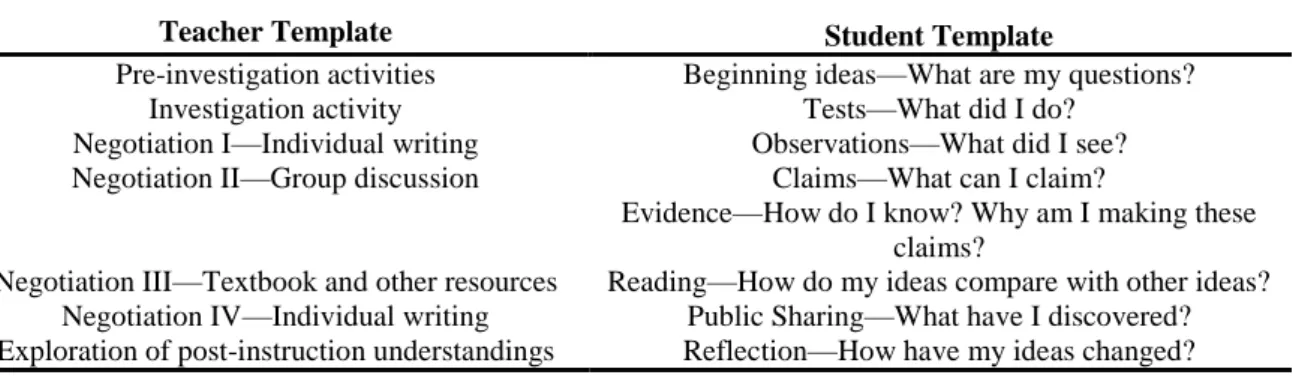
Table 2. Science Writing Heuristic: Inquiry Templates
Teacher Template Student Template
Pre-investigation activities Beginning ideas—What are my questions?
Investigation activity Tests—What did I do?
Negotiation I—Individual writing Observations—What did I see? Negotiation II—Group discussion Claims—What can I claim?
Evidence—How do I know? Why am I making these claims?
Negotiation III—Textbook and other resources Reading—How do my ideas compare with other ideas? Negotiation IV—Individual writing Public Sharing—What have I discovered? Exploration of post-instruction understandings Reflection—How have my ideas changed?
Research Examining Science Literacy Development
Over the past two decades, a number of studies (e.g., Keys, Hand, Praın, & Collıns, 1999; Hohenshell & Hand, 2006) collectively have shown that connecting language arts activities to science inquiry has been beneficial for middle and high school students. Studies highlighted the importance of teaching reading strategies for increasing science textbook comprehension (Romance & Vitale, 1992) and the importance of peer discussion combined with analytical writing for better science knowledge retention (Rivard & Straw, 2000). In a study of middle shool studnets, Hand, Wallace, and Yang (2004) found that the expereimental group that integrated both science argumentation and non-traditional writing significantly outperformed both the control and the science-argumenatation-only groups on science concept knowledge. Similar results were reported in a study of high school students (Yore et al., 2004).
Yet, as pointed out by Hand & Prain (2006), more research is needed into the conceptualization and implementation of effective teaching and learning strategies to develop student science literacy development, particularly at elementary level. In response to the above-identified need (see also Smith, Phillips, Norris, Guilbert, & Stange, 2006; Moller & Hug, 2006), the aim of the present study was to extend previous research on science-literacy integration effectivness to elementary educational level. More specifiacally, the study focused on identifying and describing teaching actions supportive of the cross-disciplinary literacy expectations necessary to compete in the 21st Century. The following research question guided this study: “How does the SWH approach enhance teaching and support learning in science and language for each student in elementary classrooms?”
Method
This article reports on qualitative findings from a mixed method, 3-year research study using the SWH approach in cooperation with two universities, area education agencies, and five school districts.
Research Participants
Study participants were recruited—with school district administrators’ assistance—from five elementary schools (1 urban, 4 rural; 1 poverty site) taking part in a three-year SWH implementation project. Due to professional and personal circumstances (e.g., transfer, retirement), the number of participating teachers varied with a maximum of 32 participating teachers in Year 2 (100% White; 87% female; teaching experience range: 2-28 years). Overall, the project serviced over 700 students (69% White, 14% Black, 12% Hispanic, 4% Asian, 1% American Indian; 48% female; 11% special education; 23% free/reduced-price-lunch status).
Intervention Procedures
learners and, across program participation years, focused on a different science content area (chemistry, physics, and biology in Years 1, 2, and 3, respectively). At the close of each PD day, teachers self-reflected by responding to the following question, “What implications does what I have just experienced have for my own classroom?” After five days of this cycle, teachers collaborated in grade-level teams on planning SWH units applying an SWH “lens” to schools’ science and literacy curricula. The school year PD had a “sharing sessions” format: The teachers discussed their celebrations and frustrations and engaged, once again, in the SWH approach as learners paying particular attention to language connections and to refining their units based on lessons learned. The SWH implementation progressed from two units in Year 1, to four units in Year 2, and to the entire science curriculum taught through the SWH approach in Year 3.
The SWH PD workshops were facilitated by the research team (2 university faculty, 9 [under]graduate assistants, 4 Area Education Agency consultants), experienced SWH teachers, and university scientists impelemtning the SWH approach in college teaching. The research team also provided ongoing feedback and support to teachers in developing and implementing SWH units and participated in data collection and analyses.
Data Sources
Data sources for the qualitative portion of the investigation included participant observations, video-taped lessons, interviews with teachers and students, and artifacts. These varied data sources were collected to lend depth to the descriptions, analyses, and interpretations.
Participant Observations
Teachers in the project submitted two videotaped teaching sessions (1 in the fall, 1 in the spring) for each of the three project years. In addition, the research team visited each teacher weekly during SWH unit implementation metting with the teachers prior to each observations to get a sense of the planning, areas of teacher concern (e.g., implementation of certain SWH techniques), and students needs. During observations, researchera took detailied field-notes focusing in particular on areas of teacher concern and audio recorded student-teacher dialogues for later analyses. The observations concluded with researcher-teacher de-briefs of the observed teaching sessions. Interviews
Formal interviews with teachers, typically conducted on the last school year PD day, focused on four main topics: (a) teaching and learning background, (b) experiences in science and literacy in teachers’ own schooling, (d) examining the processes of adding the SWH approach to the teachers’ existing repertoires, and (e) student learning processes in SWH classrooms. While the first two topics were central to Year 1 interviews, the last two topics were central to those conducted in Years 2 and 3. (The interview protocols are available upon request.) Student interviews were conducted with case-study participants (students representing varying degrees of response to SWH implementation). Informal interviews occurred often during classroom visits as teachers shared anecdotes of student learning and researchers asked children to comment on particular SWH-embedded learning activities and processes.
Artifacts
Artifact collectionincluded teacher and student concept maps, unit plans, teacher written reflections, and student writing samples. With regard to the latter, teachers were asked to submit four samples of student writing from each year of program participation (2 at the beginning and end of the year, respectivly; 2 from the fall and spring SWH unit implementation). These samples were analyzed to examine students’ science content knowledge and literacy skills development. Other examples of collected artifacts included science notebooks and photographs documenting the learning processes.
Data Analyses
Data were analyzed using the constant comparative method (Miles & Huberman, 1994). Both micro-level examinations of individuals and small groups and macro-level examination of the classrooms were integral to the analyses while maintaining an awareness of, and an appreciation for, the ongoing development of the individuals that comprise larger groups. For triangulation purposes, field notes from observations, interviews, and other artifacts were analyzed concurrently looking for patterns and connections across all data sources (Bogdan & Biklen, 2006). The analyses of transcribed field notes and interviews were supported by a qualitative data analysis software tool. Emerging coding schemes were negotiated and agreed upon by at least three members of our research team. In addition, to provide an insider perspective on the data, a procedure called collaborative interpretation in which transcribed field notes or interview transcripts were given to the teachers for analysis and interpretation was used. This insight provided an important venue to validate our emerging understandings of the data. Finally, the emergent findings were critically examined by outside members of academia on an ongoing basis to ensure content validity of the analyses.
Results and Discussion
The analysis of multiple layers of data identified two essential teaching action categories supportive of academic literacy and thinking skills development among students in SWH classrooms: (a) building an inquiry-based literacy community of social learning, further referred to simply as the social learning community and (b) purpose setting, with a gradual shift of responsibility from the teacher to the student. This, in turn, contributed to a more complex conceptual understanding of science content through argumentation, an increased motivation to engage in literacy events including in reading and writing, and a stronger use of writing for a variety of purposes and audiences. After an initial description of a literacy framework through which data were analyzed, we explore these two key categories in detail.
A Model for Consideration: Examining the Science-Literacy Event
Social Learning Community
Figure 1. An integrated science-literacy model characteristic of SWH classrooms (adapted from the Iowa Department of Education [1986] and Kucer [2009]).
the curriculum. While analyzing evidence from this study, we found the model worth re-considering to better reflect our emergent understandings of teacher actions supportive of cross-disciplinary literacy development among young students.
Unlike in the original model, purpose, a drive behind any literacy event that can be teacher- or student-defined, is situated in the center of the layered literacy wheel. From there, we situate the layers of function, form, and audience around the outside of the purpose. The social learning communitybox around the outside of the model identifies the sociocultural context of the classroom and community in which students and teachers function on a daily basis allowing a place to negotiate meaning and understanding to support individual and collective learning. We see these layers as spinning, always adapting to meet the communicative needs of the classroom during each science-literacy event. Building on Kucer (2009), any science-literacy event is perceived as taking a “slice” out of the layers of negotiated meaning keeping purpose always at the center of the work of students and teachers in classrooms and with each of the layers providing added support and a means for carrying out the work in learning and negotiating meaning in classrooms. In the following sections we report our findings in relation to the model.
Purpose Setting
“I love the way that we do science now than how we did science in fourth grade because I learn more, I get to do more. I actually feel like I am smart.” (Elizabeth, fifth grade, all names are pseudonyms)
The analyses of multilayer data revealed that purpose setting, with a gradual shift of responsibility from the teacher to the student, was a key component that supported science literacy development among students. This, in turn, provided conditions for multiple layers of negotiated science literacy meanings to unfold by engaging students in heuristic language development (mastery of function) through multiple communication modes (mastery of form) and by fostering their ability to tailor their communication as appropriate for a given purpose (consideration for audience).
Purpose
While reflecting on student learning in SWH classrooms during interviews, summer workshop planning sessions, and de-briefing sessions after formal observations, teachers frequently used the term “purpose.” In response to the student comment above, for example, Ms. Winter (Elizabeth’s teacher) explained:
I think many of the students feel as Elizabeth does. Science is now intriguing ... thought-provoking and mentally challenging, hard work. But they love it! And why do I think this is happening? Hmmmm . . . well, I know there is a purpose to it now and more than it being my purpose—it is a purpose they can buy into, too.
One example of such purpose-driven work came from a third-grade grade classroom. The teacher began a unit on matter by placing a sample of milk on each of the worktables and asked students working in small groups (3 to 4 students) to generate a list of questions that they had about milk. The students, then, negotiated with each other regarding what they believed was a testable question (i.e., a question that can be investigated through experimentation). The questions from each table were then made public and, after deliberation, the whole class decided to investigate how long it would take for milk to spoil. While the resulting smell was a talking point throughout the school, the students raced to read informational text to determine what was the stuff floating on the top, they recorded their claims and evidence with great enthusiasm, and engaged in a range of writing tasks throughout the unit including writing their observations directly on the paper towel under their cups of milk. Importantly, students became actively involved in learning the critical science concepts related to states of matter, including density and the importance of temperature.
Such purpose-driven work, in turn, increased student motivation to engage in literacy events including in reading and writing. One fifth-grade teacher observed:
read—when it is appropriate, when there is a purpose to write. The inquiry and interest function in a way to push us to act in more literate ways.
Another, second-grade teacher—who was required to collect 70 examples of writing per year per student as part of the intensive focus on writing within her district—shared that while she really struggled to get the students to produce writing samples in other subjects, she had collected over 300 samples for each student from her SWH sessions. The teacher observed that when her students had a range of purposes (e.g., answering group-generated questions, writing claims and evidence, producing summary reports for others to read)—they truly wanted to write.
Examining the teachers’ uses of the term “purpose,” we came to define purpose as something that happened during the initial stages of individual science-literacy events with teachers (or the students) setting the “big idea”—the focus, the overarching purpose for learning—devising activities and investigations to actively explore the “big ideas,” and focusing on collective knowledge co-creation.
Function
To examine the idea of function and the relationship between purpose for learning and the functions of language that appeared in student learning, we returned to the field notes and videotape transcripts and looked at a series of science-literacy events as they occurred during SWH sessions. The observed science-literacy events were coded using a combination of Smith’s (1977) uses of language and Pinnell’s (1985) functions of language. Because our study focused on identifying and describing teacher actions supportive of cross-disciplinary literacy development, our analyses primarily focused on examining the heuristic function (seeking and testing new knowledge), in particular, as it related to the informative (communicating factual information), personal (expressing individuality and personality, awareness of self, pride), and imaginative (creating new worlds, making up stories, poems) functions. Other functions identified by Pinnell (1985) and Smith (1977) that were outside of the scope of this investigation include: interactional, getting along with others, maintaining and establishing relationships; instrumental, satisfying material needs or desires; and regulatory, controlling the behavior, feelings, and attitude of others. Analyses across data sources revealed a reliable association between levels of SWH implementation and teachers’ and students’ use of language functions.
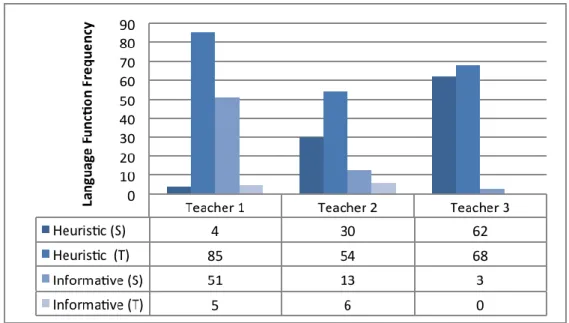
In a focused presentation of these findings, we first examine patterns of the heuristic function use—contrasted to those of informative function use—as exemplified by observation analyses of three teachers’ classrooms during second year of SWH implementation. All three teachers worked in second-grade classrooms, but represented different levels of SWH implementation. That is, while Teacher 1 was a low implementer, Teachers 2 and 3 were a medium and a high implementer, respectively. Figure 2 summarizes language function frequencies tallied during one class period, separately for teachers and students (coding examples are available upon request). The results indicated that greater success in implementing the SWH approach was associated with students’ using the heuristic function of the language more frequently; progressing from a very low frequency (n = 4) in the low SHW implementation classroom (Teacher 1), to substantially greater frequencies in higher implementation classrooms (n = 30 and n = 62, for Teachers 2 and 3, respectively). This tendency was reversed for the informational function. Further, while Teacher 1 herself used heuristic function the most frequently (in comparison to Teachers 2 and 3), her students were most frequently engaged in informative, rather that heuristic language use. This relationship between teacher and student use of the heuristic function was more balanced in higher SHW implementation level classrooms.
Figure 2. Patterns of heuristic and informative functions use in three second-grade case study teachers. One example of the relationships between personal and heuristic language functions is a kindergarten classroom in which students devised experiments as part of their push-pull science unit. As Dominic displays his ability to make a claim, he writes, “I think that those dominoes could surround those other dominoes and then the dominoes can knock down other ones.” His illustration, in turn, demonstrated his frustration (sad face) as he had completed his investigation: The table shook and gave him the evidence to support his claim when his dominoes collapsed. In this case, we observe that writing—supported by the more familiar, personal function expressed through the drawing of his personal reactions to the experiment—allowed Dominic to explore the heuristic function of the language and provided purpose for him to explain his developing understanding of physics, force and motion, from his 5-year-old perspective.
In another example taken form a third grade, we observe an interaction between multiple functions of language as a small group of girls decided to invoke the imaginative function of the language as they designed a play about “The Forest of Matter” to express their new understandings about the states of matter. During their process, the students negotiated out loud about how the setting, plot, and characters could represent their developing science knowledge. With ease, the students moved from using oral language to written language while negotiating understanding from informing, to imagining, to using the heuristic function of the language. In these examples taken from our observations and field-notes we observe several teacher actions to support student learning. In the first example, the teacher encouraged her students to explore their own ideas about push and pull while scaffolding their use of the heuristic function. Prior to the investigation and to help her young students understand what it meant to make a claim and support it with evidence, the teacher began by giving each child a “secret” item hidden in a brown paper bag. The children, then, brainstormed as a group what could be in the bag as the teacher recorded these “claims” on a chart paper for all to see and used the term “claim” repeatedly so the children became familiar with the word. Next, the children were allowed to pick up the bag— the children shook the bag, felt the object through the bag, stuck their hand in the bag without looking—each time they went back to the chart and crossed off any claims that no longer applied given the evidence they just gathered. On the day following the exploration of initial ideas of “claim” and “evidence,” the students were given dominoes to explore the idea of push and pull on their own. In the second example, we observe the teacher shifting the ownership of learning to her students by giving the students an option of independently selecting the means for expressing their emergent understanding of matter while building on their everyday and previously acquired language functions (i.e., personal, imaginative, and informative).
In these examples we also observe that purpose and function do not exist in isolation and there was a need to examine this further by considering language form, defined in this paper as the communication mode (i.e., talking, listening, reading, writing, viewing, and visualizing).
Throughout our data, we were able to see that purpose and function were not limited to oral language but were seen and heard across all communication modes. These observations identified three additional processes that facilitated science literacy development in SWH classrooms, namely: (a) public defense and debates of claims and evidence served as a means for active negotiation of learning through talk; (b) access to broad reading materials linked to a purpose for reading in science provided for high-level engagement with informational text; and (c) ongoing writing activities (e.g., recording observations, taking notes, writing claims, gathering evidence and summary writing experiences) served as a means for constant negotiation of understanding through text construction. These findings suggest that reading, writing, and talking are not and should not be viewed as separate activities to support learning.
This integrated approach to using talking, reading, and writing as means for learning is exemplified in an excerpt from Ms. Tucker’s written reflection:
When we started our first unit, I had the kids brainstorm their questions about the topic. We put these on sticky notes and organized them on the board. After students shared their questions, I had the class decide if each question was researchable or testable and then we put that question under the correct heading on the board next to our concept map. The testable questions were then where our investigations began. I dealt with the researchable questions by letting students choose a question to research. They then went to non-fiction books to locate answers to the questions. Students had to find answers from three different sources. This allowed students to see if authors or experts agreed. Some students found authors didn’t always agree and therefore this led to further discussions. After their research, students then shared the answers with the rest of the class.
In this account, the teacher perceived herself and her students as fluidly navigating multiple communication modes as student discussed their initial and developing ideas, wrote and sorted out their questions, and read informational texts in order to investigate their own questions. In an interview with another teacher, Ms. Fox reported on an interplay she found between the content of student journaling and that of subsequent scientific arguments in a whole class format. For her, journal writing was a tool for students to reflect on their learning as well as a means for her to identify her students’ misunderstandings and misconceptions. A discussion, in turn, served to make the learning process public, to “pull thoughts together,” and to address misconceptions through argumentation. She elaborated:
In a lesson on the states of matter and characteristics of each state, students share out information about what they know. In one case, a student shared that a liquid fills the container it’s in, so the students argued about if it was true. In the end students had decided that a liquid takes the shape of that container [. . .] and that a gas fills the container it’s in.
A group of fourth-grade students provided yet another example of learning across communication modes. These students drew on their previous reading experiences to represent, in writing, their learning about rocks and minerals. One of the students remembered a book from her childhood (Eric Carle’s The Very Hungry Caterpillar, 1986), which was designed in a way to show the layers of food that the caterpillar consumes. The students used the same concept to describe the layers of rock and wrote their own books accordingly in a layered-book format. In a preschool classroom focusing on animal needs—where the teacher had been discussing with her students what it meant to make a claim—Amanda shows her developing understanding when shows her teacher her written work, “Look, I made a claim, ‘Duck swimming.’” In this example, not only does Amanda make her first claim, but she also demonstrates her emergent understanding that writing is a way to communicate her knowledge to others.
In these examples, we observe several teacher actions to support student learning, namely, encouraging public discussion of claims and evidence, providing students with informational texts linked to the “big idea” of the lesson, and providing ongoing writing to learn support. In the next section, we explore ways in which teachers supported students understanding of audience and writing to different audiences—a key consideration in SWH classrooms.
Audience
included: kindergarteners creating individual photo essays to document properties and to turn these essays into books to teach their parents about science properties; second graders writing to their university student pen pals about how to make a claim and to gather evidence to solve a murder mystery; third graders writing a play for their classmates to showcase their learning about matter; and fifth graders creating travel brochures using persuasive language to entice an unknown visitor to consider a trip to their preferred environment (biome) or writing letters to the body, on behalf of body parts they had been investigating, to explain what they have learned about body systems.
Examination of student writing samples revealed a developing ability among students to tailor their communication as appropriate for a given purpose and audience as exemplified by the appropriate use of (a) format and (b) linguistic devices. With regard to the former, we observed students’ creating lists and jotting down notes and definitions when writing was directed to self and creating extended reports, booklets, plays, and letters when writing was directed to unknown audiences (e.g., high school pen pals) and to known or imagined audiences (e.g., classmates, human body). As students changed the format for their writing to better fit their audiences, we also observed their ability to adjust the use of linguistic devices that are most appropriate for the chosen format. Examples of such sophisticated language use included the use of bullets to differentiate items in a list, the use of connective devices to construct a cohesive narrative, and the use of formal conventions when writing plays and formal letters.
Analyses of teacher data identified two strands in teacher actions that fostered students’ developing understandings of audience and writing to different audiences, namely (a) discussions about purpose in science writing and (b) explicit instruction focusing on the mechanics of language use through what we term “just-in-time teaching” (Norton-Meier et al., 2008). The first strand in teacher actions is exemplified by the following quote from a teacher:
At the beginning of the year, each student decorates the front of their notebook so that it reflects their interests in science. Most kids cut out pictures and words from magazines to personalize their cover. We also divide the notebook into sections, for example, Buzz Words, information from others, inquiry, and reflection. We made tabs to label each section. We also spent time discussing how scientists use notebooks and how they would use their notebook to record their investigations and learning throughout the year.
In examining this account, we can clearly identify the teachers’ multilayer purposes for learning when using science notebooks. These purposes are to introduce students to the ideas that science writing is used to create knowledge both in and outside school settings and that science writing has many purposes, typically expressed through different genres (Schleppegrell, 2004), including (a) expressing one’s own science interests (personalized covers), (b) documenting procedures and evidence (inquiry section), (c) science explanation (reflection section), and (d) science argumentation—comparing one’s findings and interpretations against those of others (information from others section).
The second strand is exemplified by teachers’ providing students with explicit instruction focusing on mastery of lexico-grammatical means (Schleppegrell, 2004) to express meaning when “students need it with purpose” (Norton-Meier et al., 2008, p. 58). Across observations we have seen teachers providing such “just-in-time-teaching” at word-, sentence-, and discourse-levels. A word-level example included a teacher’s introducing students to scientific terminology (see an earlier example on “claim” and “evidence”). Sentence-level examples included sentence starters (e.g., “How can I...?” “What affects...?”) to support students’ formulating questions, claims, and justifications and focusing on the mechanics of writing questions. A discourse-level example included a teacher providing a mini-lesson on cohesive devices to help students to write a summary paragraph on their most recent investigation. In other words, teacher actions in these examples focused on building both the mechanics of language and the use of language as a meaning-conveying tool as they related to audience and purpose for writng.
Conclusion and Recommendations
From a classroom structure perspective, key teacher actions included creating conditions in which students engaged in practices (generating claims, devising appropriate approaches to data collection, collecting evidence, and, ultimately, building understandings of natural phenomena) that are reflective of those typically found in science communities and shifted instructional focus from teaching to learning by engaging students in shared, as well as individual, meaning construction.
From an instructional point of view, key teacher actions included purposefully centering instruction on the “big ideas” of science, scaffolding student uses of the heuristic function while building on their everyday and previously acquired language functions, encouraging public discussion of claims and evidence, providing students with informational texts linked to the “big idea” of the lesson, providing ongoing writing to learn support, and building both the mechanics of language use and the use of language as a meaning-conveying tool as appropriate for a given communicative purpose and audience.
These teaching actions, in turn, provided for students’ developing key literacy skills including engagement with complex conceptual understandings of science through inquiry, informational text, and argumentation and the development of more formal, canonical forms of reasoning in science expressed through multiple language modalities and tailored to the demands of the discipline, audience, and purpose. Importantly, these teaching actions contributed to the elementary students’ increased motivation to engage in literacy events including writing and reading.
In our guiding assumptions described at the beginning of the manuscript (see Table 1), we recognize that there is no science without language. To meet the new literacy demands of the 21st century, we as a profession, need to think differently about instruction, curriculum design, and implementation. In many educational settings, science is being left out of the curriculum because of the prevailing focus on literacy and mathematics. However, this research demonstrates that when science and language processes are intertwined, we can see interesting developments in student learning. In this study, we have seen developments in students’ use of informational texts, expanded purposes for reading and writing, and the ability for students to support a claim by backing it up with evidence from both science inquiry and consulting the experts (using multiple texts). This research contributes to an understanding of the synergy between science inquiry and language development in reading, writing, speaking, and listening and of the teacher actions supportive of such synergy. Literacy is often seen as isolated from the content area when in reality language processes are critical to teaching and learning in science.
In our research, we came to an understanding that while science knowledge development and expression cannot exist without language (after all, we cannot explain old or construct new science knowledge without language, be it mathematical, graphical, verbal, or iconic), so cross-disciplinary language and literacy knowledge development cannot exist without authentic applications characteristic of the disciplines. In SWH classrooms, the lived experience of science, created through teacher actions, requires students to engage in all the demands of language as a means to learn science and so serves as a foundation for literacy and language development. Because of the very nature of the framing experience—namely, the immersion into authentic language uses rather than adherence to formulaic uses of language—subsequent instruction involves teacher actions enabling students to move effortlessly between the two disciplines and ultimately enables the development of both.
Acknowledgements or Notes
The project featured in this paper was funded by the State of Iowa through a Math-Science Partnership and by the National Science Foundation (ESI - 0537035). The opinions and interpretations herein are solely that of the authors.
References
Amaral, O. M., Garrison, L., & Klentschy, M. (2002). Helping English learners increase achievement through inquiry-based science instruction. Bilingual Researcher Journal, 26(2), 213-239.
Andre, T., Whigham, M., Hendrikson, A., & Chambers, S. (1999). Competency beliefs, positive affect, and gender stereotypes of elementary students and their parents about science versus other school subjects. Journal of Research in Science Teaching, 36, 719-748.
Carle, E. (1986). The very hungry caterpillar. New York, NY: Penguin Young Readers Group.
Cazden C. B. (2001). Classroom Discourse: The language of teaching and learning (2nd edition). Portsmouth, NH: Heinemann.
Dewey, J. (1938). Experience and education. New York: Collier MacMillan.
Driver, R., Newton, P., & Osbourne, J. (2000). Establishing the norms of scientific argumentation in classrooms. Science Education, 84(3), 287-312.
Duschl, R., Ellenbogen, K., & Erduran, S. (1999). Middle school students' dialogic argumentation. In M. Komorek, H. Behrendt, H. Dahncke, R. Duit, W. Graber, & A. Kross (Eds.), Research in science education: Past, present and future. Proceedings of the Second International Conference of the European Science Education Research Association (ESERA), 1/2, 420-422.
Fang, Z. (2008). Going beyond the fab five: Helping students cope with the unique linguistic challenges of expository reading in intermediate grades. Journal of Adolescent & Adult Literacy, 51(6), 476–487. Galbraith, D. (1999). Writing as a knowledge-constituting process. In M. Torrance & D. Galbraith (Eds.),
Knowing what to writing: Conceptual processes in text production (pp. 139-159). Amsterdam: Amsterdam University Press.
Gallas, K. (2003). Imagination and literacy: A teacher’s search for the heart of learning. New York, NY: Teachers College Press.
Geertz, C. (1983). Local knowledge: Further essays in interpretive anthropology. New York, NY: Basic Books. Goodman, Y. M. (2003). Valuing language study: Inquiry into language for elementary and middle schools.
Urbana, IL: National Council of Teachers of English. Gowin, D. (1981). Educating. Ithaca, NY: Cornell University Press.
Halliday, M. A. K. (1975). Learning how to mean. London, UK: Arnold Press.
Hand, B. & V. Prain (2006). Moving from border crossing to convergence of perspectives in language and science literacy research and practice International Journal of Science Education, 28(2–3), 101– 107.
Hand, B., & Keys, C. (1999). Inquiry investigation. The Science Teacher, 66(4), 27–29.
Hand, B., Prain, V., & Yore, L. D. (2001). Sequential writing tasks’ influence on science learning. In G. Rijlaarsdam (Series Ed.) & P. Tynjälä, L. Mason, & K. Lonka (Eds.), Writing as a learning tool: Integrating theory and practice (pp. 105-129). Dordrecht, Netherlands: Kluwer.
Hand, B., Wallace, C., & Yang, E. (2004). Using the science writing heuristic to enhance learning outcomes from laboratory activities in seventh grade science: Quantitative and qualitative aspects. International Journal of Science Education, 26, 131-149.
Hohenshell, L., & Hand, B. (2006). Writing-to-learn strategies in secondary school cell biology. International Journal of Science Education, 28, 261–289.
Iowa Department of Education. (1986). A guide to curriculum development in the language arts. Des Moines, IA: Iowa Department of Education.
Keys, C. W., Hand, B., Praın, V. & Collıns, S. (1999). Using the science writing heuristic as a tool for learning from laboratory investigations in secondary science. Journal of Research in Science Teaching, 36, 1065–1084.
Kucer, S. B. (2009). Dimensions of literacy: A conceptual base for teaching reading and writing in school settings (3rd ed). Mahwah, NJ: Routledge.
Lemke, J. (1990). Talking science: Language, learning, and values. Norwood, NJ: Ablex.
Miles, M. B., & Huberman, M. (1994). Qualitative data analysis: An expanded sourcebook (2nd ed.). New York, NY: Sage Publications.
Moje, E. B, McIntosh-Ciechanowski, K., Kramer, K., Ellis, L., Carrillo, R., Collazo, T. (2004). Working toward third space in content area literacy: An examination of everyday funds of knowledge and Discourse. Reading Research Quarterly, 39(1), 38–70.
Moll, L. C., & Whitmore, K. F. (1996). Vygotsky in Classroom practice: Moving from individual transmission to social transmission. In E. A. Forman, N. Minick, & C. A. Stone (Eds.), Contexts for learning: Sociocultural dynamics in children's development (pp. 19-42). New York: Oxford University Press. Moller, K. J., & Hug, B. (2006). Connections across literacy and science instruction in early childhood
education: Interviewing disciplines in pre-service education. In J.V. Hoffman, D. L. Schallert, C. M. Fairbanks, J. Worthy, & B. Malocj (Eds.), 55th Yearbook of the National Reading Conference (pp. 195–211). Oak Creek, Wisconsin: National Reading Conference.
Norris, S. P. & Phillips, L. M. (2003). How literacy in its fundamental sense is central to scientific literacy. Science Education, 87, 224-240.
Norton-Meier, L., Hand, B., Hockenberry, L. & Wise, K. (2008). Questions, claims, & evidence: The important place of argument in children’s science writing. Portsmouth, NH: Heinemann.
Novak, J. D. (1977). A theory of education. Ithaca, NY: Cornell University Press.
Nystrand, M., & Duffy, J. (Eds.). (2003). Towards a rhetoric of everyday life: New directions in research on writing, text, and discourse. Madison, WI: University of Wisconsin Press.
Pinnell, G. S. (1985). Ways to look at the functions of children’s language. In A. Jaggar, & M. T., Smith-Burke (Eds.), Observing the language learner (pp. 57-72). Newark, DE: International Reading Association. Rivard, L. P., & Straw, S. B. (2000). The effect of talk and writing on learning science: An exploratory study.
Science Education, 84(5), 566-593.
Romance, N. R., & Vitale, M. R. (1992). A curriculum strategy expands time for in-depth elementary science instruction by using science-based reading strategies: Effects of a year-long study in grade four. Journal of Research in Science Teaching, 29, 545-554.
Saul, E. W. (2003). Crossing borders in science and literacy instruction: Perspectives on theory and practice (Vol. 1). Newark, DE: International Reading Association.
Scarcella, R. (2003). Academic English: A conceptual framework (Tech. Rep. No. 2003-1). Irvine: University of California, Linguistic Minority Research Institute.
Schleppegrell, M. J. (2004). The language of schooling: A functional linguistic perspective. Mahwah, NJ: Lawrence Erlbaum.
Smith, F. (1977). The uses of language. Language Arts, 54 (6), 638-644.
Smith, M. L., Phillips, L. M., Norris, S. P., Guilbert, S. L. & Stange, D. M. (2006). Scientific literacy and commercial reading programs: An analysis of text and instructional guidelines. In J.V. Hoffman, D. L. Schallert, C. M. Fairbanks, J. Worthy, & B. Malocj (Eds.)., 55th Yearbook of the National Reading Conference (pp. 293-308). Oak Creek, Wisconsin: National Reading Conference.
Vygotsky, L. V. (1962). Thought and language. Cambridge, MA: The M.I.T. Press. Vygotsky, L. V. (1978). The mind in society. Cambridge, MA: Harvard University Press.
Wallace, C. S., Hand, B., Prain, V. (2003). Writing and learning in the science classroom. Dordrecht: Kluwer Academic Publishers.
Warren, B., Ballenger, C., Ogonowski, M., Rosebery, A., & Hudicourt-Barnes, J. (2001). Rethinking diversity in learning science: The logic of everyday sense-making. Journal of Research in Science Teaching, 38(5), 529–552.
Yore, L. D., Bisanz, G. L., & Hand, B. (2003). Examining the literacy component of science literacy: 25 years of language arts and science research. International Journal of Science Eduction, 25(6), 689-725.
![Figure 1. An integrated science-literacy model characteristic of SWH classrooms (adapted from the Iowa Department of Education [1986] and Kucer [2009])](https://thumb-us.123doks.com/thumbv2/123dok_us/7928629.2108456/6.892.224.669.597.1049/figure-integrated-science-literacy-characteristic-classrooms-department-education.webp)