www.ijemst.com
Evaluation
of
the
Effects
of
Argumentation Based Science Teaching
on 5
thGrade Students’ Conceptual
Understanding of the Subjects Related to
“Matter and Change”
Derya ÇINAR1, Şule BAYRAKTAR1
1Necmettin Erbakan University
To cite this article:
Cinar, D. & Bayraktar, S. (2014). Evaluation of the effects of argumentation based science
teaching on 5
thgrade students’ conceptual understanding of the subjects related to “matter
and change”.
International Journal of Education in Mathematics, Science and Technology,
2(1), 49-77.
This article may be used for research, teaching, and private study purposes.
Any substantial or systematic reproduction, redistribution, reselling, loan, sub-licensing,
systematic supply, or distribution in any form to anyone is expressly forbidden.
Authors alone are responsible for the contents of their articles. The journal owns the
copyright of the articles.
Volume 2, Number 1, January 2014, Page 49-77
ISSN: 2147-611X
Evaluation of the Effects of Argumentation Based Science Teaching on 5
thGrade Students’ Conceptual Understanding of the Subjects Related to
“Matter and Change”
Derya Çınar1*, Şule Bayraktar1 1
Necmettin Erbakan University
Abstract
The aim of this study is to evaluate the effects of Argumentation Based Science Teaching on 5th grade students’ conceptual understanding of the subjects related to “Matter and Change”. This research is a qualitative research and its design is a multiple (compare) case study. In this study, semi-structured interviews related to the concepts were conducted before and after the experimental period in order to assess students’ conceptual understanding. The result of the study showed that students who have been trained with argumentation-based science teaching approach showed progress in conceptual understanding. In addition, it has been observed that students were able to explain these concepts with correct warrants and connect them with everyday life.
Key words: Argumentation, Science Teaching, Conceptual Understanding
Introduction
In recent years, studies in the field of education reflected the importance of argumentation on scientific knowledge acquisition, construction and the development of mental activities. New learning and teaching approaches are intended to develop students’ scientific speaking skills in science subjects, especially in science and technology education. Viewed from this perspective, argumentation is also a helping tool which has a particular importance for scientific speaking to develop scientific knowledge (Erduran, Ardaç and Güzel, 2006). For this purpose, the role of scientific argumentation on students’ improving themselves on the creation of scientific knowledge and learning issues should be taken into consideration. When the importance of knowledge that individuals have in the social life is considered, the importance of the argumentation activities in science teaching is understood better. In case appropriate argumentation activities are presented and evaluated in classrooms, it is possible for students to make claims which are compatible with these activities and understand the claims of science better (Driver, Newton and Osborne, 2000). The aim of science teaching oriented with scientific argumentations is to make students combine in conceptual and epistemic aims and as teachers or trainers, the aim is to lead students to think scientifically and reason (Osborne, Erduran and Simon, 2004a). During science teaching, critical thinking skills and scientific argumentations that enable them to understand science as a way of knowing rather than informations about scientific phenomena should be emphasized (Driver et al., 2000). If scientific thinking skills imparted to students, they will also develop science process skills. Therefore, students will change their perspectives about the world and events, and their critical thinking skills will develop.
Scientific Argumentation
The origin of argumentation activities is based on the ideas of philosopher Aristotle. Argumentation has different definitions one of which is relevant to science education: argumentation as a social and intellectual activity including an intellectual refutation or verification, directly obtaining the approval of the listener (van Eemeren, 1995). Argumentation, has also been defined as an environment that enhance students’ thinking process (Ohlsson, 1995) or putting forward ideas about a scientific subject, backing, criticizing, and evaluating process (Kuhn, 1992).By providing valid and acceptable alternative ideas on the focus of argumentation, there
*
Corresponding Author:
are intra-group or individual interactions to convince the opposite side (Clark and Sampson, 2007). As for the common feature of these definitions, argumentation is a process of reaching conclusions by judging data in evaluating the alternative perspectives and alternative solutions.
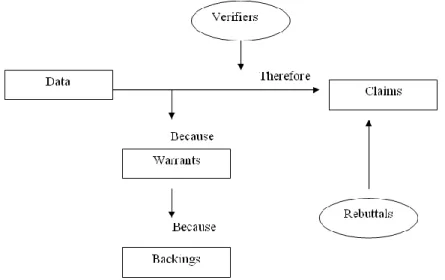
According to Toulmin (1958), scientists use arguments to relate the evidencethey select to theclaimstheyreach through use of warrants and backings. Toulmin (1958), has given a model in his book, "The Uses of Argument", describing the essential elements of argument and showing the functional relationship between them to explain how an argument should be. This model is used for the analysis of the argument in many fields, including science teaching (Driver et al., 2000). Toulmin's model of argument has 6 items: data, claim, warrant, backing, qualifier, and rebuttal. Toulmin’s Argument Pattern (TAP) is given in Figure 1.
Figure 1. Toulmin’s Model of Argumentation Toulmin’s elements of argument are described below (Kaya, 2005):
Data; are the evidence, knowledge, and facts that form the claim. Data form the basis for the establishment of argumentation. Data; may be an example (someone else's anecdotes or events we see around us, phenomena), witness (someone's opinions or views, statements) or statistical information.
Claim, is the primary objective of an argumentation. It represents the idea of the discussants argued about. They are the results whose accuracy is to be determined.
Warrant; provides logical relationships between data and claim. It explains how individual creates claims by evaluating data (reasoning process). It explains how the claim is reached by means of the data to the audience. Backing; strengthens the warrants, allows the audience to understand the reason in the argumentation. Audiences inquire the accuracy of the warrant in the argumentation by backing, or the audience may not accept that the claim is correct when they encounter with non-reliable backing. Therefore, backings allow credibility for claims. Backings may be personal, example, or statistical information like data.
Rebuttal, is the situation or exception in which one of the ideas would not hold true in the argument. In the model of argumentation, while the warrant validates progress from data toward conclusions, backings are the assumptions that reveal the accuracy of the warrant.
Qualifier, determines that under which conditions the claim is true.
In this study, the course was taught using argumentation-based science teaching approach, course materials have been prepared based on Toulmin's Argument Pattern (TAP).
Argumentation and Science Teaching
1. Expressions Table: a table which consists of true or false statements about the studied topic of science is presented to students and they are asked to choose one of these statements. S/He discusses why s/he chooses that statement.
2. Concept maps: a concept map is prepared by surveying the literature on students’ understandings of the studied science subjects. Concepts and connections in this concept map are discussed individually and in small groups in the classroom.
3. Experiment report: the experiment reports and findings of the report performed by other students are given to the students and they are engaged in discussion.
4. Competing theories with concept cartoons: two or more competing theories is given to students in the form of a concept cartoon.
5. Competing theories with a story: written stories are given to students and they are engaged in discussion. 6. Competing theories with evidences and ideas: two or more physical events are presented, but preferably two explanations are given. Students choose one of them that they think as correct one and discuss about their reason.
7. Creating an argument: a physical phenomenon such as the formation of day and night is given. A statement about this incident is done, and preferably four statements are presented. Students are requested to choose the correct statement according to them and to discuss about their reasons.
8. Predict-Observe-Explain: Students are introduced with an experiment or an activity and asked to predict what will happen as a result of the experiment before doing the experiment. Then the experiment is performed. In the last stage students are asked to compare the results with their predictions and discuss the reasons for differences between their predictions and the observations.
9. Designing an experiment: by giving a hypothesis, students are asked to design experiments about it and discuss. In this study, except competing theories with opinions and evidence, and creating an argument, all of the other activities have been applied in argumentation-based science teaching.
Most of the studies done to uncover students’ misconceptions related to science topics or to determine by which teaching method or technique the students learn betterhow they have learn better the concepts of science (Driver et al., 2000; Osborne et al., 2004a-b) show that students perceive the concepts involved in science within the framework of their right, despite the formal education they had in educational institutions, and their understanding remains outside of scientific validity. To avoid this situation, students should be encouraged to ask questions to each other by creating an atmosphere in the classroom in which they can discuss and assess their conclusions scientifically. They should also be able to comment on the opinions which were put forward, and analyze the descriptions. By this way, learning becomes more meaningful and lasting and these help students to develop and increase the concepts on their own conceptual understanding. Therefore; this argumentation atmosphere provides students as a group or an individual with the chance to interact by the concepts. Here, students are expected to acquire and to develop their conceptual understanding.
The purpose of this research is to determine 5th grade students’ conceptual understanding, who were applied argumentation-based science teaching, on the concepts of "Matter and Change" teaching unit. The research questions as follows:
1- What are the students’ understandings of Precipitation Pattern and Water Cycle before and after the application of argumentation based science teaching?
2- What are the students’ understandings of heat and temperature before and after the application of argumentation based science teaching?
3- What are the students’ understandings of expansion and water freezing before and after the application of argumentation based science teaching?
4- What is the students’ understanding of condensation before and after the application of argumentation based science teaching?
5- What are the students’ understandings of ice and vapor before and after the application of argumentation based science teaching?
6- What are the students’ understandings of the distinctive features of liquids before and after the application of argumentation based science teaching?
Method
This research is a multiple (compare) case study. A multiple case study enables the researcher to explore differences within and between cases. The goal is to replicate findings across cases. Because comparisons will be drawn, it is imperative that the cases are chosen carefully so that the researcher can predict similar results across cases, or predict contrasting results based on a theory (Yin, 2003).
Participants
A total of 26 students who are 5 th grade students participated in this study. Face to face interviews were conducted with six students who showed the most progress in understanding of the concepts (precipitation pattern and water cycle, heat and temperature, expansion-freezing of water, condensation, ice-vapor, distinctive properties of liquids, floating and sinking). For example, the student A is the student who made the largest progress in conceptual understanding in precipitation pattern and water cycle concepts.
Data Collection Instruments
Science Concept Test
Science concept test which was prepared and implemented by the researcher was used in order to identify students’ understandings of the concepts related to the “Matter and Change” before and after the application of argumentation based science teaching. Science concept test consists of 49 questions in total, 4 questions related to precipitation and water cycle concepts, 12 questions related to heat and temperature concepts, 5 questions related to expansion-freezing of water concepts, 4 questions related to condensation concept, 5 questions related to ice-vapor concepts, 8 questions related to distinctive properties of liquid, and 11 questions related to floating and sinking concepts. Content validity of the test was controlled by two experts and was decided that it is valid for purposes of the research. . KR-20 reliability coefficient of the test is found to be 0.78.
Interviews
This research was conducted by face to face interview with the semi-structured interview questions before and after the application to determine students' conceptual understanding of the subjects related to "Matter and Change" teaching unit. Preliminary and final structured interviews were conducted to determine whether the students taking argumentation-based science course constructed the concepts correctly and performed conceptual understanding right. These interviews were recorded with a voice recorder with the permission of the students. Interview questions are given below:
Master Questions
1- How do rain, snow, hail, and fog occur? What is the water cycle? 2- What is heat and temperature?
3- When a filled and tightly closed glass bottle is left in the freezer, it freezes after a while, and then it may crack. What is the reason?
4- What is the cause of the windows misting in homes in winter?
5- The ice (-5) Celsius degrees is heated constantly. What are the state changes until it changes into vapor and what is the reason?
6- Is it possible to distinguish liquids without seeing or tasting?
7- Why does a gravel sink, while a big piece of wood thrown into the water floats? Could you explain?
Helping Questions
1- What are the differences between rain, snow, hail, and fog? What makes the water cycle? 2- What are the differences between heat and temperature?
3- What is the expansion? 4- What is condensation?
5- What are freezing, melting, boiling, evaporation? 6- How are liquids identified?
7- What does floating and sinking depend on?
The Instruction
Argumentation-based activities were performed during the courses. Before starting the discussion of scientific activity, a teacher's guide was presented to the teachers in order to introduce the method of argumentation. After that, the argumentation approach was described in detail with the introductive activities first to the teachers and then to the students (Introduction Activity). In these activities, students were asked to identify the argument components. Throughout the event, students made claims. They produced warrants to reinforce the relationship between data and claims, revealed the promoters to strengthen their warrants.
Argumentation activities applied in this study are as follows:
Activity 1: Concept Map: In this activity, a concept map about “where water comes from and where does it go” given (see appendix 1). Here inaccurate and incomplete associations were given. These groups were asked to correct the map their by giving their reasons for the changes. After a small group discussion, activity was completed with a class discussion. The highest score that can be achieved on this activity was determined as 16 and 80 minutes were allotted for this activity.
Activity 2: Designing an Experiment: in another activity, the groups were asked to design an experiment about floating and sinking (see appendix 2). Because they had difficultiesin designing the experiment, a hint was given as to what materials they can use for the experiment. Following argumentations with small groups, experiments were carried out in the classroom, and the activity was finished with a class discussion. The highest score that can be achieved on this activity was determined as 10 and 80 minutes were allotted for this activity.
Activity 3: Concept Cartoons: in another activity, the concept cartoon about the intensity was given (see appendix 3). The groups were asked to explain why they agreed on which ideas. After argumentation with small groups, experiments were conducted in the classroom and the activity was completed with a class discussion. The highest score that can be achieved on this activity was determined as 14 and 120 minutes were allotted for this activity.
Activity 4: Report of the Science Experiments: In this activity, the experiment reports were given about heat and temperature (see appendix 4). Incorrect and incomplete information was given in these reports. The groups were asked to correct them. Following the argumentation with small groups, experiments were carried out in the classroom and the activity was finished with a class discussion. The highest score that can be achieved on this activity was determined as 19 and 120 minutes were allotted for this activity.
Activity 5: Predict-Observe-Explain: In this activity, the groups were asked to predict the effects of heat on matter by asking five questions. Students were encouraged to describe their prediction and why they felt this way with the warrants (see appendix 5). Following the argumentation with small groups, experiments were performed in the classroom; then they were asked to explain their observation. Comparing their predictions with observations the activity was completed with a class discussion about the real cause of the incident. The highest score that can be achieved on this activity was determined as 10 and 120 minutes were allotted for this activity. Activity 6: Story Activity: In this activity, four stories about expansion-contraction were given and the groups were asked to distinguish the components of argumentation (data, claims, backing warrants, rebuttal) (see appendix 6). Following the argumentation with small groups, the activity was completed with a class discussion. The highest score that can be achieved on this activity was determined as 20 and 120 minutes were allotted for this activity.
Activity 7: Expressions Table: In this activity, eight expressions on the water’s adventure were given (see appendix 7). The groups were asked to describe whether the expressions were correct or incorrect with the reasons. Following the argumentation with small groups, the event was completed with a class discussion. The highest score that can be achieved on this activity was determined as 32 and 80 minutes were allotted for this activity.
Findings
face interviews. The students were called as A, B, C, D, E, F. Researchers and students’ conversations are presented in the findings.
Precipitation Pattern and Water Cycle
Students (N=26) who were taught with argumentation based science instruction answered 4 questions related to precipitation and water cycle concepts.
Table 1. Comparison of the Pre-test and Post-test Results on Precipitation Pattern and Water Cycle Concepts
Pre-test Post-test
N Mean SD N Mean SD 26 3.12 0.653 26 3.31 0.884 The pretest and posttest findings of these concepts in Table 1 show that students' conceptual understanding increased as a result of the application. When the students’ responses before experimental period were examined, it was observed that they were not accurately aware of the formation of precipitation patterns and differences, and the concept of the water cycle. After application, students explained complete patterns of precipitation and differences, and water cycle with the warrants. Views of the student A before and after the application related to this subject are given below:
Before application After application
Researcher: How do rain, snow, hail, and fog occur? What is the water cycle?
Student A: precipitation is formed when clouds come across cold air.
Researcher: So What are the differences between rain, snow, hail, and fog? And what makes the water cycle?
Student A: ... Rain is liquid, snow is solid, hail is solid, fog is gas. There is no other difference between... I do not know the water cycle.
Researcher: Do you think the differences between pattern of precipitation are all so?
Student A: I do not know anything else ...
Researcher: How do rain, snow, hail, and fog occur? What is the water cycle?
Student A: As a group, we discussed this issue and We made the argument data, claims, warrants, etc... Sea water is vaporized and forms clouds, the clouds encounters cold air layers, water vapor condenses and rain occurs. If the layer is too cold, snow, if water droplets freezes, hail, if vapor is in place close to the earth as water droplets, the fog is formed.
Researcher: So could you tell the difference between these forms of precipitation?
Student A: The differences are that they are in solid, liquid and gas forms; are composing formats and their proximity to the ground.
Heat and Temperature
Students (N=26) who were applied argumentation based science instruction answered 12 questions related to heat and temperature concepts.
Table 2. Comparison of the Pre-test and Post-test Results on Heat and Temperature Concepts
Pre-test Post-test
N Mean SD N Mean SD 26 5.88 1.366 26 7.50 2.102 The pretest and posttest findings of these concepts in Table 2 show that students' conceptual understanding increased as a result of the application. Before application, it was found that students mistake the concepts of heat and temperature. Views of the student C before and after the application related to this subject are given below:
Before application After application
Researcher: What are heat and temperature? Student C: they are not the same. I think both are measured with a thermometer ...
Researcher: Why are they not the same? Student C: No, different …
Researcher: So what are the differences between heat and temperature?
Student C: I don’t know…
Researcher: What are heat and temperature?
Expansion-Freezing of water
Students (N=26) who were applied argumentation based science instruction answered 5 questions related to expansion-freezing of water concepts.
Table 3. Comparison of the Pre-test and Post-test Results on Expansion-Freezing of Water Concepts
Pre-test Post-test
N Mean SD N Mean SD 26 2.46 1.923 26 3.65 1.573 The pretest and posttest findings of these concepts in Table 3 show that students' conceptual understanding increased as a result of the application.
Before application, students could not establish any relationship between cracking of the glass bottle and the water freezing. After application, the students made the correct description with the warrants together. Views of the student D before and after the application related to this subject are given below:
Before application After application
Researcher: When a filled and tightly closed glass bottle is left in the freezer, it freezes after a while, it may crack. What do you think the reason could be?
Student D: Water is meant to change of state ... Researcher: Can you explain a little more? Student D: Water freezes.
Researcher: Yes, right, the water freezes, but how does this situation affect the glass bottle?
Student D: I do not know ...
Researcher: When a filled and tightly closed glass bottle is left in the freezer, it freezes after a while, and it may crack. What do you think the reason could be?
Student D: We talk about this story in our argumentation. water freezes, the volume increases and bottle cracks... Researcher: What is the reason?
Student D: Reason is expansion. Upon water becomes ice, unlike other substances, its volume grows, expands when it stays in the freezer for a long time and glass bottle may crack.
Condensation
Students (N=26) who were applied argumentation based science instruction answered 4 questions related to condensation concept.
Table 4. Comparison of the Pre-test and Post-test Results on Condensation Concept
Pre-test Post-test
N Mean SD N Mean SD 26 2.54 1.104 26 2.92 1.017 The pretest and posttest findings of this concept in Table 4 show that students' conceptual understanding increased as a result of the application.
Before application, students were not aware of the concept of condensation, even mistook with evaporation. After application, knowing the concept of condensation, the students explained it with the warrants. Views of the student F before and after the application related to this subject are given below:
Before application After application
Researcher: What do you think is the cause of the windows misting in homes in winter?
Student F: it is an evaporation.
Researcher: Can you explain a little more? Student F: Evaporation.
Researcher: What do you think is the cause of the windows misting in homes in winter?
Student F: it is a condensation.
Researcher: Can you explain a little more?
Ice-Vapor
Students (N=26) who were applied argumentation based science instruction answered 5 questions related to ice-vapor concepts.
Table 5. Comparison of the Pre-test and Post-test Results on Ice-Vapor Concepts
Pre-test Post-test
N Mean SD N Mean SD 26 3.12 1.107 26 3.92 1.495 The pretest and posttest findings of these concepts in Table 5 show that students' conceptual development increased as a result of the application.
Before application, the students were aware of the state changes of ice into vapor but could not fully explain the warrants. After application, the students gave the correct answers with the warrants together. Views of the student B before and after the application related to this subject are given below:
Before application After application
Researcher: The ice (-5) Degrees Celsius is heated constantly. What are the state changes until it changes into vapor and what is the reason? Student B: ... Ice is solid and melts, it becomes water, then boils and evaporates.
Researcher: So how would you explain the reason? Student B: I do not know ...
Researcher: The ice (-5) Degrees Celsius is heated constantly. What are the state changes until it changes into vapor and what is the reason?
Student B: Ice is melting by getting heat, turning from solid to liquid. Water is boiling by heat, evaporates and is going through from liquid to gas.
Researcher: So what is the reason of this event?
Student B: We discussed it in ice melting experiments. We even corrected the example of experiment reports. The temperature remained constant during state change. Ice takes the heat, melts, water takes heat, boils and becomes vapor.
Distinctive Properties of Liquids
Students (N=26) who were applied argumentation based science instruction answered 8 questions related to distinctive properties of liquids concept.
Table 6. Comparison of the Pre-test and Post-test Results on Distinctive Properties of Liquids Concept
Pre-test Post-test
N Mean SD N Mean SD 26 2.73 1.638 26 5.27 2.164 The pretest and posttest findings of this concept in Table 6 show that students' conceptual understanding increased as a result of the application.
When the responses of the students before application analyzed, it was seen that students were not accurately aware of the concepts about the distinctive features of liquids. After application, students explained how they would distinguish liquids using the right backings. Views of the student E before and after the application related to this subject are given below:
Before application After application
Researcher: Is it possible to distinguish liquid without seeing, tasting it?
Student E: It's possible, yes ...
Researcher: So how does one distinguish liquids? Student E: By looking at the boiling point ... Researcher: What else?
Student E: That's it.
Researcher: Is it possible to distinguish liquid without seeing, tasting it?
Student E: Yes ...
Floating and Sinking
Students (N=26) who were applied argumentation based science instruction answered 11 questions related to heat and temperature concepts.
Table 7. Comparison of the Pre-test and Post-test Results on Floating and Sinking Concepts
Pre-test Pro-test
N Mean SD N Mean SD 26 4.27 2.359 26 6.85 2.649 The pretest and posttest findings of these concepts in Table 7 show that students' conceptual understanding increased as a result of the application.
When the responses of students before application analyzed, it was seen that students were not aware of the concepts with floating and sinking. After application, the students had full and accurate explanations along with the warrants. They have even linked these concepts with everyday life. Views of the student D before and after the application related to this subject are given below:
Before application After application
Researcher: while a large piece of wood thrown into the water floats, why does a gravel sink? Could you explain?
Student D: if the matter is heavy, it goes down, if light, it floats...
Researcher: what does floating and sinking depend on?
Student D: it is dependent on the mass of substance.
Researcher: while a large piece of wood thrown into the water floats, why does a gravel sink? Could you explain?
Student D: it is due to density.
Researcher: Can you explain a little more?
Student D: We discussed in the concept cartoon ... It is
dependent on the density.
If the density of water is greater than the density of matter, it floats, if smaller, it sinks ...
Researcher: What do you think why the plates made of metal sinks, whereas ships float, though the same plates formed them?
Student D: density of the plate is more than the water, however ship has less density than water.
Discussion
One of the purposes to apply argumentation in science classes is to develop students' conceptual understanding. Conceptual understanding is gained through comparing new concepts with the pre-existing concepts, thinking about them in depth, creating arguments and counter arguments about a phenomenon in a suitable learning environment. Conceptual understanding is realized when students think and make evaluations about new concepts, and create arguments in the process of solving problems. It has been attempted, by this study, to determine the effects of argumentation-based science teaching approach in conceptual understanding.
Effectiveness of creating the right image for science teaching in learning concepts has been demonstrated by several studies (Sadler, 2006; Atasoy, Kadayıfçı and Akkuş, 2007). In addition, many studies surveying the impact of scientific discussion on developing students’ conceptual understanding have been done. In the studies done by Eryılmaz (2002), Gümrah and Kabapınar (2010), Yeh and She (2010), Niaz, Aguilera, Maza and Liendo (2002), Aslan (2010), Demirci (2008), Yeşiloğlu (2007), Eşkin and Bekiroğlu (2008) it was determined that students overcome their misconceptions, increase their understanding of the concepts, and they constructed the concepts meaningfully and correctly as a result of argumentation-based science teaching. The results of these studies showed that conceptual understanding is realized when students have provided with several possibilities, listening their answers, choosing appropriate answers, and reflecting on the idea, counter idea, resistance and contradictions. In this study, it was determined that a significant change in the level at which students realized concepts meaningfully and accurately owing to argumentation-based science teaching. The findings of this study are consistent with the results of the above mentioned studies.
-observe-explain activities; the concepts of expansion and contraction by story activity; concepts of floating and sinking by experiment designing activity; concepts of density by concept cartoon activity. The fact that argumentation is an effective approach that can be used comfortably at primary level was observed in this study. In Kaya (2013) study, argumentation approach is found to be effective to teach concepts of science and therefore it is stated that it should be utilized at primary and secondary schools and should be known by teachers, as well. The findings of the present study are consistent with the Kaya’s (2013) study.
In this study, it was observed that students studying with argumentation-based science teaching approach could set up a better link between the new concepts they learned and previous ones they had learned. e.g., while they previously referred how it is possible to distinguish liquids without seeing andtasting to only the boiling temperature, after application of predict-observe-explain ethyl alcohol activity, they demonstrated that link better. These findings of the research support the finding of the Aslan 's (2010) study, that the students who were trained with argumentation-based teaching approach are more successful in constructing the concepts correctly and realizing conceptual change meaningfully. In addition, it was seen that students at the primary level could create arguments and they could explain their claims with evidence. As a result, students' argumentation experiences increase and a significant improvement in the quality and quantity of argumentation was seen. In Berland and McNeill (2010) study, it was observed that students created the components of argument easily at primary level and there occurred a progress in the quality and quantity of these arguments. Berland and McNeill’s (2010) study are consistent with the findings of the present study.
Conclusion
Considering the findings of the study, it was seen that students had prior knowledge and alternative conceptions before application. However, after argumentation-based science teaching was implemented, it was determined that there occurred differences in students' conceptual understanding. Analysis of the data showed that, a significant change was found in students’ styles of thinking about events and concepts after argumentation-based approach implemented in science course. It was found that the pre-existing image in the minds of students changed dramatically as much as the targeted level by the preferred approach in this study. Students could explain the reasons of the answers with the elements of argumentation, by using the right warrants and backings. This result showed that argumentation-based science teaching has a significant effect in constructing concepts correctly and achieving conceptual understanding.
Another conclusion derived from the data was that students, who are taught with argumentation-based science approach, established a better link between the concepts they newly learned and the ones they previously learned. In argumentation based activities, it was observed that the stage of supporting the warrants, one of the argumentation stages, with backing allowed students to establish links between subjects. In addition, the importance of argumentation in science teaching has emerged as students combine events in everyday life with their knowledge through argumentation.
According to the results of the study, it may be said that argumentation-based science teaching activities in which students’ interactions with the ideas are effective in science learning. When this approach is preferred, strategies that students will be more interested should be implemented and activities should be sufficient in number. Toulmin’s Argumentation Model could be preferred by teachers often since it can be used at all educational levels and can be created by students themselves.
Acknowledgements or Notes
This study was taken from a part of Çınar (2013) doctoral (PhD) thesis.
References
Aslan, S. (2010). Tartışma esaslı öğretim yaklaşımının öğrencilerin kavramsal algılamalarına etkisi. Kastamonu Eğitim Dergisi, 18(2), 467-500.
Berland, L. K. and McNeill, K. L. (2010). A learning progression for scientific argumentation: Understanding student work and designing supportive instructional contexts. DOI 10.1002/sce.20402. Published Online 4 May 2010 in Wiley Online Library (wileyonlinelibrary.com).
Clark, D. B. and Sampson V. D. (2007). Personally-Seeded discussions to scaffold online argumentation, International Journal of Science Education, 29, 3, 253–277.
Demirci, N. (2008). Toulmin’in Bilimsel Tartışma Modeli Odaklı Eğitimin Kimya Öğretmen Adaylarının Temel Kimya Konularını Anlamaları ve Tartışma Seviyeleri Üzerine Etkisi. Yüksek Lisans Tezi, Gazi Üniversitesi, Eğitim Bilimleri Enstitüsü, Ankara.
Driver, R., Newton, P., and Osborne, J. (2000). Establishing the norms of scientific argumentation in classrooms. Science Education, 84(3), 287–312.
Erduran, S., Ardaç, D. ve Güzel, B. Y. (2006). Learning to teach argumentation: Case studies of pre-service secondary science teachers. Eurasia Journal of Mathematics, Science and Technology Education, 2, 2, 1-13.
Eryılmaz, A. (2002). Effects of conceptual assignments and conceptual change discussions on students’ misconceptions and achievement regarding force and motion. Journal of Research in Science Teaching, 39, 10, 1001–1015.
Eşkin, H. and Bekiroğlu, F. O. (2009). Investigation of a pattern between students’ engagement in argumentation and their science content knowledge: A case study. Eurasia Journal of Mathematics, Science and Technology Education, 5(1), 63-70.
Gümrah, A. and Kabapınar, F. (2010). Designing and evaluating a specific teaching intervention on chemical changes based on the notion of argumentation in science. Procedia Social and Behavioral Sciences, 2, 2, 1214–1218.
Kaya, O. N. (2005) Tartışma Teorisine Dayalı Öğretim Yaklaşımının Öğrencilerin Maddenin Tanecikli Yapısı Konusundaki Başarılarına ve Bilimin Doğası Hakkındaki Kavramlarına Etkisi. Yayınlanmamış Doktora Tezi. Gazi Üniversitesi. Ankara.
Kaya, E. (2013). Argumentation Practices in Classroom: Pre-service teachers' conceptual understanding of chemical equilibrium. International Journal of Science Education, 35, 7, 1139-1158.
Keogh, B. and Naylor, S. (1999). Concept cartoons, teaching and learning in science: An evaluation. International Journal of Science Education, 21, 4, 431–446.
Kuhn, D. (1992). Thinking as argument. Harvard Educational Review, 62(2), 155- 178.
Niaz, M., Aguilera, D., Maza, A. and Liendo, G. (2002). Arguments, contradictions, resistances, and conceptual change in students’ understanding of atomic structure. Science Education, 86, 4, 505-525.
Ohlsson, S. (1995). Learning to Do And Learning t.o Understand? A Lesson And A Challenge For Cognitive Modelling. Learning in Humans And Machines P. Reimann & H. Spads (Eds.), (pp. 37-62). Oxford: Elsevier.
Osborne, J., Erduran, S. and Simon, S. (2004a). Enhancing the quality of argumentation in school science. Journal of Research in Science Teaching, 41,10, 994-1020.
Osborne, J., Erduran, S. and Simon, S. (2004b). Ideas, Evidence and Argument in Science. Video, In-service Training Manual and Resource Pack. London: King’s College London.
Sadler, T. D. (2006). Promoting discourse and argumentation in science teacher education. Journal of Science Teacher Education, 17, 4, 323–346.
Toulmin, S. (1958). The Uses of Argument. Cambridge: Cambridge University Press.
Van Eemeren, F. H. (1995). A world of difference: The rich state of argumentation theory. Informal Logic, 17, 2, 144–158.
Wellington, J. and Osborne, J. (2001). Language and Literacy in Science Education. Buckingham, UK: Open University.
Yeh, K. H. and She, H: C. (2010). On-line synchronous scientific argumentation learning: Nurturing students' argumentation ability and conceptual change in science context. Computers & Education, 55(2), 586-602.
Yeşiloğlu, N. S. (2007). Gazlar Konusunun Lise Öğrencilerine Bilimsel tartışma (Argümantasyon) Odaklı Yöntem İle Öğretimi, Yüksek Lisans Tezi, Gazi Üniversitesi, Eğitim Bilimleri Enstitüsü, Ankara.
APPENDIX
INTRODUCTION ACTIVITY (English Version)
Electrolysis of Water
Please check the following argument carefully and discuss in your group which elements for a good argument take place in this argument and which these statements are.
“Electrolysis of water is a chemical change. New matter or matters that do not resemble properties of the matter which has been changed during chemical change appear. Water is a substance that is not flammable, caustic and explosive, when electrolyzed, hydrogen a substance flammable and explosive, oxygen is caustic.”
What is claimed here?
Electrolysis of water is a chemical change.
The reason or warrant of the claim
New matter or matters that do not resemble properties of the matter which has been changed during chemical change appear.
Evidence of the claim
ACTIVITY-1 (Worksheet b-English Version)
ACTIVITY -2(Worksheet b-English Version)
FLOATING-SINKING
Science team members sailed. Gee, we went to the sea!! What is floating on the water ... oh my God, Leaves and duck swims ... But ... anchor is sinking. Which floats, which sinks? Accordingly, design an activity, and draw the figure of it.
Hints: bodies such as board, apple, Coins, Key, sand are left in the water. Which of these will float, which will sink? Why? How can we reach a conclusion? Please explain.
ACTIVITY-3 (Worksheet b-English Version)
Ayşe Ahmet Damla Damla, one their friends, presented them the results of some observations. They are below:
1) A diet cola floats, but a regular Coke sinks.
2) The ship I've made from play dough floated but the ball sank.
3) 4-unit bodies at the same size but different mass, some of them floated, some sank. 4) I threw sand into the water, it sank, but I threw a piece of wood, it floated.
Floating or sinking of a body is related to its’ mass. Heavy objects sink and light objects float.
1) a) Which of these observation results does Ayşe use to defend her opinion? The result of observation numbered 3 is used
b) Which of these observation results does Ahmet use to defend his opinion? The result of observation numbered 4 is used
2) a) What is the rationale Ayşe used for this observation?
The bodies whose density is bigger than water sink. The smaller ones float.
b) What is the rationale Ahmet used for this observation?
The objects whose density bigger than water sink. The smaller ones float.
3) a) Which of these do you agree with? Or do you have another opinion?
b) If you agree with Ayşe, please explain why you don’t agree with Ahmet?
c) If you agree with Ahmet, please explain why you don’t agree with Ayşe?
d) If you do not agree with both of them, please explain your opinion with reasons.
ACTIVITY-4 (Worksheet b- English Version)
A group of students had an event. A matter at -5 degrees Celsius in container A and water at 24 degrees Celsius in the container B. container A were put into the container B.
Results are as follows:
1) It was determined that temperature of the matter in the container A was higher.
2) When the amount of the matter in both the container is equal, the one in the container A releases less heat.
3) When waited, the substance in the Container A loses heat.
4) The temperature exchange between these matters in containers will continue until heat values get synchronized.
Some mistakes were made in the above findings and results. Please correct these mistakes and explain why.
1) It is seen that the temperature of Container A is less, as the the temperature of Container A is -5 degrees Celcius.
2) As the amount of matter in both containers is not equal, the one in A releases less heat. Because container A is colder than B.
ACTIVITY-5 (Worksheet b- English Version)
Predict-Observe-Explain
Do wet clothes dry in cloudy air?
Is there any relationship between temperature of the medium and the evaporation? Please explain.Please give examples from daily life.
Clothes dry in the cloudy weather.
Let's do an activity with 4 pieces of cloth, 4 thermometers, 4 plastic plates, and water. Let’s soak 4 pieces of cloth and then wring. Let’s put them four separate plastic plates. Let’s put each plate in 4 different places whose temperatures are different.
Let's put the first near the radiator, the second in a corner of the classroom, the third into the interior of the window, and the fourth out of the window.
Let’s measure the temperature of the places where we put the plates with a thermometer. Every 15 minutes, let's check whether the clothes dry.
1) The places with the lowest and highest temperature?
The one near the window is the lowest and the one near the radiator is the highest
2) Where is the earliest and latest drying cloth?
The one out of the window is the latest, the one near the radiator is the earliest.
3) If we put these clothes in a warmer place, will drying time change? Why? Please explain.
If we put some of these clothes in 4 different plates in a place with equal temperature, their temprature
will be same.
4) If the clothes kept in a colder place, would they dry? Why?
Yes, they would, but they will dry late
5) Is there a relationship between temperature of the place and cloth drying? Why?
ACTIVITY-6 (Worksheet b- English Version)
STORY-3
Serpil and her family go on a picnic on a hot day. One day before they go, they completed preparations. They took out food and drinks from the fridge when they got up in the morning. They forgot to take the closed glass bottle filled with water in the freezer. When they arrived home in the evening Serpil opened the freezer, saw the water bottle get frozen and the bottle was cracked. What do you think is the cause of this event? Please explain with the warrants.
Answer: The water in glass bottles is frozen, glass breaks when it is moved from hot to cold
STORY-4
Guests will come to the Yağmur’s house. At the moment when Yağmur would do the tea service, the glass cup in which she poured tea was broken. She put tea into another glass cup and it was broken again. What do you think is the reason for this?What should Yağmur do in this situation?What would happen if other cups she used?
ACTIVITY-7 (Worksheet b- English Version)
Expressions Table
Explanations on Matter recognition and change
TRUE FALSE Reasons supporting your opinion
1) In summer the water level in rivers and lakes reduces, it increases in the spring.
In summer, water vaporizes, the level of water
reduces
2) Rain occurs after evaporation of the water vapor.
Rain occurs as a result of water vapor
condensation
3) The amount of water contained in the nature is balanced.
If the amaunt of water in nature is not balanced, the living creatures can not live on earth.
4) Mist is observed when the bottle is removed from the fridge.
When hot bottle is put into the fridge, it gets mist.
5. There is no need for energy to water cycle occur.
For water cycle, energy of sun is needed. Energy of sun turns into heat
6) Solar energy can be converted into heat energy.
Energy of sun changes into both energy of light and heat.
7) There is no relationship between the building's heating and the direction of the window in the buildings.
When the windows of the building are on the
side of sun, the house becomes warmer.
8) Precipitation and evaporation do not balance each other.
Precipitation and evaporation balance each