Modi
fi
able Risk Factors for Hospital Readmission Among Patients
with In
fl
ammatory Bowel Disease in a Nationwide Database
Edward L. Barnes, MD, MPH,* Bharati Kochar, MD,* Millie D. Long, MD, MPH,*
,†Michael D. Kappelman, MD, MPH,*
,†Christopher F. Martin, MSPH,*
,†Joshua R. Korzenik, MD,
‡and Seth D. Crockett, MD, MPH*
,†Background:Previous studies suggest that disease activity alone does not reliably predict hospital readmission among patients with inflammatory bowel diseases (IBDs). Using a national database, we aimed to further describe the burden of readmissions for IBD and identify modifiable risk factors. Methods: We performed a retrospective cohort study using 2013 data from the Nationwide Readmission Database (NRD). Using International Classification of Diseases, ninth Revision, Clinical Modification (ICD-9-CM)codes, we identified adult patients with discharge diagnoses of ulcerative colitis or Crohn’s disease and ascertained diagnoses of anxiety, depression, chronic pain, tobacco use, and other comorbidities during index admission. Logistic regression was used to estimate factors associated with hospital readmission.
Results:Among 52,498 hospitalizations of patients with IBD (63% Crohn’s disease and 37% ulcerative colitis), 12,407 (24%) were readmitted within 90 days of the index hospitalization, resulting in roughly $576 million in excess charges. In multivariable analysis of patients with Crohn’s disease, anxiety (odds ratio [OR] 1.31, 95% confidence interval [CI], 1.21–1.43), depression (OR 1.27, 95% CI, 1.07–1.50), chronic pain (OR 1.31, 95% CI, 1.18–1.46), and tobacco abuse (OR 1.13, 95% CI, 1.06–1.22) were associated with a significant increase in odds of readmission. Among patients with ulcerative colitis, anxiety (OR 1.28, 95% CI, 1.14–1.45), depression (OR 1.35, 95% CI, 1.07–1.70), and chronic pain (OR 1.44, 95% CI, 1.21–1.73) were associated with a significant increase in odds of readmission.
Conclusions: Readmission occurs frequently in patients with IBD and is costly. Anxiety, depression, and chronic pain may represent targets for interventions to prevent 90-day hospital readmission in this population.
(Inflamm Bowel Dis 2017;23:875–881)
Key Words:anxiety, depression, Crohn’s disease, ulcerative colitis, readmission
H
ospital readmissions are a key metric associated with quality of health care in the United States (US).1Furthermore,hos-pital readmissions place a great burden on the health care system and patients.1In the US, an estimated 1.2 to 1.4 million patients
have chronic inflammatory bowel disease (IBD); including both ulcerative colitis (UC) and Crohn’s disease (CD).2,3These
disor-ders are characterized by recurring gastrointestinal symptoms often requiring gastrointestinal procedures, intravenousfluid and medication support, hospitalization, and/or surgery. Thus, those with IBD represent a significant portion of patients with gastro-intestinal disorders who are hospitalized.4
Many studies evaluating readmissions in IBD have been focused on the identification of factors associated with readmis-sion in the postoperative period, including the need for emergent surgery during the index admission and preoperative comorbidities.5–8 The existing literature on IBD readmissions
after nonsurgical hospitalizations in the US includes single-center experiences, where generalizability may be limited. How-ever, these studies have suggested that poorly controlled pain and depression,9 and lack of compliance with outpatient follow-up4
were associated with a higher likelihood of readmission. Previous work has also demonstrated that disease activity was not related to readmission within 90 days,9suggesting the role of other,
poten-tially modifiable factors, such as psychiatric disease, tobacco abuse, and chronic pain.
To date, there has not been an assessment of national data to assess the factors associated with readmission in patients with IBD. Our objective was to use the Nationwide Readmissions Database (NRD) to describe the overall disease burden of readmission in patients with IBD and analyze the factors
Supplemental digital content is available for this article. Direct URL citations appear in the printed text and are provided in the HTML and PDF versions of this article on the journal’s Web site (www.ibdjournal.org).
Received for publication January 11, 2017; Accepted March 9, 2017.
From the *Division of Gastroenterology and Hepatology, University of North Carolina at Chapel Hill, Chapel Hill, North Carolina;†Center for Gastrointestinal Biology and Disease, University of North Carolina at Chapel Hill, Chapel Hill, North Carolina; and‡Division of Gastroenterology, Hepatology, and Endoscopy, Brigham and Women’s Hospital, Boston, Massachusetts.
B. Kochar is supported by the National Institutes of Health [T32DK07634]. S. D. Crockett’s effort was supported in part, by the National Institutes of Health [KL2-RR025746].
M. D. Long is a consultant for AbbVie, Takeda, Pfizer, and Theravance. The remaining authors have no conflict of interest to disclose.
Address correspondence to: Edward L. Barnes, MD, MPH, 130 Mason Farm Road, Bioinformatics Building, CB #7080, Chapel Hill, NC 27599-7080 (e-mail: [email protected]).
DOI10.1097/MIB.0000000000001121Published
of the Charlson comorbidity index, which has been validated for use as a marker of comorbid illness in studies using large admin-istrative databases.11Given our specific interest in the role that
modifiable risk factors such as depression (ICD-9-CM 296.2, 296.3, 298.0, 300.4, 311), chronic pain (338.2 or 338.4), tobacco abuse (305.1), and anxiety (300, 300.2) play in readmission we made the a priori decision to include these covariates in our analyses. For the definition of anxiety and depression, we used
ICD-9-CMdefinitions that have previously been validated in IBD using administrative data.12Similarly, we used diagnosis coding
forClostridium difficileinfection (CDI) that has previously been used in HCUP databases.13 All ICD-9-CM codes used in our
analyses are detailed in the Supplementary Table, Supplemental Digital Content 1, http://links.lww.com/IBD/B497.
We also evaluated hospital-specific factors including hos-pital location/teaching status, as well as IBD-related hoshos-pital volume. For the evaluation of IBD-related hospital volume, we used previously identified cutoffs from the Nationwide Inpatient Sample (NIS) of low, medium, and high centers (#50 admissions annually, 51–150, and.150 admissions, respectively).14Because
of high correlation between location/teaching status and hospital volume, only hospital location/teaching status was included in our final models. IBD-related surgery was included in the models for CD but not UC, given that patients with UC undergoing colec-tomy could have a scheduled readmission for repeat operation within the 90-day follow-up for readmission, with the ultimate plan for ileal pouch–anal anastomosis or other pouch operation.
Statistical Analysis
All analyses were performed using survey procedures in SAS version 9.4 (SAS Institute, Cary, NC) to account for the complex survey design. Data were weighted to reflect estimates of the national population, including the mean and proportions presented. Chi-square test and Student’sttest were used to com-pare proportions and continuous variables, respectively. We used logistic regression modeling to estimate the unadjusted odds of a readmission within 90 days of the index hospitalization for the covariates of interest. Based on clinical knowledge and previously reported risk factors for readmission, multivariable logistic regres-sion models were then constructed to evaluate the association between risk factors and readmission within 90 days, adjusting for potential confounders. All factors were included in the model because of their clinical relevance, including payer and hospital-specific factors, and all factors included in thefinal models were identified a priori. A 2-tailedP-value of 0.05 was chosen as the threshold for statistical significance for all tests. Odds ratios (ORs) and 95% confidence intervals (CIs) are presented.
RESULTS
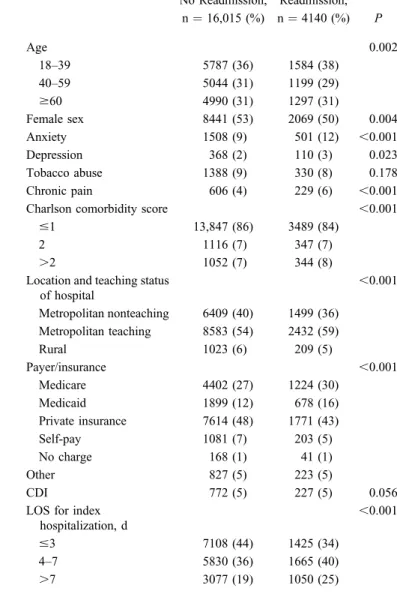
Among 52,498 patients with a diagnosis of IBD in the NRD (63% CD and 37% UC), 12,407 (24%) required readmission within 90 days of their index hospitalization. In univariate analysis, patients requiring readmission were younger, had higher associated with hospital readmission within 90 days, with
aspecificinterest intherolethatmodifiablerisk factorsplayin readmission.
MATERIALS
AND
METHODS
Data
Source
Weconductedaretrospectivecohortstudyusing2013data fromtheNRD,aresourceoftheHealthcareCostandUtilization Project(HCUP)StateInpatientDatabases.TheNRDisapublicly availableall-payerinpatient database fromthe US thatincludes datafrom14,325,172hospitalizations.Usingdatafrom21states, theNRDis designedtobenationally representativeof readmis-sion rates for all payers and the uninsured. The NRD contains morethan100clinicalandnonclinicalvariables,10upto15
diag-nosticandprocedurecodesbasedonInternationalClassification of Diseases, ninth Revision, Clinical Modification (ICD-9-CM)
coding,hospitalcharacteristics,andoutcomes,includinghospital lengthofstay(LOS),readmission,andtotalcharges.Becauseof the deidentified nature of the data, this study was determined exemptfromreviewbytheUniversityofNorthCarolina Institu-tionalReviewBoard.
Study
Sample
Weexamineddischargedatafrompatientsage18yearsand older.Any patientwithan ICD-9-CMdiagnosiscodeindicating CD (555.xx) or UC (556.xx) was eligible for inclusion in this study. Tominimize misclassification of subgroupsof IBD (CD orUC),we excludedpatientswithdischargecodesforbothCD andUC(n¼557).Theindexadmissionwasdefinedasthefirst admissionwhereanICD-9-CMdiagnosiscodeforCDorUCwas recordedasoneofthefirst3diagnosiscodes.Givenourinterestin evaluating90-dayreadmissions,onlythosepatientswithafull90 days betweenthe date of dischargefrom their index admission andDecember31,2013wereincludedintheseanalyses.
Outcomes
of
Interest
The primary outcome of interest, the first readmission within90 days ofthe index hospitalization, wasdetermined by linking discharge data of individual patients using a unique identifier specified within the NRD. We also evaluated the designated reason for readmission, as defined by the primary
ICD-9-CMdiagnosiscodeandthetotalchargesandLOS associ-atedwithreadmission.
Covariates
Charlson comorbidity index scores, were more likely to be admitted to metropolitan teaching hospitals, and were more likely to have Medicare or Medicaid insurance (Tables 1 and 2). In addition, patients requiring hospital readmission were more likely to have a diagnosis of anxiety, depression, chronic pain, tobacco abuse, or CDI. Among patients with CD, those requiring read-mission were more likely to have a diagnosis of afistula (Table 1). Readmission resulted in an additional 74,059 hospital days for those affected. The median LOS for thefirst readmission for
patients with CD was 3.45 days (interquartile range: 1.93–6.07) compared with a median LOS of 4.14 days (interquartile range: 2.40–7.03) for patients with UC (P¼0.181). The 5 most frequent primary diagnoses for readmissions among patients with CD were CD (47%), intestinal obstruction (560.81, 560.89, 560.9, 1.7%) septicemia (ICD-9-CM038.9, 1.2%), anal and rectal abscess (566, 0.4%), and acute kidney failure (584.9, 0.3%). The 5 most fre-quent primary diagnoses for readmissions among patients with UC were UC (60%), septicemia (3%), intestinal obstruction (1.4%), CDI (1.2%), and acute kidney failure (0.6%).
Among patients with IBD who were readmitted within 90 days, the median total charges for the first readmission were $27,162 (interquartile range: $15,159–$50,606). The median total charges for thefirst readmission for patients with UC were sig-nificantly greater than patients with CD ($29,881 versus $25,862,
TABLE 1.
Baseline Clinical and Demographic
Characteristics of Patients with CD in the 2013 NRD
No Readmission, n¼24,076 (%)
Readmission, n¼8267 (%) P
Age ,0.001
18–39 10,798 (45) 4040 (49) 40–59 7968 (33) 2634 (32)
$60 5002 (21) 1516 (18)
Female sex 13,370 (56) 4441 (54) 0.005 Anxiety 2678 (11) 1268 (15) ,0.001 Depression 592 (2) 285 (3) ,0.001 Tobacco abuse 4246 (17) 1805 (22) ,0.001 Chronic pain 1434 (6) 811 (10) ,0.001 Charlson comorbidity score ,0.001
#1 22,050 (92) 7397 (89)
2 1180 (5) 492 (6)
.2 846 (4) 378 (5)
Location and teaching status of hospital
,0.001 Metropolitan nonteaching 9439 (39) 3075 (37)
Metropolitan teaching 12,830 (51) 4673 (57)
Rural 1807 (8) 519 (6)
Payer/insurance ,0.001
Medicare 5818 (24) 2392 (29) Medicaid 3383 (14) 1807 (22) Private insurance 11,657 (48) 2993 (36) Self-pay 1833 (8) 618 (5)
No charge 292 (1) 95 (1)
Other 1072 (4) 346 (4)
CDI 479 (2) 249 (3) ,0.001
Need for IBD-related surgery
3834 (16) 941 (11) ,0.001 LOS for index
hospitalization, d
,0.001
#3 12,370 (51) 3599 (44) 4–7 8050 (33) 2970 (36)
.7 3656 (15) 1698 (21)
Presence of afistula (CD only)
1464 (6) 643 (8) ,0.001 Small bowel obstruction
(CD only)
10,608 (18) 3572 (17) 0.534
TABLE 2.
Baseline Clinical and Demographic
Characteristics of Patients with UC in the 2013 NRD
No Readmission, n¼16,015 (%)
Readmission, n¼4140 (%) P
Age 0.002
18–39 5787 (36) 1584 (38) 40–59 5044 (31) 1199 (29)
$60 4990 (31) 1297 (31)
Female sex 8441 (53) 2069 (50) 0.004 Anxiety 1508 (9) 501 (12) ,0.001 Depression 368 (2) 110 (3) 0.023 Tobacco abuse 1388 (9) 330 (8) 0.178 Chronic pain 606 (4) 229 (6) ,0.001 Charlson comorbidity score ,0.001
#1 13,847 (86) 3489 (84)
2 1116 (7) 347 (7)
.2 1052 (7) 344 (8)
Location and teaching status of hospital
,0.001 Metropolitan nonteaching 6409 (40) 1499 (36)
Metropolitan teaching 8583 (54) 2432 (59)
Rural 1023 (6) 209 (5)
Payer/insurance ,0.001
Medicare 4402 (27) 1224 (30) Medicaid 1899 (12) 678 (16) Private insurance 7614 (48) 1771 (43) Self-pay 1081 (7) 203 (5)
No charge 168 (1) 41 (1)
Other 827 (5) 223 (5)
CDI 772 (5) 227 (5) 0.056
LOS for index hospitalization, d
,0.001
#3 7108 (44) 1425 (34)
4–7 5830 (36) 1665 (40)
Previous single-center studies have associated an increased risk of hospital readmission with factors such as chronic pain and depression.9Abdominal pain is a common symptom among
pa-tients with IBD15and may be associated with IBD-irritable bowel
syndrome.16,17Although there were no available data on
medica-tion use within the NRD, a previous study evaluating narcotic pain use among inpatients with IBD demonstrated that use of narcotic pain medications was not associated with disease sever-ity.18Among patients with IBD, chronic pain has been associated
with significant effects on quality of life, as well as functional and social outcomes.19
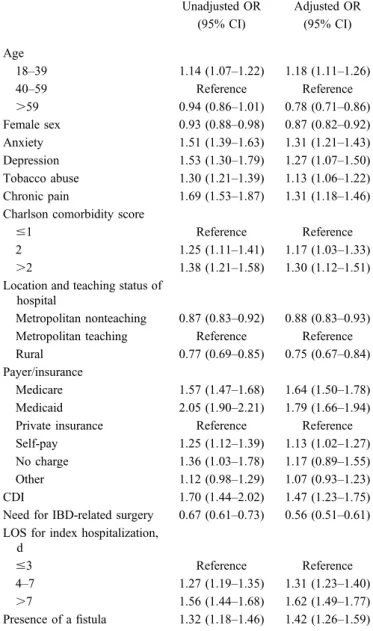
TABLE 3.
Unadjusted and Adjusted Analyses, Odds of
Readmission Among Patients with CD in the 2013 NRD
Unadjusted OR (95% CI)
Adjusted OR (95% CI)
Age
18–39 1.14 (1.07–1.22) 1.18 (1.11–1.26)
40–59 Reference Reference
.59 0.94 (0.86–1.01) 0.78 (0.71–0.86) Female sex 0.93 (0.88–0.98) 0.87 (0.82–0.92) Anxiety 1.51 (1.39–1.63) 1.31 (1.21–1.43) Depression 1.53 (1.30–1.79) 1.27 (1.07–1.50) Tobacco abuse 1.30 (1.21–1.39) 1.13 (1.06–1.22) Chronic pain 1.69 (1.53–1.87) 1.31 (1.18–1.46) Charlson comorbidity score
#1 Reference Reference
2 1.25 (1.11–1.41) 1.17 (1.03–1.33)
.2 1.38 (1.21–1.58) 1.30 (1.12–1.51) Location and teaching status of
hospital
Metropolitan nonteaching 0.87 (0.83–0.92) 0.88 (0.83–0.93) Metropolitan teaching Reference Reference Rural 0.77 (0.69–0.85) 0.75 (0.67–0.84) Payer/insurance
Medicare 1.57 (1.47–1.68) 1.64 (1.50–1.78) Medicaid 2.05 (1.90–2.21) 1.79 (1.66–1.94) Private insurance Reference Reference Self-pay 1.25 (1.12–1.39) 1.13 (1.02–1.27) No charge 1.36 (1.03–1.78) 1.17 (0.89–1.55) Other 1.12 (0.98–1.29) 1.07 (0.93–1.23) CDI 1.70 (1.44–2.02) 1.47 (1.23–1.75) Need for IBD-related surgery 0.67 (0.61–0.73) 0.56 (0.51–0.61) LOS for index hospitalization,
d
#3 Reference Reference
4–7 1.27 (1.19–1.35) 1.31 (1.23–1.40)
.7 1.56 (1.44–1.68) 1.62 (1.49–1.77) Presence of afistula 1.32 (1.18–1.46) 1.42 (1.26–1.59)
All variables included in thefinal multivariable analysis are listed above.
P ¼ 0.019). When aggregated among all IBD patients in the NRD, thetotalchargesattributedtothefirstreadmissionwithin 90dayswere$576,702,174.
Factors
Associated
with
Readmission
in
CD
Severalfactorswereassociatedwithreadmissionwithin90 days among patientswith CD, inboth unadjusted and adjusted analysis. In multivariable analysis, anxiety (OR 1.18, 95% CI, 1.11–1.26), depression (OR 1.27, 95% CI, 1.07–1.50), chronic pain (OR 1.31, 95% CI, 1.18–1.46), and tobacco abuse (OR 1.13, 95% CI, 1.06–1.22) were associated with a significant increaseinoddsofreadmissionwithin90daysofindex hospital-ization(Table3).Inaddition,youngerage,diagnosisofafistula, higherCharlsoncomorbidityscores,CDI,MedicareandMedicaid insurancestatusorself-paystatus,andanLOSgreaterthan3days ontheindexadmissionallwereassociatedwithincreasedoddsof readmission within 90 days (Table 3). An IBD-related surgery duringthe indexadmission wasassociatedwith decreasedodds of readmission within 90 days (OR 0.56, 95% CI, 0.51–0.61). When evaluating hospital-related factors, patients admitted to arural(OR0.75,95%CI,0.67–0.84)orametropolitan nonteach-ing hospital (0.88, 95% CI, 0.83–0.93) were less likely to be readmittedwhencomparedwithpatientsadmittedtometropolitan teachinghospitals.
Factors
Associated
with
Readmission
in
UC
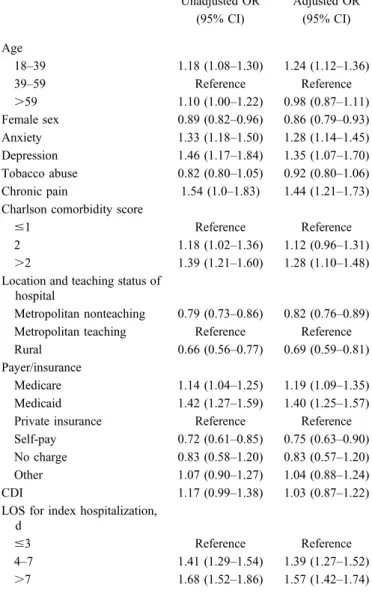
When patients with UCwere evaluatedin multivariable analysis, anxiety (OR 1.28, 95% CI, 1.14–1.45), depression (1.35, 95% CI, 1.07–1.70), and chronic pain (OR 1.44, 95%
CI,1.21–1.73) werealsoassociatedwitha significantincrease inodds ofreadmissionwithin90daysofindexhospitalization (Table4). Younger ageand LOS of greater than3 days were associatedwith increasedodds of readmission,as were Medi-careandMedicaidinsurancestatus,andhigherCharlson comor-bidityscores(Table4).Inaddition,patientsadmittedtoarural ormetropolitan nonteachinghospitalwere lesslikelyto be re-admittedwhencomparedwithpatientsadmittedtometropolitan teachinghospitals(Table4).
DISCUSSION
Chronic abdominal pain involves dysregulation of the brain–gut axis, which may lead to increased rates of anxiety and depression.20 Both anxiety and depression are increased
among patients with IBD as compared to other disease states and the general population.21–23 In addition, anxiety and
depression have been associated with an increased risk of clinical recurrence of disease in patients with IBD,24and higher
anxiety has been associated with increased resource utilization among patients with IBD.25,26 Although the impact of these
psychological comorbidities has been identified in multiple studies of patients with CD and UC, a majority of patients may not be receiving adequate psychosocial support and services as part of their overall care.27
There seems to be a significant opportunity for interven-tions aimed at decreasing readmissions among patients with psychosocial and chronic pain risk factors. In particular, early recognition of patients with coexisting psychiatric disease and/or chronic pain syndromes during the index admission is critical. After recognition of these comorbidities, multidisciplinary ap-proaches including the use of inpatient case management teams, behavioral health consultations, and the integration of pain management specialists into inpatient care models may lead to better discharge planning. In addition, early identification of responsible stakeholders after discharge including the patient’s outpatient gastroenterologist, outpatient pain management spe-cialists, and primary care provider may ultimately decrease read-mission rates as well.
With 24% of patients requiring readmission within 90 days of the index hospitalization, readmission represents a significant burden to patients with IBD and the health care system overall. Previous single-center experiences have reported 90-day readmis-sion rates between 21% and 31% for patients with IBD.9,28
Although the demonstrated rate of readmission in this study was similar, our use of a nationally representative sample is perhaps a more accurate representation of the proportion of patients with UC and CD requiring readmission within 90 days. In addition, our findings are similar to the rate of readmission within 1 year reported from an analysis using a Canadian national health database.29
The significant cost burden of hospital readmission has previously been demonstrated by Hazratjee et al4who found that
hospital readmissions within 30 days of index hospitalization increased cost of care by 111%. We also demonstrated the sub-stantial economic impacts of readmission. When aggregated among all patients with IBD in the NRD, the total charges asso-ciated with readmissions within 90 days were over $576 million. In addition, those patients requiring readmission represented over 74,000 excess hospital days as compared to those patients who did not require readmission.
When the reason for readmission has been evaluated in earlier studies, recurrent UC or CD has been identified as the driver of readmission in 27.8% to 31.4% of cases.4,9Small bowel
obstruc-tion has been commonly associated with readmission among pa-tients with CD in multiple studies4,9,30 and represented 1.7% of
readmissions among patients with CD in our population. The asso-ciation between infectious complications and the need for readmis-sion among patients with IBD is significant, particularly the association between septicemia and both UC and CD readmissions. In a previous study, patients with UC and sepsis demonstrated a significantly higher mortality rate during hospitalization when compared with a control population.31In a separate study using
NIS, patients with IBD admitted to centers with a high annual volume demonstrated lower in-hospital mortality.14In a sensitivity
analysis in which hospital volume was included in our multivari-able models, ourfinal ORs were similar to those demonstrated in the original models.
In our analysis, younger patients demonstrated increased odds of readmission, whereas patients over 59 years of age
TABLE 4.
Unadjusted and Adjusted Analyses, Odds of
Readmission Among Patients with UC in the 2013 NRD
Unadjusted OR (95% CI)
Adjusted OR (95% CI)
Age
18–39 1.18 (1.08–1.30) 1.24 (1.12–1.36)
39–59 Reference Reference
.59 1.10 (1.00–1.22) 0.98 (0.87–1.11) Female sex 0.89 (0.82–0.96) 0.86 (0.79–0.93) Anxiety 1.33 (1.18–1.50) 1.28 (1.14–1.45) Depression 1.46 (1.17–1.84) 1.35 (1.07–1.70) Tobacco abuse 0.82 (0.80–1.05) 0.92 (0.80–1.06) Chronic pain 1.54 (1.0–1.83) 1.44 (1.21–1.73) Charlson comorbidity score
#1 Reference Reference
2 1.18 (1.02–1.36) 1.12 (0.96–1.31)
.2 1.39 (1.21–1.60) 1.28 (1.10–1.48) Location and teaching status of
hospital
Metropolitan nonteaching 0.79 (0.73–0.86) 0.82 (0.76–0.89) Metropolitan teaching Reference Reference Rural 0.66 (0.56–0.77) 0.69 (0.59–0.81) Payer/insurance
Medicare 1.14 (1.04–1.25) 1.19 (1.09–1.35) Medicaid 1.42 (1.27–1.59) 1.40 (1.25–1.57) Private insurance Reference Reference Self-pay 0.72 (0.61–0.85) 0.75 (0.63–0.90) No charge 0.83 (0.58–1.20) 0.83 (0.57–1.20) Other 1.07 (0.90–1.27) 1.04 (0.88–1.24) CDI 1.17 (0.99–1.38) 1.03 (0.87–1.22) LOS for index hospitalization,
d
#3 Reference Reference
4–7 1.41 (1.29–1.54) 1.39 (1.27–1.52)
.7 1.68 (1.52–1.86) 1.57 (1.42–1.74)
significant associations such as the decreased odds of readmission among female patients.
The NRD also does not include information on race, which is a significant limitation, as black race has been associated with shorter time to readmission among pediatric patients34 and an
increased risk for readmission after colorectal surgery.35 Given
the structure of the NRD, we were also unable to evaluate pro-vider factors that may have contributed to readmission, including early discharge from the index hospitalization or treatment plans that may have led to worse outcomes including readmission. Although future approaches to decreasing readmission will likely require multidisciplinary approaches, a continued focus on pro-vider decision making during the hospitalization and discharge planning will remain a key point in improving outcomes among hospitalized patients with IBD.
In conclusion, within a nationally representative database, we identified multiple risk factors for readmission among patients with UC and CD that are associated with a significant increase in charges. These include several potentially modifiable risk factors including psychiatric disease and chronic pain conditions. Earlier recognition of comorbid diagnoses of chronic pain, anxiety, and depression, along with increased use of multidisciplinary teams and care transition models, may lead to decreased hospital readmissions and improved outcomes among patients with UC and CD.
REFERENCES
1. Jencks SF, Williams MV, Coleman EA. Rehospitalizations among pa-tients in the medicare fee-for-service program.N Engl J Med.2009;360: 1418–1428.
2. Kappelman MD, Moore KR, Allen JK, et al. Recent trends in the prev-alence of Crohn’s disease and ulcerative colitis in a commercially insured US population.Dig Dis Sci.2013;58:519–525.
3. Long MD, Hutfless S, Kappelman MD, et al. Challenges in designing a national surveillance program for inflammatory bowel disease in the United States.Inflamm Bowel Dis.2014;20:398–415.
4. Hazratjee N, Agito M, Lopez R, et al. Hospital readmissions in patients with inflammatory bowel disease.Am J Gastroenterol.2013;108:1024–1032. 5. Frolkis A, Kaplan GG, Patel AB, et al. Postoperative complications and
emergent readmission in children and adults with inflammatory bowel disease who undergo intestinal resection: a population-based study.
In-flamm Bowel Dis.2014;20:1316–1323.
6. Ozturk E, Kiran RP, Remzi F, et al. Early readmission after ileoanal pouch surgery.Dis Colon Rectum2009;52:1848–1853.
7. Medress Z, Fleshner PR. Can we predict unplanned hospital readmission after colectomy for ulcerative colitis and indeterminate colitis?Am Surg.
2007;73:998–1001.
8. Sutton JM, Wima K, Wilson GC, et al. Factors associated with 30-day readmission after restorative proctocolectomy with IPAA.Dis Colon Rec-tum2014;57:1371–1378.
9. Allegretti JR, Borges L, Lucci M, et al. Risk factors for rehospitalization within 90 Days in patients with inflammatory bowel disease.Inflamm Bowel Dis.2015;21:2583–2589.
10. Agency for the Healthcare Cost and Resource Utilization Project. Intro-duction to the HCUP Nationwide Readmission Database 2013. Available at: https://www.hcup-us.ahrq.gov/db/nation/nrd/NRD_Introduction_2013. jsp. Accessed January 9, 2017.
11. Deyo RA, Cherkin DC, Ciol MA. Adapting a clinical comorbidity index for use with ICD-9-CM administrative databases.J Clin Epidemiol.1992; 45:613–619.
12. Marrie RA, Walker JR, Graff LA, et al. Performance of administrative case definitions for depression and anxiety in inflammatory bowel disease.
J Psychosom Res.2016;89:107–113.
demonstratedthelowestoddsofreadmission.Anincreasedrateof hospitalizations and readmissions among younger patients with IBDhasbeendemonstratedinotheradministrativedatabasesas well.29,32 The increase in odds of readmission among younger
patients is likely multifactorial, as patients may have a more severedisease coursepotentiallyassociatedwithanearlieronset ofIBD.32Inaddition,olderpatientsarelikelytohaveother
co-morbidities, which might lead to increased follow-up with pri-mary care or other providers after discharge from and index admission. These factors would not be captured in the NRD, however,andthus,we werenotabletoexplorefurther.
Ourstudy is the one ofthe first nationally representative study of hospital readmissions among patients with IBD. However,ourstudyhasinherentlimitationsthatshouldbenoted. TheNRD doesnot include information regardingan individual patient’smedication profilebeforeadmissionorduringthe hos-pitalization. Although infections such as CDI and pneumonia representedsignificantetiologiesofreadmission,wewereunable toevaluatethepotentialrelationshipbetweensteroiduseorother immunosuppressive therapy and risk of subsequent infection requiring hospitalization.Inaddition,the NRDdoesnotcontain laboratorydataorclinicaldataregardingthephenotypeor sever-ity of an individual patient’s IBD at the time of admission. Althoughwedemonstratedincreasedoddsofreadmissionamong patientswithCDandafistula,andincreasedoddsofreadmission withlongerLOSonindexhospitalization,ourabilitytoevaluate therelationshipbetweentheseverityofdiseaseandoddsof read-missionislimited.
Witha largedatabasesuchasNRD, thereis potentialfor misclassification of those factors associated with readmission, particularlytobaccousewhichwasassociatedwithincreasedodds ofreadmissionamongpatientswithCD.33Thereisalsopotential
13. Kassam Z, Cribb Fabersunne C, Smith MB, et al. Clostridium difficile associated risk of death score (CARDS): a novel severity score to predict mortality among hospitalised patients with C. difficile infection.Aliment Pharmacol Ther.2016;43:725–733.
14. Ananthakrishnan AN, McGinley EL, Binion DG. Does it matter where you are hospitalized for inflammatory bowel disease? A nationwide anal-ysis of hospital volume.Am J Gastroenterol.2008;103:2789–2798. 15. Long MD, Drossman DA. Inflammatory bowel disease, irritable bowel
syndrome, or what?: a challenge to the functional-organic dichotomy.Am J Gastroenterol.2010;105:1796–1798.
16. Grover M, Herfarth H, Drossman DA. The functional–organic dichotomy: postinfectious irritable bowel syndrome and inflammatory bowel disease–irritable bowel syndrome.Clin Gastroenterol Hepatol. 2009;7: 48–53.
17. Halpin SJ, Ford AC. Prevalence of symptoms meeting criteria for irritable bowel syndrome in inflammatory bowel disease: systematic review and meta-analysis.Am J Gastroenterol.2012;107:1474–1482.
18. Long MD, Barnes EL, Herfarth HH, et al. Narcotic use for inflammatory bowel disease and risk factors during hospitalization.Inflamm Bowel Dis.
2012;18:869–876.
19. Morrison G, Van Langenberg DR, Gibson SJ, et al. Chronic pain in inflammatory bowel disease.Inflamm Bowel Dis.2013;19:1210–1217. 20. Regueiro M, Greer JB, Szigethy E. Etiology and treatment of pain and
psychosocial Issues in patients with inflammatory bowel diseases. Gas-troenterology. 2017;152:430–439.
21. Kappelman MD, Long MD, Martin C, et al. Evaluation of the patient-reported outcomes measurement information system in a large cohort of patients with inflammatory bowel diseases.Clin Gastroenterol Hepatol.
2014;12:1315–1323.e2.
22. Loftus EV, Guérin A, Yu AP, et al. Increased risks of developing anxiety and depression in young patients with Crohn’s disease.Am J Gastroen-terol.2011;106:1670–1677.
23. Mikocka-Walus A, Knowles SR, Keefer L, et al. Controversies revisited.
Inflamm Bowel Dis.2016;22:752–762.
24. Mikocka-Walus A, Pittet V, Rossel J, et al. Symptoms of depression and anxiety are independently associated with clinical recurrence of
inflammatory bowel disease. Clin Gastroenterol Hepatol. 2016;14: 1542–3565.
25. Ramos-Rivers C, Regueiro M, Vargas EJ, et al. Association between telephone activity and features of patients with inflammatory bowel dis-ease.Clin Gastroenterol Hepatol.2014;12:986–994.e1.
26. Click B, Ramos Rivers C, Koutroubakis IE, et al. Demographic and clinical predictors of high healthcare use in patients with inflammatory bowel disease.Inflamm Bowel Dis.2016;22:1442–1449.
27. Bennebroek Evertsz’F, Thijssens NAM, Stokkers PCF, et al. Do Infl am-matory Bowel Disease patients with anxiety and depressive symptoms receive the care they need?J Crohn’s Colitis.2012;6:68–76.
28. Tinsley A, Naymagon S, Mathers B, et al. Early readmission in patients hospitalized for ulcerative colitis: incidence and risk factors. Scand J Gastroenterol.2015;50:1103–1109.
29. Bernstein CN, Nabalamba A. Hospitalization, surgery, and readmission rates of IBD in Canada: a population-based study.Am J Gastroenterol.
2006;101:110–118.
30. White E, Melmed GY, Vasiliauskas EA, et al. A prospective analysis of clinical variables, serologic factors, and outcome of ileal pouch-anal anas-tomosis in patients with backwash ileitis.Dis Colon Rectum.2010;53: 987–994.
31. Colbert JF, Schmidt EP, Faubel S, Ginde AA. Severe sepsis outcomes among hospitalizations with inflammatory bowel disease.Shock. 2017;47: 128–131.
32. Nguyen GC, Bollegala N, Chong CA. Factors associated with readmis-sions and outcomes of patients hospitalized for inflammatory bowel dis-ease.Clin Gastroenterol Hepatol.2014;12:1897–1904.e1.
33. Al Kazzi ES, Lau B, Li T, et al. Differences in the prevalence of obesity, smoking and alcohol in the United States nationwide inpatient sample and the behavioral risk factor surveillance system.PLoS One. 2015;10: 1–11.
34. Dotson JL, Kappelman MD, Chisolm DJ, et al. Racial disparities in re-admission, complications, and procedures in children with Crohn’s dis-ease.Inflamm Bowel Dis.2015;21:801–808.