cmsc435 - 1
Software Requirements
Objectives
● To introduce the concepts of user and system
requirements
● To describe functional and non-functional
requirements
● To explain how software requirements may be
cmsc435 - 3
Requirements engineering
● Requirements engineering is a systematic way
of developing requirements through an iterative process of analyzing a problem, documenting the resulting observations, and checking the accuracy of the understanding gained.
● Requirements engineering is comprised of two
major tasks: analysis and modeling
● The requirements themselves are the
descriptions of the system services and constraints that are generated during the requirements engineering process.
What is a requirement?
● A software requirement is a condition orcapability needed by a user to solve a problem or achieve an objective and that must be met or possessed by a system or system
component to satisfy a contract, standard, specification, or other formally imposed document.
● Two classes of requirements:
Functional requirements – What the program does
Non-functional requirements – Attributes about
cmsc435 - 5
What is a requirement?
● It may range from a high-level abstractstatement of a service or of a system constraint to a detailed mathematical functional specification.
● This is inevitable as requirements may serve a
dual function
May be the basis for a bid for a contract
-therefore must be open to interpretation;
May be the basis for the contract itself
-therefore must be defined in detail;
Both these statements may be called
requirements.
Types of requirement
● User requirementsStatements in natural language plus diagrams of
the services the system provides and its
operational constraints. Written for customers. ● System requirements
A structured document setting out detailed
descriptions of the system’s functions, services and operational constraints. Defines what should be implemented so may be part of a contract between client and contractor.
cmsc435 - 7
Capturing the requirements
● Requirement: a feature of the system or adescription of something the system is capable of doing in order to fulfill the system’s purpose
● Three kinds of requirements:
those that absolutely must be met
those that are highly desirable but not necessary
those that are possible but could be eliminated
Characteristics of requirements
● Are they correct?● Are they consistent? ● Are they complete? ● Are they realistic?
● Does each describe something the customer
needs?
● Are they verifiable? ● Are they traceable?
cmsc435 - 9
Functional and non-functional requirements
● Functional requirements
Statements of services the system should provide,
how the system should react to particular inputs and how the system should behave in particular
situations.
● Non-functional requirements
constraints on the services or functions offered by
the system such as timing constraints, constraints on the development process, standards, security
requirements, performance, etc.
● Domain requirements
Requirements that come from the application domain
of the system and that reflect characteristics of that domain.
Functional requirements
● Describe functionality or system services. ● Depend on the type of software, expectedusers and the type of system where the software is used.
● Functional user requirements may be
high-level statements of what the system should do but functional system requirements should describe the system services in detail.
cmsc435 - 11
Examples of functional requirements
● The user shall be able to search either all of the
initial set of databases or select a subset from it.
● The system shall provide appropriate viewers for the
user to read documents in the document store.
● Every order shall be allocated a unique identifier
(ORDER_ID) which the user shall be able to copy to the account’s permanent storage area.
● Are these good requirements?
“shall” usually means a mandatory requirement
Requirements imprecision
● Problems arise when requirements are notprecisely stated.
● Ambiguous requirements may be interpreted
in different ways by developers and users.
● Consider the term “appropriate viewers”
User intention - special purpose viewer for each
different document type;
Developer interpretation - Provide a text viewer
that shows the contents of the document.
● Natural language (English) poor for expressing
cmsc435 - 13
Requirements completeness and
consistency
● In principle, requirements should be both complete and
consistent.
● Complete
They include descriptions of all facilities required.
• What is assumed as domain knowledge as a requirement?
• For example, does a requirement to list names in alphabetical order require a definition of
“alphabetical order”?
● Consistent
There is no conflicts or contradictions in the
descriptions of the system facilities.
● In practice, it is impossible to produce a complete and
consistent requirements document.
Non-functional requirements
● These define system properties andconstraints e.g. reliability, safety, security, performance, and storage requirements.
Constraints are I/O device capability, system representations, etc.
● Process requirements may also be specified
mandating a particular CASE system,
programming language or development method.
● Non-functional requirements may be more
critical than functional requirements. If these are not met, the system may be useless.
cmsc435 - 15
Functional vs. non-functional
requirements
● Functional: describes
an interaction between the system and its environment
● Examples:
System shall
communicate with external system X.
What conditions
must be met for a message to be sent
● Non-functional: describes
a restriction or constraint that limits our choices for constructing a solution
● Examples:
Paychecks distributed
no more than 4 hours after initial data are read.
System limits access
to senior managers.
Non-functional classifications
● Product requirementsRequirements which specify that the delivered
product must behave in a particular way e.g. execution speed, reliability, safety, security, etc. ● Organizational requirements
Requirements which are a consequence of
organizational policies and procedures e.g. process standards used, implementation requirements, etc. ● External requirements
Requirements which arise from factors which are
external to the system and its development process e.g. interoperability requirements, legislative requirements, etc.
cmsc435 - 17
Non-functional requirements examples
● Product requirement
8.1 The user interface for LIBSYS shall be implemented as simple HTML without frames or Java applets.
● Organizational requirement
9.3.2 The system development process and deliverable documents shall conform to the process and deliverables defined in XYZCo-SP-STAN-95.
● External (security) requirement
7.6.5 The system shall not disclose any personal information about customers apart from their name and reference number to the operators of the system.
What is “simple?”
This means implement no function the operators may invoke directly or indirectly. How do you check that?
Goals and requirements
● Non-functional requirements may be very difficult
to state precisely and imprecise requirements may be difficult to verify.
● Goal
A general intention of the user such as ease of use.
(“May” or “should” is often used instead of “shall.”) ● Verifiable non-functional requirement
A statement using some measure that can be
objectively tested.
● Goals are helpful to developers as they convey the
cmsc435 - 19
Examples
● A system goal
The system shall be responsive to any user input.
● A verifiable non-functional requirement
The system shall respond to any user input within 0.01 seconds.
This is now a measurable and testable requirement
Requirements measures
Property Measure
Speed Processed transactions/second
User/Event response time Screen refresh time
Size M Bytes
Number of ROM chips Ease of use Training time
Number of help frames Reliability Mean time to failure
Probability of unavailability Rate of failure occurrence Availability
Robustness Time to restart after failure Percentage of events causing failure Probability of data corruption on failure Portability Percentage of target dependent statements
cmsc435 - 21
Requirements interaction
● Constraintsare a type of non-functional requirement that is
imposed by the client that restricts the implementation of the system or the development process.
● Conflicts between different non-functional requirements
are common in complex systems.
E.g.,Spacecraft system
• To minimize weight, the number of separate chips in the system should be minimized.
• To minimize power consumption, lower power (i.e., slower) chips should be used.
• However, using low power chips may mean that more chips have to be used. Which is the most critical requirement?
Domain requirements
● Derived from the application domain and
describe system characteristics and features that reflect the domain.
● Domain requirements be new functional
requirements, constraints on existing
requirements or define specific computations.
● If domain requirements are not satisfied, the
cmsc435 - 23
Domain requirements problems
● UnderstandabilityRequirements are expressed in the language of
the application domain;
This is often not understood by software
engineers developing the system.
On the other hand, users rarely understand the
requirements jargon of the software engineer. ● Implicitness
Domain specialists understand the area so well
that they do not think of making the domain requirements explicit.
User requirements
● Should describe functional and non-functional
requirements in such a way that they are understandable by system users who don’t have detailed technical knowledge.
● “User requirements are defined using natural
language, tables and diagrams as these can be understood by all users.” -- Yuk!
cmsc435 - 25
Problems with natural language
● Lack of clarity- Precision is difficult without making
the document difficult to read.
● Requirements confusion- Functional and
non-functional requirements tend to be mixed-up.
● Requirements amalgamation - Several different
requirements may be expressed together.
● Ambiguity- The readers and writers of the
requirement must interpret the same words in the same way. NL is naturally ambiguous so this is very difficult.
● Over-flexibility - The same thing may be said in a
number of different ways in the specification.
● Lack of modularization - NL structures are inadequate
to structure system requirements.
How developers see users How users see developers
Users don’t know what they want. Developers don’t understand operational needs. Users can’t articulate what they want. Developers place too much emphasis on technicalities. Users have too many needs that are
politically motivated.
Developers try to tell us how to do our jobs.
Users want everything right now. Developers can’t translate clearly-stated needs into a successful system.
Users can’t prioritize needs. Developers say no all the time. Users refuse to take responsibility for
the system.
Developers are always over budget. Users are unable to provide a usable
statement of needs.
Developers are always late. Users are not committed to system
development projects.
Developers ask users for time and effort, even to the detriment of the users’ important primary duties. Users are unwilling to compromise. Developers set unrealistic standards for requirements
definition.
Users can’t remain on schedule. Developers are unable to respond quickly to legitimately changing needs.
cmsc435 - 27
Guidelines for writing requirements
● Use a standard format and use it for allrequirements. (Better, choose an existing format)
● Use language in a consistent way. Use shall for
mandatory requirements, should for desirable requirements.
● Use text highlighting to identify key parts of
the requirement.
● Avoid the use of computer jargon.
System requirements
● More detailed specifications of systemfunctions, services and constraints than user requirements.
● They are intended to be a basis for designing
the system.
● They may be incorporated into the system
contract.
● System requirements may be defined or
cmsc435 - 29
The requirements engineering process
Feasibility stud y
Requir ements elicitation and anal ysis
Requir ements specification
Requir ements validation Feasibility
repor t
System models
User and system requirements
Requir ements document
Feasibility studies
● A feasibility study decides whether or not the
proposed system is worthwhile.
● A short focused study that checks
If the system contributes to organizational
objectives;
If the system can be engineered using current
technology and within budget;
If the system can be integrated with other
cmsc435 - 31
Feasibility study implementation
● Based on information assessment (what is required),
information collection and report writing.
● Questions for people in the organization
What if the system wasn’t implemented?
What are current process problems?
How will the proposed system help?
What will be the integration problems?
Is new technology needed? What skills?
What facilities must be supported by the proposed
system?
● All involved in the outcome of the system are called
Stakeholders (e.g., users, developers, management,
contracting organization, funding source).
Methods for requirements elicitation
1. Interviews 2. Observation
3. Examine artifacts (e.g., prior system documents)
4. Joint Application Design sessions 5. Software tools (e.g., groupware) 6. Questionnaires
7. Prototypes (On paper, automated mockups) 8. Customer focus groups
cmsc435 - 33
Interviewing
● Processes:Interviewing:In formal or informal interviewing,
the RE team puts questions to stakeholders about the system that they use and the system to be developed.
Scenariosare real-life examples of how a system
can be used. They should include:
• A description of the starting situation; • A description of the normal flow of events; • A description of what can go wrong;
• Information about other concurrent activities; • A description of the state when the scenario
finishes.
Use cases
● Use-cases are a scenario based technique in
the UML which identify the actors in an
interaction and which describe the interaction itself.
● A set of use cases should describe all possible
interactions with the system.
● Sequence diagrams may be used to add detail
to use-cases by showing the sequence of event processing in the system.
cmsc435 - 35
Article printing use-case
cmsc435 - 37
Print article sequence
Use cases covered more fully later
Ethnography (Observation)
● A social scientists spends a considerable time
observing and analyzing how people actually work.
● People do not have to explain or articulate
their work.
● Social and organizational factors of
importance may be observed.
● Ethnographic studies have shown that work is
usually richer and more complex than suggested by simple system models.
cmsc435 - 39
Focused ethnography
● Combine ethnography with prototyping
● Prototype development results in unanswered
questions which focus the ethnographic analysis.
● The problem with ethnography is that it studies
existing practices which may have some historical basis which is no longer relevant.
● Requirements that are derived from the way that
people actually work rather than the way in which process definitions suggest that they ought to work.
● Requirements that are derived from cooperation and
awareness of other people’s activities.
Social and organizational factors
● Software systems are used in a social andorganizational context. This can influence or even dominate the system requirements.
● Social and organizational factors are not a
single viewpoint but are influences on all viewpoints.
● Good analysts must be sensitive to these
factors but currently no systematic way to tackle their analysis.
cmsc435 - 41
Ten Problems of Requirements Elicitation
1. The boundary of the system is ill-defined. 2. Unnecessary design information may be given.
3. Stakeholders have incomplete understanding of their needs.
4. Stakeholders have poor understanding of computer capabilities and limitations.
5. Software engineers have poor knowledge of the problem domain.
6. Stakeholder and software engineers speak different languages.
7. “Obvious” information is omitted.
8. Different stakeholders have conflicting views.
9. Requirements are vague and untestable, such as “user friendly” and “robust”.
10. Requirements are volatile and change over time.
Requirements and design
● In principle, requirements should state what the
system should do and the design should describe how
it does this.
● But, in practice, requirements and design are
inseparable
A system architecture may be designed to
structure the requirements;
The system may inter-operate with other systems
that generate design requirements;
The use of a specific design may be a domain
cmsc435 - 43
Alternatives to NL specification
Notation Description
Structured natural language
This approach depends on defining standard forms or templates to express the requirements specification.
Design description languages
This approach uses a language like a programming language but with more abstract features to specify the requirements by defining an operational model of the system. This approach is not now widely used although it can be useful for interface specifications.
Graphical notations
A graphical language, supplemented by text annotations is used to define the functional requirements for the system. An early example of such a graphical language was SADT. Now, use-case descriptions and sequence diagrams are commonly used .
Mathematical specifications
These are notations based on mathematical concepts such as finite-state machines or sets. These unambiguous specifications reduce the arguments between customer and contractor about system functionality. However, most customers don’t understand formal specifications and are reluctant to accept it as a system contract.
Structured language specifications
● The freedom of the requirements writer is
limited by a predefined template for requirements.
● All requirements are written in a standard
way.
● The terminology used in the description may
be limited.
● The advantage is that the most of the
expressiveness of natural language is maintained but a degree of uniformity is imposed on the specification.
cmsc435 - 45
Form-based specifications
● Definition of the function or entity.● Description of inputs and where they come
from.
● Description of outputs and where they go to. ● Indication of other entities required.
● Pre and post conditions (if appropriate). ● The side effects (if any) of the function.
Form-based node specification
Insulin Pump/Control Software/SRS/3.3.2
Function Compute insulin dose: Safe sugar level
Description Computes the dose of insulin to be delivered when the current measured sugar level is in the safe zone between 3 and 7 units.
Inputs Current sugar reading (r2), the previous two readings (r0 and r1) Source Current sugar reading from sensor. Other readings from memory. Outputs CompDose – the dose in insulin to be delivered
Destination Main control loop
Action: CompDose is zero if the sugar level is stable or falling or if the level is increasing but the rate of
increase is decreasing. If the level is increasing and the rate of increase is increasing, then CompDose is computed by dividing the difference between the current sugar level and the previous level by 4 and rounding the result. If the result, is rounded to zero then CompDose is set to the minimum dose that can be delivered.
Requires Two previous readings so that the rate of change of sugar level can be computed.
Pre-condition The insulin reservoir contains at least the maximum allowed single dose of insulin..
Post-condition r0 is replaced by r1 then r1 is replaced by r2 Side-effects None
cmsc435 - 47
Formal descriptions of requirements
● Indirect reference
Example: k equations in n unknowns
● Recurrence relations
Example: F(0)=1; F(1)=1; F(n+1)=F(n)+F(n-1)
● Axiomatic definition ● Expression as a language
Example: Backus-Naur form
<condition> ::= <bool-term> | <bool-term> or <condition> <bool-term> ::= <bool-factor> | <bool-factor> and <bool- term> <bool-factor> ::= <expr> <relop> <expr> | (<condition>) <relop> ::= < | < | = | > | > | < >
<expr> ::= <term> | <expr> <addop> <term> | <addop> <expr> <term> ::= <factor> | <term> <mpyop> <factor>
<factor> ::= <scaled-expr> | <primary>
<scaled-expr> ::= (<expr>) <scale> | <number> <scale>
<primary> ::= (<expr>) <regname> | <number> | <func> (<expr>) <number> ::= <integer> | <integer>. | .<integer> | <integer>.<integer> <regname> ::= $ <regchar> | <regname> <regchar>
<integer> ::= <digit> | <digit> <integer> <regchar> ::= <digit> | <letter> | <underscore> <addop> ::= + | -
<digit> ::= 0 | 1 | 2 | 3 | 4 | 5 | 6 | 7 | 8 | 9 <func> ::= abs | trunc
<letter> ::= A | a | B | b | C | c | D | d | E | e | . . . | Y | y | Z | z
<myop> ::= * | / | mod
<scale> ::= c | d | h | i | l | P | p | q | t | v <underscore> ::= _ (ASCII character 95)
cmsc435 - 49
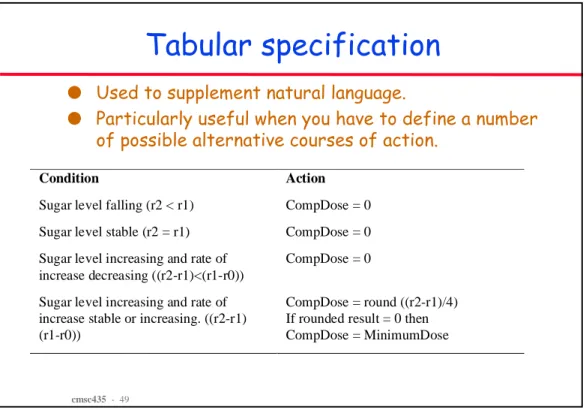
Tabular specification
● Used to supplement natural language.
● Particularly useful when you have to define a number
of possible alternative courses of action.
Condition Action
Sugar level falling (r2 < r1) CompDose = 0 Sugar level stable (r2 = r1) CompDose = 0 Sugar level increasing and rate of
increase decreasing ((r2-r1)<(r1-r0))
CompDose = 0
Sugar level increasing and rate of increase stable or increasing. ((r2-r1) (r1-r0))
CompDose = round ((r2-r1)/4) If rounded result = 0 then CompDose = MinimumDose
Decision tables
Rule 1 Rule 2 Rule 3 Rule 4 Rule 5 High standardized exam scores T F F F F
High grades - T F F F
Outside activities - - T F F Good recommendations - - - T F
Send rejection letter X X X
Send admission forms X X
Triggers Action
Table consists of True, False, and Don’t Care conditions.
cmsc435 - 51
State machines
● Functional descriptions and transition
diagrams
f(Si, Cj) = Sk
Current state Input Next state
S1 0 S2
S1 1 S1
S2 0 S2
S2 1 S1
S3 0 S1
S3 1 S3
Event tables
Mode Event 1 Event 2 Event 3 Event 4 Graphics Action 1 Action 8 0 X Architecture X Action 2 followed
by Action 3
Actions 5 and 6 in parallel
0 Native 0 Action 4 Actions 1, 2 and 3 Action 7
cmsc435 - 53
Graphical models
● Graphical models are most useful when you need
to show how state changes or where you need to describe a sequence of actions.
● Example: Sequence diagrams:
These show the sequence of events that take place during some user interaction with a system.
You read them from top to bottom to see the order of the actions that take place.
Cash withdrawal from an ATM • Validate card;
• Handle request;
• Complete transaction.
cmsc435 - 55
Interface specification
● Most systems must operate with othersystems and the operating interfaces must be specified as part of the requirements.
● Three types of interface may have to be
defined
Procedural interfaces;
Data structures that are exchanged;
Data representations.
● Formal notations are an effective technique
for interface specification.
PDL interface description
interface PrintServer {
// defines an abstract printer server
// requires: interface Printer, interface PrintDoc
// provides: initialize, print, displayPrintQueue, cancelPrintJob, switchPrinter
void initialize ( Printer p ) ; void print ( Printer p, PrintDoc d ) ; void displayPrintQueue ( Printer p ) ; void cancelPrintJob (Printer p, PrintDoc d) ;
void switchPrinter (Printer p1, Printer p2, PrintDoc d) ; } //PrintServer
cmsc435 - 57
The requirements document
● The requirements document is the officialstatement of what is required of the system developers.
● Should include both a definition of user
requirements and a specification of the system requirements.
● It is NOT a design document. As far as
possible, it should set of WHAT the system should do rather than HOW it should do it
cmsc435 - 59
Requirements validation
● Concerned with demonstrating that therequirements define the system that the customer really wants.
● Requirements error costs are high so
validation is very important
Fixing a requirements error after delivery may cost up to 100 times the cost of fixing an implementation error.
Note: This factor of 100 was once stated by Barry Boehm and has been assumed to be absolutely true, but never really validated.
Requirements checking
● Validity. Does the system provide the functions which best
support the customer’s needs?
Consistency. Are there any requirements conflicts?
Traceability. Is the origin of the requirement clearly
stated?
Verifiability. Is the requirement realistically testable?
● Completeness. Are all functions required by the customer
included?
Comprehensibility. Is the requirement properly understood?
● Realism. Can the requirements be implemented given available
budget and technology
● Adaptability. Can the requirement be changed without a large
cmsc435 - 61
Requirements validation techniques
● Requirements reviewsSystematic manual analysis of the requirements.
● Prototyping
Using an executable model of the system to check
requirements. Test-case generation
Developing tests for requirements to check
testability.
Requirements should be:
● Understandable● Non-prescriptive ● Correct
● Complete ● Concise
● Consistent language
● Unambiguous and testable ● Traceable
● Feasible
● Ranked in importance and stability (or
cmsc435 - 63
Requirements review
● Regular reviews should be held while the
requirements definition is being formulated.
● Both client and contractor staff should be
involved in reviews.
● Reviews may be formal (with completed
documents) or informal. Good communications between developers, customers and users can resolve problems at an early stage.
Requirements review -2
● Review goals and objections of system.
● Compare requirements with goals and objectives.
● Describe operational environment.
● Examine
interfaces
information flow
functions
● Check for omissions, incompleteness, inconsistency.
● Document risk.
cmsc435 - 65
Requirements management
● Requirements management is the process ofmanaging changing requirements during the requirements engineering process and system development.
● Requirements are inevitably incomplete and
inconsistent
New requirements emerge during the process as business needs change and a better
understanding of the system is developed;
Different viewpoints have different requirements and these are often contradictory.
Traceability
● Traceability is concerned with the
relationships between requirements, their sources and the system design
● Source traceability
Links from requirements to stakeholders who proposed these requirements;
● Requirements traceability
Links between dependent requirements;
● Design traceability
cmsc435 - 67
A traceability matrix
Re q.id
1.1 1.2 1.3 2.1 2.2 2.3 3.1 3.2
1.1 D R
1.2 D D D
1.3 R R
2.1 R D D
2.2 D
2.3 R D
3.1 R
3.2 R
CASE tool support
● Requirements storageRequirements should be managed in a secure, managed data store.
● Change management
The process of change management is a workflow process whose stages can be defined and information flow between these stages partially automated.
● Traceability management
Automated retrieval of the links between requirements.
cmsc435 - 69
Requirements change management
● Should apply to all proposed changes to the
requirements.
● Principal stages
Problem analysis. Discuss requirements problem and propose change;
Change analysis and costing. Assess
effects of change on other requirements;
Change implementation. Modify requirements document and other documents to reflect change.
Key points
● Requirements set out what the system should do and
define constraints on its operation and implementation.
● Functional requirements set out services the system
should provide.
● Non-functional requirements constrain the system being
developed or the development process.
● User requirements are high-level statements of what the
system should do. User requirements should be written using natural language, tables and diagrams.
● System requirements are intended to communicate the
functions that the system should provide.
● Formal notation better than English to express
requirements; pick notation understandable by developers and users.
● A software requirements document is an agreed
cmsc435 - 71
Key points
● The requirements engineering process includes a feasibility
study, requirements elicitation and analysis, requirements specification and requirements management.
● Requirements elicitation and analysis is iterative involving domain understanding, requirements collection,
classification, structuring, prioritisation and validation.
● Systems have multiple stakeholders with different
requirements.
● Social and organization factors influence system
requirements.
● Requirements validation is concerned with checks for
validity, consistency, completeness, realism and verifiability.
● Business changes inevitably lead to changing requirements.
● Requirements management includes planning and change