Sh
o
uld w
e
b
e
u
s
in
g l
e
a
rnin
g
s
tyl
e
s
?
Wh
at
r
e
s
e
a
rch h
a
s to sa
y to p
ra
c
tic
e
LSRC r
e
fe
re
n
c
e
LSRC reference
Should we be using learning styles?
What research has to say to practice
Learning style instruments are widely
used. But are they reliable and valid?
Do they have an impact on pedagogy?
This repor t examines 13 models
of learning style
and concludes that
it matters fundamentally which model
is chosen. Positive
recommendations
are made for students
,
teachers
and trainers
,
managers
,
researchers
Sh
o
uld w
e
b
e
u
s
in
g l
e
a
rnin
g
s
tyl
e
s
?
Wh
at
r
e
s
e
a
rch h
a
s to sa
y to p
ra
c
tic
e
LSRC r
e
fe
re
n
c
e
LSRC reference
Should we be using learning styles?
What research has to say to practice
Learning style instruments are widely
used. But are they reliable and valid?
Do they have an impact on pedagogy?
This repor t examines 13 models
of learning style
and concludes that
it matters fundamentally which model
is chosen. Positive
recommendations
are made for students
,
teachers
and trainers
,
managers
,
researchers
Frank Coffield
Institute of Education University of London
David Moseley
University of Newcastle
Elaine Hall
University of Newcastle
Kathryn Ecclestone
University of Exeter
Should we be using learning styles?
The Learning and Skills Research Centre is supported by the Learning and Skills Council and the Department for Education and Skills
The views expressed in this publication are those of the authors and do not necessarily reflect the views of the Learning and Skills Research Centre or the Learning and Skills Development Agency Published by the
Learning and Skills Research Centre www.LSRC.ac.uk
Feedback should be sent to: Sally Faraday
Research Manager
Learning and Skills Development Agency Regent Arcade House
19–25 Argyll Street London W1F 7LS Tel 020 7297 9098 Fax 020 7297 9190 [email protected] Copyedited by Helen Lund Designed by sans+baum Printed by Cromwell Press Ltd Trowbridge, Wiltshire 1540/05/04/500 ISBN 1 85338 914 5
© Learning and Skills Research Centre 2004
Section 1
Section 2
Section 3
Section 4
Section 5
Appendix 1 Appendix 2 Appendix 3
1
1 1 5 5
7
7 7 11 13 13 14 15
17
17 17 19 19 22
37
37 37 45 46 47 48
51
51 51 54 62 62
65 70 75 77
Acknowledgements Foreword
The appeal of learning styles
Learning styles in practice – i
The mainstream appeal of learning styles Learning styles in practice – ii
Summar y
The context of post-16 learning
Introduction Policy initiatives
Sectoral and institutional pressures Qualifications and curricula
Initial teacher training and professional development in fur ther education Students’ motivation
Conclusion
The systematic review of learning styles models
Aims of the research
Approaches to the literature review Influential models of learning styles
Rationale for organising the literature review
Summar y evaluations of 13 major models of learning styles Allinson and Hayes’ Cognitive Styles Index (CSI)
Apter’s Motivational Style Profile (MSP)
Dunn and Dunn’s model and instruments of learning styles
Entwistle’s Approaches and Study Skills Inventor y for students (ASSIST) Gregorc’s Styles Delineator (GSD)
Herrmann’s Brain Dominance Instrument (HBDI)
Honey and Mumford’s Learning Styles Questionnaire (LSQ) Jackson’s Learning Styles Profiler (LSP)
Kolb’s Learning Style Inventor y (LSI) Myers-Briggs Type Indicator (MBTI) Riding’s Cognitive Styles Analysis (CSA) Sternberg’s Thinking Styles Inventor y (TSI) Vermunt’s Inventor y of Learning Styles (ILS)
Implications for pedagogy
Introduction
What advice for practitioners? The appeal of learning styles The objections to learning styles Still no pedagogy in the UK
Differing definitions and models of pedagogy
Recommendations and conclusions
Introduction
Positive recommendations
Continuing problems with the research field of learning styles Gaps in knowledge and possible future research projects Final comments
References
List of learning styles instruments and theories List of search terms used in the literature review Glossary of terms
LSRC reference
LSRC reference
Figures and tables
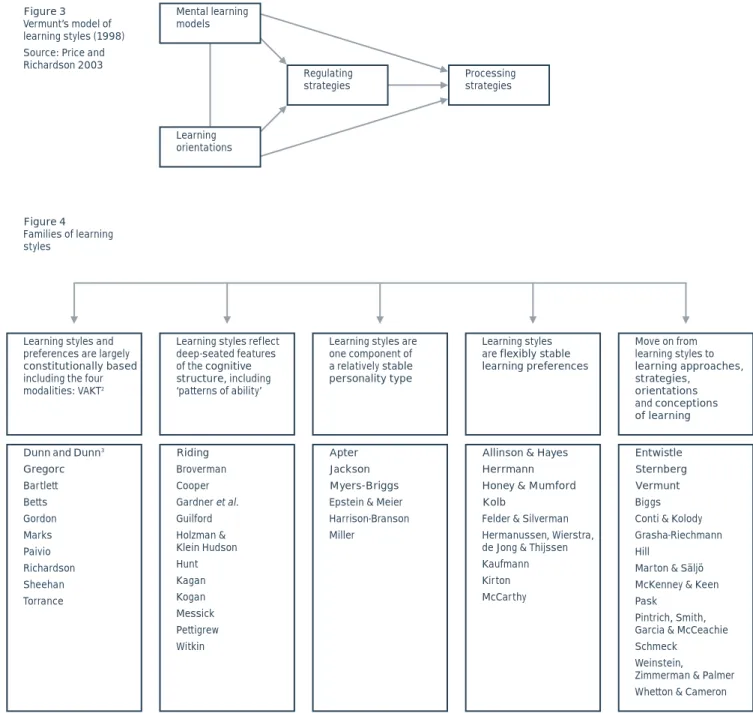
1 2 3 4 5
1 2 3 4 5 6 7 8 9 10 11 12 13 14 15
18 18 20 20 43
23 24 25 26 27 28 29 30 31 32 33 34 35 53 58
Figures
Selection of literature for review Curr y’s ‘onion’ model of learning styles Vermunt’s model of learning styles (1998) Families of learning styles
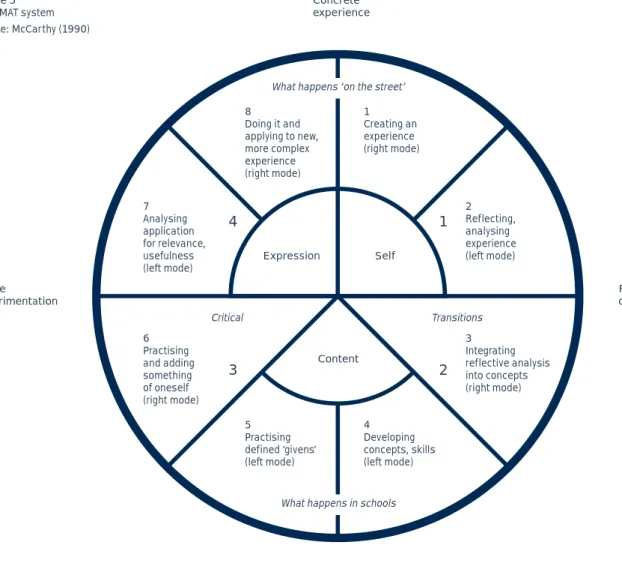
The 4MAT system
Tables
Allinson and Hayes’ Cognitive Styles Index (CSI) Apter’s Motivational Style Profile (MSP)
Dunn and Dunn’s model and instruments of learning styles
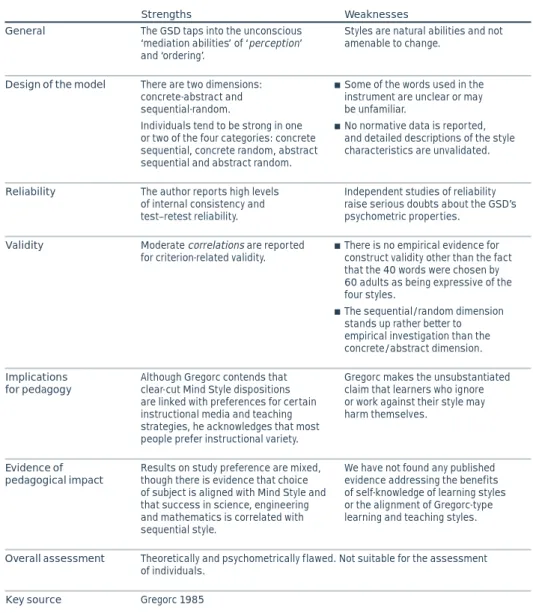
Entwistle’s Approaches and Study Skills Inventor y for Students (ASSIST) Gregorc’s Style Delineator (GSD)
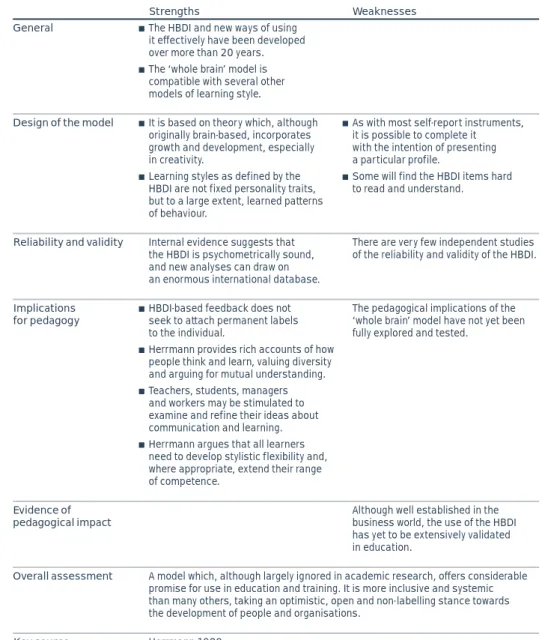
Herrmann’s Brain Dominance Instrument (HBDI)
Honey and Mumford’s Learning Styles Questionnaire (LSQ) Jackson’s Learning Styles Profiler (LSP)
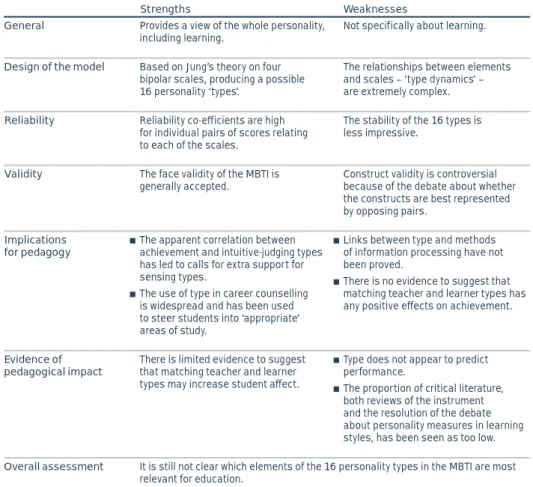
Kolb’s Learning Style Inventor y (LSI) Myers-Briggs Type Indicator (MBTI) Riding’s Cognitive Styles Analysis (CSA) Sternberg’s Thinking Styles Inventor y (TSI) Vermunt’s Inventor y of Learning Styles (ILS) Effect sizes of different types of intervention
The project team would like to extend thanks to the authors of the models reviewed in this repor t for their comments and reactions to our work which enabled us to improve the quality of the final version.
We also wish to acknowledge the steady and sensitive suppor t of John Vorhaus of the Learning and Skills Development Agency (LSDA) and the administrative skills of Louise Wilson of the University of Newcastle upon Tyne. Eugene Sadler-Smith read an earlier version of this repor t and made some useful comments for which we are also grateful.
LSRC reference
The theor y and practice of learning styles has
generated great interest and controversy over the past 20 years and more. The Learning and Skills Research Centre would like to express its appreciation to the authors of two complementar y repor ts, for the time and effor t that went into their production and for providing a valuable resource for researchers and practitioners in the learning and skills sector.
These repor ts serve two key purposes: first, they contribute to what we know about models of learning styles and to our knowledge of what these offer to teachers and learners. Second, the repor ts identify an agenda for fur ther research: to evaluate rigorously key models in a variety of learning environments in order to better understand their merits and deficiencies. We publish these repor ts in the spirit of stimulating debate and enabling knowledge of learning styles to be developed for the benefit of practice and policy. The complementar y repor t Learning styles and
pedagogy in post-16 learningprovides a systematic and critical review of learning styles models. Final sections are common to both repor ts: these draw out the implications for pedagogy and offer recommendations and conclusions for practitioners, policy-makers and the research community.
LSDA would also like to thank the steering committee for incisive commentar y and suppor t throughout the project.
Dr John Vorhaus
Research Manager
Learning and Skills Development Agency Steering committee members:
Professor Charles Desforges Professor Noel Entwistle Professor Phil Hodkinson Dr John Vorhaus
LSRC reference
Learning styles in practice – i
Megan is a communications lecturer in a fur ther education (FE) college, studying for a BA in Post-16 Education. She was inspired by some sessions on learning styles during the course to make this the focus of her action research project. She administers a well-known learning styles inventory1 to a group of mixed-age students who are following a communications and study skills module as par t of an Access course for entr y to higher education. She makes it clear to the students that this is par t of a research project for her degree. She aims to diagnose their learning styles at the outset of the course and again at the end, and then to change her teaching and assessment activities so that students develop all four learning styles as the course progresses.
Megan collects the questionnaire responses, analyses them, and then goes back to the group the following week with the results. The members of the group spend some time deciding what their strengths and weaknesses are on the four learning styles, and what activities might make them into rounded learners. Following this discussion, she asks each student to make a plan for developing his or her learning styles. She also considers what she will have to do to deal with all four types of style during the year she teaches the students.
Given that she only sees the students for 2 hours each week, it is not possible to spend time with them individually in order to review their progress in depth. However, she changes three aspects of her practice. First, she aims to cover all four styles in the way she teaches the class, and to evaluate the effects with them informally in a group review after each new activity. Second, she asks them to work in small groups for a whole lesson at three different points in the year, to review their initial diagnosisand see what they still need to attend to in order to enhance their learning styles. And finally, she tries to alter the tone and focus of her written comments on their assignments to encourage other learning styles. So, for example, she adds comments designed to encourage more practically oriented students to be more abstract and to engage with concepts, or to reflect more on their work. The action research project and its open-ended, negotiated approach to using the inventor y appear to have an effect on most of the students’ motivation and attitude to their assignments. Megan cannot know, without a control group, whether tr ying to encourage all four learning styles has raised achievement, but she feels that the project has given her and her students new enthusiasm.
Finally, Megan passes her degree. Her team manager is ver y interested in her research and asks her to run some staff development sessions on learning styles for other curriculum teams. Following these, the college applies to the Learning and Skills Research Network (LSRN) for funds to enable other staff to carr y out similar action research.
This vignette of Megan’s use of learning styles, based on the professional practice of a lecturer in an FE college, may be considered an example of ‘good practice’. But what exactly is the status of the learning styles inventor y she is using? For example, is it reliable – that is to say, does it measure the learning styles of students consistently? Is it valid – is it really a test of learning styles or of some other quality such as intelligence or personality? How should tutors and managers be responding to the learning styles of their students or staff?
How can we teach students if we do not know
how they learn? How can we improve the performance of our employees if we do not know how we ourselves learn or how to enhance their learning? Are the learning difficulties of so many students/employees better understood as the teaching problems of tutors/managers? How can we pretend any longer that we are serious about creating a learning society if we have no satisfactor y response to the questions: what model of learning do you operate with, and how do you use it to improve your practice and that of your students/staff/organisation? These are just some of the issues raised by those researchers who for the last 40–50 years have been studying the learning styles of individuals.
The mainstream appeal of learning styles Just common sense?
The example we began with, of learning styles in ever yday use, shows the appeal of the idea that teachers and course designers should pay closer attention to students’ learning styles: by diagnosing them, by encouraging students to reflect on them and by designing teaching and learning interventions around them. A fur ther impetus to interest in post-16 learning styles is given by a government policy that aims to develop the necessar y attitudes and skills for lifelong learning, par ticularly in relation to ‘learning to learn’. These are widely assumed by policy-makers and practitioners to be well delineated, generic and transferable.
Section 1
The appeal of learning styles
page 1
1
Bold italic text indicates the first usage in the text of a term in the glossar y (Appendix 3).
The logic of lifelong learning suggests that students will become more motivated to learn by knowing more about their own strengths and weaknesses as learners. In turn, if teachers can respond to individuals’ strengths and weaknesses, then retention and achievement in formal programmes are likely to rise and ‘learning to learn’ skills may provide a foundation for lifelong learning. Perhaps a more instrumental impetus is provided by pressures on resources in many post-16 institutions. For example, if students become more independent in their learning as a result of knowing their strengths and weaknesses, then negative effects from lower levels of contact between lecturers and students will be counterbalanced if students develop more effective learning strategies which they can use outside formal contact time.
There is therefore a strong intuitive appeal to the notion that we all have individual preferences and styles of learning. Fur ther evidence for the idea that we have individual learning styles appears to be offered when teachers notice that students var y enormously in the speed and manner with which they pick up new information and ideas, and the confidence with which they process and use them.
A complex research field
Yet beneath the apparently unproblematic appeal of learning styles lies a host of conceptual and empirical problems. To begin with, the learning styles field is not unified, but instead is divided into three linked areas of activity: theoretical, pedagogical and commercial. The first area of activity is a growing body of theoretical and empirical research on learning styles in the UK, the US and Western Europe that began in the early years of the 20th centur y and is still producing ideas and an ever proliferating number of instruments. Our review has identified 71 models of learning styles and we have categorised 13 of these as major models, using one or more of the following criteria:
their theoretical impor tance in the field as a whole their widespread use, either commercially or academically
their influence on other learning styles models.
The remaining 58 (listed in Appendix 1) are not critically analysed in this repor t. Many consist of rather minor adaptations of one of the leading models and therefore lack influence on the field as a whole; a large number represent the outcomes of doctoral theses. Some offer new constructs(or new labels for existing constructs) as the basis for a claim to have developed a new model. Others have been used only on ver y small or homogeneous populations, and yet others have had a brief vogue but have long fallen into obscurity. It is impor tant to note that the field of learning styles research as a whole is characterised by a ver y large number of small-scale applications of par ticular models to small samples of students in specific contexts. This has proved especially problematic for our review of evidence of the impact of learning styles on teaching and learning, since there are ver y few robust studies which offer, for example, reliable and valid evidence and clear implications for practice, based on empirical findings.
The second area of activity is a vast body of research into teaching and learning which draws researchers from diverse specialisms, mainly from different branches of psychology, but also from sociology, business studies, management and education. Researchers working in the field of learning styles across or within these disciplines tend to interpret evidence and theories in their own terms. Evidence about learning is guided by contrasting and disputed theories from psychology, sociology, education and policy studies, and is valued in different ways from different perspectives. Education is also influenced strongly by political ideologies and social values that create preferences about which type of theor y is given greatest weight.
The problem is compounded by the way in which academic researchers develop their reputations by establishing individual territories and specialisms, which are then defended against those from
a different perspective. This form of intellectual trench warfare, while common throughout academia, is a par ticular feature of the learning styles movement that militates against cumulative knowledge and cooperative research.
The third area of activity consists of a large
commercial industr y promoting par ticular inventories and instruments. Cer tain models have become extremely influential and popular: in the US, for example, the Dunn and Dunn learning styles model is used in a large number of elementar y schools; while in the UK, both Kolb’s Learning Style Inventor y (LSI) and Honey and Mumford’s Learning Styles Questionnaire (LSQ) are widely known and used. The commercial gains for creators of successful learning styles instruments are so large that critical engagement with the theoretical and empirical bases of their claims tends to be unwelcome.
Many teachers use the most well-known instruments with explicit acknowledgement of the source and a clear idea of why they have chosen a par ticular model. However, it is also common, par ticularly on in-service training, management or professional development courses, for par ticipants to analyse their learning styles using an unnamed questionnaire with no accompanying explanation or rationale. In many ways, the use of different inventories of learning styles has acquired an unexamined life of its own, where the notion of learning styles itself and the various means to measure it are accepted without question. Mainstream use has too often become separated from the research field. More problematically, it has also become isolated from deeper questions as to whether a par ticular inventor y has a sufficient theoretical basis to warrant either the research industr y which has grown around it, or the pedagogical uses to which it is currently put. A final aspect of complexity is that researchers produce their models and instruments for different purposes. Some aim to contribute to theor y about learning styles and do not design their instrument for use in mainstream practice. In contrast, others develop an instrument to be used widely by practitioners in diverse contexts. This difference affects the type of claims made for the instrument and the type of research studies that evaluate it.
These three areas of research and activity, and their potential and pitfalls, militate against the type of integrative review that we are attempting here for the LSRC. We have found the field to be much more extensive, opaque, contradictor y and controversial than we thought it was at the star t of the research process. Evaluating different models of learning styles and their implications for pedagogyrequires an appreciation of this complexity and controversy. It also requires some understanding of ideas about learning and measurement that have preoccupied researchers in education, psychology and neuroscience for decades. The extensive nature of the field surprised us: we underestimated the volume of research which has been carried out on all aspects of learning styles over the last 30 years, although most of it refers to higher education and professional learning rather than learning in FE colleges. Three examples illustrate this point. In 2000, David Kolb and his wife Alice produced a bibliography of the research conducted since 1971 on his experiential learning theor y and the Kolb Learning Styles Inventor y (LSI): it contains 1004 entries. Second, the website for the Dunn and Dunn model has a bibliography with 1140 entries. Lastly, it has been estimated that 2000 ar ticles have been written about the Myers-Briggs Type Indicator (MBTI) between 1985 and 1995 (see Coffield et al.2004 for more details, or the summaries in this repor t in Section 3).
The enormous size of the research literature in these three areas presents ver y par ticular problems for practitioners, policy-makers and researchers who are not specialists in this field. It is extremely unlikely that any of these groups will ever read the original papers and so they are dependent on reviews like this one, which have to discard the weakest papers, to summarise the large numbers of high-quality research papers, to simplify complex statistical arguments and to impose some order on a field which is marked by disunity, dissension and conceptual confusion. The principal tasks for the reviewers are to maintain academic rigour throughout the processes of selection, condensation, simplification and interpretation while also writing in a style accessible to a broad audience.
Competing ideas about learning
Conflicting assumptions about learning underpin mainstream ideas about learning and the best-known models of learning styles. For example, some theories discussed in this repor t derive from research into the functioning of the brain, where claims are made that specific neural activity related to learning can be identified in different areas of the brain. Other influential ideas derive from established psychological theories, such as personality traits, intellectual abilities and fixed traits which are said to form learning styles. From this latter perspective, it is claimed that learning styles can be defined accurately and then measured reliably and validly through psychological tests in order to predict behaviour and achievement.
Claims about learning styles from the perspective of fixed traits lead to labels and descriptors of styles as the basis for strong claims about the generalisability of learning styles. These can take on unexpected predictive or controversial characteristics. For example, the belief that styles are fixed has led to propositions that marriage par tners should have compatible learning styles; that people from socially disadvantaged groups tend to have a par ticular style; or, as Gregorc believes, that styles are God-given and that to work against one’s personal style will lead to ill health (see the evaluation of his Style Delineator (GSD) in Coffield et al.2004; also Table 5, Section 3 of this repor t.).
Even if we discard these extreme examples, the notion of styles tends to imply something fixed and stable over time. However, different theorists make different claims for the degree of stability within their model of styles. Some theories represent learning styles as ‘flexibly stable’, arguing that previous learning experiences and other environmental factorsmay create preferences, approaches or strategies rather than styles; or that styles may var y from context to context or even from task to task. Never theless, suppor ters of this view still argue that it is possible to create valid and reasonably reliable measures and for these to have diagnostic and predictive use for enhancing students’ learning. In contrast, other theorists eschew all notions of individual traits and argue that it is more productive to look at the context-specific and situated nature of learning and the idea of learning biographies rather than styles or approaches.
page 2/3
Competing ideas about learning have led to
a proliferation of terms and concepts, many of which are used interchangeably in learning styles research. For example, terms used in this introduction include ‘learning styles’, ‘learning strategies’ and ‘approaches to learning’. In addition, we have referred to ‘models’, ‘instruments’ and ‘inventories’. Our investigation has revealed other terms in constant use: ‘cognitivestyles’, ‘conativestyles’, and ‘cognitive structures’; ‘thinking styles’, ‘teaching styles’, ‘motivational styles’, ‘learning orientations’ and ‘learning conditions’. Sometimes these terms are used precisely, in order to maintain distinctions between theories; at other times, they are used ver y loosely and interchangeably. Some theorists offer clear definitions of their key concepts at the outset, but forget to maintain the limitations they have placed on their language in later papers. Rather than attempting to offer yet another set of definitions of each concept, this repor t aims to define these terms as clearly as possible within par ticular families of ideas about learning in order to show how they are used by different learning styles theorists.
Implications for defining and measuring learning styles
It is possible to explain the main dimensions that underpin different approaches to learning styles and this repor t does so in later sections. Never theless, the competing theories and techniques of measuring them, and the effectiveness of such measures are so varied and contested that simple choices about the most suitable approach are difficult to substantiate. Different ideas about learning styles create distinct approaches to identifying the specific attitudes and skills that characterise styles and different measures designed to generalise between learning contexts and types of learner.
Evaluating the claims for various models requires an understanding of the psychometricvocabular y that underpins par ticular constructs and measures of reliabilityand validity. For example, there are various dimensions to validity, including whether the various test items appear to capture what they set out to measure (face validity) and whether the range of behaviours can be seen to have an impact on task performance (predictive validity). In addition, a number of other types of validity are impor tant, including
ecological validity, catalytic validityand construct validity. In addition, there is the frequently overlooked issue of effect size.
The notion of reliability is also impor tant because some of the most popular models extrapolate from evidence of reliability to strong asser tions of generalisability, namely that learners can transfer their styles to other contexts or that measures will produce similar results with other types of student. We provide a summar y of measurement concepts in a glossar y in Appendix 3.
Finally, the technical vocabular y needed to understand and interpret the various claims about learning styles also requires an appreciation that for some researchers, a reliable and valid measure of learning styles has not yet been developed; and for some, that the perfect learning style instrument is a fantasy. From the latter perspective, observation and interviews may be more likely than instruments to capture some of the broad learning strategies that learners adopt. Those who reject the idea of measurable learning styles consider it more useful to focus on learners’ previous experiences and motivation.
Implications for pedagogy
A number of options for pedagogy flow from the different perspectives outlined in this introduction. For example, suppor ters of the concept of fixed traits and abilities argue that a valid and reliable measure is a sound basis for diagnosing individuals’ learning needs and then designing specific interventions to address them, both at the level of individual self-awareness and teacher activity. This, however, might lead to labelling and the implicit belief that traits cannot be altered. It may also promote a narrow view of ‘matching’ teaching and learning styles that could be limiting rather than liberating.
In order to counter such problems, some theorists promote the idea that learners should develop a reper toire of styles, so that an awareness of their own preferences and abilities should not bar them from working to acquire those styles which they do not yet possess. In par ticular, as students move from didactic forms of instruction to settings with a mixture of lectures, seminars and problem-based learning, it may become possible for them to use a range of approaches. This can lead to a plan for teachers to develop these styles through different teaching and learning activities, or it can lead to what might be seen as a type of ‘pedagogic sheep dip’, where teaching strategies aim explicitly to touch upon all styles at some point in a formal programme. Other theorists promote the idea of learning styles instruments as a diagnostic assessment tool that encourages a more self-aware reflection about strengths and weaknesses. For suppor ters of this idea, the notion of learning styles offers a way for teachers and students to talk more productively about learning, using a more focused vocabular y to do so. Finally, those who reject the idea of learning styles might, never theless, see value in creating a more precise vocabular y with which to talk about learning, motivation and the idea of metacognition– where better self-awareness may lead to more organised and effective approaches to teaching and learning.
A large number of injunctions and claims for pedagogy emerge from the research literature and we provide a full account of these in Coffield et al.(2004), together with an indication of their strengths and weaknesses. These are summarised in this repor t in Section 4. However, although many theorists draw logical conclusions about practice from their models of learning styles, there is a dear th of well-conducted experimental studies of alternative approaches derived from par ticular models. Moreover, most of the empirical studies have been conducted on university students in depar tments of psychology or business studies; and some would criticise these as studies of captive and perhaps atypical subjects presented with contrived tasks.
Learning styles in practice – ii
It is Monday morning in a college classroom where a group of 30 students – mostly aged between 16 and 19, with a few older learners – are in the second week of their advanced-level catering course. They are following a communication skills module, which is a mix of study skills and presentational techniques. A lecturer hands out a questionnaire on learning styles and introduces it: ‘Today I want you to reflect on your learning styles because this will help you assess your strengths and weaknesses, improve the skills you already have and develop skills you might not be so good with.’ The students dutifully spend 15 minutes scoring each item, which asks them to reflect on
what they like or do not like (eg ‘I prefer learning things from books’). They then categorise the statements they ticked into four groups: pragmatists, theorists, activists and reflectors. Each categor y has a descriptor, similar to a thumbnail sketch of strengths and
weaknesses. A quick show-of-hands review by the lecturer reveals that some of the group have an even spread of categories, while a few are heavily skewed towards one style.
‘So, Craig, what have you come out as?,’ he asks a young man in the front row.
‘I’m a pragmatist and a bit of something or other – activist.’
‘What do you reckon that tells you about your learning style, then?’
‘Well, I’m gobby and I like talking a lot and I don’t like all that boring stuff in books, or when lecturers waffle on and it’s not relevant to catering at all.’
‘OK. Sally, what about you?’
‘I’m a reflector ’cos I keep myself to myself and I’m dead shy in groups with talking and things.’
This quick survey shows that few in the group have predominantly abstract tendencies, while most of the group are more oriented towards the concrete. Most of the group become restless during the debriefing, although the adult learners are clearly more interested. The lecturer finishes: ‘Well, it’s a good idea to go back to all the statements that you put a cross by, and see if you can find ways to develop those skills over the next two years because the idea is to have a spread of styles, not just to go with your preferred style.’
This occasion is the first and last time the students consider their learning styles during the 2-year course. The questionnaire used has no identifiable source or author, no accompanying explanation other than the brief descriptors of the four styles, and no indication at all of what teachers or students should do with the information. The lecturer came across the questionnaire during a session in his initial teacher training course, where it was administered in a similar way to his approach with the catering students. The event makes it possible for the course leader to claim in the self-assessment document for the for thcoming inspection that the college ‘diagnoses students’ learning styles’. Six months later, inspectors commend this practice in their repor t.
Summary
Both examples of using an inventor y of learning styles in this section are authentic and known at first hand by one of the researchers writing this repor t. The context we have outlined indicates some of the conceptual and empirical complexity and controversy that characterise the field of learning styles research. We aim to cut through this, and to offer recommendations about the use of different inventories of learning styles in post-16 education to a range of audiences. The scope of our review, its aims, objectives and research questions are discussed in Section 3. We hope that one outcome of our review might be that the use of learning styles summarised at the beginning of this section is
underpinned by better understanding. More impor tantly perhaps, a second outcome would be that practices such as the one summarised at the end of this section are not commended as good practice.
page 4/5
Introduction
Post-16 learning in the UK is not a well-defined, autonomous and self-regulating area of activity, but a highly complex field. It is heavily influenced by economic changes, new technologies, competing interest groups and by government policies as well as by the institutions, professionals and students at the hear t of the system. The learning and skills sector, created by Act of Parliament in 2000, is an amalgam of different traditions in post-16 education and
training, and comprises a huge number of organisations (providers, inspectors and awarding and regulation bodies), all with different systems for designing and implementing curricula, assessing quality and training practitioners. In addition, there are par ticular traditions, cultures and ideas about teaching and learning
within different post-16 contexts that create both oppor tunities for and barriers to the widespread use of learning styles across the sector. The complexity and diversity of this sector present a serious challenge to any attempt to promote an informed interest in the different approaches to learning styles as a means of improving pedagogy.
This section will describe the main structural features of the post-16 sector and will discuss the potential of learning styles to influence pedagogy within current pressures on the system. It will focus on the following areas, which in themselves give some indication of the complexity of the new system:
1
policy initiatives
1.1
the learning and skills sector
1.2
higher education in FE colleges
1.3
ideas about ‘best practice’
1.4
leadership and management
2
sectoral and institutional pressures
2.1
fur ther education
2.2
work-based learning (WBL)
2.3
adult and community education (ACE)
3
qualifications and curricula 4
initial teacher training and professional development in fur ther education
5
student motivation.
Policy initiatives
The learning and skills sector
The scope of post-16 learning has broadened considerably since the establishment of the Learning and Skills Council (LSC) in 2000 and now embraces not only FE colleges, but also sixth forms in schools and colleges, adult and community education (ACE) in local education authorities (LEAs) and voluntar y organisations, lifelong learning, workplace learning and basic skills for adults. The LSC covers all publicly funded post-16 learning and training with the exception of higher education. In England, the LSC has responsibility for some 6m learners and an annual budget of more than £7bn. The learning is – to use the instrumental metaphor found in official texts – ‘delivered’ by over 4000 providers in a range of settings from classrooms and community projects to workplaces and Learndirect centres; and courses are designed and accredited by hundreds of awarding bodies. The largest element within the sector is the FE colleges, more than 400 in total, which account for around 60% of LSC funding. The inclusion of adult and community education (ACE), with its many providers new to systems of inspection, teacher training and quality assurance, adds a new layer of complexity. The attitude of the government to the sector can be gauged by reference to the discussion document,
Success for all: reforming fur ther education and training
(DfES 2002a) which listed five problems, but only three strengths. The former can be briefly summarised as follows.
Decision making has been reactive to funding oppor tunities, rather than proactive.
The quality of providers varies widely ‘with a number of truly excellent providers and excellent depar tments within colleges, co-existing with some poor and much mediocre provision’ (DfES 2002a, 5). There has not been sufficient attention paid to teaching and learning. There has been too little strategic planning for the long term.
The sector is staffed by an underdeveloped workforce ‘with unhealthy levels of casualisation’ (2002a, 5). The sector also suffers from ‘significant recruitment and retention problems’(2002a, 20) among both teachers and managers. In 1998, only 55% of FE staff were on permanent contracts, while the rest were employed on par t-time, temporar y or shor t-term contracts (FEFC 2000).
‘…too much learning is taking place in unattractive and inefficient buildings’ (DfES 2002a, 5),
caused by a legacy of under-investment in the capital infrastructure.
Section 2
The context of post-16 learning
page 6/7
These considerable problems are balanced, in the government’s view, by three significant strengths within the sector.
A distinctive commitment to social inclusion, widening par ticipation and opening up access to learning to disadvantaged people. FE colleges attract 27% of their students from the 15% of electoral wards that are the most disadvantaged (DfES 2002a, 4).
Long-standing relationships with par tners and strong credibility with local people, often based on strong learner suppor t.
‘good practice in learning deliver y, often involving inspirational creativity by front-line staff’ (DfES 2002a, 6).
Teachers and trainers within the sector are also to be suppor ted by a National Leadership College, led by a consor tium of HE institutions and LSDA. It will offer induction programmes for new FE college principals, managers of work-based learning (WBL) and adult and community education (ACE), together with training for those wishing to become senior managers. We discuss these proposals below.
Higher education in further education
Governmental policy initiatives have had, and continue to have, a significant impact on the general climate within which all teaching and learning in the sector takes place. For example, the prime ministerial target of 50% of 18–30 year olds in higher education before 2010 is unlikely to be met unless there is a major increase in the amount of higher education that is taught within fur ther education. In 1999/2000, there were as many as 149,000 students of higher education in English FE colleges (NAO 2002), including 3000 postgraduates, amounting to around 10% of total postgraduate numbers. By comparison, in Scotland, almost one-third of all higher education is taught within FE colleges. The policy of widening par ticipation is likely to find tutors in the post-16 sector more accustomed to dealing with increased student diversity than their counterpar ts in higher education, but non-traditional students remain more expensive to teach, no matter where they are taught. Moreover, both higher and fur ther education now contain higher percentages of mature students, who have the highest drop-out rates in the first year of study – 16% of mature students in higher education drop out, as compared to only 8% of their younger counterpar ts (HEFCE 2001).
The qualitative research carried out by the National Audit Office (NAO 2002) on student ‘drop-out’ involves higher rather than fur ther education, but is arguably the best evidence available. It identified five main reasons for students withdrawing during their first year of study: a lack of preparedness for higher education, changing personal circumstances or interests, financial matters, the impact of under taking paid work, and dissatisfaction with the course or institution. What is impor tant about this list is that only two of the reasons (the first and the last) are connected with the quality of provision. Par t of the contemporar y context, then, for students in higher/fur ther education is financial hardship, with as many as 47% of full-time HE students in employment during term time (Callender and Kemp 2000).
Proposals to extend higher education taught in FE colleges and to increase the number of institutions designated as ‘universities’ mean that research into learning styles and at approaches in higher education, such as that by Entwistle and Vermunt (whose models are reviewed in Section 3) becomes even more relevant to FE colleges (see Coffield et al.2004). However, even if a more considered approach to learning styles were to be adopted in higher education taught in FE colleges, time for staff development – already heavily dominated by policy initiatives – is at a premium.
Ideas about best practice
In November 2002, the government issued its vision for the future of the learning and skills sector in the second version of Success for all(DfES 2002b), which sets out a strategy for investment and reform. One of the key elements of the strategy is to ‘put teaching, training and learning at the hear t of what we do by establishing a new Standards Unit to identify and disseminate best practice, which will guide learning and training programmes’ (DfES 2002b, 5). The Standards Unit has begun to identify ‘best practice’ in deliver y, assessment, content and teaching
techniques; but it appears to be focusing, initially at least, on practitioners’ views (par ticularly those from the new Beacon colleges; see below) and inspection repor ts as the sources for ‘best practice’. It is not clear yet what theor y of learning informs its views, how it intends to engage with external research, what research it will commission, or what view it has about the relevance of learning styles.
This review should help the unit form a view on learning styles and pedagogy. An informed view is impor tant in the light of assumptions about learning styles found in other policy initiatives, such as the Fur ther Education National Training Organisation (FENTO) standards for teacher training (see below), and in initiatives for inclusive practice. As Klein et al.(2003) point out in their repor t on the implications of using the Dunn and Dunn model in FE colleges, reviewed in Coffield et al.
2004, there are numerous assumptions about learning styles in initiatives for inclusive education. Yet it is not clear how suppor ters of these general assumptions have developed their views about the impor tance of learning styles. For example, the influential Tomlinson Repor t for the Fur ther Education Funding Council (cited in FEFC 1996, 16) on provision for learners with learning difficulties and/or disabilities argues that:
There is a world of difference between, on the one hand, offering courses of education and training and then giving some students who have learning difficulties some additional human or physical aid to gain access to those courses and, on the other hand, redesigning the ver y processes of learning, assessment and organisation to fit the objectives and learning style of the student.
The extent to which this view of inclusive learning is now prevalent in the post-16 sector is evident in other policy documents. For example, advice by the LSDA to work-based learning providers advocates careful diagnostic assessment (Green 2002). This LSDA repor t cites a Depar tment for Education and Employment (DfEE) study from 2001 that presents ‘learning style’ as one dimension in a jigsaw of components that should be encompassed in the initial diagnostic assessment of trainees. It is not evident that these injunctions by Tomlinson (cited in FEFC 1996) and the LSDA (Green 2002) are based on any research on learning styles. Instead, there is a tendency to assume the existence of styles and the desirability of diagnosing and matching them through teaching and resources and individual learning plans. The assumption of the Tomlinson Committee, quoted above, is presented in broad terms by the FEFC to form the basis of one of its official principles of inclusive learning (FEFC 1996). In her repor t on initial assessment, Green offers more detail about the impor tance of learning styles, but does not reference any specific source. She asser ts that (2002, 12):
Learning style inventories will provide details of different learning preferences. Outcomes can be used in different ways. Knowledge of learning preferences can help learners exploit oppor tunities to learn through activities that match them well with [their]preferred style. However, there should also be suppor t for learners to learn when teaching/training strategies do not match well with preferences.
Other official documents use the general language of individual needs, and sometimes add asser tions about learning preferences. For example, in a suppor t pack for staff development for teachers of students with mental health problems, the DfES (2003, 41) claims that ‘like all learners, learners with mental health problems will have preferences as to how and when they learn best’. Although the emphasis in the LSDA repor t is on preferences as opposed to style, but again, it is not clear how far the idea is rooted in any research on learning styles.
In a similar vein, general assumptions about individual needs and learning styles are prevalent in initiatives to widen par ticipation in post-16 education. A recent repor t for the LSC on ‘good practice’ in colleges that are aiming to widen adult par ticipation cites the example of a par ticular college to commend the ways in which ‘Learner/learning suppor t is treated as an entitlement. Suppor t is packaged in a holisticway to meet individual needs, including practical and financial suppor t as well as additional learning’ (Taylor 2002, 34). In other examples cited in Taylor’s repor t, individual learning ‘needs’, individual pathways and initial assessment and learning plans reinforce the idea that ‘good practice’ is essentially a response to individuals. As a result, Taylor (2002) commends a series of ‘simple practitioner manuals devised in one college as a guide to learning methods and styles’.
Inspectors’ repor ts sometimes offer general
asser tions about the impor tance of meeting individual needs and differentiating teaching to accommodate them, but Office for Standards in Education (Ofsted) and Adult Learning Inspectorate (ALI) repor ts shows inconsistency in whether inspectors commend individualisation as ‘good practice’ or not. In a random sample of 30 repor ts by the ALI, reviewed for our repor t, all place a strong emphasis on individualisation. Repor ts commend creating and using individual learning plans and responding to individual needs in the classroom. Yet there is no consistency in whether inspectors commend the use of learning styles. Of the 30 repor ts, 15 mentioned the notion once in a general way. For example, ‘tutors carefully select a good range of learning materials, directly relevant to the needs, interests and learning styles of the learner’ (ALI 2002a, 21); ‘teaching and planning folders contain … useful guidance … on learning styles, teaching and learning approaches, assessment and resources’ (ALI 2003a, 6); [an initial diagnostic assessment comprised] ‘a basic skills test and an occupational and learning styles assessment to agree an individual plan of activities based on the specific needs of each learner’ (ALI 2003b, 35–36).
page 8/9
The extent to which repor ts commend individualisation depends par tly on the demands of a subject area: for example, competence-based qualifications in a college drop-in centre for business and administration lend themselves more easily to individual learning plans and programmes than, say, an A-level in histor y. It also seems that views of good practice depend on traditions within different sectors, reflected in the views of individual inspectors who come from those traditions. For example, a repor t on adult education in an LEA hardly mentions individual diagnosis or meeting individuals’ needs, but praises teachers for the ways that learners work in groups and learn from each other (ALI 2003c). A communal view of learning is more evident in the adult education repor ts than in the FE and work-based learning ones.
Despite the general nature of claims about good practice and inconsistency as to whether such claims are commended officially, an interesting feature of such citations is that they begin to take on a circularity that makes it difficult to challenge what ‘good practice’ really is. For example, Taylor’s repor t (2002, 56) notes a problem that arises when examples ‘are self-repor ted by project managers and are taken as given by authors of evaluations [of policy initiatives]… As responsiveness to learners’ needs is generally agreed to be a characteristic of good practice, such attempts to develop facilities may be regarded as being examples of positive practice’. The purpose of raising this point is not to challenge the impor tance of responding to learners’ needs: instead, it is to question the ease with which assumptions which are not suppor ted by research become mantras about ‘good practice’ and then policy injunctions.
One of the reasons given by the government for this more interventionist approach is the widely diverging standards of learner achievement within the sector. Ofsted (2002) repor ts, for instance, that 15% of colleges fail inspection and a fur ther 44% have some aspect of their performance assessed as unsatisfactor y. This welcome new focus on teaching and learning adds urgency to the question: what is considered ‘good’ or ‘best’ practice in the use of learning styles?
Leadership and management
A leadership college to be known as the Centre for Excellence in Leadership to train senior and middle managers across the learning and skills sector was established in 2003 as a consor tium of the LSDA, the Ashridge Management Centre, the University of Lancaster’s Management School and the Open University. The need for such an organisation is confirmed by repor ts such as that by the
LSDA (Frearson 2003), which found the quality
of management and leadership to be extremely variable; for example, over half of WBL providers were found to have poor leadership and management of learning (ALI 2002b). The LSDA repor t also noted that many managers in ACE receive little or no training for their roles, a problem paralleled in the low rates of teacher training for tutors in adult education. In addition, even where managers did take up professional development and training oppor tunities, the quality and content of these programmes also varied enormously. The survey found other problems in developing managers to suppor t their staff in teaching roles. For example, the chief executives of colleges said in 2002 that they were ‘more likely to feel’ that they have no time to think beyond crisis management than they did in 1997, while WBL managers were more preoccupied with operational issues than their counterpar ts in colleges. Moreover, there is a huge problem of an ageing management cohor t in fur ther education and difficulty in attracting new managers (Frearson 2003).
In relation to the ability of managers to suppor t teachers in understanding learning and improving pedagogy, Frearson’s repor t (2003) and proposals for the Centre for Excellence in Leadership raise a number of questions. For example, the LSDA survey (Frearson 2003) that formed the basis for the repor t asked for extensive comments on the appropriateness of the FENTO standards in suppor ting and enhancing managers’ tasks and roles. Yet none of the FENTO standards for managers mention the need for them to understand learning as the basis for helping their staff, although maintaining the morale and motivation of staff is one of the standards. It is therefore unclear how managers are to raise the quality of learning and maintain staff morale if they themselves have no in-depth understanding of teaching and learning.
The absence of teaching and learning as one of the skills or areas of knowledge that managers need is in stark contrast to standards of competence for school head-teachers which place a strong emphasis on teaching and learning. It is also ironic given that the title of the LSDA repor t (Frearson 2003) is Tomorrow’s learning leadersand that the title of the new website is ‘inspirelearning’ (www.inspirelearning.com). One explanation is that designers of the management programme may expect managers in colleges to have their own teaching qualification, although this is unlikely to be the case in WBL and adult education. Another explanation is that government policy since the early 1990s has been to attract non-educationalists to college chief executive posts. Notwithstanding these possibilities, the absence of teaching and learning in management standards for the learning and skills sector is not going to equip managers to make more informed decisions about learning styles and the usefulness of research into them.
Never theless, proposals for the Centre for Excellence in Leadership also call for ‘research into the diversity of leadership and management tasks, skills, knowledge and attributes to inform the design of relevant,
responsive and accessible professional development oppor tunities’ (Frearson 2003, 7). This offers some optimism that managers in the learning and skills sector may develop an in-depth understanding of the ‘core business’ of the sector, namely learning. This review may help managers to make informed decisions about the relevance of learningstyles and the
appropriateness or other wise of individual models.
Sectoral and institutional pressures Further education
Of the 400+ colleges within the FE sector, 18 have been awarded Beacon status as a mark of outstanding teaching and learning practices, as judged by the inspectorate. A fur ther 16 have been named Centres of Vocational Excellence (CoVEs) because of a vocational specialism, and another 71 colleges are currently moving successfully through the CoVE accreditation programme (HM Treasur y 2002). The government continues, however, to be concerned about the range of performance in the sector: In 1997, for instance, 125 colleges had achievement rates below 65%. This figure was, however, reduced to 48 colleges by 2000; and in general, average success rates in fur ther education have been improving slowly in recent years (HM Treasur y 2002).
Any moves to individualise learning as, for example, recommended by Kolb (1984), will be made within a system which, although it does not deserve to be called ‘mass education’, is never theless seriously overcrowded and has been historically under-funded. In June 2002, members of the National Association of Teachers in Fur ther and Higher Education (NATFHE) union went on strike, claiming that teachers in fur ther education were being paid 10% less than their counterpar ts in the school system. Hodkinson (2002, 263) summarised the major changes to the conditions of work for FE teachers and argued that these changes are having serious consequences on professionalism in the sector:
There are new conditions of ser vice, major external curriculum changes, a reduction of career hierarchies, reduced pay relative to other groups, an increase in par t-time and temporar y contracts, a new external inspections system, and, most recently, pressure for the rapid development of a fully qualified teaching workforce.
The changes in conditions which Hodkinson has detailed are symptoms of the performance management culture which has spread throughout the sector (Ainley and Bailey 1997; Gleeson and Shain 1999), with the introduction of ever tougher targets, rigorous inspections and annual appraisals of all staff. It is not being suggested here that moves towards a qualified teaching force or that rigorous inspections are in themselves objectionable, but rather that they are additional pressures on a sector which is already undergoing significant change. The researchers (cited in brackets above) argue that the operations of performance management are not neutral in their effects; indeed, they are creating dysfunctional side-effects such as compliant sub-cultures. These pressures have serious implications for the widespread use of learning styles in fur ther education. For instance, compliance with targets may lead to a surface approach to learning based on simply meeting the assessment requirements. Moreover, pressures on colleges to meet inspection criteria for differentiation or for diagnostic assessment during student induction may lead to an unthinking and uncritical administration of a learning style inventor y, as was done in the less considered of the two examples that opened this repor t (see also Gray, Griffin and Nasta 2000).
page 10/11
Work-based learning
Considerable concern is now being expressed about the quality of work-based training, or at least those sections of it that are funded and inspected by government. The final repor t of the chief inspector of the Training Standards Council (TSC) made two serious criticisms of the quality of that training. First, the pedagogy of WBL is too little understood: ‘Inspection repor t after inspection repor t describes weaknesses in the initial assessment of learning needs, in the preparation of individual learning plans, progress reviews, assessment and verification of achievements and careers guidance’ (TSC 2001, 4). And second, ‘few providers properly understand the disciplines of quality assurance, with nearly half of all those inspected last year awarded grade 4 or 5’ – the two lowest grades, describing less than satisfactor y or poor provision (TSC 2001, 5). A subsequent study by Hughes (2002, foreword) for the LSDA confirmed that the ‘noticeable deterioration [of work-based training] in the last year of operation of the Training Standards Council has accelerated under the Adult Learning Inspectorate’. This repor t analysed both quantitatively and qualitatively all inspection grades of work-based training for the four years from 1998 to 2001 and concluded that the areas of concern which were repeatedly highlighted by the inspectors were: inadequate management of the data, low levels of retention and achievement, the poor quality of assessment, and the unsystematic development of staff.
Given the poor state of pedagogy in WBL (ALI 2002b), a good deal of staff development will be needed if learning styles are to be used effectively. However, as Coffield et al.(2004) show, inventories such as Honey and Mumford’s (see Table 7, Section 3) have been widely used in workplaces. In addition, the research of Allinson and Hayes (see Table 1, Section 3) is par ticularly relevant for WBL because they have investigated the hypothesis that a similarity in cognitive style between managers and subordinates, especially in regard to mentoring, helps to produce more positive relationships.
The DfES Standards Unit and other bodies working to improve pedagogy in workplaces will need to evaluate how learning styles can help or hinder their effor ts. For example, research on workplace learning shows the impor tance of considering the subtle effects of workplace culture, ethos and environment and the idiosyncratic features of individual organisations that make learning effective or ineffective (Evans, Hodkinson and Unwin 2002). In addition, initiatives such as Modern Apprenticeships are criticised for being top-down and supply-led, and not based on the specific need for skills, knowledge and attributes in different industries and sectors (see Fuller and Unwin 2003). The complexity of WBL, together with pressures on resources for training mentors, trainers and supervisors, suggest that simplistic generalisations about the need to respond to individual learning styles or to use a par ticular learning styles inventor y will have a limited impact on pedagogy.
Adult and community education (ACE)
In 2001, a large number and diverse range of new providers of post-16 education were incorporated into the learning and skills sector. Adult and community education (ACE) – previously funded and run by LEAs, charities, voluntar y organisations and other bodies such as the Workers’ Educational Association (WEA) – and prison education are now both encompassed within the remit of the LSC and the ALI.
The ACE sector is likely to experience a number of difficulties in responding to demands for pedagogy based on learning styles. These can be summarised as follows.
The over whelming majority of the teaching workforce are par t-time and untrained.
There are strong traditions of informal, critical pedagogy and customised cer tification of courses that do not lend themselves easily to a transmission or ‘deliver y’ approach to pedagogy.
Many courses are shor t and there is a ver y wide variety of accreditation and qualifications, from diverse awarding bodies.
In September 2002, the sector began to experience external inspection with injunctions about pedagogy, assessment and quality assurance.
The difficulties in bringing together the diverse organisations that manage, implement and evaluate ACE constitute a barrier to serious consideration of effective pedagogy. There are also ver y different educational traditions within ACE, from critical pedagogy and radical workers’ education, to ideas about humanist development, community self-help and learning for leisure. These traditions tend to be implicit in debates about what counts as good teaching and learning, and it is not easy to see how learning styles research could be adapted to the ver y disparate contexts of ACE. In par ticular, the strong group and community ethos in much ACE provision remains impor tant to many tutors and learners, making simplistic ideas about individualisation and matching teaching to individual preferences or styles unappealing to many tutors. A community or group ethos is
also impor tant to many staff in the National Institute of Adult and Continuing Education (NIACE), which is a crucial organisation when it comes to raising the quality of teaching and learning in the sector.
Qualifications and curricula
Most of the post-16 applications of learning styles inventories evaluated by Coffield et al.(2004) were carried out in higher education. This is significant, because the structure, content, teaching and assessment of qualifications in higher education are still determined to a great extent by the institutions and teachers themselves. This is also largely true of ACE tutors who still enjoy considerable flexibility and autonomy in designing and running their courses; so institutions and tutors have the freedom to respond to learning styles positively or negatively.
In stark contrast, mainstream FE provision is focused on the national curricula for general A-levels, Advanced Vocational Cer tificates of Education (AVCEs, based on Advanced GNVQs), the new GCSEs in vocational subjects (based on Intermediate
GNVQs) and National Vocational Qualifications (NVQs). In these qualifications, design, content, pedagogy and assessment are heavily determined by the Qualifications and Curriculum Authority (QCA) and awarding bodies.
In addition, targets for retention and achievement can exer t a strong influence on pedagogy within the boundaries of the qualification, by encouraging compliance rather than the sor t of creative engagement with ideas about learning styles
advocated by some proponents and noted in Section 8 of Coffield et al.(2004). Fur ther pressure is created by modular structures, fragmented teaching teams, 40% of FE teachers being on temporar y or par t-time contracts, and limited course hours: all of these factors militate against continuity and dialogue.
The scope, therefore, for using learning styles as a basis for diagnosis and dialogue about learning is seriously affected by the demands of the qualification and the structure of the curriculum. Some practitioners in FE colleges may be seduced by the claims made for the ‘matching’ of learning and teaching styles in the hope of maximising achievement, rather than developing a range of learning styles in each student. But in the current state of knowledge, it is far too risky to be prescriptive about the value of individual differentiation or ‘matching’ or about employing any par ticular instrument.
Moreover, a significant number of FE teachers move regularly between heavily regulated curricula such as AVCEs to more open-ended ACE programmes. Although there has been greater flexibility for tutors in ACE to determine pedagogy, the link between funding and accredited programmes is now placing new restrictions on ACE programmes. For example, the QCA demands external assessment for all qualifications in the National Qualifications Framework (NQF) and awarding bodies are having to redesign those curricula and assessment regimes that are par t of the NQF.
Initial teacher training and professional development in further education
An obvious focus for improving post-16 teachers’ understanding of learning styles and their
implications for pedagogy is initial teacher education and continuing professional development (CPD). So we need to evaluate the potential for staff to acquire an understanding of learning styles through existing structures.
The extent to which FE college lecturers hold a full teaching qualification (as opposed to a foundation or introductor y cer tificate such as the well-known City & Guilds Fur ther & Adult Education Teachers Cer tificate) varies greatly. In some colleges, all full-time lecturers are qualified, as are many par t-time staff. In others, the figure is much lower: across the college sector as a whole, DfES figures cite 60% for full-time and 43% for par t-time staff (2002b, 18). There are no official figures for the rates of qualified staff in the ACE and WBL sectors. On average, FE colleges spend only 1–3% of their budgets on staff development. Moreover, the fragmented, par t-time nature of ACE means that oppor tunities for CPD are even more limited than they are in fur ther education.
However, even where staff have the oppor tunity to gain a full post-16 teaching qualification, the curriculum is now dominated by the outcome-based standards of FENTO. These standards focus exclusively on FE staff, and the tradition of including a ver y diverse range of trainers, lecturers and tutors on post-16 initial teacher training courses is at risk of being eroded by the need to include FENTO standards in such programmes. In addition, most post-16 teacher training is now run by colleges or by colleges in par tnership with universities. Conditions of service in colleges to enable teacher education staff to keep up to date with research evidence are not favourable, and there is wide variation within the sector.
At one level, it could be argued that the problem has already been solved: the requirement to possess knowledge and understanding of learning styles is already par t of FENTO’s current standards, which include no less than nine references to learning theor y, learning styles and the learning cycle. The learning cycle referred to is likely to be Kolb’s (see Table 9, Section 3) since his model is widely used in post-16 teacher education courses (see eg Huddleston and Unwin 1997; Gray, Griffin and Nasta 2000). For instance, the standards (FENTO 1999) stipulate that FE teachers should:
have domain-wide knowledge and critical understanding of … learning theor y, teaching approaches and methodologies
encourage learners to adopt styles of learning that are appropriate to the required outcomes
establish and agree individual learning needs, aspirations and preferred learning styles
have a generic knowledge of the role of assessment in relation to the learning cycle.
page 12/13