Taming Wildcards in Java’s Type System
∗Ross Tate
University of California, San Diego [email protected]
Alan Leung
University of California, San Diego [email protected]
Sorin Lerner
University of California, San Diego [email protected]
Abstract
Wildcards have become an important part of Java’s type system since their introduction 7 years ago. Yet there are still many open problems with Java’s wildcards. For example, there are no known sound and complete algorithms for subtyping (and consequently type checking) Java wildcards, and in fact subtyping is suspected to be undecidable because wildcards are a form of bounded exis-tential types. Furthermore, some Java types with wildcards have no joins, making inference of type arguments for generic methods par-ticularly difficult. Although there has been progress on these fronts, we have identified significant shortcomings of the current state of the art, along with new problems that have not been addressed.
In this paper, we illustrate how these shortcomings reflect the subtle complexity of the problem domain, and then present major improvements to the current algorithms for wildcards by making slight restrictions on the usage of wildcards. Our survey of existing Java programs suggests that realistic code should already satisfy our restrictions without any modifications. We present a simple al-gorithm for subtyping which is both sound and complete with our restrictions, an algorithm for lazily joining types with wildcards which addresses some of the shortcomings of prior work, and tech-niques for improving the Java type system as a whole. Lastly, we describe various extensions to wildcards that would be compatible with our algorithms.
Categories and Subject Descriptors D.3.1 [Programming Lan-guages]: Formal Definitions and Theory; D.3.2 [Programming Lan-guages]: Language Classifications—Java; D.3.3 [Programming Lan-guages]: Language Constructs and Features—Polymorphism
General Terms Algorithms, Design, Languages, Theory Keywords Wildcards, Subtyping, Existential types, Parametric types, Joins, Type inference, Single-instantiation inheritance
1.
Introduction
Java 5, released in 2004, introduced a variety of features to the Java programming language, most notably a major overhaul of the type system for the purposes of supporting generics. Although Java has undergone several revisions since, Java generics have remained unchanged since they were originally introduced into the language. ∗This work was supported by NSF grant CCF-0644306 and a Microsoft
Research PhD Fellowship.
†When we refer to
javacwe mean version 1.6.0 22.
Permission to make digital or hard copies of all or part of this work for personal or classroom use is granted without fee provided that copies are not made or distributed for profit or commercial advantage and that copies bear this notice and the full citation on the first page. To copy otherwise, to republish, to post on servers or to redistribute to lists, requires prior specific permission and/or a fee.
PLDI’11, June 4–8, 2011, San Jose, California, USA. Copyright c2011 ACM 978-1-4503-0663-8/11/06. . . $10.00
Java generics were a long-awaited improvement to Java and have been tremendously useful, leading to a significant reduction in the amount of unsafe type casts found in Java code. However, while Java generics improved the language, they also made type checking extremely complex. In particular, Java generics came withwildcards, a sophisticated type feature designed to address the limitations of plain parametric polymorphism [18].
Wildcards are a simple form of existential types. For exam-ple,List<?>represents a “list of unknowns”, namely a list of ob-jects, all of which have the same unknown static type. Similarly,
List<? extends Number>is a list of objects of some unknown static type, but this unknown static type must be a subtype ofNumber. Wildcards are a very powerful feature that is used pervasively in Java. They can be used to encode use-site variance of paramet-ric types [6, 16–18], and have been used to safely type check large parts of the standard library without using type casts. Un-fortunately, the addition of wildcards makes Java’s type system ex-tremely complex. In this paper we illustrate and address three issues of wildcards: subtyping, type-argument inference, and inconsisten-cies in the design of the type system.
Subtyping with wildcards is surprisingly challenging. In fact, there are no known sound and complete subtyping algorithms for Java, soundness meaning the algorithm accepts only subtypings permitted by Java and completeness meaning the algorithm always terminates and accepts all subtypings permitted by Java. Subtyping with wildcards is even suspected to be undecidable, being closely related to the undecidable problem of subtyping with bounded ex-istential types [20]. In Section 3 we will illustrate this challenge, including examples of programs which makejavac†suffer a stack overflow. In Section 4 we will present our simple subtyping algo-rithm which is sound and complete given certain restrictions.
Java also includes type-argument inference for generic meth-ods, which again is particularly challenging with wildcards. With-out type-argument inference, a programmer would have to provide type arguments each time a generic method is used. Thus, to make generic methods convenient, Java infers type arguments at method-invocation sites. Furthermore, Java can infer types not expressible by users, so that explicit annotation is not always an option. Un-fortunately, there is no known sound and complete type-argument inference algorithm. Plus, type-argument inference can even affect the semantics of a program. We illustrate these issues in Section 5 and present our improvements on the state of the art in Section 6.
Wildcards also introduce a variety of complications to Java’s type system as a whole. While Java attempts to address these com-plications, there are yet many to be resolved. In some cases Java is overly restrictive, while in others Java is overly relaxed. In fact, the type-checking algorithm used byjavacis non-deterministic from the user’s perspective due to wildcards. In Section 7 we will illus-trate these issues, and in Section 8 we will present our solutions.
A few of our solutions involve imposing restrictions on the Java language. Naturally one wonders whether these restrictions are practical. As such, we have analyzed 9.2 million lines of
open-source Java code and determined thatnoneof our restrictions are violated. We present our findings in Section 9, along with a number of interesting statistics on how wildcards are used in practice.
Java is an evolving language, and ideally our algorithms can evolve with it. In Section 10 we present a variety of extensions to Java which preliminary investigations indicate would be compat-ible with our algorithms. These extensions also suggest that our algorithms could apply to other languages such as C# and Scala.
Many of the above difficulties of wildcards are by no means new and have been discussed in a variety of papers [2, 8, 13, 20]. In re-sponse to these challenges, researchers have explored several ways of fixing wildcards. The work by Smith and Cartwright [13] in par-ticular made significant progress on improving algorithms for type checking Java. Throughout this paper we will identify the many contributions of these works. However, we will also identify their shortcomings, motivating the need for our improvements. Although this paper does not solve all the problems with type checking Java, it does significantly improve the state of the art, providing concrete solutions to many of the open issues with wildcards.
2.
Background
In early proposals for adding parametric polymorphism to Java, namely GJ [1], one could operate onList<String>or onList<Number>, yet operating on arbitrary lists was inconvenient because there was no form of variance. One had to define a method with a polymorphic variable P and a parameter of type List<P>, which seems natural except that this had to be done even when the type of the list contents did not matter. That is, there was no way no refer to all lists regardless of their elements. This can be especially limiting for parametric classes such asClass<P>for which the type parameter is not central to its usage. Thus, Java wanted a type system beyond standard parametric polymorphism to address these limitations. 2.1 Wildcards
Wildcards were introduced as a solution to the above problem among others [18].List<?>stands for a list whose elements have an arbitrary unknown static type. Types such as List<String>,
List<Number>, andList<List<String>> can all be used as a List<?>. The?is called a wildcard since it can stand for any type and the user has to handle it regardless of what type it stands for. One can operate on aList<?>as they would any list so long as they make no assumptions about the type of its elements. One can get its length, clear its contents, and even getObjects from it since in Java all in-stances belong toObject. As such, one might mistake aList<?>for a
List<Object>; however, unlikeList<Object>, one cannot add arbitrary
Objects to aList<?>since it might represent aList<String>which only acceptsStrings or aList<Number>which only acceptsNumbers.
Wildcards can also be constrained in order to convey restricted use of the type. For example, the type List<? extends Number> is often used to indicate read-only lists ofNumbers. This is because one can get elements of the list and statically know they areNumbers, but one cannot addNumbers to the list since the list may actually represent aList<Integer>which does not accept arbitraryNumbers. Similarly,List<? super Number>is often used to indicate write-only lists. This time, one cannot getNumbers from the list since it may actually be aList<Object>, but one can addNumbers to the list. Note, though, that this read-only/write-only usage is only convention and not actually enforced by the type system. One can mutate aList<? extends Number>via theclear method and one can read a
List<? super Number> via the length method since neither method uses the type parameter forList.
Java’s subtyping for types with wildcards is very flexible. Not only can a List<Error> be used as a List<? extends Error>, but a
List<? extends Error>can even be used as aList<? extends Throwable>
sinceErroris a subclass ofThrowable. Similarly, aList<Throwable>
can be used as aList<? super Throwable>which can be used as a
List<? super Error>. Thus by constraining wildcards above one gets covariant subtyping, and by constraining wildcards below one gets contravariant subtyping. This is known as use-site variance [16] and is one of the basic challenges of subtyping with wildcards. How-ever, it is only the beginning of the difficulties for subtyping, as we will demonstrate in Section 3. Before that, we discuss the connec-tion between wildcards and existential types as it is useful for un-derstanding and formalizing the many subtleties within wildcards. 2.2 Existential Types
Since their inception, wildcards have been recognized as a form of existential types [2, 3, 6, 8, 17, 18, 20]. The wildcard? rep-resents an existentially quantified type variable, so thatList<?>is shorthand for the existentially quantified type∃X.List<X>. Existen-tial quantification is dual to universal quantification; a∀X.List<X>
can be used as aList<String>by instantiatingXtoString, and du-ally aList<String>can be used as an∃X.List<X>by instantiatingX
toString. In particular, any list can be used as an∃X.List<X>, just likeList<?>. The conversion from concrete instantiation to existen-tial quantification is often done with an explicitpackoperation, but in this setting all packs are implicit in the subtype system.
Bounded wildcards are represented using bounded quantifica-tion. The wildcard typeList<? extends Number> is represented by ∃X extends Number.List<X>. A list belongs to this existential type if its element type is a subtype ofNumber. Examples areList<Integer>
andList<Double>, which also belong toList<? extends Number>as ex-pected. Once again this is dual to bounded universal quantification. Even subtyping of wildcards can be formalized by existential subsumption (dual to universal subsumption [7, 9, 10]). For exam-ple,∃X extends Error.List<X>subsumes∃Y extends Throwable.List<Y>
because the type variableYcan be instantiated to the typeXwhich is a subtype ofThrowablebecauseXis constrained to be a subtype ofError which is a subclass ofThrowable. Often this subsumption relation is accomplished by explicitopenandpackoperations. The left side is opened, moving its variables and their constraints into the general context, and then the types in the opened left side are packed into the variables bound in the right side and the constraints are checked to hold for those packed types. In the context of wild-cards, the opening process is called wildcard capture [5, 18] and is actually part of the specification for subtyping [5: Chapter 4.10.2]. 2.3 Implicit Constraints
While users can explicitly constrain wildcards via theextendsand
superclauses, Java also imposes implicit constraints on wildcards to make them more convenient. For example, consider the following interfaces specializingListvia F-bounded polymorphism [4]:
interface Numbers<P extends Number> extends List<P>{}
interface Errors<P extends Error> extends List<P> {} If a user uses the typeNumbers<?>, Java implicitly constrains the wildcard to be a subtype of Number [5: Chapter 5.1.10], saving the user the effort of expressing a constraint that always holds. The same is done forErrors<?>, so thatErrors<?>is a subtype of
List<? extends Error>[5: Chapter 4.10.2]. (Note that we will reuse these interfaces throughout this paper.)
Implicit constraints on wildcards are more than just a syntactic convenience though; they can express constraints that users cannot express explicitly. Consider the following interface declaration:
interface SortedList<P extends Comparable<P>> extends List<P> {} If one uses the typeSortedList<?>, Java implicitly constrains the wildcard, call itX, so thatXis a subtype ofComparable<X>[5: Chap-ter 5.1.10]. However, it is impossible to state this constraint ex-plicitly on the wildcard argument toSortedList. This is because the
class C implements List<List<? super C>>{} IsCa subtype ofList<? super C>? Step 0) C<?:List<? super C>
Step 1) List<List<? super C>><?:List<? super C>(inheritance)
Step 2) C<?:List<? super C>(checking wildcard? super C)
Step . . . (cycle forever)
Figure 1. Example of cyclic dependency in subtyping [8]
explicit constraint would need to make a recursive reference to the wildcard, but wildcards are unnamed so there is no way to reference a wildcard in its own constraint. One might be tempted to encode the constraint explicitly asSortedList<? extends Comparable<?>>, but this does not have the intended semantics because Java will not cor-relate the wildcard forComparablewith the one forSortedList.
This means that implicit constraints offer more than just conve-nience; they actually increase the expressiveness of wildcards, pro-ducing a compromise between the friendly syntax of wildcards and the expressive power of bounded existential types. However, this expressiveness comes at the cost of complexity and is the source of many of the subtleties behind wildcards.
2.4 Notation
For traditional existential types in which all constraints are explicit, we will use the syntax∃Γ : ∆. τ. The setΓis the set of bound variables, and the set∆isallconstraints on those variables. Con-straints in∆have the form v <:: τ0 analogous toextendsand v ::> τ0 analogous tosuper. Thus we denote the traditional ex-istential type for the wildcard typeSortedList<? super Integer>as ∃X:X::>Integer,X<::Comparable<X>.SortedList<X>.
For an example with multiple bound variables, consider the following class declaration that we will use throughout this paper:
class Super<P, Q extends P>{}
We denote the traditional existential type for the wildcard type
Super<?,?>as∃X,Y:Y<::X.Super<X,Y>.
3.
Non-Termination in Subtyping
The major challenge of subtyping wildcards is non-termination. In particular, with wildcards it is possible for a subtyping algorithm to always be making progress and yet still run forever. This is because there are many sources of infinity in Java’s type system, none of which are apparent at first glance. These sources arise from the fact that wildcards are, in terms of existential types, impredicative. That is, List<?>is itself a type and can be used in nearly every location a type without wildcards could be used. For example, the type List<List<?>>stands forList<∃X. List<X>>, whereas it would represent simply∃X.List<List<X>>in a predicative system.
We have identified three sources of infinity due to impredica-tivity of wildcards, in particular due to wildcards in the inheritance hierarchy and in type-parameter constraints. The first source is in-finite proofs of subtyping. The second source is wildcard types that represent infinite traditional existential types. The third source is proofs that are finite when expressed using wildcards but infinite using traditional existential types. Here we illustrate each of these challenges for creating a terminating subtyping algorithm. 3.1 Infinite Proofs
Kennedy and Pierce provide excellent simple examples illustrating some basic difficulties with wildcards [8] caused by the fact that wildcards can be used in the inheritance hierarchy. In particular, their examples demonstrate that with wildcards it is quite possible
class C<P> implements List<List<? super C<C<P>>>> {} IsC<Byte>a subtype ofList<? super C<Byte>>? Step 0) C<Byte><?:List<? super C<Byte>>
Step 1) List<List<? super C<C<Byte>>>><?:List<? super C<Byte>>
Step 2) C<Byte><?:List<? super C<C<Byte>>>
Step 3) List<List<? super C<C<Byte>>>><?:List<? super C<C<Byte>>>
Step 4) C<C<Byte>><?:List<? super C<C<Byte>>>
Step . . . (expand forever)
Figure 2. Example of acyclic proofs in subtyping [8]
for the question of whether τ is a subtype of τ0 to recursively depend on whether τ is a subtype of τ0 in a non-trivial way. Consider the program in Figure 1 and the question “IsCis subtype of List<? super C>?”. The bottom part of the figure contains the steps in a potential proof for answering this question. We start with the goal of showing thatCis a subtype ofList<? super C>. For this goal to hold,C’s superclassList<List<? super C>>must be a subtype ofList<? super C> (Step 1). For this to hold,List<List<? super C>>
must beListof some supertype of C, soC must be a subtype of
List<? super C>(Step 2). This was our original question, though, so whetherCis a subtype ofList<? super C>actually depends on itself non-trivially. This means that we can actually proveCis a subtype ofList<? super C>providedwe use an infinite proof.
The proof for Figure 1 repeats itself, but there are even subtyp-ing proofs that expand forever without ever repeatsubtyp-ing themselves. For example, consider the program in Figure 2, which is a simple modification of the program in Figure 1. The major difference is thatCnow has a type parameterPand in the superclass the type argument toCisC<P>(which could just as easily beList<P>orSet<P>
without affecting the structure of the proof). This is known as ex-pansive inheritance [8, 19] since the type parameterPexpands to the type argumentC<P>corresponding to that same type parame-terP. Because of this expansion, the proof repeats itself every four steps except with an extraC<->layer so that the proof is acyclic.
Java rejects all infinite proofs [5: Chapter 4.10], andjavac at-tempts to enforce this decision, rejecting the program in Figure 1 but suffering a stack overflow on the program in Figure 2. Thus, neither of the subtypings in Figures 1 and 2 hold according to Java. Although this seems natural, as induction is generally preferred over coinduction, it seems that for Java this is actually an inconsis-tent choice for reasons we will illustrate in Section 3.3. In our type system, infinite proofs are not even possible, avoiding the need to choose whether to accept or reject infinite proofs. Our simple re-cursive subtyping algorithm terminates because of this.
3.2 Implicitly Infinite Types
Wehr and Thiemann proved that subtyping of bounded impredica-tive existential types is undecidable [20]. Wildcards are a restricted form of existential types though, so their proof does not imply that subtyping of wildcards is undecidable. However, we have deter-mined that there are wildcard types that actually cannot be ex-pressed by Wehr and Thiemann’s type system. In particular, Wehr and Thiemann usefiniteexistential types in which all constraints are explicit, but making all implicit constraints on wildcards ex-plicit can actually result in aninfinitetraditional existential type.
Consider the following class declaration:
class Infinite<P extends Infinite<?>>{}
The wildcard typeInfinite<?>translates to an infinite traditional ex-istential type because its implicit constraints must be made explicit. In one step it translates to∃X:X <::Infinite<?>.Infinite<X>, but then the nestedInfinite<?>needs to be recursively translated which
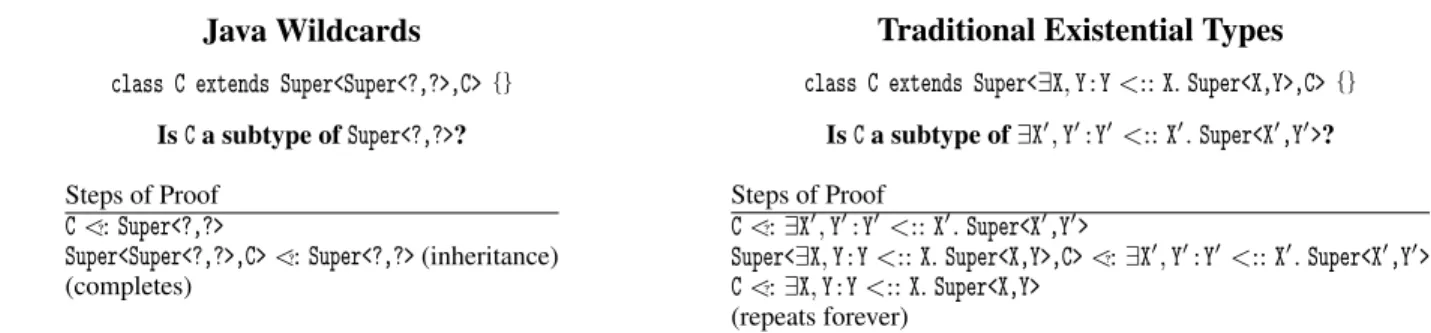
Java Wildcards
class C extends Super<Super<?,?>,C> {} IsCa subtype ofSuper<?,?>? Steps of Proof
C<?:Super<?,?>
Super<Super<?,?>,C><?:Super<?,?>(inheritance)
(completes)
Traditional Existential Types
class C extends Super<∃X,Y:Y<::X.Super<X,Y>,C>{} IsCa subtype of∃X0,Y0:Y0<::X0.Super<X0,Y0>? Steps of Proof
C<?:∃X0,Y0:Y0<::X0.Super<X0,Y0>
Super<∃X,Y:Y<::X.Super<X,Y>,C><?:∃X0,Y0:Y0<::X0.Super<X0,Y0> C<?:∃X,Y:Y<::X.Super<X,Y>
(repeats forever)
Figure 3. Example of an implicitly infinite subtyping proof
repeats ad infinitum. ThusInfinite<?>is implicitly infinite. Inter-estingly, this type is actually inhabitable by the following class:
class Omega extends Infinite<Omega>{}
This means that wildcards are even more challenging than had been believed so far. In fact, a modification like the one for Figure 2 can be applied to get a wildcard type which implicitly represents an acyclically infinite type. Because of implicitly infinite types, one cannot expect structural recursion using implicit constraints to terminate, severely limiting techniques for a terminating subtyping algorithm. Our example illustrating this problem is complex, so we leave it until Section 4.4. Nonetheless, we were able to surmount this challenge by extracting implicit constraints lazily and relying only on finiteness of the explicit type.
3.3 Implicitly Infinite Proofs
Possibly the most interesting aspect of Java’s wildcards is that finite proofs of subtyping wildcards can actually express infinite proofs of subtyping traditional existential types. This means that subtyping with wildcards is actually more powerful than traditional systems for subtyping with existential types because traditional systems only permit finite proofs. Like before, implicitly infinite proofs can exist because of implicit constraints on wildcards.
To witness how implicitly infinite proofs arise, consider the pro-grams and proofs in Figure 3. On the left, we provide the program and proof in terms of wildcards. On the right, we provide the trans-lation of that program and proof to traditional existential types. The left proof is finite, whereas the right proof is infinite. The key dif-ference stems from the fact that Java does not check implicit straints on wildcards when they are instantiated, whereas these con-straints are made explicit in the translation to traditional existential types and so need to be checked, leading to an infinite proof.
To understand why this happens, we need to discuss implicit constraints more. Unlike explicit constraints, implicit constraints on wildcards do not need to be checked after instantiation in order to ensure soundness because those implicit constraints must already holdprovidedthe subtype is a valid type (meaning its type argu-ments satisfy the criteria for the type parameters). However, while determining whether a type is valid Java uses subtyping which im-plicitly assumes all types involved are valid, potentially leading to an implicitly infinite proof. In Figure 3,Super<Super<?,?>,C>is a valid type providedCis a subtype ofSuper<?,?>. By inheritance, this reduces to whetherSuper<Super<?,?>,C>is a subtype ofSuper<?,?>. The implicit constraints on the wildcards in Super<?,?> are not checked because Java implicitly assumesSuper<Super<?,?>,C>is a valid type. Thus the proof thatSuper<Super<?,?>,C>is valid implic-itly assumes thatSuper<Super<?,?>,C>is valid, which is the source of infinity after translation. This example can be modified similarly to Figure 2 to produce a proof that is implicitly acyclically infinite.
Implicitly infinite proofs are the reason why Java’s rejection of infinite proofs is an inconsistent choice. The programs and proofs
class C<P extends List<? super C<D>>> implements List<P>{} Decl. 1)class D implements List<C<?>>{}
Decl. 2)class D implements List<C<? extends List<? super C<D>>>>{} IsC<D>a valid type?
Using Declaration 1
D<?:List<? super C<D>>(check constraint onP) List<C<?>><?:List<? super C<D>>(inheritance) C<D><?:C<?>(check wildcard? super C<D>)
Accepted (implicitly assumesC<D>is valid) Using Declaration 2
D<?:List<? super C<D>>
List<C<? extends List<? super C<D>>>><?:List<? super C<D>> C<D><?:C<? extends List<? super C<D>>>
D<?:List<? super C<D>>
Rejected (implicit assumption above is explicit here)
Figure 4. Example of the inconsistency of rejecting infinite proofs
in Figure 4 are a concrete example illustrating the inconsistency. We provide two declarations for classDwhich differ only in that the constraint on the wildcard is implicit in the first declaration and explicit in the second declaration. Thus, one would expect these two programs to be equivalent in that one would be valid if and only if the other is valid. However, this is not the case in Java because Java rejects infinite proofs. The first program is accepted because the proof thatC<D>is a valid type is finite. However, the second program is rejected because the proof thatC<D>is a valid type is infinite. In fact,javacaccepts the first program but suffers a stack overflow on the second program. Thus Java’s choice to reject infinite proofs is inconsistent with its use of implicit constraints. Interestingly, when expressed using traditional existential types, the (infinite) proof for the first program is exactly the same as the (infinite) proof for the second program as one would expect given that they only differ syntactically, affirming that existential types are a suitable formalization of wildcards.
Note that none of the wildcard types in Figures 3 and 4 are im-plicitly infinite. This means that, even if one were to prevent proofs that are infinite using subtyping rules for wildcards and prevent im-plicitly infinite wildcard types so that one could translate to tradi-tional existential types, a subtyping algorithm can still always make progress and yet run forever. Our algorithm avoids these problems by not translating to traditional or even finite existential types.
4.
Improved Subtyping
Now that we have presented the many non-termination challenges in subtyping wildcards, we present our subtyping rules with a sim-ple sound and comsim-plete subtyping algorithm which always
termi-class C<P extends Number> extends ArrayList<P>{}
List<? extends List<? extends Number>> cast(List<C<?>> list)
{return list;}
Figure 5. Example of subtyping incorrectly rejected byjavac
E
τ:=v| ∃Γ : ∆(∆). C<τE, ...,τE>
Γ :=∅|Γ, v
∆ :=∅|∆, v <::τE |∆, v::>τE
Figure 6. Grammar of our existential types (coinductive)
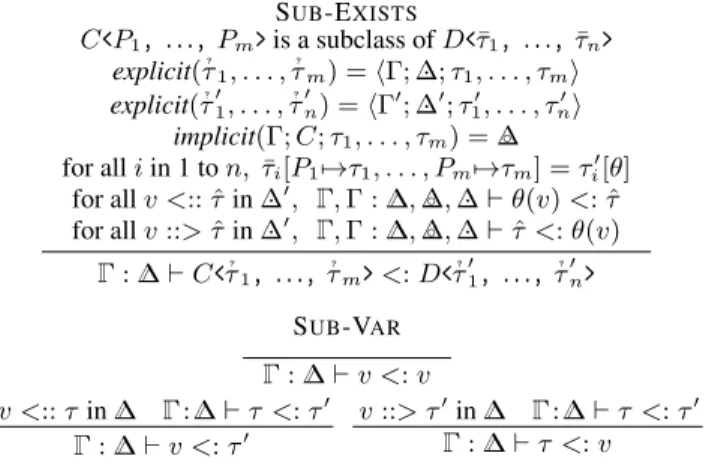
SUB-EXISTS SUB-VAR
C<P1, ...,Pm>is a subclass ofD<τ¯E1, ...,τ¯En>
G,Γ←∅−Γ0`D<τ¯E1, ...,τ¯En>[P17→τE1, . . . , Pm7→τEm]≈θiD<τE
0
1, ...,τEn0>
for allv0inΓ0, existsiin 1 tonwithθ(v0) =θi(v0)
for alliin 1 ton, G,Γ :D,∆`τ¯Ei[P17→τE1, . . . , Pm7→τEm]∼=τEi0[θ]
for allv <:: ˆτEin∆·0
, G,Γ :D,∆`θ(v)<: ˆτE[θ]
for allv::>τˆEin∆·0, G,Γ :D,∆`ˆτE[θ]<:θ(v)
G:D` ∃Γ : ∆(∆·). C<τE1, ...,τEm><:∃Γ0: ∆0(∆·0). D<τE10, ...,τEn0>
G:D`v <:v v <::τEinD G:D`τ <E :τE0
G:D`v <:τE0 v::>τE0inD G:D`τ <E :τE0
G:D`τ <E :v Figure 7. Subtyping rules for our existential types (inductive and coinductive definitions coincide given restrictions)
nates even when the wildcard types and proofs involved are im-plicitly infinite. We impose two simple restrictions, which in Sec-tion 9 we demonstrate already hold in existing code bases. With these restrictions, our subtype system has the property that all pos-sible proofs are finite, although they may still translate to infinite proofs using subtyping rules for traditional existential types. Even without restrictions, our algorithm improves on the existing subtyp-ing algorithm sincejavacfails to type check the simple program in Figure 5 that our algorithm determines is valid. Here we pro-vide the core aspects of our subtyping rules and algorithms; the full details can be found in our technical report [15].
4.1 Existential Formalization
We formalize wildcards using existential types. However, we do not use traditional existential types. Our insight is to use a variant that bridges the gap between wildcards, where constraints can be implicit, and traditional existential types, where all constraints must be explicit. We provide the grammar for our existential types, represented byτE, in Figure 6.
Note that there are two sets of constraints so that we denote our existential types as∃Γ : ∆(∆·).τE. The constraints∆are the constraints corresponding to traditional existential types, combin-ing both the implicit and explicit constraints on wildcards. The con-straints∆· are those corresponding to explicit constraints on wild-cards, with the parenthetical indicating that only those constraints need to be checked during subtyping.
Our types are a mix of inductive and coinductive structures, meaning finite and infinite. Most components are inductive so that we may do structural recursion and still have termination. How-ever, the combined constraints∆are coinductive. This essentially means that they are constructed on demand rather than all ahead of time. This corresponds to only performing wildcard capture when it is absolutely necessary. In this way we can handle wildcards rep-resenting implicitly infinite types as in Section 3.2.
4.2 Existential Subtyping
We provide the subtyping rules for our existential types in Figure 7 (for sake of simplicity, throughout this paper we assume all prob-lems with name hiding are taken care of implicitly). The judgement
G:D` τ <E :τE0means thatτEis a subtype ofτE0in the context of type variablesGwith constraintsD. The subtyping rules are syn-tax directed and so are easily adapted into an algorithm. Further-more, given the restrictions we impose in Section 4.4, the inductive and coinductive definitions coincide, meaning there is no distinc-tion between finite and infinite proofs. From this, we deduce that our algorithm terminates since all proofs are finite.
The bulk of our algorithm lies in SUB-EXISTS, since SUB-VAR
just applies assumed constraints on the type variable at hand. The first premise of SUB-EXISTSexamines the inheritance hierarchy to determine which, if any, invocations ofDthatCis a subclass or subinterface of (including reflexivity and transitivity). For Java this invocation is always unique, although this is not necessary for our algorithm. The second and third premises adapt unification to exis-tential types permitting equivalence and including the prevention of escaping type variables. The fourth premise checks that each pair of corresponding type arguments are equivalent for some chosen definition of equivalence such as simple syntactic equality or more powerful definitions as discussed in Sections 7.3 and 8.3. The fifth and sixth premises recursively check that the explicit constraints in the supertype hold after instantiation. Note that only the explicit constraints∆·0
in the supertype are checked, whereas the combined implicit and explicit constraints∆in the subtype are assumed. This separation is what enables termination and completeness.
We have no rule indicating that all types are subtypes ofObject. This is because our existential type system is designed so that such a rule arises as a consequence of other properties. In this case, it arises from the factObject is a superclass of all classes and interfaces in Java and the fact that all variables in Java are implicitly constrained above byObject. In general, the separation of implicit and explicit constraints enables our existential type system to adapt to new settings, including settings outside of Java. General reflexivity and transitivity are also consequences of our rules. In fact, the omission of transitivity is actually a key reason that the inductive and coinductive definitions coincide.
Although we do not need the full generality of our existential types and proofs to handle wildcards, this generality informs which variations of wildcards and existential types would still ensure our algorithm terminates. In Section 10, we will present a few such extensions compatible with our existential types and proofs. 4.3 Wildcard Subtyping
While the existential formalization is useful for understanding and generalizing wildcards, we can specialize the algorithm to wild-cards for a more direct solution. We present this specialization of our algorithm in Figure 8, with τ representing a Java type and ?
τ representing a Java type argument which may be a (con-strained) wildcard. The functionexplicittakes a list of type argu-ments that may be (explicitly bound) wildcards, converts wildcards to type variables, and outputs the list of fresh type variables, ex-plicit bounds on those type variables, and the possibly converted type arguments. For example,explicit(Numbers<? super Integer>) re-turnshX;X::>Integer;Numbers<X>i. The functionimplicittakes a list
SUB-EXISTS
C<P1, ...,Pm>is a subclass ofD<τ¯1, ...,τ¯n>
explicit(?
τ1, . . . , ?
τm) =hΓ; ∆·;τ1, . . . , τmi
explicit(?
τ01, . . . , ?
τ0n) =hΓ
0
; ∆·0;τ10, . . . , τ
0
ni
implicit(Γ;C;τ1, . . . , τm) = ∆◦
for alliin 1 ton, ¯τi[P17→τ1, . . . , Pm7→τm] =τi0[θ]
for allv <:: ˆτin∆·0, G,Γ :D,∆◦,∆· `θ(v)<: ˆτ for allv::>τˆin∆·0
, G,Γ :D,∆◦,∆· `τ <ˆ :θ(v)
G:D`C<?
τ1, ..., ?
τm><:D<
?
τ01, ..., ?
τ0n>
SUB-VAR G:D`v <:v v <::τinD G:D`τ <:τ0
G:D`v <:τ0
v::> τ0inD G:D`τ <:τ0
G:D`τ <:v Figure 8. Subtyping rules specialized for wildcards
of constrainable type variables, a class or interface nameC, and a list of type arguments, and outputs the constraints on those type ar-guments that are constrainable type variables as prescribed by the requirements of the corresponding type parameters ofC, constrain-ing a type variable byObjectif there are no other constraints. For example,implicit(X;Numbers;X)returnsX<::Number. Thus, applying
explicitand thenimplicitaccomplishes wildcard capture. Note that for the most part∆◦ and∆· combined act as∆does in Figure 7. 4.4 Termination
Unfortunately, our algorithm does not terminate without imposing restrictions on the Java language. Fortunately, the restrictions we impose are simple, as well as practical as we will demonstrate in Section 9. Our first restriction is on the inheritance hierarchy.
Inheritance Restriction
For every declaration of a direct superclass or superinterfaceτ
of a class or interface, the syntax? supermust not occur withinτ.
Note that the programs leading to infinite proofs in Section 3.1 (and in the upcoming Section 4.5) violate our inheritance restric-tion. This restriction is most similar to a significant relaxation of the contravariance restriction that Kennedy and Pierce showed en-ables decidable subtyping for declaration-site variance [8]. Their restriction prohibits contravariance altogether, whereas we only re-strict its usage. Furthermore, as Kennedy and Pierce mention [8], wildcards are a more expressive domain than declaration-site vari-ance. We will discuss these connections more in Section 10.1.
Constraints on type parameters also pose problems for termi-nation. The constraint context can simulate inheritance, so by con-straining a type parameterPto extendList<List<? super P>>we en-counter the same problem as in Figure 1 but this time expressed in terms of type-parameter constraints. Constraints can also pro-duce implicitly infinite types that enable infinite proofs even when our inheritance restriction is satisfied, such as in Figure 9 (which again causesjavacto suffer a stack overflow). To prevent prob-lematic forms of constraint contexts and implicitly infinite types, we restrict the constraints that can be placed on type parameters.
Parameter Restriction
For every parameterization<P1 extends τ1, ...,Pn extendsτn>,
every syntactic occurrence inτiof a typeC<..., ? superτ, ...>
must be at a covariant location inτi.
Note that our parameter restriction still allows type parameters to be constrained to extend types such asComparable<? super P>, a well known design pattern. Also note that the inheritance restriction
class C<P extends List<List<? extends List<? super C<?>>>>> implements List<P> {}
IsC<?>a subtype ofList<? extends List<? super C<?>>>? Steps of Proof
C<?><?:List<? extends List<? super C<?>>>
C<?>7→C<X>withX<::List<List<? extends List<? super C<?>>>> C<X><?:List<? extends List<? super C<?>>>
X<?:List<? super C<?>>
List<List<? extends List<? super C<?>>>><?:List<? super C<?>> C<?><?:List<? extends List<? super C<?>>>
(repeats forever)
Figure 9. Example of infinite proof due to implicitly infinite types
is actually the conjunction of the parameter restriction and Java’s restriction that no direct superclass or superinterface may have a wildcard as a type argument [5: Chapters 8.1.4 and 8.1.5].
With these restrictions we can finally state our key theorem. Subtyping Theorem. Given the inheritance and parameter re-strictions, the algorithm prescribed by the rules in Figure 8 always terminates. Furthermore it is a sound and complete implementation of the subtyping rules in the Java language specification [5: Chap-ter 4.10.2] provided all types are valid according to the Java lan-guage specification [5: Chapter 4.5].‡
Proof.Here we only discuss the reasons for our restrictions; the full proofs can be found in our technical report [15]. The first thing to notice is that, for the most part, the supertype shrinks through the recursive calls. There are only two ways in which it can grow: applying a lower-bound constraint on a type variable via SUB-VAR, and checking an explicit lower bound on a wildcard via
SUB-EXISTS. The former does not cause problems because of the
limited ways a type variable can get a lower bound. The latter is the key challenge because it essentially swaps the subtype and super-type which, if unrestricted, can cause non-termination. However, we determined that there are only two ways to increase the num-ber of swaps that can happen: inheritance, and constraints on type variables. Our inheritance and parameter restrictions prevent this, capping the number of swaps that can happen from the beginning and guaranteeing termination.
4.5 Expansive Inheritance
Smith and Cartwright conjectured that prohibiting expansive inher-itance as defined by Kennedy and Pierce [8] would provide a sound and complete subtyping algorithm [13]. This is because Kennedy and Pierce built off the work by Viroli [19] to prove that, by pro-hibiting expansive inheritance, any infinite proof of subtyping in their setting would have to repeat itself; thus a sound and complete algorithm could be defined by detecting repetitions.
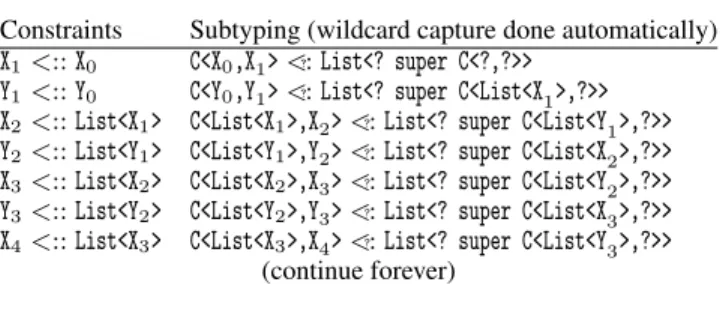
Unfortunately, we have determined that prohibiting expansive inheritance as defined by Kennedy and Pierce does not imply that all infinite proofs repeat. Thus, their algorithm adapted to wildcards does not terminate. The problem is that implicit constraints can cause an indirect form of expansion that is unaccounted for.
Consider the class declaration in Figure 10. According to the definition by Kennedy and Pierce [8], this is not expansive inheri-tance sinceList<Q>is the type argument corresponding toPrather than toQ. However, the proof in Figure 10 never repeats itself. The key observation to make is that the context, which would be fixed in Kennedy and Pierce’s setting, is continually expanding in this ‡See Section 7.4 for a clarification on type validity.
class C<P, Q extends P> implements List<List<? super C<List<Q>,?>>>{} IsC<?,?>a subtype ofList<? super C<?,?>>?
Constraints Subtyping (wildcard capture done automatically)
X1<::X0 C<X0,X1><?:List<? super C<?,?>> Y1<::Y0 C<Y0,Y1><?:List<? super C<List<X
1>,?>> X2<::List<X1> C<List<X1>,X2><?:List<? super C<List<Y
1>,?>> Y2<::List<Y1> C<List<Y1>,Y2><?:List<? super C<List<X
2>,?>> X3<::List<X2> C<List<X2>,X3><?:List<? super C<List<Y
2>,?>> Y3<::List<Y2> C<List<Y2>,Y3><?:List<? super C<List<X
3>,?>> X4<::List<X3> C<List<X3>,X4><?:List<? super C<List<Y
3>,?>>
(continue forever)
Figure 10. Example of expansion through implicit constraints
class Var{
boolean mValue;
void addTo(List<? super Var> trues, List<? super Var> falses)
{(mValue ? trues : falses).add(this);} }
Figure 11. Example of valid code erroneously rejected byjavac
setting. In the last step we display, the second type argument ofC
is a subtype ofList<? extends List<? extends List<?>>>, which will keep growing as the proof continues. Thus Smith and Cartwright’s conjecture for a terminating subtyping algorithm does not hold. In our technical report we identify syntactic restrictions that would be necessary (although possibly still not sufficient) to adapt Kennedy and Pierce’s algorithm to wildcards [15]. However, these restric-tions are significantly more complex than ours, and the adapted al-gorithm would be strictly more complex than ours.
5.
Challenges of Type-Argument Inference
So far we have discussed only one major challenge of wildcards, subtyping, and our solution to this challenge. Now we present another major challenge of wildcards, inference of type arguments for generic methods, with our techniques to follow in Section 6. 5.1 JoinsJava has the expressioncond ? t : fwhich evaluates tot ifcond
evaluates totrue, and tof otherwise. In order to determine the type of this expression, it is useful to be able to combine the types determined fort and f using ajoin(τ, τ0)function which returns the most precise common supertype of τ and τ0. Un-fortunately, not all pairs of types with wildcards have a join (even if we allow intersection types). For example, consider the types List<String> and List<Integer>, where String implements
Comparable<String>andIntegerimplementsComparable<Integer>. Both
List<String>and List<Integer> are a List of something, call itX, and in both cases thatX is a subtype ofComparable<X>. So while bothList<String>andList<Integer>are subtypes of simplyList<?>, they are also subtypes of List<? extends Comparable<?>> and of
List<? extends Comparable<? extends Comparable<?>>>and so on. Thus their join using only wildcards is the undesirable infinite type
List<? extends Comparable<? extends Comparable<? extends ...>>>.
javacaddresses this by using an algorithm for findingsome
common supertype ofτ andτ0which is not necessarily the most precise. This strategy is incomplete, as we even saw in the class-room when it failed to type check the code in Figure 11. This sim-ple program fails to type check becausejavacdetermines that the type of(mValue ? trues : falses)isList<?>rather than the obvious
<P> P getFirst(List<P> list) {return list.get(0);}
Number getFirstNumber(List<? extends Number> nums)
{return getFirst(nums);}
Object getFirstNonEmpty(List<String> strs, List<Object> obs)
{return getFirst(!strs.isEmpty() ? strs : obs);}
Object getFirstNonEmpty2(List<String> strs, List<Integer> ints)
{return getFirst(!strs.isEmpty() ? strs : ints);} Figure 12. Examples of capture conversion
List<? super Var>. In particular,javac’s algorithm may even fail to returnτwhen both arguments are the same typeτ.
Smith and Cartwright take a different approach to joining types. They extend the type system with union types [13]. That is, the join ofList<String>andList<Integer>is justList<String> | List<Integer>
in their system.τ | τ0 is defined to be a supertype of bothτ and τ0 and a subtype of all common supertypes ofτ andτ0. Thus, it is by definition the join ofτ andτ0in their extended type system. This works for the code in Figure 11, but in Section 5.2 we will demonstrate the limitations of this solution.
Another direction would be to find a form of existential types beyond wildcards for which joins always exist. For example, using traditional existential types the join of List<String> and
List<Integer>is just∃X : X <:: Comparable<X>.List<X>. However, our investigations suggest that it may be impossible for an existen-tial type system to have both joins and decidable subtyping while being expressive enough to handle common Java code. Therefore, our solution will differ from all of the above.
5.2 Capture Conversion
Java has generic methods as well as generic classes [5: Chap-ter 8.4.4]. For example, the methodgetFirstin Figure 12 is generic with respect toP. Java attempts to infer type arguments for invoca-tions of generic methods [5: Chapter 15.12.2.7], hence the uses of
getFirstinside the various methods in Figure 12 do not need to be annotated with the appropriate instantiation ofP. Interestingly, this enables Java to infer type arguments that cannot be expressed by the user. ConsidergetFirstNumber. This method is accepted byjavac;P
is instantiated to the type variable for the wildcard? extends Number, an instantiation ofPthat the programmer cannot explicitly annotate because the programmer cannot explicitly name the wildcard. Thus, Java is implicitly opening the existential typeList<? extends Number>
toList<X>withX<::Numberand then instantiatingPasXso that the return type isXwhich is a subtype ofNumber. This ability to im-plicitly capture wildcards, known as capture conversion [5: Chap-ter 5.1.10], is important to working with wildcards but means type inference has to determine when to open a wildcard type.
Smith and Cartwright developed an algorithm for type-argument inference intended to improve uponjavac[13]. Before going into their algorithm and showing some of its limitations, let us first go back to Figure 11. Notice that the example there, although origi-nally presented as a join example, can be thought of as an infer-ence example by considering the? :operator to be like a generic method. In fact, Smith and Cartwright have already shown that type-argument inference inherently requires finding common su-pertypes of two types [13], a process that is often performed using joins. Thus the ability to join types is closely intertwined with the ability to do type-argument inference. Smith and Cartwright’s ap-proach for type-argument inference is based on their union types, which we explained in Section 5.1. Their approach to type infer-ence would succeed on the example from Figure 11, because they use a union type, whereasjavacincorrectly rejects that program.
Although Smith and Cartwright’s approach to type-argument in-ference improves on Java’s approach, their approach is not strictly
<P> List<P> singleton(P elem){return null;}
<Q extends Comparable<?>> Q foo(List<? super Q> list){return null;}
String typeName(Comparable<?> c){return "Comparable";}
String typeName(String s){return "String";}
String typeName(Integer i){return "Integer";}
String typeName(Calendar c){return "Calendar";}
boolean ignore(){...};
String ambiguous(){
return typeName(foo(singleton(ignore() ? "Blah" : 1)));
}
Figure 13. Example of ambiguous typing affecting semantics
better than Java’s. Consider the methodgetFirstNonEmpty in Fig-ure 12.javacacceptsgetFirstNonEmpty, combiningList<String>and
List<Object>intoList<?> and then instantiating Pto the captured wildcard. Smith and Cartwright’s technique, on the other hand, fails to type checkgetFirstNonEmpty. They combineList<String>and
List<Object>intoList<String> | List<Object>. However, there is no instantiation ofPso thatList<P>is a supertype of the union type
List<String> | List<Object>, so they reject the code. What their tech-nique fails to incorporate in this situation is the capture conversion permitted by Java. For the same reason, they also fail to accept
getFirstNonEmpty2, althoughjavacalso fails on this program for rea-sons that are unclear given the error message. The approach we will present is able to type check all of these examples.
5.3 Ambiguous Types and Semantics
In Java, the type of an expression can affect the semantics of the program, primarily due to various forms of overloading. This is particularly problematic when combining wildcards and type-argument inference. Consider the program in Figure 13. Notice that the value returned by ambiguousdepends solely on the type of the argument totypeName, which is the return type offoowhich depends on the inferred type arguments for the generic methodsfoo
andsingleton. Usingjavac’s typing algorithms,ambiguousreturns
"Comparable". Using Smith and Cartwright’s typing algorithms [13],
ambiguous returns either "String" or "Integer" depending on how the types are (arbitrarily) ordered internally. In fact, the answers provided byjavacand by Smith and Cartwright are not the only possible answers. One could just as well instantiatePtoObjectand
Q toCalendar to get ambiguousto return"Calendar", even though a
Calendarinstance is not even present in the method.
The above discussion shows that, in fact,all four values are plausible, and which is returned depends on the results of type-argument inference. Unfortunately, the Java specification does not provide clear guidance on what should be done if there are multiple valid type arguments. It does however state the following [5: Chap-ter 15.12.2.7]: “The type-inference algorithm should be viewed as a heuristic, designed to perform well in practice.” This would lead one to believe that, given multiple valid type arguments, an imple-mentation can heuristically pick amongst them, which would actu-ally make any of the four returned values a correct implementation ofambiguous. This is not only surprising, but also leads to the un-fortunate situation that by providingjavacwith smarter static typ-ing algorithms one may actually change the semantics of existtyp-ing programs. This in turn makes improving the typing algorithms in existing implementations a risky proposition.
6.
Improving Type-Argument Inference
Here we present an algorithm for joining wildcards as existential types which addresses the limitations of union types and which is complete provided the construction is used in restricted settings.
We also describe preliminary techniques for preventing ambiguity due to type-argument inference as discussed in Section 5.3. 6.1 Lazily Joining Wildcards
As we mentioned in Section 5.1, it seems unlikely that there is an existential type system for wildcards with both joins and decid-able subtyping. Fortunately, we have determined a way to extend our type system with alazyexistential type that solves many of our problems. Given a potential constraint on the variables bound in a lazy existential type we can determine whether that constraint holds. However, we cannot enumerate the constraints on the vari-ables bound in a lazy existential type, so lazy existential types must be used in a restricted manner. In particular, for any use of τ <: τ0, lazy existential types may only be used in covariant lo-cations inτand contravariant locations inτ0. Maintaining this in-variant means thatτ0will never be a lazy existential type. This is important because applying SUB-EXISTSrequires checking all of the constraints ofτ0, but we have no means of enumerating these constraints for a lazy existential type. Fortunately,cond ? t : fas well as unambiguous type-argument inference only need a join for covariant locations of the return type, satisfying our requirement.
So suppose we want to construct the join (t) of captured wild-card types∃Γ : ∆. C<τ1, ...,τm>and∃Γ0: ∆0. D<τ10, ...,τ
0
n>.
Let{Ei}iin 1 tokbe the set of minimal raw superclasses and
super-interfaces common toCandD. Let eachEi<τ¯1i, ...,τ¯`ii>be the
superclass ofC<P1, ...,Pm>, and eachEi<τˆ1i, ...,τˆ`ii>the
su-perclass ofD<P10, ...,Pn0>. Compute the anti-unification [11, 12]
of allτ¯i
j[P17→τ1, . . . , Pm7→τm]with allτˆji[P
0
17→τ
0
1, . . . , P
0
n7→τ
0
n],
resulting inτti
j with fresh variablesΓtand assignmentsθandθ0 such that each tτji[θ] equals τ¯
i
j[P17→τ1, . . . , Pm7→τm] and each
t
τji[θ0]equalsτˆji[P107→τ10, . . . , Pn0 7→τn0]. For example, the
anti-unification of the typesMap<String,String>andMap<Integer,Integer>
isMap<v,v>with assignmentsv 7→ Stringandv 7→ Integer. The join, then, is the lazy existential type
∃Γt:hθ7→Γ : ∆;θ07→Γ0: ∆0i. E1<
t
τ1 1, ...,
t
τ1
`1> & ... &Ek<
t
τk
1, ..., t
τk `k>
The lazy constrainthθ7→Γ : ∆;θ07→Γ0 : ∆0iindicates that the constraints onΓtare the constraints that hold in contextΓ : ∆after substituting withθand in contextΓ0: ∆0after substituting withθ0. Thus the total set of constraints is not computed, but there is a way to determine whether a constraint is in this set. Note that this is the join because Java ensures theτ¯andˆτtypes will be unique.
Capture conversion can be applied to a lazy existential type, addressing the key limitation of union types that we identified in Section 5.2. The lazy constrainthθ 7→ Γ : ∆;θ0 7→Γ0 : ∆0iis simply added to the context. The same is done when SUB-EXISTS
applies with a lazy existential type as the subtype. When SUB-VAR
applies forv <:τ0withvconstrained by a lazy constraint rather than standard constraints, one checks that bothθ(v)<:τ0[θ]holds andθ0(v) <: τ0[θ0]holds, applying the substitutions to relevant constraints in the context as well. A similar adaptation is also made forτ <:v. This extended algorithm is still guaranteed to terminate. With this technique, we can type check the code in Figure 11 thatjavacincorrectly rejects as well as the code in Figure 12 in-cluding the methods that Smith and Cartwright’s algorithm incor-rectly rejects. For example, forgetFirstNonEmpty2we would first join
List<String>andList<Integer>as the lazy existential type ∃X:h{X7→String} 7→∅:∅;{X7→Integer} 7→∅:∅i.List<X>
This type would then be capture converted so that the type param-eterPofgetFirstwould be instantiated with the lazily constrained type variableX. Although not necessary here, we would also be able to determine that the constraintX<::Comparable<X>holds for the lazily constrained type variable.
Occasionally one has to join a type with a type variable. For this purpose, we introduce a specialization of union types. This spe-cialization looks likeτt(v1 | ... | vn)orτt(τ |v1 | ... |vn)
where eachvi is not lazily constrained andτt is a supertype of
some wildcard capture of each upper bound of each type variable (and ofτ if present) with the property that any other non-variable τ0which is a supertype of eachvi(andτ) is also a supertype of
τt. A typeτ0is a supertype of this specialized union type if it is a supertype ofτtor of eachvi(andτ). Note thatτtmight not be a
supertype of anyvior ofτand may instead be the join of the upper
bounds of eachvi(plusτ)afteropening the lazy existential type.
This subtlety enables capture conversion to be applied unambigu-ously when called for. Unfortunately, we cannot join a type with a type variable that is lazily constrained because we cannot enumer-ate its upper bounds.
6.2 Inferring Unambiguous Types
We believe that the Java language specification should be changed to prevent type-argument inference from introducing ambiguity into the semantics of programs. Since the inferred return type is what determines the semantics, one way to prevent ambiguity would be to permit type-argument inference only when a most precise return type can be inferred, meaning the inferred return type is a subtype of all other return types that could arise from valid type arguments for the invocation at hand. Here we discuss how such a goal affects the design of type-argument inference. However, we do not present an actual algorithm since the techniques we present need to be built upon further to produce an algorithm which prevents ambiguity but is also powerful enough to be practical.
Typical inference algorithms work by collecting a set of straints and then attempting to determine a solution to those con-straints. If those constraints are not guaranteed to be sufficient, then any solution is verified to be a correct typing of the expression (in this case the generic-method invocation). Bothjavac [5: Chap-ters 15.12.2.7 and 15.12.2.8] and Smith and Cartwright [5] use this approach. Smith and Cartwright actually collect a set of sets of con-straints, with each set of constraints guaranteed to be sufficient.
However, to prevent ambiguity due to type-argument inference, necessity of constraints is important rather than sufficiency. For the ambiguous program in Figure 13, each of the solutions we described in Section 5.3 was sufficient; however, none of them were necessary, which was the source of ambiguity. Unfortunately, Smith and Cartwright’s algorithm is specialized to find sufficient rather than necessary sets of constraints. This is why their algorithm results in two separate solutions for Figure 13. However, their algo-rithm could be altered to sacrifice sufficiency for sake of necessity by producing a less precise but necessary constraint at each point where they would currently introduce a disjunction of constraints, which actually simplifies the algorithm since it no longer has to propagate disjunctions.
After a necessary set of constraints has been determined, one then needs to determine a solution. Some constraints will suggest that it is necessary for a type argument to be a specific type, in which case one just checks that the specific type satisfies the other constraints on that type argument. However, other type arguments will only be constrained above and/or below by other types so that there can be many types satisfying the constraints. In order to prevent ambiguity, one cannot simply choose solutions for these type arguments arbitrarily. For example, if the parameterized return type of the method is covariant (and not bivariant) with respect to a type parameter, then the solution for the corresponding type argument must be the join of all its lower bounds, ensuring the inferred return type is the most precise possible. Fortunately, since such joins would occur covariantly in the return type, it is safe to use the construction described in Section 6.1.
Unfortunately, requiring the inferred return type to be the most precise possible seems too restrictive to be practical. Consider the singletonmethod in Figure 13. Under this restriction, type-argument inference would never be permitted for any invocation of
singleton(without an expected return type) even though the inferred types of most such invocations would not affect the semantics of the program. In light of this, we believe the unambiguous-inference challenge should be addressed by combining the above techniques with an ability to determine when choices can actually affect the semantics of the program. We have had promising findings on this front, but more thorough proofs and evaluations need to be done, so we leave this to future work.
6.3 Removing Intermediate Types
The processes above introduce new kinds of types, namely lazy ex-istential types. Ideally these types need not be a part of the actual type system but rather just be an algorithmic intermediary. Fortu-nately this is the case for lazy existential types. By examining how the lazy existential type is used while type checking the rest of the program, one can determine how to replace it with an existential type which may be less precise but with which the program will still type check. This is done by tracking the pairsv <: τ0 and τ <:v, wherevis lazily constrained, that are checked and found to hold using the modified SUB-VARrules. After type checking has completed, the lazy existential type can be replaced by an exis-tential type using only the tracked constraints (or slight variations thereof to prevent escaping variables). Proof-tracking techniques can also be used to eliminate intersection types, important for ad-dressing the non-determinism issues we will discuss in Section 7.2, as well as our specialized union types.
7.
Challenges of Type Checking
Wildcards pose difficulties for type checking in addition to the subtyping and inference challenges we have discussed so far. Here we identify undesirable aspects of Java’s type system caused by these difficulties, and in Section 8 we present simple changes to create an improved type system.
7.1 Inferring Implicit Constraints
Java ensures that all types use type arguments satisfying the criteria of the corresponding type parameters. Without wildcards, enforc-ing this requirement on type arguments is fairly straightforward. Wildcards, however, complicate matters significantly because there may be a way to implicitly constrain wildcards so that the type ar-guments satisfy their requirements. For example, consider the fol-lowing interface declaration:
interface SubList<P extends List<? extends Q>, Q> {} Java accepts the typeSubList<?,Number>because the wildcard can be implicitly constrained to be a subtype ofList<? extends Number>
with which the requirements of the type parameters are satisfied. However, Java rejects the typeSubList<List<Integer>,?>even though the wildcard can be implicitly constrained to be a supertype of
Integerwith which the requirements of the type parameters are satisfied (in our technical report we formalize when a wildcard can be implicitly constrained [15]). Thus, Java’s implicit-constraint inference is incomplete and as a consequence types that could be valid are nonetheless rejected by Java.
This raises the possibility of extending Java to use complete implicit-constraint inference (assuming the problem is decidable). However, we have determined that this would cause significant al-gorithmic problems (in addition to making it difficult for users to predict which types will be accepted or rejected as illustrated in our technical report [15]). In particular, complete implicit-constraint in-ference would enable users to express types that have an implicitly
infinite body rather than just implicitly infinite constraints. Con-sider the following class declaration:
class C<P extends List<Q>, Q> extends List<C<C<?,?>,?>>{} For the typeC<C<?,?>,?>to be valid,C<?,?>must be a subtype of
List<X> whereX is the last wildcard of C<C<?,?>,?>. Since C<?,?>
is a subtype ofList<C<C<?,?>,?>>, this impliesXmust be equal to
C<C<?,?>,?>, and with this implicit constraint the type arguments sat-isfy the requirements of the corresponding type parameters. Now, if we expand the implicit equality on the last wildcard inC<C<?,?>,?>
we get the typeC<C<?,?>,C<C<?,?>,?>>, which in turn contains the typeC<C<?,?>,?>so that we can continually expand to get the infinite typeC<C<?,?>,C<C<?,?>,...>>. As one might suspect, infinite types of this form cause non-termination problems for many algorithms.
In light of these observations, we will propose using implicit-constraint inference slightly stronger than Java’s in order to ad-dress a slight asymmetry in Java’s algorithm while still being user friendly as well as compatible with all algorithms in this paper. 7.2 Non-Deterministic Type Checking
The type checker injavacis currently non-deterministic from the user’s perspective. Consider the following interface declaration:
interface Maps<P extends Map<?,String>> extends List<P>{}
javac allows one to declare a program variablem to have type
Maps<? extends Map<String,?>>. The type ofm, then, has a wildcard which is constrained to be a subtype of both Map<?,String> and
Map<String,?>. This means thatm.get(0).entrySet()has two types, es-sentially∃X.Set<Entry<X,String>>and∃Y.Set<Entry<String,Y>>, nei-ther of which is a subtype of the onei-ther. However, the type-checking algorithm forjavacis designed under the assumption that this will never happen, and as suchjavaconly checks whether one of the two options is sufficient for type checking the rest of the program, which is the source of non-determinism.
javac makes this assumption because Java imposes
single-instantiation inheritance, meaning a class (or interface) can ex-tend C<τ1, ...,τn> and C<τ10, ..., τ
0
n> only if each τi equals
τi0 [5: Chapter 8.1.5] (in other words, prohibiting
multiple-in-stantiation inheritance [8]). However, it is not clear what single-instantiation inheritance should mean in the presence of wild-cards. The Java language specification is ambiguous in this re-gard [5: Chapter 4.4], andjavac’s enforcement is too weak for the assumptions made by its algorithms, as demonstrated above.
Thus, we need to reconsider single-instantiation inheritance in detail with wildcards in mind. There are two ways to address this: restrict types in some way, or infer from two constraints a stronger constraint that is consistent with single-instantiation inheritance. We consider the latter first since it is the more expressive option.
Knowing that the wildcard in m’s type above is a subtype of both Map<?,String> and Map<String,?>, single-instantiation in-heritance suggests that the wildcard is actually a subtype of
Map<String,String>. With this more precise constraint, we can deter-mine that the type ofm.get(0).entrySet()isSet<Entry<String,String>>, which is a subtype of the two alternatives mentioned earlier. For this strategy to work, given two upper bounds on a wildcard we have to be able to determine their meet: the most general common subtype consistent with single-instantiation inheritance. Interestingly, the meet of two types may not be expressible by the user. For example, the meet ofList<?>andSet<?>is∃X.List<X> & Set<X>.
Unfortunately, meets encounter many of the same problems of complete implicit-constraint inference that we discussed in Sec-tion 7.1. Assuming meets can always be computed, predicting when two types have a meet can be quite challenging. Furthermore, meets pose algorithmic challenges, such as for equivalence check-ing since with themMaps<? extends Map<String,?>>is equivalent to
class C implements List<D<? extends List<D<? extends C>>>> {}
class D<P extends C> {}
IsD<? extends List<D<? extends C>>>
equivalent toD<? extends C>? Key Steps of Proof
D<? extends List<D<? extends C>>>∼=? D<? extends C>
(Checking:>)D<? extends C><?:D<? extends List<D<? extends C>>> C<?:List<D<? extends C>>
List<D<? extends List<D<? extends C>>>><?:List<D<? extends C>> D<? extends List<D<? extends C>>>∼=? D<? extends C>
(repeat forever)
Figure 14. Example of infinite proofs due to equivalence
Maps<? extends Map<String,String>>even though neither explicit con-straint is redundant.
This problem is not specific to combining implicit and explicit constraints on wildcards. Java allows type parameters to be con-strained by intersections of types:<P extendsτ1 & ... &τn>.
Al-though Java imposes restrictions on these intersections [5: Chap-ter 4.4], when wildcards are involved the same problems arise as with combining implicit and explicit constraints. So, whilejavac
rejects the intersectionMap<?,String> & Map<String,?>, javac does permit the intersection Numbers<?> & Errors<?>. Should P be con-strained by this intersection, then due to the implicit constraints on the wildcardsPis a subtype of bothList<? extends Number>and
List<? extends Error>, which once again introduces non-determin-ism intojavac’s type checking.
As a more severe alternative, one might consider throwing out single-instantiation inheritance altogether and redesigning the type checker for multiple-instantiation inheritance, especially if Java decided to also throw out type erasure. However, multiple-instantiation inheritance in the presence of wildcards can actually lead to ambiguity in program semantics. Suppose an object has an implementation of bothList<String>andList<Integer>. That ob-ject can be passed as a List<?>, but which List implementation is passed depends on whether the wildcard was instantiated with
StringorInteger. Thus an invocation ofget(0)to get anObjectfrom theList<?> (which is valid since the wildcard implicitly extends
Object) would return different results depending on the subtyping proof that was constructed (non-deterministically from the user’s perspective). Thus a language with wildcards would either need to use single-instantiation inheritance or statically determine when subtyping can ambiguously affect semantics.
After careful consideration, our solution will be to restrict inter-sections and explicit constraints on wildcards so that they are con-sistent with single-instantiation inheritance adapted to wildcards. 7.3 Equivalence
Numbers<?>is equivalent toNumbers<? extends Number>because of the implicit constraint on the wildcard. As such, one would expect
List<Numbers<?>>to be equivalent toList<Numbers<? extends Number>>. However, this is not the case according to the Java language spec-ification [5: Chapters 4.5.1.1 and 4.10.2] and the formalization by Torgersen et al. [17] referenced therein (althoughjavac makes some attempts to support this). The reason is that Java uses syn-tactic equality when comparing type arguments, reflected in our
SUB-EXISTSrule by the use of=in the sixth premise.
Ideally equivalent types could be used interchangeably. Thus, during subtyping Java should only require type arguments to be equivalent rather than strictly syntactically identical. The obvi-ous way to implement this is to simply check that the type