Personal Management
Merit Badge Workbook
This workbook can help you but you still need to read the merit badge pamphlet.
The work space provided for each requirement should be used by the Scout to make notes for discussing the item with his counselor, not for providing the full and complete answers. Each Scout must do each requirement.
No one may add or subtract from the official requirements found inBoy Scout Requirements(Pub. 33216 – SKU 34765). The requirements were last issued or revised in 2004 • This workbook was updated in November 2013.
Scout’s Name:__________________________________________ Unit: __________________________________________ Counselor’s Name: ______________________________________ Counselor’s Phone No.: ___________________________
http://www.USScouts.Org
•
http://www.MeritBadge.Org
Please submit errors, omissions, comments or suggestions about thisworkbookto:[email protected] Comments or suggestions for changes to therequirementsfor themerit badgeshould be sent to:[email protected]
______________________________________________________________________________________________________________________________________________ 1. Do the following:
a. Choose an item that your family might want to purchase that is considered a major expense.
b. Write a plan that tells how your family would save money for the purchase identified in requirement 1a.
2. Discuss the plan with your family.
3. Discuss how other family needs must be considered in this plan.
c. Develop a written shopping strategy for the purchase identified in requirement la.
2. Comparison shop for the item. Find out where you can buy the item for the best price. (Provide prices from at least two different price sources.)
Source Price
Call around; study ads. Look for a sale or discount coupon. Consider alternatives.
Can you buy the item used?
Should you wait for a sale?
2. Do the following:
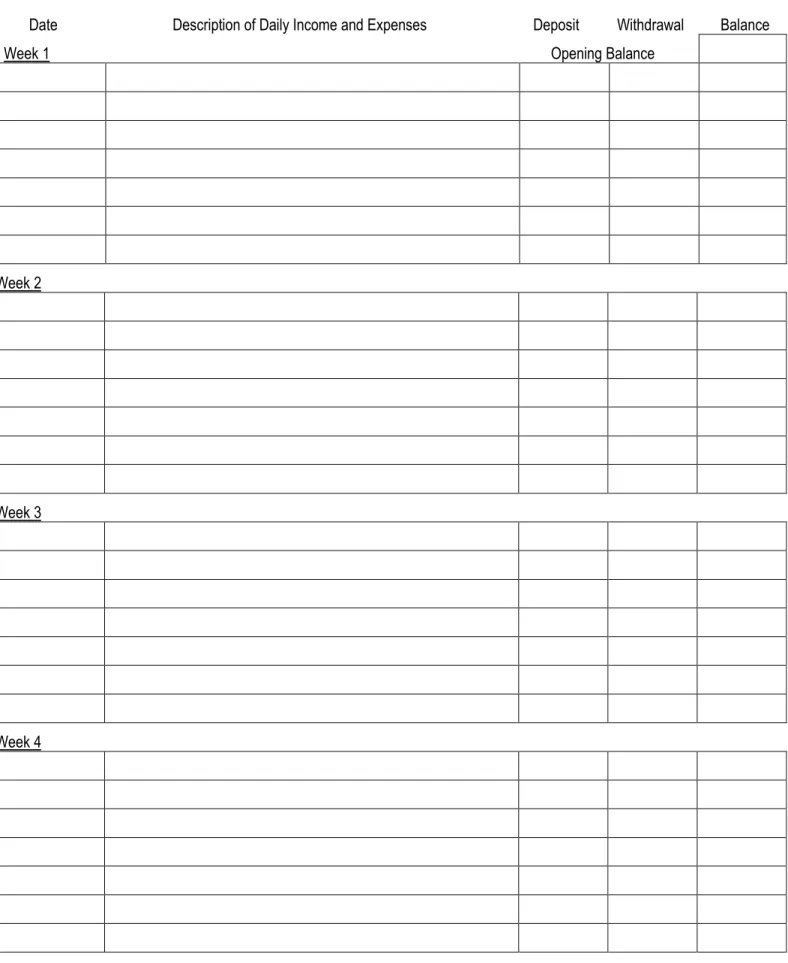
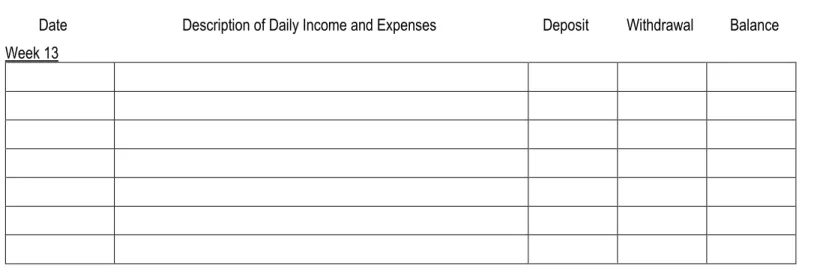
a. Prepare a budget reflecting your expected income (allowance, gifts, wages), expenses, and savings. Track your actual income, expenses, and savings for 13 consecutive weeks. (You may use the forms provided in this pamphlet, devise your own, or use a computer-generated version.) When complete, present the results to your merit badge counselor.
(There is a blank Sample Budget Plan table and a blank table for tracking your actual income and expenses that you can use at the end of this workbook.)
b. Compare expected income with expected expenses.
2. If income exceeds expenses, state how you would use the excess money (new goal, savings).
3. Discuss with your merit badge counselor FIVE of the following concepts: a. The emotions you feel when you receive money.
b. Your understanding of how the amount of money you have with you affects your spending habits.
c. Your thoughts when you buy something new and your thoughts about the same item three months later.
Explain the concept of buyer's remorse.
e. Your experience of an item you have purchased after seeing or hearing advertisements for it.
Did the item work as well as advertised?
f. Your understanding of what happens when you put money into a savings account.
g. Charitable giving. Explain its purpose and your thoughts about it.
4. Explain the following to your merit badge counselor:
a. The differences between saving and investing, including reasons for using one over the other. Saving:
Investing:
Reasons for using one over the other:
b. The concepts of return on investment and risk.
c. The concepts of simple interest and compound interest and how these affected the results of your investment exercise.
Simple interest:
How these affected the results of your investment exercise:
5. Select five publicly traded stocks from the business section of the newspaper.
Stock Current Price 1 Day Change 52-Week High 52-Week Low
Explain to your merit badge counselor the importance of the following information for each stock: a. Current price
b. How much the price changed from the previous day.
6. Pretend you have $1,000 to save, invest, and help prepare yourself for the future. Explain to your merit badge counselor the advantages or disadvantages of saving or investing in each of the following:
Advantages Disadvantages
a. Common stocks
b. Mutual funds
c. Life insurance
d. A certificate of deposit (CD)
e. A savings account or U.S. savings bond
7. Explain to your merit badge counselor the following:
a. What a loan is, what interest is, and how the annual percentage rate (APR) measures the true cost of a loan. What a loan is:
What interest is:
How the annual percentage rate (APR) measures the true cost of a loan:
c. The differences between a charge card, debit card, and credit card. Charge card
Debit card,
Credit card.
What are the costs and pitfalls of using these financial tools?
d. Credit reports and how personal responsibility can affect your credit report. Credit reports:
How personal responsibility can affect your credit report:
e. Ways to reduce or eliminate debt.
8. Demonstrate to your merit badge counselor your understanding of time management by doing the following:
a. Write a "to do" list of tasks or activities, such as homework assignments, chores, and personal projects, that must be done in the coming week. List these in order of importance to you.
b. Make a seven-day calendar or schedule. Put in your set activities, such as school classes, sports practices or games, jobs or chores, and/or Scout or church or club meetings, then plan when you will do all the tasks from your "to do" list between your set activities.
With your merit badge counselor, discuss and understand what you learned from this requirement and what you might do differently the next time.
9. Prepare a written project plan demonstrating the steps below, including the desired outcome. This is a project on paper, not a real-life project. Examples could include planning a camping trip, developing a community service project or a school or religious event, or creating an annual patrol plan with additional activities not already included in the troop annual plan. Discuss your completed project plan with your merit badge counselor.
a. Define the project. What is your goal?
b. Develop a timeline for your project that shows the steps you must take from beginning to completion.
d. Develop a list of resources. Identify how these resources will help you achieve your goal.
10. Do the following:
a. Choose a career you might want to enter after high school or college graduation.
b. Research the limitations of your anticipated career and discuss with your merit badge counselor what you have learned about qualifications such as education, skills, and experience.
Requirement resources can be found here:
Sample Budget Plan
Budgeted Amounts Actual Amounts Tot.
Actual-Tot. Budget Income Sources per Week Month 1 Month 2 Month 3 Total Month 1 Month 2 Month 3 Total
Allowance Gifts Wages Other
Income Totals
Expenses per Week Month 1 Month 2 Month 3 Total Month 1 Month 2 Month 3 Total Act.-Budget
Savings-pay yourself 1st Donations/Charity Food/Meals out Clothing Entertainment/Movies CDs/DVDs, etc. Recreation Sports/Hobbies Travel Books/Magazines Gifts Other:
Table for tracking your actual income, expenses, and savings for 13 consecutive weeks. Page 1 of 4
Date Description of Daily Income and Expenses Deposit Withdrawal Balance
Week 1 Opening Balance
Week 2
Week 3
Table for Tracking your actual income, expenses, and savings for 13 consecutive weeks. ___ Page 2 of 4
Date Description of Daily Income and Expenses Deposit Withdrawal Balance
Week 5
Week 6
Week 7
Table for Tracking your actual income, expenses, and savings for 13 consecutive weeks. ___ Page 3 of 4
Date Description of Daily Income and Expenses Deposit Withdrawal Balance
Week 9
Week 10
Week 11
Table for Tracking your actual income, expenses, and savings for 13 consecutive weeks. Page 4 of 4
Date Description of Daily Income and Expenses Deposit Withdrawal Balance
Week 13
Planned “To Do” Schedule Actual Completion Times for Each Task
[1.0.0.0] — Introduction
The current edition of theGuide to Advancementis the official source for administering advancement in all Boy Scouts of America programs: Cub Scouting, Boy Scouting, Varsity Scouting, Venturing, and Sea Scouts. It replaces any previous BSA advancement manuals, includingAdvancement Committee Policies and Procedures,Advancement and Recognition Policies and Procedures, and previous editions of theGuide to Advancement. [Page 2, and 5.0.1.4] — Policy on Unauthorized Changes to Advancement Program
No council, committee, district, unit, or individual has the authority to add to, or subtract from, advancement requirements.There are limited exceptions relating only to youth members with special needs. For details see section 10, “Advancement for Members With Special Needs”.
[Page 2] — The “Guide to Safe Scouting” Applies
Policies and procedures outlined in theGuide to Safe Scouting,No. 34416, apply to all BSA activities, including those related to advancement and Eagle Scout service projects.
[7.0.3.1] — The Buddy System and Certifying Completion
A youth member must not meet one-on-one with an adult. Sessions with counselors must take place where others can view the interaction, or the Scout must have a buddy: a friend, parent, guardian, brother, sister, or other relative—or better yet, another Scout working on the same badge—along with him attending the session.
When the Scout meets with the counselor, he should bring any required projects. If these cannot be transported, he should present evidence, such as photographs or adult verification. His unit leader, for example, might state that a satisfactory bridge or tower has been built for the Pioneering merit badge, or that meals were prepared for Cooking. If there are questions that requirements were met, a counselor may confirm with adults involved. Once satisfied, the counselor signs the blue card using the date upon which the Scout completed the requirements, or in the case of partials, initials the individual requirements passed.
Note that from time to time, it may be appropriate for a requirement that has been met for one badge to also count for another. See “Fulfilling More Than One Requirement With a Single Activity,” 4.2.3.6.
[7.0.3.2] — Group Instruction
It is acceptable—and sometimes desirable—for merit badges to be taught in group settings. This often occurs at camp and merit badge midways or similar events. Interactive group discussions can support learning. The method can also be attractive to “guest experts” assisting registered and approved counselors. Slide shows, skits, demonstrations, panels, and various other techniques can also be employed, but as any teacher can attest, not everyone will learn all the material.
There must be attention to each individual’s projects and his fulfillment ofallrequirements. We must know that every Scout —actually and
personally— completed them. If, for example, a requirement uses words like “show,” “demonstrate,” or “discuss,” then every Scout must do that. It is unacceptable to award badges on the basis of sitting in classroomswatchingdemonstrations, or remaining silent during discussions.
It is sometimes reported that Scouts who have received merit badges through group instructional settings have not fulfilled all the requirements. To offer a quality merit badge program, council and district advancement committees should ensure the following are in place for all group instructional events.
Merit badge counselors are known to be registered and approved.
Any guest experts or guest speakers, or others assisting who are not registered and approved as merit badge counselors, do not accept the responsibilities of, or behave as, merit badge counselors, either at a group instructional event or at any other time. Their service is temporary, not ongoing.
Counselors agree not to assume prerequisites have been completed without some level of evidence that the work has been done. Pictures and letters from other merit badge counselors or unit leaders are the best form of prerequisite documentation when the actual work done cannot be brought to the camp or site of the merit badge event.
There is a mechanism for unit leaders or others to report concerns to a council advancement committee on summer camp merit badge programs, group instructional events, and any other merit badge counseling issues—especially in instances where it is believed BSA procedures are not followed. See “Reporting Merit Badge Counseling Concerns,” 11.1.0.0.
There must be attention to each individual’s projects and his fulfillment of all requirements. We must know that every Scout—actually and personally—completed them.
[7.0.3.3] — Partial Completions
A Scout need not pass all the requirements of one merit badge with the same counselor. It may be that due to timing or location issues, etc., he must meet with a different counselor to finish the badge. The Application for Merit Badge has a place to record what has been finished—a “partial.” In the center section on the reverse of the blue card, the counselor initials for each requirement passed. In the case of a partial completion, the counselor does not retain his or her portion of the card. A subsequent counselor may choose not to accept partial work, but this should be rare. A Scout, if he believes he is being treated unfairly, may work with his unit leader to find another counselor. An example for the use of a signed partial would be to take it to camp as proof of prerequisites. Partials have no expiration except the Scout’s 18th birthday. Units, districts, or councils shall not establish