Chapter 12
Gene expression
and regulation
Bacterial genomes usually contain several thousand different genes. Some of the gene products are required by the cell under all growth conditions and are called house-keeping genes. These include the genes that encode such proteins as DNA poly-merase, RNA polypoly-merase, and DNA gyrase. Many other gene products are required under specific growth conditions. These include enzymes that synthesize amino acids, break down specific sugars, or respond to a specific environmental condition such as DNA damage.
Housekeeping genes must be expressed at some level all of the time. Frequently, as the cell grows faster, more of the housekeeping gene products are needed. Even under very slow growth, some of each housekeeping gene product is made. The gene prod-ucts required for specific growth conditions are not needed all of the time. These genes are frequently expressed at extremely low levels, or not expressed at all when they are not needed and yet made when they are needed. This chapter will examine
gene regulationor how bacteria regulate the expression of their genes so that the genes that are being expressed meet the needs of the cell for a specific growth condition.
Gene regulation can occur at three possible places in the production of an active gene product. First, the transcription of the gene can be regulated. This is known as transcriptional regulation. When the gene is transcribed and how much it is transcribed influences the amount of gene product that is made. Second, if the gene encodes a protein, it can be regulated at the translational level. This is known as translational regulation. How often the mRNA is translated influences the amount of gene product that is made. Third, gene products can be regulated after they are completely synthesized by either post-transcriptionalor
post-translational regulation mechanisms. Both RNA and protein can be regulated by degradation to control how much active gene product is present. Both can also be subjected to modifications such as the methylation of nucleosides in rRNA, the extensive modifications made to tRNAs (over 80 modified nucleosides have been described), or the phosphorylation of response-regulator proteins (see below). These modifications can play a major role in the function of the gene product.
In general, every step that is required to make an active gene product can be the focus of a regulatory event. In practice, most bacterial regulation occurs at the tran-scriptional level. Trantran-scriptional regulation is thought to be more frequent because it would be a waste to make the RNA if neither the RNA nor its encoded protein is needed. The first three systems discussed — repression of the lacoperon by Lac
repressor, activation of the lacoperon by cAMP-CAP, and control of the trpoperon by attenuation — describe classic transcriptional regulation mechanisms. The last three systems — regulation of the heat shock genes, regulation of the SOS response, and regulation of capsule synthesis — rely on different combinations of transcriptional, post-transcriptional, and post-translational regulatory mechanisms and will be used to demonstrate how several regulatory mechanisms can be integrated to fine-tune gene expression.
The players in the regulation game
Ribonucleic acid, or RNA, exists as messenger RNA (mRNA), transfer RNA (tRNA), and ribosomal RNA (rRNA). In most cases, RNA is a single-stranded, rather than a double-stranded, molecule. RNA participates in both genetic and functional activities. As mRNA, it allows the genetic information stored in the DNA molecule to be transmit-ted into proteins. As tRNA, it transfers amino acids during translation. As rRNA, it maintains the structure of the ribosome and helps carry out translation.
RNA is chemically synthesized by the action of RNA polymerase in a process called
transcription. There are four identifiable steps during transcription: promoter recognition; chain initiation;chain elongation; and chain termination
(Fig. 12.1). RNA polymerase catalyzes the formation of phosphodiester bonds be-tween ribonucleotides using DNA as a template. Unlike DNA polymerase, RNA poly-merase does not require a primer to begin synthesis of the RNA molecule (see Chapter 2 for details of DNA synthesis). Growth of the RNA chain, like the growth of a DNA chain, is in the 5¢to 3¢direction because RNA polymerase can only add a new nu-cleotide to a free 3¢OH group. The order in which the different ribonucleotides are added to a free 3¢OH is determined by a double-stranded DNA molecule in which one strand acts as the template (Fig. 12.2). The template strand is complementary to the RNA. The
non-template or coding
strandcontains the same sequence as the RNA except for the substitution of uracil for thymine.
Core RNA polymerase
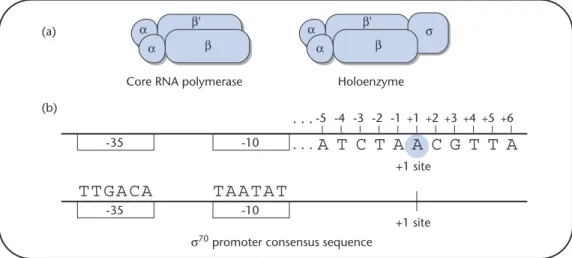
is a complex composed of the proteins b, b¢ and two subunits of a (Fig. 12.3a). Core RNA polymerase is re-sponsible for the synthesis of RNA, but it imparts no specificity as to where the start of the RNA occurs. Core RNA polymerase is converted to holoenzyme
when one additional pro-tein, sigma factor (s) is associated with it (Fig.
Promoter
-35 -10 +1 site mRNA
Start
Terminator mRNA
Stop DNA
mRNA
RNA polymerase RNA polymerase
RNA polymerase mRNA
RNA polymerase (a)
(b)
(c)
(d)
(e)
Fig. 12.1The four major steps of transcription. (a) RNA polymerase recognizes the promoter. (b) RNA polymerase moves to the start site and begins polymerizing RNA. (c) RNA polymerase moves along the DNA template, elongating the RNA. (d) RNA polymerase stops RNA synthesis. The newly synthesized RNA disassociates from RNA polymerase and RNA polymerase disassociates from the DNA. RNA polymerase transcribes mRNA, rRNA, and tRNA.
12.3a). s factor directs RNA polymerase to specific se-quences in the DNA called promotersso that transcrip-tion initiates at the proper place.
Bacteria can contain more than one sfactor. In E. coli, the major sfactor present under normal growth condi-tions is called sigma 70 or s70. s70recognizes promoters that have a specific DNA sequence and directs the RNA polymerase molecule that it is part of to begin transcrip-tion near these specific sequences. s70was named for its molecular weight, which is 70 kilodaltons. Different s fac-tors recognize different sequences as promoters. For
ex-ample, when cells are exposed to an increase in temperature or heat shock a group of genes is induced to cope with this stress (see below). The expression of the heat-shock genes is controlled by an alternative sfactor and all of the heat-shock genes have a common promoter sequence that is recognized by the alternative sfactor. The heat-shock promoter sequence is different from the promoter sequence recognized by s70.
Promoters contain two distinct sequence motifs that reside ~10 bases and ~35 bases upstream of the transcriptional start site or first base of the RNA. The transcriptional start site is known as the +1 site. All of the bases following the +1 site are transcribed into RNA and are numbered consecutively with positive numbers (Fig. 12.3b). The bases prior to the +1 site are numbered consecutively with negative numbers. The motif at ~10 bases upstream of the +1 site is called the -10 regionand the motif at ~35 bases upstream of the +1 is called the -35 region. s70recognizes promoters with a consensus sequenceconsisting of TAATAT at the 10 region and TTGACA at the
-ATCCTGTCTACGTATAAATACGC
TAGGACAGATGCATATTTATGCG
AUCCUGUCUACGUAUAAAUACGC
3'5' 3'
5'
5' 3'
Non-template or coding strand
Template strand mRNA
β α
α σ
β α
α
A T C T A A C G T T A
-5 -4 -3 -2 -1 +1+2 +3 +4 +5+6
... ...
-35 -10
+1 site
T T G A C A
T A A T A T
-35 -10
+1 site σ70 promoter consensus sequence
Core RNA polymerase Holoenzyme (a)
(b)
β' β'
Fig. 12.2The mRNA is synthesized using one strand of the DNA as a template. This makes the mRNA
complementary to the template strand. When the DNA sequence encoding a gene is shown, by convention the DNA strand that is the same sequence as the mRNA (except for T to U) is usually shown.
Fig. 12.3The structure of RNA polymerase and the regions in the promoter it binds to. (a) RNA polymerase has two forms. Core RNA polymerase synthesizes RNA in vitro but starts at many places on the DNA. Holoenzyme also synthesizes RNA in vitro but it starts only at promoters. (b) The general organization of the signals used by RNA polymerase. RNA polymerase recognizes promoters, which consist of a -10 region and a -35 region. RNA polymerase begins synthesis of RNA at the +1 base. RNA polymerase containing s70recognizes specific sequences at the -10 and -35 regions. The closer a sequence
is to the consensus, the better s70is at recognizing it as a promoter and the more times it will be
transcribed into RNA. If any of the bases are changed, s70may still recognize the sequence as a promoter
35 region (Fig. 12.3b). Promoters are defined according to their strength. This means that the stronger the promoter, the stronger the interaction between that promoter sequence and RNA polymerase. A general rule of thumb is that the closer the -10 and -35 sequences of a promoter are to the consensus sequence, the stronger the promoter.
RNA polymerase holoenzyme binds to promoter sequences and covers approxi-mately 75 bases of the DNA from -55 to +20. Once bound, RNA polymerase initiates transcription by causing the double-stranded DNA template to open, effectively melting the hydrogen bonds that hold the two DNA strands together in the promoter region (Fig. 12.4). As RNA polymerase starts transcribing at the +1 site, it continues to open the double-stranded DNA molecule, creating a short region of single-stranded DNA. After RNA polymerase has passed through the opened DNA, this region will re-form hydrogen bonds to give a closed DNA molecule. Approximately two turns of the double helix or 17 base pairs are unwound at any given time during the elongation phase of transcription.
Although sfactor is needed for RNA polymerase to bind to the right promoter se-quences, it is not needed during the elongation phase of transcription. After a short RNA transcript is synthesized, sfactor dissociates from RNA polymerase and core RNA polymerase continues to elongate the RNA transcript. Transcription continues until core RNA polymerase encounters a transcription termination signal or
RNA polymerase
RNA polymerase binds to the promoter
RNA polymerase opens the double helix
RNA polymerase begins transcription at the +1 site
As RNA polymerase moves down the DNA the double helix reforms behind it (a)
(b)
(c)
(d)
mRNA +1
Fig. 12.4The beginning steps of transcription. RNA
polymerase opens a 17 base pair bubble in the DNA to gain access to the DNA template.
terminator where RNA polymerase and the newly synthesized RNA dissociate from the DNA to end transcription.
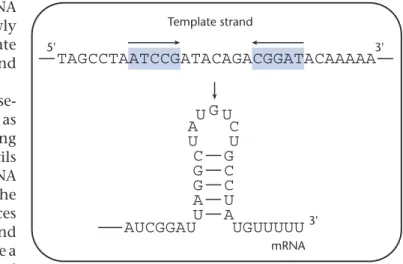
Inverted repeat se-quences are often found as part of a terminator along with a stretch of uracils found at the end of the RNA transcript (Fig. 12.5). The inverted repeat sequences are able to hydrogen bond with each other and create a stretch of double-stranded
RNA. When this secondary structure forms in the RNA, it takes on the appearance of a
stem loop structure. Terminating transcription can either involve a protein called Rho or be Rho independent, depending on the sequence comprising the terminator. Terminators that do not involve Rho rely on the stem loop structure that forms at the end of the RNA to halt RNA polymerase’s forward motion along the DNA. In contrast, Rho-dependent terminators rely on both Rho and the formation of the stem loop structure at the end of the RNA to halt transcription.
Initiation of a new round of transcription does not require that the previous round be terminated. This means that there can be several RNA polymerase complexes tran-scribing the same template DNA at the same time (Fig. 12.6). Multiple RNA poly-merases, because of the size of RNA polymerase, must be spread at least 75 nucleotides apart. In bacteria, translation of an mRNA into its corresponding polypeptide does not require that the entire mRNA be synthesized or transcription be terminated be-fore translation is initiated. Ribosomes are able to bind the ribosome binding site
(RBS) or Shine–Dalgarno sequencein the mRNA and initiate translation at the
Template strand
TAGCCTAATCCGATACAGACGGATACAAAAA
5' 3'
mRNA 3'
AUCGGAUU AUGUUUUU A U
G C G C C G U U A CU G U
RNA polymerase RBS
Ribosome
Protein
mRNA
+1 site
Terminator Template
Fig. 12.5Termination of transcription takes place at specific sites. Frequently, a hairpin structure is part of the termination site. Inverted repeats form the base of the hairpin. The hairpin is
frequently followed by a stretch of uracils.
Fig. 12.6Multiple rounds of transcription and translation take place at the same time. As RNA polymerase moves along the DNA template, the mRNA becomes accessible to
ribosomes. The ribosomes bind to the RBS and initiate translation at the AUG start codon.
starting methionine codon (AUG) even if RNA polymerase is still transcribing the mRNA.
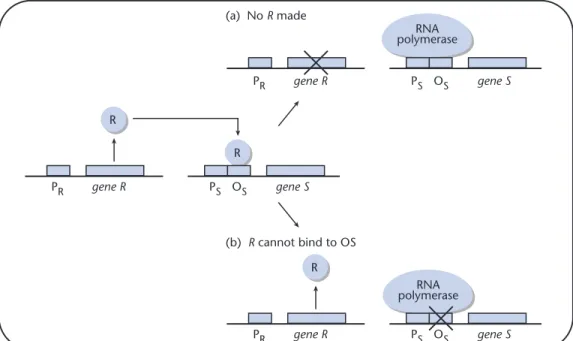
In transcriptional regulation, DNA sequences called control regionsor opera-torsare found adjacent to or overlapping the -35 and -10 regions of the promoter. Specific DNA binding proteins recognize these control regions and exert an effect on holoenzyme’s ability to initiate transcription. Regulatory proteins can bind to their control region and prevent transcription. This is known as repression. Regulatory proteins can also bind to their control regions and promote RNA polymerase binding to the promoter. This effect is known as activation. The regulatory mechanisms controlling gene expression are typically discovered by mutational analysis. Muta-tions that eliminate the regulation or make the regulation even better usually localize to one of two places (Fig. 12.7). The mutations can be in the genes encoding the re-pressors or activators. The mutations can also be in the nucleotide sequences that these regulatory proteins bind to.
Operons and regulons
An adaptive response, metabolic pathway, or developmental program usually re-quires more than one gene. Frequently, the genes for a given process are regulated in a similar manner. Genes that need to be coordinately regulated can be located right next to each other or spread around the chromosome. An operonis a group of genes physically linked on the chromosome and under the control of the same promoter(s) (Fig. 12.8a). In an operon, the linked genes give rise to a single mRNA that is trans-FYI 12.1
Coupled
transcription and translation in different species
In bacteria, transcription and translation can take place on the same mRNA molecule at the same time. This is possible because bacteria do not have a membrane surrounding their DNA and all of the proteins needed for both processes have access to the DNA. The situation is quite different in eukaryotic cells that do have a membrane, called the nuclear membrane, surrounding their DNA. The proteins needed for transcription are inside the nuclear membrane but the proteins needed for translation are located outside of the nuclear membrane. Thus, coupled transcription and translation cannot happen in eukaryotic cells. A second difference between bacteria and eukaryotes is that while bacteria make many polycistronic mRNAs, eukaryotes only encode one protein per mRNA.
R R
PR gene R PS OS gene S
RNA polymerase
PR gene R PS OS gene S
RNA polymerase R
PR gene R PS OS gene S
(a) No R made
(b) R cannot bind to OS
Fig. 12.7Regulatory mechanisms are frequently studied by mutational analysis. Two classes of mutations are possible. (a) Mutations in the R geneor R genepromoter result in no R protein being produced. (b) Mutations in the operator (O) DNA sequence can result in the R protein not being able to bind to the DNA and carry out regulation.
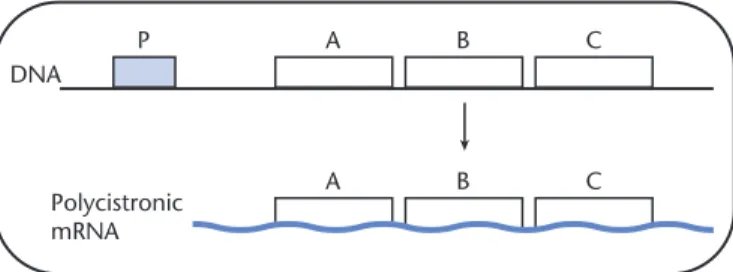
lated into the different gene products. This type of mRNA is called a polycistronic mRNA(Fig. 12.9). A regulon
is a group of genes all needed for the same process but physically located in different parts of the chromosome and containing their own promoter(s) (Fig. 12.8b). In a regulon, the promoters are all regulated in the same fash-ion and allow for coordinate expressfash-ion of the necessary genes.
Repression of the
lac
operon
The metabolism of the sugar, lactose, requires at least two proteins in E. coli. The lac-tose permease, encoded by the lacYgene, transports lactose into the cell. The enzyme b-galactosidase, called b-gal for short and encoded by the lacZgene, catalyzes the cleavage of the b1,4-glycosidic linkage in lactose resulting in the monosaccharides, galactose and glucose (Fig. 12.10a). When a compound is broken down, the process is called catabolic. The lacoperon expresses genes whose products catabolize lactose. Analogs are available that mimic lactose’s ability to either be a substrate for b-gal (X-gal, ONPG) or converted to an inducerof the lacoperon (IPTG) (Fig. 12.10b). This has made the study of the lacoperon and its regulation amenable to examination in the laboratory. These analogs are frequently used in DNA cloning experiments as described in Chapters 13 and 14.
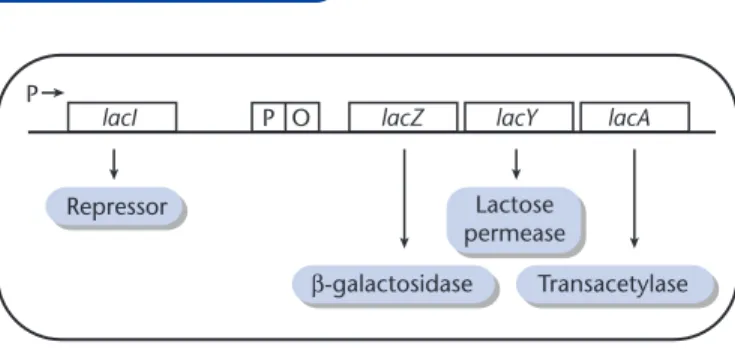
lacZ, lacY, and one other gene, lacA, are linked on the E. colichromosome (Fig. 12.11). lacAencodes a detoxifying enzyme called b-galactoside transacetylase. The in-tracellular concentrations of b-gal and Lac permease are very low in E. colicells grown
P O Z Y A
P O A P O B C
P O X
P R
R R R
R (a) An operon
(b) A regulon
Fig. 12.8There are two widely used organizational schemes in bacteria for multiple genes that are coordinately regulated. (a) In an operon, all of the genes are physically linked and under the control of one promoter. (b) In a regulon, the genes are in different places on the chromosome but they all have promoters that respond to the same regulators.
P A B C
A B C
DNA
Polycistronic mRNA
Fig. 12.9Polycistronic mRNAs are translated into more than one protein. In this example,
gene A,gene B, and gene Care encoded on one mRNA and will all be translated from this one mRNA.
CH2OH
O O OH
OH HO
Cl Br H
N
CH2OH
O O OH
OH HO
NO2
CH2OH
O OH
OH
HO S CHCH3
CH3
Lactose CH2OH
O OH
OH HO
CH2OH
O OH
OH OH O
b
1 4
(D-galactose) (D-glucose) CH2OH
O OH
OH
OH HO
HO
CH2OH
O OH
OH OH
D-galactose D-glucose
Xgal
Cannot be cleaved by b-galactosidase ONPG
IPTG
colorless cleavage yellow colorless cleavage blue (b)
(a)
Fig. 12.10 (a) Cleavage of lactose by b-galactosidase. (b) Lactose analogs that are used to study the lacoperon. X-gal is converted from a colorless compound to a dark blue compound when it is cleaved by
b-galactosidase. ONPG is converted from a colorless compound to a yellow compound. IPTG cannot be cleaved by b-galactosidase but it can bind to LacI and induce the
in medium that does not contain lactose (Table 12.1). If lactose is added to the medium, b-gal, Lac permease, and transacetylase appear at the same time in E. colicells. After lactose is transported into the cell, some of it is converted to allolactose (1–6-O-b-galactopyranosyl-D-glucose) by the few molecules of b-gal found in uninduced cells. Allo-lactose is a rearranged Allo-lactose molecule and an inducer of the lacoperon.
lacZ, lacY, and lacAare coordinately expressed from one
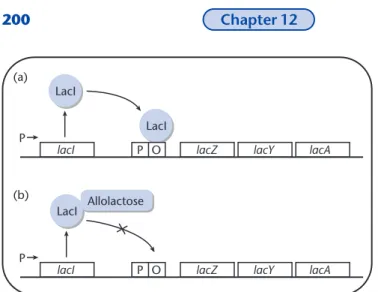
promoter called lacPthat directs expression of a polycistronic mRNA (Fig. 12.11). lacP is located upstream of lacZ. lacIencodes the lactose repressor protein and is located upstream of lacP. lacI has its own promoter and is constitutively expressed. Lac Re-pressor or LacI binds to the DNA at the lacoperator site called lacO. lacOis located between lacIand lacZ. In the absence of inducer, Lac repressor is bound to lacO, preventing expression of the operon (Fig. 12.12a). In the presence of inducer, inducer binds to Lac repressor and prevents repressor from binding to lacO, leading to tran-scription of the operon (Fig. 12.12b).
How lacoperon induction takes place and the players that control this induction were elucidated in the extensive genetic analyses undertaken by Francois Jacob, Jacques Monod, and their coworkers. Table 12.1 describes a few of the lacmutants iso-lated by Jacob and Monod and the effect the inducer has on the activity of b-gal and transacetylase. For example, Class I mutations eliminate the inducibility of the lac operon resulting in b-gal and transacetylase activity being detectable in the absence of lactose (uninduced). This class of mutation results in a constitutive Lac+phenotype
and maps to either the lacIgene or to lacO. lacI-mutations are recessive or have no
phenotype in the presence of a wild-type lacoperon. Enough LacI is made from the wild-type lacIgene to repress both copies of the lacoperon. Class II mutations result in a super-repressed Lac- phenotype. Super-repressed mutants have no b-gal or
transacetylase activity in the presence of inducer. These mutations map to the lacI
Repressor
b-galactosidase Lactose permease
Transacetylase
lacI P O lacZ lacY lacA
P
Table 12.1 Some classes of E. coli lac mutant isolated by Jacob and Monod and the effect inducer has on the relative concentrations of ß-galactosidase and transacetylase in the mutant
backgrounds. The mutations were examined when they resided in the chromosome in one copy and in merodiploids containing a second copy of the lac operon on an F¢.
Class Genotype ß-galactosidase (lacZ) Transacetylase (lacA)
Uninduced Induced Uninduced Induced
WT lacZ A I 0.1 100 1 100 I lacZ A I- 100 100 90 90
lacZ A I-/F¢lacZ A I 1 240 1 270
II lacZ A Is 0.1 1 1 1
lacZ A Is/F¢lacZ A I 0.1 2 1 3
III lacZ A Oc 25 95 15 100
lacZ-A O /F¢lacZ A-Oc 180 440 1 220
II +III lacZ A O Is 190 219 150 200
F¢lacZ A Oc I
Fig. 12.11 The genes that encode the proteins used to transport and degrade lactose form an operon. The operon is regulated by LacI. The lacIgene is located just upstream of lacZ,
lacY, and lacA. LacI is expressed from its own promoter that is on all of the time.
gene and result in a repressor that can no longer be inacti-vated by inducer. Super-repressor mutants are dominant to wild type because the mutant LacI can bind to both copies of the lac operon and turn them off. Class III muta-tions are in lacOand prevent Lac repressor from binding and turning off the operon. lacOcmutants are dominant to wild type because wild-type LacI from either copy of the operon cannot repress the lac operon containing the lacOc mutant. When super-repressor mutants are com-bined with lacOcmutants, lacOcmutants are dominant to super-repressor mutants because the super-repressor still cannot bind the mutant lacO.
Activation of the
lac
operon by cyclic AMP and
the CAP protein
If lactose and glucose are added to a culture of wild-type E. colicells, the lacoperon is not induced. No lac mRNA or gene products are made. This effect of glucose is the re-sult of a second regulatory mechanism, catabolite repression. Catabolite repres-sion affects not only lac gene expression but also other operons that catabolize specific sugars such as galactose, arabinose, and maltose. Contrary to its name, catabolite repression describes an activating mechanism, involving a complex be-tween cAMP (cyclic adenosine monophosphate) and the catabolite activator protein (CAP; also called cyclic AMP receptor protein or CRP) (Fig. 12.13).
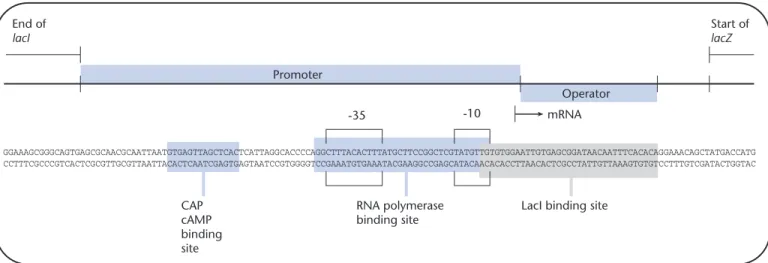
If given the choice of sugars to metabolize, E. coliwill use glucose first and then other sugars. When levels of glucose are high, there is no need to express high levels of the enzymes needed for the metabolism of lactose or other sugars, which yield less en-ergy than glucose. High levels of intracellular glucose result in low levels of cAMP. Low levels of cAMP mean very few cAMP–CAP complexes. When intracellular levels of glucose drop and other sugars must be metabolized, levels of cAMP increase. In-creased cAMP levels mean there are more cAMP–CAP complexes. cAMP–CAP binds to a specific site on the DNA that is located adjacent to the promoter for the lac genes (Fig. 12.14) and adjacent to promoters controlling the expression of other sugar me-tabolizing operons affected by cAMP–CAP. The -10 and -35 motifs in the promoter sequence for lacare not a perfect match to the consensus sequence for s70promoters. cAMP–CAP bound to the CAP binding site increases the binding of s70RNA poly-merase to the lacpromoter. By having two mechanisms controlling the expression of the lacoperon, cells ensure that the lacgene products are only made when needed.
Regulation of the tryptophan biosynthesis operon
by attenuation
The biosynthesis of the aromatic amino acid tryptophan requires the activity of three enzymes, anthranilate synthetase (trpE) complexed with phosphoribosyl-anthranilate transferase (trpD), phosphoribosyl-phosphoribosyl-anthranilate isomerase (trpC), and tryptophan synthetase (trpA and trpB) to convert chorismate to tryptophan. The five trpstructural genes encoding the three tryptophan biosynthetic enzymes are physi-cally linked and coordinately regulated as an operon. The trpgenes are arranged in the
LacI
lacI P O lacZ lacY lacA
P
lacI P O lacZ lacY lacA
P
LacI
LacI Allolactose (a)
(b)
Fig. 12.12 A model for the regulation of the lacoperon. The Lac repressor or LacI binds to the
lacoperator DNA (lacO) and prevents transcription of lacZ,
lacY, and lacA. If lactose is present inside the cell, it is converted to allolactose. Allolactose binds to LacI and prevents its interaction with
lacO. This allows expression of the lacZ, lacY, and lacAgenes.
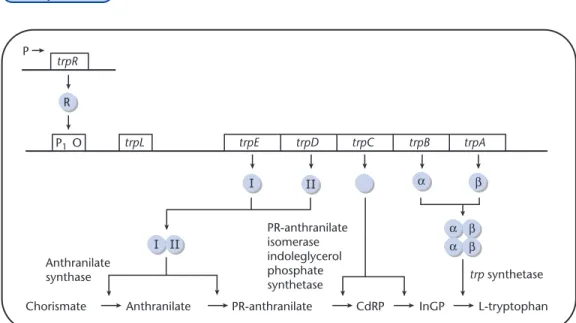
order that their encoded enzymes function in the biosynthetic pathway (Fig. 12.15). The goal of a biosynthetic or anabolicpathway is to synthesize the end product only when it is needed. In 1959, Cohen and Jacob made the observation that addition of tryptophan to an actively dividing E. coliculture repressed the synthesis of trypto-phan synthetase. The trpoperon is repressed by TrpR, a transcriptional repressor,
Fig. 12.13 Catabolite repression of the lactose operon. (a) High levels of glucose mean low levels of cAMP. There is not enough cAMP to complex with CAP and no induction of the lacoperon takes place. LacI remains bound to lacO. (b) Low levels of glucose lead to high levels of cAMP. cAMP complexes with CAP and binds in front of lacP. If there is lactose present, it is converted to allolactose, allolactose complexes with LacI and prevents LacI from binding to lacO. This leads to induction of the lacoperon.
Promoter
Operator End of
lacI
Start of
lacZ
mRNA
CAP cAMP binding site
RNA polymerase binding site
LacI binding site
-35 -10
CCTTTCGCCCGTCACTCGCGTTGCGTTAATTACACTCAATCGAGTGAGTAATCCGTGGGGTCCGAAATGTGAAATACGAAGGCCGAGCATACAACACACCTTAACACTCGCCTATTGTTAAAGTGTGTCCTTTGTCGATACTGGTAC GGAAAGCGGGCAGTGAGCGCAACGCAATTAATGTGAGTTAGCTCACTCATTAGGCACCCCAGGCTTTACACTTTATGCTTCCGGCTCGTATGTTGTGTGGAATTGTGAGCGGATAACAATTTCACACAGGAAACAGCTATGACCATG
when levels of tryptophan are high in the cell (Fig. 12.15). The gene encoding the TrpR repressor is not located near the trpoperon.
Even though expression of both the lacand trpoperons are regulated by repression, the mechanism by which the LacI and TrpR repressors work is very different. The LacI repressor when bound to its effector molecule (i.e. lactose) cannot repress transcrip-tion. In contrast, the TrpR repressor must be bound by an effector molecule, in this case tryptophan, for it to repress transcription. The repression mechanism for the trp operon can be viewed as a coarse control mechanism; an all or none approach to gene expression. However, another regulatory mechanism, attenuation, is available to fine-tune gene expression of some biosynthetic operons, especially during times of extremely short supply of end products.
Attenuation was first proposed by Charles Yanofsky and coworkers who observed that under normal growth conditions approximately nine out of 10 trp mRNA tran-scripts terminate before they reach the structural genes of the trp operon. This means that even when repression is lifted and transcription is initiated from the trp pro-moter, RNA polymerase abruptly halts, failing to elongate the trp mRNA across the structural genes. During conditions of severe tryptophan starvation, the premature termination of transcription is abolished, allowing expression of the trp operon at 10-fold higher levels than under normal growth conditions.
What is happening to cause early termination of the trpmRNA? The answer lies in the regulatory sequence in front of the trp structural genes. Downstream from the trppromoter and the TrpR repressor binding site but upstream of the trpstructural genes, are 162 base pairs. The 162 base pair sequence is called the leader sequence
or trpL(Fig. 12.16a). trpLcontains a ribosome binding site adjacent to an AUG trans-lational start codon. This means there are two RBS sites and two AUG transtrans-lational start codons located after the trp promoter but in front of the first trpstructural gene (trpE).
The trp leader sequence, after it is transcribed into mRNA, can be translated into a short polypeptide consisting of 14 amino acids. Of these 14 amino acids, two are trp residues that are located next to each other. The presence of two tandem trpresidues is very rare. Most E. coliproteins contain one trpper every 100 amino acids. At the end of trpLis a Rho-independent terminator. This signal resides approximately 40 base pairs
Fig. 12.15 The structure of the
trpoperon and the enzymatic activities encoded by the trp
genes. The regulator of the trp
operon, TrpR, is encoded by a gene that is not linked to the rest of the operon. The structural genes, trp EDCBA, are positioned in the operon in the same order as the enzymes they encode are used in tryptophan synthesis.
upstream of the signals that control the translation of the trpstructural genes. The DNA sequence in this region suggests that the encoded mRNA has a very high proba-bility of forming stem loop secondary structures. There are three combinations of stem loops that can form. They have been named the pause loop (1:2), the terminator loop (3:4), and the anti-terminator loop (2:3) (Fig. 12.16b).
Attenuation of the trpoperon uses the secondary structures in the mRNA to deter-mine the amount of tryptophan in the cell (Fig. 12.17). RNA polymerase initiates tran-scription at the trp promoter after the TrpR repressor has been removed. Because translation can be initiated before the mRNA is completed, a ribosome loads at the trpL RBS and initiates translation of TrpL (Fig. 12.17 step 1). As RNA polymerase elongates the trpLmRNA, stem loop structures will form in the mRNA. The first secondary struc-ture that can form is the 1:2 pause loop. This large hairpin strucstruc-ture is called the pause loop because it forms behind the transcribing RNA polymerase and causes RNA poly-merase’s forward movement along the DNA template to pause (Fig. 12.17 step 2). Paus-ing transcription allows the translatPaus-ing ribosome to stay close to the transcribPaus-ing RNA polymerase. This ensures that these two complexes stay in close communication dur-ing crucial times of abruptly changdur-ing levels of tryptophan. As the translatdur-ing ribo-some advances on the mRNA, the riboribo-some breaks apart the pause loop freeing RNA polymerase to continue transcribing trpL (Fig. 12.17 step 3). At this time, the ribosome
AAGUUCAC G U A A A A A G G G U A U CGACAAUGAAAGCAAUUUUCGUACUGAAAGGUU G U G G C A C C A A G U C C U U C A C G C G A C G G G C A G U G U A U U A AUCAGAUACCCA UUUUUUUU C G C C G U G C A C G A G
U AA
G C G G C C UA A UG
A UGGUGGCGCACUUCCUGAAAC GCCUAA C G G G G C C C C U G A A U G U A C U U G A C C A A
C A U
C
A CA
C G U G C A GU AA A
... ...
Met Lys Ala Ile Phe Val Leu Lys GlyTrp Trp Trp Arg Thr Ser Stop Trp Arg Thr Ser Stop Pause hairpin Pause 1:2 3:4 2:3 10 20
30 40 50
60 70 80 90 100 110 120 130
140 60 70
80 90
100
110
120
P1 O RBS trpL
Rho-independent terminator
RBS trpE trpD
AUG AUG AUG
162 bp
mRNA
Translation begins before the mRNA is completely synthesized (a)
(b)
Fig. 12.16 The features of the leader region of the trpoperon. (a) trpL
is transcribed into mRNA. (b) The trpLmRNA can form three different
stem loop structures depending on the prevalence of charged trp–tRNAs inside the cell (see text and Fig. 12.17 for details).
P1 O RBS trpL
Rho-independent terminator
RBS trpE
AUG AUG
AUG
UGGUGG
1 2
1
2 3 4
1 2
AUG
RBS trpE
UGGUGG
1
2 3 4
UGGUGG
trp trp
1 2
3 4
DNA RNA
polymerase
Step 1
Step 2
Step 3
Step 4
Alternate step 4
Alternate step 5
UGGUGG
Fig. 12.17 The predictions of the attenuation model. (Step 1) Coupled transcription/translation takes place as for any bacterial gene. (Step 2) RNA polymerase pauses and 1 : 2 stem loop forms. (Step 3) The ribosome disrupts the 1 : 2 stem loop and encounters the two trpcodons. (Step 4) If enough tryptophan is present, charged trp–tRNAs will be present and the ribosomes will translate trpL. This causes RNA polymerase to stop at the terminator composed of a 3 : 4 stem loop. (Alternate Step 4) If not enough trpis found in the cell, the ribosome stalls at the two trpcodons, while RNA polymerase continues. The 2 : 3 stem loop forms. (Alternate Step 5) The 3 : 4 terminator cannot form and RNA polymerase continues transcribing into the trpstructural genes. This exposes the RBS upstream of trpE, allowing translation of
encounters the two trpcodons. If there are two charged tryptophanyl–tRNAs to pass tryptophan to the ribosome to add to the growing TrpL polypeptide, then the ribo-some does not stall, and it is able to stay close to the transcribing RNA polymerase (Fig. 12.17 step 4). If they stay close, very few bases of the mRNA transcript will separate the ribosome from the RNA polymerase and only the 3:4 terminator loop structure is pre-dicted to form. The 3:4 loop is a Rho-independent transcription terminator.
If two charged tryptophanyl–tRNAs are not available to pass tryptophan to the translating ribosome, then the ribosome stalls in its attempt to synthesize the TrpL polypeptide (Fig. 12.17 alternate step 4). The transcribing RNA polymerase continues to move away from the stalled ribosome, creating a longer stretch of bases that sepa-rate these two complexes. Because of the longer distance between RNA polymerase and the ribosome, the larger 2:3 anti-terminator stem loop structure forms. The 2:3 loop is not a transcription termination signal and RNA polymerase continues its for-ward motion, transcribing the trpstructural genes (Fig. 12.17 alternate step 5). Thus, the leader peptide plays a decisive role in determining if transcription of the trp oper-on will terminate early or will coper-ontinue into the structural genes. Other E. coli biosyn-thetic operons, including those that synthesize phe, his, leu, thr, andilv, are controlled by attenuation. Of this group of operons, only trphas a repressor in addition to attenuation.
Regulation of the heat-shock regulon by an alternate
sigma factor, mRNA stability, and proteolysis
The coordinately regulated genes of an operon are physically linked and controlled by the same promoter. In contrast, the coordinately regulated genes of a regulon are physi-cally located in different parts of the chromosome and are controlled by their own pro-moters yet are regulated by the same mechanisms. Regulons are also called multigene systems or global regulatory systems. Table 12.2 describes a few of the regulons identi-fied in bacteria. Three bacterial regulons, heat shock, SOS and eps, will be used to illus-trate the regulatory mechanisms and components associated with regulons.
Cells respond to an abrupt increase in temperature by inducing synthesis of a specif-ic group of proteins to cope with this stress. This heat-shock response has been docu-mented in many different cell types and extensively studied at the molecular level in prokaryotic cells such as E. coli. E. coli is a mesophile, which means its normal growth temperature is between 20°C and 37°C. Shifts in temperature within this range result in very little stress for the bacterium and there is no noticeable adjustment in its gene expression. E. coliresponds to an abrupt increase in temperature from 30°C to 42°C by producing a set of ~30 different proteins (Table 12.3). These proteins are collectively called the heat-shock proteins (Hsps). Within 5 minutes after a 30°C to 42°C tempera-ture shift, the Hsp proteins increase by 10-fold. After this transient increase, the amount of the Hsp proteins decreases slightly to a steady-state level. The steady-state level is maintained as long as the cells remain at the elevated temperature. Once the temperature is decreased from 42°C to 30°C, the levels of Hsp proteins decrease abrupt-ly, approximately a 10-fold decrease within 5 minutes. Besides a change in tempera-ture, other agents such as ethanol, organic solvents, or certain DNA damaging agents can induce heat-shock gene expression. This suggests that the members of the heat shock regulon deal with cellular damage that can occur in several different ways.
Many of the hspgenes encode either proteases or chaperones. Proteases are proteins that degrade proteins especially those that may be abnormal. Abnormal proteins
Table 12.2 Examples of regulons identified in E. coli.
Multigene system Stimulus Regulator Regulated genes
Heat shock Shift to high temperature s32(htpR=rpoH) ~30 heat-shock proteins
(Hsps) including proteases and chaperones
pH shock Acid tolerance CadC Several gene products needed for protection from acid damage SOS response Extensive DNA damage LexA repressor ~20 gene products needed
for DNA repair
Oxidation response H2O2 OxyR repressor ~12 gene products needed
for protection from H2O2
and other oxidants Porin response High osmolarity Sensor EnvZ Porin genes
regulator OmpR
Catabolite repression Carbon utilization Crp-cAMP Many different sugar catabolizing operons
Table 12.3 Heat-shock proteins in E. coliand their corresponding functions.
Regulon Hsp protein Function
s32 DnaK Chaperone
DnaJ Chaperone
GroEL Chaperone
GroES Chaperone
GrpE Nucleotide exchange factor
Lon Protease
ClpX Protease
ClpP Protease
HflB Protease
RpoD Sigma factor s70
HtpR Heat-shock sigma factor s32
HtpG Chaperone
GapA Dehydrogenase
ClpB Chaperone
HtrM Epimerase
IbpB Chaperone
IbpA Chaperone
ClpY Protease
sE DegP Protease
sE Sigma factor
s32 Sigma factor
unknown LysU Lysyl-tRNA synthetase
s32regulated Hsps whose function is unknown: HtpY, HslA, HslC, HslK, HtpX, FtsJ, HslO, HslP, HslV, HtrC,
HslW, HslX, HslY, HslZ, HtpK, HtpT.
s32regulated Hsps whose function and regulation are unknown: PspA, HslE, HslF, HslG, HslI, HslJ, HslM,
include incompletely synthesized proteins and proteins that are not folded correctly. Chaperones are proteins that bind to abnormal proteins, unfold them, and try to let them refold into an active configuration. Frequently, if a chaperone cannot fix an ab-normal protein, it will target the abab-normal protein for degradation by a protease. From looking at the genes that are part of the heat-shock regulon, it is interesting that they mainly deal with misfolded proteins. This suggests that misfolding of proteins is the predominant damage to cells at high temperatures.
The genes encoding Hsps are scattered around the chromosome but are coordi-nately regulated. Thus, the hspgenes constitute a regulon. The regulator of the heat-shock response is an alternative sigma factor, named sigma 32 or s32. s32 is a 32 kilodalton protein and the gene encoding s32is rpoH(for RNA polymerase subunit heat shock). s32 directed RNA polymerase recognizes the distinctive sequences of heat-shock promoters. The heat shock promoters have different -10 (CCCCAT) and -35 (CTTGAAA) consensus sequences than promoters recognized by s70. All of the hspgenes have a heat-shock promoter. In fact, once the E. coligenome was sequenced, heat-shock promoter sequences were used to identify novel potential Hsps.
s32is made at all temperatures yet the hspgene products are not. s32is an unstable protein and at low temperatures it has a half-life of about one minute. At high tem-peratures, 10 times more s32protein is made and the s32that is made is five times more stable than the s32made at low temperatures. The regulation of the rpoHgene is at the translational level. There is a significant amount of rpoH mRNA in cells at low temperatures yet translation of this mRNA is inhibited. At high temperatures, trans-lational inhibition is relieved and s32protein is made. Two regions of the rpoH mRNA are required for translational inhibition, a region near the +1 site and a region internal to the rpoHgene between nucleotides 150 and 250 in the mRNA. How these two re-gions of the mRNA inhibit translation at low temperatures is not well understood. The two regions are capable of forming a stem loop structure and this may prevent the ribosome from loading at the RBS and inhibit translation in addition to possibly in-creasing the stability of this mRNA.
s32is degraded by a specific protease called HflB. Degradation of s32at 30°C also re-quires a chaperone composed of three proteins, DnaK, DnaJ, and GrpE. Degradation of s32at 30°C is decreased ~ 10-fold by mutations in any one of the genes that encode HflB, DnaK, DnaJ, or GrpE. All four of these proteins are part of the heat-shock regu-lon and so their expression is induced by heat shock. If more chaperone proteins are present at higher temperatures to help degrade s32, then how does s32ever interact with core RNA polymerase to activate the heat-shock genes? While the precise answer to this question is unknown, recent experiments suggest that the interactions be-tween DnaK and s32are temperature dependent and only occur at low temperatures. When the temperature is raised, DnaK and s32no longer interact yet interaction be-tween s32 and core RNA polymerase remains unchanged. It is possible that this temperature-dependent interaction of DnaK and s32plays a role in s32stability at high temperatures. If the temperature is lowered from 42°C to 30°C, translational inhibition of the mRNA returns and s32again becomes sensitive to degradation. The heat-shock response can be turned off as quickly as it was turned on.
A second heat-induced regulon is controlled by a second alternative sigma factor, sE. At temperatures around 50°C, sEcontrolled promoters are very active. Deletions of the gene encoding sEare temperature sensitive at 42°C, whereas deletions of the gene encoding s32are temperature sensitive at 20°C. sEresponds to misfolded outer mem-brane proteins and s32responds to misfolded cytoplasmic proteins. The s32gene also has a sEpromoter so that all of the Hsps are induced by a cascade effect when sE
regu-lated genes are expressed. It is thought that the sEregulon provides proteins that are needed at more extreme conditions. Given what we know, it is possible to induce the s32regulon by itself or the s32and sEregulons together. Having several overlapping regulons that respond to different degrees of one condition gives the cell more flexi-bility in how it responds. Cells can make large amounts of very specific gene products without wasting resources by making gene products that they don’t need.
Regulation of the SOS regulon by proteolytic cleavage
of the repressor
The SOS regulon permits a rapid response to severe or lethal levels of DNA damage. The goal is to quickly activate DNA repair proteins and deal with the DNA damage in a swift manner. Speed is of the essence to save the cell by restoring its chromosome to an intact double-stranded state. The DNA repair enzymes that are induced result in a higher level of mistakes than normally seen but this is balanced by their speed in re-pairing the majority of the chromosome. During the SOS response, cell division is halted so that damaged chromosomes are not segregated into daughter cells. Thus, in addition to DNA repair enzymes, a cell division inhibitor protein is also expressed at high levels during the SOS response. Table 12.4 describes the genes and proteins of the SOS regulon. The SOS genes are expressed at low levels during normal cell growth. They are induced to high-level expression upon extensive DNA damage.
Weigle and coworkers first reported from their observations of reactivated UV-irradiated lthat some DNA repair systems are inducible (see FYI12.2). Many of these repair mechanisms are activated as part of the SOS regulon. Like the heat-shock regu-lon, the SOS regulon has a mechanism for signaling when the regulon should be on or off. The SOS genes contain a common sequence that in some cases overlaps the pro-moter region and in other cases is adjacent to the propro-moter region. This common se-quence is bound by a repressor protein called LexA. SOS promoters bound by LexA cannot be used to initiate transcription. As a result of significant DNA damage, the LexA repressor is inactivated and removed so that the SOS genes are expressed.
How is the LexA repressor inactivated and removed from the promoters of SOS genes? Upon exposure to DNA damaging agents, large amounts of single-stranded DNA accumulate (Fig. 12.18a). Single-stranded DNA is bound by the RecA protein (Fig. 12.18b). RecA participates in homologous recombination (see Chapter 5) and in
Table 12.4 Known SOS genes, proteins, and corresponding functions in E. coli.
Gene Protein Function
lexA LexA Represses transcription of SOS genes
recA RecA LexA activator and major homologous recombination protein
recN RecN Binds ATP; RecBCD substitute
ruvAB Ruv Branch migration and resolution
sulA(sfiA) SulA Cell division inhibitor
umuC UmuC Mutagenesis
umuD UmuD Mutagenesis
uvrA UvrA Excision repair
uvrB UvrB Excision repair
uvrD UvrD Excision repair
FYI 12.2
Weigle reactivation
If a lysate of lambda is UV irradiated, the DNA in many of the phage is damaged and these phage are not capable of growth. If this irradiated lysate is used to infect a population of
E. colithat have also been irradiated, many of the damaged phage now survive. This basic observation is known as the Weigle effect or Weigle reactivation. At first it was not clear why two doses of irradiation (one to the phage and one to the bacterium) should fix the damage caused by one dose of irradiation. We now know that irradiating the bacteria induces the SOS response and induces the synthesis of DNA repair enzymes. When the damaged
lDNA is introduced into the SOS induced bacteria, the l
DNA is repaired and is used to produce more phage.
post replication DNA repair (see Chapter 4). In the case of extensive DNA damage, RecA complexed to single-stranded DNA binds to LexA and induces LexA to cleave it-self (Fig. 12.18c). Since LexA, with help from the RecA–ssDNA complex, cleaves itit-self, LexA is said to autocleave. Autocleavage of LexA takes place between two specific amino acids that separate the repressor into two domains, the DNA binding domain and the dimerization domain. Two LexA molecules bind to the sequence found in SOS regulon promoters. The disruption of dimerization results in the removal of LexA from the SOS promoters (Fig. 12.18d). Once LexA is removed, SOS genes are expressed at high levels. Eventually the induction signal, RecA complexed to single-stranded DNA, drops because of DNA repair, and LexA is no longer able to undergo autocleav-age. This returns the regulon to its prestimulus or uninduced state.
Two-component regulatory systems: signal
transduction and the
cps
regulon
Bacteria continually monitor their environment so as to set in motion a proper re-sponse to detected changes. There are molecular mechanisms that pick up signals from the environment and transmit this information to the appropriate regulators. This is the concept of signal transduction. The molecular mechanism associated with this process in bacteria is the two-component system. The two-component
P
LexA binding
site
SOS induced genes LexA
P
or (a)
(b)
(c)
(d)
RecA
RecA
Fig. 12.18 The SOS response. (a) DNA damage leads to single-stranded DNA. (b) RecA binds to the ssDNA. (c) RecA–ssDNA binds to LexA. (d) Lex A undergoes autocleavage, relieving repression of the SOS genes.
signal transduction system consists of a sensor-kinase protein and a re-sponse-regulator protein(see Fig. 11.4). This system has been identified as a regu-latory mechanism for many operons and regulons, including induction of competency in B. subtilis(see Chapter 11). The basic components of two-component signal transduction systems are described in Chapter 11. Two-component systems are found in many different bacteria. In E. colithere are at least 50 different examples of this type of regulation. Table 12.5 describes a few of these systems. We will use the E. coli cpssystem, which controls synthesis of an exopolysaccharide capsule, to illustrate two-component signal transduction.
E. coli produces a number of different types of exopolysaccharides. Exopoly-saccharides are polymers consisting of sugars linked together, often in a lattice-type structure. They are located on the outside of the bacterial cell and while some remain attached to the bacterial cell, others do not. They often protect bacteria from harsh environments, toxic chemicals, or bacteriophage. Some exopolysaccharides serve as matrices to link a number of different bacteria into a community or biofilm. Other bacterial exopolysaccha-rides cause health problems in humans.
An extensively studied E. coli exopolysaccharide is the colanic acid capsule. The genes encoding the en-zymes that make this poly-mer are named cps(colanic acid polysaccharide). The majority of the cpsgenes are arranged in a single operon. The regulation of the cps genes involves several dif-ferent regulatory mecha-nisms (Fig. 12.19). One such mechanism is a two-component system involv-ing the sensor-kinase protein, RcsC (regulator of capsule synthesis), and the response-regulator protein, RcsB. This two-component system can be activated by
Table 12.5 Examples of two component systems in E. coli.
System Two-component response-regulator/sensor-kinase
Nitrogen limitation NtrC regulator/NtrB sensor Phophorus limitation PhoR regulator/PhoB sensor Oxygen limitation ArcA regulator/ArcB sensor Osmotic upshift KdpD regulator/KdpE sensor Capsule expression RcsB regulator/RcsC sensor Porin regulation OmpR regulator/EnvZ sensor
RcsC RcsC
RcsB
RcsA P
RcsB P
A B P
A B P
1
2
Reduced levels of MDOs
Inner membrane
3
4
Lon
Active Inactive
5
P Genes for colanic acid capsule biosynthesis
Fig. 12.19 Regulation of the cps
genes. (Step 1) Reduced levels of MDOs (membrane-derived oligosaccharides) result in autophosphorylation of RcsC (Step 2). (Step 3) The phosphate group is transferred to RcsB. (Step 4) RcsB binds to RcsA. (Step 5) This complex acts on the cps
promoter and activates transcription of the cpsgenes. RcsA is also an unstable protein that is degraded by Lon protease. When RcsA is in a complex with RcsB, it is protected from degradation. Expression of cps
genes is controlled by several different mechanisms to ensure that the capsule in only made when needed.
osmotic shock or by cell desiccation. The signal that RcsC responds to during periods of high osmolarity is the level of membrane-derived oligosaccharides (MDOs). Levels of MDOs are low during periods of high osmolarity, and the reduced levels of MDOs are thought to act as a signal to trigger RcsC autophosphorylation. Once RcsC is phos-phorylated it transfers the phosphate to the response-regulator, RcsB. Phosphorylat-ed RcsB interacts with a second positive regulatory protein, RcsA, to activate the expression of the cpsgenes and lead to biosynthesis of the colanic acid capsule.
Interestingly, the heat-shock protease, Lon, also plays a role in regulating the ex-pression of the cpsgenes. RcsA is an unstable protein and is degraded by Lon. This in-stability keeps the levels of RcsA in the cell very low and the capsule genes turned off. Removing Lon activity increases levels of RcsA and together with phosphorylated RcsB, this complex turns on cpsgenes expression. It is estimated that there are ap-proximately 40 cpsgenes or about 1% of the genes in E. coli. Thus, making the colanic acid capsule requires a significant amount of energy and cellular resources. The cell uses several mechanisms to ensure that the capsule is only made when needed.
controlled by translational repression and protein stability. The SOS regulon is induced upon the removal of the LexA repressor. RecA complexed to single-stranded DNA facilitates LexA autocleavage, effectively removing LexA from SOS promoters. Signal transduction, through the transfer of phosphate groups, from RcsC to RcsB regulates the expression of genes needed to make colanic acid capsular polysaccharide. The second regulator of the capsule genes, RcsA, is regulated by protein stability.
Many examples of operons and regulons are known in E. coli and other prokaryotes. Conjugation under the control of the tra operon (Chapter 10) and
l‘s lytic/lysogenic decision-making process
controlled by multiple operons (Chapter 7) represent examples of groups of genes coordinately regulated. Areas of intense research today center on the
regulation of virulence gene activity in bacterial pathogenicity. The products encoded by virulence genes allow pathogenic bacteria to cause disease. Some virulence genes are organized and controlled as global regulons. Examples include regulation of the toxin genes of Vibrio cholerae, the causative agent of cholera and the regulation of the toxin genes of Corynebacterium diphtheriae, the causative agent of diphtheria. A sensor regulator pair involved in signal transduction regulates expression of the virulence genes of Bordetella pertussis, the causative agent of whooping cough.
Summary
Many mechanisms regulate gene activity. The goal is to express genes only when needed. The catabolic machinery needed to metabolize lactose only needs be available when lactose is present. Likewise, tryptophan only needs to be made when the cell runs out of this amino acid. Transcriptional regulation is frequently observed because transcription is the first step in expressing a gene. Transcriptional regulation for the lacand trpoperons involves a repressor, LacI or TrpR, respectively. LacI represses transcription when not bound by the inducer lactose. In contrast, TrpR represses transcription only when bound by tryptophan. Both of these operons have at least one additional regulatory feature. For the lacoperon, its transcription is positively regulated by cAMP–CAP. For the trpoperon, its transcription is fine-tuned by the process of attenuation. Attenuation is the mechanism by which the transcribing RNA polymerase pays attention to the translating ribosome, and bases its decision as to whether to transcribe the trp structural genes on if the translating ribosome stalls in its movement along the leader mRNA.
Regulons involve large networks of genes, often arranged in multiple operons, yet regulated by a common global regulatory mechanism. The heat-shock, SOS, and cpscapsule regulons are controlled by several different mechanisms. The heat-shock alternate sigma factor, s32, directs RNA polymerase to transcribe only heat-shock promoters. s32levels are
Further reading
Gottesman, S. 1995. Regulation of capsule synthesis: modification of the two-component paradigm by an accessory unstable regulator, In Two-Component Signal Transduction, eds. J. Hoch and T.J. Silhavy, pp. 253–62. Washington, DC: ASM Press.
Jacob, F. and Monod, J. 1961. Genetic regulatory mechanisms in the synthesis of proteins. Journal of Molecular Biology, 3: 318–56.
Schwartz, D. and Beckwith, J.R. 1970. Mutants missing a factor necessary for the expression of catabolite sensitive operons in E. coli. In The Lactose Operon, eds. J.R. Beckwith and D. Zipser, pp. 417–22. Cold Spring Harbor, NY: Cold Spring Harbor Laboratory Press.
Walker, G.C. 1996. SOS regulon. In Escherichia coliand Salmonella typhimurium: Cellular and Molecular Biology, 2nd edn., eds. F.C. Neidhardt, R. Curtiss III, J.L. Ingraham, E.C.C. Lin, K.B. Low, B. Hagasanik, W.S. Rexnikoff, M. Riley, M. Schaechter, and H.E. Umbarger. Washington, DC: ASM Press.
Weigle, J. 1953. Induction of mutations in a bacterial virus. Proceedings of the National Academy of Science, USA, 39: 628–36.
Yanofsky, C. 1981. Attenuation in the control of expression of bacterial operons. Nature, 289: 751–8.
Study questions
1 Give two examples each of positive and negative regulation.
2 Is it guaranteed that once mRNA is expressed that the encoded gene product will also be expressed? Why or why not?
3 What steps in the production of a protein can be regulated? What steps in the production of RNA can be regulated?
4 How does the presence of glucose in the medium in which E. coliis grown affect the synthesis of E. coli’s enzymes involved in the utilization of lactose? What happens at the molecular level to explain this effect?
5 Name a compound that only acts as an inducer of the lacoperon and explain why it cannot be a substrate. Name a compound that is a substrate for b-galactosidase and explain why it cannot act as an inducer.
6 Describe transcriptional attenuation. Why hasn’t this regulatory mechanism been described in eukaryotic cells?
7 Suppose you isolated a new bacterial species in the genus, Finalococcusand you wish to learn whether it has a multigene response (e.g. regulon) to the stress of taking a final exam. How would you experimentally demonstrate that this bacterium had a multigene response to the stress of taking a final?
8 What would happen to the regulation of the SOS regulon if the LexA binding regions were deleted? How would this impact the cell?
9 Contrast and compare repression in the lacand trpoperons.