3. OPTIONS FOR GROWTH
3.1. OPPORTUNITIES AND RESOURCES Visions for Africa
There is a general lack of vision for Africa’s development. Past development failures and recur-rent crises have led to adaptation strategies and short planning horizons rather than planning for long-term goals. International development NGOs seem to follow a strategy of ‘misery adapta-tion’ for Africa. For instance, when maize fails due to drought and low soil fertility, cultivation of cassava is recommended based on its drought and infertility tolerance. The tendency is to ac-cept limitations and adapt to them.
Although there are major differences between Africa and Asia, there are lessons to be learned. For instance, recent achievements in agricultural development in Vietnam are worth a paragraph. Within a few years, the country has moved from being one of the poorest nations in the world to become the second largest exporter of both coffee and rice. Part of their success is based on bold visions and large-scale investments in productive land resources.
Development failures in Africa in the 1970s and 80s are history. We have learned a lot since then. Governments and political sentiments have changed. There are good reasons for being op-timistic, forward-looking and daring in the formulation of development programmes.
Education
The greatest resource of a country is, of course, its people. Knowledge, aspirations and cultural values are powerful determinants of a country’s political, economic and social performance. At-tempts to promote national development should, therefore, always take a human-centered ap-proach.
Following independence, education received high priority in African countries. 'Africanisation' of both curriculum and staff became a fundamental objective for the universities in the new states. Universities were given the role of 'development institutions' with a responsibility to un-dertake locally relevant research and participate directly in rural development (Girdwood, 1995). Low salaries among academic staff lead to dual employment and little effort devoted to teaching and research (Godonoo, 1998). With an estimated exodus of professionals from Africa to indus-trialized countries in the order of 100,000 in the 1980's alone, much of what was gained in terms of education has obviously been lost. During the 1990's, the difficult situation has been com-pounded by the tragedy of the HIV epidemic. According to Domatob (1998), "sub-Saharan Afri-can higher education faces a grave crisis". The problems are obviously fundamental and com-plex. Nevertheless, higher education is—and will always be—an essential instrument for social, cultural and economic development.
The role of African universities has to a large extent been to supply government institutions with trained manpower. The near automatic hiring of most graduates by the administration for the last 40 years, has led to weak links between universities and the private sector. Relatively little uni-versity knowledge has, therefore, contributed directly to the production of goods and economic growth in society. As a result, the private sector has lost the opportunity of achieving techno-logical improvement and rising productivity. A redirection of universities towards (1) useful knowledge, (2) the local community, and (3) the economy, may improve their role as
'develop-ment institutions'. These three features have been a characteristic of universities in the United States since the establishment of the land-grant universities (Neave, 1998; Fischer, 2000).
Already in the early 1990's, there was a recognition that liberal arts education for public service in Africa needed to yield to science, engineering and business management to support the private sector and facilitate self-employment and economic growth (Saint, 1992). To contribute to de-velopment, African universities should "promote a culture of science-inspired creativity and technology innovations linked to the entrepreneurial enterprise" (Ajayi et al., 1996).
The commercial sector in Malawi is relatively weak. The importance of such a sector is demon-strated by the economic consequences of the implosion of commercial farming in Zimbabwe. Development of the commercial sector holds a significant potential for economic growth in Ma-lawi.
Malawi faces both challenges and opportunities due to its proximity to the highly developed economy of South Africa. Productive enterprises in South Africa represent strong competitors, while the high purchasing power of the South African people constitutes a great market for Ma-lawian producers. There is, no doubt, a need to explore and develop commercial opportunities. Presently, there is also a need for education of extension officers in Malawi for government and NGO employment. Seventy percent of extension positions are vacant. To fill the positions, 350 graduates must be produced for the next three years. The Department of Extension hired 28 Bunda graduates recently, but all except two have moved to NGOs for higher salaries and better working conditions (thanks to generous donors). The agency has, in fact, started to train its own staff members to deal with the problem of staff shortage.
Implications for Bunda College
Advice for changes in the agricultural educational system will depend on the vision for possible and effective paths for agricultural development. As a result of increased focus on market liber-alisation, value added, and regional and international trade, more emphasis will be placed on educating graduates who can participate directly in economic value creation and less emphasis on graduates with a mission to advice others. In this respect, there will be a greater need for teach-ing the so-called ‘hard sciences’—not less. There will be a need for more knowledge transfer— not less. These ideas are not new, however. They were presented more than a decade ago as de-scribed above, but were met with strong ideological opposition at the time. However, political views have changed, ideas have matured and the need for private sector value creation is now finally a mainstream argument in the development discourse. Bunda College should be com-mended for its clear vision and early educational changes in this respect. Bunda is, in fact, ahead of many donors and NGOs.
A couple of decades ago, the idea of ‘supply-driven’ research were replaced by the idea of ‘de-mand-driven’ research in international development literature. However, the presumption that partly illiterate farmers know — and can articulate — the most promising research opportunities, is dubious at best. Time is overripe to make one step further into the concept of ‘ dialogue-driven’ research where farmers and scientists discuss and learn from each other to reach a com-mon ground for problem analysis and assessment of research opportunities. In fact, staff at Bunda College have already entered the stage of dialogue approach and are thus ahead of foreign advisers.
The concept of ‘interdisciplinarity’ at Bunda College should not be limited to interaction between natural science and social science through links with Chancellor College, but just as much through interaction with scientists in subjects such as human nutrition, medicine, engineering, climatology, hydrology, business management and marketing.
Support to a national scientific agricultural journal in Malawi should be assessed with caution. There are many examples of short-lived national scientific journals in Africa. As a start, it will be more cost-effective—and in fact more rewarding scientifically—to use existing conduits for research results. There are several well-established African scientific journals (see www.ajol.info). Some of them do, however, struggle to maintain regularity. They appear to be in need of scientific contributions and financial support. International journals with a regional focus are an important mechanism for scientific communication across borders. High-level re-search papers should preferably be published in international peer-reviewed journals with global distribution. For comparison, the Scandinavian countries have for decades maintained a joint agricultural scientific journal entitled ‘Acta Agriculturæ Scandinavica.’
Vocational training in agriculture
University of Malawi made a policy some years back to focus on degree programs only and stopped all diploma courses. But now, it is clear that this policy was wrong since nobody took over the diploma-training programme. Meanwhile, MOA is requesting Bunda to resume the di-ploma training. However, Bunda has a serious capacity problem that needs to be addressed quickly if it is to play a role.
Previous vocational agricultural programmes did not include entrepreneurship training. It is a new concept in Malawi. A revitalisation of the diploma education in agriculture should include the business aspects of farming.
Apart from the Natural Resources College, there are structures that are idle previously used for training veterinary assistants at Mikolongwe in Chiradzulu. Mikolongwe Vocational School of-fers programmes within three trades: 1) construction, 2) agriculture and 3) business administra-tion. The combination of existing programmes constitutes a promising platform for further de-velopment of an agricultural entrepreneurship curriculum.
Business development
Private enterprises are needed to:
1. Provide input and output markets for smallholder producers 2. Produce agricultural products
3. Process agricultural products (value added) 4. Create job opportunities
5. Expand the non-agricultural labour force demanding food products
However, the human capacity to develop the private sector is still weak in Malawi. Training and support is required. The development of businesses is largely dependent on the mindset of a few individuals. If done well, training and stimulation of entrepreneurs may, in fact, have more far-reaching consequences than traditional development projects (Box 1).
Box 1
Is one entrepreneur worth more than 100 million dollars?
Around 1980, a government managed rural development program started in Northern Zambia funded by Norad. The programme included basic agricultural research, adaptive research, village development, regional administra-tion, farmers’ cooperatives for inputs and outputs, a large maize mill, a main road and plenty of feeder roads. After about 15 years, almost $100 million had been spent. At the same time, three independent evaluation reports stated that the programme had had very little impact.
Around 1980, an enthusiastic young university graduate wanted to buy a farm somewhere in southern Africa, but had no money. He and his wife finally signed a 99-year lease on a large piece of unused bush land in Zambia, lo-cated next to a stream. With their bare hands, they started to clear the land and plant tomatoes. After about 15 years, they employed 150 workers in the peak season. Workers received thrice the normal wage plus free housing with a community TV lounge plus free work uniforms and bicycles every year. The workers received training to the extent that the owner could leave the operation for a year without drop in production. The farm had 15 well-main-tained small tractors and a truck for hauling tomatoes directly to the market. Neighboring farmers delivered pro-duce for joint marketing. The business gave many families a secure income, training in modern farming and inspi-ration to move forward.
Land and water
When asked what smallholders in Malawi perceive as the major causes of poverty, they give the following prioritised list (FAO-IC, 1996):
1. Drought
2. Small landholdings 3. Low soil fertility
Given its natural resources, Malawi could easily feed its people. The country has plenty of sun-shine, reasonable amount of good land, and plenty of water. These are three basic requirements for plenty of food. A fundamental drawback, however, is that the water is not where the land is. Investments are needed to combine the two.
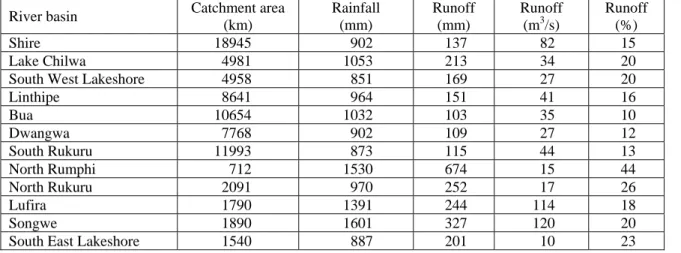
Malawi’s drainage system consists of 17 water resource areas that are further subdivided into 78 water resource units. At present, these resources are barely utilised. Important characteristics of the major river basins are shown in Table 5. The surface water resources are totally dependent on rainfall. Some rivers display seasonal flow patterns and dry up to a large extent in the dry season. Shortage of domestic water is common in rural areas during the dry season, and in urban areas during drought.
Table 5. Annual runoff from Malawian river basins, some of which can be impounded and stored in reservoirs for water supply and irrigation (NEAP, 2005).
River basin Catchment area
(km) Rainfall (mm) Runoff (mm) Runoff (m3/s)
Runoff (%)
Shire 18945 902 137 82 15
Lake Chilwa 4981 1053 213 34 20
South West Lakeshore 4958 851 169 27 20
Linthipe 8641 964 151 41 16
Bua 10654 1032 103 35 10
Dwangwa 7768 902 109 27 12
South Rukuru 11993 873 115 44 13
North Rumphi 712 1530 674 15 44
North Rukuru 2091 970 252 17 26
Lufira 1790 1391 244 114 18
Songwe 1890 1601 327 120 20
Lake Chiuta 2462 1135 247 19 22
Likoma Island 18.7 1121 280 - -
Chizumulu Island 3.3 1121 280 - -
Ruo 3494 1373 538 60 39
Nkhotakota Lakeshore 4949 1399 260 41 19
Nkhata Bay Lakeshore 5458 1438 461 80 32
Karonga Lakeshore 1928 1028 361 22 35
Malawi has abundant land where soil and topography are suitable for irrigation. However, only limited areas can be easily supplied with water directly from perennial streams. Other areas would need more investment in water conveyance. The flat areas along the lakeshore and the Shire River valley consist of marshy land, swamps and lagoons that are poorly drained and sus-ceptible to floods. Flood control structures and drainage canals would be needed to utilize these areas to their full potential. The area suited for irrigation has been estimated to be about 100,000 ha plus 61,900 ha of dambos according to FAO (1997) and 500,000 ha according to WB (2005). The amount of water flowing from the Malawian surface into Lake Malawi is 12.5 km3 per year. The outflow from Shire River into Zambezi River carries 16 km3 water per year. These are sub-stantial figures.
Irrigation has played only a small part in the agricultural development in Malawi. Currently, only 28,000 ha are irrigated of which 16,000 ha are on two large sugar estates (SUCOMA at Nchalo and DWASCO at Dwangwa). A further 3,600 ha are on 16 government-owned small-holder rice schemes distributed throughout the country. The main potential for future medium to large-scale irrigation development is found along the lakeshore using water pumped from Lake Malawi. In the longer term, there are potentials for major gravity canals. There are also poten-tials in many areas for small-scale irrigation estimated at over 100,000 ha (NEAP, 2005). Esti-mates of irrigation potentials appear to differ substantially between literature sources and should not be taken as exact figures.
Fish farming should be regarded as an integral component of agricultural water management pro-jects. It can turn pig manure (or other material rich in nitrogen and phosphorus) into valuable protein for humans via algae growth (Figure 9).
Past fish farming projects appear to have been successful and appreciated by people. Fishponds can be built by individual farm families or by groups of farmers. Presently about 5700 farmers operate about 7500 fishponds in Malawi. Each fishpond tends to be around 200 m2. Presently there is one fish farm extension officer in each district plus some in certain areas along the shore of Lake Malawi. FAO, funded by IFAD, has published a guide entitled “Integration of Aquac-ulture into Irrigated Small-Farming Systems for Southern Africa.”
Small-scale or large-scale water structures
There is a popular belief in development communities that only small-scale water schemes are appropriate in Africa. The concept of ‘water harvesting’ is often embraced with enthusiasm. Al-though small structures are useful and often the only option available, one needs to realize that they have clear limitations:
1. Water harvesting provides water primarily in the wet season
2. The volume of stored water is commonly too small for use in the dry season 3. Water harvesting from roofs is not possible in areas with mainly thatched huts
4. Treadle pumps are arduous to operate for weak persons, particularly for under-nourished people in the ‘hungry season’ and always for short women
5. Suitable land surfaces for water harvesting may not be present where they are needed 6. Small reservoirs are filled very quickly with sediments and rendered useless
7. Water harvesting and irrigation schemes directly linked to the flow of rivers are often damaged by floods (see Box 2)
Box 2
Malawi's Irrigation Project Fails to Deliver
By Raphael Mweninguwe (Planet’s Voice 30 Sep. 2002) (excepts)
The planners of the USD 15 million Bwanje Irrigation Scheme in Dedza district project will have to go back to the drawing board and come up with another plan for the scheme if what the demands for farmers is something to go by. The 800-hectare scheme has failed to meet the expectation of smallholder farmers.
"The water is not enough to irrigate our crops. Most of the gardens have not been levelled and water does not reach these plots," complained Samalani Chipezeani, one of the smallholder farmers in the scheme.
The construction of the project, which began in 1997, was aimed at enabling smallholder farmers to produce rice and other crops for food security and economic development at household level among others.
Despite having this irrigation scheme the people surrounding Bwanje were among the thousands of people country-wide facing serious food shortage.
The rivers Nankhokwe and Mwandipewera that run near the scheme burst the riverbanks during the rainy season and flooded the scheme causing massive damage to the crops.
Alikangelo Koloti from Maluza Village in the district said something should be done to control the situation. He said when Nankhokwe river is full, it floods the scheme leaving "all of us hungry as it has done this year." The smallholder farmers expected the construction of a dam at the scheme, a thing that farmers feel would supply them with water constantly.
But what the constructors did was to divert water from the Nankhokwe River to the canal leading to the scheme. When the amount of water in the river is reduced as a result of extreme hot weather, the flow of water in the canal is also reduced and this makes it impossible for most of the gardens in the scheme to be irrigated.
Only large water structures can provide the volume of water needed to reduce the effects of se-vere drought and provide water for dry season cropping. Large structures are also needed to buffer floods. There is definitely a need for small-scale water structures, but their limitation should be acknowledged. At the same time, large structures for water impoundment and convey-ance are needed to provide water in the dry season over areas large enough to have an impact on the national food security. Furthermore, large structures are needed to alleviate flood damage. The commonly held view among international development agents that large-scale water infra-structures cannot be managed in Africa, needs to be challenged. Sooner or later, existing man-agement problems must be solved. Provision of water should be seen as a service similar to pro-vision of health services, roads, fertilizer, seeds, extension services, electricity and the like. For the sake of comparison, NASFAM spends USD 40 of donor funds per member annually to fa-cilitate its extension and market service.
Water management problems need to be solved to contribute to the reduction of poverty and make the country less vulnerable to the erratic rainfall. Lessons for Malawi can be learned from e.g., Vietnam’s extensive water management plans and operations.
Limits to growth on small farms
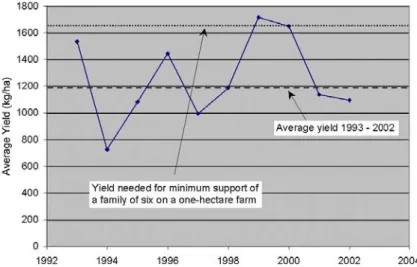
With an average farm size among poor families of one hectare, the potential of growth is limited. A family of six (two parents and four children, 1 to 14 years) needs a minimum of 4.6 giga calo-ries annually to satisfy their energy requirement (FAO, 2001). This can be obtained by a maize yield of 1350 kg, which is 150 kg above the present average yield in Malawi. To pay for neces-sities of life and fertiliser, the family may have to sell maybe 200 kg of maize (prices fluctuate). Diversifying the crop production to facilitate a better nutrition (inclusion of groundnut or bean) would reduce the total calorie production on the farm. To maintain the minimum calorie duction, one may assume a maize yield increase of at least 100 kg/ha. To obtain minimum pro-duction of calories, minimum nutrition, and income, we can conservatively estimate that an aver-age maize yield increase of 450 kg/ha is needed. This translates to an averaver-age yield of 1650 kg/ha. During the last 10 years, this was obtained only twice (concurrently with the distribution of starter packs; Figure 10).
Figure 10. Historic maize yields and estimated minimum maize yield needed to support a family of six on a one-hectare land (historic maize data from MAIFS, undated)
Recent drought events have led many families to grow more cassava to maintain food security since maize is rather sensitive to drought spells. Replacing maize with cassava represents, how-ever, a major setback in terms of protein nutrition.
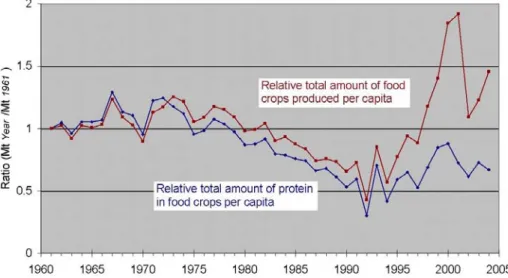
The total amount of food crops per capita produced in Malawi (measured as sum of fresh weight banana, cassava, green maize, groundnut, maize, millet, pigeon pea, plantain, potato, pulses, rice and sorghum) decreased steadily from 1975 to 1992. Since 1992, there has been a steep but er-ratic increase. However, the increase in crop protein production per capita has been significantly lower during the last 12 years since most of the food crop increase consists of higher cassava production. The per capita crop protein production is presently only about 50 % of what is was in the 1970s (Figure 11).
Figure 11. Relative total amount of food crops per capita and relative total amount of protein per capita (1961 = 1; based on FAO statistics and average protein content).
Presently (2005), the government is considering boosting maize production by subsidizing fertil-isers. The soils in Malawi are, in fact, dramatically low in nitrogen, phosphorus and in some ar-eas potassium. The World Bank (2003) estimates that harvested crops annually remove a net 75,000 ton of soil nutrients, causing environmental degradation, and compromising family liveli-hoods and food security. Fertiliser application is absolutely necessary, but not sufficient for sus-tained yields. Fertilisers will remain a high cost item for Malawian farmers for the foreseeable future, so profitability of fertiliser use depends heavily on making best use of the limited amounts of fertiliser that the typical smallholder is able to purchase. The advice that Malawian farmers have been given on fertiliser use actively discourages the effective use of this important input through a disregard for the economics of maize production at the smallholder level.
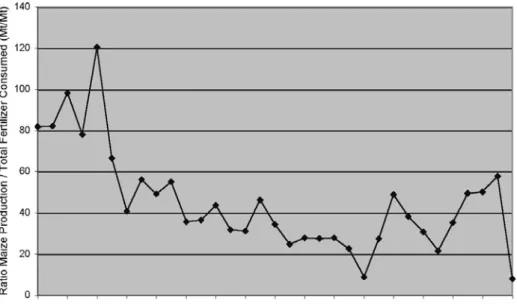
The outcome is unsurprising. Data on maize production and total fertiliser consumed in Malawi indicate that the fertiliser efficiency has gone down since 1970 (Figure 12). Although several variables are hidden in these data (e.g., rainfall, arrival time of fertiliser, changes in use of fertil-iser between crops) subsidy on fertilfertil-isers is clearly not a long-term solution alone. The reduc-tions in fertiliser efficiency is a result of soil erosion, loss of soil organic matter, compromised crop management (poor weeding, for example), late or inappropriate fertiliser application, acidi-fication, depletion of nutrients other than NPK, and formation of subsoil hoe pans. All these fac-tors must be addressed to maintain crop yields.
Figure 12. Ratio of maize production (Mt) and total fertiliser consumption (Mt) in Malawi 1970-2002 (based on data from FAO statistical data base).
The situation is obviously difficult for the individual farmers to handle. Reaching the higher po-tential yield levels cannot be achieved by peasants alone. It requires that a research system de-velops appropriate agronomic recommendations and appropriate high-yielding seeds and that a system exists for producing and marketing seeds. A system must also exist for timely marketing of appropriate fertiliser and other agro-chemicals, and knowledge of best practices must be made available to the peasants. There must be a well functioning market for the marketable output from farmers. A good rural infrastructure must ensure low cost access to the markets for input and output. Some of these preconditions can only be met through government funding and pro-vision. Others are best satisfied by allowing markets to develop – markets where government only plays a regulatory role.
Box 3
Groundnut Production and Marketing
Plan Malawi and the International Crops Research Institute for Semi-arid Tropics (ICRISAT) initiated collaborative work in 1999 to promote production of the improved groundnut variety CG7 in all Plan communities. ICRISAT pro-vided technical and other assistance in CG7 groundnut production in Plan communities. Specifically, the collabora-tion was set with the following objectives:
• To increase awareness of the value of growing improved high-yielding varieties by following good agricultural practices thus, enhancing the production of groundnuts among smallholder farmers through farmer managed participatory on-farm demonstrations and field days.
• To train smallholder farmers’ groups in improved groundnut production and management technologies and in the use of simple hand-operated, labour-saving tools through farmer field days and demonstrations.
• To strengthen the capacity of field technicians and volunteers working in communities in transferring groundnut production technologies through short-term training courses.
• To improve families’ access to and availability of improved groundnut seed varieties through establishment of community managed revolving seed banks.
Within four years of the initiation of this work, the Plan communities realised appreciable increase in production, and therefore required an outlet for the surplus. The next phase, therefore, introduced an innovative strategy to community development by linking production to marketing through participatory methods that took full cognisance
of roles and responsibilities within families and communities. The production, training, processing and utilisation components of the previous phase were retained in order to provide the necessary skills for new communities. ICRISAT undertook to assist Plan communities in the identification of markets for groundnut and pigeon pea pro-duced by families in the Kasungu, Lilongwe and Mzuzu programme units. A survey was carried out to determine the extent of the logistical challenges that would be encountered in the supply chain coordination, and to establish likely quantities and quality of groundnuts available. A structure for marketing was developed to link the Plan communi-ties to the National Smallholder Farmers Organization (NASFAM) - a key player in groundnut production and mar-keting in Malawi. NASFAM’s policy does not allow it to buy from non-members, but an existing collaboration be-tween NASFAM and ICRISAT was used to overcome this problem. ICRISAT undertook to carry out the quality as-surance for NASFAM. The price to be paid for the produce was negotiated directly between NASFAM and Plan Ma-lawi, with ICRISAT providing unbiased marketing information to both parties.
Marketing centres were established at already existing Plan unit grain banks. Farmers bring the produce to these centres, ICRISAT technical staffs evaluate the quality, and then the farmers are paid on the spot by NASFAM. Dur-ing the 2004 marketDur-ing season (June – September), in some communities as much as MK1 million of produce was purchased by NASFAM within a period of ten days. The collaboration demonstrated a practical way of linking im-proved seed, good agricultural practices, supply chain coordination and a system of grades and standards, to bene-fit smallholder farmers in Malawi.
In Malawi the public sector has clearly fallen short of creating the preconditions for peasants and farmers to develop. Cammack (2004) places the blame for Malawi’s sorry performance squarely with poor governance in the country:
“Malawi is underdeveloped and continuing on its downward economic and political spiral as a result of the structure and substance of its governing structure. This is not to deny that other factors are also fundamental: it is landlocked, it lacks natural resources, and it has high population densities on the land, degradation of the environment, high rates of inequality, HIV/AIDS, etc. Some ill-designed policies, poor advice and insufficient follow-through by donors might be added to this list.
But given the amount of money and technical assistance that has gone into Malawi in the last two decades, if the Banda and Muluzi governments and civil service had devised and honestly implemented the right policies and utilized the advice given, the country would have prospered. As it is, lack of capacity, weak institutions, leaders’ self-interest, a weak civil society, and repeated donor bail-outs have permitted even the best policies and programmes to be ignored, subverted or delayed to the point of their being ineffective.” (Cammack, 2004: 33-34).
Considering the past poor performance of the government, the planned downsizing of govern-ment services and the weak market position of individual peasants, the immediate future looks rather bleak. New ways of farmer organisations should be considered.
New agricultural production units
The system of individual subsistence farmers guided by government employed extension staff has proven expensive and weak in terms of livelihood security and growth potential. To some extent, its weakness has been compensated for by unsustainable foreign-funded NGO services. The partial withdrawal of government services and increased reliance on market forces will no doubt leave farmers in an even more precarious situation open for exploitation. In this setting, NGOs see opportunities for playing a bigger role. Are there alternative approaches?
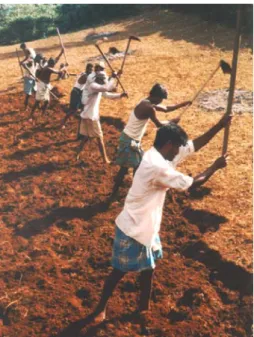
New concepts of economic farming units where farmers can obtain greater strength through joint enterprises, have been proposed (Kwapata, 2005). Although organisational details need to be worked out and tested, one can envisage production units managed by community members trained in agriculture and enterprise management. Larger and cohesive production units could obtain the necessary market power to increase its profit margin. They would also be in a better organisational position to solve some of the water management challenges alluded to above. And
above all, they could possess knowledge and be linked to sources of information such that they would have a substantial internal problem-solving capacity. The purpose of production units would not primarily be to obtain benefits of scale, but to obtain economic growth through social organisation and change of mindset (Figure 13).
Figure 13. Joint effort can be a strong motivator in development by creating common goals (from Sri Lanka; photo K. Esser)
3.2. POLICIES FOR THE PRIVATE AND PUBLIC SECTORS TO REALISE THE PO-TENTIAL
A precondition for sustainable income increase is an increase in labour productivity. Poverty re-duction requires that those below the poverty line share in the income increase, e.g. by increasing their own productivity. Growth in Malawi agriculture holds a potential for creating broad-based poverty-reducing growth for a number of reasons:
• Because of its initial size and importance. Agriculture contributes 40 % of Malawi’s GDP. A growth of 6 % in agricultural income alone thus translates into a 2.3 % growth in GDP. Smaller sectors would need a much larger annual growth in order to have the same effect on total GDP
• There is a large potential for productivity gains in agriculture, as pointed out above. A doubling of yield per hectare does not require a doubling of labour inputs or total input use per hectare. Growth in production originating only from increase in area planted, however, will not increase productivity and returns to labour.
• Agricultural goods are important wage goods. Increased productivity is necessary for bringing down the cost of food for the poor and vulnerable and thereby securing their ac-cess. But low food prices are also important for maintaining the purchasing power of wages, and thereby maintaining the competitiveness of export and import competing in-dustries. These low prices have to come about through increased productivity, and lower
production cost per unit. Malawi is constrained by limited foreign exchange earnings in importing foodstuffs, and thereby dependent on high productivity in its own agriculture for maintaining low food prices. Keeping food prices low by subsidising imports is not a sustainable policy for a foreign exchange-constrained economy – as Malawi has painfully experienced. The only way maize prices can sustainably be kept at levels affordable to the poor is through increased efficiency and productivity in maize production in Malawi.
• There are large multipliers from increased agricultural incomes. When smallholder farm-ers increase their income a large share of the income increase tends to be directed toward increased demand for locally produced goods and services, such as food, building materi-als for improved houses, furniture, education, trade, etc. They thus create demand for la-bour in various rural sectors, and thereby increased employment possibilities for the rural poor (including those that have too small land holdings to become net sellers from their own land). This income growth in turn creates new rounds of demand, employment growth, and income growth. Growth in smallholder agriculture thus contributes to broad based income increase in rural societies. There is also a direct effect of increased demand for agricultural labour when some producers expand their production by hiring labour. Furthermore, the extended family system found in Malawi will redistribute some of the income increase to destitute family members. Paradoxically, because of the demand mul-tipliers, the faster agriculture grows the faster will also other sectors grow, such that agri-culture becomes a smaller share of the economy (Timmer, 1987).
Agriculture is part of private sector, made up of millions of production units. But farmers cannot develop beyond subsistence agriculture in isolation. Increasing the productivity of farming by adopting science-based agriculture requires a set of conducive conditions and a large number of firms working and developing together: farms, input suppliers, produce traders, processors, transporters, researchers, regulators, etc. Historic experience from many countries indicate a ba-sic set of conducive conditions:
• “Fiscal and monetary policies to establish and maintain low inflation and low interest rates;
• A broad tax base, simple tax structures and effective tax administration, to raise revenues for the government in a way that does not distort competition; and
• Secure property rights, effective rule of law, and peace and security“ (DFID, 2005)
Developing agriculture, however, also requires that a set of public goods is provided, as each smallholder is typically too small to provide for these by him/herself. Such public goods include:
• Research for developing more productive technologies suitable for the various agro-eco-logical and socio-economic conditions
• Dissemination of the best technologies
• Provision of rural infrastructure, particularly roads and railways for reducing the cost of accessing input and output markets
• Defining and maintaining grades and standards, including environmental standards
• Organizing joint (group) activities, e.g. larger irrigation initiatives
3.3. PRESENT CONSTRAINTS
Macroeconomic management is very difficult in an economy so dependent on agriculture vulner-able to uncertain rainfall and on varivulner-able donor support, as is the Malawian economy. The pre-sent macroeconomic environment in Malawi is not conducive to agricultural growth. The pri-mary macroeconomic constraint has been a very high interest rate and high rate of inflation (Fig-ure 14). Huge fiscal deficits have been financed with domestic borrowing, resulting in real inter-est rates of up to 25 % on Treasury Bills (45 % in nominal terms).
Figure 14. Inflation and interest rates on 91-day Treasury Bills from 1995-2003 (Anon, 2005).
Thus Government consumption and investment has absorbed more or less all available credit in the country, crowding out private investment. It is not easy to find many investment projects that yield more than a 25 % secure return, thus being able to compete with lending to the government. The effects of this are evident from the data on bank lending to the private sector, which has dropped to extremely low levels (Figure 15).
The current government has given top priority to reducing the deficit and thereby reducing the interest rate and making capital available also for the private sector. The interest rate has been brought down to about 10 % (T-Bills, real terms). This is a very positive result, but the govern-ment’s efforts are being continued, and should be continued, to bring the deficit and interest rate even lower. Inflation has also been brought down to about 14 %. Reducing inflationary pres-sures even further are important for reducing expectations of Kwacha devaluation. Devaluation expectations constitute a major uncertainty for investors. Nevertheless, the reduction in interest rates and inflation are a major achievement, and should in themselves give a boost to investment and growth also in the agriculture sector, especially in marketing and processing. But it should also lead to better access to finance for farmers and ease the development of sustainable micro finance initiatives.
On another front past government policies have also been less than helpful in developing the sec-tor. In most seasons the government has been active in buying fertiliser and seed for distribution, and in deficit years it has imported maize for supplying consumers. Decisions about how much to procure and at which prices it would be sold, have been taken very late and have therefore added to the uncertainties facing commercial traders in these sectors. This is likely to have re-duced private investment and competition in trading and storing of inputs and produce, and thus made both inputs and output markets less efficient. It is important, if government shall still be a trader in these markets, that it must announce its intentions, terms and conditions at a much ear-lier date and behave with a much higher degree of predictability. (The best is probably that the government entirely stops being an importer and trader in inputs and output. It is hard to see how it can perform these tasks more efficiently than a competitive trading sector.) Improvement in the manner in which the government behaves in the sector is likely to spur increased investment and competition in trading and storing of inputs and output, and thus offer lower trading margins in the sector and higher efficiency.
Poorly developed financial sector
The high government borrowing has severely reduced the financial sector’s incentives and abili-ties to lend to the private sector, and thereby hampered the development of a financial sector geared toward providing credit to private sector firms and individuals.
Weak infrastructure
A precondition for agriculture to increase its productivity is that it is profitable for farmers to use the purchased inputs required for high output farming. Profitability depends on the farm gate price of inputs and output. Poorly developed transport infrastructure will reduce profitability by increasing input prices and reducing output prices – in some areas to the point where high output systems simply are not profitable. High transport and transaction costs on imports and exports have been a major drag on growth in Malawi. Low harbour capacity in ports in Mozambique, and poorly functioning rail systems and roads are major constraints. Improving infrastructure, both for transit through neighbouring countries, but also within Malawi will be important for in-creasing the profitability of high productivity agriculture. There also seems to be much scope for reducing transaction cost in improving cooperation with transit countries. Within Malawi trans-action cost may also be reduced by reducing the license requirements for traders and by opening up for more competition in transport and trading.
Poorly developed regional trade in staples
Malawi is a member of several regional initiatives aimed at increasing intraregional trade. How-ever, many of the countries in the region consider staple crops to be of such strategic importance that they place various restrictions on trade in these. Nevertheless, there is a large unofficial
trade, but legalising and easing these flows would contribute to increased efficiency and also more stable prices within the region. It would be particularly helpful to the more outlying areas of the country if trade did not need to pass through the centre.
Protection of property rights and security
Theft of assets such as livestock and produce are reported to be a major concern to producers. Sometimes and in some places this is such a big problem that production becomes totally impos-sible.
Weak policy and regulatory capacity of the government
Following the move to a more liberalised economy, the Ministry of Agriculture has struggled to redefine its role, responsibilities and mode of operations. Severe financial constraints in the pub-lic sector have contributed to poor working conditions and motivation. Capacity has been lost to NGOs and others who have been able to offer better employment conditions. High mortality of officers has also contributed negatively. Due to recurring food crises, policy has operated more in a crisis management mode than in a development mode. Ministry expertise has frequently been overruled by the high politicians’ need to show action on crisis management. And much capacity has been directed to managing crisis programmes, such as the Targeted Input Program (TIP). The result has been that the government has lagged behind in providing needed public goods and developing suitable regulations and standards for the sector.
Poor capacity of research and extension systems
Financial constraints have caused severe reduction in the resources, manpower and capacity available to the national agricultural research and extension systems.
Insurance
Farming in Malawi is a very risky business, and peasants and farmers must give high priority to choosing crops and production methods that minimise risk. Formal insurance mechanisms are poorly developed. The main livelihood insurance for smallholder livelihood is probably the ex-tended family. The public sector, government and donors, as well as NGOs contribute with food aid, food for work schemes and various other schemes, but these schemes are unable to ensure food security for the population.