DECISION SUPPORT SYSTEM FOR SELECTION OF CHAIRMAN OF OSIS
USING ELECTRE METHOD IN SMK PGRI 35
WEST JAKARTA
Mia Rosmiati1; Nur Atika Sari2Information System1
Universitan Bina Sarana Informatika, Jakarta, Indonesia1
http://www.bsi.ac.id1
Information System 2
STMIK Nusa Mandiri, Jakarta, Indonesia2
http://www.nusamandiri.ac.id2
Abstract— In an organization choosing a leader who is highly dedicated, responsible and responsive to every problem is not easy. A leader is not only required to have intelligence and skill but also must have a soul of leadership, a great sense of responsibility and can be a role model. The purpose of this study was to determine the student council president using the ELECTRE method based on 4 (four) criteria, namely managerial ability, knowledge and skills, collaborative communication responsibilities and discipline. With the application of the ELECTRE method, it is expected to be able to achieve these objectives. With the implementation of the ELECTRE method in the process of electing the student council president at SMK PGRI 35 Jakarta, it can determine the student council chair with accurate results in accordance with the criteria given by the school. The results of calculations with the Electre method will obtain the highest rating, namely: A3 (Miranti Sofia) because if it indicates that the alternative is the chosen alternative.
Keywords: Electre, Decision, Election.
Abstrak—Dalam sebuah organisasi memilih seorang pemimpin yang berdedikasi tinggi, bertanggung jawab dan cepat tanggap terhadap setiap permasalahan tidaklah mudah. Seorang pemimpin tidak hanya dituntut memiliki kecerdasan dan kecakapan, tetapi juga harus memiliki jiwa kepemimpinan, rasa tanggung jawab yang besar dan dapat menjadi panutan. Tujuan dari penelitian ini adalah untuk menentukan ketua OSIS menggunakan metode ELECTRE berdasarkan 4 (empat) kriteria, yaitu kemampuan manajerial, pengetahuan dan skill, tanggung jawab komunikasi bekerjasama dan kedisiplinan. Dengan diterapkannya metode electre diharapkan mampu
mencapai tujuan tersebut. Dengan diterapkannya metode electre dalam proses pemilihan ketua OSIS di SMK PGRI 35 Jakarta dapat menentukan ketua OSIS dengan hasil yang akurat sesuai dengan kriteria-krieria yang diberikan oleh pihak sekolah. Hasil dari perhitungan dengan metode Electre maka diperoleh peringkat yang paling tinggi yaitu: A3 (Miranti Sofia) karena jika mengindikasikan bahwa alternatif merupakan alternatif yang terpilih. Kata Kunci: Electre, Keputusan, Pemilihan.
INTRODUCTION
At this time education has an important
role in determining the progress of a nation and society, because with education can develop one's potential. Education can also be considered as a long-term investment that can be utilized in life so education must always be improved and maintained its quality. In an education there are various kinds of organizations, one of which is OSIS. OSIS is an activity that must be done every year, the election of OSIS chairperson is done by giving an assessment of students (Astuti & Safrudin, 2016). OSIS is one organization that can carry out democratic values in schools, because OSIS is an organization that is in the school environment (Aulawi & Srinawati, 2019).
To produce leaders that are in line with expectations, a democratic and legitimate leader election mechanism is used so that it can be accepted by all members (Fitriyani & Ipnuwati, 2017). The selection is a stage to decide whether a candidate for the student council chair is suitable or not to serve as the student council chair at SMK PGRI 35 Jakarta. Decisions taken are expected to be more accurate so that the quality obtained is as expected and does not harm the school. For
effectiveness in carrying out the duties of the student council president, then in making the right decision is needed. Teachers at SMK PGRI 35 Jakarta participated in the selection of the Student Council Chairperson based on several assessment factors and criteria. However, currently the selection process for OSIS Chairperson at SMK PGRI 35 is still done manually. The assessment process that is still carried out manually and implemented in written form can lead to the process of selecting the OSIS chairperson requiring quite a long time in conducting data processing (Astuti & Safrudin, 2016). One of the efforts to help the selection of student council presidential candidates in SMK PGRI 35 Jakarta is by implementing a decision support system.
According to (Sunoto, Ismawan, & Nulhakim, 2017), Decision support system as a computer-based system consisting of three interacting components, a language system (a mechanism to provide communication between users and other decision support system components), a knowledge system (knowledge problem domains that reside in a decision support system or as data or as a procedure), and a problem-processing system (the relationship between two other constituents, consisting of one or more general problem manipulation capabilities needed for decision making).
One method that can be used in a decision support system is Elimination Et Choix Traduisant
La Realite (ELECTRE) method. ELECTRE including
the multic Criteria decision-making analysis method originating from Europe in the 1960s.
ELECTRE is an acronym of Elimination Et Choix
Traduisant La Realite or in English means
Elemination and Choice Expressing expressing Reallity (Yulyantari & Wijaya, 2019). ELECTRE
Method is can be used in conditions where
alternatives which do not fit the criteria are eliminated and suitable alternatives can be produced (Sundari, Wanto, Saifullah, & Gunawan, 2017). ELECTRE usually used for many alternatives but has few criteria (Damanik, Parlina, Tambunan, & Irawan, 2017).
The purpose of this study was to determine the student council president using the ELECTRE method based on 4 (four) criteria, namely managerial ability, knowledge and skills, collaborative communication responsibilities and discipline.
MATERIALS AND METHODS A. Research Stages
The stages carried out in this study are : 1. Pre-Field Stage
At this stage, the first week the authors conducted a survey by visiting SMK PGRI 35 JAKARTA which addressed at St. Jati Raya 1 No.52 Cengkareng, West Jakarta to request research permission from the head of the school and the OSIS coach.
2. Field Work Stage
The stage of field work the authors carry out research with a predetermined schedule. The author meets the Student Council coach to ask for data or conduct interviews, the author gives several questions relating to students and what are the criteria that determine the student council president election.
3. Data Analysis Stage
The data analysis phase is carried out in the third week. Here the author gets student data from the previous stage and also requests the data needed through the results of interviews with the Student Council coach and teacher. 4. Literature Study Stage
At this stage the authors do what is called literature review, namely studying reference books and research results that have been done by others.
5. Evaluation and Reporting
In this fifth stage the researcher checks all the data that has been obtained and has been processed.
B. Method of Collecting Data
Data collection methods in this study were divided into three, as follows :
1. Observation
In this stage, observations were made directly by visiting SMK PGRI 35 Jakarta by examining the environmental conditions of the research objects that support research activities.
2. Interview
In this stage interviews were conducted with the supervisors of OSIS supervisors and staff of SMK PGRI 35 Jakarta to obtain data.
3. Literature Study
In this stage, it is done by studying reference books or sources related to this research.
C. Population and Research Sample
Population is a generalization area that consists of objects / subjects that have certain characteristics determined by researchers to be studied and then conclusions drawn. While the sample is part of a number of characteristics possessed by the population used for research. If a large population, researchers may not take all for mass research because of limited funds, manpower, and time so researchers can use samples taken from that population (Sugiyono, 2017).
The population in this study were students of class XI SMK PGRI 35 Jakarta in the academic year 2018-2019. While the sample in this study were taken as many as 5 students from the entire population. The sample in this study was obtained from the recommendations of the student council coaches and teachers based on the activeness of the school in participating in activities and extracurricular activities and having more abilities in various fields.
D. Data Analysis Method
In the election of Student Council Chairperson using Elimination Et Choix Traduisant
La Realite (ELECTRE) Method required criteria and
weights to do the calculations so that the best alternative is obtained, in this case the intended alternative is a part of class XI students of SMK PGRI 35 Jakarta. The following is a table of criteria for selecting the student council candidate:
Table 1 Criteria and weights
No Criteria Weights
1 Field of study skills 5 2 Behavior 4 3 Creativity 4 4 Communication 3 Source : (Rosmiati & Sari, 2020)
RESULT AND DISCUSSION
Provided alternative data in the form of candidate student chair student data which has been recommended by the teacher and student council coach. The criteria that are used as a reference in making decisions in this study are in the form of criteria data contained in the determination of the value of the student council president candidate, namely the ability of the field of study, behavior, creativity, and communication.
The degree of importance plays a role in providing the level of importance between the four criteria of the ability of the field of study, behavior, creativity, and communication. Alternative data provided can be seen as in table 2.
Table 2. Alternative Data
N
o Alternative
Criterias Field of
study skills Behavior Creativity Communication
1 Abdul Aziz 5 3 3 3
2 Mutiara 3 3 3 4
3 Miranti Sofia 5 3 3 1 4 Rio saputra 3 4 5 1
5 Fiqriawan 4 3 5 3
Source : (Rosmiati & Sari, 2020)
The next step is to normalize the four criteria. Normalized decision matrix, each attribute is converted to a comparable value :
(rij = = 𝑿𝒊𝒋
√∑ᴹ𝒊=𝟏 𝑿𝒊𝒋² Untuk i = 1,2,3, … m dan j =
1,2,3, … n)
So we get the normalized R matrix as follows: 0,5455 0,4160 0,3418 0,5 0,3273 0,4160 0,3418 0,6666 R = 0,5455 0,4160 0,3148 0,1666 0,3273 0,5547 0,5698 0,1666 0,4364 0,4160 0,5698 0,5
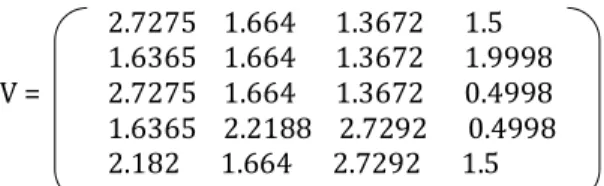
Weighting in the normalized matrix. Matrix V is the product of R multiplication with W (weight), where W = {5,4,4,3}. To find the matrix V calculated as follows:
Formula : ( V = W . R )
So that the obtained matrix V is as follows: 2.7275 1.664 1.3672 1.5
1.6365 1.664 1.3672 1.9998 V = 2.7275 1.664 1.3672 0.4998 1.6365 2.2188 2.7292 0.4998 2.182 1.664 2.7292 1.5
Determine the set of concordance and discordance index.
1. Calculate concordance
Formula: Ckl = {J,Vkl,≥Vij}, for j ,..., 3,2,1…..n So the concordance set is generated in the following table:
Table 3. The set Corcodance
C The set
C12 {1,2,3} C13 {1,2,3,4}
C14 {1,4}
C15 {1,2,4} C21 {2,3,4} C23 {2,3,4}
C24 {4}
C25 {2,4}
C31 {1,2,3} C32 {1,2,3}
C34 {1,4}
C35 {1,2}
C41 {2,3}
C42 {1,2,3} C43 {2,3,4}
C45 {2,3}
C The set
C52 {1,2,3} C53 {2,3,4} C54 {1,3,4} Source : (Rosmiati & Sari, 2020) 2. Calculate discordance
Formula : Dkl = {J,Kkj,≥Vij}, for j ,..., 3,2,1 ….n So that the results of Discordance can be as follows:
Table 4. The set Discordance
D The set
D12 {4}
D13 {}
D14 {2,3}
D15 {3}
D21 {1}
D23 {1}
D24 {1,2,3} D25 {1,3}
D31 {4}
D32 {4}
D34 {2,3} D35 {3,4} D41 {1,4}
D42 {4}
D43 {1}
D45 {1,4}
D51 {1}
D52 {4}
D53 {1}
D54 {2}
Source : (Rosmiati & Sari, 2020)
Calculate concordance and discordance matrices. Calculating concordance.
1. Calculate the matrix concordance
Formula : Ckl = ∑jc w Wj So that the matrix is obtained :
- 13 16 8 12 11 - 11 3 7 C = 13 13 - 8 9
8 13 11 - 8 11 13 11 12 - 2. Calculate the matrix discordance
To calculate the value of an element in the discordance matrix is to divide the maximum difference in the value of the criteria included in the discordance subset by the maximum difference in the value of all criteria.
Formula : dkl = {𝑀𝑎𝑥(𝑉𝑚𝑛−𝑉𝑚𝑛−𝑖𝑛)},𝑚,𝑛,€𝑑𝑘𝑙{𝑀𝑎𝑥(𝑉𝑚𝑛−𝑉𝑖𝑛},𝑚,𝑛=1,2,3,…… }
Resulting in the discordance matrix as follows: - 0,4 0 0,8 1 1 - 0,7 0,6 1.8 D= 1 1 - 0,8 1
1 1 1 - 1 0.5 0.5 0.5 0,5 -
Determine the threshold of the concordance and discordance dominant matrix. Threshold is obtained by adding all matrix elements divided by matrix size.
1. Calculate the dominant matrix of concordance. Formula: C ∑𝑛𝑘=1 ∑𝑛𝑙=1 𝑑𝑘𝑙
𝑀∗(𝑚−1)
C=
13+16+8+12+11+11+8+7+13+13+8+9+8+13+11+8+11+13+11+12 5(5−1)
=216 20
= 10.8 (11)
Thus, the concordance dominant matrix is : - 1 1 0 1 1 - 1 0 0 C = 1 1 - 0 0 0 1 1 - 0 1 1 1 1 - 2. Calculate the dominant matrix of discordance.
Formula : D ∑𝑛𝑘=1 ∑𝑛𝑙=1 𝐶𝑘𝑙 𝑀∗(𝑚−1)
D =
0,4+0+0,8+1+1+0.7+0.6+2+1+1+0,8+1+1+1+1+1+0,5+0.5+0.5+0,5 5(5−1)
=16.1
20 = 0.8
Thus, the discordance dominant matrix is: - 0 0 1 1 1 - 0 0 1 D = 1 1 - 1 1 1 1 1 - 1 0 0 0 0 -
Determine the aggregate dominance matrix Matrices provide a sequence of alternative choices so that in matrices that have number 1 are eliminated. Thus, the best alternative is the alternative that dominates the other alternatives.
Formula : Ekl = fkl * gkl
x
Eliminate alternatives that are less favorable. Matrix E is generated from the multiplication of matrix F and matrix G, as follows:
- 0 0 0 1 1 - 0 0 0 E = 1 1 - 0 0 0 1 1 - 0 0 0 0 0 -
The results of calculations using the Electre method will obtain the highest rating, namely: A3 (Miranti Sofia) because if it indicates that the alternative is the chosen alternative.
CONCLUSION
After conducting research and data processing, the conclusions obtained in a decision support for the selection of candidates for Student Council Chairperson at SMK PGRI 35 Jakarta using the ELECTRE method namely, by using the ELECTRE method can make it easier to determine prospective students to become Chair of student council based on criteria set for determine the alternative to be chosen, the results of the calculation of the ELECTRE method can be used for the selection of candidates for the Student Council Chair who will serve as the Student Council Chairperson, from the research results it can be concluded that A3 and A4 are selected to be the Student Council candidate. From the results of this study, it is expected that in the future, in addition to being able to use the ELECTRE method, research can also be done using other methods such as Fuzzy SAW, Simple Additive Weighting (SAW) as a comparison to get better results, and if this decision support system is already running well, going forward Further research is suggested to create a web-based student election management application using the Electre method and add more criteria to simplify the selection process.
REFERENCES
Astuti, Y., & Safrudin, A. (2016). Metode FUZZY AHP untuk Pemilihan Ketua OSIS pada SMA N 1 Jogonalan Klaten. Creative Information
Technology Journal, 4(1), 56.
https://doi.org/10.24076/citec.2016v4i1.95 Aulawi, A., & Srinawati, S. (2019). IMPLEMENTASI
NILAI-NILAI DEMOKRASI DALAM PENGAMBILAN KEPUTUSAN ORGANISASI UNTUK MENINGKATKAN ORGANISASI SISWA INTRA SEKOLAH (OSIS) DI SMK DARUS SYIFA KOTA CILEGON. PRO PATRIA,
2(1), 38–50. Retrieved from
http://ejournal.lppm-unbaja.ac.id/index.php/propatria/article/vie w/489
Damanik, H. J., Parlina, I., Tambunan, H. S., & Irawan, E. (2017). Sistem Pendukung Keputusan Dalam Seleksi Penyiar Radio Boss Fm 102.8 Pematang Siantar Menggunakan Metode Electre. KOMIK (Konferensi Nasional
Teknologi Informasi Dan Komputer), 1(1), 38–
44. Retrieved from
https://www.ejurnal.stmik-budidarma.ac.id/index.php/komik/article/vi ew/470
Fitriyani, N., & Ipnuwati, S. (2017). SISTEM PENDUKUNG KEPUTUSAN DALAM MENENTUKAN KETUA OSIS MENGGUNAKAN SIMPLE ADDITIVE WEIGHTING (SAW) (STUDI KASUS : MTsN MODEL TALANGPADANG). Prociding Kmsi, 5(1). Rosmiati, M., & Sari, N. A. (2020). Laporan Akhir
Penelitian Mandiri: Sistem Pendukung
Keputusan Pemilihan Ketua Osis
Menggunakan Metode ELECTRE Pada SMK PGRI 35 Jakarta Barat. Jakarta.
Sugiyono. (2017). METODE PENELITIAN
KUANTITATIF, KUALITATIF, DAN R&D (Buku).
Bandung: ALFABETA.
Sundari, S., Wanto, A., Saifullah, & Gunawan, I. (2017). Sistem Pendukung Keputusan Dengan Menggunakan Metode Electre Dalam Merekomendasikan Dosen Berprestasi Bidang Ilmu Komputer (Study Kasus di AMIK & STIKOM Tunas Bangsa). Seminar Nasional Multi Disiplin Ilmu, (x), 1–6.
Sunoto, I., Ismawan, F., & Nulhakim, A. L. (2017). SISTEM PENDUKUNG KEPUTUSAN SELEKSI KETUA OSIS DENGAN METODE AHP SMK F
- 1 1 0 1 1 - 1 0 0 1 1 - 0 0 0 1 1 - 0 1 1 1 1
-G - 0 0 1 1 1 - 0 0 1 1 1 - 1 1 1 1 1 - 1 0 0 0 0
-PGRI 23 JAKARTA. Jurnal Sisfotek Global, 7(2), 56–62. Retrieved from https://stmikglobal.ac.id/journal/index.php/ sisfotek/article/view/152
Yulyantari, L. M., & Wijaya, I. P. (2019). Manajemen
Model Pada Sistem Pendukung Keputusan.